 Roseala tessellatus (Herrich-Schäffer, [1854]) (Lepidoptera: Hepialidae) damaging grapevines in Brazil
ABSTRACT
Viticulture has been expanded to different producing regions of Brazil. Grape producers in the southeastern and southern regions of Brazil have consistently reported the incidence of a caterpillar damaging the trunk and branches of vine plants. Larvae were reared in the laboratory, and the species Roseala tessellatus (Herrich-Schäffer, [1854]) (Lepidoptera: Hepialidae) was subsequently identified as responsible for the damage. This study presents information on the geographic distribution of this pest species in Brazil, the damage caused to vine plants, and images of the main development phases, suggesting management methods. Additionally, references and genetic sequences that could be used for molecular identification of the different stages of insect development are indicated.
Keywords:
Ghost moth; Viticulture; Vineyard; Stem borer; New pest
Grapevine (Vitis spp.) has significant commercial value, being cultivated in numerous regions worldwide, including Brazil. Its importance lies in the diverse utilization of grapes, primarily for natural consumption and wine production. In Brazil, cultivation of grapevines covers an area of 74,798 ha [2022] (IBGE, 2024).
As with any other crop, the vine is used as a host by a variety of organisms, including mites and insect pests (Singh and Acevedo, 2024). In Brazil, the number of identified insect species has increased over time. Prior to the 1967 compilations (Silva et al., 1968), 162 species of insect pests were identified. However, subsequent studies have identified additional native (Poletto et al., 2010; Bortoli et al., 2012; Montezano et al., 2014; Costa-Lima et al., 2016; Bortolotto et al., 2022) and exotic species (Botton and Walker, 2009; Pacheco da Silva et al., 2017) associated with the crop.
Over the past 20 years, the first author (MB) has been consulted on numerous occasions regarding a species of “stem borer” that has caused the death of vines of all ages. Young plants, ranging in age from one to five years, are typically damaged, with larvae frequently attacking branches, thereby requiring the pruning and removal of the affected branches. Given the severity of the damage, requests have been made for insects to be reared in the laboratory and identified to the species level through adult specimens.
Structures (n= 127) with larvae attack (trunk and branches) from different grapevine varieties were collected at the Embrapa Uva e Vinho (Bento Gonçalves, Rio Grande do Sul State, Brazil – 29°09’50”S; 51°31’43”W; 623m a.s.l.), on April 25, 2023. These structures were cut into portions of approximately 50 cm and kept upright in plastic buckets (40 liters) under controlled conditions (25 ± 2°C, 70 ± 10% UR and 12-hour photoperiod), until the adults emerged. To maintain humidity, the bottom of the buckets was lined with discs of qualitative filter paper (n= 10), 24 cm in diameter and 80 g in weight. In each bucket, a maximum of 15 branches/trunks were arranged with their base touching the filter paper moistened with distilled water. The opening of the bucket was covered with plastic film to prevent evaporation and insect escape. Given the availability of material (larvae) from different locations, to allow comparisons of immature larvae, in addition to bibliographical reference (Stehr, 1987), two weeks after the start of creation, branches and trunks of tree buckets were opened for observation and to obtain entomological material for preservation in 70GL alcohol, including caterpillars (n= 12) and pupae (n= 8). From the remaining material kept in laboratory, 21 adults were obtained, of which, only nine had fully extended their wings. These nine “perfect” moths were killed in a freezer (-20°C) for later extension and morphological identification, and the other moths were preserved in 70GL alcohol. Most of the larvae (especially the smaller ones) ate the plant tissue towards the trunk, leaving the plant structures, dying between the filter papers, before reaching the pupal stage. This indicates that the larvae needed plant tissue “in vivo” for their feeding associated with the habit of moving to increasingly larger structures (towards the trunk) during development. All larvae reared showed characteristics of Hepialidae (Stehr, 1987) and were morphologically compatible with those received from various producers. The occurrence of natural enemies or entomopathogens was not observed.
The specific identification of adults was made by the second author (CGCM) comparing the moths obtained with primary types deposited in the Museum national d’Historie naturelle (Paris, France) and National History Museum (London, UK) and Naturhistorisches Museum (Vienna, Austria) (Mielke and Grehan, 2012).
Based on external morphology, the species was identified as Roseala tessellatus (Herrich-Schäffer, [1854]) (Lepidoptera: Hepialidae) (Figs. 1a-1l). In general, the attacks observed were located on the edges of vineyards, generally in close proximity to native forest (Atlantic Forest). In all cases, assuming a density of 2,000 to 3,000 plants per hectare, the attack at the base of the plants (grafting point) that could result in the complete loss of the plant was a maximum of 50 plants per vineyard. In these instances, when producers observed the damage, they sought guidance fearing that the attack would spread to the entire vineyard, a fact that was not recorded. The occurrence was generally localized. Similarly, in subsequent harvests, when contacted, winegrowers did not record losses again, indicating that the occurrence was seasonal. In plants infested at the base, when the aerial part dried out, it was possible to redirect the branches from the point of attack. In other situations, upon locating the borers, producers used mechanical control by cutting the plants with pruning shears. Reports from producers who employed chemical control with insecticides from the pyrethroid and organophosphate chemical groups indicated that mortality was not significantly elevated.
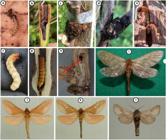
a-k. Roseala tessellatus: a - small larva, external appearance; b - small larva inside an apical branch of vine; c - excrement and sawdust that indicate the presence of the larva inside the branch in a young plant; d - damage especially found at forks where the larva needs to leave the middle of the branch to move to the larger one; e - larva developed inside the adult vine latch; f - external appearance of a developed larva; g - pupa inside branch; h - branch attacked by larva that was preyed upon by woodpeckers (hole through which the larva was preyed indicated by red arrow); i - female emerged from grapevine branch (wingspan 4.68cm); j and k - male (wingspan 4.74 and 4.78cm), collected in nature, l - Givira philomela male (wingspan 3.35cm).
The occurrence data recorded in this study, which includes materials sent by producers, bibliographic records (Viette, 1950, 1951) and consultations with collections, indicate the presence of R. tessellatus in the southeastern (Espírito Santo, Minas Gerais, Rio de Janeiro, and São Paulo) and southern (Paraná, Santa Catarina, and Rio Grande do Sul) regions of Brazil (Fig. 2 - black and gray circles).
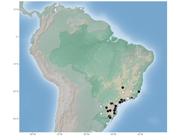
Collecting localities of Roseala tessellatus (black circles) and Givira philomela (white circles), gray colored areas indicate overlapping locations of occurrence.
It is important to note that most Hepialidae species exhibit an annual cycle (Grehan, 1989). In the case of R. tessellatus, the adults emerge in late summer to mid-autumn (March - April). The moths engage in a mating flight, after which the females release tiny eggs when in flight, dispersing them among the vegetation below (Tobi et al., 1993). Upon hatching, the polyphagous larvae commence their search for food in the litter (Fig. 1a). Subsequently, they penetrate more tender branches (Fig. 1b), migrating toward larger branches during development (Figs. 1c-1e). At the conclusion of the developmental cycle, the larvae, which have accumulated a substantial amount of fat (Fig. 1f), construct a chamber where they undergo metamorphosis into pupae and remain within the wood (Fig. 1g). They remain in this state until the adults emerge. Similarly to other species of boring insects that inhabit wood, the immature stages of R. tessellatus can only be accessed by organisms that introduce eggs into their bodies, such as parasitoids (e.g., Cameron, 1950; Scaccini et al., 2021) or predators that can open the wood and remove the larvae or pupae, such as woodpeckers (Fig. 1f) (Murphy et al., 2018). With regard to the feeding habits of caterpillars, observations conducted in both laboratory and field settings revealed that the larvae of R. tessellatus fed on wood from vines collected in the field. Additionally, they demonstrated the ability to migrate and feed on dry wood from cages and even on the bamboo utilized as a support for the vines in the field.
The Hepialidae family (Lepidoptera) is represented by 701 species worldwide, which are included in 83 genera (Grehan et al., 2023). In Latin America, at least 125 species belonging to 30 genera are known (Mielke and Grehan, 2012). In Brazil, a record of 43 species belonging to 16 genera has been documented (Siewert, 2024). In contrast to the majority of lepidopterans, which feed on green plant parts, hepialid caterpillars typically bore into the roots, stems, and branches of trees, consume pasture roots, and are mycophagous (Grehan, 1989). The moths do not feed and have a crepuscular or nocturnal habit (Carneiro et al., 2024). Only a few species of Hepialidae are economically important (Rishi et al., 2018; Atijegbe et al., 2022), particularly when larval tunneling and feeding cause wood defects in stems, branches, and roots and provide entry sites for decay or pathogenic microorganisms. In such instances, the larvae are protected within tunnels excavated in the soil or plant tissue, particularly within the wood, where the limitations of control strategies are evident (Tobi et al., 1993).
In addition to R. tessellatus, a second stem borer lepidopteran species, Givira philomela Schaus, 1892, belonging to the Cossidae family, has been recorded in Brazil (Biezanko, 1961a, 1961b). The known geographic distribution of both species overlaps within the country (Fig. 2), thereby necessitating the rearing of the specimens until adulthood to facilitate accurate identification (Figs. 1i-1l). It is noteworthy that, in contrast to the genus Roseala Viette, 1950, which is monospecific, containing only the R. tessellatus species (Mielke and Grehan, 2012), the genus Givira Walker, 1856 is represented by over 80 species distributed throughout the American continent (Anonymous, 2024). Furthermore, in addition to G. philomela (Biezanko, 1961a, 1961b) attacking vines in Brazil, there is a record of Givira ethela (Neumoegen and Dyar, 1893) as a pest that bores through vine trunks in California (Scaccini et al., 2021). In the case of G. ethela, in addition to the physical damage caused to vine branches by the larvae, it is reported that the galleries created by the larvae allow access to Planococcus ficus Signoret, 1875, which protect themselves in the galleries against natural enemies, natural stress, and pesticide treatments (Scaccini et al., 2021).
Besides the lepidopterans already mentioned for Brazil, there are several reports of insects boring branches and trunks of grapevines in other countries. These include other Lepidoptera species, especially from the Cossidae family, namely Dervishiya cadambae (Moore, [1866]) (Yadav et al., 2020), Paropta paradoxus (Herrich-Schäffer, [1851]) (Plaut, 1973; Atay et al., 2019), and Zeuzera multistrigata Moore, 1881 (Sunitha et al., 2022). Moreover, there are reports of coleopterans, particularly from the family Cerambycidae, including species of the genus Phymatodes Mulsant, 1839 (Lim et al., 2013) and Xylotrechus arvicola (Olivier, 1795) (Rodríguez-González et al., 2019). Given the considerable diversity and paucity of knowledge about the Brazilian entomological fauna, particularly with regard to the biology and ecology of the majority of species, it is anticipated that there may be other species from different groups that act as vine stem borers. This reinforces the importance of specific identification. Due to the difficulty of establishing a lepidopteran rearing in the laboratory for specific identification by adults and the possibility of distinct species from different families and even orders of insects occurring, it is recommended the use of molecular identification to compare existing sequences of R. tessellatus and Givira species available in the BOLD Systems (Ratnasingham and Hebert, 2013) and GenBank (Sayers et al., 2020) databases for a more comprehensive evaluation of lepidopteran species and other boring insects of grapevine.
Acknowledgements
We are grateful to Dr. Eduardo Carneiro UFPR for drawing the distribution map of Roseala tessellatus and Givira philomela (Fig. 2), to ICMBio and MMA for the Authorizations for Scientific Activities (SISBIO n°. 48218-3 and 38547-10) and Alexandre Meneses Neto (Epagri) for observations in Santa Catarina.
-
Funding
This work was supported by the Conselho Nacional de Desenvolvimento Científico e Tecnológico-CNPq, under grants (MB 312428/2021-2 and AS 306346/2023-0).
References
-
Anonymous, 2024. Givira Walker, 1856. Avaliable in: https://ftp.funet.fi/index/Tree_of_life/insecta/lepidoptera/ditrysia/cossoidea/cossidae/hypoptinae/givira/ (accessed 21 March 2024).
» https://ftp.funet.fi/index/Tree_of_life/insecta/lepidoptera/ditrysia/cossoidea/cossidae/hypoptinae/givira/ -
Atay, E., Sertkaya, E., Tatlı, M., 2019. The first record of Paropta paradoxus (Herrich-Schäffer, 1851) (Lepidoptera: Cossidae) in Hatay Province of Turkey and its external and genital morphology. JAES 4 (3), 525-531. https://doi.org/10.35229/jaes.643648
» https://doi.org/10.35229/jaes.643648 -
Atijegbe, S. R., Mansfield, S., Ferguson, C. M., Rostás, M., Worner, S. P., 2022. Thermal requirements for egg development of two endemic Wiseana pest species (Lepidoptera: Hepialidae) of economic importance. J. Appl. Entomol. 146 (6), 753-759. https://doi.org/10.1111/jen.13002
» https://doi.org/10.1111/jen.13002 - Biezanko, C.M., 1961a. Castiniidae, Zygaenidae, Dalceridae, Eucleidae, Megalopygidae, Cossidae et Hepialidae da Zona Sueste do Rio Grande do Sul. Arq. Entomol. Esc. Agron. "Eliseu Maciel", Sér. A 14, 1-6.
- Biezanko, C.M. 1961b. Castnidae, Zygaenidae, Dalceridae, Eucleidae, Megalopygidae, Cossidae e Hepialidae da Zona Missioneira do Rio Grande do Sul. Arq. Entomol. Esc. Agron. "Eliseu Maciel", Sér. B 14, 1-15
-
Bortoli, L. C., Bertin, A., Efrom, C. F. S., Botton, M., 2012. Biologia e tabela de vida e fertilidade de Spodoptera eridania (Cramer) (Lepidoptera: Noctuidae) em morangueiro e videira. Rev. Bras. Frutic. 34 (4), 1068-1073. https://doi.org/10.1590/S0100-29452012000400013
» https://doi.org/10.1590/S0100-29452012000400013 -
Bortolotto, O. C., Pomari-Fernandes, A., Souza, G. R. B., 2022. Grapevine defoliation by Spodoptera frugiperda Smith, 1797 (Lepidoptera: Noctuidae) in Brazil. Cienc. Rural 52 (7), e20210168. https://doi.org/10.1590/0103-8478cr20210168
» https://doi.org/10.1590/0103-8478cr20210168 -
Botton, M., Walker, M. A., 2009. Grape Phylloxera in Brazil. Acta Hortic. (816), 39-40. https://doi.org/10.17660/ActaHortic.2009.816.6
» https://doi.org/10.17660/ActaHortic.2009.816.6 -
Cameron, E., 1950. The biology and economic importance of Alomya debellator (F.), a remarkable parasite of the swift moth, Hepialus lupulinus (L). Bull. Entomol. Res. 41 (2), 429-483. https://doi.org/10.1017/S0007485300027723
» https://doi.org/10.1017/S0007485300027723 -
Carneiro, E., Marconato, G., Specht, A., Duarte, M., Casagrande, M. M., 2024. Lepidoptera Linnaeus, 1758. In: Rafael, J.A., Melo, G.A.R., Carvalho, C.J.B., Casari, S., Constantino, R. (Eds.), Insetos do Brasil: Diversidade e Taxonomia. 2. ed. INPA, Manaus, Cap. 33. pp. 710-766. https://doi.org/10.61818/56330464c33
» https://doi.org/10.61818/56330464c33 -
Costa-Lima, T. C., Moreira, G. R., Gonçalves, G. L., Specht, A., 2016. Lasiothyris luminosa (Razowski & Becker) (Lepidoptera: Tortricidae): a new grapevine pest in Northeastern Brazil. Neotrop. Entomol. 45, 336-339. https://doi.org/10.1007/s13744-016-0379-9
» https://doi.org/10.1007/s13744-016-0379-9 -
Grehan, J. R., 1989. Larval feeding habits of the Hepialidae (Lepidoptera). J. Nat. Hist. 23 (4), 803-824. https://doi.org/10.1080/00222938900770421
» https://doi.org/10.1080/00222938900770421 -
Grehan, J. R., Mielke, C. G. C., Turner, J. R. G., Nielsen, E., 2023. A revised world catalogue of Ghost Moths (Lepidoptera: Hepialidae) with taxonomic and biological annotations. Zoonova 28, 1-337. https://doi.org/10.5281/zenodo.8292448
» https://doi.org/10.5281/zenodo.8292448 -
IBGE, 2024. Produção de uva. Avaliable in: https://www.ibge.gov.br/explica/producao-agropecuaria/uva/br (accessed 18 March 2024).
» https://www.ibge.gov.br/explica/producao-agropecuaria/uva/br -
Lim, J., Kim, I.-K., Lee, Y.-S., Kim, K.-M., Kim, C.-H., Lim, J.-S., Park, S.-Y., Lee, B.-W., 2013. Three species of Phymatodes Mulsant (Coleoptera: Cerambycidae) new to South Korea that hosted on Vitis vinifera Linnaeus (Vitaceae). Entomol. Res. 43, 34-39. https://doi.org/10.1111/1748-5967.12007
» https://doi.org/10.1111/1748-5967.12007 - Mielke, C.G.C., Grehan, D.J.R., 2012. Catalogue of the Latin American Hepialidae with taxonomic remarks (Lepidoptera). Nachr. entomol. Ver. Apollo, 32 (3/4), 131-158.
-
Montezano, D. G., Specht, A., Sosa-Gómez, D. R., Roque-Specht, V. F., Barros, N. M., 2014. Immature stages of Spodoptera eridania (Lepidoptera: Noctuidae): developmental parameters and host plants. J. Insect Sci. 14 (238), 1-11. https://doi.org/10.1093/jisesa/ieu100
» https://doi.org/10.1093/jisesa/ieu100 -
Murphy, T. C., Gould, J. R., Van Driesche, R. G., Elkinton, J. S., 2018. Interactions between woodpecker attack and parasitism by introduced parasitoids of the emerald ash borer. Biol. Control 122, 109-117. https://doi.org/10.1016/j.biocontrol.2018.04.011
» https://doi.org/10.1016/j.biocontrol.2018.04.011 -
Pacheco da Silva, V. C., Kaydan, M. B., Malausa, T., Germain, J.-F., Bernardi, D., Rignol, G., Botton, M., 2017. Integrative taxonomy methods reveal high mealybug (Hemiptera: Pseudococcidae) diversity in southern Brazilian fruit crops. Sci. Rep. 7, 15741. https://doi.org/10.1038/s41598-017-15983-5
» https://doi.org/10.1038/s41598-017-15983-5 -
Plaut, H. N., 1973. On the biology of Paropta paradoxus (H.-S.) (Lep., Cossidae) on grapevine in Israel. Bull. Entomol. Res. 63 (2), 237-245. https://doi.org/10.1017/S000748530003902X
» https://doi.org/10.1017/S000748530003902X -
Poletto, G., Benedetti, A. J., Barros, N. M., Vargas, L. R. B., Specht, A., 2010. Aucula magnifica (Schaus, 1904) (Lepidoptera: Noctuidae: Agaristinae): morphology of egg and last instar larvae. Braz. J. Biol. 70 (2), 373-380. https://doi.org/10.1590/S1519-69842010000200020
» https://doi.org/10.1590/S1519-69842010000200020 -
Ratnasingham, S., Hebert, P. D. N., 2013. A DNA-based registry for all animal species: The Barcode Index Number (BIN) System. PLoS One 8 (8), e66213. https://doi.org/10.1371/journal.pone.0066213
» https://doi.org/10.1371/journal.pone.0066213 - Rishi, R. R., Ravi, N., Durai, M. V., Manohara, T. N., Karnat, N. M., 2018. An epidemic outbreak of Sahyadrassus malabaricus (Moore) (Lepidoptera: Hepialidae) on Tectona grandis in Kolisalu-Pura, Karnataka, India. J. Entomol. Zool. Stud. 6 (5), 1160-1162.
-
Rodríguez-González, Á., Casquero, P. A., García-González, J., Rodríguez-Robles, D., Morán del Pozo, J. M., Juan-Valdés, A., 2019. Analysis of the mechanical properties of wood attacked by Xylotrechus arvicola (Coleoptera: Cerambycidae) larvae, and its influence on the structural properties of the plant. Vitis 58 (3), 105-112. https://doi.org/10.5073/vitis.2019.58.105-112
» https://doi.org/10.5073/vitis.2019.58.105-112 -
Sayers, E. W., Cavanaugh, M., Clark, K., Ostell, J., Pruitt, K. D., Karsch-Mizrachi, I., 2020. GenBank. Nucleic Acids Res. 48 (D1), D84-D86. https://doi.org/10.1093/nar/gkz956
» https://doi.org/10.1093/nar/gkz956 -
Scaccini, D., Ruzzier, E., Daane, K. M., 2021. Givira ethela (Neumoegen and Dyar, 1893) (Lepidoptera: Cossidae), a previously unidentified pest on Vitis vinifera (L.). Insects 12 (3), 239. https://doi.org/10.3390/insects12030239
» https://doi.org/10.3390/insects12030239 -
Siewert, R., 2024. Hepialidae. Catálogo Taxonômico da Fauna do Brasil. Available in: http://fauna.jbrj.gov.br/fauna/faunadobrasil/2604 (accessed 27 Feb 2024).
» http://fauna.jbrj.gov.br/fauna/faunadobrasil/2604 - Silva, A. G. A., Gonçalves, C. R., Galvão, D. M., Gonçalves, A. J. L., Gomes, J., Silva, M. N., Simoni, L., 1968. Quarto catálogo dos insetos que vivem nas plantas do Brasil: Seus parasitos e predadores. Ministério da Agricultura, Rio de Janeiro.
-
Singh, S., Acevedo, F. E., 2024. Grapevine plant defense responses associated with arthropod herbivory: A review. Crop Prot. 177, 106551. https://doi.org/10.1016/j.cropro.2023.106551
» https://doi.org/10.1016/j.cropro.2023.106551 - Stehr, F.W. Immature insects. Kendall Hunt Pub Co, Dubuque, Iowa, 1987.
-
Sunitha, N. D., Prashanth, G., Remedia, P. D., 2022. Zeuzera leuconotum (Butler) (Lepidoptera: Cossidae): A new threat to Vitis vinifera (L.). J. Entomol. Zool. Stud. 10 (3), 34-39. https://doi.org/10.22271/j.ento.2022.v10.i3a.9009
» https://doi.org/10.22271/j.ento.2022.v10.i3a.9009 -
Tobi, D. R., Grehan, J. R., Parker, B. L., 1993. Review of the ecological and economic significance of forest Hepialidae (lnsecta: lepidoptera). For. Ecol. Manage. 56 (1-4), 1-12. https://doi.org/10.1016/0378-1127(93)90099-9
» https://doi.org/10.1016/0378-1127(93)90099-9 - Viette, P., 1950. Contribution a l’étude des Hepialidae (15ª note). Genres et espèces de l’Amérique latine. Rev. Fr. Entomol. 17 (1), 52-62.
-
Viette, P., 1951. CXVII. - Contribution to the study of Hepialidae (25th note). On some new or little known species in the British Museum. Ann. Mag. Nat. Hist. 4 (48), 1272-1282. https://doi.org/10.1080/00222935108654257
» https://doi.org/10.1080/00222935108654257 - Yadav, D. S., Mhaske, S. H., Ranade, Y. H., Ghule, S. B., Shashank, P. R., Yakovlev, R. V., 2020. First record of occurrence of Dervishiya cadambae on grapevine, Vitis vinifera, along with its morphological and molecular identification and pathogenicity evaluation potential of Metarhizium brunneum as its biocontrol agent. Bull. Insectol. 73, 137-148.
Edited by
-
Associate Editor:
Marcelo Picanço


