
 New derivatives of dillapiole have ovicidal, larvicidal and adulticidal effect on Aedes (Stegomyia) aegypti (Diptera: Culicidae)
ABSTRACT
The new molecules piperidyl dillapiole and propyl ether dillapiole were evaluated in Aedes aegypti as an alternative for the control of populations of this mosquito. A total of 1,690 samples, comprising 780 eggs, 780 larvae and 130 adults, were treated with both substances for 4 h, 24 h and 90 min, respectively. The dillapiole (80 µg/mL), temephos (0.012 µg/mL) as positive control, and the negative control (water + DMSO 0.05%). The 50% lethal concentrations (LC50) of propyl ether dillapiole and piperidyl dillapiole in eggs were 18.07 and 49.97 µg/mL and, in larvae, the LC50 of these substances were 29.15 and 72.93 µg/mL, which caused darkening of the cuticle and displacement of the head. In the adults, the LC50 of the two substances after 90 min was 148.25 and 263.26 µg/mL, respectively. The insertion of the propyl and piperidine radicals into the dillapiole molecule resulted in the substances propyl ether dillapiole and piperidyl dillapiole, both of which had a toxic effect on Ae. aegypti. However, propyl ether dillapiole, which has propylene in its side chain, showed greater ovicidal, larvicidal and adulticidal activity when compared to piperidyl dillapiole. These results are promising as an alternative form of control of Ae. aegypti, which is the primary vector of human arboviruses.
Keywords:
Vector control; Piper aduncum; Piperidyl; Propyl; Semi-synthetics; Toxicity
Introduction
Aedes (Stegomyia) aegypti (Linnaeus, 1762) is the primary vector of the arboviruses dengue (DEN-1, DEN-2, DEN-3 and DEN-4), Zika, chikungunya and urban yellow fever (Powell, 2016). In 2022, 1,390,673 probable cases of dengue, 170,199 of chikungunya and 9,256 of Zika were recorded in Brazil (Ministério da Saúde, 2022). Records of Ae. aegypti populations being resistant to synthetic chemical insecticides, such as temephos and malathion, have led to the replacement of these with new insecticides (larvicides and adulticides), which have less impact on non-target organisms (Valle et al., 2019).
Studies indicate that plant extracts (Rafael et al., 2008; Nawaz et al., 2011), such as essential oils (EOs) (Oliveira et al., 2013; Martianasari and Hamid, 2019; França et al., 2020; Oliveira et al., 2022) and derived molecules, can be effective alternatives for the control of Ae. aegypti (Pinto et al., 2012; Domingos et al., 2014; Silva et al., 2019; Santos et al., 2020; Silva et al., 2021) and Aedes albopictus (Meireles et al., 2016). Piper aduncum essential oil (EO) caused high lethality in larvae and adults of Anopheles marajoara and Ae. aegypti (Almeida et al., 2009; Oliveira et al., 2013). In addition to this species, Piper arboreum and Piper marginatum caused the mortality of Ae. aegypti larvae (Santana et al., 2015). Piper betle inhibited the hatching of eggs and showed larvicidal and adulticidal activity against Ae. aegypti (Martianasari and Hamid, 2019). Piper longum showed ovicidal and larvicidal effects against Ae. aegypti, Anopheles stephensi and Culex quinquefasciatus (Dey et al., 2020). Piper capitarianum caused morphological changes, such as darkening of the cuticle, loss of segments and displacement of the head in the larvae of Ae. aegypti and Ae. albopictus (França et al., 2020). The essential oils of P. aduncum, P. marginatum, Piper gaudichaudianum, Piper crassinervium and Piper arboreum showed up to 90% lethality against the larvae of Ae. aegypti (Pereira Filho et al., 2021). Piper purusanum inhibited egg hatching and caused mortality of the larvae of Ae. aegypti, Ae. albopictus, Anopheles albitarsis, Anopheles triannulatus, Anopheles darlingi and Anopheles nuneztovari (Oliveira et al., 2022).
Piper aduncum, a shrub of the Piperaceae family, is commonly used by the indigenous peoples of the Amazon in traditional medicine as an antiseptic for skin cuts, in the control of bleeding and as an insect repellent (Pohlit et al., 2004). Samples of this oil present 58% to 98% dillapiole as the main component (Maia et al., 1998). The dillapiole molecule (C12H14O4), which is composed of methylenedioxyphenylpropene and whose methylenedioxyphenyl group is also present in the molecules safrol (C10H10O2), myristicin (C11H12O3) and sarisan (C11H12O3), confers insecticidal action to these compounds (Bernard et al., 1995; Fazolin et al., 2007; Pinto et al., 2012). The sarisan molecule presents a toxic action against Musca domestica and Culex pipiens pallens (Zhang et al., 2005), while safrole and myristicin have a larvicidal effect on Ae. aegypti and Culex pipens (Perumalsamy et al., 2009). Dillapiole has proven larvicidal (Bernard et al., 1995; Pohlit et al., 2004) and adulticide action in Ae. aegypti (Pinto et al., 2012). This substance has a synergistic effect when used with commercial synthetic insecticides against Ae. aegypti and An. albitarsis (Tomar et al., 1979a, 1979b; Gomes et al., 2016).
Modifications in the side chain (allyl) of carbons of the dillapiole molecule have given rise to semisynthetic derivatives, which have a synergistic effect in Tribolium castaneum when used with pyrethrin (Mukerjee et al., 1979; Tomar et al., 1979a, 1979b), and in the larvae of Aedes atropalpus when used with α-tertienyl (Majerus, 1997; Belzile et al., 2000). Ethyl, methyl, propyl, n-butyl and isodillapiole derivatives have shown adulticidal activity in Ae. aegypti (Pinto et al., 2012). Ethyl ether and n-butyl ether dillapiole have also shown ovicidal, larvicidal and genotoxic effects in this mosquito (Domingos et al., 2014) and in Ae. albopictus (Meireles et al., 2016). In Ae. aegypti, methyl ether dillapiole was observed to be toxic (Silva et al., 2019) and genotoxic (Silva et al., 2021), and isodillapiole presented genotoxic action (Santos et al., 2020). The 4-nerolidylcatechol (4-NC) from Piper peltatum was toxic against Ae. aegypti, Culex quinquefasciatus and Anopheles darlingi (Nascimento et al., 2024). The search for effective methods of population control of Ae. aegypti is a continuous one. The study of new substances of botanical origin, such as those derived from dillapiole, is fundamental for the discovery of biolarvicides to complement the entomological control of this mosquito. Therefore, it is crucial to investigate the insecticidal effect of new substances, such as propyl ether dillapiole and piperidyl dillapiole, which have in their structure the methylenedioxyphenyl group, one that is known for its insecticidal potential. As such, the objective of this research was to evaluate for the first time the toxic effect of propyl ether dillapiole and piperidyl dillapiole in eggs, larvae and adults of Ae. aegypti from the central Amazon.
Materials and methods
Acquisition of Piper aduncum and extraction of its essential oil
Leaves and thin stems of P. aduncum were obtained from Embrapa Amazônia Occidental, Km 23, state highway AM-010, in the municipality of Manaus, state of Amazonas, Brazil. A total of 20 kg of P. aduncum (dried in an oven at 40 °C) was used for steam distillation in a semi-industrial oil distiller (SIEMA, Litiara), which resulted in the extraction of 230 mL of essential oil (EO). From 10 mL (1.082 g/mL) of this EO, a dillapiole-rich fraction (85% w/v) was isolated using a silica gel 60 chromatographic column (20 cm high; 1.5 cm in diameter) and eluted with hex: AcOEt (9:1).
Preparation of propyl ether dillapiole and piperidyl dillapiole derivatives
Propyl ether dillapiole was obtained using the oxymercury method, according to Pinto et al. (2012). Dillapiole (149.7 mg) was dissolved in tetrahydrofuran (THF), a suspension of Hg(OAc)2 in propyl alcohol (C3H8O), and with magnetic stirring under nitrogen at 0 ºC at room temperature for 72 h. The organomercurial intermediate was then reduced by adding an alkaline solution of NaBH4 for 5-10 min. The Hg was removed by filtration, whose filtrate was extracted with CHCl3. The combined CHCl3 phases were washed with H2O, sat. aq. and dried with anhydrous MgSO4.
Piperidyl dillapiole was obtained by the Mannich reaction. Dillapiole (103.5 mg), dissolved in dimethyl sulfoxide - DMSO (C2H6SO, 1 mL), piperidyl (1 mmol) and 37% formaldehyde (1 mL), was heated to 50 °C and maintained under stirring (Fisatom, 753A, series 389215) for 24 h (adapted from Kumar et al. 2019). The reaction was washed in distilled water (20 mL) and extracted with dichloromethane - DCM (2x with 20 mL). The organic phase was washed with saturated NaCl (20 mL) and extracted with DCM. The DCM phase dried using anhydrous Na2SO4 was filtered and evaporated.
The derivatives had their reactions confirmed using thin layer chromatography (TLC), after reading in a chamber (Spectroline®, CX-20) with ultraviolet light (254 nm). Propyl ether dillapiole and piperidyl dillapiole were purified via a silica gel chromatographic column 60 (0.040-0.063 mm, 200-400 mesh ASTM from Merck) and elution with hexane: AcOEt (95:5, 1:1 and 8:2, 7:3). These substances were identified using the nuclear magnetic resonance (NMR) spectra of hydrogen (1H) and carbon (13C), in a spectrometer (Varian, INOVA 500) 500 and 125 MHz, with tetramethylsilane (TMS) as the internal standard and deuterated chloroform as the solvent. The propyl ether dillapiole and piperidyl dillapiole were diluted in DMSO (10 mg/mL), (Sigma Aldrich®) at 5%, and the stock solution was stored in a refrigerator (-20 ºC) for later use in bioassays. The physicochemical properties of propyl ether dillapiole and piperidyl dillapiole were calculated using the SwissADME software (Swiss Institute of Bioinformatics©).
Capture of Aedes aegypti
Eggs and larvae of Ae. aegypti were collected inside households and in the peridomicile area in the Coroado district (3°05'38.0” S 59°59'02.8” W), which is in east of the city of Manaus, capital of the state of Amazonas, Brazil. Ovitrap traps were used, which had boards (25.4 mm x 152.4 mm) and contained a 10% solution of Guinea grass (Panicum maximum) in drinking water. Collections were performed under authorization from the Biodiversity Information and Authorization System (Sisbio) of the Chico Mendes Institute for Biodiversity Conservation (ICMBio) (number 77078, December 2020, Brazil). The immature samples were transported to the insectarium of the Laboratory of Cytogenetics, Genomics and Evolution of Mosquito Vectors (LCGEM), Coordination of Health and Social Well-being (COSBE), Campus I, at the National Institute for Amazonian Research (INPA), Manaus, Amazonas.
Formation of colonies of Aedes aegypti at the INPA Insectarium
The specimens of Ae. aegypti that were captured in the field were bred in the INPA Insectarium at a controlled temperature of 27 ± 2 ºC, relative humidity of 70 ± 5% and photoperiod 12:12 (FAO, 2017). The larvae were maintained in drinking water and fed with fish feed (TetraMin® Tropical Flakes®) until the prepupal stage. The insects were then transferred to containers covered with nets. Adults were identified according to taxonomic keys (Rueda, 2004), and then transferred to cages for breeding and oviposition and fed with 10% sucrose solution (w/v). The females performed blood feeding on hamsters (Mesocricetus auratus), twice a week. The hamsters (120 g each) were anesthetized intramuscularly with a solution of ketamine hydrochloride 10% (v/v) and xylazine hydrochloride 2% (v/v), according to the guidelines of the Ethics Committee on the Use of Animals (CEUA) at the INPA Central Vivarium (protocol number 013/2020).
Filter paper and 20 mL of drinking water were placed in 50 mL containers for oviposition of pregnant females. The eggs obtained from Ae. aegypti were used to form two consecutive generations (G1 and G2) in order to minimize the presence of chemical insecticide molecules administered by the mosquito vector control programs in the city of Manaus. In addition, the susceptibility of the G2 specimens to the organophosphate temephos, which was used as a positive control in this study, was confirmed. The G3 eggs (n=1,000) were used in the bioassays of this research.
Aedes aegypti ovicidal bioassays
Ovicidal bioassays using propyl ether dillapiole and piperidyl dillapiole were performed according to Silva et al. (2019) and Oliveira et al. (2022), with adaptations. Of the total 780 eggs of Ae. aegypti, 600 were used for both substances; 300 for propyl ether dillapiole, at concentrations of 100, 50, 25, 12.5 and 6.25 µg/mL (v/v) and 300 eggs for piperidyl dillapiole at concentrations of 200, 100, 50, 25 and 12.5 µg/mL (v/v). The remaining eggs (n=180) were distributed in the dillapiole at 80 µg/mL, used to compare with its derivatives, temephos – TM (Fersol 500 CE, Fersol Indústria e Comércio S/A, SP, Brazil) at 0.012 µg/mL (v/v) as positive control (PC), and the negative control (NC), which was distilled water in DMSO, Sigma Aldric, at 0.5% (v/v).
The bioassays were performed in triplicate with 20 eggs in each replica (n=60), and 10 mL of solution of each of the ten concentrations of both substances. After 4 h of exposure to the substances, the eggs were transferred to containers containing drinking water. Egg hatching was recorded 24 hours after the start of the bioassay. To determine the inhibition of viability of the eggs exposed to different concentrations of propyl ether dillapiole and piperidyl dillapiole, the percentage of unhatched eggs was calculated by dividing the number of hatched larvae by the total number of eggs multiplied by 10.
Aedes aegypti larvicidal bioassays
The larvicidal bioassay with propyl ether dillapiole and piperidyl dillapiole was performed according to the recommendations of the World Health Organization (WHO, 2005), with adaptations for the number of larvae and replications. A total of 600 larvae were used for both substances, 300 for the five concentrations of propyl ether dillapiole at 100, 50, 25, 12.5 and 6.25 µg/mL (v/v) and 300 for piperidyl dillapiole at 200, 100, 50, 25 and 12.5 µg/mL. The other larvae (n=180) were distributed dillapiole 80 µg/mL, used to compare with its derivatives, in the positive control (PC) temephos at 0.012 µg/mL, and in the NC, which was distilled water in DMSO 0.05%. The bioassay was performed in triplicate with 20 larvae per replica (n=60) in 20 mL of the solution of the substances.
After 24 hours of exposure, the number of dead larvae and those that did not respond to mechanical stimuli were counted and the mortality percentage was calculated to determine the larvicidal effect of dillapiole derivatives.
Morphological analysis of larvae of Aedes aegypti
After the larvicidal bioassay described above, a total of 90 larvae of Ae. aegypti had their external morphology analyzed, being ten per concentration of propyl ether dillapiole at 100, 25 and 6.25 µg/mL (n=30) and ten per concentration of piperidyl dillapiole at 200, 50 and 12.5 µg/mL (n=30), in addition to the dillapiole at 80 µg/mL (n=10) for comparison with its derivatives, positive control temephos at 0.012 µg/mL (n=10), and the negative control (n=10) in water and DMSO 0.05%. Microphotographs of morphological malformations (displacement of the head, darkening of the cuticle of the body, elimination of the intestinal contents and darkening of the siphon) were obtained using a stereoscopic microscope (Carl Zeiss Stemi 2000, Oberkochen, Germany, AxioCam MRc camera, Blue Edition version), and analyzed according to França et al. (2020).
Aedes aegypti adulticidal bioassay
The adulticidal bioassay was carried out according to the guidelines of the Centers for Disease Control and Prevention (CDC, 2012). In the adulticidal bioassay, piperidyl dillapiole at concentrations of 1,000, 500, 250, 125 and 60 µg/mL and propyl ether dillapiole at concentrations of 600, 300, 150, 75 and 37 µg/mL, the dillapiole at 80 µg/mL used to compare with its derivatives, positive control with the insecticide Cielo ULV® (Clarke Mosquito Control Products, Inc. Charles, IL 60174 USA) at 0.01 µg/mL (v/v), and the negative control solubilized in acetone 99.8% were impregnated on the walls in 250 mL bottles (Schott Duran®) the, in triplicate. After 12 hours, 10 fed females aged 3 to 5 days were transferred to each bottle, that allowed the entry of air, totaling 390 samples. Of the mosquitoes knocked out in each bottle, from time 0, every 15 min, up to 90 min, the percentage of mortality (immobility of movements) was calculated. The total number of dead individuals was divided by the total number at the beginning of the test and multiplied by 100.
Statistical analysis
The LC50 and LC90 for unviability of eggs, mortality of Ae. aegypti larvae and adults were estimated using the Generalized Linear Model (GLM) of concentration-response (Probit) of the R software (R Core Team, version 4.4.0, 2024). Mortality data were submitted to ANOVA and the Tukey test (p < 0.05) using GraphPad Prism® software (version 8.0, GraphPad Software Inc., San Diego, California, USA).
Results
Characterization of dillapiole derivatives
The new semisynthetic derivatives propyl ether dillapiole and piperidyl dillapiole were confirmed by 1H and 13C NMR spectra. The propyl ether dillapiole presents 1H NMR (CDCl3; 500 MHz) of 6.40 s, 2.83 dd, 2.53 dd, 3.56 sext, 1.11 d, 5.88 s, 3.43 sext, 3.34 sext, 1.55 sext, 0.88 t, 3.76 s, 4.01 s; 13C NMR (CDCl3; 125 MHz): 125.5, 136.1, 137.7, 144.9, 144.5, 103.9, 37.2, 76.2, 19.9, 101.2, 70.7, 23.5, 10.9. Piperidyl dillapiole presents 1H NMR (CDCl3; 500 MHz) of 6.38 s; 2.85 dd; 2.51 dd; 3.49 sext; 1.11 d; 5.88 s; 3.76 s; 4.01 s; 3.33 s. 13C NMR (CDCl3; 125 MHz): 19.9; 37.5; 57.1; 60.8; 61.9; 78.4; 101.9; 104.5; 125.9; 136.9; 138.4; 145.7; 145.3.
The radical propyl ether (C3H7O) was added to dillapiole (Fig. 1A) and produced the molecule propyl ether dillapiole 4,5-dimethoxy-6-(2-propoxypropyl)-1,3-benzodioxole, with its chemical structure modified to propylene (Fig. 1B), and had the aspect of a light-yellow oil. Similarly, the piperidyl radical (C5H11N) was added to the dillapiole molecule and produced the piperidyl dillapiole molecule 1-[6,7-dimethoxy-5-(prop-2-en-1-yl)-1,3-benzodioxol-4-yl] piperidin (Fig. 1C).

Chemical structure of the dillapiole molecule (A), isolated from Piper aduncum essential oil from the Brazilian Amazon, and its semisynthetic derivatives: (B) propyl ether dillapiole and (C) piperidyl dillapiole. Source: Authors (2024).
The pure propyl ether dillapiole had a yield of 41.8 mg, which equates to a yield of 77%, while piperidyl dillapiole had a yield of 75.5 mg (74%). The physicochemical data of propyl ether dillapiole and piperidyl dillapiole are presented in Table 1.
Physic-chemical properties of propyl ether dillapiole and piperidyl dillapiole obtained via the SwissADME tool.
Ovicidal activity of dillapiole derivatives in Aedes aegypti
Propyl ether dillapiole and piperidyl dillapiole caused inhibition of the hatching of Ae. aegypti eggs, after 4 h of exposure to these compounds. The inhibition of egg hatching by propyl ether dillapiole ranged from 18 to 93% at the lowest (6.25 µg/mL) and highest concentrations (100 µg/mL), respectively (Fig. 2A). Inhibition by piperidyl dillapiole ranged from 13 to 88%, in the lowest (12.5 µg/mL) and highest concentrations (200 µg/mL), respectively (Fig. 2B). In the dillapiole at 80 µg/mL and temephos at 0.012 µg/mL, inhibition of hatching was 95% and 98%, respectively. In the negative control (water and DMSO 0.05%), the hatching inhibition was 2% (Fig. 2).

Percentage (mean ± standard deviation) of inhibition of hatching of Ae. aegypti eggs exposed for 4 hours to different concentrations of dillapiole derivatives: (A) - propyl ether dillapiole and (B) - piperidyl dillapiole. Abbreviations: PED - propyl ether dillapiole; PPD - piperidyl dillapiole; DIL - dillapiole at 80 µg/Ml; TM – temephos at 0.012 µg/mL); NC - negative control (water and DMSO 0.05%). a, b, c, d, e, f: different letters represent statistical differences according to the Tukey test at p < 0.05. Source: Authors (2024).
Propyl ether dillapiole showed significantly higher egg unviability (p < 0.05) in relation to the negative control. Only at the concentration 100 µg/mL was egg inviability significantly (p = 0.05) similar to the positive controls (dillapiole 80 µg/mL and temephos at 0.012 µg/mL). The piperidyl dillapiole at concentrations of 25, 50, 100 and 200 µg/mL showed statistically greater inhibition of egg hatching (p < 0.05) than the negative control. Only at the concentration 200 µg/mL was egg inviability significantly (p = 0.05) similar to the dillapiole and temephos.
Larvicidal effect of dillapiole derivatives in Aedes aegypti
There was mortality of third-instar Ae. aegypti larvae after 24 h of exposure to propyl ether dillapiole and piperidyl dillapiole. Propyl ether dillapiole caused mortality that ranged from 10% to 93% at concentrations of 6.25 µg/mL to 100 µg/mL respectively (Fig. 3A). The piperidyl dillapiole caused mortality that ranged from 17% to 85% at concentrations from 12.5 µg/mL to 200 µg/mL, respectively (Fig. 3B). The dillapiole at 80 µg/mL and temephos at 0.012 µg/mL caused inviability of 95% and 98.33% of the larvae, respectively, while in the negative control (NC) mortality was 3%.
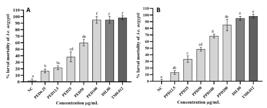
Percentage (mean ± standard deviation) of Ae. aegypti larvae mortality after 24 hours of exposure to different concentrations of dillapiole derivatives: (A) propyl ether dillapiole and (B) piperidyl dillapiole. Abbreviations: PED - propyl ether dillapiole; PPD - piperidyl dillapiole; DIL - dillapiole at 80 µg/mL and PC 2 – temephos at 0.012 µg/mL; NC - negative control (water and DMSO 0.05%). a, b, c, d, e, f: different letters represent statistical differences by the Tukey test at p < 0.05. Source: Authors (2024).
All treatments with propyl ether dillapiole had significant mortality (p < 0.05) when compared to the negative control. Only the concentration 100 µg/mL was significantly (p = 0.05) similar to the dillapiole at 80 µg/mL and temephos at 0.012 µg/mL; the other concentrations were significantly lower in relation to these controls. Mortality at concentrations of 25, 50, 100 and 200 µg/mL of piperidyl dillapiole was significantly higher (p < 0.05) in relation to the negative control (water + DMSO 0.05%); only the concentration 200 µg/mL was significantly (p = 0.05) similar to the temephos at 0.012 µg/mL and dillapiole at 80 µg/mL.
Lethal concentrations in eggs and larvae of Aedes aegypti
In eggs, the LC50 and LC90 for propyl ether dillapiole were 18.7 and 85.63 µg/mL and for piperidyl dillapiole were 49.97 and 268.33 µg/mL, respectively, after 4 h of exposure (Figs. 4A and 4B; Table 2). In the third-instar Ae. aegypti larvae that were exposed for 24 h, the LC50 and LC90 for propyl ether dillapiole were 29.15 and 132 µg/mL and for piperidyl dillapiole were 72.93 and 460.67 µg/mL, respectively (Figs. 4C and 4D; Table 2).

Estimates of the LC50 and LC90 for eggs (A e B) and larvae (C and D) of Aedes aegypti exposed to propyl ether dillapiole (A and C) and piperidyl dillapiole (B and D) for 4 and 24 h, respectively. Abbreviations: PED: Propyl ether dillapiole; PPD: Piperidyl dillapiole; LC: lethal concentration; CI: 95% confidence interval.
Estimates of the LC50 and LC90 (µg/mL) with confidence interval for the biolarvicides piperidyl dillapiole and propyl ether dillapiole for use against eggs and larvae of Aedes aegypti in exposure bioassays.
Morphological analysis of Aedes aegypti larvae
In third instar larvae of Ae. aegypti treated with 200 and 50 µg/mL of piperidyl dillapiole and 100 and 25 µg/mL of propyl ether dillapiole, as well as in the temephos at 0.012 µg/mL and dillapiole at 80 µg/mL, external morphological changes occurred: darkening of the cuticle (35 ± 8%), head displacement (25 ± 12%) and loss of abdominal segments (15 ± 10%), with destruction of the exoskeleton of the larvae, especially those treated with propyl ether dillapiole at 100 µg/mL. In larvae exposed to concentrations of 12 µg/mL of piperidyl dillapiole and 6.25 µg/mL of propyl ether dillapiole, there were no changes in their external morphology after 24 h. The same occurred in the negative control based on water and DMSO 0.05% (Fig. 5).

External morphology of Ae. aegypti larvae after 24 hours of bioassay. (a) negative control (water and DMSO 0.5%); (b) dillapiole at 80 µg/mL; (c) temephos at 0.012 µg/mL; (d - f) propyl ether dillapiole at 100 µg/mL; and (g - i) piperidyl dillapiole 200 µg/mL. (a) head (H), thorax (TH), abdomen (AB), respiratory siphon (S) and anal papilla (AP), unchanged. (b - e, g - i) displacement of the head, pointed by the arrow. (b - d, f - h) darkening of the exoskeleton in the chest and abdominal segments I to III regions. (d, e, f, h and i) deterioration of the exoskeleton thorax and abdominal segments I to III. Source: Authors (2024).
Adulticidal effect of dillapiole derivatives in Aedes aegypti
Table 3 shows the mean mortality percentage of female Ae. aegypti after being exposed to piperidyl dillapiole, propyl ether dillapiole, dillapiole and temephos.
Mean percentage and standard deviation (SD) of mortality of female Ae. aegypti exposed for 90 mins to different concentrations of dillapiole derivatives (piperidyl and propyl ether dillapiole).
In the first contact with of piperidyl dillapiole, mortality ranged from 10 ± 2.50% to 55.50 ± 5.55% at the four highest concentrations (1,000, 500, 250 and 125 µg/mL). After 90 min, mortality ranged from 30 ± 3.50% to 97 ± 3.00% at concentrations of 125 µg/mL at 1000 µg/mL. In the first 15 minutes of exposure, propyl ether dillapiole caused mortality of 5 ± 2.00% at the lowest concentration (37 µg/mL) and 60 ± 5.00% at the highest concentration (600 µg/mL). In 90 min, mortality was above 90% at concentrations 150, 300 and 600 µg/mL. The positive control (Cielo ULV®) at 0.01 µg/mL caused mortality of 92 ± 2.10% in the first 15 minutes and 100 ± 1.50% after 60 min. In the dillapiole (80 µg/mL) mortality ranged from 60 ± 4.00% in the first 15 min to 98 ± 1.50% after 75 min.
In the six analyzed times, there was a significant difference (p < 0.05) in mortality of adult Ae. aegypti in the treatments of 1,000, 500 and 250 µg/mL of piperidyl dillapiole and 600, 300, 150 and 75 µg/mL of propyl ether dillapiole in relation to the negative control. There was no significant difference (p = 0.05) in the treatment of 1,000 µg/mL of piperidyl dillapiole after 45 min in relation to this same time in the positive control (Cielo ULV® at 0.01 µg/mL and dillapiole at 80 µg/mL). The concentrations 600 and 300 µg/mL of propyl ether dillapiole did not show significant difference (p = 0.05) in relation to dillapiole up to 15 min or in relation to the insecticide Cielo ULV®, after 60 min. From 60 to 90 min, mortality at concentrations 600, 300 and 150 µg/mL was statistically similar (p = 0.05) to those of the controls Cielo ULV® and dillapiole.
Estimates of the LC50 and LC90 (confidence intervals) for propyl ether dillapiole in adults were 148.25 μg/mL (54.49–242.01) e 364.28 μg/mL (271.05–457.51) (F = 35.24; df = 5; p < 9.06e-07), and for piperidyl dillapiole were 263.26 μg/mL (263.60–456.91) and 748.28 μg/mL (651.89–844.67) (F = 57.31; df = 5; p < 5.87e-08), respectively, after 90min of exposure (Figs. 6A and 6B).

Estimates of the LC50 and LC90 (µg/mL) with confidence interval for the biolarvicides propyl ether dillapiole (A) and piperidyl dillapiole (B) for use against adults of Aedes aegypti in contact bioassays. Abbreviation: LC: lethal concentration.
Discussion
The physicochemical characteristics of propyl ether dillapiole and piperidyl dillapiole molecules are in agreement with Lipinski's rule. The molecules with logP (lipophilicity/water solubility) ≤ 5; aqueous solubility (logS) ranging from -4~0.5 log mol/L; number of hydrogen bond acceptors ≤ 10; number of hydrogen bond donors ≤ 5, number of rotating bonds ≤ 10 and molecular weight ≤ 500 g/mol (Lipinski et al., 2001) show good interaction with cell receptors (Fernandes et al., 2016). Such properties may allow the propyl ether dillapiole and piperidyl dillapiole molecules to cross the cell membrane of the Ae. aegypti, thus causing dose-dependent toxicity in this mosquito.
The use of synthetic chemical insecticides represents a challenge for mosquito surveillance campaigns and vector control of Ae. aegypti due to frequent reports of populations that are resistant to these compounds (Valle et al., 2019). Promising studies with plant extracts, such as essential oils, isolates and plant-derived molecules, especially of the genus Piper sp., have shown activity against eggs, larvae, pupae and adults of Ae. aegypti (Rafael et al., 2008; Pinto et al., 2012; Oliveira et al., 2013; Domingos et al., 2014; Ríos et al., 2017; Scalvenzi et al., 2019; Silva et al., 2019; França et al., 2020; Oliveira et al., 2022; Nascimento et al., 2024).
Plant substances, such as the neem-based compound 'NeemAzal' used against Ae. aegypti, alter proteins, ion channels, nucleic acids and other cellular components of mosquitoes causing changes in the central nervous system, leading to the death of the insect (Hillary et al., 2024). These effects may have occurred in Ae. aegypti, after exposure to propyl dillapiole ether and piperidyl dillapiole, observed in this study through the ovicidal effect, larvicidal with changes in larval morphology and adulticidal effect.
Dillapiole and its derivatives have a potential application in the vector control of Ae. aegypti (Rafael et al., 2008; Domingos et al., 2014; Silva et al., 2021), as observed in the present study with the substances piperidyl dillapiole and propyl ether dillapiole. The toxicity of dillapiole against Ae. aegypti is related to the methylenedioxyphenylpropene group that is present in this substance (La Camera et al., 2004). The modified side chain (propane) of this molecule gave rise to derivatives, including propyl ether dillapiole, which demonstrated a synergistic effect with the insecticide pyrethrin against the beetle T. castaneum, with an LC50 of 90 µg/mL (Mukerjee et al., 1979; Tomar et al., 1979a, 1979b). The propyl molecule with α-tertienyl had its synergism factor increased in Ae. atropalpus (Majerus, 1997; Belzile et al., 2000). The addition of etheric radicals to the dillapiole molecule gave rise to the semisynthetic derivatives ethyl ether, n-butyl ether and methyl ether dillapiole, with adulticidal effect in Ae. aegypti (Pinto et al., 2012), and ovicidal, larvicidal and genotoxic actions were observed in this mosquito (Domingos et al., 2014; Silva et al., 2019; Santos et al., 2020; Silva et al., 2021) and Ae. albopictus (Meireles et al., 2016).
In this study, the propyl and piperidyl radicals, inserted in the side chain and aromatic ring (phenyl) of dillapiole, originated the ether molecules propyl dillapiole and piperidyl dillapiole, respectively, and maintained the methylenedioxyphenyl group in their structure. Propyl ether dillapiole and piperidyl dillapiole in concentrations of 100 and 200 µg/mL caused 93% and 88% inviability of Ae. aegypti eggs, respectively. These results corroborate those of Domingos et al. (2014) who reported the 100% inviability of Ae. aegypti eggs treated with n-butyl ether dillapiole (12 µg/mL) and ethyl ether dillapiole (40 µg/mL). Meireles et al. (2016) recorded 100% hatching inhibition of Ae. albopictus exposed to concentrations of 12.5 µg/mL and 20 µg/mL of n-butyl ether dillapiole and ethyl ether dillapiole, respectively. Silva et al. (2019) observed 97% inviability of Ae. aegypti eggs after exposure to a concentration of 140 µg/mL of methyl ether dillapiole, with an LC50 of 60 µg/mL. Data from such studies indicate that dillapiole derivatives were more active than propyl ether dillapiole and piperidyl dillapiole, which caused 95% and 85% inviability of eggs at concentrations of 100 and 200 µg/mL. On the other hand, the percentage of inviability of eggs exposed to the derivatives tested in this study was similar to what was observed by Oliveira et al. (2022), who used the essential oil of P. purusanum, which produced 81.6% inviability in eggs of Ae. aegypti, Ae. albopictus, An. albitarsis, An. triannulatus, An. darlingi and An. nuneztovari in concentrations ranging from 15.62 to 31.25 µg/mL.
Larvae of Ae. aegypti tested with the essential oils of P. arboreum, P. marginatum and P. aduncum at a concentration of 500 µg/mL showed mortality, with an LC50 of 34 to 55 µg/mL (Santana et al., 2015). The EO of P. betle at 1,500 µg/mL caused 93% mortality of Ae. aegypti larvae, with an LC50 of 720 µg/mL, with severe damage to the midgut and external morphology, in addition to increased levels of the enzymes glutathione S-transferase (GST) and cytochrome P450 (Vasantha-Srinivasan et al., 2017). The changes observed in the morphology of Ae. aegypti larvae can be attributed to the lipophilicity of propyl dillapiole and piperidyl dillapiole ether, which facilitates the systemic absorption of these substances by the mosquito cuticle, resulting in toxicity. These findings are in accordance with previous studies (Hashem et al., 2018; Soonwera et al., 2022), which associated this effect in Tribolium castaneum and Ae. aegypti, respectively, to the lipophilicity of molecules present in the essential oil of the tested plants.
The high mortality of Ae. aegypti larvae caused by the phenylpropanoids dillapiole, (E)-anethole and β-asarone demonstrates the toxic effect of the EOs of Piper hemmendorffii, Piper crassinervium and P. aduncum on larvae of this mosquito, as they caused the destruction of its midgut and darkening of the cuticle (Pereira Filho et al., 2021). The essential oil of P. capitarum caused the mortality of Ae. aegypti and Ae. albopictus with a LC50 of 87.6 μg/mL and 76.1 μg/mL, respectively (França et al., 2020). The essential oil of P. purusanum showed high activity against An. Nuneztovari, An. Triannulatus, An. Darlingi and An. Albitarsis larvae, with an LC50 that ranged from 49.84 to 51.61 μg/mL (Oliveira et al., 2022). 4-NC from Piper peltatum has a toxic effect against Cx. quinquefasciatus, An. darlingi and Ae. aegypti, with LC50 52.3 ± 1.0 to 62 ± 0.8 µg/mL (Nascimento et al., 2024). These concentrations are similar to those observed in this study, using dillapiole derivatives, and propyl ether dillapiole was more toxic.
Propyl ether dillapiole at 100 µg/mL and piperidyl dillapiole at 200 µg/mL after 24 h resulted in the death of 95 and 83% of Ae. aegypti larvae, respectively and an LC50 of 29.15 and 72.93 μg/mL. Rafael et al. (2008) tested dillapiole, the precursor molecule of these derivatives, which caused 67% mortality of Ae. aegypti larvae at a concentration of 400 µg/mL. In the study by Pereira Filho et al. (2021), there was 100% mortality of three populations of Ae. aegypti, which was exposed to dillapiole after 24 h, with an LC50 ranging from 15.06 to 17.75 µg/mL. When used in this study, dillapiole at 80 µg/mL caused 95% mortality, which is equal to that of propyl ether dillapiole at 100 µg/mL.
On the other hand, the substances tested in this study were less toxic than the derivatives n-butyl ether and ethyl ether dillapiole, which presented an LC50 of 18.6 and 61.8 µg/mL against Ae. aegypti (Domingos et al., 2014) and of 25.60 and 55.86 µg/mL against Ae. albopictus (Meireles et al., 2016), after 24 hours of exposure, the same period adopted in this study. The LC50 of methyl ether dillapiole in Ae. aegypti larvae after 24 h was 97 µg/mL (Silva et al., 2019). The essential oils of several species of Piper caused high toxicity, with an LC50 ranging from 23.50 μg/mL (P. aduncum) to 63.55 μg/mL (P. crassinervium) (Pereira Filho et al., 2021).
Propyl ether dillapiole has greater potential for use as a biolarvicide against Ae. aegypti in relation to piperidyl dillapiole due to its greater toxicity. Both molecules have good larvicidal activity within the limit established by Cheng et al., (2003). For these authors, larvicidal substances with an LC50 < 100 µg/mL are considered active and those with an LC50 < 50 µg/mL as highly active. Therefore, based on the LC50 calculated in the present study, propyl ether dillapiole and piperidyl dillapiole can be considered highly active and active in the control of Ae. aegypti larvae since their LC50 were 29.15 and 72.93 µg/mL.
Added to this, the fact that propyl ether dillapiole and piperidyl dillapiole are stable molecules and have a known structure and physicochemical characteristics makes them potentially favorable to be produced and used. There are no reports in the literature about piperidyl ether dillapiole being used against Ae. aegypti or in non-target organisms, therefore this study is the first to analyze the insecticidal effect of this substance.
A larvicidal and adulticidal effect and morphological changes (shrinkage in the abdominal segments and elimination of intestinal contents) in Ae. aegypti and Ae. albopictus after treatment with the EO of P. capitarianum Yunck were recorded by França et al. (2020). In the present study, mortality of Ae. aegypti larvae and changes in their external morphology (darkening of the cuticle and head displacement) occurred after exposure to the two dillapiole derivatives for 24 h, with higher mortality in of the larvae subjected to dillapiole propyl ether.
Compounds containing piperidine in their structure showed adulticidal effect in Ae. aegypti, with an LC50 of 0.8 to 29.2 µg/mL per mosquito (Pridgeon et al., 2007). In this study, this molecule was added to the aromatic ring of dillapiole and conferred ovicidal, larvicidal and adulticidal activity. These data corroborate those of Pinto et al. (2012) who reported high mortality caused by dillapiole and its derivatives isodillapiole, methyl ether, propyl ether, n-butyl ether and propyl ether, whose LC50 were 0.381, 0.136, 0.295, 0.315 and 0.438 µg/cm3, respectively. Extracts of black pepper (Piper nigera) caused 84% mortality of adults of Ae. aegypti and 44.7% of Anopheles stephensi, after 48 h of exposure, with an LC50 of 1.56 and 5.11%, respectively (Nawaz et al., 2011). The essential oil of P. betle, at a concentration of 2.5 µL/mL, caused 100% mortality of adult Ae. aegypti, with an LC50 of 0.955 µL/mL, after 30 min of exposure (Martianasari and Hamid, 2019). The insecticidal effect of dillapiole, safrole and myristicin on Ae. aegypti has been associated with the methylenedioxyphenyl group, which is present in these molecules (Perumalsamy et al., 2009; Tohge et al., 2017).
Modifications in the double bond (propene) of dillapiole and the insertion of other radicals gave rise to semisynthetic compounds, which had actions with different levels of activity against eggs, larvae and adults of Ae. aegypti (Pinto et al., 2012; Domingos et al., 2014; Silva et al., 2019) and Ae. albopictus (Meireles et al., 2016). In this study, propyl ether dillapiole and piperidyl dillapiole showed ovicidal, larvicidal and adulticidal effects and caused morphological alterations in the larvae of Ae. aegypti; however, propyl ether dillapiole, with propane in its side chain, showed greater toxic activity in relation to piperidyl dillapiole, which may impede the reproductive success of Ae. aegypti. These pioneering data are a powerful tool for enhancing future studies of the effects of both substances in this mosquito and in other species of epidemiological importance, as well as in non-target organisms.
Conclusions
The new derivatives piperidyl dillapiole and propyl ether dillapiole showed ovicidal, larvicidal and adulticidal activity, and caused also, noticeable systemic morphological alterations in the larvae of Ae. aegypti under laboratory conditions. Both molecules are promising as an alternative form of control of populations Ae. aegypti, especially the propyl ether dillapiole with the single bond (propane) and propyl radical in the side chain, which showed greater insecticidal activity in this mosquito.
Data statement
This article has all the data that were generated or analyzed during this study.
Acknowledgments
We are grateful for financial support through the project Adaptações da Biota Aquática da Amazônia II - ADAPTA II, Institutos Nacionais de Ciência e Tecnologia, (INCT), Instituto Nacional de Pesquisas da Amazônia - INPA, Conselho Nacional de Desenvolvimento Científico e Tecnológico - CNPq, Fundação de Amparo à Pesquisa do Estado do Amazonas - FAPEAM (process Nº. 465540) coordinated by Dr. Adalberto Luis Val; Coordenação de Aperfeiçoamento de Pessoal de Nível Superior - CAPES and FAPEAM/ SEDECTI /SEPLANCTI/Governo do Estado do Amazonas, POSGRAD - Call POSGRAD/FAPEAM, both coordinated by Dr. Eliana Feldberg and Zelina Estevam dos S. Torres, Programa de Pós-graduação em Genética, Conservação e Biologia Evolutiva (PPG - GCBEv) at INPA. Laboratório de Fitoquímica e Semissíntese (FITOPHAR) at Universidade Federal do Amazonas – UFAM, coordinated by Dr. Fernanda Guilhon-Simplicio. Central Analítica do Laboratório Temático de Química de Produtos Naturais (CA-LTQPN) at INPA. MSc. Joaquim Ferreira do Nascimento Neto at the Laboratório de Malária e Dengue, coordinated by Dr. Rosemary Roque.
-
Compliance with ethical standards
The collection of mosquitoes was authorized by the Sistema de Autorização e Informação em Biodiversidade (SISBio) (No. 77078, Dec. 2020). The blood meal of the female mosquitoes, which was performed using hamsters, was authorized by the Ethics Committee on the Use of Animals (013/2020) at INPA.
References
-
Almeida, R. R. P., Souto, R. N. P., Bastos, C. N., da Silva, M. H. L., Maia, J. G. S., 2009. Chemical variation in Piper aduncum and biological properties of its dillapiole-rich essential oil. Chem. Biodivers. 6 (9), 1427-1434. http://doi.org/10.1002/cbdv.200800212
» http://doi.org/10.1002/cbdv.200800212 -
Belzile, A.-S., Majerus, S. L., Podeszfinski, C., Guillet, G., Durst, T., Arnason, J. T., 2000. Dillapiol derivatives as synergists: structure-activity relashionship analysis. Pestic. Biochem. Physiol. 66 (1), 33-40. http://doi.org/10.1006/pest.1999.2453
» http://doi.org/10.1006/pest.1999.2453 -
Bernard, C. B., Krishanmurty, H. G., Chauret, D., Durst, T., Philogène, B. J. R., Sánchez-Vindas, P., Hasbun, C., Poveda, L., San Román, L., Arnason, J. T., 1995. Insecticidal defenses of Piperaceae from the neotropics. J. Chem. Ecol. 21 (6), 801-814. http://doi.org/10.1007/BF02033462
» http://doi.org/10.1007/BF02033462 -
Centers for Disease Control and Prevention – CDC, 2012. CONUS Manual for Evaluating Insecticide Resistance in Mosquitoes Using the CDC Bottle Bioassay Kit. United States. Available in: https://www.cdc.gov/mosquitoes/pdfs/CONUS-508.pdf (accessed 12 February 2024).
» https://www.cdc.gov/mosquitoes/pdfs/CONUS-508.pdf -
Cheng, S.-S., Chang, H.-T., Chang, S.-T., Tsai, K.-H., Chen, W.-J., 2003. Bioactivity of selected plant essential oils against the yellow fever mosquito Aedes aegypti larvae. Bioresour. Technol. 89 (1), 99-102. http://doi.org/10.1016/S0960-8524(03)00008-7
» http://doi.org/10.1016/S0960-8524(03)00008-7 -
Dey, P., Goyary, D., Chattopadhyay, P., Kishor, S., Karmakar, S., Verma, A., 2020. Evaluation of larvicidal activity of Piper longum leaf against the dengue vector, Aedes aegypti, malarial vector, Anopheles stephensi and filariasis vector, Culex quinquefasciatus. S. Afr. J. Bot. 132, 482-490. http://doi.org/10.1016/j.sajb.2020.06.016
» http://doi.org/10.1016/j.sajb.2020.06.016 -
Domingos, P. R. C., Pinto, A. C. S., Santos, J. M. M., Rafael, M. S., 2014. Insecticidal and genotoxic potential of two semi-synthetic derivatives of dillapiole for the control of Aedes (Stegomyia) aegypti (Diptera: culicidae). Mutat. Res. Genet. Toxicol. Environ. Mutagen. 772, 42-54. http://doi.org/10.1016/j.mrgentox.2014.07.008
» http://doi.org/10.1016/j.mrgentox.2014.07.008 -
Fazolin, M., Estrela, J. L. V., Catani, V., Alécio, M. R., Lima, M. S., 2007. Propriedade inseticida dos óleos essenciais de Piper hispidinervum C. DC.; Piper aduncum L. e Tanaecium nocturnum (Barb. Rodr.) Bur. & K. Shum sobre Tenebrio molitor L., 1758. Cienc. Agrotec. 31 (1), 113-120. http://doi.org/10.1590/S1413-70542007000100017
» http://doi.org/10.1590/S1413-70542007000100017 -
Fernandes, T. B., Segreti, M. C. F., Polli, M. C., Parise Filho, R., 2016. Analysis of the applicability and use of lipinski’s rule for central nervous system drugs. Lett. Drug Des. Discov. 13, 999-1006. http://doi.org/10.2174/1570180813666160622092839
» http://doi.org/10.2174/1570180813666160622092839 - Food and Agriculture Organization – FAO. United Nations, International Atomic Energy Agency – IAEA, 2017. Guidelines for Routine Colony Maintenance of Aedes Mosquito Species – Version 1.0. FAO/IAEA, Vienna, 18 pp.
-
França, L. P., Amaral, A. C. F., Ramos, A. S., Ferreira, J. L. P., Maria, A. C. B., Oliveira, K. M. T., Araujo Júnior, E. S., Branches, A. D. S., Silva, J. N., Silva, N. G., Barros, G. A., Chaves, F. C. M., Tadei, W. P., Silva, J. R. A., 2020. Piper capitarianum essential oil: a promising insecticidal agent for the management of Aedes aegypti and Aedes albopictus. Environ. Sci. Pollut. Res. Int. 28 (8), 9760-9776. http://doi.org/10.1007/s11356-020-11148-6
» http://doi.org/10.1007/s11356-020-11148-6 -
Gomes, E. O., Nunomura, S. M., Marinotti, O., Tadei, W. P., 2016. Synergistic potential of dillapiole combined with pyrethroids against mosquitoes. Vector Biol J 1 (3), 3. http://doi.org/10.4172/2473-4810.1000114
» http://doi.org/10.4172/2473-4810.1000114 -
Hashem, A. S., Awadalla, S. S., Zayed, G. M., Maggi, F., Benelli, G., 2018. Pimpinella anisum essential oil nanoemulsions against Tribolium castaneum-insecticidal activity and mode of action. Environ. Sci. Pollut. Res. Int. 25 (19), 18802-18812. http://doi.org/10.1007/s11356-018-2068-1
» http://doi.org/10.1007/s11356-018-2068-1 -
Hillary, V. E., Ceasar, S. A., Ignacimuthu, S., 2024. Efficacy of plant products in controlling disease vector mosquitoes, a review. Entomol. Exp. Appl. 172 (3), 195-214. http://doi.org/10.1111/eea.13401
» http://doi.org/10.1111/eea.13401 -
Kumar, P. P., Siva, B., Rao, B. V., Dileep Kumar, G. D., Nayak, V. L., Tiwari, A. K., Purushotham, U., Rao, C. V., Babu, K. S., 2019. Synthesis and biological evaluation of bergenin-1,2,3-triazole hybrids as novel class of anti-mitotic agents. Bioorg. Chem. 91, 103161. http://doi.org/10.1016/j.bioorg.2019.103161
» http://doi.org/10.1016/j.bioorg.2019.103161 -
La Camera, S., Gouzerh, G., Dhondt, S., Hoffmann, L., Fritig, B., Legrand, M., Heitz, T., 2004. Metabolic reprogramming in plant innate immunity: the contributions of phenylpropanoid and oxylipin pathways. Immunol. Rev. 198 (1), 267-284. http://doi.org/10.1111/j.0105-2896.2004.0129.x
» http://doi.org/10.1111/j.0105-2896.2004.0129.x -
Lipinski, C. A., Lombardo, F., Dominy, B. W., Feeney, P. J., 2001. Experimental and computational approaches to estimate solubility and permeability in drug discovery and development settings. Adv. Drug Deliv. Rev. 46 (1-3), 3-26. http://doi.org/10.1016/S0169-409X(00)00129-0
» http://doi.org/10.1016/S0169-409X(00)00129-0 -
Maia, J. G. S., Zohhbi, M. D. G. B., Andrade, E. H. A., Santos, A. S., da Silva, M. H. L., Luz, A. I. R., Bastos, C. N., 1998. Constituents of the essential oil of Piper aduncum L. growing wild in the Amazon region. Flavour Fragrance J. 13 (4), 269-272. http://doi.org/10.1002/(SICI)1099-1026(1998070)13:4<269::AID-FFJ744>3.0.CO;2-A
» http://doi.org/10.1002/(SICI)1099-1026(1998070)13:4<269::AID-FFJ744>3.0.CO;2-A - Majerus, S. L., 1997. A Novel Synthesis of Dillapiol and its Derivatives and their Role as Chemosensitizes and Insecticide Synergists. Master of Science Thesis, Universite of Otawa.
-
Martianasari, R., Hamid, P. H., 2019. Larvicidal, adulticidal, and oviposition-deterrent activity of Piper betle L. essential oil to Aedes aegypti. Vet. World 12 (3), 367-371. http://doi.org/10.14202/vetworld.2019.367-371
» http://doi.org/10.14202/vetworld.2019.367-371 -
Meireles, S. F., Domingos, P. R. C., Pinto, A. C. S., Rafael, M. S., 2016. Toxic effect and genotoxicity of the semisynthetic derivatives dillapiole ethyl ether and dillapiole n -butyl ether for control of Aedes albopictus (Diptera: culicidae). Mutat. Res. Genet. Toxicol. Environ. Mutagen. 807, 1-7. http://doi.org/10.1016/j.mrgentox.2016.07.003
» http://doi.org/10.1016/j.mrgentox.2016.07.003 -
Ministério da Saúde, 2022. Monitoramento dos casos de arboviroses até a semana epidemiológica 47 de 2022. Available in: https://www.gov.br/saude/pt-br/centrais-de-conteudo/publicacoes/boletins/epidemiologicos/edicoes/2022/boletim-epidemiologico-vol-53-no47/viewx (accessed 12 February 2024).
» https://www.gov.br/saude/pt-br/centrais-de-conteudo/publicacoes/boletins/epidemiologicos/edicoes/2022/boletim-epidemiologico-vol-53-no47/viewx -
Mukerjee, S. K., Saxena, V. S., Tomar, S. S., 1979. New methylenedioxyphenyl synergists for pyrethrins. J. Agric. Food Chem. 27 (6), 1209-1211. http://doi.org/10.1021/jf60226a033
» http://doi.org/10.1021/jf60226a033 -
Nascimento, S. R. L., Pinto, A. C. S., Meireles, S. F., Silva, J. S., Chaves, F. C. M., Rafael, M. S., 2024. Isolation of 4-nerolidylcatechol from leaves of Piper peltatum L., and evaluation of larvicidal activity in mosquito vectors, with emphasis on Aedes aegypti (Diptera: culicidae). Rev. Bras. Entomol. 68 (2), e20230074. http://doi.org/10.1590/1806-9665-rbent-2023-0074
» http://doi.org/10.1590/1806-9665-rbent-2023-0074 - Nawaz, R., Rashid Rathor, H., Bilal, H., Hassan, S.A., Khan, A., 2011. adulticidal Activity of Olea vera, Linum usitatissimum and Piper nigera against Anopheles stephensi and Aedes aegypti under laboratory conditions. Iran. J. Arthropod-Borne Dis. 5, 2-9.
-
Oliveira, L., Cardoso, S. K., Lara Junior, C. R., Vieira, T. M., Guimarães, E. F., Figueiredo, L. S., Martins, E. R., Moreira, D. L., Kaplan, M. A., 2013. Chemical study and larvicidal activity against Aedes aegypti of essential oil of Piper aduncum L. (Piperaceae). An. Acad. Bras. Cienc. 85 (4), 1227-1234. http://doi.org/10.1590/0001-3765201391011
» http://doi.org/10.1590/0001-3765201391011 -
Oliveira, A. C., Simões, R. C., Lima, C. A. P., Silva, F. M. A., Nunomura, S. M., Roque, R. A., Tadei, W. P., Nunomura, R. C. S., 2022. Essential oil of Piper purusanum C.DC (Piperaceae) and its main sesquiterpenes: biodefensives against malaria and dengue vectors, without lethal effect on non-target aquatic fauna. Environ. Sci. Pollut. Res. Int. 29 (31), 47242-47253. http://doi.org/10.1007/s11356-022-19196-w
» http://doi.org/10.1007/s11356-022-19196-w -
Pereira Filho, A. A., Pessoa, G. C. D., Yamaguchi, L. F., Stanton, M. A., Serravite, A. M., Pereira, R. H. M., Neves, W. S., Kato, M. J., 2021. Larvicidal activity of essential oils from piper species against strains of Aedes aegypti (Diptera: Culicidae) resistant to pyrethroids. Front. Plant Sci. 12, 685864. http://doi.org/10.3389/fpls.2021.685864
» http://doi.org/10.3389/fpls.2021.685864 -
Perumalsamy, H., Kim, N.-J., Ahn, Y.-J., 2009. Larvicidal activity of compounds isolated from Asarum heterotropoides against Culex pipiens pallens, Aedes aegypti, and Ochlerotatus togoi (Diptera: culicidae). J. Med. Entomol. 46 (6), 1420-1423. http://doi.org/10.1603/033.046.0624
» http://doi.org/10.1603/033.046.0624 -
Pinto, A. C. S., Nogueira, K. L., Chaves, F. C. M., Silva, L. V. S., Tadei, W. P., Pohlit, A. M., 2012. Adulticidal activity of dillapiol and semi-synthetic derivatives of dillapiol against adults of Aedes aegypti (L.) (Culicidae). J. Mosq. Res. 2, 1-7. http://doi.org/10.5376/jmr.2012.01.0001
» http://doi.org/10.5376/jmr.2012.01.0001 -
Pohlit, A. M., Quinard, E. L. J., Nunomura, S. M., Tadei, W. P., Hidalgo, A. F., Pinto, A. C. S., Santos, E. V. M., Morais, S. K. R., Saraiva, R. D. C. G., Ming, L. C., Alecrim, A. M., Ferraz, A. B., Pedroso, A. C. S., Diniz, E. V., Finney, E. K., Gomes, E. O., Dias, H. B., Souza, K. S., Oliveira, L. C. P., Don, L. C., Queiroz, M. M. A., Henrique, M. C., Santos, M., Lacerda Júnior, O. S., Pinto, P. S., Silva, S. G., Graça, Y. R., 2004. Screening of plants found in the State of Amazonas, Brazil for activity against Aedes aegypti larvae. Acta Amazon. 34 (1), 97-105. http://doi.org/10.1590/S0044-59672004000100012
» http://doi.org/10.1590/S0044-59672004000100012 -
Powell, J. R., 2016. Mosquitoes on the move. Science 354 (6315), 971-972. http://doi.org/10.1126/science.aal1717
» http://doi.org/10.1126/science.aal1717 -
Pridgeon, J. W., Meepagala, K. M., Becnel, J. J., Clark, G. G., Pereira, R. M., Linthicum, K. J., 2007. Structure-activity relationships of 33 piperidines as toxicants against female adults of Aedes aegypti (Diptera: culicidae). J. Med. Entomol. 44 (2), 263-269. http://doi.org/10.1093/jmedent/44.2.263
» http://doi.org/10.1093/jmedent/44.2.263 -
Rafael, M. S., Hereira-Rojas, W. J., Roper, J. J., Nunomura, S. M., Tadei, W. P., 2008. Potential control of Aedes aegypti (Diptera: Culicidae) with Piper aduncum L. (Piperaceae) extracts demonstrated by chromosomal biomarkers and toxic effects on interphase nuclei. Genet. Mol. Res. 7 (3), 772-781. http://doi.org/10.4238/vol7-3gmr481
» http://doi.org/10.4238/vol7-3gmr481 -
Ríos, N., Stashenko, E. E., Duque, J. E., 2017. Evaluation of the insecticidal activity of essential oils and their mixtures against Aedes aegypti (Diptera: culicidae). Rev. Bras. Entomol. 61 (4), 307-311. http://doi.org/10.1016/j.rbe.2017.08.005
» http://doi.org/10.1016/j.rbe.2017.08.005 -
Rueda, L. M., 2004. Pictorial keys for the identification of mosquitoes (Diptera: Culicidae) associated with dengue virus transmission. Zootaxa 589 (1), 1-60. http://doi.org/10.11646/zootaxa.589.1.1
» http://doi.org/10.11646/zootaxa.589.1.1 -
Santana, H. T., Trindade, F. T. T., Stabeli, R. G., Silva, A. A. E., Militão, J. S. T. L., Facundo, V. A., 2015. Essential oils of leaves of Piper species display larvicidal activity against the dengue vector, Aedes aegypti (Diptera: culicidae). Rev. Bras. Plantas Med. 17, 105-111. http://doi.org/10.1590/1983-084X/13_052
» http://doi.org/10.1590/1983-084X/13_052 -
Santos, L. H. F., Domingos, P. R. C., Meireles, S. D. F., Bridi, L. C., Pinto, A. C. S., Rafael, M. S., 2020. Genotoxic effects of semi-synthetic isodillapiole on oviposition in Aedes aegypti (Linnaeus, 1762) (Diptera: culicidae). Rev. Soc. Bras. Med. Trop. 53, e20200467. http://doi.org/10.1590/0037-8682-0467-2020
» http://doi.org/10.1590/0037-8682-0467-2020 -
Scalvenzi, L., Radice, M., Toma, L., Severini, F., Boccolini, D., Bella, A., Guerrini, A., Tacchini, M., Sacchetti, G., Chiurato, M., Romi, R., Di Luca, M., 2019. Larvicidal activity of Ocimum campechianum, Ocotea quixos and Piper aduncum essential oils against Aedes aegypti. Parasite 26, 23. http://doi.org/10.1051/parasite/2019024
» http://doi.org/10.1051/parasite/2019024 -
Silva, J. S., Pinto, A. C. S., Santos, L. H. F., Rafael, M. S., 2019. Efeito ovicida e larvicida do éter metil dilapiol (EMD) em Aedes aegypti, Manaus-AM. In: Salgado, Y.C.S. (Eds.), Patologias: doenças parasitárias, Atena Editora, Ponta Grossa, pp. 192–204. http://doi.org/10.22533/at.ed.97819180323
» http://doi.org/10.22533/at.ed.97819180323 -
Silva, J. S., Pinto, A. C. S., Santos, L. H. F., Silva, L. J. S., Cruz, D. L. V., Rafael, M. S., 2021. Genotoxic and mutagenic effects of methyl ether dillapiole on the development of Aedes aegypti (Diptera: culicidae). Med. Vet. Entomol. 35 (4), 556-566. http://doi.org/10.1111/mve.12533
» http://doi.org/10.1111/mve.12533 -
Soonwera, M., Moungthipmalai, T., Aungtikun, J., Sittichok, S., 2022. Combinations of plant essential oils and their major compositions inducing mortality and morphological abnormality of Aedes aegypti and Aedes albopictus. Heliyon 8 (5), e09346. http://doi.org/10.1016/j.heliyon.2022.e09346
» http://doi.org/10.1016/j.heliyon.2022.e09346 -
Tohge, T., Souza, L. P., Fernie, A. R., 2017. Current understanding of the pathways of flavonoid biosynthesis in model and crop plants. J. Exp. Bot. 68 (15), 4013-4028. http://doi.org/10.1093/jxb/erx177
» http://doi.org/10.1093/jxb/erx177 -
Tomar, S. S., Maheshwari, M. L., Mukerjee, S. K., 1979a. Synthesis and synergistic activity of some pyrethrum synergists from dillapiole. Agric. Biol. Chem. 43 (7), 1479-1483. http://doi.org/10.1271/bbb1961.43.1479
» http://doi.org/10.1271/bbb1961.43.1479 -
Tomar, S. S., Maheshwari, M. L., Mukerjee, S. K., 1979b. Synthesis and synergistic activity of dillapiole-based pyrethrum synergists. J. Agric. Food Chem. 27 (3), 547-550. http://doi.org/10.1021/jf60223a012
» http://doi.org/10.1021/jf60223a012 -
Valle, D., Bellinato, D. F., Viana-Medeiros, P. F., Lima, J. B. P., Martins Junior, A. D. J., 2019. Resistance to temephos and deltamethrin in Aedes aegypti from Brazil between 1985 and 2017. Mem. Inst. Oswaldo Cruz 114, e180544. http://doi.org/10.1590/0074-02760180544
» http://doi.org/10.1590/0074-02760180544 -
Vasantha-Srinivasan, P., Senthil-Nathan, S., Ponsankar, A., Thanigaivel, A., Edwin, E.-S., Selin-Rani, S., Chellappandian, M., Pradeepa, V., Lija-Escaline, J., Kalaivani, K., Hunter, W. B., Duraipandiyan, V., Al-Dhabi, N. A., 2017. Comparative analysis of mosquito (Diptera: Culicidae: Aedes aegypti Liston) responses to the insecticide temephos and plant derived essential oil derived from Piper betle L. Ecotoxicol. Environ. Saf. 139, 439-446. http://doi.org/10.1016/j.ecoenv.2017.01.026
» http://doi.org/10.1016/j.ecoenv.2017.01.026 -
World Health Organization – WHO, 2005. Guidelines for Laboratory and Field Testing of Mosquito Larvicides. Geneva. Available in: https://apps.who.int/iris/handle/10665/69101 (accessed 12 February 2024).
» https://apps.who.int/iris/handle/10665/69101 - Zhang, J., Ma, Z., Feng, J., Feng, G., Zhang, X., 2005. Bioactivity of Sarisan against Musca domestica L. and Culex pipiens pallens Chin. J Pest Sci 7, 85-87.
Edited by
-
Associate Editor:
Maria Sallum


