 Population dynamics of Dalbulus maidis in maize: effects of time of day and sampling technique
ABSTRACT
Understanding the population dynamics of the corn leafhopper Dalbulus maidis (Hemiptera: Cicadellidae), the vector of pathogens responsible for maize stunt diseases, is essential for establishing an integrated management program for this pest. Defining an easy, fast, accurate and representative sampling method for D. maidis would allow both population estimation for monitoring and control decision making. Therefore, we evaluated three sampling methods (yellow sticky traps, direct whorl counts and sweep nets), time of day and variations in climatic factors on D. maidis captures. For this purpose, D. maidis populations in field maize plants at phenological stages V3 to V9 were monitored from September 2022 to May 2024. The numbers of leafhoppers captured by the three sampling methods were correlated with climatic variations during this period. The sampling method affected the number of individuals collected. During the sampling period, 11,520 D. maidis individuals were captured. Among these, yellow sticky traps recorded 957 individuals. Direct whorl counts registered 2,999 individuals in the morning and 2,723 in the afternoon. Sweep net sampling recorded 2,415 individuals collected in the morning and 2,426 in the afternoon. Direct whorl observations showed positive correlations with temperature, relative humidity and accumulated rainfall. The results show that the active direct whorl counting method is the most efficient for monitoring and observing population variations of the corn leafhopper, outperforming sweep nets and yellow sticky traps. This study highlights the importance of adjusting monitoring strategies for more accurate population estimates and control recommendations in integrated management programs for the corn leafhopper D. maidis.
Keywords:
Zea mays; Population dynamics; Agricultural monitoring; Corn leafhopper; Integrated Pest Management
Introduction
Corn (Zea mays L.) is one of the most important cereals globally, playing a key role in human and animal food security. Its importance stems from its role as a primary source of energy and nutrients, widely used in direct human consumption, including flours, oils, and processed products, and, even more significantly, as an essential component in poultry, swine, and cattle feed, representing up to 80% of animal diets in Brazil (USDA, 2023). Currently, global corn production exceeds one billion tons annually, surpassing that of rice and wheat. The United States, China, and Brazil are the largest global producers, accounting for a significant portion of the worldwide supply, with cultivated areas spanning millions of hectares across several continents (CONAB, 2023; USDA, 2023).
However, corn productivity is constantly threatened by pests and diseases, notably the corn leafhopper, Dalbulus maidis (DeLong & Wolcott) (Hemiptera: Cicadellidae). This insect, predominantly distributed in the Neotropics, is a crucial vector of important plant pathogens. D. maidis is the primary insect vector of mollicutes, a group of wall–less bacteria, including Spiroplasma kunkelii (CSS) and maize bushy stunt phytoplasma (MBSP), which causes the diseases known as corn stunt diseases (Oliveira et al., 2021). This insect can also transmit viruses responsible for maize rayado fino disease (Maize rayado fino virus – MRFV) (Gámez, 1973) and maize striate mosaic disease (Maize striate mosaic virus – MSMV) (Vilanova et al., 2022). These diseases are systemic and vascular; once transmitted to maize, they colonize the phloem, triggering physiological, hormonal, and biochemical alterations (Nault, 1980). Symptoms include reduced plant size, shortened internodes, lower nutrient absorption and assimilation, impaired photoassimilate production, smaller ears with defects or sterility, as well as malformed and shriveled grains (Oliveira et al., 2013).
The geospatial distribution of D. maidis ranges from the United States to temperate regions of Argentina (Oliveira et al., 2013). The continuous presence of hosts, such as cultivated corn and tiguera corn, facilitates the proliferation and dispersal of the insect, making monitoring and integrated management of D. maidis essential to mitigate crop losses and ensure the sustainability of corn production globally (Ávila et al., 2021).
Dalbulus maidis populations are strongly influenced by environmental factors, including maize presence as their primary host plant. Temperatures between 17°C and 35°C favor the insect’s presence in planting areas and positively affect its development and reproduction. In contrast, heavy rainfall, native vegetation, and other crops can contribute to population reduction (van Nieuwenhove et al., 2016; Foresti et al., 2022). This reduction is primarily attributed to several factors. Firstly, the lack of suitable hosts plays a crucial role, as D. maidis is a highly specialized insect on corn (Zea mays) (Sabato et al., 2018). Secondly, the diversification of agricultural fields provides a “dilution effect” for the pest, as the density of preferred host plants (corn) is reduced compared to extensive monocultures, thereby hindering D. maidis in locating hosts (Foresti et al., 2022). Thirdly, more diverse ecosystems tend to harbor a greater diversity and abundance of natural enemies, which can increase their activity against pest populations (Souza et al., 2021). Finally, non-host vegetation can act as a physical barrier, impeding D. maidis dispersal and colonization. Furthermore, some non-host plants may release volatile compounds that repel D. maidis or interfere with its ability to locate corn (Al Shidi et al., 2018).
The corn leafhopper exhibits a distinct edge-biased spatial distribution in the field, with significantly higher densities at field boundaries (Foresti et al., 2022). The temporal variability of this pest's presence is associated with the plant's phenological stage; populations are most abundant during the vegetative stage and reach their peak during the off-season (Meneses et al., 2016). In the context of maize cultivation in Brazil, “off-season” refers to the inter-harvest period, characterized by the absence of widespread maize cultivation. However, the persistence of volunteer plants (“tigueras”) originating from residual grains of the previous harvest, or from smaller-scale cultivated areas, often under irrigation, provides host availability for D. maidis. Despite the reduction in cultivated area, the presence of these remnant plants or small-scale crops during the off-season is crucial for the survival and multiplication of the leafhopper, allowing its populations to reach peaks before the onset of the subsequent main harvest. These factors certainly influence the establishment of methods and collection periods for estimating D. maidis populations.
In Integrated Pest Management (IPM), sampling is a key component for making accurate decisions regarding pest control in crops (Pedigo and Rice, 2008). D. maidis monitoring is carried out through systematic sampling, typically involving the use of traps or direct counting on plants (Pinto et al., 2023). Inspections usually target whorl and leaves (i.e., active sampling) to estimate pest infestation levels (Carpane and Catalano, 2022). A widely adopted method is the double-sided yellow sticky traps (i.e., passive collection), which are practical and effective. The corn leafhopper is attracted to the yellow color and is trapped on the adhesive cards, making counting easier (Meneses et al., 2016). Passive sampling is often preferred over active sampling in IPM programs due to the lower labor requirement (Pedigo and Rice, 2008). However, the accuracy of population estimates should be the primary criterion when selecting a sampling method. To develop an effective IPM program for D. maidis and thereby reduce maize stunt diseases in the field, it is critical to evaluate not only sampling method efficiency but also optimal sampling time and the effect of year-round maize availability on population dynamics. These factors directly influence management strategies for both the leafhopper and its transmitted phytopathogens. In this study, we compared three D. maidis sampling techniques—sweep-netting, direct visual counts of plant whorls, and yellow sticky traps—while also assessing their correlation with time of day and climatic variables to determine their impact on population fluctuations across seasons.
Although previous studies, such as that by Pinto et al. (2023), have compared the use and efficiency of different D. maidis sampling techniques in various biomes, understanding the insect’s population dynamics in year-round corn systems. Moreover, the correlation of these techniques with daylight hours and seasonal climate variables, remains underexplored. Our study aims to fill this gap, providing crucial insights for the development of more precise Integrated Pest Management (IPM) adapted to continuous cropping conditions.
In this study, 'sampling time' refers specifically to the diurnal collection periods (mid-morning and late afternoon), aiming to identify variations in the insect's activity and exposure throughout the day. The 'sampling techniques' evaluated correspond to the tools used to quantify the D. maidis population in the field, including the entomological sweep net, yellow sticky traps, and direct visual counting on plant cartridges. Our work advances by integrating analysis of the influence of time of day and weather variables on capture efficiency. This multifactorial approach allows for a more robust evaluation of monitoring strategies, providing essential data to optimize not only sampling accuracy but also the effectiveness of insect control tactics.
Material and methods
Study Site
The research was conducted at Embrapa Maize and Sorghum’s experimental fields in Sete Lagoas-MG (19°27'34” S, 44°10'30” W; 19°26'49” S, 44°10'18” W; 19°26'49” S, 44°10'23” W; and 19°26'46” S, 44°10'10” W), at an altitude of 720 meters, from September 2022 to May 2024. However, due to the availability of corn, sampling was performed at one site at a time, with locations adjusted according to crop presence during the study period.
Sampling Area
Maize (hybrids PZ 316 and P4285) was planted on a staggered schedule every 21 days to standardize the vegetative stage, so that, in the 150 m2 sampling area, there were always plants in the vegetative stages between V3/4 and V8/9. Sampling methods were carried out on maize plants in the aforementioned vegetative stages. In this phase where the highest incidence of the corn leafhopper occurs and is considered the ideal stage for capture, with the highest probability of insect detection and a greater chance of assessing the accurate population in the field (Carmo et al., 2024).
Sampling and Counting Methods for D. maidis
Dalbulus maidis adults were monitored weekly, employing three distinct methods: (1) sweep-netting (146 cm circumference / 85 cm length); (2) yellow sticky traps (Pragas.com® - 26.5 cm high x 10 cm wide); and (3) direct visual counts by a trained observer. Sweep net and direct counting are considered active sampling techniques, as they require human intervention during data collection. At the same time, yellow sticky traps are passive, relying on the insect's own movement to be captured, without the presence of the collector. For the sweep netting method, random transects were walked through the experimental area. At each of the three sampling points, ten sweeps were performed over corn plants along a sequence of ten plants, totaling thirty sweeps per evaluation. For direct visual counts, the whorl of ten corn plants was observed for one and a half minutes at three random points within a 100 m2 area at the center of the plot. One yellow sticky trap was placed at the center of the experimental area at 1.5 m above ground and replaced every seven days.
Sweep-netting and visual observations were conducted at two time periods: mid-morning (≈10:00) and late afternoon (≈16:00).
Weather Conditions
Meteorological data were recorded throughout the trial period. Air temperature (°C) and relative humidity (%) were measured directly in the experimental area during sampling using a PD-003 digital thermometer (by Tomate Eletrônicos). Wind speed (m/s), solar radiation (kJ/m2), and precipitation (mm) were obtained from the automatic weather station A569 of the National Institute of Meteorology (INMET, 2024), located in Sete Lagoas, MG (19°27'19” S, 44°10'24” W).
Data analysis
We assessed data normality using the Shapiro-Wilk test (α = 0.05) and evaluated variance homogeneity with Levene's test (α = 0.05). Outliers were identified through direct observation of box-plot distributions.
As the climatic data violated normality assumptions (Shapiro-Wilk test, p < 0.05), non-parametric Wilcoxon tests and Spearman's rank correlation analyses were performed. To compare sampling methods and collection periods, we fitted a generalized linear model (GLM) with Poisson distribution - the most appropriate approach for count data in this study. Model diagnostics included evaluation of equidispersion parameters and residual distribution patterns (Crawley, 2013).
All statistical analyses were performed using R version 4.4.1 (R Development Core Team, 2024). We employed the following packages: MASS, car, and rstatix for model fitting and statistical testing; and ggplot2 for data visualization and graphical output.
Results
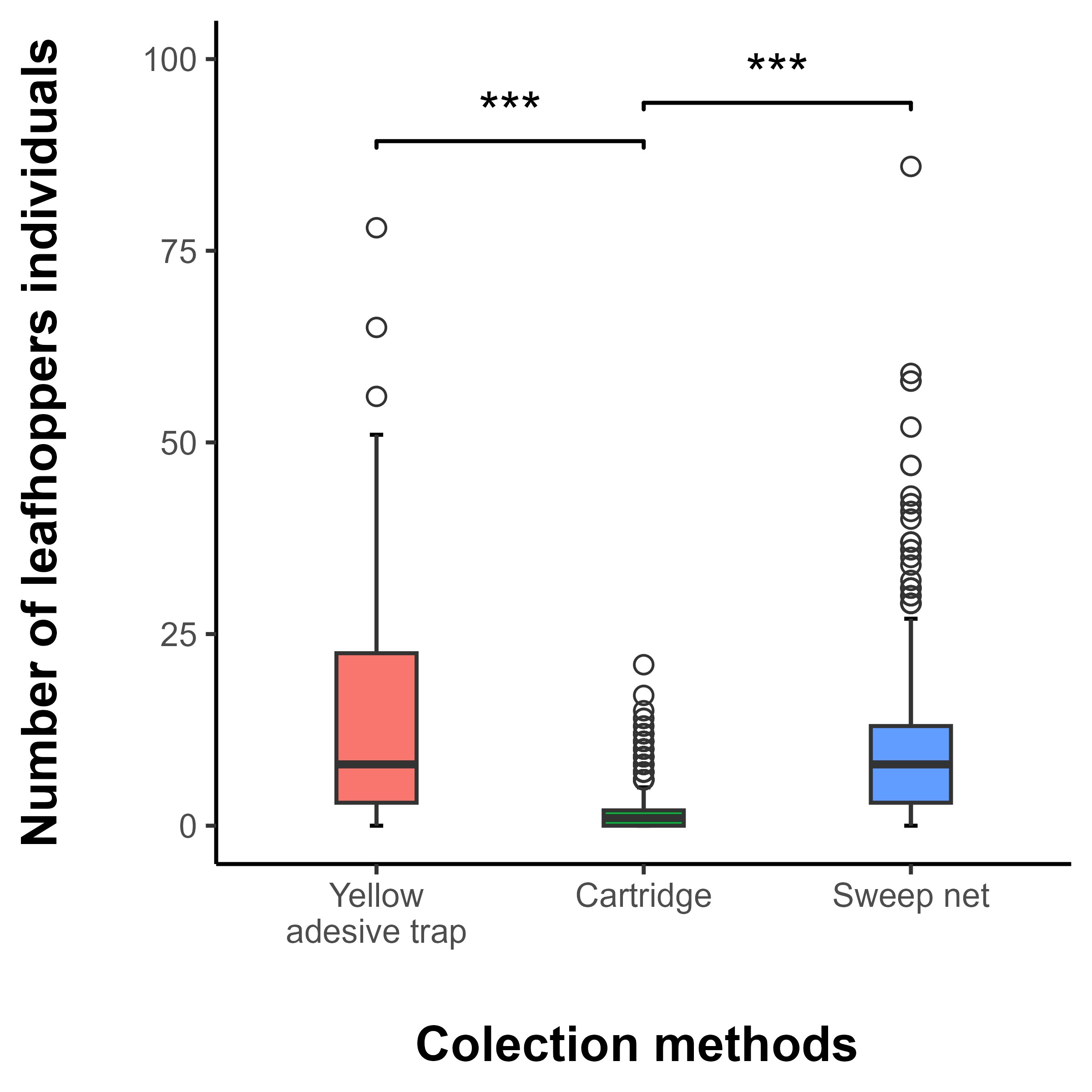
A total of 11,520 corn leafhoppers (Dalbulus maidis) were collected. Capture numbers varied significantly among sampling methods (χ2 = 3651.3, df = 2, p < 0.001) (Fig. 1). No significant differences were observed between morning and afternoon collections, regardless of sampling method (χ2 = 3.0, df = 1, p = 0.082) (Fig. 2). This consistency held true for both whorl examinations and sweep-netting approaches.
Number of leafhoppers Dalbulus maidis by sampling methods (Yellow adesive trap, cartridge and Sweep net). Boxplots followed by the same line indicate statistically significant differences by the adjusted generalized linear model (GLM) with Poisson distribution (Level of significance = 5%) Sep-2022 and Jun-2024. Sete Lagoas, 2024, MG, Brazil.
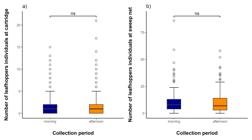
Number of corn leafhoppers D. maidis observed in cartridge a), and entomological sweep net b) at morning and afternoon. Boxplots followed by the same line indicate statistically significant differences by the adjusted generalized linear model (GLM) with Poisson distribution (Level of significance = 5%) Sep-2022 and Jun-2024. Sete Lagoas, 2024, MG, Brazil.
Through direct whorl observations, we recorded 2,999 individuals in morning samples and 2,723 in afternoon samples, totaling 5,722 leafhoppers. Sweep netting captured 2,415 specimens in morning collections and 2,426 in afternoon sessions (total 4,841). Finally, yellow sticky traps captured 957 individuals throughout the experimental period (Fig. 3). The number of corn leafhoppers recorded through direct whorl inspection was 6.0 times higher than that captured by yellow sticky traps. In addition, the sweep net captured approximately 5.1 times more individuals than the sticky traps. Direct whorl observations revealed positive correlations between D. maidis density and three climatic variables: temperature, relative humidity, and cumulative rainfall (Table 1). This indicates that peak insect densities occurred under warmer, wetter conditions with higher precipitation. Conversely, we observed negative correlations with wind speed and solar radiation, indicating that strong winds and intense sunlight reduce D. maidis presence in maize whorls. Sweep-netting collections showed a positive correlation between D. maidis density and cumulative rainfall, indicating that peak populations occur during the main maize growing season (Table 1). In contrast, yellow sticky traps demonstrated negative correlations with three climatic variables: temperature, relative humidity, and cumulative rainfall. These results indicate that warmer, wetter conditions with higher precipitation significantly reduce trap efficacy for monitoring D. maidis populations (Table 1).

Average ± standard error of weekly number of corn leafhoppers Dalbulus maidis observed in cartridge a), entomological sweep net b), and yellow sticky trap c), between Sep-2022 and Jun-2024. Sete Lagoas, 2024, MG, Brazil.
Correlation between the corn leafhopper D. maidis counting obtained through: (1) direct whorl observations, (2) sweep net sampling, and (3) yellow sticky traps, with measured environmental variables (temperature, relative humidity, wind speed, solar radiation, and accumulated rainfall). Sete Lagoas, Minas Gerais, Brazil, 2024.
Discussion
To advance the understanding of Dalbulus maidis behavior and field population dynamics in year-round maize systems—as well as to refine sampling strategies for IPM (Integrated Pest Management)—this study evaluated the efficiency of three sampling methods for D. maidis in maize. The investigation accounted for variations in sampling time and climatic data, aiming to correlate with insect population density. These questions are relevant to address a common concern in pest management: what time of day the insect is most exposed, either to improve sampling accuracy or to optimize insecticide application.
In line with Pinto et al. (2023), who investigated the effectiveness of direct counting on corn plants as a sampling method, our work advances by integrating analysis of the influence of time of day and weather variables on the capture efficiency of D. maidis. While other studies have focused on comparing techniques in different biomes, our research deepens the understanding of the temporal and environmental factors that modulate the detection of D. maidis in a continuous corn crop system. This multifactorial approach allows for a more robust evaluation of monitoring strategies, providing essential data to optimize not only sampling accuracy but also the effectiveness of future insecticide applications.
Despite differences in the total number of insects collected among methods, we observed no significant difference between sweep-net sampling and visual assessment in terms of detecting changes in leafhopper population. The two methods proved similar in this regard. Direct on-plant observation emerged as the most efficient method compared to the others evaluated. These findings align with Pinto et al. (2023), who reported comparable results when studying D. maidis sampling techniques: direct counts, plant-tapping over plastic trays, and white beating cloth . In this study, the authors evaluated the efficiency of three sampling techniques across two Brazilian biomes. The findings revealed that direct plant counting not only detected higher insect densities but also required shorter sampling times, a crucial factor when selecting pest monitoring methods. This logistical advantage for pest detection should be emphasized, as simpler methods typically reduce sampling error (Genizi et al., 1986)
The sampling efficiency for D. maidis was significantly influenced by climatic variables. These findings agree with previous studies indicating that higher temperatures and increased humidity favor the activity and dispersal of sap-sucking pests (Kocmánková et al., 2009; Beeraganni et al., 2014). Conversely, wind and solar radiation may inhibit insect feeding behavior and movement (Mazza et al., 1999). Solar radiation in particular plays a significant role in D. maidis abundance. Al Shidi et al. (2018) similarly found that infestation levels of sap-sucking insects, such as Ommatissus lybicus (Hemiptera: Tropiduchidae) correlated with solar radiation intensity.
Environmental factors, including humidity, temperature, and light, significantly influence insect behavior and physiology (Ramniwas et al., 2023; Li et al., 2024). These parameters directly affect population dynamics by modulating key biological rates, including development, survival, fecundity, and dispersal (Ramniwas et al., 2023).
Dalbulus maidis populations thrive in lower humidity environments. Heavy rainfall in tropical regions has been reported to negatively impact insect populations inhabiting plant canopies (Chen et al., 2019). These adverse effects result from both the mechanical impact of raindrops on canopy-dwelling insects, causing direct mortality (Norris et al., 2002), and rainfall disruption of mating and dispersal behaviors. Furthermore, humid conditions promote insect mortality through entomopathogenic fungal infections (Souza et al., 2021).
Temperature, precipitation, and humidity are known determinants of arthropod community composition, with variations in these factors driving population fluctuations across species (Rodrigues, 2004; Pellegrino et al., 2013). These environmental parameters serve as ecological predictors, as they regulate fundamental life-history behaviors including foraging, molting processes, and insect reproduction (Kontodimas et al., 2004; Ramniwas et al., 2023).
Light represents another key factor potentially influencing D. maidis population fluctuations, as insects rely on light cues for several biological functions, including circadian rhythms, photoperiodism, visual perception, and spatial orientation (Kim et al., 2018). However, our study found no significant effect of sampling time on either: (1) captured insect density or (2) field presence patterns. This consistency was observed across both direct whorl counts (which would reveal hidden insect aggregations) and sweep net sampling (which would reflect flight activity). Consequently, monitoring and control activities need not be restricted to specific daily time windows.
The highest population peaks of D. maidis were recorded in February and March, suggesting that, despite the year-round availability of maize, the species' population surge coincides with the cultivation period of second-season maize in the field.
In IPM programs, passive sampling methods like yellow sticky traps are widely recommended due to their ease of use and cost-effectiveness, particularly for large areas. They enable continuous monitoring without requiring the presence of collector. However, consistent with Pinto et al. (2023), our results demonstrate that this method showed weak correlation with actual D. maidis populations compared to active techniques. Yellow traps captured significantly fewer individuals than active methods, suggesting this approach may underestimate true pest densities in the field.
Both sweep net sampling and direct observation showed variation between morning and afternoon collections, though without significant differences between these time periods. This indicates similar population distribution patterns throughout the day. In contrast, yellow sticky traps exhibited lower overall capture efficiency but provided valuable data for continuous monitoring pest presence
Since no significant differences were found in insect collection between morning and afternoon periods, monitoring can be conducted during either time window. Likewise, insecticide applications could be conducted at either time of day, considering only the insect’s exposure. However, it is important to note that in the morning, temperatures tend to rise and relative humidity decreases. In contrast, in the late afternoon, temperatures drop, and humidity increases during the night. These conditions may enhance the effectiveness of insecticides (biological or chemical) on the plant, as the retention time of sprayed droplets on the leaf surface tends to be longer under higher humidity and lower temperature (Tian et al., 2020).
Finally, for more accurate monitoring, we recommend using active sampling methods combined with climatic factor observations, as these can serve as valuable predictors of field infestation levels.
Acknowledgments
We are grateful to CropLife Brasil ® for their financial support, as well as the Minas Gerais State Research Support Foundation (FAPEMIG) and the National Council for Scientific and Technological Development (CNPq) for scholarships.
References
-
Al Shidi, R. H., Kumar, L., Al-Khatri, S. A., Alaufi, M. S., Albahri, M. M., 2018. Does solar radiation affect the distribution of dubas bug (Ommatissus lybicus de Bergevin) infestation? Agriculture 8 (7), 107. http://doi.org/10.3390/agriculture8070107
» http://doi.org/10.3390/agriculture8070107 - Ávila, C. J., Oliveira, C. M., Moreira, S. C. S., Bianco, R., Tamai, M. A., 2021. A cigarrinha Dalbulus maidis e os enfezamentos do milho no Brasil. Plantio Direto 182, 1-8.
- Beeraganni, K., Meena, M., Shaikh, N. N., Kumar, N., 2014. Impact of climate change on insect pests. Trends Biosci. 8 (3), 597-600.
-
Carmo, D., Pinto, C. B., Lopes, P. H. Q., Paes, J. S., Souza, H. D. D., Santos, A. A., Cecon, P. R., Sarmento, R. A., Picanço, M. C., 2024. The first standardised sampling plan designed to scout Dalbulus maidis (Hemiptera: Cicadellidae) adults in corn crops using yellow sticky traps. J. Appl. Entomol. 149 (1), 111-120. http://doi.org/10.1111/jen.13365
» http://doi.org/10.1111/jen.13365 - Carpane, P. D., Catalano, M. I., 2022. Probing behavior of the corn leafhopper Dalbulus maidis on susceptible and resistant maize hybrids. PLoS One 17 (5), e0259481.
-
Chen, H., Chang, X. L., Wang, Y. P., Lu, M. H., Liu, W. C., Zhai, B. P., Hu, G., 2019. The early northward migration of the white-backed planthopper (Sogatella furcifera) is often hindered by heavy precipitation in Southern China during the preflood season in May and June. Insects 10 (6), 158. http://doi.org/10.3390/insects10060158
» http://doi.org/10.3390/insects10060158 - Companhia Nacional de Abastecimento – CONAB, 2023. Acompanhamento da safra brasileira de grãos. Brasília, DF.
- Crawley, M. J., 2013. The R Book, 2nd ed. John Wiley & Sons, Chichester.
-
Foresti, J., Pereira, R. R., Santana Júnior, P. A., Neves, T. N., Silva, P. R., Rosseto, J., Picanço, M. C., 2022. Spatial–temporal distribution of Dalbulus maidis (Hemiptera: Cicadellidae) and factors affecting its abundance in Brazil corn. Pest Manag. Sci. 78 (6), 2196-2203. http://doi.org/10.1002/ps.6842
» http://doi.org/10.1002/ps.6842 -
Gámez, R., 1973. Transmission of rayado fino virus of maize (Zea mays) by Dalbulus maidis. Ann. Appl. Biol. 73 (3), 285-292. http://doi.org/10.1111/j.1744-7348.1973.tb00935.x
» http://doi.org/10.1111/j.1744-7348.1973.tb00935.x - Genizi, A., Frankel, H., Palti, J., Ausher, R., Blazquez, C. H., Hochberg, R., Edelbaum, G., Sachs, Y., Dinoor, A., 1986. Pest and Disease Monitoring and Management. Springer, Berlin, p. 57-131.
-
Instituto Nacional de Meteorologia – INMET, 2024. Banco de dados meteorológicos. Available in: https://bdmep.inmet.gov.br/ (accessed 22 October 2024).
» https://bdmep.inmet.gov.br/ -
Kim, K., Song, H., Li, C., Huang, Q., Lei, C., 2018. Effect of several factors on the phototactic response of the oriental armyworm, Mythimna separata (Lepidoptera: Noctuidae). J. Asia Pac. Entomol. 21 (3), 952-957. http://doi.org/10.1016/j.aspen.2018.07.010
» http://doi.org/10.1016/j.aspen.2018.07.010 - Kocmánková, E., Trnka, M., Juroch, J., Dubrovský, M., Semerádová, D., Možný, M., Žalud, Z., 2009. Impact of climate change on the occurrence and activity of harmful organisms. Plant Protect. Sci. 45 (10), S48-S52.
-
Kontodimas, D. C., Eliopoulos, P. A., Stathas, G. J., Economou, L. P., 2004. Comparative temperature-dependent development of Nephus includens (Kirsch) and Nephus bisignatus (Boheman) (Coleoptera: Coccinellidae) preying on Planococcus citri (Risso) (Homoptera: Pseudococcidae): evaluation of a linear and various nonlinear models using specific criteria. Environ. Entomol. 33 (1), 1-11. http://doi.org/10.1603/0046-225X-33.1.1
» http://doi.org/10.1603/0046-225X-33.1.1 - Li, D., Brough, B., Rees, J. W., Coste, C. F., Yuan, C., Fowler, M. S., Sait, S. M., 2024. Humidity modifies species‐specific and age‐dependent heat stress effects in an insect host‐parasitoid interaction. Ecol. Evol. 14 (7), e70047.
- Mazza, C. A., Zavala, J., Scopel, A. L., Ballaré, C. L., 1999. Perception of solar UVB radiation by phytophagous insects: behavioral responses and ecosystem implications. Proc. Natl. Acad. Sci. USA 96 (3), 980-985.
-
Meneses, A. R., Querino, R. B., Oliveira, C. M., Maia, A. H., Silva, P. R., 2016. Seasonal and vertical distribution of Dalbulus maidis (Hemiptera: Cicadellidae) in Brazilian corn fields. Fla. Entomol. 99 (4), 750-754. http://doi.org/10.1653/024.099.0428
» http://doi.org/10.1653/024.099.0428 -
Nault, L. R., 1980. Mayze bushy stunt and corn stunt: a comparison of disease symptoms, pathogens host ranges, and vectors. Phytopathology 70 (7), 659-662. http://doi.org/10.1094/Phyto-70-659
» http://doi.org/10.1094/Phyto-70-659 -
Norris, R., Memmott, J., Lovell, D., 2002. The effect of rainfall on the survivorship of a biocontrol agent. J. Appl. Ecol. 39 (2), 26-34. http://doi.org/10.1046/j.1365-2664.2002.00712.x
» http://doi.org/10.1046/j.1365-2664.2002.00712.x -
Oliveira, C. M., Frizzas, M. R., Oliveira, E., 2021. Overwintering plants for Dalbulus maidis (DeLong and Wolcott) (Hemiptera: Cicadellidae) adults during the maize off-season in central Brazil. Int. J. Trop. Insect Sci. 40 (4), 1105-1111. http://doi.org/10.1007/s42690-020-00165-0
» http://doi.org/10.1007/s42690-020-00165-0 -
Oliveira, C. M., Lopes, J. R., Nault, L. R., 2013. Survival strategies of Dalbulus maidis during maize off-season in Brazil. Entomol. Exp. Appl. 147 (2), 141-153. http://doi.org/10.1111/eea.12059
» http://doi.org/10.1111/eea.12059 - Pedigo, L. P., Rice, M. E., 2008. Entomology and Pest Management. 6th ed. Prentice Hall, New Jersey, 784 pp.
-
Pellegrino, A. C., Penaflor, M. F. G. V., Nardi, C., Bezner-Kerr, W., Guglielmo, C. G., Bento, J. M. S., Mcneil, J. N., 2013. Weather forecasting by insects: modified sexual behaviour in response to atmospheric pressure changes. PLoS One 8 (10), 1-5. http://doi.org/10.1371/journal.pone.0075004
» http://doi.org/10.1371/journal.pone.0075004 -
Pinto, C. B., Carmo, D. D. G. D., Santos, J. L. D., Picanço Filho, M. C., Soares, J. M., Sarmento, R. A., Picanço, M. C., 2023. Sampling methodology of a key pest: technique and sampling unit for evaluation of leafhopper Dalbulus maidis populations in maize crops. Agriculture 13 (7), 1391. http://doi.org/10.3390/agriculture13071391
» http://doi.org/10.3390/agriculture13071391 -
R Development Core Team, 2024. A Language and Environment for Statistical Computing. R Foundation for Statistical Computing, Vienna. Available in: https://www.r-project.org/ (accessed 4 November 2024).
» https://www.r-project.org/ -
Ramniwas, S., Tyagi, P. K., Sharma, A., Kumar, G., 2023. Abiotic stress and physiological adaptive strategies of insects. Front. Physiol. 14, 1210052. http://doi.org/10.3389/fphys.2023.1210052
» http://doi.org/10.3389/fphys.2023.1210052 - Rodrigues, W. C., 2004. Fatores que influenciam no desenvolvimento dos insetos. Info Insetos 1, 1-4.
- Sabato, E. D. O., Karam, D., Oliveira, C. M., 2018. Sobrevivência da cigarrinha Dalbulus maidis (Hemiptera: Cicadelidae) em espécies de plantas da família Poaceae. Embrapa Milho e Sorgo, Sete Lagoas. Boletim de Pesquisa e Desenvolvimento 175.
-
Souza, D. A., Oliveira, C. M., Tamai, M. A., Souza, D. A., Oliveira, C. M., Tamai, M. A., Faria, M., Lopes, R. B., 2021. First report on the natural occurrence of entomopathogenic fungi in populations of the leafhopper Dalbulus maidis (Hemiptera: Cicadellidae): pathogen identifications and their incidence in maize crops. Fungal Biol. 125 (12), 980-988. http://doi.org/10.1016/j.funbio.2021.08.004
» http://doi.org/10.1016/j.funbio.2021.08.004 - Tian, Z., Xue, X., Cui, L., Chen, C., 2020. Droplet deposition characteristics of plant protection UAV spraying at night. Int. J. Precis. Agric. Aviat. 3 (4), 18-23.
-
United States Department of Agriculture – USDA, 2023. World Agricultural Production. Washington, D.C. Available in: https://apps.fas.usda.gov/psd/wap.aspx (accessed 10 July 2025).
» https://apps.fas.usda.gov/psd/wap.aspx -
van Nieuwenhove, G. A., Frías, E. A., Virla, E. G., 2016. Effects of temperature on the development, performance and fitness of the corn leafhopper Dalbulus maidis (DeLong) (Hemiptera: Cicadellidae): implications on its distribution under climate change. Agric. For. Entomol. 18 (1), 1-10. http://doi.org/10.1111/afe.12118
» http://doi.org/10.1111/afe.12118 -
Vilanova, E. S., Ramos, A., Oliveira, M. C. S., Esteves, M. B., Gonçalves, M. C., Lopes, J. R., 2022. First report of a mastrevirus (Geminiviridae) transmitted by the corn leafhopper. Plant Dis. 106 (5), 1330-1333. http://doi.org/10.1094/PDIS-09-21-1882-SC
» http://doi.org/10.1094/PDIS-09-21-1882-SC
Edited by
-
Associate Editor:
Marcelo Picanço