 Developing competencies in planetary health: integrating systems thinking and interconnection within nature into medical education
ABSTRACT
Introduction: There is a lack of teaching strategies to explore the Planetary Health (PH) domains of Interconnection Within Nature (IWN) and Systems Thinking/Complexity (ST/C). The Actor-Network Theory provides a pedagogical framework for this approach, as it discusses the inseparability of humanity/nature.
Objective: To assess medical students’ understanding of the PH domains of IWN and ST/C.
Method: Exploratory case study with sociodemographic questionnaires and open-ended responses spanning 2022 and 2023 involving two cohorts of medical students. Teachers were interviewed, classes were recorded, and assignments submitted by students were analyzed. Small student groups conducted patient interviews, presented PH portfolios, and developed network diagrams. IWN activities included a contemplative trail in the university garden or reflections on moments when students individually felt part of the planet.
Results: Ninety-six students (87% of 110 invited) and 9 teachers (100%) participated. Students demonstrated a comprehensive understanding of patients within their psychosocial and environmental context, describing the interconnections between various human and non-human actors throughout their case studies and network diagrams. The IWN activities were challenging, and a substantial portion achieved the goal of reflecting on the inseparability between nature and humanity, or people’s and the planet’s health.
Conclusion: The methodologies used for training the ST/C and IWN substantially contributed to students’ understanding of patients in a systemic PH perspective and the intrinsic relationship between nature, humanity, and health. This study highlights the importance of incorporating these teaching strategies to broaden students’ perspectives on PH.
Keywords:
Global Health; Environmental Health; Climate Change; Education, Medical, Undergraduate; Health Education
RESUMO
Introdução: Há uma falta de estratégias de ensino para explorar os domínios da Saúde Planetária (SP) denominados de Interconexão Através da Natureza e de Pensamento Sistêmico/Complexidade. A Teoria Ator-Rede oferece uma estrutura pedagógica para essa abordagem, pois discute a inseparabilidade entre humanidade e natureza.
Objetivo: Este estudo teve como objetivo avaliar a compreensão de estudantes de Medicina sobre os domínios Interconexão Através da Natureza e Pensamento Sistêmico/Complexidade da SP.
Método: Trata-se de um estudo de caso exploratório com questionários sociodemográficos e respostas abertas, realizado entre 2022 e 2023, envolvendo duas turmas de estudantes de Medicina. Professores foram entrevistados, aulas foram gravadas e as atividades submetidas pelos alunos foram analisadas. Pequenos grupos de estudantes realizaram entrevistas com pacientes, apresentaram portfólios sobre SP e desenvolveram diagramas de rede. As atividades de Interconexão Através da Natureza incluíram uma trilha contemplativa no jardim da universidade e reflexões sobre momentos em que os alunos se sentiram parte do planeta.
Resultado: Participaram do estudo 96 estudantes (87% dos 110 convidados) e nove professores (100%). Os discentes demonstraram uma compreensão abrangente dos pacientes dentro dos seus contextos psicossocial e ambiental ao descreverem as interconexões entre diversos atores humanos e não humanos ao longo de seus estudos de caso e diagramas de rede. As atividades de Interconexão Através da Natureza foram desafiadoras, e uma parte substancial alcançou o objetivo de refletir sobre a inseparabilidade entre natureza e humanidade ou a saúde das pessoas e do planeta.
Conclusão: As metodologias utilizadas para o treinamento em Pensamento Sistêmico/Complexidade e Interconexão Através da Natureza contribuíram substancialmente para a compreensão dos alunos sobre os pacientes sob uma perspectiva sistêmica de SP e a relação intrínseca entre natureza, humanidade e saúde. Este estudo destaca a importância de incorporar essas estratégias de ensino para ampliar as perspectivas dos alunos sobre a SP.
Palavras-chave:
Saúde Global; Saúde Ambiental; Mudanças Climáticas; Educação Médica; Educação em Saúde
INTRODUCTION
Planetary Health (PH) is a growing transdisciplinary field and social movement that addresses the intrinsic interdependencies between the health of humanity and the health of Earth’s ecosystems, seeking equity worldwide1),(2. Anthropogenic changes and climate change are known to be the greatest global health threats3 and the greatest opportunity in the 21st-century world4),(5. In 2022, a working party from the World Health Organization, resonating with the position of various international entities, launched a call to all involved in health education to ensure that graduating health professionals are capable of identifying, preventing, and responding to the health impacts of climate change and environmental degradation6),(7),(8),(9),(10. In Brazil, the 2014 National Curriculum Guidelines for Undergraduate Medical Programs state that students must consider the various dimensions of human diversity or social groups, including environmental aspects11.
In order to teach students a perspective characterized as ‘a planetary health lens’ the Planetary Health Educational Framework recommends that five main aspects are addressed: interconnection within nature; anthropocene and health; systems thinking/ complexity-based approaches; equity and social justice; and movement building and systems change12),(13. As a result, various didactic strategies in PH have emerged globally14, although predominantly with an emphasis on the domains of anthropocene and health and, in some cases, on movement building and systems change. Furthermore, few studies have been dedicated to the assessment of the implementation of educational strategies in PH.
The educational material ‘Patient and Clinic through the Lens of Planetary Health: Learning Guide for Undergraduate Health Education’15, developed by the authors as a result of international experience in the subject, stands out for delving into innovative teaching possibilities in the domains of interconnection within nature (IWN) and systems thinking/complexity-based approaches (ST/C) in PH using the perspective of Actor-Network Theory (ANT), a social science theory that discusses the division of humanity/nature and considers humans and non-humans acting in networks and producing society. ST/C refers to the description of how various elements interact and merge as part of complex systems (social, environmental, economic, among others) at different geo-spatial and temporal scales. IWN is a term recently coined in the field of PH, signifying that humans are part of and not separate from nature, in contrast to the dichotomous view of humanity or culture and nature13.
While another article broadly evaluated the learning of students16, this article aims to understand in deeper details the perceptions of medical students regarding the domains of IWN and ST/C through the perspective of ANT and by implementing the educational material ‘Patient and Clinic through the Lens of Planetary Health: Learning Guide for Undergraduate Health Education’.
METHOD
Study design
This is an action research study of an exploratory, cross-sectional case, employing a qualitative methodology.
Participants and survey
All teachers and students enrolled in a mandatory course during the third semester, which aims to integrate basic and clinical disciplines by interviewing patients, were invited to participate. The study was conducted at the Medical School of Universidade Federal do Rio Grande do Sul, Brazil, during August 2022 (class 1) and January 2023 (class 2). Students who did not provide consent or declined to participate were excluded.
The survey consisted of sociodemographic data and a questionnaire with open-ended questions about the experience and learning after the intervention17. Additionally, students and teachers were invited to write a word or statement summarizing their experience with the IWN activities. Also, classes were recorded and transcribed, and the assignments submitted by students were analyzed. Finally, the teachers participated in a collective evaluative semi-structured interview.
All participants completed the informed consent form, and the study was approved by the Ethical and Research Committee of Universidade Federal do Rio Grande do Sul (CAAE 57907022.3.0000.5347).
Intervention
The intervention in education comprised a 2-session module for Class 1 and a 3-session module for Class 2, lasting up to 3 hours each. Students were organized into small groups, each consisting of 8 students and 1 teacher, tasked with interviewing a patient admitted to the university hospital and creating a portfolio detailing their clinical case. During one of these sessions, the teacher facilitated IWN activities tailored to each small group.
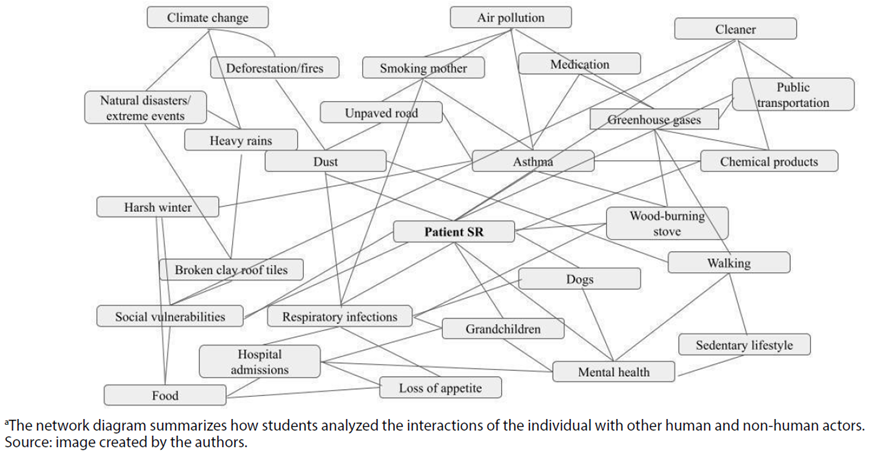
The complete portfolio15),(18 consisted of essay queries about the connections between the disease, the patient and PH topics (anthropocene and health), as well as about an individual and collective or advocacy approach. The final task involved creating a network diagram to visually depict the interconnections between the patient’s medical history and PH concepts explored throughout the portfolio aiming to describe the complexity of factors that occur in a society, including the action of non-human actors in its construction. Students were instructed to place the patient at the center of the diagram and illustrate connections with various actors present in the case, such as individuals, families, psychosocial dynamics, and environmental factors. Additionally, they were prompted to incorporate actors that are key PH themes, including air pollution, deforestation, climate change, natural disasters, equity, migration, food and water security, mental health, and infectious diseases.
The IWN session for class 1 featured an outdoor trail through the university garden situated in an urban setting, where students engaged with thematic posters made of cardboard and other repurposed materials to stimulate reflections. In contrast, class 2 IWN session involved reading a supplementary text, followed by students sharing personal photos or anecdotes within their small groups, depicting moments of interconnection within the planet. These variations in activities aimed to assess the feasibility of replicating methodologies. All session materials are accessible within the published educational resources15),(18.
Educational strategies for IWN and ST/C were developed grounded in the ANT, a sociological perspective challenging the dichotomy between humanity/culture and nature, considering humans and non-humans acting in networks and producing society. This approach holds particular significance in comprehending the interconnection (other than separation) between human health and the health of the planet19.
Data analysis
The qualitative data were analyzed with the support of NVIVO 1.5 software using Bardin’s content analysis with inductive analysis by themes. Frequency, mean, and standard deviation calculations were performed using Python version 3.6.9.
RESULTS
Overview
Ninety-six students (87%; class 1 n=43; class 2 n=53) and nine teachers (100%) were included. Of the 110 invited students, 8 declined to participate (class 1 n=7; class 2 n=1), and 6 students (class 1 n=1; class 2 n=6) were disqualified for not responding to the informed consent form or the instrument applied at the end of the intervention.
The majority of students were female (51 female, 44 male, and 1 other), white (66 white, 21 brown, 6 black, 2 yellow or indigenous, 1 non-responder), with an average age of 24.41 years (standard deviation ± 5.8 years), and with a family income between 5-10 minimum wages (33: 1-4 wages; 35: 5-10 wages; 27: 11 or more wages; 1: non-responder).
The ST/C and IWN domains are explained in detail below. While not emphasized in this study, the additional domains, namely anthropocene and health, equity and social justice, and building movements/systems change, were also interwoven throughout the students’ activities.
Systems thinking/complexity-based approaches
Each group of approximately 8 members (total 13 groups) interviewed a hospitalized patient (9 different patients, as some interviewed the same patient) at the university hospital and presented/delivered a portfolio about them. In the majority of network diagrams, students predominantly engaged in group work and constructed visual networks with a satisfactory number of elements and connections, problematizing the case within spheres both proximate and distant to the individual. Regardless of the visual diagram, students adeptly described the network in text throughout their Portfolio, narrating the connections from the individual to PH as they addressed the task’s questions, and during their presentations, sparking debate with teachers and researchers in PH.
We have chosen to present a condensed and adapted version of one of the students’ works for publication (Box 1; Figure 1). The patient’s name and age have been changed to preserve their identity.
Example of a network diagrama developed by the students about a patient they interviewed (adapted).
Students commented on how the activities allowed them to expand their perspective on health and diseases, for example: ”They could [the activities] enhance the understanding of the situations that permeate the patient’s life, from their pathologies to their social, economic, cultural, etc., context.”; “The context of life and diseases may be even more interconnected than I thought.”; “Investigating the patient’s engagement with the environment around them can reveal a lot about their health.”; and “Treating the patient within their context and not just focusing on the disease.”.
Interconnection within nature
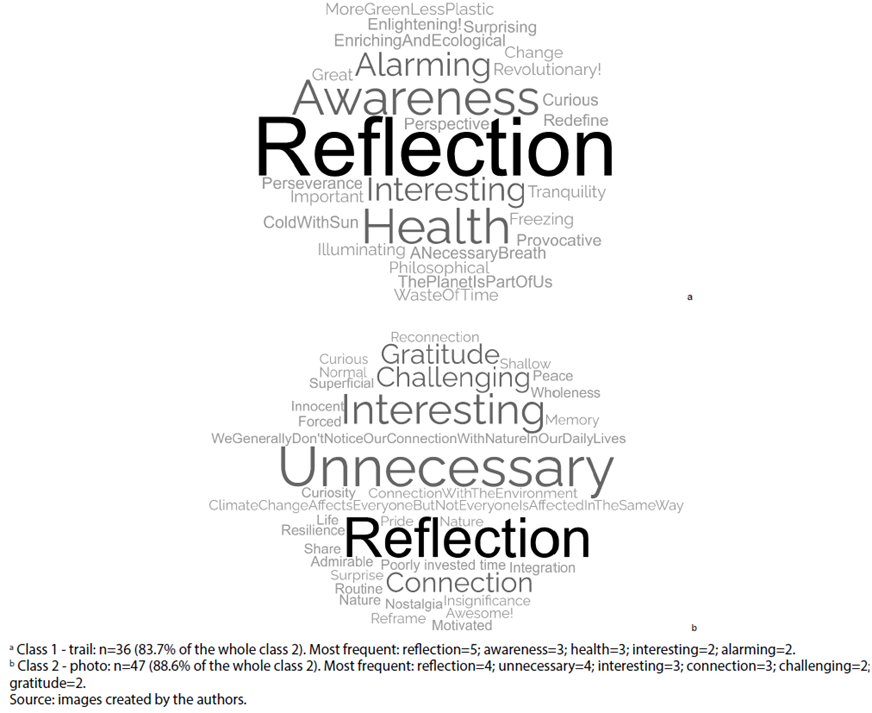
The general perception of the different experiences in the IWN activities is summarized in Figure 2. Students from class 1 (Figure 2a) wrote their responses on strips of paper at the end of the trail and deposited them in a box. Students from class 2 (Figure 2b) answered this question at the end of the last class, which was a different day the activity occurred and included students whose teachers were unable to develop or complete the activity.
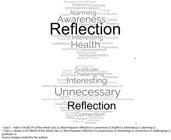
Word cloud composed of the responses that students gave about the activity for Class 1 - traila and Class 2 - photob on “IWN”, answering the question: “Write 1 word or expression about this experience.”
Interconnection within nature: trail activity (class 1)
The reflections and impressions about this activity were collected at two moments: immediately after the trail in a group conversation and in the general questionnaire about the complete intervention. Seven students expressed their understanding of the overall message of the experience, especially the relationship between health and the planet: “I found that the activity leads to a lot of reflection on things that we don’t usually stop to think about. I had never thought about the relationship between environmental problems and population health; I found this reflection relevant.”; “It’s not a matter of ‘let’s save nature’, it’s ‘let’s save our own society.’ The lifestyle we are having today is unsustainable and will collapse, and probably the most affected people will be those who have had the least access to this development.”; and “My word was perspective because it was a new look at medicine in the sense that we are also users of the environment, and it’s not just there to serve us; we are a part of it.”
Regarding the poster that questioned, ‘Is there a limit between nature and non-nature?’ their interpretations were (n=6): “When we think about nature, we see it as something external, as if we were not part of it. When that question arises, if there is a limit, we are also part of it, and sooner or later, this will also impact us. We are also part of this nature that is being degraded.”; “I found it very interesting because it even talks about how culturally we separated ourselves from nature, but actually, we are nature; we are in nature.”; “We are part of nature; we are animals. It’s for us to become aware of what we are doing.”; and “This impact is not an impact disconnected from us. We don’t realize this impact that comes back to us because everything is connected.”.
At the end of the trail, the final poster posed the question, ‘How about going down to earth?’ and depicted a rocket returning to Earth. Here are some interpretations and representations from students (n=5) and from a teacher: “People tend to look for more space, pursue extravagant efforts, and don’t seek to reduce what causes the problems.”; and “I thought of landfill and landing. We live so disconnected from the planet that it’s as if we were extraterrestrial beings on this planet, and ‘grounding’ would be realizing that we are part of this planet and that we need to live more harmoniously with it.”. Also:
We often tend to think that all resources are extremely limited. The solutions we usually seek when we think of extravagant ideas for future issues are about expansion rather than reform. So, I believe the concept of ‘grounding’ is very relevant here; we project these ideas far outward, like what NASA might do to provide us with more resources in the future. We need to focus more on what we actually have here and now.
Other posters that caught their attention were mainly about the healthcare sector’s carbon footprint, microplastics inside and outside the body, eco-anxiety and solastalgia, forest bathing, air pollution compared to smoking, calculating their own carbon footprint, and the food system. Discussions arose about energy sources, COVID-19, equity, and the possibilities and relevance of individual versus collective action. One student spoke about her experiential journey: “It’s interesting because we’re in the middle of a lot of trees next to the streets: this very mixed feeling of city and nature. I think it brought me a lot, this experience of walking around here slowly, thinking about where I am.”.
There was praise for the ludicity of the activity (n=1): “I think that something that needs to reach not only us as students but as human beings should be delivered in a more playful, less bureaucratic, and persuasive way: interactions like the ones we had in the forest.”.
Critiques were made regarding its apparent lack of depth (n=5) and aesthetics/sustainability (n=2), and one student expressed appreciation for the concept of finitude: “The information presented there was superficial and seemed to underestimate our ability to understand the subject.”; “In school, in the cultural products we consume many times, this is already brought up. This is a much more structural, superior issue that, no matter how much we take action, (...) the cause would be capitalism, the form of unequal exploitation.”; “The signs could have a better appearance.”; “Using cardboard gives the wrong idea of recycling because it only makes part of the material unusable in the recycling process.”; and “I liked the idea of finitude, found it beautiful.”.
Interconnection within nature: photos activity (class 2)
In this activity, students were supposed to comment on a photo and/or their experience of feeling part of the planet (provided supporting text on the subject). Two of 7 teachers reported not having carried out the activity with their small group of students due to a lack of time and/or suitable classroom space after carrying out the patient’s interview at the hospital. Students’ comments (1 positive and 5 negative) were extracted only within their general comments about the whole intervention, resulting in a few students commenting specifically about this IWN activity: “I found it very nice and connecting for the group.”; “Very subjective approach that consumes a significant amount of time.”; and “They did not contribute to the development of a discussion.”.
During the teachers’ collective interview, one teacher highlighted how the exercise allowed them to better understand their students. Based on an account from an indigenous student, she reinforced her idea of bringing indigenous individuals to the class next semester:
It was beautiful, very nice; the students bring things that we can’t even imagine! They brought their personal aspect; they had this discussion about the city, where they are, where they move around, the places where they felt connected. (...) He [indigenous student] presented his photo in the village with his father, mother, the forest behind, the houses... there’s nothing better than an indigenous person to talk about this, about the relationship between humans and nature! (...) so we could include by inviting 1 from each ethnic group, to speak about their reality.
One teacher shared how the exercise served as a bridge to address planetary health issues, and another emphasized that her guidance for the exercise facilitated a better understanding of the activity for the students:
Each student brought their digital photo, starting with a question about places where they felt good, nature-related things, and then moving on to more structural issues, such as the issue of plastic on the beach, ecological activism that some were already involved in, the issue of livestock and environmental impact, and matters of inequity. It was very interesting because, through the photos, they made connections with broader issues.
I asked them: I want a moment in your life when you felt like ‘nothing’ in relation to the world, in the sense of feeling like a grain of sand. They came up with some really cool things: a student who is a musician and was playing at a wedding, and it started raining... it was a moment when he felt very connected, as if nature was in the music; there was a girl who said she liked to walk, look at trees; one showed a photo of the sunset from the window, the change in the sky’s color.
One teacher did not report how their activity went, and one teacher emphasized the difficulty students had in reflecting on the humanity/nature topic:
I found it very interesting, but I feel they didn’t grasp the reflection well. One student showed a photo of herself at the beach, and on that day, it rained, so she had to go to a cabin with fishermen to seek shelter, and then it was like the connection with nature ended. I took that and asked: okay, but why did the connection with nature end? That’s exactly what we’re talking about, how our connection is always there, whether we’re at the beach or in the hospital.
DISCUSSION
The results indicated that the didactic methodologies used are quite useful for addressing the domains of IWN and ST/C. Students, in general, demonstrate the ability to see the patient integrally, both in their immediate and more distant context, describing the multiple interconnections among the various actors in their studied case throughout the portfolio and visually in the presented network diagrams. The IWN activities posed challenges to students and teachers, and not all students were able to fully benefit from what they proposed. However, a portion achieved the expected goal of reflecting on the inseparability between nature and humanity, or health and the planet.
To educate on ST/C, we have implemented the approach of a graphical visualization of an associative sociology, namely the ANT, which connects human and non-human actor-networks that influence each other in a chain of actions, as proposed in previous studies20),(21. This we referred to as the ‘network diagram’, which aligns with network science or medicine. It facilitates the understanding of health-disease determinants at both micro and macro levels, including biological, environmental, and social factors, challenging the traditional dualism of ‘bio’ as ‘hard science’ and ‘psychosocial’ as ‘soft science’22.
This exercise of network diagrams enabled a visualization of the individual’s context. Being hospital inpatients, some had risk factors strongly suggestive of an established disease, such as smoking in the case of Chronic Obstructive Pulmonary Disease. This sometimes led students to give less consideration to other risk factors such as air pollution. While not the main risk factor contributing to the development of that particular patient, the exercise encourages students to recognize that air pollution, for instance, acts as a risk factor for exacerbating the condition for that individual and also for the emergence of pathologies in all those exposed to it. Also, reflecting on the tobacco production process, for example, is also very useful in understanding how it harms both the individual and the environment. Broadening the medical student’s perspective to include collective care remains a challenge for contemporary medicine. Additionally, in a student case presentation, a debate on environmental racism arose, yet most network diagrams omitted the patient’s race, underscoring the need for educators to emphasize the role of race in the social determinants of health.
An IWN approach is essential when teaching PH13. We tested two pedagogical methods (the trail activity and the activity involving photographs), each with slightly different potentials, but sharing the same goal of diminishing the perceived gap between humanity and nature; health and planet. The traditional expression ‘connection/reconnection with nature’ comprises three domains: cognitive (knowledge about nature), affective (feelings and emotions towards nature), and experiential (actions and experiences with/in nature), which were addressed in the IWN activities23. The cognitive domain, unlike teaching about nature, was addressed with a focus on the interdependence between human health/society and the planet/nature, demonstrating that they are a unified entity; they are on the same side, with no ‘inside and outside’. During the activities, the aim was for the experiential or affective domains, as well as the construction of the network diagram, to contribute to reinterpreting this cognitive understanding.
This study deliberately used the term interconnection within nature13 instead of connection/reconnection with nature, as it highlights, based on the studies of sociologist and anthropologist Bruno Latour, that there are not two distinct types of existence, one natural and the other social. Instead, we are always dealing with hybrids, collectives of actors (networks): there is no such thing as something purely natural or untainted by the social sphere (and vice versa) to which one must connect or reconnect, but rather, it is essential to recognize these associations. Analogous to the nature/society dilemma, the separation between human health and the health of other non-human actors, whether living or non-living, is merely an appearance. Non-human actors are not inert or a background against which society unfolds; their agency has become increasingly evident in the Anthropocene. It is essential to form alliances with them if we wish to flourish. We believe that this terminology is not merely conceptual but highly affects how this central paradigm of PH is communicated and assimilated, guiding peoples’ actions24.
In addition, the expressions ‘grounding’ and ‘going down to earth’ were used throughout the trail. These expressions signify acknowledging that Earth’s resources are finite, and that the current way of living cannot be sustained for everyone. It serves as an invitation to adopt a more realistic way of life, encouraging the exploration of new ways to inhabit the planet25.
The trail faced some criticism for its ludic nature, for presenting information perceived as superficial, and even for its aesthetic sense, even though other students praised the activity. The negative interpretations demonstrate some students’ unfamiliarity with the method and underscore the necessity of more guided involvement by teachers during the trail. For instance, the poster depicting microplastics in the sea and in human organs was not only intended to inform about the existence and risks of microplastics, but also to provoke a rethinking of interconnection: destroying nature, which may seem distant, is in fact not as separate or ‘outside’ as it appears. The prevalent separatist belief between humanity and nature (or the health of the planet and people) sustains the collective illusion that the environment can be degraded without repercussions for humanity, as it would supposedly remain unaffected25.
Furthermore, the limiting belief that only more traditional classroom spaces are valid for higher education and that purely biological technical knowledge is the only relevant aspect, to the detriment of reflections on psychosocial and environmental subjectivities22, reinforced by the current medical education model, may partly explain the assessment of the trail. It is also possible that some students showed little openness to the activities due to not having allowed themselves to realize that what was being proposed differed from the traditional approach to environmental education and sustainability. This is because it advocates for interconnection with human health, addresses climate change, and includes a systemic view of the complexity of relationships and the perspective of inequity.
On the other hand, several students grasped the real intention of this IWN activity in the trail, having expressed their reflections on the relationship between humanity/nature and health/planet. One student’s comment exemplifies the maturation process of the raised issues, initially referring to humans as users of the environment and subsequently affirming our integral part of it: this initial term alludes to the idea of exploiting natural resources, thus displaying an entrenched attachment to a utilitarian mode of existence, in contrast to the notion of belonging, association, and interconnection, which is subsequently mentioned. Additionally, the activity catalyzed discussions on PH themes.
In conclusion to the IWN trail activity, it is noteworthy to mention a topic raised by a student regarding capitalism and its form of unequal exploitation, which is closely linked to social and environmental inequalities. While this is a debatable topic, the perspective advocated by Bruno Latour is that ‘developmentalism’ lies at the heart of the problem. This concept is present in both left and right-wing governments, and the solution involves each individual contemplating how they wish to inhabit this world25.
The IWN activity involving photographs highlighted similar issues concerning some participants’ disregard or unfamiliarity with reflective and subjective approaches. However, overall, this pedagogical strategy fostered group interaction by creating an intimate space for students and teachers, enabling students to narrate personal stories. Through this process, supported by the text and discussions with teachers, students reinterpreted their memories and perceptions of interconnection, leading to a deeper understanding of reality26.
It was common for students to share experiences about places with green or blue areas where they felt experientially interconnected, bringing them a sense of well-being. To help them recognize constant interconnections in all places, including urban areas, and understand how nature and society/humanity operate in association, blurring the lines between where one ends and the other begins20, teachers needed to stimulate this perspective. This approach was also challenging for the educators themselves. For those teachers who couldn’t conduct face-to-face discussions, the activity lost its meaning for the students. Dedicating more class time to IWN activities could potentially lead to a greater assimilation of the intended reflection.
As an outcome of the activity involving photos, a teacher expressed interest in inviting indigenous people to contribute to this class in upcoming semesters. This approach has a good potential, considering indigenous perspectives often dissolve boundaries between nature and themselves. They typically perceive that there is no separate entity known as ‘nature’ (and them); instead, they understand ‘the biosphere as infused with life and myriad forms of consciousness interconnected by symbiotic relationships that are crucial for the dynamic balance of the planet’24. It should be approached respectfully, with openness to listening and reflecting on how to integrate their teachings into Western life27, aiming for the desired educational impact.
This study contributes to the field of education in planetary health by thoroughly exploring didactic methodologies for the domains IWN and ST/C. It encompasses sociological/anthropological and philosophical interpretations that underpin the foundations of the subject and can be replicated in other universities. Limitations of the study include its execution in just one university (limiting its generalizability), with limited classroom time, and the impossibility to conduct additional data collection through interviews about the IWN photo activity, leading to less information to analyze this strategy in comparison to the IWN trail approach.
CONCLUSION
The current research illustrates that the didactic methodologies employed, integrating the ST/C was crucial for students to understand patients in a systemic and contextualized manner. Although the IWN activities presented challenges for both students and teachers, they were also very meaningful, as a portion of the students achieved the proposed objectives, contemplating the inseparability between nature and humanity, or health and planet.
ACKNOWLEDGMENTS
The authors would like to thank Enrique Falceto de Barros for his feedback on the article.
References
- 1 Whitmee S, Haines A, Beyrer C, et al. Safeguarding human health in the Anthropocene epoch: report of The Rockefeller Foundation-Lancet Commission on planetary health. Lancet. 2015;386(10007):1973-2028.
- 2 de Castañeda RR, Villers J, Guzmán CAF, et al. One Health and planetary health research: leveraging differences to grow together. Lancet Planet Health. 2023;7(2):e109-e111.
- 3 The Lancet. A Commission on climate change. Lancet . 2009;373(9676):1659.
- 4 Wang H, Horton R. Tackling climate change: the greatest opportunity for global health. Lancet . 2015;386(10006):1798-1799.
- 5 Clinicians for Planetary Health. One Earth. 2022;5(4):329-332.
- 6 WHO-CS Working Group to advance action on Health and Climate Change. A Call for Strengthening Climate Change Education for All Health Professionals. An Open Letter to Universities and All Education Stakeholders.; 2022.
-
7 World Organization of Family Doctors (WONCA). Accessed June 4, 2023. https://www.globalfamilydoctor.com/news/inmyviewdeclarationonplanetaryhealth.aspx
» https://www.globalfamilydoctor.com/news/inmyviewdeclarationonplanetaryhealth.aspx - 8 Shaw E, Walpole S, McLean M, et al. AMEE Consensus Statement: Planetary health and education for sustainable healthcare. Med Teach. 2021;43(3):272-286.
-
9 Declaration on Planetary Health. AFMC. Published April 12, 2023. Accessed June 4, 2023. https://www.afmc.ca/initiatives/planetaryhealthdeclaration/
» https://www.afmc.ca/initiatives/planetaryhealthdeclaration/ - 10 Omrani OE, Dafallah A, Paniello Castillo B, et al. Envisioning planetary health in every medical curriculum: An international medical student organization’s perspective. Med Teach . 2020;42(10):1107-1111.
-
11 Brasil. Resolução nº 3, de 20 de junho de 2014. Institui diretrizes curriculares nacionais do curso de Graduação em Medicina e dá outras providências. Brasília, DF: Ministério da Educação, 2014. Available at: http://portal.mec.gov.br/index.php?option=com_docman&view=download&alias=15874-rces003-14&Itemid=30192
» http://portal.mec.gov.br/index.php?option=com_docman&view=download&alias=15874-rces003-14&Itemid=30192 - 12 Stone SB, Myers SS, Golden CD, Planetary Health Education Brainstorm Group. Cross-cutting principles for planetary health education. Lancet Planet Health. 2018;2(5):e192-e193.
- 13 Guzmán CAF, Aguirre AA, Astle B, et al. A framework to guide planetary health education. Lancet Planet Health. 2021;5(5):e253-e255
-
14 Global Consortium on Climate and Health Education. Columbia University Mailman School of Public Health. Published January 18, 2017. Accessed June 4, 2023. https://www.publichealth.columbia.edu/research/centers/global-consortium-climate-health-education
» https://www.publichealth.columbia.edu/research/centers/global-consortium-climate-health-education -
15 Zandavalli RB, de Camargo T de, Stein AT, de Barros EF, Patrício KP, Abelson A. Pessoa E Clínica Sob as Lentes Da Saúde Planetária: Roteiro Para Educação Na Graduação Da área Da Saúde; 2022. Acessado em 29 de Dezembro de 2024. Disponível em:Disponível em: https://www.ufrgs.br/telessauders/documentos/planetaria/Vol1PessoaCl%C3%ADnica.pdf
» https://www.ufrgs.br/telessauders/documentos/planetaria/Vol1PessoaCl%C3%ADnica.pdf -
16 Zandavalli, R.B., Stein, A.T. & de Camargo, T.S. Systems approach in planetary health education for medical students: a mixed methods study. BMC Med Educ 24, 365 (2024). Accessed May 05, 2024. https://doi.org/10.1186/s12909-024-05341-1
» https://doi.org/https://doi.org/10.1186/s12909-024-05341-1 - 17 Floss M, Vieira Ilgenfritz CA, Rodrigues YE, et al. Development and Assessment of a Brazilian Pilot Massive Open Online Course in Planetary Health Education: An Innovative Model for Primary Care Professionals and Community Training. Front Public Health. 2021;9:663783.
-
18 Planetary Health - TelessaúdeRS-UFRGS. TelessaúdeRS-UFRGS. Published October 21, 2022. Accessed June 17, 2023. https://www.ufrgs.br/telessauders/saude-planetaria/
» https://www.ufrgs.br/telessauders/saude-planetaria/ - 19 Latour B, Centre de Sociologie de l’Innovation Bruno LaTour. Reassembling the Social: An Introduction to Actor-Network-Theory. Oxford University Press; 2005.
-
20 Barros EF de, Camargo TS de, Souza DO de. Actor network theory to map planetary health interconnections: a clinical case study. The Lancet Planetary Health. 2019;3:S2. doi:10.1016/S2542-5196(19)30145-7
» https://doi.org/10.1016/S2542-5196(19)30145-7 - 21 Barros EF, de Camargo TS, Stein AT, Abelsohn A, de Souza DO. Planetary health action framework: A case study. International Health Trends and Perspectives. 2022;2(3):106-123.
-
22 Greene JA, Loscalzo J. Putting the Patient Back Together - Social Medicine, Network Medicine, and the Limits of Reductionism. Published online December 21, 2017. doi:10.1056/NEJMms1706744
» https://doi.org/10.1056/NEJMms1706744 - 23 Zylstra MJ, Knight AT, Esler KJ, Le Grange LLL. Connectedness as a core conservation concern: An interdisciplinary review of theory and a call for practice. Springer Sci Rev. 2014;2(1-2):119-143.
- 24 Taddei R. Intervention of another nature: resources for thinking in (and out of) the Anthropocene. In: Ruby Press, ed. Everyday Matters: Contemporary Approaches to Architecture. ; 2022:124-141.
- 25 Latour B . Down to Earth: Politics in the New Climatic Regime. Polity Press; 2018.
- 26 Cunha MI da. CONTA-ME AGORA!: AS NARRATIVAS COMO ALTERNATIVAS PEDAGÓGICAS NA PESQUISA E NO ENSINO. Rev Fac Educ. 1997;23(1-2):185-195.
-
27 ReAct Latinoamérica Por un mundo libre de infecciones intratables. ReAct Latinoamérica. Accessed August 13, 2023. https://reactlat.org/
» https://reactlat.org/
-
11
Preprint deposit: 10/07/24 (https://doi.org/10.1590/SciELOPreprints.10070).
-
12
Evaluated by double blind review process.
-
SOURCES OF FUNDING
The authors declare no sources of funding.
-
DISCLOSURE STATEMENT AND FUNDING
The authors report no financial or non-financial conflicts of interest in this work and declare that no funding was obtained or used to produce this paper.
-
DATA AVAILABILITY STATEMENT
Data available on request from the authors.
Data available on request from the authors.
History
-
Received
07 Jan 2025 -
Accepted
13 Feb 2025 -
Preprint posted on
07 Oct 2024
10.1590/SciELOPreprints.10070