 The problem of radial free fall into a Schwarzschild black hole and its representation in Kruskal diagrams
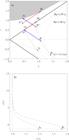
The analysis of the free-fall problem in Schwarzschild spacetime via spacetime diagrams offers a rigorous framework for understanding the behavior of coordinate and proper time functions associated with massive bodies undergoing radial free fall. This methodological approach underscores the pedagogical and analytical utility of such diagrams in representing worldlines, delineating causal relationships between events, and interpreting the nature of the Schwarzschild singularities. This study presents a detailed investigation of the free-fall scenario employing Kruskal–Szekeres diagrams, along with two case studies focusing on the relativistic perceptions of observers in free fall—either departing from the same radial coordinate at different coordinate times, or from distinct radial coordinates at a common coordinate time. During their trajectories, the observers exchange electromagnetic signals, and the reception of these signals forms the basis of their respective observational frameworks. The analysis reveals that, in both scenarios, the inferences drawn by each observer, relying solely on received signals, are mutually inconsistent. However, an interpretation based on invariant spacetime intervals and event-based analysis allows for an unambiguous determination of which observer crosses the event horizon first. The results highlight the significance of diagrammatic tools in elucidating key relativistic phenomena and in clarifying common misconceptions related to black hole physics.
Keywords:
Free fall; black hole; Schwarzschild metric; Kruskal diagram; Kruskal–Szekeres
 Thumbnail
 Thumbnail
 Thumbnail
 Thumbnail
 Thumbnail
 Thumbnail
 Thumbnail
 Thumbnail
 Thumbnail
 Thumbnail
 Thumbnail