 Social and emotional competencies in elementary school: a systematic review
ABSTRACT
The objective of this literature review was to map and characterize the scientific production of studies on social and emotional competencies, and related concepts regarding elementary school, between 2010 and 2019. After carrying out the steps recommended by the Preferred Reporting Items for Systematic Reviews and Meta-Analyses (PRISMA) group for conducting systematic reviews and meta-analyses, 66 studies were analyzed. Most were empirical studies, with a sample of students and included interventions. The most frequent social and emotional competencies were emotional regulation, emotional perception and social interaction. The results pointed to positive associations between social and emotional competencies and health, well-being, students’ academic performance and functional social interactions, and negative associations with anxiety, stress and burnout. The focus on elementary education may have left some studies out of this review given the diversity of terms to refer to the same educational stage in the countries where the studies were carried out.
Keywords:
Education; Elementary School; Emotional Intelligence; Literature Review; Social Skills
RESUMO
O objetivo desta revisão de literatura foi mapear e caracterizar a produção científica dos estudos sobre competências socioemocionais e conceitos correlatos no ensino fundamental, entre 2010 a 2019. Após etapas recomendadas pelo Grupo Preferred Reporting Items for Systematic Reviews and Meta-Analyses (PRISMA) para a condução de revisões sistemáticas e metanálises, 66 estudos foram analisados. A maioria era de estudos empíricos, com amostra de alunos, e incluía intervenções. As competências socioemocionais mais frequentes foram regulação emocional, percepção emocional e interação social. Os resultados da análise apontaram para associações positivas entre competências socioemocionais e saúde, bem-estar, rendimento acadêmico dos alunos e interações sociais funcionais; e associações negativas com ansiedade, estresse e burnout. O foco no ensino fundamental pode ter deixado alguns estudos de fora desta revisão em razão da diversidade de nomenclaturas para se referir ao mesmo estágio educacional dos países onde os estudos foram realizados.
Palavras-chave:
Educação; Ensino Fundamental; Habilidades Sociais; Inteligência Emocional; Revisão de Literatura
RESUMEN
El objetivo de esta revisión bibliográfica fue mapear y caracterizar la producción científica de estudios sobre competencias socioemocionales y conceptos en la escuela primaria, entre 2010 y 2019. Después de los pasos recomendados por el Grupo Prisma para la realización de revisiones sistemáticas y metanálisis, 66 estudios fueron analizados. La mayoría fueron estudios empíricos, con estudiantes y intervenciones. Las competencias socioemocionales más frecuentes fueron la regulación emocional, la percepción emocional y la interacción social. Los resultados apuntaron asociaciones positivas entre las competencias socioemocionales y la salud, el bienestar, el rendimiento académico de los estudiantes y las interacciones sociales funcionales; y asociaciones negativas con la ansiedad, el estrés y el Burnout. El foco en la educación primaria puede haber dejado algunos estudios fuera de esta revisión debido la diversidad de nomenclaturas para referirse a una misma etapa educativa en los países.
Palabras clave:
Educación; Educación Básica; Habilidades Sociales; Inteligencia Emocional; Revisión de Literatura
Socioemotional competencies (SEC) follow from the association of knowledge, skills and motivations for dealing with emotional content in different situations to improve the behavioral repertoire. The focus is on learning and continuous development to make the individual better able to cope with the many emotional demands found in today's society (Bisquerra Alzina and Pérez-Escoda, 2007).
The concept of SEC is related to that of emotional intelligence (EI) and social skills (SS). EI follows the tradition of studies on intelligence with a focus on cognition. The construct is considered from at least two perspectives: ability and trait. The first involves the cognitive and emotional domain of task performance and is a form of processing emotional information. The second view links EI to personality traits and motivations, increasing the complexity of the conceptual scope (Rivers et al., 2019).
The SS focus on interpersonal interactions that require a wide range of skills, including emotional ones. The context of socialization and culture demands specific emotional patterns from individuals. These skills converge in a common axis aimed to develop adaptive social interactions. This axis attempts to outline classes and subclasses of SS, such as the SS Portfolio, that includes ten classes (e.g., empathy, communication, friendship, assertiveness, among others), and the educational social skills (ESS), which highlight four broad classes and 32 subclasses (Vieira-Santos et al., 2018; Del Prette and Del Prette, 2021).
Adherence to the concept of SEC in this study, while recognizing its links with EI and SS, is attributable to its greater breadth in coordinating knowledge, skills and attitudes, and the inclusion of the ongoing learning dimension, i.e., the ground for acquiring a repertoire of competences. SEC is based on a constructivist and socio-evolutionary perspective related to child development (Saarni, 2002). This emphasizes primary school as a fruitful field for this learning.
Following a broader line of thought, emotional education and social emotional learning (SEL) proposed the formal teaching and learning of socioemotional skills and competencies at every stage of life. Bisquerra Alzina and Pérez-Escoda's (2007) model follows this proposal and presents a set of five blocks of competencies that guide emotional education: emotional awareness, emotional regulation, emotional autonomy, social competence, and life and well-being competences.
Based on this theoretical framework, several models have appeared in the literature focusing on skill development programs, especially for children and adolescents, such as the Collaborative for Academic, Social and Emotional Learning (CASEL), which has been implemented in schools in the United States. This model includes five domains: self-knowledge or self-awareness, self-management or self-control, social awareness, pro-social behavior, and responsible decision-making (CASEL, 2021; Frye et al., 2022).
AMIGOS ("friends", in English) stands for another SEC model in which each letter of the word represents a competence to be developed through a specific training program: Attention to emotions, Moment to relax, Ideas that help, Generate solutions, Be proud of your work, and Smile and remember to be brave and stay calm. The model is widely used with children, adolescents and adults, entailing positive results in reducing anxiety (Guancino et al., 2020).
This plethora of terms and concepts to address socioemotional development has led to a conceptual overlap. The concepts of EI, SS, and SEC are interrelated, with SEC having a more direct relationship with appropriate socioemotional performance given the situation (Oliveira et al., 2022).
Thus, the contextual and situational issue seems to be important for SEC. Mapping how the SEC is studied in the context of education may be relevant not only for conceptual refinement, but also for expanding the possibilities of application in emotional education interventions, especially in the early years of socialization at school.
From a theoretical point of view, the same interchangeable use of concepts related to emotional domains is observed in the field of education, i.e. there are those who refer to SEC, others to SS and still others to EI, pointing to positive effects on health, well-being and performance, whether of the teacher or the student (Cabello et al., 2010; Jennings et al., 2017; Primi et al., 2021).
Interest in the emotional development of students and teachers made its way in the international and national literature, despite still being scarce (Santos et al., 2018). In Brazil, the National Educational Bases and Guidelines Law (Brasil, 1996) does not emphasize this specific set of competencies, which some call soft skills (Morais, Gondim and Palma, 2020), and they not included in public policies. Nevertheless, some partnership-based initiatives are observed in public schools for curricular changes based on CASEL (Primi et al., 2021).
Teachers’ reports of student misbehavior suggest a deficit of social and emotional skills in this social group (Jennings et al., 2017). Examples of this are the aggression cases portrayed by the media (an internet search for "public school fight" shows more than three million results) and the involvement of youth in crime and risky behaviors, with a 39% homicide rate among youth aged 15 to 19 in Brazil in 2019 (Cerqueira et al., 2021).
This affective and relational difficulty in schools, more specifically faced by students and teachers, has been called the "pandemic of emotional illiteracy". It is associated with a theoretical shift in the field of education that remains neglected in many school curricula (Branco, 2004).
Considering the importance of the emotional domain in children's and adults’ individual repertoire, the following research question was formulated: How would scientific production on SEC be characterized in an educational context? To answer this question, our general objective was to map and characterize the scientific production of studies on SEC and related concepts in elementary school between 2010 and 2019.
This literature review is expected to provide a comprehensive overview of the SEC-related production, identifying the main research topics, methodologies used, conclusions, advances and limitations. It is also expected to help formulate policies related to emotional education and the training of elementary school teachers.
METHOD
The Web of Science, Scopus and Annual Reviews databases were selected to conduct the systematic literature review. Sources were selected based on the more than 14 thousand publications collected with the term "emotional literacy" in all indexes in 2021.
Considering the focus on SEC and related concepts (EI and SS), the following keywords were used for the English title and keyword search "emotional competencies", "emotional competence", "emotional intelligence", "social intelligence" and "social skills" together with the terms "education" and "teacher". The search period for articles was ten years (2010 to 2019). After search, three stages were conducted out as described below.
FIRST STAGE
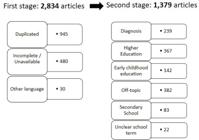
A total of 2,834 results were found (2,012 in Scopus, 821 in Web of Science, and one1 in Annual Reviews). Articles were selected following the Preferred Reporting Items for Systematic Reviews and Meta-Analyses — PRISMA Group (Galvão et al., 2015) guidelines. The first step of the analysis was to exclude duplicate articles, incomplete articles, articles that were not freely accessible at the time of the search, and articles that were not in English, Spanish, or Portuguese. These three processes resulted in the exclusion of 1,455 articles (Figure 1).
SECOND STAGE
The titles and abstracts were read to verify that articles met the inclusion and exclusion criteria (Figure 1).
The inclusion criteria were: i. the article should address the SEC or its correlates (EI and SS) exclusively in elementary school (or equivalent to elementary school in Brazil, i.e. from 1st to 9th grade, students’ age between six and 15 years); ii it should have teachers, students or both as the sample; and iii. no clinical diagnoses.
Exclusion criteria were: i. articles that referred to the population with any physical or mental limitation; ii. articles that referred to higher education and other later stages, including those whose audience was university teachers and students, as well as professionals in specific fields; iii. articles that were off-topic, i.e., did not approach the SEC and related concepts, neither referred to the teaching-learning relationship; iv. articles that used the concepts in early childhood education — kindergarten — or in secondary education, either exclusively or comprising all school levels (early childhood, elementary and secondary); finally, v. articles that did not specify the level of education to which they referred were excluded.
THIRD STAGE
After applying these criteria, 1,280 articles were excluded, leaving 99 for the full reading and evaluation stage. The selected articles were read in full by two reviewers who filled in a spreadsheet with the following items: title, authors, year of publication, empirical or theoretical article, participants, age group of students (regardless of whether the participants were students or teachers), school year studied, theoretical model, whether it was a training and, if so, how many measurements were taken to assess its effectiveness and whether there was a control group; finally, the main results. Spreadsheets were compared and in the few cases of disagreement, the article was discussed and evaluated together. After this stage, 23 articles were excluded, leaving 66 articles for this review.
RESULTS
Most of the 66 articles analyzed in this review were empirical studies (n=63) with a quantitative methodology (n=53). Half of the empirical studies were characterized as intervention studies (n=33), the majority of which used a control group (n=20) and a pre-post-test design (n=32); of these, only six included follow-up measures.
There were more studies on SS (n=31), followed by EI (n=19), and finally SEC (n=16). The year 2018 had the highest number of publications (n=15), and students made up the predominant target population (n=31).
Three temporal phases were identified that mark the evolution of studies on the three topics covered by this review (EI, SEC and SS) (see Figure 2): phase 1, called "exploratory", covered the period from 2010 to 2012 and was characterized by few studies on the topic, although it signaled an annual growth in publications; phase 2, called "unstable", from 2013 to 2016, was characterized by an oscillation in the number of publications; finally, phase 3, of "recovery", referred to the last three years (2017 to 2019), in which an increase in the number of publications was observed with some stabilization. The three phases are described in more detail below.

PHASE 1: EXPLORATORY
This phase includes 11 articles (2010 to 2012), one of which is theoretical and the others empirical. Five of the empirical studies are intervention studies. As for the target population, students prevailed (n=5). SEC and SS were addressed by four studies each and EI by three studies.
Table 1 shows details of the articles in this phase. It organizes the studies by theoretical model, authors and main findings. For the purpose of presenting the results, article description has been organized according to the phenomenon approached.
At this stage, the papers on SEC were mainly characterized by protective factors, such as the prevention and control of drugs in schools (theoretical articles), and the SEC needed in social interactions between peers and between students and teachers, such as the recognition, expression and regulation of emotions (Hosotani and Imai-Matsumura, 2011; Law and Lee, 2011; Ambrona Benito, López-Pérez and Márquez-González, 2012).
The two SEC interventions used a control group and pre-post-test design, with only one conducting follow-up in a longitudinal study with students. Both have been shown to be effective in developing the proposed SEC, substantially reducing behavior problems and increasing awareness of emotional processes (Ambrona Benito, López-Pérez and Márquez-González, 2012; Brackett et al., 2012).
EI was the subject of three articles, all empirical (no intervention), two with teachers and one with teachers and students. Most studies reviewed associated EI and intra- and interpersonal emotional aspects, focusing on the relationship with the work context and coping (for teachers) and with disruptive behavior (for students), from the teachers’ perspective. Two of the three studies (Augusto-Landa, López-Zafra and Pulido-Martos, 2011; Garrido and Pacheco, 2012) adopted the skills model.
There were four studies on SS, all of them empirical and most of them with students (n=3). There was a great diversity in the SS proposed by the studies; a focus on interaction (e.g., skills for making friends, fair play, how to respond, refuse, and report bullying), cognition (e.g., verbal and nonverbal memory and intelligence), emotions (e.g., self-esteem, depression, and anger), and attitudes (e.g., motivation, attitudes toward school) was observed. Half of the articles presented the theoretical models that served as a reference for the studies (Christodoulides et al., 2012; Rickard, Bambrick and Gill, 2012).
There were three interventions with a pre-post-test design and two with a control group. The results highlighted that interventions may be effective in developing SS in students, whether it is a computer game or a more collaborative teaching style, including in relation to bullying (Rubin-Vaughan et al., 2011; Ebrahim, 2012).
PHASE 2: UNSTABLE
This phase encompasses 24 articles (2013 to 2016), all of which are empirical in nature, with 12 describing interventions and one validating a measure. Students were the main audience of these papers (n=8). Regarding the concepts discussed, the majority focused on SS (n=14) (see Table 2). The results of this phase were also pooled by the concepts of SEC, EI or SS.
Of the four articles on SEC, all were empirical, with two interventions and one measurement validation study. The studies were divided between two categories: those conducted with teachers alone and those conducted with teachers and students (n=2 each). The majority of the studies adopted extant SEC models from the literature, namely FRIENDS, emotional education and CASEL.
In relation to the interventions, one focused on the students’ SEC as perceived by teachers, while the other focused on the teachers’ SEC. Both studies employed a pre-post-test design; however, only one of them implemented a follow-up phase and did not use a control group (Iizuka et al., 2014), while the other adopted a quantitative methodology (Pérez Escoda et al., 2013). The interventions were deemed effective.
The relationship between SEC and the work context was emphasized in the studies involving teachers. When the teacher-student dyad was studied, teacher perception and student self-perception of SEC were highlighted.
The six articles on EI describe empirical studies, of which three are interventions and all adopt a pre-post-test design. The only intervention that does not adopt a control group is also the only one to carry out follow-up (Hen and Sharabi-Nov, 2014). Teachers make up the target audience for most of the studies (n=4).
EI is commonly defined as the perception, understanding, evaluation, regulation, expression, and use of emotions. Only one study employed the concept of socioemotional intelligence, distinguishing its focus from that of the other studies (Karimzadeh et al., 2014). The bulk of the studies adopted a skills model to approach EI (n=3).
The studies focusing on teachers centered on interventions (n=2) and associations between EI and other variables related to mental health and the work context (n=2). The concept of EI proved to be developed through training and to serve as a protective factor in relation to mental health and stress in teachers (Hen and Sharabi-Nov, 2014; Karimzadeh et al., 2014; Ju et al., 2015; Pulido-Martos et al., 2016).
In studies with a sample of students, interest was in the development of EI (Kim and Chung, 2014). When the target audience included teachers and students, the focus was on the impact of teachers’ EI on students’ academic performance (Curci, Lanciano and Soleti, 2014).
As for the articles on SS (n=14), all were empirical studies, and half were interventions. Students were the target audience of seven studies. The variability of SS was also observed at this stage, with a perceived affective (e.g., empathy, self-control, emotional regulation), behavioral (e.g., internalizing, externalizing behaviors, assertiveness), relational (e.g., fair-play, interpersonal relationships, civility, communication) and academic (e.g., performance, respect for rules, academic competence) focus.
Three studies did not use the SS concept; one study examined protective factors for students in relation to bullying and emotional problems (Leadbeater, Thompson and Sukhawathanakul, 2016), and the other two adopted the concept of social competence (Akgun and Araz, 2014; McQuade et al., 2016). It should be noted that only two studies did not provide a detailed explanation of the SS model they adopted (Tan et al., 2013; Zorza et al., 2016). Furthermore, two other studies employed their own models (Zorofi, 2013; Gil-Madrona et al., 2016). The model developed by Del Prette and Del Prette emerged as the most prevalent among the articles (n=2).
With regard to the interventions, it is noteworthy that all of them had a control group and a pre-post-test design; only two had a follow-up measure, one of which was longitudinal (Derri et al., 2014; Leadbeater, Thompson and Sukhawathanakul, 2016). All the interventions included students, either exclusively (n=3), as part of the teacher-student dyad (n=2), or including parents (n=2).
The field of physical education was frequent among the articles, both related to intervention (Derri et al., 2014; Akelaitis and Malinauskas, 2016; Gil-Madrona et al., 2016) and associative (Saiz Panadero et al., 2016). Not all training has been considered effective in developing students’ SS (Da Silva et al., 2016).
When teachers and parents were included in the surveys, the focus shifted to their perspective on students’ SS and possible associations with dysfunctional behaviors, educational context variables, and sociodemographic variables.
PHASE 3: RESUMPTION
This phase comprises 31 articles (2017 to 2019), of which only two are theoretical studies. Of the 29 empirical articles, 16 were interventions. As for the target audience, the majority conducted the study with students (n=18). In terms of concepts, the majority dealt with SS (n=13). Table 3 discloses the characteristics of the studies in this phase, with the results of this review pooled by the concepts of SEC, EI or SS.
Of the eight articles dealing with SEC, the majority focused on students (n=3). At this stage, reference to consolidated models remains, with emphasis on emotional education. Of the empirical articles (n=7), three were interventions. All had a pre-post-test design (none with a follow-up measure), and only one of the intervention studies did not adopt a control group (Sánchez Calleja, Rodríguez Gómez and García Jiménez, 2018). The interventions focused on different audiences and were considered to be effective.
The SEC studies with students focused on emotional education, developing SEC and relating it to health (self-esteem and anxiety), classroom climate and academic performance (grades). When teachers were the target audience, the focus was on emotional learning and the perception of emotional teaching, as well as the relationship with burnout and social support.
By working simultaneously with teachers and students, the influence of teachers’ preparation toward developing students’ SEC was investigated. When parents were included in the survey, the focus was on the others’ perception about students’ SEC, highlighting the complementarity of these roles for emotional education (Márquez-Cervantes and Gaeta-González, 2018).
The articles on EI (n=10) were empirical, with four interventions, all with a pre-post-test design, and only one longitudinal study had a follow-up measure (García et al., 2018). Two of the four interventions employed a control group. As for the target population, students prevailed (n=9).
In the other studies, coping mechanisms, family climate, executive functions, academic performance, and sociodemographic profile emerged as salient factors, yielding results analogous to those previously described: EI exhibits a positive correlation with adaptive aspects and a negative correlation with maladaptive ones.
Two articles measured EI in physical education classes, showing that the practice of physical activities is positively and significantly associated with a better emotional domain (Amado-Alonso et al., 2019), favoring its development (García et al., 2018).
The Traits model (n=7) was the prevailing theoretical framework for EI in this context, while one article adopted the Multiple Intelligences model and assessed EI through intra- and interpersonal factors (Rebollo Goñi, 2017).
The sole study involving teachers examined a novel model of teaching competences, one of which was EI (Susanto, Asmi Rozali and Agustina, 2019). With regard to the studies conducted with students, they all examined the relationship between EI and other variables. Intervention studies on both EI and SEC have demonstrated efficacy in reducing bullying and negative affect, while increasing academic performance and positive affect.
Finally, of the 13 articles on SS, only one adopted a theoretical approach (Siddiqui and Ventista, 2018). Of the 12 empirical studies, nine were on interventions, with the majority targeting students (n=6). The studies also showed conceptual diversity in relation to SS, with a focus on the affective dimension (e.g., expression of feelings, intensity of emotions, empathy, emotional management, school stressors), behavioral (e.g., pro-social behaviors, appropriate behavior when winning, when losing, during a game, aggressive behavior, assertiveness), and relational (e.g., fair-play, communication, conflict resolution, socialization).
The majority of the studies (n=10) employed a model of SS, while only one study employed the concept of social skills (Morrow, Hubbard and Sharp, 2019). The most prevalent models among the articles were by Gutiérrez-Marín et al. (2017, n=2) and Del Prette and Del Prette (2021, n=3) (Jovarini et al., 2018; Da Silva et al., 2018; Cintra and Del Prette, 2019; Gil-Madrona et al., 2019; Navarro-Patón et al., 2019).
Of the nine intervention articles, only one did not employ a pre-post-test design (Cañabate et al., 2018), and of those that adopted this design, three performed follow-up. Only two included a control group (Miller et al., 2017; Da Silva et al., 2018). Notably, one training was not deemed effective in developing SS, despite its significant association with an increase in positive emotions among participants (Cañabate et al., 2018).
Most of the studies with students were intervention studies (n=6) and looked for links with affective aspects, bullying, performance (motor and academic), school stressors, and appropriate physical activity behaviors.
When the studies kept the students and expanded the audience (parents and teachers), they sought their perceptions of the students’ SS, monitoring post-intervention or one-time changes. The only study with teachers applied an intervention considered effective for the development of SS in this audience (Cintra and Del Prette, 2019).
DISCUSSION
The studies reviewed were divided into three phases, with changes in terms of approach, target audience, and survey focus. Phase 1 was characterized by fewer studies than phase 3, suggesting the growth of surveys on emotion in the field of education. Interest in SS remained high throughout the three phases, in contrast to EI that gained prominence beginning in phase 2. The number of studies on SEC remained similar across the three phases.
In terms of target audience, the triad of teachers-parents-students was the only one absent in phase 1, and it was also not the focus of research in the other phases. The survey with teachers maintained some regularity across the phases and was concerned with the health/disease and well-being of the teacher as a worker and how it associates with variables related to work (e.g., commitment) and personal ones (e.g., coping and empathy). Students were of primary interest in all phases, having an emphasis on phase 3. Except for EI where the focus in Phase 1 was on teachers, the focus shifted to students in phase 3.
This change broadened the relationship between EI and students’ academic performance (grades), inappropriate behavior (aggression, bullying), affect (negative and positive), personal aspects (empathy, subjective well-being, anxiety, and executive functioning), and social aspects (family climate, social adjustment, and social skills). This may indicate that students’ emotional domain should be considered taking into account the groups with which they interact and that influence their educational development, such as parents and teachers.
With regard to SEC, teachers and the teacher-student dyad were studied in all phases. In phase 1, students were studied more, while in phase 3 all target groups, including the triad, were expanded. The studies with students emphasized the protective function and the SEC required during social interaction between peers.
This broadening of audiences from phase 2 onwards showed a concern for the mental health of teachers, linking emotions to other variables of professional interest. Those studies focused on the teacher-student dyad, and also those including parents, sought a broader view of the context, such as the classroom climate and the family-school relationship, while still measuring individual variables. Literature shows that inappropriate behavior in the classroom is one of the most emotionally draining factors for teachers (Taxer and Gross, 2018). This fact was also observed in this review.
In terms of SS, interest in students was prominent in all phases and in the dyad from Phase 2 onward. The triad was more representative in phase 2, and only in the phase 3 were articles exclusively focused on with teachers found. Surveys with students mapped different relational skills, presenting SS as a large conceptual umbrella (Tallamini et al., 2022). In contrast to the SEC or EI, which have models with structured elements, the SS are defined more broadly, expressing contextually and culturally appropriate behavior.
An analysis of intervention studies shows a progressive increase over the three phases. Interest in EI interventions began in phase 2 and increased significantly in phase 3. The same happened with SEC interventions, partly due to the focus on emotional learning (Bisquerra Alzina and Pérez-Escoda, 2007; Wigelsworth et al., 2022).
However, it should be noted that the majority of intervention studies in the three phases had SS as their theoretical basis, with a significant increase in phase 2. It is clear that SS are acquired through training (Del Prette and Del Prette, 2021) and have produced positive effects in reducing bullying and aggression and improving academic and emotional performance.
The methodological improvement of interventions was noticeable throughout the three phases, although in different ways for each approach. In EI, for example, from phase 2 onwards, all the intervention studies had a pre-post-test design and most included a control group. For the SEC and SS studies, however, there was a reduction in this rigor. Although most studies had a pre-post-test design, the presence of a control group decreased from phase 2 onwards for SEC and in phase 3 for SS.
Analyzing the theoretical-conceptual aspects of the three constructs studied in this review, although the concept of EI has been measured with different aspects over the years, it maintained some constant characteristics, such as a state of alertness to emotions (one's own and those of others), the ability to regulate them and also to use them appropriately.
The theoretical models of EI were identified as early as in phase 1, but there has been a change over the years: in the initial phases, the skills model prevailed, and in the last phase, the traits model. This result asserts the tension that still exists in the field of EI, since it considers both the perspective of personal traits and skills that are acquired through training. This rebounds on the definitions adopted by the authors and the instruments used (Woyciekoski and Hutz, 2009; Rivers et al., 2019).
The concept of SEC has been measured using different models over time, but from phase 2 onwards the use of models already defined in literature such as Bisquerra, CASEL and FRIENDS was strengthened, which may justify the similarity of what has been measured over the years. The validation of measures also appeared in this period. These aspects would allow us to infer a quest to consolidate the concept of SEC, distinguishing it from other constructs.
As far as SS is concerned, most of the studies showed the model adopted, with phase 2 standing out as having the most models and, based on it, the adoption of the same model by more than one article was identified.
In brief, temporal phases showed greater clarity of theoretical models, a change in the target audience and, thus, possible relationships between EI, SEC and SS with other variables, as well as a growing interest in intervention studies. Some points, however, are worth highlighting in an independent joint analysis of the phases.
The first of these refers to the terms and expressions used in the search for articles that, although not synonymous, presented similar results, reaffirming the interrelationship between these concepts. EI, especially the trait model, emphasizes the notion of emotional intelligence competencies (Bonesso et al., 2020), and authors in the field of competencies also admit to an approximation with this model (Bisquerra Alzina and Pérez-Escoda, 2007).
The elements or competences measured in the studies approached are similar, as they generally cover emotional perception and recognition, and the regulation and use of emotions. There seems to be a convergence that SEC involves emotional regulation and some level of awareness (emotional or social), contributing to students’ academic performance, a more favorable classroom climate, and teachers’ health and well-being.
EI seems to generally involve emotional perception and the management/regulation of emotions. In the school context, it contributes to students’ academic performance and also to teachers’ health and well-being. Studies on SS, on the other hand, differ more in their elements, focusing on social interaction, but not disregarding the emotional side, as evidenced in the articles reviewed. A theoretically predicted common axis was also observed (Del Prette and Del Prette, 2021).
In general, the results of the studies showed that EI is an attribute of both teachers and students (trait model), and that it is related to health, well-being and performance of both students and teachers. In addition, the out-of-class context was also considered (Alharbi, 2018). EI seems to play an important role in the development of pedagogical skills and effective teaching (Karimzadeh et al., 2014; Susanto, Asmi Rozali and Agustina, 2019).
This diversity of results highlights the contribution of EI to general life satisfaction and, in the school context, the benefits for students, teachers and the environment. On the other hand, they do not allow us to say what they actually predict (Woyciekoski and Hutz, 2009).
The few studies found on SEC suggest an approach that is still under construction, although it expands the understanding of the emotional domain scope. However, there is a convergence in the adoption of theoretical models. The findings on SEC show that there is room in literature for a conceptual discussion, the construction of measures, the adoption of training as a means of improving the teacher-student relationship and, therefore, the teaching and learning.
According to Morente et al. (2017), students’ SEC can predict self-esteem, academic performance and a favorable social climate in the classroom, as well as reduce anxiety. The supportive environment provided by the teacher favors emotional learning and, consequently, the development of SEC, minimizing behavior problems and student aggression (McQuade et al., 2016; Portnow, Downer and Brown, 2018).
Common SS models were identified in articles within and between phases, such as Gresham and Elliott (1990), Monjas (2006; 2012), Gutiérrez-Marín et al. (2017) and Del Prette and Del Prette (2021). Some articles on physical education have adopted the same model, measuring social skills using the Student's Behaviours’ Self-Evaluation Scale in different phases, while others adopted the Social Skills Rating System or were based on the scale's authors.
Although this theoretical diversity is widely discussed in literature, there are efforts toward greater delimitation, such as the prediction of two main axes (desirable and undesirable behaviors), the SS portfolio, with which the results of this review agree (Del Prette and Del Prette, 2021), and ESS, but which, like Tallamini et al. (2022), were not explicitly found in this review and constitute a concept that needs further delimitation (Vieira-Santos et al., 2018).
The predominance of students as the main target group is in line with the findings of Tallamini et al. (2022). With regard to teachers, the focus on workers’ mental health is in line with the interest of studies in the benefits of SEC and EI, not only for teachers, but also for the well-being of students (Bisquerra Alzina and López-Cassà, 2021).
The studies that looked at the teacher-student dyad contributed to four aspects of this interaction: i. the generalization of socioemotional learning to other contexts; ii. teachers’ perceptions of students’ variables; iii. the impact of teachers’ characteristics on students; and iv. the socializing role of teachers in developing students’ skills. Items i. and ii. include studies with parents.
One point criticized in literature and found in this review is the use of grades, especially as an exclusive parameter to measure student and teacher performance (Ballou and Springer, 2015). However, the evidence that shows that EI predicts students’ academic performance (Castro et al., 2021) should be considered.
Bullying and aggression were highlighted in the studies reviewed, indicating the importance of SEC, EI or SS in reducing this type of behavior, also portrayed in the media. This suggests a deficit in students’ socioemotional skills/competences (Branco, 2004).
There has been an interest in studies of interventions in EI, SS and SEC. This provides evidence that they are effective in developing socioemotional skills. Emotional learning is independent of the characteristics that favor its development (Bonesso et al., 2020).
The proposed interventions were successful in increasing recognition and understanding of both simple and mixed EI emotions, adaptive skills, academic performance, positive affect, well-being, empathy, social adjustment, and attention to feelings. Assertiveness, use of regulatory strategies, communication, cooperation, social adjustment, institutional climate and effective teaching also increased following the interventions.
Variables such as aggression, negative affect, conduct symptoms and behavior problems (internalizing and externalizing problems) also decreased after the interventions. There were controversial results regarding anxiety (Iizuka et al., 2014; Luna et al., 2019), suggesting that the type of training and the characteristics of the target group may have an impact on the greater or lesser effectiveness of socioemotional training. These findings are consistent with the recognition in literature of the effectiveness of interventions aimed at promoting socioemotional learning (Tallamini et al., 2022; Wigelsworth et al., 2022).
Another highlight in the intervention-related articles was the inclusion of the control group in pre-post-test designs, helping to strengthen the evidence of their effectiveness. Pre- and post-measurements allow identifying the acquisition of learning, and those that provide for follow-up broaden the understanding of long-term learning retention. Follow-up is still infrequent in research (Del Prette and Del Prette, 2021), which was also found in this review. Long-term learning indicates that the content has been absorbed in such a way that it can be applied in other spheres of life and not just in a specific context (Cualheta, Abbad and Rodrigues de Lima, 2022).
The studies reviewed, especially those of an empirical nature, sought to investigate the relationship between SEC, EI and SS with other variables in the work context (teachers) or academic context (students), to test their development through interventions and their impact on teachers and students, as well as to discuss, more broadly, the inclusion of SEC, EI and SS in school curricula. It can be seen that throughout the three phases there has been an increase in the complexity of studies in relation to the three constructs that guided this review, signaling that there is a trend toward theoretical and methodological convergence regarding the acquisition of repertoire in the socioemotional domain.
CONCLUSION
The aim of this literature review was to map and characterize the scientific production of studies on SEC and related concepts in elementary school between 2010 and 2019. Temporal phases were identified, varying in relation to the number of productions, main characteristics of the concepts (SEC, EI and SS) over the years, pointing out to their similarities and differences. Results show that these concepts are interdependent and offer multiple benefits for the school context, including students and teachers.
From a theoretical point of view, there is a clearer approximation between SEC and EI. Some articles on SEC adopted the theoretical framework and measures of EI, which had the highest number of articles.
The studies on SS were the most numerous, probably due to the malleability of the concept, given the endless list of social, emotional and behavioral skills that may guide training for repertoire-building purposes.
However, there were few longitudinal studies, and although the interventions included pre- and post-measures, they did not look at long-term learning retention. Qualitative research techniques were also rarely used. In view of this, it is suggested that future research involving training prioritize qualitative and methodological techniques.
One limitation is the fact that it was necessary to find the ages corresponding to the children's grades in different countries in order to standardize them, and this criterion is suggested for further research.
Another limitation refers to the exclusion criteria, which did not cover a large number of articles. The educational environment is broad and has several sub-themes, which can also have an impact on teachers’ SEC, such as inclusive education or teaching in different grades.
This review has contributed to characterize studies on SEC, EI and SS in the context of education. There is still a need for new studies that focus on better conceptual demarcation, given the theoretical similarities and methodological convergences found here. This allows us to conclude that, regardless of which concept is used — EI, SEC or SS —, training and intervention allow promoting the acquisition of a repertoire that helps students to deal better with their emotions and those of others. This development relies on the help of parents and teachers.
It is also suggested that further studies be dedicated to mapping the SEC teachers need to better promote the emotional development of their students, given the importance of this interaction in the educational context. This would help to propose models adapted to this context; after all, competence is a concept that depends on situation to make sense.
Data availability statement:
The research data are available in the body of the article.
References
-
AKELAITIS, Arturas V.; MALINAUSKAS, Romualdas. Education of Social Skills among Senior High School Age Students in Physical Education Classes. European Journal of Contemporary Education, v. 18, n. 4, 2016. https://doi.org/10.13187/ejced.2016.18.381
» https://doi.org/10.13187/ejced.2016.18.381 -
AKGUN, Serap; ARAZ, Arzu. The effects of conflict resolution education on conflict resolution skills, social competence, and aggression in Turkish elementary school students. Journal of Peace Education, v. 11, n. 1, p. 30-45, 2014. https://doi.org/10.1080/17400201.2013.777898
» https://doi.org/10.1080/17400201.2013.777898 -
ALHARBI, Manal. Emotional intelligence of Saudi children in the basic education program. Saudi Medical Journal, v. 39, n. 6, p. 615-621, 2018. https://doi.org/10.15537/smj.2018.6.22141
» https://doi.org/10.15537/smj.2018.6.22141 -
ALONSO FERRES, Marta; BERROCAL DE LUNA, Emilio; JIMÉNEZ SÁNCHEZ, Miguel. Estudio sobre la inteligencia emocional y los factores contextuales en estudiantes de cuarto de educación primaria de la provincia de Granada. Revista de Investigación Educativa, v. 36, n. 1, p. 141, 2018. https://doi.org/10.6018/rie.36.1.281441
» https://doi.org/10.6018/rie.36.1.281441 -
AMADO-ALONSO, Diana; LEÓN-DEL-BARCO, Benito; MENDO-LÁZARO, Santiago; SÁNCHEZ-MIGUEL, Pedro A.; IGLESIAS GALLEGO, Damián. Emotional Intelligence and the Practice of Organized Physical-Sport Activity in Children. Sustainability, v. 11, n. 6, p. 1615, 2019. https://doi.org/10.3390/su11061615
» https://doi.org/10.3390/su11061615 -
AMBRONA BENITO, Tamara; LÓPEZ-PÉREZ, Belén; MÁRQUEZ-GONZÁLEZ, María. Eficacia de un programa de educación emocional breve para incrementar la competencia emocional de niños de eduación primaria. Revista Española de Orientación y Psicopedagogía, v. 23, n. 1, p. 39-49, 2012. https://doi.org/10.5944/reop.vol.23.num.1.2012.11392
» https://doi.org/10.5944/reop.vol.23.num.1.2012.11392 -
AUGUSTO-LANDA, José M.; LÓPEZ-ZAFRA, Esther; PULIDO-MARTOS, Manuel. Inteligencia Emocional Percibida y estrategias de afrontamiento al estrés en profesores de enseñanza primaria: propuesta de un modelo explicativo con ecuaciones estructurales (SEM). Revista de Psicología Social, v. 26, n. 3, p. 413-425, 2011. https://doi.org/10.1174/021347411797361310
» https://doi.org/10.1174/021347411797361310 -
BALLOU, Dale; SPRINGER, Matthew G. Using Student Test Scores to Measure Teacher Performance: Some Problems in the Design and Implementation of Evaluation Systems. Educational Researcher, v. 44, n. 2, p. 77-86, 2015. https://doi.org/10.3102/0013189X15574904
» https://doi.org/10.3102/0013189X15574904 -
BISQUERRA ALZINA, Rafael; LOPEZ-CASSA, Èlia. La evaluación en la educación emocional: Instrumentos y recursos. Aula Abierta, v. 50, n. 4, p. 757-766, 2021. https://doi.org/10.17811/rifie.50.4.2021.757-766
» https://doi.org/10.17811/rifie.50.4.2021.757-766 -
BISQUERRA ALZINA, Rafael; PÉREZ-ESCODA, Núria. Las competencias emocionales. Educación XX1, v. 10, n. 1, p. 61-82, 2007. https://doi.org/10.5944/educxx1.1.10.297
» https://doi.org/10.5944/educxx1.1.10.297 -
BONESSO, Sara; GERLI, Fabrizio; ZAMPIERI, Rita; BOYATZIS, Richard E. Updating the Debate on Behavioral Competency Development: State of the Art and Future Challenges. Frontiers in Psychology, v. 11, n. 1267, p. 1-28, 2020. https://doi.org/10.3389/fpsyg.2020.01267
» https://doi.org/10.3389/fpsyg.2020.01267 - BRACKETT, Marc A.; RIVERS, Susan E.; REYES, Maria R.; SALOVEY, Peter. Enhancing academic performance and social and emotional competence with the RULER feeling words curriculum. Learning and Individual Differences, v. 22, n. 2, p. 218-224, 2012.
- BRANCO, Augusta Veiga. Competência emocional: um estudo com professores. Lisbon: Quarteto, 2004.
-
BRASIL. Lei n° 9.394, de 20 de dezembro de 1996 Estabelece as diretrizes e bases da educação nacional. Disponível em: https://www.planalto.gov.br/ccivil_03/leis/l9394.htm Acesso em: 3 jun. 2019.
» https://www.planalto.gov.br/ccivil_03/leis/l9394.htm - CABELLO, Rosario; RUIZ, Desireé; FERNÁNDEZ-BERROCAL, Pablo. Docentes emocionalmente inteligentes. Revista Electrónica Interuniversitaria de Formación del Profesorado, Zaragoza, v. 13, n. 1, p. 41-49, 2010.
-
CAÑABATE, Dolors; MARTÍNEZ, Georgina; RODRÍGUEZ, David; COLOMER, Jordi. Analysing Emotions and Social Skills in Physical Education. Sustainability, v. 10, n. 5, p. 1585, 2018. https://doi.org/10.3390/su10051585
» https://doi.org/10.3390/su10051585 -
CASTRO, Angélica Maria Ferreira de Melo; BUENO, José Maurício Haas; PEIXOTO, Evandro Morais. Socioemotional and Cognitive Skills: Its Relation to School Performance in Elementary School. Paidéia, Ribeirão Preto, v. 31, n. e3137, p. 1-9, 2021. https://doi.org/10.1590/1982-4327e3137
» https://doi.org/10.1590/1982-4327e3137 -
CEJUDO, Javier. Effects of a programme to improve emotional intelligence on psychosocial adjustment and academic performance in primary education. Infancia y Aprendizaje, v. 40, n. 3, p. 503-530, 2017. https://doi.org/10.1080/02103702.2017.1341099
» https://doi.org/10.1080/02103702.2017.1341099 -
CERQUEIRA, Daniel; BUENO, Samira; PALMIERI ALVES, Paloma; LIMA, Renato Sergio de; SILVA, Enid R. A. da; FERREIRA, Helder; PIMENTEL, Amanda; BARROS, Betina; MARQUES, David; PACHECO, Dennis; OLIVEIRA ACCIOLY LINS, Gabriel de; REIS LINO, Igor dos; SOBRAL, Isabela; FIGUEIREDO, Isabel; MARTINS, Juliana; CHACON ARMSTRONG, Karolina; SILVA FIGUEIREDO, Taís da. Atlas da violência 2021: principais resultados. São Paulo: Fórum Brasileiro de Segurança Pública-FBSP, 2021. Disponível em: https://www.ipea.gov.br/atlasviolencia/publicacoes/62/atlas-2020-destaques Acesso em: 15 maio 2022.
» https://www.ipea.gov.br/atlasviolencia/publicacoes/62/atlas-2020-destaques -
CHONG, Wan Har; CHYE, Stefanie; HUAN, Vivien S.; ANG, Rebecca P. Generalized problematic Internet use and regulation of social emotional competence: The mediating role of maladaptive cognitions arising from academic expectation stress on adolescents. Computers in Human Behavior, v. 38, p. 151-158, 2014. https://doi.org/10.1016/j.chb.2014.05.023
» https://doi.org/10.1016/j.chb.2014.05.023 -
CHRISTODOULIDES, Efstathios; DERRI, Vassiliki; TSIVITANIDOU, Olia; KIOUMOURTZOGLOU, Efthimis. Differences in social skills of cypriot students in the physical education class. Journal of Physical Education and Sport, v. 12, n. 3, p. 371-380, 2012. https://doi.org/10.7752/jpes.2012.03055
» https://doi.org/10.7752/jpes.2012.03055 -
CINTRA, Amelie Bussolan; DEL PRETTE, Zilda A. P. Caraterísticas dos professores-cursistas, processo e resultados em programa semipresencial de habilidades sociais. Psico-USF, v. 24, n. 4, p. 711-723, 2019. https://doi.org/10.1590/1413-82712019240409
» https://doi.org/10.1590/1413-82712019240409 -
COELHO, Vitor A.; SOUSA, Vanda; MARCHANTE, Marta. Social and emotional competencies evaluation questionnaire — teacher's version: validation of a short form. Psychological Reports, v. 119, n. 1, p. 221-236, 2016. https://doi.org/10.1177/0033294116656617
» https://doi.org/10.1177/0033294116656617 -
COLLABORATIVE FOR ACADEMIC, SOCIAL AND EMOTIONAL LEARNING (CASEL). What Is the CASEL Framework? Chicago, 2021. Disponível em: https://casel.org/fundamentals-of-sel/what-is-the-casel-framework/ Acesso em: 06 maio 2022.
» https://casel.org/fundamentals-of-sel/what-is-the-casel-framework/ -
CUALHETA, Luciana Padovez; ABBAD, Gardênia da Silva; RODRIGUES DE LIMA, Marcos Felipe Rodrigues de. Does learning happen and remain stable over time? A longitudinal assessment of entrepreneurship education using situational judgment tests. The International Journal of Management Education, v. 20, n. 3, p. 1-20, 2022. https://doi.org/10.1016/j.ijme.2022.100724
» https://doi.org/10.1016/j.ijme.2022.100724 -
CURCI, Antonietta; LANCIANO, Tiziana; SOLETI, Emanuela. Emotions in the Classroom: The Role of Teachers’ Emotional Intelligence Ability in Predicting Students’ Achievement. The American Journal of Psychology, v. 127, n. 4, p. 431, 2014. https://doi.org/10.5406/amerjpsyc.127.4.0431
» https://doi.org/10.5406/amerjpsyc.127.4.0431 -
DA SILVA, Jorge Luiz; OLIVEIRA, Wanderlei Abadio de; BRAGA, Iara Falleiros; FARIAS, Marilurdes Silva; LIZZI, Elisangela Aparecida da Silva; GONÇALVES, Marlene Fagundes Carvalho; PEREIRA, Beatriz Oliveira; SILVA, Marta Angélica Iossi. The Effects of a Skill-Based Intervention for Victims of Bullying in Brazil. International Journal of Environmental Research and Public Health, v. 13, n. 11, p. 1042, 2016. https://doi.org/10.3390/ijerph13111042
» https://doi.org/10.3390/ijerph13111042 -
DA SILVA, Jorge Luiz; OLIVEIRA, Wanderlei Abadio de; CARLOS, Diene Monique; LIZZI, Elisangela Aparecida da Silva; ROSÁRIO, Rafaela; SILVA, Marta Angélica Iossi. Intervention in social skills and bullying. Revista Brasileira de Enfermagem, v. 71, n. 3, p. 1085-1091, 2018. https://doi.org/10.1590/0034-7167-2017-0151
» https://doi.org/10.1590/0034-7167-2017-0151 - DEL PRETTE, Almir; DEL PRETTE, Zilda Aparecida Pereira. Sistema multimídia de habilidades sociais de crianças São Paulo: Casa do Psicólogo, 2005.
- DEL PRETTE, Almir; DEL PRETTE, Zilda Aparecida Pereira. Competência social e habilidades sociais: manual teórico-prático. Petrópolis: Vozes, 2021.
-
DERRI, Vassiliki; KELLIS, Iraklis; VERNADAKIS, Nikolaos A.; ALBANIDIS, Evangelos; KIOUMOURTZOGLOU, Efthimis. The effect of an intercultural Physical Education Program in comparison to the typical one on students’ social skills learning. Journal of Human Sport and Exercise, v. 9, n. 1, p. 91-102, 2014. https://doi.org/10.4100/jhse.2014.91.10
» https://doi.org/10.4100/jhse.2014.91.10 - DOUDIN, P.-A.; CURCHOD-RUEDI, D. La compréhension des émotions et pratiques de réintégration. In: DOUDIN, P.-A.; LAFORTUNE, L. (eds.). Intervenir auprès des élèves ayant besoins particuliers: quelle formation à l'enseignement? Québec: Presse de l’Université du Québec, 2010. p. 145-163.
-
EBRAHIM, Ali. The effect of cooperative learning strategies on elementary students’ science achievement and social skills in Kuwait. International Journal of Science and Mathematics Education, v. 10, n. 2, p. 293-314, 2012. https://doi.org/10.1007/s10763-011-9293-0
» https://doi.org/10.1007/s10763-011-9293-0 - ELLIOTT, Stephen Nelson; Gresham, Frank M. Social skills improvement system: classwide intervention program. Minneapolis, MN: Pearson, Assessments, 2007.
- EPSTEIN, M.H. Behavioral and emotional rating scale 2. ed. Austin, TX: PRO-ED, 2004.
-
ESTURGÓ-DEU, Maria Estrella; SALA-ROCA, Josefina. Disruptive behaviour of students in primary education and emotional intelligence. Teaching and Teacher Education, v. 26, n. 4, p. 830-837, 2010. https://doi.org/10.1016/j.tate.2009.10.020
» https://doi.org/10.1016/j.tate.2009.10.020 -
FERNÁNDEZ-GARCÍA, Laura; FERNÁNDEZ-RÍO, Javier. Proyecto Wonderwall: identificación y manejo de emociones en la Educación Física de Educación Primaria (Project Wonderwall. Emotions’ identification and management in Primary Education Physical Education). Retos, n. 35, p. 381-386, 2019. https://doi.org/10.47197/retos.v0i35.63259
» https://doi.org/10.47197/retos.v0i35.63259 -
FIORILLI, Caterina; ALBANESE, Ottavia; GABOLA, Piera; PEPE, Alessandro. Teachers’ Emotional Competence and Social Support: Assessing the Mediating Role of Teacher Burnout. Scandinavian Journal of Educational Research, v. 61, n. 2, p. 127-138, 2017. https://doi.org/10.1080/00313831.2015.1119722
» https://doi.org/10.1080/00313831.2015.1119722 -
FRYE, Katherine E.; BOSS, Delaney L.; ANTHONY, Christopher J.; DU, Hanxiang; XING, Wanli. Content Analysis of the CASEL Framework Using K-12 State SEL Standards. School Psychology Review, v. 51, n. 2, p. 1-15, 2022. https://doi.org/10.1080/2372966X.2022.2030193
» https://doi.org/10.1080/2372966X.2022.2030193 -
GALVÃO, Taís Freire; PANSANI, Thais de Souza Andrade; HARRAD, David. Principais itens para relatar Revisões sistemáticas e Meta-análises: A recomendação PRISMA. Epidemiologia e Serviços de Saúde, v. 24, n. 2, p. 335-342, 2015. https://doi.org/10.5123/S1679-49742015000200017
» https://doi.org/10.5123/S1679-49742015000200017 - GARCÍA, David Macías; LÓPEZ, Ignacio González; SUANES, María Dolores Eslava. El fútbol como estrategia para el desarrollo de la inteligencia emocional del alumnado de educación primaria: una experiencia didáctica. Educação & Formação, v. 3, n. 8, p. 17-36, 2018. ISSN-e: 2448-3583
-
GARRIDO, Mario Pena; PACHECO, Natalio Extremera. Inteligencia emocional percibida en profesorado de primaria y su relación con los niveles de burnout e ilusión por el trabajo (engagement). Revista de Educación, v. 359, p. 604-627, 2012. https://doi.org/10.4438/1988-592X-RE-2011-359-109
» https://doi.org/10.4438/1988-592X-RE-2011-359-109 -
GIL-MADRONA, Pedro; GUTIÉRREZ-MARÍN, Eva Cristina; CUPANI, Marcos; SAMALOT-RIVERA, Amaury; DÍAZ-SUÁREZ, Arturo; LÓPEZ-SÁNCHEZ, Guillermo F. The Effects of an Appropriate Behavior Program on Elementary School Children Social Skills Development in Physical Education. Frontiers in Psychology, v. 10, p. 1-8, 2019. https://doi.org/10.3389/fpsyg.2019.01998
» https://doi.org/10.3389/fpsyg.2019.01998 - GIL-MADRONA, Pedro; SAMALOT-RIVERA, Amaury; KOZUB, Francis M. Acquisition and Transfer of Values and Social Skills through a Physical Education Program Focused in the Affective Domain. Motricidade, v. 12, n. 3, p. 32-38, 2016. ISSN: 1646-107X
- GRESHAM, Frank M.; ELLIOT, Stephen N. Social skills rating system Circle Pines, MN: American Guidance Service, 1990.
-
GUANCINO, Letícia; TONI, Caroline Guisantes de Salvo; BATISTA, Ana Priscila. Prevenção de ansiedade infantil a partir do método friends. Psico-USF, Campinas, v. 25, n. 3, p. 519-531, 2020. https://doi.org/10.1590/1413-82712020250310
» https://doi.org/10.1590/1413-82712020250310 - GUTIÉRREZ-MARÍN, E.; GIL-MADRONA, P.; PRIETO-AYUSO, A.; DÍAZ-SUÁREZ, A. Conductas apropiadas en Educación Física y el deporte en la escuela y validación de la escala. Cuadernos de Psicología del Deporte, v. 17, n. 2, p. 99-110, 2017. ISSN: 1989-5879
- GUTMAN, Leslie Morrison; SCHOON, Ingrid. The impact of non-cognitive skills on outcomes for young people: literature review. London: Institute of Education, University of London: Education Endowment Foundation, 2013.
-
HEN, Meirav; SHARABI-NOV, Adi. Teaching the teachers: emotional intelligence training for teachers. Teaching Education, v. 25, n. 4, p. 375-390, 2014. https://doi.org/10.1080/10476210.2014.908838
» https://doi.org/10.1080/10476210.2014.908838 - HOSOTANI, Rika; IMAI-MATSUMURA, Kyoko. Emotional experience, expression, and regulation of high-quality Japanese elementary school teachers. Teaching and Teacher Education, v. 27, n. 6, p. 1039-1048, 2011. ISSN: 0742-051X
- IIZUKA, Cristina Akiko; BARRETT, Paula M.; GILLIES, Robyn; COOK, Clayton R.; MARINOVIC, Welber. A combined intervention targeting both teachers’ and students’ social-emotional skills: preliminary evaluation of students’ outcomes. Australian Journal of Guidance and Counselling, v. 24, n. 2, p. 152-166, 2014. ISSN: 1037-2911
-
JENNINGS, Patricia A.; BROWN, Joshua; FRANK, Jennifer L.; DOYLE FOSCO, Sebrina L.; OH, Yoonkyung; DAVIS, Regin; RASHEED, Damira; DEWEESE, Anna; DEMAURO, Anthony A.; CHAM, Heining; GREENBERG, Mark T. Impacts of the CARE for Teachers program on teachers’ social and emotional competence and classroom interactions. Journal of Educational Psychology, v. 109, n. 7, p. 1010-1028, 2017. https://doi.org/10.1037/edu0000187
» https://doi.org/10.1037/edu0000187 -
JOVARINI, Neidiany Vieira; LEME, Vanessa Barbosa Romera; CORREIA-ZANINI, Marta Regina Gonçalves. Influence of Social Skills and Stressors on Academic Achievement in the Sixth-Grade. Paidéia (Ribeirão Preto), v. 28, n. 0, 2018. https://doi.org/10.1590/1982-4327e2819
» https://doi.org/10.1590/1982-4327e2819 -
JU, Chengting; LAN, Jijun; LI, Yuan; FENG, Wei; YOU, Xuqun. The mediating role of workplace social support on the relationship between trait emotional intelligence and teacher burnout. Teaching and Teacher Education, v. 51, p. 58-67, 2015. https://doi.org/10.1016/j.tate.2015.06.001
» https://doi.org/10.1016/j.tate.2015.06.001 -
KARIMZADEH, Mansoureh; SALEHI, Hadi; EMBI, Mohamed Amin; MEHDI, Nasiri; SHOJAEE, Mohammad. Teaching Efficacy in the Classroom: Skill Based Training for Teachers’ Empowerment. English Language Teaching, v. 7, n. 8, p. 106, 2014. https://doi.org/10.5539/elt.v7n8p106
» https://doi.org/10.5539/elt.v7n8p106 - KELLIS, Iraklis; VERNADAKIS, Nikolaos A.; ALBANIDIS, Evangelos; DERRI, Vassiliki; KOURTESSES, T. The development of a student's behaviors’ self evaluation scale (SBSS) in multicultural physical education class settings. Educational Research and Review, v. 5, n. 11, p. 637-645, 2010.
-
KIM, Mi-Hye; CHUNG, Hae-Kyung. Sensory education program development, application and its therapeutic effect in children. Nutrition Research and Practice, v. 8, n. 1, p. 112, 2014. https://doi.org/10.4162/nrp.2014.8.1.112
» https://doi.org/10.4162/nrp.2014.8.1.112 -
LADD, Gary W.; HERALD-BROWN, Sarah L.; ANDREWS, Rebecca K. The Child Behavior Scale (CBS) revisited: A longitudinal evaluation of CBS subscales with children, preadolescents, and adolescents. Psychological Assessment, v. 21, n. 3, 325-339, 2009. https://doi.org/10.1037/a0016205
» https://doi.org/10.1037/a0016205 -
LAW, Ben M. F.; LEE, Tak Yan. Importance of emotional competence in designing an antidrug education curriculum for junior secondary school students in Hong Kong. The Scientific World Journal, v. 11, p. 2257-2265, 2011. https://doi.org/10.1100/2011/127894
» https://doi.org/10.1100/2011/127894 -
LEADBEATER, Bonnie J.; THOMPSON, Kara; SUKHAWATHANAKUL, Paweena. Enhancing social responsibility and prosocial leadership to prevent aggression, peer victimization, and emotional problems in elementary school children. American Journal of Community Psychology, v. 58, n. 3-4, p. 365-376, 2016. https://doi.org/10.1002/ajcp.12092
» https://doi.org/10.1002/ajcp.12092 -
LEE, Jeongmin; YANG, Yanyun; ZUILKOWSKI, Stephanie Simmons. A multiple-group confirmatory factor analysis of teacher perceptions of social and emotional learning in rural Malawi. British Journal of Educational Psychology, v. 89, n. 4, p. 600-615, 2019. https://doi.org/10.1111/bjep.12247
» https://doi.org/10.1111/bjep.12247 -
LUNA, Pablo; GUERRERO, Jerónimo; CEJUDO, Javier. Improving Adolescents’ Subjective Well-Being, Trait Emotional Intelligence and Social Anxiety through a Programme Based on the Sport Education Model. International Journal of Environmental Research and Public Health, v. 16, n. 10, p. 1821, 2019. https://doi.org/10.3390/ijerph16101821
» https://doi.org/10.3390/ijerph16101821 -
MÁRQUEZ-CERVANTES, Maria Concepción; GAETA-GONZÁLEZ, Martha Leticia. Competencias emocionales y toma de decisiones responsable en preadolescentes con el apoyo de docentes, padres y madres de familia: Un estudio comparativo en estudiantes de 4o a 6o año de educación primaria en España. Revista Electrónica Educare, v. 22, n. 1, p. 1-25, 2018. http://doi.org/10.15359/ree.22-1.9
» http://doi.org/10.15359/ree.22-1.9 -
MCQUADE, Julia D.; BREAUX, Rosanna P.; GÓMEZ, Angelina F.; ZAKARIAN, Rebecca J.; WEATHERLY, Julia. Biased self-perceived social competence and engagement in subtypes of aggression: Examination of peer rejection, social dominance goals, and sex of the child as moderators: Biased Self-Perceptions of Social Competence. Aggressive Behavior, v. 42, n. 5, p. 498-509, 2016. http://doi.org/10.1002/ab.21645
» http://doi.org/10.1002/ab.21645 -
MILLER, Cindy Faith; KOCHEL, Karen P.; WHEELER, Lorey A.; UPDEGRAFF, Kimberly A.; FABES, Richard A.; MARTIN, Carol Lynn; HANISH, Laura D. The efficacy of a relationship building intervention in 5th grade. Journal of School Psychology, v. 61, p. 75-88, 2017. http://doi.org/10.1016/j.jsp.2017.01.002
» http://doi.org/10.1016/j.jsp.2017.01.002 - MONJAS, María Inés. Programa de enseñanza de habilidades de interacción social (PEHIS) para niños y niñas en edad escolar. 8. ed. Madrid: CEPE, 2006.
- MONJAS, María Inés. Programa de Enseñanza de Habilidades de Interacción Social (PEHIS). Para niños y niñas en edad escolar. Madrid: CEPE, 2012.
- MORAIS, Franciane Andrade de; GONDIM, Sônia Maria Guedes; PALMA, Emanuel Missias Silva. Demandas de trabalho emocional docente: um estudo em uma instituição federal de ensino. Quaderns de Psicologia, v. 22, n. 1, 30 abr. 2020.
- MORENTE, Agnès; FILELLA GIUIU, Gemma; RIBES CASTELLS, Ramona; PÉREZ ESCODA, Núria. Análisis de la relación entre competencias emocionales, autoestima, clima de aula, rendimiento académico y nivel de bienestar en una muestra de escolares de educación primaria//Analysis of the relationship between emotional competences, self-esteem(…). REOP - Revista Española de Orientación y Psicopedagogía, v. 28, n. 1, p. 8-18, 2017. ISSN: 1139-7853
-
MORROW, Michael T.; HUBBARD, Julie A.; SHARP, Marissa K. Preadolescents’ daily peer victimization and perceived social competence: moderating effects of classroom aggression. Journal of Clinical Child & Adolescent Psychology, v. 48, n. 5, p. 716-727, 2019. http://doi.org/10.1080/15374416.2017.1416618
» http://doi.org/10.1080/15374416.2017.1416618 - NAVARRO-PATÓN, Rubén; LAGO-BALLESTEROS, Joaquín; BASANTA-CAMIÑO, Silvia. Conductas prosociales de escolares de educación primaria: influencia de los juegos cooperativos. SPORT TK-Revista EuroAmericana de Ciencias del Deporte, p. 33-37, 2019. ISSN: 2340-8812
-
NELSON, Melanie A.; CALDARELLA, Paul; HANSEN, Blake D.; GRAHAM, Mark A.; WILLIAMS, Leslie; WILLS, Howard P. Improving Student Behavior in Art Classrooms: An Exploratory Study of CW-FIT Tier 1. Journal of Positive Behavior Interventions, v. 20, n. 4, p. 227-238, 2018. https://doi.org/10.1177/1098300718762744
» https://doi.org/10.1177/1098300718762744 -
OLIVEIRA, Tiago Fernandes; NUNES, Maiana Farias de Oliveira; BARBOSA, Franciele Cristina; SILVA, Narbal. Socio-emotional Competencies in Organizations and at Work: Concepts and instruments in Brazilian and international studies. Psico-USF, Campinas, v. 27, n. 1, p. 99-113, 2022. https://doi.org/10.1590/1413-82712022270108
» https://doi.org/10.1590/1413-82712022270108 -
PÉREZ ESCODA, Núria; FILELLA, G.; SOLDEVILA BENET, Anna; FONDEVILA, Anna. Evaluación de un programa de educación emocional para profesorado de primaria (evaluation of an emotional education program for primary teachers). Educación XX1, v. 16, n. 1, 2013. https://doi.org/10.5944/educxx1.16.1.725
» https://doi.org/10.5944/educxx1.16.1.725 -
PIZATO, Elaine Cristina Gardinal; MARTURANO, Edna Maria; FONTAINE, Anne Marie Germaine Victorine. Trajetórias de habilidades sociais e problemas de comportamento no ensino fundamental: influência da educação infantil. Psicologia: Reflexão e Crítica, v. 27, n. 1, p. 189-197, 2014. https://doi.org/10.1590/S0102-79722014000100021
» https://doi.org/10.1590/S0102-79722014000100021 -
PORTNOW, Sam; DOWNER, Jason T.; BROWN, Joshua. Reductions in aggressive behavior within the context of a universal, social emotional learning program: Classroom- and student-level mechanisms. Journal of School Psychology, v. 68, p. 38-52, 2018. https://doi.org/10.1016/j.jsp.2017.12.004
» https://doi.org/10.1016/j.jsp.2017.12.004 -
POSTIGO-ZEGARRA, Silvia; SCHOEPS, Konstanze; MONTOYA-CASTILLA, Inmaculada; ESCARTÍ, Amparo. Emotional education program for adolescents (PREDEMA): evaluation from the perspective of students and effects on socio-affective competences. Infancia y Aprendizaje, v. 42, n. 2, p. 303-336, 2019. https://doi.org/10.1080/02103702.2019.1578925
» https://doi.org/10.1080/02103702.2019.1578925 -
PRIMI, Ricardo; SANTOS, Daniel; JOHN, Oliver P.; DE FRUYT, Filip. SENNA Inventory for the assessment of social and emotional skills: technical manual. São Paulo: Instituto Ayrton Senna [Preprint]. PsyArXiv. 2021. https://doi.org/10.31234/osf.io/byvpr
» https://doi.org/10.31234/osf.io/byvpr -
PRINO, Laura E.; PASTA, Tiziana; LONGOBARDI, Claudio; MARENGO, Davide; SETTANNI, Michele. From their point of view: identifying socio-behavioral profiles of primary school pupils based on peer group perception. Frontiers in Psychology, v. 9, p. 1421, 2018. https://doi.org/10.3389/fpsyg.2018.01421
» https://doi.org/10.3389/fpsyg.2018.01421 -
PULIDO-MARTOS, Manuel; LOPEZ-ZAFRA, Esther; ESTÉVEZ-LÓPEZ, Fernando; AUGUSTO-LANDA, José María. The Moderator Role of Perceived Emotional Intelligence in the Relationship between Sources of Stress and Mental Health in Teachers. The Spanish Journal of Psychology, v. 19, p. E7, 2016. https://doi.org/10.1017/sjp.2016.8
» https://doi.org/10.1017/sjp.2016.8 -
RABBANI, I. A.; HAMEED, Adnan; UL HAQ, Moeez. Comparing social skills of students with and without education vouchers. World Applied Sciences Journal, v. 30, p. 1264-1270, 2014. https://doi.org/10.5829/idosi.wasj.2014.30.10.147
» https://doi.org/10.5829/idosi.wasj.2014.30.10.147 -
REBOLLO GOÑI, Edurne. Estudio de la inteligencia emocional y función ejecutiva en educación primaria. ReiDoCrea: Revista Electrónica de Investigación Docencia Creativa, v. 6, 29-36, 2017. https://doi.org/10.30827/Digibug.44253
» https://doi.org/10.30827/Digibug.44253 -
RICKARD, Nikki S.; BAMBRICK, Caroline J.; GILL, Anneliese. Absence of widespread psychosocial and cognitive effects of school-based music instruction in 10-13-year-old students. International Journal of Music Education, v. 30, n. 1, p. 57-78, 2012. https://doi.org/10.1177/0255761411431399
» https://doi.org/10.1177/0255761411431399 -
RIVERS, Susan E.; HANDLEY-MINER, Isaac J.; MAYER, John D.; CARUSO, David R. Emotional Intelligence. In: STERNBERG, Robert J. (ed.). The Cambridge Handbook of Intelligence. Cambridge Handbooks in Psychology Cambridge: Cambridge University Press, 2019. p. 709-735. https://doi.org/10.1017/9781108770422.030
» https://doi.org/10.1017/9781108770422.030 -
RODRÍGUEZ-LEDO, César; OREJUDO HERNÁNDEZ, Santos; CELMA PASTOR, Laura; CARDOSO MORENO, María Jesus. Mejora de las competencias socioemocionales en el aula, con jóvenes de Educación Secundaria, mediante el programa SEA. Electronic Journal of Research in Education Psychology, v. 16, n. 46, p. 681-701, 2018. https://doi.org/10.25115/ejrep.v16i46.2241
» https://doi.org/10.25115/ejrep.v16i46.2241 -
RUBIN-VAUGHAN, Alice; PEPLER, Debra; BROWN, Steven; CRAIG, Wendy. Quest for the Golden Rule: An effective social skills promotion and bullying prevention program. Computers & Education, v. 56, n. 1, p. 166-175, 2011. https://doi.org/10.1016/j.compedu.2010.08.009
» https://doi.org/10.1016/j.compedu.2010.08.009 - SAARNI, Carolyn. Competência emocional: uma perspectiva evolutiva. In: BAR-ON, Reuven; PARKER, James D. A. Manual de inteligência emocional Porto Alegre: Artmed, 2002. p. 65-80.
-
SAIZ PANADERO, M.; PRIETO AYUSO, A.; GUTIERREZ MARÍN, E.C.; GIL MADRONA, P. Initial evaluation in 6th grade elementary teaching social skills and intervention approach school Physical Education. Sport Tk-Revista Euroamericana de Ciencias del Deporte, v. 5, n. 1, p. 65-73, 2016. https://doi.org/10.6018/249131
» https://doi.org/10.6018/249131 -
SÁNCHEZ CALLEJA, Laura; RODRÍGUEZ GÓMEZ, Gregorio; GARCÍA JIMÉNEZ, Eduardo. Desarrollo de competencias emocionales a través del Programa AEdEm para Educación Secundaria. Revista Complutense de Educación, v. 29, n. 4, p. 975-994, 12 2018. https://doi.org/10.5209/RCED.54402
» https://doi.org/10.5209/RCED.54402 -
SANCHEZ, Rebecca Polley; BARTEL, Chelsea M.; BROWN, Emily; DEROSIER, Melissa. The acceptability and efficacy of an intelligent social tutoring system. Computers & Education, v. 78, p. 321-332, 2014. https://doi.org/10.1016/j.compedu.2014.06.013
» https://doi.org/10.1016/j.compedu.2014.06.013 -
SANTOS, Maristela Volpe dos; SILVA, Talita Fernanda da; SPADARI, Gabriela Fabbro; NAKANO, Tatiana de Cássia. Competências Socioemocionais: Análise da Produção Científica Nacional e Internacional. Gerais: Revista Interinstitucional de Psicologia, v. 11, n. 1, p. 4-10, 2018. https://doi.org/10.36298/gerais2019110102
» https://doi.org/10.36298/gerais2019110102 -
SIDDIQUI, Nadia; VENTISTA, Ourania M. A review of school-based interventions for the improvement of social emotional skills and wider outcomes of education. International Journal of Educational Research, v. 90, p. 117-132, 2018. https://doi.org/10.1016/j.ijer.2018.06.003
» https://doi.org/10.1016/j.ijer.2018.06.003 -
SUSANTO, Ratnawati; ASMI ROZALI, Yuli; AGUSTINA, Noni. Development of pedagogical competency models for elementary school teachers: pedagogical knowledge, reflective ability, emotional intelligence and instructional communication pattern. Universal Journal of Educational Research, v. 7, n. 10, p. 2124-2132, 2019. https://doi.org/10.13189/ujer.2019.071010
» https://doi.org/10.13189/ujer.2019.071010 -
TALLAMINI, Elsa Zanette; PATIAS, Naiana Dapieve; FERREIRA, Vinícius Renato Thomé; WAGNER, Márcia Fortes. Treinamento de Habilidades Sociais no Contexto Escolar: Revisão Sistemática. Estudos e Pesquisas em Psicologia, v. 22, n. 1, p. 147-163, 2022. https://doi.org/10.12957/epp.2022.66484
» https://doi.org/10.12957/epp.2022.66484 -
TAN, Jean Lee; GOH, Dion; ANG, Rebecca P.; HUAN, Vivien S.. Participatory evaluation of an educational game for social skills acquisition. Computers & Education, v. 64, p. 70-80, 2013. https://doi.org/10.1016/j.compedu.2013.01.006
» https://doi.org/10.1016/j.compedu.2013.01.006 -
TAXER, Jamie L.; GROSS, James J. Emotion regulation in teachers: The "why" and "how". Teaching and Teacher Education, v. 74, p. 180-189, 2018. https://doi.org/10.1016/j.tate.2018.05.008
» https://doi.org/10.1016/j.tate.2018.05.008 -
TILLMAN, Kathleen S.; PRAZAK, Michael. Friendship Club: Development and implementation of a 12-week social skills group curriculum. Counselling and Psychotherapy Research, v. 19, n. 2, p. 158-166, 2019. https://doi.org/10.1002/capr.12213
» https://doi.org/10.1002/capr.12213 -
VALENZUELA-SANTOYO, Alba del Carmen; PORTILLO-PEÑUELAS, Samuel Alejandro. Emotional Intelligence in Primary Education and Its Relationship with Academic Performance. Revista Electrónica Educare, v. 22, n. 3, 2018. http://doi.org/10.15359/ree.22-3.11
» http://doi.org/10.15359/ree.22-3.11 -
VIEIRA-SANTOS, Joene; DEL PRETTE, Zilda Aparecida Pereira; DEL PRETTE, Almir. Habilidades sociais educativas: Revisão da produção brasileira. Avances en Psicología Latinoamericana, v. 36, n. 1, p. 45, 2018. https://doi.org/10.12804/revistas.urosario.edu.co/apl/a.5069
» https://doi.org/10.12804/revistas.urosario.edu.co/apl/a.5069 -
WIGELSWORTH, Michael; VERITY, Lily; MASON, Carla; QUALTER, Pamela; HUMPHREY, Neil. Social and emotional learning in primary schools: A review of the current state of evidence. British Journal of Educational Psychology, v. 92, n. 3, p. 898-924, 2022. https://doi.org/10.1111/bjep.12480
» https://doi.org/10.1111/bjep.12480 -
WOLLERSHEIM SHERVEY, Sarah; SANDILOS, Lia E.; DIPERNA, James C.; LEI, Pui-Wa. Social validity of the social skills improvement system—Classwide Intervention Program (SSIS-CIP) in the primary grades. School Psychology Quarterly, v. 32, n. 3, p. 414-421, 2017. http://doi.org/10.1037/spq0000203
» http://doi.org/10.1037/spq0000203 -
WOYCIEKOSKI, Carla; HUTZ, Claudio Simon. Inteligência emocional: teoria, pesquisa, medida, aplicações e controvérsias. Psicologia: Reflexão e Crítica, v. 22, n. 1, p. 1-11, 2009. https://doi.org/10.1590/S0102-79722009000100002
» https://doi.org/10.1590/S0102-79722009000100002 -
ZOROFI, Majid. Relationship between media usage and skills development of students. Research Journal of Applied Sciences, Engineering and Technology, v. 11, n. 9, p. 1876-1882, 2013. http://doi.org/10.19026/rjaset.5.4724
» http://doi.org/10.19026/rjaset.5.4724 -
ZORZA, Juan Pablo; MARINO, Julián; ACOSTA MESAS, Alberto. Executive functions as predictors of school performance and social relationships: primary and secondary school students. The Spanish Journal of Psychology, v. 19, p. E23, 2016. http://doi.org/10.1017/sjp.2016.23
» http://doi.org/10.1017/sjp.2016.23
Edited by
-
Responsible editor:
Wilma de Nazaré Baia Coelho https://orcid.org/0000-0001-8679-809X

 Source: research data (2021).
 Source: research data (2021).