
 Extraction of phenolic acids from cocoa residues as linkers for the synthesis of porous materials
ABSTRACT
The accumulation and utilization of cocoa pod husk (CPH) and cocoa bean shell (CBS), representing 80% of cocoa processing residues, requires an innovative approach, due to their chemical composition, to generate added value. Among the chemical components found in CPH and CBS extracts, gallic and protocatechuic acids are the most abundant. These biomolecules are of great interest as metal coordination centers, like biological metal-organic frameworks. Therefore, this study aimed to optimize the extraction conditions of phenolic compounds (extraction technique, time, temperature, residue/solvent ratio, and mixture of extraction solvents) in CPH and CBS, mainly looking for the conditions that allow the highest percentage of extraction of gallic and protocatechuic acids. The optimal extraction conditions revealed that CBS extracts exhibited 89% antioxidant activity, along with higher amounts of phenolic compounds and quantified phenolic acids than CPH extracts. Therefore, CBS demonstrates greater efficiency as a renewable source of organic linkers for biological metal-organic framework synthesis.
Key words:
Theobroma cacao; biomass; antioxidant activity; phenolic compounds
HIGHLIGHTS:
Use of residual biomass generated during cocoa processing.
Optimal extraction conditions can lead to separating phenolic acids of interest.
Cocoa bean shell extract is a better source of antioxidant compounds than cocoa pod husk extract.
RESUMO
A acumulação e utilização da casca de cacau (CPH) e da casca do grão de cacau (CBS) que representam 80% dos resíduos do processamento do cacau, requer uma abordagem inovadora, dada a sua composição química, gerando valor agregado. Dentro da composição química encontrada nos extratos de CPH e CBS, os ácidos gálico e protocatecuico são os mais abundantes. Estas biomoléculas são de grande interesse como centros de coordenação metálica, por exemplo, em estruturas biológicas metal-orgânicas. Assim sendo, este estudo procurou otimizar as condições de extração dos compostos fenólicos (técnica de extração, tempo, temperatura, relação resíduo/solvente e mistura de solventes de extração) em CPH e CBS, procurando principalmente as condições que permitem a maior percentagem de extração dos ácidos gálico e protocatecuico. As condições ótimas de extração mostraram que o CBS apresenta 89% de atividade antioxidante, mais compostos fenólicos e ácidos fenólicos quantificados que o CPH. Por conseguinte, o CBS teria uma maior eficiência como fonte renovável de ligantes orgânicos para a síntese de estrutura orgânica-metal biológica.
Palavras-chave:
Theobroma cacao; biomassa; atividade antioxidante; compostos fenólicos
Introduction
Colombia has recently become a global leader in quality cocoa bean production. For Colombia, cocoa is a viable economic solution for people affected by post-conflict issues, the peace treaty, and the substitution of illicit crops. Compared to 2020, cocoa production in 2021 increased by 54%, leading to a significant amount of cocoa waste, as only 15% of the fruit is used in the chocolate industry. On a global scale, cocoa production reached 4,953 thousand tons for 2022/2023 (ICCO, 2023), resulting in approximately 3,950 thousand tons of waste generated.
Interestingly, cocoa pod husk (CPH) and cocoa bean shell (CBS) are recognized as biomasses with a high content of phenolic compounds, which are important constituents in food, nutraceutical, and cosmeceutical industries due to their antioxidant and anti-inflammatory properties (Ramos-Escudero et al., 2023). However, most of these residues are used as organic fertilizer, animal feed (Jozinović et al., 2019), cellulose/lignocellulose raw material (Veloso et al., 2020), carbon sources in polyhydroxyalkanoates synthesis (Sánchez et al., 2023), and biochar production (Abbey et al., 2023).
Consequently, a novel strategy is needed to capitalize on the chemical composition of these residues and add value to the cocoa production chain. Utilizing phenolic acids from CPH and CBS extracts as organic linkers to construct a biological metal-organic structures (bioMOFs) represents an innovative way to add value to cocoa waste. These bioMOFs can function both as drug carriers and as a source of antioxidants. Therefore, the efficient extraction of phenolic acids from CPH and CBS is crucial as a source of linkers in the construction of bioMOFs (Arceusz et al., 2013).
Although the interest in adding value to CPH and CBS is clear, only one study has analyzed these residues from the same plant source. In this study, it was observed that CBS contains 41.65% more polyphenols than CPH under optimal conditions (65 °C, 8 hours, and 75 mbar) (Ramos-Escudero et al., 2023). This is relevant because the polyphenols content in the CPH and CBS can be significantly affected by factors such as the cocoa plant clone, rainfall, and ambient temperature, among others (Gil et al., 2021).
Currently, regardless of the source of the residue, reports show that gallic acid (GA) and protocatechuic acid (PCA) are the polyphenols present in the most significant quantity (Rebollo-Hernanz et al., 2019). Therefore, a comparative analysis of the extraction efficiency of these polyphenols and their antioxidant activity in both residues is crucial for determining the optimal source and conditions for obtaining linkers useful in generating bioMOFs from cocoa residues.
Therefore, the first aim of this study was to optimize extraction conditions by evaluating time, temperature, residue/solvent ratio, particle size, extraction technique, and solvent mixture (Valadez-Carmona et al., 2017; Rebollo-Hernanz et al., 2019). This optimization focused on phenolic acids through the determination of total phenolics, identification and quantification by HPLC, and evaluation of the antioxidant activity of the different phenolic extracts. The goal was to analyze the relationship between phenolic acid composition and biological activity, thereby identifying which cocoa biomass extract is the most appropriate source of linkers in the synthesis of bioMOFs that could serve as drug carriers with antioxidant activity.
Material and Methods
This study was conducted at the National University of Colombia, Bogotá (4° 38’ 08″ N 74° 04’ 58″ W, altitude 2600 m above sea level), from February 2021 to November 2022. All chemicals used were of analytical grade. Protocatechuic acid was obtained from Alfa Aesar (Tewksbury, United States), while gallic acid, sodium bicarbonate, and 2,2-diphenyl-1-picrylhydrazyl (DPPH) were obtained from Sigma Aldrich (St. Louis, United States). Folin-Ciocalteu’s reagent, methanol, and acetone were supplied by Panreac (Barcelona, Spain). The NEXTCOA project, an initiative from the Universidad Industrial de Santander (Bucaramanga, Colombia), donated the agro-industrial residues (CPH and CBS). The ripe cocoa fruits were collected from a cocoa plantation located in San Vicente de Chucurí (Santander, Colombia, 6° 52′ 55″ N 73° 24′ 43″ W, altitude 692 m above sea level) from clone CCN51 trees aged between 6 and 10 years. The cocoa fruits were harvested at their optimum maturity stage, as indicated by intense red color characteristic of the CCN51 variety.
CPH and CBS extractions were conducted using the one-factor-at-a-time (OFAT) method, with three replicates for a total of 81 tests. The factors evaluated included the type of cocoa residue (separated using an impact sieve shaker with a 1.41 mm pore size 14 mesh screen: small < 2 mm2 < big), solvent mixture, extraction technique, and residue/solvent ratio. Variables such as temperature (20 °C) and extraction time (60 min) were kept constant (Table 1). Statistical significance was assessed using analysis of variance (ANOVA) followed by Tukey’s test at a 95% confidence level.
For the OFAT method, one or two grams of dry matter from CPH and CBS were accurately weighed into individual flasks, and 10 mL of each solvent mixture was added to each flask. The flasks were subjected to either constant stirring (referred to in this study as “conventional extraction”) or submerged in an ultrasound-assisted bath (40 kHz) for 60 min at room temperature. Following extraction, the samples were centrifuged at room temperature twice for 15 min at 4500 rpm. The supernatants were collected into individual vials and stored at 4 °C until further use.
After determining the best conditions to extract the highest concentration of phenolic compounds, the temperature and time through OFAT design were optimized. First, the extraction variables were evaluated by testing three time intervals (30, 60, and 90 min) and three temperatures (21, 30, and 40 °C) for each residue type (CPH and CBS), resulting in 36 experiments, including two replicates for each experiment. The total phenolic content in the CPH and CBS extract supernatant was determined by triplicate using the Folin-Ciocalteu method (Agbor et al., 2014). The supernatant’s absorbance was measured at 760 nm with a UV-Vis spectrometer, using a calibration curve constructed with gallic acid as the standard at concentrations ranging from 10 to 100 mg L-1. The results are expressed as mg GAE g-1 DW, where GAE corresponds to the gallic acid equivalents (the standard used) (Manzano et al., 2017), and DW is the sample’s dry weight.
The supernatants of the CPH and CBS extracts (2 mL) were filtered through a 0.45 μm syringe filter, and the phenolic acids (gallic and protocatechuic) in each sample were quantified using high-performance liquid chromatography using a diode array detector (HPLC-DAD) with an automatic injector (20 μL). The HPLC was equipped with a Kinetex C18 reverse phase column (100 × 4.6 mm id, 2.6 μm particle size) and utilized two mobile phase solvents: A) 1% acetic acid in H2O and B) 1% acetic acid in acetonitrile. Elution was performed using a gradient method: 94% phase A and 6% phase B (1 min), 85% phase A and 15% phase B (2 min), 75% phase A and 25% phase B (5 min), 85% phase A and 15% phase B (1 min), and 94% phase A and 6% phase B (2 min). The isocratic flow rate was maintained at 0.5 mL min-1, with the UV detector set at 278 nm. HPLC data analysis was performed using Chromeleon™ Chromatography Data System (CDS) software. Phenolic compounds were identified by comparing the retention time and spectral characteristics with gallic and protocatechuic acid standards at concentrations ranging between 0.5 and 100 mg L-1. The limits of detection (LOD) and quantification (LOQ) for GA and PCA were found as follows: LODGA = 1.736 µg mL-1, LOQGA = 5.260 µg mL-1, LODPCA = 2.104 µg mL-1, and LOQPCA = 6.375 µg mL-1.
Additionally, the extracts obtained with the best extraction conditions were externally analyzed to determine all the phenolic compounds present. For this analysis, CPH and CBS extracts were dissolved in a 0.2% methanol/water mixture in formic acid (1:1), vortexed for 5 min, sonicated for 5 min, and subsequently injected into an ultra-high-performance liquid chromatograph with orbitrap detector (UHPLC-OBITRAP-MS). The chromatographic column used was Hypersil GOLD Aq (Thermo Scientific, Sunnyvale, USA; 100 × 2.1 mm, 1.9 μm particle size) maintained at 30 °C. The mobile phase consisted of an aqueous solution of 0.2% ammonium formate (A) and acetonitrile with 0.2% ammonium formate (B), applied with the following gradient: 100% A, linearly increasing up to 100% B over 8 min, held for 4 min, returned to initial conditions in 1 min. The total run time was 13 min, with an additional 3 min for post-run. Reference standards, including xanthines, catechins, flavonoids, anthocyanins, and phenolic acids (GA, p-hydroxybenzoic acid, and vanillic acid) were used.
The antioxidant activity of CPH and CBS extracts was determined by spectrophotometry using the 2,2-diphenyl-1-picrylhydrazyl (DPPH) radical assay, as described previously by Valadez-Carmona et al. (2017), with minor modifications. Briefly, a stock solution was prepared by dissolving 8 mg of DPPH in 20 mL of methanol. To achieve an absorbance of 1.1 ± 0.02 units at 515 nm, 45 mL of methanol was added to 5 mL of the stock solution to obtain the working solution. Next, 150 μL each of CPH and CBS supernatants were added to 2850 μL of the DPPH working solution and stored for 2 hours in the dark. The free radical scavenging activity was evaluated by measuring the decreased absorbance at 515 nm using UV-Vis spectrometer. The antioxidant activity was expressed as a percentage of DPPH discoloration using Eq. 1:
where:
A0- absorbance of the DPPH work solution; and,
As- absorbance of the sample.
As a source of phenolic acids, the extract preparation required large-scale extraction. First, 500 g in 5 L of methanol/water (70/30) was subjected to conventional extraction methods (90 min at 40 °C). The extract was filtered, rota-evaporated, centrifuged, and lyophilized, obtaining 35 g of CPH extract. Subsequently, 11.16 g of lyophilized extract was dissolved in 250 mL of distilled water and subjected to acid hydrolysis (Kusrini et al., 2019). Hydrolysis was achieved by adding H2SO4 (pH of 2) and stirring for 12 hours at 50 °C. After the reaction time, the extract was cooled to room temperature and separated with diethyl ether.
Subsequently, the extract was purified by liquid/liquid base-acid extraction (NaHCO3, pH 8; H2SO4, pH 2) and extracted with diethyl ether, as described above. The final organic phase was concentrated to 1 mL at room temperature. For further purification by column chromatography, 450 μL of the extract was seeded on a chromatographic column packed with 20 g of silica gel 60 (0.004 - 0.063 mm). A gradient eluent of two mixtures of chloroform/ethyl acetate/acetic acid (30 mL phase A = 75/25/1; 50 mL phase B = 50/50/1) was used, followed by 40 mL methanol. The collected fractions were analyzed using thin-layer chromatography (TLC), and phenolic acid was quantified using HPLC methodology.
Results and Discussion
The results indicate that the CBS extract had a higher total phenolic content than the CPH residue (Table 2), similar to what was reported by Ramos-Escudero et al. (2023). Interestingly, the OFAT method did not show significant differences between the ultrasound and conventional extraction techniques for either cocoa residue (Table S1, Supplementary Information). This lack of difference could be explained by the long extraction time (60 min), which may possibly cause degradation of polyphenols, a known disadvantage of ultrasound-assisted extraction.
Conversely, regarding the mixture of solvents and the residue/solvent ratio, there is a noticeable difference in the extraction of phenolic compounds (Tables S2 and S3, Supplementary Information). The total phenolic content results show that the mixture of acetone/water/acetic acid (70:29.5:0.5) more efficiently extracts the compounds of interest, similar to what has been reported by Fajardo Daza et al. (2020). However, since these extracts, without further purification, are intended to synthesize bioMOFs, the selected solvent mixture is methanol/water (70:30), since the acetone/water/acetic acid mixture has shown disadvantages due to mixtures of solvents with different polarity and acidity. Acetic acid generates the acceleration and structural modulation, while acetone can limit the growth of the bioMOF by interposing between the crystal layers, modulating its morphology in only one direction (Jia et al., 2021).
It is also essential to note that water was evaluated as part of the extraction solvent system, considering that it has been reported as a reaction medium in synthesizing bioMOF based on phenolic acids and magnesium (Sharma et al., 2021). The choice of solvent is a critical factor in MOF synthesis, as it significantly influences the structure and property of the desired material (Banerjee et al., 2016). Preliminary results from the group show that using acetone/water /acetic acid as a solvent in synthesizing a bioMOF produces a powder with infrard peaks that deviate from those reported for bioMOFs (Figure S1, Supplementary Information). In contrast, using methanol/water leads to the desired crystal structure typical of MOFs.
On the other hand, the residue/solvent ratio comparison exhibited an increase in phenolic compounds when the amount of residue decreased. This may be a consequence of better diffusion processes in a larger solvent space (Akinoso & Osunrinade, 2012). Consequently, a residue-to-solvent ratio of 1:10 was selected to obtain maximum phenolic extraction. Additionally, the particle size of the CPH residue used (Figure S2, Supplementary Information) showed that it is an important variable to be considered. As expected, smaller particle size provide a larger surface area, increasing the interaction with the extraction solvent (Putra et al., 2018). Therefore, CPH with a particle size of less than 2 mm2 benefits the extraction process of phenolic compounds.
After selecting the extraction technique (conventional stirring), solvent mixture (methanol/water), residue/solvent ratio (1:10), and particle size (< 2 mm2), the temperature and extraction time were studied. For this experimental design, three time intervals (20, 30, and 40 min) and three temperatures (22, 30, and 40 °C) were analyzed for each cocoa residue.
The summary results (Table 3) showed that the amount of phenolic compounds significantly increased with increasing temperature (Table S4, Supplementary Information) and slightly varied with different extraction times. This trend is similar to that seen by Aguilera et al. (2019), where high temperatures resulted in the highest total phenolic content, although there was no variation in the bioactive compounds with prolonged extraction times. In addition, longer extraction times led to a decrease in total phenolic content due to the decomposition of the active compounds, as observed previously by Liyana-Pathirana and Shahidi (2005). When comparing the previous results by residue type, CBS consistently presented the highest total phenolic content.
The HPLC identification of CPH and CBS extracts, using gallic (GA) and protocatechuic acid (PCA) standards, is shown in Figure 1. The results show a significant difference in the amounts of PCA and GA between the extracts at 40 °C for 90 min, with CBS exhibiting a higher concentration of PCA compared to GA.

High performance liquid chromatography of the phenolic compounds gallic acid (GA) and protocatechuic acid (PCA) identified in cocoa pod husk (CPH) and cocoa bean shell (CBS) at 278 nm
Interestingly, although it has been reported that CPH contains a higher amount of GA than PCA, and CBS exhibits an inverse relationship (Valadez-Carmona et al., 2017; Rebollo-Hernanz et al., 2019), the results under the optimized extraction conditions showed that PCA (Figure 2B) is present in higher amounts compared to GA (Figure 2A) in both cocoa residues.

Average phenolic acids (A) gallic acid and (B) protocatechuic acid quantification obtained in cocoa residues extracted at 30 min and 22 °C (“30/22” on the x-axis), 60 min and 30 °C (60/30), and 90 min and 40 °C (90/40) variations
In addition, the CBS residue contains higher amounts of both phenolic acids compared to CPH residue. This difference may be partly due to the experimental conditions used for extraction, although it is important to consider that phenolic composition also depends on factors such as the type of cocoa tree, climatic conditions, fertilization, and storage time after harvest (Oracz et al., 2013). Finally, the quantification of phenolic acids shows no significant difference between increases in time and temperature during the extraction process (Table S5, Supplementary Information). This suggests that the extraction conditions used are highly efficient, even at low temperatures and for short times.
Considering the richness of phenolic compounds contained in the extracts, the CPH and CBS extracts with the highest amounts of GA and PCA (90 min, 40 °C) were further analyzed by ultra-high-performance liquid chromatography (UHPLC) with an orbitrap mass detector. This analysis was performed externally by the CROM-MASS (chromatography and mass spectrometry laboratory at the Universidad Industrial de Santander, Colombia). The qualitative and quantitative report (Table S6, Supplementary Information) shows a representative amount of xanthines, catechins, triterpenoids, phenolic acids, and a low percentage of flavonoids, based on the reference standard used to analyze the phenolic compounds. Therefore, it is recommended to purify the CPH and CBS extracts before their use as a source of phenolic acids as an organic linker in the synthesis of bioMOFs (Kusrini et al., 2019).
The extraction of polyphenolic compounds from the cocoa fruit has been widely studied. Although the dependence on the physicochemical conditions (solvent, temperature, and residue size) can cause the polyphenolic compounds to vary, approximately 51 different compounds were extracted using MeOH/CH3COOH (Vargas-Arana et al., 2022). These analytes, reported in gallic acid equivalents (GAE, mg Gallic g-1 DW), have shown a range of values: 6.04 - 9.83 (Manzano et al., 2017), 6.04 - 94.95 (Jokić et al., 2018), 7.3 - 29.5 (Cádiz-Gurrea et al., 2020), and 4.60 - 6.90 (Soares & Oliveira, 2022) within which protocatechuic acid has been found in low or trace concentrations (5.7 mg 100 g-1 or 0.3 mg 100 g-1), as well as gallic acid (9.83 mg 100 g-1). This highlights the viability of the extraction and purification methodology reported in this study, which achieves concentrations up to two orders of magnitude higher for the analytes of interest.
The antioxidant activity of CPH and CBS extracts was estimated at 70 and 89%, respectively, using the DPPH assay, with commercial GA and PCA as positive controls (Figure 3). The results show that both extracts present an antioxidant activity above 70%, with CBS showing higher efficiency, as evidenced by its immediate reaction. The latter was observed experimentally when the CBS extract was left in contact with DPPH for just a few seconds, in contrast to the CPH extract, which required more time to react. Finally, the analysis of antioxidant activity show no significant difference when varying time and temperature for each residue (Table S7, Supplementary Information).

Antioxidant activity of cocoa pod husk (CPH) and cocoa bean shell (CBS) with 30 min and 22 °C (“30/22” on the x-axis), 60 min and 30 °C (60/30), and 90 min and 40 °C (90/40) variations
Therefore, when considering which residue produces the extract with the highest amount of total phenolic content, the highest phenolic acid quantification, and the highest antioxidant activity, the CBS extract proved to be a potential source of antioxidant compounds, protecting cells from oxidative stress (Cañas et al., 2020). Consequently, if residual biomass from cocoa processing is utilized as a source of antioxidant compounds, CBS is the residue of choice. On the other hand, if the final application involves the synthesis of bioMOF for drug delivery, CPH is the best candidate. Its lower number of polyphenols compared to CBS increases the probability of interaction between PCA and GA with the metal center, which leads to a higher probability of metal-organic framework (MOF) formation (Ismail et al., 2020; Angkawijaya et al., 2023).
Additionally, considering the limited exploration of PCA as an organic ligand in bioMOFs compared to GA (Ismail et al., 2020), the behavior of antioxidant activity (DPPH radical scavenging percentage) versus total phenolic content or PCA concentration in CPH and CBS was analyzed and reported in two graphs (Figure 4). The six treatments analyzed are clustered into two distinct areas depending on the type of cocoa residues, revealing a significant difference (Table S7, Supplementary Information) when the antioxidant activity is correlated with PCA concentration (Figure 4B). Moreover, it is evident that CPH extracts have a lower DPPH radical scavenging percentage, which is attributed to their lower total phenolic content or PCA concentration, as mentioned above.

Biplot behavior of the antioxidant activity of six different treatments of cocoa residues correlated to (A) total phenolic content (mg g-1) or (B) PCA (mg L-1)
However, although the CBS extracts exhibit high total phenolic contents, PCA, and DPPH radical scavenging percentage, a difference between the different temperature and time extraction conditions was observed, unlike the more consistent results with CPH extract. This may suggest the susceptibility of CBS extracts to extreme temperatures and time, where higher total phenolic content or PCA is seen with lower DPPH radical scavenging percentage. This analysis suggests the use of intermediate conditions, such as 60 min and 30 °C, which would not affect the properties of the antioxidant compounds of interest. Interestingly, the trend observed in the cocoa residue extract differed from expectations based on the bibliographic references. For instance, the CPH extract showed a lower quantity of phenolic compounds (1.78 ± 0.13 mg GAE g-1) and exhibited a high antioxidant activity (15.24 ± 0.09 mg mL-1). Conversely, in CBS extracts, a higher quantity of phenolic compounds (3.97 ± 0.25 mg GAE g-1) was associated with lower antioxidant activity (7.04 ± 0.02 mg mL-1) (Ordoñez et al., 2019).
Considering the results from the UHPLC analysis, which indicated the need for sample preconditioning and identified CPH as the best candidate for the synthesis of MOF, a pre-treatment involving acid hydrolysis and purification by column chromatography was carried out on this specific cocoa residue. This pre-treatment and purification of phenolic acids in the CPH showed that the peak area assigned to PCA increased (Figure 5A) compared to the results observed without hydrolysis and without purification (CPH wHwP) or without hydrolysis and with purification (CPH wH/P). Quantification showed that the PCA amount was 136.62 mg L-1 in CPH extract without hydrolysis and without purification (CPH wHwP), 22.13 mg L-1 in the extract without hydrolysis but with purification (CPH wH/P), and 608.20 mg L-1 in the extract with both hydrolysis and purification (CPH H/P).

HPLC chromatograms of the phenolic compounds gallic acid (GA) and protocatechuic acid (PCA) identified in cocoa pod husk (CPH) before and after hydrolysis treatment (A) and column chromatography purification (B), at 278 nm
The above findings are of great interest since CPH residues represent a higher quantity (75%) during the production chain in the chocolate industry. Additionally, one of the fractions (Figure 5B) obtained during the purification process via column chromatography (F3) allowed for the estimation that CPH contains 35 μg of PCA g-1 per sample - a lower value, as expected, compared to the 89 μg of PCA g-1 per sample found when no purification process is carried out. This latter value is very close to that reported in the literature (129.7 μg g-1) (Valadez-Carmona et al., 2017).
Conclusions
-
The optimal extraction conditions revealed that the cocoa bean shell (CBS) exhibited higher total phenolic content, more quantified phenolic acids (gallic and protocatechuic acid), and faster antioxidant activity compared to cocoa pod husk (CPH).
-
In this context, cocoa bean shell (CBS) emerges as a potential candidate for use as a linker source in the synthesis of biological metal-organic frameworks (bioMOFs).
-
Traditionally, the synthesis of biological metal-organic frameworks (bioMOFs) typically involves the use of a single linker. However, by utilizing extracts from both CBS and CPH, which contain both phenolic acids, it is possible to synthesize more complex MOFs with properties defined by the relationship between the two linkers simultaneously present.
Acknowledgment
The authors gratefully acknowledge the financial support provided by the Vicerectoría de investigación at the Universidad Nacional de Colombia (HERMES 50285), and from the Ministry of Science and Technology of Colombia through project contract No. 80740-171-2021 (HERMES 46737).
Literature Cited
-
Abbey, C. Y. B.; Duwiejuah, A. B.; Quianoo, A. K. Removal of toxic metals from aqueous phase using cacao pod husk biochar in the era of green chemistry. Applied Water Science, v.13, e57, 2023. https://doi.org/10.1007/s13201-022-01863-5
» https://doi.org/10.1007/s13201-022-01863-5 -
Agbor, G. A.; Vinson, J. A.; Donnelly, P. E. Folin-Ciocalteau reagent for polyphenolic assay. International Journal of Food Science, Nutrition and Dietetics, v.3, p.147-156, 2014. https://doi.org/10.19070/2326-3350-1400028
» https://doi.org/10.19070/2326-3350-1400028 -
Aguilera, Y.; Rebollo-Hernanz, M.; Cañas, S.; Taladrid, D.; Martín-Cabrejas, M. A. Response surface methodology to optimise the heat-assisted aqueous extraction of phenolic compounds from coffee parchment and their comprehensive analysis. Food & Function, v.10, p.4739-4750, 2019. https://doi.org/10.1039/C9FO00544G
» https://doi.org/10.1039/C9FO00544G -
Akinoso, R.; Osunrinade, O. A. Mass transfer during oil extraction from palm kernel, cocoa and groundnut. Journal of Engineering and Applied Science, v.7, p.326-330, 2012. https://doi.org/10.3923/jeasci.2012.326.330
» https://doi.org/10.3923/jeasci.2012.326.330 -
Angkawijaya, A. E.; Bundjaja, V.; Santoso, S. P.; Go, A. W.; Lin, S.-P.; Cheng, K.-C.; Soetaredjo, F. E.; Ismadji, S. Biocompatible and biodegradable copper-protocatechuic metal-organic frameworks as rifampicin carrier. Biomaterials Advances, v.146, e213269, 2023. https://doi.org/10.1016/j.bioadv.2022.213269
» https://doi.org/10.1016/j.bioadv.2022.213269 -
Arceusz, A.; Wesolowski, M.; Konieczynski, P. Methods for extraction and determination of phenolic acids in medicinal plants: A review, Natural Product Communications, v.8, p.1821-1829, 2013. https://doi.org/10.1177/1934578X1300801238
» https://doi.org/10.1177/1934578X1300801238 -
Banerjee, D.; Wang, H.; Deibert, B. J.; Li, J. Alkaline Earth Metal-Based Metal - Organic Frameworks: Synthesis, Properties, and Applications, in The Chemistry of Metal-Organic Frameworks: Synthesis, Characterization, and Applications, 2016. Chapter 4, p.73-103. https://doi.org/10.1002/9783527693078.ch4
» https://doi.org/10.1002/9783527693078.ch4 -
Cádiz-Gurrea, M. D. L. L.; Fernández-Ochoa, Á.; Leyva-Jiménez, F. J.; Guerrero-Muñoz, N.; Villegas-Aguilar, M. D. C.; Pimentel-Moral, S.; Ramos-Escudero, F.; Segura-Carretero, A. LC-MS and spectrophotometric approaches for evaluation of bioactive compounds from Peru cocoa by-products for commercial applications. Molecules, v.25, e3177, 2020. https://doi.org/10.3390/molecules25143177
» https://doi.org/10.3390/molecules25143177 -
Cañas, S.; Rebollo-Hernanz, M.; Aguilera, Y.; Benítez, V.; Braojos, C.; Arribas, S. M.; Martín-Cabrejas, M. A. Bioaccessibility of phenolic compounds from cocoa shell subjected to in vitro digestion and its antioxidant activity in intestinal and hepatic cells. Medical Sciences Forum, v.2, e5, 2021. https://doi.org/10.3390/CAHD2020-08612
» https://doi.org/10.3390/CAHD2020-08612 -
Fajardo Daza, J. A.; Ibarra, C. A.; Arturo Perdomo, D.; Herrera Ruales, F. C. Optimization of ultrasound assisted extraction of polyphenols in cocoa beans. Vitae, v.27, p.1-8, 2020. https://doi.org/10.17533/udea.vitae.v27n1a01
» https://doi.org/10.17533/udea.vitae.v27n1a01 -
Gil, M.; Uribe, D.; Gallego, V.; Bedoya, C.; Arango-Varela, S. Traceability of polyphenols in cocoa during the postharvest and industrialization processes and their biological antioxidant potential. Heliyon, v.7, e07738, 2021. https://doi.org/10.1016/j.heliyon.2021.e07738
» https://doi.org/10.1016/j.heliyon.2021.e07738 -
ICCO - International Cocoa Organization. Data on production and grindings of cocoa beans. 2023. Available on: <Available on: https://www.icco.org/statistics/#production >. Accessed on: Mar. 2024.
» https://www.icco.org/statistics/#production -
Ismail, M.; Bustam, M. A.; Yeong, Y. F. Gallate-based metal-organic frameworks, a new family of hybrid materials and their applications: A review. Crystals, v.10, e1006, 2020. https://doi.org/10.3390/cryst10111006
» https://doi.org/10.3390/cryst10111006 -
Jia, J.; Wei, L.; Li, F.; Yu, C.; Yang, K.; Liang, T. In situ growth of NiFe MOF/NF by controlling solvent mixtures as efficient electrocatalyst in oxygen evolution. Inorganic Chemistry Communications, v.128, e108605, 2021. https://doi.org/10.1016/j.inoche.2021.108605
» https://doi.org/10.1016/j.inoche.2021.108605 -
Jokić, S.; Gagić, T.; Knez, Ž.; Šubarić, D.; Škerget, M. Separation of active compounds from food by-product (cocoa shell) using subcritical water extraction. Molecules, v.23, e1408, 2018. https://doi.org/10.3390/molecules23061408
» https://doi.org/10.3390/molecules23061408 -
Jozinović, A.; Balentić, J. P.; Ačkar, Đ.; Babić, J.; Pajin, B.; Miličević, B.; Guberac, S.; Vrdoljak, A.; Šubarić, D. Cocoa husk application in the enrichment of extruded snack products. Journal of Food Processing and Preservation, v.43, e13866, 2019. https://doi.org/10.1111/jfpp.13866
» https://doi.org/10.1111/jfpp.13866 -
Kusrini, D.; Fachriyah, E.; Prinanda, G. R. Isolation of phenolic acid in Acalypha indica I plants and test total phenol also antioxidant test using DPPH method. IOP Conference Series: Materials Science and Engineering, v.509, e012033, 2019. https://iopscience.iop.org/article/10.1088/1757-899X/509/1/012033
» https://iopscience.iop.org/article/10.1088/1757-899X/509/1/012033 -
Liyana-Pathirana, C.; Shahidi, F. Optimization of extraction of phenolic compounds from wheat using response surface methodology. Food Chemistry, v.93, p.47-56, 2005. https://doi.org/10.1016/j.foodchem.2004.08.050
» https://doi.org/10.1016/j.foodchem.2004.08.050 -
Manzano, P.; Hernndez, J; Quijano-Avilés, M.; Barragán, A.; Chóez-Guaranda, I.; Viteri, R.; Valle, O. Polyphenols extracted from Theobroma cacao waste and its utility as antioxidant. Emirates Journal of Food and Agriculture, v.29, p.45-50, 2017. https://doi.org/10.9755/ejfa.2016-04-388
» https://doi.org/10.9755/ejfa.2016-04-388 -
Oracz, J.; Zyzelewicz, D.; Nebesny, E. The content of polyphenolic compounds in cocoa beans (Theobroma cacao L.), depending on variety, growing region and processing operations: A review. Critical Reviews in Food Science and Nutrition, v.55, p.1176-1192, 2013. https://doi.org/10.1080/10408398.2012.686934
» https://doi.org/10.1080/10408398.2012.686934 -
Ordoñez, E. S.; Leon-Arevalo, A.; Rivera-Rojas, H.; Vargas, E. Quantification of total polyphenols and antioxidant capacity in skins and seeds from cacao (Theobroma cacao L.), tuna (Opuntia ficus indica Mill), grape (Vitis Vinífera) and uvilla (Pourouma cecropiifolia). Scientia Agropecuaria, v.10, p.175-183, 2019. https://doi.org/10.17268/sci.agropecu.2019.02.02
» https://doi.org/10.17268/sci.agropecu.2019.02.02 -
Putra, N. R.; Rizkiyah, D. N.; Zaini, A. S.; Yunus, M. A. C.; Machmudah, S.; Idham, Z. binti; Hazwan Ruslan, M. S. Effect of particle size on yield extract and antioxidant activity of peanut skin using modified supercritical carbon dioxide and soxhlet extraction. Journal of Food Processing and Preservation , v.42, e13689, 2018. https://doi.org/10.1111/jfpp.13689
» https://doi.org/10.1111/jfpp.13689 -
Ramos-Escudero, F.; Casimiro-Gonzales, S.; Cádiz-Gurrea, M. de la L.; Chávez, K. C.; Basilio-Atencio, J.; Ordoñez, E. S.; Muñoz, A. M.; Segura-Carretero, A. Optimizing vacuum drying process of polyphenols, flavanols and DPPH radical scavenging assay in pod husk and bean shell cocoa. Scientific Reports, v.13, e13900, 2023. https://doi.org/10.1038/s41598-023-40815-0
» https://doi.org/10.1038/s41598-023-40815-0 -
Rebollo-Hernanz, M.; Zhang, Q.; Aguilera, Y.; Martín-Cabrejas, M. A.; Gonzalez de Mejia, E. Relationship of the phytochemicals from coffee and cocoa by-products with their potential to modulate biomarkers of metabolic syndrome in vitro. Antioxidants, v.8, e279, 2019. https://doi.org/10.3390/antiox8080279
» https://doi.org/10.3390/antiox8080279 -
Sánchez, M.; Laca, A.; Laca, A.; Díaz, M. Cocoa bean shell as promising feedstock for the production of poly(3-hydroxybutyrate) (PHB). Applied Science, v.13, e975, 2023. https://doi.org/10.3390/app13020975
» https://doi.org/10.3390/app13020975 -
Sharma, A.; Kumar, A.; Changning, L.; Hazari, P. P.; Mahajan, S. D.; Aalinkeel, R.; Sharma, R. K.; Swihart, M. T. A cannabidiol-loaded Mg-gallate metal-organic framework-based potential therapeutic for glioblastomas. Journal of Materials Chemistry, v.9, p.2505-2514, 2021. https://doi.org/10.1039/D0TB02780D
» https://doi.org/10.1039/D0TB02780D -
Soares, T. F.; Oliveira, M. B. P. P. Cocoa by-products: Characterization of bioactive compounds and beneficial health effects. Molecules, v.27, e1625, 2022. https://doi.org/10.3390/molecules27051625
» https://doi.org/10.3390/molecules27051625 -
Valadez-Carmona, L.; Plazola-Jacinto, C. P.; Hernández-Ortega, M.; Hernández-Navarro, M. D.; Villarreal, F.; Necoechea-Mondragón, H.; Ortiz-Moreno, A.; Ceballos-Reyes, G. Effects of microwaves, hot air and freeze-drying on the phenolic compounds, antioxidant capacity, enzyme activity and microstructure of cacao pod husks (Theobroma cacao L.). Innovative Food Science & Emerging Technologies, v.41, p.378-386, 2017. https://doi.org/10.1016/j.ifset.2017.04.012
» https://doi.org/10.1016/j.ifset.2017.04.012 -
Vargas-Arana, G.; Merino-Zegarra, C.; Tang, M.; Pertino, M. W.; Simirgiotis, M. J. UHPLC-MS characterization, and antioxidant and nutritional analysis of cocoa waste flours from the Peruvian Amazon. Antioxidants, v.11, e595, 2022. https://doi.org/10.3390/antiox11030595
» https://doi.org/10.3390/antiox11030595 -
Veloso, M. C. R. de A.; Pires, M. R.; Villela, L. S.; Scatolino, M. V.; Protásio, T. de P.; Mendes, L. M.; Guimarães Júnior, J. B. Potential destination of Brazilian cocoa agro-industrial wastes for production of materials with high added value. Waste Management, v.118, p.36-44, 2020. https://doi.org/10.1016/j.wasman.2020.08.019
» https://doi.org/10.1016/j.wasman.2020.08.019

 CPH - Cocoa pod husk; CBS - Cocoa bean shell
 CPH - Cocoa pod husk; CBS - Cocoa bean shell
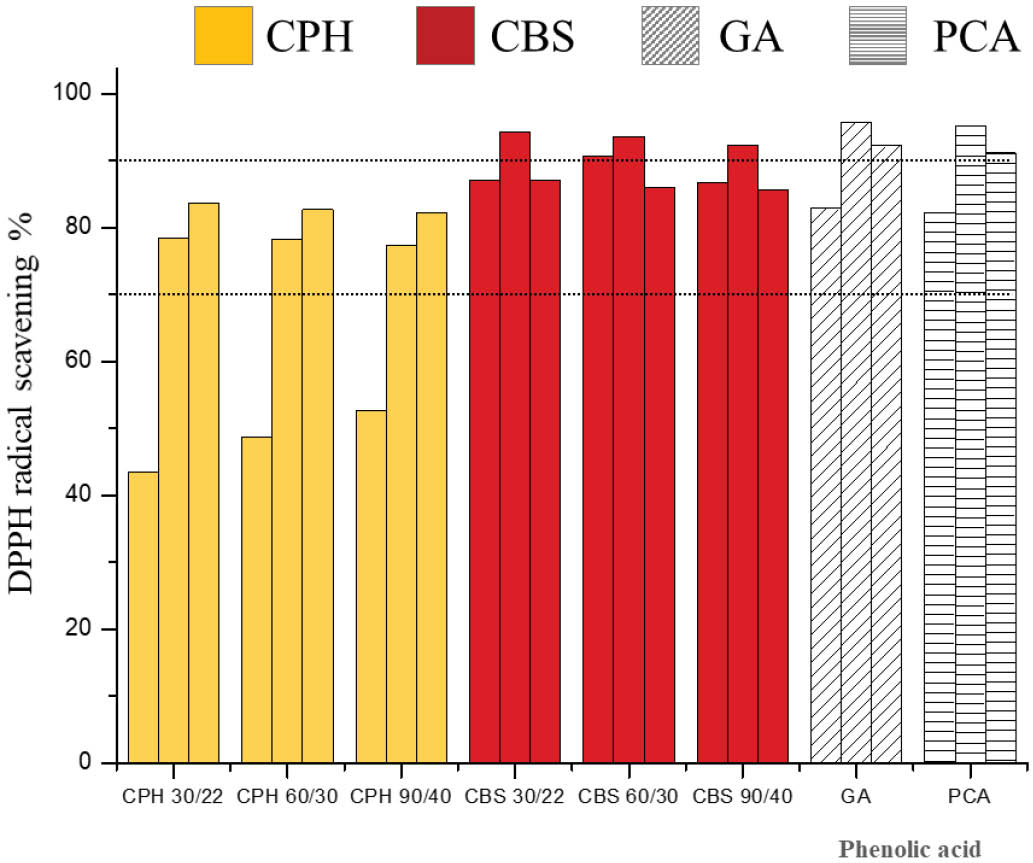 Commercially available gallic (GA) and protocatechuic (PCA) acid were used as comparisons; DPPH - 2,2-diphenyl-1-picrylhydrazyl. CBS - Cocoa bean shell; CPH - Cocoa pod husk
 GAE - Gallic acid equivalents; TPC - Total Phenolic Acid; PCA - Protocatechuic acid; DPPH - 2,2-diphenyl-1-picrylhydrazyl; CBS - Cocoa bean shell; CPH - Cocoa pod husk
 Cocoa pod husk without hydrolysis and without purification (CPH wH/wP); Cocoa pod husk without hydrolysis and with purification (CPH wH/P); Cocoa pod husk with hydrolysis and with purification (CPH H/P)