
 Flow rate estimation of motor-pump sets using neural networks and multiple linear regression
ABSTRACT
Studies on flow rate estimation techniques in irrigation systems are crucial for effective water resource management, shaping the economic interactions among water users. In this context, artificial neural networks and multiple linear regression methods have been applied in various agricultural fields and can be employed in flow rate monitoring and estimation projects. This study aimed to estimate the water flow rate in motor-pump sets using artificial neural networks and multiple linear regression. The data were collected from electrical parameters measured at the power supply of different motor-pump sets. The electrical variables included voltage, current, power, and energy at a 1-minute interval. Observed and estimated data were compared and evaluated using 1:1 scatter plots, coefficient of determination (R2), and statistical indicators such as mean squared error and root mean square error. R2 results were more favorable for the artificial neural network models in the 1.103 and 7.355 kW motor-pump sets, with R2 values exceeding 0.98 and mean squared error and root mean square error close to zero. Data computing, processing, and prediction methods such as artificial neural networks and multiple linear regression proved useful in developing predictive models for estimating water flow rates. However, artificial neural networks yielded better statistical performance in flow rate estimation when compared to multiple linear regression.
Key words:
artificial intelligence; pumping systems; electrical parameters; water flow
HIGHLIGHTS
The estimation of water flow rate can be derived from measurements taken at the control panels of pumping systems.
Electrical parameters serve as an alternative for estimating water flow rates in irrigation systems.
Neural networks and multiple linear regression can be used to estimate the flow rate of motor-pump sets.
RESUMO
Estudos sobre técnicas para estimar a vazão em sistemas de irrigação, são cruciais para o gerenciamento de recursos hídricos, impactando nas relações econômico-financeiras entre os consumidores de água. Neste sentido, os métodos de redes neurais artificiais e regressão linear múltipla, vêm sendo aplicados nos diferentes campos da agricultura, podendo ser utilizados em projetos de monitoramento e estimativa da vazão. Objetivou-se com este estudo estimar a vazão de água em conjuntos motobombas usando redes neurais artificias e regressão linear múltipla. Foram utilizados dados coletados a partir da leitura de grandezas elétricas fornecidas pela rede de alimentação de distintas motobombas. As grandezas elétricas usadas foram tensão, corrente, potência e energia em 1 min. Os dados observados e estimados foram comparados e avaliados através da análise gráfica 1:1, coeficiente de determinação (R2) e pelos indicadores estatísticos: erro quadrado médio e raiz quadrática do erro médio. Os resultados de R2 foram melhores para as redes neurais artificiais nas motobombas de 1,103 e 7,355 kW, com valores de R2 superiores a 0,98 e erro quadrado médio e raiz quadrática do erro médio bem próximos de zero. Métodos de computação, processamento e predição de dados, como as redes neurais artificiais e regressão linear múltipla, provaram ser úteis no desenvolvimento de modelos preditivos para a estimativa de vazão de água. Porém, as redes neurais artificiais apresentaram melhores resultados estatísticos na estimativa da vazão quando comparadas à regressão linear múltipla.
Palavras-chave:
inteligência artificial; sistemas de bombeamento; grandezas elétricas; fluxo de água
Introduction
Irrigated agriculture is one of the largest consumers of water, and most systems are powered by the electrical grid (Xu & Chen, 2024), with the pumping station as the primary energy consumer. In these systems, electrical parameters such as voltage, current, power, and energy are linked to the electric motors of motor-pump (MPs) sets and their control panels (Gherbi et al., 2017; Goman et al., 2019).
In irrigation systems, especially those with high water demand, there is often a lack of monitoring, implementation of methods, and installation of instruments at pumping stations capable of estimating flow rates. Flow rate must be quantified to optimize system performance, aiming for greater efficiency with less water use (Yin et al., 2022).
Flow rate estimation methodologies can be classified as direct or indirect, with each category allowing for point-based or continuous measurements. In irrigation water management, continuous measurements are more suitable due to the variability in water consumption throughout the crop cycle (Koech & Langat, 2018).
Although recommended, continuous measurements are rarely adopted due to the high cost of equipment for indirect flow rate estimation, such as ultrasonic meters (Feng et al., 2024). In most cases, measurements are taken at specific points in time and may not accurately reflect actual water consumption throughout use (Kumar & Sarangi, 2022). Electrical parameter data may serve as an indirect alternative for continuous water flow rate estimation in irrigation systems, proposing a machine learning approach that estimates flow rate by processing data such as voltage, current, power, and energy consumption.
Artificial intelligence (AI) is currently being applied effectively in the agricultural sector, enabling the development of new technologies and the automation of processes, thanks to advancements in electronics and computing (Shaikh et al., 2022). This approach involves using computers to perform tasks that exceed human cognitive capabilities (Ho et al., 2023). Within this context, artificial neural networks (ANNs) stand out for their unique learning capabilities and processing speed.
In this context, artificial neural network methods serve as predictive tools for numerous applications in agricultural water management. Their algorithms can be applied in predictive models in agricultural production (Karimi et al., 2020; AbdelFattah et al., 2021; Ellafi et al., 2021), including the prediction of soil physical and hydraulic properties (Mozaffari et al., 2024), among other uses.
Another data prediction method that has been in use for a longer time is multiple linear regression (MLR), which also analyzes the relationship between a dependent variable, the value to be estimated, and multiple independent variables (Dimitriadou & Nikolakopoulos, 2022). According to Zhang et al. (2017), it is considered a simple method, and its results are easy to interpret.
Its application is widespread in agricultural studies, such as predicting water infiltration into the soil (Pahlavan-Rad et al., 2020), forecasting organic potato (Solanum tuberosum) yield (Abrougui et al., 2019), assessing chlorophyll content in wheat (Triticale sp.) (Song et al., 2021), and estimating parameters of the Van Genuchten model (Kayser et al., 2024).
Given this, studies applying these two methods to estimate flow rates from electrical parameter data have not been explored. Therefore, this study aims to estimate the water flow rate in motor-pump sets using electrical parameter data by applying artificial neural networks and multiple linear regression.
Material and Methods
The study was conducted in 2022 at the Agricultural Hydraulics Laboratory of the Department of Rural Engineering, Center for Rural Sciences, Federal University of Santa Maria (UFSM), Santa Maria city, Rio Grande do Sul state, Brazil. For the experiments, four motor-pump sets were used for water pumping and conveyance, as described in Table 1.
Centrifugal hydraulic pump (CHP) and three-phase induction motor (TPIM) used in the experiment
Water was supplied through a closed-loop pumping system composed of brown polyvinyl chloride (PVC) pipes (intended for cold water, according to NBR 5648), with solvent-welded joints and diameters of 50 mm for the suction line and 40 mm for the discharge line.
A 1¼” gate valve was installed on the discharge pipeline, allowing flow rate adjustment in the pumping system through gradual openings. A water meter was installed on the discharge line downstream of the gate valve to measure the actual flow rate of the motor-pump sets, recorded as the observed flow rate (Qobs).
The water meter was a turbine-type model with a 20 m3 h⁻1 nominal flow rate. Volume was quantified from one and a quarter turns of the dial, measured from the onset of pointer movement. The device was calibrated using the volumetric method, with a collection tank of known dimensions (area of 1.076 m2 and height of 1 m), and a stopwatch was used to measure the water collection time between two levels (initial and final).
Ten gradual openings were performed for the 1.103, 2.207, and 3.678 kW motor-pumps and eight openings for the 7.355 kW motor-pump set, with five tests and three repetitions for each opening. Through a random selection process, the evennumbered openings were chosen for data use.
With the aid of an electronic multimeter, commercially known as a voltmeter-wattmeter-ammeter (Peacefair, model PZEM-0061, China), electrical parameters - voltage (V, volts), current (A, amp), power (W, Watt), and energy consumption (Wh, Watt-hour) - were measured at each valve opening. The main technical specifications of the device were: operating frequency of 45-65 Hz, voltage range of 80-260 V, test current range of 0-100 A, and nominal power of 100 A / 22 kW. A key feature of this instrument is its ability to perform contactless current measurements, as it includes a current transformer (CT). It is a low-cost device, easy to install, and user-friendly for data reading. The measured values are related to the accuracy of the equipment used and are therefore subject to possible errors, even if of small magnitude.
The electrical parameter data obtained were used for indirect flow rate estimation using artificial neural networks and multiple linear regression (MLR). The software used to implement both methods was IBM SPSS Statistics 22 (IBM producer, New York, USA).
The input layer of the ANNs consisted of the following variables: voltage, current, power, and energy consumption over 1 min, while the output variable was flow rate (L s⁻1), the parameter to be estimated. The data were entered into the software using a supervised learning model, in which an external supervisor provides both the inputs and the corresponding output of the network. The data were not normalized or standardized, as they were already on a consistent scale.
The data recorded for flow rate estimation were randomly divided into three sets: 60% for training, 20% for validation, and 20% for testing (Kayser et al., 2024). Table 2 presents the data points used in each process phase to estimate the flow rate for the different motor-pump sets.
Number of samples used for training, testing, and validation of the electrical parameters for each motor-pump set (MP)
The artificial neural networks used were of the perceptron type, trained using the backpropagation algorithm with a hyperbolic tangent activation function. The ANN’s architecture can be described as 4-n-1, with four neurons in the input layer, n neurons in the hidden layer, and one in the output layer. The training procedures were conducted with four neurons in the input layer and one in the output layer. The hidden layer was set to automatic, with the number of neurons varying according to the network configuration. Four stopping rules were applied to determine when to end neural network training, in the following order: (i) a single step without error reduction, (ii) a maximum training time of 15 min, (iii) a minimum relative change in training error of 0.0001, and (iv) a minimum relative change in the training error ratio of 0.001.
A fixed number of runs was pre-established for network training; in this case, 10 runs. According to Kayser et al. (2024), this procedure is characterized by the synaptic weights being reinitialized at each run, resulting in different outcomes for the same network configuration. The selected ANN was that with the highest R2 value on the validation data; in the event of a tie, the network with the lowest root mean square error (RMSE) was selected.
The stepwise (Forward) method was used for multiple linear regression, with the electrical parameters (voltage, current, power, and energy consumption) as independent variables and the flow rate (Q) as the dependent variable, as shown in Eq. 1.
In this procedure, the adopted modus operandi was characterized as follows: the method is an iterative process of incremental variable selection, in which the model starts with no independent variables and, at each step, incorporates the most statistically significant variable until no further meaningful improvements can be made. The procedure was concluded when no additional variables were selected for inclusion or removal.
In multiple linear regression, the degree of correlation between variables was assessed using the Pearson correlation coefficient (r), identifying which variables were directly or inversely correlated with flow rate estimation. The classification is presented in Table 3.
For the artificial neural networks, the importance of each variable in flow rate estimation was assessed by its percentage contribution.
The performance of the proposed methods was evaluated using 1:1 scatter plot analysis comparing observed and estimated data, the coefficient of determination (R2), and error-based indicators-mean squared error (MSE) and root mean square error (RMSE)-which range from 0 to infinity. The indicators are defined in Eqs. 2 and 3.
where:
Oi - observed data;
Pi - estimated data, and;
n - number of observations.
Results and Discussion
Figure 1 shows the artificial neural network architectures generated from the electrical parameter data (independent variables) to estimate the flow rate (dependent variable). For the 1.103 kW motor-pump set, the artificial neural network architecture consisted of four neurons in the input layer, one in the hidden layer, and one in the output layer. The same architecture (4-1-1) was observed for the 2.207 kW motor-pump set. In contrast, the 3.678 and 7.355 kW motor-pump sets exhibited a 4-2-1 architecture.

Artificial neural network architectures for the input variables in motor-pump sets of 1.103 kW (A), 2.207 kW (B), 3.678 kW (C), and 7.355 kW (D)
As also shown in Figure 1, flow rate estimation was achieved using only one or two neurons in the hidden layer for all motorpump sets. These results suggest that the quality of the artificial neural network model fit to the data does not necessarily depend on using many neurons in the hidden layers.
These simple architectures demonstrate that one or two neurons in the hidden layer were sufficient to estimate the dependent variable. Similarly, more complex neural network architectures, characterized by a greater number of hidden layers and neurons per layer, can perform well in data prediction, as demonstrated in studies such as those by King et al. (2016), Dalkiliç & Hashimi (2020), and Selim et al. (2024).
Table 4 presents the models generated by MLR for flow rate estimation in the different motor-pump sets.
Among the independent variables, the models were built based on those with the highest statistical significance, which were retained in the final model. Variables that did not significantly contribute to improving predictive performance were excluded.
For the 1.103 kW motor-pump set, two models were generated: one using only the power variable and another using two variables, power and voltage. To select the model used for flow rate estimation, the software chose the one with the highest R2 value, Model 2, with an R2 of 0.887. Two models were also generated for the 2.207 kW motor-pump set: one with only the power variable and a second including both power and voltage. The model selected for flow rate estimation was Model 2, which presented an R2 of 0.389.
For the 3.678 kW motor-pump set, the MLR generated only one model, using energy as the variable, with an R2 of 0.229, as shown in Table 4. For the 7.355 kW motor-pump set, two models were generated, and Model 1 was selected. This model included only the power variable and demonstrated a strong relationship with an R2 of 0.999.
The models for the 1.103 and 7.355 kW motor-pump sets showed a good fit to the data, indicating that the independent variables studied explained the variability of the estimated flow rate and provided greater reliability in the estimates.
The R2 values for the 2.207 and 3.678 kW motor-pump sets indicate that the power and energy variables represent only a small part of the variation in the flow rate. This means that, for a better fit of the model, it would be advisable to consider using or adding other independent parameters.
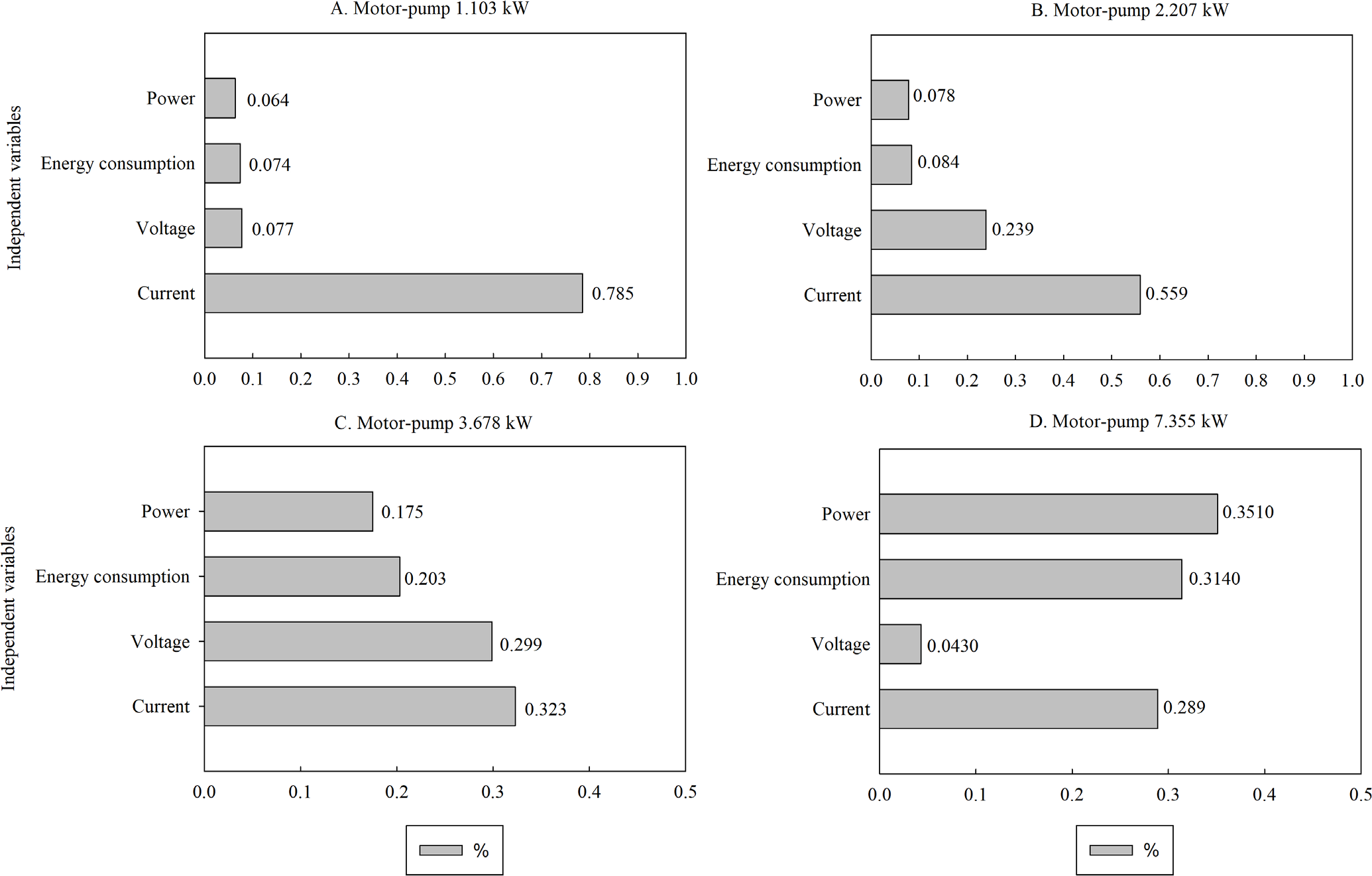
Figure 2 presents the percentage contribution of each input variable (voltage, current, power, and energy consumption) in the ANN model proposed for flow rate estimation.

Percentage contribution of input variables in the flow rate estimation model for motor-pump sets of (A) 1.103 kW, (B) 2.207 kW, (C) 3.678 kW, and (D) 7.355 kW
For the 1.103 kW motor-pump set (Figure 2), the electrical parameter with the highest relative contribution to flow rate estimation was current (78.5%), followed by voltage (7.7%), energy (7.4%), and power (6.4%). For the 2.207 kW motorpump set, a similar pattern was observed, with current again showing the highest contribution at 55.9%, followed by voltage (23.9%), energy (8.4%), and power (7.8%).
In the 3.678 kW motor-pump set, the contribution of the variables was more evenly distributed: current (32.3%), voltage (29.9%), energy (20.3%), and power (17.5%). Only the 7.355 kW motor-pump set displayed a different pattern, with power (35.1%) and energy (31.4%) showing the highest contributions, followed by current (28.9%) and voltage (4.3%).
Table 5 presents the Pearson correlation coefficient (r) values between the independent and dependent variables (flow rate) for the multiple linear regression models across the different motor-pump sets.
As shown in Table 5, for the 1.103 kW motor-pump set, the variables energy consumption, power, and current exhibited positive correlation coefficients greater than 0.9, close to 1, classified as “very high”, indicating a direct relationship with flow rate estimation. Voltage was the only variable to show a negative correlation across all four motor-pumps, indicating an inverse relationship in the flow rate estimation.
For the 2.207 kW motor-pump set, the highest correlations were observed with power and energy consumption, with values of 0.563, classified as “high”, followed by current at 0.551, also classified as “high”. A similar pattern was observed in the 3.678 kW motor-pump, with power and energy consumption showing the highest values (0.479), classified as “moderate,” and current at 0.470, classified as “high”. For the 7.355 kW motor-pump set, power showed the highest correlation, with a value of 1.00, indicating a “near-perfect” relationship. Notably, voltage showed negative correlations in all motor-pump sets.
According to Schneider (1998), the Pearson correlation coefficient measures the strength of the relationship between two variables, with values close to 1.0 indicating strong predictive performance. Overall, current, power, and energy are the variables that show the strongest correlation with flow rate estimation across all motor-pump sets.
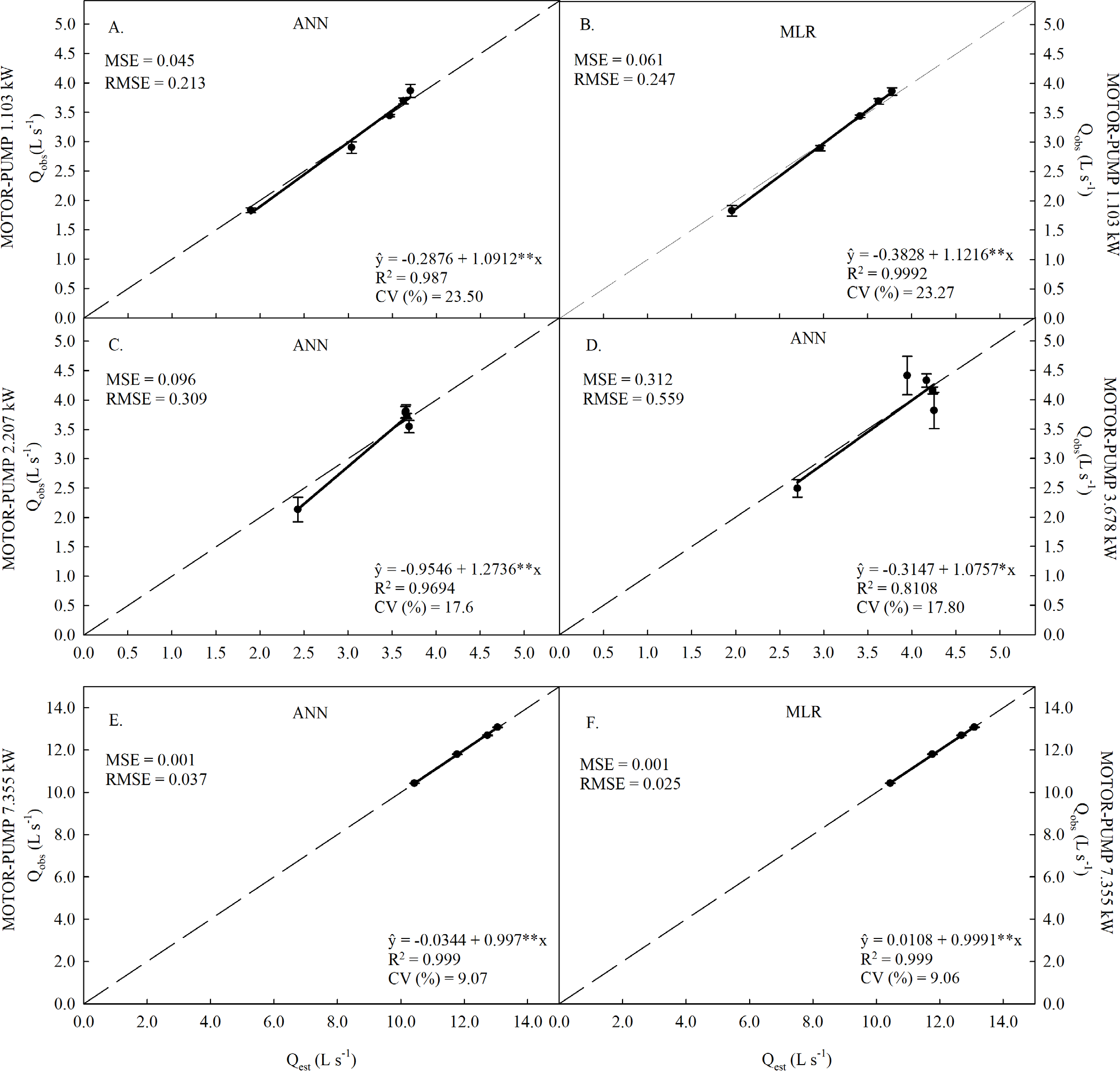
Figure 3 shows the 1:1 relationship between the observed flow rate values (Qobs) and estimated flow rate values (Qest) obtained using artificial neural networks and multiple linear regression for motor-pump sets of 1.103, 2.207, 3.678, and 7.355 kW.

Observed flow rate (Qobs) and estimated flow rate (Qest) values using artificial neural networks (ANNs) and multiple linear regression (MLR) for motor-pump sets of 1.103, 2.207, 3.678, and 7.355 kW
Comparisons between observed and estimated distributions for the 1.103 kW motor-pump set are presented in Figures 3A and B. It can be observed that the values are closely aligned with the 1:1 line between observed and estimated data, with a coefficient of determination of R2 = 0.987 for the ANN and R2 = 0.999 for the MLR. The deviations between observed and estimated results were minimal, with MSE and RMSE values close to zero. According to Sobenko et al. (2022), the values of these indicators range from 0 to +∞, and the smaller the values, the better the performance. This demonstrates that for the 1.103 kW motor-pump set, the results highlight the accuracy of both methods in estimating flow rate, with model values close to the observed data.
Both methods yielded similar R2 values; however, the ANN achieved lower MSE and RMSE values. In a study on hourly flow rate modeling in a photovoltaic water pumping system with two input variables, Haddad et al. (2015) reported that ANNs achieved high accuracy and can reliably estimate flow rate. Similarly, Flores et al. (2020), when estimating flow rate through indirect feedback in a water pumping network using artificial intelligence, concluded that this indirect measurement system can effectively estimate flow rate.
Flow rate estimation using ANN for the 2.207 kW motorpump (Figure 3C) yielded an R2 of 0.9694, indicating excellent agreement between the data. The MSE and RMSE values were 0.096 and 0.309, respectively. The MLR (2.207 kW motorpump set) showed inferior performance with R2 = 0.541 and equation ŷ = -1.3238 + 1.3891ns x. These results highlight the superior performance of ANN compared to MLR. A study by Huang et al. (2019) on predicting groundwater recharge also reported better results using a multilayer perceptron network, providing more accurate groundwater recharge estimates than the linear regression method.
Figure 3D presents the estimated and observed values for the 3.678 kW motor-pump set. The ANN achieved a coefficient of determination of R2 = 0.8108, while the MLR model yielded an R2 of 0.3618 and the equation ŷ = -2.0928 + 1.5451nsx.
Figures 3E and F show the 7.355 kW motor-pump results, where the narrow band around the 1:1 line indicates strong agreement between the observed and estimated data for both methods. Both ANN and MLR demonstrated strong predictive capacity for flow rate estimation, with R2 values exceeding 0.9, and MSE values were equal. Only the MLR model showed a lower RMSE value, at 0.025.
Kassem et al. (2021), in a study on monthly rainfall estimation in Northern Cyprus, demonstrated that the artificial neural network model was considered the most effective method for predicting precipitation and was more accurate than multiple linear regression. Similarly, Rehman et al. (2024) compared models for estimating soil erodibility in Peninsular Malaysia and concluded that ANN produced better results, outperforming MLR.
The ANN was trained individually for each motor-pump set, as their technical specifications precluded a generalized training model. The same procedure was adopted for the MLR, with estimates generated separately for each unit.
The practical application of this study is feasible, and the device studied could be installed directly in the control panels of pumping systems to obtain real-time electrical parameters from the motors. This information can be integrated into an application through automation systems, enabling flow rate monitoring.
Conclusions
-
1. Flow rate estimation in water pumping systems using the artificial neural network methodology yielded better results than multiple linear regression. Artificial neural networks proved to be more precise and accurate in estimating flow rate, showing higher determination coefficient values and lower mean squared error and root mean square error values than the multiple linear regression methodology.
-
2. In irrigation systems, applying estimation methods such as artificial neural networks and multiple linear regression can serve as an alternative for indirectly quantifying water use, meeting the water requirements of crops.
-
3. Although several devices can assist in flow rate estimation, this parameter can also be estimated indirectly using these two methods and simpler, more cost-effective variables such as electrical parameters (voltage, current, power, and energy consumption).
-
4. There is a lack of comparative studies on flow rate estimation using this type of data, and this study offers an alternative approach characterized by ease of measurement, installation, and use.
Data availability statement:
The authors declare no data underlying the text.
Literature Cited
-
Abdel-Fattah, M. K.; Mokhtar, A.; Abdo, A. I. Application of neural network and time series modeling to study the suitability of drain water quality for irrigation: a case study from Egypt. Environmental Science and Pollution Research, v.28, p.898-914, 2021. https://doi.org/10.1007/s11356-020-10543-3
» https://doi.org/10.1007/s11356-020-10543-3 -
Abrougui, K.; Gabsi, K.; Mercatoris, B.; Khemis, C.; Amami, R.; Chehaibi, S. Prediction of organic potato yield using tillage systems and soil properties by artificial neural network (ANN) and multiple linear regressions (MLR). Soil and Tillage Research, v.190, p.202-208, 2019. https://doi.org/10.1016/j.still.2019.01.011
» https://doi.org/10.1016/j.still.2019.01.011 - Camargo, A. P.; Sentelhas, P. C. Avaliação do desempenho de diferentes métodos de estimativa da evapotranspiração potencial no estado de São Paulo, Brasil. Revista Brasileira de Agrometeorologia, v.5, p.89-97, 1997.
-
Dalkiliç, H. Y.; Hashimi, S. A. Prediction of daily streamflow using artificial neural networks (ANNs), wavelet neural networks (WNNs), and adaptive neuro-fuzzy inference system (ANFIS) models. Water Supply, v.20, p.1396-1408, 2020. https://doi.org/10.2166/ws.2020.062
» https://doi.org/10.2166/ws.2020.062 -
Dimitriadou, S.; Nikolakopoulos, K. G. Multiple linear regression models with limited data for the prediction of reference evapotranspiration of the Peloponnese, Greece. Hydrology, v.9, p.e124, 2022. https://doi.org/10.3390/hydrology9070124
» https://doi.org/10.3390/hydrology9070124 -
Ellafi, M. A.; Deeks, L. K.; Simmons, R. W. Application of artificial neural networks to the design of subsurface drainage systems in Libyan agricultural projects. Journal of Hydrology: Regional Studies, v.35, e100832, 2021. https://doi.org/10.1016/j.ejrh.2021.100832
» https://doi.org/10.1016/j.ejrh.2021.100832 -
Feng, X.; Bi, S.; Li, H.; Qi, Y.; Chen, S.; Shao, L. Soil moisture forecasting for precision irrigation management using real-time electricity consumption records. Agricultural Water Management, v.291, e108656, 2024. https://doi.org/10.1016/j.agwat.2023.108656
» https://doi.org/10.1016/j.agwat.2023.108656 -
Flores, T. K. S.; Villanueva, J. M. M.; Gomes, H. P.; Catunda, S. Y. C. Indirect feedback measurement of flow in a water pumping network employing artificial intelligence. Sensors, v.21, e75, 2020. https://doi.org/10.3390/s21010075
» https://doi.org/10.3390/s21010075 -
Gherbi, A. D.; Arab, A. H.; Salhi, H. Improvement and validation of PV motor-pump model for PV pumping system performance analysis. Solar Energy, v.144, p.310-320, 2017. https://doi.org/10.1016/j.solener.2016.12.042
» https://doi.org/10.1016/j.solener.2016.12.042 -
Goman, V.; Oshurbekov, S.; Kazakbaev, V.; Prakht, V.; Dmitrievskii, V. Energy efficiency analysis of fixed-speed pump drives with various types of motors. Applied Sciences, v.9, e5295, 2019. https://doi.org/10.3390/app9245295
» https://doi.org/10.3390/app9245295 -
Haddad, S.; Benghanem, M.; Mellit, A.; Daffallah, K. O. ANNs-based modeling and prediction of hourly flow rate of a photovoltaic water pumping system: Experimental validation. Renewable and Sustainable Energy Reviews, v.43, p.635-643, 2015. https://doi.org/10.1016/j.rser.2014.11.083
» https://doi.org/10.1016/j.rser.2014.11.083 -
Ho, H.; Chiu, Y.; Chen, T.; Lin, Y. Flow measurement in open channels using imaging techniques in conjunction with a convolutional neural network. Journal of Hydrology, v.618, e129183, 2023. https://doi.org/10.1016/j.jhydrol.2023.129183
» https://doi.org/10.1016/j.jhydrol.2023.129183 -
Huang, X.; Gao, L.; Crosbie, R. S.; Zhang, N.; Fu, G.; Double, R. Groundwater recharge prediction using linear regression, multilayer perception network, and deep learning. Water, v.11, e1879, 2019. https://doi.org/10.3390/w11091879
» https://doi.org/10.3390/w11091879 -
Karimi, B.; Mohammadi, P.; Sanikhani, H.; Salih, S. Q.; Yaseen, Z. M. Modeling wetted areas of moisture bulb for drip irrigation systems: An enhanced empirical model and artificial neural network. Computers and Electronics in Agriculture, v.178, e105767, 2020. https://doi.org/10.1016/j.compag.2020.105767
» https://doi.org/10.1016/j.compag.2020.105767 -
Kassem, Y.; Gökçekuş, H.; Çamur, H.; Esenel, E. Application of artificial neural network, multiple linear regression, and response surface regression models in the estimation of monthly rainfall in Northern Cyprus. Desalination and Water Treatment, v.215, p.328-346, 2021. https://doi.org/10.5004/dwt.2021.26525
» https://doi.org/10.5004/dwt.2021.26525 -
Kayser, L. P.; Peiter, M. X.; Robaina, A. R.; Conceição, C. G. da; Sebem, E.; Weber, L. de S.; Torres, R. R.; Pereira, T. dos S. Estimativa dos parâmetros do modelo de Van Genuchten via regressão linear múltipla. Observatório De La Economía Latinoamericana, v.22, e6988, 2024. https://doi.org/10.55905/oelv22n10-023
» https://doi.org/10.55905/oelv22n10-023 -
King, B. A.; Bjorneberg, D. L.; Trout, T. J.; Mateos, L.; Araujo, D. F.; Costa, R. N. Estimation of furrow irrigation sediment loss using an artificial neural network. Journal of Irrigation and Drainage Engineering, v.142, e04015031, 2016. https://doi.org/10.1061/(ASCE)IR.1943-4774.000093
» https://doi.org/10.1061/(ASCE)IR.1943-4774.000093 -
Koech, R.; Langat, P. Improving irrigation water use efficiency: A review of advances, challenges and opportunities in the Australian context. Water, v.10, e1771, 2018. https://doi.org/10.3390/w10121771
» https://doi.org/10.3390/w10121771 -
Kumar, A.; Sarangi, A. Flow measuring devices in surface irrigation for enhancing agricultural water productivity. Current Science, v.122, p.1135-1144, 2022. https://doi.org/10.18520/cs/v122/i10/1135-1144
» https://doi.org/10.18520/cs/v122/i10/1135-1144 -
Mozaffari, H.; Moosavi, A. A.; Nematollahi, M. A. Predicting saturated and near-saturated hydraulic conductivity using artificial neural networks and multiple linear regression in calcareous soils. Plos One, v.19, e0296933, 2024. https://doi.org/10.1371/journal.pone.029693
» https://doi.org/10.1371/journal.pone.029693 -
Pahlavan-Rad, M. R.; Dahmardeh, K.; Hadizadeh, M.; Keykha, G.; Mohammadnia, N.; Gangali, M.; Keikha, M.; Davatgar, N.; Brungard, C. Prediction of soil water infiltration using multiple linear regression and random forest in a dry flood plain, eastern Iran. Catena, v.194, e104715, 2020. https://doi.org/10.1016/j.catena.2020.104715
» https://doi.org/10.1016/j.catena.2020.104715 -
Rehman, M. A.; Rahman, N. A.; Ibrahim, A. N. H.; Kamal, N. A.; Ahmad, A. Estimation of soil erodibility in Peninsular Malaysia: A case study using multiple linear regression and artificial neural networks. Heliyon, v.10, e28854, 2024. https://doi.org/10.1016/j.heliyon.2024.e28854
» https://doi.org/10.1016/j.heliyon.2024.e28854 - Schneider, P. R. Análise de regressão aplicada à Engenharia Florestal. Santa Maria: UFSM/CEPEF, 1998. 236p.
-
Selim, T.; Elshaarawy, M. K.; Elkiki, M.; Eltarabily, M. G. Estimating seepage losses from lined irrigation canals using nonlinear regression and artificial neural network models. Applied Water Science, v.14, e90, 2024. https://doi.org/10.1007/s13201-024-02142-1
» https://doi.org/10.1007/s13201-024-02142-1 -
Shaikh, T. A.; Rasool, T.; Lone, F. R. Towards leveraging the role of machine learning and artificial intelligence in precision agriculture and smart farming. Computers and Electronics in Agriculture, v.198, e107119, 2022. https://doi.org/10.1016/j.compag.2022.107119
» https://doi.org/10.1016/j.compag.2022.107119 -
Sobenko, L. R.; Pimenta, B. D.; Camargo, A. P. de; Robaina, A. D.; Peiter, M. X.; Frizzone, J. A. Indicators for evaluation of model performance: irrigation hydraulics applications. Acta Scientiarum: Agronomy, v.45, e56300, 2022. https://doi.org/10.4025/actasciagron.v45i1.56300
» https://doi.org/10.4025/actasciagron.v45i1.56300 -
Song, Y.; Teng, G.; Yuan, Y.; Liu, T.; Sun, Z. Assessment of wheat chlorophyll content by the multiple linear regression of leaf image features. Information Processing in Agriculture, v.8, p.232-243, 2021. https://doi.org/10.1016/j.inpa.2020.05.002
» https://doi.org/10.1016/j.inpa.2020.05.002 -
Xu, Z.; Chen, X. Optimization of the Coupling between Water and Energy Consumption in a Smart Integrated Photovoltaic Pumping Station System.Water, v.16, e1493, 2024. https://doi.org/10.3390/w16111493
» https://doi.org/10.3390/w16111493 -
Yin, L.; Tao, F.; Chen, Y.; Wang, Y. Reducing agriculture irrigation water consumption through reshaping cropping systems across China. Agricultural and Forest Meteorology, v.312, e108707, 2022. https://doi.org/10.1016/j.agrformet.2021.108707
» https://doi.org/10.1016/j.agrformet.2021.108707 -
Zhang, H.; Wu, P.; Yin, A.; Yang, X.; Zhang, M.; Gao, C. Prediction of soil organic carbon in an intensively managed reclamation zone of eastern China: A comparison of multiple linear regressions and the random forest model. Science of the Total Environment, v.592, p.704-713, 2017. https://doi.org/10.1016/j.scitotenv.2017.02.146
» https://doi.org/10.1016/j.scitotenv.2017.02.146
-
Editors:
Antônio Gustavo de Luna Souto & Carlos Alberto Vieira de Azevedo


 Error bars represent standard deviation (n = 2); ** - Significant by F test at p ≤ 0.01; * - Significant by F test at p ≤ 0.05; ns - Not significant. MSE - Mean squared error; RMSE - Root mean square error