
 Weather conditions, droplet size and application rate in quality of drone application
ABSTRACT
The application of plant protection sprays using drones or remotely piloted aircraft is a key advancement in the digital technological automation of agriculture. However, the optimal spray application rate and droplet size required to minimize the impact of weather conditions on spray coverage and deposition remain to be elucidated. This study aimed to evaluate how weather conditions, spray application rate, and spray droplet size affect spray coverage and deposition when applied using remotely piloted aircraft (RPA). The experiment was performed in a 2 × 2 × 4 factorial design (time of day, application volume, and droplet size). An irregular 5 × 10 m grid was established with 20 sampling points for the distribution of collectors for spray deposition and coverage analyses. The application of sprays as medium-sized droplets resulted in higher deposition levels, whereas coarse-sized droplets provided greater coverage than achieved with other droplet sizes. Weather conditions and droplet size classes are crucial factors affecting spray coverage and deposition during spraying operations with remotely piloted aircraft. The results obtained in this study revealed a clear distinction between the effects of mediumand coarse-sized droplets on spray coverage and deposition, regardless of spray application rate and weather conditions. Spray application rate directly impacts deposition uniformity, with higher application rates leading to reduced variation than observed at lower application rates.
Key words:
application technology; wind speed; spray drones; spray uniformity; aerial spraying
HIGHLIGHTS:
Droplet size and weather impact the coverage and deposition of sprays applied using a remotely piloted aircraft (RPA).
Coarse droplets help minimize the impact of weather without compromising the coverage of sprays applied using an RPA. Higher spray application rates do not affect spray deposition but improve the uniformity of spray application.
RESUMO
A aplicação de produtos fitossanitários com o uso de drones ou aeronaves remotamente pilotáveis (ARP) representa um avanço relevante na automação tecnológica da agricultura. No entanto, a definição da taxa de aplicação e do tamanho de gota ideais para reduzir os efeitos das condições meteorológicas sobre a cobertura e a deposição da pulverização ainda é necessária. Este estudo teve como objetivo avaliar os efeitos das condições meteorológicas, taxa de aplicação e tamanho de gotas na cobertura e deposição de gotas de pulverização na aplicação com ARP. O experimento foi realizado em um esquema fatorial de 2 × 2 × 4 considerando período do dia, volume de aplicação e classe de gotas. Foi construído um grid irregular de 5 × 10 m, totalizando 20 pontos amostrais para distribuição de coletores para análise de depósito e cobertura. A classe de tamanho de gotas médias apresentou maior depósito, enquanto, gotas grossas geraram maior cobertura quando comparado as classes de tamanho de gotas. As condições meteorológicas e a classe de tamanho de gotas são fatores determinantes da cobertura e do depósito durante a pulverização com ARP. A análise revelou uma separação clara entre as gotas médias e grossas, independentemente da taxa de aplicação e condições meteorológicas. A taxa de aplicação afeta diretamente a uniformidade da deposição e, com taxas mais altas, resulta em menor variação.
Palavras-chave:
tecnologia de aplicação; velocidade do vento; drones de pulverização; uniformidade de aplicação; aplicação aérea
Introduction
Agriculture is continuously evolving, and in the era of Agriculture 4.0, there is an increased reliance on tool automation and digital technologies to increase management efficiency (Silva Neto et al., 2021). One such technology involves using remotely piloted aircraft (RPA) for the aerial spraying of plant protection products (Martin et al., 2019). According to the National Civil Aviation Agency (ANAC) of Brazil, an RPA is operated remotely for non-recreational purposes (ANAC, 2017).
Using RPA for applying plant protection products provides several advantages, including reduced costs and greater flexibility than when using aircraft or ground sprayers. RPA enables spray applications in areas where other equipment cannot operate, such as areas with difficult access, steep terrain, or obstacles (Verger et al., 2014; Gao et al., 2018). Additionally, RPA helps reduce and optimize chemical and water usage while minimizing environmental contamination and operator exposure (Hu et al., 2022; Xu et al., 2022; Hafeez et al., 2023).
Further research is needed to develop effective strategies for crop protection through spray applications using RPA, particularly at low spray application rates (Lan & Chen, 2018). According to Chen et al. (2020), droplet size is a crucial factor during spray application, as it can affect both product deposition on the target and spray drift. Vaz et al. (2024) examined the impact of droplet size and spray application rates on hairy beggartick (Bidens pilosa) control, finding that extremely coarse-sized droplets achieved superior control compared to fine-sized droplets. In spray applications using RPA, it is critical to monitor weather conditions to adjust operational parameters for improved application safety and efficiency, as changing weather conditions affect evaporation losses during spray applications. However, the optimal spray application rate and droplet size needed to minimize the impact of weather conditions on spray coverage and deposition remain to be elucidated. This study aimed to evaluate how weather conditions, spray application rate, and spray droplet size affect spray coverage and deposition when applied using remotely piloted aircraft.
Material and Methods
The study was performed at a school farm, with application quality variables analyzed at the Research Center for Application Technology and Agricultural Machinery (Núcleo de Investigação em Tecnologia de Aplicação e Máquinas Agrícolas) laboratory at the State University of Northern Paraná, Luiz Meneghel Campus, Bandeirantes, Paraná, Brazil. The experiment followed a completely randomized design with a 2 × 2 × 4 factorial arrangement comprising weather conditions, spray application volume, and droplet size, with each treatment replicated four times.
Weather conditions were determined through measurements taken during morning and afternoon periods. Application volumes were 5.0, 6.5, 8.5, and 10.0 L ha-1 by adjusting nozzle flow rates to 0.45, 0.68, 0.76, and 0.90 L min-1, respectively. Tests were performed to estimate the droplet size produced by the rotating nozzle using images captured with a Phantom Miro M110 (Vision Research, Wayne, NJ, USA) ultra-slowmotion camera (10,000 frames s-1). To provide contrast for visualizing the droplets, a Neewer NL 660 (Neewer, Shenzhen, China). Light-emitting diode panel at maximum intensity was positioned in front of the ultra-slow-motion camera, in this way, when the droplets are sprayed, they appear in contrast against a black background, thus enhancing edge definition and sharpness, which facilitates more accurate measurement of droplet spectrum parameters. Spraying was performed using an unmanned aerial vehicle-based spray simulator equipped with a rotating nozzle, diaphragm pump, and rotation and flow rate controls, like those used in a remotely piloted aircraft (RPA).
In each recording, droplet capture occurred when the drops interrupted the light directed toward the camera during the 10-µs shutter exposure time of the camera. Four replications were performed for each treatment, with images captured at a rate of 2.49 s, corresponding to 5,238 frames. The filming was done at the center of the spray opening and 50 cm above the droplet generator and the center of the camera. After each capture (repetition), images were transferred to a computer via network cable, and the slow-motion file was then converted to .avi. The software for the droplet spectrum experiment was developed in Python 3.7.1, utilizing the OpenCV image processing module (OpenCV-Python) version 3.4.3.18, the Scikit-learn machine learning module (sklearn) version 0.20, and the NumPy multidimensional array processing module (NumPy) version 1.15.2.
Based on the droplet spectrum experiment results, droplet size classes were classified following ASABE Standard 572.3 (ASABE, 2020), and the values have been reported by for reference nozzles. The droplet size classes were identified as medium-sized, with a volume median diameter (VMD) of approximately 253 μm, and coarse-sized droplet class, with a VMD of approximately 369 μm. These classes were based on the droplet spectrum provided for testing in the subsequent experiment, which can be adjusted in the RPA settings.
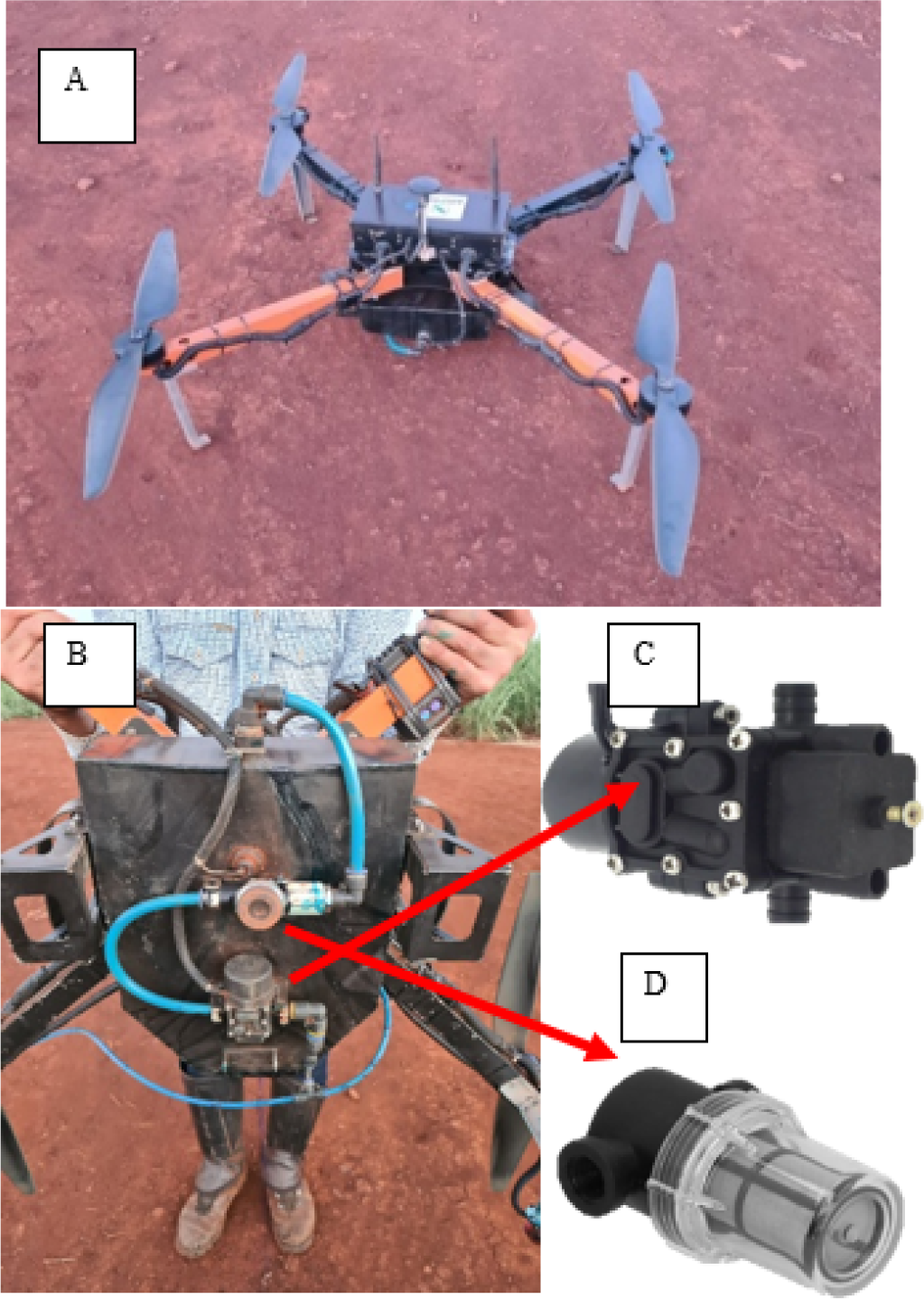
The RPA used in this study ARPAC (ARPAC Indústria de Aeronaves LTDA, São Paulo, Brazil) was automatically configured to operate at a speed of 5 m s-1, a flight height of 3.0 m from the target, and an application range of 6 m. Tests of effective application range were conducted following the ASAE S386.2 methodology (ASABE, 2018). The aircraft spray system (Figure 1A) consisted of a 10 L tank (Figure 1B) and a peristaltic pump that supplied liquid to two rotary nozzles, with a maximum flow rate of 5.6 L min-1 (Figure 1C). A 100mesh filter was positioned before the pump to ensure proper liquid filtration (Figure 1D). The RPA featured two horizontally rotating nozzles mounted under each rear rotor, operating under different voltages with rotation speeds ranging between 0-16,000 rpm. Table 1 shows the parameters of the RPA used in this study.

Components of the remotely piloted aircraft spray system: (A) Top view of the remotely piloted aircraft; (B) Bottom view of the remotely piloted aircraft; (C) Peristaltic pump; (D) 100-mesh pump filter
The experiments were performed with four replicates, with 20 sampling points per replicate, totaling 80 sampling points per treatment. A regular 5 × 10 m grid was constructed, consisting of 20 sampling points arranged in five parallel strips spaced 5-m apart. Each strip contained four collectors positioned 5 m apart for alternating applications (Figure 2).

In this experiment, spray deposition and coverage were quantified using tracers with artificial targets. At each sampling point, two data collectors were placed: one consisting of water sensitive paper (150 g m-2 matte coated paper, 3 × 7 cm) used for the image analysis of coverage with a WINDIAS image analysis system (WINDIAS; Delta-T Devices Ltd, Cambridge, UK), and the other using a Mylar card (3.3 × 10 cm plastic plate) for the spectrophotometric analysis of spray deposition. The mylar card data collectors and water-sensitive papers were mounted on a rigid base and fixed to wooden stakes 0.9 m above ground level.
The spray solution consisted of water and a Brilliant Blue FCF marker (maltodextrin and artificial dye: Brilliant Blue FCF 11%) (Duas Rodas Industrial Ltda., Jaraguá do Sul, Brazil), at a concentration of 6 g L-1. After their application, the spray solution samples were collected from each nozzle to establish the calibration curve of the tracer, and the absorbance was measured spectrophotometrically at 630 nm using a Femto Model 600 S (Femto, São Paulo, Brazil) spectrophotometer.
During all applications, the data for temperature, relative humidity of air, wind speed, and wind direction were recorded at a weather station equipped with sensors fixed at 1.5 m above ground level, with the data being logged every second. Weather condition 1 occurred in the morning, with an air temperature of 26.9 °C (± 1.25 °C), relative humidity of 63.9% (± 5%), and a wind speed of 2.2 m s-1 (± 0.62 m s-1), and weather condition 2 occurred in the afternoon, with an air temperature of 30.4 °C (± 1.39 °C), relative humidity of 52.8% (± 6%), and a wind speed of 1.4 m s-1 (± 0.87 m s-1).
After the spray applications, the collectors were removed from the holder and placed individually in plastic containers with 25 mL of distilled water. The containers were shaken, and the absorbance of the resulting solution was measured using spectrophotometry. Following absorbance measurements, deposition was calculated and expressed in microliters per square centimeter, as outlined by Oliveira et al. (2021).
For deposition data, correction factors were applied based on the change in spray application rate, with a reference rate of 5 L ha-1; therefore, the correction factors applied were 2.0, 1.7, and 1.3 for 10.0, 8.5, and 6.5 L ha-1, respectively. The spray coverage data was extracted from the collectors, and the coverage percentage was analyzed using the WINDIAS image analysis system.
All data were analyzed using descriptive statistics to examine the measures of central tendency and dispersion and identify potential outliers. Data normality was assessed using the Shapiro-Wilk’s test (p < 0.05), and the homogeneity of variance was estimated using Levene’s test. The variability of spray deposition and coverage was analyzed as a function of spray application rates and droplet classes under the two weather conditions. Multivariate analysis using canonical variable techniques was employed to examine the relationship, the vegan (Oksanen et al., 2020) and candisc (Fox & Weisberg, 2019) packages were used. slope, dispersion, and contribution of the variables to treatment variability, investigating the interrelation between application rates, droplet size, weather conditions, spray deposition, and coverage. All analyses were performed using the R software Version 4.5.0 (R Core Team, 2022).
Results and Discussion
Figure 3 presents the canonical analysis illustrating the interrelationship between spray application rate, droplet size, and weather conditions with spray deposition and coverage variables under weather conditions 1. The cumulative variance in the first two canonical variables was 98.9%, indicating high accuracy in biplot interpretation. Bhering (2017) reported that results can be considered reliable when the sum of variance in the first two variables is >70%.

Canonical variable analysis applied to different spray application rates of 5.0, 6.5, 8.5, and 10 L ha-1 with coarse and medium-sized droplets, weather conditions, spray deposition, and coverage data under weather conditions 1 (air temperature of 26.9 °C (± 1.25 °C), relative air humidity (RH) of 63.9% (± 5%), and a wind speed of 2.2 m s-1 (± 0.62 m s-1))
Dissimilar variability was observed between droplet classes and application rates. Statistically, the combination of different spray application rates of 5.0, 6.5, 8.5, and 10 L ha-1 with coarsesized droplets differed from that of the respective application rates with medium-sized droplets. Furthermore, spraying medium-sized droplets onto these four application rates resulted in higher deposition levels than coarse-sized droplets at the same application rates. Chen et al. (2020) also reported that droplet size impacts target surface deposition, with the medium-sized droplet class showing higher deposition rates than achieved using the fineand coarse-sized droplet classes.
It was possible to observe that coarse-sized droplets generated greater variability in coverage than medium-sized droplets. This finding is in line with the results reported by Byers et al. (2024), who evaluated UAV spraying systems, such as the DJI Agras T30 and the TTA M4E, concluding that coarse-sized droplets result in greater coverage. which can be explained by the loss due to drift when sprayed with mediumsized droplets and the lesser impact of weather conditions on coarse-sized droplets, that is, a greater number of droplets reaching the target compared to medium-sized droplets.
The combination of spray application rates and the coarsesized droplet class did not affect spray deposition. Different spray application rates resulted in similar variability across droplet size classes, with no statistically significant differences in droplet size variation across the different application rates. Shan et al. (2021) and Oliveira et al. (2021) also reported that the coarse-sized droplet class leads to lower target surface deposition of sprays than achieved with the fineand mediumsized droplet classes, significantly reducing control efficacy, particularly with herbicides. Regarding application coverage, the coarse droplet size class affected its variability but remained unaffected by changes in weather conditions during morning applications (Figure 3).
Droplet deposition was impacted by wind speed, humidity, and air temperature. The increase in wind speed, temperature, and relative humidity under the morning conditions resulted in higher levels of targeted deposition than during the afternoon. This result can be attributed to optimal application parameters (air temperature <30 °C and relative humidity >50%) under weather condition 1 based on sound application technology practices, with no significant effects on droplet evaporation rate.
Wind speed was crucial in determining spray coverage and deposition when using RPA. Spray applications performed under weather condition 1 ensured greater deposition levels than under weather condition 2, particularly when using the medium-sized droplet class, regardless of spray application rate.
The use of coarse droplets is also less relatively affected by propeller-induced vortices and downwash effects (Wang et al., 2021; Biglia et al., 2022). A positive correlation was observed between spray coverage, deposition, and temperature, indicating that the rise in temperature during the morning period benefited both spray coverage and deposition. Conversely, relative humidity and wind speed correlated negatively with spray coverage, demonstrating that higher relative humidity and wind speed values are associated with lower spray coverage.
Table 2 presents the coefficients of variation (CVs) for spray deposition and coverage under weather conditions 1. The spray application rate exhibits an inverse relationship with CV (%), implying that increasing application rates reduce variation in spray deposition. Specifically, the spray application rate of 10 L ha-1 exhibited the lowest coefficients of variation, with 20.24% for coarse-sized droplets and 19.90% for mediumsized droplets, providing greater deposition uniformity than achieved at the other spray application rates.
Coefficient of variation for spray deposition and coverage variables under weather conditions 1(air temperature of 26.9 °C (±1.25 °C), relative humidity of 63.9% (±5%), and a wind speed of 2.2 m s-1 (±0.62 m s-1))
At the application rates of 5 and 6.5 L ha-1, significantly higher coefficients of variation were observed, particularly for coarse droplets (53.95 and 42.17%, respectively), indicating greater variability in spray deposition. This behavior indicates that lower spray application rates may lead to less uniform distribution than obtained using higher spray application rates, potentially compromising application efficacy.
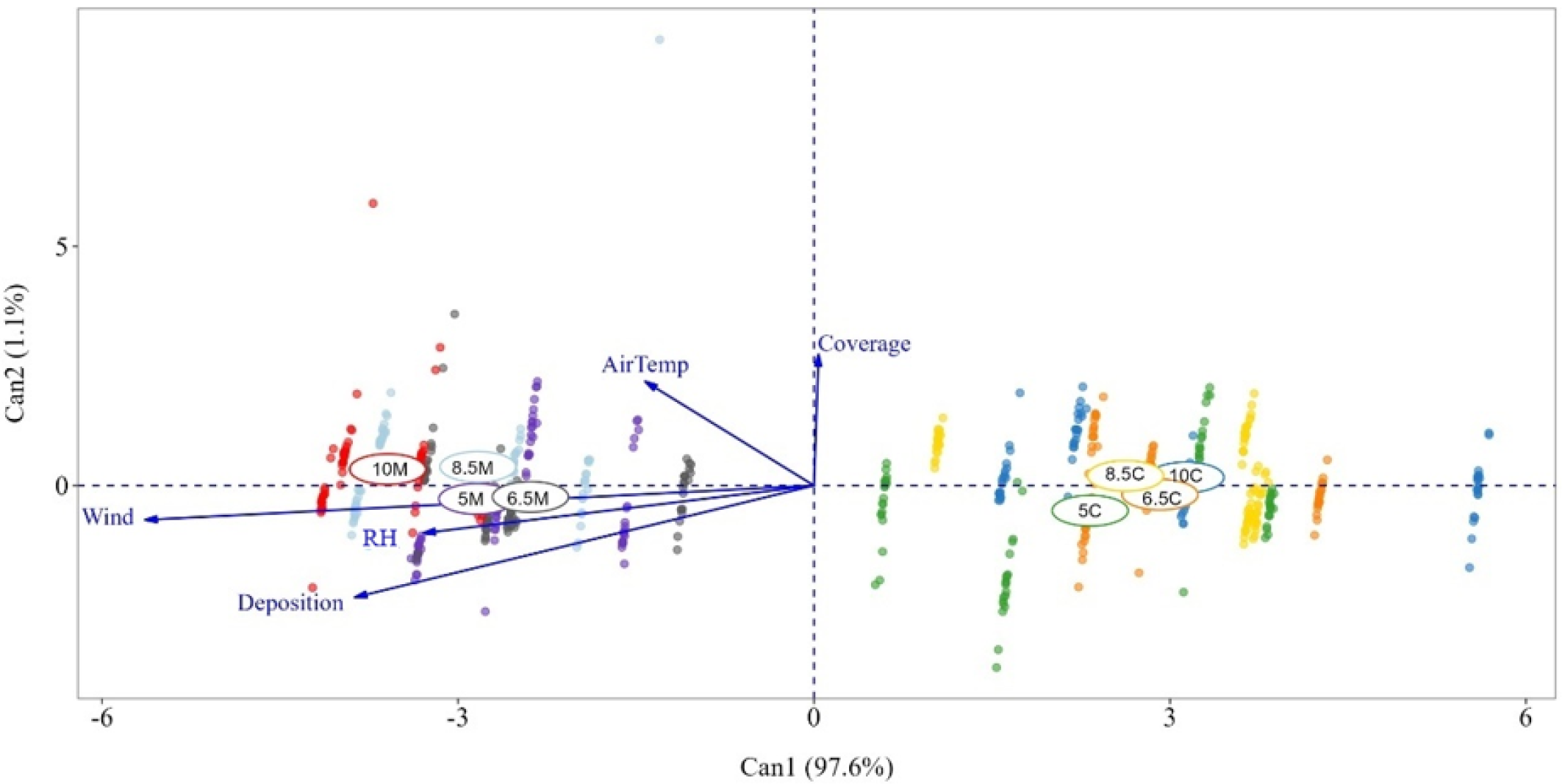
Additionally, applications using coarse droplets exhibited higher CVs across all application rates, demonstrating lower uniformity than achieved using medium-sized droplets. Thus, the uniformity of spray coverage correlated with spray application rates when using coarse droplets. When using medium-sized droplets, the increase in spray application rate led to an increase in CV. The first two canonical variables accounted for 97.3% of the total variance, indicating uniform variability within the dataset (Figure 4).

Canonical variable analysis applied to different spray application rates of 5.0, 6.5, 8.5, and 10 L ha-1 with coarse-sized droplets and medium-sized droplets, weather conditions, and spray deposition and coverage data under weather conditions 2 (air temperature of 30.4 °C (±1.39 °C), relative air humidity (RH) of 52.8% (± 6%), and a wind speed of 1.4 m s-1 (± 0.87 m s-1))
Variability differences were observed across the different droplet classes; specifically, the variability values for the combinations of spray application rates (5.0, 6.5, 8.5, and 10.0 L ha-1) with the coarse-sized droplet class were statistically different from those obtained with the medium-sized droplet class. The treatments combining the spray application rates of 5.0 and 8.5 L ha-1 with coarse-sized droplets were unaffected by weather condition 2 and exhibited no impact on the variability of spray deposition and coverage data. However, the combination of the spray application rates of 6.5 and 10 L ha-1 affected the variability of spray coverage data.
In general, the extent of spray deposition was relatively less impacted by weather conditions, droplet size class, and spray application rates, as indicated by the size of the arrow representing spray deposition. The larger the arrow, the higher the impact of the other vectors on an analyzed vector (Figure 4). Thus, spray deposition was not significantly altered by the factors studied.
Spray deposition correlated positively with wind speed and temperature under weather conditions 2, whereas negative correlations were observed for canopy coverage and relative humidity. This result indicates that higher temperatures and wind speeds during spray applications increased spray deposition, whereas lower relative humidity or increased spray coverage reduced deposition.
Relative air humidity is the variable that most positively affects the variability in spray coverage, which can be explained by droplet evaporation, as reduced relative humidity leads to increased droplet evaporation during spray application (Sasaki et al., 2016). According to Yu et al. (2009a), increasing relative humidity leads to an exponential rise in droplet evaporation time, with recorded values reaching up to 153%. Additionally, evaporation time increased approximately 9.2-fold when the droplet diameter expanded by a factor of 3.6-fold (Yu et al., 2009b). Therefore, droplet size significantly impacts evaporation losses (Xu et al., 2010).
Spray coverage and deposition correlated negatively with wind speed and temperature, respectively. These results can be attributed to drift losses caused by wind speed carrying droplets beyond the target area. Wang et al. (2020) demonstrated this effect by evaluating spray drift from a commercial RPA equipped with centrifugal nozzles under high wind conditions, with droplets collected 50 m downwind. Furthermore, Liu et al. (2021) and Grant et al. (2022) showed that wind speed has a greater influence on drift risk potential than droplet size.
Table 3 presents the coefficient of variation for spray deposition and coverage under weather conditions 2. The spray application rate affects both spray deposition uniformity and coverage. At lower application rates (5 and 6.5 L ha-1), particularly when using medium-sized droplets, the CV for spray deposition exhibited higher variability (75.38 and 39.16%, respectively), indicating reduced deposition uniformity under these conditions. At higher application rates, such as 10 L ha-1, with medium-sized droplets, CV decreased to 32.45%, indicating greater spray deposition uniformity.
Coefficient of variation for spray deposition and coverage variables under weather conditions 2
A comparative analysis of the coarse and medium-sized droplets revealed that the coarse-sized droplets tended to show less coverage variation than medium-sized droplets. For example, for the application rate of 6.5 L ha-1, the CV of spray coverage with medium-sized droplets was 144.28%, whereas the application of the coarse-sized droplets at this same rate exhibited a CV of 100.86% (Table 3). These results indicate that the selection for droplet size class plays a fundamental role in the uniformity of spray deposition and coverage.
The application of medium-sized droplets resulted in greater variability in spray deposition compared to the use of coarse-sized droplets. The coarse-sized droplet class was less affected by weather conditions, impacting spray coverage more than spray deposition.
Under weather conditions 2, medium-sized droplets generally exhibited higher CVs at low spray application rates than at high rates, indicating reduced deposition uniformity compared with that achieved under weather conditions 1. This result can be attributed to the relatively more extreme conditions during spray application under weather conditions 2. These findings suggest that using medium droplet sizes at low rates is less favorable for uniformity under weather conditions 2, whereas higher application rates under weather conditions 1 result in more consistent deposition than with lower rates.
Conclusions
-
1. Application of medium-sized droplets using remotely piloted aircraft resulted in higher deposition levels, whereas coarse-sized droplets provided greater coverage than the other droplet size classes.
-
2. Both weather conditions and droplet size are crucial in determining coverage and deposition during spraying operations with remotely piloted aircraft.
-
3. A clear distinction exists between spray coverage and deposition achieved using mediumand coarse-sized droplets, irrespective of application rate and weather conditions.
-
4. Application rate directly influences deposition uniformity, with higher rates leading to reduced variation.
Acknowledgments:
The authors would like to express their gratitude to all the students from the Laboratory of the Core Research Group in Application Technology and Agricultural Machinery (NITEC) at the State University of Northern Paraná (UENP) who contributed to the data collection, the Coordenação de Aperfeiçoamento de Pessoal de Nível Superior - Brasil (CAPES) and Indústria de Aeronaves Ltda (ARPAC).
Data availability statement:
There are no data underlying the text.
Literature Cited
-
ANAC - Agencia Nacional de Aviação Civil. General requirements for unmanned aircraft for civil use. 26p. 2017. Available on: <https://www.anac.gov.br/assuntos/legislacao/legislacao-1/rbha-e-rbac/rbac/rbac-e-94>. Accessed on: Feb 2023.
» https://www.anac.gov.br/assuntos/legislacao/legislacao-1/rbha-e-rbac/rbac/rbac-e-94 -
ASABE - American Society of Agricultural and Biological Engineers. Calibration and distribution test of agricultural aerial application equipment. ASAE S386.2 FEB1988 (R2018). 2018. Available on: <https://elibrary.asabe.org/abstract.asp?aid=44203&t=3&redir=&0redirType=>. Accessed on: May 2024.
» https://elibrary.asabe.org/abstract.asp?aid=44203&t=3&redir=&0redirType -
ASABE - ANSI/ ASABE. Spray nozzle classification by droplet spectra. Standard 572.3. 2020. Available on: <https://webstore.ansi.org/preview-pages/ASABE/preview_ANSI+ASABE+S572.3+FEB2020.pdf>. Accessed on: May 2023.
» https://webstore.ansi.org/preview-pages/ASABE/preview_ANSI+ASABE+S572.3+FEB2020.pdf -
Bhering, L. L. Rbio: A tool for biometric and statistical analysis using the R platform. Crop Breeding and Applied Biotechnology, v.17, p.187-190, 2017. https://doi.org/10.1590/1984-70332017v17n2s29
» https://doi.org/10.1590/1984-70332017v17n2s29 -
Biglia, A.; Grella, M.; Santoro, F.; Manetto, G.; Di Gennaro, F.; Vercesi, A.; Balsari, P. UAV-spray application in vineyards: Flight modes and spray system adjustment effects on canopy deposit, coverage, and off-target losses. Science of the Total Environment, v.845, e157292, 2022. https://doi.org/10.1016/j.scitotenv.2022.157292
» https://doi.org/10.1016/j.scitotenv.2022.157292 -
Byers, C.; Virk, S.; Rains, G.; Li, S. Spray deposition and uniformity assessment of unmanned aerial application systems (UAAS) at varying operational parameters. Frontiers in Agronomy, v.6, e1418623, 2024. https://doi.org/10.3389/fagro.2024.1418623
» https://doi.org/10.3389/fagro.2024.1418623 -
Chen, S.; Lan, Y.; Zhou, Z.; Ouyang, F.; Wang, G.; Huang, X.; Deng, X.; Cheng, S. Effect of droplet size parameters on droplet deposition and drift of aerial spraying by using plant protection unmanned aerial vehicle. Agronomy, v.10, e195, 2020. https://doi.org/10.3390/agronomy10020195
» https://doi.org/10.3390/agronomy10020195 -
Fox, J.; Weisberg, S. An R Companion to Applied Regression (3rd ed.). Sage. R package version 0.8-0. 2019. Available on: https://CRAN.Rproject.org/package=candisc
» https://CRAN.Rproject.org/package=candisc -
Gao, J.; Liao, W.; Nuyttens, D.; Lootens, P.; Vangeyte, J.; Pižurica, A.; Saeys, W.; Pieters, J. G. Fusion of pixel and object-based features for weed mapping using unmanned aerial vehicle imagery. International Journal of Applied Earth Observation and Geoinformation, v.67, p.43-53, 2018. https://doi.org/10.1016/j.jag.2017.12.012
» https://doi.org/10.1016/j.jag.2017.12.012 -
Grant, S.; Perine, J.; Abi-Akar, F.; Lane, T.; Kent, B.; Mohler, C.; Scott, C.; Ritter, A. A wind-tunnel assessment of parameters that may impact spray drift during UAV pesticide application. Drones, v.6, e204, 2022. https://doi.org/10.3390/drones6080204
» https://doi.org/10.3390/drones6080204 -
Hafeez, A.; Husain, M. A.; Singh, S. P.; Chauhan, A.; Khan, M. T.; Kumar, N.; Chauhan, A.; Soni, S. K. Implementation of drone technology for farm monitoring & pesticide spraying: A review. Information Processing in Agriculture, v.10, p.192-203, 2022. https://doi.org/10.1016/j.inpa.2022.02.002
» https://doi.org/10.1016/j.inpa.2022.02.002 -
Hu, H.; Kaizu, Y.; Huang, J.; Furuhashi, K.; Zhang, H.; Li, M.; Imou, K. Research on methods decreasing pesticide waste based on plant protection unmanned aerial vehicles: A review. Frontiers in Plant Science, v.13, e811256, 2022. https://doi.org/10.3389/fpls.2022.811256
» https://doi.org/10.3389/fpls.2022.811256 -
Lan, Y.; Chen, S. Current status and trends of plant protection UAV and its spraying technology in China. International Journal of Precision Agricultural Aviation, v.1, p.1-9, 2018. https://doi.org/10.33440/j.ijpaa.20180101.0002
» https://doi.org/10.33440/j.ijpaa.20180101.0002 -
Liu, Q.; Chen, S.; Wang, G.; Lan, Y. Drift evaluation of a quadrotor unmanned aerial vehicle (UAV) sprayer: Effect of liquid pressure and wind speed on drift potential based on wind tunnel test. Applied Sciences, v.11, e7258, 2021. https://doi.org/10.3390/app11167258
» https://doi.org/10.3390/app11167258 -
Martin, D. E.; Woldt, W. E.; Latheef, M. A. Effect of application height and ground speed on spray pattern and droplet spectra from remotely piloted aerial application systems. Drones, v.3, e83, 2019. https://doi.org/10.3390/drones3040083
» https://doi.org/10.3390/drones3040083 -
Oksanen, J.; Blanchet, F. G.; Friendly, M.; Kindt, R.; Legendre, P.; McGlinn, D.; Minchin, P. R.; O’Hara, R. B.; Simpson, G. L.; Solymos, P.; Stevens, M. H. H.; Szoecs, E.; Wagner, H. vegan: Community Ecology Package (Version 2.5-7). R package, 2020. Available on: https://CRAN.R-project.org/package=vegan
» https://CRAN.R-project.org/package=vegan -
Oliveira, O. G.; Lopes, P. R.; Raetano, C. G.; Lima, R. C.; Prado, E. P. Influence of droplet size on spray deposition and weed control using glyphosate. Engenharia Agrícola, v.41, p.449-457, 2021. https://doi.org/10.1590/1809-4430-Eng.Agric.v41n4p449-457/2021
» https://doi.org/10.1590/1809-4430-Eng.Agric.v41n4p449-457/2021 -
R Core Team. R: A language and environment for statistical computing R Foundation for Statistical Computing, Vienna, Austria, 2022. Available on: https://cran.r-project.org/index.html
» https://cran.r-project.org/index.html -
Sasaki, R. S.; Teixeira, M. M.; Fernandes, H. C.; Zolnier, S.; Maciel, C. F.; Alvarenga, C. B. D. Droplets spectrum of air-assisted boom sprayers under different environmental and operational conditions. Revista Brasileira de Engenharia Agrícola e Ambiental, v.20, p.92-96, 2016. https://doi.org/10.1590/1807-1929/agriambi.v20n1p92-96
» https://doi.org/10.1590/1807-1929/agriambi.v20n1p92-96 -
Shan, C. F.; Wang, G. B.; Wang, H. H.; Xie, Y. J.; Wang, H. Z.; Wang, S. L.; Chen, S. D.; Lan, Y. B. Effects of droplet size and spray volume parameters on droplet deposition of wheat herbicide application by using unmanned aerial vehicle. International Journal of Agricultural and Biological Engineering, v.14, p.74-81, 2021. https://doi:.org/10.25165/j.ijabe.20211401.6129
» https://.org/10.25165/j.ijabe.20211401.6129 -
Silva Neto, J. O.; Sasaki, R. S.; Alvarenga, C. B. de. Remotely piloted aircraft (RPA) for pesticide application. Research, Society and Development, v.10, e293101220573, 2021. https://doi.org/10.33448/rsd-v10i12.20573
» https://doi.org/10.33448/rsd-v10i12.20573 -
Vaz, V.; Ferreira, G. A. D. P.; Freitas, F. C. D.; Paiva, M. C.; Lemos, A. S.; Souza, W. M.; Furtado Júnior, M. R.; Cecon, P. R. Spray volume and droplet spectrum in the control of Bidens pilosa and Ipomoea triloba with the Fomesafen herbicide. Revista Brasileira de Engenharia Agrícola e Ambiental, v.28, e282568, 2024. https://doi.org/10.1590/1807-1929/agriambi.v28n8e282568
» https://doi.org/10.1590/1807-1929/agriambi.v28n8e282568 -
Verger, A.; Vigneau, N.; Chéron, C.; Gilliot, J.; Comar, A.; Baret, F. Green area index from an unmanned aerial system over wheat and rapeseed crops. Remote Sensing of Environment, v.152, p.654-664, 2014. https://doi.org/10.1016/j.rse.2014.06.006
» https://doi.org/10.1016/j.rse.2014.06.006 -
Wang, C.; Herbst, A.; Zeng, A.; Wongsuk, S.; Qiao, B.; Qi, P.; Bonds, J.; Overbeck, V.; Yang, Y.; Gao, W.; He, X. Assessment of spray deposition, drift and mass balance from unmanned aerial vehicle sprayer using an artificial vineyard. Science of the Total Environment, v.777, e146181, 2022. https://doi.org/777.146181.10.1016/j.scitotenv.2021.146181
» https://doi.org/777.146181.10.1016/j.scitotenv.2021.146181 -
Wang, G.; Han, Y.; Li, X.; Andaloro, J.; Chen, P.; Hoffmann, W. C.; Han, X.; Chen, S.; Lan, Y. Field evaluation of spray drift and environmental impact using an agricultural unmanned aerial vehicle (UAV) sprayer. Science of the Total Environment, v.737, e139793, 2020. https://doi.org/10.1016/j.scitotenv.2020.139793
» https://doi.org/10.1016/j.scitotenv.2020.139793 -
Xu, L.; Zhu, H.; Ozkan, H. E.; Thistle, H. W. Evaporation rate and development of wetted area of water droplets with and without surfactant at different locations on waxy leaf surfaces. Biosystems Engineering, v.106, p.58-67, 2010. https://doi.org/10.1016/j.biosystemseng.2010.02.004
» https://doi.org/10.1016/j.biosystemseng.2010.02.004 -
Xu, Y.; Xue, X.; Sun, Z.; Cui, L.; Cai, C.; Zhou, Q.; Chen, C.; Gu, W. Joint path planning and scheduling for vehicleassisted multiple Unmanned Aerial Systems plant protection operation. Computers and Electronics in Agriculture, v.200, e107221, 2022. https://doi.org/10.1016/j.compag.2022.107221
» https://doi.org/10.1016/j.compag.2022.107221 -
Yu, Y.; Zhu, H.; Ozkan, H. E.; Derksen, R. C.; Krause, C. R. Evaporation and deposition coverage area of droplets containing insecticides and spray additives on hydrophilic, hydrophobic, and crabapple leaf surfaces. Transactions of the ASABE, v.52, p.39-49, 2009b. https://doi.org/52.10.13031/2013.25939
» https://doi.org/52.10.13031/2013.25939 -
Yu, Y. A.; Zhu, H.; Frantz, J. M.; Reding, M. E.; Chan, K. C.; Ozkan, H. E. Evaporation and coverage area of pesticide droplets on hairy and waxy leaves. Biosystems Engineering, v.101, p.324-334, 2009a. https://doi.org/10.1016/j.biosystemseng.2009.08.006
» https://doi.org/10.1016/j.biosystemseng.2009.08.006
-
Editors:
Toshik Iarley da Silva & Hans Raj Gheyi


 5C - 5 L ha-1 - Coarse; 6.5C - 6.5 L ha-1 - Coarse; 8.5C - 8.5 L ha-1 - Coarse; 10C - 10 L ha-1 - Coarse; 5M - 5 L ha-1 - Medium; 6.5M - 6.5 L ha-1 - Medium; 8.5M - 8.5 L ha-1 - Medium; 10M - 10 L ha-1 - Medium; RH - Air relative humidity; AirTemp.- Air temperature; Wind - Wind speed
 5C - 5 L ha-1 - Coarse; 6.5C - 6.5 L ha-1 - Coarse; 8.5C - 8.5 L ha-1 - Coarse; 10C - 10 L ha-1 - Coarse; 5M - 5 L ha-1 - Medium; 6.5M - 6.5 L ha-1 - Medium; 8.5M - 8.5 L ha-1 - Medium; 10M - 10 L ha-1 - Medium; RH - Air relative humidity; AirTemp.- Air temperature; Wind - Wind speed