 Exchangeable cations determined by different methods: Implications for soil classification and evaluation
ABSTRACT
For a comprehensive and global evaluation of soils, it is essential to define common diagnostic properties among classification or interpretative systems. Specifically, in soil taxonomy, the Brazilian Soil Classification System (SiBCS) adopts analytical methods that differ from those used in international systems such as the World Reference Base for Soil Resources (WRB) and the Soil Taxonomy (ST). In the chemical properties, differences are observed in the determination of exchangeable basic cations and potential acidity (H+Al), as well as derived properties such as the sum of bases (SB), cation exchange capacity (CECpH7), and base saturation (V). This study aimed to: (i) to compare the values of H+Al, SB, CEC, and V in Brazilian soils determined by different analytical methods; (ii) to propose regression models to harmonize values of the properties obtained through different analytical procedures; and (iii) to compare the threshold values of diagnostic properties used as classification criteria in the SiBCS with those adopted by WRB and ST. A representative database of Brazilian soils published in the Brazilian Soil Data Repository (SoilData) was used, comprising 2,217 samples from surface horizons and 3,726 from subsurface horizons. Values of SB, CEC, and V for surface and subsurface horizons, obtained using the methods applied in the SiBCS, were lower than those determined by the WRB and ST methods. The difference in the estimated V values was below 5 %, which falls within the analytical error range. Thus, the SiBCS criteria of V ≥50 % for identifying eutrophic character and >65 % for defining a chernozemic A horizon were found to be high, and they tend to underestimate several Brazilian soil classes, particularly those classified as Chernossolos, as well as the misclassification of anthropic and other soils modified by agricultural practices. It is proposed that the SiBCS adopt thresholds similar to those used in WRB and ST for base saturation, or alternatively, apply regression equations to improve correspondence among the systems.
Keywords
analytical methods; diagnostic properties; soil classification; data harmonization
INTRODUCTION
Defining compatible soil diagnostic properties across taxonomic and interpretative systems is essential for coherent classification and global correlation. Among the chemical properties related to nutrient availability and soil acidity, either inherent or induced by management practices, exchangeable basic cations such as calcium (Ca²⁺), magnesium (Mg²⁺), sodium (Na⁺), and potassium (K⁺) are particularly important, along with potential acidity (H+Al) and active acidity (Al³⁺) (Tomé Jr., 1997).
In addition to their absolute concentrations, exchangeable cations are used to calculate properties that represent the expression of negatively charged sites of soil particles, including the sum of bases (SB), cation exchange capacity (CEC), and effective cation exchange capacity (CECₑ), as well as the relative concentration of cations expressed as base saturation (V). These soil properties define diagnostic criteria for distinguishing soil horizons and classes within the Brazilian Soil Classification System (Santos et al., 2025) and the international systems World Reference Base for Soil Resources (WRB) (IUSS Working Group, 2022) and Soil Taxonomy (ST) (Soil Survey Staff, 2022). They are also widely employed in soil fertility assessment and in liming recommendations (Tomé Jr., 1997).
Regarding the determination of these properties, although the different soil classification systems employ a similar set of chemical properties to establish their taxonomic criteria, they adopt distinct analytical methods. In the SiBCS, calcium (Ca²⁺), magnesium (Mg²⁺), and aluminum (Al³⁺) are extracted using a potassium chloride (KCl) solution, whereas sodium (Na⁺) and potassium (K⁺) are extracted using a mixture of hydrochloric acid and sulfuric acid (Mehlich-1). Potential acidity (H+Al) is extracted using a calcium acetate [Ca(OAc)2] solution buffered at pH 7.0. Cation exchange capacity CECpH7 is obtained indirectly by summing the SB and H+Al values (Teixeira et al., 2017).
In contrast, the WRB and ST systems use an ammonium acetate (NH₄OAc) solution buffered at pH 7 to extract the basic cations and to determine the potential cation exchange capacity directly of the CECpH7 (CECNH4OAc). Additionally, for saline and alkaline soils, the CECpH8.2 is determined as the sum of SBNH4OAc and H+Al extracted with a barium chloride (H+AlBaCl2) solution buffered at pH 8.2 (IUSS Working Group WRB, 2022; Soil Survey Staff, 2014). In all three classification systems, V is calculated as the ratio between SB and CECpH7, and in specific cases in the WRB and ST, as the ratio between SB and CECₚH₈.₂.
Given these analytical differences, some studies have evaluated methods used to determine absolute and relative contents of exchangeable cations and examined the correspondence among values derived from these analytical procedures for Brazilian soils (Verdade, 1956; van Raij and Küpper, 1966; Castro et al., 1972; Oliveira, 1975; Camargo et al., 1982). The first Brazilian initiative to assess the consistency of interpretations and concepts across different soil classification systems took place during the First International Soil Classification Workshop (1st ISCW) (Camargo and Beinroth, 1978). Soil horizon samples from four Podzólico Vermelho-Amarelo (currently Argissolo Vermelho-Amarelo) (Acrisol or Lixisol – WRB) and one Terra Roxa Estruturada (currently Nitossolo) (Nitisol – WRB) profile were analyzed, and conversion equations were proposed to relate the values of exchangeable bases, acidity, CEC, and V obtained using SiBCS methods to those determined by the international procedures (Ikawa, 1978). Later, Larach and Paolinelli (1982) compiled previous results, including those from the International Committee on Low Activity Clays (ICOMLAC) (Moormann, 1985), and suggested that a V value of 50 % obtained using ST methods would correspond to a V value of 65 % using SiBCS methods. According to the authors, in surface horizons, a V value of 50 % determined by ST would be equivalent to 58 % in SiBCS.
In 1999, the first edition of the SiBCS (Embrapa, 1999), following the suggestion of Larach and Paolinelli (1982), the V thresholds of 50 % was adopted to distinguish eutrophic and dystrophic materials, and V equal or higher than 65 % to define the chernozemic A horizon in relation to other A horizons (A prominent and A humic), a criterion maintained in the current edition (Santos et al., 2025). These thresholds are roughly equivalent to the 35 and 50 % limits, adopted in ST and WRB, respectively. However, the estimated 15 % difference becomes evident only when considering the V based on CECₚH₈.₂, which is not used as a diagnostic criterion for surface horizons in the international systems. This suggests that the SiBCS applies more restrictive criteria than the ST and WRB. Moreover, the proposal by Larach and Paolinelli (1982) was based on a small, unrepresentative sample, with limited spatial and thematic representation across Brazilian territory.
Given the differences in extractants used in laboratory analyses, it is necessary to establish equivalence or harmonization criteria between diagnostic properties values obtained by the SiBCS and those determined in international systems, particularly for SB, CEC, and V values. This study hypothesizes that reevaluating the correspondence between SB, CEC (referred to as CTC in the SiBCS), and V values obtained by different analytical methods will improve diagnostic criteria within the SiBCS, while allowing to represent better soils with high natural fertility or significant anthropic modifications, and finally enhance consistency with the criteria used in WRB and ST.
The specific objectives of this study were: (i) to compare H+Al, SB, CEC, and V values of Brazilian soils determined using different analytical methods; (ii) to propose regression models to harmonize values of properties obtained through different analytical methods; and (iii) to compare the threshold values of diagnostic properties used as classification criteria in the SiBCS with those adopted by WRB and ST.
MATERIALS AND METHODS
Soil data
The data used in this study were compiled from publications covering soils of the entire Brazilian territory. Among these sources are the proceedings of the 1st International Soil Classification Workshop (1st ISCW) (Camargo and Beinroth, 1978), which include soil samples from the states of Rio de Janeiro, Paraná, Alagoas, and Pernambuco, and the 8th ISCW (Camargo et al., 1986), comprising samples from Rio de Janeiro, São Paulo, Minas Gerais, Goiás, and Distrito Federal. Twenty-one reports from the RadamBrasil Project (1970 - 1985) were included, providing spatial coverage across 20 Brazilian States: Santa Catarina, Rio Grande do Sul, Paraná, Amazonas, Acre, Mato Grosso, Rondônia, Roraima, Goiás, Pará, Piauí, Tocantins, Pernambuco, Paraíba, Ceará, Bahia, Mato Grosso do Sul, Minas Gerais, São Paulo, Espírito Santo, and the Federal District.
Documents or datasets not available in digital format were tabulated and digitized. All original reports and datasets, as well as the final database used in this study, are described and made available through the Brazilian Soil Data Repository (SoilData - soildata.mapbiomas.org) and the details of the sources are in table 1.
Soil samples in these reports were analyzed in paired format using both the analytical methodologies adopted by the SiBCS and those used in the international classification systems WRB and ST. The RadamBrasil Project data were generated at the former laboratory of the Superintendency for the Development of the Southern Region (SUDESUL) in Pelotas, Rio Grande do Sul State, Brazil. Data from the 1st and 8th ISCW were generated by the laboratory of the former National Service for Soil Survey and Classification in Rio de Janeiro, Brazil, and by the National Soil Survey Laboratory of the Soil Conservation Service in Lincoln, Nebraska, USA. The analytical methodologies used to determine the chemical properties included H+Al, SB, CECₚH₇, CECₚH₈.₂, and V (Table 2).
Analytical methods used as diagnostic criteria in the Brazilian Soil Classification System (SiBCS) and in the international systems World Reference Base for Soil Resources (WRB) and Soil Taxonomy (ST)
Data processing
To ensure comparability across different datasets, all measurement units and nomenclature were standardized and verified. This process included identifying duplicate records, verifying values outside expected ranges, and correcting deviations in accordance with established soil composition patterns. Subsequently, the dataset was examined for consistency to identify possible input errors or discrepancies. This analysis involved assessing the dispersion of values obtained by each analytical method, with particular attention to data showing greater variability relative to the established trend line, and inspecting the minimum and maximum values.
When inconsistencies were observed, a cautious approach was adopted to preserve the integrity of the analytical results while preserving the authenticity of the original data sources. Although some inconsistencies might have resulted from transcription or typing errors, the original data was retained to ensure transparency. In cases where two or more inconsistencies were detected, the affected soil horizons were excluded from the dataset. This measure prevented distortions that could compromise the validity of subsequent analyses. When data were missing for one of the paired analytical methods, the corresponding observation was also excluded to ensure that all comparisons were based exclusively on complete paired data.
Statistical analysis
For each property determined by each analytical method, descriptive statistics (mean, median, standard deviation, minimum, and maximum) were calculated separately for surface (A horizon) and subsurface (B and C horizons).
Assumptions of residual normality were examined both graphically (Q–Q plots) and formally using the Shapiro–Wilk test. Homogeneity of variance was evaluated graphically (residuals versus predicted values) and through the Breusch–Pagan test. As expected for large datasets (n >2,000), these tests indicated statistically significant deviations from both normality and homoscedasticity (p<0.05). However, given the sample size, a graphical assessment, which is more informative in such cases, was therefore prioritized. The Q–Q plots showed no severe departures from normality, and residual plots indicated only mild heteroscedasticity.
Mean values of results from each analyses were compared using the T-test for two samples with equal variances. Correlation among properties determined by different analytical methods was modeled using regression analysis. Values obtained from the SiBCS reference method were plotted on the x-axis, while those from international methods were plotted on the y-axis. The regression models were evaluated for goodness of fit, with particular attention paid to the coefficients of determination (R²) and statistical significance.
RESULTS AND DISCUSSION
Database composition
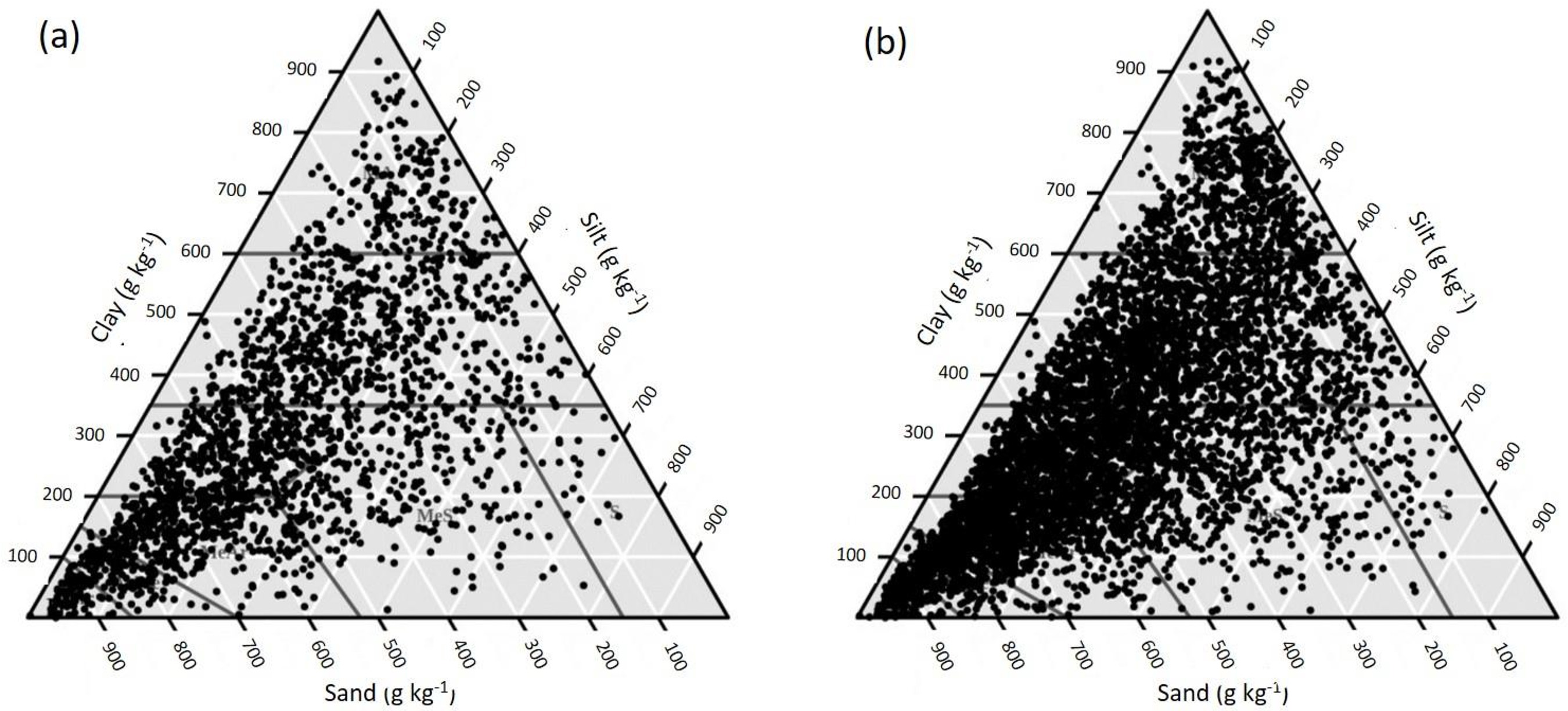
Following consistency assessment, a total of 2,217 surface horizon samples and 3,726 subsurface horizon samples were retained for the analysis of exchangeable cations and potential acidity determined by different analytical methods. The dataset represents a wide range of textural classes, as shown in the ternary diagrams (Figure 1).

Distribution of horizons according to particle-size fractions in ternary diagrams. (a) Surface horizons (A and transitional horizons), n = 2,217; (b) Subsurface horizons (E, B, C, and transitional horizons), n = 3,726.
Evaluation of properties in surface horizons
The H+Al values determined by the SiBCS method were lower than those obtained using the H+AlBaCl2 method (WRB and ST). Similarly, the SiBCS-derived values of SB, CTC, and V were lower than the SBNH4OAc, CECₚH₇, and VₚH₇, respectively (Table 3). As a result, when the CTC (SiBCS) was lower than the CECₚH₈.₂ (WRB and ST), the corresponding V value was higher than the VₚH₈.₂ (Table 3).
Values of properties for surface horizons, calculated from exchangeable cations and potential acidity determinations obtained using the SiBCS, WRB and ST methods
The differences between SB and H+Al directly influence the base saturation, as previously noted by Larach and Paolinelli (1982). According to these authors, determination of CEC in Brazilian soils using the analytical methods currently adopted by SiBCS resulted in lower values than those obtained using the international methods. They proposed that “for operational purposes, a V value of 65 % obtained from the former SNLCS (currently Embrapa Solos) would correspond to 50 % in the Soil Conservation Service (SCS, pH 7).”
Since the first edition of the SiBCS (Embrapa, 1999), this assumption has been adopted, establishing 65 % as the minimum V threshold for defining the chernozemic A horizon. This threshold remains in the current 2025 edition (Santos et al., 2025). However, this criterion was originally based on only 28 samples from four Argissolos (Acrisol or Lixisol - WRB)and one Nitossolo (Nitisol - WRB) profile, providing limited representativeness of Brazilian soils. Moreover, the 65 % threshold was not supported by quantitative correspondence analyses but was merely suggested as a practical approximation.
The adoption of V 65 % as the criterion for identifying a Chernozêmico A horizon constitutes a relatively stringent standard, which likely leads to an underestimation of these diagnostic horizons and, consequently, of the soil classes in which they occur, particularly the order Chernossolos (Santos et al., 2025) (Chernozems, Kantanozems, or Phaeozems, WRB). These soils, and others with Chernozêmico A horizons, are typically associated with higher natural fertility.
In agricultural soils, the eutrophic character of a soil is generally interpreted as higher fertility, and management practices often aim to increase the exchangeable Ca, Mg, and V levels (Tomé Jr., 1997), especially in dystrophic soils as defined by the SiBCS criteria (Santos et al., 2025). These properties are also used to interpret land-use potential in various international systems, such as discussed within the International Network of Black Soils (FAO/ITPS, 2015), where the black soils are recognized as highly productive soils and one of the categories is defined by CECₚH₇ ≥25.0 cmolc kg-¹ and V ≥50 %.
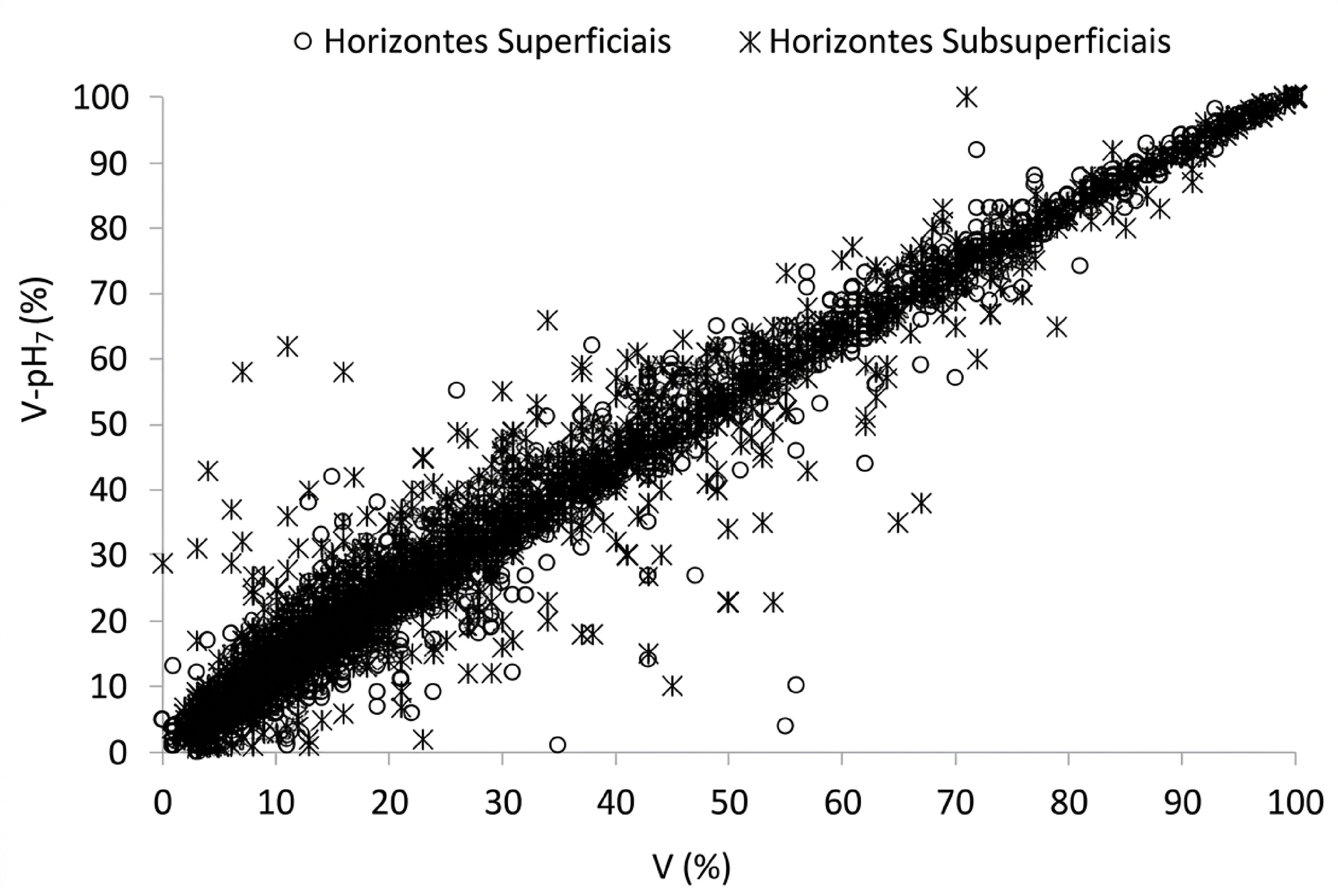
Accordingly, correspondence among SiBCS and international analytical methods for H+Al, SB, CEC, and V was assessed through linear regression models (Figures 2, 3, 4, 5, 6, and 7). The resulting predictive equations are presented in table 5.

Scatterplot of H+Al values in SiBCS and H+AlBaCl2 in ST of the surface (n = 2,159) and subsurface (n = 3,628) horizons. Dashed trend line represents the surface horizons and the solid line represents the subsurface horizons.

Scatterplot of SB values in SiBCS and SBNH4OAc in WRB and ST of the surface (n = 1,693) and subsurface (n = 2,811) horizons. Dashed trend line represents the surface horizons, and the solid line represents the subsurface horizons.

Scatterplot of CTC values in SiBCS and CECpH7 in WRB and ST of the surface (n = 1,690) and subsurface (n = 2,795) horizons. Dashed trend line represents the surface horizons, and the solid line represents the subsurface horizons.

Scatter plot of CTC values in the SiBCS and CECpH8.2 in the ST of the surface (n = 1,690) and subsurface horizons (n = 2,795). Dashed trend line represents the surface horizons, and the solid line represents the subsurface horizons.

Scatter plot of V values in the SiBCS and VpH7 in the WRB and ST of the surface (n = 1,690) and subsurface horizons (n = 2,789). Dashed trend line represents the surface horizons, and the solid line represents the subsurface horizons.

Scatterplot of V values in SiBCS and VpH8.2 in ST of surface (n = 1,690) and subsurface (n = 2,789) horizons. Dashed trend line refers to surface horizons and solid line to subsurface horizons.
Properties of subsurface horizons
The exchangeable cation and potential acidity values obtained using the analytical method adopted by the SiBCS were lower than those determined by the methods used in international systems (WRB and ST) (Table 4). The same trend was observed for CTC, whose value is lower than that of CECpH8.2, and consequently, the V is higher than VpH8.2 (Table 4).
Values of properties for subsurface horizons, calculated from exchangeable cations and potential acidity determinations obtained using the SiBCS, WRB, and ST methods
The most appropriate way to establish correspondence among properties values determined by different methods is through linear regression analysis. These functions were derived from relationships between the parameters H+Al, SB, CTC, and V obtained by the SiBCS method, and those obtained by H+AlBaCl₂, SBNH₄OAc, CECpH7, CECpH8.2, VpH7, and VpH8.2 (Figures 2, 3, 4, 5, 6, and 7). The regression equations for defining these correspondences are presented in table 6.
Equations for obtaining correspondence among methods
Notably, due to differences in the extractants used in laboratory analyses for determining exchangeable cation contents and soil potential acidity, it is necessary to adjust or harmonize property values obtained through the SiBCS method with those obtained by WRB and ST. This adjustment is particularly important for CEC and V, which are key parameters in defining diagnostic properties, diagnostic horizons, and soil classes across multiple hierarchical levels.
To establish correspondence among property values, predictive equations were proposed for surface horizons (Table 5) and subsurface horizons (Table 6). In these tables, the first column refers to the property to be estimated based on its value determined by the other method (included in the equation).
Predictive equations for estimating H+Al, SB, CEC and V values obtained by the analytical methods adopted in the SiBCS and the international WRB and ST systems for surface horizons
Predictive equations for estimating H+Al, SB, CEC and V values obtained by the analytical methods adopted in the SiBCS and the international WRB and ST systems for subsurface horizons
Regarding the methodological differences, it is important to note that for H+Al, the BaCl₂ solution used in the ST and WRB methods tends to overestimate values compared to those obtained with the 0.5 mol L-1 Ca(OAc)2 (pH 7.0) solution in the method preconized by SiBCS. The BaCl₂ solution extracts cations adsorbed to both permanent and pH-dependent charges. For basic cations (Ca²⁺ and Mg²⁺), the ion-exchange principle is similar among the different extractant solutions, whereas both methods used the same KCl solution for Al³⁺. As for Na⁺ and K⁺, ion exchange is performed in the ST and WRB systems, whereas in the SiBCS, a dilute strong acid solution is used; however, these methodological differences do not lead to significant variations in their concentrations, and exert minimal influence on SB and CEC calculations in either classification system (Soil Survey Staff, 2011, 2014; Teixeira et al., 2017).
In the SiBCS, CTC is used to define the activity of the clay fraction (high-activity – ≥27.0 cmolc kg-¹), while V is used to define the diagnostic surface Chernozêmico A horizon (≥65 %) and the eutrophic and dystrophic character (≥50 % and <50 %, respectively). These parameters are also used as diagnostic criteria in some subsurface soil classes, such as Chernossolos and Luvissolos (Santos et al., 2025). In the international systems, the CECpH7 is used to define the activity of the clay fraction and to identify diagnostic horizons such as the ferralic (WRB) and oxic (ST).
In the WRB, V is also used to define eutric character (V = SB/CECe ≥50 %). In the Soil Taxonomy (ST), the eutrophic (VpH7 ≥ 50 or ≥ 60) and eutric (for the Oxisols order Acrustox and Acrudox ≥ 35 %) characters are defined using similar threshold values. In the WRB, CECₚH8.2 is applied only in special cases, such as to analyze saline or alkaline soils. The WRB also applies base saturation to define the Chernic and Mollic horizons and the soil groups Chernozems, Kastanozems, and Phaeozems; and the ST adopts this diagnostic property to define the Mollic epipedon and the Mollisols order.
The variations observed among analytical methods and proposals in this study are supported by a large number of soil samples representing a wide range of soil classes across Brazil. These results have important implications for soil classification in the SiBCS and for establishing correspondence of diagnostic property values among different soil classification systems.
Regarding the correspondence of soil classes between the SiBCS and international systems, the V (SiBCS) value estimated through equations derived from VₚH7 (WRB and ST) may differ by up to approximately 5 % for both surface and subsurface horizons. This variation can be considered negligible given the own analytical uncertainty of the methods. Therefore, a direct correspondence between the values obtained by both methods to be adopted in the SiBCS is proposed in this study. Consequently, no distinction exists between the V of the Mollic epipedon (ST), the Chernic and Mollic horizons (WRB), and the eutrophic or dystrophic characters as defined by SiBCS, WRB, and ST.
In addition, for the SiBCS, the small difference observed justifies a revision of the threshold values defining diagnostic horizons, particularly the V criterion, currently set at ≥65 %. Revising this limit could significantly affect the geographic distribution of the order Chernossolos in the Brazilian territory, as well as of classes of soils with chernozemic A horizons.
The proposed adjustment of V% will also affect the classification of anthropic soils and those modified by management practices, such as liming, thereby enabling better interpretation of their potential and limitations for agriculture.
CONCLUSIONS
The values of potential acidity (H+Al), sum of bases (SB), cation exchange capacity (CEC), and base saturation (V) obtained using the analytical methods adopted by the SiBCS are lower than those obtained using the methods of the international systems WRB and ST. For the V values, the difference between methods is approximately 5 %; therefore, a direct correspondence between the different methods can be considered acceptable, except for VₚH8.2, for which the use of predictive equations is recommended.
For the diagnostic surface Chernozêmico A horizon, the current 65 % V threshold underestimates the occurrence of this horizon and the soil classes in which it is found across Brazil. Adjusting the threshold to define the eutrophic character in surface horizons, in accordance with international classification criteria, will provide a more accurate representation of the soil fertility and the geographic distribution of these soils.
ACKNOWLEDGMENTS
The authors acknowledge the members of the Pedometrics Laboratory who contributed to data cleaning and compilation: David Oliveira Pontes (UTFPR), Graziele Feltrin Dias Wendling (UFSM), Aline Mari Huf dos Reis (UFG), Marcos Vinicius Souza Cardoso (UTFPR), Ana Caroline Pretto (UTFPR), and Gabriel Ferreira Pontes (UnB). The authors acknowledge Embrapa Soils and all contributors involved in the soil survey reports from which the data were derived. We also acknowledge the financial support from CNPq (National Council for Scientific and Technological Development) - Brazil.
-
How to cite:
Fontana A, Anjos LHC, Almeida VP, Kempner DLK, Horst TZ, Samuel-Rosa A. Exchangeable cations determined by different methods: implications for soil classification and evaluation. Rev Bras Cienc Solo. 2026;50:e0250049. https://doi.org/10.36783/18069657rbcs20250049
-
1
“CTC” refers to the cation exchange capacity (CEC) as determined by the SiBCS method.
DATA AVAILABILITY
The data will be provided upon request.
REFERENCES
- Camargo MM, Beinroth FN. Proceedings of first international soil classification workshop. Rio de Janeiro: Embrapa/SNLCS; 1978.
- Camargo MN, Kimble JM, Beinroth FN, Arango HP. Classification, characterization and utilization of Oxisols. Part 2: Filed trip background site and pedon descriptions analytical data. In: Proceedings of Eighth International Soil Classification Workshop. Rio de Janeiro, Embrapa/SNLCS; 1986.
-
Camargo AO, van Raij B, Valadares JMAS. Avaliação da capacidade de troca de cátions em solos utilizando o método do tampão SMP. Bragantia. 1982;41:119-23. https://doi.org/10.1590/S0006-87051982000100012
» https://doi.org/10.1590/S0006-87051982000100012 -
Castro AF, Barreto WO, Anastácio MLA. Correlação entre pH e saturação de bases de alguns solos brasileiros. Pesq Agropec Bras. 1972;7;9-17. https://doi.org/10.1590/S1678-3921.pab1972.v7.17337
» https://doi.org/10.1590/S1678-3921.pab1972.v7.17337 - Empresa Brasileira de Pesquisa Agropecuária – Embrapa. Sistema brasileiro de classificação de solos. Rio de Janeiro: Embrapa Solos; 1999.
- Food and Agriculture Organization of the United Nations / Intergovernmental Technical Panel on Soils - FAO/ITPS. Status of the World’s Soil Resources (SWSR) – Main Report. Rome, Italy: FAO/ITPS; 2015.
- Ikawa H. Correlation of selected data for some Brazilian soils provided by Brazil and SCS-USDA laboratories. In: Camargo MN, Beinroth FN, editors. Proceedings of first international soil classification workshop. Rio de Janeiro: Embrapa/SNLCS; 1978. p. 338-53.
-
IUSS Working Group WRB. World reference base for soil resources. International soil classification system for naming soils and creating legends for soil maps. 4th. ed. Vienna, Austria: International Union of Soil Sciences (IUSS); 2022. Available from: https://www.isric.org/sites/default/files/WRB_fourth_edition_2022-12-18.pdf
» https://www.isric.org/sites/default/files/WRB_fourth_edition_2022-12-18.pdf - Larach JOI, Paolinelli GP. Capacidade de troca de cátions, soma de bases e saturação de bases: Correlação de resultados procedentes do SCS-USDA e do SNLCS-Embrapa e implicações conexas. Rio de Janeiro: Embrapa-SNLCS; 1982. (Boletim de pesquisa, 5).
- Moormann FR. Expert from the circular letters of the International Committee on Low Activity Clays (ICOMLAC). Washington, DC: Soil Management Support Service; 1985.
-
Oliveira JB. Diferenciação e distribuição de solos, em diversos níveis categóricos, de duas áreas aparentemente homogêneas de Oxissolo. Bragantia. 1975;34:309-48. https://doi.org/10.1590/S0006-87051975000100021
» https://doi.org/10.1590/S0006-87051975000100021 - Santos HG, Jacomine PKT, Anjos LHC, Oliveira VA, Lumbreras JF, Coelho MR, Almeida JA, Araújo Filho JC, Lima HN, Marques FA, Oliveira JB, Cunha TJF. Sistema brasileiro de classificação de solos. 6. ed. rev. ampl. Brasília, DF: Embrapa; 2025.
- Soil Survey Staff. Soil survey laboratory information manual. In: Burt R, editor. Soil Survey Investigations Report No. 45, Version 2.0. Washington, DC: United States Department of Agriculture, Natural Resources Conservation Service; 2011.
- Soil Survey Staff. Keys to soil taxonomy. 13th ed. Washington, DC: United States Department of Agriculture, Natural Resources Conservation Service; 2022.
- Soil Survey Staff. Kellogg soil survey laboratory methods manual - Soil survey investigations report nº 42. Version 5.0. Washington, DC: United States Department of Agriculture, Natural Resources Conservation Service; 2014.
- Teixeira PC, Donagemma GK, Fontana A, Teixeira WG. Manual de métodos de análise de solo. 3. ed. rev e ampl. Brasília, DF: Embrapa; 2017.
- Tomé Jr JB. Manual para interpretação de análise de solo. Guaíba: Agropecuária; 1997.
-
van Raij B, Küpper A. Capacidade de troca de cátions em solos: Estudo comparativo de alguns métodos. Bragantia. 1966;25:327-36. https://doi.org/10.1590/S0006-87051966000200005
» https://doi.org/10.1590/S0006-87051966000200005 -
Verdade FC. Observações sobre métodos de determinação da capacidade de troca de cátions do solo. Bragantia. 1956;15:393-401. https://doi.org/10.1590/S0006-87051956000100029
» https://doi.org/10.1590/S0006-87051956000100029
Edited by
-
Editor:
Marcos Gervasio Pereira https://orcid.org/0000-0002-1402-3612 and Carlos Ernesto Gonçalves Reynaud Schaefer https://orcid.org/0000-0001-7060-1598