 Phosphorus fractions in a lowland production system in subtropical soil under no-tillage
ABSTRACT
Phosphorus (P) is one of the most limiting elements for plant nutrition in tropical and subtropical soils due to its high binding energy on the surface of iron and aluminum oxides and hydroxides. Flooded rice cultivation occurs in lowlands, influencing redox reactions and P dynamics. This study aimed to evaluate the forms of phosphorus and their lability after soil reoxidation subsequent to a period of flooding for irrigated rice cultivation following four seasons of cultivation with soybean-ryegrass and corn-white clover succession in an Albaqualf (Planossolo) fertilized with triple superphosphate under no-tillage. The experiments were conducted in Albaqualf (Planossolo), in a 2 × 2 double factorial scheme, with factor 1 being P fertilization and factor 2 being flooding followed by drainage. Triple superphosphate was used as the P source. One of the experiments consisted of a soybean-ryegrass, and the other consisted of corn-white clover, cultivated for four years, with irrigated rice cultivated in the fifth year. Using TSP increased the soil P-labile fraction by 107 and 114 %, for soybean-ryegrass succession and corn-white clover succession, respectively. After the end of the flooding period and post-soil drainage, a reduction of 17 and 13 % was observed in the P-labile and P-moderately labile fractions, in soybean-ryegrass, respectively. And the same fractions in the corn-white clover succession decreased 12 and 5 %, respectively. Using P fertilizer increases the fractions of P-labile, P-moderately labile, and P-less labile in the soil. Soil drainage after rice cultivation reduces the fractions of labile and moderately labile phosphorus in the soil, regardless of the crop succession used.
Keywords
rice; labile phosphorus; no-tillage; crop rotation
INTRODUCTION
Brazil plays a prominent role in the global production of food, fiber, and energy, which will see a 30 % increase in global demand by 2050 (FAO, 2024). However, it is known that approximately 80 % of Brazilian agricultural soils are deficient in phosphorus (Cardoso et al., 2020; Rodrigues et al., 2021). The lack of this nutrient in the soil has been attributed as a major limiting factor to crop productivity, which is met by using soluble phosphate fertilizers (Richardson et al., 2011; Heuer et al., 2017). Nonetheless, it is estimated that only 10 to 20 % of the P applied in the form of phosphate fertilizers is made available to crops (Syers et al., 2008). The inefficiency of P use in Brazilian soils is due to the high fixation of phosphorus in iron and aluminum oxides in tropical and subtropical soils (Rodrigues et al., 2016). Furthermore, Brazil imports more than 80 % of all fertilizers and raw materials for soluble phosphate fertilizers, which are the most widely used in agriculture and have higher agronomic efficiency (ANDA, 2024). Since phosphate fertilizers have low efficiency, it is necessary to understand techniques and cultivation systems that improve P availability to plants.
Improving the efficiency of phosphate fertilization is necessary for adequate crop development, as the low concentration of P in the soil occurs due to the strong interaction of mineral surfaces and metal cations with the organic and inorganic forms of P, making it not widely available to crops (Bortoluzzi et al., 2015). Among the forms of P that is found in the soil, we have organic P (Po), which is composed of phosphodiesters (available as deoxyribonucleic acid and ribonucleic acid) and phosphomonoesters (available as inositol phosphates, adenosine phosphates and phospholipids) (Zhang et al., 2023). Another form is inorganic P (Pi), found mainly in the soil in a smaller proportion as polyphosphates, and in a larger proportion it precipitates and is found as orthophosphates, due to the high affinity with cations such as Ca2+, Fe3+ and Al3+ (Darch et al., 2014). The low phosphate availability in soil occurs through adsorption on surfaces such as Fe and Al oxides and hydroxides, phyllosilicate edges and organic matter (OM), which have positive charges. Since phosphates are anions, their largest proportion is adsorbed and becomes unavailable to plants (Hinsinger, 2001; Gérard, 2016). Through the exchange of ligands (specific sorption), phosphates are adsorbed on mineral surfaces, and polyvalent metal cations can also provide a negative charge on surfaces and adsorb phosphates, reducing their mobility in the soil (Redel et al., 2007). On the soil surface, under no-till conditions, there is an increase in the availability of Pi in the soil solution, due to the reduction in the binding energy of the P adsorption sites due to their saturation with the annual use of phosphate fertilizers (Rheinheimer and Anghinoni, 2001). Futhermore, no-tillage accumulates crop residue on the soil surface, increasing OM and its decomposition products, contributing positively to the increase in the Po fraction close to the soil surface (Rheinheimer and Anghinoni, 2003).
Phophorus dynamics in the soil are understood through its fractionation, which occurs with a sequence of sample extractions with different solutions and reagents, which selectively break the adsorption bonds of the different forms of phosphate ions in the soil, allowing their quantification and understanding of their different forms according to each land use (Gatiboni et al., 2013). This fractionation allows us to define the P availability for plants, as we distinguish the stable and organic fractions and the labile and non-labile fractions through fractional extraction. The amounts of P extracted in resin and bicarbonate comprise the fraction of labile P in the soil (which would be available to plants and microorganisms) while the sum of the remaining fractions of P (Pi and Po in hydroxide and sonicate + hydroxide, Pi in HCl and residual P in sulfuric digestion), constitute the P unavailable to plants, being characterized as the non-labile P of the soil (Cross and Schlesinger, 1995).
Management practices such as no-tillage and crop rotation influence soil processes that can affect phosphorus fractions (Li et al., 2023). The use of different species, such as grasses and legumes, over time, in the same area, characterizes crop rotation, which in turn requires the alternation of different crops to break the disease cycle, as well as providing a positive residual effect on the soil, environment and successor crops due to the different plant root systems (Morrison et al., 2017; Li et al., 2021, 2023). In Rio Grande do Sul State, lowland soils are used with irrigated rice, soybean and extensive livestock, basically, with some areas cultivated with corn (Carlos et al., 2020; Sousa et al., 2021). In this context, crop succession or rotation is essential for intensifying the use of paddy fields and alternating the means of production, and is currently the best way to control the main weed in irrigated rice, red rice (Carlos et al., 2022). The way crops can potentially influence the P fractions in the soil is mainly related to the type of root system, such as that of the corn crop, which is a C4 grass with more voluminous roots and higher residual intake when compared to soybean crops.
In paddy fields cultivated with flood-irrigated rice in rotation with non-flooded crops, such as soybeans, corn and pastures, there is an alternation in soil oxidation-reduction conditions. Thus, during flooding, Fe oxides and hydroxides can be considered a source of P for rice plants, as Fe reduction increases P availability (Teixeira et al., 2018). Reoxidation of the soil after drainage for the cultivation of non-flooded species reverses the reactions of Fe oxides and hydroxides, which precipitate in the soil in forms of low crystallinity and begin to act again as P drains in the soil, reducing the availability of the nutrient. It was observed that soil drainage after a flooding period increases the maximum phosphorus adsorption capacity, and this effect remains for approximately 163 days in Argiaquoll soil and 121 days Albaqualf soil (Teixeira et al., 2018).
This study aimed to evaluate the forms of phosphorus and their lability after soil reoxidation subsequent to a period of flooding for irrigated rice cultivation, following four seasons of cultivation with soybean-ryegrass and corn-white clover succession in Albaqualf (Planossolo) fertilized with triple superphosphate under no-tillage.
MATERIALS AND METHODS
Site description
Experiments were conducted in Capão do Leão, southern Brazil, at the Terras Baixas Station of Embrapa Clima Temperado, Pelotas-RS, coordinates 31° 48’ 02” S and 52° 29’ 44” L and 12 m of altitude above sea level. Experiments were conducted in a soil classified as Albaqualf (Soil Taxonomy) (Soil Survey Staff, 2014) or Planossolo Háplico Eutrófico Solódico by the Brazilian classification (Santos et al., 2018), with the physical and chemical properties described as the following: pHH2O (1:1): 5.5; O.M.: 2.2%; K: 40 mg dm-3; Na: 48 mg dm-3; P: 1.5 mg dm-3; Al3+: 0.6 cmolc dm-3; Ca2+: 2.2 cmolc dm-3; Mg2+: 1.3 cmolc dm-3; soil clay content: 20 %. The climate is characterized as humid subtropical (Cfa) with average annual temperature and rainfall of 17.8 °C and 1360 mm, respectively.
Experimental design
One of the experiments consisted of a soybean-ryegrass succession and the other a corn-white clover succession, with subsequent irrigated rice cultivation. Experiments were conducted in a 2 × 2 double factorial scheme, with factor 1 being the soil sampling period and factor 2 being phosphate fertilization. Factor 1 consisted of before and after soil flooding for the rice crop, followed by drainage. Second sampling period was carried out with the soil drained after the flooding period for rice cultivation. Factor 2 consisted of the control treatment without phosphate fertilization and with phosphorus application with triple superphosphate (TSP) at rates of 48 and 52.4 kg ha-1 of P for corn and soybeans, respectively, with annual reapplication by broadcast.
Experimental design used was randomized blocks with four replications, conducted during five crop seasons in the experimental area. Rainfed crops were cultivated during the first four seasons, and irrigated rice was cultivated in the fifth agricultural season. Experimental units consisted of plots with an area of 20 m2. Corn cultivar Pioneer 3063 was used, with a population density of 80,000 plants ha-1, and the soybean cultivar BRS 153, at a density of 400,000 plants ha-1, both sown with a spacing of 0.50 m between rows. Rice cultivar used was BRS Querência, with a density of 100 kg ha-1 of seeds, with a spacing of 0.17 m. For weed control, the area was chemically managed with glyphosate herbicide at a rate of 4 L ha-1.
Before implementing the experiment, pre-planting fertilizer with KCl was distributed in the plots, totaling 103.8 kg ha-1 of K for soybeans and corn. Soon after, the fertilizer was incorporated into the soil, using a rotary hoe in the 0.00-0.20 m layer. In the following years, the experiment was conducted in a no-tillage system (NTS), with annual and superficial application of KCl, in the same starting dose. For corn, a rate of 130 kg ha-1 of N was applied, and for rice, a rate of 100 kg ha-1 of N, using common urea.
Soil phosphorus fractionation
In the fifth crop season of the experiment, soil samples were collected from the experimental plots on two occasions, before and after rice cultivation. Collection before rice cultivation was carried out 30 days before flooding, and the collection after cultivation occurred after total drainage of the cultivated area, around 60 days after harvest. Soil samples were composed of ten sub-samples being collected at two layers 0.00-0.025 and 0.025-0.05 m. Soil samples were dried and sieved (2 mm sieve). In these samples, the chemical fractionation of phosphorus was carried using the method of Hedley et al. (1982), modified by Condron et al. (1985) and adapted from Gatiboni (2003), being fractionated in fraction P-RTA (phosphorus extracted with anion exchange resin), Pi bic (inorganic phosphorus extracted with NaHCO3), Pi hid 01 and Po hid 01 (inorganic and organic phosphorus extracted with NaOH 0.1 mol L-1), Pi hid 05 and Po hid 05 (inorganic and organic phosphorus extracted with NaOH 0.5 mol L-1), Pi HCl (phosphorus extracted with HCl 1.0 mol L-1) and P resid (residual phosphorus). Samples of 1.5 g of dry soil were subjected to sequential extraction in the following order: anion Exchange resin blade (P RTA) > NaHCO3 0.5 mol L-1 (Pi bic and Po bic) > NaOH 0.1 mol L-1 (Pi hid 01 and Po hid 01) > HCl 1.0 mol L-1 (Pi HCl) > and NaOH 0.5 mol L-1 (Pi hid 05 and Po hid 05). After extractions, the remaining soil was dried in the oven and subjected to digestion with H2SO4 + H2O2 + MgCl2 (P resid).
The results were also classified into P-labile fraction of the soil (Pi RTA + Pi bic + Po bic), P-moderately labile (Pi hid 01 + Pi hid 05 + Po hid 01 + Po hid 05) and P-less labile (Pi HCl + P resid) (Costa et al., 2014).
Statistical analysis
Phosphorus forms extracted in the fractionation before and after irrigated rice cultivation were subjected to statistical analysis using the mixed procedure. When a significant difference was observed, the means were compared using the Tukey’s test at 5 % probability. All statistical analyses were performed using the statistical program R® (R Development Core Team, 2020).
RESULTS
Inorganic P (Pi)
Phosphate fertilization significantly increased the fractions of labile P (P RTA and Pi bic) before rice cultivation and after the end of the flooding period and post soil drainage, both in the 0.00-0.025 and 0.025-0.05 m layers, being more expressive in the layer of 0.00-0.025 m in relation to the control, in soybean-ryegrass succession (Table 1) and corn-white clover succession (Table 2). With soil drainage, after the flood period, the concentration of P in the most labile fractions (P RTA and Pi bic) reduced significantly at a layer of 0.00-0.025 m, when TSP was used in both crop successions. Phosphate fertilization increased the fraction of moderately labile P (Pi hid 01) in relation to the control, both for layers and for crop successions, before rice cultivation and after the end of the flooding period and post soil drainage (Tables 1 and 2), with the exception of soybean-ryegrass succession, in the 0.025-0.05 m layer. Having the soil drained, after a period of flooding did not show significant effects on the P content of the moderately labile fraction. The fraction of P associated with calcium in TSP was higher than control and there was no effect of soil drainage after a period of flooding (Tables 1 and 2). The use of phosphate fertilizer increased the fraction Pi hid 05 in corn-white clover succession, before rice cultivation and after the end of the flooding period and post soil drainage at a layer of 0.00-0.025 m and before rice cultivation at a layer of 0.025-0.05 m.. After the flooding period and drainage, this form of P decreased both in the crop successions and at depths.
Inorganic phosphorus fractions (mg kg-1) of samples from Albaqualf (Planossolo) soil collected before and after the cultivation of irrigated rice at two layers and as a function of phosphate fertilization, in a soybean-ryegrass succession under no-tillage
Inorganic phosphorus fractions of samples from Albaqualf (Planossolo) soil collected before and after the cultivation of irrigated rice at two layers and as a function of phosphate fertilization, in a corn-white clover under no-tillage
Organic P (Po)
There was an increase in Po content in the treatment with phosphate fertilizer at a layer of 0.00-0.025 m, before rice cultivation and after the end of the flooding period and post-soil drainage in the soybean-ryegrass succession (Table 3) and corn-white clover succession (Table 4). At a layer of 0.025-0.05 m, no significant differences were observed when using phosphate fertilizer (Tables 3 and 4). The fractions of Po hid 01 and 05 were not benefit by fertilization in both crop successions at a layer of 0.00-0.025 m before flooding for the rice crop. After the end of the flooding period and post-soil drainage, there was a significant difference with the use of TSP in the fraction of Po hid 01 at a layer of 0.00-0.025 m in both crop successions and at a depth of 0.00-0.025 m in the corn-white clover succession. The fraction of Po hid 05 was not influenced by phosphate fertilization, and in the assessment carried out on the drained soil after a period of flooding.
Organic phosphorus fractions (mg kg-1) of samples from Albaqualf (Planossolo) soil collected before and after the cultivation of irrigated rice at two layers and as a function of phosphate fertilization, in a soybean-ryegrass succession under no-tillage
Organic phosphorus fractions of samples from Albaqualf (Planossolo) soil collected before and after the cultivation of irrigated rice at two layers and as a function of phosphate fertilization, in a corn-white clover succession under no-tillage
Total inorganic, total organic, residual and total phosphorus
Total Pi was higher with phosphate fertilizer in relation to the control in all conditions evaluated. There was a significant interaction of flooding followed by drainage in the 0.00-0.025 m layer with and without TSP on total Pi in soybean-ryegrass succession (Table 5). Regarding total Po, superiority was observed with the use of TSP in the 0.00-0.025 m layer, in the soybean-ryegrass succession (Table 5). In the corn-white clover, at a layer of 0.00-0.025 m, the total Po concentration was higher only after the end of the flooding period and post-soil drainage (Table 6).
Inorganic phosphorus (Pi), organic phosphorus (Po), residual phosphorus (P resid) and total phosphorus (P total) (mg kg-1) of samples from Albaqualf (Planossolo) soil collected before and after the cultivation of irrigated rice at two layers and as a function of phosphate fertilization, in a soybean-ryegrass succession under no-tillage
Inorganic phosphorus (Pi), organic phosphorus (Po), residual phosphorus (P resid) and total phosphorus (P total) of samples from Albaqualf (Planossolo) soil collected before and after the cultivation of irrigated rice at two layers and as a function of phosphate fertilization, in a corn-white clover under no-tillage
There was a small increase in the fraction P resid with fertilization in relation to the control in corn and soybean-ryegrass succession at a layer of 0.00-0.025 m (Tables 5 and 6), but there was no influence of this fraction in the assessment carried on the drained soil after a period of flooding for both layers, regardless of the crop succession. When phosphate fertilizer was used in soybean-ryegrass, at a layer of 0.00-0.025 m, an increase in the fraction of P resid was observed, but no effect of flooding followed by drainage on this fraction (Table 5). Total P showed superiority in layers and crop successions when using TSP (Table 5 and 6), showing a flooding followed by drainage effect only in the 0.00-0.025 m layer in the soybean-ryegrass succession.
P labile, moderately labile and less labile
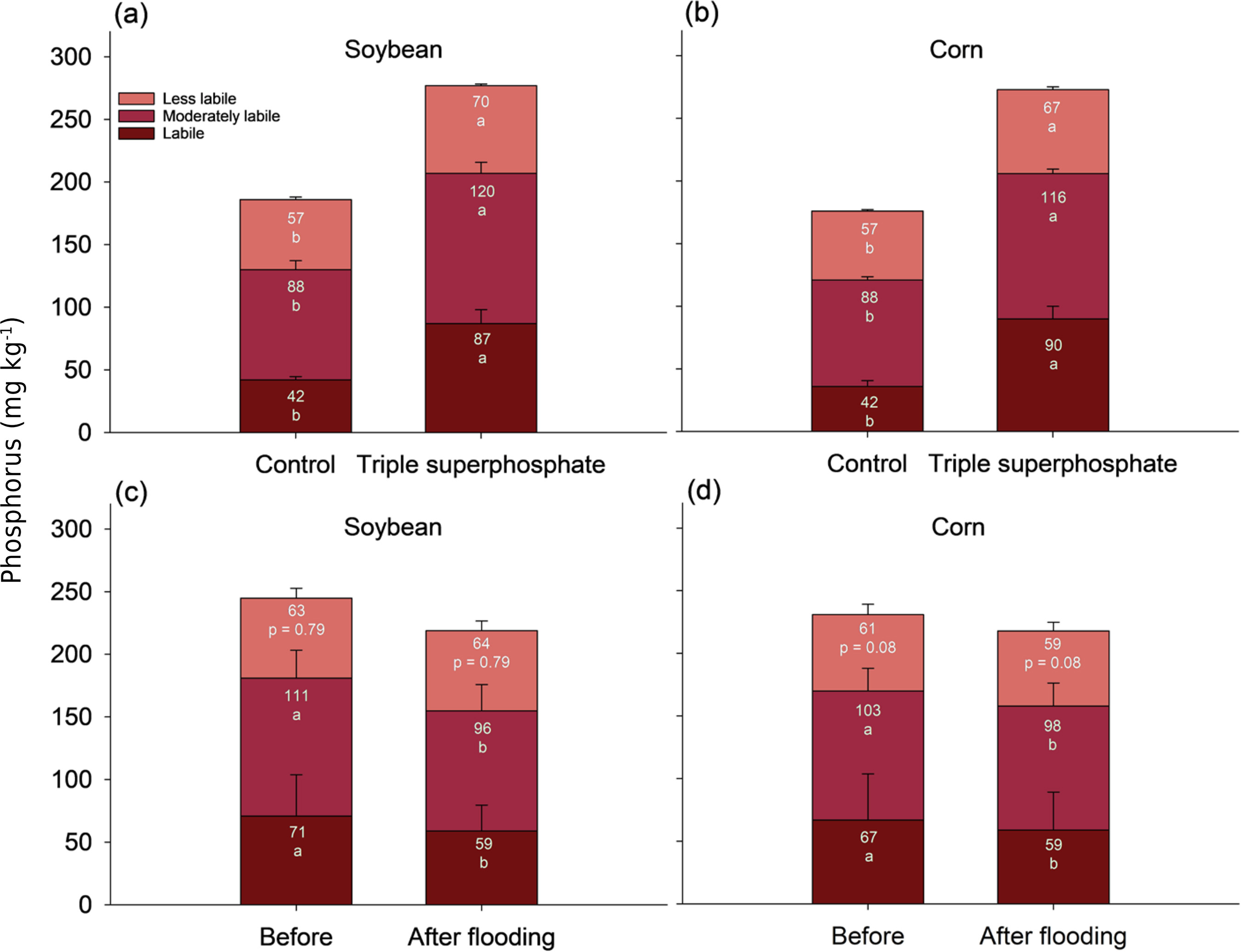
P-labile fraction of the soil (Pi RTA + Pi bic + Po bic) was 107 and 114 % higher with the use of TSP, for soybean-ryegrass (Figure 1a) and corn-white clover succession, respectively (Figure 1b). The P-moderately labile (Pi hid 01 + Pi hid 05 + Po hid 01 + Po hid 05) and P-less labile (Pi HCl + P resid) fractions had P levels 36 and 23 %, higher, respectively, for the succession with soybean in relation control treatment (Figure 1a). In the same comparison, an increase in P-moderately labile and P-slightly labile was observed, which was 32 and 17 % higher, respectively, for corn in comparison treatment control 1b). After the end of the flooding period and post soil drainage, a reduction of 17 and 13 %, respectively, was observed in the fractions P-labile and P-moderately labile, in the soybean-ryegrass (Figure 1c) and corn-white clover (Figure 1d), a reduction of 12 and 5 %, respectively, for the same fractions.
Fractions of phosphorus labile (Pi RTA + Pi bic + Po bic), moderately labile (Pi hid 01 + Pi hid 05 + Po hid 01 + Po hid 05), and less labile (Pi HCl + P resid) as a function of phosphate fertilization in a soybean-ryegrass (a) and corn-white clover succession (b), and as a function of flooding followed by drainage in soybean-ryegrass (c) and corn-white clover succession (d) under no-tillage in Albaqualf (Planossolo), Capão do Leão-RS.
DISCUSSION
Inorganic P
The increase in fractions labile and moderately labile Pi in the most superficial layers of the soil observed in the experiment (Tables 1 and 2) is due to the accumulation of phosphorus caused by the annual P fertilization, associated with the no-tillage. Rotta (2012), evaluating labile Pi in three areas with different years of adoption of no-tillage, found that there was a decrease in labile Pi in only one of them, when it was subjected to soil tillage in the last year of cultivation. In this case, the rupture of soil aggregates, increasing the contact surface between the adsorption sites and the phosphate ion, probably contributed to higher energy retention, as suggested by Selles et al. (1997). Management systems that promote an increase in OM in the soil, such as no-tillage, contribute to the increase in more labile forms of Pi, especially because organic acids from the decomposition of OM block the sites of P adsorption due to the coating with Fe and Al oxides (Zamuner et al., 2008).
According to Rheinheimer and Anghinoni (2003), P initially accumulates in less labile forms (places more avid for P) with consequent P saturation and, sequentially, accumulates in moderately labile fractions. The moderately labile fraction can act as a source or sink of available Pi, depending on the amount of Pi added as fertilizer. Under conditions of high application of phosphate fertilizer, higher than export by crops, excess Pi is accumulated in moderately labile forms, draining the added P. Likewise, in a situation of low fertilizer addition, moderately labile Pi can also act as a source, meeting the needs of the crop (Conte et al., 2003; Gatiboni et al., 2007).
Flooding the soil for rice cultivation causes profound chemical and electrochemical changes (Sousa et al., 2002). The most important chemical change that occurs in flooded soils is the reduction of ferric oxides (Fe3+) to ferrous oxides (Fe2+), with a consequent increase in Fe solubility. The transformations that occur in a flooded soil are markedly affected by Fe chemistry, due to the large amount of Fe oxides and hydroxides that can be reduced and the reactivity of Fe with other compounds in the soil (Sousa et al., 2023). Phosphorus is one of the elements whose dynamics are affected by the behavior of Fe in flooded soils, as the P-Fe compounds are those that contribute most to the P available to plants, before and after flooding (Ranno et al., 2007).
After the end of the flooding period for rice cultivation, the soil reoxidizes and there is a reduction in the concentration of inorganic forms of labile P, both in soybean-ryegrass and corn-white clover succession (Tables 1 and 2) due to the transformations that occur in Fe oxides and hydroxides. During the flooding period, iron oxides and hydroxides can be considered a source of phosphorus for rice plants, since anaerobic bacteria use ferric oxides as electron receptors in the respiratory process, reducing them to more soluble ferrous oxides, promoting desorption of phosphorus (Ponnamperuma, 1972). After rice cultivation, the areas are drained, and soil reoxidation reverses the reduction reactions of Fe oxides and hydroxides, which precipitate in the soil in forms of low crystallinity and once again act as drains of phosphorus from the soil, reducing the amount and availability of phosphorus. Hernández and Meurer (1998) observed a positive correlation between P adsorption and low-crystallinity forms of Fe.
Decrease in labile inorganic forms of P observed with the return of soil after a period of flooding may impact the growth and yield of crops subsequently. Teixeira et al. (2018) observed an increase in the soil P retention capacity after soil drainage, which varies according to the soil type, with a reported duration of this effect of 121 and 163 days, respectively, in Albaqualf and Argiaquoll soils.
Another fraction of inorganic phosphorus negatively affected by flooding followed by drainage, was Pi hid 05 (Tables 1 and 2). There was a decrease in this phosphorus fraction after the end of the flooding period and post-soil drainage, in soybean-ryegrass and corn-white clover succession. The NaOH 0.5 mol L-1 extracts chemically and physically protected inorganic and organic phosphorus on the internal surfaces of the microaggregates, which are partially or totally dissolved due to flooding. Desorption of phosphorus from this fraction allows it to change its lability and can be a form accessed by plants during flooding.
Organic P
Unlike what occurred with the labile inorganic forms of P, the labile and moderately labile organic forms at a layer of 0.00-0.025 m increased with drainage after a flooding period when the soil was fertilized with TSP, although in soybean-ryegrass succession, the increase in the fraction Po bic was not significant. Soil flooding reduces the decomposition of organic residues, which may have caused organic P accumulation due to lower P mineralization. However, the understanding of Po forms and dynamics in soils is scarse, as there are several limitations in the available methodologies, thus making the understanding of its dynamics inferior to that of Pi (Turner et al., 2005).
The Po comes from the decomposition products of microbial tissues and plant residues added to the soil, constituting an important source of this nutrient for plants through mineralization. Several authors have demonstrated that, initially, the absorption of phosphorus by plants is provided by labile inorganic phosphorus fractions with intermediate lability. Subsequently, with a decrease in the availability of inorganic phosphorus in the soil, organic phosphorus mineralization occurs, which replaces the levels of inorganic fractions (Rheinheimer and Anghinoni, 2003; Gatiboni et al., 2003). Thus, the increase observed in Po levels in labile and moderately labile forms (Tables 3 and 4) observed after the flood period for rice cultivation may compensate for the decrease in inorganic forms (Tables 1 and 2) that occurred in this period condition. However, for this form to be used by plants, P mineralization must occur, which may be slower in flooded environments, as the decomposition of OM is slower (Sahrawat, 2004).
Inorganic, organic, residual, and total P
Total phosphorus is made up of different fractions in the soil, which can be transformed into each other and present different rates of availability for plants and microorganisms (Gao et al., 2019). The availability of total P to plants is low, with approximately 95-99 % being in an unavailable or insoluble form for direct assimilation (Richardson et al., 2011). In the present study, P total was higher with the use of TSP, due to the increase in the Pi total, Po total and P resid fractions. In relation to Pi total, the high contribution came from the labile inorganic forms of Pi (RTA and bic). It was observed by Prakash et al. (2018) that even with different soil uses, such as agroforestry systems, cotton-wheat, rice-wheat, and corn-wheat, the fraction of Pi that contributed most was that associated with Ca and Al, with a proportion of around 73.4 and 75.2 % of total Pi. It is reported by Kiflu et al. (2017) that Po constitutes only 7 % of P total, with the largest fraction being found in the recalcitrant form. A study conducted by Hu et al. (2016) showed changes in the 0.00-0.10 and 0.10-0.20 m soil layers, with total P representation of 66.9–81.9 % and 66.1–81.1 % in each layer, respectively, and variation in P concentration from 289 to 337 mg kg-1 in the 0.00-0.10 m layer and 269 to 326 mg kg-1 in the 0.10-0.20 m soil layer. These values are higher than those found in the present study, considering the layers of of 0.00-0.25 and 0.025-0.05 m.
Another fraction of this nutrient in the soil is P resid, which depends on the crop species, soil pH, rate, and time of P application, and P adsorption potential in the soil (Sánchez, 1976). It can be reversed for many years and become available for plant absorption (Syers et al., 2008). The P resid fraction has low absorption by plants, contributing to the accumulation of P in the soil, that is, a possible “P reservoir” accumulates in the soil (Borie et al., 2019), justifying the increase in the P resid fraction observed with the use of the TSP in the present study. This continuous application of P in the form of fertilizers significantly increases Pi in the soil. Velásquez et al. (2016) observed that around 53-77 % of soil P was made up of inorganic P forms. The difference observed in the P resid content in soybean-ryegrass succession may be related to this fraction of P being mobilized through biological intervention of the roots, justifying the lack of significant difference in corn-white clover succession, since root intervention is essential to make changes and use the soil P resid. According to Borie et al. (2019), the symbiotic changes carried by arbuscular mycorrhizal (AM) fungi and the biochemical modifications of the roots are essential for plants to be able to access and mobilize the P resid, highlighting the need to understand the different mechanisms and associations of the different plant species so that the efficiency and transformation of non-labile phosphorus fractions can be further improved into labile fractions in the soil, minimizing and optimizing the use of phosphate fertilizers.
CONCLUSIONS
Flood-irrigated rice cultivation allows the reduction of labile inorganic forms of phosphorus in the soil (P RTA and Pbic 0.5 mol L-1) in the 0.00-0.25 m layer, using triple superphosphate. Phosphate fertilizer increases the fractions of labile, moderately labile, and less labile phosphorus in the soil.
-
How to cite:
Sousa RO, Silva JBS, Scivittaro WB, Pasa EH, Carlos FS. Phosphorus fractions in a lowland production system in subtropical soil under no-tillage. Rev Bras Cienc Solo. 2025;49:e0240133. https://doi.org/10.36783/18069657rbcs20240133
DATA AVAILABILITY
The data will be provided upon request.
REFERENCES
-
Associação Nacional para Difusão de Adubos – ANDA. Anuário de importação de fertilizantes: Pesquisa setorial – Dados. São Paulo, SP: ANDA; 2024. Available from: https://anda.org.br/
» https://anda.org.br/ -
Borie F, Aguilera P, Castillo C, Valentine A, Seguel A, Barea JM, Cornejo P. Revisiting the nature of phosphorus pools in Chilean volcanic soils as a basis for arbuscular mycorrhizal management in plant P acquisition. J Soil Sci Plant Nutr. 2019;19:390-401. https://doi.org/10.1007/s42729-019-00041-y
» https://doi.org/10.1007/s42729-019-00041-y -
Bortoluzzi EC, Pérez CAS, Ardisson JD, Tiecher T, Caner L. Occurrence of iron and aluminum sesquioxides and their implications for the P sorption in subtropical soils. Appl Clay Sci. 2015;104:196-204. https://doi.org/10.1016/j.clay.2014.11.032
» https://doi.org/10.1016/j.clay.2014.11.032 -
Cardoso EF, Wolter RC, Veçozzi TA, Teixeira JBDS, Carlos FS, Sousa RO. Phosphate fertilization for rice irrigated in soils with different phosphorus adsorption capacities. Arch Agron Soil Sci. 2020;68:89-100. https://doi.org/10.1080/03650340.2020.1827233
» https://doi.org/10.1080/03650340.2020.1827233 -
Carlos FS, Denardin LGO, Martins AP, Anghinoni I, Carvalho PCF, Rossi I, Buchain MP, Cereza T, Carmona FC, Camargo FAO. Integrated crop–livestock systems in lowlands increase the availability of nutrients to irrigated rice. Land Degrad Dev. 2020;31:2962-72. https://doi.org/10.1002/ldr.3653
» https://doi.org/10.1002/ldr.3653 -
Carlos F, Schaffer N, Mariot RF, Fernandes RS, Boechat CL, Roesch LFW, Camargo FAO. Soybean crop incorporation in irrigated rice cultivation improves nitrogen availability, soil microbial diversity and activity, and growth of ryegrass. Appl Soil Ecol. 2022;170:104313. https://doi.org/10.1016/j.apsoil.2021.104313
» https://doi.org/10.1016/j.apsoil.2021.104313 -
Condron LM, Goh KM, Newman RH. Nature and distribution of soil phosphorus as revealed by a sequential extraction method followed by 31P nuclear magnetic resonance analysis. J Soil Sci. 1985;36:199-207. https://doi.org/10.1111/j.1365-2389.1985.tb00324.x
» https://doi.org/10.1111/j.1365-2389.1985.tb00324.x -
Conte E, Anghinoni I, Rheinheimer DS. Frações de fósforo acumuladas em Latossolo argiloso pela aplicação de fosfato no sistema plantio direto. Rev Bras Cienc Solo. 2003;27:893-900. https://doi.org/10.1590/S0100-06832003000500014
» https://doi.org/10.1590/S0100-06832003000500014 -
Costa SEVGA, Souza ED, Anghinoni I, Carvalho PCF, Martins AP, Kunrath TR, Cecagno D, Balerini F. Impact of an integrated no-till crop-livestock system on phosphorus distribution, availability and stock. Agr Ecosyst Environ. 2014;190:43-51. https://doi.org/10.1016/j.agee.2013.12.001
» https://doi.org/10.1016/j.agee.2013.12.001 -
Cross AF, Schlesinger WH. A literature review and evaluation of the Hedley fractionation: Applications to the biochemical cycle of soil phosphorus in natural ecosystems. Geoderma. 1995;64:197-214. https://doi.org/10.1016/0016-7061(94)00023-4
» https://doi.org/10.1016/0016-7061(94)00023-4 -
Darch T, Blackwell MSA, Hawkins JMB, Haygarth PM, Chadwick D. A meta-analysis of organic and inorganic phosphorus in organic fertilizers, soils, and water: implications for water quality. Crit Rev Environ Sci Technol. 2014;44:2172-202. https://doi.org/10.1080/10643389.2013.790752
» https://doi.org/10.1080/10643389.2013.790752 -
Gao P, Liu Y, Wang Y, Liu X, Wang Z, Ma LQ. Spatial and temporal changes of P and Ca distribution and fractionation in soil and sediment in a karst farmland-wetland system. Chemosphere. 2019;220:644-50. https://doi.org/10.1016/j.chemosphere.2018.12.183
» https://doi.org/10.1016/j.chemosphere.2018.12.183 -
Food and Agriculture Organization of the United Nations - FAO. How to Feed the World in 2050. Rome: FAO; 2024. Available from: https://www.fao.org/
» https://www.fao.org/ - Gatiboni LC. Disponibilidade de formas de fósforo do solo às plantas [thesis]. Santa Maria: Universidade Federal de Santa Maria; 2003.
- Gatiboni LC, Brunetto G, Santos DR, Kaminski J. Fracionamento químico das formas de fósforo do solo: usos e limitações. In: Araújo AP, Alves BJR, editors. Tópicos em ciência do solo. Viçosa, MG: Sociedade Brasileira de Ciência do Solo; 2013. v. 8. p. 141-87.
-
Gatiboni LC, Kaminski J, Rheinheimer DDS, Flores JPC. Biodisponibilidade de formas de fósforo acumuladas em solo sob sistema plantio direto. Rev Bras Cienc Solo. 2007;31:691-9. https://doi.org/10.1590/S0100-06832007000400010
» https://doi.org/10.1590/S0100-06832007000400010 -
Gérard F. Clay minerals, iron/aluminum oxides, and their contribution to phosphate sorption in soils - A myth revisited. Geoderma. 2016;262:213-26. https://doi.org/10.1016/j.geoderma.2015.08.036
» https://doi.org/10.1016/j.geoderma.2015.08.036 -
Hedley MJ, Stewart JWB, Chauhan BS. Changes in inorganic and organic phosphorus fractions induced by cultivation practices and by laboratory incubation. Soil Sci Soc Am J. 1982;46:970-6. https://doi.org/10.2136/sssaj1982.03615995004600050017x
» https://doi.org/10.2136/sssaj1982.03615995004600050017x -
Hernández J, Meurer EJ. Adsorção de fósforo e sua relação com formas de ferro em dez solos do Uruguai. Rev Bras Cienc Solo. 1998;22:223-30. https://doi.org/10.1590/S0100-06831998000200007
» https://doi.org/10.1590/S0100-06831998000200007 -
Heuer S, Gaxiola R, Schilling R, Herrera‐Estrella L, López‐Arredondo D, Wissuwa M, Rouached H. Improving phosphorus use efficiency: a complex trait with emerging opportunities. Plant J. 2017;90:868-85. https://doi.org/10.1111/tpj.13423
» https://doi.org/10.1111/tpj.13423 -
Hinsinger P. Bioavailability of soil inorganic P in the rhizosphere as affected by root-induced chemical changes: A review. Plant Soil. 2001;237:173-95. https://doi.org/10.1023/A:1013351617532
» https://doi.org/10.1023/A:1013351617532 -
Hu G, Yang H, Pang X, Bao W, Tian G. Responses of soil phosphorus fractions to gap size in a reforested spruce forest. Geoderma. 2016;279:61-9. https://doi.org/10.1016/j.geoderma.2016.05.023
» https://doi.org/10.1016/j.geoderma.2016.05.023 -
Kiflu A, Beyene S, Jef S. Fractionation and availability of phosphorus in acid soils of Hagereselam, Southern Ethiopia under diferent rates of lime. Chem Biol Technol Agric. 2017;4:21 https://doi.org/10.1186/s40538-017-0105-9
» https://doi.org/10.1186/s40538-017-0105-9 -
Li H, Zhang Y, Sun Y, Liu P, Zhang Q, Wang X, Li J. Long-term effects of optimized fertilization, tillage and crop rotation on soil fertility, crop yield and economic profit on the Loess Plateau. Eur J Agron. 2023;143:126731. https://doi.org/10.1016/j.eja.2022.126731
» https://doi.org/10.1016/j.eja.2022.126731 -
Li H, Zhang Y, Zhang Q, Ahmad N, Liu P, Wang R, Li J, Wang X. Converting continuous cropping to rotation including subsoiling improves crop yield and prevents soil water deficit: A 12-yr in-situ study in the Loess Plateau, China. Agr Water Manage. 2021;256:107062 https://doi.org/10.1016/j.agwat.2021.107062
» https://doi.org/10.1016/j.agwat.2021.107062 -
Morrison MJ, Cober ER, Gregorich EG, Voldeng HD, Ma B, Topp GC. Tillage and crop rotation effects on the yield of corn, soybean and wheat in eastern Canada. Can J Plant Sci. 2017;98:183-91. https://doi.org/10.1139/cjps-2016-0407
» https://doi.org/10.1139/cjps-2016-0407 -
Ponnamperuma FN. The chemistry of submerged soils. Adv Agron. 1972;24:29-96. https://doi.org/10.1016/S0065-2113(08)60633-1
» https://doi.org/10.1016/S0065-2113(08)60633-1 -
Prakash D, Benbi DK. Saroa GS. Land-use effects on phosphorus fractions in Indo-Gangetic alluvial soils. Agroforest Syst. 2018;92:437-48. https://doi.org/10.1007/s10457-016-0061-6
» https://doi.org/10.1007/s10457-016-0061-6 -
Ranno SK, Silva LSD, Gatiboni LC, Rhoden AC. Capacidade de adsorção de fósforo em solos de várzea do Estado do Rio Grande do Sul. Rev Bras Cienc Solo. 2007;31:21-8. https://doi.org/10.1590/S0100-06832007000100003
» https://doi.org/10.1590/S0100-06832007000100003 -
R Development Core Team. R: A language and environment for statistical computing. Vienna, Austria: R Foundation for Statistical Computing; 2020. Available from: http://www.R-project.org/
» http://www.R-project.org/ -
Redel YD, Rubio R, Rouanet JL, Borie F. Phosphorus bioavailability affected by tillage and crop rotation on a Chilean volcanic derived Ultisol. Geoderma. 2007;139:388-96. https://doi.org/10.1016/j.geoderma.2007.02.018
» https://doi.org/10.1016/j.geoderma.2007.02.018 -
Rheinheimer DS, Anghinoni I. Distribuição do fósforo inorgânico em sistemas de manejo de solo. Pesq Agropec Bras. 2001;36:151-60. https://doi.org/10.1590/S0100-204X2001000100019
» https://doi.org/10.1590/S0100-204X2001000100019 -
Rheinheimer DS, Anghinoni I. Accumulation of soil organic phosphorus by soil tillage and cropping systems under subtropical conditions. Commun Soil Sci Plant Anal. 2003;34:2339-54. https://doi.org/10.1081/CSS-120024068
» https://doi.org/10.1081/CSS-120024068 -
Richardson AE, Lynch JP, Ryan PR, Delhaize E, Smith FA, Smith SE, Harvey PR, Ryan MH, Veneklaas EJ, Lambers H, Oberson A, Culvenor RA, Simpson RJ. Plant and microbial strategies to improve the phosphorus efficiency of agriculture. Plant Soil. 2011;349:121-56. https://doi.org/10.1007/s11104-011-0950-4
» https://doi.org/10.1007/s11104-011-0950-4 -
Rodrigues M, Pavinato PS, Withers PJA, Teles APB, Herrera WFB. Legacy phosphorus and no tillage agriculture in tropical Oxisols of the Brazilian savanna. Sci Total Environ. 2016;542:1050-61. https://doi.org/10.1016/j.scitotenv.2015.08.118
» https://doi.org/10.1016/j.scitotenv.2015.08.118 -
Rodrigues M, Withers PJA, Soltangheisi A, Vargas V, Holzschuh M, Pavinato PS. Tillage systems and cover crops affecting soil phosphorus bioavailability in Brazilian Cerrado Oxisols. Soil Till Res. 2021;205:104770. https://doi.org/10.1016/j.still.2020.104770
» https://doi.org/10.1016/j.still.2020.104770 - Rotta LR. Fracionamento e disponibilidade de fósforo em uma cronosequência de cultivos sob plantio direto [dissertation]. Jataí: Universidade Federal de Goiás; 2012.
-
Sahrawat KL. Organic matter accumulation in submerged soils. Adv Agron. 2004;81:169-201. https://doi.org/10.1016/S0065-2113(03)81004-0
» https://doi.org/10.1016/S0065-2113(03)81004-0 - Sánchez PA. Properties and management of soils in the tropics. New York: Wiley-Interscience, 1976.
- Santos HG, Jacomine PKT, Anjos LHC, Oliveira VA, Lumbreras JF, Coelho MR, Almeida JA, Araújo Filho JC, Oliveira JB, Cunha TJF. Sistema brasileiro de classificação de solos. 5. ed. rev. ampl. Brasília, DF: Embrapa; 2018.
-
Selles F, Kochhann RA, Denardin JE, Zentner RP, Faganello A. Distribution of phosphorus fractions in a Brazilian Oxisol under different tillage systems. Soil Till Res. 1997;44:23-34. https://doi.org/10.1016/S0167-1987(97)00026-3
» https://doi.org/10.1016/S0167-1987(97)00026-3 - Soil Survey Staff. Keys to soil taxonomy. 12th ed. Washington, DC: United States Department of Agriculture, Natural Resources Conservation Service; 2014.
-
Sousa RO, Bohnen H, Meurer EJ. Composição da solução de um solo alagado conforme a profundidade e o tempo de alagamento, utilizando novo método de coleta. Rev Bras Cienc Solo. 2002;26:343-8. https://doi.org/10.1590/S0100-06832002000200007
» https://doi.org/10.1590/S0100-06832002000200007 -
Sousa ROD, Carlos FS, Silva LSD, Scivittaro WB, Ribeiro PL, Lima CLRD. No-tillage for flooded rice in Brazilian subtropical paddy fields: History, challenges, advances and perspectives. Rev Bras Cienc Solo. 2021;45:e0210102. https://doi.org/10.36783/18069657rbcs20210102
» https://doi.org/10.36783/18069657rbcs20210102 - Sousa RO, Carlos FS, Silva LS. As reações de oxirredução do solo. In: Tiecher T, Silva LS, Martins AP, Mallmann FJK, editors. Química do solo. Santa Maria: Sociedade Brasileira de Ciência do Solo - Núcleo Regional Sul; 2023. p. 241-70.
- Syers JK, Johnston AE, Curtin D. Efficiency of soil and fertilizer phosphorus use. Rome: Food and Agriculture Organization of the United Nations; 2008. (FAO Fertilizer and plant nutrition bulletin, 18).
-
Teixeira JBS, Sousa RO, Vale MLC. Phosphorus adsorption after drainage in two soil classes. Rev Ceres. 2018;65:196-203. https://doi.org/10.1590/0034-737X201865020012
» https://doi.org/10.1590/0034-737X201865020012 -
Turner BL, Cade-Menun BJ, Condron LM, Newman S. Extraction of soil organic phosphorus. Talanta. 2005;66:294-306. https://doi.org/10.1016/j.talanta.2004.11.012
» https://doi.org/10.1016/j.talanta.2004.11.012 -
Velásquez G, Ngo PT, Rumpel C, Calabi-Floody M, Redel Y, Turner BL, Mora LM. Chemical nature of residual phosphorus in Andisols. Geoderma. 2016;271:27-31. https://doi.org/10.1016/j.geoderma.2016.01.027
» https://doi.org/10.1016/j.geoderma.2016.01.027 -
Zamuner EC, Picone LI, Echeverria HE. Organic and inorganic phosphorus in Mollisol soil under different tillage practices. Soil Till Res. 2008;99(2):131-38. https://doi.org/10.1016/j.still.2007.12.006
» https://doi.org/10.1016/j.still.2007.12.006 -
Zhang K, Zheng D, Gu Y, Xu J, Wang M, Mu B, Wen S, Tang T, Rengel Z, Shen J. Utilizing soil organic phosphorus for sustainable crop production: Insights into the rhizosphere. Plant Soil. 2023;498:57-75. https://doi.org/10.1007/S11104-023-06136-X
» https://doi.org/10.1007/S11104-023-06136-X
Edited by
-
Editor:
Tales Tiecher https://orcid.org/0000-0001-5612-2849 and Paulo Sergio Pavinato https://orcid.org/0000-0003-3244-2666