 Coconut residues increase light fraction of organic matter and water retention in semi-arid sandy soil under irrigated cultivation
ABSTRACT
Coconut palm cultivation is associated with the generation of a large amount of residues, mainly from coconut shells, and their utilization in agriculture can represent an opportunity in the context of circular economy and climate change. This study aimed to determine the effect of coconut shell deposition on carbon (C) stocks, organic matter quality, and soil water retention in coconut palm cultivation in the Brazilian semi-arid region. The study was conducted in a commercial coconut palm cultivation area in Petrolina, Pernambuco State, Brazil, forming a chronosequence with 0, 2, 4, 5 and 6 years of coconut shells or coconut leaves application on soil surface. Carbon contents and stocks up to 0.40 m deep, the physical quality of soil organic matter, and soil water retention were evaluated. Coconut leaves and coconut shells increased organic C content in the surface layers of the soil, but the addition of residues did not influence soil C stocks. The light fraction of organic matter (>53 µm) was more sensitive to the management studied, while the heavy fraction of organic matter (<53 µm) was not significantly changed by the evaluated treatments. Coconut shells deposition on the surface increased the available water content to 8.5 % in the soil up to 0.40 m deep, but the effects were more significant on the surface. The highest C contents in the fraction >53 µm and the highest soil water retention were observed three years after the deposition of coconut shells on the surface, which suggests the need for reapplying the residues after this period to maintain the benefits.
Keywords
soil carbon stock; organic matter fractions; coconut shell; soil moisture; soil mulch
INTRODUCTION
Soil is an important carbon (C) reservoir in the ecosystem, storing about 2,500 Pg of C, approximately 1.8 times more than the biosphere and atmosphere combined (Lal, 2008). Only about 42 % of the entire carbon storage capacity in the topsoil is actually being used (Georgiou et al., 2022). Moreover, these authors also observed that soils with lower %C saturation may provide greater C sequestration efficacy through C accumulation rates that are larger than on C saturated soils. Organic C is the main form to store this element in the soil, being the main component of soil organic matter (SOM), which is an important source of nutrients for plants and charges for ion retention in the soil, in addition to promoting soil water retention and infiltration, reducing surface runoff and improving aggregation, hence reducing soil susceptibility to erosion (Lal, 2008; Fukumasu et al., 2022). In addition, soil organic C (SOC) is an energy substrate for soil microbiota and is associated with increased soil biodiversity (Batjes and Sombroek, 1997; Lal, 2008).
Soil C stock depends on the balance between the inputs of organic materials (mainly leaves and root exudates) and the outputs of C, which occur mainly in the form of CO2 emissions into the atmosphere. Decomposition of SOM is influenced by the quantity and quality of organic materials added to the soil, as well as by factors that affect the rate of decomposition, especially temperature and humidity of the environment (Davidson and Janssens, 2006) and other soil attributes such as sand, density, clay, silt, and pH (Chanlabut and Nahok, 2023). In addition, the physical protection of organic compounds within aggregates and chemical protection due to the formation of chemical bonds (Davidson and Janssens, 2006) minimize SOM decomposition rates, while management practices such as soil turning stimulate decomposition and mineralization (Lal, 2008). Despite the importance of organic matter for soil fertility, increasing C stock in sandy soils of tropical regions is a major challenge since edaphoclimatic conditions favor rapid decomposition.
Coconut palm crop is important in tropical regions of the world, being cultivated in approximately 90 countries (Martins, 2011), with a cultivated area of about 11.3 million hectares and production of approximately 63.6 million tons in 2021. In 2021, the main producing region was Asia, with production of 54 million tons on about 9.6 million hectares of cultivation (FAO, 2023). In 2021, Brazil was the fifth largest producer in the world, with a cultivated area of about 186 thousand hectares and production of 2.46 million tons (FAO, 2023), with the Northeast region responsible for 67 % of the production and 79 % of the cultivated area (IBGE, 2017).
Coconut cultivation areas can stock around 35 Mg ha-1 of carbon in soils (Chanlabut and Nahok, 2023). Coconut palm cultivation is associated with the generation of a large amount of biomass from the processing of fruits, whose water is bottled by agro-industries, and leaves that annually detach from the palm trees. According to Nunes et al. (2007), considering that the area with the crop in Brazil was 290,515 hectares in 2007, the estimated annual production is about 3.84 million tons of residues, of which 1.53 million tons are coconut shells and 1.69 million tons are leaves. In a context of circular economy and low-C emission agriculture, aligned with the Sustainable Development Goals, the utilization of residues such as coconut leaves and shells in coconut palm cultivation areas can be an alternative to increase organic C stocks in the soil.
This study hypothesizes the use of green coconut shells as soil conditioner is an alternative to increase soil water retention and to quantitatively and qualitatively improve organic matter content under conditions of cultivation with high humidity and high temperature, presenting itself as an important low-C emission agricultural practice. This study aimed to evaluate soil water retention, C stocks, and organic matter quality (0.00-0.40 m) due to coconut shell deposition under the soil surface in a commercial coconut palm cultivation area in the Brazilian semi-arid region.
MATERIALS AND METHODS
Characterization of the study area
The study was carried out in a commercial coconut palm cultivation area, located in Petrolina, PE, Brazil, whose soil is classified as an association of Argissolo Amarelo and Argissolo Vermelho-Amarelo (Ultisol, according to Soil Taxonomy). The climate of the region is BSwh’, according to Köppen’s classification system, with a dry climate, xerophytic vegetation and dry winter, with average temperature ranging between 24 and 28 °C and average rainfall of 549 mm, with rains concentrated from November to April (Teixeira, 2010).
The study area has 135 hectares cultivated with coconut palm trees, planted at a density of 205 plants per hectare. Irrigation management carried out in the area consists of the application of about 350 L of water per plant daily, and fertilization is performed via fertigation, with monthly application of 300 g of urea, 300 g of potassium chloride (KCl), 10 g of boron (B), 20 g of zinc (Zn) and 50 g of magnesium (Mg) per plant.
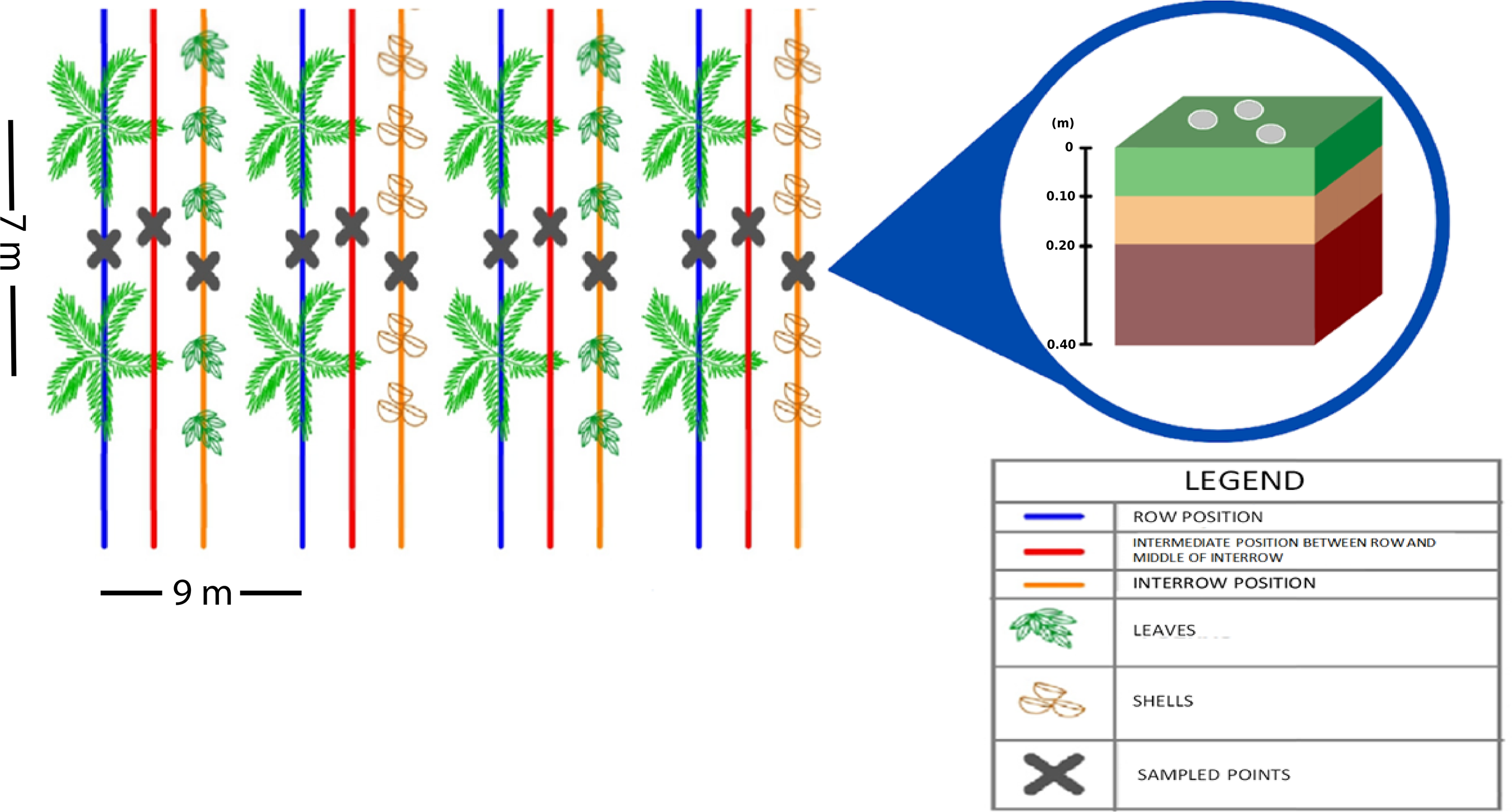
At the time of sampling, the plants had a uniform age of 22 years. About six years prior to sampling, the commercial cultivation area began to receive the application of green coconut shells, from the industrial processing of the fruits (intended for coconut water bottling). The residues were partially shredded (higher than 0.10 m) and applied to the soil surface at a rate of 60 dm³ m-2. The applications were carried out gradually in the area of 135 ha, one plot per year, as the residues were produced in the industry. The residue was applied only once in each plot, in alternating rows (Figure 1). In this way, a chronosequence was formed within the property, with different times of deposition of coconut shells on the soil (6, 5, 4 and 2 years). The area with the oldest deposition received coconut shells only once, six years ago, and the last areas of the farm have not yet received the application of the residue (time zero, before coconut shell application).

Representation of the soil sampling points distribution in the areas with 0 and 6 years of residue deposition. In the areas with 2, 4 and 5 years of residue deposition, sampling was carried out only at the planting row position.
Annually, during the cleaning pruning of the plants, the coconut leaves are cutted and deposited on soil surface in rows that have not received the deposition of coconut shells. Characterization of the two types of residues (coconut shells and leaves) is presented in table 1.
Soil sampling
Five plots were sampled within the cultivation area, representing a chronosequence with 0, 2, 4, 5 and 6 years of coconut shell application on soil surface. In each plot, six trenches were opened to collect soil samples, three trenches located in rows with coconut shell deposition, and three trenches located in rows with annual addition of coconut leaves.
Sampling was intensified in the areas of 0 and 6 years, as they represent the extremes of the chronosequence, with samples collected in three trenches opened in the interrow, in three trenches opened in the planting row, and in three trenches opened at an intermediate point between the row and the middle of the interrow (Figure 1). In the other areas (2, 4 and 5 years), representing the intermediate points of the chronosequence, the trenches were opened only in the planting row.
In each soil pit, three undisturbed soil samples were collected at soil layers of 0.00-0.10, 0.10-0.20, and 0.20-0.40 m (Figure 1). Samples were collected in stainless steel cylinders with 5 cm diameter by 5 cm height and were used to determine bulk density and water retention. In the same pits, disturbed soil samples were also collected for characterization of physio-chemical properties: clay, silt and sand contents, hydrogen potential (pH); available phosphorus (P); cation exchange capacity (CEC); exchangeable potassium (K), calcium (Ca) and magnesium (Mg); potential acidity (H+Al); sum of bases (SB); and soil saturation percentage (V%), following the methodology described in Teixeira et al. (2017) (Tables 2 and 3).
Chemical characterization of an Ultisol cultivated with coconut palm as a function of a chronosequence of deposition of coconut shells and leaves
Clay contents (g kg-1) (±standard error) at different layers as a function of coconut shell and coconut leaf deposition in Ultisol cultivated with coconut palm in Petrolina, PE, Brazil
Soil C stocks
Organic C contents in the soil were measured by the dry combustion method, in an elemental analyzer (Vario TOC Cube, Germany). From the total C contents in the soil samples, C stocks were calculated for each layer using equation 1.
Carbon stocks in the soil were corrected by the equivalent soil mass (Ellert and Bettany, 1995), considering the area without coconut shell and leaf deposition as a reference. Carbon stocks were calculated based on the results obtained from samples collected in the planting row in the areas with 2, 4 and 5 years of chronosequence. In these areas, C stocks (0.00-0.40 m) were estimated based on the C content in the planting row, considering the management of the areas with deposition of coconut leaves in 50 % of the planting rows and coconut shells in 50 % of the interrows.
In the areas with 0 and 6 years, the collected data allowed the calculation of C stocks for the three sample collection positions: planting row, middle of the interrow, and intermediate point. In these two areas, C stocks were calculated by two different methods, and their results were compared with each other:
(i) Calculation similar to that performed for the areas with intermediate times of residue deposition, i.e., considering that the C content present in the planting row is uniform throughout the cultivation area and extrapolating this value to the entire plot;
(ii) Calculation of the C stock of the plot weighted as a function of the area occupied by each of the three positions where sampling was performed. The assumptions used in this C stock calculation method were as follows:
-
In each hectare of cultivation, 50 % of the area receives the addition of coconut leaves from the cleaning pruning of the plants, and 50 % of the area receives the addition of coconut shells. This only does not occur in the area that has not yet received any coconut shell deposition (time 0 of coconut shell deposition), where 50 % of the area receives the addition of leaves, and 50 % remains without mulch on the surface.
-
Considering the space between the rows of coconut palm trees (Figure 1), i.e., between one row and another, it was considered that about 25 % of the area is represented by the samples collected in the planting row, about 25 % of the area between the cultivation rows is represented by the samples collected in the center of the interrow, and 50 % of the area is represented by the samples collected at the intermediate point between the planting row and the center of the interrow.
-
Thus, the C stock accumulated up to 0.40 m depth for each of the times evaluated was estimated by equation 2.
Considering that:
In which:
Est Cleaf: C stock in the interrow that receives the addition of coconut shells (Mg ha-1);
Est Cshell: C stock in the interrow that receives the addition of coconut leaves (Mg ha-1);
Est Crow shell: C stock determined in the planting row in the area influenced by coconut shells (Mg ha-1);
Est Cmiddle shell: C stock determined at the intermediate point between the planting row and the center of the interrow, i.e., in the crown projection area, influenced by coconut shells (Mg ha-1);
Est Cinterrow shell: C stock calculated based on C contents and bulk density determined in the center of the interrow in the area influenced by coconut shells (Mg ha-1);
Est Crow leaf: C stock calculated based on C contents and bulk density determined in the planting row in the area influenced by coconut leaves (Mg ha-1);
Est Cmiddle leaf: C stock calculated based on C contents and bulk density determined at the intermediate point between the planting row and the center of the interrow, i.e., in the crown projection area, influenced by coconut leaves (Mg ha-1);
Est Cinterrow leaf: C stock calculated based on C contents and bulk density determined in the center of the interrow in the area influenced by coconut leaves (Mg ha-1).
This weighting method for calculating C stocks in soil is similar to that used by Frazão et al. (2013).
Physical fractionation of soil organic matter
In all areas of the chronosequence, the collected samples were subjected to the physical particle-size fractionation of SOM (Cambardella and Elliot, 1992). Soil samples (20 g) received 80 mL of sodium hexametaphosphate solution (5 g L-1) and were stirred for 16 h for complete dispersion. Then, the suspension was passed through a 53-μm-mesh sieve, which allowed the separation of two particle-size fractions: sand size fraction (larger than 53 μm), which represents uncomplexed organic matter; and silt+clay fraction (smaller than 53 μm), which represents the fraction of organic matter that interacts with the mineral fraction of the soil, forming organomineral complexes.
Soil water retention
Water retention was determined in the undisturbed samples collected from the soil pits of each area. Moisture contents at tensions equivalent to the permanent wilting point (-1,500 KPa) and field capacity (-10 KPa) were determined using the centrifuge method, described by Teixeira et al. (2017). Water retention was estimated as the difference between the water content in field capacity and the water in the wilting point.
Statistical analysis
Data analysis consisted of variance analysis, looking for the effects of the interaction between the application of green coconut shell and the time of application on the studied attributes. When significant, the effects of the time of residue deposition on the surface were analyzed by regression, with the fit of the mathematical model that best explained the behavior of the data. When significant, the effects of the type of residue and sampling position were analyzed by means of comparison tests.
RESULTS AND DISCUSSION
Soil C contents and stocks
Soil C contents in the 0.00-0.10 m layer ranged from 0.49 to 1.13 g kg-1 in areas with coconut shell deposition and from 0.45 to 0.82 g kg-1 in areas with coconut leaf deposition (Table 4). For all times and treatments evaluated, the SOC content was higher in the 0.00-0.10 m layer and decreased in subsurface. Significant differences in C contents were observed between the two treatments evaluated. In the areas with four years of residue deposition, the SOC contents in the 0.00-0.10 m layer in rows that received coconut shells were 43 % higher than in rows that received coconut leaves. In the deeper soil layers (0.10-0.20 and 0.20-0.40 m), the C contents were similar for the two types of biomass added to the surface.
Carbon contents (g kg-1) (±standard error) at different layers as a function of coconut shell and coconut leaf deposition in an Ultisol cultivated with coconut palm in Petrolina, PE, Brazil
For bulk density, there were no significant differences, and the areas are homogeneous. In the areas with 0 and 6 years, where sampling was carried out at 3 points (planting row, center of the interrow, and intermediate point), there were no changes that suggest the occurrence of compaction despite the usual agricultural machinery traffic observed in the area. Bulk densities varied from 1.39 to 1.53 Mg m-3, which is compatible with expected values for sandy soils.
Clay content in the evaluated areas did not vary according to the treatments (Table 3), i.e., for the same sampling layer, soil particle size is homogeneous, which allows the comparison of C stocks between the areas and also suggests no need for correcting the stocks based on the clay content, as performed by Frazão et al. (2013) in the study of soil C stocks in an area cultivated with oil palm in the Brazilian Amazon. In all areas, there was an increase in clay content in the subsurface, which is characteristic of Ultisols and does not represent an impediment to the calculation of C stocks, since the behavior is similar in all the areas evaluated.
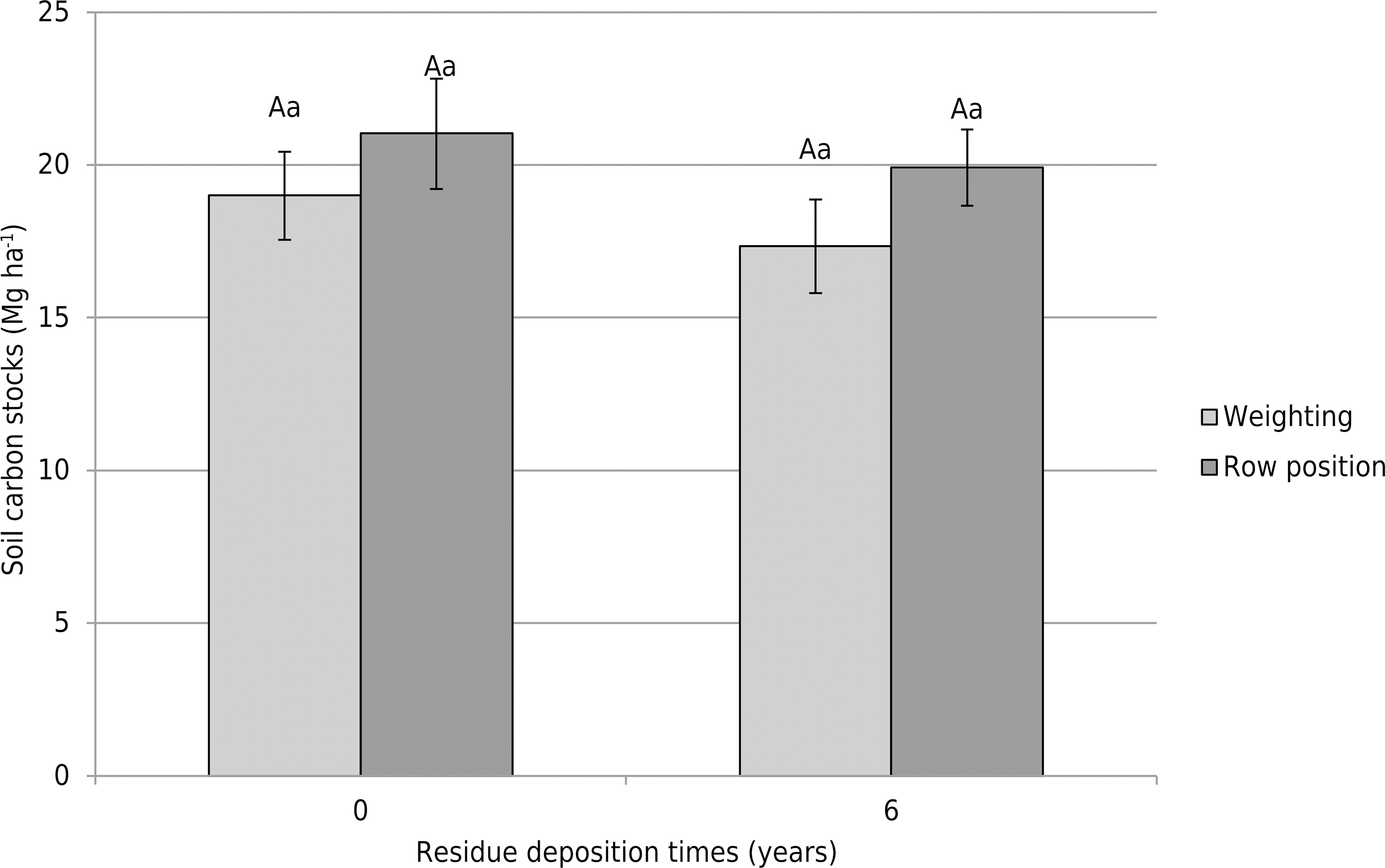
Both for the initial time and 6 years of residue deposition, the C stocks in the soil were similar when considering C contents and bulk density only in the planting row or when calculated considering the weighting between the three sampling points (Figure 2). This provides reliability when comparing the deposition times only with the collection carried out in the planting row position. In practical terms, this result suggests that future sampling for C stock assessments in coconut palm cultivation areas in sandy soils can be carried out randomly in the area, without the need to collect separate samples in rows and interrows, reducing the analytical costs of this type of assessment. These observations are important not only for future studies, but also for evaluations in commercial areas, especially in the context of monitoring related to payments for C accumulation in soil.
Comparison of C stocks (Mg ha-1) in Ultisol cultivated with coconut palm (0.00-0.40 m), calculated as a function of samples collected only in the planting row or calculated by weighting between row, interrow and intermediate point of collection. Values represent the total C stock, considering that in the cultivation areas there are alternating rows that receive deposition of coconut shells and coconut leaves. Uppercase letters compare means between calculation methodologies, and lowercase letters compare means between times.
Frazão et al. (2013) evaluated soil C stocks as a function of the introduction of oil palm (Elaeis guineensis Jacq.) cultivation in the Brazilian Amazon (chronosequence with 4, 8 and 25 years of cultivation). In the study conducted by these authors, soil C contents were 22-38 % higher in the area closest to the base of the oil palm tree compared to the average in the interrow, indicating the increase in SOM must have been largely due to organic material derived from the roots. In addition, soil C stocks in the interrows that receive pruned leaves from oil palm trees were 9-26 % higher than in the interrows that do not receive this type of mulch. However, the areas cultivated with oil palm evaluated by Frazão et al. (2013) had an average clay content of 240 g kg-1, much higher than those observed in the areas of the present study. Therefore, under these conditions, the spatial variability of C contents in the soil may require the collection of a larger number of samples to monitor C stocks in the soil.
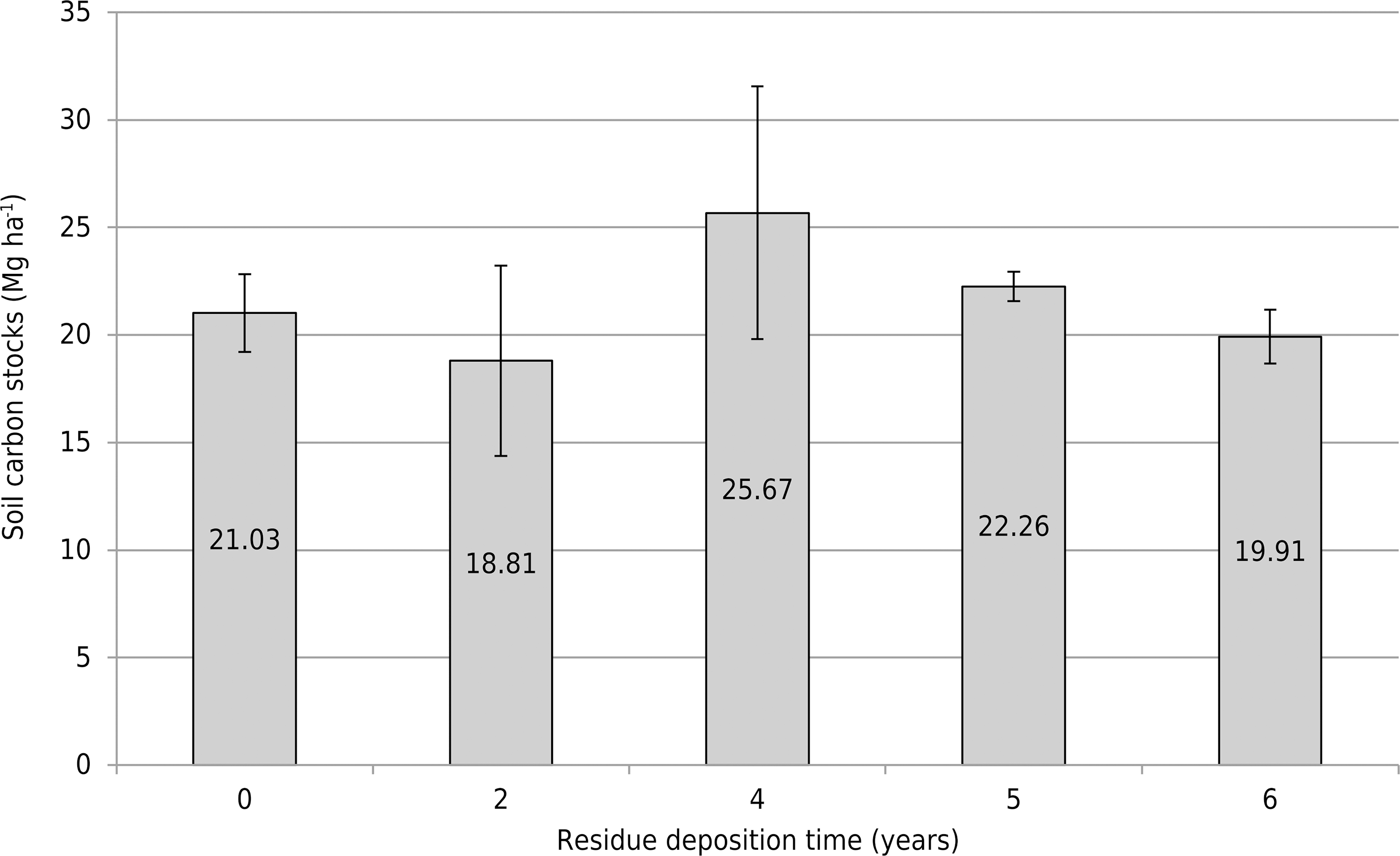
In the present study, over the time of residue deposition on the soil, the average C stock was 21.5 Mg ha-1, ranging from 18.81 Mg ha-1 in the area with 2 years to 25.67 Mg ha-1 in the area with 4 years (Figure 3). There was no effect of residue deposition time on C stocks.
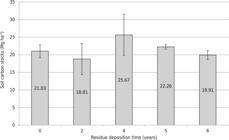
Carbon stocks (Mg ha-1) in Ultisol cultivated with coconut palm (0.00-0.40 m), as a function of time of residue deposition on the soil surface. Values represent the total C stock considering that in the cultivation areas, alternating rows receive deposition of coconut shells and coconut leaves.
In the study conducted by Frazão et al. (2013), after adjusting for differences in bulk density and clay content between treatments, C stocks at 0.30 m soil depth ranged from 22.7 Mg ha-1 in the area with 25 years to 33.2 Mg ha-1 in the area with 4 years. Although Frazão et al. (2013) evaluated C stocks only up to 0.30 m depth, while in the present study the stocks were evaluated up to 0.40 m, the C stocks observed by these authors were higher than those observed in the present study. These differences can be attributed to the higher clay content present in the soil compared to the clay contents found in the present study. Temperature and humidity conditions are favorable to the decomposition of organic matter in both cases, since the study of Frazão et al. (2013) was conducted in the Amazon region (rainfall of 2500 mm/year and average temperature of 26.6 °C), while the present study was conducted in a region with tropical climate and using irrigation. In both situations, due to high decomposition, only a small fraction of the added C remains stored in the soil (Frazão et al., 2013). Also in this context, Davidson and Janssens (2006) state that the conditions found in upland mineral soils, not subject to flooding, generally favor decomposition and result in relatively low C densities. The absence of a significant effect of time of residue deposition on the soil observed in Figure 3 was also reported by Frazão et al. (2013).
The C stocks in the soil obtained in the present study are consistent with stocks observed under similar edaphoclimatic conditions. Santana et al. (2022) evaluated C stocks in different land uses in the Petrolina region and observed that, while native vegetation stores around 80.7 Mg ha-1 of C up to 1.00 m deep, irrigated areas cultivated with grape and mango have C stocks of 69.5 and 23.9 Mg ha-1, respectively. It is important to note that the residue input in grape and mango crops is lower than in coconut palm crops, evaluated in the present study, due to the annual deposition of leaves in the areas cultivated with coconut palm. In addition, it is worth mentioning that the stocks reported by Santana et al. (2022) were calculated up to 1.00 m depth, while the present study considered the accumulation up to 0.40 m.
Menezes et al. (2021) studied C stocks in soil and vegetation in several locations in the Brazilian semi-arid region and observed that the native vegetation of the Caatinga stored about 125 Mg ha-1 of C, and 70 % of this total is found in the soil, which is equivalent to about 87.5 Mg ha-1 up to 1.00 m depth. The C stock in the soil up to 0.30 m depth in the Caatinga is about 31 Mg ha-1 (Mapbiomas, 2023). Menezes et al. (2021) also observed that, despite the variability of soil classes found in the Brazilian semi-arid region, C stocks under native conditions do not differ between soil types. Based on this observation by Menezes et al. (2021), it can be stated that the C stocks in this area cultivated with coconut palm (21.5 Mg ha-1) are about 30% lower than the values found under native conditions, while the grape and mango crops studied by Santana et al. (2022) showed reductions of about 14 % and 70 % in the original C stocks.
Physical fractions of soil organic matter
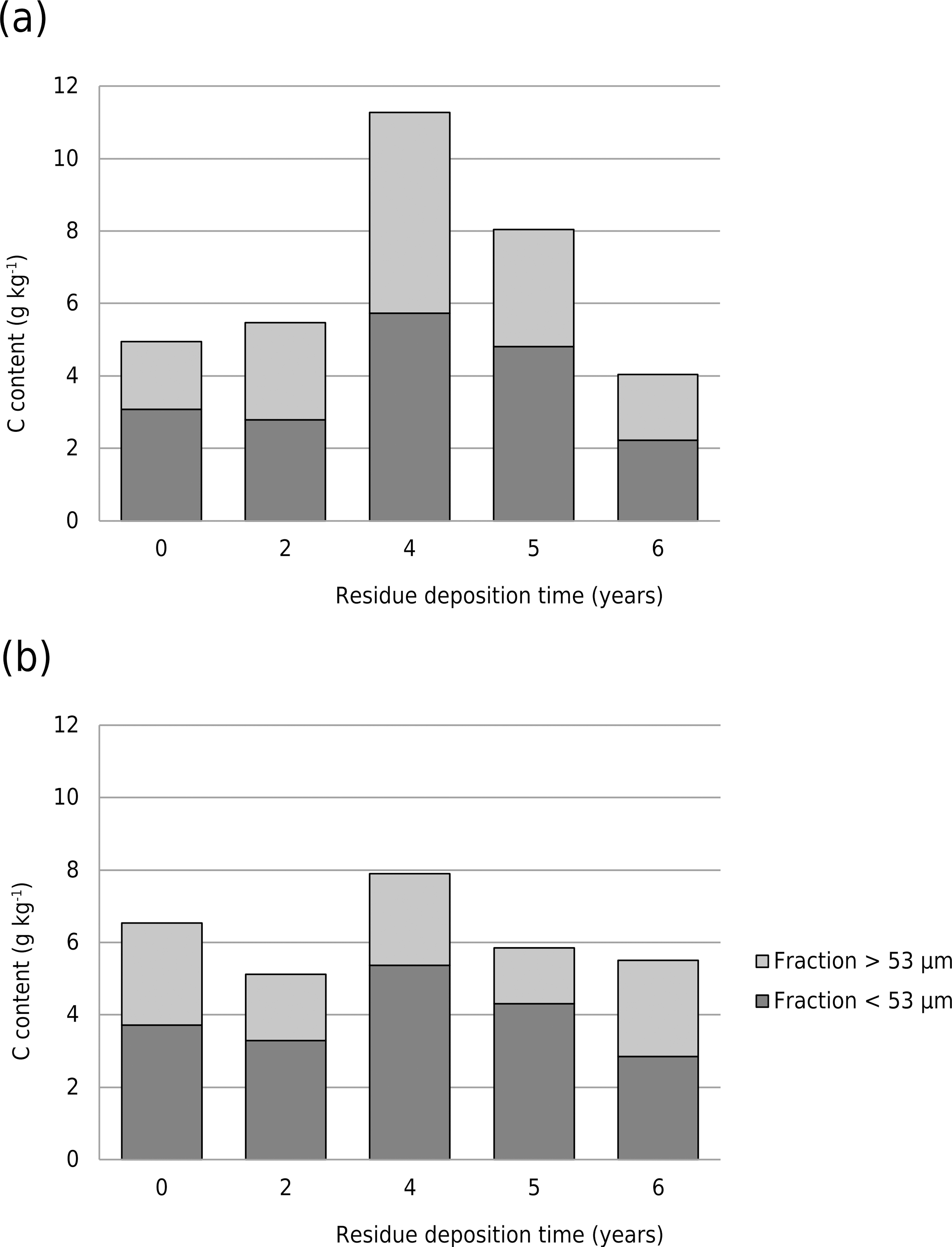
In the evaluation of the physical fractionation of SOM, there was no variation in the C content in the organic matter fraction <53 μm over time (Figures 4a and 4b). In addition, this behavior was similar for the two types of residue (coconut shells and coconut leaves) added to the soil surface. This fraction with size of less than 53 μm represents the organic matter associated with soil minerals and has a long residence time in the soil.

Carbon contents in the particle-size fractions of soil organic matter, as a function of the time of deposition of (a) coconut shell and (b) coconut leaf on the surface.
The fraction >53 μm, which represents the residues recently added to the soil, did not vary over time when leaves were deposited on the surface, but was altered over time in the area that received coconut shells (Figure 4a and Table 5). The equation fitted to the data shows that, in the area that received coconut shells, there was initially an increase in C content in the light fraction of SOM and that this increase occurred until approximately 3.2 years after the deposition of coconut shells on the surface, when the C content in this fraction reached a value of about 3.0 g kg-1. From that moment on, the amount of C stored in this fraction of SOM began to decrease. This suggests that reapplication of coconut shell is necessary every three years to maintain the effects on the soil. However, additional studies to verify the adjustment of the dose of residue to be reapplied are still necessary, since, in this 3-year interval, remnants of the previous application will still be present in the soil.
Effect of the type of residue on the carbon contents in the particle-size fractions of organic matter over the time of deposition in Ultisol cultivated with coconut palm in Petrolina, PE, Brazil
Organic matter can be found in soil in two forms: (I) free or weakly associated with soil mineral particles (uncomplexed organic matter) or (II) strongly bound to mineral particles (forming organomineral complexes: OMC) (Christensen, 1992). The direct interaction between mineral particles and organic compounds forms the primary OMCs, which aggregate to form the secondary OMCs (Christensen, 1992).
Due to their complexity, several methods can be used to quantify and qualify the SOM compartments (Christensen, 1992). Given the size difference between the fractions, the particle size method allows separating the light fraction (both free and occluded light), represented here by the fraction with size greater than 53 μm, and the heavy fraction of primary OMC, equivalent to the fraction with size smaller than 53 μm in the present study. Free organic matter is not stabilized by silt and clay particles; therefore, variations in the content of this fraction basically depend on recent litter additions and climatic conditions (Matus, 2021). When organic materials are added to the soil, changes in the amounts of C in the light and intermediate fractions of the organic matter compartments occur rapidly, while the fraction bound to the minerals responds slowly, and the protective capacity is based on the protective capacity of silt and clay to complex these organic molecules (Hassink et al., 1997).
Different behaviors observed for the two fractions (Figure 4) are coherent, since different compartments of SOM respond differently to the factors that affect the decomposition, and the decomposition of the more labile fraction of SOM is clearly sensitive to changes in temperature, while the decomposition of the more recalcitrant fractions is influenced by other environmental variables (Davidson and Janssens, 2006). Increase in negative charges, stability of aggregates in water, complexation of organic molecules with iron-containing minerals, and the addition of root material are the key mechanisms of organic C protection in tropical agricultural soils (Wells et al., 2022). However, as pointed out by Hassink et al. (1997), the net accumulation of organic matter in the soil depends not only on the protective capacity of the soil, but mainly on how much of this capacity is already occupied by organic material.
The absence of treatment effects on the more recalcitrant fraction of SOM may suggest that the potential for C accumulation is already at its maximum level in this sandy soil with low cation exchange capacity. Highly weathered soils with low cation exchange capacity, such as those in the present study, have low C stabilization potential due to the low specific surface area of the minerals (Doetterl et al., 2018). Stewart et al. (2008), when studying the SOM fractions of soils with different classes and textures and also under different climatic conditions, observed that if the chemically protected C compartment was filled, additional accumulation would possibly occur in aggregated and unprotected fractions, such as the fraction larger than 53 μm, which are less stable and subject to changes due to soil management. Hassink et al. (1997) observed that in a sandy soil in the 0.00-0.10 m layer, the silt and clay fractions contained the same amount of C as the light fraction, which led them to conclude that the capacity of silt and clay to protect the soil was exceeded and that additions of C were not accumulated in this layer, but in the intermediate layers. However, the organic C content of the soil can be affected not only by the proportion of minerals in the silt and clay fractions, but also by the type of mineral in the clay fraction, land use and management, and chemical characteristics of the organic material (Matus, 2021). The study conducted by Matus (2021) also shows that 72 to 88 % of the total C and N of the soil is bound to silt and clay particles.
Soil water retention
Figure 5 shows the influence of coconut shells and straw on soil water storage at soil layers of 0.00-0.10, 0.10-0.20 and 0.20-0.40 m, as a function of the time of residue deposition on the surface. Addition of coconut shells on the surface affected soil water availability at the three depths, although the effects were more significant in the more superficial layers. Coconut leaf deposition influenced soil water retention only at the 0.10-0.20 m.

Available water in an Ultisol cultivated with coconut palm in Petrolina, PE, Brazil, as a function of the time of deposition of coconut shell and coconut leaves on the surface. (a) 0.00-0.10 m,
(b) 0.10-0.20 m, and (c) 0.20-0.40 m soil layer.
Rawls et al. (2003) showed changes in organic C content promote an increase in soil water retention, but the effect is directly influenced by soil texture and the amount of organic C present in the soil, so in sandy soils with low C contents, the increase of organic material leads to increased water retention, corroborating the observations in figure 5. These same authors also showed that water retention at -33 kPa (equivalent to field capacity for the soil of that study) is affected more strongly by the organic C added to the soil than by the amount of water retained at -1500 KPa.
Fukumasu et al. (2022) showed soil microporosity is more strongly correlated with soil organic C content than with clay content, which demonstrates the importance of adding organic material for water availability to plants. In a semi-arid environment with sandy soils, such as the conditions under which the present study was conducted, these observations are important because they suggest that conservation management with a significant addition of organic material to the soil can be an important strategy to increase water retention in the soil and, possibly, can also induce greater water use efficiency. Nevertheless, the results found in the present study suggest that the quality of the organic material also interferes with the effect on water availability (Figure 5) and that reapplication is needed to maintain the positive effects over time. Based on the equations fitted to the data, it is estimated that, for the 0.00-0.10 m layer, the highest amount of available water (8.5 %) was obtained around 3 years after coconut shell application on the surface, coinciding with the point of maximum accumulation of the light fraction of SOM observed in figure 4a.
CONCLUSIONS
In sandy soils cultivated with coconut palm under tropical conditions, there is no need for differentiating between rows and interrows for sampling to calculate soil C stocks. After 6 years of coconut shell deposition on soil surface, there was no increase in C stocks up to 0.40 m depth, but increments were observed in the light fraction of soil organic matter and water retention. It is necessary to reapply coconut shells every three years to maintain these positive effects on the light fraction of soil organic matter and water retention. Adopting this management option deserves to be reconsidered, as it can promote increments in soil C stocks and other soil quality attributes.
-
How to cite: Silva IEB, Deon MD, Silva DJ, Xavier FAS, Santos APG, Signor D. Coconut residues increase light fraction of organic matter and water retention in semi-arid sandy soil under irrigated cultivation. Rev Bras Cienc Solo. 2024;48:e0240042. https://doi.org/10.36783/18069657rbcs20240042
-
FUNDING
The authors thank the Graduate Program in Environmental Science and Technology (PPGCTA) of the University of Pernambuco and the Coordination for the Improvement of Higher Education Personnel (CAPES), Brazil - Financing Code 001, for the support, the Pernambuco State Science and Technology Support Foundation (FACEPE) for granting a master’s scholarship to the first author (IBPG-0337-5.01/20) and the Brazilian Agricultural Research Corporation for funding the study (32.16.04.020.00.00).
-
SUPPLEMENTARY MATERIALS
Supplementary data to this article can be found online at https://www.rbcsjournal.org/wp-content/uploads/articles_xml/1806-9657-rbcs-48-e0240007/1806-9657-rbcs-48-e0240042-suppl01.pdf
DATA AVAILABILITY
All data was generated or analyzed in this study.
REFERENCES
-
Batjes NH, Sombroek WG. Possibilities for carbon sequestration in tropical and subtropical soils. Glob Change Biol. 1997;3:161-73. https://doi.org/10.1046/j.1365-2486.1997.00062.x
» https://doi.org/10.1046/j.1365-2486.1997.00062.x -
Cabral MMS, Abud AKS, Rocha MSRS, Almeida RMRG, Gomes MA. Composição da fibra da casca de coco verde in natura e após pré-tratamentos químicos. Engevista. 2017;19:99-108. https://doi.org/10.22409/engevista.v19i1.802
» https://doi.org/10.22409/engevista.v19i1.802 -
Cambardella CA, Elliott ET. Particulate soil organicmatter changes across a grassland cultivation sequence. Soil Sci Soc Am J. 1992;56:777-83. https://doi.org/10.2136/sssaj1992.03615995005600030017x
» https://doi.org/10.2136/sssaj1992.03615995005600030017x -
Chanlabut U, Nahok B. Soil carbon stock and soil properties under different land use types of agriculture. Environ Nat Resour J. 2023;21:417-27. https://doi.org/10.32526/ennrj/21/20230056
» https://doi.org/10.32526/ennrj/21/20230056 -
Christensen BT. Physical fractionation of soil and organic matter in primary particle size and density separates. Adv Soil Sci. 1992;20:1-90. https://doi.org/10.1007/978-1-4612-2930-8_1
» https://doi.org/10.1007/978-1-4612-2930-8_1 -
Davidson EA, Janssens IA. Temperature sensitivity of soil carbon decomposition and feedbacks to climate change. Nature. 2006;440:165-73. https://doi.org/10.1038/nature04514
» https://doi.org/10.1038/nature04514 -
Doetterl S, Berhe AA, Arnold C, Bodé S, Fiener, P, Finke P, Fuchslueger L, Griepentrog M, Harden, JW, Nadeu E, Schnecker J, Six J, Trumbore S, Van Oost K, Vogel V, Boecky P. Links among warming, carbon and microbial dynamics mediated by soil mineral weathering. Nat Geosci. 2018;11:589-93. https://doi.org/10.1038/s41561-018-0168-7
» https://doi.org/10.1038/s41561-018-0168-7 -
Ellert BH, Bettany JR. Calculation of organic matter and nutrients stored in soils under contrasting management regimes. Can J Soil Sci. 1995;75:529-38. https://doi.org/10.4141/cjss95-075
» https://doi.org/10.4141/cjss95-075 -
Food and Agriculture Organization of the United Nations - FAO. FAOStat [internet]. 2023. Available from: https://www.fao.org/faostat/en/#home
» https://www.fao.org/faostat/en/#home -
Frazão LA, Paustian K, Cerri CEP, Cerri CC. Soil carbon stocks and changes after oil palm introduction in the Brazilian Amazon. GCB Bioenergy. 2013;5:384-90. https://doi.org/10.1111/j.1757-1707.2012.01196.x
» https://doi.org/10.1111/j.1757-1707.2012.01196.x -
Fukumasu J, Jarvis N, Koestel J, Kätterer T, Larsbo M. Relations between soil organic carbon content and the pore size distribution for an arable topsoil with large variations in soil properties. Eur J Soil Sci. 2022;73:e13212. https://doi.org/10.1111/ejss.13212
» https://doi.org/10.1111/ejss.13212 -
Georgiou K, Jackson RB, Vindušková O, Abramoff RZ, Ahlström A, Feng W, Harden JW, Pellegrini AFA, Polley HW, Soong JL, Riley WJ, Torn MS. Global stocks and capacity of mineral-associated soil organic carbon. Nat Commun. 2022;13:3797. https://doi.org/10.1038/s41467-022-31540-9
» https://doi.org/10.1038/s41467-022-31540-9 -
Hassink J, Whitmore AP, Kubát J. Size and density fractionation of soil organic matter and the physical capacity of soils to protect organic matter. Dev Crop Sci. 1997;25:245-55. https://doi.org/10.1016/S0378-519X(97)80025-6
» https://doi.org/10.1016/S0378-519X(97)80025-6 - Instituto Brasileiro de Geografia e Estatística – IBGE. Censo Agropecuário 2017. Rio de Janeiro, IBGE; 2017.
-
Lal R. Carbon sequestration. Philos Trans R Soc B Biol Sci. 2008;363:815-30. https://doi.org/10.1098/rstb.2007.2185
» https://doi.org/10.1098/rstb.2007.2185 -
MapBiomas Brasil. Mapeamento inédito indica que Brasil estoca no solo equivalente a 70 anos das emissões de CO2 do país [internet]. MapBiomas; 2023. Available from: https://mapbiomas.org/mapeamento-inedito-indica-que-brasil-estoca-no-solo-o-equivalente-a-70-anos-das-emissoes-de-co2-do-pais
» https://mapbiomas.org/mapeamento-inedito-indica-que-brasil-estoca-no-solo-o-equivalente-a-70-anos-das-emissoes-de-co2-do-pais -
Martins CR. Evolução da produção de coco no Brasil e o comércio internacional: Panorama 2010. Aracaju: Embrapa Tabuleiros Costeiros; 2011. Available from: https://www.cpatc.embrapa.br/publicacoes_2011/doc_164.pdf
» https://www.cpatc.embrapa.br/publicacoes_2011/doc_164.pdf -
Matus FJ. Fine silt and clay content is the main factor defining maximal C and N accumulations in soils: A meta-analysis. Sci Rep. 2021;11:6438. https://doi.org/10.1038/s41598-021-84821-6
» https://doi.org/10.1038/s41598-021-84821-6 -
Menezes RSC, Sales AT, Primo DC, Albuquerque ERGM, Jesus KN, Pareyn FGC, Santanta MS, Santos UJ, Martins JCR, Althoff TD, Nascimento DM, Gouveia RF, Fernandes MM, Loureiro DC, Araújo Filho JC, Giongo V, Duda GP, Alves BJR, Ivo WMPM, Andrade EM, Sampaio EVSB. Soil and vegetation carbon stocks after land-use changes in a seasonally dry tropical forest. Geoderma. 2021;390:114943. https://doi.org/10.1016/J.GEODERMA.2021.114943
» https://doi.org/10.1016/J.GEODERMA.2021.114943 -
Nunes MUC. Compostagem laminar como estratégia de sustentabilidade para sistemas de produção de coco no Nordeste. In: Cintra FLD, Rollemberg HF, editors. Seminário Sobre Manejo Sustentável para a Cultura do Coqueiro: Resultados de pesquisas e estudos de casos: anais; 2017; Aracaju. Brasília, DF: Embrapa; 2017. p. 88-106. Available from: http://www.bdpa.cnptia.embrapa.br/consulta/busca?b=ad&id=1076353&biblioteca=vazio&busca=1076353&qFacets=1076353&sort=&paginacao=t&paginaAtual=1
» http://www.bdpa.cnptia.embrapa.br/consulta/busca?b=ad&id=1076353&biblioteca=vazio&busca=1076353&qFacets=1076353&sort=&paginacao=t&paginaAtual=1 -
Nunes MUC, Santos JR, Santos TC. Tecnologia para biodegradação da casca de coco seco e de outros resíduos do coqueiro. Aracaju: Embrapa Tabuleiros Costeiros; 2007 (Circular técnica 46). Available from: https://ainfo.cnptia.embrapa.br/digital/bitstream/item/158629/1/ct-46.pdf
» https://ainfo.cnptia.embrapa.br/digital/bitstream/item/158629/1/ct-46.pdf -
Rawls WJ, Pachepsky YA, Ritchie JC, Sobecki TM, Bloodworth H. Effect of soil organic carbon on soil water retention. Geoderma. 2003;116:61-76. https://doi.org/10.1016/S0016-7061(03)00094-6
» https://doi.org/10.1016/S0016-7061(03)00094-6 -
Santana MS, Andrade EM, Sampaio EVSB, Ferreira TO, Salviano AM, Silva, DJ, Cunha TJF, Giongo V. Do agrosystems change soil carbon and nutrient stocks in a semiarid environment? J Arid Environ. 2022;201:104747. https://doi.org/10.1016/j.jaridenv.2022.104747
» https://doi.org/10.1016/j.jaridenv.2022.104747 -
Santos PF, Góis TA, Silva SPR. Caracterização e geração de combustíveis gasosos utilizando folha de coqueiro da produção do coco (Cocos nucifera). Res Soc Dev. 2021;10:e34610716783. https://doi.org/10.33448/rsd-v10i7.16783
» https://doi.org/10.33448/rsd-v10i7.16783 -
Stewart CE, Plante AF, Paustian K, Conant RT, Six J. Soil carbon saturation: Linking concept and measurable carbon pools. Soil Sci Soc Am J. 2008;72:379-92. https://doi.org/10.2136/sssaj2007.0104
» https://doi.org/10.2136/sssaj2007.0104 -
Teixeira AHC. Informações agrometeorológicas do polo Petrolina, PE/Juazeiro - 1963 a 2009. Petrolina: Embrapa Semiárido; 2010. Available from: https://www.infoteca.cnptia.embrapa.br/bitstream/doc/883657/1/SDC233.pdf
» https://www.infoteca.cnptia.embrapa.br/bitstream/doc/883657/1/SDC233.pdf - Teixeira PC, Donagemma GK, Fontana A, Teixeira WG. Manual de métodos de análise de solo. 3. ed. rev e ampl. Brasília, DF: Embrapa; 2017.
-
Wells JM, Crow SE, Sierra CA, Deenik JL, Carlson KM, Meki MN, Kiniry J. Edaphic controls of soil organic carbon in tropical agricultural landscapes. Sci Rep. 2022;12:21574. https://doi.org/10.1038/s41598-022-24655-y
» https://doi.org/10.1038/s41598-022-24655-y
Edited by
-
Editors:
José Miguel Reichert https://orcid.org/0000-0001-9943-2898 and Etelvino Henrique Novotny https://orcid.org/0000-0001-9575-1779

 Source: Author.