 Degraded soils in the Brazilian semiarid region harbor bacteria with high phosphate solubilization potential
ABSTRACT
The widespread deficiency of available phosphorus (P) in soils, particularly in tropical regions, necessitates the application of phosphate fertilizers due to their high adsorption. However, excessive use engenders significant economic costs and contributes to eutrophication of aquatic ecosystems and the mobilization of heavy metals. One viable alternative is the use of phosphate-solubilizing bacteria (PSB), which can solubilize phosphate through the production of acids and enzymes. This study aimed to assess the cultivable PSB community in different pedogenetic horizons of degraded and preserved Planosols and Luvisols (Planossolos and Luvissolos) in the semiarid and subhumid regions of Brazil, as these soils exhibit a high P availability, particularly in deeper layers. Furthermore, the biotechnological potential of the most promising PSB was evaluated in corn. A total of 170 PSB strains were collected, with 96 bacteria isolated from Planosol and 74 from Luvisol. The majority of the PSB exhibited a medium solubilization index and a broad morphophysiological diversity, and all solubilized calcium phosphate in liquid media. To investigate the biotechnological potential of these bacteria, eight PSB strains were selected based on their ability to solubilize calcium phosphate (>160 mg L-1) and to promote plant growth through mechanisms such as high auxin production, exopolysaccharide synthesis, zinc solubilization, and antagonism against the pathogen Fusarium sp. The PSB were identified as follows: PL1A, PL2L (Priestia sp.), PL1B (Neobacillus sp.), PL3J and LU13C (Streptomyces sp.), PL6A (Fictibacillus sp.), and PL18E and LU10E (Bacillus sp.). The PSB were inoculated into corn with the treatments based on the absence of phosphorus (-P) (control), simple superphosphate (SSP), reactive natural phosphate (RP), and the SSP + RP combination. The maximum available P value in the soil was observed in the RP treatment, where LU10E (78.70 mg dm-3) was inoculated, and in the SSP treatment, where LUC13C (69.9 mg dm-3) was inoculated. Isolates LU13C, LU10E, and PL3J exhibited the highest efficiency in phosphorus mobilization, PL1B and PL18E were moderately efficient, while PL1A, PL2L, and PL6A were the least efficient. This study assessed the diversity of phosphate-solubilizing bacteria (PSB) across soil profiles of degraded and vegetated Planosols and Luvisols in the Borborema Province, Northeastern Brazil, resulting in the establishment of the first bacterial collection comprising 170 strains with confirmed potential for phosphorus solubilization and corn growth promotion.
Keywords
Phosphate fertilizers; Planosol; Luvisol;
Zea mays
INTRODUCTION
The excessive reliance on chemical fertilizers to overcome phosphorus (P) deficiencies in agricultural soils compromises the long-term sustainability of farming systems. Although P is essential for plant growth, photosynthesis, and root development (Lambers, 2022), its low bioavailability in soils remains a major constraint to crop productivity (Withers et al., 2018). This persistent dependency highlights the pressing need for more sustainable and efficient nutrient management strategies. In this context, researchers have recently developed a bioinoculant, Biomaphos®, based on Bacillus subtilis and Bacillus megaterium, which enhances P uptake by the plant root system (Oliveira-Paiva et al., 2020).
In the northeastern region of Brazil, a high concentration of P has already been observed in different pedogenetic horizons of Luvisols and Planosols (Câmara et al., 2021; Neves et al., 2021; Santos et al., 2022). These soil types are prevalent in the state of Pernambuco, which is home to dry forests with a semiarid climate, as well as sub-humid plateaus that act as transitional zones between the Caatinga and Atlantic Forest biomes (Araújo Filho et al., 2000; Pavinato et al., 2021).
Planosols, which cover more than 10 % of the Brazilian semiarid region, exhibit poor drainage, a sandy or medium-textured surface horizon, and a subsurface horizon with a significant accumulation of clay (Sousa et al., 2020, 2023). Conversely, Luvisols comprise more than 13 % of the semiarid region and present a textural B horizon with a high amount of clay and iron oxides, and a high base saturation, which makes them highly fertile (Sousa et al., 2021a; Santos et al., 2022). The desertification of these soils has been exacerbated by both environmental factors, such as prolonged droughts, high evapotranspiration rates, and soil salinization, and anthropogenic pressures, notably deforestation. These combined stresses have severely compromised the productivity of several subsistence crops, including corn, cassava, and rice (Vieira et al., 2021; Lins et al., 2023; Araujo et al., 2024). Despite the extreme climatic conditions in these regions, degraded soils exhibit a high total P content in the A (10 to 30 mg kg-1) and C pedogenetic horizons (5 to 77 mg kg-1) (Câmara et al., 2021; Neves et al., 2021; Sousa et al., 2021a; Santos et al., 2022). In this sense, we postulated that these soils harbor bacteria with a high potential for phosphate solubilization.
Microbial activity is essential for P solubilization in soils and for its subsequent availability to plants, which absorb it in the orthophosphate form. However, a significant proportion of phosphates becomes unavailable due to precipitation with cations such as calcium (Ca), magnesium (Mg), iron (Fe), and aluminum (Al), as well as adsorption onto clay minerals (Pang et al., 2024). Consequently, there is a significant reliance on costly phosphate fertilizers (Withers et al., 2018), particularly for corn production, which exceeded 100 million tons in the last harvest (2022/23) (CONAB, 2023). An economically viable and environmentally sustainable solution would be the adoption of phosphate-solubilizing bacteria (PSB), which encompass bacterial genera that produce organic acids, phosphatases, and phytases. These bacteria are capable of transforming P into soluble and assimilable forms as orthophosphate ions (Rawat et al., 2021; Li et al., 2023). Additionally, PSB may possess additional plant growth-promoting mechanisms, including zinc (Zn) solubilization, indole-3-acetic acid (IAA) production, exopolysaccharides (EPS), and biological control. These attributes, taken together, substantiate the efficacy of PSB in promoting plant growth and increasing crop yields (Lobo et al., 2019; Araújo et al., 2020; Sousa et al., 2021b; Araújo Filho et al., 2023).
Plant growth-promoting bacteria (PGPB), particularly phosphate-solubilizing bacteria (PSB), have been shown to enhance the development of corn (Zea mays), beans (Phaseolus vulgaris), rice (Oryza sativa), soybean (Glycine max), and sorghum (Sorghum bicolor) across diverse environmental conditions (Mattos et al., 2020; Velloso et al., 2020; Silva et al., 2021; Sousa et al., 2021b; Wang et al., 2021; Ait-Ouakrim et al., 2023). In tropical semiarid regions, their biotechnological potential is particularly promising, driven by their marked phenotypic plasticity (Galindo-Castañeda et al., 2022). Furthermore, corn development under water stress conditions is significantly enhanced in the presence of PGPB isolated from soils of temporary ponds in the semiarid region of Pernambuco State, Brazil (Araújo et al., 2023). However, no previous studies have investigated PSB in the horizons of Planosols and Luvisols, especially in regions impacted by desertification and complete degradation of the floral landscape.
We postulated that bacteria isolated from Planosols and Luvisols of semiarid and subhumid regions could solubilize phosphate and could increase P availability in the soil and nutrient uptake in corn plants. This study aimed to investigate the presence of PSB in the surface and subsurface horizons of Planosols and Luvisols in Northeast Brazil and to evaluate the mechanisms by which PSB can promote plant growth in corn.
MATERIALS AND METHODS
Study site and sampling strategy
The Borborema province, in northeastern Brazil's semiarid region, is among the most densely populated such areas in the world. This region is characterized by a hot, dry climate with highly erratic rainfall, which is concentrated in just three months of the year (Carvalho et al., 2024). In this region, the weathering of granite rocks has resulted in the formation of Planosols (Câmara et al., 2021; Sousa et al., 2023), whereas the weathering of amphibolite and biotite schists has led to the formation of Chromic Luvisols (Câmara et al., 2021; Silva et al., 2024).
Soil samples were collected from eight areas in the state of Pernambuco, which is predominantly located in semiarid zones. The municipalities of Serra Talhada (ST), Belém de São Francisco (BF), Itacuruba (IT-1), and Afogados de Ingazeira (AI) are situated within the semiarid climate zone of the Caatinga dry forest biome in the Borborema Province. Lagoa do Ouro (LO) and Camutanga (CA), on the other hand, are located in a subhumid climate zone, between the tropical Atlantic Forest and the dry forest. Itacuruba 2 (IT-2) and BF are part of the Cabrobó desertification center, an area undergoing severe soil degradation for approximately 40 years, resulting in the loss of vegetation and grazing (Neves et al., 2021; Santos et al., 2022; Sousa et al., 2023). Further details on the vegetation of each site are available in Table S1.
The soils sampled were described morphologically according to the methodology outlined by Santos et al. (2015) and classified according to the World Reference Base (IUSS Working Group WRB, 2015). According to the Brazilian Soil Classification System (SiBCS), the Planossolos of ST and LO were classified as Planossolo Háplico Eutrófico, and those of BF and CA as Planossolo Nátrico Órtico (Sousa et al., 2023). The Luvissolos of IT, ST and AI were classified as Luvissolo Crômico Órtico (Silva et al., 2024).
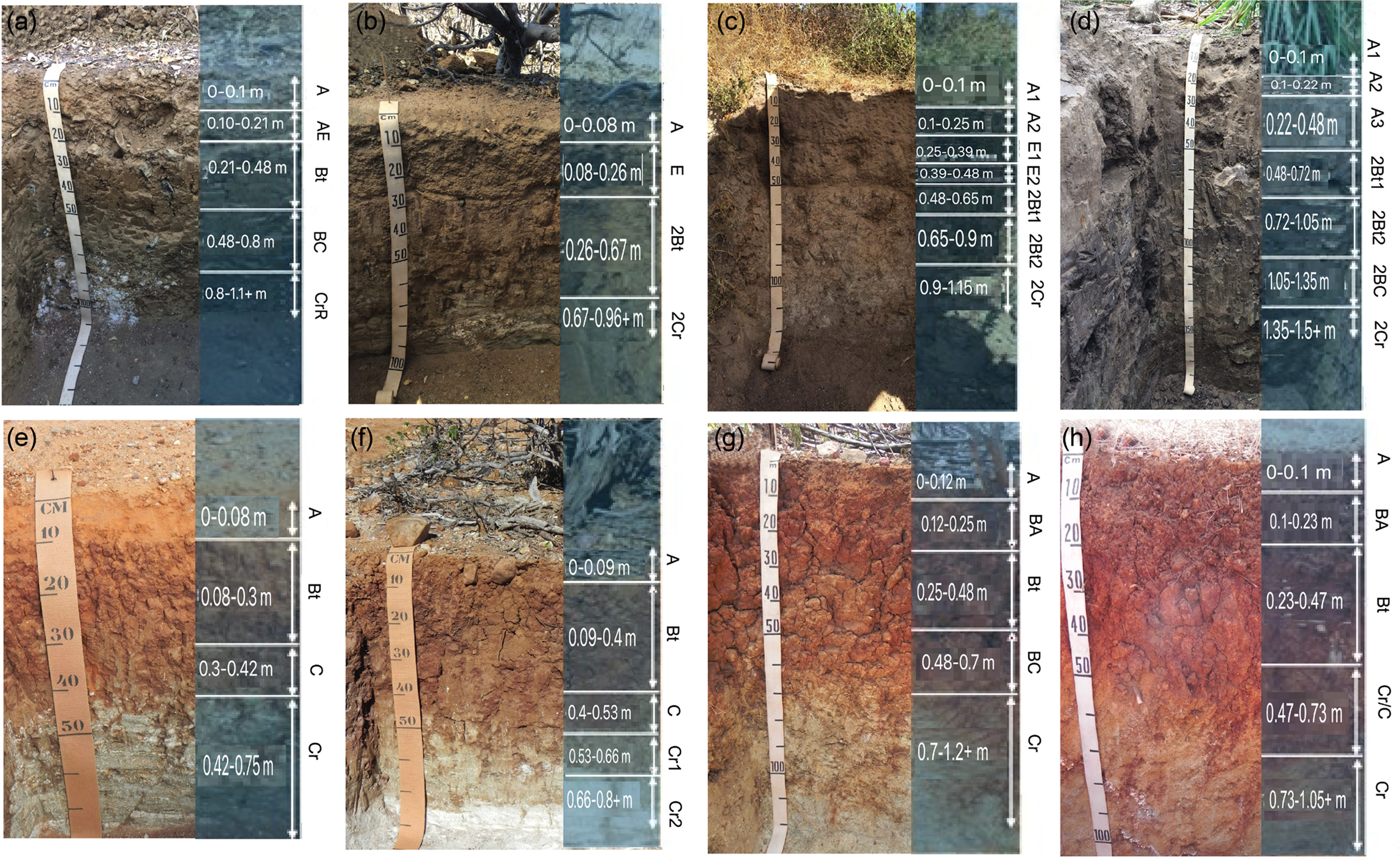
Sampling followed the procedures outlined in the Field Soil Collection and Description Manual (Santos et al., 2015), in which trenches were excavated until the Ce horizon was reached. Bulk soil samples were collected in triplicate from each identified pedogenetic horizon (Figure 1) and immediately stored under refrigeration (1 to 4 °C). Prior to analysis, the samples were subjected to a pre-incubation period of 24 to 48 h to restore microbial activity equilibrium.
Planosols (a-d) and Luvisols (e-h) from a tropical semiarid, Pernambuco State, Brazil. a: Serra Talhada; b: Belém de São Francisco; c: Lagoa do Ouro; d: Camutanga; e and f: Itacuruba; g: Serra Talhada; and h: Afogados de Ingazeira.
Isolation, selection, and characterization of PSB
Bacterial isolation from each pedogenetic horizon of Luvisols and Planosols was conducted by placing 1 g of each soil sample into 9 mL of sterile 0.85 % saline solution (dilution 10-1). A ten-fold serial dilution was then performed (10-2 to 10-4), with each dilution inoculated in NBRIP medium (Nautiyal, 1999) at 30 °C for 7 days. The presence of a translucent halo around colonies is indicative of calcium phosphate solubilization and PSB selection. However, non-halo-forming bacteria in NBRIP solid medium may demonstrate phosphate solubilization efficiency in liquid medium (Nautiyal, 1999; Bashan et al., 2013; Abreu et al., 2017).
We employed the criteria of isolating bacteria grown on NBRIP solid medium, with and without halo formation, for the selection of PSB. The count of colony-forming units (CFU) per gram of soil (CFU g-1) was determined for each plate. For purification, the isolated colonies were randomly selected and streaked onto Petri dishes containing NBRIP culture medium, then incubated at 30 °C for 7 days. Subsequently, the bacterial colonies were phenotypically evaluated through morphological characterization in accordance with the methodology proposed by Hungria and Silva (2011). Following the morphological description of the isolates, the diversity indices (Dominance, Simpson, Shannon, Margalef, and Equitability) were estimated.
Capacity of bacterial isolates to solubilize calcium phosphate
The capacity of the isolates to solubilize calcium phosphate was determined in NBRIP agar plates and liquid medium. For evaluation of the plates, the diameter of the colony and halo zone were measured, and the solubilization index (SI) was calculated according to equation 1 (Kaur and Kaur, 2020).
The solubilization capacity of the isolates was classified, according to the SI, as low (SI <2), medium (2< SI <4), and high (SI >4) (Berraquero et al., 1976).
To evaluate the solubilization of calcium phosphate in NBRIP liquid medium, the bacterial isolates were initially cultivated in tubes containing 5 mL of Tryptone Soy Broth (TSB) for 10 days at 150 rpm. The inoculum was then adjusted to an absorbance of 0.2 with 0.9 % sterile saline solution at 620 nm. Finally, 50 μL of each strain was inoculated into 50 mL Falcon tubes containing 25 mL of liquid NBRIP medium and incubated for 9 days at 150 rpm in triplicate. On days 5, 7, and 9, 2 mL aliquots were taken from each tube, and the soluble phosphate content of each sample was determined by the Vanado-Molybdate colorimetric method (Bertramson, 1942). Additionally, the medium pH was measured on day 9.
Zn solubilization, IAA production, and EPS formation
Isolates that exhibited morphological differences and solubilization of calcium phosphate >160 mg L-1 were selected for the evaluation of their ability to solubilize Zn, produce IAA, and form EPS. Zinc solubilization was quantified by halo zone formation around bacterial colonies on tris minimal salt medium containing 14 mmol L-1 ZnO (Suleman et al., 2018). The plates were incubated for 14 days at 30 °C in the dark. The Zn solubilization index was calculated as the ratio of the total diameter (colony + halo zone) to the colony diameter (Fasim et al., 2002). The quantitative assessment of IAA was followed by Gordon and Weber (1951) with modifications. In brief, the isolates were cultivated in TSB medium supplemented with L-tryptophan (5 mmol L-1), incubated for 7 days at 150 rpm at 30 °C in the dark, and then centrifuged 1 mL at 12,000 rpm for 5 min to obtain the supernatant. Subsequently, 4 mL of Salkowski reagent (comprising 1 mL of 0.5 mol L-1 FeCl3, 50 mL of distilled H2O, and 30 mL of H2SO4) was added.
The resulting solution was incubated in the dark at room temperature for 30 min. The production of IAA was confirmed by observing the presence of a pink color in the samples (Kuss et al., 2007). The IAA concentration was estimated in triplicate by colorimetric measurement at 530 nm and using a standard curve with known IAA concentrations: 5, 10, 20, 40, 60, and 80 μg mL-1. The IAA production was classified as low (<1 μg mL-1), medium (1-11 μg mL-1), high (11-50 μg mL-1), and very high (>50 μg mL-1). Exopolysaccharides (EPS) were qualitatively determined according to the methodology defined by Paulo et al. (2012). The isolates were grown in TSB medium (10 %) supplemented with 10 % sucrose and adjusted to pH 7.5. Subsequently, 5 μL of each sample was inoculated onto 5 mm diameter filter paper discs, which were then placed in culture medium and incubated for 72 h at 28 °C. The EPS production was characterized visually by measuring the EPS halo produced and confirmed using a platinum loop impregnated with the colony in 2 mL of ethyl alcohol.
Antagonism assay
The antagonistic potential of the selected bacterial isolates was assessed using dual-culture assays against Fusarium sp., following the methodology proposed by Dennis and Webster (1971), as this microorganism is a known pathogen of corn. The Fusarium sp. strain was obtained from the Laboratory of Phytopathology at the Pernambuco Agronomic Institute (IPA) and isolated from corn plants exhibiting symptoms of the disease.
PSB selection
Eight bacteria designated PL1A, PL1B, PL2L, PL3J, PL6A, PL18E, LU10E, and LU13C were selected from a total of 170 strains. The bacteria were selected according to the following criteria: a) morphological differences in color, shape, elevation, edge, surface, and halo formation; b) solubilization of calcium phosphate in the liquid medium NBRIP ≥160 mg L-1; c) calcium phosphate solubilization efficiency without a significant reduction in solubilization capacity over time; d) display of at least one plant growth promotion mechanism, such as Zn solubilization, high IAA production, EPS formation, or antagonism with Fusarium sp. The PSB were previously cultured in TSA (Tryptone Soy Agar) medium and transferred to TSB medium for 4 days at 30 °C and 150 rpm.
Bacteria identification
The DNA of the isolates was extracted using the PureLinkTM Microbiome DNA Purification kit (Life Technologies, Carlsbad, United States) following the manufacturer’s instructions. Universal bacterial primers 27 F (5’-AGAGTTTGACCTGGCTCAG-3’) and 1492R (5’-GGTTACCTTGTTACGACTT-3’) (Lane, 1991) were used for partial amplification of the 16S rRNA gene. The amplification reaction and conditions were described in Araújo et al. (2020).
The resulting PCR products were sent to the Sequencing Platform of the Laboratory of Applied Biotechnology and Cell Biology (LABCEN/CCB) at the Federal University of Pernambuco (UFPE), Brazil, for purification and sequencing. The sequences were then compared with the EzBioCloud 16S-based ID database (Yoon et al., 2017).
The partial sequences of strains PL1A, PL3J, PL6A, PL18E, LU10E, and LU13C were submitted to GenBank under access number PV984144, PV984145, PV984146, PV984147, PV984148, and PV984149, respectively.
Growth promotion in Zea mays
A greenhouse experiment was conducted using 3 kg of Acrisol per pot. Physical and chemical properties of the soil were as follows: sand 420 g kg-1, silt 345 g kg-1, clay 235 g kg-1, pH(H2O) (soil: solution ratio of 1:2.5) 5.3, Al3+ 0.3 cmolc dm-3, Ca2+ 2.5 cmolc dm-3, Mg2+ 1.15 cmolc dm-3, K+ 0.08 cmolc dm-3, N 1.18 g kg-1, organic carbon 23.33 g kg-1, P 1.56 mg dm-3, and H+Al 5.53 cmolc dm-3. At 20 days prior to the experiment, the pH was raised to 6.4 through the incubation method, employing CaCO3 and MgCO3 (3:1) as raising agents. The experiment was conducted in a factorial design comprising four treatments (P sources), eight bacterial strains, and a control (no inoculation), arranged in a completely randomized design with four replicates.
The P sources comprised single superphosphate (SSP) with 18 % P2O5, reactive rock phosphate (RP) with 12.56 % P2O5 and 3.6 % solubility in citric acid, a combination of 1⁄2 dose of SSP + 1⁄2 dose of RP, and a control treatment (-P) without the addition of P. The applied P dose was determined according to the recommendation for corn crops in the state of Pernambuco, Brazil (IPA, 2008). One day before planting, a nutrient solution without P was added to all treatments. Zea mays cultivar BR5026 seeds were disinfected by immersion in 70 % alcohol for 3 min, 2 % sodium hypochlorite for 7 min, and 70 % alcohol for 1 min, followed by eight successive washes with sterile distilled water.
The inoculum was adjusted to 10⁸ CFU mL-¹, using 0.85 % sterile saline solution, with optical density measured at 540 nm, following the methodology described by Ribeiro et al. (2018). Twelve seeds of corn were sown in each pot, and 20 mL of bacterial inoculum were applied to the seed surface. Ten days later, the seedlings were thinned to two plants per pot. The plants were harvested in 40 days. For all treatments, the P content of the soil was evaluated using the Mehlich-1 method (Teixeira et al., 2017).
Total biomass of roots and shoots was dried in a forced-air circulation oven at 60 °C until constant weight to obtain dry matter. Plant material was ground in a Wiley mill, and chemical analyses were conducted on the shoot to determine N content by distillation, K content by flame photometry, and P content by ICP-OES.
Statistical analyses
The estimated variables were tested for normality and homoscedasticity, and, when necessary, data transformations were applied to meet the assumptions of the analysis of variance. Mean comparisons were performed for phosphate solubilization indices, bacterial abundance across soil profiles, plant growth-promoting mechanisms, phosphorus content, productivity parameters, and nutrient uptake in corn. The data were subjected to variance analyses, and the means were compared by the Tukey test at the 5 % probability level, using the InfoStat/L program (Di Rienzo et al., 2020). Diversity indices were calculated using the software PAST 3.24 (Hammer et al., 2001). The results obtained from the inoculation experiment with the main isolates in corn were subjected to principal component analysis (PCA) using PAST software (version 4.03).
RESULTS
Bacterial abundance
The maximum and minimum values of total bacteria in Planosols ranged from 4.19 log10 CFU g-1 (ST-PL, horizon Ce/R) to 6.94 log₁₀ CFU g-¹ (LO-PL, horizon Ap), respectively. For Luvisols, the maximum and minimum values ranged from 3.60 log10 CFU g-1 (AI-LU, horizon Br) to 6.53 (ST-LU, horizon A), as illustrated in table 1. In general, in most horizons of Planosols, the percentage of bacteria with a halo was higher than 90 %. Nevertheless, the percentage of bacteria with halos differed between horizons in Luvisols, with a minimum of 5 % observed in horizon A of the area AI (Table 1).
Total bacterial abundance and percentage of bacteria with phosphate solubilization halo for each horizon of Planosols (PL) and Luvisols (LU) from the collected areas
Morphological characterization of bacteria and calcium phosphate solubilization capacity
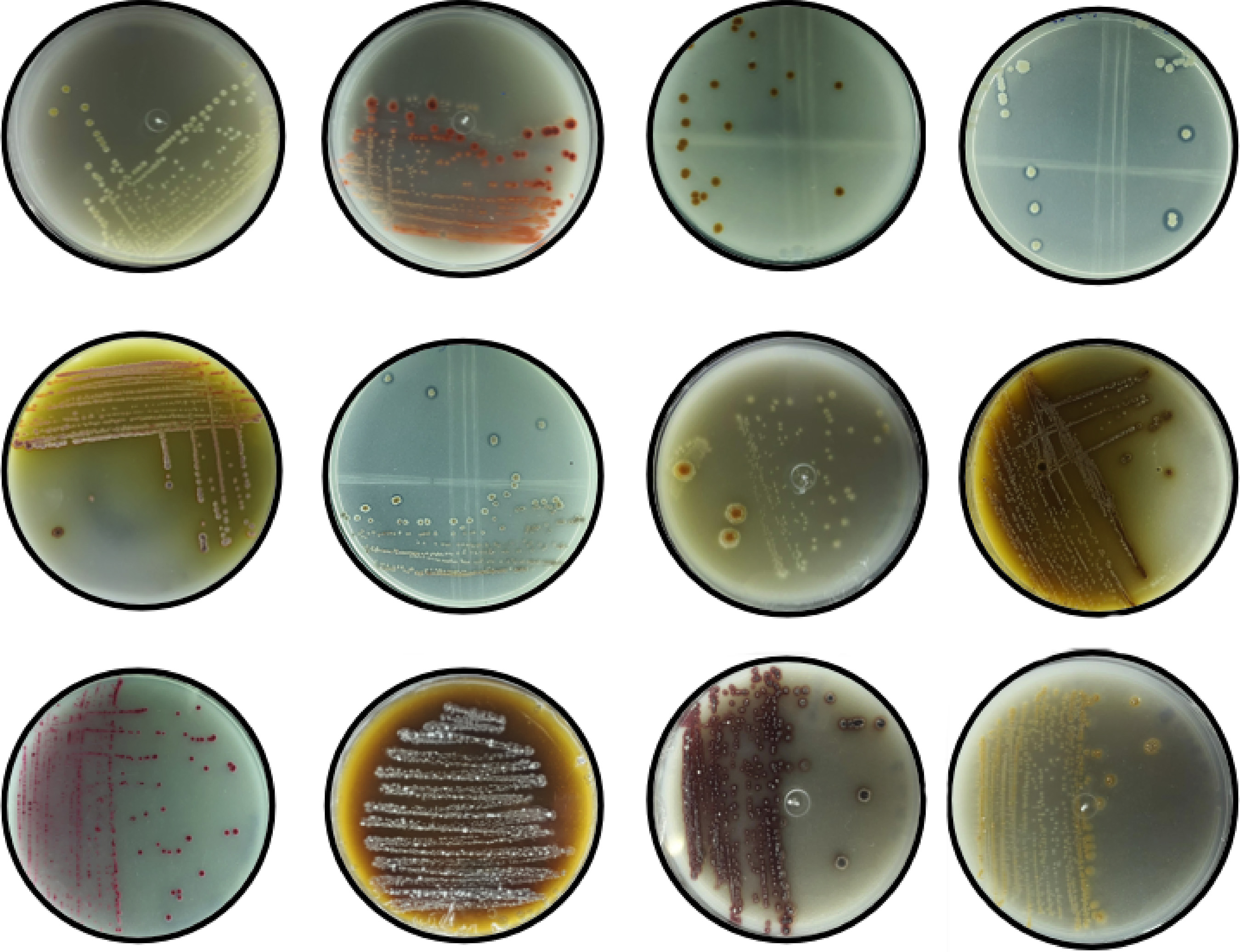
A total of 170 bacteria were characterized, of which 96 and 74 corresponded to Planosols and Luvisols, respectively (Table S2). The majority of isolated bacteria exhibited notable morphological similarities in color, shape, elevation, edges, and surfaces. The majority of isolates demonstrated a medium solubilization capacity, as evidenced by the solubilization index. Approximately 70 % of the isolated bacterial colonies exhibited typical actinobacterial morphology, with a tendency toward micellar growth and a high degree of chromaticity (Figure 2).
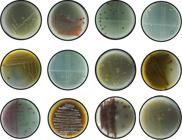
Phosphate solubilizing bacteria in Petri dishes with NBRIP medium isolated from Planosols and Luvisols. This picture was also published in the report, "State of Knowledge of Soil Biodiversity" (Winding et al., 2020).
The index of similarities revealed the formation of 37 bacterial groups for Planosols profiles and 26 groups for Luvisols. The groups formed showed high phenotypic diversity of bacterial isolates (Table S2).
Evaluation of phosphate-solubilizing efficiency in NBRIP liquid medium
The majority of isolates from Planosols and Luvisols solubilized phosphate in a liquid NBRIP medium, with significant differences (p<0.05) compared with the control (no inoculation). Additionally, the pH of the culture medium decreased in the control treatment.
The isolates from Planosols profiles exhibited the highest P solubilization rate on day 9 for the bacteria: PL1B (228.20 mg L-1) isolated from horizon A of the ST-PL area (Table S3), PL6A (159.52 mg L-1) isolated from the A horizon of the BF-PL area (Table S4), PL13D (156.90 mg L-1) isolated from the E2 horizon of the LO-PL area (Table S5), and PL18E (422.68 mg L-1) isolated from the horizon Ap2 of the CA-PL area (Table S6). The isolates from Luvisols exhibited the highest P solubilization rate on day 9 for LU2F (255.84 mg L-1) isolated from the Bt horizon of area IT1-LU (Table S7), on day 7 for LU5D (219 44 mg L-1) isolated from horizon A of area IT2-LU (Table S8), on day 9 for LU11F (264.21 mg L-1) from horizon BC and area ST-LU (Table S9) and LU17B (204.75 mg L-1) from the Ce horizon of the AI-LU area (Table S10).
Zn solubilization, IAA production, EPS formation, and antagonist assay
Solubilization mechanisms of Zn, IAA production, EPS formation, and Fusarium antagonism of isolates that exhibited capacity for P solubilization in NBRIP liquid medium ≥160 mg L-1 were evaluated. This evaluation was conducted without a reduction in the solubilizing capacity over time and with distinct morphophysiological characteristics. Only three bacteria (PL3J, PL18E, and LU3D) displayed the capacity to solubilize Zn, with solubilization indices (SIZn) of 2.44 for PL3J, 2.63 for PL18E, and 3.04 for LU3D.
Regarding IAA production, the isolates PL1A (horizon A of ST-PL), PL1B (horizon A of ST-PL), PL2L (horizon AE of ST-PL), PL6A (horizon A of BF-PL), LU10E (horizon Bt of ST-LU), and LU13C (horizon A of AI-LU) exhibited high production. In contrast, LU10B (horizon Bt BF), LU11A, and LU11F (isolated from the BC horizon of Luvisol profile 3) displayed intermediate production (Table 2). Regarding EPS formation, five isolates showed high EPS production: PL1A, PL3J, PL6A, PL18E, and LU10E. In contrast, LU3D (horizon C of profile 1 of Luvisol) showed intermediate production, while PL1E, PL2L, and LU13C exhibited low production (Table 2 and Figure S1A). Conversely, Fusarium growth was significantly inhibited when confronted with the bacteria PL3J (Table 3 and Figure S1B).
Zinc solubilization index (SIZn), production of indole-3 acetic acid (IAA), and exopolysaccharides (EPS) of the isolates that presented a solubilization of P >160 mg L-1
Micellar growth of Fusarium sp. confronted with phosphate-solubilizing bacteria during 7 days of growth
Identification of PSB by 16S rRNA gene sequencing
Isolates PL1A and PL2L were identified as Priestia sp., with 98.9 and 94.9 % similarity, respectively. The PL1B showed similarity with Neobacillus sp. (90.30 %), PL6A with Fictibacillus sp. (95.7 %), and PL18E and LU10E with Bacillus sp. (~ 94 %). Isolates PL3J and LU13C were identified as actinobacteria, Streptomyces sp., with 98 % similarity (Table 4).
Identification of strains obtained from Planosols and Luvisols, based on eight bacterial strains selected from the sequencing of the 16S rRNA
Effect of PSB inoculation
The maximum P content in the soil was observed for the treatment with rock phosphate (RP) inoculated with LU10E (78.7 mg dm-3), which showed significant differences (p<0.05) compared to the control (without P). Besides, the treatment with single superphosphate (SSP) inoculated with LUC13C was 69.9 mg dm-3 (Table 5).
Phosphorus concentration in soil for the treatments without the addition of phosphorus (P-), with single superphosphate (SSP), with rock phosphate (RP), and SSP + RP, inoculated with phosphate-solubilizing bacteria
Regarding RDM and SDM, no statistical differences (p>0.05) were observed between the treatments (Table 6). As for the contents of N and K in plants, no significant differences were observed (Table 6). Nevertheless, for the N content, the treatment PL6A (-P) exhibited the highest value (42.35 g kg-1). Among the inoculated treatments, the maximum values for P were observed in SSP PL2L (2.81 g kg-1) and SSP + RP LU13C (2.73 g kg-1). Similarly, for the K content, the treatments inoculated with PL1A (0.41 g kg-1) and PL2L (0.45 g kg-1) and the RP treatment inoculated with PL6A (0.42 g kg-1) and PL3J (0.40 g kg-1) exhibited the highest values (Table 6).
Shoot dry mass (SDM), root dry mass (RDM), nitrogen (N), phosphorus (P), and potassium (K) content of corn plants for treatments without P (P-), single superphosphate (SSP), rock phosphate (RP), and SSP + RP inoculated with phosphate-solubilizing bacteria
Multivariate Analysis
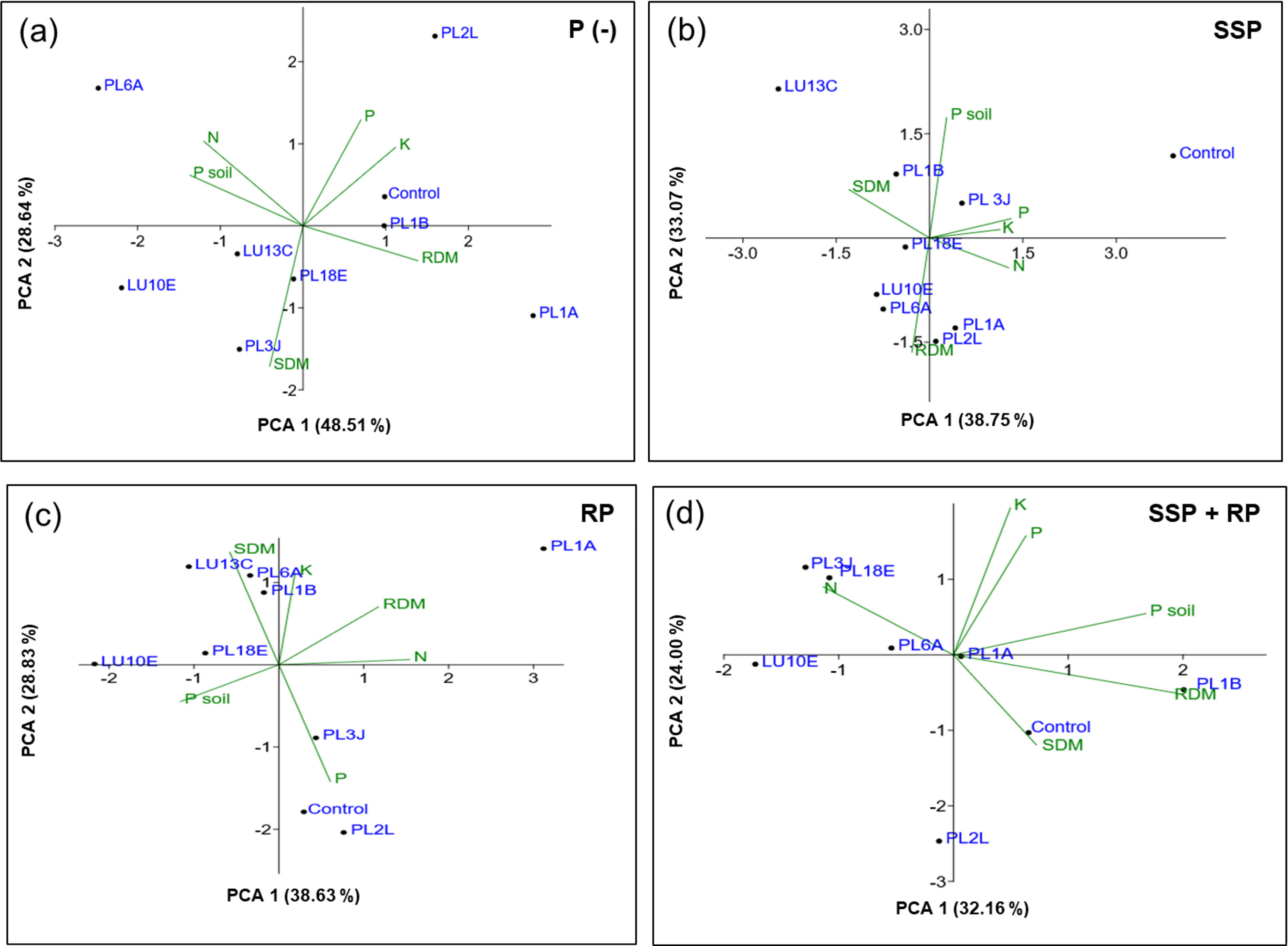
The first two principal components explained 67.2 % (P–), 71.8 % (SSP), 67.5 % (RP), and 56.2 % (SSP+RP) of the total data variability (Figure 3). The concentrations of K, N, and P in plant tissue showed weak correlations with bacterial inoculation in the treatments without phosphorus addition and those supplemented with single superphosphate (SSP). In the rock phosphate (RP) treatment, LU10E inoculation exhibited a strong correlation with soil phosphorus availability. In the combined treatment (SSP+RP), root dry matter production and phosphorus content in plant tissue were positively correlated with inoculation by isolates PL3J and LU13C. Accordingly, LU13C, LU10E, and PL3J were the most efficient in mobilizing phosphorus, PL1B and PL18E showed intermediate performance, while PL1A, PL2L, and PL6A were the least effective.
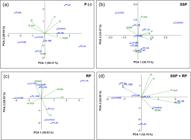
Principal Component Analysis (PCA) for the evaluated variables and treatments with four phosphorus sources. P(-): no phosphorus addition (a); SSP: with single superphosphate addition (b); RP: with rock phosphate addition (c); SSP+RP: with both single superphosphate and rock phosphate addition (d). P soil: available phosphorus in the soil; P: phosphorus content in plant tissue; N: nitrogen content in plant tissue; K: potassium content in plant tissue; SDM: shoot dry matter; RDM: root dry matter.
DISCUSSION
This study represents the first investigation of the culturable phosphate-solubilizing bacterial community along Planosol and Luvisol profiles in the semiarid region of Brazil. In general, PSB prospecting is conducted in the surface layer of the rhizosphere (Araújo et al., 2020; Cumpa-Velásquez et al., 2021). However, Câmara et al. (2021), Neves et al. (2021; 2023), and Sousa et al. (2021a, 2022) have demonstrated that the high content of available P is especially prevalent in subsurface pedogenetic horizons of Planosols and Luvisols, which are formed from gneiss and amphibolites, respectively. The P source in these horizons is apatite. Therefore, we postulate that these soils harbor a high diversity of PSB, capable of releasing organic acids and phosphatases, thereby solubilizing and mineralizing phosphorus.
A bacterial collection comprising 170 PSB, isolated from different pedogenetic horizons of Planosols and Luvisols, was established, and the potential of these PSB for corn growth and P availability in soil was elucidated. The use of microorganisms as biofertilizers (e.g., inoculants) represents a sustainable alternative to promote positive effects on soil and crop productivity (Numan et al., 2018; Ramakrishna et al., 2019; O’Callaghan et al., 2022). In particular, we found a high morphological diversity and abundance of PSB isolated from Planosols and Luvisols, with a higher prevalence of actinobacteria (Table S2 and Figure 2). Actinobacteria are Gram-positive bacteria with a rigid peptidoglycan cell wall that enables them to survive in extreme environmental conditions, such as degraded soils exposed to high temperatures, evapotranspiration, and ultraviolet irradiation, as well as long dry periods, which are characteristic of the Brazilian semiarid region (Alvarez et al., 2017; Nafis et al., 2019).
Degraded soils in desertified environments may host pioneer communities of actinobacteria with highly resilient morphophysiological traits (Kavamura et al., 2013). These microorganisms contribute to the structural integrity of the soil by enveloping large aggregates with pseudohyphae and secreting mucilaginous polysaccharides that function as natural binding agents (Cania et al., 2020; Santos et al., 2022). Such activity may initially support the formation of biological soil crusts in the semiarid soils of the Caatinga dry forest biome (Guan et al., 2018). Particularly, under the subhumid conditions of Lagoa do Ouro (LO) and Camutanga (CA), actinobacteria play a central role in improving soil health by promoting the accumulation of carbon and nitrogen in soil organic matter. This is primarily achieved through the efficient decomposition of recalcitrant plant-derived compounds, such as phenolics enriched with aromatic rings. These compounds are readily degraded by actinobacteria, which are recognized as oligotrophic microorganisms or K-strategists (Javed et al., 2021; Hu et al., 2023).
Notably, for Planosol profiles, we observed a reduced number of bacteria in the subsurface horizons (Table 1), corresponding to approximately a 33 % decrease (from ~6 to ~4 log₁₀ CFU g-¹). Regarding Luvisols, we identified slight variations in the number of bacteria between the superficial and subsurface horizons in most profiles (Table 1). Several studies have shown that the abundance of edaphic microorganisms is associated with soil physical and chemical properties, including organic matter, nutrients, and porosity (Bhatt and Maheshwari, 2020; Weldmichael et al., 2020). Likely, the physical and chemical properties of horizon B of Planosols (i.e., a pedogenetic horizon with clay accumulation and a slow permeability) and of eutrophic Bt of Luvisols (i.e., soils with clay activity that confers high fertility) may positively influence the abundance of these bacteria.
Functionally, these bacteria demonstrated the ability to solubilize phosphate. The non-halo-forming isolates obtained on NBRIP solid medium exhibited the capacity to solubilize calcium phosphate in liquid medium (Table S3–S10), a trait previously reported in several studies (Nautiyal, 1999; Liu et al., 2015; Abreu et al., 2017). Furthermore, differences in phosphate solubilization were observed over time, potentially due to bacterial kinetics and calcium phosphate solubilization capacity or medium saturation with different chemical species derived from bacterial metabolism and the reacted mineral, resulting in the formation of intermediate phosphate species known as brushite crystals (Delvasto et al., 2006; Anzuay et al., 2013). A decrease in the pH of the inoculated NBRIP medium was observed (Table S3-S10). This result indicates that the medium has undergone acidification due to the production of organic acids, such as gluconic, 2-ketogluconic, citric, and malic, by bacteria for phosphorus solubilization. This has been reported in several studies (Abreu et al., 2017; Xu et al., 2019; Brucker et al., 2020).
Regarding Zn solubilization, only PL3J, PL18E, and LU3D were capable of effectively solubilizing ZnO (Table 2). In plants, Zn plays a role in carbohydrate and nitrogen metabolism, auxin and protein synthesis, and cell membrane maintenance (Kamran et al., 2017). Some PSB of the genera Bacillus, Pseudomonas, and Enterobacter were identified as possible candidates for the solubilization of zinc oxide (ZnO), zinc carbonate (ZnCO3), and zinc phosphate (Zn3(PO4)2) (Kamran et al., 2017; Hussain et al., 2020). In addition to Bacillus sp., we identified the actinobacteria Streptomyces sp. (PL3J) as a Zn solubilizer. This mechanism has never been reported for this actinobacteria. Thus, it is necessary to evaluate the solubilization of the strains in the presence of other forms of Zn.
In addition to zinc solubilization, the isolates were also evaluated for their ability to produce indole-3-acetic acid, a key phytohormone involved in plant development. Nine isolates (PL1A, PL1B, PL2L, PL6A, LU10B, LU10E, LU11A, LU11F, LU13C) exhibited medium to high IAA production levels (Table 2), consistent with reports for strains used in the commercial product Biomaphos®. This hormone promotes the development of primary and lateral roots, enhancing water and nutrient uptake (Gilbert et al., 2018). The variation in IAA production observed here may be associated with tryptophan concentration, pH, temperature, and carbon and nitrogen sources, as previously noted by Molina et al. (2018) and Liu et al. (2019).
Another mechanism evaluated was exopolysaccharide production, which was identified in the isolates PL1A, PL1E, PL2L, PL3J, PL6A, PL18E, LU3D, LU10E, and LU13C (Table 2). These results confirm the study by Araújo et al. (2020), which reported the isolation of bacteria capable of synthesizing EPS from Brazilian semiarid soil. The EPS participates as signaling molecules in interactions with plants, in protecting against biotic or abiotic factors through biofilm formation, and in maintaining the stability of soil aggregates. The use of EPS-producing bacteria is important in the formulation of biofertilizers, as it helps ensure the survival and maintenance of the microbial community in the habitat (Bhagat et al., 2021; Bittencourt et al., 2023).
An additional functional trait observed in some PSB, such as Bacillus, Pseudomonas, and Streptomyces, was their potential as biological control agents against phytopathogenic fungi. Several genera, including Fusarium, Rhizoctonia, Sclerotinia, Phytophthora, and Aspergillus, are known for their phytopathogenic and toxigenic effects on crops (Faheem et al., 2015; Khan et al., 2018). Among the isolates tested, only PL3J (Streptomyces sp.) demonstrated strong antagonistic activity against Fusarium sp. (Table 3). Streptomyces species are well known for producing a wide array of antibiotics through tightly regulated biosynthetic pathways (Xia et al., 2020). In addition to Fusarium control, these bacteria may also inhibit other phytopathogens, as previously documented (Khan et al., 2018).
The corn inoculation experiment revealed that both the phosphate rock (RP) treatment inoculated with LU10E and the single superphosphate (SSP) treatment inoculated with LU13C led to a significant increase in soil phosphorus levels compared to the control treatment, which did not receive phosphorus supplementation (Table 6). However, no statistical differences (p>0.05) were observed between treatments for RDM, SDM, and nutrient content, which may be attributed to the short duration of the greenhouse experiment (Table 6). Ribeiro et al. (2018) reported that long-term experiments demonstrate increased solubilization of rock phosphate and accumulation of phosphorus in biomass and millet grains. Additionally, Hameeda et al. (2008) observed a significant increase in shoot and grain yield in corn inoculated with PSB strains of the genera Pseudomonas and Serratia, using different P sources, in a greenhouse experiment lasting 96 days.
In other similar studies, PSB of the genus Bacillus was inoculated in various crops, including corn (Gomes et al., 2014) and sorghum (Mattos et al., 2020), with the addition of phosphate rock. This increased root and shoot biomass and nutrient content, such as N and P, at 50 days. Similarly, we observed different responses of the PSB to varying P sources, particularly for P in soil, SDM, and RDM (Table 6). Several studies have indicated that the potential of microorganisms to solubilize phosphorus is variable and dependent on several factors, including solubilization mechanisms and their ability to release phosphorus into the soil, as well as the genetics of the strains and the type of phosphate rock (Gomes et al., 2014; Billah et al., 2019; Silva et al., 2021). Consequently, future field evaluations of PSB are essential for selecting the most efficacious bacteria for the development of a biofertilizer.
CONCLUSION
This study provided a novel assessment of the cultivable phosphate-solubilizing bacterial community across pedogenetic horizons of Planosols and Luvisols in Brazil's semiarid region, where phosphorus availability is notably high in deeper layers. The biotechnological potential of selected PSB isolates was also evaluated, with promising results for corn development. Among the isolates, LU13C, LU10E, and PL3J exhibited the highest phosphorus mobilization efficiency, followed by PL1B and PL18E with intermediate performance, while PL1A, PL2L, and PL6A were the least effective.
The characterization of phosphate-solubilizing bacteria across soil profiles of Planosols and Luvisols in the Brazilian semiarid region established the first regional bacterial collection, comprising 170 taxonomically and functionally diverse strains with notable biotechnological potential. These isolates demonstrated the ability to solubilize more than 400 mg L-1 of phosphorus in liquid culture, highlighting their efficiency in mobilizing P from insoluble sources. Beyond phosphorus solubilization, the strains exhibited multiple plant growth-promoting traits, including indole-3-acetic acid synthesis, exopolysaccharide production, zinc solubilization, and antagonistic activity against phytopathogens, underscoring their multifunctionality in supporting plant health and soil fertility.
Among the evaluated isolates, Bacillus sp. (LUC10E) and Streptomyces sp. (LUC13C), obtained from Luvisols of Serra Talhada and Afogados de Ingazeira, respectively, were particularly effective at enhancing phosphorus availability under soil conditions. These strains stand out as promising candidates for the development of bioinoculants or biofertilizers to improve nutrient cycling and sustainability in agricultural systems in semiarid environments.
ACKNOWLEDGMENTS
The authors thank the Plataform of Sequencing-LABCEN/CCB at the UFPE and Instituto Agronômico de Pernambuco for allowing the use of their facilities, and the company Fosprata for supplying phosphate rock.
-
How to cite:
Buzó LN, Fracetto FJC, Paiva CAO, Nascimento CWA, Souza Júnior VS, Silva WR, Silva CCG, Fracetto GGM. Degraded soils in the Brazilian semiarid region harbor bacteria with high phosphate solubilization potential. Rev Bras Cienc Solo. 2026;50:e0250028. https://doi.org/10.36783/18069657rbcs20250028
-
FUNDING
The first author thanks the Coordenação de Aperfeiçoamento de Pessoal de Nível Superior (CAPES) for the fellowships granted. The authors G.G.M.F. (306252/2021–0) and V.S.S.J. (305916/2023-8) thank Conselho Nacional de Desenvolvimento Científico e Tecnológico (CNPq). F.J.C.F (BFP-0032-5.01/23), C.C.G.S (BFP-0055-5.01/23) and W.R.S (BCT-0740-5.01/22) thank Fundação de Amparo à Ciência e Tecnologia do Estado de Pernambuco for the fellowship provided and for the financial support in this investigation (APQ-1073-5.01/22). We wish to express our appreciation to Coordenação de Aperfeiçoamento de Pessoal de Nível Superior (CAPES) - Finance Code 001.
SUPPLEMENTARY MATERIALS
Supplementary data to this article can be found online at https://docs.google.com/document/d/161raZxMgZ-KSIHlGpHQZPqFQtOMOluWi/edit?usp=sharing&ouid=116369191546168468509&rtpof=true&sd=true
DATA AVAILABILITY
All data was generated or analyzed in this study.
REFERENCES
-
Abreu CS, Figueiredo JEF, Oliveira-Paiva CA, Santos VL, Gomes EA, Ribeiro VP, Barros VA, Lana UGP, Marriel IE. Maize endophytic bacteria as mineral phosphate solubilizers. Genet Mol Res. 2017;16:gmr16019294. https://doi.org/10.4238/gmr16019294
» https://doi.org/10.4238/gmr16019294 -
Ait-Ouakrim EH, Chakhchar A, El Modafar C, Douira A, Amir S, Ibnsouda-Koraichi S, Belkadi B, Filali-Maltouf A. Assessment of potent phosphate-solubilizing bacteria isolated from the olive tree rhizosphere grown on phosphate sludge and their effect on common bean growth. Geomicrobiol J. 2023;40:605-17. https://doi.org/10.1080/01490451.2023.2218839
» https://doi.org/10.1080/01490451.2023.2218839 -
Alvarez A, Saez JM, Costa JSD, Colin VL, Fuentes MS, Cuozzo SA, Benimeli CS, Polti MA, Amoroso MJ. Actinobacteria: current research and perspectives for bioremediation of pesticides and heavy metals. Chemosphere. 2017;166:41-62. https://doi.org/10.1016/j.chemosphere.2016.09.070
» https://doi.org/10.1016/j.chemosphere.2016.09.070 -
Anzuay MS, Frola O, Angelini JG, Ludueña LM, Fabra A, Taurian T. Genetic diversity of phosphate-solubilizing peanut (Arachis hypogaea L.) associated bacteria and mechanisms involved in this ability. Symbiosis. 2013;60:143-54. https://doi.org/10.1007/s13199-013-0250-2
» https://doi.org/10.1007/s13199-013-0250-2 -
Araujo ASF, Medeiros EV, Costa DP, Pereira APA, Mendes LW. From desertification to restoration in the Brazilian semiarid region: Unveiling the potential of land restoration on soil microbial properties. J Environ Manage. 2024;351:119746. https://doi.org/10.1016/j.jenvman.2023.119746
» https://doi.org/10.1016/j.jenvman.2023.119746 - Araújo Filho JC, Burgos N, Lopes OF, Silva FHBB, Medeiros LAR, Melo Filho HFR, Parayba RBV, Cavalcanti AC, Oliveira Neto MB, Silva FBR, Leite AP, Santos JCP, Sousa Neto NC, Silva AB, Luz LRQP, Reis RMG, Barros AHC. Levantamento de reconhecimento de baixa e média intensidade dos solos do Estado de Pernambuco. Rio de Janeiro: Embrapa Solos; 2000. (Boletim de pesquisa, 11).
- Araújo Filho JC, Correa MM, Paiva AQ, Costa OV, Valladares GS, Ribeiro MR, Schaefer CE. Semiarid soils of the Caatinga Biome of Northeastern Brazil. In: Schaefer CEGR, editor. The soils of Brazil. World Soils Book Series. Cham: Springer International Publishing; 2023. p. 175-93.
-
Araújo VLVP, Fracetto GGM, Silva AMM, Pereira APA, Freitas CCG, Barros FMR, Santana MC, Feiler HP, Matteoli FP, Fracetto FJC, Cardoso EJBN. Potential of growth-promoting bacteria in maize (Zea mays L.) varies according to soil moisture. Microbiol Res. 2023;271:127352. https://doi.org/10.1016/j.micres.2023.127352
» https://doi.org/10.1016/j.micres.2023.127352 -
Araújo VLVP, Lira Junior MA, Souza Júnior VS, Araújo Filho JC, Fracetto FJC, Andreote FD, Pereira APA, Mendes Júnior JP, Barros FMR, Fracetto GGM. Bacteria from tropical semiarid temporary ponds promote maize growth under hydric stress. Microbiol Res. 2020;240:126564. https://doi.org/10.1016/j.micres.2020.126564
» https://doi.org/10.1016/j.micres.2020.126564 -
Bashan Y, Kamnev AA, de-Bashan LE. A proposal for isolating and testing phosphate-solubilizing bacteria that enhance plant growth. Biol Fertil Soils. 2013;49:1-2. https://doi.org/10.1007/s00374-012-0756-4
» https://doi.org/10.1007/s00374-012-0756-4 - Berraquero FR, Baya AM, Cormenzana AR. Establishment of indices for the study of phosphate solubilization by soil bacteria. Ars Pharmacéutica. 1976;17:399-406.
-
Bertramson BR. Phosphorus analysis of plant material. Plant Physiol. 1942;17:447-57. https://doi.org/10.1104/pp.17.3.447
» https://doi.org/10.1104/pp.17.3.447 -
Bhagat N, Raghav M, Dubey S, Bedi N. Bacterial exopolysaccharides: Insight into their role in plant abiotic stress tolerance. J Microbiol Biotechnol. 2021;31:1045-59. https://doi.org/10.4014/jmb.2105.05009
» https://doi.org/10.4014/jmb.2105.05009 -
Bhatt K, Maheshwari DK. Bacillus megaterium strain CDK25, a novel plant growth promoting bacterium enhances proximate chemical and nutritional composition of Capsicum annuum L. Front Plant Sci. 2020;11:1147. https://doi.org/10.3389/fpls.2020.01147
» https://doi.org/10.3389/fpls.2020.01147 -
Billah M, Khan M, Bano A, Hassan TU, Munir A, Gurmani AR. Phosphorus and phosphate solubilizing bacteria: Keys for sustainable agriculture. Geomicrobiol J. 2019;36:904-16. https://doi.org/10.1080/01490451.2019.1654043
» https://doi.org/10.1080/01490451.2019.1654043 -
Bittencourt PP, Alves AF, Ferreira MB, Irineu LESS, Pinto VB, Olivares FL. Mechanisms and applications of bacterial inoculants in plant drought stress tolerance. Microorganisms. 2023;11:502. https://doi.org/10.3390/microorganisms11020502
» https://doi.org/10.3390/microorganisms11020502 -
Brucker E, Kernchen S, Spohn M. Release of phosphorus and silicon from minerals by soil microorganisms depends on the availability of organic carbon. Soil Biol Biochem. 2020;143:107737. https://doi.org/10.1016/j.soilbio.2020.107737
» https://doi.org/10.1016/j.soilbio.2020.107737 -
Câmara ERG, Santos JCB, Araújo Filho JC, Schulze SMBB, Corrêa MM, Ferreira TO, Sousa JES, Souza Júnior VS. Parent rock–pedogenesis relationship: How the weathering of metamorphic rocks influences the genesis of Planosols and Luvisols under a semiarid climate in NE Brazil. Geoderma. 2021;385:114878. https://doi.org/10.1016/j.geoderma.2020.114878
» https://doi.org/10.1016/j.geoderma.2020.114878 -
Cania B, Vestergaard G, Suhadolc M, Mihelič R, Krauss M, Fliessbach A, Mäder P, Szumelda A, Schloter M, Schulz S. Site-specific conditions change the response of bacterial producers of soil structure-stabilizing agents such as exopolysaccharides and lipopolysaccharides to tillage intensity. Front Microbiol. 2020;11:568. https://doi.org/10.3389/fmicb.2020.00568
» https://doi.org/10.3389/fmicb.2020.00568 -
Companhia Nacional do Abastecimento - Conab. Acompanhamento da Safra Brasileira: Boletim da Safra de Grãos. Ministério do Desenvolvimento Agrário e Agricultura Familiar; 2023 [cited 2023 Dec 10]. Available from: https://www.gov.br/conab/pt-br/atuacao/informacoes-agropecuarias/safras/safra-de-graos/boletim-da-safra-de-graos/11o-levantamento-safra-2022-23/e-book_boletim-de-safras-11o-levantamento.pdf
» https://www.gov.br/conab/pt-br/atuacao/informacoes-agropecuarias/safras/safra-de-graos/boletim-da-safra-de-graos/11o-levantamento-safra-2022-23/e-book_boletim-de-safras-11o-levantamento.pdf -
Cumpa-Velásquez LM, Moriconi JI, Dip DP, Castagno LN, Puig ML, Maiale SJ, Santa-Maria GE, Sannazzaro AI, Estrella MJ. Prospecting phosphate solubilizing bacteria in alkaline-sodic environments reveals intra-specific variability in Pantoea eucalypti affecting nutrient acquisition and rhizobial nodulation in Lotus tenuis. Appl Soil Ecol. 2021;168:104125. https://doi.org/10.1016/j.apsoil.2021.104125
» https://doi.org/10.1016/j.apsoil.2021.104125 -
Carvalho IP, Bastos FH, Cordeiro AMN. Geomorphological heritage and geotourism in a Granite terrain of the Semiarid Northeast of Brazil: The case of the Uruburetama Massif. Geoheritage. 2024;16:68. https://doi.org/10.1007/s12371-024-00953-x
» https://doi.org/10.1007/s12371-024-00953-x -
Delvasto P, Valverde A, Ballester A, Igual JM, Muñoz JA, González F, Blázquez ML, García C. Characterization of brushite as a re-crystallization product formed during bacterial solubilization of hydroxyapatite in batch cultures. Soil Biol Biochem. 2006;38:2645-54. https://doi.org/10.1016/j.soilbio.2006.03.020
» https://doi.org/10.1016/j.soilbio.2006.03.020 -
Dennis C, Webster J. Antagonistic properties of species-groups of Trichoderma: I. Production of non-volatile antibiotics. Trans Br Mycol Soc. 1971;57:25-39. https://doi.org/10.1016/S0007-1536(71)80077-3
» https://doi.org/10.1016/S0007-1536(71)80077-3 - Di Rienzo JA, Casanoves F, Balzarini MG, Gonzalez L, Tablada MRCW, Robledo CW. InfoStat versión 2020. Argentina: Centro de Transferencia InfoStat, FCA, Universidad Nacional de Córdoba; 2020.
-
Faheem M, Raza W, Zhong W, Nan Z, Shen Q, Xu Y. Evaluation of the biocontrol potential of Streptomyces goshikiensis YCXU against Fusarium oxysporum f. sp. niveum Biol Control. 2015;81:101-10. https://doi.org/10.1016/j.biocontrol.2014.11.012
» https://doi.org/10.1016/j.biocontrol.2014.11.012 -
Fasim F, Ahmed N, Parsons R, Gadd GM. Solubilization of zinc salts by a bacterium isolated from the air environment of a tannery. FEMS Microbiol. Lett. 2002;213:1-6. https://doi.org/10.1111/j.1574-6968.2002.tb11277.x
» https://doi.org/10.1111/j.1574-6968.2002.tb11277.x -
Galindo-Castañeda T, Lynch JP, Six J, Hartmann M. Improving soil resource uptake by plants through capitalizing on synergies between root architecture and anatomy and root-associated microorganisms. Front Plant Sci. 2022;13:827369. https://doi.org/10.3389/fpls.2022.827369
» https://doi.org/10.3389/fpls.2022.827369 -
Gilbert S, Xu J, Acosta K, Poulev A, Lebeis S, Lam E. Bacterial production of indole related compounds reveals their role in association between duckweeds and endophytes. Front Chem. 2018;6:265. https://doi.org/10.3389/fchem.2018.00265
» https://doi.org/10.3389/fchem.2018.00265 -
Gomes EA, Silva UDC, Marriel IE, Oliveira CA, Lana UGDP. Rock phosphate solubilizing microorganisms isolated from maize rhizosphere soil. Rev Bras Milho Sorgo. 2014;13:69-81. https://doi.org/10.18512/1980-6477/rbms.v13n1p69-81
» https://doi.org/10.18512/1980-6477/rbms.v13n1p69-81 -
Gordon SA, Weber RP. Colorimetric estimation of indoleacetic acid. Plant Physiol. 1951;26:192-5. https://doi.org/10.1104/pp.26.1.192
» https://doi.org/10.1104/pp.26.1.192 -
Guan P, Zhang X, Yu J, Cheng Y, Li Q, Andriuzzi WS, Liang W. Soil microbial food web channels associated with biological soil crusts in desertification restoration: The carbon flow from microbes to nematodes. Soil Biol Biochem. 2018;116:82-90. https://doi.org/10.1016/j.soilbio.2017.10.003
» https://doi.org/10.1016/j.soilbio.2017.10.003 -
Hameeda B, Harini G, Rupela OP, Wani SP, Reddy G. Growth promotion of maize by phosphate-solubilizing bacteria isolated from composts and macrofauna. Microbiol Res. 2008;163:234-42. https://doi.org/10.1016/j.micres.2006.05.009
» https://doi.org/10.1016/j.micres.2006.05.009 - Hammer Ø, Harper DA. Past: Paleontological statistics software package for educaton and data anlysis. Palaeontologia Electronica. 2001;4:4.
-
Hu P, Zhang W, Kuzyakov Y, Xiao L, Xiao D, Xu L,Wang K. Linking bacterial life strategies with soil organic matter accrual by karst vegetation restoration. Soil Biol Biochem. 2023;177:108925. https://doi.org/10.1016/j.soilbio.2022.108925
» https://doi.org/10.1016/j.soilbio.2022.108925 - Hungria M, Silva KD. Manual de curadores de germoplasma-microorganismos: rizóbios e bactérias promotoras do crescimento vegetal. Brasília, DF: Embrapa Recursos Genéticos e Biotecnologia; 2011.
-
Hussain A, Zahir ZA, Ditta A, Tahir MU, Ahmad M, Mumtaz MZ, Hayat K, Hussain S. Production and implication of bio-activated organic fertilizer enriched with zinc-solubilizing bacteria to boost up maize (Zea mays L.) production and biofortification under two cropping seasons. Agronomy. 2020;10:39. https://doi.org/10.3390/agronomy10010039
» https://doi.org/10.3390/agronomy10010039 -
Instituto Agronômico de Pernambuco - IPA. Recomendações de adubação para o Estado de Pernambuco: 2ª aproximação. Recife: IPA; 2008. Available from: https://dspace.sti.ufcg.edu.br/handle/riufcg/39333
» https://dspace.sti.ufcg.edu.br/handle/riufcg/39333 - IUSS Working Group WRB. World reference base for soil resources 2014, update 2015: International soil classification system for naming soils and creating legends for soil maps. Rome: Food and Agriculture Organization of the United Nations; 2015. (World Soil Resources Reports, 106).
-
Javed Z, Tripathi GD, Mishra M, Dashora K. Actinomycetes–the microbial machinery for the organic-cycling, plant growth, and sustainable soil health. Biocatal Agric Biotech. 2021;31:101893. https://doi.org/10.1016/j.bcab.2020.101893
» https://doi.org/10.1016/j.bcab.2020.101893 -
Kamran S, Shahid I, Baig DN, Rizwan M, Malik KA, Mehnaz S. Contribution of zinc solubilizing bacteria in growth promotion and zinc content of wheat. Front Microbiol. 2017;8:322772. https://doi.org/10.3389/fmicb.2017.02593
» https://doi.org/10.3389/fmicb.2017.02593 -
Kaur R, Kaur S. Variation in the phosphate solubilizing bacteria from virgin and the agricultural soils of Punjab. Curr Microbiol. 2020;77:2118-27. https://doi.org/10.1007/s00284-020-02080-6
» https://doi.org/10.1007/s00284-020-02080-6 -
Kavamura V, Taketani RG, Lançoni MD, Andreote FD, Mendes R, Melo IS. Water regime influences bulk soil and rhizosphere of Cereus jamacaru bacterial communities in the Brazilian Caatinga biome. PloS One. 2013;9:e73606. https://doi.org/10.1371/journal.pone.0073606
» https://doi.org/10.1371/journal.pone.0073606 -
Khan N, Martínez-Hidalgo P, Ice TA, Maymon M, Humm EA, Nejat N, Sanders ER, Kaplan D, Hirsch AM. Antifungal activity of Bacillus species against Fusarium and analysis of the potential mechanisms used in biocontrol. Front Microbiol. 2018;9:2363. https://doi.org/10.3389/fmicb.2018.02363
» https://doi.org/10.3389/fmicb.2018.02363 -
Kuss AV, Kuss VV, Lovato T, Flôres ML. Fixação de nitrogênio e produção de ácido indolacético in vitro por bactérias diazotróficas endofíticas. Pesq Agropec Bras. 2007;42:1459-65. https://doi.org/10.1590/S0100-204X2007001000013
» https://doi.org/10.1590/S0100-204X2007001000013 -
Lambers H. Phosphorus acquisition and utilization in plants. Annu Rev Plant Biol. 2022;73:17-42. https://doi.org/10.1146/annurev-arplant-102720-125738
» https://doi.org/10.1146/annurev-arplant-102720-125738 - Lane DJ. 16S/23S rRNA sequencing. In: Stackebrandt E, Goodfellow M, editors. Nucleic acid techniques in bacterial systematics. West Sussex: John Wiley and Sons; 1991.
-
Li HP, Han QQ, Liu QM, Gan YN, Rensing C, Rivera WL, Zhao Q, Zhang JL. Roles of phosphate-solubilizing bacteria in mediating soil legacy phosphorus availability. Microbiol Res. 2023;272:127375. https://doi.org/10.1016/j.micres.2023.127375
» https://doi.org/10.1016/j.micres.2023.127375 -
Lins CMT, Souza ER, Souza TEMS, Paulino MKSS, Monteiro DR, Souza Júnior VS, Dourado PRM, Rego Junior FEA, Silva YJA, Schaffer B. Influence of vegetation cover and rainfall intensity on soil attributes in an area undergoing desertification in Brazil. Catena. 2023;221:106751. https://doi.org/10.1016/j.catena.2022.106751
» https://doi.org/10.1016/j.catena.2022.106751 -
Liu WH, Chen FF, Wang CE, Fu HH, Fang XQ, Ye JR, Shi JY. Indole-3-acetic acid in Burkholderia pyrrocinia JK-SH007: Enzymatic identification of the indole-3-acetamide synthesis pathway. Front Microbiol. 2019;10:2559. https://doi.org/10.3389/fmicb.2019.02559
» https://doi.org/10.3389/fmicb.2019.02559 -
Liu Z, Li YC, Zhang S, Fu Y, Fan X, Patel JS, Zhang M. Characterization of phosphate-solubilizing bacteria isolated from calcareous soils. Appl Soil Ecol. 2015;96:217-24. https://doi.org/10.1016/j.apsoil.2015.08.003
» https://doi.org/10.1016/j.apsoil.2015.08.003 -
Lobo CB, Tomás MSJ, Viruel E, Ferrero MA, Lucca ME. Development of low-cost formulations of plant growth-promoting bacteria to be used as inoculants in beneficial agricultural technologies. Microbiol Res. 2019;219:12-25. https://doi.org/10.1016/j.micres.2018.10.012
» https://doi.org/10.1016/j.micres.2018.10.012 -
Mattos BB, Marriel IE, Sousa SM, Lana UDP, Schaffert RE, Gomes EA, Oliveira-Paiva CA. Sorghum genotypes response to inoculation with phosphate solubilizing bacteria. Rev Bras Milho Sorgo. 2020;19:e1177. https://doi.org/10.18512/rbms2020v19e1177
» https://doi.org/10.18512/rbms2020v19e1177 -
Molina R, Rivera D, Mora V, López G, Rosas S, Spaepen S, Vanderleyden J, Cassán F. Regulation of IAA biosynthesis in Azospirillum brasilense under environmental stress conditions. Curr Microbiol. 2018;75:1408-18. https://doi.org/10.1007/s00284-018-1537-6
» https://doi.org/10.1007/s00284-018-1537-6 -
Nafis A, Raklami A, Bechtaoui N, El Khalloufi F, El Alaoui A, Glick BR, Hafidi M, Kouisni L, Ouhdouch Y, Hassani L. Actinobacteria from extreme niches in Morocco and their plant growth-promoting potentials. Diversity. 2019;11:139. https://doi.org/10.3390/d11080139
» https://doi.org/10.3390/d11080139 -
Nautiyal CS. An efficient microbiological growth medium for screening phosphate solubilizing microorganisms. FEMS Microbiol Lett. 1999;170:265-70. https://doi.org/10.1111/j.1574-6968.1999.tb13383.x
» https://doi.org/10.1111/j.1574-6968.1999.tb13383.x -
Neves LVDMW, Fracetto FJC, Fracetto GGM, Araújo Filho JC, Araujo JKS, Santos JCB, Mendes Júnior JP, Souza Júnior VS. Microbial abundance and C and N stocks in tropical degraded Planosols from semiarid northeastern Brazil. Catena. 2021;196:104931. https://doi.org/10.1016/j.catena.2020.104931
» https://doi.org/10.1016/j.catena.2020.104931 -
Neves LVDMW, Sousa JES, Santos JCB, Araújo Filho JC, Corrêa MM, Sousa MG, Fracetto FJC, Fracetto GGM, Araujo JKS, Freire GAP, Ferreira TO, Souza Júnior VS. Weathering of gneiss saprolites and formation of Planosols under semiarid climate (NE Brazil). J South Am Earth Sci. 2023;123:104206. https://doi.org/10.1016/j.jsames.2023.104206
» https://doi.org/10.1016/j.jsames.2023.104206 -
Numan M, Bashir S, Khan Y, Mumtaz R, Shinwari ZK, Khan AL, Khan A, Ahmed AH. Plant growth promoting bacteria as an alternative strategy for salt tolerance in plants: A review. Microbiol Res. 2018;209:21-32. https://doi.org/10.1016/j.micres.2018.02.003
» https://doi.org/10.1016/j.micres.2018.02.003 -
O'Callaghan M, Ballard RA, Wright D. Soil microbial inoculants for sustainable agriculture: Limitations and opportunities. Soil Use Manage. 2022;38:1340-69. https://doi.org/10.1111/sum.12811
» https://doi.org/10.1111/sum.12811 - Oliveira-Paiva CA, Cota LV, Marriel IE, Gomes EA, de Sousa SM, Lana UDP, Alves VMC. Viabilidade técnica e econômica do Biomaphos® (Bacillus subtilis CNPMS B2084 e Bacillus megaterium CNPMS B119) nas culturas de milho e soja. Sete Lagoas: Embrapa Milho e Sorgo; 2020. (Boletim de Pesquisa e Desenvolvimento, 210).
-
Pang F, Li Q, Solanki MK, Wang Z, Xing YX, Dong DF. Soil phosphorus transformation and plant uptake driven by phosphate-solubilizing microorganisms. Front Microbiol. 2024;15:1383813. https://doi.org/10.3389/fmicb.2024.1383813
» https://doi.org/10.3389/fmicb.2024.1383813 -
Paulo EM, Vasconcelos MP, Oliveira IS, Affe HMJ, Nascimento R, Melo IS, Roque MRA, Assis SA. An alternative method for screening lactic acid bacteria for the production of exopolysaccharides with rapid confirmation. Cienc Tecnol Aliment. 2012;32:710-4. https://doi.org/10.1590/S0101-20612012005000094
» https://doi.org/10.1590/S0101-20612012005000094 -
Pavinato PS, Rocha GC, Cherubin MR, Harris I, Jones DL, Withers PJA. Map of total phosphorus content in native soils of Brazil. Sci Agric. 2021;78:e20200077. https://doi.org/10.1590/1678-992X-2020-0077
» https://doi.org/10.1590/1678-992X-2020-0077 -
Ramakrishna W, Yadav R, Li K. Plant growth promoting bacteria in agriculture: Two sides of a coin. Appl Soil Ecol. 2019;138:10-8. https://doi.org/10.1016/j.apsoil.2019.02.019
» https://doi.org/10.1016/j.apsoil.2019.02.019 -
Rawat P, Das S, Shankhdhar D, Shankhdhar SC. Phosphate-solubilizing microorganisms: Mechanism and their role in phosphate solubilization and uptake. J Soil Sci Plant Nutr. 2021;21:49-68. https://doi.org/10.1007/s42729-020-00342-7
» https://doi.org/10.1007/s42729-020-00342-7 -
Ribeiro VP, Marriel IE, Sousa SMD, Lana UGDP, Mattos BB, Oliveira CAD, Gomes EA. Endophytic Bacillus strains enhance pearl millet growth and nutrient uptake under low-P. Braz J Microbiol. 2018;49:40-6. https://doi.org/10.1016/j.bjm.2018.06.005
» https://doi.org/10.1016/j.bjm.2018.06.005 - Santos RD, Lemos RC, Santos HG, Ker JC, Anjos LHC, Shimizu SH. Manual de descrição e coleta de solos no campo. 7 ed rev ampl. Viçosa, MG: Sociedade Brasileira de Ciência do Solo; 2015.
-
Santos TO, Fracetto FJC, Souza Júnior VS, Araújo Filho JC, Lira Junior MA, Mendes Júnior JP, Siqueira Neto M, Silva YRO, Barros FMR, Fracetto GGM. Carbon and nitrogen stocks and microbial indicators in tropical semiarid degraded Luvisols. Catena. 2022;210:105885. https://doi.org/10.1016/j.catena.2021.105885
» https://doi.org/10.1016/j.catena.2021.105885 -
Silva UC, Cuadros-Orellana S, Silva DR, Freitas-Júnior LF, Fernandes AC, Leite LR, Oliveira CA, Santos VL. Genomic and phenotypic insights into the potential of rock phosphate solubilizing bacteria to promote millet growth in vivo. Front Microbiol. 2021;11:574550. https://doi.org/10.3389/fmicb.2020.574550
» https://doi.org/10.3389/fmicb.2020.574550 -
Silva VRF, Silva AHN, Sousa MG, Araújo Filho JC, Corrêa MM, Alves GB, Ferreira TO, Araújo JKS, Souza CD, Sousa JES, Santos JCB, Souza Júnior VS. Impact of climate on mineralogy and formation of Luvisols in Borborema province, northeastern Brazil. J South Am Earth Sci. 2024;149:105197. https://doi.org/10.1016/j.jsames.2024.105197
» https://doi.org/10.1016/j.jsames.2024.105197 -
Sousa JES, Andrade GRP, Araújo Filho JC, Santos JCB, Corrêa MM, Ferreira TO, Camargo PB, Araújo JKS, Silva AHN, Sousa MG, Souza Júnior VS. Weathering and mineral alteration of metamorphic rocks and genesis of Planosols along a rainfall gradient in Borborema Province, Northeast Brazil. Geoderma R. 2023;33:e00642. https://doi.org/10.1016/j.geodrs.2023.e00642
» https://doi.org/10.1016/j.geodrs.2023.e00642 -
Sousa JES, Santos JCB, Corrêa MM, Nascimento AF, Schulze SMBB, Ferreira TO, Araújo Filho JC, Souza Júnior VS. Mineralogy and genesis of Planosols under a semiarid climate, Borborema Plateau, NE Brazil. Catena. 2020;184:104260. https://doi.org/10.1016/j.catena.2019.104260
» https://doi.org/10.1016/j.catena.2019.104260 -
Sousa MG, Araujo JKS, Ferreira TO, Andrade GRP, Araújo Filho JC, Fracetto GGM, Santos JCB, Fracetto FJC, Lima GK, Souza Junior VS. Long-term effects of irrigated agriculture on Luvisol pedogenesis in semiarid region, northeastern Brazil. Catena. 2021a;206:105529. https://doi.org/10.1016/j.catena.2021.105529
» https://doi.org/10.1016/j.catena.2021.105529 -
Sousa MG, Araujo JKS, Fracetto GGM, Ferreira TO, Fracetto FJC, Araújo Filho JC, Otero XL, Santos JCB, Silva AHN, Souza Junior VS. Changes in organic carbon and microbiology community structure due to long-term irrigated agriculture on Luvisols in the Brazilian semi-arid region. Catena. 2022;212:106058. https://doi.org/10.1016/j.catena.2022.106058
» https://doi.org/10.1016/j.catena.2022.106058 -
Sousa SM, Oliveira CA, Andrade DL, Carvalho CG, Ribeiro VP, Pastina MM, Marriel IE, Lana UGP, Gomes EA. Tropical Bacillus strains inoculation enhances maize root surface area, dry weight, nutrient uptake and grain yield. J Plant Growth Regul. 2021b;40:867-77. https://doi.org/10.1007/s00344-020-10146-9
» https://doi.org/10.1007/s00344-020-10146-9 -
Suleman M, Yasmin S, Rasul M, Yahya M, Atta BM, Mirza MS. Phosphate solubilizing bacteria with glucose dehydrogenase gene for phosphorus uptake and beneficial effects on wheat. PloS One. 2018;13:e0204408. https://doi.org/10.1371/journal.pone.0204408
» https://doi.org/10.1371/journal.pone.0204408 - Teixeira PC, Donagemma GK, Fontana A, Teixeira WG. Manual de métodos de análise de solo. 3. ed. rev e ampl. Brasília, DF: Embrapa; 2017.
-
Velloso CCV, Oliveira CA, Gomes EA, Lana UGDP, Carvalho CG, Guimarães LJM, Pastina MM, Sousa SM. Genome-guided insights of tropical Bacillus strains efficient in maize growth promotion. FEMS Microbiol Ecol. 2020;96:fiaa157. https://doi.org/10.1093/femsec/fiaa157
» https://doi.org/10.1093/femsec/fiaa157 -
Vieira RMD, Tomasella J, Barbosa AA, Martins MA, Rodriguez DA, Rezende FS, Carriello F, Santana MD. Desertification risk assessment in Northeast Brazil: Current trends and future scenarios. Land Degrad Dev. 2021;32:224-40. https://doi.org/10.1002/ldr.3681
» https://doi.org/10.1002/ldr.3681 -
Wang Y, Peng S, Hua Q, Qiu C, Wu P, Liu X, Lin X. The long-term effects of using phosphate-solubilizing bacteria and photosynthetic bacteria as biofertilizers on peanut yield and soil bacteria community. Front Microbiol. 2021;12:693535. https://doi.org/10.3389/fmicb.2021.693535
» https://doi.org/10.3389/fmicb.2021.693535 -
Weldmichael TG, Michéli E, Fodor H, Simon B. The influence of depth on soil chemical properties and microbial respiration in the upper soil horizons. Eurasian Soil Sci. 2020;53:780-6. https://doi.org/10.1134/S1064229320060137
» https://doi.org/10.1134/S1064229320060137 -
Winding A, Singh BK, Bach E, Brown G, Zhang J, Cooper M, Dion P, Mele P, Eisenhauer N, Pena-Neira S, Lindo Z. State of knowledge of soil biodiversity: status, challenges, and potentialities. Italy: Food and Agriculture Organization of the United Nations; 2020. https://doi.org/10.4060/cb1928en
» https://doi.org/10.4060/cb1928en -
Withers PJA, Rodrigues M, Soltangheisi A, Carvalho TS, Guilherme LRG, Benites VDM, Gatiboni LC, Sousa DMG, Nunes RS, Rosolem CA, Andreote FD, Oliveira Jr A, Coutinho ELM, Pavinato PS. Transitions to sustainable management of phosphorus in Brazilian agriculture. Sci Rep. 2018;8:2537. https://doi.org/10.1038/s41598-018-20887-z
» https://doi.org/10.1038/s41598-018-20887-z -
Xia H, Zhan X, Mao XM, Li YQ. The regulatory cascades of antibiotic production in Streptomyces World J Microbiol Biotechnol. 2020;36:13. https://doi.org/10.1007/s11274-019-2789-4
» https://doi.org/10.1007/s11274-019-2789-4 -
Xu JC, Huang LM, Chen C, Wang J, Long XX. Effective lead immobilization by phosphate rock solubilization mediated by phosphate rock amendment and phosphate solubilizing bacteria. Chemosphere. 2019;237:124540. https://doi.org/10.1016/j.chemosphere.2019.124540
» https://doi.org/10.1016/j.chemosphere.2019.124540 -
Yoon SH, Ha SM, Kwon S, Lim J, Kim Y, Seo H, Chun J. Introducing EzBioCloud: a taxonomically united database of 16S rRNA gene sequences and whole-genome assemblies. Int J Syst Evol Micr. 2017;67:1613. https://doi.org/10.1099/ijsem.0.001755
» https://doi.org/10.1099/ijsem.0.001755
Edited by
-
Editor:
José Miguel Reichert https://orcid.org/0000-0001-9943-2898 and Jerri Edson Zilli https://orcid.org/0000-0003-2138-3488