 Building a new approach to soil fertility: From nutrient content to stocks and budget in Luvisols in the Brazilian subtropics
ABSTRACT
Extreme weather events drive the revision of soil management and fertility assessment practices, aiming to conserve natural resources and reduce costs. This study evaluated soil fertility based on available nutrient contents, nutrient stocks, and nutrient budget in Luvisols under cultivation of silage corn and different conservationist management systems. We hypothesized that the nutrient stocks and budget approach provides a better understanding of nutrient dynamics, including the role of soil as a source or sink, compared with evaluation based solely on nutrient content and critical values. The experiment was conducted from 2018 to 2020 in Roca Sales, Rio Grande do Sul State, Brazil, using a design with soil management systems (no-tillage and minimum tillage) and the following winter cover crops: (white) oats (Avena sativa), oats + common vetch (Vicia sativa), forage radish (Raphanus sativus), and fallow vegetation (spontaneous plants). The experiment included three harvests of silage corn, three winter crops, and soil (0.00–0.10 and 0.10–0.20 m layers) and plant sampling. Available P and K contents, exchangeable Ca and Mg contents, and their stocks and fluxes were evaluated through cycling and export. Data were analyzed using linear mixed models (p≤0.05). Potassium, Ca, and Mg contents decreased, while P was maintained, without a recommendation for fertilization based on critical values. Stocks of K, Ca, and Mg decreased, while P stocks remained stable. Nutrient budget revealed that soil was a source of P and K (as well as Ca under the no-tillage system) and a sink for Mg (along with Ca under the minimum tillage system). Nutrient cycling compensated for nutrient export for all the nutrients except Mg, and forage radish stood out. Cycling via forage radish was around 63 kg ha-1 P, 551 kg ha-1 K, and 109 kg ha-1 Ca. The nutrient stocks and budget approach complements content-based evaluation by incorporating nutrient dynamics and expanding the basis of management decisions.
Keywords
no-tillage system; minimum tillage; cover crops; cycling; silage corn
INTRODUCTION
The recent dry periods and historic rains responsible for major flooding in Rio Grande do Sul, in the South region of Brazil, had a severe impact on agricultural activity and rural producers (Emater-RS/Ascar, 2022, 2024). Around 2.7 million hectares were affected by soil and topsoil loss in the May 2024 rains alone (Emater-RS/Ascar, 2024). The seriousness of the situation stems from the important role of Rio Grande do Sul in Brazilian food production and the potential environmental damage caused by the transport of nutrients to water bodies, particularly from agricultural areas that neglect soil conservation practices (Tiecher and Minella, 2015).
Eliminating soil tillage, intercropping, and crop rotation are initial steps for soil conservation in crop fields to protect soil against erosion (Deuschle et al., 2019; Restovich et al., 2019; Inagaki et al., 2021) and to build resilience in the face of climate change. Cover crops are recognized for supplying organic matter through biomass, adding atmospheric N to the soil through biological nitrogen fixation by leguminous plants, creating biopores, controlling pests, diseases, and weeds, and promoting soil aggregation (Calegari et al., 2013; Inagaki et al., 2021; Carvalho et al., 2022).
Furthermore, other management practices introduce greater complexity to the agroecosystem without compromising crop yield potential. Lima et al. (2025) found greater fertilization efficiency, biomass production, and P cycling in intensive grain production systems when system fertilization was adopted in soils with high phosphorus availability. Simões et al. (2023) found that combining no-tillage with a livestock component through moderate winter grazing increases crop yields (grain and forage) and benefits soil physical quality. These results are further enhanced when, in addition to grazing, system fertilization is adopted rather than crop-specific fertilization (Simões et al., 2023).
Consistent with the growing trend toward management systems that benefit soil and agricultural production, Camargo et al. (2024) considered grazing a common factor and compared different fertilization strategies, with or without nitrogen application, in the Brazilian Cerrado. The authors found that higher yields of the summer crop and higher chemical and biological soil quality were correlated with the adoption of system fertilization combined with nitrogen (N) application. The importance of N for soil quality lies in its close relationship with soil organic matter and the biogeochemical dynamics of nutrients.
Therefore, the elimination of soil tillage, the cultivation of cover crops, the adoption of different fertilization strategies, and the introduction of livestock into integrated production systems (or their combination) are examples of management changes that progressively add complexity and provide biodiversity to the agroecosystem (Vezzani and Mielniczuk, 2011). These characteristics promote fluxes of matter and energy mediated by soil organisms, establishing systemic relationships (Anghinoni and Vezzani, 2021).
A soil fertility assessment approach more aligned with conservationist management seeks to consider processes already underway and to regard the soil as a medium favorable to life and the activity of organisms. Regarding the first aspect, the nutrient budget considers the soil as a system in which inputs occur through the application of mineral fertilizers, manure, biological nitrogen fixation, and atmospheric deposition. Outputs occur through nutrient export in harvests (productive outputs) or through transformation into forms unavailable to plants (unproductive outputs). Transformations refer to nutrient cycling through residue decomposition (Cunha et al., 2010). Nutrient stocks not only standardize units of measurement, but are also related to organization of the soil porous system and soil physics.
Considering the porous system in fertility assessments through nutrient stocks and nutrient budget can be understood as a way to connect fertility to the role of organisms in nutrient dynamics. Organisms inhabit the porous soil system. While some can change pore arrangements and create better conditions for resource access and movement, others are more restricted to occupying minute sites, utilizing resources available in the rhizosphere, and protecting themselves from predators and fluctuations in soil water content (Lavelle, 2012).
In general, the soil nutrient budget is a useful approach for evaluating the long-term effects of fertilizer management, or changes that signal a risk of ecosystem contamination. Furthermore, it has the advantage of being based on traditional soil chemistry analyses and on crop yield evaluations. However, under this perspective, soil fertility is not limited to reference values or ranges from the chemical-mineral approach; rather, it gathers knowledge from soil chemistry, physics, and biology to understand the biogeochemical dynamics of the nutrients. Thus, this approach may be more appropriate for assessing systemic fertility (Anghinoni and Vezzani, 2021) and for soils already classified as having high nutrient availability, serving as a strategy to minimize environmental impacts.
This study aimed to assess soil fertility based on available nutrient contents, their respective stocks, and the nutrient budget in the soil, considering a silage corn crop established on a soil with high nutrient levels and under different conservation management practices. The hypothesis of this study is that assessment of soil fertility through nutrient stocks and nutrient budget allows detection of variations in nutrient availability related to the role of soil as a source or sink, as well as the role of plants in nutrient cycling and export, processes that are not accounted for solely through assessment of nutrient contents and critical values.
MATERIALS AND METHODS
Location and history of the experimental area
The experimental area, with an average slope of 8 %, is located in Granja Piccinini, a family-owned property in the municipality of Roca Sales (29° 15’ 27” S, 51° 50’ 39” W), Taquari Valley, Rio Grande do Sul, Brazil. The climate of the region is Cfa according to the Köppen classification system (Alvares et al., 2013). The soil is classified as a Luvissolo Crômico Pálico abrúptico (Santos et al., 2018), corresponding to the Luvisol class (IUSS, 2015). The soil contains 380 g kg-1 clay, 210 g kg-1 sand, and 390 g kg-1 silt in the A horizon (0.00-0.30 m layer); and the soil mineralogy is shown in figure S2.
In general, Luvisols occur in the Central Depression and part of the Southern Plateau (Planalto Meridional) regions of the state of Rio Grande do Sul, representing 2 % of the state soil diversity (Rio Grande do Sul, 2021).
Prior to setting up the experiment, area management involved applying swine and cattle manure, cultivating wheat in winter, and, when necessary, harrowing and leveling the soil before sowing corn for silage production. Although the family reported manure application, the rates, frequency, or characterization of the manure applied on the area were not recorded.
Field experiment
Establishment of the no-tillage system and minimum tillage with annual chiseling was immediately implemented across the experimental area in April 2018, with surface application of 3.0 Mg ha-1 of agricultural limestone (ECC = 68 %). The chemical characterization of the soil at the time of experiment establishment is shown in table 1.
Initial soil chemical properties (0.00–0.20 m layer) prior to experiment establishment (April 2018) in a Luvisol in Roca Sales, Rio Grande do Sul State, southern Brazil
Each soil management system occupied a 60 × 12.5 m strip (across the slope and around 2-m difference in level from one to the next). Within the strips, 3 blocks (20 × 12.5 m) were established; and four treatments (plots of 12.5 × 5 m) were distributed at random in the blocks, consisting of the following fall-winter cover crops: 1) (white) oats (Avena sativa); 2) oats + common vetch intercrop (Avena sativa + Vicia sativa); 3) forage radish (Raphanus sativus); and 4) fallow, characterized by spontaneous plants such as pigweed (Amaranthus spp.), beggar-ticks (Bidens spp.), morning glory (Ipomoea spp.), wood sorrel (Oxalis spp.), barnyard grass (Echinochloa spp.), goosegrass (Eleusine indica), and others (Figure S1). Cover crops were sown following the same seeding rate protocol every year: 100 kg ha-¹ for white oats, 30 + 80 kg ha-¹ for the white oats + common vetch intercrop, and 15 kg ha-¹ for forage radish. A randomized block experimental design was used, with soil management systems (not randomized) and winter cover crops (fully randomized) following silage corn as the cash crop each year.
Soil: sampling, analyses, and nutrient stocks
Soil sampling for chemical analyses was carried out at the beginning and end of the evaluation period, that is, after termination of the winter cover crops in 2018 and after third crop harvest (the second crop in the summer of 2020). A soil probe auger was used to collect soil samples from the 0.00-0.10 and 0.10-0.20 m layers of each plot. A composite sample was obtained from three subsamples randomized within each plot.
Soil sampling for evaluation of soil bulk density was performed only at the end of the evaluation period. Volumetric rings were used to collect soil from the 0.00-0.10 and 0.10-0.20 m layers in two randomly selected replicates per plot. Soil bulk density data can be found in the Supplementary Material.
Chemical analyses included determination of available P and K nutrients (Mehlich-1) (Mehlich, 1953) and exchangeable Ca and Mg (extraction with 1 mol L-1 KCl solution followed by atomic absorption spectrometry measurement), according to procedures described by Tedesco et al. (1995). The stock of a nutrient in the soil (SX, in kg ha-1) was calculated as the product of the concentration of the nutrient in the soil (Cx, in mg kg-1), the soil bulk density (BD, in kg dm-3), the thickness of the soil layer (e, in m), and the factor of 10 (Equation 1). The stock in the top 0.20 m of the soil was calculated as the sum of the stock in the layers.
Plant: sampling, analyses, and nutrient accumulation
Samples from corn plants and corn crop residue were taken in the three crop seasons (2018-2019 summer crop season, 2019-2020 summer crop season, and 2020-2020 second crop season) a few days before mechanized harvest. Corn plants and corn crop residue (summer crop residue) were collected from 1 linear m in the crop row (or 4 plants), randomly selected to represent the plot. Corn plants were cut at 0.60 m above the soil surface, and the stalk bases measuring 0.60 m height were collected as corn residue. The yield of the silage corn crop and of the summer crop residue was calculated based on plant dry matter per plant and on the plant population in a given area. Data are shown in table S8.
Sampling of cover crop residue (shoot biomass) was conducted in both winter seasons (2018 and 2019) by cutting the plants at soil level a few days before chemical termination in two representative 0.25 m² areas per plot. The yield of the winter crop residue was calculated by extrapolating the dry matter mass of the plants from the sampling area to a hectare. Data are shown in table S8.
Plant samples were processed and subjected to acid digestion to determine the P, K, Ca, and Mg macronutrient concentrations in the plant tissue (Tedesco et al., 1995). Nutrient accumulation in the biomass (Ax, in kg ha-1) was calculated as the product of the nutrient concentration in the plant tissue (ContentX, in %) and the plant dry biomass per hectare (DM, in kg ha-1) divided by a factor of 100 (Equation 2).
Soil fertilization management
Soil fertilization during the experiment was performed through application of mineral fertilizers only for the summer crop, following the recommendations of the Liming and Fertilization Manual for the States of Rio Grande do Sul and Santa Catarina (CQFS-RS/SC, 2016). The surface-applied fertilizers were conventional urea (45 % N) and ammonium nitrate (27 % N, 5 % Ca, 4 % S). More detailed information is available in table S1. In addition, 67 m³ ha-1 of swine and cattle manure was applied on February 28, 2019. This application was not part of the experimental protocol and occurred accidentally during routine farm operations. As this material was not characterized, the mean concentration of the macronutrients in the manure was assumed to be the mean regional reference values for liquid swine manure and liquid cattle manure (slurry) (CQFS-RS/SC, 2016). Thus, the mean concentrations were considered to be 2.1 kg m-3 N, 0.7 kg m-3 P, 1.2 kg m-3 K, 1.6 kg m-3 Ca, and 0.6 kg m-3 Mg.
Consequently, the nutrient inputs to the soil during the evaluation period are detailed in table 2. Total soil nutrient input was defined as the sum of nutrient inputs through mineral fertilizers and manure application (Equation 3).
Nutrient application rates for silage corn crops over the evaluation period (2018–2020) in a Luvisol in Roca Sales, Rio Grande do Sul State, southern Brazil
Soil nutrient budget: evaluation period and main events
The evaluation period for the soil nutrient budget of available P, available K, exchangeable Ca, and exchangeable Mg began with termination of the cover crops in winter 2018 and ended with the silage corn second crop harvest in summer 2020. Under minimum tillage, soil acidity (pH in water) ranged from 5.9 ± 0.1 to 5.1 ± 0.1; and in the no-tillage system, it ranged from 5.7 ± 0.1 to 5.2 ± 0.1, in the 0.00-0.20 m layer.
The initial soil nutrient stock was calculated as the sum of the soil nutrient stock after termination of the winter cover crops in 2018 and the nutrient accumulation in the biomass of the cover crop residue at the time of soil sampling (Equation 4).
The final soil nutrient stock was calculated as the sum of the soil nutrient stock after harvest of the second crop in 2020-2020 and the nutrient accumulation in the corn residue at the time of soil sampling (Equation 5).
The main events for evaluation of nutrient budget over the period were nutrient output by export in three silage corn harvests (2018-2019 crop, 2019-2020 crop, and 2020-2020 second crop); the cycling brought about by decomposition of the respective corn residues (stalks) left on the soil; nutrient input through three applications of mineral fertilizers and one application of manure; and cycling brought about by decomposition of the two winter crop residues (winter 2018 and winter 2019).
Nutrient output was defined as nutrient export during silage corn harvests, that is, the sum of nutrient accumulation in the corn plant biomass over the crop seasons (Equation 6). Nutrient cycling, in turn, was calculated as the sum of nutrient accumulation in the winter cover crop biomass and corn residue across the entire evaluation period (Equation 7).
Figure 1 illustrates the main events considered in evaluating nutrient budget in the field experiment. Further details can be found in the Supplementary Material.

Timeline of field experiments and key events for soil fertility assessment in a Luvisol in Roca Sales, Rio Grande do Sul State, southern Brazil.
Statistical analysis
All statistical analyses were conducted at a 5 % significance level using R Studio software (v. 4.5.0) (R Core Team, 2025). The packages used can be found in table S4. Linear mixed models (lmer function) were used (Crawley, 2013). The blocks and the plants nested within blocks were treated as random factors in all models due to the experimental design. The models used to evaluate soil nutrient contents, soil nutrient stocks, and biomass nutrient flux are shown in table 3. Nutrient flux refers to the cumulative cycling of summer and winter residues, along with nutrient export from productive output during corn crop harvests.
All the models were checked for normality and homoscedasticity assumptions using Q-Q plots and residuals versus fitted values plots. In the event of a violation of one of the assumptions, outliers were evaluated using Cleveland dot plots, and/or the data were transformed to a logarithmic scale. When outliers were detected in the dataset, values were replaced with the median, with a maximum of 5 % of the dataset replaced. Subsequently, the original and corrected models were compared, selecting the one with the lowest Akaike Information Criterion (AIC) value for ANOVA. A Tukey test was used for mean comparisons at the 5 % significance level (Table 4).
Analysis of variance (ANOVA) of P, K, Ca, and Mg content and stocks in the soil, as well as nutrients in shoot biomass and their effects. Luvisols, Roca Sales (Rio Grande do Sul State, southern Brazil)
RESULTS
Nutrient content and soil fertility diagnosis
In general, the soil nutrient content decreased over the evaluation period. The exception was available soil P content, which was considered stable even after the three silage corn crop seasons. Although the levels of the four nutrients declined over the period, they remained above their critical levels and, in the case of available P, above the environmentally critical threshold after the three silage corn crop seasons. Cultivation of winter cover crops affected only the available P and exchangeable Ca contents, with no influence on the available K and exchangeable Mg contents in the soil (Figure 2).
Available K (Figure 2b) and exchangeable Mg (Figure 2c) concentrations showed the sharpest decreases in mean values across the soil layers and cover crops over the evaluation period. Under the no-tillage system, the decline was 39 % for K and 29 % for Mg, whereas under minimum tillage, the decline was 33 and 28 %, respectively. In addition, considerable depletion of K was observed in the 0.10-0.20 m layer over the years under both soil management systems, with a decrease from 451 ± 36 mg dm-3 to 133 ± 7 mg dm-3 (Figure 2b).
Greater variation in available soil P concentration was observed in the no-tillage system, with a difference of 47 mg dm-3, attributed to winter cover crops. Under this management system and across the layers, the soil cultivated with oats in the winter exhibited 121 ± 20 mg dm-3 of the nutrient, whereas the soil cultivated with oats + common vetch exhibited 74 ± 15 mg dm-3, a concentration closer to the environmental critical threshold (75 mg dm-3). Under minimum tillage, the available soil P concentration was statistically similar among the cover crops, at 101 ± 6 mg dm‑3 (Figure 2a).
The reduction in exchangeable soil Ca concentration was 13.4 % in the oats + common vetch crop and 15.6 % under fallow conditions, on average across soil layers, over the evaluation period. In fact, the lowest exchangeable soil Ca concentration was found in the soil under fallow conditions at the end of the evaluation period (12.7 ± 0.7 cmolc dm-3). In contrast, cultivation of forage radish effectively maintained the soil nutrient levels even after three silage corn crop seasons, ranging from 13.8 ± 0.5 to 13.7 ± 0.5 cmolc dm-3 in the mean of the layers (Figure 2c).

Soil fertility assessment through soil nutrient contents in a Luvisol in Roca Sales, Rio Grande do Sul State, southern Brazil. (a) Available P (0.00–0.20 m layer) as affected by soil management and winter cover crops; (b) Available K as affected by soil layer depth and sampling moment; (c) Exchangeable Ca (0.00–0.20 m layer) as affected by sampling moment and winter cover crops; and (d) Exchangeable Mg (0.00–0.20 m layer) as affected by sampling moment and soil management. Means followed by the same letter are not statistically different according to Tukey’s test (p<0.05).
Nutrient budget and soil fertility diagnosis
Over the evaluation period, the productive outputs of K and Mg exceeded the respective inputs (Table 2 and Figures 3d and 3h). This resulted in a decline in K, Ca, and Mg stocks, while P stocks remained unchanged. In addition, only the P stock was affected by cover crop cultivation (Figure 3).

Soil fertility assessment through soil nutrient stocks and budget in the 0.00–0.20 m soil layer, and nutrient fluxes due to crop residue decomposition cycling and corn harvest export. (a) Available P stock as affected by soil management and winter cover crops; (b) P in shoot biomass as affected by nutrient fluxes and winter cover crops; (c) Available K stock as affected by soil sampling moment; (d) K in shoot biomass as affected by nutrient fluxes; (e) Exchangeable Ca stock as affected by soil management and soil sampling moment; (f) Ca in shoot biomass as affected by nutrient fluxes and soil management; (g) Exchangeable Mg stock as affected by soil sampling moment; and (h) Mg in shoot biomass as affected by nutrient fluxes in a Luvisol in Roca Sales, Rio Grande do Sul State, southern Brazil. Means followed by the same letter are not statistically different according to Tukey’s test (p<0.05).
Regardless of the cultivation of cover crops and soil management systems, the K stock declined from 1192 ± 77 kg ha-1 at the beginning of the evaluation period to 711 ± 23 kg ha-1 at the end. This reduction was lower than expected considering the inputs and outputs from the system (539 ± 79 kg ha-1) (Figure 3c). In contrast, the reduction in the Mg stock exceeded the differences between inputs and outputs (2014 ± 110 kg ha-1); the Mg stock at the beginning of the evaluation period was 2083 ± 110 kg ha-1 and fell to 1482 ± 66 kg ha-1 at the end of the period (Figure 3g).
The same trend was observed for variation in soil Ca stock under minimum tillage, with an initial stock of 6083 ± 202 kg ha-1 and a final stock of 5385 ± 114 kg ha-1, exceeding the difference between nutrient inputs and outputs by 763 kg ha-1 over the evaluation period. In contrast, in the no-tillage system, relative stability was observed in soil Ca stock, which ranged from 5429 ± 146 to 5076 ± 160 kg ha-1 (Figure 3e).
Soil P stock exhibited a maximum value in the no-tillage system under oats (247 ± 24 kg ha-1) and a minimum value under oats + common vetch (143 ± 14 kg ha-1) (Figure 3a). Under minimum tillage, soil P stock showed intermediate values across cover crop cultivation, with a mean of 193 ± 10 kg ha-1 (Figure 3a).
Regarding nutrient fluxes, considering the mean values across treatments, nutrient cycling through crop residues was higher than nutrient export at harvest only for K and Ca over the evaluation period. The opposite was found for Mg, and no differences were observed for P. Plant residue cycling was 42 ± 3 kg ha-1 P, 474 ± 17 kg ha-1 K, 74 ± 6 kg ha-1 Ca, and 42 ± 2 kg ha-1 Mg. In contrast, the export attributed to crop harvest was 42 ± 1 kg ha-1 P, 398 ± 13 kg ha-1 K, 32 ± 1 kg ha-1 Ca, and 50 ± 2 kg ha-1 Mg (Figure 3).
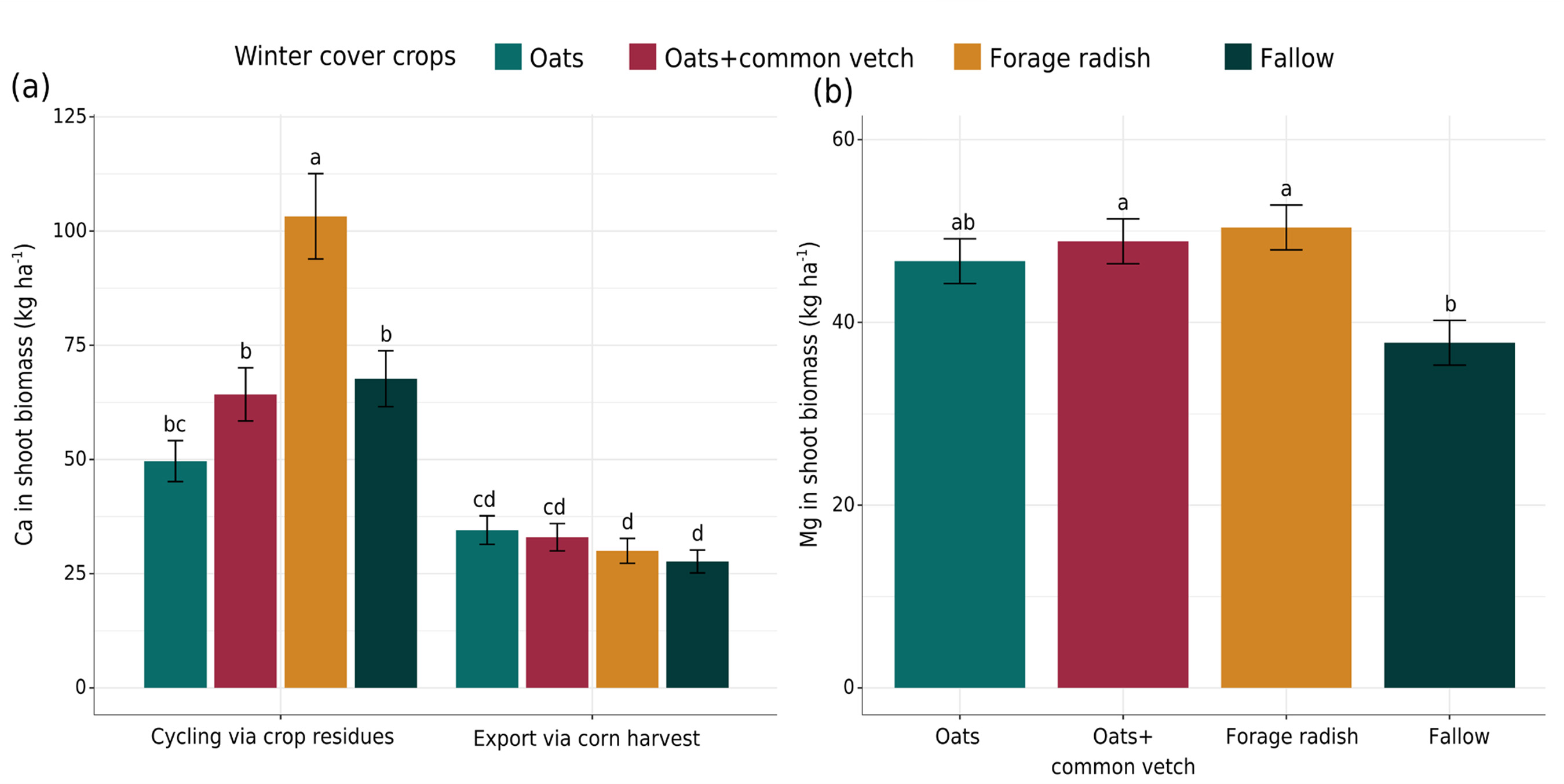
Even so, the cultivation of winter cover crops influenced cycling and export of all nutrients (Figure 3b and Figure 4), except K. In general, cultivation of cover crops contributed to greater nutrient accumulation in plant biomass compared with fallow conditions, both in the winter cycle (in the cover crops themselves) and in the summer cycle (in the whole corn plant) (Figure 3b and Figure 4). The most prominent crop for P and Ca cycling potential was forage radish. Regardless of soil management system, forage radish was responsible for cycling 103 ± 9 kg ha-1 of Ca (Figure 4a) and 62 ± 4 kg ha-1 of P (Figure 3b). The contrast with cycling of both of these nutrients under fallow conditions is clear, where only 68 ± 6 kg ha-1 Ca and 28 ± 4 kg ha-1 P were cycled by the spontaneous vegetation (Figure 4a and Figure 3b). Another noteworthy result is the lower Ca cycling attributed to winter oats cultivation, which was only 49 ± 5 kg ha-1 (Figure 4a).

Nutrient content in shoot biomass. (a) Ca in shoot biomass as affected by nutrient fluxes and winter cover crops; (b) Ca in shoot biomass as affected by winter cover crops. Luvisols, Roca Sales (Rio Grande do Sul State, southern Brazil). Means followed by the same letter are not statistically different according to the Tukey test (p<0.05).
DISCUSSION
Assessment of soil nutrient content was sufficient to waive the recommendation for P, K, Ca, and Mg fertilization for the next silage corn crop seasons. Comparison between the final contents and the critical threshold confirms that the soil is able to continue supplying nutrients to the plants, barring water restrictions (Table S4) (CQFS-RS/SC, 2016). This is due to the slow decline in Ca and Mg content and the stability of P content. However, monitoring exchangeable K content and soil acidity is recommended. The application of nitrogen fertilizers alone should be sufficient to maintain production levels, and application of fertilizers containing P, K, Ca, and Mg would likely not result in higher yields (CQFS-RS/SC, 2016).
This conclusion is supported by results on nutrient exports across the three crop seasons and their effects on soil nutrient reserves. The high availability of soil nutrients, whether due to soil pedogenesis and classification or to decades of manure application, provides a degree of autonomy from external inputs. This is particularly true for farmers with access to livestock manure as an organic fertilizer, which may be desirable for most rural producers.
However, the evaluation of the nutrient budget reveals processes in soil nutrient dynamics and soil-plant relationships that are inaccessible through nutrient content evaluation alone. A nutrient budget highlights the role of winter cover crops, such as oats, oats + common vetch intercropping, and forage radish, in maintaining soil fertility, principally through nutrient cycling. Camargo et al. (2024) also found that restricting analysis to nutrient availability alone, with a particular focus on the soil role in supplying nutrients to plants, runs the risk of overlooking soil functions related to nutrient reserves and cycling.
Evidence of soil operating as a nutrient stock and in nutrient cycling is observed for all the nutrients under evaluation. Beginning with K, the nutrient budget over the evaluation period indicated that the soil acted as a source, as the stock at the end of the evaluation period exceeded expectations based only on system inputs and outputs (Figure 3c). Replenishment in the soil solution occurs through the conversion of non-exchangeable K into its available form, which happens when nutrient export exceeds input from fertilizers (Moterle et al., 2019; Flores et al., 2021). Crop diversification and the presence of 2:1 clay minerals (Figure S2) also contribute to the concentration gradient between the rhizospheric and the non-rhizospheric (bulk soil) environments, as well as between the soil surface and deep layers, which is essentially the cycling provided by plants. The availability of K is therefore the result of nutrient diffusion, pumping, and buffering in the soil (Sparks, 2003; Garcia et al., 2008; Vieira et al., 2016; Tiecher et al., 2017; Moterle et al., 2019; Flores et al., 2021).
Other studies have also observed these dynamics. Nutrient pumping was observed in corn-brachiaria grass (Brachiaria brizantha) intercropping in a Chernossolo, creating a gradient of the crop residue, with greater accumulation of K+, a higher proportion of exchangeable K at the surface, and reduction of K at depth compared with monoculture (Garcia et al., 2008). Soil K-buffering capacity was also observed in soils with the presence of 2:1 clay minerals, regarding replenishment of the K+ ion through diffusion from the interlayer space (structural K and non-exchangeable K) to the surfaces of the clay minerals (exchangeable K), and then to the soil solution (solution K) (Vieira et al., 2016; Moterle et al., 2019; Flores et al., 2021).
The maintenance of high levels of exchangeable Ca and Mg (Figures 2c and 2d) is also due to the presence of 2:1 clay minerals in the soil and to the slow diffusion of these ions from the interlayer space during weathering (Fontes, 2012; Kämpf et al., 2012). The nutrient supply through the dissolution of clay minerals can be enhanced by calcicole plants, such as forage radish, which secrete more di- and tricarboxylic acids than calcifuge plants, such as oats, thereby increasing the availability of Ca, P, Fe, and Mn for their own uptake (Ström, 1997; Moreira and Siqueira, 2006). Therefore, plants like forage radish also return a greater amount of these nutrients to the soil through cycling (Fernandes et al., 2018) (Figure 4a).
Despite the high levels of exchangeable Ca and Mg in the soil, the nutrient budget indicated an unproductive loss of Mg over the evaluation period and, under minimum tillage, a loss of Ca as well (Figures 3e and 3g). Losses of Ca and Mg from the soil system result from leaching, complexation with the organic phase, immobilization in the microbial biomass, and precipitation (Ström, 1997; Sparks, 2003; Fontes, 2012; Brady and Weil, 2013). Leaching of soil nutrients following years of pig slurry application is characterized by higher losses of nitrate (NO3-), K, ammonium (NH4+), and P (in that order), with NO3- losses depending on the applied rate and leachate volume (Girotto et al., 2013). In this regard, the high N load through a single slurry application (141 kg ha-1 of N), followed by 80 days of fall fallow in combination with heavy rains in the period (Figure S3), may have contributed to a peak in N-NO3- leaching down the soil profile and, consequently, a greater loss of Ca and Mg (Girotto et al., 2013). In addition, Ca2+ and Mg2+ ions can be co-leached with chloride and sulfate under acidic soil conditions (Edwards, 1998; Brady and Weil, 2013), which may have occurred through the addition of sulfur from ammonium nitrate.
Comparing soil management practices, the no-tillage system enhanced biological activity related to Ca dynamics and resulted in more efficient nutrient use by mitigating losses over the evaluation period. Regardless of the winter cover crops, the soil Ca stock was stable under the no-tillage system, even though it showed similarities with nutrient cycling and the productive output of Ca under the minimum tillage system (cycling of around 70 kg ha-1 and output of around 30 kg ha-1, as shown in figure 3f).
Soil P budget showed that the soil solid phase functioned as a nutrient source for the solution, maintaining soil stocks even without fertilization and after the harvest of three silage corn crops (Figure 3a). Due to the low mobility of P in soil, P dynamics are highly plant-dependent, and soils cultivated during winter have greater biomass production and root abundance than fallow soils (Chavarría et al., 2016; Tiecher et al., 2017). From this perspective, grasses still stand out relative to brassicas and legumes due to their fasciculate root system, greater rhizodeposition, and mycorrhizal association (Moreira and Siqueira, 2006).
Nevertheless, P cycling in forage radish is driven by plant compensation strategies that make nutrients available in the soil. Forage radish overcomes mechanical impediments, expands its roots, and produces root hairs that are able to access P at depth; it produces acid phosphatases and stimulates production of alkaline phosphatase by bacteria from the rhizosphere; and it secretes larger amounts of di- and tricarboxylic acids (such as oxalic and citric acid, respectively) that solubilize phosphate (Ström, 1997). Although it does not benefit from mycorrhizal association, its decomposition does not inhibit colonization of the subsequent crop (Dalla Costa and Lovato, 2004; Pellerin et al., 2007). All these adaptations make forage radish a cover crop with greater cumulative effects on soil, increasing P availability and enhancing nutrient cycling (Figure 3b).
From an enzymatic perspective, phosphatases are extracellular enzymes (EE) that occur diffusely (free) or in an immobilized state (protected within microaggregates and/or complexed with organic molecules and clay minerals) (Burns et al., 2013). As they persist in the soil, phosphatases promote continuous degradation of organic P, its immobilization within the microbial biomass, and subsequent mineralization, even if plant demand has already been met (Gatiboni et al., 2008; Burns et al., 2013; Chavarría et al., 2016). Enzyme activity and the stability of the soil-plant-microorganism relationship in the no-tillage system explain the maintenance of the higher P stock in the soil under oat cultivation since the beginning of the evaluation period (Figure 3a), even though it was not the most efficient plant in terms of nutrient cycling.
It should be emphasized that elevated soil P stocks must be carefully monitored. Available P above the environmental critical limit (Gatiboni et al., 2014) poses the risk of transferring the nutrient to aquatic ecosystems, causing eutrophication and ecological imbalances, particularly under the threat of heavy rains in the context of climate change.
CONCLUSIONS
Fertility evaluation based on nutrient content indicated reductions in K, Ca, and Mg and maintenance of P over the evaluation period, without the need for fertilization based on critical values. Winter cover crops did not influence K and Mg contents, but lessened the reduction in Ca, especially forage radish, whereas fallow conditions showed the greatest decrease in this nutrient.
The nutrient stock and budget approach highlighted processes not captured by nutrient content, such as reductions in K, Ca, and Mg stocks and maintenance of P stocks. The soil acted as a source of P and K (and Ca under the no-tillage system) and as a sink of Mg (and Ca under minimum tillage), reinforcing its role in nutrient dynamics. The cycling promoted by cover crops compensated for or exceeded nutrient exports for most nutrients, except Mg, highlighting the importance of these species, especially forage radish, in maintaining system fertility. Thus, evaluation using nutrient stocks and budgets complements analysis based on nutrient contents by integrating soil nutrient availability, fluxes, and stocks.
ACKNOWLEDGMENTS
This research was conducted with support from Granja Piccinini in Roca Sales, Rio Grande do Sul.
How to cite:
FUNDING
DATA AVAILABILITY
The data will be provided upon request.
SUPPLEMENTARY MATERIAL
Supplementary data to this article can be found online at https://doi.org/10.1016/XXX
REFERENCES
-
Alvares CA, Stape JL, Sentelhas PC, Gonçalves JLM, Sparovek G. Köppen’s climate classification map for Brazil. Meteorol Z. 2013;22:711-28. https://doi.org/10.1127/0941-2948/2013/0507
» https://doi.org/10.1127/0941-2948/2013/0507 -
Anghinoni I, Vezzani FM. Systemic Soil Fertility as product of system self-organization resulting from management. Rev Bras Cienc Solo. 2021;45:e0210090. https://doi.org/10.36783/18069657rbcs20210090
» https://doi.org/10.36783/18069657rbcs20210090 - Brady NC, Weil RR. Elementos da natureza e propriedades dos solos. 3. ed. Porto Alegre: Bookman; 2013.
-
Burns RG, DeForest JL, Marxsen J, Sinsabaugh RL, Stromberger ME, Wallenstein MD, Weintraub MN, Zoppini A. Soil enzymes in a changing environment: Current knowledge and future directions. Soil Biol Biochem. 2013;58:216-34. https://doi.org/10.1016/j.soilbio.2012.11.009
» https://doi.org/10.1016/j.soilbio.2012.11.009 -
Calegari A, Tiecher T, Hargrove WL, Ralisch R, Tessier D, Tourdonnet S, Guimarães MF, Santos DR. Long-term effect of different soil management systems and winter crops on soil acidity and vertical distribution of nutrients in a Brazilian Oxisol. Soil Till Res. 2013;133:32-9. https://doi.org/10.1016/j.still.2013.05.009
» https://doi.org/10.1016/j.still.2013.05.009 -
Camargo TA, Alves LA, Mendes IC, Gasques LR, Oliveira LGS, Pires GC, Almeida TO, Carvalho PCF, Souza ED. Enhancing soil quality and grain yields through fertilization strategies in integrated crop-livestock system under no-till in Brazilian Cerrado. Eur J Soil Biol. 2024;121:103613. https://doi.org/10.1016/j.ejsobi.2024.103613
» https://doi.org/10.1016/j.ejsobi.2024.103613 -
Carvalho ML, Vanolli BS, Schiebelbein BE, Borba DA, Luz FB, Cardoso GM, Bortolo LS, Marostica MEM, Souza VS. Guia prático de plantas de cobertura: aspectos fitotécnicos e impactos sobre a saúde do solo. Piracicaba: Esalq-USP; 2022. https://doi.org/10.11606/9786589722151
» https://doi.org/10.11606/9786589722151 -
Chavarría DN, Verdenelli RA, Serri DL, Restovich SB, Andriulo AE, Meriles JM, Vargas-Gil S. Effect of cover crops on microbial community structure and related enzyme activities and macronutrient availability. Eur J Soil Biol. 2016;76:74-82. https://doi.org/10.1016/j.ejsobi.2016.07.002
» https://doi.org/10.1016/j.ejsobi.2016.07.002 - Comissão de Química e Fertilidade do Solo - CQFS-RS/SC. Manual de calagem e adubação para os Estados do Rio Grande do Sul e de Santa Catarina. 11. ed. Porto Alegre: Sociedade Brasileira de Ciência do Solo - Núcleo Regional Sul; 2016.
- Crawley MJ. The R Book. 2nd ed. Chichester: Wiley; 2013.
- Cunha JF, Casarin V, Prochnow LI. Balanço de nutrientes na agricultura brasileira. In: Prochnow LI, Casarin V, Stipp SR, editors. Boas práticas para uso eficiente de fertilizantes. v. 2, Nutrientes. Piracicaba: IPNI Brasil; 2010. p. 309-51.
-
Dalla Costa M, Lovato PE. Fosfatases na dinâmica do fósforo do solo sob culturas de cobertura com espécies micorrízicas e não micorrízicas. Pesq Agropec Bras. 2004;39:603-05. https://doi.org/10.1590/S0100-204X2004000600013
» https://doi.org/10.1590/S0100-204X2004000600013 -
Deuschle D, Minella JPG, Hörbe TAN, Londero AL, Schneider FJA. Erosion and hydrological response in no-tillage subjected to crop rotation intensification in southern Brazil. Geoderma. 2019;340:157-63. https://doi.org/10.1016/j.geoderma.2019.01.010.
» https://doi.org/10.1016/j.geoderma.2019.01.010 -
Edwards PJ. Sulfur cycling, retention, and mobility in soils: A review. Washington, DC: United States Department of Agriculture, Natural Resources Conservation Service; 1998. https://doi.org/10.2737/NE-GTR-250
» https://doi.org/10.2737/NE-GTR-250 -
Empresa de Assistência Técnica e Extensão Rural - Emater-RS/Ascar. Efeito da estiagem nas principais atividades agrícolas do Rio Grande do Sul. Porto Alegre: Governo do Estado do Rio Grande do Sul, Secretaria de Desenvolvimento Rural; 2022. (Boletim de Evento Adverso, 1) [cited 2026 Aug 31]. Available from: https://joia.rs.gov.br/uploads/noticia/22722/BOLETIM_ESTIAGEM_N__01_2022.pdf
» https://joia.rs.gov.br/uploads/noticia/22722/BOLETIM_ESTIAGEM_N__01_2022.pdf -
Empresa de Assistência Técnica e Extensão Rural - Emater-RS/Ascar. Impactos das chuvas e cheias extremas no Rio Grande do Sul em maio de 2024. Porto Alegre: Governo do Estado do Rio Grande do Sul, Secretaria de Desenvolvimento Rural; 2024. (Boletim de Evento Adverso, 1) [cited 2026 Aug 31]. Available from: https://www.estado.rs.gov.br/upload/arquivos/202406/relatorio-sisperdas-evento-enchentes-em-maio-2024.pdf
» https://www.estado.rs.gov.br/upload/arquivos/202406/relatorio-sisperdas-evento-enchentes-em-maio-2024.pdf - Fernandes MS, Santos LA, Souza SR. Absorção de nutrientes. In: Fernandes MS, Souza SR, Santos LA, editors. Nutrição mineral de plantas. Viçosa, MG: Sociedade Brasileira de Ciência do Solo; 2018. p. 125-65.
-
Flores JPM, Alves LA, Denardin LGO, Martins AP, Bortoluzzi EC, Inda AV, Carvalho PCF, Tiecher T. Soil K forms and K budget in integrated crop-livestock systems in subtropical paddy fields. Soil Till Res. 2021;213:e105070. https://doi.org/10.1016/j.still.2021.105070
» https://doi.org/10.1016/j.still.2021.105070 - Fontes MPF. Intemperismo de rochas e minerais. In: Ker JC, Curi N, Schaefer CEGR, Vidal Torrado P, editors. Pedologia: Fundamentos. Viçosa, MG: Sociedade Brasileira de Ciência do Solo; 2012. p. 171-206.
-
Garcia RA, Crusciol CAC, Calonego JC, Rosolem CA. Potassium cycling in a corn-brachiaria cropping system. Eur J Agron. 2008;28:579-85. https://doi.org/10.1016/j.eja.2008.01.002
» https://doi.org/10.1016/j.eja.2008.01.002 -
Gatiboni LC, Kaminski J, Rheinheimer DS, Brunetto G. Fósforo da biomassa microbiana e atividade de fosfatases ácidas durante a diminuição do fósforo disponível no solo. Pesq Agropec Bras. 2008;43:1085-91. https://doi.org/10.1590/S0100-204X2008000800019
» https://doi.org/10.1590/S0100-204X2008000800019 -
Gatiboni LC, Smyth TJ, Schmitt DE, Cassol PC, Oliveira CMB. Proposta de limites críticos ambientais de fósforo para solos de Santa Catarina. Lages: Udesc/CAV; 2014. (Boletim técnico, 2) [cited 2026 Aug 31]. Available from: https://www.cav.udesc.br/arquivos/id_submenu/622/boletim_tecnico_2014_proposta_de_limites_criticos_ambientais_de_fosforo_para_solos_de_santa_catarina.pdf
» https://www.cav.udesc.br/arquivos/id_submenu/622/boletim_tecnico_2014_proposta_de_limites_criticos_ambientais_de_fosforo_para_solos_de_santa_catarina.pdf -
Girotto E, Ceretta CA, Lourenzi CR, Lorensini F, Tiecher TL, Vieira RCB, Trentin G, Basso CJ, Miotto A, Brunetto G. Nutrient transfers by leaching in a no-tillage system through soil treated with repeated pig slurry applications. Nutr Cycl Agroecosyst. 2013;95:115-31. https://doi.org/10.1007/s10705-013-9552-2
» https://doi.org/10.1007/s10705-013-9552-2 -
Inagaki TM, Sá JCM, Tormena CA, Dranski A, Muchalak A, Briedis C, Ferreira AO, Giarola NFB, Silva AP. Mechanical and biological chiseling impacts on soil organic C stocks, root growth, and crop yield in a long-term no-till system. Soil Till Res. 2021;211:e104993. https://doi.org/10.1016/j.still.2021.104993
» https://doi.org/10.1016/j.still.2021.104993 - IUSS Working Group WRB. World reference base for soil resources 2014, update 2015: International soil classification system for naming soils and creating legends for soil maps. Rome: Food and Agriculture Organization of the United Nations; 2015. (World Soil Resources Reports, 106).
- Kämpf N, Marques JJ, Curi N. Mineralogia dos solos brasileiros. In: Ker JC, Curi N, Schaefer CEGR, Vidal Torrado P, editors. Pedologia: Fundamentos. Viçosa, MG: Sociedade Brasileira de Ciência do Solo; 2012. p. 81-146.
- Lavelle P. Soil as a habitat. In: Wall DH, editor. Soil ecology and ecosystem services. Oxford, UK: Oxford University Press; 2012. p. 7–21.
-
Lima AP, Fontoura SMV, Moraes RP, Bayer C, Gatiboni L, Tiecher T. Phosphate fertilization strategies and placement effects on grain crop yields in subtropical no-till Oxisols. Rev Bras Cienc Solo. 2025;49(spe1):e0240071. https://doi.org/10.36783/18069657rbcs20240071
» https://doi.org/10.36783/18069657rbcs20240071 - Mehlich A. Determination of P, Ca, Mg, K, Na, NH4 Raleigh, NC: North Carolina Department of Agriculture, Soil Testing Division; 1953. (Publication No. 1-53).
- Moreira FMS, Siqueira JO. Microbiologia e bioquímica do solo. 2. ed. Lavras: UFLA; 2006.
-
Moterle DF, Bortoluzzi EC, Kaminski J, Rheinheimer DS, Caner L. Does Ferralsol clay mineralogy maintain potassium long-term supply to plants? Rev Bras Cienc Solo. 2019;43:e0180166. https://doi.org/10.1590/18069657rbcs20180166
» https://doi.org/10.1590/18069657rbcs20180166 -
Pellerin S, Mollier A, Morel C, Plenchette C. Effect of incorporation of Brassica napus L. residues in soils on mycorrhizal fungus colonisation of roots and phosphorus uptake by maize (Zea mays L.). Eur J Agron. 2007;26:113-20. https://doi.org/10.1016/j.eja.2006.07.007
» https://doi.org/10.1016/j.eja.2006.07.007 - R Core Team. R: A language and environment for statistical computing. Vienna: R Foundation for Statistical Computing; 2025.
-
Restovich SB, Andriulo AE, Armas-Herrera CM, Beribe MJ, Portela SI. Combining cover crops and low nitrogen fertilization improves soil supporting functions. Plant Soil. 2019;442:401-17. https://doi.org/10.1007/s11104-019-04205-8
» https://doi.org/10.1007/s11104-019-04205-8 -
Rio Grande do Sul. Secretaria de Planejamento, Governança e Gestão, Departamento de Planejamento Governamental. Atlas socioeconômico do Rio Grande do Sul. 6. ed. Porto Alegre: Secretaria de Planejamento, Governança e Gestão; 2021 [cited 2026 Aug 31]. Available from: https://atlassocioeconomico.rs.gov.br/solos
» https://atlassocioeconomico.rs.gov.br/solos - Santos HG, Jacomine PKT, Anjos LHC, Oliveira VA, Lumbreras JF, Coelho MR, Almeida JA, Araújo Filho JC, Oliveira JB, Cunha TJF. Sistema brasileiro de classificação de solos. 5. ed. rev. ampl. Brasília, DF: Embrapa; 2018.
-
Simões VJLP, Souza ES, Martins AP, Tiecher T, Bremm C, Ramos JS, Farias GD, Carvalho PCF. Structural soil quality and system fertilization efficiency in integrated crop-livestock system. Agric Ecosyst Environ. 2023;349:108453. https://doi.org/10.1016/j.agee.2023.108453
» https://doi.org/10.1016/j.agee.2023.108453 - Sparks DL. Environmental soil chemistry. 2nd ed. San Diego: Elsevier; 2003.
-
Ström L. Root exudation of organic acids: Importance to nutrient availability and the calcifuge and calcicole behaviour of plants. Oikos. 1997;80:459-66. https://doi.org/10.2307/3546618
» https://doi.org/10.2307/3546618 - Tedesco MJ, Gianello C, Bissani CA, Bohnen H, Volkweiss SJ. Análises de solo, plantas e outros materiais. 2. ed. Porto Alegre: Universidade Federal do Rio Grande do Sul; 1995. (Boletim técnico, 5).
-
Tiecher T, Calegari A, Caner L, Rheinheimer DS. Soil fertility and nutrient budget after 23-years of different soil tillage systems and winter cover crops in a subtropical Oxisol. Geoderma. 2017;308:78-85. https://doi.org/10.1016/j.geoderma.2017.08.028
» https://doi.org/10.1016/j.geoderma.2017.08.028 -
Tiecher T, Gatiboni L, Santos DR, Bissani CA, Martins AP, Gianello C, Dick DP, Bortoluzzi EC, Escosteguy PAV, Silva LS, Brunetto G, Mallmann FJK, Pauletti V, Lourenzi CR, Sousa RO, Carlos FS, Azevedo AC. Base saturation is an inadequate term for Soil Science. Rev Bras Cienc Solo. 2022;46:e0220125. https://doi.org/10.36783/18069657rbcs20220125
» https://doi.org/10.36783/18069657rbcs20220125 -
Tiecher T, Minella JPG. Erosão do solo: um problema mundial agravando-se num contexto de “agricultura conservacionista” no Sul do Brasil. In: Tiecher T, editor. Manejo e conservação do solo e da água em pequenas propriedades rurais no Sul do Brasil: contextualizando as atividades agropecuárias e os problemas erosivos. Frederico Westphalen: URI; 2015. p. 122-53 [cited 2026 Aug 31]. Available from: https://www.fw.uri.br/storage/publications/files/80d9424ee3a6a8d6bc698d8e751c6c55211.pdf
» https://www.fw.uri.br/storage/publications/files/80d9424ee3a6a8d6bc698d8e751c6c55211.pdf - Vezzani FM, Mielniczuk J. O solo como sistema. Curitiba: Edição dos autores; 2011.
-
Vieira MS, Oliveira FHT, Santos HC, Medeiros JS. Contribution of non-exchangeable potassium forms and its accumulation in corn plants. Rev Bras Eng Agr Amb. 2016;20:9-15. https://doi.org/10.1590/1807-1929/agriambi.v20n1p9-15
» https://doi.org/10.1590/1807-1929/agriambi.v20n1p9-15