 Mulching effects on the quality formation of medicinal materials and rhizosphere soil microenvironment in Notopterygium franchetii in the Qinghai-Tibet Plateau
ABSTRACT
Different cultivation methods directly affect the quality of medicinal materials, to gain insights into the effects of different type of mulching on the quality of Notopterygium franchetii root medicinal materials, farmland experiments were conducted in the Qinghai-Tibet Plateau. We subjected two-year-old Notopterygium franchetii seedling to five mulching treatments: no mulching (CK, control), coarse sand mulching (CM), grassy mulching (GM), stalk mulching (SM), and plastic mulching (PM). Following these treatments, we determined the moisture content, pH, NPK contents, and enzymeatic activity of the soil, and morphological indexes and content of the main components of root. Stalk mulching and PM increased the main root biomass by increasing its ground diameter and reduced branched root biomass by reducing the number of branched roots produced. Grassy mulching increased the root biomass by promoting main root elongation. Mulching increased the total content of the six main root components, with the most significant change obtained with GM, but the pattern of change of the different components varied among the mulch treatments. Contents of NPK were significantly higher than in the control with GM, but decreased with PM. Coarse sand mulching and PM significantly reduced the activities of urease and sucrase, and SM significantly increased the activities of urease, catalase and sucrase, but significantly decreased that of phosphatase. Furthermore, GM significantly increased phosphatase and sucrase activities, while CM significantly decreased urease and sucrase activities. Various soil enzymes and its pH promote main root bioaccumulation by increasing the root ground diameter or main root length. Sucrase activity promoted the accumulation of ferulic acid, psoralen, and notopterol content, and inhibited the accumulation of chlorogenic acid and nodakenin. Elevated soil water content promoted the accumulation of ferulic acid, notopterol and nodakenin, and inhibited isoimperatorin accumulation. Hence, NPK, pH, and various enzymes have different effects on the accumulation of major components in the root. The effect of mulching is closely linked to root growth and distribution, as well as to the soil environment. Various soil factors affect the quality of medicinal materials differently and, ultimately, can work together to form an equilibrium state that benefit the accumulation of main root biomass and main components with medicinal interest in Notopterygium franchetii.
Keywords
morphological characteristics; main component; soil enzyme; NPK
INTRODUCTION
A good soil environment is the key to appropriate plant growth and development. Improving the farmland soil environment by planting herbs species that lead to a high-quality output is fundamental to preserving the natural resources needed for the sustainable production of Chinese medicinal materials, particularly those accumulated in the root. Hence, practices that use soil cover to enhance the soil environment and increase crop yield and quality have become important in ecological agriculture development.
Farmland mulch technology has shown great potential as an effective farming practice to improve crop productivity ecological agriculture approaches. Mulch application can regulate soil temperature and humidity, main nutrients content availability, enzymatic activity, and the organic carbon content, and ultimately improveing the soil environment and enhancing crop productivity (Xu et al., 2018). The two main types of farmland mulch are organic mulch (grassy or straw) and inorganic cover (plastic film or coarse sand), with plastic film cover being the most commonly used in modern agriculture. Plastic film and coarse sand mulching have a beneficial effect on preserving soil water and moisture, decreasing the negative effects of heat on the soil, while reducing interbank weeds growth and nutrient loss (Liu et al., 2022). Organic matter mulching has great potential for soil carbon sequestration, not only to increase soil carbon content, but also to provide other ecological and agronomic benefits (Li et al., 2023). Straw and grassy mulching materials are biological sources of cover, which consume soil water and nutrients and have a nutritional competition relationship with crops. However, they can produce beneficial organic substances, including soil nutrients, improving the soil microenvironment and efficiently transforming and recycling organic substances (Gu et al., 2017; Zhang et al., 2019). Plant rhizosphere microenvironment is the most active place for material circulation, energy exchange, and information exchange between plants and farmland soil. Because the rhizosphere soil microenvironment is the node of the plant-soil circulation system, understanding it is crucial to improving crop growth and soil production efficiency.
Root system is central to water and material transport and utilization in the soil-plant-atmosphere (SPAC) circulation interface and directly affects the efficiency of water and nutrient utilization by plants. Root system modulates the ability of plants to adapt to their environment and their ecological strategies (Zhang et al., 2012). Plastic mulching can improve the water content of soil surface, change the soil environment and root distribution, and is conducive to the utilization of shallow and laterally distant soil water and nutrients (Xu et al., 2019). Accordingly, plastic mulching increases the surface distribution of Malus pumila roots in the soil. Contrarily, grass mulching increases the horizontal distribution range and vertical depth of roots (Sun et al., 2015), and changes the fractal dimension of roots (Huang et al., 2018). The study of the spatial distribution characteristics of the root system is of great significance to further understanding nutrient absorption and spatial and temporal distribution properties of roots and their mechanisms. This knowledge can be used to improve the field water management practices and develop cultivation techniques that lead, for example, to producing high-quality medicinal materials in roots.
Elevation and climate conditions in the farmland cultivated area of Notopterygium franchetii H. Boiss are similar to those in the wild distribution area, but the taproot is shortened and the rootlets are abundant and strong, and the quality of medicinal materials is significantly decreased. Therefore, soil environmental factors become the main factors affecting the quality of medicinal materials, which limits the high-quality production of cultivated medicinal materials in farmland. To clarify the influence mechanism of soil microenvironment factors on the quality formation of Notopterygium franchetii medicinal materials, in this study, we analyzed the relationship between different soil microenvironments and the quality of Notopterygium franchetii root biomass accumulation by testing different mulching treatments on plants grown on the Qinghai-Tibet Plateau. We investigated which soil microenvironments are suitable for the active growth and development of Notopterygium franchetii to provide a more theoretical basis for protecting Notopterygium franchetii resources and developing scientifically informed planting systems.
MATERIALS AND METHODS
Site description
A field study was conducted from 2022 to 2023 at the Huzhu Notopterygium franchetii model garden (36.8° N, 102.16° E, 2,809 m altitude), located on the Qinghai-Tibetan Plateau of Northwest China. The field site has a continental cold-temperate climate, with a mean annual air temperature of 5.8 ℃. Mean annual rainfall is 477 mm, with a frost-free period of 105 to 128 days from June to October. Soil fertility is uniform, containing 145.8 mg g-1 organic matter, rapidly-available P (Olsen-P) 28.5 mg kg-1, rapidly-available K 196.9 mg kg-1, 39.44 mg kg-1 inorganic N (NO3-N plus NH4-N) and the capacity weight is 1.36 g cm-3.
Experimental conditions of the treatments
Two-year-old Notopterygium franchetii plants grown in farmland were used as the test material. The row spacing uesd was 0.3 × 0.5 m, and plants with uniform growth potential were selected for analysis. There were five treatments performed, including the controls: no mulching (CK, Adjacent the not mulching treatment experimental plots), coarse sand mulching (CM), grassy mulching (GM), stalk mulching (SM), plastic mulching (PM). Coarse sand and stalk mulching were applied with the thickness needed to cover the soil completely (without exposed land). The treatments were initiated on March 20, 2022, when the surface thaw was 0.15 m and the temperature reached approximately 5 ℃. The trial used a randomized block design with one plot with three replicates per treatment. All experimental areas, tillage, fertilization and pest control were the same among experimental plots; the only variation was the type of mulch treatments applied. In September and October 2022, more than three plants were randomly selected to analyze. Their intact roots were dug out, the non-rhizosphere soil shucked off, the rhizosphere soil brushed off and collected, and then collected into self-sealed bags. Soil samples were divided into two parts: a fresh sample and an air one, and sieved through a screen with a mesh diameter of 0.85 mm. All treatment plots were sampled three times each, with 15-day intervals, and each sampling was repeated three times. After sampling, several indexes were determined according to the test needs.
Soil moisture content and porosity
Soil samples from the layer of 0.00-0.10 m were collected, 0.30 m away from the trunk of the plant and the plastic mulching edge, using an earth drill with a 38 mm diameter drill bit. Each sampling was performed three times at equal distances in different directions. Soil water content was determined using the drying method. Soil pH was measured by adding deionized water to the sample at a soil-water ratio 1:5 and determined using a pH meter (Remagnet pH meter, pHSJ-6L, China) (Zhang et al., 2023).
Soil N, P, K and organic matter
Alkaline nitrogen (N) content was determined with the alkaline solution diffusion method (Wang et al., 2022). After absorbing nitrogen, boric acid is titrated with standard hydrochloric acid, and the content of alkali-hydrolyzed nitrogen is calculated according to the consumption of standard acid (Equation 1).
in which: N is the alkalolytic nitrogen concentration; C is the hydrochloric acid standard solution concentration; V is the sample consumption of hydrochloric acid standard liquid volume; V0 is the standard liquid volume of consumed hydrochloric acid was determined in blank; 14 is the molar mass of nitrogen; 1000 is the conversion coefficient; and W is the soil sample weight.
Available phosphorus (P) content was determined with the Sodium Bicarbonate extraction-Molybdenum Antimony resistance colorimetry anti-spectrophotometry (Wang et al., 2022), according to equation 2.
in which: ω is the available phosphorus content; A is the sample absorbance; A0 is the blank control absorbance; α is the corrected curve intercept; V1 is the sample volume; b is the slope of standard curve; 50 is the color development constant volume; V2 is the color sample volume; m is the sample amount; and wdm is the dry matter content in soil sample (g g-1).
Effective potassium (K) content was extracted by CH3COONH4 1 mol L-1 and determined by ammonium acetate extraction-flame photometry (Wang et al., 2022), according to equation 3.
in which: ρ is the mass concentration of potassium in the test solution; V is the leaching fluid accumulation; D is the dilution ratio; and m is the quality classification of soil samples.
Soil organic matter content was determined with the potassium dichromate capacity method-external thermal method. Soil organic matter content content was calculated by the number of FeSO4 consumed by titration (Wang et al., 2022), according to equation 4.
in which: O.M. is the soil organic carbon content; C is the K2Cr2O7 standard liquid concentration; V1 is the added K2Cr2O7 standard liquid volume; V0 is the blank calibration consumption FeSO4 solution volume; V is the sample titration consumes FeSO4 solution volume; M is the molar mass of ¼; 1.08 is the oxidation correction factor; m is the soil sample quality; 1.724 is the conversion coefficient of organic carbon to organic matter; and ωm is the soil moisture constant.
Soil enzyme activities
Urease activity was determined with the sodium phenol colorimetry; Sucrase activity was determined with the 3, 5− dinitro salicylic acid colorimetry; Phosphatase activity was determined with the phenylene disodium phosphate method, according to Alef and Nannpieri (1998); Catalase activity was determined with the potassium permanganate titration, according to Zhao (2023). Activity of urease was expressed as mg g-1 NH4+-N; of sucrase as mg g-1 glucose; of catalase as the consumption mg g-1 KMnO4; and of phosphatase as mg g-1 4-nitrophenol (PN) per 1 g of soil dry matter per 1 h (Borowik et al., 2022).
Root physiological and major compound
According to the root classification method proposed by Reubens et al. (2007), fine roots, with a root diameter <3 mm, and coarse roots, with a root diameter >3 mm, were separated, and their number, length, and fresh weight were determined. After washing and grading, the roots were degreened at 105 ℃ for 5 min and then dried at 80 ℃ for 24 h to a constant weight. Root dry mass was obtained by weighing in an electronic balance with an accuracy of 0.0001 g, and three replicates were done for each treatment (Ma et al., 2013).
Contents of ferulic acid, psoralen, notopterol, chlorogenic acid, isoimpertinin and nodakenin were determined by Agilent HPLC-1200 (USA) (Peng, 2021). Prior to HPLC analysis, each sample was filtered through a 0.2 μm cellulose acetate membrane (VWR International, USA). Then, 10 μL of the sample was injected in an Agilent HPLC-1200 equipped with an SPD-M20A Diode Array Detector, Agilent Eclipse XDB-C18 (150 × 4.6 mm, 5 μm) chromatographic column, and four-element gradient pump. References for our measurements ferulic acid (110773-201614, >99.0 %), psoralen (110739-201918, >99.3 %), notopterol (111820-201705, >99.9 %), chlorogenic acid (110753-201817, >99.4 %), isoimperatorin (110827-201812, >99.6 %) and nodakenin (111821-201604, >99.6 %) were purchased from the National Institutes for Food and Drug Control (China).
Statistical Analyses
Statistical analyses were performed using SPSS version 23.0 (SPSS Inc., Chicago IL, USA). Statistical analyses were performed using Variance and Standardized major axis. Soil moisture, organic matter, NPK, soil enzyme, root physiological index, and major compounds were compared among treatments using ANOVA. Means and corresponding standard deviations (SD) were presented. All statistically significant differences were tested at the 0.05 significance level.
RESULTS
Mulching on root biomass and morphological indicators
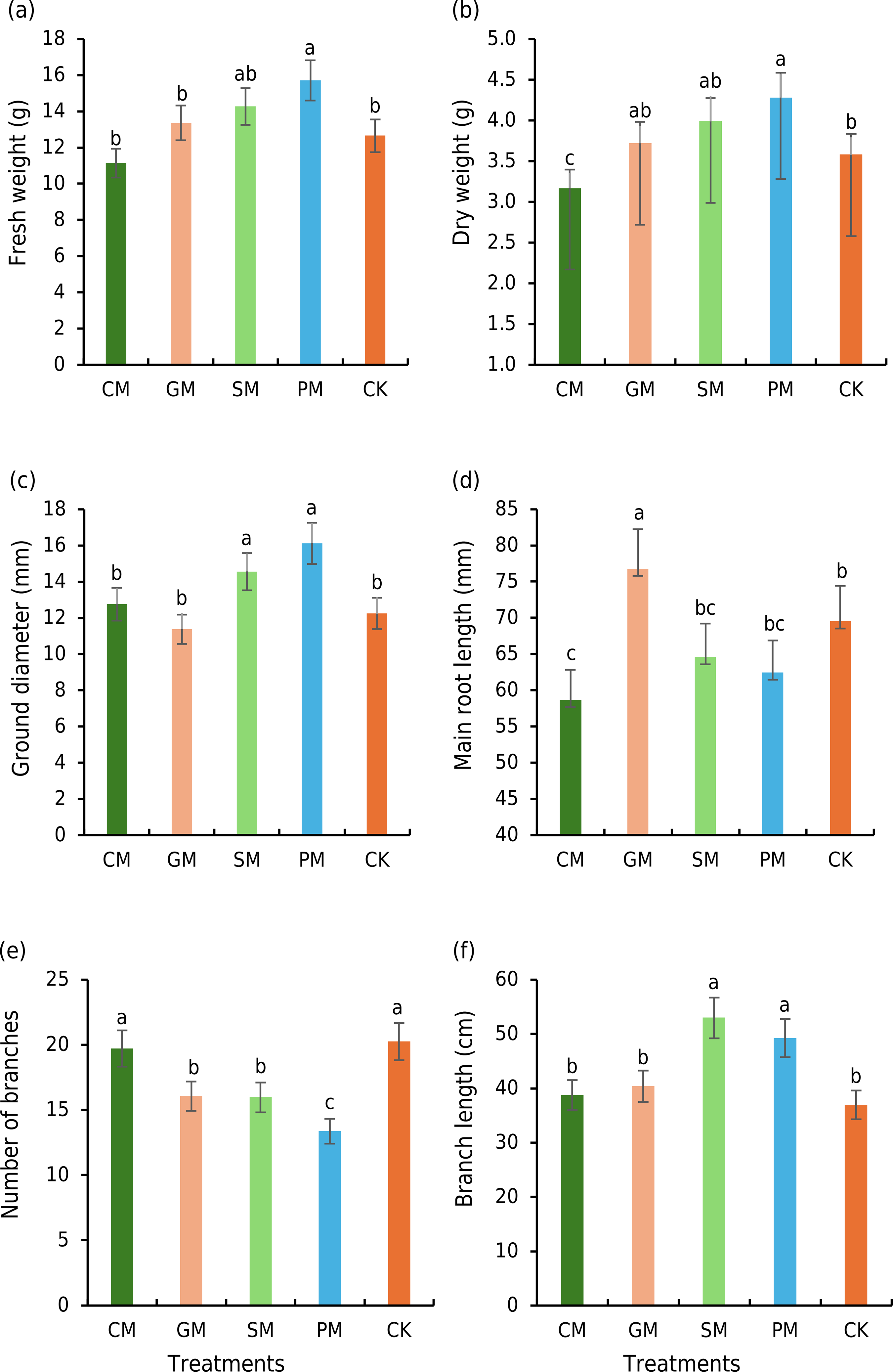
The growth and development of the root system directly reflect the adaptability to the soil environment and directly impact plant vegetative and reproductive growth. In this study, the root fresh and dry weights were significantly reduced in CM-treated, with a decrease to 88.06 and 88.55 % of CK, respectively. In PM-treated plants, fresh and dry weights increased significantly to 124.19 and 119.55 %, respectively, compared to the CK control. Moisture content of GM, SM, and PM-treated roots also increased compared with the control (Figures 1a and 1b). Ground diameter and length determine the main root biomass. Ground diameter of SM and PM-treated plants significantly increased to 118.86 and 131.59 % of CK, respectively (Figure 1c). The main root length of the GM-treated plants was significantly higher, an increased to 110.52 % of CK, while the rest of the mulching treatments reduced the main root length. The decrease induced by the CM treatment was the most significant, leading to 84.80 % of the root length of the control (Figure 1d). Mulching treatments also reduced the number of branch roots, with the PM treatment leading to a length of 66.07 % of CK; the CM treatment did not cause significant differences in the number of branched roots (Figure 1e). Average length of the branch root was increased, but the difference was only significant for SM and PM treatments, leading to 143.37 and 133.27 % of the control, respectively (Figure 1f).

Effects of mulching treatments on biomass and morphological indicators of roots. CM: coarse sand mulching; GM: grassy mulching; SM: stalk mulching; PM: plastic mulching; CK: no mulching. Different lowercase letters indicate significant different differences at the p<0.05 level.
Mulching on major components of root
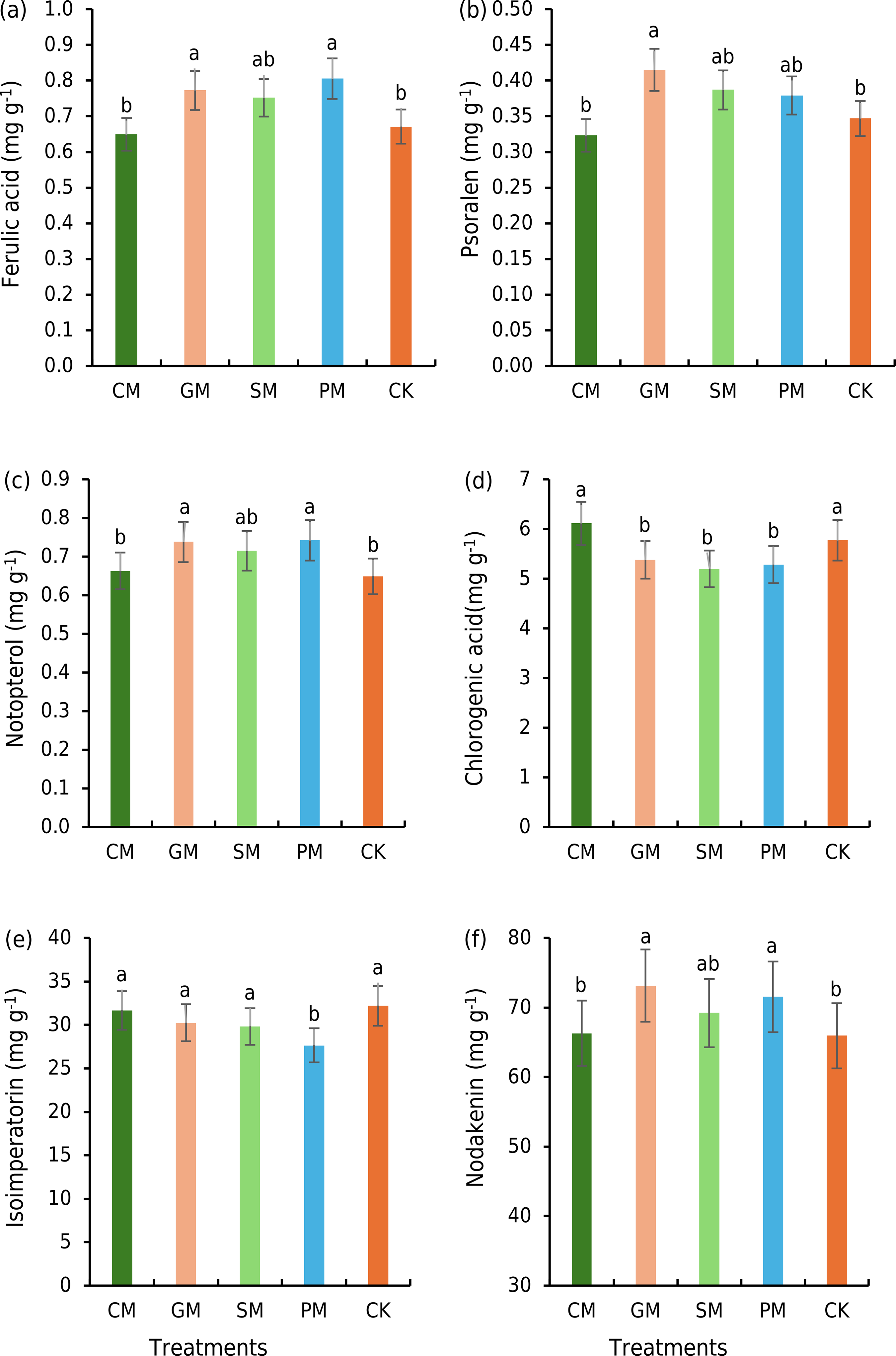
Mulch treatments increased the total content of the six main components analyzed; the increase was the most significant for the GM treatment, reaching 104.85 % of the control contents. The CM treatment reduced the contents of ferulic acid, psoralen and isoimperatorin to 96.72, 93.08 and 98.36 %, respectively, and increased the contents of notopterol, chlorogenic acid, and nodakenin to 102.16, 105.94, and 100.51 %, respectively, but the differences were not significant. Ferulic acid, psoralen, notopterol, and nodakenin content significantly increased to 115.20, 119.60, 113.71 and 110.91 % of CK, respectively, for roots under the GM treatments. Root content of ferulic acid, notopterol, and nodakenin significantly increased to 119.97, 114.33, 108.47, and 108.47 % of the control after the PM treatments. Content of ferulic acid, psoralen, notopterol and nodakenin increased to 115.20, 119.60, 113.71, and 104.92 % of the control, respectively, after the SM treatments, but their difference was not significant. Content of chlorogenic acid was significantly reduced to 93.21, 90.90, and 91.53 of CK after GM, SM, and PM treatments, respectively, and the content of isoimperatorin decreased after GM, SM and PM treatments, but only the PM (85.86 % of the control) lead to a statistically significant decrease (Figure 2).

Effects of mulching treatments on main content indicators of roots. CM: Coarse sand mulching; GM: Grassy mulching; SM: Stalk mulching; PM: Plastic mulching; CK: No mulching. Different lowercase letters indicate significant differences at the p<0.05 level.
Mulching on soil moisture content and pH
Soil water content reflects the ability of the soil to maintain and supply water to the growing plants. Soil moisture content in the top 0.00-0.20 m increased with increasing depth, and the moisture content in the 0.30-1.00 m decreased and then gradually stabilized; the difference between the top 0.00-0.20 and the 0.30-1.00 m was statistically significant. Mulching treatments increased the soil moisture content, with the greatest increase being achieved with PMm, 131.96 % of the control, and the lowest moisture with PMe, 111.45 % of the control. The GM, SM, and PMm treatments led to a significantly higher surface 0.00-0.05 m soil moisture content than that of PMe and CK treatments (Figure 3a). The CM and PM treatments increased soil pH. The most significant increase was obtained with PMm, reaching 102.97 % of the control value. Soil pH decreased with GM and SM, with the most significant change obtained with GM, reaching 96.97 % only of the control (Figure 3b).

Effects of mulching treatments on moisture content and pH in rhizosphere soil. CM: Coarse sand mulching; GM: Grassy mulching; SM: Stalk mulching; PMe: Plastic mulching edge; PMm: Plastic mulching middle; CK: No mulching.
Mulching on soil NPK and organic matter content
Soil alkali hydrolyzed N content increased significantly with the GM and SM treatments, reaching 123.22 and 117.02 % of the control, respectively, and decreased significantly with the PMm treatments, leading to 79.04 % of the control (Figure 4a). Available P content significantly increased to 124.3 % after GM treatment and increased after CM and SM treatments, but the difference was not significant. It decreased to 79.65 % (PMe) and 45.3 4% (PMm) of the control, respectively (Figure 4b). Available K content was significantly increased with GM treatment, reaching 119.14 % of the control, and that was decreased after PM treatment, decreased to 90.77 % (PMe) and 70.57 % (PMm) of the control, respectively (Figure 4c). Organic matter significantly increased after SM treatment to 107.59 % of the control (Figure 4d). Mulching treatments had a more significant influence on alkali hydrolyzed N, available P, available K, and organic matter content at 0.00-0.40 m than at deeper soil, especially the GM and SM treatments on 0.00-0.20 m top surface soil.

Effects of mulching treatments on moisture content and pH in rhizosphere soil. CM: Coarse sand mulching; GM: Grassy mulching; SM: Stalk mulching; PMe: Plastic mulching edge; PMm: Plastic mulching middle; CK: No mulching.
Mulching on soil enzymes
The SM treatment significantly increased the urease activity to 121.34 % of the control, and the CM and PM treatments significantly decreased it; the most significant change occurred with CM, which led to a decrease to 59.65 % of the control. The GM treatment increased the soil phosphatase activity to 102.58 % of the control, SM treatment significantly decreased it to 86.31 % of control, and CM and PM decreased the phosphatase activity but not significantly. The GM and SM treatments increased the soil sucrase activity to 135.69 and 130.06 % of control, respectively, and the CM and PMe treatments decreased the soil sucrase activity to 62.53 and 85.19 % of control, respectively (Figure 5).

Effect of mulching treatment on the soil enzyme activities in the rhizosphere soil. CM: Coarse sand mulching; GM: Grassy mulching; SM: Stalk mulching; PMe: Plastic mulching edge; PMm: Plastic mulching middle; CK: No mulching.
Correlation between soil factors and quality indexes of root medicinal materials
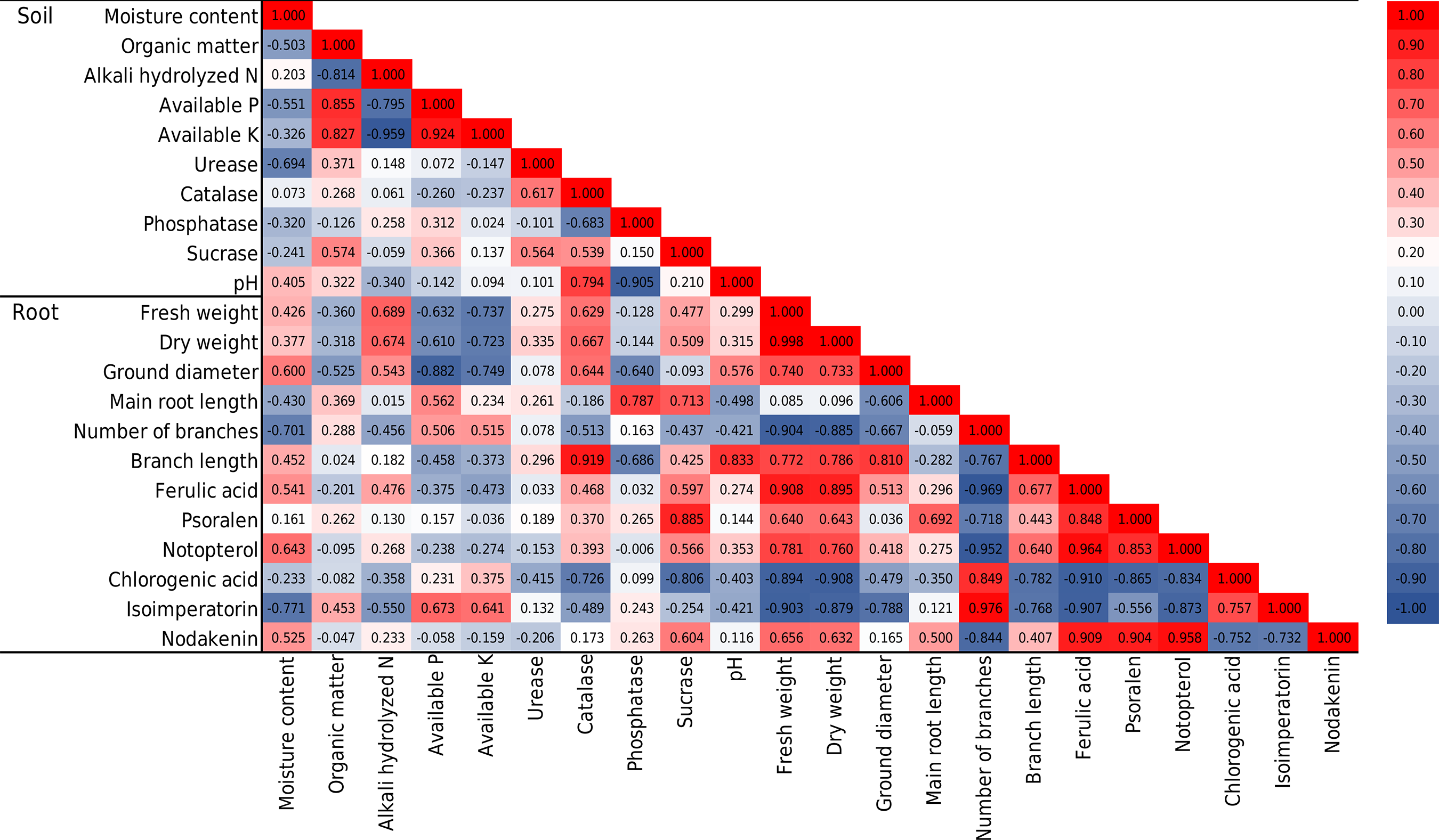
By analyzing the correlation between soil factors, plant physiological indicators, and root morphological characteristics, we identified that root dry weight was significantly positively correlated with catalase, urease, and sucrase activities and significantly negatively correlated with soil available P and available K. Ground root diameter was significantly positively correlated with catalase activity, and pH, but significantly negatively correlated with alkali hydrolyzed N, available P, available K, and phosphatase activity. For the main root, the length was significantly positively correlated with phosphatase and sucrase activities, while it was significantly negatively correlated with pH. The number of root branches was significantly negatively correlated with the soil moisture content, and the branch root length was significantly positively correlated with catalase and significantly negatively correlated with phosphatase activity. Interestingly, the root main components analyzed had variable correlations with the other measured traits. Ferulic acid was significantly positively correlated with sucrase activity and soil moisture content. The psoralen were significantly positively correlated with sucrase and pH. The notopterol was significantly positively correlated with sucrase and soil moisture content. Chlorogenic acid content was negatively correlated with urease, catalase, and sucrase activities. The iso imperatorin content was significantly positively correlated with available P and available K, but soil moisture content had a significantly negative impcat. Finally, the nodakenin content was significantly positively correlated with the soil moisture content, but significantly negatively correlated with sucrase activity.
DISCUSSION
Each plant root system has its own growth characteristics, and the growth environment can transform its structure. Roots are the main interface of material circulation between plants and soil, and their morphology and distribution determine which potential sources of soil nutrients and water are used by plants. Root biomass at different depths is an important indicator that reflects root distribution, and this factor deeply influences aboveground plant growth (Zencich et al., 2002). In this study, CM treatments reduced root biomass, and PM increased it. The GM reduced the plant ground diameter but increased the main root length. The PM-treated plants had a significantly reduced number of branch roots, while CM did not significantly change this number compared with the control. Overall, the average length of the branch root increased with mulching, but the difference to the control was only significant with SM and PM treatments. The use of GM leads to nutrient and water competition in the topsoil and interspecific interaction effects, causing the root system to extend to the deep soil to obtain enough water and nutrients for plant growth. The SM and PM increase the temperature and humidity of the shallow soil layers, improve root vitality, and lead to the production of a large number of fibrils, which can absorb more nutrients in the surface soil so that the main root does not need to produce a large number of strong branch roots and extend to the deeper soil layers. Wild Notopterygium franchetii mainly grows in arbor forests, with a surface soil temperature relatively lower than that of the farmland and relatively high humidity, which means that the wild root system does not need to extend more in length past the surface area to absorb water. Farmland cultivation is generally done without irrigation facilities, and soil water is available at deeper layers lower than in wild environments, which requires plants to produce many branched roots and fibrils to absorb water.

Heatmap of correlation between soil physic-chemical properties and root medicine quality indicators.
The content of the main components (ferulic acid, psoralen, notopterol, chlorogenic acid, isoimperatorin, and nodakenin) is an important indicator of the quality of accumulated medicinal materials. Mulching treatments change the farmland soil environment and affect the synthesis and accumulation of plant active components, moreover, the accumulation pattern of the different components varied among the cover treatments tested. All mulching treatments tested in this study increased the total content of the six main components tested, and the content of the main components with the most significantly increased observed in the SM treatment.
Plant ferulic acid and coniferyl ferulate can be mutually converted, with a dynamic equilibrium that depends on the environmental conditions and plant growth state. Light and high temperature can decompose coniferyl ferulate to increase the ferulic acid content (Wang et al., 2015). Ferulic acid, an intermediate of lignin synthesis, and lignin contents are regulated according to the intensity of plant nutrition and reproductive growth (Vanholme et al., 2019). Various enzymes such as soil catalase and phosphatase correlate significantly with the content of phenolic acids and volatile substances in plant, and environmental factors such as phytohormones accumulation, temperature, and light directly affect the plant metabolic synthesis pathways of phenolic acids and volatile substances (Qu et al., 2011). Mulching treatments influence soil temperature, humidity, and enzymatic activity. These changes alter the state of organic substances and nutrient elements available in the soil and lead to unbalances in the supply of nitrogen, phosphorus, and potassium, resulting in insufficient or excessive supply of raw materials or intermediates required for the synthesis of secondary metabolites, and in the content of different secondary metabolites (Yang et al., 2008). Studies have found that the metabolism of phenolic acids in houttuynia is mainly affected by soil microenvironmental factors, while the metabolism of volatile substances is mainly affected by both soil environmental factors and genetic factors. Therefore, biological or abiotic environmental signals regulate the metabolic synthesis pathway of plant secondary metabolites, thus affecting the content of main components. The increased decay triggered by GM and SM can supply more organic raw materials for secondary metabolites production and create a more suitable soil microenvironment, which significantly increase the total content of root main components. Furthermore, environmental changes alter the expression of specific genes in the plant tissue, which can also affect metabolite content.
Soil water content reflects the ability of the soil to maintain and supply water to the plants. Mulching increased the overall soil water content, with the soil water content at 0.00-0.20 m being significantly higher than at 0.30-1.00 m deep soil. Mulching treatments increase the process of surface water infiltration and consequently increase the soil water content (Hu et al., 2009). In the tested area, soil moisture mainly comes from groundwater, and the effect of reducing soil water evaporation has a more obvious impact on soil moisture than improving surface water infiltration. The PM treatment forms a diaphragm between the soil and the atmosphere, reducing the soil surface water evaporation and increasing soil water content. The SM and GM treatments form a surface structure similar to the deep aquifer layer, reducing surface water runoff and improving water infiltration (Cook et al., 2006; Lei et al., 2008), thus increasing the water content of the shallow soil. These treatments lead to significant increases in soil water in the surface layer 0.00-0.05 m, mainly because of the increased surface water infiltration; additionally, the mulch can obstruct direct light radiation and reduce the evaporation of the surface soil water.
Soil pH influences the presence and availability of soil nutrients. Studies have found that the continuous decomposition of mulched straw increases the soil humus content, and the decomposition of organic matter produces acidic substances and reduces sandy soil pH (Acharya et al., 2023). The SM leads to good air permeability, increases the soil organic matter content and the soil pH buffer capacity, and improves acidic soil acidification resistance. After GM and SMe treatments, pH decreased in the rhizosphere soil, possibly due to changes in soil organic matter content and produced root exudates.
Available NPK and organic matter contents of the rhizosphere are the basic nutritional guarantee for normal plant growth (Zhang et al., 2021). The SM could increase the summer corn nitrogen uptake and utilization as well as grain yield of summer corn by improving the soil organic carbon content and soil nitrogen availability (Wang et al., 2022). The different mulch treatments tested had different effects on the NPK contents of Notopterygium franchetii rhizosphere. The NPK content significantly increased with GM, but the influence of CM and SM was not significant. The PM significantly decreased the NPK content. Soil organic matter, NH4+-N and pH are the key environmental factors affecting the change of soil phosphorus form. Mulching treatment can increase the biological availability of soil phosphorus by increasing the contents of total phosphorus, microbial phosphorus, organic phosphorus, and some inorganic phosphorus forms in surface soil (Wang et al., 2021; Chen et al., 2023).
Straw mulching can change the composition of free particulate organic matter and has a positive effect on the content of water-soluble organic matter (Anuo et al., 2023). The SM significantly increased the organic matter content, while other mulching treatments had no significant effect compared with the control. The GM and SM can improve the soil microenvironment, which is conducive to soil microbial activities, promote soil organic matter decomposition and nutrient circulation, and reduce surface nutrient runoff, increasing soil NPK and organic matter contents (Liu et al., 2021). Increasing the soil water content can also lead to significantly higher soil temperatures, which improves the metabolic activity of soil enzymes and microorganisms, leading to the mineralization of nutrients or infiltration through the vertical capillary runoff of the soil layers and reducing the NPK and organic matter contents in the rhizosphere.
Soil enzymes are involved in diverse plant physiological metabolic pathways, and their activity directly affects root uptake efficiency, and the transport and utilization of soil water and organic matter. The CM and PM significantly reduced urease and sucrase activities, and SM significantly increased urease, catalase, sucrase, and phosphatase activities. The GM significantly increased phosphatase and sucrase activities while reducing urease activity in CM soil. Soil enzyme activity in the rhizosphere is directly related to the species and quantity of root exudates. Root exudates have stimulating effects on soil animals, plants, or microorganisms, leading to biased changes in the soil environment, downregulating the gene expression of enzymes related to plant synthesis, and affecting soil enzymatic activity (Zhang et al., 2015). Studies have found that mulch can effectively improve the soil enzyme activity to some extent, mainly through increasing the moisture and providing good conditions for the reproduction and activities of soil microorganisms, as well as for various enzymatic reactions, promoting the diffusion of enzymes and substrate, thus improving the enzyme activity (Chen, 2016). The effects of different mulching materials on each soil environmental factors were inconsistent in this study. Geographical environment, soil type, and farmland management measures of the experimental site will affect the soil environmental factors and produce different influences; under the combined action of multiple factors, soil enzyme activity can also produce different changes.
Plants and the rhizosphere antagonize and interact with each other, establishing a relative balance that depends on the plant adaptability to the soil environment. A correlation analysis between soil factors and plant physiological indicators revealed that catalase, urease and sucras activities promoted biomass accumulation in plant roots. In root morphological development, ground diameter and main root length are the relative factors that mostly affect biomass accumulation. Catalase activity and pH can thicken root diameter, while phosphatase and sucrase activities can promote main root growth. Branch root quantity and length are also key factors affecting biomass accumulation. Soil moisture content and phosphatase activity inhibited branch root growth, whereas catalase activity promoted branch root elongation. Sucrase activity promoted the accumulation of ferulic acid, psoralen, and notopterol, and inhibited the accumulation of chlorogenic acid and nodakenin. Higher soil moisture contents promoted the accumulation of ferulic acid, notopterol, and nodakenin, and suppressed isoimperatorin accumulation. Hence, NPK content, pH and enzymatic activities influence the accumulation of major plant components differently.
CONCLUSION
Farmland mulch treatments can change the root system living soil environment, affecting the root biomass accumulation and main components. Stalk mulching treatment and plastic mulching treatment increase main root biomass by increasing ground diameter, and reduce branched root biomass by reducing the number of branched roots. Grassy mulching treatment increases biomass by promoting main root elongation growth. Stalk mulching treatment and grassy mulching treatment increased surface soil water content, decreased pH value, changed related enzyme activities, and increased NPK and organic matter content, thus promoting the synthesis and accumulation of main root components. Certain combinations of soil factors contribute most effectively to the accumulation of main root biomass and primary components in Notopterygium franchetii Mulch treatments tested here influence the soil environmental factors but are not necessarily conducive to the formation of high-quality root materials in artificially grown Notopterygium franchetii. Further research will be required to comprehensively test the cultivation management measures for a variety of soil environmental factors, establishing soil environmental conditions that lead to the formation of compounds with a high medicinal quality index and providing strong theoretical guidance to improve further the quality of medicinal materials obtained in plants grown in farmland.
ACKNOWLEDGEMENTS
This study was supported by funding from the Natural Science Foundation of Qinghai Province (2024-ZJ-951), Youth Scientific Research Fund Project of Qinghai University (2021-QYY-6) and Young and middle-aged Science and Technology Project of Medical Science Department of Qinghai University (2021-kyy-5).
-
How to cite: Xu S, Ma R, Yang S, La T, Nan X, Kang W. Mulching effects on the quality formation of medicinal materials and rhizosphere soil microenvironment in Notopterygium franchetii in the Qinghai-Tibet Plateau. Rev Bras Cienc Solo. 2025;49:e0230105. https://doi.org/10.36783/18069657rbcs20230105
DATA AVAILABILITY
The data that support the findings of this study are available on request from the corresponding author.
REFERENCES
-
Acharya P, Ghimire R, Acosta-Martínez V. Cover crop-mediated soil carbon storage and soil health in semi-arid irrigated cropping systems. Agr Ecosyst Environ. 2023;361:108813. https://doi.org/10.1016/j.agee.2023.108813
» https://doi.org/10.1016/j.agee.2023.108813 - Alef K, Nannipieri P. Methods in applied soil microbiology and biochemistry. Cambridge: Academic Press; 1998. p. 316–65.
-
Anuo CO, Cooper JA, Koehler-Cole K, Ramirez SII, Kaiser M. Effect of cover cropping on soil organic matter characteristics: Insights from a five-year field experiment in Nebraska. Agr Ecosyst Environ. 2023;347:108393. https://doi.org/10.1016/j.agee.2023.108393
» https://doi.org/10.1016/j.agee.2023.108393 -
Borowik A, Wyszkowska J, Kucharski J. Bacteria and soil enzymes supporting the valorization of forested soils. Materials. 2022;15:3287. https://doi.org/10.3390/ma15093287
» https://doi.org/10.3390/ma15093287 - Chen F. Screening of allelochemicals and research on allelopathy in the rhizosphere soil of Rehmannia glutinosa Libosch [thesis]. Henan, China: Henan Agricultural University; 2016.
-
Chen X, Wang Y, Wang J, Condron LM, Guo B, Liu J, Li H. Impact of ryegrass cover crop inclusion on soil phosphorus and pqqC-and phoD-harboring bacterial communities. Soil Till Res. 2023;234:105823. https://doi.org/10.1016/j.still.2023.105823
» https://doi.org/10.1016/j.still.2023.105823 -
Cook HF, Valdes GSB, Lee HC. Mulch effects on rainfall interception, soil physical characteristics and temperature under Zea mays L. Soil Till Res. 2006;91:227-35. https://doi.org/10.1016/j.still.2005.12.007
» https://doi.org/10.1016/j.still.2005.12.007 -
Gu XB, Li YN, Du YD. Biodegradable film mulching improves soil temperature, moisture and seed yield of winter oilseed rape. Soil Till Res. 2017;171:42-50. https://doi.org/10.1016/j.still.2017.04.008
» https://doi.org/10.1016/j.still.2017.04.008 -
Hu S, Xie XL, Wang KR. Effects of straw mulching and sodding culture on soil water use and variation in citrus orchiard in dry season. Acta Ecol Sin. 2009;29:976-83. https://doi.org/10.1007/978-1-4020-9623-5_5
» https://doi.org/10.1007/978-1-4020-9623-5_5 -
Huang P, Cao H, Zhang RX, Ji T, Li YG, Yang HQ. Different response of apple root physiology and leaf photosynthesis to mulching of different materials. Sci Agr Sin. 2018;51:160-9. https://doi.org/10.3864/j.issn.0578-1752.2018.01.015
» https://doi.org/10.3864/j.issn.0578-1752.2018.01.015 - Lei JY, Wu FQ, Wang J, Guo JH. Effects of conservation tillage on soil physical properties and corn yield. Transactions CSAE. 2008;24:40-5.
-
Li GR, Tang XQ, Hou QM, Li T, Xie HX, Lu ZQ, Zhang TS, Liao YC, Wen XX. Response of soil organic carbon fractions to legume incorporation into cropping system and the factors affecting it: A global meta-analysis. Agr Ecosyst Environ. 2023;342:108231. https://doi.org/10.1016/j.agee.2022.108231
» https://doi.org/10.1016/j.agee.2022.108231 - Liu C-Y, Jiao F-L, Hong S-Z, Sun C-T, Zhang M-M, Zhang K, Li Q-doiQ. Effects of different mulch treatments on soil enzyme activities and soil nutrients. Acta Agr Boreali-Sin. 2021;36:246-52.
-
Liu MX, Liu X, Zhao Y, Dong WY, Liu EK. Effects of film mulching on soil microbial carbon source metabolism in dry-farmland. Acta Ecol Sin. 2022;42:9213-25. https://doi.org/10.5846/stxb202107302071
» https://doi.org/10.5846/stxb202107302071 -
Ma LH, Liu XL, Wang YK, Wu PT. Effects of drip irrigation on deep root distribution, rooting depth, and soil water profile of jujube in a semiarid region. Plant Soil. 2013;373:995-1006. https://doi.org/10.1007/s11104-013-1880-0
» https://doi.org/10.1007/s11104-013-1880-0 - Peng R. Study on the chemical constituents and quality evaluate method of the Notopterygium incisum (Qianghuo). Nanjing, China: Nanjing University of Chinese Medicine; 2021.
-
Qu W, Wu F-H, Li J, Liang J-Y. Alkaloids form Houttuynia cordata and their Antiplatelet Aggregation activities. Chin J Nat Medicines. 2011;9:425-8. https://doi.org/10.3724/SP.J.1009.2011.00425
» https://doi.org/10.3724/SP.J.1009.2011.00425 -
Reubens B, Poesen J, Danjon F. The role of fine and coarse roots in shallow slope stability and soil erosion control with a focus on root system architecture: A review. Trees. 2007;21:385-402. https://doi.org/10.1007/s00468-007-0132-4
» https://doi.org/10.1007/s00468-007-0132-4 -
Shen PF, Wang WY, Li T, Liao YC, Li YJ, Wen XX. Effects of different mulching measures on soil properties, bacterial community, fruit yield and quality of Luochuan apple orchard in Shaanxi Province. Acta Hortic Sin. 2019;46:817-31. https://doi.org/10.16420/j.issn.0513-353x.2018-0863
» https://doi.org/10.16420/j.issn.0513-353x.2018-0863 -
Sun WT, Liu XL, Dong T, Yin XM, Niu JQ, Ma M. Root distribution, soil characteristics, root distribution and fruit quality affected by different mulching measures in apple orchard in the dry area of eastern Gansu. J Fruit Sci. 2015;32:841-51. https://doi.org/10.13925/j.cnki.gsxb.20150017
» https://doi.org/10.13925/j.cnki.gsxb.20150017 -
Vanholme R, D Meester B, Ralph J, Boerjan W. Lignin biosynthesis and its integration into metabolism. Curr Opin Biotech. 2019;56:230-9. https://doi.org/10.1016/j.copbio.2019.02.018
» https://doi.org/10.1016/j.copbio.2019.02.018 -
Wang T, Lin L-B, Zhang Q-L, Le L, Liu S-Y, Li Y-B, Zhang L. Dynamic changes of ferulic acid and coniferyl ferulate in Chuanxiong Rhizoma during the sun-drying process. Plant Sci J. 2015;33:259-63. https://doi.org/10.11913/PSJ.2095-0837.2015.20259
» https://doi.org/10.11913/PSJ.2095-0837.2015.20259 - Wang XL, Xu WZ, Bu YJ. Method and analysis guide of soil environmental index. Beijing: China Agriculture Press; 2022.
-
Wang YJ, Huang QQ, Gao H, Zhang RQ, Yang L, Guo YR, Li HK, Awasthi MK, Gaochao Li. Long-term cover crops improved soil phosphorus availability in a rain-fed apple orchard. Chemosphere. 2021;275:130093. https://doi.org/10.1016/j.chemosphere.2021.130093
» https://doi.org/10.1016/j.chemosphere.2021.130093 -
Wang Z, Sun J, Du YD, Sun D, Gan HC, Niu WQ. Effects of mulching practices on soil carbon, nitrogen contents, and grain yield, water and nitrogen use efficiencies of summer maize. Chin J Eco-Agr. 2022;30:913-23. https://doi.org/10.12357/cjea.20210574
» https://doi.org/10.12357/cjea.20210574 -
Xu SR, Zhang EH, Ma RL, Wang Q, Liu QL, Huang YF. Effects of mulching on soil environment and water utilization by roots of Lycium barbarum. Acta Pratacult Sin. 2019;28:12-22. https://doi.org/10.11686/cyxb2018162
» https://doi.org/10.11686/cyxb2018162 -
Xu SR, Zhang EH, Ma RL, Wang Q, Liu QL, Wang HL. Effects of mulching patterns on root growth and soil environment of Lycium barbarum. Chin J Eco-Agr. 2018;26:1802-10. https://doi.org/10.13930/j.cnki.cjea.180305
» https://doi.org/10.13930/j.cnki.cjea.180305 -
Yang Y, He F, Yu LJ. Dynamics analyses of nutrients consumption and flavonoids accumulation in cell suspension culture of Glycyrrhiza inflata. Biol Plantarum. 2008;52:732-4. https://doi.org/10.1007/s10535-008-0141-1
» https://doi.org/10.1007/s10535-008-0141-1 -
Zencich SJ, Froend RH, Turner JV, Gailitis V. Influence of groundwater depth on the seasonal sources of water accessed by Banksia tree species on a shallow, sandy coastal aquifer. Oecologia. 2002;131:8-19. https://doi.org/10.1007/s00442-001-0855-7
» https://doi.org/10.1007/s00442-001-0855-7 -
Zhang D, Hou C, Ma WM, Wang CT, Deng ZZM, Zhang T. Study on soil enzyme activities under shrub encroachment gradients in alpine grassland. Acta Pratacult Sin. 2023;32:79-92. https://doi.org/10.11686/cyxb2022421
» https://doi.org/10.11686/cyxb2022421 -
Zhang K, Tian CY, Li CJ. Root growth and spatio-temporal distribution of three common annual halophytes in a saline desert, northern Xinjiang. J Arid Land. 2012;4:330-41. https://doi.org/10.3724/SP.J.1227.2012.00330
» https://doi.org/10.3724/SP.J.1227.2012.00330 -
Zhang XQ, Qian YL, Cao CF. Effects of straw mulching on maize photosynthetic characteristics and rhizosphere soil micro-ecological environment. Chil J Agric Res. 2015;75:481-7. https://doi.org/10.4067/S0718-58392015000500014
» https://doi.org/10.4067/S0718-58392015000500014 -
Zhang XY, You SY, Tian YQ, Li JS. Comparison of plastic film, biodegradable paper and bio-based film mulching for summer tomato production: Soil properties, plant growth, fruit yield and fruit quality. Sci Hortic. 2019;249:38-48. https://doi.org/10.1016/j.scienta.2019.01.037
» https://doi.org/10.1016/j.scienta.2019.01.037 -
Zhang YH, Wang R, Peng XX, Zhang YJ, Ning F, Xu ZG, Wang Q, Dong ZY, Jia GC, Wei L, Li J. Changes in soil organic carbon and total nitrogen in apple orchards in different climate regions on the Loess Plateau. Catena. 2021;197:104989. https://doi.org/10.1016/j.catena.2020.104989
» https://doi.org/10.1016/j.catena.2020.104989 -
Zhao ZW, Wu Y, Chen WJ, Sun W, Wang ZH, Liu GB, Xue S. Soil enzyme kinetics and thermodynamics in response to long-term vegetation succession. Sci Total Environ. 2023;882:163542. https://doi.org/10.1016/j.scitotenv.2023.163542
» https://doi.org/10.1016/j.scitotenv.2023.163542
Edited by
-
Editors:
José Miguel Reichert https://orcid.org/0000-0001-9943-2898 and Marco Aurélio Carbone Carneiro https://orcid.org/0000-0003-4349-3071