 EVALUATION OF PHOSPHORUS REQUIREMENT BY THE SORPTION ISOTHERM TECHNIQUE IN SOILS AMENDED WITH ORGANIC MATERIALS
SUMMARY
Phosphorus requirement was evaluated by the sorption isotherm technique by means of laboratory and greenhouse experiments which were carried out at the Department of Soils and Environmental Sciences of the University of California, Riverside (CA), USA, from January to November of 1985. Two soils with different sorption capacities received increasing amounts of barley straw, cowpea plant tops, dairy manure and sewage sludge. The addition of the organic materials studied decreased P sorption capacity of the soils, except when the two lowest doses of barley straw were applied to the Aquatibia soil (Typic xerofluvent). The decreases were proportional to the P concentration in the organic materials and to the amount applied. Dairy manure was more efficient in preventing P sorption by the Hoda soil (Ultic haploxeralf) than the cowpea plant tops. The sorption isotherm technique gave better results in soil with high P sorption capacity because it supplied similar amounts of P to the crop, even with the addition of several organic residues varying in composition and P content. Phosphorus mineralization from the soil organic pool should be taken into account when the sorption isotherm technique is applied to soils with low buffer capacity and that were fertilized with organic materials.
Index terms
soil phosphorus; sorption isotherm; organic fertilizers
RESUMO
A recomendação de fósforo pela técnica da isoterma de sorção foi avaliada, em condições de laboratório e de casa de vegetação, no Departamento de Ciências do Solo e Ambientais da Universidade da Califórnia, Riverside (CA), EUA, de janeiro a novembro de 1985. Doses crescentes de palha de cevada, parte aérea de feijão-caupi, esterco de curral e lodo de esgoto foram incorporadas em dois solos com diferentes capacidades de sorção de fósforo. As adições de todo o material orgânico diminuíram a capacidade de sorção de fósforo nos dois solos estudados, exceto quando as duas doses mais baixas de palha de cevada foram aplicadas no solo aluvial (Typic xerofluvent). As reduções na capacidade de sorção de fósforo foram proporcionais à concentração desse elemento no material orgânico e à quantidade aplicada. O esterco de curral foi mais eficiente na prevenção da sorção de fósforo pelo solo podzólico vermelho-amarelo (Ultic haploxeralf) do que o feijão-caupi. A técnica da isoterma de sorção deu melhores resultados no solo com alta capacidade de sorção de fósforo por este ter fornecido uma quantidade similar do nutriente às plantas, mesmo após a adição de material orgânico de composição química variada e com diferentes concentrações de fósforo. Em contrapartida, a mineralização do fósforo orgânico deve ser levada em consideração quando essa técnica for utilizada em solos com baixa capacidade de sorção desse elemento e que tenham recebido a incorporação de material orgânico.
Termos de indexação
isotermas de sorção; adubação orgânica; adubação fosfatada
INTRODUCTION
Phosphorus (P) uptake from soils by plants depends on the capacity of the soil to maintain a sufficient P supply to the root, which, in turn, according to Larsen (1967), depends on the level of P in soil solution (intensity factor); the rate at which the solution is replenished from the solid phase (kinetic factor); the quantity of P capable of replenishing the solution (capacity factor), and the rate at which the absorption zone is replenished by nearby solution (diffusion factor). However, Gunary & Sutton (1967) were able to account for 80 to 85% of the variation in P uptake from a range of soils with different sorption capacities considering only the intensity and capacity factors. This was possible because both kinetic and diffusion factors have been shown to be closely correlated with the concentration of P in solution, and hence, were taken into account by the intensity factor (Larsen, 1967).
A procedure which considers both intensity and capacity factors and has been used to estimate the P requirements by plants is the sorption isotherm technique (Beckwith, 1965; Fox & Kamprath, 1970). This procedure consists in measuring sorbed phosphate at standard supernatant concentrations of P as an estimate of fertilizer P requirements for maximum plant growth. These concentrations seem to vary among species and with soil characteristics (Sanchez & Uehara, 1980). Hence, Fox et al. (1974) found that Chinese cabbage (Brassica pekinensis), which grows rapidly, needed a lower external P requirement than head lettuce (Lactuca sativa). They also observed that this requirement can change with the advancing state of development, since corn (Zea mays) made near maximum growth at about 0.2 mg of P dm−3 in the equilibrium solution, while grain production was 95% at about 0.06 mg dm−3. Soils with low P sorption capacity should require a higher P concentration in soil solution than those with high sorption capacity because of the limited buffering capacity factor of sandy soils, Histosols, and other soils with low P sorption (Woodruff & Kamprath, 1965; Fox & Kamprath, 1970). However, Fox et al. (1974), working with soils of wide range in weathering and mineralogy, noted that the external P requirement for 95% yield of corn was in the range of 0.05 to 0.07 mg dm−3.
The decomposition of added organic matter seems to modify the sorption-desorption characteristics of the soil solid phase. Organic matter can decrease P sorption by producing organic acids which can complex P in soil solution, preventing its adsorption or precipitation; it can also form stable surface complexes with iron (Fe) and aluminum (Al) which blocks the Pretention (Nagarajah et al., 1970). Hence, since the addition of organic materials affects the sorption characteristics of the soils, the amount of P fertilizer required should also change. After evaluating the effect of organic residues varying in P concentrations on sorption and desorption of P by a high P fixing soil, Singh & Jones (1976) observed that the increase or decrease in sorption of P was a function of P content of the organic materials that are turned into the soil; they concluded that the use of the sorption technique for predicting P requirements should take into consideration the type and the amount of organic matter added to the soil, its total P content and the elapsed time after addition. So far no attempt has been made to evaluate, by means of greenhouse and field experiments, the sorption technique under these conditions.
The objective of this study was to evaluate the suitability of the sorption isotherm technique in estimating the amount of inorganic P required for optimum plant growth, when soils with different sorption capacities were amended with increasing amounts of organic residues varying in total P content.
MATERIAL AND METHODS
Soil samples from the 0−20 cm layer of an Aquatibia soil (Typic xerofluvent, Aluvial soil) and a Hoda soil (Ultic haploxeralf, Eutrophic Red-Yellow Latosol) were air dried and passed through a 5 mm sieve. Some chemical and physical properties of these soils are shown in Table 1.
Four organic materials were used in this experiment. Cowpea [Vigna unguiculata (L.) Walp cv. California Blackeye No. 5] seeds were inoculated with rhizobial strain 176-A32 (Nitragin) using a peat carrier and grown in sand culture receiving 1/5 strength Hoagland's solution (Hoagland & Arnon, 1950). After 47 days plant tops were harvested at bloom stage, dried at 65∘C in an oven with forced ventilation to constant weight, and then ground to pass a 0.5 mm sieve. Sewage sludge from Riverside municipal plant, dairy manure and barley (Hordeum vulgare L.) straw were also dried at 65∘C, grounded to pass a 0.5 mm sieve and added to the soils. The composition of these organic materials is shown in Table 2.
Soil pH was determined in a 1:2.5 soil /0.01 mol L−1 CaCl2 solution ratio. Iron oxide was determined by the Holmgren (1967) method. Soil particle-size distribution was determined by the hydrometer method (Day, 1965). Total C in soils and organic materials was determined by the dry combustion method in a modified Coleman N Analyser. Exchangeable Ca,Mg and K were extracted by the Thomas (1982) method and measured by atomic absorption spectrophotometry. Resin extractable P was determined according to Sibbesen (1978). Organic materials were digested in HNO3/HClO4 and the extract was analyzed for total P by the Murphy & Riley (1962) method. Mineral composition of the clay fraction of the Aquatibia soil was performed according to Jackson (1956).
Total N was measured by the macro-Kjeldahl method as described by Bremner & Mulvaney (1982). Water soluble P was determined by shaking 0.1 g of the organic materials with 100 mL of deionized water for one hour and passing the extract through a Whatman No 42 filter paper. Phosphorus in the extract was analyzed by the same method used for total P.
Incubation and greenhouse studies were conducted at the Department of Soil and Environmental Sciences of the University of California, Riverside. Organic residues were applied at rates of 0, 4; 8; 12 and 16 g kg−1 of soil, and the mixture placed in triplicate in 300 mL plastic containers. Every time the water content dropped to 50%, moisture was adjusted to the maximum water retention capacity. This was evaluated by weighing the plastic containers. Maximum water retention was determined previously by weighing the amount of water held by the soil two hours after saturation. The samples were incubated for 90 days at room temperature (24±1∘C) and mixed twice during this period to enhance contact of the organic materials with the soil. At the end of the incubation period samples were air-dried.
Sorption studies were conducted at room temperature. One and one-half g of soil sample from each replicate was equilibrated for six days in 40 mL centrifuge tubes with 15 mL of a solution containing 0.01 mol L−1 of CaCl2 and amounts of P varying from 0 to 200 mg dm−3 for the Aquatibia and from 100 to 700 mg dm−3 for the Hoda soil. Two drops of toluene were added to each tube to minimize microbial activity; all tubes were shaken for 1/2 an hour three times a day. After the equilibration period, the tubes were centrifuged at 2000 rpm and the supernatant was passed through a Whatman No 42 filter paper. Phosphorus in the solution was determined in a Technicon Auto Analyzer II, using the Murphy & Riley (1962) method with the color measured at 660 nm . Sorbed P was estimated by the difference between P added and P remaining in the equilibrium solution. These data were used to plot sorption isotherm curves.
Greenhouse studies were conducted in 3.8 dm3 black plastic pots, lined with double polyethylene bags. Three kilograms samples of the Aquatibia soil were amended with 12,24,36 and 48 g of the organic residues, while 2.3 kg samples of the Hoda soil received 9.2,18.4,27.6 and 36.8 g of the organic materials, making additions equivalent to approximately 9,18,27 and 36 Mg ha−1. Moisture was adjusted to maximum water retention as described above. The treatments were incubated, in four replicates, for 90 days at room temperature (24±1∘C) and mixed twice during this period. After incubation, all pots received inorganic P as KH2PO4 in order to establish an initial concentration of 0.2 mg dm−3 in the equilibrium solution (Table 3). These added amounts of inorganic P were calculated from regression equations obtained from the amounts of P added to the soils and the amounts in equilibrium solution (Table 4).
Amounts of inorganic P fertilizer required to establish an initial concentration of 0.2 mg dm−3 in the equilibrium solution of the two soils amended with organic materials.
Regression equations and coefficients of determination for amounts of added P(Y) and P concentration (𝐱) in the equilibrium solution of two soils previously amended and incubated with organic materials
Pots treated with cowpea plant tops and dairy manure at 12 g kg−1 and sewage sludge at 4 g kg−1 were retained for crop growth, while other higher dosages were discarded since the P concentration in the equilibrium solution of these samples surpassed 0.2 mg dm−3. To produce a response curve, P was added in rates of 0,20,30,40,60 and 80 mg kg−1 to the untreated Aquatibia soil and of 0, 200, 400, 600, 800 and 1000 mg kg−1 to the untreated Hoda soil. The minimum amount of added P producing the maximum yield of shoot dry matter was considered to be 90% of the maximum yield. All pots received 3 mL of a micronutrient solution which added 2.2 mg of B ; 2.5 mg of Mn; 6.0mg of Zn; 0.75mg of Cu e 0.6 mg of Mo to the soils.
Ten corn (Zea mays L. cv. Golden Cross Bantam T-51) seeds were planted and thinned to four seedlings five days after germination. Water was supplied by adjusting the pots to container capacity when necessary. Nitrogen was supplied by adding 2.0 g of this nutrient as NH4NO3 and 1 g as (NH4)2SO4 per pot. Five weeks after germination plant tops were harvested, placed in paper bags and dried at 65∘C in a ventilated oven for three days. Dry material was weighed and ground to pass a 0.25 mm sieve. Total P was determined in a HNO3/HClO4 extract by the Technicon Auto Analyzer II.
For statistical and regression analysis, only straw, cowpea and dairy manure at the rates of 0,4 and 8 g kg−1 were considered for the Aquatibia soil, while all organic materials at all rates were considered for the Hoda soil. Analysis of variance was used to determine significant differences due to treatments, whereas means from the organic sources within each dose were compared using the Duncan's test at the 0.05 probability level. Linear and curvelinear regressions were conducted according to Snedecor and Cochran (1980).
RESULTS AND DISCUSSION
Laboratory studies
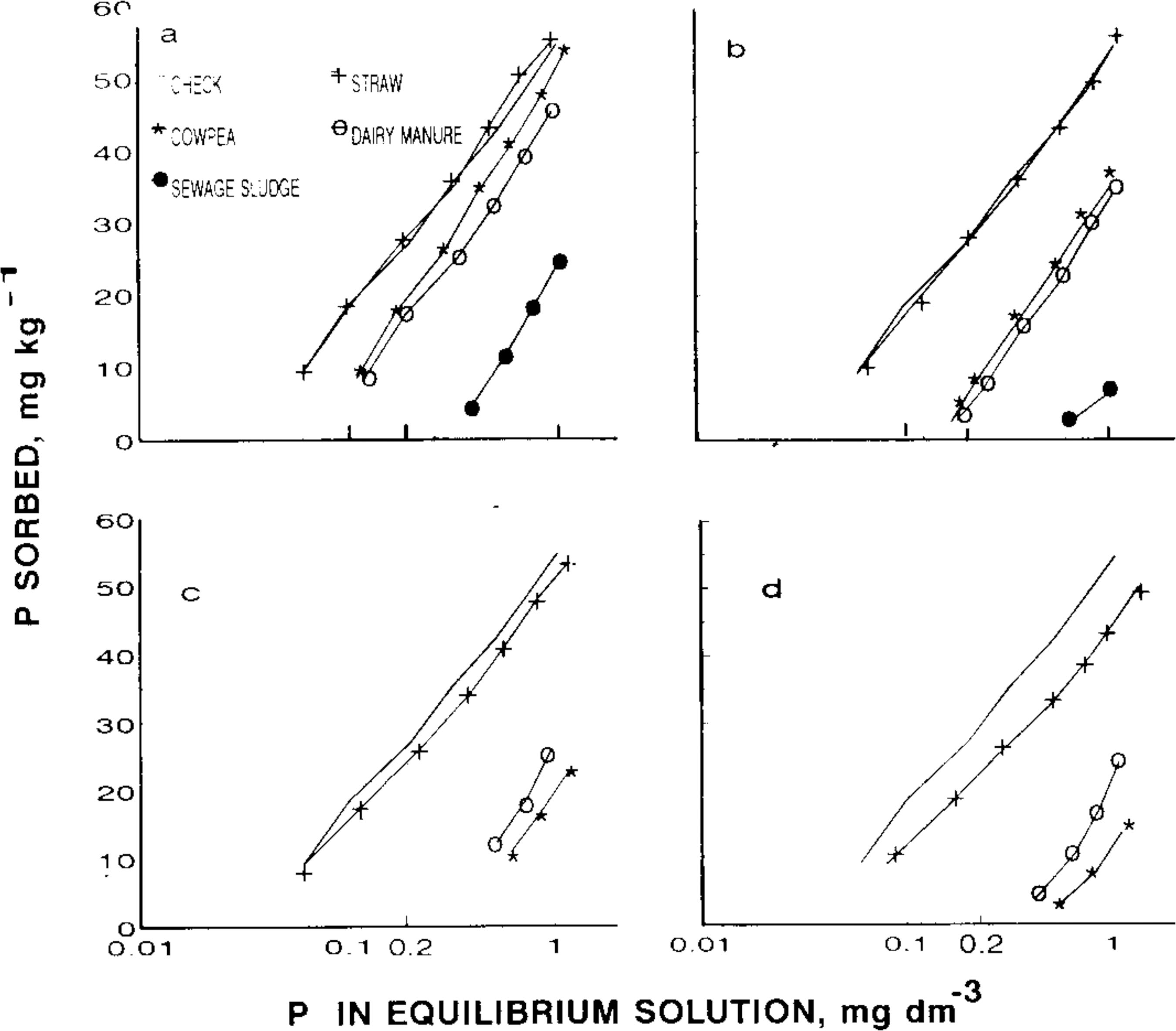
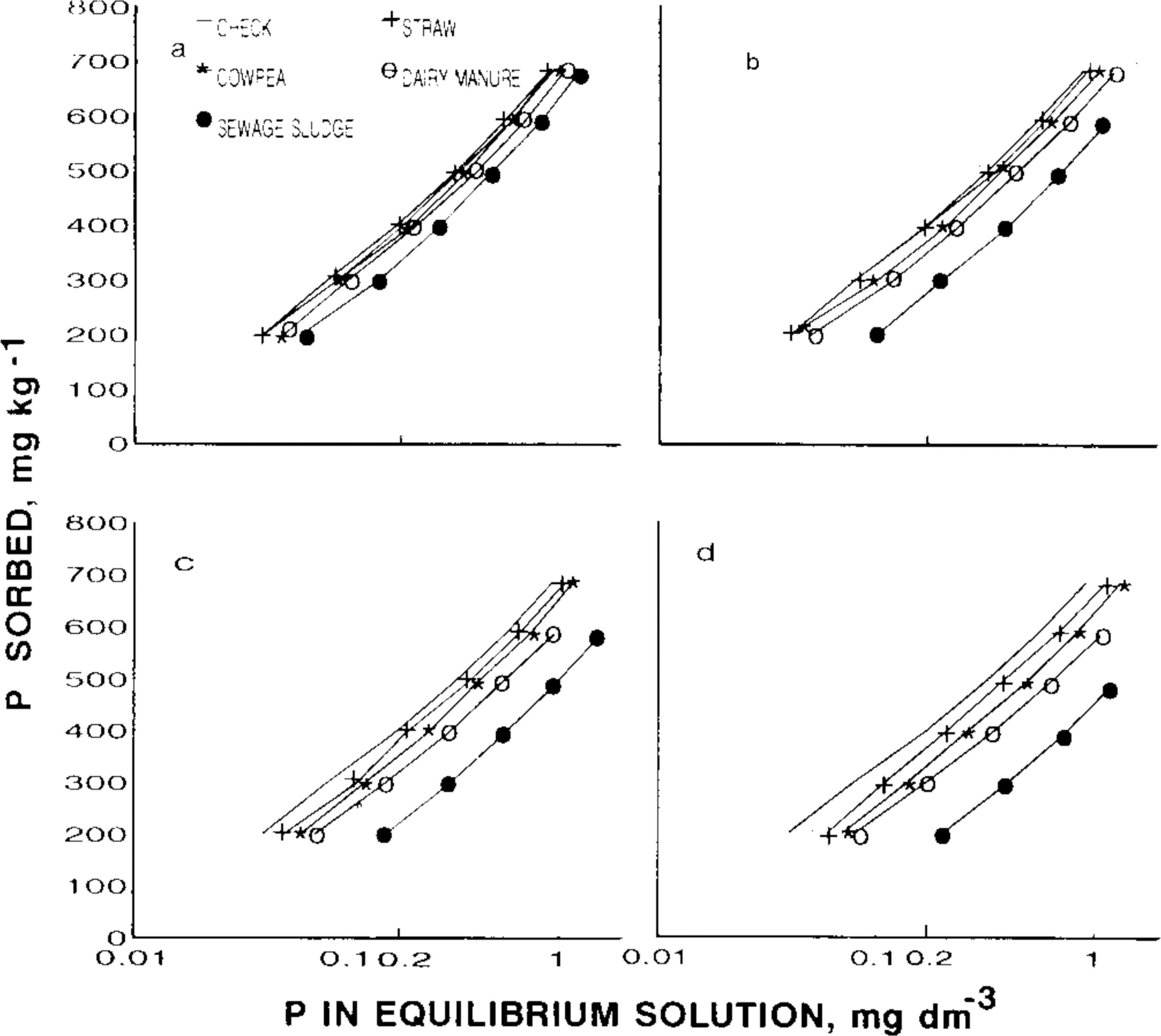
Sorption data on samples incubated with the organic residues for the two soils under investigation are shown in Figures 1 and 2. The Aquatibia soil showed a lower buffer capacity than the Hoda soil as observed by the lower curve slope (amount of inorganic P applied to the soil in order to obtain a unit change in the concentration of P in the equilibrium solution), and by the distance between the isotherms for the different treatments. The lower buffer capacity presented by the Aquatibia soil is probably a result of the low percentage of clay, predominantly kaolinite and iron oxides in this soil (Table 1).
Phosphorus sorption by the Aquatibia soil incubated with increasing rates of organic residues. a: 4 g kg−1; b: 8 g kg−1; c: 12 g kg−1; d: 16 g kg−1.
Phosphorus sorption by the Hoda soil incubated with increasing rates of organic residues. a: 4 g kg−1; b: 8 g kg−1; c: 12 g kg−1; d: 16 g kg−1.
The addition of the organic residues modified the P sortion capacity of both soils. Since cowpea, dairy manure and sewage sludge had P concentrations above the critical value of 3 g kg−1 suggested by Singh & Jones (1976), these were expected to decrease the amount of P sorbed by the soils as observed. However, the addition of straw also decreased the amount of sorbed P in the two higher doses, which suggests that the period of incubation was enough for the microorganisms to narrow the C:P ratio and thus favor mineralization of the organic P.
The decrease in P sorbed by the soils seemed to be proportional to the P content in the organic residues. Hence, straw treatment behaved like the check treatment where no organic materials were applied, cowpea plant tops and dairy manure had approximately the same effect on soil P sorption, and the sewage sludge produced the greatest decrease in the amounts of P sorbed by the soils, completely saturating the soil sorption capacity when the two higher dosages were applied to the Aquatibia soil. Since cowpea had 1.4 g kg−1 more P than the dairy manure, a greater decrease in the amount of P sorbed by the solid phase should be expected for the cowpea treatment. However, this relationship was inverse for the soil with high P sorption capacity and was consistent with all the dosages, which suggests that dairy manure treatments were more efficient in preventing P adsorption by this soil than the green manure treatments.
Greenhouse studies
Increases in the yield of dry weight from the plant tops in response to inorganic P applications to the Aquatibia soil not treated with organic materials followed the equation Y = 11.61 + 3.16x − 0.0267x2 (r2 =0.9857) where Y is the relative yield (%) and x is the amount of inorganic P added ( mg kg−1). This equation shows that 90% of maximum yield of dry matter was observed with the application of 35 mg of P kg−1. Since the amount predicted by the sorption isotherm technique for this soil was 33 mg of P kg−1, it is apparent that this technique has successfully estimated the P requirements for the Aquatibia soil.
Within the range of rates considered in the statistical analysis (0;4 and 8 g kg−1), the dry weight of corn plant tops were not statistically different when Aquatibia soil was treated with barley straw, cowpea plant tops and dairy manure (Table 5). However, regression analysis showed a quadratic and linear correlation for straw and dairy manure treatments, respectively (Table 6). Treatments not receiving the addition of inorganic P fertilizer showed that in fact there was no need for supplementation, since the yield measured for these pots was the same as the yield observed for other treatments. Phosphorus uptake by the corn was linearly correlated with the amount of P applied in the Aquatibia soil and could be calculated by the equation Y=14.868+1.431x (r2=0.9977) where Y is the amount of P absorbed ( mg per pot) and x is the amount of P added (mg kg−1); the minimum amount of P necessary to obtain maximum yield was about 65 mg per pot.
Dry weight of corn plant tops grown in Aquatibia soil treated with organic materials and with sufficient inorganic P to bring the P concentration in the equilibrium solution to 0.2mgdm−3(1)
Regression equations and coefficients of determination for dry matter yield (YM) or P uptake (YP) and dose of organic material (𝐱) added to different soils
Phosphorus uptake for the dairy manure treatment was greater than that for the straw treatment in all rates considered and that for the cowpea treatment at the rate of 8 g kg−1 (Table 7). Regression analysis showed a linear correlation for all treatments, suggesting that there was more P available as the amount of organic materials increased (Table 6). This effect could be a result of an alteration in the soil buffer capacity as shown by the sorption isotherms, or by further mineralization of P from the soil organic pool due to increased microbial activity caused by the presence of plants (Sattel & Morris ,1992; Thompson & Black, 1970; Somani & Saxena, 1971). The higher amount of P absorbed by plants receiving 8 g kg−1 of dairy manure corroborates the first hypothesis since this residue is a composted material and hence more resistant to mineralization (Gunary, 1968; Bromfield, 1961). The presence of easily mineralizable organic P compounds in the cowpea plant tops associated with a high amount of water-soluble P (Table 2), probably caused a prompt release of most of its P into solution during the incubation period, permitting the available P to move into more insoluble forms, before the plant growing period start. The fast decomposition of the green manure would also decrease the amount of active sites present in the organic matter, which are able to adsorb P in a more available form, as proposed by Harter (1969).
Amounts of 𝐏 in corn plant tops grown in Aquatibia soil treated with organic materials and with sufficient inorganic P to bring the P concentration in the equilibrium solution to 0.2 mg dm−3(1)
The yield of dry matter from the tops in response to application of inorganic P to the Hoda soil not treated with organic materials showed that 90% of the maximum yield was obtained by the P addition of 324 mg kg−1 soil, according to the equation Y = 106.09x/(57.61 + x), where Y is the relative yield (%) and x the amount of inorganic P added (mg kg−1 soil). The relationship presented a determination coefficient of 0.9960. Since the amount of P given by the sorption isotherm technique was 444 mg kg−1, it is apparent that this technique overestimated the amount required by this soil. As observed by Olsen & Watanabe (1963) P uptake at a given P concentration in solution is not the same for all soils, but increases with the buffering capacity of the soil, which is due in part to an increase in the diffusion factor.
The addition of organic residues to the Hoda soil did not affect the amount of dry matter produced by the corn in any of the doses studied (Table 8). Regression analysis also showed no significant effect of the added organic materials on the yield of dry matter (equations not shown). The amount of P taken up by the corn was also linearly correlated to the amount of P fertilizer added, following the equation Y = 3.5066 + 0.3974x (r2 = 0.998), where Y is the amount of P absorbed (mg per pot) and x is the amount of P added (mg kg−1). Plants reached maximum growth by absorbing 131 mg per pot of P. Phosphorus accumulation in the plant was reasonably constant for all organic materials added to the Hoda soil (Table 9). Significant differences on P absorption were observed only at the rates of 8 and 12 g kg−1, where more P seemed to be available from the cowpea and sewage sludge treatments. The quadratic behavior presented by the regression equations suggests a synergistic effect between the added inorganic P and these organic materials. As observed by Martin & Cartwright (1971), availability of P in the form of organic compounds such as myoinositol hexaphosphate was drastically decreased when this material was added to a high P retention soil. Anderson et al. (1974) concluded that this low availability of organic P could be due to the adsorption of these compounds by soil colloids and, possibly, by formation of insoluble Fe and Al complexes.
Dry weight of corn plant tops grown in Hoda soil treated with organic materials and with sufficient inorganic P to bring the P concentration in the equilibrium solution to 0.2mgdm−3
Amounts of P in corn plant tops grown in Hoda soil treated with organic materials and with sufficient inorganic 𝐏 to bring the 𝐏 concentration in the equilibrium solution to 0.2mgdm−3(1)
CONCLUSIONS
-
Additions of the organic materials studied decreased the P sorption capacity of the soils, except when the two lowest doses of barley straw where applied to the Aquatibia soil. The decreases were proportional to the P concentration in the organic materials and to the amount applied.
-
Dairy manure was more efficient in preventing P adsorption by the Hoda soil than the green manure treatment.
-
The sorption isotherm technique gave better results in soil with high P sorption capacity because it supplied reasonably similar amounts of P to the crop, even with the addition of several organic residues varying in composition and P content.
-
Phosphorus mineralization from the soil organic pool should be taken into account when the sorption isotherm technique is applied to soils with low buffer capacity and that are fertilized with organic materials.
REFERENCES
- ANDERSON, G.; WILLIAMS, E.G. & MOIR, J. O. A comparison of the sorption of inorganic orthophosphate and inositol hexaphosphate by six acid soils. J. Soil Sci., Oxford, 25:51-62, 1974.
- BECKWITH, R.S.. Sorbed phosphate at standard supernatant concentrations as an estimate of the phosphate needs of soils. Aust. J. Exp. Agric. Anim. Husb., Cambridge, 5:52:58, 1965.
- BREMNER, J.M. & MULVANEY, C.S. Nitrogen-total. In: PAGE, A.L; MILLER, R.H. & KEENEY, D. R., eds. Methods of soil analysis. 2. ed. Madison, American Society of Agronomy, 1982. v.2, p.595-622.
- BROMFIELD, S.M. Sheep feces in relation to the phosphorus cycle under pastures. Aust. J. Agric. Res., Victoria, 12:111-123, 1961.
- DAY, P.R. Particle fractionation and particle-size analysis. In: BLACK, C. A., ed. Methods of soil analysis, part 1. Madison, American Society of Agronomy. 1965. p.545-566.
- FOX, R. L. & KAMPRATH, E. J. Phosphate sorption isotherms for evaluating the phosphate requirements of soils. Soil Sci. Soc. Am. Proc., Madison, 34:902-907, 1970.
- FOX, R.L.; NISHIMOTO, R.K.; THOMPSON, R.S. & PENA, R.S. de la. Comparative external phosphorus requirements of plant growing in tropical soils. In: INTERNATIONAL CONGRESS OF SOIL SCIENCE, 10., Transactions. 1974. Moscow, Nauka Publishing House, 1974. p.232-239. v4.
- GUNARY, D. The availability of phosphate in sheep dung. J. Agric. Sci., Cambridge, 70:33-38, 1968.
- GUNARY, D. & SUTTON, D.C.D. Soil factors affecting plant uptake of phosphate. J. Soil Sci., Oxford, 18:167-173, 1967.
- HARTER, R.D. Phosphorus sorption sites in soils. Soil Sci. Soc. Am. Proc., Madison, 33:630-632, 1969.
- HOAGLAND, D.R. & ARNON, D.I. The water culture method for growing plants. Calif. Agric. Expt. St., Tarzana, 1950. 32p. (Circular, 37).
- HOLMGREN, G.G.S. A rapid citrate-dithionite extractable iron procedure. Soil Sci. Soc. Am. Proc., Madison, 31:210-211, 1967.
- JACKSON, M.L. Soil chemical analysis - advanced course. Madison, University of Wisconsin, 1956. 895p.
- LARSEN, S. Soil phosphorus. Adv. Agronomy, New York, 19:151-210, 1967.
- MARTIN, J.K. & CARTWRIGHT, B. The comparative plant availability of 32P myo-inositol hexaphosphate and KH232PO4 added to soils. Commun. Soil Sci. Plant Anal., Monticello, 2:375-381, 1971.
- MURPHY, J. & RILEY, J.P. A modified single solution method for determination of phosphate in natural waters. Anal. Chim. Acta, Amsterdam, 27:31-36, 1962.
- NAGAJARAH, S.; POSNER, A.M. & QUIRK, J.P. Competitive adsorption of phosphate with polygalacturonate and other organic anions on kaolinite and oxide surfaces. Nature, London, 228:83-85, 1970.
- OLSEN, S.R. & WATANABE, F.S. Diffusion of phosphorus as related to soil texture and plant uptake. Soil Sci. Soc. Am. Proc., Madison, 27:648-653, 1963.
- SANCHEZ, P.A. & UEHARA, G. Management considerations for acid soils with high phosphorus fixation capacity. In: KHASAWNEH, F.E., ed. The role of phosphorus in agriculture. Madison, American Society of Agronomy, 1980. p.471-514.
- SATTEL, R.R. & MORRIS, R.A. Phosphorus fractions and availability in Sri Lankan Alfisols. Soil Sci. Soc. Am. J., Madison, 56:1510-1515, 1992.
- SIBBESEN, E. An investigation of the anion-exchange resin method for soil phosphate extraction. Plant Soil, The Hague 50:305-321, 1978.
- SINGH, B.B. & JONES, J.P. Phosphorus sorption and desorption characteristics of soil as affected by organic residues. Soil Sci. Soc. Am. Proc., Madison, 40:389-395, 1976.
- SNEDECOR, G.W. & COCHRAN, W.G. Statistical methods. 7.ed. Iowa, The Iowa State University Press, 1980. 507p.
- SOMANI, L.L. & SAXENA, S.N. Studies on the mineralization of organic phosphorus under the influence of crop growth in some soils of Rajasthan. J. Ind. Soc. Soil Sci., New Delhi, 19:261-267, 1971.
- THOMAS, G.W. Exchangeable cations. In: PAGE, A.L.; MILLER, R.H. & KEENEY, D.R., eds. Methods of soil analysis. II. Madison, American Society of Agronomy, 1982. p.159-164.
- THOMPSON, L.M. & BLACK, C.A. Changes in extractable organic phosphorus in soil in the presence and absence of plants. III. phosphatase effects. Plant Soil, Dordrecht, 32:355-348, 1970.
- WOODRUFF, J.R. & KAMPRATH, D.E.J. Phosphorus adsorption maximum as measured by the Langmuir Isotherm and its relationship to phosphorus availability. Soil Sci. Soc. Am. Proc., Madison, 29:148-150, 1965.