 Phosphate fertilizer solubility affects the P use efficiency and the sustainability of wood production by Eucalyptus stands
ABSTRACT
Eucalyptus genus exhibits high nutrient use efficiency, but the phosphorus (P) balance in the soil under Eucalyptus stands is often negative, mainly due to higher P exportation in the wood after forest harvesting when compared with fertilization inputs. We evaluated the effect of phosphate fertilizers with varying solubilities and technologies on P balance and use efficiency in Eucalyptus, focusing on organic P (Po) mineralization. A randomized complete block design, with four blocks and six treatments, was used to test the P sources both as single sources and in mixtures. The P balance was calculated by considering fertilization as input and wood harvest as output. By adding P stocks from the soil and trees, we estimated the potential number of rotations (PNR). Relative agronomic efficiency (RAE), recovered P (Rec-P), and P use efficiency (P-UE) were also estimated. Before the experiment, soil P stocks were higher when P contents obtained through fractionation were considered. Phosphorus balance was positive in treatments with rock phosphate when considering total P applied. Organic P significantly influenced PNR, with increases ranging from one to four rotations. The P-UE was higher when soluble P was used. Treatments fertilized with phosphate complexed with humic substances had higher Rec-P and RAE. Soluble phosphate fertilizers promote high wood production but fail to meet long-term P needs due to their rapid uptake and depletion, resulting in negative P balance. In contrast, rock phosphate maintained positive P balances, suggesting it can sustain soil fertility and have a long-term effect on multiple rotations (legacy P), promoting sustainability. Nevertheless, Po is essential for soil fertility and P availability in Eucalyptus stands, contributing more than routine analysis suggests. It should therefore be considered in sustainable fertilizer management to ensure the long-term productivity and economic viability of Eucalyptus plantations.
Keywords
phosphorus balance; legacy P; minimum tillage; soil P fractionation; organic phosphorus
INTRODUCTION
The definition of the ideal source for phosphate fertilization in forest plantations is a topic of constant reconsideration in Brazil. In the last decades, several studies were conducted either in greenhouses or under field conditions to verify the efficiency of Eucalyptus plantations to uptake P from different sources (Ismael et al., 1998; Fernandez et al., 2000; Leite et al., 2009; Costa et al., 2016). Soluble P sources, such as single superphosphate (SSP), triple superphosphate (TSP), monoammonium phosphate (MAP), and diammonium phosphate (DAP), enhance initial growth of Eucalyptus due to its high P availability and consequently result in higher final productivity compared with less soluble sources, such as rock phosphates (RP) (Dias et al., 2000; Fernandez et al., 2000; Bazani et al., 2014). In general, to achieve the same productivity by the end of the first year, RP needs to be five times higher compared with TSP (Gava et al., 1997). In this sense, the use of soluble P fertilizers enhances P availability in the soil and the plant nutritional status, such as P accumulation, thereby increasing aboveground biomass (Rodrigues et al., 2025).
Mineral fertilization positively affects plant nutrition, light utilization, photosynthetic rate, and antioxidant performance, improving the growth of Eucalyptus plantation (Florentino et al., 2021). The highest rate of P uptake and demand by Eucalyptus occurs up to the second year of forest age. Fertilization responses found in the initial growth phase of the forest decrease throughout the rotation and may cease by the end of the rotation (Bazani et al., 2014). This occurs because nutrient demand in Eucalyptus plantations can be basically divided into two main periods: before and after canopy closure. In the pre-closure phase, there is a high nutritional demand, and plants rely on the soil as a nutrient source to develop roots and expand the leaf area (Gonçalves et al., 2014). In the post-closure phase, there is substantial aboveground growth and the establishment of nutrient cycling, such as biochemical, biogeochemical, and geochemical cycle, as an important source of plant nutrients (Laclau et al., 2010). Responses to fertilization tend to diminish during this phase, which extends until the end of the rotation, as water and light availability become more limiting to tree growth than nutrient availability (Campoe et al., 2013; da Silva et al., 2016).
Fertilization practices in forest plantations are characterized by recommendations based on the contents of available nutrient in the soil and in the estimated productivity of species (Gonçalves et al., 2022). Growth responses to phosphate fertilization, considering a full rotation of approximately seven years, are expected at maximum doses of 60-70 kg ha-1 of P2O5, in soils with clay content above 35 % with low resin P values (0-2 mg dm-3) (Santana et al., 2008; Silva et al., 2013; Rocha et al., 2019a). The amount of P fertilizer to be applied, usually done as a single dosage at planting time considering P low mobility in the soil, is calculated based on the amount P exported by the end of the rotation, to ensure a sustainable balance between inputs and outputs in the stands. It has been reported that in Eucalyptus plantations P exportation varies from 30 to 60 kg ha-1 over rotations of approximately seven years, considering a mean annual increment of 30-50 m³ ha-1 yr-1 (Melo et al., 2016; Rocha et al., 2019b). This is possible because Eucalyptus plantations in Brazil are generally established under minimum tillage systems with harvest residue retention on site (Rocha et al., 2016a). Overall, this practice enhances soil fertility, for example, by increasing organic matter content, mainly in the surface layers (Menegale et al., 2016), improving nutrient cycling and biomass productivity (Campoe et al., 2012). Additionally, it improves soil biological diversity and activity (Pereira et al., 2019) and consequently leads to the release of assimilable P from organic matter (Costa et al., 2016; Lino et al., 2016), which plays a fundamental role in tree nutrition throughout the rotation (Fox et al., 2011).
One of the greatest challenges in the forestry sector is to identify the balance between silvicultural strategies and methods that allow high wood productivity in the long-term with minimal negative environmental impacts (Booth, 2013; Massuque et al., 2023; Laclau et al., 2024). Different forms of phosphate fertilization management are common in Brazil, including the use of granulated mixtures with soluble fertilizers, sometimes associated with rock phosphate application aiming for long-term P availability (Bazani et al., 2014). Combined with the advent of new fertilizer technologies such as superphosphates complexed with organic compounds (Erro et al., 2012; Urrutia et al., 2013), it is important to analyze the influence that different phosphate sources can have on various aspects of productivity, such as nutrient use efficiency in Eucalyptus stands. Despite being highly efficient in nutrient use, studies on forest nutrition demonstrate that the P balance between input via fertilization and export via harvest in Eucalyptus stands is negative (Ferraz et al., 2016; Menegale et al., 2016). In this sense, this study aimed to evaluate the effect of phosphate fertilizers with different technologies and soil solubilities on P balance and use efficiency in Eucalyptus grandis stands managed under minimum tillage, and to elucidate the contribution of organic P (Po) mineralization to the productive balance of the stands.
MATERIALS AND METHODS
Study site
The study was carried out in Itatinga, São Paulo, Brazil (23° 06’ S; 48° 36’ W at 863 m above sea level). According to the Köppen classification system, the climate is humid subtropical (Cfa) (Alvares et al., 2013) with a mean annual rainfall of 1,319 mm. Average annual temperature of the area is 19.4 °C, with lows of 2 °C in the coldest month and 31 °C in the hottest month (Rocha et al., 2019a). The dry season occurs from April to September, and the wet season from October to March. Rainfall in the region is historically concentrated from October through March; however, in recent years, atypical periods of drought have occurred (Foltran et al., 2019). The natural vegetation in the site was Cerrado stricto senso, also known as Brazilian savanna. The topography of the area is flat, and the soil is dystrophic, with a sandy loam texture down to a depth of 1.50 m (200 g kg-1 of clay) and sandy clay loam from 1.50 to 2.00 m (250 g kg-1 of clay). It has a high degree of weathering (i.e., silt/clay ratio of 0.1; average Ki of 1.2), its predominant mineral is kaolinite (Kr >0.75), and the soil charge balance is negative (∆pH <0) and decreased with depth. At a depth of 2.00 m, the ∆pH was almost zero, indicating a low balance of negative charges (Bazani, 2014). Soil is classified as Latossolo Vermelho-Amarelo (LVAd) according to the Brazilian soil classification system, corresponding to an Oxisol in the USDA soil taxonomy classification (Santos et al., 2018). These soil characteristics are consistent with most soils used for forest plantations in Brazil, representing the reality of tropical forest soils (Gonçalves et al., 2013).
In the study area, between 1940 and 1997, Eucalyptus saligna Sm. was conducted in a coppicing system to produce wood for energy. During this period, it was common not to invest in fertilization practices. Between 1997 and 2011, E. saligna was cultivated with low nutrient input (300 kg ha-1 of NPK 10:20:10). After clear-cutting, average productivity was 20 m³ ha-1 yr-1 (Foltran, 2017; Rodrigues, 2022). The experiment was conducted from April 2012 to December 2019. It was established using genetically improved (half-sib seeds) three-month-old seedlings of Eucalyptus grandis Hill Ex Maiden, Coff’s Harbour provenance. This species was being widely cultivated by forest companies. It was a selected progeny with rapid growth and excellent field yields, and its response to management, in terms of growth, can be considered as a baseline of comparison to other Eucalyptus species cultivated in areas with low water deficit and medium texture soils. To this day, this material is still used for hybridization with other species due to the quality of its wood (Brawner et al., 2013; Barros et al., 2024; Melo et al., 2024).
Site management practices and treatments
Experimental design was a randomized complete block with four repetitions (blocks) and six treatments, as follows: Control - no P fertilizer application; SSP – single superphosphate (as high soluble source); CSP - phosphate fertilizer complexed with humic substances (NPK 06:26:06 +6 % Ca + 5 % S); RP – rock phosphate, from Gafsa (as low soluble source); PM – one-to-one (1:1) ratio mixture of SSP and RP; CSPmix – CSP and RP mixture (NPK 06:26:06 + 10 % Ca + 3 % S). For rock phosphate in the treatments RP and PM, the dosage was defined according to the content of P soluble in citric acid 2 % (HCi 2 %), whereas for SSP and CSP, according to the amount of P soluble in neutral ammonium citrate and water (NAC + H2O). The CSP and CSPmix are formulations of ready-made fertilizers, so the amounts of P applied were based on the amounts of P available to the plants indicated by the manufacturers. Each plot of the experiment had a total area of 486 m2 (81 trees, 6 m2 tree-1, 3.0 × 2.0 m), with an evaluation area of 150 m2 (25 trees) and a double-row buffer of 336 m2 (56 trees). The choice of planting density mainly depends on edaphoclimatic conditions of the site (Lima et al., 2012), with no water restriction, the high stocking (trees planted per hectare, 2200 to 1600 trees ha-1, 3.0 × 1.5–2.0 m spacing) will increase mean annual increment and shorten the harvest time to the maximum. As a general rule, higher stocking leads to higher total biomass production per unit area for a given rotation lengthbut lower biomass per tree (Leite et al., 1999; Gonçalves et al., 2013). In addition, this spacing also makes it easier for machinery to move around the stands (Ramantswana et al., 2020). Soil preparation followed the minimum tillage system, maintaining the residues of the previous rotation on the soil, with soil preparation (0.60 m deep) restricted to the planting line.
Before planting, 2 Mg ha-1 of dolomitic lime (approximately 543 kg ha-1 of Ca and 144 kg ha-1 of Mg) were applied in the total area without incorporation. Liming in forest plantations is only applied to meet the Ca and Mg requirements and not to correct the pH of the soil (Rocha et al., 2019c). Therefore, the amount of lime applied was determined considering the amounts of available Ca and Mg in the soil before planting, accordingly to Boletim 100 recommendations (Gonçalves et al., 2022). The other nutrients were applied at planting time. In Brazil, fertilizer application in forest plantations is usually done with the largest amount of nutrients applied at the time of planting, except for N, K, and B, which are applied in one or more topdressing applications owing to their mobility in the soil, aiming to supply these nutrients during the period of maximum plant growth in the first two years (Gonçalves et al., 2008). In the experiment, it was applied 26 kg ha-1 of P (60 kg ha-1 P2O5; P = P2O5 × 0.436), 30 kg ha-1 of fritted trace elements (1.8 % B, 0.8 % Cu, 2.0 % Mn, 9.0 % Zn, 3.0 % Fe, 0.1 % Mo), and starter doses of N (17 kg ha-1 as ammonium nitrate) and K (30 kg ha-1 as potassium chloride) - to stimulate plant establishment (~0.20 m soil depth). Two topdressing applications were performed with higher doses of N, K, and B: the first at 2.7 months post-planting (20 kg ha-1 of N, 39 kg ha-1 of K, and 5 kg ha-1 of B, as ulexite), and the second at 5.7 months post-planting, after the end of the dry season (30 kg ha-1 of N and 52 kg ha-1 of K). Total amounts of N and K applied were 67 kg ha-1 and 121 kg ha-1, respectively. Phosphate fertilization was based on the research results and recommendations made for the state of São Paulo by Gonçalves (2011).
Soil sampling and chemical analysis
Before planting, soil samples were collected from all the experimental area, in the 0.00-1.00 m soil layers. Samples were collected at every 0.10 m using a soil sampling auger (~0.05 m diameter, Dutch type), and 20 subsamples were grouped into one representative sample, accounting for the heterogeneity. Samples were air-dried and then sieved (2 mm mesh) and soil P (i.e., ion-exchange resin) and other soil chemical (i.e., pH, C, N, K, Ca, Mg, Al, H+Al) and physical properties (i.e., sand, silt, clay, and bulk density) were determined according to Teixeira et al. (2017) (Table 1). Nutrient stock in the soil was calculated by multiplying the nutrient content by the soil volume in the evaluated layer (Menegale et al., 2016; Rocha, 2018).
Soil chemical and physical properties of the sampling carried out before planting, taking composite samples (20:1) randomly distributed throughout the experimental area
Soil phosphorus fractions
Soil samples collected before planting from the layer of 0.00-0.20 m were submitted to sequential extraction of P following the procedure described by Hedley et al. (1982) and modified by Rheinheimer et al. (2000). Phosphorus pools were obtained by measuring inorganic P (Pi) and organic P (Po) fractions in the following order: (1) anion-exchange resin membrane - Piresin fraction; (2) 0.5 mol L-1 sodium bicarbonate (NaHCO3 at pH 8.5) (Pibic and Pobic); (3) 0.1 mol L-1 sodium hydroxide (NaOH) (Pihyd0.1 and Pohyd0.1); (4) 1.0 mol L-1 hydrochloric acid (HCl) (PiHCl); and (5) 0.5 mol L-1 NaOH (Pihyd0.5 and Pohyd0.5). The remaining soil was oven-dried and (6) digested with H2SO4 + H2O2 to determine residual P (Presidual). Phosphorus concentrations in the acid extractants were determined using the Murphy and Riley (1962) methodology. The Pi fractions in the alkaline extractants (NaHCO3 and NaOH) were determined using the Dick and Tabatabai (1977) methodology. For determining total P in the alkaline extractants, ammonium persulfate + H2SO4 digestion was performed in an autoclave, and P was determined by Murphy and Riley (1962). The Po was estimated by the difference between total P and Pi in each extractant (Rheinheimer et al., 2000; Teles et al., 2017; Foltran et al., 2019).
Soil P fractions were grouped according to the P lability, determined as: “labile P pool” (Presin + Pibic + Pobic), “moderate-labile P pool” (Pihyd 0,1 + Pohyd 0,1 + PHCl), and “non-labile P pool” (Pihyd 0,5 + Pohyd 0,5 + Presidual) (Costa et al., 2016; Foltran et al., 2019). Although these fractions are considered ‘chemically defined’, they have been broadly associated with various classes of P (Negassa and Leinweber, 2009; Kruse et al., 2015).
Tree growth and aboveground biomass
At the end of the rotation (eighth year post-planting), the diameter breast height (DBH) and total height (H) of all trees in the plot evaluation area were measured. Based on the data obtained from this inventory, the individuals were organized into four diametric frequency classes, with one standard deviation of amplitude. Afterwards, from the central classes, six trees per treatment (36 trees in total) were selected and harvested for volume and biomass measurements. The solid volume was calculated using the Smalian equation (Scolforo and Thiersch, 2004), with diameters measured every meter up to a minimum of 0.05 m. From the data obtained, a general equation for wood volume (wood with bark) was adjusted, adopting the Schumacher and Hall (1933) model, considering DBH and total height of the trees as variables. Mean annual increment (MAI) for each treatment was calculated by dividing the volume by age.
Total aboveground biomass was determined in all sampled trees. Trees were separated into compartments: the trunk (stem wood and stem bark) and crown (leaves and live branches). Trunk was segmented up to a ≤0.05 m diameter at the thinner end. Diameter, length, and total fresh weight were measured in the field. Subsamples were collected from all compartments for moisture measurements (dried at 65 °C until constant weight). Dry mass of the wood and bark was determined from samples composed of discs taken from the trunk every meter and of the branches and leaves from representative samples of ± 300 g. The product of the trees' total fresh weight and the components' humidity percentage resulted in the total dry mass. By using the data from the 36 trees sampled, models were adjusted and evaluated to determine which one best estimated the biomass of the stands. To evaluate the model accuracy, the following metrics were used: root mean squared error (RMSE), Akaike Information Criteria (AIC), and graphical analysis of the distribution of residuals and the correlation between observed and estimated data. These metrics were determined according to Burkhart and Tomé (2012) and Sileshi (2014). The DBH and H of trees were used as independent variables for adjustment. Trees outside the range of ± 2 standard deviations were removed from the database to perform calculations of volume and aboveground biomass.
Phosphorus contents and stocks in the aboveground biomass
Dry samples of the aboveground biomass components were homogenized and ground in a Wiley mill. Subsequently, the P contents were determined according to Malavolta et al. (1997). Samples were subjected to nitric-perchloric acid digestion and post-determination by colorimetry. The product of the estimated biomass per hectare of each biomass component and the respective nutrient content resulted in the nutrient stocks in the trees.
Phosphorus balance and potential number of rotations
At the end of the rotation, the P balance was estimated. As fertilization was considered as nutrient input, two scenarios were considered for balance calculations: i) the input via fertilizer, considering the P readily available to plants (RAP) at the time of fertilization; and ii) the total P applied via fertilization. The input of rock weathering was not considered, as the soil was highly weathered (Oxisol; LVAd). Harvesting was considered an output.
Stocks of nutrients in the soil before the experiment establishment were calculated, considering the data from routine analysis and P fractionation. Only those fractions with the greatest potential for P mineralization for nutrition were considered, i.e., labile P pool (Presin + Pibic + Pobic) and moderate-labile P pool (Pihyd 0,1 + Pohyd 0,1 + PHCl). The root biomass (Mello and Gonçalves, 2008) and the amount of nutrients in the litter (Rocha et al., 2016b) were estimated using data obtained in a similar forest stand with the same genetic material (Rocha et al., 2016a). Based on this data, the potential number of rotations was calculated using the following equation (Equation 1):
in which: PNR is the potential number of rotations; NSS is the nutrient stocks on the soil (0.00-0.20 m layer); NSB is the nutrient stocks in the biomass; F is the nutrient input by fertilization; and E is the nutrient loss by exportation.
Phosphorus use efficiency and recovery from fertilizer by plants
Results of the plant analyses, including the nutrient stock in each treatment and the biomass produced in each compartment of the plant, were used as the basis for calculating: Relative agronomic efficiency (RAE%) and the recovered P (P-Rec%) (Equations 2 and 3) (Bazani, 2014; van Raij, 2017); Phosphorus Use Efficiency (PUE) for total biomass production (Equation 4) and for steam wood production (Equation 5) of stands (Mg ha-1) (Barros et al., 1986; Turner and Lambert, 2014; Valadares et al., 2020).
in which: RAE (%) is the relative agronomic efficiency; Vol aP is the wood (with bark) production by plants in a given alternative P fertilizer (m³ ha-1); Vol rP is the wood production by plants in the reference P fertilizer (SSP); and Volcontrol is the wood production on the Control treatment without any P fertilizer application.
in which: P-Rec (%) is the P recovered from fertilizer application; Pstockn is the amount of P accumulated in total aboveground biomass in fertilized treatments (kg ha-1); Pstockcontrol is the amount of P accumulated in aboveground biomass in the Control treatment without any P fertilizer application (kg ha-1); and Papplied is the amount of P applied in the fertilizer application, in which we considered the readily available P and total P (kg ha-1).
in which: PUE is the phosphorus use efficiency; Y is the amount of biomass produced (total biomass and steam wood biomass in Mg ha-1); and Pstockn is the amount of P accumulated in total aboveground biomass in fertilized treatments (kg ha-1).
Data analysis
Data on tree growth, biomass production, and P stocks in aboveground biomass were tested for normality (Shapiro-Wilk test) and homoscedasticity. Descriptive analysis and analysis of variance (one-way ANOVA) were performed to identify differences between treatments and variables, with blocks and treatments as the source of variation. In addition, the ANOVA was conducted in a two-factor arrangement for the PNR, considering the amount of input from fertilizers and treatments, as well as soil P stock from Pi and Po pools and treatments. A similar approach was employed for the P-Rec %, with the variation source being the P input from fertilizers and treatments. When differences were found by ANOVA, the data were subjected to comparison of means using Fisher's least significant difference test (LSD) (p<0.10) (Smith, 1978). As an experimental field trial, we established 10 % as the mean comparison test based on previous studies with the same site conditions (Menegale et al., 2016; Florentino et al., 2022). The analyses were performed using R 4.1.2 (R Development Core Team, 2021), and graphs were created using OriginLab 2024 (OriginLab©, institutional license of the University of São Paulo).
RESULTS
Soil nutrient stocks before planting
Prior to the experiment establishment, the P contents obtained through soil fractionation were higher than those obtained by routine analysis for the 0.00-0.20 m layer (Table 2). The content of Pi (Presin + Pibic) was 40 % higher than the resin P evaluated in the routine analysis. When considering the total P content in this pool (Pi + Po), the values were four times higher than those found in the routine analysis. The highest soil P contents were found in the organic form, predominantly in the moderately labile pool. Organic P (Po) contents relative to inorganic P (Pi) were twice as high in the labile pool and four times higher in the moderately labile pool. Considering the total P contents in the moderately labile pool (Pi + Po), the values were seven times greater than those found in the routine analysis. Although the weathering acts preliminarily on cationic bases, the total P stock in the studied soil was 2.5 times lower than the potassium (K) total stock and 50 % lower than calcium (Ca). Only compared with magnesium (Mg), the total P stock was 25 % higher.
Soil nutrient stocks in the 0.00-1.00 m layer prior to the establishment of the experimental area. Soil P contents obtained by routine analysis and P fractionation
Phosphorus balance and potential number of rotations
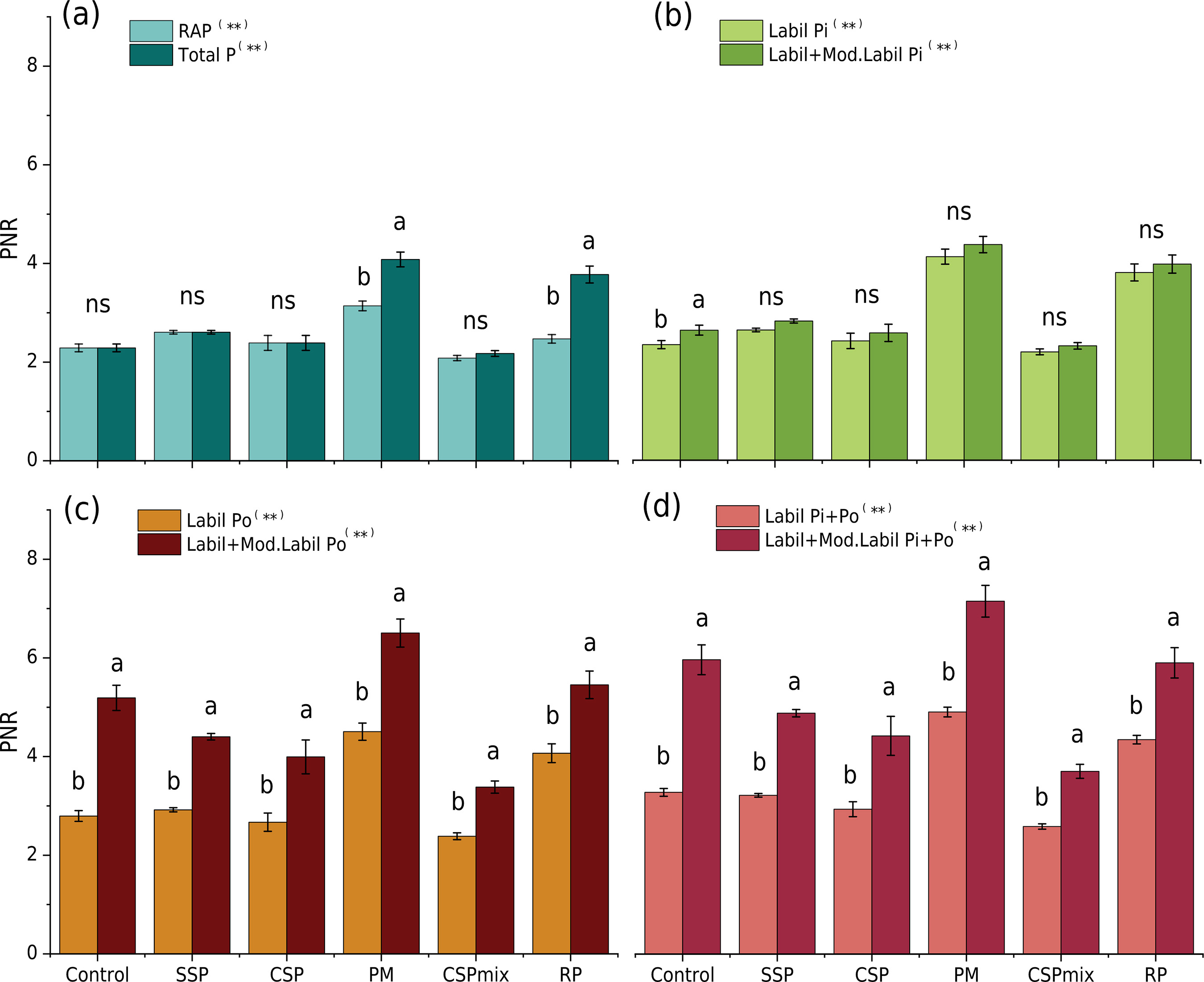
Phosphorus balance was assessed, considering fertilization as input and wood plus bark harvest as output (Table 3). Two scenarios were considered for P input: i) the input via fertilizer, considering the P readily available to plants (RAP) at the time of fertilization, and ii) the total P applied via fertilization. In the first scenario, all assessed balances were negative, with PM showing a balance closest to zero (equilibrium). In the second scenario, the treatments that received higher total P amounts, i.e., those that received rock phosphate (RP and PM), presented positive balances above 20 kg ha-1. From the initial soil nutrient stock and the nutrient balance, it was possible to assess the potential number of rotations (PNR) (Figure 1). When considering total P input via fertilization, the number of rotations increased only for treatments that received rock phosphate, especially RP, which had its PNR doubled. Increases in PNR were observed when considering the initial P stock as the Pi and Po fractions from the labile and moderately labile pools. The most significant increases were found when Po from both pools was considered, especially when summed. The greatest gains were found for the Control, with increases ranging from 1 to 4 rotations. Other treatments also showed increases, but with a maximum gain of three rotations (PM). Furthermore, among the P fertilized treatments, those that received soluble phosphate as the main P source presented the lowest PNR, while those that received rock phosphate had the greatest PNR, above six rotations.
Phosphorus balance of Eucalyptus grandis stands fertilized with phosphate sources that have different solubility. Fertilization was considered as input and harvesting as output, considering the most common scenario of wood removal with bark

Potential number of rotations (PNR) considering: (a) Soil inorganic phosphorus (Pi) stock obtained by routine analysis (ion exchange resin), readily available (RAP) and total amounts of P in the applied fertilizers; (b) Soil Pi stock obtained by P fractionation and total amounts of P in the applied fertilizers; (c) Soil organic phosphorus (Po) stock obtained by P fractionation and total amounts of P in the applied fertilizers; and (d) Soil Pi + Po stocks obtained by P fractionation and total amounts of P in the applied fertilizers. Bars labeled with the same letter do not differ by the LSD test at 10 %. As indicated by the data, the comparisons are made within each treatment; however, the differences between treatments within each factor are found to be significant (p<0.05). Treatments: no P fertilization (Control); Single superphosphate (SSP); Complexed humic-phosphate (P-metal-HS – CSP); P mixture (SSP+RP) at a 1:1 ratio (PM); Complexed humic-phosphate mixture (P-metal-HS + RP – CSPmix); and rock phosphate (RP).
Phosphorus use efficiency
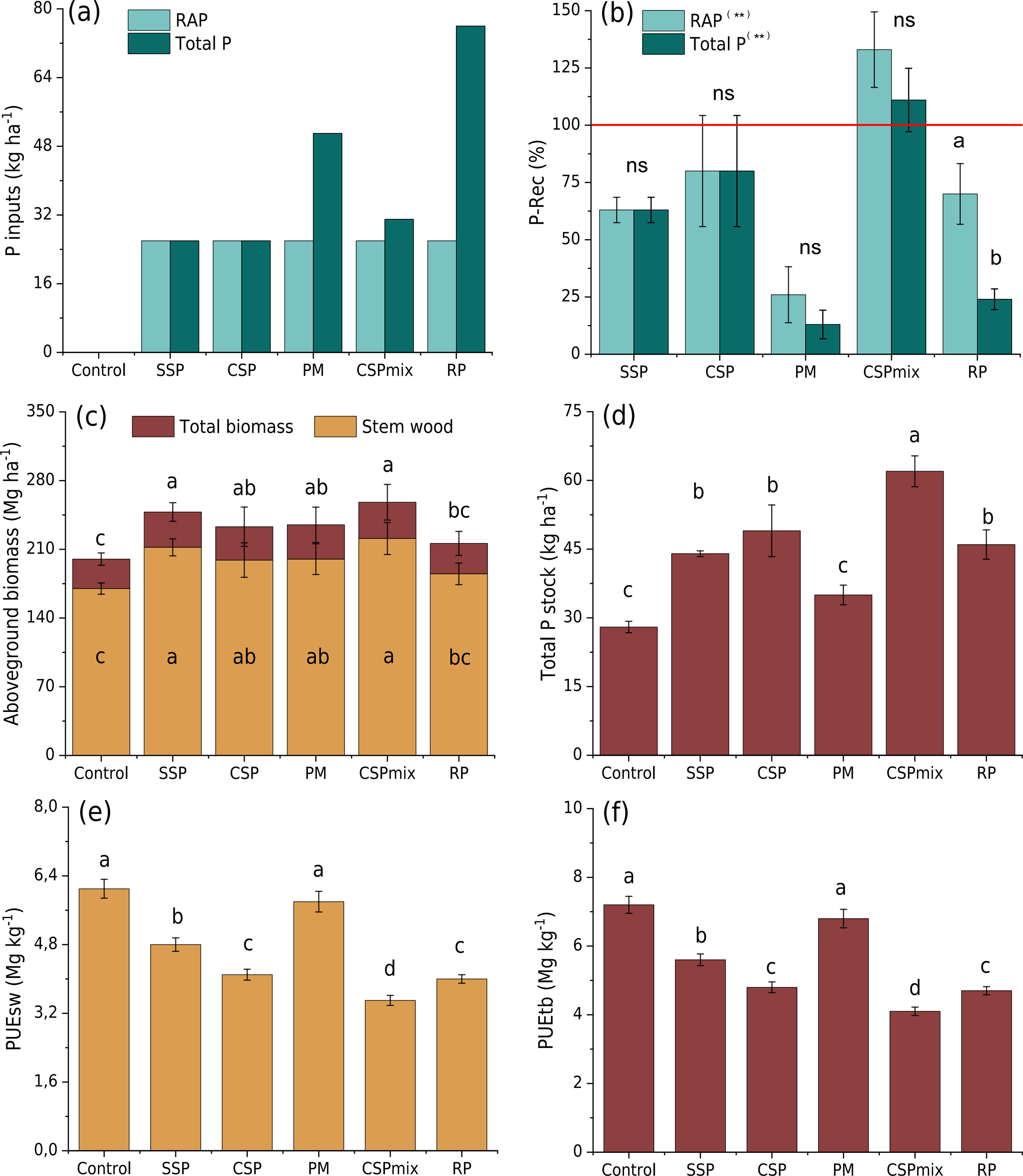
Treatments fertilized with P exhibited higher volume and aboveground biomass production compared with Control, which did not receive P fertilization (Figures 2c and 3a). Consequently, these treatments also showed higher P stocks in aboveground biomass (Figure 2e). However, they exhibited lower P use efficiency (PUE) for wood production compared with Control, except for PM, which achieved similar indices (Figures 2d and 2f). The amount of P recovered from fertilization (P-Rec%) relative to the P readily available to plants showed that the CSPmix treatment had the highest efficiency, followed by CSP, RP, and SSP (Figure 2b). The treatment with the lowest performance was PM. Conversely, when considering the P recovered from the total applied amounts, a decrease in efficiency was observed, especially for RP, which received the highest total P amounts. The SSP and CSP did not show a decrease since the total applied P was in a form readily available to plants (Figure 2a). Regarding relative agronomic efficiency (RAE%) compared with standard treatment (i.e., SSP), all other treatments had lower efficiency except for CSPmix, which had a 20 % higher efficiency (Figure 3b). The treatment with the lowest RAE was RP, with efficiency significantly below the other P-fertilized treatments.

Use of P by Eucalyptus grandis stands fertilized with P sources of different solubility. (a) Phosphorus inputs by readily available (RAP) and total amounts of P from the applied fertilizers; (b) Recovered P from RAP and total amount of P applied; (c) Steam wood and total aboveground biomass production; (d) Total P stocks in aboveground biomass; (e) Phosphorus use efficiency (PUE) considering steam wood (sw) production; (f) PUE considering total biomass (tb) production. Bars labeled with the same letter do not differ by the LSD test at 10 %. As indicated by the data in Figure 1B, the comparisons are made within each treatment; however, the differences between treatments within each factor are found to be significant (p<0.05). For the other figures, the comparisons were made between treatments. Treatments: no P fertilization (Control); Single superphosphate (SSP); Complexed humic-phosphate (P-metal-HS – CSP); P mixture (SSP+RP) at a 1:1 ratio (PM); Complexed humic-phosphate mixture (P-metal-HS + RP – CSPmix); and rock phosphate (RP).

Volume of wood with bark (a) and relative agronomic efficiency (RAE) of Eucalyptus grandis stands fertilized with P sources of different solubility (b). For RAE the SSP was considered the reference P fertilizer. Treatments: no P fertilization (Control); Single superphosphate (SSP); Complexed humic-phosphate (P-metal-HS – CSP); P mixture (SSP+RP) at a 1:1 ratio (PM); Complexed humic-phosphate mixture (P-metal-HS + RP – CSPmix); and rock phosphate (RP).
DISCUSSION
Use of soluble sources
The primary objective of P fertilization is to meet the P demand during the initial two years of tree growth, a period during which there is a greater dependency on P derived from fertilizers (Silva et al., 2013; Bazani et al., 2014). After this period, as the canopies close, the trees utilize P more efficiently through biochemical and biogeochemical cycling (Laclau et al., 2010; Tian et al., 2024). Despite exhibiting high wood productivity at the end of the crop rotation, the treatments fertilized with soluble P sources (i.e., SSP, CSP, and CSPmix) presented negative balances, meaning that harvest outputs were higher than inputs via fertilization. Even when considering the total applied P, the balance remained negative because P in these treatments was almost entirely in forms readily available to plants (van Raij, 2017). This negative balance indicates that the amount of P applied through fertilization was insufficient to meet the complete P demand of Eucalyptus throughout the rotation.
Significant amounts of P are added to the soil throughout the rotation by litterfall. Approximately 3 kg ha-1 yr-1 of P is deposited via leaf litter in Eucalyptus stands (Silva et al., 2013; Menegale et al., 2016; Rocha, 2018). Thus, it is possible that a substantial portion of the P uptake throughout the rotation came from the mineralization of Po, which is incorporated into the soil in large quantities in labile and moderately labile forms (Bani et al., 2018; Foltran et al., 2019; Rodrigues et al., 2025). If Po were considered as a nutrient input in calculations, positive P balances could be obtained for most treatments. The treatment with the highest P use efficiency was the Control, which highlights the significant contribution of Po to tree nutrition throughout the rotation, as it did not receive P via fertilization but still achieved an average productivity of 40 m³ ha-1 yr-1 (Fox et al., 2011; Lambers, 2022; Rodrigues et al., 2025).
Organic P significantly contributed to the amounts of P recovered from fertilization and, consequently, to the P use efficiency of the trees. Observing the P-Rec% results for CSPmix, the 11 and 33 % surpluses can be attributed to the inorganic P (Pi) uptake through the mineralization of organic P (Po) (Rocha et al., 2019b). The technology incorporated into the CSP fertilizer, involving the protection of fertilizer granules with humic acids in the mix (Erro et al., 2012), may have favored greater P acquisition by the trees by increasing P availability at the time of fertilization and by stimulating root development (Canellas et al., 2008), especially during the initial growth, thus allowed a greater amount of fertilizer P to be recovered. In an adjacent experiment, it was observed that at the end of one year of growth, Eucalyptus grandis trees fertilized with CSP exhibited greater root biomass than plants fertilized with SSP (Bazani, 2014). Despite the high performance and P recovery from fertilizer, the trees fertilized with CSP treatment accumulated more P in aboveground biomass than trees from other treatments, resulting in lower P use efficiency along with RP.
Additionally, Po had a strong impact on the estimate of the potential number of rotations (PNR). When considering the organic fractions in the P stocks prior to the experiment establishment, the PNR for treatments that received only soluble P doubled. Soil P stocks were much higher when these fractions were considered, demonstrating that routine analysis underestimates the soil P quantities that can be utilized by plants, especially in the case of trees (Foltran et al., 2019). Even when considering only the 0.00-0.20 m layer, the P quantities were higher than the critical levels for the full development of Eucalyptus (~3-4 mg kg-1) (Gonçalves et al., 2014). These high concentrations of Po in the soil surface layer are expected due to the low mobility of this nutrient in the soil and the inputs of organic matter by biogeochemical cycling over crop rotation (Fox et al., 2011; Reed et al., 2011). Moreover, the maintenance of harvest residues from the previous rotation contributed to the increase in these contents. Trees greatly benefit from Po mineralization due to their deep rooting and high capacity to associate with mycorrhizal fungi, which enhance their nutrient absorption capacity, especially for P (Sette et al., 2013; Robin et al., 2019; Silva et al., 2022).
Use of rock phosphate and potential residual effect
The P balances for treatments that received rock phosphate were negative when considering only the P readily available at the time of fertilization. When considering the total applied P amounts, the balances for PM and RP were positive, indicating that a substantial amount of P remained in the soil and that the fertilizers were the main P source in these treatments. Until the third year of cultivation, significant amounts of P-Ca were found in the RP treatment through the chemical fractionation of soil P (Foltran et al., 2019). Between the third and eighth year, the P-Ca were almost entirely solubilized (Rodrigues et al., 2025).
Trees grown under PM treatment exhibited P use efficiency equivalent to the Control treatment, despite having similar productivity to SSP and CSP and a lower P recovery rate than RP by both calculation methods. The use of soluble phosphate in fertilization provides a greater initial growth boost (Gava et al., 1997; Fernandez et al., 2000; Bazani et al., 2014), and our results might suggest that the rock phosphate used in this treatment was completely solubilized and absorbed by the trees, resulting in high final productivity. The PM had 52 % lower P-Ca levels than RP at the end of the rotation but achieved 10 % higher biomass and volume (Rodrigues et al., 2025). The relative agronomic efficiency was higher in the PM treatment than CSP, demonstrating that using a mix of soluble and low-solubility sources can be a beneficial strategy for Eucalyptus plantations.
Rock phosphate treatment demonstrated one of the lowest P use efficiencies and the lowest relative agronomic efficiency (RAE) among the treatments. This was primarily attributed to significant P accumulation in aboveground biomass, comparable to SSP, which achieved a 12 % higher volume and biomass. Moreover, RP showed a P recovery rate similar to SSP when considering only readily available P from fertilization, reflecting its high accumulation in aboveground biomass. However, the recovery rate considering the total applied P was below 25 %. In contrast to soluble phosphates, rock phosphate initially promotes slower growth due to its low solubility in soil (Gava et al., 1997; Fernandez et al., 2000; Bazani et al., 2014).
Rock phosphate treatment produced approximately 10 % higher volume and biomass than the Control, demonstrating that the absence of P fertilization has a great impact on wood production. Soil P contents found at the end of the rotation, considering Po, were 40 and 77 mg kg-1 in the labile and moderately labile pools, respectively (Rodrigues et al., 2025). Therefore, the use of rock phosphate in the quantities used in the present study may have a residual effect in a second crop rotation, an effect also known as legacy P (Withers et al., 2018; Gatiboni et al., 2020), potentially making P supplementation unnecessary if managed correctly with minimum tillage and the maintenance of harvest residues on the soil (Florentino et al., 2025). This could make the long-term strategy more economically viable than using soluble P as the main P source for plants. The quantities of available soil P, combined with the high efficiency of Eucalyptus in acquiring soil nutrients (Laclau et al., 2010; Reed et al., 2011; Hallama et al., 2019), support this hypothesis. Additionally, RP and PM showed an PNR higher by 1-2 rotations compared with treatments that received soluble P via fertilization.
CONCLUSION
Phosphate fertilization plays a critical role in sustaining wood production in Eucalyptus stands managed under minimum tillage. Soluble phosphate fertilizers promote high wood production but fail to meet long-term P needs due to their rapid uptake and subsequent depletion, resulting in negative P balance in the soil-plant system. In contrast, the use of rock phosphate resulted in positive P balances, suggesting that this fertilizer can maintain soil fertility and have a long-term effect on multiple crop rotations (legacy P) without frequent reapplication, thereby promoting sustainable agricultural practices. This effect was also observed when the fertilizer was applied as a mixture. Nevertheless, the organic P is essential to soil fertility and P availability in Eucalyptus stands, a contribution that is underestimated by soil routine analysis. Accounting for it will lead to more sustainable management practices for phosphate fertilizers, ensuring the long-term productivity and economic viability of Eucalyptus plantations.
ACKNOWLEDGMENTS
The authors would like to thank Fundação de Amparo à Pesquisa do Estado de São Paulo (FAPESP) for the funding (2012/18.234-5) and the Coordenação de Aperfeiçoamento de Pessoal de Nível Superior (CAPES) for the scholarship granted to Adam da Cruz Rodrigues during the master's and doctoral degree course (88887.372060/2019-00; 88887.666539/2022-00). We thank the Instituto de Pesquisa e Estudos Florestais (IPEF) and it’s Silviculture and Management Thematic Program (PTSM – Programa Cooperativo sobre Silvicultura e Manejo). We thank the staff of the Itatinga Forest Sciences Experimental Station (Universidade de Sao Paulo), particularly Rildo Moreira e Moreira, for their technical support.
-
How to cite:
Rodrigues AC, Foltran EC, Florentino AL, Santos CRC, Lima FT, Barreto MLR, Ferraz AV, Gonçalves JLM. Phosphate fertilizer solubility affects the P use efficiency and the sustainability of wood production by Eucalyptus stands. Rev Bras Cienc Solo. 2025;49nspe1:e0240156. https://doi.org/10.36783/18069657rbcs20240156
DATA AVAILABILITY
The datasets generated will be provided upon request to the corresponding author.
REFERENCES
-
Alvares CA, Stape JL, Sentelhas PC, Gonçalves JLM, Sparovek G. Köppen’s climate classification map for Brazil. Meteorol Z. 2013;22:711-28. https://doi.org/10.1127/0941-2948/2013/0507
» https://doi.org/10.1127/0941-2948/2013/0507 -
Bani A, Pioli S, Ventura M, Panzacchi P, Borruso L, Tognetti R, Tonon G, Brusetti L. The role of microbial community in the decomposition of leaf litter and deadwood. Appl Soil Ecol. 2018;126:75-84. https://doi.org/10.1016/j.apsoil.2018.02.017
» https://doi.org/10.1016/j.apsoil.2018.02.017 -
Barros LP, Marcal TS, Goncalves FMA, Nunes JAR, Carneiro VQ, Botelho TT, Aguiar AM, Lima JL, Dias DC. Multi-environment clonal selection using ideotype-design derived from factor analytic linear mixed models: an application on Eucalyptus breeding. Euphytica. 2024;220:160. https://doi.org/10.1007/s10681-024-03402-6
» https://doi.org/10.1007/s10681-024-03402-6 - Barros NF, Novais RF, Carmo DN, Neves JCL. Classificação nutricional de sítios florestais: Descrição de uma metodologia. Rev Arvore. 1986;10:112-20.
-
Bazani JH. Eficiência de fertilizantes fosfatados solúveis e pouco solúveis, com ou sem complexação com substâncias húmicas, em plantações de eucalipto [dissertation]. Piracicaba: Universidade de São Paulo, Escola Superior de Agricultura “Luiz de Queiroz”; 2014. https://doi.org/10.11606/D.11.2014.tde-11112014-160156
» https://doi.org/10.11606/D.11.2014.tde-11112014-160156 - Bazani JH, Gonçalves JLM, Rocha JHT, Melo EASC, Maurício P. Nutrição fosfatada em plantações de Eucalipto. Inf Agron. 2014;148:28.
-
Booth TH. Eucalypt plantations and climate change. For Ecol Manage. 2013;301:28-34. https://doi.org/10.1016/j.foreco.2012.04.004
» https://doi.org/10.1016/j.foreco.2012.04.004 -
Brawner JT, Lee DJ, Meder R, Almeida AC, Dieters MJ. Classifying genotype by environment interactions for targeted germplasm deployment with a focus on Eucalyptus Euphytica. 2013;191:403-14. https://doi.org/10.1007/s10681-013-0892-4
» https://doi.org/10.1007/s10681-013-0892-4 - Burkhart HE, Tomé M. Modeling forest trees and stands. Dordrecht: Springer Science & Business Media; 2012.
-
Campoe OC, Stape JL, Laclau JP, Marsden C, Nouvellon Y. Stand-level patterns of carbon fluxes and partitioning in a Eucalyptus grandis plantation across a gradient of productivity, in São Paulo State, Brazil. Tree Physiol. 2012;32:696-706. https://doi.org/10.1093/treephys/tps038
» https://doi.org/10.1093/treephys/tps038 -
Campoe OC, Stape JL, Nouvellon Y, Laclau JP, Bauerle WL, Binkley D, Le Maire G. Stem production, light absorption and light use efficiency between dominant and non-dominant trees of Eucalyptus grandis across a productivity gradient in Brazil. For Ecol Manage. 2013;288:14-20. https://doi.org/10.1016/j.foreco.2012.07.035
» https://doi.org/10.1016/j.foreco.2012.07.035 -
Canellas LP, Teixeira LRL, Dobbss LB, Silva CA, Medici LO, Zandonadi DB, Façanha AR. Humic acids crossinteractions with root and organic acids. Ann Appl Biol. 2008;153:157-66. https://doi.org/10.1111/J.1744-7348.2008.00249.X
» https://doi.org/10.1111/J.1744-7348.2008.00249.X -
Costa M, Gama-Rodrigues A, Gonçalves J, Gama-Rodrigues E, Sales M, Aleixo S. Labile and non-labile fractions of phosphorus and its transformations in soil under Eucalyptus plantations, Brazil. Forests. 2016;7:15. https://doi.org/10.3390/f7010015
» https://doi.org/10.3390/f7010015 -
Dias LE, Fernandez JQP, Barros NF, Novais RF, Moraes EJ, Daniels WL. Availability of phosphorus in a Brazilian Oxisol cultivated with eucalyptus after nine years as influenced by phosphorus‐fertilizer source, rate, and placement. Commun Soil Sci Plant Anal. 2000;31:837-47. https://doi.org/10.1080/00103620009370481
» https://doi.org/10.1080/00103620009370481 -
Dick WA, Tabatabai MA. Determination of orthophosphate in aqueous solutions containing labile organic and inorganic phosphorus compounds. J Environ Qual. 1977;6:82-5. https://doi.org/10.2134/jeq1977.00472425000600010018x
» https://doi.org/10.2134/jeq1977.00472425000600010018x -
Erro J, Urrutia O, Baigorri R, Aparicio-Tejo P, Irigoyen I, Torino F, Mandado M, Yvin JC, Garcia-Mina JM. Organic Complexed Superphosphates (CSP): Physicochemical characterization and agronomical properties. J Agric Food Chem. 2012;60:2008-17. https://doi.org/10.1021/jf204821j
» https://doi.org/10.1021/jf204821j -
Fernandez JQP, Dias LE, Barros NF, Novais RF, Moraes EJ. Productivity of Eucalyptus camaldulensis affected by rate and placement of two phosphorus fertilizers to a Brazilian Oxisol. For Ecol Manage. 2000;127:93-102. https://doi.org/10.1016/S0378-1127(99)00121-8
» https://doi.org/10.1016/S0378-1127(99)00121-8 -
Ferraz AV, Poggiani F, Silva PHM. Aplicação de lodo de esgoto seco e fertilizantes minerais em plantios de Pinus caribaea var. hondurensis: produtividade e balanço de nutrientes. Sci For. 2016;44:959-70. https://doi.org/10.18671/scifor.v44n112.17
» https://doi.org/10.18671/scifor.v44n112.17 -
Florentino AL, Ferraz AV, Carvalho MEA, Mateus NS, Masullo LS, Monteleone RCR, Gaziola SA, Azevedo RA, Lavres J, Gonçalves JLM. Wood production and nutritional and antioxidant status of field-grown Eucalyptus under a differential supply of lime and copper plus zinc. Ind Crops Prod. 2022;175:114192. https://doi.org/10.1016/j.indcrop.2021.114192
» https://doi.org/10.1016/j.indcrop.2021.114192 -
Florentino AL, Ferraz AV, Rodrigues AC, Mateus NS, Cardoso PHS, Filley TR, Mariano E, Lavres J, Gonçalves JLM, Abreu-Junior CH. Twelve-year residual effect of sewage sludge on the biogeochemical cycling of potentially toxic elements in tropical Eucalyptus plantation. For Ecol Manage. 2025;593:122863. https://doi.org/10.1016/j.foreco.2025.122863
» https://doi.org/10.1016/j.foreco.2025.122863 -
Florentino AL, Masullo LS, Ferraz AV, Mateus NS, Monteleone RCR, Pastoriza LBB, Rocha JHT, Alleoni LRF, Lavres J, Gonçalves JLM. Nutritional status of Eucalyptus plantation and chemical attributes of a Ferralsol amended with lime and copper plus zinc. For Ecol Manage. 2021;502:119742. https://doi.org/10.1016/j.foreco.2021.119742
» https://doi.org/10.1016/j.foreco.2021.119742 -
Foltran EC, Rocha JHT, Bazani JH, Gonçalves JLM, Rodrigues M, Pavinato P, Valduga GR, Erro J, Garcia-Mina JM. Phosphorus pool responses under different P inorganic fertilizers for a eucalyptus plantation in a loamy Oxisol. For Ecol Manage. 2019;435:170-9. https://doi.org/10.1016/j.foreco.2018.10.053
» https://doi.org/10.1016/j.foreco.2018.10.053 -
Foltran EC. Dinâmica do fósforo no sistema solo-planta em função da solubilidade de fertilizantes fosfatados, em plantios de Eucalyptus grandis [dissertation]. Piracicaba: Universidade de São Paulo, Escola Superior de Agricultura “Luiz de Queiroz”; 2017. https://doi.org/10.11606/d.11.2017.tde-25072017-171626
» https://doi.org/10.11606/d.11.2017.tde-25072017-171626 -
Fox TR, Miller BW, Rubilar R, Stape JL, Albaugh TJ. Phosphorus nutrition of forest plantations: The role of inorganic and organic phosphorus. In: Bünemann E, Oberson A, Frossard E, editors. Phosphorus in action. Soil biology. Berlin, Heidelberg: Springer; 2011. v. 26. p. 317-38. https://doi.org/10.1007/978-3-642-15271-9_13
» https://doi.org/10.1007/978-3-642-15271-9_13 -
Gatiboni L, Brunetto G, Pavinato PS, George TS. Legacy phosphorus in agriculture: Role of past management and perspectives for the future. Front Earth Sci. 2020;8:619935. https://doi.org/10.3389/feart.2020.619935
» https://doi.org/10.3389/feart.2020.619935 -
Gava JL, Gonçalves JLM, Shibata FY, Corradini L. Eficiência relativa de fertilizantes fosfatados no crescimento inicial de eucalipto cultivado em solos do cerrado. Rev Bras Cienc Solo. 1997;21:497-504. https://doi.org/10.1590/S0100-06831997000300020
» https://doi.org/10.1590/S0100-06831997000300020 - Gonçalves JLM, Alvares CA, Behling M, Alves JM, Pizzi GT, Angeli A. Produtividade de plantações de eucalipto manejadas nos sistemas de alto fuste e talhadia, em função de fatores edafoclimáticos. Sci For. 2014;40:411-9.
- Gonçalves JLM. Fertilização de plantação de Eucalipto. In: Anais II Encontro brasileiro de silvicultura; 2011; Campinas. Programa Cooperativo sobre Silvicultura e Manejo, Instituto de Pesquisas e Estudos Florestais, Fundação de Pesquisas Florestais do Paraná; 2011. p. 342.
-
Gonçalves JLM, Alvares CA, Higa AR, Silva LD, Alfenas AC, Stahl J, Ferraz SFB, Lima WP, Brancalion PHS, Hubner A, Bouillet JPD, Laclau JP, Nouvellon Y, Epron D. Integrating genetic and silvicultural strategies to minimize abiotic and biotic constraints in Brazilian eucalypt plantations. For Ecol Manage. 2013;301:6-27. https://doi.org/10.1016/j.foreco.2012.12.030
» https://doi.org/10.1016/j.foreco.2012.12.030 - Gonçalves JLM, Arthur Junior JC, Rocha JHT, Ferraz AV, Guerrini IA. Plantações florestais e seringueira. In: Cantarella H, Quaggio JA, Mattos Jr D, Boaretto RM, van Raij B, editors. Boletim 100: Recomendações de adubação e calagem para o estado de São Paulo. Campinas: IAC; 2022. p. 437-56.
-
Gonçalves JLM, Stape JL, Laclau JP, Bouillet JP, Ranger J. Assessing the effects of early silvicultural management on long-term site productivity of fast-growing eucalypt plantations: The Brazilian experience. South For. 2008;70:105-18. https://doi.org/10.2989/SOUTH.FOR.2008.70.2.6.534
» https://doi.org/10.2989/SOUTH.FOR.2008.70.2.6.534 -
Hallama M, Pekrun C, Lambers H, Kandeler E. Hidden miners - the roles of cover crops and soil microorganisms in phosphorus cycling through agroecosystems. Plant Soil. 2019;434:7-45. https://doi.org/10.1007/s11104-018-3810-7
» https://doi.org/10.1007/s11104-018-3810-7 -
Hedley MJ, Stewart JWB, Chauhan BS. Changes in inorganic and organic soil phosphorus fractions induced by cultivation practices and by laboratory incubations. Soil Sci Soc Am J. 1982;46:970-6. https://doi.org/10.2136/sssaj1982.03615995004600050017x
» https://doi.org/10.2136/sssaj1982.03615995004600050017x - Ismael JJ, Valeri SV, Corradini L, Alvarenga SF, Valle CF, Ferreira ME, Banzatto DA. Níveis críticos de fósforo no solo e nas folhas para a implantação de Eucalyptus grandis Hill ex Maiden, em quatro tipos de solos. Sci For. 1998;54:29-40.
-
Kruse J, Abraham M, Amelung W, Baum C, Bol R, Kühn O, Lewandowski H, Niederberger J, Oelmann Y, Rüger C, Santner J, Siebers M, Siebers N, Spohn M, Vestergren J, Vogts A, Leinweber P. Innovative methods in soil phosphorus research: A review. J Plant Nutr Soil Sci. 2015;178:43-88. https://doi.org/10.1002/jpln.201400327
» https://doi.org/10.1002/jpln.201400327 -
Laclau JP, Gonçalves JLM, Bouillet JP, Nouvellon Y. Perspectives: Can we apply sodium in tropical plantations to reduce the need of potassium fertilizer? For Ecol Manage. 2024;553:121643. https://doi.org/10.1016/j.foreco.2023.121643
» https://doi.org/10.1016/j.foreco.2023.121643 -
Laclau JP, Ranger J, Gonçalves JLM, Maquère V, Krusche AV, M’Bou AT, Nouvellon Y, Saint-André L, Bouillet JP, Piccolo MC, Deleporte P. Biogeochemical cycles of nutrients in tropical Eucalyptus plantations. For Ecol Manage. 2010;259:1771-85. https://doi.org/10.1016/j.foreco.2009.06.010
» https://doi.org/10.1016/j.foreco.2009.06.010 -
Lambers H. Phosphorus acquisition and utilization in plants. Annu Rev Plant Biol. 2022;73:17-42. https://doi.org/10.1146/annurev-arplant-102720-125738
» https://doi.org/10.1146/annurev-arplant-102720-125738 -
Leite FP, Barros NF, Novais RF, Sans LMA, Fabres AS. Relações hídricas em povoamento de eucalipto com diferentes densidades populacionais. Rev Bras Cienc Solo. 1999;23:9-16. https://doi.org/10.1590/S0100-06831999000100002
» https://doi.org/10.1590/S0100-06831999000100002 -
Leite PB, Alvarez V VH, Barros NF, Neves JCL, Guarçoni MA, Zanão Júnior A. Níveis críticos de fósforo, para eucalipto, em casa de vegetação, em função da sua localização no solo. Rev Bras Cienc Solo. 2009;33:1311-22. https://doi.org/10.1590/S0100-06832009000500024
» https://doi.org/10.1590/S0100-06832009000500024 -
Lima WP, Laprovitera R, Ferraz SFB, Rodrigues CB, Silva MM. Forest plantations and water consumption: A strategy for hydrosolidarity. Int J For Res. 2012;2012:908465. https://doi.org/10.1155/2012/908465
» https://doi.org/10.1155/2012/908465 -
Lino IAN, Santos VM, Escobar IEC, Silva DKA, Araújo ASF, Maia LC. Soil Enzymatic activity in Eucalyptus Grandis plantations of different ages. Land Degrad Dev. 2016;27:77-82. https://doi.org/10.1002/ldr.2454
» https://doi.org/10.1002/ldr.2454 - Malavolta E, Vitti GC, Oliveira SA. Avaliação do estado nutricional das plantas: Princípios e aplicações. 2. ed. Piracicaba: Associação Brasileira para Pesquisa da Potassa e do Fosfato; 1997.
-
Massuque J, Sanchez JYSC, Loureiro BA, Setter C, Lima MDR, Silva PHM, Protásio TP, Hein PRG, Trugilho PF. Evaluating the potential of non-commercial Eucalyptus spp. and Corymbia spp. for Bioenergy in Brazil. Bioenerg Res. 2023;16:1592-603. https://doi.org/10.1007/S12155-022-10502-5
» https://doi.org/10.1007/S12155-022-10502-5 -
Mello SLDM, Gonçalves JLDM. Equações para estimar a biomassa da parte aérea e do sistema radicular em povoamentos de Eucalyptus grandis em sítios com produtividades distintas. Rev Arvore. 2008;32:101-11. https://doi.org/10.1590/S0100-67622008000100012
» https://doi.org/10.1590/S0100-67622008000100012 -
Melo AB, Silva PHM, Araujo SL, Silva JGM, Ferraz AV, Rocha SMG, Almeida MNF, Araújo M, Godinho T, Castor Neto TC, Moulin JC, Vidaurre GB. Productivity and wood quality traits of Corymbia and Eucalyptus species in two soil water deficit sites. Ind Crops Prod. 2024;219:119141. https://doi.org/10.1016/j.indcrop.2024.119141
» https://doi.org/10.1016/j.indcrop.2024.119141 -
Melo EASC, Gonçalves JLM, Rocha JHT, Hakamada RE, Bazani JH, Wenzel AVA, Arthur JC, Borges JS, Malheiros R, Lemos CCZ, Ferreira EVO, Ferraz AV. Responses of clonal eucalypt plantations to N, P and K fertilizer application in different edaphoclimatic conditions. Forests. 2016;7:2. https://doi.org/10.3390/f7010002
» https://doi.org/10.3390/f7010002 -
Menegale M, Rocha JHT, Harrison R, Goncalves J, Almeida R, Piccolo M, Hubner A, Arthur Junior J, Ferraz AV, James J, Michelsen-Correa S. Effect of timber harvest intensities and fertilizer application on stocks of soil C, N, P, and S. Forests. 2016;7:319. https://doi.org/10.3390/f7120319
» https://doi.org/10.3390/f7120319 -
Murphy J, Riley JP. A modified single solution method for the determination of phosphate in natural waters. Anal Chim Acta. 1962;27:31-6. https://doi.org/10.1016/S0003-2670(00)88444-5
» https://doi.org/10.1016/S0003-2670(00)88444-5 -
Negassa W, Leinweber P. How does the Hedley sequential phosphorus fractionation reflect impacts of land use and management on soil phosphorus: A review. J Plant Nutr Soil Sci. 2009;172:305-25. https://doi.org/10.1002/jpln.200800223
» https://doi.org/10.1002/jpln.200800223 -
Pereira APA, Durrer A, Gumiere T, Gonçalves JLM, Robin A, Bouillet JP, Wang J, Verma JP, Singh BK, Cardoso EJBN. Mixed Eucalyptus plantations induce changes in microbial communities and increase biological functions in the soil and litter layers. For Ecol Manage. 2019;433:332-42. https://doi.org/10.1016/j.foreco.2018.11.018
» https://doi.org/10.1016/j.foreco.2018.11.018 -
Pulito AP, Gonçalves JLM, Smethurst PJ, Junior JCA, Alvares CA, Rocha JHT, Hübner A, Moraes LF, Miranda AC, Kamogawa MY, Gava JL, Chaves R, Silva CR. Available nitrogen and responses to nitrogen fertilizer in Brazilian eucalypt plantations on soils of contrasting texture. Forests. 2015;6:973-91. https://doi.org/10.3390/F6040973
» https://doi.org/10.3390/F6040973 -
R Development Core Team. R: A language and environment for statistical computing. Vienna, Austria: R Foundation for Statistical Computing; 2021. Available from: http://www.R-project.org/
» http://www.R-project.org/ -
Ramantswana M, Guerra SPS, Ersson BT. Advances in the mechanization of regenerating plantation forests: A review. Curr For Rep. 2020;6:143-58. https://doi.org/10.1007/S40725-020-00114-7
» https://doi.org/10.1007/S40725-020-00114-7 -
Reed SC, Townsend AR, Taylor PG, Cleveland CC. Phosphorus cycling in tropical forests growing on highly weathered soils. In: Bünemann E, Oberson A, Frossard E, editors. Phosphorus in action: biological processes in soil phosphorus cycling. Berlin, Heidelberg: Springer; 2011. p. 339-69. https://doi.org/10.1007/978-3-642-15271-9_14
» https://doi.org/10.1007/978-3-642-15271-9_14 -
Rheinheimer DS, Anghinoni I, Kaminski J. Depletion of inorganic phosphorus fractions by successive extraction with resin in different soils and management systems. Rev Bras Cienc Solo. 2000;24:345-54. https://doi.org/10.1590/S0100-06832000000200012
» https://doi.org/10.1590/S0100-06832000000200012 -
Robin A, Pradier C, Sanguin H, Mahé F, Lambais GR, Pereira APA, Germon A, Santana MC, Tisseyre P, Pablo A-L, Heuillard P, Sauvadet M, Bouillet JP, Andreote FD, Plassard C, Gonçalves JLM, Cardoso EJBN, Laclau JP, Hinsinger P, Jourdan C. How deep can ectomycorrhizas go? A case study on Pisolithus down to 4 meters in a Brazilian eucalypt plantation. Mycorrhiza. 2019;29:637-48. https://doi.org/10.1007/s00572-019-00917-y
» https://doi.org/10.1007/s00572-019-00917-y -
Rocha JHT. Manejo de resíduos florestais e deficiência nutricional em duas rotações de cultivo de eucalipto [thesis]. Piracicaba: Universidade de São Paulo, Escola Superior de Agricultura “Luiz de Queiroz”; 2018. https://doi.org/10.11606/T.11.2018.tde-05012018-182504
» https://doi.org/10.11606/T.11.2018.tde-05012018-182504 -
Rocha JHT, du Toit B, Gonçalves JLM. Ca and Mg nutrition and its application in Eucalyptus and Pinus plantations. For Ecol Manage. 2019c;442:63-78. https://doi.org/10.1016/j.foreco.2019.03.062
» https://doi.org/10.1016/j.foreco.2019.03.062 -
Rocha JHT, Gonçalves JLM, Ferraz AV, Poiati DA, Arthur Junior JC, Hubner A. Growth dynamics and productivity of an Eucalyptus grandis plantation under omission of N, P, K Ca and Mg over two crop rotation. For Ecol Manage. 2019a;447:158-68. https://doi.org/10.1016/j.foreco.2019.05.060
» https://doi.org/10.1016/j.foreco.2019.05.060 -
Rocha JHT, Gonçalves JLM, Gava JL, Godinho TO, Melo EASC, Bazani JH, Hubner A, Arthur Junior JC, Wichert MP. Forest residue maintenance increased the wood productivity of a Eucalyptus plantation over two short rotations. For Ecol Manage. 2016a;379:1-10. https://doi.org/10.1016/j.foreco.2016.07.042
» https://doi.org/10.1016/j.foreco.2016.07.042 -
Rocha JHT, Marques ERG, Gonçalves JLM, Hübner A, Brandani CB, Ferraz AV, Moreira RM. Decomposition rates of forest residues and soil fertility after clear-cutting of Eucalyptus grandis stands in response to site management and fertilizer application. Soil Use Manag. 2016b;32:289-302. https://doi.org/10.1111/sum.12283
» https://doi.org/10.1111/sum.12283 -
Rocha JHT, Menegale MLC, Rodrigues M, Gonçalves JLM, Pavinato PS, Foltran EC, Harrison R, James JN. Impacts of timber harvest intensity and P fertilizer application on soil P fractions. For Ecol Manage. 2019b;437:295-303. https://doi.org/10.1016/j.foreco.2019.01.051
» https://doi.org/10.1016/j.foreco.2019.01.051 -
Rodrigues AC. Resposta do Eucalyptus à aplicação de fontes fosfatadas com diferentes solubilidades [dissertation]. Piracicaba: Universidade de São Paulo, Escola Superior de Agricultura “Luiz de Queiroz”, Escola Superior de Agricultura “Luiz de Queiroz”; 2022. https://doi.org/10.11606/D.11.2022.tde-08062022-152300
» https://doi.org/10.11606/D.11.2022.tde-08062022-152300 -
Rodrigues AC, Foltran EC, Teles APB, Florentino AL, Gomes SHM, Rocha JHT, Pavinato PS, Bazani JH, Ferraz AV, Gonçalves JLM. Effects of phosphate solubility on soil p pools, nutrition, and growth of Eucalyptus over an eight-year rotation. J Soil Sci Plant Nutr. 2025;25:4503-16. https://doi.org/10.1007/S42729-025-02412-0
» https://doi.org/10.1007/S42729-025-02412-0 -
Santana RC, Barros NF, Novais RF, Leite HG, Comerford NB. Alocação de nutrientes em plantios de eucalipto no Brasil. Rev Bras Cienc Solo. 2008;32:2723-33. https://doi.org/10.1590/S0100-06832008000700016
» https://doi.org/10.1590/S0100-06832008000700016 - Santos HG, Jacomine PKT, Anjos LHC, Oliveira VA, Lumbreras JF, Coelho MR, Almeida JA, Araújo Filho JC, Oliveira JB, Cunha TJF. Sistema brasileiro de classificação de solos. 5. ed. rev. ampl. Brasília, DF: Embrapa; 2018.
- Schumacher FX, Hall FS. Logarithmic expression of timber-tree. J Agric Res. 1933;47:719-34.
- Scolforo JRS, Thiersch CR. Biometria florestal: medição, volumetria e gravimetria. Lavras: UFLA/FAEPE; 2004.
-
Sette CR, Laclau JP, Tomazello Filho M, Moreira RM, Bouillet JP, Ranger J, Almeida JCR. Source-driven remobilizations of nutrients within stem wood in Eucalyptus grandis plantations. Trees. 2013;27:827-39. https://doi.org/10.1007/S00468-012-0837-X
» https://doi.org/10.1007/S00468-012-0837-X -
Sileshi GW. A critical review of forest biomass estimation models, common mistakes and corrective measures. For Ecol Manage. 2014;329:237-54. https://doi.org/10.1016/j.foreco.2014.06.026
» https://doi.org/10.1016/j.foreco.2014.06.026 -
Silva FMO, Bulgarelli RG, Mubeen U, Caldana C, Andrade SAL, Mazzafera P. Low phosphorus induces differential metabolic responses in eucalyptus species improving nutrient use efficiency. Front Plant Sci. 2022;13:989827. https://doi.org/10.3389/FPLS.2022.989827
» https://doi.org/10.3389/FPLS.2022.989827 -
Silva PHM, Poggiani F, Libardi PL, Gonçalves AN. Fertilizer management of eucalypt plantations on sandy soil in Brazil: Initial growth and nutrient cycling. For Ecol Manage. 2013;301:67-78. https://doi.org/10.1016/j.foreco.2012.10.033
» https://doi.org/10.1016/j.foreco.2012.10.033 -
Silva RML, Hakamada RE, Bazani JH, Otto MSG, Stape JL. Fertilization response, light use, and growth efficiency in Eucalyptus plantations across soil and climate gradients in Brazil. Forests. 2016;7:117. https://doi.org/10.3390/F7060117
» https://doi.org/10.3390/F7060117 -
Smith CW. Bayes least significant difference: A review and comparison. Agron J. 1978;70:123-7. https://doi.org/10.2134/agronj1978.00021962007000010028x
» https://doi.org/10.2134/agronj1978.00021962007000010028x - Teixeira PC, Donagemma GK, Fontana A, Teixeira WG. Manual de métodos de análise de solo. 3. ed. rev e ampl. Brasília, DF: Embrapa; 2017.
-
Teles APB, Rodrigues M, Bejarano Herrera WF, Soltangheisi A, Sartor LR, Withers PJA, Pavinato PS. Do cover crops change the lability of phosphorus in a clayey subtropical soil under different phosphate fertilizers? Soil Use Manag. 2017;33:34-44. https://doi.org/10.1111/sum.12327
» https://doi.org/10.1111/sum.12327 -
Tian J, Dunfield K, Condron L. Biological cycling of nitrogen and phosphorus in soils. Plant Soil. 2024;498:1-4. https://doi.org/10.1007/S11104-024-06601-1
» https://doi.org/10.1007/S11104-024-06601-1 -
Turner J, Lambert MJ. Analysis of nutrient use efficiency (NUE) in Eucalyptus pilularis forests. Aust J Bot. 2014;62:558-69. https://doi.org/10.1071/BT14162
» https://doi.org/10.1071/BT14162 -
Urrutia O, Guardado I, Erro J, Mandado M, García-Mina JM. Theoretical chemical characterization of phosphate-metal–humic complexes and relationships with their effects on both phosphorus soil fixation and phosphorus availability for plants. J Sci Food Agric. 2013;93:293-303. https://doi.org/10.1002/JSFA.5756
» https://doi.org/10.1002/JSFA.5756 -
Valadares SV, Neves JCL, Leite HG, Barros NF, Cropper WP, Gerber S. Predicting phosphorus use efficiency and allocation in eucalypt plantations. For Ecol Manage. 2020;460:117859. https://doi.org/10.1016/j.foreco.2019.117859
» https://doi.org/10.1016/j.foreco.2019.117859 - van Raij B. Fertilidade do solo e manejo de nutrientes. Piracicaba: International Plant Nutrition Institute; 2011
-
Withers PJA, Rodrigues M, Soltangheisi A, Carvalho TS, Guilherme LRG, Benites VM, Gatiboni LC, Sousa DMG, Nunes RS, Rosolem CA, Andreote FD, Oliveira A, Coutinho ELM, Pavinato PS. Transitions to sustainable management of phosphorus in Brazilian agriculture. Sci Rep. 2018;8:2537. https://doi.org/10.1038/s41598-018-20887-z
» https://doi.org/10.1038/s41598-018-20887-z
Edited by
-
Editor:
Jimmy Walter RascheAlvarez https://orcid.org/0000-0002-2517-6868 and Tales Tiecher https://orcid.org/0000-0001-5612-2849