 Fertilization strategies to improve phosphorus availability and soil quality in integrated crop-livestock system in tropical soils
ABSTRACT
Exploring different fertilization strategies in an integrated crop-livestock system (ICLS) can enhance soil phosphorus (P) availability and improve soil quality, ultimately leading to higher yield. This study aimed to evaluate different fertilization strategies in ICLS and their effects on soil P fractions, soil quality and soybean grain yield in a tropical soil. Initiated in 2019, the experiment tested four fertilization strategies: 1) Conventional fertilization with P and K applied at soybean sowing (CF); 2) CF + N fertilization in the pasture phase (CF+N); 3) System fertilization with P and K applied in the pasture phase (SF) and; 4) SF + N fertilization in the pasture phase (SF+N). Nitrogen fertilization in the pasture (CF+N and SF+N) increased soil P availability by up to 32 %. Additionally, SF+N increased the contents of total and inorganic P extracted with NaOH and HCl by up to 12, 49 and 59 %, respectively, compared with CF. A similar trend was observed for the P legacy index, where SF was approximately 4.1 times higher than the CF. The metabolic quotient was also enhanced, and microbial biomass carbon (BMC) was increased in system fertilization treatments. However, soil physical properties, such as weighted mean diameter and geometric mean diameter, remained unaffected by the fertilization strategies. Soybean grain yield was 16 % higher in the treatment with SF+N, compared with CF, indicating that both the P and K fertilization strategies and the presence of N in the pasture can alter soybean yield. Soybean crop benefits from the enrichment of N in the soil via fertilization in the pasture phase, and, when combined with system fertilization, the benefits are enhanced by the greater availability of P, total P, and the index of legacy P in the soil.
Keywords
microbial biomass; phosphorus fractionation; pasture; soil organic matter; soybean
INTRODUCTION
Population and economic growth by 2050 are expected to double the global demand for food (United Nations, 2022). At the same time, there is an increase in production costs and appeal for environmental preservation. This scenario highlights the importance of investing in production systems that are both intensive and sustainable in the long term. Thereby, the integrated crop-livestock system (ICLS) under no-tillage (NT) represents a sustainable intensification alternative for food production, allowing the association between crops and pastures, without soil disturbance (Ayarza et al., 2022). This system supports the diversification of crops and permanent soil cover, achieving high productive yields per unit area and improving soil quality (Moraes et al., 2014).
The introduction of animals into the system increases biodiversity and ensures greater nutrient cycling (Lemaire et al., 2023). Nutrient cycling releases nutrients throughout and between rotation phases, resulting in greater synchronism between nutrient release into the solution and plant uptake (Assmann et al., 2017). In ICLS, it is estimated that only 4 % of all phosphorus (P) is exported via meat production, while the remainder is exported through grains. This demonstrates that grazing animals act as nutrient recyclers, with export flows primarily controlled by grain production (Alves et al., 2019).
While conventional fertilization focuses on the grain crop and follows a chemical-mineralist approach, system fertilization leverages nutrient recycling potential to optimize overall production. In this process, animals play a key role as catalysts in the soil-plant system (Farias et al., 2020; Alves et al., 2022). The concept of system fertilization is based on the idea of applying fertilizers during the phase with the lowest nutrient export within the production system, aiming to enhance nutrient use efficiency by leveraging the nutrient cycling process between system phases (Farias et al., 2020; Camargo et al., 2024).
This fertilization strategy has proven effective in increasing food production with the same amount of nutrients applied. Alves et al. (2022) and Farias et al. (2020) concluded that system fertilization in ICLS enables greater forage production without affecting soybean grain yield. Additionally, Pires et al. (2022) verified higher soybean grain yield in areas with system fertilization (P and K in the pasture phase) associated with N application in the pasture, as a result of improvements in soil quality. However, studies on system fertilization are still scarce, and they are more focused on productivity. There is a lack of research evaluating the effects of this fertilization strategy on the P fractions and P availability in the soil. Phosphorus is crucial for agricultural production due to its high demand and limited mineral reserves (Deiss et al., 2016). Although the total P content in the soil is high, only a very small fraction is readily available for plants (Xu et al., 2020; Pavinato et al., 2021). This is because most P in the soil is strongly adsorbed in iron and aluminum oxides, mainly in tropical soils (Fink et al., 2016).
In the soil, P can be found in inorganic (Pi) and organic (Po) forms with different degrees of availability to plants, and the proportions of these forms change according to soil management and biogeochemical and environmental factors (Zhang et al., 2014). Fertilization management can modify soil P dynamics, as continuous mineral fertilization can alter soil properties, including soil organic matter (SOM), pH, and biological indicators (Yan et al., 2013). Some studies demonstrate that nitrogen fertilization can increase rhizodeposition of exudates and other organic compounds, resulting in increased microbial activity and P uptake by plants (He et al., 2020; Leptin et al., 2021).
System fertilization in ICLS can increase the SOM content, improve soil quality, and increase the P availability to plants. Studies on this topic provide valuable information to promote ICLS as a pathway for sustainable intensification, and they offer a scientific basis for future technical recommendations for these environments. This study aimed to determine the changes promoted by the fertilization strategies under ICLS in the soil P fractions, soybean grain yield and quality indicators in a tropical soil of the Brazilian Cerrado.
MATERIALS AND METHODS
Site description
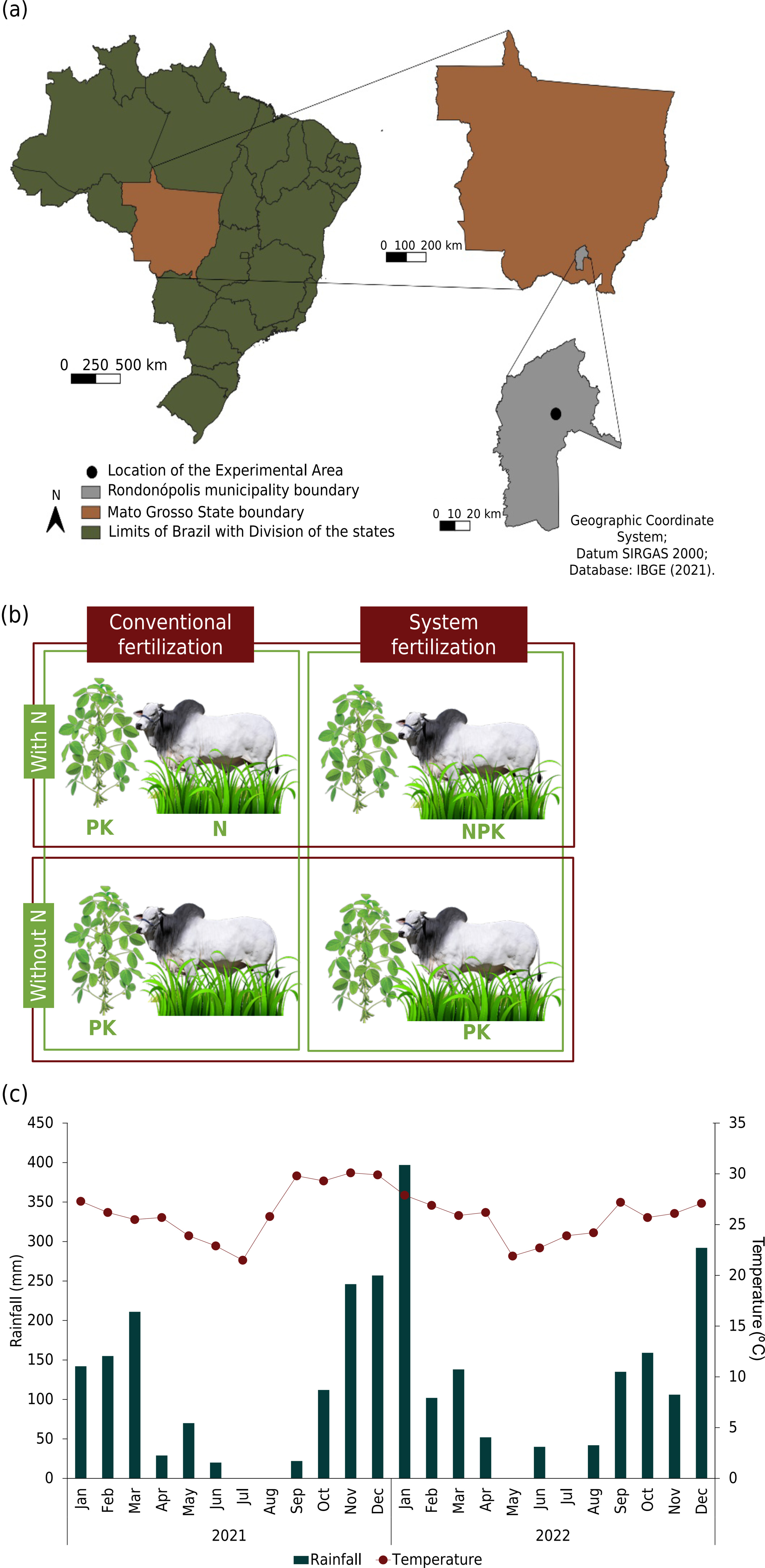
Experiment was managed in the Guarita Farm (16° 33’ 54” S, 54° 41’ 08” W), located in Rondonópolis, Mato Grosso State, Brazil, and began in 2019 with the pasture sowing. Climate of the region is tropical, characterized by a dry winter (Aw), according to the classification system of Köppen (Alvares et al., 2013), with a dry season (May to September) and a rainy season (October to April). Average annual air temperature and precipitation are 26.1 °C and 1436 mm, respectively (Figure 1c). Soil type is classified as Latossolo Vermelho distrófico (Santos et al., 2013), with a clayey texture (39 % of clay).

Location of the experimental area (a), representation of the treatments with different fertilization strategies in integrated crop-livestock system (b), and total rainfall (mm) and average temperature (°C) during the experimental period in 2021 and 2022, in Rondonópolis, Mato Grosso, Brazil. Adapted from Camargo et al. (2024).
Prior to the establishment of the experiment, the area (22.8 ha) was cultivated with soybean-corn succession for over 15 years. At the initiation of the experiment, soil physicochemical properties in the 0.00-0.20 m layer were characterized as follows: pH(CaCl2):5.5 (moderated), Ca2+ and Mg2+: 2.5 and 1.3 cmolc dm-3, respectively (adequate), CEC (Cation Exchange Capacity): 6.8 cmolc dm-3 (moderated), available K: 69.2 mg dm-3 (moderated), available P: 30.8 mg dm-3 (high), base saturation: 60 % (moderated), bulk density: 1.4 Mg m-3 (moderated). Soil properties were analyzed according to Tedesco et al. (1995), and interpreted according to Sousa and Lobato (2004). In addition, soil sampling was carried out for mineralogical characterization at 0.00-0.20 and 0.20-0.40 m (Table 1).
Content of total iron (Fe2O3), crystalline (Fed), low crystallinity (Feo), and the main minerals of the clay fraction in the surface layers of the soil
Experimental design and management
Experiment followed an ICLS, alternating soybean cultivation (Glycine max L.) during the summer season (October to February) and livestock phase with cattle grazing brachiaria (Urochloa brizantha cv. BRS Piatã) during the winter season (April to August). Soybean was planted with a row spacing of 0.50 m, and the cultivar used was Brasmax Foco 711I77 IPRO. Four fertilization strategies were tested: (1) Conventional fertilization, with P and K applied in soybean sowing (CF); (2) Conventional fertilization + N fertilization in the pasture (CF+N); (3) System fertilization, with P and K applied in pasture sowing (SF); and (4) System fertilization + N fertilization in the pasture (SF+N) (Figure 1). Treatments were distributed in randomized blocks with three replicates, totaling twelve experimental units, in an area of 22.8 ha, with each plot measuring 1.9 ha each.
Phosphate and potassium fertilization were calculated from an estimated soybean yield of 4.8 Mg ha-1. Thus, broadcast applications with 80 kg ha-1 of P2O5 and 80 kg ha-1 de K2O were applied annually (Sousa and Lobato, 2004), split into two applications: according to the treatments: half in the second harvest (on pasture sown – system fertilization) and half in the summer (on soybean sown – conventional fertilization). Nitrogen fertilization was applied to the pasture, only in the treatments that received N, at the dose of 100 kg ha-1 of N as ammonium nitrate.
Pasture sowing was carried out in March, following the soybean harvest, using a small grain seeder and a seeding rate of 8.8 kg ha-1 with cultural value of 68 %, to reach 6.0 kg ha-1 of pure viable seeds. Pasture grazing was conducted according to the “Rotatinuous” stocking methodology (Carvalho, 2013) in a continuous system with male Nelore cattle with an average weight of 262.0 ± 6.2 kg. Animals started grazing when the pasture reached an average height of 0.33 m, and were managed to maintain height between 0.24 and 0.40 m. Animals remained in the area between March and May due to the low rainfall and pasture production. There was regrowth of the pasture, and the animals remained in June and July, totaling an average of 65 days of grazing in the evaluation year (2022).
Analysis of forms and P legacy in the soil
In January 2022, after three years of experiment start, soil was sampled for P analysis during soybean flowering, in three layers: 0.00-0.05, 0.05-0.10, 0.10-0.20 m. All samplings were conducted on a single day to mitigate any potential environmental variations. Each sample was composed of five subsamples collected in a trench, using spatulas; the points for opening the trench were chosen randomly. Subsequently, the soil samples were air-dried, ground, and sieved (2 mm).
Soil P fractions were evaluated using the sequential chemical fractionation proposed by Gatiboni and Condron (2021). Total P content (Pt) was estimated by a soil subsample (0.1 g) digested with concentrated sulfuric acid and 37 % hydrogen peroxide in the presence of saturated magnesium chloride, following the method proposed by Olsen and Sommers (1982). Another subsample was used for the sequential chemical P fractionation. For this, 0.5 g of soil was sequentially extracted using 10 mL of Mehlich-3 extractant solution (P-M3; Mehlich, 1984), NaOH 0.5 mol L-1 (Pi+Po), and HCl (Pi-HCl), then shaken for 5, 30, and 30 min, respectively. Total P in NaOH extract was determined by digestion with sulfuric acid and ammonium persulfate in an autoclave at 121 °C. Phosphorus content in each extract was measured by the colorimetric method of Murphy and Riley (1962); and organic P in alkali extract (NaOH) was obtained by the difference between total P and inorganic P.
From the P fractionation data, occluded P and legacy P index were calculated. Occluded P was considered the difference of the total P and the sum of P extracted by Mehlich-3, 0.5 mol L-1 NaOH (Pi + Po), and 1.0 mol L-1 HCl (Equation 1).
To estimate the soil legacy P index (Equation 3), we considered 15 mg dm-3 as the critical level of P extracted by Mehlich-1 (Sousa and Lobato, 2004), and then, we converted this content into values equivalent to Mehlich-3 (Equation 2), according to Mumbach et al. (2018).
In which, P-M3eq is the equivalent value to Mehlich-3; P-M1 is the P content extracted by Mehlich-1; and clay is the soil clay content.
To calculate the P legacy index we considered the P extracted by Mehlich-3 as labile P, with 100 % of potential availability; the Pi and Po extracted by NaOH 0.5 mol L-1 and Pi extracted by HCl as moderately labile P, with 50 % of potential availability; and the occluded P as non-labile P, with only 10 % of potential availability.
Indicators of soil quality and soybean productivity
On the same day as soil sampling for P fractionation, samples were collected for physical and microbiological analysis; however, in layers 0.00-0.20 and 0.00-0.10 m, respectively. Microbiological properties assessed included Microbial Biomass Carbon (MB-C) and nitrogen (MB-N), which were evaluated following the methodology of Brookes et al. (1985) and Vance et al. (1987), with the soil extractor ratio 1:2.5 (Tate et al., 1988) and correction factor of 0.33 and 0.54 to C and N, respectively (Brookes et al., 1985; Sparling and West, 1988). Basal respiration was determined according to the methodology proposed by Jenkinson and Powlson (1976). Metabolic quotient (qCO2) was calculated by the ratio between basal respiration and MB-C (Anderson and Domcsh, 1993). β-glycosidase activity was performed according to Eivazi and Tabatabai (1988). Soil organic matter was evaluated according to Tedesco et al. (1995).
Physical analyses carried out were the weighted mean diameter (WMD) (Equation 4) and the geometric mean diameter (GMD) (Equation 5) of the aggregates, which were determined according to the equations described in Kemper and Rosenau (1986):
in which: xi is the mean diameter of aggregate classes in millimeters; and wi is the proportion of each class in relation to the total.
in which: wp is the weight of aggregates of each class in grams; xi is the mean diameter of aggregate classes in mm; and wi is the proportion of each class of aggregates in relation to the total.
Soybean grain yield was evaluated in 2021/2022. Grain yield was determined by harvesting the useful area, then converted to kg ha-1 at 130 g kg-1 moisture content.
Statistical analysis
Data normality was assessed by the Shapiro-Wilk test to verify normality, and the Bartlett test assessed variance homogeneity. Analysis of variance was applied, and where significant (p<0.05), means were compared by Tukey multiple comparison test (p<0.05). Statistical analyses were performed in R software.
Interaction and influence of fertilization strategies on P fractions, soil quality indicators, and crop yield were also evaluated by Principal Component Analysis (PCA). For this, the original data were normalized to zero mean and unitary variance (µ = 0, σ = 1) (Jeffers, 1978). The criteria of Hair et al. (2009) were adopted for choosing the number of components, based on variables with eigenvalues above 1.00 that synthesized an accumulated variance above 70 %. The PCA was processed using the Statistica 7.0 software.
RESULTS
The fractions of P in the soil were influenced by the fertilization strategies used in the ICLS, showing distinct behaviors across the evaluated soil layers (Figures 2 and 3). At the 0.00-0.05 m soil layer, the SF + N resulted in 47 % higher P content extracted by Mehlich-3 (labile P) compared with CF. Conversely, the CF+N strategy increased approximately 54 % the labile P content in the soil. At the 0.05-0.10 m, a higher value of labile P was verified under SF + N. No difference between fertilization strategies was observed at the 0.10-0.20 m for labile P (Figure 2a).

Phosphorus (P) content extracted by Mehlich-3 (a), total P (b), inorganic P (c), and organic P (d) extracted by NaOH 0.5 mol L-1 at 0.00-0.05, 0.05-0.10, and 0.10-0.20 m soil layer evaluated in an integrated crop-livestock system under different fertilization strategies in tropical soil. CF: conventional fertilization with P and K applied in soybean sowing; CF+N: conventional fertilization + N applied in soybean sowing; SF: system fertilization with P and K applied in pasture; SF+N: system fertilization + N applied in pasture. Different letters between bars indicate differences by Tukey test (5 %). ns: not significant.

Soil phosphorus (P) content extracted by HCl 1 mol L-1 (a), occluded P (b), legacy P index (c) and total organic carbon (TOC) (d) at 0.00-0.05, 0.05-0.10 and 0.10-0.20 m soil layer evaluated in integrated crop-livestock system under different fertilization strategies in tropical soil. CF: conventional fertilization with P and K applied in soybean sowing; CF+N: conventional fertilization + N applied in soybean sowing; SF: system fertilization with P and K applied in pasture; SF+N: system fertilization + N applied in pasture. Different letters between bars indicate differences by Tukey test (5 %). Ns: not significant.
Total P content was affected by fertilization strategies only at the 0.00-0.05 m layer The CF strategy presented the lowest total P content, with approximately 600 mg dm-3. The other strategies CF+N, SF and SF+N were up to 12 % superior to CF (Figure 2b). The NaOH-Pi contents were higher with SF, which increased 49 and 26 % at the 0.00-0.05 and 0.05-0.10 m, respectively, in relation to CF (Figure 2c). The NaOH-Po contents showed an opposite behavior, and differences were verified only at the 0.10-0.20 m soil, with higher contents under SF+N (32 % in relation to CF+N) (Figure 2d).
System fertilization + N resulted in higher P extracted by HCl, being 56 % higher compared with CF, ranging from 25.1 to 39.2 mg dm-3 at the 0.00-0.05 m layer. The same behavior was verified at the 0.10-0.20 m, with an increment of 26 % in relation to the CF (Figure 3a). Differences in occluded P were more accentuated, with SF+N resulting in 125 and 84 % higher occluded P compared with CF, at the 0.00-0.05 and 0.05-0.10 m, respectively (Figure 3b). Legacy P was influenced only at the 0.00-0.05 m layer, where the SF+N treatment was approximately 4.1 times greater than CF (Figure 3c). Different fertilization strategies affected the TOC in the three layers evaluated (Figure 3d). In all layers, the lowest TOC level was observed under CF. Otherwise, SF + N resulted in an increase of 37 % compared with CF at the 0.00-0.05 m. Similarly, at the 0.05-0.10 m, the alternative strategies to CF were superior (68 %), and at the 0.10-0.20 m layer, the system fertilization (SF and SF+N) increased the TOC by up to 92 % compared with CF.
Different fertilization strategies affected MBC and qCO2, which were superior under SF. The MBC in SF was 37 % higher than in CF+N. Otherwise, no difference between fertilization strategies were verified to MBN,β-glycosidase activity, aggregate stability, WMD and GMD (Table 2).
Soil quality indicators related to biological and physical properties in an integrated crop-livestock system under fertilization strategies in tropical soil
Soybean grain yield ranged from 3.3 to 3.8 Mg ha-1 in the 2021/2022 harvest, being affected by fertilization strategies (Figure 4). The SF+N showed 16 % higher yield than the CF. The SF and CF+N showed intermediate yields (Figure 4). The main components analysis presented 65.7 % of explanation (37.45 % in principal component 1, and 28.21 % in principal component 2) of the original variance of the data. The analysis showed the grouping in three distinct regions, according to the evaluated treatments, defining soil properties more associated with soybean yield. The variables P Mehlich-3, MBN, occluded P, TOC, β-glycosidase and soybean yield were highly related, all these variables were associated with SF+N. The MBC, organic P, HCl-P, total P, legacy P index, and WMD were closely linked to SF treatment (Figure 5).

Soybean grain yield at 2021/2022 harvest obtained in integrated crop-livestock system under different fertilization strategies in tropical soil. CF: conventional fertilization with P and K applied in soybean sowing; CF+N: conventional fertilization + N applied in soybean sowing; SF: system fertilization with P and K applied in pasture; SF+N: system fertilization + N applied in pasture. Different letters between bars indicate differences by Tukey's test (5 %).

Bipplot of principal components of the influence of fertilization strategies on the soil phosphorus (P) fractions, soil quality indicators, and soybean yield in an integrated crop-livestock system under fertilization strategies in tropical soil. Phosphorus content extracted by Mehlich-3 (P Melich-3), inorganic P extracted by NaOH (Inorganic P), organic P extracted by NaOH (Organic P), soybean Yield (Yield), Inorganic P extracted by HCl 1 mol L-1 (HCl-P), total organic carbon (TOC), mean weight diameter (MWD), microbial biomass carbon (MBC), microbial biomass nitrogen (MBN) and metabolic quotient (qCO2).
DISCUSSION
Interest in conservative management systems is growing. In this context, systems such as ICLS can contribute to plant and animal biomass production when managed with effective fertility practices. This, in turn, promotes an increase in SOM and P availability (Deiss et al., 2016; Bieluczyk et al., 2020; Carlos et al., 2020). It is important to highlight that P is one of the main nutrients that limit agricultural production in highly weathered soils, such as in the Brazilian Cerrado. Although the total P contents in these soils are high, often above 800 mg kg-1 in the 0.00-0.05 m layer (Figure 4b), the available amount is considerably low.
In our study with ICLS, system fertilization, associated or not with N fertilization, contributed to the increase of TOC (Figure 3d) and availability of P (Figure 4a), with a positive correlation between these variables (Figure 5). Similar results were observed by Yang et al. (2019) in a study evaluating the effect of SOM on the adsorption and desorption of P. The authors observed that the available P content increased as the SOM content increased. This may be associated with the negative charges of SOM functional groups (e.g., carboxyl, phenol), which can interact with positively charged minerals, as oxides of Fe and Al, reducing P adsorption (Liu et al., 1999; Yaghi and Hartikainen, 2013; Yan et al., 2016). This previous hypothesis is widely accepted, mainly due to the high amount of iron oxides in our soil (Table 1).
The highest available P values were verified in treatments with N fertilization, mainly when applied in pasture (system fertilization) (Figure 4a). This highlights the importance of N fertilization in pasture in ICLS, as it enhances pasture production and increases SOM content, potentially improving P use efficiency. In addition, N fertilization affects the soil chemical properties, microbial activity, and root characteristics, thereby affecting soil P dynamics (Touhami et al., 2022). The β-glycosidase enzyme, which is related to the C levels in the soil (Sobucki et al., 2021), and MBC play an important role in the degradation of SOM and plant residues, and this was confirmed by the relationship between these variables and the SOM in our study (Figure 5).
Among the soil quality properties analyzed, the physical ones (weighted and geometric mean diameter) showed no changes. These indicators are associated with the physical functions of the soil, including stability and support, habitat for biological activity, and water storage and filtration (Rabot et al., 2018). These results may be attributed to the duration of the experiment, as physical properties are often less sensitive than microbiological properties in detecting changes in management in the short term.
The higher qCO2 values observed in alternative strategies to conventional fertilization (Table 2) may be associated with increased microbial activity resulting from P and K fertilization, as reported by Denardin et al. (2022) and Pires et al. (2022). This greater activity may also be associated with the greater entry of SOM into the system, as shown by the MBC and TOC results.
Distribution of Pi extracted with NaOH 0.5 mol L-1 was also influenced by different fertilization strategies at the 0.00-0.05 and 0.05-0.10 m, demonstrating that CF without N addition reduced Pi content (Figure 3c). This fraction of Pi may consider the P bound to oxides of Fe and Al (Cross and Schlesinger, 1995), and it is classified as an intermediate lability, being accessed by plants with greater P uptake capacity (Guo and Yost, 1998; Gatiboni et al., 2007). Brachiaria is considered a high P-efficient crop due to its aggressive root system, increasing P cycling (Pavinato et al., 2024) and may be accessing these potentially available fractions of P. Otherwise, Po extracted with NaOH 0.5 mol L-1 is linked to stable organic matter in the soil, which is physically protected within aggregates (Cross and Schlesinger, 1995; Zamuner et al., 2008). As a result, the organic P is expected to be altered, especially in the more superficial layers of the soil. However, this was not verified in our study, probably due to climatic conditions of high temperature and humidity added to the agricultural activity in these soils, intensifying the mineralization-immobilization processes (Chen et al., 2003).
Relative to total P, it was verified that differences only occurred in the layer of 0.00-0.05 m (Figure 2c). High values of total P were already expected in this area due to the clayey texture, with predominance of kaolinite, hematite, goethite and gibbsite (Table 1). These minerals have a high capacity to adsorb P, especially iron and aluminum oxides (Vilar et al., 2010; Peluco et al., 2015). However, the total P contents observed in SF+N were up to 365 mg kg-1 higher compared with CF. Probably, these results are related to the higher root system in areas with system fertilization and N in the pasture, associated with the highest input of pasture residues and the highest stocking rate, as documented by Farias et al. (2020) in an experiment testing system fertilization in comparison with conventional fertilization, with N fertilization in the pasture. Moreover, the higher root system allows the plant to capture and absorb P from deep layers, increasing its availability in the surface layers (Lambers et al., 2008).
The legacy P index is an important result regarding reducing the use of phosphate fertilizers. This index is related to how many times the critical level for plants is accumulated in the soil in fractions potentially available for plants (Gatiboni and Condron, 2021). Withers et al. (2018) highlighted that one of the alternatives to improve the use of environmental resources while maintaining or increasing food production is to use soil legacy P. In this context, the excess P not removed by grains and meat is being accumulated in the soil in potentially plant-available forms (Gatiboni and Condron, 2021). This can be incorporated into fertilization strategies, both through the application of N in the pasture and with system fertilization. Furthermore, higher values of microbial activity were observed in this study (Table 2). This, combined with the diversity of crops in ICLS and the greater input of SOM, enhances the potential for utilizing legacy P from the soil.
Repositioning fertilization with P and K and applying N to the pasture contribute to increased soybean grain productivity (Figure 4). Some authors have linked this increase in productivity to the higher input of SOM into the system. Nitrogen fertilization enhances the biomass production of U. brizantha, accelerating C sequestration and improving soil quality, thus creating a favorable environment for soybean cultivation (Pires et al., 2022; Freitas et al., 2023; Camargo et al., 2024).
Higher soybean yield, P availability, and soil health indicators in areas with SF and SF+N (Figure 5) are important information to justify investments in management practices such as fertilization strategies in ICLS. Fertilization management in pastures increases forage production (Farias et al., 2020) and consequently, the root production (López-Mársico et al., 2015), resulting in improved soil quality and enabling nutrient availability for soybeans grown in succession, as P and K exports from meat are minimal (Alves et al., 2019). Simões et al. (2023) evaluated the system fertilization in different production systems and verified higher forage production and soybean yield in succession, compared with conventional fertilization. In this way, increasing P use efficiency and grain yield, without increasing the nutrient application, can be achieved by adjusting the application timing.
CONCLUSIONS
System fertilization strategy with reallocation of P and K from the crop phase to the pasture, associated with nitrogen fertilization of the pasture, results in higher soybean in ICLS (Integrated Crop-Livestock System). Higher soybean yields are associated with improved soil quality and total, inorganic, available and occluded P fractions. System fertilization and N application in the pasture increase the amounts of total P, organic P, inorganic P extracted by HCl and NaOH, and available P by Mehlich-3. Occluded P and the legacy of P in the soil are related to higher values of soil organic matter, weighted mean diameter, carbon, and particles of microbial biomass and β-glycosidase activity. Thus, system fertilization can be an alternative to enhance the P use efficiency and soil quality in ICLS in Brazilian Cerrado soil, guaranteeing higher soybean yield production per unit of input applied.
ACKNOWLEDGMENTS
The authors thank Agrisus through project No. 3049/21 and Yara Brasil through “Boa Colheita” Program for providing substantial financial support. We also thank CNPq for productivity grants and Capes for support with postgraduate grants, Fazenda Guarita for the area donated for the experiment, REM-MT and PRS Cerrado for partial financial support.
-
How to cite:
Pires GC, Gotz LF, Alves LA, Silva LS, Gama JP, Denardin LGO, Pavinato PS, Tiecher T, Carvalho PCF, Souza ED. Fertilization strategies to improve phosphorus availability and soil quality in integrated crop-livestock system in tropical soils. Rev Bras Cienc Solo. 2025;49nspe1:e0240164. https://doi.org/10.36783/18069657rbcs20240164
DATA AVAILABILITY
The data will be provided upon request.
REFERENCES
-
Alvares CA, Stape JL, Sentelhas PC, Gonçalves JLM, Sparovek G. Köppen’s climate classification map for Brazil. Meteorol Z. 2013;22:711-28. https://doi.org/10.1127/0941-2948/2013/0507
» https://doi.org/10.1127/0941-2948/2013/0507 -
Alves LA, Denardin LGO, Farias GD, Flores JPM, Fillippi D, Bremm C, Carvalho PCF, Martins AP, Gatiboni LC, Tiecher T. Fertilization strategies and liming in no-till integrated crop–livestock systems: Effects on phosphorus and potassium use efficiency. Rev Bras Cienc Solo. 2022;46:e0210125. https://doi.org/10.36783/18069657rbcs20210125
» https://doi.org/10.36783/18069657rbcs20210125 -
Alves LA, Denardin LGO, Martins AP, Anghinoni I, Carvalho PCF, Tiecher T. Soil acidification and P, K, Ca and Mg budget as affected by sheep grazing and crop rotation in a long-term integrated crop-livestock system in southern Brazil. Geoderma. 2019;351:197-208. https://doi.org/10.1016/j.geoderma.2019.04.036
» https://doi.org/10.1016/j.geoderma.2019.04.036 -
Anderson TH, Domsch KH. The metabolic quotient for CO2 (qCO2) as a specifc activity parameter to assess the efects of environmental conditions, such as pH, on the microbial biomass of forest soil. Soil Biol Biochem. 1993;25:393-5. https://doi.org/10.1016/0038-0717(93)90140-7
» https://doi.org/10.1016/0038-0717(93)90140-7 -
Assmann TS, Soares AB, Assmann AL, Levinski F, Correa R. Adubação de sistemas em integração lavoura-pecuária. In: I Congresso Brasileiro de Sistemas Integrados de Produção Agropecuária. IV Encontro de Integração Lavoura-Pecuária no Sul do Brasil - Palestras: intensificação com sustentabilidade; 2017. Cascavel, Paraná. Pato Branco: UTFPR Campus Pato Branco; 2017. p. 67-84. Available from: http://www.pb.utfpr.edu.br/coagr/eventos
» http://www.pb.utfpr.edu.br/coagr/eventos -
Ayarza M, Rao I, Vilela L, Lascano C, Vera-Infanzón R. Soil carbon accumulation in crop-livestock systems in acid soil savannas of South America: A review. Adv Agron. 2022;173:163-226. https://doi.org/10.1016/bs.agron.2022.02.003
» https://doi.org/10.1016/bs.agron.2022.02.003 -
Bieluczyk W, Piccolo MC, Pereira MG, Moraes MT, Soltangheisi A, Bernardi ACC, Pezzopane JRM, Oliveira PPA, Moreira MZ, Camargo PB, Dias CTS, Batista I, Cherubin MR. Integrated farming systems influence soil organic matter dynamics in southeastern Brazil. Geoderma. 2020;371:114368. https://doi.org/10.1016/j.geoderma.2020.114368
» https://doi.org/10.1016/j.geoderma.2020.114368 -
Brookes PC. Chloroform fumigation and the release of soil nitrogen. Soil Biol Biochem. 1985;17:837-42. https://doi.org/10.1016/0038-0717(85)90144-0
» https://doi.org/10.1016/0038-0717(85)90144-0 -
Camargo TA, Alves LA, Mendes IC, Gasques LR, Oliveira LGS, Pires GC, Almeida TO, Carvalho PCF, Souza ED. Enhancing soil quality and grain yields through fertilization strategies in integrated crop-livestock system under no-till in Brazilian Cerrado. Eur J Soil Biol. 2024;121:103613. https://doi.org/10.1016/j.ejsobi.2024.103613
» https://doi.org/10.1016/j.ejsobi.2024.103613 -
Carlos FS, Denardin LGO, Martins AP, Anghinoni I, Carvalho PCF, Rossi I, Buchain MP, Cereza T, Carmona FC, Camargo FAO. Integrated crop–livestock systems in lowlands increase the availability of nutrients to irrigated rice. Land Degrad Dev. 2020;31:2962-72. https://doi.org/10.1002/ldr.3653
» https://doi.org/10.1002/ldr.3653 -
Carvalho PCF. Harry Stobbs Memorial Lecture: Can grazing behavior support innovations in grassland management? Trop Grasslands. 2013;1:137-55. https://doi.org/10.17138/tgft(1)137-155
» https://doi.org/10.17138/tgft(1)137-155 -
Chen CR, Condron LM, Davis MR, Sherlock RR. Seazonal changes in soil phosphorus and associated microbial properties under adjacent grassland and forest in New Zealand. Forest Ecol Manag. 2003;177:539-57. https://doi.org/10.1016/S0378-1127(02)00450-4
» https://doi.org/10.1016/S0378-1127(02)00450-4 -
Cross AF, Schlesinger WH. A literature review and evaluation of the. Hedley fractionation: Applications to the biogeochemical cycle of soil phosphorus in natural ecosystems. Geoderma. 1995;64:197-214. https://doi.org/10.1016/0016-7061(94)00023-4
» https://doi.org/10.1016/0016-7061(94)00023-4 -
Deiss L, Moraes A, Dieckow J, Franzluebbers AJ, Gatiboni LC, Sassaki GL, Carvalho PCF. Soil phosphorus compounds in integrated crop-livestock systems of subtropical Brazil. Geoderma.2016;274:88-96. https://doi.org/10.1016/j.geoderma.2016.03.028
» https://doi.org/10.1016/j.geoderma.2016.03.028 -
Denardin LGO, Martins AP, Flores JPM, Alves LA, Pires CB, Machado DR, Anghinoni I, Carvalho PCF, Kuzyakov Y, Rice CW, Chabbi A. Fertilization effects on soil microbial composition and nutrient availability in integrated rice-livestock production systems. Appl Soil Ecol. 2022;174:104420. https://doi.org/10.1016/j.apsoil.2022.104420
» https://doi.org/10.1016/j.apsoil.2022.104420 -
Eivazi F, Tabatabai MA. Glucosidases and galactosidases in soils. Soil Biol Biochem. 1988;20:601-6. https://doi.org/10.1016/0038-0717(88)90141-1
» https://doi.org/10.1016/0038-0717(88)90141-1 -
Farias GD, Dubeux JCB, Savian JV, Duarte LP, Martins AP, Tiecher T, Alves LA, Carvalho PCF, Bremm C. Integrated crop-livestock system with system fertilization approach improves food production and resource-use efficiency in agricultural lands. Agron Sustain Dev. 2020;40:39. https://doi.org/10.1007/s13593-020-00643-2
» https://doi.org/10.1007/s13593-020-00643-2 -
Fink JR, Inda AV, Tiecher T, Barrón V. Iron oxides and organic matter on soil phosphorus availability. Cienc Agrotec. 2016;40:369-79. https://doi.org/10.1590/1413-70542016404023016
» https://doi.org/10.1590/1413-70542016404023016 -
Freitas CM, Yasuoka JI, Pires GC, Gama JP, Oliveira LGS, Davi JEA, Silva LS, Silva IAG, Bremm C, Carvalho PCF, Moraes A, Souza ED. System fertilization in the pasture phase enhances productivity in integrated crop–livestock systems. J Agric Sci. 2023;161:755-62. https://doi.org/10.1017/S0021859623000606
» https://doi.org/10.1017/S0021859623000606 -
Gatiboni LC, Condron LM. A rapid fractionation method for assessing key soil phosphorus parameters in agroecosystems. Geoderma. 2021;385:114893. https://doi.org/10.1016/j.geoderma.2020.114893
» https://doi.org/10.1016/j.geoderma.2020.114893 -
Gatiboni LC, Kaminski J, Rheinheimer DS, Flores JPC. Biodisponibilidade de formas de fósforo acumuladas em solo sob sistema plantio direto. Rev Bras Cienc Solo. 2007;31:691-9. https://doi.org/10.1590/S0100-06832007000400010
» https://doi.org/10.1590/S0100-06832007000400010 -
Guo F, Yost RS. Partitioning soil phosphorus into three discrete pools of differing availability. Soil Sci. 1998;163:822-33. https://doi.org/10.1097/00010694-199810000-00006
» https://doi.org/10.1097/00010694-199810000-00006 - Hair JR, Anderson RE, Tatham RL. Análise multivariada de dados. 6th ed. Porto Alegre: Bookman; 2009.
-
He H, Wu M, Guo L, Fan C, Zhang Z, Su R, Peng Q, Pang J, Lambers H. Release of tartrate as a major carboxylate by alfalfa (Medicago sativa L.) under phosphorus deficiency and the effect of soil nitrogen supply. Plant Soil. 2020;449:169-78. https://doi.org/10.1007/s11104-020-04481-9
» https://doi.org/10.1007/s11104-020-04481-9 - Jeffers JNR. An introduction to system analysis: With ecological applications. London: Edward Arnold; 1978.
-
Jenkinson DS, Powlson DS. The efects of biocidal treatments on metabolism in soil - I. Fumigation with chloroform. Soil Biol Biochem. 1976;8:167-77. https://doi.org/10.1016/0038-0717(76)90001-8
» https://doi.org/10.1016/0038-0717(76)90001-8 - Kemper WD, Rosenau RC. Aggregate stability and size distribution. In: Klute A, editor. Methods of soil analysis. 2nd ed. Madison: Agronomy Monograph; 1986. p. 425-42.
-
Lambers H, Raven JA, Shaver GR, Smith SE. Plant nutrient-acquisition strategies change with soil age. Trends Ecol Evol. 2008;23:95-103. https://doi.org/10.1016/j.tree.2007.10.008
» https://doi.org/10.1016/j.tree.2007.10.008 -
Lemaire G, Garnier J, Pontes LS, Carvalho PCF, Billen G, Assman TS. Domestic herbivores, the crucial trophic level for sustainable agriculture: Avenues for reconnecting livestock to cropping systems. Agronomy. 2023;13:982. https://doi.org/10.3390/agronomy13040982
» https://doi.org/10.3390/agronomy13040982 -
Leptin A, Whitehead D, Anderson CR, Cameron KC, Lehto NJ. Increased soil nitrogen supply enhances root-derived available soil carbon leading to reduced potential nitrification activity. Appl Soil Ecol. 2021;159:103842. https://doi.org/10.1016/j.apsoil.2020.103842
» https://doi.org/10.1016/j.apsoil.2020.103842 -
Liu F, He J, Colombo C, Violante A. Competitive adsorption of sulfate and oxalate on goethite in the absence or presence of phosphate. Soil Sci. 1999;164:180-9. https://doi.org/10.1097/00010694-199903000-00004
» https://doi.org/10.1097/00010694-199903000-00004 -
López-Mársico L, Altesor A, Oyarzabal M, Baldassini P, Paruelo JM. Grazing increases belowground biomass and net primary production in a temperate grassland. Plant Soil. 2015;392:155-62. https://doi.org/10.1007/s11104-015-2452-2
» https://doi.org/10.1007/s11104-015-2452-2 -
Mehlich A. Mehlich 3 soil test extractant: A modification of Mehlich 2 extractant. Commun Soil Sci Plant Anal. 1984;12:1409-16. https://doi.org/10.1080/00103628409367568.
» https://doi.org/10.1080/00103628409367568 -
Moraes A, Carvalho PCF, Luftosa SBC, Lang CR, Deiss L. Research on integrated crop-livestock systems in Brazil. Cienc Agron. 2014;45:1024-31. https://doi.org/10.1590/S1806-66902014000500018
» https://doi.org/10.1590/S1806-66902014000500018 -
Mumbach GL, Oliveira DA, Warmling MI, Gatiboni LC. Quantificação de fósforo por Mehlich 1, Mehlich 3 e Resina Trocadora de Ânions em solos com diferentes teores de argila. Rev Ceres. 2018;65:546-54. https://doi.org/10.1590/0034-737X201865060010
» https://doi.org/10.1590/0034-737X201865060010 -
Murphy J, Riley JP. A modified single solution method for the determination of phosphate in natural waters. Anal Chim Acta. 1962;27:31-6. https://doi.org/10.1016/S0003-2670(00)88444-5
» https://doi.org/10.1016/S0003-2670(00)88444-5 - Olsen SR, Sommers LE. Phosphorus methods of soil analysis. In: Page AL, Miller RH, Keeney QR, editors. Chemical and microbiological properties. Madison: Soil Science Society of America; 1982. p. 403-30.
-
Pavinato PS, Gotz LF, Teles APB, Arruda B, Herrera WB, Chadwick DR, Jones DL, Withers PJA. Legacy soil phosphorus bioavailability in tropical and temperate soils: Implications for sustainable crop production. Soil Till Res. 2024;244:106228. https://doi.org/10.1016/j.still.2024.106228
» https://doi.org/10.1016/j.still.2024.106228 -
Pavinato PS, Rocha GC, Cherubin MR, Harris I, Jones DL, Withers PJA. Map of total phosphorus content in native soils of Brazil. Sci Agric. 2021;78:e20200077. https://doi.org/10.1590/1678-992X-2020- 0077
» https://doi.org/10.1590/1678-992X-2020- 0077 -
Peluco RG, Marques Júnior J, Siqueira DS, Pereira GT, Barbosa RS, Teixeira DB. Mapeamento do fósforo adsorvido por meio da cor e da suscetibilidade magnética do solo. Pesq Agropec Bras. 2015;50:259-66. https://doi.org/10.1590/S0100-204X2015000300010
» https://doi.org/10.1590/S0100-204X2015000300010 -
Pires GC, Denardin LGO, Silva LS, Freitas CM, Gonçalves EC, Camargo TA, Bremm C, Carvalho PCF, Souza ED. System fertilization increases soybean yield through soil quality improvements in integrated crop‑livestock system in tropical soils. J Soil Sci Plant Nutr. 2022;22:4487-95. https://doi.org/10.1007/s42729-022-01050-0
» https://doi.org/10.1007/s42729-022-01050-0 -
Rabot E, Wiesmeier M, Schlüter S, Voegel H-J. Soil structure as an indicator of soil functions: a review. Geoderma. 2018;314:122-37. https://doi.org/10.1016/j.geoderma.2017.11.009
» https://doi.org/10.1016/j.geoderma.2017.11.009 - Santos HG, Jacomine PKT, Anjos LHC, Oliveira VA, Lumbreras JF, Coelho MR, Almeida JA, Cunha TJF, Oliveira JB. Sistema brasileiro de classificação de solos: Embrapa, Brasília, DF; 2013.
-
Simões VJLP, Souza ES, Martins AP, Tiecher T, Bremm C, Ramos JS, Farias GD, Carvalho PCF. Structural soil quality and system fertilization efficiency in integrated crop-livestock system. Agr Ecosyst Environ. 2023;349:108453. https://doi.org/10.1016/j.agee.2023.108453
» https://doi.org/10.1016/j.agee.2023.108453 -
Sobucki L, Ramos RF, Meireles LA, Antoniolli ZI, Jacques RJS. Contribution of enzymes to soil quality and the evolution of research in Brazil. Rev Bras Cienc Solo. 2021;45:e0210109. https://doi.org/10.36783/18069657rbcs20210109
» https://doi.org/10.36783/18069657rbcs20210109 - Sousa DMG, Lobato E. Cerrado: Correção do solo e adubação. 2nd. ed. Brasília, DF: Embrapa Informação Tecnológica; 2004.
-
Sparling GP, West W. A direct extraction method to estimate soil microbial C: calibration in situ using microbial respiration and 14C-labeled cells. Soil Biol Biochem. 1988;20:337-43. https://doi.org/10.1016/0038-0717(88)90014-4
» https://doi.org/10.1016/0038-0717(88)90014-4 -
Tate KR, Ross DJ, Feltham CW. A direct extraction method to estimate soil microbial C: Effects of experimental variables and some different calibration procedures. Soil Biol Biochem. 1988;20:329-35. https://doi.org/10.1016/0038-0717(88)90013-2
» https://doi.org/10.1016/0038-0717(88)90013-2 - Tedesco MJ, Gianello C, Bissani CA, Bohnen H, Volkweiss SJ. Análises de solo, plantas e outros materiais. 2. ed. Porto Alegre: Universidade Federal do Rio Grande do Sul; 1995. (Boletim técnico, 5).
-
Touhami D, McDowell RW, Condron LM, Bouray M. Nitrogen fertilization effects on soil phosphorus dynamics under a grass-pasture system. Nutr Cycl Agroecosys. 2022;124:227-46. https://doi.org/10.1007/s10705-021-10191-0
» https://doi.org/10.1007/s10705-021-10191-0 -
United Nations. Our growing population; 2022 [cited 2022 Dec 20]. Available from: https://www.un.org/en/global-issues/population
» https://www.un.org/en/global-issues/population -
Vance ED, Brookes PC, Jenkinson DS. An extraction method for measuring soil microbial biomass C. Soil Biol Biochem. 1987;19:703-7. https://doi.org/10.1016/0038-0717(87)90052-6
» https://doi.org/10.1016/0038-0717(87)90052-6 -
Vilar CC, Costa ACS, Hoepers A, Souza Junior IG. Capacidade máxima de adsorção de fósforo relacionada a formas de ferro e alumínio em solos subtropicais. Rev Bras Cienc Solo. 2010;34:1059-68. https://doi.org/10.1590/S0100-06832010000400006
» https://doi.org/10.1590/S0100-06832010000400006 -
Withers PJA, Rodrigues M, Soltangheisi A, Carvalho TS, Guilherme LRG, Benites VM, Gatiboni LC, Sousa DMG, Nunes RS, Rosolem CA, Andreote FD, Oliveira A, Coutinho ELM, Pavinato PS. Transitions to sustainable management of phosphorus in Brazilian agriculture. Sci Rep-UK. 2018;8:2537. https://doi.org/10.1038/s41598-018-20887-z
» https://doi.org/10.1038/s41598-018-20887-z -
Xu XL, Mao XL, Van Zwieten L, Niazi NK, Lu KP, Bolan NS, Wang HL. Wetting-drying cycles during a rice-wheat crop rotation rapidly (im)mobilize recalcitrant soil phosphorus. J Soil Sediment. 2020;20:3921-30. https://doi.org/10.1007/s11368-020-02712-1
» https://doi.org/10.1007/s11368-020-02712-1 -
Yaghi N, Hartikainen H. Enhancement of phosphorus sorption onto light expanded clay aggregates by means of aluminum and iron oxide coatings. Chemosphere. 2013;93:1879-86. https://doi.org/10.1016/j.chemosphere.2013.06.059
» https://doi.org/10.1016/j.chemosphere.2013.06.059 -
Yan J, Jiang T, Yao Y, Lu S, Wang Q, Wei S. Preliminary investigation of phosphorus adsorption onto two types of iron oxide-organic matter complexes. J Environ Sci. 2016;42:152-62. https://doi.org/10.1016/j.jes.2015.08.008
» https://doi.org/10.1016/j.jes.2015.08.008 -
Yan X, Wang D, Zhang H, Zhang G, Wei Z. Organic amendments affect phosphorus sorption characteristics in a paddy soil. Agr Ecosyst Environ. 2013;175:47-53. https://doi.org/10.1016/j.agee.2013.05.009
» https://doi.org/10.1016/j.agee.2013.05.009 -
Yang X, Chen X, Yang X. Effect of organic matter on phosphorus adsorption and desorption in a black soil from Northeast China. Soil Till Res. 2019;187:85-91. https://doi.org/10.1016/j.still.2018.11.016
» https://doi.org/10.1016/j.still.2018.11.016 -
Zamuner EC, Picone LI, Echeverria HE. Organic and inorganic phosphorus in Mollisol soil under different tillage practices. Soil Till Res. 2008;99:131-8. https://doi.org/10.1016/j.still.2007.12.006
» https://doi.org/10.1016/j.still.2007.12.006 -
Zhang S, Huffman T, Zhang X, Liu W, Liu Z. Spatial distribution of soil nutrient at depth in black soil of Northeast China: A case study of soil available phosphorus and total phosphorus. J Soil Sediment. 2014;14:1775-89. https://doi.org/10.5601/jelem.2022.27.3.2319
» https://doi.org/10.5601/jelem.2022.27.3.2319
Edited by
-
Editors:
Luciano Colpo Gatiboni https://orcid.org/0000-0001-8724-3600 and Jimmy Walter Rasche Alvarez https://orcid.org/0000-0002-2517-6868