 Anthropic soils in SiBCS and WRB: Review of criteria and conceptualization of the Anthropic horizon
ABSTRACT
The diagnostic anthropic A horizon in the Brazilian Soil Classification System (SiBCS) and the Pretic horizon in the World Reference Base for Soil Resources (WRB) comprise the surface mineral genetic horizons of soils formed under strong influence of original indigenous communities for a long time, notably in Brazil those known as Terras Pretas de Índio (TPI) or Amazonian Dark Earths (ADE). The surface horizons of these soils in Brazil are characterized by ceramic artifacts, charcoal, dark colors, and higher levels of carbon, calcium, magnesium, and phosphorus than the adjacent soils. This study aimed to propose additional quantitative criteria for the anthropic A horizon in the SiBCS and contribute to the Pretic horizon and Pretic Anthrosols in the WRB. A database of many studies on these soils was compiled, including morphological, physical, and chemical diagnostic characteristics of horizons classified as anthropic (Au) in anthropized soils. The following data was used to identify and differentiate these horizons: thickness, color (value and chroma), pH(H2O), calcium (Ca2+), magnesium (Mg2+), sum of bases (SB), cation exchange capacity (CEC), base saturation (V), available phosphorus (P – Mehlich-1 extractant), and organic carbon (Corg). For SiBCS, it is suggested to define the diagnostic anthropic A horizon based on a limit of organic carbon content (Corg) greater than or equal to 6.0 g kg-1 and a color with value ≤4 and chroma ≤3; to create the “anthropic character” for surface mineral diagnostic horizons with expressive anthropic modifications that do not meet the quantitative criteria of thickness, color, P, and Corg for the diagnostic anthropic A horizon; and to define a criteria of “anthric properties”, to be used in soils in which the surface mineral diagnostic horizons show recent and significant modifications due to agricultural and/or other activities, meeting a P content (Mehlich-1 extractant) ≥30 mg kg-1 and V ≥50 %, abrupt transition from the surface horizon to the subsequent one, and/or absence of transitional horizons AB and/or BA. In the WRB system, it is proposed that the Pretic horizon should maintain the P content (Mehlich-1 extractant) ≥30 mg kg-1, and in the Pretic Anthrosols class, to reduce the combined thickness of Pretic sub horizons to ≥0.30 m (0.30 m) within 1.00 m (1.00 m) of the mineral soil surface.
Keywords
SiBCS quantitative criteria; Amazonian Dark Earths; Pretic horizon; Pretic Anthrosol
INTRODUCTION
Soils with horizons formed or modified by intense human activity occur in various regions of Brazil; however, they have been mainly reported in the Amazon, where they are identified as Terras Pretas de Índio (TPI) and internationally as Amazonian Dark Earths (ADEs) (IUSS Working Group WRB, 2015, 2022). Dating indicates their formation between 2,500 and 500 years before present (Neves et al., 2004), and they occur mostly in ancient human occupation sites, usually near rivers and watercourses (Kern and Kämpf, 1989; Kern et al., 2003; Kämpf and Kern, 2005; Woods et al., 2009; Schmidt et al., 2014).
The term TPI originated from the identification of soils containing ceramic artifacts, dark colors, and high nutrient contents in surface horizons. Compared to adjacent soils, these soils present higher pH(H₂O), calcium (Ca²⁺), magnesium (Mg²⁺), and available phosphorus (P), as well as higher zinc (Zn), manganese (Mn), and barium (Ba) contents, along with higher cation exchange capacity (CEC) and base saturation (V) (Kämpf and Kern, 2005; Glaser, 2007; Cunha et al., 2009a). The dark coloration is due to pigmentation from carbonized organic matter, such as charcoal, while the high CEC results from carbon structures of high stability and a large number of negative charges (Liang et al., 2006; Cunha et al., 2009b; Fontana et al., 2017).
A proposal for a classification structure for the Amazonian Dark Earths and other ancient anthropic soils was presented by Kämpf et al. (2003), designed to address the combined needs of scientists from different fields interested in the identification and data ordering of ADEs and other ancient anthropic soils. The author´s classification prioritizes and emphasizes soil properties influenced by ancient humans, their surroundings and history, and subsequent pedogenesis. They present their classification as a new, independent formal soil classification system and highlight the limited knowledge of these ancient anthropic soils. As a final statement in the document: “The authors hope that in time formal soil classification systems will be adequate for a proper distinction of the variety of Amazonian Dark Earths and other ancient anthropic soils”.
However, the ADEs are identified only by the anthropic A surface diagnostic horizon placed in some soil classes at the subgroup level of the Brazilian Soil Classification System – SiBCS (Santos et al., 2025), which encompasses horizons intensively modified by human (anthropic) influence in the past. Although this horizon has been part of SiBCS since its first edition in 1999 (Embrapa, 1999), its definition was slightly modified in later editions, with the criteria remaining predominantly qualitative (Santos et al., 2006, 2013).
In the 2018 edition of SiBCS (Santos et al., 2018), based on the study of Cordeiro et al. (2017), quantitative criteria for thickness and available P (Mehlich-1 extractant) were included. In the most recent edition of the SiBCS (Santos et al., 2025), the anthropic A horizon is defined as:
Formed or modified by humans through prolonged use, whether as a dwelling, disposal, or cultivation site, showing evidence of additions of organic and/or mineral materials of varied nature, with the presence of ceramic artifacts and/or shells, mixed or not with lithic artifacts, bones, or traces of fire (charcoal and ashes). The anthropic A horizon (including intermediate horizons AB, AE, and AC), in addition to one or more of the above-mentioned evidences of past human activity, must meet the following quantitative requirements: (a) thickness ≥20 cm, continuous or cumulative, within the first 80 cm from the soil surface; (b) available phosphorus (Mehlich-1 extractant) ≥30 mg kg -1
(Santos et al., 2025, p. 63).
In the World Reference Base for Soil Resources (WRB) system (IUSS Working Group WRB, 2015, 2022), the anthropic horizons of the ADEs are identified as Pretic horizon if they meet some diagnostic criteria. The name of the Pretic horizon derives from the Portuguese word preto (black), referring to the dark color of the surface horizon, and it is qualitatively defined as following:
… is a mineral surface horizon that results from human activities with the addition of black carbon, especially charcoal. It is characterized by its dark colour, usually the presence of artefacts (ceramic fragments, lithic instruments, bone or shell tools etc.) and high contents of organic carbon, phosphorus, calcium, magnesium and micronutrients (mainly zinc and manganese), usually contrasting with natural soils in the surrounding area. It contains remnants of black carbon, which may be recognized visually or by chemical analyses
(IUSS Working Group WRB, 2022, p. 62-63).
Soils with Pretic horizons are widespread in the Amazon Basin, where they are the result of original indigenous communities’ activities, and the soil characteristics resulting from anthropic changes (Lombardo et al., 2022) have persisted over many centuries despite the prevailing humid tropical conditions, which generally lead to high organic matter mineralization rates. In the WRB, soils with a Pretic horizon are associated with the ‘Terra Preta de Indio’ or ‘Amazonian Dark Earths’, and their high organic carbon stocks and the common occurrence of low-activity clays are highlighted.
Regarding diagnostic criteria in the WRB (IUSS Working Group WRB, 2022), the Pretic horizon is defined as:
…a surface horizon consisting of mineral material and has:
1. a Munsell color value ≤4 and chroma ≤3, both moist; and
2. ≥0.6 % (6.0 g kg - ¹) soil organic carbon; and
3. exchangeable Ca plus Mg (by 1 M NH₄OAc, pH 7) of ≥1.0 cmol c kg - ¹ fine earth; and
4. ≥100 mg kg - ¹ P in the Mehlich-3 extract; and
5. one or more of the following subitems: (a) visible black carbon ≥1 % (by exposed area relative to fine earth); or (b) both: i. black carbon ≥0.3 % determined by chemical analysis; and ii. a ratio between carbon belonging to molecules of black carbon and total organic carbon of ≥0.15, determined by chemical analyses;
and
6. one or more layers with a combined thickness ≥20 cm
( IUSS Working Group WRB, 2022 , p. 63)
Also, in the WRB, one of the criteria for defining the Anthrosols reference group is - “a pretic horizon, the layers of which have a combined thickness of ≥50 cm, within 100 cm of the mineral soil surface”. ( IUSS Working Group WRB, 2022 , p. 96).
The premise of this study is that the current quantitative criteria for identifying the anthropic A horizon (SiBCS), as well as the Pretic horizon and Pretic Anthrosols (WRB), require revision to better represent soils identified as ADE in Brazil. This study aimed to validate and propose additional quantitative criteria for the anthropic A horizon in the SiBCS and contribute to the Pretic horizon and Pretic Anthrosols in the WRB, based on results of Brazilian research compiled in a comprehensive database.
MATERIALS AND METHODS
Survey and selection of Anthropic soil studies
For the data collection and review of studies on anthropic soils, the following search terms were defined: Terra Preta de Índio, Amazonian Soils, Anthropic Soils, Anthropic A Horizon, Pretic Horizon, Amazonian Dark Earth, TPI, ADE, Prehistoric Human Occupation, Pre-Columbian Population, Anthrosols, Anthropic Soil Characteristics, Black Carbon, Pedoarchaeology, Anthropogenesis, Anthropic Soil Profile, and Pre-Columbian Settlements.
The search was limited to publications in Portuguese and English from 1970 to 2019. Web searches were conducted using the following platforms: Google Scholar, CAPES Journal Portal, ScienceDirect, SpringerLink, Scielo, ERIC, Science.gov, and Science Research. The scientific papers, books, book chapters, reviews, and reports found in each platform were included in the database.
A total of 84 studies were obtained and classified into two categories: (i) publications with complete soil profile data: including physical and chemical properties, and morphological characteristics of soils with an anthropic A horizon, which were used for database construction; (ii) related documents without full datasets containing relevant contextual information for this study.
Organization of the Anthropic soil database in a spreadsheet
Twenty-three publications with complete datasets were identified, totaling 104 fully described profiles characterized by genetic anthropic horizons, designated as “Au”, according to the Manual for Soil Description and Sampling in the Field (Santos et al., 2015). Soils sampled by layers and not horizons were excluded. Analytical data were verified according to the methodology adopted in the SiBCS, and were also discarded profiles using analytical methods different from those described in Teixeira et al. (2017). The information was entered into a spreadsheet containing general descriptions, morphological characteristics, and physical, chemical, and mineralogical properties.
The general description included latitude and longitude, landscape position, slope, vegetation cover, elevation, lithology, geological formation, chronology, parent material, local and regional relief, erosion, drainage, primary vegetation, current land use, and climate.
Morphological descriptions comprised horizon nomenclature, upper and lower depth limits, color, textural class, structure, and dry, moist, and wet consistencies. Physical data included particle-size distribution (coarse sand, fine sand, silt, and clay), water-dispersed clay, flocculation degree, silt/clay ratio, bulk density, particle density, and porosity. Chemical data included pH(H₂O and KCl), exchange complex (Ca²⁺, Mg²⁺, K⁺, Na⁺, Al³⁺, H⁺), available phosphorus (Mehlich-1 extractant), sum of bases (SB), cation exchange capacity (CEC), base saturation (V), organic carbon (Corg), nitrogen (N), sulfuric attack (SiO₂, Al₂O₃, Fe₂O₃, TiO₂, P₂O₅, MnO, Ki, and Kr), Fe and Al extracted by acid ammonium oxalate and dithionite-citrate-bicarbonate methods. Details on morphological descriptions and sampling are available in Santos et al. (2015), and analytical methods are available in Teixeira et al. (2017).
Due to differences in measurement units, harmonization was required to convert percentage values (%) to g kg-1 and milliequivalents per 100 mL to cmolc kg-1. It was also found that some chemical properties were expressed using different bases, i.e., volumetric (cmolc dm-3) versus gravimetric (cmolc kg-1). Therefore, volumetric data were converted to gravimetric values using a pedotransfer function (Cordeiro et al., 2020).
Analysis of diagnostic characteristics and definition of criteria for the Anthropic and Pretic Horizons
The characteristics established in the last and current versions of SiBCS (Santos et al., 2018, 2025) for the Anthropic horizon were evaluated, such as thickness and available P (Mehlich-1 extractant), as well as additional ones proposed in this study for inclusion, namely organic carbon and color (value and chroma), which are key indicators for identifying TPIs or ADEs. In this study, the Pretic horizon, the limit value of P, the extractant method, and the combined thickness were considered to define the Pretic Anthrosols (IUSS Working Group WRB, 2022).
Data evaluation and pattern identification for the distribution of Athropic A horizon characteristics were performed using simple data dispersion (trend and range), measures of central tendency (mean, mode, or median), and/or frequency distribution analysis. Subsequently, the horizons and profiles were classified according to the SiBCS (Santos et al., 2025) and WRB (IUSS Working Group, 2022), followed by reclassification based on the proposed criteria for both soil classification systems.
RESULTS AND DISCUSSION
Soil classes with Anthropic horizon and morphological characteristics
In the previous and current editions of SiBCS (Santos et al., 2018, 2025), the presence of a surface diagnostic Anthropic A horizon is used as a criterion to differentiate classes at the 4th (subgroup) or 5th (family) categorical levels. Therefore, different soil orders present this type of surface horizon.
Among the 104 profiles analyzed, at the suborder level of the SiBCS, the most frequent classes where anthropic horizons are considered are the Argissolos Acinzentados, Vermelhos, Vermelho-Amarelos, and Amarelos, and the Latossolos Vermelho-Amarelos and Amarelos (Figure 1). However, anthropic horizons are also included in Cambissolos Flúvicos and Háplicos; Neossolos Litólicos, Regolíticos, Quartzarênicos and Flúvicos; Gleissolos Háplicos; Plintossolos Pétricos and Argilúvicos; and Luvissolos Crômicos.

Profiles of Brazilian soils with Anthropic A horizons, from left to right, in the states of Maranhão, Roraima, Rondônia and Amazonas (Photos from A. Fontana).
The upper boundary of Anthropic A horizons of soils in the database ranged from 0.00 to 1.64 m, and the lower boundary from 0.03 to 2.00 m (Figure 2; Table 1). The vast majority (approximately 84 %) began within the upper 0.50 m of the profile, and a smaller portion (about 12 %) between 0.50 and 1.00 m depth. For the lower limit, most horizons ended within 0.50 m depth (65 %), with about 25 % between 0.50 and 1.00 m. Regarding their position in the profile, buried anthropic A horizons (designated as Aup) were identified in 15 profiles. It is therefore proposed that the description of the Anthropic A horizon should include the indication that they may or may not begin at the soil surface, different from other mineral surface diagnostic horizons in the SiBCS.

Initial and final depths, thickness, value, and chroma of Anthropic horizons of Brazilian soils
The minimum thickness of horizons identified as Anthropic in the database was 0.08 m, and the maximum was 2.00 m (including transitional horizons), with most diagnostic surface horizons less than 1.00 m thick (Figure 3; Table 1). The average thickness was approximately 0.59 m, and the median 0.55 m, with only three horizons thinner than 0.20 m.
About 97% of the profiles in the database had Anthropic A horizons with combined thicknesses (sum of all subhorizons) ≥0.20 m. This value matches previous findings from the same dataset (Cordeiro et al., 2017) and corroborates the criterion adopted in the last two SiBCS editions (Santos et al., 2018, 2025). Moreover, the same minimum thickness is used as a criterion for the Pretic horizon in the WRB (IUSS Working Group WRB, 2022).
The hues of the Anthropic A horizons ranged from 2.5YR to 5Y, with the vast majority showing hue 10YR, followed by 7.5YR, 5YR, and a few with 2.5Y and 5Y. The value and chroma (moist) were predominantly ≤4 (92 % of horizons) and ≤3 (94 %), respectively (Figure 4).


The predominance of low value and chroma reflects the dark color typical of these horizons, due to their high organic matter content and the presence of carbonized material from various plant sources. The accumulation of organic matter in these soils is attributed to original indigenous communities’ activities for a long time, especially with the use of fire, which transformed organic biomass into charcoal (black carbon) (Glaser and Amelung, 2003; Cunha et al., 2009b; Teixeira et al., 2009; Lombardo et al., 2022). Carbonized organic matter is recalcitrant and contains pigmenting properties that produce a black color (Liang et al., 2006). When Anthropic A horizons display higher values and chroma (i.e., lighter colors), this may indicate areas with lower pyrogenic carbon content, resulting from reduced fire use by original populations or a short period of site occupation (Liang et al., 2006).
Regarding color, neither the previous nor the current editions of SiBCS (Santos et al., 2018, 2025) include color as a criterion for defining the Anthropic A horizon; even though this is a distinctive feature for identifying and naming these soils in the Amazon. In contrast, the WRB applies a color criterion for the Pretic horizon (value ≤4 and chroma ≤3, moist) (IUSS Working Group WRB, 2022). Therefore, it is suggested that color (value and chroma) be incorporated into the definition of the Anthropic A horizon in SiBCS, as the dark color is a fundamental characteristic for defining ADEs, as mentioned by Kämpf et al. (2003).
Grain size and chemical properties
In the particle-size distribution of the anthropic A horizons, the sand fraction stands out, with a mean and median of 429 and 420 g kg-1, respectively, and minimum and maximum values of 30 and 930 g kg-1, with fine and coarse sand being approximately equivalent. The clay fraction has a mean and median of 293 and 270 g kg-1, respectively, with minimum and maximum values of 40 and 765 g kg-1 (Table 2). The silt fraction shows a mean and median of 281 and 248 g kg-1, respectively, with a minimum of 10 g kg-1 and a maximum of 885 g kg-1 (Table 2).
The large variation in particle-size fractions results from the predominant occupation of sites near water streams, floodplains, adjacent bluffs, and interior upland soils, and across different soil types (Kämpf et al., 2003; Miranda, 2018). Although particle-size distribution is an important criterion for defining diagnostic horizons in the SiBCS (e.g., B textural – textural gradient and B latossólico – minimum clay content), it is not relevant as a criterion for the anthropic A horizon. According to Lima (2001) and Corrêa (2007), in addition to high variability, the particle-size fractions are not different from the surrounding soils without the anthropic horizon.
However, in some profiles with anthropic horizons, AM01 from the XV RCC of 2025 (Oliveira et al., 2025) and RO-08 from the XII RCC of 2018 (Oliveira et al., 2019), the textural gradient seems to be augmented in these soils. One hypothesis is that the increase in sand fraction of the anthropic horizon occurs mainly due to the effect of fire in clay particles - vitrification, forming larger particles, and the presence of sand-size ceramic fragments (Teixeira and Martins, 2004), and is also intensified by the process of argilluviation (Macedo et al., 2017).
The pH(H₂O) values of the Anthropic A horizons are mostly above 5.0, with a mean and median of 5.7, and minimum and maximum values of 3.7 and 7.9, respectively (Table 3). Aluminum (Al³⁺) content ranges from 0.0 to 5.5 cmolc kg-1, but Al³⁺ generally contributes little to the cation exchange complex (Table 3). This is a favorable characteristic of ADEs, as Al³⁺ can limit root growth and plant productivity.
The pH and Al³⁺ contents of Anthropic A horizons differ from non-anthropic soils in the Amazon (Lima, 2001; Lehmann et al., 2003; Kämpf and Kern, 2005; Corrêa, 2007; Glaser, 2007; Cunha et al., 2009a; Campos et al., 2011). The lower acidity of anthropic horizons is directly related to the addition of carbonaceous materials, mainly ashes, which contain alkaline components such as calcium carbonate, calcium hydroxides, calcium sulfate, iron and magnesium salts, and sodium and potassium carbonates and hydroxides (Woods et al., 2009).
It is known that the high rainfall and intense biological activity favor rapid decomposition of organic matter and leaching of exchangeable bases such as Ca²⁺, Mg²⁺, and K⁺ (Echart and Cavalli-Molina, 2001). However, the high Ca²⁺ and Mg²⁺ contents found in anthropic soils such as the ADEs are linked to the addition of bones, ashes, and residues rich in these elements, and the pyrogenic carbon (Lima, 2001; Madari et al., 2009; Teixeira et al., 2009; Schmidt, 2013; Schaefer et al., 2017).
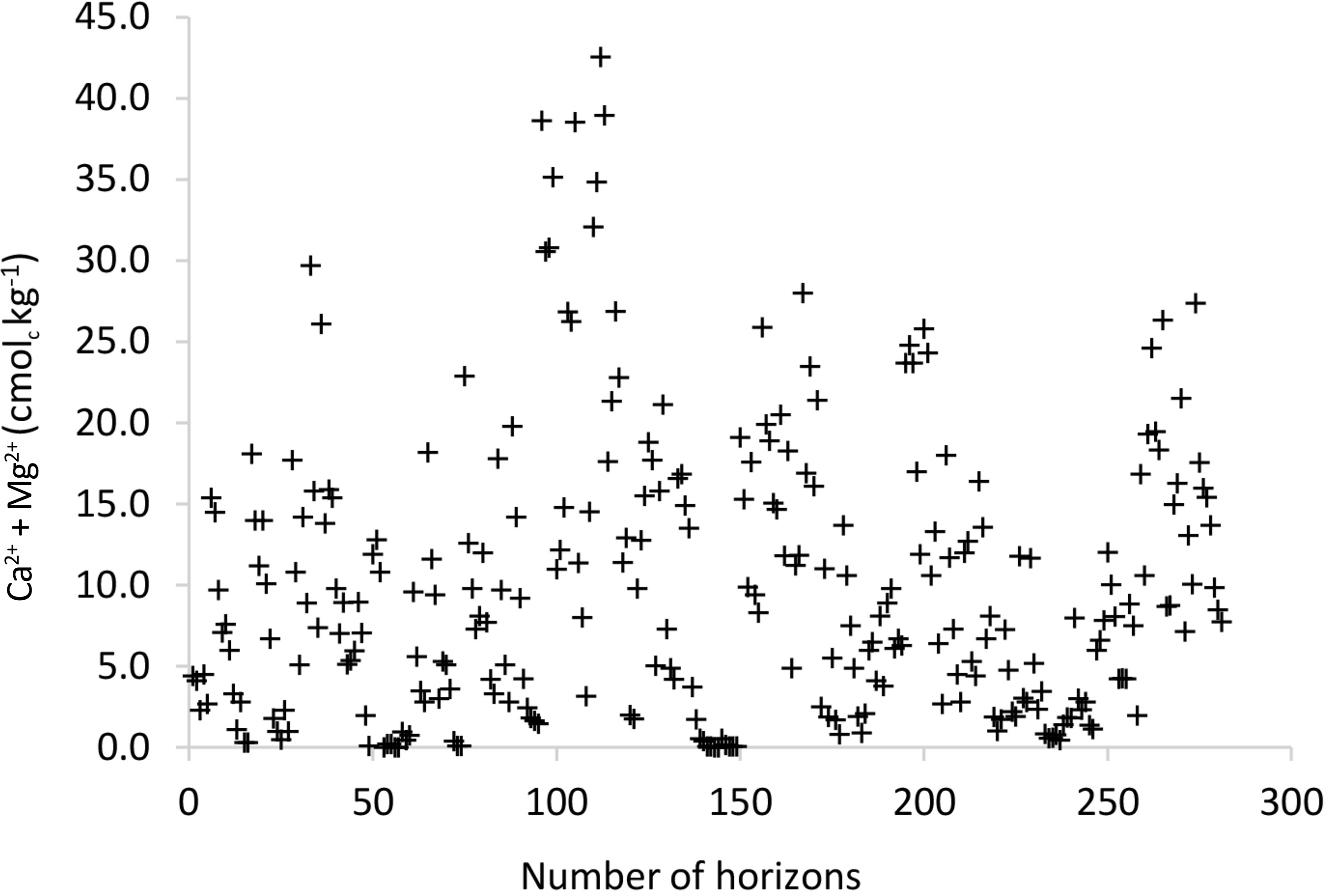
In the profiles identified as having Anthropic A horizon in the database, the Ca²⁺ and Mg²⁺ contents show a wide range, varying from 0.0 to 42.5 cmolc kg-1, with a mean of 9.9 cmolc kg-1 and a median of 8.1 cmolc kg-1 (Table 3). Most Anthropic A horizons have Ca²⁺ + Mg²⁺ contents ≥1.0 cmolc kg-1 (Figure 6), which is the minimum value required to define the Pretic horizon in the WRB (IUSS Working Group WRB, 2022).
In general, Anthropic A horizons with low Ca²⁺ and Mg²⁺ contents are associated with sandy textures (over 70 % sand) (Corrêa, 2007; Martins et al., 2007). These elements may have been removed over time due to agricultural cultivation at the present, leaching, or lower initial additions in areas where the anthropic horizons formed, possibly due to less intense or brief time of human occupation. Therefore, it is not recommended to incorporate this property as a criterion for the Anthropic A horizon in the SiBCS, and in the Pretic horizon of WRB.

Given the high levels of cations in the exchange complex, particularly Ca²⁺ and Mg²⁺, the sum of bases (SB) values ranged from 0.0 to 43.0 cmolc kg-1, with a mean of 10.1 cmolc kg-1 and a median of 8.1 cmolc kg-1 (Table 3). Few horizons presented an SB value below the detection limit of the methods used to measure the bases (0.0 cmolc kg-1), as reported by Corrêa (2007) and Martins et al. (2007), both with sandy soils (over 70 % sand).
Consistent with the SB values, the cation exchange capacity (CEC) and the base saturation (V) values are both high (Table 3). Values of CEC ranged from 3.0 to 107.0 cmolc kg-1, with a mean of 19.1 cmolc kg-1 and a median of 15.6 cmolc kg-1. The V values range from 0.2 % (sandy soils) to 100 %, with a mean and median of 53 and 59 %, respectively, and most horizons showing values equal to or above 50 %. Organic matter strongly influences the amount of negative charges and cation retention in anthropic horizons (Fontana et al., 2017).
Although most Anthropic A horizons exhibit high CEC and V values, distinguishing them from non-Anthropogenic soils, these parameters vary with soil granulometry and organic matter content. Therefore, the incorporation of these diagnostic characteristics into the classification of the Anthropic A horizon in the SiBCS is not recommended.
Available phosphorus (P), determined using the Mehlich-1 extractant, shows a wide range of values, from 3 to 7,761 mg kg-1, with a mean of 556 mg kg-1 and a median of 186 mg kg-1 (Table 3). The high P contents are attributed to the deposition of bones, ashes, and human waste, which are considered key indicators of human activity in soils (Lima et al., 2002; Kämpf and Kern, 2005; Birk et al., 2011; Barbosa et al., 2020). The horizons with low P contents were reported by Kämpf and Kern (2005), Corrêa (2007), Souza (2011), Silva et al. (2012), Cavassani (2021), and Miranda (2018). Therefore, based on the threshold value of 30 mg kg-1 (Figure 6), approximately 87 % of the Anthropic A horizons meet this criterion. Thus, the results validate maintaining the value of 30 mg kg-1 of P as a classification criterion for the anthropic A horizon in the SiBCS.

Organic carbon (Corg) contents range from 1.4 to 111.5 g kg-1, with a mean of 29.2 g kg-1 and a median of 22.7 g kg-1 (Table 3; Figure 7). The importance of Corg levels in the characterization of the Anthropic A horizon is emphasized by their higher values compared to those of underlying subsurface horizons in the profile and of surrounding non-anthropic soils.
The main factors influencing Corg contents include the type, amount, and quality of the deposited organic material - both current and past - such as shells, palm leaves, wood, and other residues, as well as the form and intensity of carbonization processes (campfires and burnings). Furthermore, the interaction between organic matter and minerals, particularly clays, contributes to the formation of highly stable organo-mineral complexes (Alho et al., 2019).

Therefore, a threshold of Corg ≥0.6 % (6.0 g kg-1) is recommended for inclusion in the definition of the Anthropic A horizon in the SiBCS, corresponding to the same lower limit already adopted for chernozemic A horizons and other mineral diagnostic surface horizons, also separating from the weak A horizon. Additionally, the inclusion of Corg as a diagnostic criterion is considered appropriate, given its deposition and its predominant role in distinguishing TPIs (Glaser and Amelung, 2003; Kämpf et al., 2003; Cunha et al., 2009b; Teixeira et al., 2009).
Proposal of criteria for the definition of the Anthropic horizon in the SiBCS
The quantitative characteristics of the diagnostic Anthropic horizon in the SiBCS (Santos et al., 2025) were adjusted from previous versions and based on the study by Cordeiro et al. (2017). These include a thickness greater than or equal to 0.20 m (20 cm) continuous or cumulative within the first 0.80 m (80 cm) of the soil surface, and an available phosphorus (P) content (Mehlich-1 extractant) greater than or equal to 30 mg kg-1.
As for organic carbon (Corg) and color (value and chroma), which are not yet considered in the SiBCS, these characteristics are essential for distinguishing and characterizing the anthropic influence in the ADEs, since they are directly related to the deposition of organic materials and pyrogenic carbon acting as anthropic markers. Under these conditions, it is suggested that these characteristics be incorporated into the definition of the Anthropic horizon in the SiBCS, according to the following proposal:
Anthropic A horizon
-
i) Color: value ≤4 and chroma ≤3 (moist soil);
-
ii) Organic carbon (Corg) ≥6.0 g kg-1.
Based on the current SiBCS criteria (Santos et al., 2025), of the total of 77 soil profiles in the database, approximately 70 profiles (90 %) exhibit a diagnostic Anthropic A horizon (Table 4). With the inclusion of the Corg and color (value and chroma) criteria, about 65 profiles (84%) would be characterized as having an Anthropic A horizon (Table 4).
Although this results in a reduction of five profiles (6 %), the proposed modification still encompasses the vast majority of surface horizons described as anthropic in the literature compiled in this study. The inclusion of color and Corg as criteria allows separating the ADEs from surrounding soils; in this way, preserving them as cultural sites and areas of high importance for traditional communities that still use these soils for agriculture.
For those profiles that contain horizons with anthropic modifications but do not meet the current criteria in the SiBCS or the proposed one for the diagnostic Anthropic horizon, it is suggested to apply the designation “anthropic character”, as defined below:
Anthropic character
Used to describe surface mineral horizons that exhibit anthropic modifications such as the presence of ceramic and/or lithic artifacts, bones, shells, charcoal, and ash, but that do not meet one or more of the quantitative criteria for the Anthropic horizon (thickness, color value and or chroma, P, or Corg).
For horizons that show significant modifications by human activities but are not associated with the Anthropic horizon, neither originated from past human activities, as described in the formation of the ADEs, it is proposed that the SiBCS introduce the designation “anthric property”, as defined below:
Anthric properties
Applied to surface mineral horizons that have been formed or substantially modified by recent human activity. Examples of anthric properties include increases in nutrient levels due to fertilization (organic or mineral) and reductions in soil acidity through liming, compared to subsurface horizons in the profile or to surrounding soils that are not modified. In the case of chernozemic A horizons, additional modifications in thickness and color may also occur.
Indicators of alteration caused by agricultural practices, such as fertilization and liming at levels compatible with high-demand crops, include: P (Mehlich-1 extractant) equal to or greater than 30 mg kg-1 and V equal to or greater than 50 % (Tomé Junior, 1997). As a complementary diagnostic criterion, the presence of an abrupt transition between the surface and the underlying horizon and/or the absence of transitional AB and/or BA horizons due to homogenization from tillage or deep plowing.
The designation of the horizon would include the term “anthric” and be applied to the following surface diagnostic horizons: Anthric Chernozemic A, Anthric Humic, Anthric Prominent, and Anthric Moderate.
Classification of soil profiles according to current SiBCS criteria and the proposed definition for the Anthropic horizons of Brazilian soils
Proposed contribution to the Pretic horizon and Pretic Anthrosols in the WRB
As a contribution to the WRB, some modifications are proposed for the definition of the Pretic horizon, and for the Pretic Anthrosols. The suggested adjustments involve the P threshold values, and the thickness of the Pretic for the reference group of Anthrosols.
Pretic horizon
It is proposed to change the criteria below and maintain the others:
-
Available phosphorus content ≥30 mg kg-1 (Mehlich-1) or ≥60 mg kg-1 (Mehlich-3).
The current version of WRB (IUSS Working Group WRB, 2022) adopts a limit of P ≥100 mg kg-1 using the Mehlich-3 method. It is considered that this value is roughly twice that of P in the Mehlich-1 extract (Kabała et al., 2018). When compared to the 3rd edition of WRB (IUSS Working Group WRB, 2015), the value of P was increased from 30 to 50 mg kg-1 (Mehlich-1) or from 60 to 100 mg kg-1 (Mehlich-3). It is noteworthy that the threshold adopted in the WRB 2015 edition relied on the Brazilian soils compiled in this study (Figure 6 and Table 3).
Pretic Anthrosol
It is proposed to change the criteria below to identify Anthrosols with a Pretic horizon:
-
Pretic horizon thickness ≥0.30 m (30 cm), whether continuous or combined within 1.00 m (100 cm) of the mineral soil surface.
Under the current WRB criteria for the Pretic Anthrosol, “a pretic horizon, the layers of which have a combined thickness of ≥50 cm, within 100 cm of the mineral soil surface” is required (IUSS Working Group WRB, 2022). Using this criterion, only 32 out of 77 profiles with complete data (41 %) compiled in the study meet the thickness requirement (Table 1 and Figure 3). By reducing the Pretic horizon thickness threshold, the number increases to 67 profiles (81 % of the total). Decreasing the Pretic horizon thickness criterion for Anthrosols allows for greater inclusion of profiles with Anthropic horizons that are identified as ADEs.
CONCLUSION
Within the SiBCS, it is recommended to include, in the definition of the diagnostic Anthropic horizon, the most relevant quantitative criteria for distinguishing and characterizing these soils: organic carbon content (Corg) ≥ 6.0 g kg-1, and color value ≤4 and chroma ≤3 (moist soil).
For surface mineral diagnostic horizons exhibiting significant anthropic modifications that meet qualitative but not one or more of the quantitative criteria (thickness, color, P, or Corg) of the Anthropic horizon of the ADEs, it is proposed to include an “anthropic character”.
For other surface mineral diagnostic horizons with recent and pronounced modifications resulting from agricultural activities characterized by P (Mehlich-1 extractant) ≥30 mg kg-1, V ≥50 %, abrupt transition from surface to subsurface horizon, and/or the absence of AB or BA transitional horizons, it is proposed to include the designation “anthric properties”, applied before the name of the A horizon.
In the WRB, to ensure coherence with the classification of TPIs (Terras Pretas de Índio) or ADEs (Amazonian Dark Earths) and the database that supported their original definition, it is recommended that the Pretic horizon be defined by P (Mehlich-1) ≥30 mg kg-1 or P (Mehlich-3) ≥60 mg kg-1, and a combined thickness ≥0.30 m (30 cm) of Pretic sub-horizons within the first 1.00 m (100 cm) of the mineral soil surface for identifying the Pretic Anthrosols.
-
How to cite:
Cordeiro FR, Fontana A, Anjos LHC, Teixeira WG. Anthropic soils in SiBCS and WRB: Review of criteria and conceptualization of the Anthropic horizon. Rev Bras Cienc Solo. 2026;50nspe1:e0250048. https://doi.org/10.36783/18069657rbcs20250048
-
FUNDING
The authors express their gratitude to CNPq for providing a master’s scholarship to the first author through the PPGA-CS/UFRRJ, CNPq and Faperj to provide research funds to co-authors, and to Embrapa Solos for other financial support.
DATA AVAILABILITY
The data will be provided upon request.
REFERENCES
-
Alho CFBV, Samuel-Rosa A, Martins GC, Hiemstra T, Kuyper TW, Teixeira WG. Spatial variation of carbon and nutrients stocks in Amazonian Dark Earth. Geoderma. 2019;337:322-32. https://doi.org/10.1016/j.geoderma.2018.09.040
» https://doi.org/10.1016/j.geoderma.2018.09.040 -
Barbosa JZ, Motta ACV, Corrêa RS, Melo VF, Muniz AW, Martins GC, Silva LDCR, Teixeira WG, Young SD, Broadley MR. Elemental signatures of an Amazonian Dark Earth as result of its formation process. Geoderma. 2020;361:114085. https://doi.org/10.1016/j.geoderma.2019.114085
» https://doi.org/10.1016/j.geoderma.2019.114085 -
Birk JJ, Teixeira WG, Neves EG, Glaser B. Faeces deposition on Amazonian Anthrosols as assessed from 5β-stanols. J Archaeol Sci. 2011;38:1209-20. https://doi.org/10.1016/j.jas.2010.12.015
» https://doi.org/10.1016/j.jas.2010.12.015 -
Campos MCC, Ribeiro MR, Souza Júnior VS, Ribeiro Filho MR, Souza RVCC, Almeida MC. Caracterização e classificação de Terras Pretas Arqueológicas na Região do Médio Rio Madeira. Bragantia. 2011;70:598-609. https://doi.org/10.1590/S0006-87052011000300016
» https://doi.org/10.1590/S0006-87052011000300016 -
Cavassani RS, Anjos LHC, Pereira MG, Garcia AC. Amazonian Dark Earths in Rondônia state: Soil properties, carbon dating and classification. Rev Bras Cienc Solo. 2021;45:e0200160. https://doi.org/10.36783/18069657rbcs20200160
» https://doi.org/10.36783/18069657rbcs20200160 -
Cordeiro FR, Cesário FV, Fontana A, Anjos LHC, Canto ACB, Teixeira WG. Pedotransfer functions: The role of soil chemical Properties units conversion for soil classification. Rev Bras Cienc Solo. 2020;44:e0190086. https://doi.org/10.36783/18069657rbcs20190086
» https://doi.org/10.36783/18069657rbcs20190086 - Cordeiro FR, Fontana A, Menezes AR, Anjos LHC, Teixeira WG. Critérios quantitativos para a taxonomia de solos com horizonte antrópico no SiBCS. In: XXXVI Congresso Brasileiro de Ciência do Solo - Amazônia e seus solos: Peculiaridades e potencialidades. 2017; Jul 30-Ago 4; Belém: Editora da UFRA; 2017.
- Corrêa GR. Caracterização pedológica de Arqueo-Antropossolos no Brasil: Sambaquis da região dos Lagos (RJ) e Terras Pretas do Índio na região do baixo rio Negro/Solimões (AM) [dissertation]. Viçosa, MG: Universidade Federal de Viçosa; 2007.
-
Cunha TJF, Madari BE, Canellas LP, Ribeiro LP, Benites VM, Santos GA. Soil organic matter and fertility of anthropogenic dark earths (Terra Preta de Índio) in the Brazilian Amazon basin. Rev Bras Cienc Solo. 2009a;33:85-93. https://doi.org/10.1590/S0100-06832009000100009
» https://doi.org/10.1590/S0100-06832009000100009 - Cunha TJF, Novotny EH, Madari BE, Benites VM, Martin-Neto L, Santos GA. O carbono pirogênico. Petrolina: Embrapa Semiárido; 2009b.
-
Echart CL, Cavalli-Molina S. Fitotoxicidade do alumínio: efeitos, mecanismo de tolerância e seu controle genético. Cienc Rural. 2001:31;531-41. https://doi.org/10.1590/S0103-84782001000300030
» https://doi.org/10.1590/S0103-84782001000300030 - Empresa Brasileira de Pesquisa Agropecuária - Embrapa. Sistema brasileiro de classificação de solos. Brasília, DF: Embrapa Produção de Informação; 1999.
- Fontana A, Cordeiro FR, Teixeira WG, Carvalho LF, Menezes AR. Participação da matéria orgânica na capacidade de troca catiônica em solos antrópicos no Brasil: Avaliação de dados secundários. Rio de Janeiro: Embrapa Solos; 2017.
-
Glaser B, Amelung W. Pyrogenic carbon in native grassland soils along a climosequence in North America. Glob Biogeochem Cycles. 2003:17(2);1064. https://doi.org/10.1029/2002GB002019
» https://doi.org/10.1029/2002GB002019 -
Glaser B, Woods W. Amazonian Dark Earths: Explorations in Space and Time; 2004. 10.1007/978-3-662-05683-7.
» https://doi.org/10.1007/978-3-662-05683-7 -
Glaser B. Prehistorically modified soils of central Amazonia: A model for sustainable agriculture in the twenty-first century. Phil Trans R Soc B. 2007;362:187-96. https://doi.org/10.1098/rstb.2006.1978
» https://doi.org/10.1098/rstb.2006.1978 - IUSS Working Group WRB. World reference base for soil resources 2014, update 2015: International soil classification system for naming soils and creating legends for soil maps. Rome: Food and Agriculture Organization of the United Nations; 2015. (World Soil Resources Reports, 106).
-
IUSS Working Group WRB. World reference base for soil resources. International soil classification system for naming soils and creating legends for soil maps. 4th. ed. Vienna, Austria: International Union of Soil Sciences (IUSS); 2022. Available from: https://www.isric.org/sites/default/files/WRB_fourth_edition_2022-12-18.pdf
» https://www.isric.org/sites/default/files/WRB_fourth_edition_2022-12-18.pdf -
Kabała C, Galka B, Labaz B, Anjos LHC, Cavassani R. Towards more simple and coherent chemical criteria in a classification of anthropogenic soils: A comparison of phosphorus tests for diagnostic horizons and properties. Geoderma. 2018;320:1-11. https://doi.org/10.1016/j.geoderma.2018.01.024
» https://doi.org/10.1016/j.geoderma.2018.01.024 - Kämpf N, Kern DC. O solo como registro da ocupação humana pré-histórica na Amazônia. In: Vidal-Torrado P, Alleoni LRF, Cooper M, Silva AP, Cardoso EJ, editors. Tópicos em ciência do solo. Viçosa, MG: Sociedade Brasileira de Ciência do Solo; 2005. v. 4. p. 277-320.
- Kämpf N, Woods W, Sobroek W, Kern DC, Cunha TJ. Classification of Amazonian Dark Earths and other ancient anthropic soils. In: Lehmann J, Kern DC, Glaser B, Wodos WI, editors. Amazonian Dark Earths: Origin properties management. Dordrecht: Springer Netherlands; 2003. p. 77-102.
- Kern DC, D’aquino G, Rodrigues TE, Frazao FJL, Sombroek W, Myers TP, Neves EG. Distribution of Amazonian Dark Earths in the Brazilian Amazon. In: Lehmann J, Kern DC, Glaser B, Wodos WI, editors. Amazonian Dark Earths: Origin properties management. Dordrecht: Springer Netherlands; 2003. p. 51-75.
- Kern DC, Kämpf N. Os efeitos de antigos assentamentos indígenas na formação de solos com Terra Preta Arqueológicas na região de Oriximana-PA. Rev Bras Cienc Solo. 1989;13:219-25.
-
Lehmann J, Silva JP, Steiner C, Nehls T, Zech W, Glaser B. Nutrient availability and leaching in an archaeological Anthrosol and a Ferralsol of the Central Amazon basin: Fertilizer, manure and charcoal amendments. Plant Soil. 2003;249:343-57. https://doi.org/10.1023/A:1022833116184
» https://doi.org/10.1023/A:1022833116184 -
Liang B, Lehmann J, Solomon D, Kinyangi J, Grossman JBO, Jo S, Thies J, Luizão FJP, Neves E. Black carbon increases cation exchange capacity in soils. Soil Sci Soc Am J. 2006;70:1719-30. https://doi.org/10.2136/sssaj2005.0383
» https://doi.org/10.2136/sssaj2005.0383 -
Lima HN, Schaefer CE, Mello JW, Gilkes RJ, Ker JC. Pedogenesis and pre-Colombian land use of “Terra Preta Anthrosols” (“Indian black earth”) of Western Amazonia. Geoderma. 2002;110:1-17. https://doi.org/10.1016/S0016-7061(02)00141-6
» https://doi.org/10.1016/S0016-7061(02)00141-6 - Lima HN. Gênese, química, mineralogia e micromorfologia de solos da Amazônia Ocidental [thesis]. Viçosa, MG: Universidade Federal de Viçosa; 2001.
-
Lombardo U, Arroyo-Kalin M, Schmidt M, Huisman H, Lima HP, Moraes CP, et al. Evidence confirms an anthropic origin of Amazonian Dark Earths. Nat Commun. 2022;13:3444. https://doi.org/10.1038/s41467-022-31064-2
» https://doi.org/10.1038/s41467-022-31064-2 -
Macedo RS, Teixeira WG, Corrêa MM, Martins GC, Vidal-Torrado P. Pedogenetic processes in Anthrosols with pretic horizon (Amazonian Dark Earth) in Central Amazon, Brazil. Plos One. 2017;12:e0178038. https://doi.org/10.1371/journal.pone.0178038
» https://doi.org/10.1371/journal.pone.0178038 - Madari BE, Milori DP, Martin Neto L, Benites VM, Cunha TJF, Novotny EH, Coelho MR, Santos GA. Matéria orgânica dos solos antrópicos da Amazônia (Terra Preta de Índio): Suas características e papel na sustentabilidade da fertilidade do solo. São Carlos: Embrapa Instrumentação; 2009.
- Martins GC, Teixeira WG, Macedo RS, Marques JD. Ocorrência de horizontes antrópicos (Terra Preta de Índio) em Neossolos Quartzarênicos no município de Parintins – AM - Brasil. Manaus: Embrapa Amazônia Ocidental; 2007.
- Miranda JF. Terras Pretas Arqueológicas no Médio Amazonas e Alto Solimões: Química, mineralogia, micromorfologia e idade [thesis]. Viçosa, MG: Universidade Federal de Viçosa; 2018.
- Neves EG, Petersen JB, Bartone RN, Heckenberger MJ. The timing of Terra Preta formation in the Central Amazon: Archaeological data from three sites. In: Glaser B, Woods WI, editors. Amazonian Dark Earths: Explorations in space and time. Berlin, Heidelberg: Springer; 2004. p. 125-34.
- Oliveira VA, Lumbreras JF, Coelho MR, Lima HN, Santos LAC, Oliveira Júnior RC, Rodrigues MRL, Martins GC, Macedo JLV, Teixeira WG, Calderano SB. Solos da XV Reunião Brasileira de Classificação e Correlação de Solos. In: Lumbreras JF, Coelho MR, Oliveira VA, Lima HN, Teixeira WG, Santos LAC, Rodrigues MRL, Santos-Mendonça ML, editors. Guia de campo da XV Reunião Brasileira de Classificação e Correlação de Solos: RCC das várzeas do médio Rio Amazonas e entorno. Brasília, DF: Embrapa; 2025. p. 167-259.
- Oliveira VA, Lumbreras JF, Coelho MR, Mendes AM, Anjos LHC, Cipriani HN, Medeiros IM, Calderano SB, Ker JC. Solos da XII Reunião Brasileira de Classificação e Correlação de Solos: RCC de Rondônia. In: Lumbreras JF, Silva LM, Anjos LHC, Oliveira VA, Wadt PGS, Pereira MG, Delarmelindahonoré EA, Burity KTL, editors. Guia de campo da XII Reunião Brasileira de Classificação e Correlação de Solos: RCC de Rondônia. Brasília, DF: Embrapa; 2019. p. 68-115.
- Santos HG, Jacomine PKT, Anjos LHC, Oliveira VA, Lumbreras JF, Coelho MR, Almeida JA, Cunha TJF, Oliveira JB. Sistema brasileiro de classificação de solos. 3. ed. rev amp. Brasília, DF: Embrapa; 2013.
- Santos HG, Jacomine PKT, Anjos LHC, Oliveira VA, Lumbreras JF, Coelho MR, Almeida JA, Araújo Filho JC, Oliveira JB, Cunha TJF. Sistema brasileiro de classificação de solos. 5. ed. rev. ampl. Brasília, DF: Embrapa; 2018.
- Santos HG, Jacomine PKT, Anjos LHC, Oliveira VA, Lumbreras JF, Coelho MR, Almeida JA, Araújo Filho JC, Lima HN, Marques FA, Oliveira JB, Cunha TJF. Sistema brasileiro de classificação de solos. 6. ed. rev ampl. Brasília, DF: Embrapa; 2025.
- Santos HG, Jacomine PKT, Anjos LHC, Oliveira VA, Oliveira JB, Coelho MR, Lumbreras JF, Cunha TJF. Sistema brasileiro de classificação de solos. 2. ed. Brasília, DF: Embrapa; 2006.
- Santos RD, Santos HG, Ker JC, Anjos LHC, Shimizu SH. Manual de descrição e coleta de solo no campo. 7. ed. rev ampl. Viçosa, MG. Sociedade Brasileira de Ciência do Solo; 2015.
- Schaefer CEGR, Lima HN, Teixeira WG, Vale Jr JF, Souza KW, Corrêa GR, Mendonça BAF, Amaral EF, Campos MCC, Ruivo MLN. Solos da região amazônica. In: Curi N, Ker JC, Vidal-Torrado P, Schaefer CEGR, editors. Pedologia: Solos dos biomas brasileiros. Viçosa, MG: Sociedade Brasileira de Ciência do Solo; 2017. p. 111-75.
-
Schmidt MJ, Rapp Py-Daniel A, Moraes CP, Valle RBM, Caromano CF, Texeira WG, Barbosa CA, Fonseca JA, Magalhães MP, Santos SSC, Silva RS, Guapindaia VL, Moraes B, Lima HP, Neves EG, Heckenberger MJ. Dark earths and the human built landscape in Amazonia: A widespread pattern of Anthrosol formation. J Archaeol Sci. 2014;42:152-65. https://doi.org/10.1016/j.jas.2013.11.002
» https://doi.org/10.1016/j.jas.2013.11.002 -
Schmidt M. Amazonian Dark Earths: Pathways to sustainable development in tropical rainforests? Bol Mus Parae Emílio Goeldi Cienc Hum. 2013;8:11-38. https://doi.org/10.1590/S1981-81222013000100002
» https://doi.org/10.1590/S1981-81222013000100002 -
Silva AKT, Guimarães JTF, Lemos VP, Costa ML, Kern DC. Mineralogy and geochemistry of soil profiles with Archeological Black Earth from Bom Jesus do Tocantins, southeastern Amazon. Acta Amaz. 2012;42:477-90. https://doi.org/10.1590/S0044-59672012000400005
» https://doi.org/10.1590/S0044-59672012000400005 - Souza KW. Gênese, mineralogia, micromorfologia e formas de fósforo em Arqueo-Antropossolos da várzea do Rio Amazonas [thesis]. Viçosa, MG: Universidade Federal de Viçosa; 2011.
- Teixeira PC, Donagemma GK, Fontana A, Teixeira WG. Manual de métodos de análise de solo. 3. ed. rev e ampl. Brasília, DF: Embrapa; 2017.
- Teixeira WG, Kern DC, Madari BE, Lima HN, Woods W. As Terras Pretas de Índio da Amazônia: Sua caracterização e uso deste conhecimento na criação de novas áreas. Manaus: Embrapa Amazônia Ocidental; 2009.
-
Teixeira WG, Martins GC. Soil physical characterization. In: Lehmann J, Kern DC, Glaser B, Woods WI, editors. Amazonian dark earths: Origin, properties, management. Dordrecht: Kluwer; 2004. p. 271-86. https://doi.org/10.1007/1-4020-2597-1_15
» https://doi.org/10.1007/1-4020-2597-1_15 - Tomé Jr JB. Manual para interpretação de análise de solo. Guaíba: Livraria e Editora Agropecuária; 1997.
- Woods WI, Teixeira WG, Lehmann J, Steiner C, Winklerprins A, Rebellato L. Amazonian dark earths: Wim Sombroek’s vision. Dordrecht: Springer Science / Business Media; 2009.
Edited by
-
Editor:
Marcos Gervasio Pereira https://orcid.org/0000-0002-1402-3612 and Sheila Aparecida Correia Furquim https://orcid.org/0000-0001-7050-275X