 Soil acidity neutralization and clay mineralogy modifications following limestone and dolomitic-limestone application in southern Brazil
ABSTRACT
Agricultural practices and soil management may affect physical and chemical properties and clay mineralogy. This study evaluated the short- to medium-term effects of liming methods and limestone sources on the physical and chemical properties and clay mineralogy of a subtropical soil in Southern Brazil. For this purpose, a field trial established in 2004 on an Ultisol (Argissolo Vermelho-Amarelo distrófico) was evaluated. Soil samples from the 0.00-0.05, 0.05-0.10, and 0.10-0.20 m were taken after 141 months, in the control treatments and the liming treatments that received 6.1 Mg ha-1 of calcitic (450 g kg-1 CaO and 15 g kg-1 MgO) and dolomitic (320 g kg‑1 CaO and 140 g kg-1 MgO) limestone applied either on the surface or incorporated into the 0.00-0.20 m soil layer. Additionally, a soil from natural grassland (Pampa biome) was sampled in an adjacent area. Soil samples were analyzed for a range of chemical properties and mineralogy, including infra-micrometric clay fractionation, and characterized using X-rays diffraction. Limestone raises soil pH, reduces exchangeable aluminum, and increases exchangeable calcium and magnesium levels, with effects varying with soil depth and application technique. The type of limestone used and the technique for applying lime both affected the swelling behavior of the 2:1 clay minerals, even when the soil mineralogy is dominated by kaolinite. Notably, the cation exchange capacity of the <0.05 µm clay sub-fraction was much higher than that of the coarser sub-fractions, highlighting their importance in soil chemical properties. The research advances our knowledge of soil behavior in agricultural settings by shedding light on the complex relationships among limestone additions, soil acidity, and clay mineralogy. Overall, this study improves soil management practices by highlighting the importance of ultrafine clay fractions on soil chemical properties.
Keywords
liming strategies; subtropical soils; clay mineralogy; soil acidity; limestone application
INTRODUCTION
Soils in natural biomes of subtropical regions exhibit, in most cases, high potential acidity (H+Al) largely due to their advanced stage of weathering. A significant part of the Al3+ released during weathering is either complexed by soil organic matter (Mendonça and Rowell, 1994; Berggren and Mulder, 1995; Wagai et al., 2020) or trapped into the interlayer of the 2:1 clay minerals, forming hydoxyl-aluminum interlayered minerals (HIMs) (Meunier, 2007; Bortoluzzi et al., 2008; Caner et al., 2014; Bertolazi et al., 2017; Bruand et al., 2026). When these soils are converted for agricultural use, liming is applied to neutralize acidity and raise the soil pH above 5.5, thereby reducing Al³⁺ toxicity (Sousa and Lobato, 2004; CQFS-RS/SC, 2016; Rheinheimer et al., 2024, 2025). The lime requirement to raise the pH (in water) to 6.0 in Brazilian subtropical soils can range from less than 2 to over 20 Mg ha-1, depending on the variability in soil types—particularly in clay and organic matter content (CQFS-RS/SC, 2016). The most commonly used and locally available resources for this purpose are finely ground calcitic and dolomitic limestones (DNPM, 2006; Ruiz et al., 2020). To enhance neutralization of potential acidity, it is recommended to incorporate lime to homogenize the 0.00-0.20 or 0.00-0.30 m layer (Morse and Arvidson, 2002).
Beyond pH correction, liming also increases cation exchange capacity (CEC) by increasing the number of functional groups available for cation exchange, both in organic matter and in inorganic constituents. This improves the soil capacity to retain and exchange essential cations such as Ca²⁺ and Mg²⁺, which are released during limestone dissolution. Soil clay minerals are highly sensitive to changes in soil physical and chemical properties, particularly pH and exchangeable cations, induced by agricultural practices. As such, they are indicators of soil functioning over annual to multi-year timescales (Calvaruso et al., 2010; Cornu et al., 2012). In the context of agricultural production, investigating short-term mineralogical modifications provides significant insight into the behavior of soils under varying managements (Velde and Peck, 2002; Pernes-Debuyser et al., 2003; Barré et al., 2007, 2008a,b; Bortoluzzi et al., 2008; Montagne et al., 2008; Bortoluzzi et al., 2012; Britzke et al., 2012).
In the context of agricultural production, short-term mineralogical modifications provide critical insight into the behavior of soils under varying management regimes (Pernes-Debuyser et al., 2003; Barré et al., 2007; Bortoluzzi et al., 2008, 2012; Montagne et al., 2008; Britzke et al., 2012; Bakker et al., 2019). Given that clay minerals constitute the most reactive soil minerals — playing key roles in cation exchange, aggregation, organic matter stabilization, and weathering—particular attention should be directed toward the infra-micrometer fractions to understand their influence on soil properties better (Laird et al., 1991; Laird and Nater, 1993; Montagne et al., 2008; Hubert et al., 2009, 2012; Bertolazi et al., 2017). Among these clay minerals, expansible 2:1 clay minerals, such as smectites and vermiculites, are especially responsive to environmental changes. These often result in subtle changes in interlayer cations, affecting properties such as cation exchange capacity and aluminum content (e.g., Bertolazi et al., 2017).
Considering this knowledge, the purpose of this study is to investigate how agricultural practices—specifically liming—and soil management, such as tillage, influence the physical and chemical properties and clay mineralogy of a subtropical Ultisol in Southern Brazil over short- to medium-term timescales. The study addresses two main questions: (i) How do liming and soil management affect cation exchange capacity and nutrients (Ca2+, Mg2+, K+, PO43-) availability? (ii) How does liming alter soil mineralogy through the neutralization of aluminum in soil solution?
MATERIALS AND METHODS
Study site
The field trial was established in the experimental area of the Federal University of Santa Maria (Brazil), located in the municipality of Santa Maria, Rio Grande do Sul (29° 43' 13" S; 53° 42' 13" W) (Figure 1). Before the field experiment was established in October 2004, the soil was covered by the natural vegetation of the Pampa Biome. The region has a humid subtropical climate (Cfa) according to the Köppen classification system (Alvares et al., 2014), with hot summers, few frosts between May and August, and no distinct dry season. The average annual temperature is 19.2 °C, and the mean annual rainfall during the experiment duration (2004–2016) was 1,810 mm yr-1. The soil developed from Mesozoic fluvial-eolian sandstones dating back 220 to 135 million years, classified as an Argissolo Vermelho-Amarelo distrófico, according to the Brazilian Soil Classification System (Santos et al., 2025), and as an Ultisol (Typic Hapludult), characterized by a sandy loam texture and strong acidity (Rheinheimer et al., 2024). The soil under the natural biome presents the following horizons: A1 (0.00-0.15 m), A2 (0.15-0.35 m), AB (0.35-0.55 m), BA (0.55-0.75 m), Bt1 (0.75-0.90 m), and Bt2 (0.90-1.10 m). The dominant pedogenic processes are clay illuviation and exchange complex desaturation, which led to soil acidification and the release of large amounts of exchangeable aluminum (Rheinheimer et al., 2024). The native vegetation was treated with glyphosate to establish the experiment. The experimental area was then divided into two strips, each containing three contiguous experimental units measuring 30 m2 (5 × 6 m) with no spacing between plots. In one strip, lime treatments were randomly applied directly on the soil surface without soil tillage. In the other strip, lime treatments were incorporated into the soil after application by plowing to a depth of 0.20 m, followed by two disc-harrowing operations (Figure 2). The split-plot design experiment included three replicates per treatment to evaluate the effect of liming with and without tillage. According to the Soil Chemistry and Fertility Commission (CQFS-RS/SC, 2016) of the Brazilian Soil Science Society, the recommended practice for converting natural biomes to agricultural use involves applying dolomitic limestone and incorporating it into the 0.00-0.20 m soil layer to neutralize soil acidity. This method is considered as the “standard” soil acidity correction treatment. The lime rate required to raise the soil pH in water to 6.0 in the 0.00-0.20 m layer was calculated at 6.1 Mg ha-1, corresponding to an Effective Neutralizing Power (ENP) of 100 %.


Representation of the experimental design applied when the Pampa biome was converted into croplands (a) with surface application of limestone (b) and incorporation of limestone by soil plowing (c).
The ENP of limestones is a reactivity index based on the content of calcium and magnesium carbonates in the rock and particle size (degree of grinding). Calcitic and dolomitic limestones exhibit very similar particle‑size distributions. Both are produced by the same company using an identical grinding process, resulting in 100 % of the particles being smaller than 2.00 mm. The calcitic and dolomitic limestones contain, respectively, 18.8 and 20.3 % of particles >0.84 mm, 21.2 and 19.3 % between 0.84 and 0.30 mm, and 60.2 and 60.4 % <0.30 mm. Calcitic limestone contained 450 g kg-1 of CaO and 15 g kg-1 of MgO with a Ca:Mg molar ratio of 35.5 and an ENP of 64 %. Dolomitic limestone contained 320 g kg-1 of CaO and 140 g kg-1 of MgO with a Ca:Mg molar ratio of 2.7 and an ENP of 70 %. Six treatments were evaluated: (i) control (no lime), (ii) 100 % dolomitic limestone (standard), and (iii) 100 % calcitic limestone, applied in two different modes: (i) surface application and (ii) incorporation by tillage in the 0.00-0.20 m soil layer.
After the establishment of the experiment, the no-tillage (NT) system was adopted for crop cultivation. The grown crops included soybean (Glycine max L. Merrill); wheat (Triticum aestivum L.), canola (Brassica napus L. var. oleifera), and rye (Secale cereale L.). Additionally, forage or cover crops were grown, including black oat (Avena strigosa Schreb) and a consortium of black oat + forage turnip (Raphanus raphanistrum L. ssp. Raphanistrum) and vetch (Vicia sativa L.). For grain crops, nitrogen (N), phosphorus (P), and potassium (K) fertilizers were applied as a mixture of monoammonium phosphate, diammonium phosphate, and potassium chloride. Application rates followed the official regional recommendations provided by the Soil Chemistry and Fertility Commission (CQFS-RS/SC, 2016).
Soil sampling
For this study, soil samples were collected from the control treatment (no lime) and from plots treated with two types of limestone—calcitic and dolomitic—applied via two methods: surface application after desiccation of vegetation with glyphosate and incorporation (Figure 2). Soil sampling was performed in July 2016, 141 months after the initial lime application at the beginning of the experiment in October 2004. In the center of each plot, a soil pit measuring 0.5 × 0.5 × 0.5 m was opened with a cutting shovel to collect samples. Samples were taken from four layers: 0.00-0.05, 0.05-0.10, 0.10-0.20, and 0.20-0.40 m. To provide a baseline, additional samples were collected from soil under native vegetation in the Pampa biome, located adjacent to the experimental field. The soil samples were dried in an oven at 55 °C, manually disaggregated and sieved at 2 mm for subsequent analyses.
Soil chemical properties
Soil pH was measured in a water suspension using a 1:1 (v/v) soil-to-solution ratio. Soil potential acidity (H+Al) was estimated using equation 1, proposed by Kaminski et al. (2001), as adopted by the Soil Chemistry and Fertility Commission CQFS-RS/SC (2016) for lime recommendation.
The SMP index [buffer solution developed by Shoemaker et al. (1961)] was measured using the TSM buffer (Tampão Santa Maria), a non-carcinogenic alternative to the original SMP solution, following the methodology of Toledo et al. (2012).
Exchangeable Ca, Mg, and Al were extracted with 1 mol L-1 KCl (Tedesco et al., 1995). Quantification of exchangeable cations was performed as follows: Ca2+ and Mg2+ by atomic absorption spectrophotometry; and Al3+ by titration with 0.0125 mol L-1 NaOH solution (Tedesco et al., 1995). Exchangeable potassium (K+) was extracted using the Mehlich-1 solution (0.0125 mol L-1 H2SO4 + 0.05 mol L-1 HCl; Mehlich, 1953) and quantified using atomic emission spectrophotometry.
Effective cation exchange capacity (CECef) was calculated by equation 2 as the sum of exchangeable cations:
Cation exchange capacity at pH 7.0 (CECpH 7.0) was calculated using equation 3.
Aluminum saturation (m) was calculated using equation 4.
Cation saturation [(Ca2+ + Mg2+ + K+): V] was calculated using equation 5.
Following the recommendation of Tiecher et al. (2022), we adopted the term cation saturation rather than the traditional base saturation to better reflect the soil chemical composition.
Clay mineral analyses
Soil samples were fractionated into sand (50-2000 µm), silt (2-50 µm), and clay (<2 µm) fractions after destruction of the organic matter using 5 % H2O2 at 40 °C for 7 days. The samples were saturated three times with 1 mol L-1 NaCl solution and subjected to ultrasonication (∼150 W for 30 s). Sand fraction was obtained by wet sieving at 50 µm. The <50 μm fractions were again saturated three times with 1 mol L-1 NaCl solution and ultrasonicated under the same conditions to ensure complete dispersion. The excess NaCl was removed by dialysis using Spectra/Por® membrane (MWCO: 6,000-8,000 Da) in ultrapure water. Clay fraction was separated from the silt fraction by sedimentation, using repeated siphoning after 16 h of decantation at 20 °C. All fractions were subsequently dried for quantification.
An aliquot of the clay fraction (<2 μm) was subsequently fractionated into three sub-fractions (<0.05, 0.05–0.10, and 0.1–2 μm) using centrifugation following protocols from Laird et al. (1991), Hubert et al. (2009, 2012) and Bertolazi et al. (2017). Clay fraction was treated with a dithionite–citrate–bicarbonate (DCB) solution (Mehra and Jackson, 1960) to remove amorphous and/or crystalline Fe oxy–hydroxides, ensuring optimal dispersion. Different size-fractions were obtained by centrifugation cycles at varying relative centrifugal forces, repeated until the supernatant was clear (8–10 cycles). Subfractions were flocculated with Ca2+, dialyzed to remove excess salts, dried at 60 °C and quantified gravimetrically. Mass proportions of the sub-micrometric fractions were calculated from recovery of the initial deferified <2 μm fraction and normalized to 100 %. The clay fraction and the sub-fractions were saturated four times with Ca2+ (0.5 mol L-1 CaCl2) and K+ (1 mol L-1 KCl). Excess salts were removed by dialysis. For CEC, 10 mg of clay and subfractions were saturated five times with 1 mol L-1 MgCl2, then washed with ethanol until the absence of chloride. Afterwards, the samples were saturated with 1 mol L-1 ammonium acetate to displace Mg2+. The Mg2+ displaced by NH4+, representing the CEC, was quantified by atomic absorption spectrophotometry. The CEC values were expressed in cmolc kg-1 (Righi et al., 1995).
Mineralogy of clay fractions and sub-fractions was characterized using X-rays diffraction (XRD). Oriented slides were prepared by depositing a small amount of clay suspension onto glass slides and air-drying at room temperature. The XRD analyses were performed using a Bruker D8 Advance diffractometer equipped with a Lynx eye detector, operating with Cu Kα radiation at 40 kV and 40 mA. Scans were recorded over the range 3 to 35° 2θ, with a step size of 0.016° 2θ and a counting time of 229 s per step (converted from a scanning mode). The Ca-saturated samples were analyzed in an air-dried (AD) state and after ethylene glycol (EG) solvation at 50 °C inside a desiccator for 16 h.
Statistical analyses
Data on soil chemical properties related to acidity were submitted to analysis of variance (ANOVA), considering the following sources of variation: lime treatments (L), soil depth (D), mode of application (M) and their interactions. When treatment effects were statistically significant (p<0.05 based on the F test), comparisons were made using the Scott-Knott test at the same significance level (p<0.05). This included differences between treatment mean values within the same layer and between soil layers within the same treatment. All statistical analyses were performed using Sisvar software (Ferreira, 2008).
RESULTS AND DISCUSSION
Particle size distribution
Soil texture was classified as sandy loam across all sampled depths. The sand fraction dominated, averaging 63 %, followed by silt (23 %) and clay (14 %) (Table 1). Variations across soil depths and treatments were minimal. Soil from the Pampa biome exhibited the highest sand content (72.9 %), the lowest silt (17.7 %) and clay contents (9.4 % at 0.00-0.05 m soil layer). Following DCB treatment, the remaining clay fraction represented, on average, 86.5 % of the total bulk clay mass, indicating that iron oxi-hydroxides accounted for approximately 13.5 % of the original clay fraction, consistent with the advanced weathering stage of these subtropical soils.
Particle size distribution of the soil samples from an adjacent area under natural vegetation of Pampa biome, from the control treatment and the liming treatments receiving calcitic and dolomitic limestone applied either on the surface or incorporated into the soil, after 141 months from the beginning of the experiment in an Ultisol from Southern Brazil
Mass contributions of sub-micrometric fractions at 0.00-0.05, 0.05-0.10, and 0.10-0.20 m soil layers were calculated from gravimetric recoveries normalized to 100 % (Table 2), with an average recovery rate of 94.5 % (range: 90.0 to 97.4 %). The <0.05 µm sub-fraction was dominant, comprising 41.1–48.6 % of the <2 µm fraction. The 0.05–0.1 µm sub-fraction represented 17.5–24.1 %, while the 0.1–2 µm sub-fraction accounted for 31.0–38.8 %. The proportions showed minimal variation across treatments and depths. The predominance of particles <0.1 µm (61–69 % of the clay fraction), exceeding values reported by Hubert et al. (2012) and Bertolazi et al. (2017), implies a high specific surface area and, consequently, a high reactivity of the clay fraction.
Infra-micrometric fractionation of the soil samples from an adjacent area under natural vegetation of Pampa biome, from the control treatment and the liming treatments receiving calcitic and dolomitic limestone applied either on the surface or incorporated into the soil, after 141 months from the beginning of the experiment in an Ultisol from Southern Brazil
Chemical indicators related to soil acidity
A statistically significant interaction (p<0.01) was observed among limestone type, application method, and soil depth for all six evaluated soil properties. Pampa biome soil (Figure 3) is characterized by strong acidity (pH 4.2-4.4), high exchangeable Al3+ (0.8-1.5 cmolc kg-1), and low availability of Ca2+ (1.5-0.5 cmolc kg-1) and Mg2+ (1.1-0.6 cmolc kg-1). Twelve years after the installation of the experiment, all the liming treatments (regardless of lime type or application method) increased the soil pH values (Figure 3a), reduced exchangeable Al3+ (Figure 3b), and raised Ca2+ and Mg2+ contents compared with the control and the soil from a reference area of the Pampa biome. Consequently, Al3+ saturation decreased (Figure 3e), and saturation of Ca²⁺, Mg²⁺, and K⁺ increased (Figure 3f), confirming the long-term effectiveness of liming in mitigating acidity. However, in the upper soil layers (0.00-0.05 and 0.05-0.10 m), pH values following the incorporation of calcitic limestone were lower than those observed in the subsurface layers (0.10-0.20 and 0.20-0.40 m), indicating surface reacidification. This pattern suggests insufficient neutralization of acidity (Al3+) as previously noted by Rheinheimer et al. (2024). The vertical migration of Mg2+ exceeded that of Ca2+, as evidenced by a decreasing Ca:Mg ratio with soil depth, from 2.19 in the 0.00-0.05 m soil layer to 1.69 in the 0.05-0.10 and 0.10-0.20 m, and to 1.59 in the 0.20-0.40 m soil layer, respectively, under incorporated dolomitic limestone.
Surface application of dolomitic limestone led to important vertical stratification of soil acidity parameters across the profile: pH values increased, and Al3+ decreased (Figures 3a and 3b) in the 0.00–0.10 m layer, but higher Ca2+ and Mg2+ levels were limited to the top 0.00-0.05 m layer (Figures 3c and 3d). In contrast, incorporated dolomitic limestone (standard soil acidity correction) promoted a more uniform distribution of these exchangeable cations. In the other soil layers, despite no significant changes in pH, the Ca2+ and Mg2+ content increased, indicating downward migration of these cations following limestone dissolution (Figure 3f). These patterns highlight the importance of application methods in determining the depth of chemical properties amelioration.

Chemical properties of the sampled soils as a function of soil depth for the different treatments. (a) soil pH in water, (b) exchangeable Al3+, (c) exchangeable Ca2+, (d) exchangeable Mg2+, (e) Al3+ saturation, (f) Ca2+ + Mg2+ + K+ saturation. The values of the coefficients of variation (%) are the following: pH(H2O) (3.3); Al3+ (13.6); Ca2+ (8.4); Mg2+ (11.7); Al3+ saturation (11.3); cation saturation (6.8).
The CEC did not differ significantly among treatments or soil layers for the three clay sub-fractions (Figure 4). However, the <0.05 µm clay fraction exhibited substantially higher CEC values (averaging 18.3 cmolc kg-1 clay), compared with the 0.05-0.1 µm and 0.1-2.0 µm fractions (averaging 7.1 cmolc kg-1 clay). This CEC of the finest clay particles is 2.58 times higher than that of the coarser fractions (Figure 4), confirming the greater chemical reactivity of these particles, as discussed above.
Lime application, in addition to supplying Ca2+ and Mg2+ — which are the cations in the carbonate structure — altered the functional groups of clay minerals, oxides, and organic matter. Didactically, this alteration can be divided into two major groups: (a) the release of negative charges naturally occupied by Al3+ (which may contain a small amount of H+ (Veith, 1977) and (b) the creation of new negative charges through the expulsion of the hydrogen nucleus (H+) and the persistence of the electron orbiting around the oxygen nucleus of the functional groups. The use of calcitic limestone resulted in more intense changes in surface charge (1.08 to 3.36 cmolc kg-1, with a decrease in the deeper soil layers) than dolomitic limestone (0.28 to 2.28 cmolc kg-1). Similarly, variations in negative surface charges were more significant with superficial lime application (0.75 to 3.22 cmolc kg-1) compared with lime incorporation (0.61 to 2.41 cmolc kg-1). The creation of negative charges accounted for 69.1 to 77.1 % and 43.5 to 68.1 % of the total variation in these charges when calcitic and dolomitic limestones were used, respectively.

Cation exchange capacity of the <0.05 µm, 0.05-0.1 µm and 0.1-2 µm fractions for the 0.00-0.05 m layer (a), the 0.05-0.10 m layer (b) and the 0.10-0.20 m layer (c).
Mineralogical changes in the clay fraction
Experimental X-rays diffraction patterns of the bulk clay fraction (<2 µm) in the Ca-AD and Ca-EG states are given in figure 5. Kaolinite is identified by characteristic peaks at d = 7.18 Å and d = 3.58 Å, which remain unchanged after ethylene glycol (EG) treatment. The relative intensity of the kaolinite peaks, compared with that of other clay mineral peaks, revealed kaolinite as the dominant mineral in the clay fraction. The broad and asymmetric kaolinite peaks indicate (i) a low coherent scattering domain size (CSDS), which reflects poor crystallinity and (ii) the presence of two kaolinite populations, as described by Bertolazi et al. (2017). The main peak centered at ∼7.18 and 3.58 Å corresponds to well-crystallized kaolinite, while the low-angle shoulders at ~7.35 and ~3.60 Å are attributed to poorly crystallized kaolinite, consistent with findings from Coelho and Vidal-Torrado (2003), Bortoluzzi et al. (2008), Caner et al. (2014) and Bertolazi et al. (2017) in southern Brazil.
Minor but significant amounts of 2:1 clay minerals were also detected with peaks at d ~ 14.4 Å and d = 4.71 Å in the AD state. Upon EG solvation, the prominent peak at d ~ 14.4 Å split into two contributions: a dominant peak at the same position, attributed to non-swelling hydroxyl-interlayered minerals (HIMs) with aluminized layers (Meunier, 2007; Caner et al., 2014). A minor peak that shifts to 16-16.5 Å, indicating the presence of swelling layers such as vermiculite. Clay mineral assemblage is similar across all samples, with subtle variations between treatments and soil layers. These differences are primarily related to the swelling behavior of the 2:1 clay minerals. The swelling is minimal and limited to the 0.00-0.05 m layer for the control and the Pampa biome soils. In contrast, soils treated with limestone exhibit slightly increased swelling, observed in both the 0.00–0.05 and 0.05–0.10 m layers. Further details on the swelling capacity will be discussed in the subsequent section on clay sub-fractions.

X-ray diffractograms of the clay fraction saturated with Ca in air-dried (CaAD) and solvated with ethylene glycol (CaEG) for the three soil layers. (a) 0.00-0.05 m, (b) 0.05-0.10 m, and (c) 0.10-0.20 m.
Mineralogy of the <0.05 µm fraction
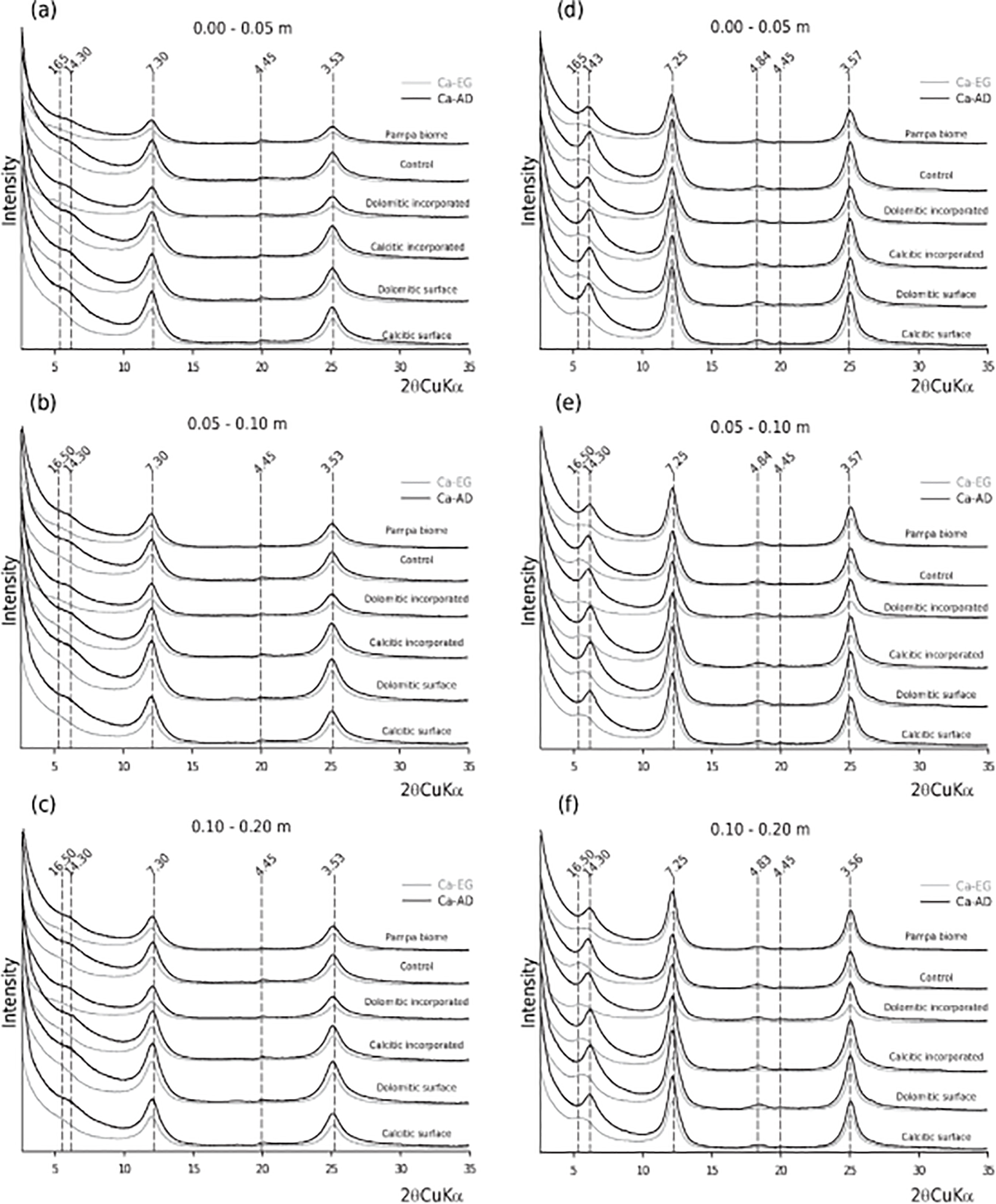
Experimental X-rays diffractograms of the <0.05 µm clay sub-fraction reveal broad diffraction peaks rather than well-defined reflections, indicating the presence of poorly crystalline clay minerals and/or interstratified clay minerals (Figure 6), as described by Hubert et al. (2012). This sub-fraction is predominantly composed of kaolinite (Figure 6). Characterization of 2:1 clay minerals in this fraction is particularly challenging, as their diffraction peaks after ethylene glycol (EG) treatment are difficult to distinguish from the background. The heterogeneous swelling behavior observed after EG treatment suggests the presence of swelling layers such as vermiculites and/or smectites, with varying proportions of aluminum in the interlayers (Meunier, 2007; Hubert et al., 2012; Viennet et al., 2015).
This sub-fraction, representing 41 to 48 % of the bulk clay fraction, exhibits only broad diffraction peaks without distinct reflections. The difficulty in distinguishing 2:1 minerals in this fraction suggests that their contribution may be underestimated when only bulk clay is analyzed, as noted by Hubert et al. (2012). The diffracted signal <0.05 µm fraction is responsible for the broadening of kaolinite peaks in the bulk clay fraction and for the intensity of low-angle reflections (11–12 °2θ) associated with 2:1 clay minerals. The presence of partly expandable 2:1 clay minerals in this sub-fraction, combined with its substantial mass percentage, explains its large contribution to the CEC of the <2 µm fraction and consequently to the soil CEC (Supplementary Materials) and underscores its importance in soil chemical properties. This sub-fraction exhibits subtle variations across samples, regardless of soil layers or treatments. Slightly greater peak displacement of the 2:1 clay minerals after EG treatment in the 0.00-0.05 m layer suggests a higher proportion of expandable layers than in the 0.05-0.10 and 0.10-0.20 m layers, possibly reflecting a greater effect of liming.

X-ray diffractograms of the <0.05 µm fraction (a-c) and 0.05–0.1 µm fraction (d-f) saturated with Ca in air-dried (CaAD) and solvated with ethylene glycol (CaEG) for the three soil layers)
Mineralogy of the 0.05-0.1 µm fraction
This clay sub-fraction is mainly composed of kaolinite (peaks at d = 7.15 Å and d = 3.58 Å), and 2:1 clay minerals, indicated by a broad peak centered around d ≈ 14.5 Å in the air-dried (AD) state (Supplementary Materials). Kaolinite peaks in this sub-fraction exhibit greater symmetry and narrower widths than those in the finer clay fraction, reflecting higher crystallinity. Upon EG solvation, the peak of 2:1 clay minerals at ~ 14.5 Å partially swells to d ~ 16.2 Å, while a portion remains unchanged at d ~ 14.5 Å. This dual behaviour indicates the presence of interstratified minerals, with non-swelling layers attributed to HIMs (hydroxy-interlayered mineral species or aluminized layers), and swelling layers corresponding to vermiculite or smectite. The XRD patterns across treatments were similar for the 0.00-0.05, 0.05-0.10, and 0.10-0.20 m layers (Supplementary Materials). However, slight variations in swelling behavior were noted among treatments. The general trend observed is a slightly greater swelling capacity of the 2:1 clay minerals from the soils that received limestone applications. These differences are likely due to a higher proportion of swelling layers in the Pampa biome, compared to control soil samples and those from the reference area, consistent with the replacement of interlayer Al3+ by Ca2+ and Mg2+.
Mineralogy of the 0.1-2 µm fraction
The 0.1–2 µm fraction exhibited a better-crystallized kaolinite (narrower peaks at 7.17 Å and 3.58 Å). The relative intensity of kaolinite peaks compared with those of 2:1 clay minerals suggests a higher proportion of 2:1 clay minerals in this fraction. A low-intensity peak at ~10 Å in AD state that shifts to d ~ 11.2 Å after EG treatment indicates the presence of a small amount of illite/smectite interstratified minerals with a low proportion of smectite (Figure 7). This mixed layer is mainly found in control samples and in those with the application of calcitic limestone (surface and incorporated) and dolomitic limestone (surface). However, it is almost absent in samples from the Pampa biome and in the treatment with incorporated dolomitic limestone. Additional peaks at 14.2, 7.20, 4.72, and 3.52 Å in the AD state are also attributable to 2:1 clay minerals. Following EG treatment, the peak at 14.2 Å splits into two contributions: a dominant contribution that remains unchanged at ~ 14.2 Å, indicating the presence of non-swelling layers, and a minor contribution that swells to ~ 16.5-17.0 Å, suggesting a low proportion of swelling layers attributed to non-aluminized vermiculite or smectite layers (Viennet et al., 2015). Swelling behavior varies slightly across treatments and soil depths. Swelling capacity was observed in the control and the Pampa biome soil samples, indicating the absence of swelling clay minerals and the presence of hydroxy-interlayered minerals (HIMs). Soils treated with dolomitic limestone exhibit slightly greater swelling capacity than those treated with calcitic limestone, the control, or Pampa biome, especially when lime was incorporated. Samples from the 0.10-0.20 m layer exhibit reduced swelling capacity compared with samples from the superficial layers. The XRD patterns of K-saturated samples and following thermal treatments are provided in the supplementary material.

X-ray diffractograms of the 0.1-2 µm fraction saturated with Ca in air-dried (CaAD) and solvated with ethylene glycol (CaEG) for the three soil layers. (a) 0.00-0.05 m, (b) 0.05-0.10 m, (c) 0.10-0.20 m.
The limited swelling of clays in the soil samples from the control treatment and the reference area (Pampa biome) reveals the presence of hydroxy interlayered minerals (HIMs), whereas slightly increased swelling in limed soils indicates partial replacement of interlayer Al3+ by Ca2+ and Mg2+. These mineralogical changes reflect the chemical effects of liming: increased pH and cation availability facilitate the exchange of interlayer Al3+ or Al polymers with Ca2+ and Mg2+, enhancing the swelling capacity of 2:1 minerals (Figure 8). The results demonstrate that even small amounts of 2:1 minerals in these highly weathered soils exert a strong influence on soil acidity buffering. Liming enhances the swelling behavior of these minerals by promoting the exchange of interlayer Al with Ca2+ and Mg2+, thereby reducing Al toxicity and improving nutrient retention (Figure 8). The infra-micrometric fractionation approach proved essential for detecting subtle mineralogical changes that bulk analyses is unable to detect due to low sensitivity. These findings reinforce the importance of fine clay fractions in the short-term reactivity of subtropical soils.

Structures of 2:1 clay minerals explaining replacement of Al3+ and/or (Al[OH]n) by Ca2+ or Mg2+ following liming and increase of swelling and CEC.
CONCLUSIONS
This study aimed to better understand how various liming practices affect soil chemistry and clay mineral reactivity, with a focus on short- to medium-term changes in soil physical and chemical properties and mineralogy in Southern Brazil. Significant interactions were observed among limestone type (calcitic and dolomitic), application method (surface and incorporated), and soil depth. The type of limestone and its application method influenced soil chemical properties differently. Notably, calcitic limestone led to faster reacidification of the topsoil compared with dolomitic limestone. Detailed analysis of clay minerals confirmed the dominance of kaolinite— typical of subtropical soils—and the presence of small amounts of 2:1 clay minerals. These 2:1 minerals exhibited varying degrees of crystallinity and swelling behavior, which were influenced by both the limestone type and the application method.
These 2:1 clay minerals exhibited varying degrees of crystallinity and swelling behavior, which were influenced by limestone type and application method. The findings suggest that soil management practices can alter clay mineral characteristics even 141 months after lime application. Although non-swelling hydroxyl-interlayered minerals are the dominant 2:1 clay minerals, indicating strong aluminization typical of subtropical Ultisols, the study revealed a subtle yet discernible impact of liming on their swelling properties. Lime-treated soils showed a general trend toward increased swelling capacity, suggesting a higher proportion of swelling layers compared to control and native pasture samples. This effect was more pronounced in the coarse clay sub-fraction (0.1–2 µm) than in the finer fraction (<0.05 µm). Given the similar modifications observed with both limestone types, it is advisable to use the most abundant and cost-effective regional source—dolomitic limestone—which also provides magnesium to the soil. Incorporating the lime is recommended to amend the entire 0.00–0.20 m soil layer effectively.
How to cite:
FUNDING
SUPPLEMENTARY MATERIALS
Supplementary data to this article can be found online at https://doi.org/.
DATA AVAILABILITY
The data will be provided upon request.
REFERENCES
-
Alvares CA, Stape JL, Sentelhas PC, Gonçalves JLM, Sparovek G. Köppen's climate classification map for Brazil. Meteorol Z. 2013;22:711-28. https://doi.org/10.1127/0941-2948/2013/0507
» https://doi.org/10.1127/0941-2948/2013/0507 -
Bakker E, Lanson B, Findling N, Wander MM, Hubert F. Mineralogical differences in a temperate cultivated soil arising from different agronomic processes and plant K-uptake. Geoderma. 2019;347:210-19. https://doi.org/10.1016/j.geoderma.2019.04.010
» https://doi.org/10.1016/j.geoderma.2019.04.010 -
Barré P, Velde B, Abbadie L. Dynamic role of “illite-like” clay minerals in temperate soils: facts and hypotheses. Biogeochemistry. 2007;82:77–88. https://doi.org/10.1007/s10533-006-9054-2
» https://doi.org/10.1007/s10533-006-9054-2 -
Barré P, Montagnier P, Chenu C, Abbadie L, Velde B. Clay minerals as soil potassium reservoir: observation and quantification through X-ray diffraction. Plant Soil. 2008a;302:213-20. https://doi.org/10.1007/s11104-007-9471-6
» https://doi.org/10.1007/s11104-007-9471-6 -
Barré P, Velde B, Fontaine C, Catel N, Abbadie L. Which 2:1 clay minerals are involved in the soil potassium reservoir? Insights from potassium addition or removal experiments on three temperate grassland soil clay assemblages. Geoderma. 2008b;146:216-23. https://doi.org/10.1016/j.geoderma.2008.05.022
» https://doi.org/10.1016/j.geoderma.2008.05.022 -
Berggren D, Mulder J. The role of organic matter in controlling aluminum solubility in acidic mineral soil horizons. Geochim Cosmochim Acta. 1995;59:4167-80. https://doi.org/10.1016/0016-7037(95)94443-J
» https://doi.org/10.1016/0016-7037(95)94443-J -
Bertolazi VT, Inda AV, Caner L, Posselt Martins A, Vaz MAB, Bonnet M, Anghinoni I, Carvalho PCF. Impact of an integrated no-till soybean–beef cattle production system on Oxisol mineralogy in southern Brazil. Appl Clay Sci. 2017;149:67-74. https://doi.org/10.1016/j.clay.2017.08.028
» https://doi.org/10.1016/j.clay.2017.08.028 -
Bortoluzzi EC, Velde B, Pernes M, Dur JC, Tessier D. Vermiculite, with hydroxy-aluminium interlayer, and kaolinite formation in a subtropical sandy soil from south Brazil. Clay Miner. 2008;43:185-93. https://doi.org/10.1180/claymin.2008.043.2.03
» https://doi.org/10.1180/claymin.2008.043.2.03 -
Bortoluzzi EC, Moterle DF, Rheinheimer DS, Casali CA, Melo GW, Brunetto G. Mineralogical changes caused by grape production in a Regosol from subtropical Brazilian climate. J Soils Sediments. 2012;12:854-62. https://doi.org/10.1007/s11368-012-0509-x]
» https://doi.org/10.1007/s11368-012-0509-x -
Britzke D, Silva LS, Moterle DF, Rheinheimer DS, Bortoluzzi EC. A study of potassium dynamics and mineralogy in soils from subtropical Brazilian lowlands. J Soils Sediments. 2012;12:185-97. https://doi.org/10.1007/s11368-011-0431-7
» https://doi.org/10.1007/s11368-011-0431-7 -
Bruand A, Brossard M, Caner L. Occurrence of 2:1 phyllosilicates in Ferralsols: A viewpoint. Geoderma. 2026;470:117832. https://doi.org/10.1016/j.geoderma.2026.117832
» https://doi.org/10.1016/j.geoderma.2026.117832 -
Calvaruso C, Turpault MP, Leclerc E, Ranger J, Garbaye J, Uroz S, Frey-Klett P. Influence of forest trees on the distribution of mineral weathering-associated bacterial communities of the Scleroderma citrinum mycorrhizosphere. Appl Environ Microbiol. 2010;76:4780-7. https://doi.org/10.1128/AEM.03040-09
» https://doi.org/10.1128/AEM.03040-09 -
Caner L, Radtke LM, Vignol-Lelarge ML, Inda Jr AV, Bortoluzzi EC, Mexias AS. Basalt and rhyo-dacite weathering and soil clay formation under subtropical climate in southern Brazil. Geoderma. 2014;235-236:100-12. https://doi.org/10.1016/j.geoderma.2014.06.024
» https://doi.org/10.1016/j.geoderma.2014.06.024 -
Coelho MC, Vidal-Torrado P. Characterization and genesis of plinthic profiles developed on sandstone (Bauru Group): II - Mineralogical properties. Rev Bras Cienc Solo. 2003;27:495-507. https://doi.org/10.1590/S0100-06832003000300011
» https://doi.org/10.1590/S0100-06832003000300011 -
Cornu S, Montagne D, Barré P, Caner L. Evidence of short-term clay evolution in soils under human impact. C R Geosci. 2012;344:747-57. https://doi.org/10.1016/j.crte.2012.09.005
» https://doi.org/10.1016/j.crte.2012.09.005 - Comissão de Química e Fertilidade do Solo - CQFS-RS/SC. Manual de calagem e adubação para os Estados do Rio Grande do Sul e de Santa Catarina. 11. ed. Porto Alegre: Sociedade Brasileira de Ciência do Solo - Núcleo Regional Sul; 2016.
-
Departamento Nacional de Produção Mineral – DNPM. Anuário Mineral Brasileiro - 2006. Brasília, DF: DNPM; 2006. Available from: http://www.dnpm.gov.br/conteudo.asp?IDSecao=68&IDPagina=789.
» http://www.dnpm.gov.br/conteudo.asp?IDSecao=68&IDPagina=789 - Ferreira DF. Estatística multivariada. Lavras: Editora UFLA; 2008.
-
Hubert F, Caner L, Meunier A, Lanson B. Advances in the characterisation of soil clay mineralogy using X-ray diffraction: From decomposition to profile fitting. Eur J Soil Sci. 2009;60:1093-105. https://doi.org/10.1111/j.1365-2389.2009.01194.x
» https://doi.org/10.1111/j.1365-2389.2009.01194.x -
Hubert F, Caner L, Meunier A, Ferrage E. Unraveling complex <2 µm clay mineralogy from soils using X-ray diffraction profile modeling on particle-size sub-fractions. Implication for soil pedogenesis and reactivity. Am Mineral. 2012;97:384-98. https://doi.org/10.2138/am.2012.3900
» https://doi.org/10.2138/am.2012.3900 - Kaminski J, Rheinheimer DS, Bartz HR. Proposta de nova equação para determinação do valor de H+Al pelo uso do índice SMP em solos do RS e de SC. In: Anais da 33a Reunião Anual da Rede Oficial de Laboratórios de Análise de Solo e de Tecido Vegetal dos Estados do Rio Grande do Sul e de Santa Catarina; Frederico Westphalen, Brasil. Frederico Westphalen: ROLAS; 2001. p. 21-26.
-
Laird DA, Nater EA. Nature of the illitic phase associated with randomly interstratified smectite/illite in soils. Clays Clay Miner. 1993;41:280-7. https://doi.org/10.1346/CCMN.1993.0410302
» https://doi.org/10.1346/CCMN.1993.0410302 -
Laird DA, Barak P, Nater EA, Dowdy RH. Chemistry of smectitic and illitic phases in interstratified soil smectite. Soil Sci Soc Am J. 1991;55:1499-504. https://doi.org/10.2136/sssaj1991.03615995005500050050x
» https://doi.org/10.2136/sssaj1991.03615995005500050050x - Mehlich A. Determination of P, Ca, Mg, K, Na and NH4 by North Carolina soil testing laboratory. Raleigh: University North Carolina; 1953.
-
Mehra OP, Jackson ML. Iron oxides removal from soil and clays by a dithionite–citrate system buffered with sodium bicarbonate. In: Ingerson E, editor. Clays and clay minerals - Proceedings of the Seventh National Conference on Clays and Clay Minerals. Oxford: Pergamon Press; 1960. p. 317–27. https://doi.org/10.1016/B978-0-08-009235-5.50026-7
» https://doi.org/10.1016/B978-0-08-009235-5.50026-7 - Mendonça ES, Rowell DL. Dinâmica do alumínio e de diferentes frações orgânicas de um Latossolo Argiloso sob cerrado e soja. Rev Bras Cienc Solo. 1994;18:295-303.
-
Meunier A. Soil hydroxy-interlayered minerals: A re-interpretation of their crystallochemical properties. Clays Clay Minerals. 2007;55:380-8. https://doi.org/10.1346/CCMN.2007.0550406
» https://doi.org/10.1346/CCMN.2007.0550406 -
Montagne D, Cornu S, Le Forestier L, Hardy M, Josiere O, Caner L, Cousin I. Impact of drainage on soil-forming mechanisms in a French Albeluvisol: Input of mineralogical data in mass balance modelling. Geoderma. 2008;145:426-38. https://doi.org/10.1016/j.geoderma.2008.02.005
» https://doi.org/10.1016/j.geoderma.2008.02.005 -
Morse JW, Arvidson RS. The dissolution kinetics of major sedimentary carbonate minerals. Earth Sci Rev. 2002;58:51-84. https://doi.org/10.1016/S0012-8252(01)00083-6
» https://doi.org/10.1016/S0012-8252(01)00083-6 -
Pernes-Debuyser A, Pernes M, Velde B, Tessier D. Soil mineralogy evolution in the INRA 42 plots experiment (Versailles, France). Clays Clay Minerals. 2003;51:577-84. https://doi.org/10.1346/CCMN.2003.0510512
» https://doi.org/10.1346/CCMN.2003.0510512 -
Rheinheimer DS, Bortoluzzi EC, Moterle DF, Le Guet T, Bastos MC, Coelho LL, Meotti BL, Santanna AS, Tiecher T. Kinetics of soil re-acidification under no-tillage system. Soil Till Res. 2024;242:106137. https://doi.org/10.1016/j.still.2024.106137
» https://doi.org/10.1016/j.still.2024.106137 -
Rheinheimer DS, Miotto A, Meotti ML, Santana AS, Coelho LL, Pesini G, Silva LS, Tiecher T. Yield and productivity of grain and cover crops are not affected by Ca/Mg ratio in a subtropical Brazilian Ultisol. J Soil Sci Plant Nutr. 2025;25:1578-96. https://doi.org/10.1007/s42729-025-02225-1
» https://doi.org/10.1007/s42729-025-02225-1 -
Righi D, Terribile F, Petit S. Low-charge to high-charge beidellite conversion in a vertisol from south Italy. Clays Clay Minerals. 1995;43:495-502. https://doi.org/10.1346/CCMN.1995.0430414
» https://doi.org/10.1346/CCMN.1995.0430414 -
Ruiz F, Perlatti F, Oliveira DP, Ferreira TO. Revealing tropical technosols as an alternative for mine reclamation and waste management. Minerals. 2020;10:110. https://doi.org/10.3390/min10020110
» https://doi.org/10.3390/min10020110 - Santos HG, Jacomine PKT, Anjos LHC, Oliveira VA, Lumbreras JF, Coelho MR, Almeida JA, Araújo Filho JC, Lima HN, Marques FA, Oliveira JB, Cunha TJF. Sistema brasileiro de classificação de solos. 6. ed. rev. ampl. Brasília, DF: Embrapa; 2025.
- Sousa DMG, Lobato E. Cerrado correção do solo e adubação. 2. ed. Brasília, DF: Embrapa Informação Tecnológica / Planaltina, DF: Embrapa Cerrados; 2004.
- Tedesco MJ, Gianello C, Bissani CA, Bohnen H, Volkweiss SJ. Análises de solo, plantas e outros materiais. 2. ed. Porto Alegre: Universidade Federal do Rio Grande do Sul; 1995. (Boletim técnico, 5).
-
Tiecher T, Gatiboni L, Rheinheimer DS, Bissani CA, Martins AP, Gianello C, Dick DP, Bortoluzzi EC, Escosteguy PAV, Silva LS, Brunetto G, Mallmann FJK, Pauletti V, Lourenzi CR, Sousa RO, Carlos FS, Azevedo AC. Base saturation is an inadequate term for Soil Science. Rev Bras Cienc Solo. 2022;46:e0220125. https://doi.org/10.36783/18069657rbcs20220125
» https://doi.org/10.36783/18069657rbcs20220125 -
Toledo JA, Kaminski J, Santanna MA, Rheinheimer DS. Tampão Santa Maria (TSM) como alternativa ao tampão SMP para medição da acidez potencial de solos ácidos. Rev Bras Cienc Solo. 2012;36:427-35. https://doi.org/10.1590/S0100-06832012000200012
» https://doi.org/10.1590/S0100-06832012000200012 -
Veith JA. Basicity of exchangeable aluminum, formation of gibbsite, and composition of the exchange acidity in the presence of exchangers. Soil Sci Soc Am J. 1977;41:865-70. https://doi.org/10.2136/sssaj1977.03615995004100050010x
» https://doi.org/10.2136/sssaj1977.03615995004100050010x -
Velde B, Peck T. Clay mineral changes in the Morrow experimental plots, University of Illinois. Clays Clay Miner. 2002;50:364-70. https://doi.org/10.1346/000986002760833738.
» https://doi.org/10.1346/000986002760833738 -
Viennet J-C, Hubert F, Ferrage E, Tertre E, Legout A, Turpault MP. Investigation of clay mineralogy in a temperate acidic soil of a forest using X-ray diffraction profile modeling: Beyond the HIS and HIV description. Geoderma. 2015;241-242:75-86. https://doi.org/10.1016/j.geoderma.2014.11.004
» https://doi.org/10.1016/j.geoderma.2014.11.004 -
Wagai R, Kajiura M, Asano M. Iron and aluminum association with microbially processed organic matter via meso-density aggregate formation across soils: Organo-metallic glue hypothesis. Soil. 2020;6:597-627. https://doi.org/10.5194/soil-6-597-2020
» https://doi.org/10.5194/soil-6-597-2020