
 Perceptions of Basic Education Teachers about Soils
ABSTRACT
In basic education, teachers are essential for Soil Education, a field that seeks to raise awareness about the importance of soil and its conservation. This study examined the soil knowledge of 81 Basic Education teachers in Planalto Serrano, Santa Catarina. Questionnaires and lexicometric analysis were applied, including Descending Hierarchical Classification and Factorial Correspondence Analysis, which were conducted using IRAMUTEQ software. Lexicometric analysis clusters texts, identifies patterns, and evaluates word frequency associations using chi-square statistics to assess their divergence from the central theme. The results identified 10 thematic categories, with the most significant being: (1) the role of soils in agricultural sustainability and biogeochemical cycles; (2) the need for region-specific supplementary materials; and (3) the influence of academic background and practical experience on teacher perceptions. Soil education to instill pedological awareness requires contextualized approaches and continuous training.
Keywords
Lexicometrics; reconstruction of knowledge; sustainable management; teaching staff
INTRODUCTION
Education is a fundamental right of all Brazilian citizens (Brasil, 1988) and plays an essential role in the formation of civic awareness. In the context of this educational process, teachers are the key agents, by mediating knowledge and promoting the construction and reconstruction of their perceptions (Becker, 2005). In this way, teachers play a crucial role in the comprehensive education of students throughout their educational careers (Cirino, 2008).
In Brazil, the structure of Basic Education is designed to build a curriculum grounded in principles that favor interdisciplinary dialogue, acknowledging the stages of integral human development (Bernardino and Vanzuita, 2021). In this sense, developing an understanding of the interrelationship between society and natural resources is essential, as these aspects are intrinsically linked (Silva and Zucchetti, 2012).
With regard to the exploitation of natural resources, the excessive pursuit of wealth and capital accumulation has resulted in a range of adverse consequences. Natural resources constitute the foundation for sustaining life on Earth, and soil is one of these essential components. Frequently, an inadequate and fragmented understanding is the cause of its inappropriate utilization. Given this context, it is crucial to implement strategies focused on disseminating and educating the community about soil science, with the goal of highlighting the significance of sustainable environmental stewardship. From this standpoint, education emerges as a key instrument for fostering social change, which will in turn influence the way individuals care for the environment, thereby equipping them to face the challenges of the contemporary world (Bacchiegga, 2013).
Recent studies (e.g., Vital et al., 2018; Henrique et al., 2024) have mentioned critical challenges faced by educators, e.g., the lack of teaching resources adapted to regional contexts, the omission of the topic in training curricula, and an excessive workload, which impairs a more comprehensive engagement with environmental issues. This gap limits the practical approach to soils as a vital resource, as warned by Brevik et al. (2022). The same authors pointed out that perceptions of soils among these professionals varied according to factors such as academic background, school curriculum and the educational priorities of the institution.
Despite all these challenges, it is essential to explore practical and experimental approaches to integrating this topic in the classroom by building strategies that provide opportunities to raise student pedagogical awareness and encourage them to adopt sustainable practices that minimize the environmental impacts of human activity (Aleixo et al., 2018). Based on this premise, this study sought to examine the perceptions of Basic Education teachers about soils in the Planalto Serrano region of Santa Catarina.
MATERIALS AND METHODS
This research was approved by the Committee for Ethics and Research (CEP) of UDESC (report No. 4802163, May 24, 2021). The query included 45 school units in the region of the Association of Municipalities of the Region Serrana (AMURES - SC), in Planalto Serrano of Santa Catarina. The study included teachers from the following educational levels: Grades 1–5 of Elementary School (Early Years), Grades 6–9 of Elementary School (Later Years), and Grades 1–3 of High School.
Data were collected based on a questionnaire on the Google Forms platform. The main purpose of the query was to compile information about the professional qualifications of the teachers. The first stage of the questionnaire consisted of the following questions: Full name; Age; Gender: Female or Male; time of service; which municipality(ies) do you work in?; which State school(s) do you work in?; academic qualification (basic formation); complementary qualification: (None, Specialization, Master's degree, Doctorate); which disciplines do you teach currently?; what school years/grades do you teach currently?: Elementary School (1st, 2nd, 3rd, 4th, 5th, 6th, 7th, 8th, 9th), High School (1st, 2nd, 3rd); what is the total number of students you teach currently (2021/2022); Number of classes do you teach currently; What is your total workload? [query proposed by Henrique (2024)]. The second stage included an open-ended question based on Charlot's (1996) Knowledge Balance methodology, with adaptations: “Since I was born, I have learned many things in my family, on the street, at school and in other places. Among the things I have learned, which have been the most important to me? And now, what am I hoping to learn?” Building on this model, participants were asked to reflect on their perceptions regarding soils, discussing what they had learned in different contexts (at home, on the street, at work, during undergraduate and graduate studies, etc.) and what they desired to learn. The responses were subjected to lexicometric analysis using Descending Hierarchical Classification (DHC) and Correspondence Factor Analysis (CFA), as proposed by Reinert (1986), using the Iramuteq software (Ratinaud and Marchand, 2012).
Descending Hierarchical Classification organizes textual data into groups (clusters), segmenting them according to the repeated occurrence of specific vocabulary in the textual corpus (Sousa et al., 2020; Sousa, 2021). This technique automates the categorization of documents and identifies patterns within large data sets by applying chi-square (χ²) association statistics between words (Reinert, 2007) (significant if ≥75 % segment coverage is achieved).
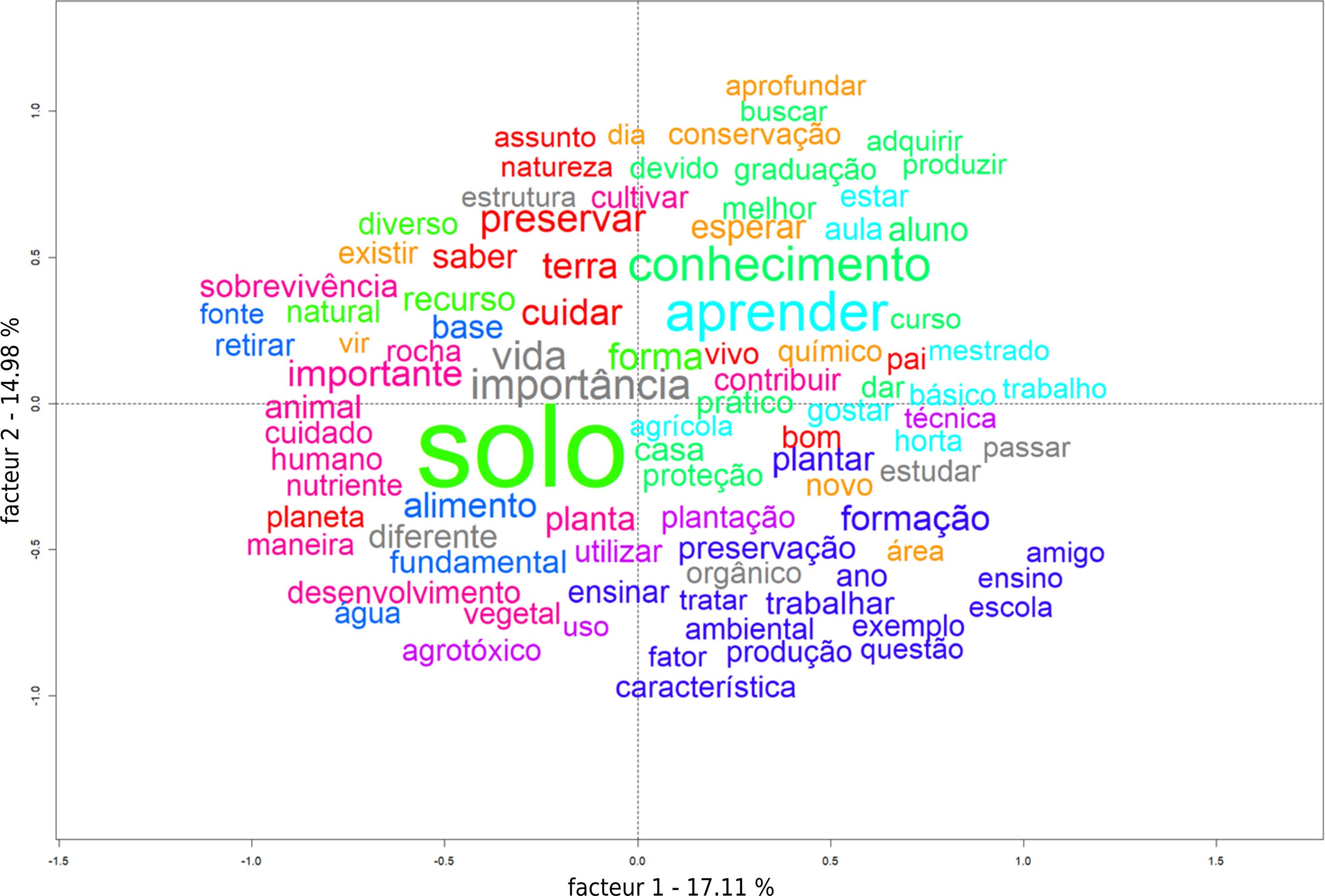
The CFA considers the vocabulary, taking into account the word frequency within each class. A graphical representation is generated to illustrate the disparity between classes and words, i.e., the most distant elements in the Cartesian plane indicate the weakest relationships between each other and the greatest divergence from the central theme, the field of knowledge under study (Nascimento and Menandro, 2006).
RESULTS
Professional description
Eighty-one teachers participated in this study. The sample included 11 male teachers, aged 21 to 60 years, with 4 to 23 years of teaching experience. The 70 female teachers in the study ranged in age from 21 to 70 years old, with teaching experience spanning 6 to 35 years.
As a first professional qualification (undergraduate course), most of these professionals (Table 1) graduated in Biological Sciences, followed by Pedagogy, Social Sciences and Literature. Some teachers hold multiple degrees, for example, in Mathematics/Chemistry or Forestry Engineering/Physics/Mathematics, among others. In total, 69.14 % of the teachers have a Graduate Specialization (Latu sensu); 13.58 % have no specialization; 6.17 % obtained a Master's degree and 1.23 % a Doctorate. The rest have either a Latu Sensu or a MBA (Master in Business Administration) specialization.
Distribution of teachers based on their first professional qualification and average class size, number of students and workloads
Teachers of certain academic disciplines, such as Biological Sciences, Social Sciences, Geography, Philosophy, Mathematics, Arts, and Chemistry, were responsible for an average of over 300 students. This scenario results in a high number of classes and, consequently, an overwhelming workload (Table 1).
Reinert method for perceptions about soils
Within the entire corpus of 81 texts segmented into 90 parts, a total of 2,847 words were deemed relevant. Following the removal of duplicate entries, 897 words related explicitly to this study theme were identified. To ensure clarity and easily understandable results, only nouns, adjectives, and verbs were taken into account. In the end, the 90 segments were organized into 10 textual classes, with an exploitation rate of 94.44 % of the total text corpus.
Descending hierarchical classification and correspondence factor analysis
Figure 1 illustrates the ten classes generated by text analysis, highlighting the percentage of the textual corpus used in each Class and their respective themes. Two main Classes (10 and 9) were subdivided into other Classes. The dendrogram is read from right to left or top to bottom.

Classification of 81 texts in ten categories. Source: Developed by the authors, using the Iramuteq software.
The learning objectives per class are detailed as follows: Class 3 - differences between environments in each region; Class 4 - management characteristics in each region; Class 5 - importance of soil and its formation; Class 6 -soil composition and conservation; Class 10 - soil as the basis for life on Earth; Class 1 - food production and housing construction; Class 2 -nature conservation; Class 7 - practical insights acquired during teaching and in undergraduate and master's courses; Class 8 -use of school gardens to work with composting; Class 9 - practical insights acquired through daily agricultural practices and living with friends.
In figure 2, the upper left quadrant is characterized by the dominance of Classes 4 and 10, with minor contributions from Classes 6 and 9. The lower left quadrant prominently displays Classes 4, 5, and 6, along with some scattered points from Class 3. In the upper right quadrant, Classes 1, 2, and 9 are predominant, accompanied by fewer points from Classes 5 and 8. Finally, Classes 7 and 8 are the most prominent in the lower right quadrant, with some points also present in Classes 4, 1, and 9.

DISCUSSION
The description of the professional landscape of Basic Education teachers in Brazil reveals several substantial challenges that tend to deteriorate teaching quality, particularly in subjects such as soil science (Bonfada et al., 2018). As suggested in table 1, a comprehensive analysis of a teacher practical reality must take factors such as the number of classes and students, as well as the overall workload, into account. Teacher ongoing training and pedagogical planning are constrained by high workloads (40–60 hours weekly for 45 of 81 teachers), large class sizes (e.g., 231.8 students on average for Biological Sciences teachers), and limited material resources. These factors reduce the time available for professional development by increasing demands from lesson planning and assessments (Sabóia and Barbosa, 2020). Prolonged working hours (exceeding 40 teaching hours) can lead to stress and occupational illness, ultimately compromising the quality of both teaching and learning (Gasparini et al., 2005). While the ideal workload, number of classes and students for a teaching professional differ (Jacomini et al., 2020), the National Education Council of Brazil (CNE) recommends a maximum of approximately 200 students and seven classes per teacher. This recommendation was established to ensure effective teaching practices, lesson preparation and assessments. However, studies from 2017 revealed that public education teachers typically managed an average of 228.6 students, with some cases reaching up to 525 students in total. In contrast to countries such as the United States and Japan, where teachers typically handle up to seven classes, 45 % of Brazilian teachers work in more than one school, and 30 % are employed across multiple educational networks. According to the CNE, 30 students per class are recommended, although specific guidelines supporting this recommendation are not readily available. Disturbingly, these recommended values were still being exceeded in 2023, particularly in high school settings.
Further aggravating circumstances are that many teachers are demotivated by the scarcity of material resources, which limits the effectiveness of teaching, and by the professional instability that comes with being hired on a temporary basis. Although numerous challenges will have to be faced, governments and educational institutions must provide the necessary resources for the ongoing training of their teaching staff to make teaching practices effective and create a valued and stable work environment.
The results showed that for the teaching of specific topics, such as soil science, regional contextualization and paradidactic materials (educational resources complementary to textbooks) are priority (Alves et al., 2020; Henrique et al., 2024). In addition, teacher training should integrate experimental practices, such as school gardens and composting, and the public policies should be aligned with CNE recommendations to reduce excessive workloads and the number of classes per teacher.
In contrast, the analysis of perceptions about soils (Figures 1 and 2) demonstrates a multifaceted and comprehensive understanding of the significance of this environmental resource. The diverse Classes identified in this study highlight multiple soil-related aspects in an overall view of regional characteristics, management practices and the soils’ critical role in sustaining life on Earth.
Class 3 underscores the importance of regional context in soil studies, emphasizing the need to tailor analyses to the specific characteristics of each environment (Henrique et al., 2024). To ensure an integrative approach, it is crucial to develop region-specific paradidactic materials on the theme (Comin et al., 2013; Alves et al., 2020). Class 4 completes the discussion by emphasizing that soil management varies according to each environment as well as the regional characteristics. This connection between types of environment and management sheds light on teacher understanding of the importance of using agricultural practices and conservation strategies tailored to specific soil conditions at each location.
Text segments most closely related to “Soil Function, Formation and Composition” were allocated to Classes 5 and 6. Class 5 addresses the recognition of soils as an essential environmental resource for plant support and development, as well as for human activities such as agriculture and housing construction, and as shelter for numerous life forms. In this sense, the teachers were aware of the soil formation factors, including physical, chemical, and biological weathering of rocks, which are influenced by rainfall, temperature, mineralogy, and relief conditions (Sacramento and Falconi, 2011). Class 6 highlights teacher perceptions about soil components and environmental conservation practices. Here, variations in soil composition, influenced by factors such as moisture, temperature, organisms, and organic matter, are emphasized. In this sense, soil conservation is considered fundamental for maintaining environmental balance, whereas soil degradation is associated with several problems, including the reduction of natural fertility, loss of organic matter and carbon, as well as water erosion and contamination (Lima et al., 2007). Words most closely related to “Soil as a Basis for Life and Sustainability” were assigned to Classes 10, 1 and 2: Class 10 reinforces the importance of soils as an environmental resource indispensable to life, for their role in plant nutrition, food production, and maintenance of biogeochemical cycles (Lima et al., 2007). Classes 1 and 2 complement the idea that this resource is essential for maintaining life, apart from food production, since soils are fundamental for building housing and infrastructure (Garzone, 2022).
The aspect “Practical Perceptions and Educational Experiences”, in Classes 7, 8 and 9, addresses the practical knowledge of teachers acquired during their teaching practice, undergraduate and master's courses (Class 7), use of school gardens and composting (Class 8), and daily agricultural practices or living with friends (Class 9). Class 7 highlights the importance of practice in teacher training, particularly in topics that involve visualizing the object of knowledge, such as soils, their forms of degradation, sustainable use, and forms of conservation (Oliveira et al., 2023). In line with this premise, Silva (2018) emphasized the importance of studying soils for agricultural sustainability, considering their properties and the development of appropriate management practices to create participatory, practical classes. Class 8 is related to perceptions about the use of school gardens and composting, incorporating pedagogical practices in soil education to promote pedological awareness and food education in an interdisciplinary and playful manner (Silva et al., 2020; Duarte et al., 2023). In relation to Class 9, the importance of perceptions acquired in agricultural practices and daily life, be it with family or friends, is stressed, above all, field experiences (rural area) as fundamental for understanding soil properties and management. This exchange of experiences among relatives and friends is considered beneficial for the conservation and sustainable use of agricultural soils (Comin et al., 2013).
According to Silva (2018), these perceptions are essential for the reconstruction of knowledge among these professionals, as their existing understanding of important physical, chemical, and biological properties and sustainable management practices is connected with new information, such as the importance of soils for agricultural sustainability. These perceptions influence the development of participatory and alternative pedagogical practices. Moreover, personal features should be taken into account, aspects with emotional roots that are sometimes undervalued and discarded by science (Brevik et al., 2022). According to Brevik et al. (2022), soil education serves as a vital tool for fostering connections, offering insights into its significance in everyday life. Analyzing teacher perceptions of soils reveals a complex understanding of this environmental resource, encompassing its physical, biological, and chemical properties, as well as its critical role in supporting life, enabling food production, and promoting environmental sustainability. This study also sought to highlight the contribution of practical knowledge and educational experiences to the (re)construction of perceptions and the promotion of soil awareness.
Movements addressing environmental issues and their impacts are becoming increasingly frequent, as are the actions of human beings that cause these impacts (Santana, 2021). These movements aim to raise awareness, particularly within the local contexts in which individuals are embedded. Education is a means of preparing people to address these issues by fostering environmental awareness and promoting sustainable behavior. Consequently, studying environmental perceptions is crucial for understanding the relationships between humans and their environment (Santana, 2021).
CONCLUSION
Soil Education is a fundamental tool for preparing individuals and professionals to face environmental challenges, instilling sustainable practices, and raising awareness about the significance of soils. Teachers acknowledge the relevance of soils for agricultural sustainability, their properties (physical, chemical, and biological), and sustainable management, but lack adequate training in this area. Teacher training programs should include modules on soils, particularly those related to regional practices. Paradidactic resources adapted to local contexts (such as soils of the Planalto Serrano) must be developed. Education Departments must continuously offer soil-related information in professional training courses, whereas soil scientists should promote extension events and the development of paradidactic material.
ACKNOWLEDGMENTS
PAP UDESC-FAPESC 2023 TR000733, CAPES and Klabin S.A. for funding the project.
-
How to cite:
Henrique SM, Rossi LS, Miquelluti DJ, Costa IN, Beckert AKV, Cardoso DCC, Vinciguera VR. Perceptions of basic education teachers about soils. Rev Bras Cienc Solo. 2026;50:e0250098. https://doi.org/10.36783/18069657rbcs20250098
DATA AVAILABILITY
The data will be provided upon request.
REFERENCES
- Aleixo S, Maciel CP, Silva AP. Conservação de solos: Sensibilização ambiental de alunos de licenciatura em pedagogia de Campos dos Goytacazes, RJ. Rev Ambient Ação. 2018;16:1-13.
-
Alves PRD, Fonseca MN, Ferentz LMS. O ensino de solos na matéria de geografia com abordagem em educação ambiental: projeto solos do meu bairro. Rev Geogr. 2020;37:201-20. https://doi.org/10.51359/2238-6211.2020.246081
» https://doi.org/10.51359/2238-6211.2020.246081 -
Bacchiegga F. Unveiling Environmental Sociology Approaches: a Review of Selected Articles. Sustain Debate. 2013;4:118-37. https://doi.org/10.18472/sustdeb.v4n2.2013.8090
» https://doi.org/10.18472/sustdeb.v4n2.2013.8090 - Becker ELS. Solo e ensino. Vidya. 2005;25:73-80.
-
Bernardino AC, Vanzuita A. Diversidade como princípio formativo: Uma discussão sobre as práticas educativas de saberes tradicionais. Dialogia. 2021;39:e20432. https://doi.org/10.5585/39.2021.20432
» https://doi.org/10.5585/39.2021.20432 -
Bonfada KM, Much LN, Terrazzan EA. Caracterização da formação inicial e da atuação profissional de professores em escolas públicas de ensino médio. RELACult. 2018;4:1-10. https://doi.org/10.23899/relacult.v4i0.797
» https://doi.org/10.23899/relacult.v4i0.797 -
Brasil. Data From: Constituição da República Federativa do Brasil de 1988. Brasília; DF: Casa Civil; 1988 [cited 2023 Sep. 22]. Available from: http://www.planalto.gov.br/ccivil_03/constituicao/constituicao.htm
» http://www.planalto.gov.br/ccivil_03/constituicao/constituicao.htm -
Brevik EC, Krzic M, Muggler CC, Field D, Hannam J, Uchida Y. Soil science education: A multinational look at current perspectives. Nat Sci Educ. 2022;51:e20077. https://doi.org/10.1002/nse2.20077
» https://doi.org/10.1002/nse2.20077 - Charlot B. Relação com o saber e com a escola entre estudantes de periferia. Cad Pesq. 1996;97:47-63.
- Cirino FO. Sistematização participativa de cursos de capacitação em solos para professores da educação básica [dissertation]. Viçosa, MG: Universidade Federal de Viçosa; 2008.
- Comin FV, Furlan MC, Ferrony HM, Oliveira AL. O ensino de solos sob a perspectiva da educação ambiental: Aplicação de experimentos para ensino e conscientização. Rev Cient AJES. 2013;4:1-12.
-
Duarte CAJ, Miquelluti DJ, Campos ML, Costa IN, Henrique SM. Hortas: Estudo de solos na área de ciências ambientais no componente curricular de química do ensino médio. Rev Bras Educ Ambient. 2023;18:344-65. https://doi.org/10.34024/revbea.2023.v18.15236
» https://doi.org/10.34024/revbea.2023.v18.15236 -
Garzone B. Data from: Solo: fonte de vida e riqueza da humanidade. Brasil: Entre solos [internet]; 2022 [cited 2024 Jan 12]. Available from: https://www.entresolos.org.br/solo-fonte-de-vida-e-riqueza-da-humanidade/
» https://www.entresolos.org.br/solo-fonte-de-vida-e-riqueza-da-humanidade/ -
Gasparini SM, Barreto SM, Assunção AA. O professor, as condições de trabalho e os efeitos sobre sua saúde. Educ Pesqui. 2005;31:189-99. https://doi.org/10.1590/S1517-97022005000200003
» https://doi.org/10.1590/S1517-97022005000200003 -
Henrique SM, Sequinatto-Rossi L, Pereira GE. Regional approach to education in soil science for Santa Catarina. Rev Deb Educ. 2024;16:e15793. https://doi.org/10.28998/2175-6600.2024v16n38pe15793
» https://doi.org/10.28998/2175-6600.2024v16n38pe15793 - Henrique SM. Percepção sobre solos de professores da educação básica do Planalto Serrano de Santa Catarina [thesis]. Lages, SC: Universidade do Estado de Santa Catarina; 2024.
-
Jacomini MA, Cruz RE, Castro EC. Jornada de trabalho docente na rede pública de educação básica: Parâmetros para discussão. Arq Anal Polit Educ. 2020;28:1-25. https://doi.org/10.14507/epaa.28.4862
» https://doi.org/10.14507/epaa.28.4862 - Lima VC, Lima MR, Melo VF. Classificação brasileira de solos. In: Lima VC, Lima MR, Melo VF, editors. O solo no meio ambiente. Curitiba: Universidade Federal do Paraná; 2007. p. 1-141.
- Nascimento ARA, Menandro PRM. Análise lexical e análise de conteúdo: Uma proposta de utilização conjugada. Estud Pesqui Psicol. 2006;6:72-88.
- Oliveira JGR, Ribeiro LO, Ribon A. Trilhando a educação em solos: Diálogos teóricos e práticas pedagógicas. Pará de Minas: Virtual Books Editora; 2023.
- Ratinaud P, Marchand P. Application de la méthode ALCESTE aux « gros » corpus et stabilité des « mondes lexicaux » : analyse du « CableGate » avec IRAMUTEQ. Actes des 11eme Journées internationales d’Analyse statistique des Données Textuelles. 2012;3:835-44.
-
Reinert M. Postures énonciatives et mondes lexicaux stabilisés en analyse statistique de discours. Lang Soc. 2007;3:189-202. https://doi.org/10.3917/ls.121.0189
» https://doi.org/10.3917/ls.121.0189 - Reinert M. Un logiciel d’analyse lexicale. Cah Anal Données. 1986;11:471-81.
-
Sabóia VSM, Barbosa RP. Base nacional comum curricular: Competências, habilidades e o planejamento escolar. Rev Pemo. 2020;2:1-13. https://doi.org/10.47149/pemo.v2i1.3663
» https://doi.org/10.47149/pemo.v2i1.3663 - Sacramento ACR, Falconi S. Educação geográfica e ensino de solos: Uma experiência em sala de aula. Rev Geogr Am Cent. 2011;2:1-15.
- Santana ICH. Percepção ambiental: Representações sociais de professores da educação básica. Ens Perspect. 2021;2:1-12.
-
Silva AV, Silva Filho JF, Wangen DRB, Souza MLC, Silva EL. Projeto horta e compostagem: tratamento de resíduos sólidos em escola pública em Urutaí. Sci Elec Arch. 2020;13:36-41. https://doi.org/10.36560/1312020929
» https://doi.org/10.36560/1312020929 - Silva FA. Solos na escola: uma alternativa de abordagem na educação ambiental no ensino fundamental I [monograph]. Areia: Universidade Federal da Paraíba; 2018.
-
Silva JRB, Zucchetti DT. Sociologia ambiental: Estudo na perspectiva da sociedade de risco e bioética na esfera da educação. Rev Conhec Online. 2012;2:1-17. https://doi.org/10.25112/rco.v2i0.256
» https://doi.org/10.25112/rco.v2i0.256 - Sousa YSO, Gondim SMG, Carias IA, Batistta JS, Machado KCM. O uso do software Iramuteq na análise de dados de entrevistas. Rev Pesqui Prat Psicossoc. 2020;15:1-19.
-
Sousa YSO. O uso do Software Iramuteq: Fundamentos de lexicometria para pesquisas qualitativas. Estud Pesqui Psicol. 2021;21:1541-60. https://doi.org/10.12957/epp.2021.64034
» https://doi.org/10.12957/epp.2021.64034 -
Vital AFM, Cavalcante FL, Araújo JMM, Barbosa IS, Oliveira DS, Azevedo GH. Uso não agrícola do solo: A tinta de terra como inovação tecnológica e sustentável. Rev Bras Eng Biossistemas. 2018;12:144-51. https://doi.org/10.18011/bioeng2018v12n2p144-151
» https://doi.org/10.18011/bioeng2018v12n2p144-151
Edited by
-
Editor:
José Miguel Reichert https://orcid.org/0000-0001-9943-2898 and João Tavares Filho https://orcid.org/0000-0002-6005-6335


 Source: Developed by the authors in 2023.