 Aggregate-size effects on soil physical and chemical properties and microbial communities during wetland-to-upland transition in cold-region ecosystems of northeastern China
ABSTRACT
Soil aggregates are critical for maintaining soil structure, nutrient cycling, and microbial habitats, but their dynamics under land-use change remain unclear in cold-region ecosystems. This study aimed to examine soil aggregates, physical and chemical properties, enzyme activities, and bacterial communities across three aggregate size classes (mega-, macro-, and micro-aggregates) in wetland and farmland soils in northeastern China. Wetland soils contained larger proportions of coarse aggregates, higher mean weight diameter (MWD), and greater carbon and nitrogen contents than farmland soils, indicating stronger structural stability and nutrient retention. Microbial α- and β-diversity differed by aggregate size, with larger aggregates harboring more diverse bacterial communities. Soil organic carbon, TN, and SWC were the main drivers of microbial composition, especially in larger aggregates. Bacterial taxa also shifted with land use, with Nitrospinota and Desulfobacterota enriched in wetlands, while Actinobacteriota and Gemmatimonadota were more abundant in farmland. These results highlight the role of aggregate stability in shaping microbial diversity and soil functions during wetland-to-upland transitions.
Keywords
soil structural stability; carbon nitrogen cycling; bacterial diversity; extracellular enzyme activity; land-use change
INTRODUCTION
Cold-region wetlands are critical ecosystems with high biodiversity, large carbon storage, and important roles in hydrological regulation and global biogeochemical cycles (Zhang et al., 2023). As transitional zones between terrestrial and aquatic environments, they are characterized by persistent water saturation, reduced decomposition, and specialized anaerobic microbial communities (Guerrero et al., 2002). In northeastern China, particularly in the Lesser Khingan Mountains, forested wetlands hold exceptionally high organic carbon stocks, exceeding those of adjacent uplands and the national average, thus contributing substantially to carbon budgets (Ren et al., 2023).
In recent decades, rapid agricultural expansion has drained and converted many wetlands into croplands, profoundly altering hydrology, vegetation, and soil physical and chemical properties (Ballut-Dajud et al., 2022). This transition from saturated wetlands to aerated uplands disrupts soil structure, reduces carbon and nutrient inputs, and reshapes microbial communities and functions (Melkani et al., 2025). Although the ecological consequences of wetland loss are well recognized, the mechanisms driving soil structural and microbial functional changes during wetland-to-upland transitions remain insufficiently understood, especially at the aggregate scale (Zhang and Furman, 2021).
Soil aggregates are the fundamental structural units of soils, influencing organic matter stabilization, nutrient cycling, and microbial habitats. Their stability directly affects porosity, water retention, nutrient availability, and erosion resistance, thereby regulating soil health and productivity (Menon et al., 2020). Microorganisms contribute to aggregate formation and stabilization through extracellular polymeric substances and enzymes (Tang et al., 2011; Costa et al., 2018). Aggregate-associated microbial communities are shaped by land use, redox potential, and substrate availability: saturated conditions favor anaerobic taxa that promote organic matter accumulation, while upland agriculture selects for aerobic taxa linked to rapid decomposition (Naylor et al., 2022).
Extracellular enzymes such as β-glucosidase, urease, and protease mediate carbon, nitrogen, and phosphorus cycling. Their activities serve as sensitive indicators of soil biological responses to land-use conversion and vary across aggregate sizes depending on substrate availability and microbial composition (Griffiths et al., 2001; Peng et al., 2021). Measuring enzyme activities at the aggregate scale therefore provides insights into functional shifts during wetland reclamation (Yin et al., 2025).
Most studies in northeastern China have focused on upland-to-paddy or wetland conversions, often reporting improved aggregation and changes in microbial communities under saturation (Li et al., 2020; Sun et al., 2021). By contrast, far fewer have examined the reverse process, wetland conversion to croplands, despite its widespread occurrence. Understanding these impacts at the aggregate level is essential for predicting soil degradation and guiding restoration practices (Mishra et al., 2024). To address this gap, the present study investigates how wetland-to-upland conversion affects aggregate distribution, soil physical and chemical properties, enzyme activities, and bacterial communities in cold-region ecosystems. Specifically, we addressed: (1) How does reclamation alter aggregate size distribution and stability? (2) Does it deplete organic carbon and nitrogen in specific fractions? (3) Which microbial taxa shift under changing redox and substrate conditions, and how do these relate to enzyme activities? By answering these questions, our study emphasizes the novel role of aggregate-size heterogeneity in regulating soil processes under land-use change, providing practical insights for soil conservation, carbon management, and ecological restoration in Northeast China.
MATERIALS AND METHODS
Site description
The study was conducted in the Raolihe National Nature Reserve, located in the Lesser Khingan Mountains of northeastern China (48°45′–49°00′ N, 133°30′–133°50′ E). This region features a well-preserved cold-region wetland system that has undergone extensive land-use transformation over the past decades due to agricultural reclamation. Historically characterized by saturated marshes with high organic matter accumulation, large areas of natural wetland have been artificially drained and converted into upland croplands. This wetland-to-upland transition has resulted in substantial changes in soil hydrology, redox conditions, vegetation composition, and microbial processes (Figure 1). The study sites represent two typical land-use types along this reclamation gradient: (1) natural wetlands (marshes and swamp meadows) that retain hydric soil conditions and support hydrophytic vegetation such as Phragmites australis, Typha angustifolia, and Carex appendiculata, and (2) upland corn fields that have been converted from wetlands through long-term drainage and tillage, now dominated by aerobic, terrestrial vegetation and conventional agronomic management.
For upland plots, fertilization followed regional practice within recommended ranges, with total nutrient inputs of approximately 200–220 kg ha-1 of N, 75–90 kg ha-1 of P₂O₅, and 90–110 kg ha-1 of K₂O; nitrogen (as urea) was split as basal (≈40 %) and topdressed (≈60 %) during crop growth, with phosphorus (DAP) and potassium (KCl) applied basally. Local climate is cold temperate continental monsoon, with an average annual temperature of approximately 1 °C, annual precipitation of ~600 mm (mostly in summer), and a frost-free period of about 90 days (Dong et al., 2014). Soils in the natural wetlands are mainly peat and gley soils with high moisture content and carbon density, while reclaimed uplands exhibit lower organic carbon levels and a shift toward oxidized soil conditions (Yin et al., 2025).

Location map of the study site in the northeastern of China. The red circle indicates the exact location of the experimental area.
Experimental design and sample collection
The study was conducted in the Raolihe National Nature Reserve, located in the cold-temperate region of northeastern China. This area has undergone significant agricultural reclamation over the past decades, making it a representative site for investigating land use change from natural wetlands to upland farmland. Two land use types were selected: (1) natural wetland plots that remained undisturbed and preserved original hydrological and vegetation conditions; and (2) upland farmland plots converted from wetlands, cultivated with maize under conventional tillage for over 30 years. All plots shared similar soil type (Mollisols), topography, and climatic conditions. The soils in this region are typically fertile, with relatively high organic carbon and nitrogen contents, but fertility declines after long-term reclamation due to reductions in soil organic matter and nutrient availability.
A completely randomized block design was applied with three replicates for each land use type. Soil samples were collected in August 2023 during the peak growing season. In each replicate plot, five subsamples were taken from the 0.00–0.15 m soil layer using an 0.08 m diameter soil auger following an “S” pattern, then homogenized into one composite sample. A total of six composite samples were collected (three per land use type). Visible plant residues and roots were removed manually in the field, and samples were immediately sealed in sterile polyethylene bags, transported on ice, and stored at 4 °C in the dark until further analysis within 24 h. For subsequent laboratory analyses, a portion of each sample was used for physical and chemical property measurements and enzyme activity assays, while the remainder was stored at −80 °C for microbial DNA extraction and community structure characterization.
Aggregate size distribution analysis
The remaining portion of each composite soil sample was air-dried and stored at 4 °C until further analysis. Soil moisture was monitored every 6 h, and the sieving process was initiated once moisture content stabilized between 10 and 15 %. Each sample was initially passed through an 8 mm mesh to remove coarse particles, followed by sequential dry sieving with nested sieves of 2, 1, and 0.25 mm apertures. A subsample of 200 g was sieved for 5 min on each sieve using a mechanical shaker. Based on particle size, the aggregates were classified into three categories: mega-aggregates (>2 mm), macro-aggregates (2–0.25 mm), and micro-aggregates (<0.25 mm). The proportion of each size class was calculated relative to the total dry mass. Aggregate stability was further evaluated by calculating mean weight diameter (MWD) and geometric mean diameter (GMD), which reflect the average size and structural integrity of soil aggregates under different land-use conditions. Equation 1 was used to calculate MWD.
in which: xi is the mean diameter of the ith size fraction of soil aggregates; wi is the weight fraction of the total sample that corresponds to the ith size fraction; and n is the number of size fractions.
Geometric Mean Diameter (GMD) (Equation 2) is another measure used to describe the average size of soil aggregates.
in which: xi is the mean diameter of the ith size fraction of soil aggregates (in millimeters); wi is the weight fraction of the total sample that corresponds to the ith size fraction; n is the number of size fractions; and exp denotes the exponential function.
After fractionation, samples for microbial analysis and long-term storage will be kept at −80 °C until DNA extraction within two days. Samples for chemical analysis will be air-dried, sieved, and stored at room temperature for subsequent analysis.
Analysis of soil physical and chemical properties
For each aggregate fraction, soil physical and chemical and biochemical parameters were measured. Soil pH was determined in a 1:2.5 (w/v) soil-to-water suspension with a calibrated pH meter (Zhang et al., 2021). Soil water content (SWC) was obtained gravimetrically by drying fresh soil at 105 °C until a constant weight was reached (Ma et al., 2016). Soil organic carbon (SOC) was quantified using the dichromate oxidation procedure, while total nitrogen (TN) was assessed through the Kjeldahl digestion method (Hicks et al., 2022; Hernández et al., 2023). Total phosphorus (TP) was measured by molybdenum–antimony colorimetry following HClO₄–H₂SO₄ digestion, and total potassium (TK) was determined with a flame photometer (Wen et al., 2021; Li et al., 2025). Cellulose concentration was analyzed via the anthrone–sulfuric acid colorimetric approach (Yang et al., 2025). Urease activity was assessed using the indophenol blue reaction (Tavares et al., 2021). Activity of β-glucosidase was evaluated with p-nitrophenyl-β-D-glucopyranoside as substrate (Uchiyama et al., 2013), and protease activity was assayed by casein hydrolysis followed by spectrophotometric detection (Jesmin et al., 2022). Enzyme activities were normalized to dry soil weight. All analyses were conducted in triplicate to ensure reliability.
DNA extraction and high-throughput 16S rRNA gene paired-end sequencing
Genomic DNA was isolated from 0.5 g of soil using the Omega E.Z.N.A.® Soil DNA Kit (Omega Bio-Tek, Norcross, GA, USA), according to the manufacturer’s instructions. The DNA quality and purity were evaluated with a NanoDrop 2000 spectrophotometer (Thermo Fisher Scientific, Waltham, MA, USA) by measuring the A260/A280 ratio, and integrity was verified by 1 % (w/v) agarose gel electrophoresis. A two-step PCR amplification was conducted on a GeneAmp 9700 thermal cycler (Applied Biosystems, Thermo Fisher Scientific, Waltham, MA, USA). In the first step, the bacterial 16S rRNA gene V3–V4 region was amplified using primers 515F (5′-GTGCCAGCMGCCGCGGTAA-3′) and 907R (5′-CCGTCAATTCMTTTRAGTTT-3′), and in the second step, barcode sequences were incorporated. Each 25 μL PCR reaction mixture contained 1× buffer, 1.5 mmol L-1 MgCl₂, 0.2 mmol L-1 dNTPs, 0.5 μmol L-1 of each primer, 1.25 U of Taq polymerase (Takara, Japan), and 1 μL of template DNA. The thermal program consisted of an initial denaturation at 95 °C for 3 min; 25 cycles of 95 °C for 30 s, 55 °C for 30 s, and 72 °C for 45 s; followed by a final extension at 72 °C for 10 min. To exclude the effect of potential PCR inhibitors, serial dilutions of selected DNA extracts were tested to confirm consistent amplification efficiency. Amplified products were purified using a PCR cleanup kit (Omega Bio-Tek) and quantified with a QuantiFluor®-ST fluorometer (Promega, Madison, WI, USA) before normalization for sequencing (Ding and Xu, 2022). The libraries were then sequenced on an Illumina HiSeq 2500 platform (PE250 mode, San Diego, CA, USA) at Shanghai Meiji Biotechnology Co., Ltd. (Shanghai, China).
Sequencing data processing and analysis
Sequencing data were analyzed using QIIME (Caporaso Lab, Northern Arizona University, Flagstaff, AZ, USA) in combination with the DADA2 pipeline (Benjamin Callahan, North Carolina State University, Raleigh, NC, USA). Low-quality reads, defined as sequences with Phred scores below Q20 or lengths under 200 bp, were removed during quality control. Chimeric sequences were identified and discarded using the UCHIME algorithm. Adapter trimming was carried out with Cutadapt (version 3.4). Non-bacterial sequences were screened against the SILVA reference database (version 138) and subsequently excluded. To reduce sequencing artifacts, singletons (OTUs detected only once across all samples) were also eliminated from the dataset.
Statistical analysis
Statistical analyses were applied to compare soil properties and microbial community patterns across land-use types and aggregate size classes. The Shapiro–Wilk test was used to assess normality, and Levene test was used to assess homogeneity of variance. Differences in soil physicochemical properties and enzyme activities among aggregate fractions were evaluated with one-way ANOVA, followed by Tukey’s HSD test for pairwise comparisons, with significance defined at p<0.05. Microbial alpha diversity (Shannon and Simpson indices) was calculated using Mothur (version 1.44.3). Beta diversity was assessed using principal coordinate analysis (PCoA) based on Bray–Curtis dissimilarities, and statistical significance among groups was determined through permutational multivariate analysis of variance (PERMANOVA) in R (version 4.2.2; R Core Team, Vienna, Austria). Spearman's correlation was used to examine associations between microbial phyla and soil variables, while Mantel tests quantified relationships between overall microbial community composition and environmental parameters. Heatmaps and Venn diagrams were generated with the R packages “vegan,” “ggplot2,” and “VennDiagram.” All statistical analyses and data visualization were performed using R (version 4.2.2) and OriginPro 2021 (OriginLab Corporation, Northampton, MA, USA).
RESULTS
Characteristics of soil aggregate composition
The distribution of mechanically stable soil aggregates differed significantly between wetland and farmland soils (Table 1). In wetland soils, the proportion of mega-aggregates (>2 mm) was highest, followed by macro-aggregates (2–0.25 mm) and micro-aggregates (<0.25 mm), accounting for 41.72, 32.14, and 26.18 %, respectively. In contrast, farmland soils contained significantly lower proportions of mega-aggregates and higher proportions of both macro- and micro-aggregates. The proportion of microaggregates in farmland reached 39.07 %, significantly higher than that in wetland soils. Furthermore, mean weight diameter (MWD) and geometric mean diameter (GMD) of aggregates were significantly higher in wetland soils (1.85 and 0.62 mm, respectively) than in farmland soils (0.93 and 0.28 mm), indicating that wetland soils possessed greater aggregate stability.
Proportions of mechanically stable soil aggregates and aggregate stability indices (MWD and GMD) in wetland and farmland soils
Soil physical and chemical properties
Soil physical and chemical and biochemical properties varied markedly among different aggregate size fractions in both wetland and upland soils (Table 2). In wetland samples, pH gradually decreased from WMe to WMi, and was significantly higher than in upland samples. The SWC showed a decreasing trend with decreasing aggregate size, with the highest value in WMe and the lowest in UMi. A similar trend was observed for SOC and TN, where the highest contents were recorded in WMe and the lowest in UMi. The TP and TK contents showed smaller variation across samples, with TP remaining relatively stable and TK slightly lower in UMi. Cellulose content was highest in WMe and lower in finer aggregates in both wetland and upland soils, but without a clear consistent trend across all fractions. Urease activity was highest in WMe and gradually decreased toward UMi. The β-Glucosidase activity peaked in WMa, followed by WMe, and was lowest in UMa and UMi. Protease activity was generally higher in wetland aggregates than in upland samples, with the highest value observed in WMe.
Soil physical and chemical properties and enzyme activities across aggregate size fractions in wetland and upland soils
Microbial community composition
Venn diagram analysis illustrated the overlap and uniqueness of OTU compositions among different aggregate size fractions in wetland and upland soils (Figure 2a). A total of 1375 OTUs were shared among all six groups, representing the core microbiome. Each aggregate type also exhibited unique OTUs. Specifically, WMi, WMa, and UMa contained 199, 246, and 254 unique OTUs, respectively, while UMe and WMe had 162 and 247 unique OTUs. The smallest number of unique OTUs was observed in UMi (114). These findings indicate both common microbial taxa and site- or fraction-specific microbial communities across soil aggregates. At the phylum level, the dominant bacterial taxa across all soil aggregates included Actinobacteriota, Proteobacteria, Acidobacteriota, Chloroflexi, and Firmicutes, collectively accounting for the majority of relative abundance (Figure 2b). Among them, Actinobacteriota showed the highest relative abundance across all treatments, with proportions ranging from 18.97 % (WMi) to 27.65 % (UMi). Proteobacteria and Acidobacteriota were also consistently abundant, with moderate variation across wetland and upland aggregates.

Principal coordinates analysis (PCoA) using Bray–Curtis dissimilarities illustrates distinct clustering of microbial communities across aggregate size fractions in wetland and upland soils. WMe: mega-aggregate of wetland; WMa: marco-aggregate of wetland; WMi: micro-aggregate of wetland; UMe: mega-aggregate of upland; UMa: marco-aggregate of upland; UMi: micro-aggregate of upland.
Significant differences in bacterial community composition at the phylum level were detected between the mega-aggregate fractions of wetland (WMe) and upland (UMe) soils (Figure 3a). Based on Student t-test results, four phyla exhibited statistically significant differences in relative abundance between the two land use types (p<0.05). Nitrospinota showed the highest degree of enrichment in the wetland mega-aggregates, followed by Spirochaetota, Patescibacteria, and Desulfobacterota, all of which were also significantly more abundant in WMe than in UMe. Bacterial community composition at the phylum level differed significantly between macro-aggregate fractions of wetland (WMa) and upland (UMa) soils (Figure 3b). According to Student t-test, four phyla showed statistically significant differences in relative abundance between the two land use types (p<0.05). Actinobacteriota and Gemmatimonadota were significantly enriched in upland macro-aggregates, while Desulfobacterota and Myxococcota were more abundant in wetland macro-aggregates. Phylum-level differences in bacterial community composition were also evident between the micro-aggregate fractions of wetland (WMi) and upland (UMi) soils. Student t-test revealed four phyla with significant differences in relative abundance (p<0.05). Nitrospirota and Desulfobacterota were significantly enriched in WMi, while Gemmatimonadota and Actinobacteriota were more abundant in UMi (Figure 3c).

Comparison of phylum-level bacterial community composition between wetland and upland soils across different aggregate size fractions. WMe: mega-aggregate of wetland; WMa: marco-aggregate of wetland; WMi: micro-aggregate of wetland; UMe: mega-aggregate of upland; UMa: marco-aggregate of upland; UMi: micro-aggregate of upland. * p<0.05; ** p<0.01; and *** p<0.001.
Correlation between soil physical and chemical properties and the relative abundance of microbial communities
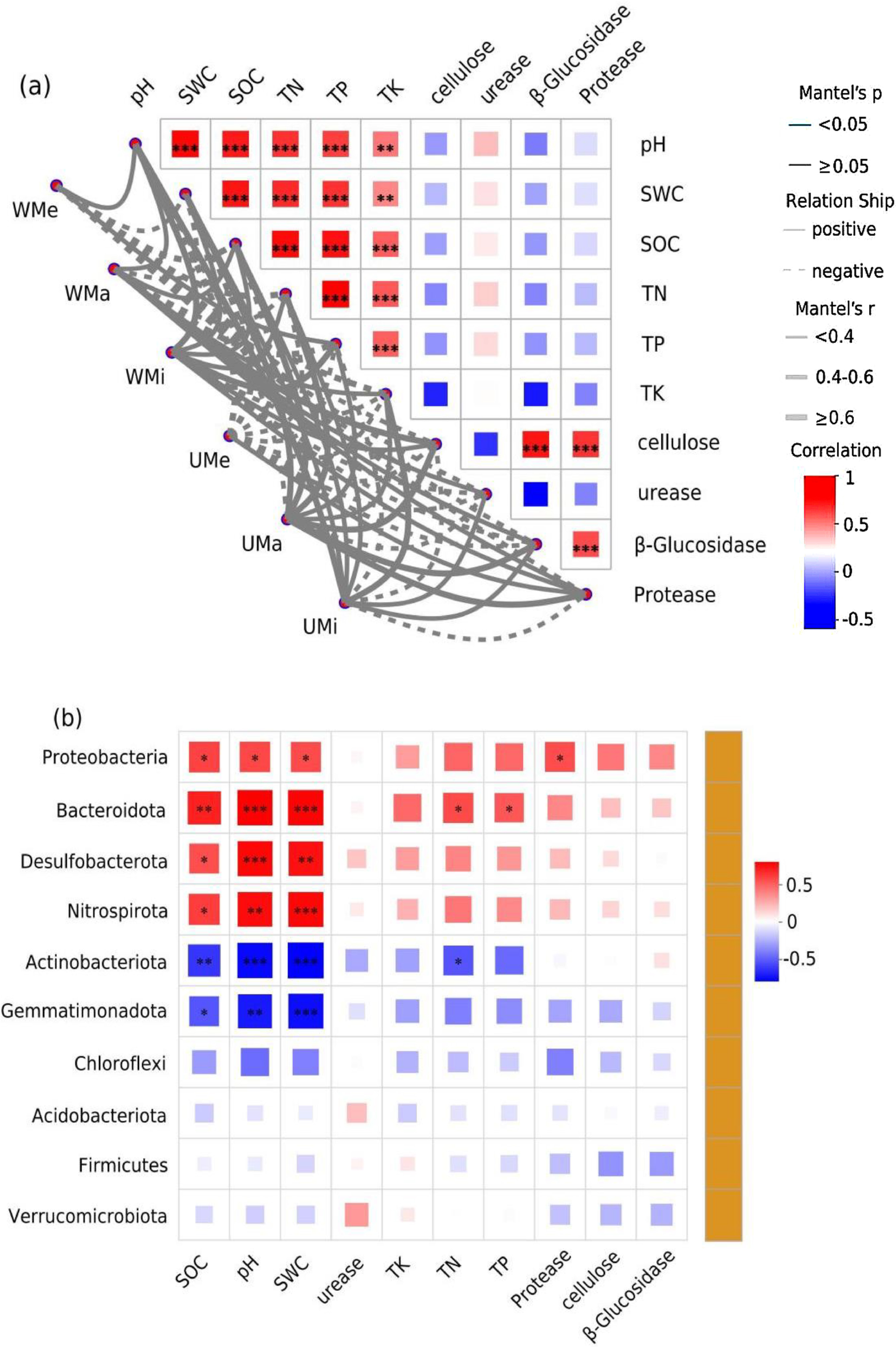
Mantel test results showed varying degrees of correlation between soil physical and chemical properties and aggregate size classes in both wetland and upland soils (Figure 4a). In wetland soils, WMe and WMa exhibited strong and statistically significant correlations (r ≥0.6, p<0.05) with SOC, TN, and SWC. In contrast, WMi showed weak correlations with these factors (r <0.4, p≥0.05), and no significant associations were observed. Soil enzyme activities, including β-glucosidase, urease, and protease, were moderately correlated (0.4≤ r <0.6) with WMe and WMa, but had low or non-significant correlations with WMi. In upland soils, UMe and UMa also displayed significant correlations with SOC, TN, and SWC. The UMe showed particularly strong correlations with TN and SWC. The UMa had moderate correlations with SOC and TN, but no significant correlation with SWC. The UMi exhibited no significant correlation with any tested soil parameter (r <0.6, p≥0.05). Spearman correlation analysis revealed distinct associations between dominant bacterial phyla and soil physical and chemical properties (Figure 4b). Actinobacteriota exhibited significant negative correlations with SOC, pH, SWC, and TN. In contrast, Proteobacteria showed significant positive correlations with SOC, pH, and SWC, and was also positively correlated with protease activity (r = 0.509, p = 0.031). Other phyla, such as Acidobacteriota, Chloroflexi, and Firmicutes, demonstrated weak or non-significant correlations with most soil variables (p≥0.05). For soil enzyme activities, only Proteobacteria showed a significant association with protease, whereas no significant correlations were observed between any phylum and urease, β-glucosidase, or cellulose activity.

Result from Mantel test (a) and Heatmap (b) to explore the relationship between the microbial community composition and soil physicochemical properties. WMe: mega-aggregate of wetland; WMa: marco-aggregate of wetland; WMi: micro-aggregate of wetland; UMe: mega-aggregate of upland; UMa: marco-aggregate of upland; UMi: micro-aggregate of upland; pH: soil pH value. SWC: soil water content; SOC: soil organic carbon content; TN: total nitrogen content of the soil samples; TP: total phosphorus content of the soil samples; TK: total potassium content of the soil samples. Significance levels: * p<0.05, ** p<0.01, *** p<0.001.
Microbial alpha diversity
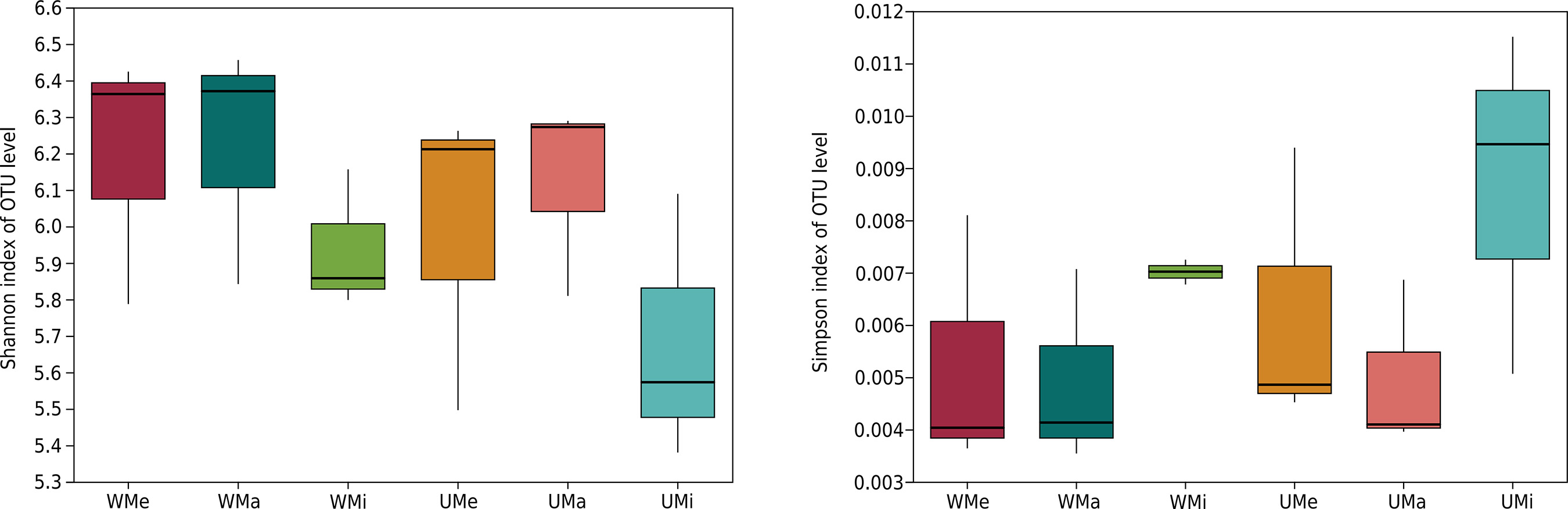
Microbial alpha diversity exhibited noticeable variation across different soil aggregate size classes in both wetland and upland soils (Figure 5). Shannon index patterns indicated higher community diversity in larger aggregate fractions, whereas the smallest fractions tended to show reduced diversity. Similar trends were observed with the Simpson index, where lower values reflected higher diversity in coarse aggregates, and higher values suggested lower evenness in finer aggregates. However, pairwise comparisons using T-tests revealed no statistically significant differences in alpha diversity among the groups.

Characteristics of bacterial alpha diversity of 16S rRNA gene libraries. WMe: mega-aggregate of wetland; WMa: marco-aggregate of wetland; WMi: micro-aggregate of wetland; UMe: mega-aggregate of upland; UMa: marco-aggregate of upland; UMi: micro-aggregate of upland.
Microbial beta diversity
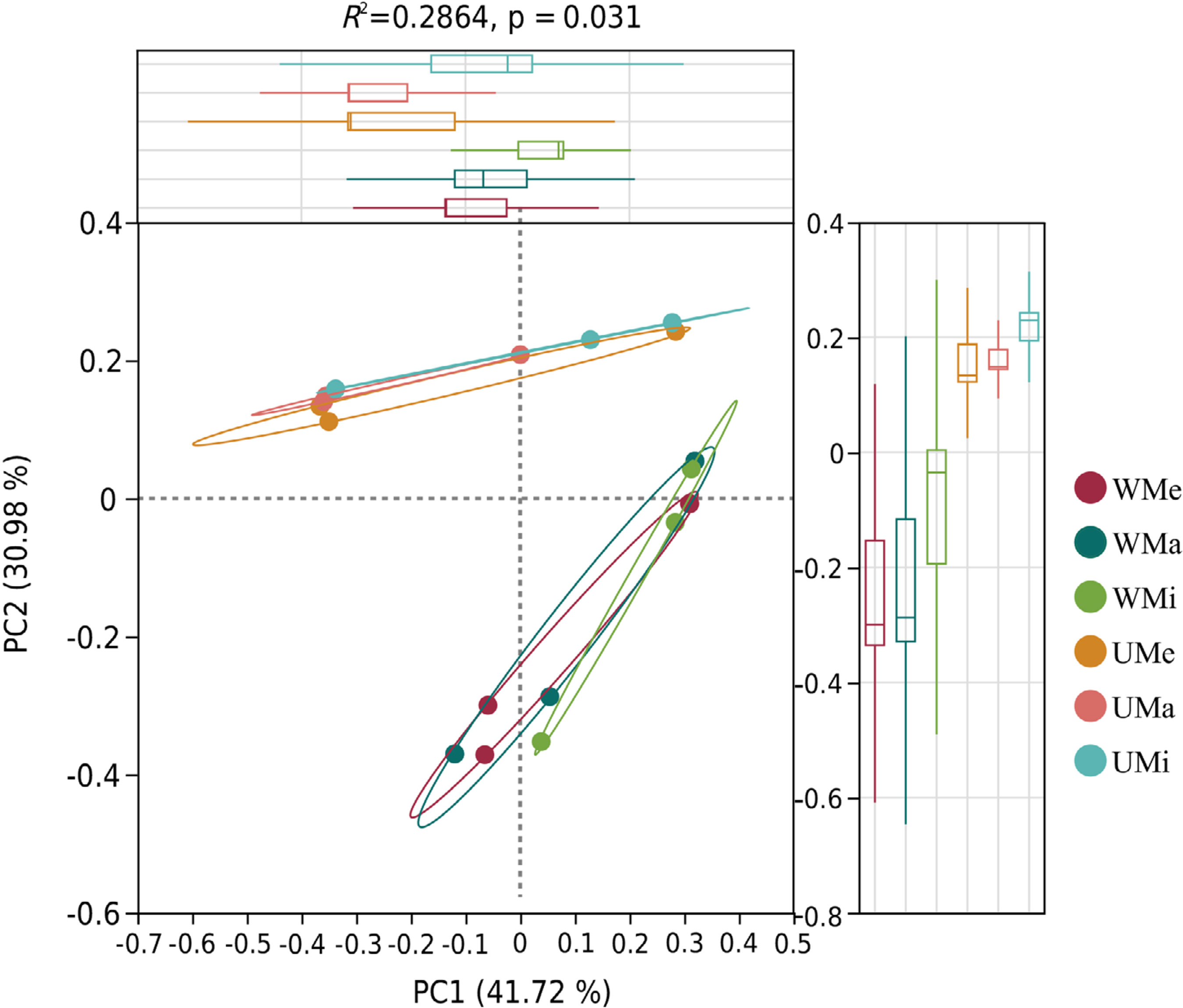
Principal coordinate analysis (PCoA) based on Bray–Curtis distances revealed clear differentiation in microbial community composition among soil aggregate size fractions and land-use types (Figure 6). The first principal coordinate (PC1) explained 41.72 % of the total variation, and the second (PC2) explained 30.98 %, together accounting for 72.70 % of the total variance. Samples from wetland and upland soils were distinctly separated along PC1, while variation among aggregate size classes was primarily reflected along PC2. PERMANOVA analysis confirmed that differences in microbial community composition among groups were statistically significant (R² = 0.2864, p = 0.031).

Principal coordinates analysis (PCoA) using Bray–Curtis dissimilarities illustrates distinct clustering of microbial communities across aggregate size fractions in wetland and upland soils. WMe: mega-aggregate of wetland; WMa: marco-aggregate of wetland; WMi: micro-aggregate of wetland; UMe: mega-aggregate of upland; UMa: marco-aggregate of upland; UMi: micro-aggregate of upland.
DISCUSSION
Land use markedly influenced the distribution of mechanically stable soil aggregates, with wetland soils exhibiting significantly higher proportions of mega-aggregates and greater aggregate stability, as reflected by elevated MWD and GMD values. This pattern likely reflects the long-term water-saturated conditions and high organic inputs in wetlands, which favor aggregate formation and protection through microbial exudates and physical bonding (Timmis and Ramos, 2021). In contrast, tillage and fertilization in farmlands disrupt aggregate integrity, leading to fragmentation and increased dominance of microaggregates (Shuanhu et al., 2025). Soil physical, chemical and biochemical properties also varied significantly across aggregate size fractions. Lower pH values in upland soils may be attributed to continuous fertilization-induced acidification (Daba et al., 2021).
Soil organic carbon, TN, and SWC decreased with decreasing aggregate size and were consistently higher in wetland soils. These findings are in line with previous studies showing that large aggregates can physically protect organic matter and support microbial habitats (Khan et al., 2025). Enzyme activities were also responsive to both land use and aggregate size. Higher urease and protease activities in wetland aggregates suggest that favorable moisture and nutrient conditions promote microbial metabolism (Daunoras et al., 2024). The peak of β-glucosidase activity in wetland macro-aggregates may indicate a hotspot for cellulose decomposition, consistent with studies in paddy and riparian soils (Li et al., 2019). Overall, these results highlight that conversion from wetland to farmland disrupts soil aggregate stability and weakens microbial functions, underscoring the ecological importance of preserving wetland soil structure.
The overlap and divergence in OTU composition among aggregate fractions indicate that both common and habitat-specific microbial taxa coexist within wetland and upland soils. The presence of 1375 shared OTUs across all aggregate types suggests a core microbiome that persists despite differences in aggregate size and land use. However, the identification of numerous unique OTUs in specific aggregate fractions particularly in WMa, UMa, and WMe reflects the influence of microhabitat heterogeneity and land use history on bacterial niche differentiation. These findings are consistent with recent studies reporting spatial partitioning of microbial assemblages driven by soil structural and environmental gradients (Zhang et al., 2020).
At the phylum level, Actinobacteriota, Proteobacteria, and Acidobacteriota dominated across all samples, highlighting their broad ecological tolerance and functional plasticity. The consistent dominance of Actinobacteriota, particularly in upland micro-aggregates, may reflect their adaptation to lower moisture and nutrient availability (Lan et al., 2022). Proteobacteria, known for their copiotrophic characteristics, maintained stable abundance across both soil types, suggesting their functional versatility in varying aggregate environments. Notably, land use induced differences in aggregate composition appeared to shape bacterial community structure within each fraction. For example, wetland mega-aggregates exhibited enrichment in the Nitrospinota, Spirochaetota, and Desulfobacterota phyla, which are often associated with anaerobic processes and saturated environments. In contrast, upland macroaggregates were enriched in Actinobacteriota and Gemmatimonadota, which are commonly associated with drier, oxidized conditions. These compositional shifts imply a strong coupling between aggregate-level habitat characteristics and bacterial niche selection, further underscoring the ecological role of soil structural hierarchy (Gupta and Tiedje, 2024).
Soil aggregate size plays a fundamental role in regulating the spatial heterogeneity of soil physical and chemical properties and microbial community composition (Han et al., 2021). Our results demonstrated that larger aggregates, particularly mega-aggregates in wetland soils, contained higher levels of SOC, TN, and SWC, along with greater enzyme activity. These findings support previous research suggesting that macrostructures create favorable habitats for organic matter accumulation and microbial colonization, owing to their higher porosity and water retention (Liu et al., 2024a). In contrast, micro-aggregates in both wetland and upland soils had lower nutrient levels and enzymatic activities, likely because of reduced pore space and limited microbial accessibility (Bhattacharyya et al., 2021). The observed urease, β-glucosidase, and protease activity patterns further indicate that nutrient cycling is more active in coarse aggregates, probably due to greater substrate availability and microbial biomass (Jilling et al., 2021).
Mantel and Spearman analyses highlighted SOC, TN, and SWC as the dominant factors influencing microbial community composition across aggregate fractions. These variables were closely linked to mega- and macro-aggregates but showed little effect on micro-aggregates, suggesting a spatial decoupling of microbial processes in finer fractions (Zhang et al., 2024). Moreover, the positive correlation between Proteobacteria and nutrient availability, especially protease activity, indicates that copiotrophic taxa are more active in nutrient-rich aggregates, whereas oligotrophic taxa such as Actinobacteria prevail in nutrient-poor environments (Dai et al., 2018).
Microbial diversity patterns also reflected aggregate-scale heterogeneity. Although α-diversity indices were higher in larger aggregates, the differences were not statistically significant (Liu et al., 2024b). By contrast, β-diversity analysis using PCoA and PERMANOVA showed that both land-use type and aggregate size significantly influenced microbial community composition (Liu et al., 2022). The clear separation of wetland and upland samples along PC1 emphasized the overriding role of land use in shaping microbial biogeography, consistent with previous findings on wetland-to-upland transitions.
CONCLUSION
Soil aggregate size and land-use type jointly regulate soil physical and chemical properties, enzyme activities, and microbial communities in cold-region soils. Wetlands contained more large aggregates, greater stability, and higher soil organic carbon and total nitrogen, as well as higher soil water content, than farmlands, supporting more diverse and active microbial assemblages. Soil organic carbon, total nitrogen, and soil water content were identified as key drivers of microbial community structure, especially in macro- and mega-aggregates. These results not only clarify mechanisms of soil structural degradation and microbial shifts after wetland reclamation but also offer practical implications. Conserving natural wetlands is critical for maintaining soil structure, nutrient stocks, and microbial diversity. Sustainable farmland practices, such as reduced tillage, organic amendments, and water conservation, can help preserve aggregate stability and microbial function. Restoration measures, including rewetting and vegetation recovery, may further enhance soil carbon sequestration and microbial resilience.
How to cite:
FUNDING
DATA AVAILABILITY
Datasets generated during and/or analyzed during the current study are available from the corresponding author upon reasonable request.
REFERENCES
-
Ballut-Dajud GA, Herazo LCS, Fernández-Lambert G, Marín-Muñiz JL, Méndez MCL, Betanzo-Torres EA. Factors affecting wetland loss: A review. Land. 2022;11:434. https://doi.org/10.3390/land11030434
» https://doi.org/10.3390/land11030434 -
Bhattacharyya R, Rabbi SMF, Zhang Y, Young IM, Jones AR, Dennis PG, Menzies NW, Kopittke PM, Dalal RC. Soil organic carbon is significantly associated with the pore geometry, microbial diversity and enzyme activity of the macro-aggregates under different land uses. Sci Total Environ. 2021;778:146286. https://doi.org/10.1016/j.scitotenv.2021.146286
» https://doi.org/10.1016/j.scitotenv.2021.146286 -
Costa OYA, Raaijmakers JM, Kuramae EE. Microbial extracellular polymeric substances: Ecological function and impact on soil aggregation. Front Microbiol. 2018;9:1636. https://doi.org/10.3389/fmicb.2018.01636
» https://doi.org/10.3389/fmicb.2018.01636 -
Daba NA, Li D, Huang J, Han T, Zhang L, Ali S, Khan MN, Du J, Liu S, Legesse TG, Liu L, Xu Y, Zhang H, Wang B. Long-term fertilization and lime-induced soil pH changes affect nitrogen use efficiency and grain yields in acidic soil under wheat-maize rotation. Agronomy. 2021;11:2069. https://doi.org/10.3390/agronomy11102069
» https://doi.org/10.3390/agronomy11102069 -
Dai Z, Su W, Chen H, Barberán A, Zhao H, Yu M, Yu L, Brookes PC, Schadt CW, Chang SX, Xu J. Long-term nitrogen fertilization decreases bacterial diversity and favors the growth of Actinobacteria and Proteobacteria in agro-ecosystems across the globe. Global Change Biol. 2018;24:3452-61. https://doi.org/10.1111/gcb.14163
» https://doi.org/10.1111/gcb.14163 -
Daunoras J, Kačergius A, Gudiukaitė R. Role of soil microbiota enzymes in soil health and activity changes depending on climate change and the type of soil ecosystem. Biology. 2024;13:85. https://doi.org/10.3390/biology13020085
» https://doi.org/10.3390/biology13020085 -
Ding J, Xu N. Variations of soil bacterial microbial community and functional structure under different land-uses. Rev Bras Cienc Solo. 2022;46:e0220090. https://doi.org/10.36783/18069657rbcs20220090
» https://doi.org/10.36783/18069657rbcs20220090 - Dong Z, Wang Z, Liu D, Song K, Li L, Ren C, Jia M. Spatial decision analysis on wetlands restoration in the lower reaches of Songhua River (LRSR), Northeast China, based on remote sensing and GIS. Int J Environ Res. 2014;8:849-60.
-
Guerrero R, Piqueras M, Berlanga M. Microbial mats and the search for minimal ecosystems. Int Microbiol. 2002;5:177-88. https://doi.org/10.1007/s10123-002-0094-8
» https://doi.org/10.1007/s10123-002-0094-8 -
Gupta VV, Tiedje JM. Ranking environmental and edaphic attributes driving soil microbial community structure and activity with special attention to spatial and temporal scales. mLife. 2024;1:21-41. https://doi.org/10.1002/mlf2.12116
» https://doi.org/10.1002/mlf2.12116 -
Griffiths BS, Bonkowski M, Roy J, Ritz K. Functional stability, substrate utilisation and biological indicators of soils following environmental impacts. Appl Soil Ecol. 2001;16:49-61. https://doi.org/10.1016/S0929-1393(00)00081-0
» https://doi.org/10.1016/S0929-1393(00)00081-0 -
Han S, Delgado-Baquerizo M, Luo X, Liu Y, Van Nostrand JD, Chen W, Zhou J, Huang Q. Soil aggregate size-dependent relationships between microbial functional diversity and multifunctionality. Soil Biol Biochem. 2021;154:108143. https://doi.org/10.1016/j.soilbio.2021.108143
» https://doi.org/10.1016/j.soilbio.2021.108143 -
Hernández TDB, Slater BK, Shaffer JM, Basta N. Comparison of methods for determining organic carbon content of urban soils in Central Ohio. Geoderma Reg. 2023;34:e00680. https://doi.org/10.1016/j.geodrs.2023.e00680
» https://doi.org/10.1016/j.geodrs.2023.e00680 -
Hicks TD, Kuns CM, Raman C, Bates ZT, Nagarajan S. Simplified method for the determination of total kjeldahl nitrogen in wastewater. Environments. 2022;9:55. https://doi.org/10.3390/environments9050055
» https://doi.org/10.3390/environments9050055 -
Jesmin T, Margenot AJ, Mulvaney RL. A comprehensive method for casein-based assay of soil protease activity. Commun Soil Sci Plant. 2022;4:507-20. https://doi.org/10.1080/00103624.2021.2017954
» https://doi.org/10.1080/00103624.2021.2017954 -
Jilling A, Keiluweit M, Gutknecht JLM, Grandy AS. Priming mechanisms providing plants and microbes access to mineral-associated organic matter. Soil Biol Biochem. 2021;158:108265. https://doi.org/10.1016/j.soilbio.2021.108265
» https://doi.org/10.1016/j.soilbio.2021.108265 -
Khan MT, Supronienė S, Žvirdauskienė R, Aleinikovienė J. Climate, soil, and microbes: Interactions shaping organic matter decomposition in croplands. Agronomy. 2025;15:1928. https://doi.org/10.3390/agronomy15081928
» https://doi.org/10.3390/agronomy15081928 -
Lan J, Wang S, Wang J, Qi X, Long Q, Huang M. The shift of soil bacterial community after afforestation influence soil organic carbon and aggregate stability in karst region. Front Microbiol. 2022;13:901126. https://doi.org/10.3389/fmicb.2022.901126
» https://doi.org/10.3389/fmicb.2022.901126 -
Li X, Zhang H, Sun M, Xu N, Sun G, Zhao M. Land use change from upland to paddy field in Mollisols drives soil aggregation and associated microbial communities. Appl Soil Ecol. 2020;146:103351. https://doi.org/10.1016/j.apsoil.2019.09.001
» https://doi.org/10.1016/j.apsoil.2019.09.001 -
Li Y, Xing T, Fu Z, Pu T, Ding P, Wu Y, Yang F, Wang X, Yong T, Yang W. Rhizosphere bacterial communities mediate the effect of maize-soybean strip intercropping and nitrogen management on cadmium phytoextraction. Appl Soil Ecol. 2025;207:105934. https://doi.org/10.1016/j.apsoil.2025.105934
» https://doi.org/10.1016/j.apsoil.2025.105934 -
Li Z, Rui Z, Zhang D, Feng X, Lu H, Shen S, Zheng J, Li L, Song Z, Pan G. Macroaggregates as biochemically functional hotspots in soil matrix: evidence from a rice paddy under long-term fertilization treatments in the Taihu Lake Plain, eastern China. Appl Soil Ecol. 2019;138:262-73. https://doi.org/10.1016/j.apsoil.2019.01.013
» https://doi.org/10.1016/j.apsoil.2019.01.013 -
Liu S, Lin Z, Duan X, Deng Y. Effects of soil microorganisms on aggregate stability during vegetation recovery in degraded granitic red soil areas. Appl Soil Ecol. 2024a;204:105734. https://doi.org/10.1016/j.apsoil.2024.105734
» https://doi.org/10.1016/j.apsoil.2024.105734 -
Liu S, Sun Y, Shi F, Liu Y, Wang F, Dong S, Li M. Composition and diversity of soil microbial community associated with land use types in the agro–pastoral area in the upper yellow river basin. Front Plant Sci. 2022;13:819661. https://doi.org/10.3389/fpls.2022.819661
» https://doi.org/10.3389/fpls.2022.819661 -
Liu X, Xiong Z, Ouyang L, He G, Liu W, Cai M. Macrohabitat and microhabitat mediate the relationships between wetland multifaceted biodiversity and multifunctionality. Catena. 2024b;241:108023. https://doi.org/10.1016/j.catena.2024.108023
» https://doi.org/10.1016/j.catena.2024.108023 -
Ma Y, Qu L, Wang W, Yang X, Lei T. Measuring soil water content through volume/mass replacement using a constant volume container. Geoderma. 2016;271:42-9. https://doi.org/10.1016/j.geoderma.2016.02.003
» https://doi.org/10.1016/j.geoderma.2016.02.003 -
Melkani S, Manirakiza N, Rabbany A, Medina-Irizarry N, Smidt S, Braswell A, Martens-Habbena W, Bhadha JH. Understanding the mechanisms of hydrolytic enzyme mediated organic matter decomposition under different land covers within a subtropical preserve. Front Environ Sci. 2025;13:1564047. https://doi.org/10.3389/fenvs.2025.1564047
» https://doi.org/10.3389/fenvs.2025.1564047 -
Menon M, Mawodza T, Rabbani A, Blaud A, Lair GJ, Babaei M, Kercheva M, Rousseva S, Banwart S. Pore system characteristics of soil aggregates and their relevance to aggregate stability. Geoderma. 2020;366:114259. https://doi.org/10.1016/j.geoderma.2020.114259
» https://doi.org/10.1016/j.geoderma.2020.114259 -
Mishra SK, Chowdhury SD, Bhunia P, Sarkar A. Clogging in subsurface flow constructed wetlands: Mechanisms, influencing factors, measurements, modelling, and remediation. Ecol Eng. 2024;208:107374. https://doi.org/10.1016/j.ecoleng.2024.107374
» https://doi.org/10.1016/j.ecoleng.2024.107374 -
Naylor D, McClure R, Jansson J. Trends in microbial community composition and function by soil depth. Microorganisms. 2022;10:540. https://doi.org/10.3390/microorganisms10030540
» https://doi.org/10.3390/microorganisms10030540 -
Peng S, Liu W, Xu G, Pei X, Millerick K, Duan B. A meta-analysis of soil microbial and physicochemical properties following native forest conversion. Catena. 2021;204:105447. https://doi.org/10.1016/j.catena.2021.105447
» https://doi.org/10.1016/j.catena.2021.105447 -
Ren Y, Li X, Mao D, Xi Y, Wang Z. Northeast China holds huge wetland soil organic carbon storage: An estimation from 819 soil profiles and random forest algorithm. Plant Soil. 2023;490:469-83. https://doi.org/10.1007/s11104-023-06089-1
» https://doi.org/10.1007/s11104-023-06089-1 -
Shuanhu L, Bohan Z, Wu H, Rongbiao L, Wang P. Three decades of tllage driven topsoil displacement and soil erosion attenuation on Loess Plateau slope farmlands. Agriculture. 2025;15:1084. https://doi.org/10.3390/agriculture15101084
» https://doi.org/10.3390/agriculture15101084 -
Sun M, Li T, Li D, Zhao Y, Gao F, Sun L, Li X. Conversion of land use from upland to paddy field changes soil bacterial community structure in Mollisols of Northeast China. Microb Ecol. 2021;81:1018-28. https://doi.org/10.1007/s00248-020-01632-4
» https://doi.org/10.1007/s00248-020-01632-4 -
Tang J, Mo Y, Zhang J, Zhang R. Influence of biological aggregating agents associated with microbial population on soil aggregate stability. Appl Soil Ecol. 2011;47:153-9. https://doi.org/10.1016/j.apsoil.2011.01.001
» https://doi.org/10.1016/j.apsoil.2011.01.001 -
Tavares MC, Oliveira KA, Fátima A, Coltro WKT, Santos JCC. Based analytical device with colorimetric detection for urease activity determination in soils and evaluation of potential inhibitors. Talanta. 2021;230:122301. https://doi.org/10.1016/j.talanta.2021.122301
» https://doi.org/10.1016/j.talanta.2021.122301 -
Timmis K, Ramos JL. The soil crisis: The need to treat as a global health problem and the pivotal role of microbes in prophylaxis and therapy. Microb Biotechnol. 2021;14:769-97. https://doi.org/10.1111/1751-7915.13771
» https://doi.org/10.1111/1751-7915.13771 -
Uchiyama T, Miyazaki K, Yaoi K. Characterization of a novel β-glucosidase from a compost microbial metagenome with strong transglycosylation activity. J Biol Chem. 2013;25:18325-34. https://doi.org/10.1074/jbc.M113.471342
» https://doi.org/10.1074/jbc.M113.471342 -
Wen Y, You J, Zhu J, Hu H, Gao J, Huang J. Long-term green manure application improves soil K availability in red paddy soil of subtropical China. J Soils Sediments. 2021;21:63-72. https://doi.org/10.1007/s11368-020-02768-z
» https://doi.org/10.1007/s11368-020-02768-z -
Yang H, Zang Z, Wang Z, Song K, Gao Y, Wei J, Han L, Zhang J, Liu C. Rapid determination of cellulose and starch in tobacco by colorimetric method. ACS Omega. 2025;10:13548-54. https://doi.org/10.1021/acsomega.5c00427.
» https://doi.org/10.1021/acsomega.5c00427 -
Yin X, Yu X, Qin L, Jiang M, Lu X, Zou Y. Reclamation leads to loss of soil organic carbon and molecular complexity: Evidence from natural to reclaimed wetlands. Soil Till Res. 2025;248:106436. https://doi.org/10.1016/j.still.2024.106436
» https://doi.org/10.1016/j.still.2024.106436 -
Zhang S, Yang X, Hsu LC, Liu YT, Wang SL, White JR, Shaheen SM, Chen Q, Rinklebe J. Soil acidification enhances the mobilization of phosphorus under anoxic conditions in an agricultural soil: Investigating the potential for loss of phosphorus to water and the associated environmental risk. Sci Total Environ. 2021;793:148531. https://doi.org/10.1016/j.scitotenv.2021.148531
» https://doi.org/10.1016/j.scitotenv.2021.148531 -
Zhang X, Li Y, Ren S, Zhang X. Soil CO2 emissions and water level response in an arid zone lake wetland under freeze–thaw action. J Hydrol. 2023;625:130069. https://doi.org/10.1016/j.jhydrol.2023.130069
» https://doi.org/10.1016/j.jhydrol.2023.130069 -
Zhang X, Liu S, Wang J, Huang Y, Freedman Z, Fu S, Liu K, Wang H, Li X, Yao M, Liu X, Schuler J. Local community assembly mechanisms shape soil bacterial β diversity patterns along a latitudinal gradient. Nat Commun. 2020;11:5428. https://doi.org/10.1038/s41467-020-19228-4
» https://doi.org/10.1038/s41467-020-19228-4 -
Zhang Y, Ren Y, Zhou S, Ning X, Wang X, Yang Y, Sun S, Vinay N, Bahn M, Han J, Liu Y, Xiong Y, Liao Y, Mo F. Spatio-temporal microbial regulation of aggregate-associated priming effects under contrasting tillage practices. Sci Total Environ. 2024;925:171564. https://doi.org/10.1016/j.scitotenv.2024.171564
» https://doi.org/10.1016/j.scitotenv.2024.171564 -
Zhang Z, Furman A. Soil redox dynamics under dynamic hydrologic regimes-A review. Sci Total Environ. 2021;763:143026. https://doi.org/10.1016/j.scitotenv.2020.143026
» https://doi.org/10.1016/j.scitotenv.2020.143026