 How do centipedes and millipedes respond to grazing intensity in an integrated crop-livestock system with soybean-pasture succession?
ABSTRACT
Centipedes and millipedes promote important functions in the ecosystem. However, land use intensification in agricultural areas can reduce the abundance and diversity of these organisms. To understand the effect of grazing intensification on communities of centipedes and millipedes, we sampled these organisms in an integrated crop-livestock system (ICLS) experiment, cultivated for 13 years with soybean (Glycine max) in the summer and black oat (Avena strigosa) + Italian ryegrass (Lolium multiflorum) for cattle grazing in the winter. Treatments consisted of different grazing intensities defined by sward heights of 0.10, 0.20, 0.30, and 0.40 m under continuous stocking, and control paddocks (no grazing). We used monoliths to collect centipedes and millipedes in the 0.00-0.10 and 0.10-0.20 m soil layers, and pitfall traps to collect specimens on the soil surface. Samplings were conducted for two years at two distinct moments of the ICLS: immediately after cattle removal from the pasture in 2014 and 2015 (post-grazing), and after soybean harvest in 2015 and 2016 (post-soybean). To evaluate the composition of millipede community, an extra sampling was performed with pitfall traps in 2018 (post-grazing). A total of 498 centipedes and 217 millipedes were collected during the two methods. We observed a greater abundance of centipedes and millipedes in the post-grazing environment and at lower grazing intensities in the 0.00-0.10 m soil layer. No significant effects of sward height were observed on centipede and millipede abundance in the 0.10-0.20 m soil layer or in the sampling with pitfall traps. Millipedes of genera Catharosoma, Leptodesmus, and organisms of the Pseudonannolenidae family occur in the integrated crop-livestock system, and Rhinocricus and Catharosoma in no grazing pastures. Moderate to light grazing intensities (0.30 m sward height) promote soil centipede and millipede communities with animal and soybean production in the integrated crop-livestock system, aligning sustainable intensification to food production.
Keywords
Diplopoda; Chilopoda;
Myriapoda
; agriculture; sustainable intensification
INTRODUCTION
Integrated crop-livestock systems (ICLS) can be an alternative to increase sustainable food production in a global scenario of reduced arable land (Peterson et al., 2020). The ICLS combines agriculture cycles for grain production with cattle grazing and, when well managed, it may result in higher plant and animal productivity (Kunrath et al., 2020), greater input and land-use efficiency (Farias et al., 2020), and improved soil quality (Cecagno et al., 2016; Carvalho et al., 2018). On the other hand, the excess animal load in the pasture cycle reduces the residues of cover crops, increases soil compaction, alters soil moisture and temperature regimes, and reduces soil physical, chemical, and biological quality (Bartz et al., 2014; Maharjan et al., 2017; Rakkar et al., 2017).
Intensification of soil use may lead to a reduction in the abundance, diversity, and activity of edaphic organisms (Liu et al., 2017) and to the loss of ecosystem services that are fundamental to environmental quality, which may increase the dependence on external inputs to maintain plant and animal production (Carvalho et al., 2021). Thus, although ICLS is expected to produce more food per unit area, the design and management of these systems must be carefully executed to promote synergistic interactions among its components instead of an over-intensification, which may lead to environmental degradation (Carvalho et al., 2018).
Due to its ecological importance and its high sensitivity to environmental disturbances, soil fauna may be used to indicate the limit between land-use intensification and environmental degradation. Among soil fauna organisms, the subphylum Myriapoda represents one of the largest groups and plays essential roles in soil and environment (Wilson and Anderson, 2004). Classes Diplopoda (millipedes) and Chilopoda (centipedes) comprise the largest number of described species, compared to classes Symphyla and Pauropoda (Minelli and Golovatch, 2013). In Brazilian agricultural systems, millipedes and centipedes are more abundant than Symphyla (Kraft et al., 2021), which may be found in greater abundance in forest ecosystems (Morais et al., 2010). Millipedes act in the decomposition of organic residues, nutrient cycling (Fernández et al., 2016; Battirola et al., 2017), and in the stimulation of microbial activity (Snyder and Hendrix, 2008). As generalist predators, centipedes play a fundamental role in biological control (van Lenteren, 2012). They may feed on invertebrates such as earthworms, collembolans, and dipterans (Günther et al., 2013), and large species can prey on large arthropods, amphibians, and small mammals (Dugon and Arthur, 2012). Moreover, the habitat structure influences prey availability, and an ICLS composed of pastures and soybeans may promote small herbivores (Klarner et al., 2017) associated with the environmental refuges provided by these crops. Centipedes and millipedes also have low tolerance and high sensitivity to changes in the environment, which makes them excellent bioindicators of soil quality (Snyder and Hendrix, 2008; Diekötter et al., 2010; Suárez et al., 2018).
Despite their importance, there is still a need to know the biodiversity and behavior of Myriapoda communities in agricultural areas and integrated crop-livestock systems. Compared to other edaphic fauna groups, there are few studies about these organisms, especially in Latin American conditions (Ospina-Bautista et al., 2022; Parra-Gómez, 2022). Therefore, studies on integrated crop-livestock systems require understanding how grazing intensities affect these communities since 3.9 million hectares are managed according to these regenerative agriculture practices in subtropical Brazil (Rede ILPF, 2021).
This study aimed to evaluate the response of soil centipedes and millipedes to grazing intensity in an integrated crop-livestock system cultivated for 13 years with soybeans, in summer, and a mix of black oat + Italian ryegrass cover crops grazed by beef cattle, in winter. We predict that the intensification of land use (heavier grazing intensities, or lower sward heights) has a negative effect on the abundance of centipedes and millipedes. We hypothesized that lower grazing intensities (or higher sward heights) benefit the abundance and diversity of these organisms, either by the greater offer of cover crop residues that benefit the millipedes, or by the presence of other soil fauna organisms that are part of the food chain of the centipedes.
MATERIALS AND METHODS
Study area
The study was carried out as part of a long-term integrated crop-livestock system (ICLS) experiment established in 2001 at the Espinilho Farm, in the municipality of São Miguel das Missões, Rio Grande do Sul State, Brazil (28° 56’ 14.00” S, 54° 20’ 50.61” W, 465 m above sea level). The experimental site is characterized by a slightly undulated topography, and the soil is classified as Latossolo Vermelho Distroférrico (Santos et al., 2018) or a Rhodic Hapludox (Soil Survey Staff, 1999). The climate is humid subtropical (Cfa, Köppen-Geiger classification) (Beck et al., 2018) with an average annual precipitation of 1,850 mm well distributed throughout the seasons, and an average annual temperature of 19 °C (Schuster et al., 2019).
The area was covered by native grassland and used for extensive beef cattle production for decades. In 1993, the native grassland was converted to no-till soybean (Glycine max L.) cropland, succeeded by black oats (Avena strigosa Schreb.) for soil cover and seed production in the winter. In 2001, 22 ha started being managed as an ICLS with an annual rotation of soybean production, in summer (November to April), and beef cattle production on mixed black oats + Italian ryegrass (Lolium multiflorum Lam.) pastures, in winter (May to October) (Kunrath et al., 2014). Each year, soybean was sown after removing the animals from the experimental site. Pasture species were established immediately after the soybean harvest. Black oats were drill-seeded at 60 and 35 kg ha-1 seeding rates in 2014 and 2015, respectively. Italian ryegrass resulted from previous-year self-seeding (volunteer plants) plus supplementary broadcast seeding at 30 and 25 kg ha-1 seeding rates in 2014 and 2015, respectively (Kunrath et al., 2020).
The experimental design was a randomized complete block with three replicates. Treatments consisted of four grazing intensities, totaling 12 paddocks ranging from 0.8 to 3.6 ha. Grazing intensities were defined by average sward heights in winter: 0.10, 0.20, 0.30, and 0.40 m. Two 0.1 ha control plots (without grazing) were allocated among the blocks. Grazed paddocks were managed under continuous stocking with a variable stocking rate: three tester animals (crossbred Angus × Nelore steers) with an initial body weight of ~200 kg remained in the paddocks over the entire stocking period, and put-and-take animals were used to adjust the observed sward height to their nominal targets. Average sward height of each paddock was obtained by periodically measuring 100 random points with a sward stick. For more experiment details, see Kunrath et al. (2020).
Millipede and centipede sampling and identification
Centipede and millipede abundance in the ICLS was assessed at four sampling dates. Two samplings were performed immediately after cattle removal from the area (“post-grazing”; November 05–11, 2014 and November 1–7, 2015), and two samplings were performed immediately after soybean harvest (“post-soybean”; April 29–May 06, 2015 and May 06–13, 2016). Collecting points were allocated in a grid of 60 × 36 m in the center of each grazed paddock. The grid consisted of three 60 m transects spaced 18 m apart. Three collection points were allocated in each transect, totaling nine collection points per paddock (Freiberg et al., 2020). Collections were performed over the four sampling dates at the same sites determined by RTK GPS (1-cm accuracy, HiperPro, Topcon, Singapore). The study was carried out according to the Authorization for Activities with a Scientific Purpose number 4345-6 (SISBIO) issued by the Ministry of the Environment of Brazil. Centipedes and millipedes were collected by using soil monoliths (0.25 × 0.25 × 0.20 m), according to the standard Tropical Soil Biology and Fertility Programme (TSBF) sampling protocol (Anderson and Ingram, 1993). Soil was collected in two layers (0.00-0.10 and 0.10-0.20 m), placed into a plastic bag, and the macroarthropods were manually collected in the field laboratory. Following the same sampling design of TSBF, we also sampled epiedaphic centipedes and millipedes with pitfall traps (0.09 m Ø × 0.20 m, with cover) containing 500 mL of 70 % ethyl alcohol (v/v), which remained in the field for seven days.
To collect adult millipedes for taxonomic identification, we performed an extra sampling with the same sampling design in grazed paddocks (0.10, 0.20, 0.30, and 0.40 m). At the control paddocks (0.60 m - no grazing), a linear transect with seven points distanced 15 m from each other, was located at the center of each paddock. This sampling comprised a total of 122 pitfall traps, which remained in the field for thirty days (from May 04 to June 04, 2018). All organisms were preserved in 80 % ethyl alcohol solution and the millipedes were identified at the level of order, family, and genus at the Laboratory of Diversity and Systematics of the University of Vale do Rio dos Sinos (UNISINOS), Brazil. The centipede taxa were not determined due to the lack of specialized taxonomists in Brazil, and the sampling methods (pitfall traps and TSBF), which restricted the collection of juvenile centipede specimens.
Soil properties
Soil samples (0.00-0.10 m layer) were collected to evaluate the relationship between soil chemical and physical properties and myriapods abundance. Sampling was performed after grazing (November 2014) and after soybean harvest (April 2015), at the same nine collection points per paddock. The following soil physical properties were determined: total porosity, macroporosity, and microporosity on the tension table (Donagema et al., 2011); bulk density, using the volumetric ring method (Blake and Hartge, 1986); and gravimetric humidity, by drying the soil in an oven at 105 °C to constant weight. The determined chemical properties were organic matter, pH(water 1: 1); P and K (Mehlich-1), Ca2+, Mg2+, and Al3+ (KCl 1 mol L-1), and soil moisture (Donagema et al., 2011). We also collected the residual forage shoot at the end of the stocking period (“post-grazing”) and litter following soybean harvest (“post-soybean”). The samples were collected using a metallic square (0.25 × 0.15 m), at three points per paddock, and oven-dried at 65 °C until reaching constant mass to determine biomass.
Statistical analysis
All statistical analyses were performed in R version 4.1.1 (R Development Core Team, 2021). The effect of grazing intensity (sward heights of 0.10, 0.20, 0.30 and 0.40 m) on the abundance of centipedes and millipedes was tested using generalized linear models with a Poisson distribution. With this model, we analyzed the effect of the environment, comparing the post-grazing and post-soybean. For this analysis, we considered the total abundance per paddock, in which the nine sampling points per paddock were summed and considered a single point. Therefore, we obtained 48 sampling points, 24 points for the environment post-grazing, and 24 for post-soybean. The coefficient of determination (R2) of the fitted models was calculated based on the likelihood-ratio test, using the ‘r.squaredLR’ function of the MuMIn package (Barton, 2020).
Redundancy analysis (RDA) was performed to analyze the relationship between the abundance of centipedes and millipedes with environmental variables (Oksanen et al., 2020). Before the RDA analysis, chemical, physical, and land cover variables were selected according to a Principal Component Analysis and the collinearity (variables with correlation >0.8 were excluded). Data on macroporosity, microporosity, total porosity, bulk density, phosphorus, potassium, pH, organic matter, soil moisture, and plant dry mass (shoots and litter) were log-transformed, and the abundance data was transformed according to Legendre and Gallagher (2001). ANOVA-like permutation test was performed to access the significance of the model.
RESULTS
Abundance of centipedes and millipedes
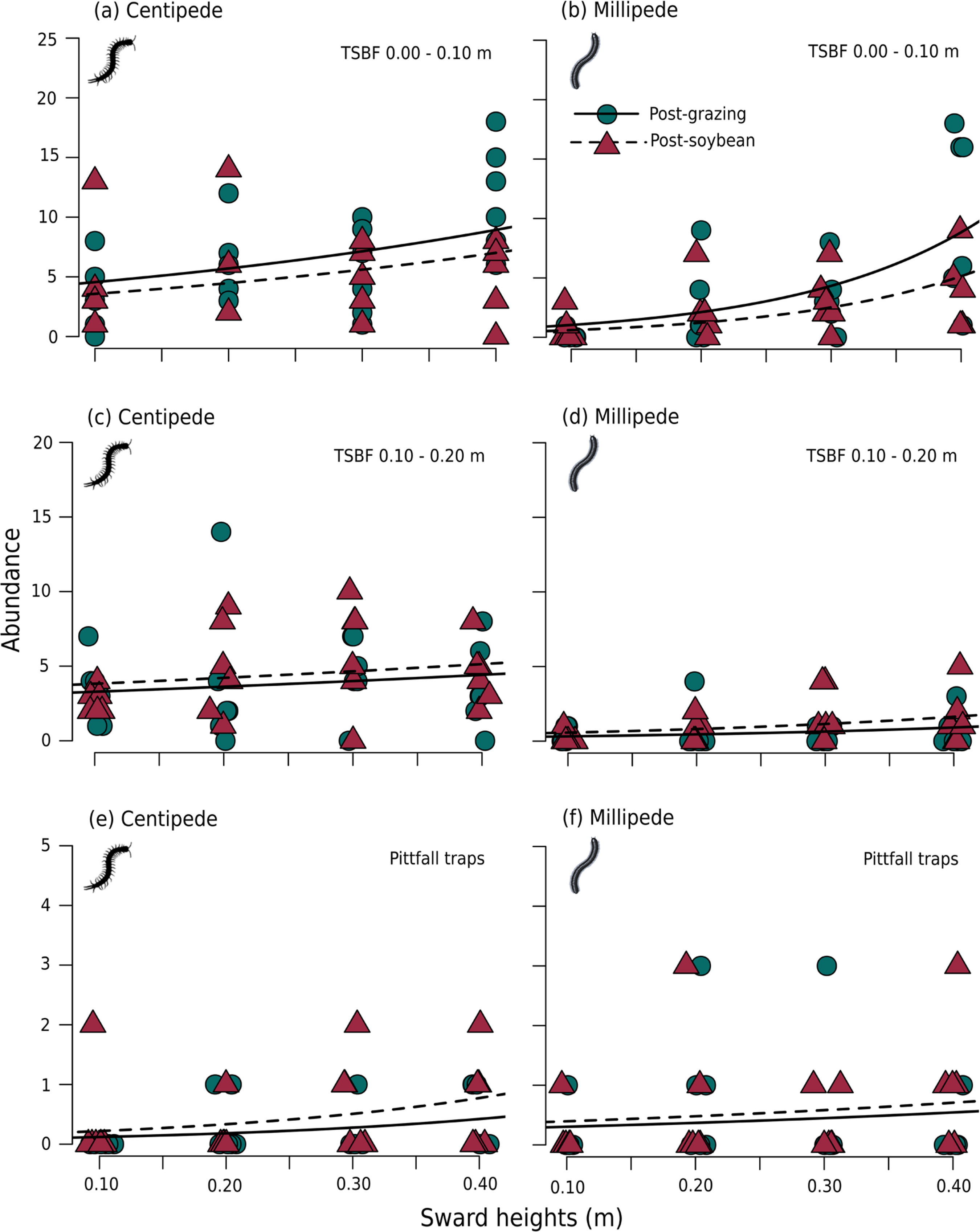
Data obtained from soil monoliths showed a significant response of centipedes and millipedes to grazing intensification and the environment (post-grazing vs. post-soybean) in the 0.00-0.10 m soil layer (Table 1; Figures 1a and 1b). For centipedes, we collected 481 individuals, 282 of which were in the 0.00-0.10 m soil layer and 199 in the 0.10-0.20 m soil layer. In the 0.00-0.10 m soil layer, we observed greater abundance (56 %) in the post-grazing environment (56 %; p<0.001) and in the sward height of 0.40 m (35.8 %; p<0.05) (Figure 1a). In the 0.10-0.20 m soil layer, we did not observe a significant effect of grazing intensity or the environment, although 53.7 % of centipedes were found in the post-soybean environment and 31.2 % in the sward height of 0.30 m (Figure 1c).
Summary of the generalized linear models (GLM) testing for the effect of grazing intensity (sward heights of 0.10, 0.20, 0.30, and 0.40 m in winter) and environment (post-grazing vs. post-soybean) on the abundance of centipedes and millipedes in an integrated crop-livestock system (soybean-beef cattle). Sampling was carried out with the Tropical Soil Biology and Fertility Programme (TSBF) protocol and pitfall traps. Model: Response ~ Sward height + Environment (post-grazing, post-soybean)
Abundance of centipedes (a, c, e) and millipedes (b, d, f) in an integrated crop-livestock system with cattle grazing at different intensities in winter (sward heights of 0.10, 0.20, 0.30 and 0.40 m) and soybean culture in summer. Sampling was carried out after cattle removal from the pasture (post-grazing) and after soybean harvest (post-soybean) using the Tropical Soil Biology and Fertility Programme (TSBF) protocol in 0.00-0.10 m (a, b) and 0.10-0.20 m soil layer (c, d), and pitfall traps (e, f).
Regarding millipede abundance, we collected 194 organisms, 155 of which were in the 0.00-0.10 m soil layer and 39 individuals in the 0.10-0.20 m soil layer. In the 0.00-0.10 m soil layer (Figure 1b), we also observed greater abundance (63.2 %) in the post-grazing environment (p<0.001) and in the sward height of 0.40 m (60.0 %, p<0.01). Despite no statistical difference in the 0.10-0.20 m soil layer, 64.1 % of millipedes were collected in the post-soybean environment and 35.9 % in the sward height of 0.30 m (Figure 1d). We collected only 17 centipedes (64.7 % post-soybean) and 23 millipedes (56.5 % post-soybean) in the pitfall trap samplings. In this sampling method, no significant responses to grazing intensification and environment were observed (Table 1, Figures 1e and 1f).
Redundancy analysis (RDA) showed the environmental variables explained a lower proportion of the total variation in the abundance of centipedes and millipedes in the 0.00-0.10 m layer, in both post-grazing and post-soybean environments (Figure 2). Therefore, other biotic and abiotic variables, such as availability of potential preys, and cattle dung deposition, precipitation, and temperature could be considered to explain the millipede and centipede community in the ICLS. In the post-grazing (Figure 2a), the environmental variables explained 16.64 % of the total variation, mainly driven by the forage residual biomass (Dm) that explained 8.13 % of the total variation (F = 4.9577, p = 0.007) being associated with the millipede abundance. Organic matter (OM) explained 3.85 % (F = 2.2444, p = 0.11) and potassium 3.99 % (F = 2.314, p = 0.112). However, the fitted model of RDA for the selected variables showed no statistical significance (F = 1.4256, p = 0.106). In the post-soybean environment (Figure 2b), the environmental variables explained 11.56 % of the total variation, although no statistical significance was observed (F = 1.5365, p = 0.101). Between the variables, total soil porosity and macroporosity explained most of the variance (2.32 % of the total variation, F = 2.3934, p = 0.095; 2.52 % of the total variation, F = 2.6138, p = 0.098, respectively). The variables P and K were positively associated with millipede abundance (<1 % of the total variation, not significant).
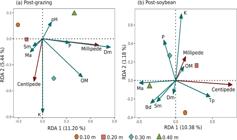
Redundancy Analysis (RDA) relating the environmental variables to the abundance of centipedes and millipedes collected using the Tropical Soil Biology and Fertility Programme (TSBF) protocol in the 0.00-0.10 m soil layer of an integrated crop-livestock system with cattle grazing at different intensities in winter (sward heights of 0.10, 0.20, 0.30 and 0.40 m) and soybean crops in summer. Sward heights were plotted as centroids values (points). The RDA comprised 58 observations in post-grazing (a) and 103 observations in post-soybean (b). Macroporosity (Ma), total porosity (Tp), organic matter (Om), soil moisture (Sm), bulk density (Bd), dry mass (Dm), pH, phosphorus (P), and potassium (K).
Millipede community
The extra longer sampling (30 days) resulted in the collection of 37 millipedes in the grazed paddocks, which belonged to two orders, three families, and three genera (Table 2). Lighter grazing intensities showed greater richness (sward heights of 0.30 and 0.40 m), with the occurrence of the genera Catharosoma, Leptodesmus, and Gen. 1. The genus Catharosoma comprised 78.4 % of the millipedes collected at the experimental site. At the sward height of 0.10 m, only individuals of the family Pseudonannolenidae (Gen. 1) were observed. Moreover, four individuals of the genus Rhinocricus (Spirobolida; Rhinocricidae) were collected exclusively in no grazed paddocks (0.60 m pasture height).
Composition of orders, families, and genera of millipedes in an integrated crop-livestock system with cattle grazing at different intensities in winter (sward heights of 0.10, 0.20, 0.30 and 0.40 m) and soybean crops in summer. Sampling was carried out for 30 days using the pitfall trap method, after cattle removal from the pasture
DISCUSSION
Our results support that the abundance of centipedes and millipedes in the 0.00-0.10 m soil layer is influenced by grazing intensity and the environment (pasture or soybean crop). Higher sward heights and the post-grazing environment benefit the abundance of these organisms because of the environmental conditions and the availability of food (vegetable residues and soil fauna). Centipedes are predators of smaller arthropods, like meso and macroinvertebrates (Berg and Hemerik, 2004; Trucchi et al., 2009), and may have found greater prey availability at greater sward heights, as suggested by Klarner et al. (2017). In this sense, the greater amount of plant residues deposited on the soil because of lighter grazing intensities provides a favorable environment for myriapods occurrence (Battirola et al., 2017). In addition to the amount of litter, the quality of leaf species, such as dry matter content and chemical and physical toughness, can also influence myriapods and cause changes in the composition of millipede and centipede communities (Ospina-Bautista et al., 2022). Millipedes may be conditioned by the amount and quality of biomass since they play an extremely important role in the initial process of residue decomposition in the soil (Smit and Van Aarde, 2001). These organisms increase the specific surface area of residues, facilitating the decomposition by microorganisms, the mineralization (Snyder and Hendrix, 2008), and the release of nutrients to the soil (Smit and Van Aarde, 2001; Silva et al., 2017).
The greater abundance of centipedes and millipedes in the 0.00-0.10 m layer in post-grazing indicates that the pasture environment provides better conditions for communities of these organisms compared to soybean cultivation. An opposite response was expected regarding the type and quality of cover crops present in the area. According to Suzuki et al. (2013), the abundance of millipedes in an environment may reflect the type of litter present, as these organisms have food preferences for more easily degradable residues, such as soybean straw, which has a lower C/N ratio. In this sense, Stašiov et al. (2021) point out that the litter with higher nitrogen content promoted a greater abundance of millipedes, and higher nitrogen content in soil promoted the diversity of millipedes.
However, other factors potentially affecting soil communities are also present in this area and may harm centipedes and millipedes, mainly during soybean cultivation. Soybean crop is managed with herbicides, fungicides, and insecticides in large quantities and repeatedly, and these practices alter the communities of myriapods, reducing their abundance and diversity (Hill et al., 2017; Gunstone et al., 2021). Nonetheless, during the pasture cycle, there is a greater variety of food for the edaphic organisms through the cultivation of mixed cover crops (black oat and ryegrass) and the deposition of cattle dung patches that may support the food web of millipedes (Römbke et al., 2010; Pecenka and Lundgren, 2018). In addition, manure plates also allow the development of other macro and microinvertebrates that are potential prey for centipedes (Römbke et al., 2010). Cattle dung patches shelter a varied group of soil fauna, such as mites, springtails, spiders, isopods, and larvae of Diptera, Lepidoptera, and Coleoptera (Pecenka and Lundgren, 2018). In the ILCS, the coverage of cattle dung patches decreases with the increase in pasture height, depending on the animal stocking rate, which is greater at heights of 0.10 and 0.20 m (Silva et al., 2020). Although cattle dung provides refuge sites for foraging ground fauna, we found a greater abundance of epiedaphic arthropods at higher grazing heights (data not published). Therefore, despite cattle imposing heterogeneity on the soil with the deposition of dung, the structure of the vegetation (amount of biomass) has a greater influence on the abundance of soil fauna and other predators (Freiberg et al., 2020).
Our study did not find significant relationships between the abundance of millipedes and centipedes with chemical and physical soil properties. However, it is important to highlight that other studies have shown soil properties influence the myriapod community. Organic carbon and soil moisture have been reported to promote the abundance of millipedes (Marchão et al., 2009; Manhães et al., 2013). Moreover, the soil pH may lead to the presence and abundance of certain species of millipedes (Ashwini and Sridhar, 2006; Stašiov et al., 2021).
In this regard, it is noteworthy that in the samplings carried out in the 0.10-0.20 m soil layer, we observed a greater abundance of centipedes and millipedes in the post-soybean environment, although without statistical differences between the environments (soybean vs. pasture). This fact may be related to the soil moisture and temperature conditions. Ashwini and Sridhar (2006) reported a positive relationship between soil moisture and soil temperature with millipede abundance. Soil moisture tends to decrease, and temperature tends to increase in the topsoil layer, especially at lower sward heights (0.10 m), where there are less residues covering the soil (Martins et al., 2016). Also, Oxisols have shown a low amplitude of soil temperature around 0.12 cm soil layer, so the subsurface layer can have better moisture and temperature conditions for centipedes and millipedes communities (Bogyó et al., 2015).
Data on the composition of millipede community demonstrate the dominance of the genus Catharosoma, found in greater abundance at grazing intensities of 0.20, 0.30, and 0.40 m. This genus has been reported in the Rio Grande do Sul State, in environments such as forests (Rodrigues et al., 2020) and floodplains (e.g., Pantanal Biome) where Callisthene fasciculata is a monodominant species (Santos-Silva et al., 2019). Genus Leptodesmus occurred only in treatments with grazing intensities of 0.30 and 0.40 m. Its occurrence was reported in Araucaria and Pinus forests in Southern Brazil, but not in agricultural environments (Rodrigues et al., 2017), which may suggest that pastures (post-grazing) offer edaphic and environmental conditions similar to forestry areas.
Millipedes of the Pseudonannolenidae family were observed in the 0.30 and 0.40 m grazing intensities, and they were the only ones in the 0.10 m of grazing indicating tolerance to land-use intensification. In Brazil, there are reports of the occurrence of the Pseudonannolenidae family in different ecosystems, from agroecosystems (Boock and Lordello, 1952) to caves (Fontanetti, 1996). These reports indicate organisms are cosmopolitan and can be found in the most diverse environments, associated with highly conserved environments and modified anthropically. The genus Rhinocricus was collected only in the control paddocks – without grazing. This genus has been reported as a potential bioindicator of contaminated soils (Souza and Fontanetti, 2011; Fontanetti et al., 2012) and was sampled in more abundance in soil forestry with low disturb (Rodrigues et al., 2017). This genus was sampled at the least impacted paddocks, where the pasture is cultivated as a cover crop for soybean production in summer. This suggests that millipedes from these taxa are potential bioindicators for agroecosystems. However, it is important to point out that further studies are needed to verify the potential for indicating environmental changes by these genera and families.
Considering the productive responses in this ICLS, the average soybean grain yield has shown little variation between treatments over the years, being 2.88; 2.86; 2.83; and 3.09 Mg ha-1 following sward heights of 0.10, 0.20, 0.30, and 0.40 m, respectively (Nunes et al., 2021). On the other hand, meat production varied widely between treatments, as a result of increasing stocking rates from the lightest to the heaviest grazing intensity, being 183, 311, 428 and 510 kg of live weight ha-1 on average, respectively (Nunes et al., 2021). Therefore, although managing black oat + ryegrass pastures at the sward height of 0.10 m represents the greatest production intensification, this practice leads to the loss of centipede and millipede communities, as well as chemical and physical degradation of the soil (Bonetti et al., 2019).
The grazing intensity of 0.40 m resulted in greater abundance and richness of millipedes and abundance of centipedes. However, it showed lower meat production per area and lower profitability. At the sward height of 0.20 m, there is a greater abundance of centipedes and millipedes than at 0.10 m, although the richness of millipedes is lower. When grazing is managed at 0.30 m, there is greater abundance and richness of these organisms, which allows for reconciling the maintenance of biodiversity and food productivity. Adjusting the stocking rates in an ICLS is fundamental to seeking the sustainability of this system and benefitting the soil centipede and millipede communities and their functionalities in the agroecosystems. Our results indicate that in integrated crop-livestock systems, adopting pasture management practices such as adequate grazing intensities may enhance the environment through greater food availability and habitats for soil fauna. In this way, higher sward heights provide more favorable environmental conditions for centipedes and millipedes, which may promote their ecology processes in greater magnitude and contribute to environmental sustainability.
CONCLUSIONS
Grazing intensity management in integrated crop-livestock systems affects the abundance of centipedes and millipedes in the 0.00-0.10 m soil layer. Higher sward heights provide greater environmental conditions that increase the abundance of these organisms in the post-grazing compared to the post-soybean environment. In the pasture environment, the millipede diversity comprises the occurrence of the genera Catharosoma, Leptodesmus, and organisms of the Pseudonannolenidae family, with a greater richness of millipedes being sheltered in pastures managed at 0.30 and 0.40 m sward height. Therefore, moderate to light grazing intensities (0.30 m sward height) promote soil centipede and millipede communities with animal and soybean production in the integrated crop-livestock system, aligning sustainable intensification to food production.
ACKNOWLEDGEMENTS
The authors would like to thank the Grupo de Pesquisa em Sistemas Integrados de Produção Agropecuária at the Federal University of Rio Grande do Sul, and the Laboratório de Biologia do Solo at the Federal University of Santa Maria, for their assistance in the field and laboratory.
-
How to cite: Freiberg JA, Trombeta HW, Rodrigues PES, Nunes PAA, Dambros CS, Carvalho PCF, Antoniolli ZI, Jacques RJS. How do centipedes and millipedes respond to grazing intensity in an integrated crop-livestock system with soybean-pasture succession? Rev Bras Cienc Solo. 2025;49:e0240114. https://doi.org/10.36783/18069657rbcs20240114
-
FUNDING
We are grateful to the Coordenação de Aperfeiçoamento de Pessoal de Nível Superior (CAPES) - Finance Code 001 and the Conselho Nacional de Desenvolvimento Científico e Tecnológico (CNPq) for financial support.
DATA AVAILABILITY
The data will be provided upon request.
REFERENCES
- Anderson JM, Ingram JSI. Tropical soil biology and fertility: A handbook of methods. 2nd ed. Wallingford, UK: CAB International; 1993.
-
Ashwini KM, Sridhar KR. Seasonal abundance and activity of pill millipedes (Arthrosphaera magna) in mixed plantation and semi-evergreen forest of southern India. Acta Oecol. 2006;29:27-32. https://doi.org/10.1016/j.actao.2005.07.005
» https://doi.org/10.1016/j.actao.2005.07.005 -
Barton K. MuMIn: Multi-model inference. R package version 1.43.17. CRAN - Package MuMIn; 2020. Available from: https://CRAN.R-project.org/package=MuMIn
» https://CRAN.R-project.org/package=MuMIn -
Bartz MLC, Brown GG, Orso R, Mafra AL, Baretta D. The influence of land use systems on soil and surface litter fauna in the western region of Santa Catarina. Rev Cienc Agron. 2014;45:880-7. https://doi.org/10.1590/S1806-66902014000500003
» https://doi.org/10.1590/S1806-66902014000500003 -
Battirola LD, Golovatch SI, Pinheiro TG, Batistella DA, Rosado-Neto GH, Chagas Jr A, Brescovit AD, Marques MI. Myriapod (Arthropoda, Myriapoda) diversity and distribution in a floodplain forest of the Brazilian Pantanal. Stud Neotrop Fauna Environ. 2018;53:62-74. https://doi.org/10.1080/01650521.2017.1397978
» https://doi.org/10.1080/01650521.2017.1397978 -
Beck HE, Zimmermann NE, McVicar TR, Vergopolan N, Berg A, Wood EF. Present and future Köppen-Geiger climate classification maps at 1-km resolution. Sci Data. 2018;5:180214. https://doi.org/10.1038/sdata.2018.214
» https://doi.org/10.1038/sdata.2018.214 -
Berg MP, Hemerik L. Secondary succession of terrestrial isopod, centipede, and millipede communities in grasslands under restoration. Biol Fertil Soils. 2004;40:163-70. https://doi.org/10.1007/s00374-004-0765-z
» https://doi.org/10.1007/s00374-004-0765-z -
Blake GR, Hartge KH. Bulk density. In: Klute A, editor. Methods of soil analysis: Part 1 Physical and mineralogical methods. Madison: SSSA; 1986. p. 363-75. https://doi.org/10.2136/sssabookser5.1.2ed.c14
» https://doi.org/10.2136/sssabookser5.1.2ed.c14 -
Bogyó D, Magura TD, Nagy D, Tothmeresz B. Distribution of millipedes (Myriapoda, Diplopoda) along a forest interior - forest edge - grassland habitat complex. Zookeys. 2015;510:181-95. https://doi.org/10.3897/zookeys.510.8657
» https://doi.org/10.3897/zookeys.510.8657 -
Bonetti JA, Anghinoni I, Gubiani PI, Cecagno D, Moraes MT. Impact of a long-term crop-livestock system on the physical and hydraulic properties of an Oxisol. Soil Till Res. 2019;186:280-91. https://doi.org/10.1016/j.still.2018.11.003
» https://doi.org/10.1016/j.still.2018.11.003 -
Boock OJ, Lordello LGE. Diplópoda depredador de tubérculos de batatinha. Bragantia. 1952;12: 343-7. https://doi.org/10.1590/S0006-87051952000400006
» https://doi.org/10.1590/S0006-87051952000400006 -
Carvalho PCF, Nunes PAA, Pontes-Prates A, Szymczak LS, Souza Filho W, Moojen FG, Lemaire G. Reconnecting grazing livestock to crop landscapes: reversing specialization trends to restore landscape multifunctionality. Front Sustain Food Syst. 2021;5:750765. https://doi.org/10.3389/fsufs.2021.750765
» https://doi.org/10.3389/fsufs.2021.750765 -
Carvalho PCF, Peterson CA, Nunes PAA, Martins AP, Souza Filho W, Bertolazi VT, Kunrath TR, Moraes A, Anghinoni I. Animal production and soil characteristics from integrated crop-livestock systems: toward sustainable intensification. J Anim Sci. 2018;96:3513-25. https://doi.org/10.1093/jas/sky085
» https://doi.org/10.1093/jas/sky085 -
Cecagno D, Costa SEVGA, Anghinoni I, Kunrath TR, Martins AP, Reichert JM, Gubiani PI, Balerini F, Fink JR, Carvalho PCF. Least limiting water range and soybean yield in a long-term, no-till, integrated crop-livestock system under different grazing intensities. Soil Till Res. 2016;56:54-62. https://doi.org/10.1016/j.still.2015.10.005
» https://doi.org/10.1016/j.still.2015.10.005 -
Diekötter T, Wamser S, Wolters V, Birkhofer K. Landscape and management effects on structure and function of soil arthropod communities in winter wheat. Agr Ecosyst Environ. 2010;137:108-12. https://doi.org/10.1016/j.agee.2010.01.008
» https://doi.org/10.1016/j.agee.2010.01.008 - Donagema GK, Campos DVB, Calderano SB, Teixeira WG, Viana JHM. Manual de métodos de análise do solo. 2. ed. rev. Rio de Janeiro: Embrapa Solos; 2011.
-
Dugon MM, Arthur W. Comparative studies on the structure and development of the venom-delivery system of centipedes, and a hypothesis on the origin of this evolutionary novelty: Comparative structure and development of centipede venom system. Evol Dev. 2012;14:128-37. https://doi.org/10.1111/j.1525-142X.2011.00527.x
» https://doi.org/10.1111/j.1525-142X.2011.00527.x -
Farias GD, Dubeux JCB, Savian JV, Duarte LP, Martins AP, Tiecher T, Alves LA, Carvalho PCF, Bremm C. Integrated crop-livestock system with system fertilization approach improves food production and resource-use efficiency in agricultural lands. Agron Sustain Dev. 2020;40:39. https://doi.org/10.1007/s13593-020-00643-2
» https://doi.org/10.1007/s13593-020-00643-2 -
Fernández R, Edgecombe GD, Giribet G. Exploring phylogenetic relationships within Myriapoda and the effects of matrix composition and occupancy on phylogenomic reconstruction. Syst Biol. 2016;65:871-89. https://doi.org/10.1093/sysbio/syw041
» https://doi.org/10.1093/sysbio/syw041 -
Fontanetti CS, Nogarol LR, Souza RB, Bozzatto V, Perez DG. Biomonitoring of substrates containing sewage sludge: assessment of the feasibility in using the diplopod Rhinocricus padbergi Ecotox Environ Contam. 2012;7:49-54. https://doi.org/10.5132/jbse.2012.01.008
» https://doi.org/10.5132/jbse.2012.01.008 -
Fontanetti CS. Description of three cave diplopods of Pseudonannolene silvestri (Diplopoda, Pseudonannolenida, Pseudonannolenidae). Rev Bras Zool. 1996;13:427-33. https://doi.org/10.1590/S0101-81751996000200013
» https://doi.org/10.1590/S0101-81751996000200013 -
Freiberg JA, Dambros CS, Rodrigues ENL, Teixeira RA, Vieira ADHN, Almeida HS, Carvalho PCF, Jacques RJS. Increased grazing intensity in pastures reduces the abundance and richness of ground spiders in an integrated crop-livestock system. Agron Sustain Dev. 2020;40:1. https://doi.org/10.1007/s13593-019-0604-0
» https://doi.org/10.1007/s13593-019-0604-0 -
Gunstone T, Cornelisse T, Klein K, Dubey A, Donley N. Pesticides and soil invertebrates: A hazard assessment. Front Environ Sci. 2021;9:643847. https://doi.org/10.3389/fenvs.2021.643847
» https://doi.org/10.3389/fenvs.2021.643847 -
Günther B, Rall BC, Ferlian O, Scheu S, Eitzinger B. Variations in prey consumption of centipede predators in forest soils as indicated by molecular gut content analysis. Oikos. 2013;123:1192-8. https://doi.org/10.1111/j.1600-0706.2013.00868.x
» https://doi.org/10.1111/j.1600-0706.2013.00868.x -
Hill MP, Macfadyen S, Nash MA. Broad spectrum pesticide application alters natural enemy communities and may facilitate secondary pest outbreaks. PeerJ. 2017;5:e4179. https://doi.org/10.7717/peerj.4179
» https://doi.org/10.7717/peerj.4179 -
Klarner B, Winkelmann H, Krashevska V, Maraun M, Widyastuti R, Scheu S. Trophic niches, diversity and community composition of invertebrate top predators (Chilopoda) as affected by conversion of tropical lowland rainforest in Sumatra (Indonesia). PLoS One. 2017;12:e0180915. https://doi.org/10.1371/journal.pone.0180915
» https://doi.org/10.1371/journal.pone.0180915 -
Kraft E, Oliveira Filho LCI, Carneiro MC, Klauberg Filho O, Baretta CRDM, Baretta D. Edaphic fauna affects soybean productivity under no-till system. Sci Agric. 2021;78:e20190137. https://doi.org/10.1590/1678-992x-2019-0137
» https://doi.org/10.1590/1678-992x-2019-0137 -
Kunrath TR, Cadenazzi M, Brambilla DM, Anghinoni I, Moraes A, Barro RS, Carvalho PCF. Management targets for continuously stocked mixed oat × annual ryegrass pasture in a no-till integrated crop-livestock system. Eur J Agron. 2014;57:71-6. https://doi.org/10.1016/j.eja.2013.09.013
» https://doi.org/10.1016/j.eja.2013.09.013 -
Kunrath TR, Nunes PAA, Souza Filho W, Cadenazzi M, Bremm C, Martins AP, Carvalho PCF. Sward height determines pasture production and animal performance in a long-term soybean-beef cattle integrated system. Agr Syst. 2020;177:102716. https://doi.org/10.1016/j.agsy.2019.102716
» https://doi.org/10.1016/j.agsy.2019.102716 -
Legendre P, Gallagher ED. Ecologically meaningful transformations for ordination of species data. Oecologia. 2001;129:271-80. https://doi.org/10.1007/s004420100716
» https://doi.org/10.1007/s004420100716 -
Liu S, Yang X, Ives AR, Feng Z, Sha L. Effects of seasonal and perennial grazing on soil fauna community and microbial biomass carbon in the subalpine meadows of yunnan, Southwest China. Pedosphere. 2017;27:371-9. https://doi.org/10.1016/S1002-0160(17)60325-4
» https://doi.org/10.1016/S1002-0160(17)60325-4 -
Maharjan M, Sanaullah M, Razavi BS, Kuzyakov Y. Effect of land use and management practices on microbial biomass and enzyme activities in subtropical top-and sub-soils. Appl Soil Ecol. 2017;113:22-8. https://doi.org/10.1016/j.apsoil.2017.01.008
» https://doi.org/10.1016/j.apsoil.2017.01.008 -
Manhães CMC, Gama-Rodrigues EF, Moço MKS, Gama-Rodrigues AC. Meso- and macrofauna in the soil and litter of leguminous trees in a degraded pasture in Brazil. Agroforest Syst. 2013;87:993-1004. https://doi.org/10.1007/s10457-013-9614-0
» https://doi.org/10.1007/s10457-013-9614-0 -
Marchão RL, Lavelle P, Celini L, Balbino LC, Vilela L, Becquer T. Soil macrofauna under integrated crop-livestock systems in a Brazilian Cerrado Ferralsol. Pesq Agropec Bras. 2009;44:1011-20. https://doi.org/10.1590/S0100-204X2009000800033
» https://doi.org/10.1590/S0100-204X2009000800033 -
Martins AP, Costa SEVGA, Anghinoni I, Kunrath TR, Cecagno D, Reichert JM, Balerini F, Dillenburg LR, Carvalho PCF. Soil moisture and soybean physiology affected by drought in an integrated crop-livestock system. Pesq Agropec Bras. 2016;51:978-89. https://doi.org/10.1590/S0100-204X2016000800010
» https://doi.org/10.1590/S0100-204X2016000800010 -
Minelli A, Golovatch SI. Myriapods. In: Reference module in life sciences. Amsterdam: Elsevier; 2013. p. 421-32. https://doi.org/10.1016/B978-0-12-809633-8.02259-7
» https://doi.org/10.1016/B978-0-12-809633-8.02259-7 -
Morais JWD, Oliveira VDS, Dambros CDS, Tapia-Coral SC, Acioli ANS. Mesofauna do solo em diferentes sistemas de uso da terra no Alto Rio Solimões, AM. Neotrop Entomol. 2010;39:145-52. https://doi.org/10.1590/S1519-566X2010000200001
» https://doi.org/10.1590/S1519-566X2010000200001 -
Nunes PAA, Laca EA, Carvalho PCF, Li M, Souza Filho W, Kunrath TR, Martins AP, Gaudin A. Livestock integration into soybean systems improves long-term system stability and profits without compromising crop yields. Sci Rep. 2021;11:1649. https://doi.org/10.1038/s41598-021-81270-z
» https://doi.org/10.1038/s41598-021-81270-z -
Oksanen J, Blanchet FG, Friendly M, Kindt R, Legendre P, McGlinn D, Minchin PR, O’Hara RB, Simpson GL, Solymos P, Stevens MHH, Szoecs E, Wagner H. vegan: Community Ecology Package. R package version 2.5-7. CRAN -Package vegan; 2020. Available from: https://CRAN.R-project.org/package=vegan
» https://CRAN.R-project.org/package=vegan -
Ospina-Bautista F, López-Bedoya PA, Estévez JV, Martínez-Torres D, Galvis-Jiménez S. Restoration strategy drives the leaf litter myriapod richness (Arthropoda: Myriapoda) on a protected área. Bol Cient Mus Hist Nat. 2022;26:13-23. https://doi.org/10.17151/bccm.2022.26.1.1
» https://doi.org/10.17151/bccm.2022.26.1.1 -
Parra-Gómez A. Catálogo de los milpiés (Myriapoda: Diplopoda) de Chile. Rev Chil Entomol. 2022;48:451-504. https://doi.org/10.35249/rche.48.3.22.02
» https://doi.org/10.35249/rche.48.3.22.02 -
Pecenka JR, Lundgren JG. The importance of dung beetles and arthropod communities on degradation of cattle dung pats in eastern South Dakota. PeerJ. 2018;6:e5220. https://doi.org/10.7717/peerj.5220
» https://doi.org/10.7717/peerj.5220 -
Peterson CA, Bell LW, Carvalho PCF, Gaudin ACM. Resilience of an Integrated Crop–Livestock System to climate change: a simulation analysis of cover crop grazing in Southern Brazil. Front Sustain Food Syst. 2020;4:604099. https://doi.org/10.3389/fsufs.2020.604099
» https://doi.org/10.3389/fsufs.2020.604099 -
R Development Core Team. R: A language and environment for statistical computing. Vienna, Austria: R Foundation for Statistical Computing; 2021. Available from: http://www.R-project.org/
» http://www.R-project.org/ -
Rakkar MK, Blanco-Canqui H, Drijber RA, Drewnoski ME, MacDonald JC, Klopfenstein T. Impacts of cattle grazing of corn residues on soil properties after 16 years. Soil Sci Soc Am J. 2017;81:414-24. https://doi.org/10.2136/sssaj2016.07.0227
» https://doi.org/10.2136/sssaj2016.07.0227 -
Rede Integração-Lavoura-Pecuária-Floresta - ILPF. ILPF em números [internet]; 2021. Available from: https://redeilpf.org.br/ilpf-em-numeros/
» https://redeilpf.org.br/ilpf-em-numeros/ -
Rodrigues PES, Costa-Schmidt LE, Ott R, Rodrigues ENL. Influence of forest structure upon the diversity and composition of edaphic diplopods. J Insect Conserv. 2017;21:297-306. https://doi.org/10.1007/s10841-017-9976-0
» https://doi.org/10.1007/s10841-017-9976-0 -
Rodrigues PES, Golovatch SI, Ott R, Rodrigues ENL. Three new species of the millipede genus Catharosoma Silvestri, 1897 from southern Brazil, with new records and a clarified identity of Catharosoma intermedium (Carl, 1902) (Diplopoda: Polydesmida: Paradoxosomatidae). Zootaxa. 2020;4751:119-30. https://doi.org/10.11646/zootaxa.4751.1.6
» https://doi.org/10.11646/zootaxa.4751.1.6 -
Römbke J, Coors A, Fernández ÁA, Förster B, Fernández C, Jensen J, Lumaret JP, Cots MAP, Liebig M. Effects of the parasiticide ivermectin on the structure and function of dung and soil invertebrate communities in the field (Madrid, Spain). Appl Soil Ecol. 2010;45:284-92. https://doi.org/10.1016/j.apsoil.2010.05.004
» https://doi.org/10.1016/j.apsoil.2010.05.004 - Santos HG, Jacomine PKT, Anjos LHC, Oliveira VA, Lumbreras JF, Coelho MR, Almeida JA, Araújo Filho JC. Sistema Brasileiro de Classificação de Solos. 5ª ed. Brasília, DF: Embrapa Solos; 2018.
-
Santos-Silva L, Golovatch SI, Pinheiro TG, Chagas-Jr A, Marques MI, Battirola LD. Myriapods (Arthropoda, Myriapoda) in the Pantanal of Poconé, Mato Grosso, Brazil. Biota Neotrop. 2019;19:e20180631. https://doi.org/10.1590/1676-0611-bn-2018-0631
» https://doi.org/10.1590/1676-0611-bn-2018-0631 -
Schuster MZ, Lustosa SBC, Pelissari A, Harrison SK, Sulc RM, Deiss L, Lang CR, Carvalho PCF, Gazziero DLP, Moraes A. Optimizing forage allowance for productivity and weed management in integrated crop-livestock systems. Agron Sustain Dev. 2019;39:18. https://doi.org/10.1007/s13593-019-0564-4
» https://doi.org/10.1007/s13593-019-0564-4 -
Silva FD, Nunes, PAA, Bredemeier C, Cadenazzi M, Amaral LP, Pfeifer FM, Anghinoni I, Carvalho PCF. Spatiotemporal distribution of cattle dung patches in a subtropical soybean-beef system under different grazing intensities in winter. Agronomy. 2020;10:1423. https://doi.org/10.3390/agronomy10091423
» https://doi.org/10.3390/agronomy10091423 -
Silva VM, Antoniolli ZI, Jacques RJS, Ott R, Rodrigues PES, Andrade FV, Passos RR, Mendonça ES. Influence of the tropical millipede, Glyphiulus granulatus (Gervais, 1847), on aggregation, enzymatic activity, and phosphorus fractions in the soil. Geoderma. 2017;289:135-41. https://doi.org/10.1016/j.geoderma.2016.11.031
» https://doi.org/10.1016/j.geoderma.2016.11.031 -
Smit AM, Van Aarde RJ. The influence of millipedes on selected soil elements: A microcosm study on three species occurring on coastal sand dunes. Funct Ecol. 2001;15:51-9. https://doi.org/10.1046/j.1365-2435.2001.00493.x
» https://doi.org/10.1046/j.1365-2435.2001.00493.x -
Snyder BA, Hendrix PF. Current and potential roles of soil macroinvertebrates (Earthworms, Millipedes, and Isopods) in ecological restoration. Restor Ecol. 2008;16:629-36. https://doi.org/10.1111/j.1526-100X.2008.00484.x
» https://doi.org/10.1111/j.1526-100X.2008.00484.x -
Souza TS, Fontanetti CS. Morphological biomarkers in the Rhinocricus padbergi midgut exposed to contaminated soil. Ecotox Environ Safe. 2011;74:10-8. https://doi.org/10.1016/j.ecoenv.2010.09.009
» https://doi.org/10.1016/j.ecoenv.2010.09.009 -
Stašiov S, Vician V, Benčať T, Pätoprstý V, Lukáčik I, Svitok M. Influence of soil properties on millipede (Diplopoda) communities in forest stands of various tree species. Acta Oecol. 2021;113:103793. https://doi.org/10.1016/j.actao.2021.103793
» https://doi.org/10.1016/j.actao.2021.103793 -
Suárez LR, Josa YTP, Samboni EJA, Cifuentes KDL, Bautista EHD, Salazar JCS. Soil macrofauna under different land uses in the Colombian Amazon. Pesq Agropec Bras. 2018;53:1383-91. https://doi.org/10.1590/s0100-204x2018001200011
» https://doi.org/10.1590/s0100-204x2018001200011 -
Suzuki Y, Grayston SJ, Prescott CE. Effects of leaf litter consumption by millipedes (Harpaphe haydeniana) on subsequent decomposition depends on litter type. Soil Biol Biochem. 2013;57:116-23. https://doi.org/10.1016/j.soilbio.2012.07.020
» https://doi.org/10.1016/j.soilbio.2012.07.020 -
Trucchi E, Pitzalis M, Zapparoli M, Bologna M. Short-term effects of canopy and surface fire on centipede (Chilopoda) communities in a semi natural Mediterranean forest. Entomol Fennica 2009;20:129-38. https://doi.org/10.33338/ef.84471
» https://doi.org/10.33338/ef.84471 -
van Lenteren JC. The state of commercial augmentative biological control: Plenty of natural enemies, but a frustrating lack of uptake. BioControl. 2012;57:1-20. https://doi.org/10.1007/s10526-011-9395-1
» https://doi.org/10.1007/s10526-011-9395-1 -
Wilson HM, Anderson LI. Morphology and taxonomy of paleozoic millipedes (Diplopoda: Chilognatha: Archipolypoda) from Scotland. J Paleontol. 2004;78:169-84. https://doi.org/10.1666/0022-3360(2004)078<0169:MATOPM>2.0.CO;2
» https://doi.org/10.1666/0022-3360(2004)078<0169:MATOPM>2.0.CO;2
Edited by
-
Editor:
José Miguel Reichert https://orcid.org/0000-0001-9943-2898 and Carolina Riviera Duarte Maluche Baretta https://orcid.org/0000-0001-7131-1517