 Accumulation and distribution dynamics of biomass, phosphorus, and starch in cassava fertilized with or without phosphorus during long growth cycles
ABSTRACT
Phosphorus (P) is one of the most important nutrients for plant growth. In cassava, P promotes plant growth and alters the synthesis and accumulation of starch in the storage roots. This study aimed to understand the dynamics of the accumulation and distribution of biomass, P, and starch in cassava plants fertilized with or without P during long growth cycles. A randomized block design with a split-plot scheme and four replicates was used. Plots were represented by the application of 0 (zero) or 70 kg ha-1 P, and the subplots were represented by 12 plant-harvesting times in a 21-month cycle (1, 2, 3, 5, 7, 9, 11, 13, 15, 17, 19, and 21 months). During the first vegetative cycle, P uptake by plants was high; during the second vegetative cycle, P allocation to the roots was greater than P uptake from the soil. Phosphorus supply promoted a late increase of 19-23 % in starch accumulation in cassava plants. Storage roots were stronger sinks for starch than stems during the first vegetative cycle; however, the contribution of stems increased during the second vegetative cycle. Unfertilized plants consumed more storage root starch reserves to maintain shoot regrowth at the beginning of the second vegetative cycle. Supply of P to cassava is a fundamental management practice for increasing starch accumulation in storage roots harvested with long vegetative cycles.
Keywords
Manihot esculenta
; phosphorus concentration; carbohydrate remobilization
INTRODUCTION
Cassava (Manihot esculenta Crantz.) is an important carbohydrate source and a staple food for millions of people in tropical and subtropical regions (Pushpalatha and Gangadharan, 2020). Cassava is a perennial crop that undergoes alternating periods of vegetative growth, synthesis, starch accumulation in storage roots, and dormancy (Sagrilo et al., 2008; Alves et al., 2022). In the south-central region of Brazil, cassava cultivars grown for industrial processing are normally harvested over a long cycle (16-24 months) after two periods of vegetative growth to obtain a better yield and quality of roots, flour, and starch (Mota et al., 2020; Gazola et al., 2022). During plant development, high production of dry matter and high accumulation of starch in the storage roots is important.
Phosphorus (P) is not the most taken up nutrient by cassava crops (Lorenzi et al., 1981; Howeler and Cadavid, 1983); however, it participates in the enzymes involved in starch synthesis, is part of the structure of starch, and is linked to amylopectin in the form of a phosphate ester (Nielsen et al., 1994). Therefore, P fertilizer application is necessary to increase cassava root yield (Cavallari et al., 2021; Peña-Venegas et al., 2021). Thus, adequate P supply promotes plant growth (Rosa et al., 2021) and stimulates root storage and starch production.
Cassava response to P supply depends on the initial P availability in the soil, cultivar, and the soil native mycorrhizal population. In soils with low P availability, P supply is extremely important for increasing storage root yield (Perin et al., 1983; Gomes, 1987; Fidalski, 1999; Rosa et al., 2021). However, when soil P concentration is above a critical level, the response of cassava to P application is normally absent (Nguyen et al., 2002; Gomes and Silva, 2006). Cassava response to P supply may also be low, depending on the population of native arbuscular mycorrhizal fungi (AMF) in the soil (Omondi et al., 2019) and the cassava genotype (Pellet and El-Sharkawy, 1993a; Omondi et al., 2019). Native AMFs are responsible for approximately 86 % of the P taken up by cassava crops (Cavallari et al., 2021).
Therefore, long-cycle cassava may have a greater demand for P at a later stage of the cycle to sustain starch production during the second vegetative cycle, because P is involved in the synthesis of this carbohydrate (Taiz and Zeiger, 2013). Studies have shown the benefits of phosphate fertilization on root yield (Sieverding and Howeler, 1985; Pellet and El-Sharkawy, 1993a,b; Rosa et al., 2021; Silveira et al., 2023) and root starch content of cassava, but most studies have been limited to studying the effects of P on starch production during the first vegetative cycle of cassava (Alves et al., 2002; Burgos and Cenóz, 2012; Cuvaca et al., 2015; Silveira et al., 2021). Cassava genotypes with a higher density of thin and long absorbent roots have a greater P uptake capacity from the soil (Pellet and El-Sharkawy, 1993a). However, improvements in starch synthesis and accumulation in cassava roots in response to P supply may vary according to the genotype used (Silveira et al., 2021). The cultivar IAC 14 has good productive performance in field environments and is mainly recommended for cultivation in low-fertility soils (Sagrilo et al., 2007). However, there are doubts about whether P supply can be an efficient management alternative to increase the starch yield of this cultivar in late harvests with two vegetative cycles, as information on the dynamics of biomass and starch accumulation in IAC 14 plants is scarce. Thus, we hypothesized that P supply could alter the growth and distribution of dry matter (DM) and starch among plant parts of cassava harvested over a long cycle. This study aimed to evaluate the effects of P supply on the accumulation and distribution of DM, phosphorus, and starch in cassava for industrial use during long harvest periods.
MATERIALS AND METHODS
Location, soil, and climate
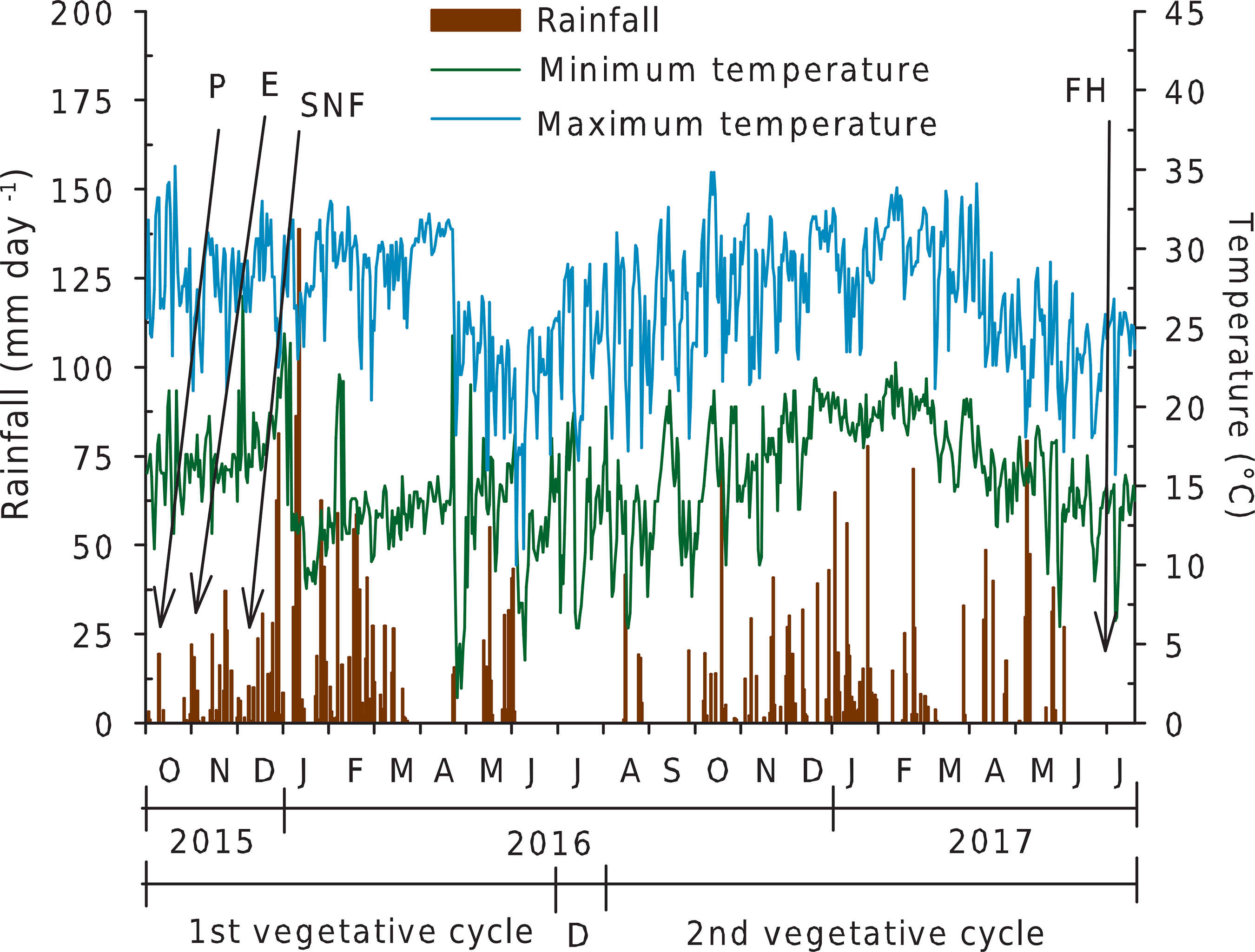
A field experiment was carried out between 2015 and 2017 at the experimental farm of the College of Agricultural Science at São Paulo State University (FCA/UNESP) in the municipality of São Manuel-SP. The farm is located at 22° 77’ S; 48° 57’ W, and 740 m above sea level. The soil in the experimental area was Latossolo Vermelho Distroférrico (Santos et al., 2018), which corresponds to Hapludox (Soil Survey Staff, 2014). According to the Köppen classification system, the climate in the area is classified as Cfa type. Corn was cultivated in the area during the autumn and winter of 2015. Maximum and minimum temperatures and precipitation during the experiment are shown in figure 1.

Daily rainfall, and maximum and minimum temperatures observed during cassava growing over two vegetative cycles. P: planting; E: emergence; SNF: sidedressing N fertilization; FH: final harvest.
Experimental design and treatments
The experimental design used randomized blocks in a split-plot scheme with four replicates. Plots were supplied with 0 or 70 kg ha-1 P at planting. Subplots consisted of 11 plant sampling times: 2, 3, 5, 7, 9, 11, 13, 15, 17, 19, and 21 months after planting (MAP). Each plot consisted of eight 8 m-long rows, with a spacing of 1.20 m between rows and 0.80 m between plants. Each subplot was represented by useful plants in the center and adjacent plants that were not sampled. Six plants per subplot were harvested during the first two sampling periods to obtain sufficient material for analysis. After the third sampling period, the number of sampled plants per subplot was reduced to two, following the methodology used in other studies (Howeler and Cadavid, 1983; Alves et al., 2022; Silveira et al., 2023). This occurred because the plants were tall and big, which made harvesting very difficult and time-consuming, requiring a lot of labor. The borders were not harvested in subsequent samplings.
Soil tillage, cassava planting, and management
Initially, the soil in the experimental area was collected at a 0.00–0.20 m soil layer and analyzed for chemical and physical properties (Table 1). Soil tillage was carried out by plowing at a 0.15–0.20 m layer, followed by two harrowings. The furrows were opened at a 0.10 m depth and 33.3 kg ha-1 K were applied together with 0 or 70 kg ha-1 P, according to the treatments. Triple superphosphate (41 % P2O5 [18 % P] and 10 % Ca) and potassium chloride (60 % K2O [50 % K]) were used as sources of P and K, respectively. Fertilizers were incorporated into the bottom of the furrows, and cassava stem cuttings were manually distributed in the furrows and covered with soil. Cassava stems (0.20 m long) were cut from the middle third of healthy plants of cultivar IAC 14, which were approximately one year old. Planting occurred on 10/15/2015, and 14 days after planting (DAP), the herbicides glyphosate (1,920 g ha-1 a.i.), trifluralin (1,080 g ha-1 a.i.), and metribuzin (480 g ha-1 a.i.) were used for weed control. Cassava emergence occurred on 11/09/2015 at 25 DAP.
Soil chemical and physical properties of the experimental area at a 0.00–0.20 m layer before cassava planting
Topdressing nitrogen fertilization was carried out 40 days after plant emergence (12/19/2015) using 40 kg ha-1 N (Lorenzi et al., 1997) as ammonium sulfate (20 % N and 22 % S). Pest, disease, and weed control in the experimental area were conducted following the technical recommendations for crops in the region whenever necessary.
Plant sampling and analysis
At each sampling time, two plants were harvested per subplot, except at the first and second sampling times (2 and 3 MAP, respectively). As the plants in these two samples were small, six plants were collected per subplot for evaluation. After harvest, the plants were separated into leaves (petioles and leaf blades), stems, planted stem cuttings, and storage roots. Samples were weighed (fresh weight), and representative sub-samples were removed and weighed (fresh weight). Sub-samples were dried using an oven with air circulation at 65 °C for 96 h. The dried sub-samples were weighed (dry weight) to determine the dry matter (DM) percentage. Using the data on fresh matter and percentage of DM, the accumulation of DM per unit area was calculated for each plant part and the whole plant. The harvest index was calculated by dividing the amount of DM accumulated in the storage roots by the DM of the whole plant.
Dried sub-samples were ground in a Wiley-type mill with a 1 mm sieve and subjected to analysis of P (Malavolta et al., 1997) and starch content. For starch analysis, 200 mg of sample was added to 42 mL of distilled water together with 100 µL of the alpha-amylase enzyme and 1 mL of 2 mol L-1 sodium acetate buffer solution at pH 5.35. Then, the samples remained shaking for 2 h at 90 °C. Subsequently, the temperature was reduced to 50 °C, 100 µL of the enzyme amyloglucosidase was added, and the samples were kept shaking for 2 h at 55 °C. The Somogyi methodology adapted by Nelson (1944) was adopted to quantify the sugar content, which was subsequently multiplied by 0.9 factor to convert it into starch content (Mota et al., 2020).
Amounts of P and starch accumulated in the leaves, stems, planted stem cuttings, and storage roots were estimated by multiplying the P and starch contents in the plant parts by the amount of DM accumulated. Total P and starch accumulated by the plants were obtained by summing the amounts accumulated in all the plant parts.
Data analysis
Data were subjected to analysis of variance. The means of P supply were compared using the LSD test (p<0.05) using the SISVAR statistical software (Ferreira, 2011). The effects of plant sampling time on the analyzed variables were subjected to regression analysis (p<0.05) using SigmaPlot 10.0. Regression equations were tested separately for each vegetative cassava growth cycle. Significant equations with the highest coefficients of determination that best explained the relationship between the sampling time and dependent variables were selected. Therefore, we had two equations for each variable: one for the first and another for the second vegetative growth cycle (except for the variables P accumulated in the stem and P accumulated in the stem cuttings).
RESULTS
Biomass accumulation and distribution
The biomass of leaves, planted stem cuttings, and storage roots was not significantly affected by P supply (Figures 2a, 2c, and 2d). In the P-fertilized treatment, the stems biomass evaluated at 11, 13, 19, and 21 MAP was higher than that in the P-unfertilized treatment (Figure 2b). Whole-plant biomass in the P-fertilized treatment was higher than in the P-unfertilized treatment only during the last two harvests (Figure 2e).

Amount of biomass accumulated in the leaves (a), stems (b), planted stem cuttings (c), storage roots (d), and whole plant, and its evolution over two vegetative growth cycle of cassava in response to application of 0 or 70 kg ha-1 P. Asterisk (*) indicates a significant difference between P supply treatments using the LSD test (p<0.05). NS: not significant.
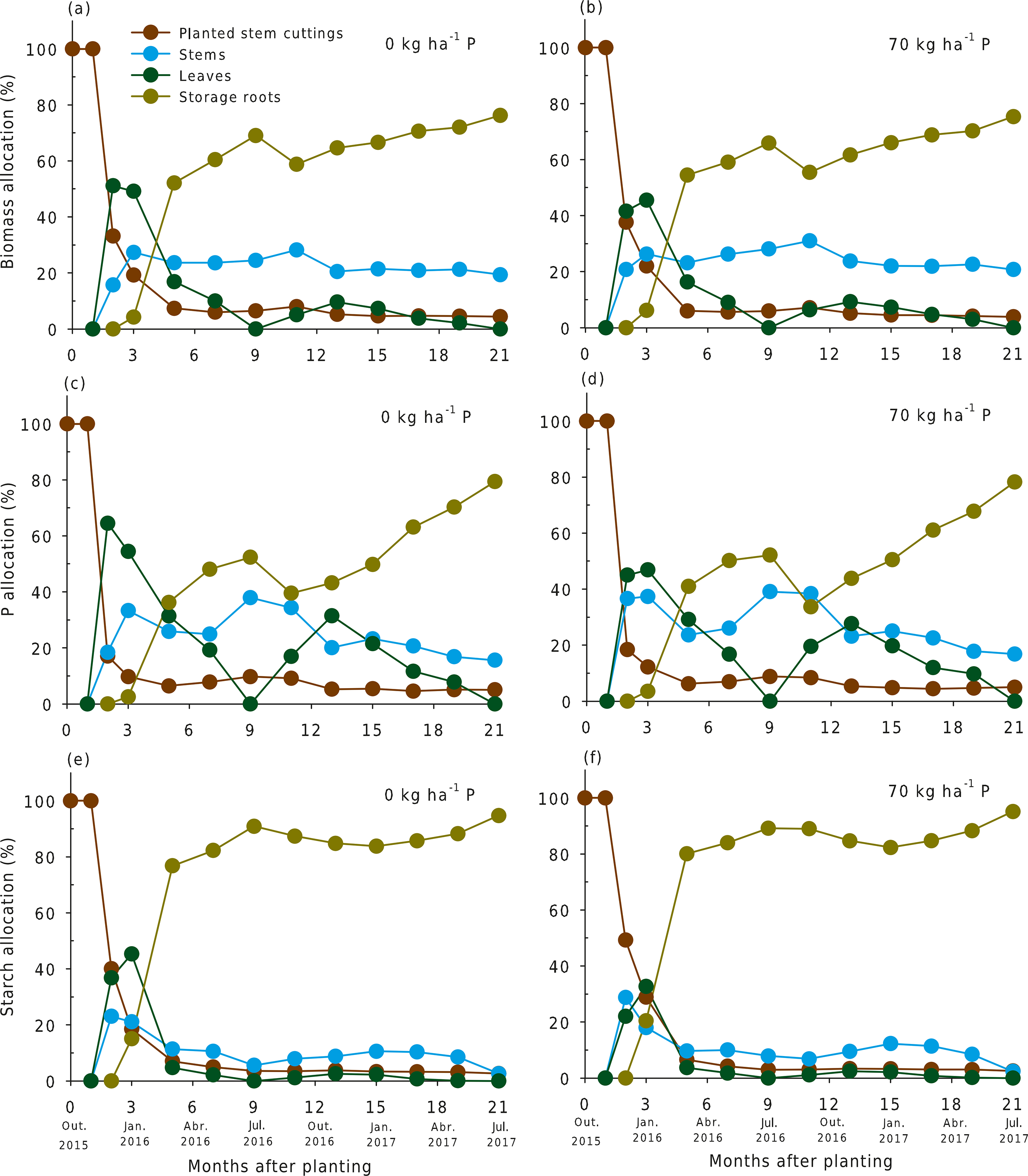
Biomass accumulation dynamics differed between the plant parts during cassava development (Figure 2 and Table 2). Leaf biomass showed two peaks of maximum accumulation, one between 4.9 and 5.8 MAP, and another at 13.8 MAP (Figure 2a). At 3 MAP, leaves represented 46–49 % of the plant biomass (Figures 2a, 3a, and 3b). No leaf biomass was observed at 9 or 21 MAP. In the stems, there was an increase in biomass up to 7.7 MAP, with a subsequent reduction of up to 9 MAP (Figure 2b). After 9 MAP, stem biomass increased by 47.9–48.7 % until the end of the cycle (21 MAP), but the proportion of DM allocated to stems remained between 20–27 % (Figures 2b, 3a, and 3b).
Biomass accumulated in the planted stem cuttings and whole plants increased up to 7.5 MAP, whereas the amount of biomass accumulated in the storage roots increased by 885 % up to 8.5 MAP (Figures 2c, 2d and 2e; and Table 2). The proportion of DM allocated to planted stem cuttings decreased from planting to 5 MAP, whereas biomass allocation to storage roots increased significantly after the tuberization stage (Figures 3a and 3b). Between 7.5–9 MAP, there was a 16–21 % reduction in whole-plant biomass and a 10 % reduction in planted stem cuttings biomass (Figures 2c and 2e). However, the root biomass was reduced by 23 % between 8.5 and 11 MAP, along with the proportion of biomass allocated to storage roots (Figures 2d, 3a, 3b, 4a, and 4b). At 9 MAP, the planted stem cuttings biomass increased by 30 % until 11 MAP and remained stable until the end of the cycle (Figure 2c).
Allocation of biomass, P, and starch in the cassava plant parts at each harvest time, and its evolution over two vegetative growth cycle of cassava in response to application of 0 or 70 kg ha-1 P.
Storage root biomass increased by 110-140 %, whereas whole-plant biomass increased by 71–99 % from 9–11 up to 21 MAP (Figures 2d, 2e, 4a and 4b; and Table 2). At the end of the cycle, the plants accumulated between 29.6 and 34.5 Mg ha-1 biomass and allocated between 75.4–76.3 % in the storage roots, 20.7–19.4 % in the stems, and 3.9–4.4 % in the planted stem cuttings (Figures 3a, 3b, 4a, and 4b).

Biomass, P, and starch accumulation and percentage of maximum accumulation (peak of demand) over two vegetative growth cycle of cassava in response to application of 0 or 70 kg ha-1 P.
Phosphorus concentration, accumulation, and distribution
Phosphorus supply increased the accumulation of this nutrient in all plant parts and the whole plant (Figure 5 and Table 2). The P content in the P-fertilized treatment increased significantly at the beginning of the crop cycle. In the leaves of plants from the P-fertilized treatment, P accumulation between 3 and 5 MAP was greater than that in the leaves from the P-unfertilized treatment; however, this difference was not maintained in the later stages of the cassava cycle (Figure 5a). In general, across all harvests, stems from the P-fertilized treatment accumulated more P than those from the unfertilized treatment (Figure 5b).

Phosphorus content in the plant parts and amount of P accumulated in the leaves (a), stems (b), planted stem cuttings (c), storage roots (d), and whole plant, and its evolution over two vegetative growth cycle of cassava in response to application of 0 or
70 kg ha-1 P. Asterisk (*) indicates a significant difference between P supply treatments using the LSD test (p<0.05). NS: not significant.
In the planted stem cuttings, P supply increased the accumulation of this nutrient only in harvests carried out at 2, 5, and 11 MAP (Figure 5c and Table 2). Phosphorus accumulation in the storage roots of the P-fertilized treatment was greater than that in the P-unfertilized treatment at harvests performed at 5, 7, 15, 17, 19, and 21 MAP (Figure 5d). However, P accumulation in the P-fertilized treatment was greater for the whole plant than in the P-unfertilized treatment from 5 MAP until the end of the cycle (Figure 5e).
Amounts of P taken up by the plant increased from emergence to 6.3 MAP, when plants uptake approximately 92–93 % of the total P demand (14.7–19.4 kg ha-1 P) (Figures 4c, 4d and 5e; and Table 2). Between 6.3 and 9 MAP, the amount of P taken up decreased, and the allocation of P to the storage roots decreased between 9 and 11 MAP (Figures 3c, 3d, 4c, 4d, and 5e). Amounts of P taken up by plants increased only after 9 MAP, reaching the maximum uptake peak of 15.9–20.9 kg ha-1 P at 17 MAP (100 % of demand) (Figures 4c, 4d, and 5e). At the end of the cycle, the highest P allocation occurred in the following plant parts: storage roots>stems>stem cuttings (Figures 3c and 3d).
Starch content, accumulation, and distribution
Phosphorus supply did not change the content or accumulation of starch in cassava leaves (Figure 6a and Table 2). Although starch content did not differ significantly between treatments, during the 13–17 MAP period, starch accumulation in the stems of the P-fertilized treatment was numerically greater than that in the stems of the P-unfertilized treatment (Figure 6b). In the planted stem cuttings, P supply increased the starch content only at 2 and 3 MAP (Figure 6c). However, the amount of starch accumulated in the stem cuttings of the P-fertilized treatment at 3 and 15 MAP was greater than that of the P-unfertilized treatment.

Starch content in the plant parts and amount of starch accumulated in the leaves (a), stems (b), planted stem cuttings (c), storage roots (d), and whole plant, and its evolution over two vegetative growth cycle of cassava in response to application of 0 or 70 kg ha-1 P. Asterisk (*) indicates a significant difference between P supply treatments using the LSD test (p<0.05). NS: not significant.
Fertilized P treatment had higher starch content in the storage roots than the P-unfertilized treatment at only 3 and 13 MAP (Figure 6d). However, the amount of starch accumulated in the storage roots of the P-fertilized treatment at 13, 17, and 21 MAP was greater than that in the P-unfertilized treatment (Figure 6d and Table 2). The proportion of starch allocated to the storage roots was greater than 80 % at 5 MAP in the P-fertilized treatment and at 7 MAP in the P-unfertilized treatment (Figures 3e and 3f). From tuberization to 11 MAP, P supply did not affect starch accumulation in the storage roots and the whole plant (Figures 6d and 6e). However, P application significantly increased the whole-plant starch accumulation between 15 and 21 MAP.
There were two peaks in starch accumulation in the cassava plants. In the leaves, maximum starch accumulation occurred at 4.2 and 13.5 MAP, but the proportion allocated to the leaves was greater at 3 MAP (Figures 3e, 3f and 6a; and Table 2). In the planted stem cuttings, maximum starch accumulation occurred at 7 and 17.8 MAP, whereas in the storage roots and whole plants, maximum starch accumulation occurred at 9 and 21 MAP (Figures 4e, 4f and 6).
In the stems, starch accumulation peaks varied depending on P supply. In the P-fertilized treatment, the maximum starch accumulation occurred at 8.4 and 16.3 MAP (Figure 6b and Table 2). However, in the P-unfertilized treatment, the peaks of starch accumulation in the stems occurred at 7 and 17 MAP. In the storage roots, the maximum accumulation of starch was 8.1-9.1 Mg ha-1 at 9 MAP, but in the period of 7-11 MAP, the storage roots accumulated approximately 40 % of the total starch produced by the plants (Figures 4e, 4f, and 6d). At 21 MAP, the plants accumulated 15.9-18.9 Mg ha-1 starch, allocating approximately 95 % of this total to the storage roots (Figures 3e, 3f, 4e, 4f, and 6e).
DISCUSSION
Cassava is a plant that can associate with native soil AMF to increase P uptake (Sieverding and Howeler, 1985; Cavallari et al., 2021; Peña-Venegas et al., 2021). In the present study, P supply significantly increased stem development only during the second vegetative cycle of cassava, resulting in plants with greater biomass. Increases in shoot biomass (leaves and stems) in response to P supply have also been observed in other studies (Omondi et al., 2019; Rosa et al., 2021), highlighting the importance of P supply in cassava shoot growth. However, in the present study, P supply did not alter biomass accumulation in the leaves, stems, or storage roots. Studies on other cassava cultivars (IAC 576-70 or Israeli cultivars) have shown an increase in the biomass of stem cuttings (Rosa et al., 2021) and storage roots (Omondi et al., 2019). Cultivar IAC 14 has been characterized as adapted to low-fertility soils (IAC, 2024), probably because its response to P supply is low. Cassava plants can adapt their growth to low P availability with highly variable responses between genotypes (Pellet and El-Sharkawy, 1993b; Nansahwang et al., 2022; Silveira et al., 2023). For example, under low P availability, some plants decrease in size and maintain relatively high leaf P contents and photosynthetic rates, similar to plants grown under high P availability (Cock and Connor, 2021). In this study, P levels in the soil were low (Table 1) (Lorenzi et al., 1997; Feltran et al., 2022) and leaf P concentrations of P-unfertilized plants were statistically similar to those of P-fertilized plants, indicating that cultivar IAC 14 adapted to conditions of P limitation in the soil.
Leaf biomass showed an accumulation peak in cassava first and second vegetative cycles, which coincided with periods of rain and high temperatures, similar to previous studies (Sagrilo et al., 2008; Menegucci et al., 2024). Storage roots and stems are the preferential sinks of carbohydrates in cassava plants, as found in other studies (Howeler and Cadavid, 1983; Sagrilo et al., 2008; Menegucci et al., 2024), but we observed that the proportion of DM allocated to the growth of storage roots in the first vegetative cycle was greater than that in the second vegetative cycle.
Phosphorus supply resulted in a greater increase in P accumulation, especially in the stems and storage roots. Leaf and stem cuttings of P-supplemented plants showed an increased accumulation of this nutrient, mainly during the first vegetative cycle. However, despite the increase in P levels in plant parts (stem, stem cuttings, and storage roots) during the initial stage of the cycle, the increase in P uptake occurred only from 5 MAP onwards, when the storage roots became the preferential sink of P in plants. Howeler and Cadavid (1983) also found that cassava storage roots contain a considerable fraction of P that the plants take up.
Although P uptake increased during the second vegetative cycle, the results showed that cassava plants uptake 92-93 % of the total P demand during the first cycle. Leaf senescence between 6.3–9 MAP decreased the amount of P taken up by the cassava plants. However, the resumption of leaf growth after the dormancy stage (9 MAP) temporarily decreased P allocation to storage roots, as the plant invested reserves in leaf growth. Nevertheless, the allocation of P to storage roots increased again during the second vegetative cycle, and the redistribution of P to storage roots during the second vegetative cycle was 50 % greater than that during the first vegetative cycle. The soil of the area had low P availability (Table 1), and the phosphate fertilizer used was soluble (triple superphosphate). Therefore, the greater P allocation to the storage roots in the second vegetative cycle was not related to a later greater P availability in the soil, but rather a greater capacity for internal P redistribution among the developing plant tissues.
Although P-unfertilized plants took up less P, the maximum amounts of P taken up were relatively high (14.7 and 15.9 kg ha-1 P at the first and second vegetative cycle, respectively) for soil with low P availability (Table 1). This suggests that native soil AMF greatly contributes to P uptake by cassava plants grown in P-deficient soils (Cavallari et al., 2021).
In plants, starch is synthesized in the leaves using sucrose as a sugar source during the day, mobilized, and subsequently degraded at night to be transported, used in the plant metabolism, or stored (Munyikwa et al., 1997; Li et al., 2016). However, the starch accumulation process is complex, varies with the plant species, and involves several key enzymes (Munyikwa et al., 1997; Li et al., 2016; Tappiban et al., 2019). Furthermore, P also participates in starch synthesis in plants and is a component of amylopectin (Nielsen et al., 1994; Taiz and Zeiger, 2013). Despite that, in the present study, P supply only affected starch accumulation in the later stages of the cycle, resulting in delayed increases in starch accumulation in the stems and storage roots. P-fertilized plants accumulated 19–23 % more starch during the second vegetative cycle than P-unfertilized plants. The increase in P accumulation in the stems and planted stem cuttings during periods of greater DM accumulation in storage roots suggests that stems and planted stem cuttings also have starch synthesis and accumulation. However, despite the increase in P and starch accumulation in stems and planted stem cuttings up to 9 MAP, starch contents in storage roots remained among 58.5–81.2 %, while in these two plant organs, they ranged from 7.4–41.6 % (Figures 5 and 6), indicating that the main site of starch synthesis and accumulation in cassava plants are the storage roots (Li et al., 2016; Tappiban et al., 2019).
This study showed that P supply did not interfere with starch accumulation in cultivar IAC 14 during the first vegetative cycle. This may be related to the characteristics of this cultivar, which performs well in low-fertility soils (Sagrilo et al., 2007) and has late starch accumulation in its storage roots. For example, although cassava has a low response to nitrogen fertilization (Nguyen et al., 2002), in the cultivar IAC 14, late N application, i.e., at the beginning of the second vegetative growth cycle, increases starch yield (Mota et al., 2020). Therefore, P supply is important for increasing starch accumulation in the later cycle stages of this cultivar.
The storage roots and stems are the main starch sinks in cassava plants (Chiewchankaset et al., 2022). However, starch accumulated in the stems between 7-11 MAP and in the storage roots between 9-11 MAP increasingly tended to be remobilized for leaf growth at the beginning of the second vegetative cycle. Other studies on cassava have shown that starch stored in the stems and storage roots is remobilized to form new leaves during new growth stages (Omondi et al., 2019).
In the first vegetative cycle, the increase in starch accumulation in the stems was 0.8-fold and in the storage roots was 9.6-fold, with the peak of starch accumulation in the storage roots occurring in the dormancy stage, which coincided with the dry and cold seasons (July 2016 at 9 MAP; Figure 1). In the dormancy stage, cassava falls all its foliage, and there is no vegetative growth; however, there is translocation of carbohydrates and starch accumulation in the storage roots (Conceição, 1981). Menegucci et al. (2024) also found a high starch content in the storage roots of cultivars IAC 118-95 and IAC 90 during the dormancy stage (July 2018).
During the second vegetative cycle, the increase in starch accumulation in the stems was 2.5–3.2-fold, and in the storage roots were 2.0–2.4-fold. This suggests that cultivar IAC 14 allocates more starch to storage root growth in the first vegetative cycle than in the second vegetative cycle. The stems receive a considerable proportion of carbohydrates from photosynthesis during the second vegetative cycle. Low-yielding cassava varieties accumulate more starch in the stems than in the storage roots, whereas high-yielding varieties increasingly allocate starch to the storage roots (Chiewchankaset et al., 2022). However, despite the cultivar IAC 14 being a high performer in low-fertility soils (Sagrilo et al., 2007), the pattern of starch allocation in the stems and storage roots varies depending on plant age.
After the dormancy stage, there was intense P translocation from the storage roots to support the regrowth of cassava foliage. Although storage root biomass also decreased during this period, the results of this study showed that storage root starch reserves are consumed in greater proportions to maintain shoot regrowth when cassava plants are grown without P supply. Therefore, P supply is essential for maintaining cassava plant growth and starch accumulation in storage roots.
CONCLUSIONS
P-fertilized cassava plants take up more P from the soil and allocate it mainly to storage roots and stems. During the first vegetative cycle, cassava takes up between 92-93 % of its P demand, and in the second vegetative cycle, P allocation to the storage roots was 50 % greater than in the first cycle. P-fertilized plants accumulated 19–23 % more starch during the second vegetative cycle than P-unfertilized plants. The P supply did not interfere with starch accumulation in the plants of cultivar IAC 14 during the first vegetative cycle. In the first vegetative cycle, the storage roots were stronger sinks for starch accumulation than the stems; however, in the second vegetative cycle, the percentage increase in starch accumulation in the stems was similar to that in the storage roots. Starch reserves in the storage roots of P-unfertilized plants were consumed in greater proportions to maintain shoot regrowth at the beginning of the second vegetative cycle.
ACKNOWLEDGMENTS
We thank the Coordination for the Improvement of Higher Education Personnel (CAPES) for providing a scholarship to the first author (finance code 001) and the National Council for Scientific and Technological Development (cnpq) for providing an award for excellence in research to the third author.
-
How to cite: Magolbo LAS, Nascimento LG, Fernandes AM, Guedes PTP. Accumulation and distribution dynamics of biomass, phosphorus, and starch in cassava fertilized with or without phosphorus during long growth cycles Rev Bras Cienc Solo. 2024;48:e0240047. https://doi.org/10.36783/18069657rbcs20240047
DATA AVAILABILITY
The data will be provided upon request.
REFERENCES
-
Alves FAT, Silveira FPM, Lopes WAR, Oliveira FA, Silveira LM, Barros Júnior AP. Accumulation and efficiency of phosphorus use in irrigated cassava cultivars in the Brazilian semiarid region. Rev Bras Eng Agr Amb. 2022;26:930-8. https://doi.org/10.1590/1807-1929/agriambi.v26n12p930-938
» https://doi.org/10.1590/1807-1929/agriambi.v26n12p930-938 - Burgos AM, Cenóz PJ. Efectos de la aplicación de fósforo y potasio en la producción y calidad de raíces de mandioca (Manihot esculenta Crantz) en un suelo arenoso y clima subtropical. Rev Cient UDO Agr. 2012;12:144-52.
-
Cavallari LG, Fernandes AM, Mota LHSO, Leite HMF, Piroli VLB. Growth and phosphorus uptake by cassava in P-deficient soil in response to mycorrhizal inoculation. Rev Bras Cienc Solo. 2021;45:e0210060. https://doi.org/10.36783/18069657rbcs20210060
» https://doi.org/10.36783/18069657rbcs20210060 -
Chiewchankaset P, Thaiprasit J, Kalapanulak S, Wojciechowski T, Boonjing P, Saithong T. Effective metabolic carbon utilization and shoot-to-root partitioning modulate distinctive yield in high yielding cassava variety. Front Plant Sci. 2022;13:832304. https://doi.org/10.3389/fpls.2022.832304
» https://doi.org/10.3389/fpls.2022.832304 -
Cock JH, Connor DJ. Cassava. In: Sadras VO, Calderini DF, editors. Crop physiology: Case histories for major crops. Cambridge: Academic Press; 2021. p. 588-633. https://doi.org/10.1016/B978-0-12-819194-1.00019-0
» https://doi.org/10.1016/B978-0-12-819194-1.00019-0 - Conceição AJ. A mandioca. 3. ed. São Paulo: Nobel; 1981.
-
Cuvaca IB, Eash NS, Zivanovic S, Lambert DM, Walker F, Rustrick B. Cassava (Manihot esculenta Crantz) tuber quality as measured by starch and cyanide (hcn) affected by nitrogen, phosphorus, and potassium fertilizer rates. J Agr Sci. 2015;7:36-49. https://doi.org/10.5539/jas.v7n6p36
» https://doi.org/10.5539/jas.v7n6p36 - Feltran JC, Peressin VA, Granja NP, Silva Filho HM, Lorenzi JO, Fernandes AM, Factor TL, Ros AB, Aguiar EB. Raízes e tubérculos. In: Cantarella H, Quaggio JA, Mattos Jr. D, Boaretto RM, van Raij B, editors. Recomendações de adubação e calagem para o estado de São Paulo. Campinas: Instituto Agronômico; 2022. p. 314-7. (Boletim 100).
-
Ferreira DF. Sisvar: A computer statistical analysis system. Cienc Agrotec. 2011;35:1039-42. https://doi.org/10.1590/S1413-70542011000600001
» https://doi.org/10.1590/S1413-70542011000600001 -
Fidalski J. Respostas da mandioca à adubação NPK e calagem em solos arenosos do noroeste do Paraná. Pesq Agropec Bras. 1999;34:1353-9. https://doi.org/10.1590/S0100-204X1999000800005
» https://doi.org/10.1590/S0100-204X1999000800005 -
Gazola B, Fernandes AM, Hellmeister G, Abrami LS, Silva RM, Soratto RP. Potassium management effects on yield and quality of cassava varieties in tropical sandy soils. Crop Pasture Sci. 2022;73:285-99. https://doi.org/10.1071/CP21229
» https://doi.org/10.1071/CP21229 - Gomes JC, Silva J. Correção da acidez e adubação. In: Souza LS, Farias ARN, Mattos PLP, Fukuda WMG, editors. Aspectos socioeconômicos e agronômicos da mandioca. Cruz das Almas: Embrapa Mandioca e Fruticultura Tropical; 2006. p. 215-47.
- Gomes JC. Considerações sobre adubação e calagem para a cultivar de mandioca. Rev Bras Mandioca. 1987;6:99-107.
-
Howeler RH, Cadavid LF. Accumulation and distribution of dry matter and nutrients during a 12-month growth cycle of cassava. Field Crops Res. 1983;7:123-39. https://doi.org/10.1016/0378-4290(83)90017-5
» https://doi.org/10.1016/0378-4290(83)90017-5 -
Instituto Agronômico de Campinas - IAC. Mandioca: IAC 14. Campinas: IAC; 2024 [cited 2024 Feb 20]. Available from: https://www.iac.sp.gov.br/cultivares/inicio/Folders/Mandioca/IAC14.htm
» https://www.iac.sp.gov.br/cultivares/inicio/Folders/Mandioca/IAC14.htm -
Li Y-Z, Zhao J-Y, Wu S-M, Fan X-W, Luo X-L, Chen B-S. Characters related to higher starch accumulation in cassava storage roots. Sci Rep. 2016;6:19823. https://doi.org/10.1038/srep19823
» https://doi.org/10.1038/srep19823 -
Lorenzi JO, Gallo JR, Malavolta E. Acumulação de matéria seca e macronutrientes por dois cultivares de mandioca. Bragantia. 1981;40:145-56. https://doi.org/10.1590/S0006-87051981000100014
» https://doi.org/10.1590/S0006-87051981000100014 - Lorenzi JO, Monteiro PA, Miranda Filho HS, van Raij B. Raízes e tubérculos. In: van Raij B, Cantarella H, Quaggio JA, Furlani AMC, editors. Recomendações de adubação e calagem para o Estado de São Paulo. Campinas: Instituto Agronômico; 1997. p. 221-9. (Boletim técnico, 100).
- Malavolta E, Vitti GC, Oliveira SA. Avaliação do estado nutricional das plantas: Princípios e aplicações. Piracicaba: Potafos; 1997.
-
Menegucci NC, Leonel M, Fernandes AM, Nunes JGS, Nunes JGS. Biomass yield and chemical composition of the cassava plant over two vegetative growth cycles. Acta Sci Agron. 2024;46:e63719. https://doi.org/10.4025/actasciagron.v46i1.63719
» https://doi.org/10.4025/actasciagron.v46i1.63719 -
Mota LHSO, Fernandes AM, Assuncao NS, Leite HMF. Leaf area development and yield of cassava in response to pruning of shoots and the late supply of nitrogen and potassium. Agron J. 2020;112:1406-22. https://doi.org/10.1002/agj2.20113
» https://doi.org/10.1002/agj2.20113 -
Munyikwa TRI, Langeveld S, Salehuzzaman SNIM, Jacobsen E, Visser RGF. Cassava starch biosynthesis: New avenues for modifying starch quantity and quality. Euphytica. 1997;96:65-75. https://doi.org/10.1023/A:1002935603412
» https://doi.org/10.1023/A:1002935603412 -
Nansahwang A, Leksungnoen P, Armatmontree C, Aramrak S, Kongsil P, Wisawapipat W. Phosphate mineral solubility controls on cassava root exudates, rhizosphere nutrient availability, and plant nutrient accumulation. Rhizosphere. 2022;23:100575. https://doi.org/10.1016/j.rhisph.2022.100575
» https://doi.org/10.1016/j.rhisph.2022.100575 -
Nguyen H, Schoenau JJ, Nguyen D, van Rees K, Boehm M. Effects of long-term nitrogen, phosphorus, and potassium fertilization on cassava yield and plant nutrient composition in North Vietnam. J Plant Nutr. 2002;25:425-42. https://doi.org/10.1081/PLN-120003374
» https://doi.org/10.1081/PLN-120003374 -
Nielsen TH, Wischmann B, Enevoldsen K, Moller BL. Starch phosphorylation in potato tubers proceeds concurrently with de novo biosynthesis of starch. Plant Physiol. 1994;105:111-7. https://doi.org/10.1104/pp.105.1.111
» https://doi.org/10.1104/pp.105.1.111 -
Omondi JO, Lazarovitch N, Rachmilevitch S, Yermiyahu U. Phosphorus affects storage root yield of cassava through root numbers. J Plant Nutr. 2019;42:2070-9. https://doi.org/10.1080/01904167.2019.1655033
» https://doi.org/10.1080/01904167.2019.1655033 -
Pellet D, El-Sharkawy MA. Cassava varietal response to phosphorus fertilization. II. Phosphorus uptake and use efficiency. Field Crops Res. 1993a;35:13-20. https://doi.org/10.1016/0378-4290(93)90132-7
» https://doi.org/10.1016/0378-4290(93)90132-7 -
Pellet D, El-Sharkawy MA. Cassava varietal response to phosphorus fertilization. I. Yield, biomass and gas exchange. Field Crops Res. 1993b;35:1-11. https://doi.org/10.1016/0378-4290(93)90131-6
» https://doi.org/10.1016/0378-4290(93)90131-6 -
Peña-Venegas RA, Lee S-J, Thuita M, Mlay DP, Masso C, Vanlauwe B, Rodriguez A, Sanders IR. The phosphate inhibition paradigm: host and fungal genotypes determine arbuscular mycorrhizal fungal colonization and responsiveness to inoculation in cassava with increasing phosphorus supply. Front Plant Sci. 2021;12:693037. https://doi.org/10.3389/fpls.2021.693037
» https://doi.org/10.3389/fpls.2021.693037 - Perin S, Lobato E, Costa IRS. Efeito de níveis de fósforo no rendimento de mandioca em solo sob vegetação de cerrados. Rev Bras Mandioca. 1983;2:25-30.
-
Pushpalatha R, Gangadharan B. Is cassava (Manihot esculenta Crantz) a climate “smart” crop? A review in the context of bridging future food demand gap. Trop Plant Biol. 2020;13:201-11. https://doi.org/10.1007/s12042-020-09255-2
» https://doi.org/10.1007/s12042-020-09255-2 -
Rosa B-HS, Fernandes AM, Gazola B, Nunes JGS, Soratto RP. Liming and phosphorus fertilization increase cassava root yield without affecting its cooking time. Agron J. 2021;113:4386-95. https://doi.org/10.1002/agj2.20842
» https://doi.org/10.1002/agj2.20842 - Sagrilo E, Otsubo AA, Silva AS, Rohden VS. Gomez SA. Comportamento de cultivares de mandioca no Vale do Ivinhema, Mato Grosso do Sul. Dourados: Embrapa Agropecuária Oeste; 2007. (Boletim de Pesquisa e Desenvolvimento, 43).
-
Sagrilo E, Vidigal Filho PS, Pequeno MG, Gonçalves-Vidigal MC, Kvitschal MV. Dry matter production and distribution in three cassava (Manihot esculenta Crantz) cultivars during the second vegetative plant cycle. Braz Arch Biol Technol. 2008;51:1079-87. https://doi.org/10.1590/S1516-89132008000600001
» https://doi.org/10.1590/S1516-89132008000600001 - Santos HG, Jacomine PKT, Anjos LHC, Oliveira VA, Lumbreras JF, Coelho MR, Almeida JA, Araújo Filho JC, Oliveira JB, Cunha TJF. Sistema brasileiro de classificação de solos. 5. ed. rev. ampl. Brasília, DF: Embrapa; 2018.
-
Sieverding E, Howeler R. Influence of species of VA mycorrhizal fungi on cassava yield response to phosphorus fertilization. Plant Soil. 1985;88:213-21. https://doi.org/10.1007/BF02182447
» https://doi.org/10.1007/BF02182447 -
Silveira FPDM, Lopes WDAR, Oliveira PRHD, Lima FLDS, Silveira LMD, Barros Júnior AP. Quality of table cassava roots fertilized with phosphorus. Rev Caatinga. 2021;34:965-75. https://doi.org/10.1590/1983-21252021v34n424rc
» https://doi.org/10.1590/1983-21252021v34n424rc -
Silveira FPM, Lopes WAR, Oliveira PRH, Santos MG, Monteiro AL, Santos GL, Silva SF, Souza EGF, Silveira LM, Barros Júnior AP. Agronomic performance of cassava fertilized with phosphorus doses. Biosci J. 2023;39:e39077. https://doi.org/10.14393/BJ-v39n0a2023-65423
» https://doi.org/10.14393/BJ-v39n0a2023-65423 - Soil Survey Staff. Keys to soil taxonomy. 12th ed. Washington, DC: United States Department of Agriculture, Natural Resources Conservation Service; 2014.
- Taiz L, Zeiger E. Fisiologia vegetal. 5. ed. Porto Alegre: Artmed; 2013.
-
Tappiban P, Smith DR, Triwitayakorn K, Bao J. Recent understanding of starch biosynthesis in cassava for quality improvement: A review. Trends Food Sci Tech. 2019;83:167-80. https://doi.org/10.1016/j.tifs.2018.11.019.
» https://doi.org/10.1016/j.tifs.2018.11.019
Edited by
-
Editors:
José Miguel Reichert https://orcid.org/0000-0001-9943-2898 and Tales Tiecher https://orcid.org/0000-0001-5612-2849