 Duromide is an effective urease inhibitor when combined with vinasse and blended with ammonium sulphate
ABSTRACT
A recent trend in sugarcane production is to apply urea fertilizers in combination with vinasse (V) to balance nitrogen (N) and potassium (K) supply. This practice promotes a circular economy and a possible reduction in N losses through ammonia (NH3) volatilization due to the acidic nature of V. However, it is unclear whether V reduces NH3 volatilization, and whether the addition of urease inhibitors further reduces NH3 losses. Furthermore, the efficacy of formulations containing urea and urease inhibitors may decrease over time when blended with acidic fertilizers such as ammonium sulfate (AS). This study aimed to determine the efficacy of urease inhibitors N-(n-butyl) thiophosphoric triamide (NBPT) and Duromide in reducing NH3 volatilization losses from urea applied with V and from urea blended with AS and stored for 10 months in a warehouse. Two different experiments were conducted under controlled conditions. Seven days after fertilizer application, urea addition to V resulted in a 35 % NH3 loss (a reduction of only 36 % compared to urea), whereas NBPT-treated urea + V and Duromide-treated urea + V resulted in reductions of 51 and 74 %, respectively. The efficacy of NBPT-treated urea blended with AS to control volatilization decreased from 41 to 9 % after 10 months of storage. In contrast, the efficacy of Duromide-treated urea in reducing the NH3 volatilization remained relatively constant. Duromide is a more stable and effective urease inhibitor than NBPT, supporting agronomic practices that reduce NH3 volatilization and maintain inhibitory effects when blended with acidic fertilizers such as AS or combined with acidic organo-mineral fertilizers like V.
Keywords
NBPT; nitrogen; sugarcane; fertilizer; urease inhibitor
INTRODUCTION
Brazil is the largest producer of sugarcane (Saccharum spp.) worldwide (USDA, 2024). Sugarcane biomass is used to produce ethanol, sugar, electricity, and other biorenewables (Bordonal et al., 2018). The majority of this biomass is used in ethanol production, with Brazil producing 29.7 billion liters of ethanol in 2023 (Conab, 2024). Vinasse (V) is a by-product generated during ethanol rectification and distillation (Parsaee et al., 2019). About 13 L of V are generated for every 1 L of ethanol produced from sugarcane (Gallucci et al., 2019). Owing to its high concentrations of organic matter and potassium (K), V is commonly applied to sugarcane fields (Rossetto et al., 2018). With the increasing availability of V and the ongoing need to reduce application costs and balance the nitrogen (N):K ratio, sugarcane producers enrich V with N fertilizers. In addition to this, there is some evidence that V reduces N losses through ammonia (NH3) volatilization (Gallucci et al., 2019; Oliveira et al., 2023), however losses remain high (Otto et al., 2017).
Urea is the most widely used N fertilizer worldwide, accounting for more than 50 % of current N demand (IFA, 2024). Its popularity is explained by its high N concentration, widespread availability, and low production costs (Cantarella et al., 2018). However, when applied to the soil surface or at shallow depths, urea undergoes hydrolysis by the urease enzyme, resulting in the loss of NH3 to the atmosphere. In sugarcane fields mulched with straw, NH3 volatilization can range from 24 to 61 % of the applied N (Cantarella et al., 2008; Mariano et al., 2012; Mira et al., 2017; Pinheiro et al., 2018). The deleterious effects of NH3 volatilization include reduced yield (Torralbo et al., 2022), economic losses (Pan et al., 2016), air pollution, and contamination of terrestrial and aquatic ecosystems (Behera et al., 2013; Wyer et al., 2022).
The most cost-effective method for reducing NH3 volatilization is applying urease inhibitors to urea. The most widely used urease inhibitor worldwide is N-(n-butyl) thiophosphoric triamide (NBPT) (Cantarella et al., 2018; Modolo et al., 2018; Klimczyk et al., 2021). Silva et al. (2017) found that NBPT-treated urea resulted in a 52 % reduction in NH3 volatilization compared with conventional urea. However, the stability of NBPT decreases when it is added to organic matrices (Gioacchini et al., 2000), suggesting that combining V with NBPT-treated urea may not be as effective at managing NH3 volatilization.
Blending urea with ammonium sulfate (AS) is a common practice to supply nitrogen and sulfur (S) to crops. Ammonium sulfate is less prone to substantial ammonia (NH3) volatilization losses in non-alkaline soils. (Minato et al., 2020; Santos et al., 2020; Corrêa et al., 2021), but losses can be significant in alkaline soils (Rao and Batra, 1983; Schwenke et al., 2014; Powlson and Dawson, 2022). In contrast, NH3 volatilization losses from urea are significant regardless of soil pH. An alternative to using more concentrated fertilizers and reducing N losses from volatilization is to treat urea with NBPT. However, as can occur with organic mixtures, NBPT, when mixed with inorganic matrices, can also have its efficacy reduced by up to 34 % (Cassim et al., 2024).
Duromide is a novel urease inhibitor (CAS # 2093385-47-6; reaction product of N-(n-butyl) thiophosphoric triamide, urea, and formaldehyde) that acts as a urease inhibitor (Slater, 2020), slowing urea hydrolysis and thereby preventing ammonia volatilization. Duromide is a more complex molecule than NBPT, resulting in greater stability. Recent studies showed that Duromide-treated urea was more effective in reducing NH3 losses (Cassim et al., 2021) and increasing Brachiaria (Urochloa spp.) yield (Cassimiro et al., 2023) than NBPT-treated urea. Since the Duromide molecule is more stable when compared with NBPT, it can provide greater efficacy in reducing NH3 volatilization when mixed with V or AS. However, no studies have tested this hypothesis.
Recycling agricultural waste and reducing nutrient losses in sugarcane plantations are key strategies to promote a circular economy and enhance agronomic performance. To the best of our knowledge, no study has yet assessed the effect of the urease inhibitor Duromide on NH3 volatilization losses when urea is dissolved in V, nor changes in its efficacy during storage when blended with AS. Our hypotheses are that urea + V + Duromide provides the greatest reduction in NH3 volatilization than urea + NBPT; and that Duromide-treated urea maintains its efficacy in reducing N losses over a longer storage period than NBPT when blended with AS. This study aimed to (i) determine the efficiency of urease inhibitors NBPT and Duromide in reducing N losses through NH3 volatilization when urea is dissolved in V; and (ii) assess the efficacy of Duromide and NBPT-treated urea blended with AS in reducing NH3 volatilization after ten months of storage in a warehouse.
MATERIALS AND METHODS
Soil description
The soil (0.00–0.10 m layer) used in the experiments was an Argissolo Vermelho Distrófico arênico of sandy texture, according to the Brazilian Soil Classification System (SiBCS) (Santos et al., 2018), corresponding to an Ultisol in the USDA Soil Taxonomy (Soil Survey Staff, 2014). After visible organic residues had been removed, the soil was sieved to 4 mm and stored at room temperature until incubation. The main soil chemical properties were: pH(H2O) of 5.2 and cation exchange capacity (CEC) at pH 7.0 of 10.5 cmolc dm-3 (Tedesco et al., 1995); organic carbon, 6.96 g kg-1 (measured by dry combustion using a Flash EA 1112, Thermo Finnigan, Milan, Italy); and clay content, 102 g kg-1 (Claessen, 1997).
Experiment 1: Urea combined with V and urease inhibitor
The first experiment was conducted in a greenhouse using a completely randomized design with five treatments and four replications. Treatments consisted of a control (without N application), urea (Ur) (46 % N), Ur + V, NBPT-treated Ur + V (Ur-NBPT + V), and Duromide-treated Ur + V (Ur-Duromide + V). The pH of V was 4.0. Each experimental unit consisted of a 2.8 L polyethylene pot containing 2.8 kg of soil moistened to 80 % of field capacity, equivalent to 2.5 kg of dry soil. Nitrogen fertilizers were applied by broadcasting at a rate of 0.8 mg cm-2, equivalent to 80 kg N ha-1. The N supplied by V was disregarded, as the amendment had low contents of ammonium N (NH4+-N, 68.5 g m-3) and nitrate N (NO3--N, 1.0 g m-3). The V rate was 30 m3 ha-1 (Cetesb, 2020).
In this study, AnvolTM was used as a source of Duromide to treat urea in both experiments. Anvol is a commercially available stabilizer containing two active ingredients: Duromide (the main active ingredient) and NBPT. For simplicity, the treatments in which urea was treated with Anvol will be referred to in this paper as Ur-Duromide.
For treatments including V and urea (with or without inhibitor), the fertilizer formulation was diluted in V and then applied to the soil surface using a directed jet application method, with a total volume of 71 mL per pot (28.4 g water kg-1 of dry soil). For treatments with inhibitors, granular urea was treated with the urease inhibitors, prior to dissolution in V. For Ur (without V), the fertilizer was diluted in an equivalent volume of distilled water. The treatments were applied to partially moistened soil (60 % of field capacity). The total volume of solution applied per treatment increased the gravimetric soil moisture to 80 % of field capacity. During the experimental period, soil moisture was adjusted to 80 % of field capacity every two days by weighing the pots and adding distilled water as needed. The greenhouse was equipped with temperature and humidity control, with the temperature maintained at 27 °C ± 2.5 °C and the humidity at 70 % ± 5 %.
The quantification of N losses via NH3 volatilization was carried out within pots using the semi-open static chamber method (Araújo et al., 2009). A 2 L (Ø = 10.0 cm) static chamber was used. A piece of polyurethane sponge (2.5 cm wide and 25 cm long) was placed inside the chamber, suspended on a flask containing 50 mL of 1 mol L−1 sulfuric acid (H2SO4) and 4 % (v/v) glycerin. The NH3-N collection device was placed in the central area of pots immediately after treatments were applied. The evaluation lasted 30 days, and NH3-N collections were made on days 1, 2, 3, 4, 5, 7, 9, 11, 13, 15, 17, 20, 24, and 30.
The sponge was replaced at each collection with a new sponge containing the acid + glycerin solution. Used sponges and excess acid solution were then transferred to flasks with snap caps containing 20 mL of distilled water. The flasks were shaken on a horizontal shaker at 2 Hz for 30 min to extract ammonium sulfate from the sponge via the reaction between H2SO4 and captured NH3. The NH3-N content of the extract was determined by the semi-micro Kjeldahl method. Briefly, 20 mL of the solution from snap-capped flasks was distilled by adding 5 mol L-1 NaOH, followed by titration with 0.01 mol L-1 H2SO4. The measured amounts of NH3-N were multiplied by a factor of 1.66 to correct the NH3 capture efficiency of the semi-open static chamber method used (Martins et al., 2021).
Experiment 2: Urea treated with urease inhibitors blended with AS and stored for 10 months
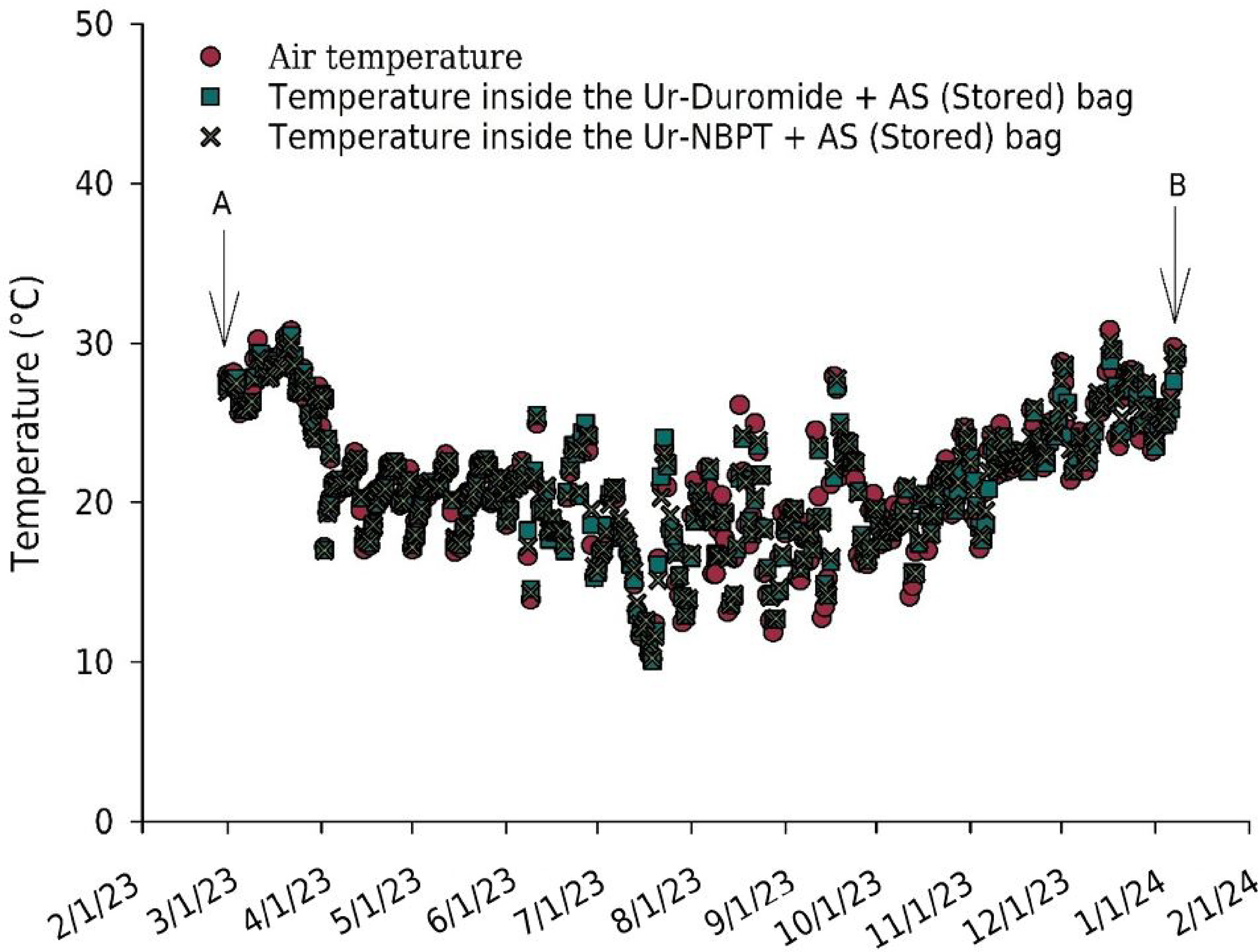
The second experiment was conducted in the laboratory using a completely randomized design with six treatments and four replications. Treatments consisted of five blends of urea or urea + urease inhibitor with AS and a control without N application. The blends used were: urea (Ur) + ammonium sulfate (AS) (Ur + AS); NBPT-treated Ur 72 h before the start of the experiment + AS (Ur-NBPT + AS Fresh), Duromide-treated Ur 72 h before the start of the experiment + AS (Ur-Duromide + AS Fresh), NBPT-treated Ur + AS stored for 10 months (Ur-NBPT + AS Stored), and Duromide-treated Ur + AS stored for 10 months (Ur-Duromide + AS Stored). The proportion of N fertilizers in the blends was 76 % Ur (treated or untreated with inhibitor) and 24 % AS. Urea was treated with NBPT and Duromide prior to blending with ammonium sulfate, as in the process used for commercial formulations. The AS used had a pH of 4.24. The blends were stored for 10 months in 50-kg bags at room temperature in a warehouse before the start of the NH3 volatilization trial. During storage, the temperature of the blends inside the bags and the room air temperature were measured using T-type sensors coupled to a data logger (CR1000, Campbell Scientific) (Figure 1). Subsamples were collected from stored bags to prepare the replications of Ur-NBPT + AS (Stored) and Ur-Duromide + AS (Stored) treatments and Ur + AS.
Daily temperature data during fertilizer storage. Arrow A indicates the start of fertilizer storage on March 1, 2023. Arrow B indicates the start of the ammonia (NH3) volatilization experiment on January 8, 2024, after 10 months of fertilizer storage.
Each experimental unit consisted of a 1,750 mL glass jar containing moist soil at 80 % field capacity, equivalent to 300 g of dry soil. Nitrogen fertilizers were applied by broadcasting. The N rate was 1.0 mg cm-2, equivalent to 100 kg ha-1. All experimental units were stored in an incubator in the absence of light at constant temperature (28 ± 0.3 °C). Soil used in experiment 2 was the same soil as in experiment 1.
Quantification of N losses via NH3-N volatilization was carried out in each glass jar using an adapted method proposed by Nômmik (1973). A polyurethane sponge was suspended 0.10 m above the soil to capture the volatilized NH3-N. The sponge, with a density of 0.017 g cm-3, diameter of 0.07 m, and a thickness of 1.2 cm, was soaked with 40 mL of a 1 mol L-1 H2SO4 solution containing 4 % glycerin (v/v) immediately before being placed in the glass jar. At each collection time, the sponge was replaced with a new sponge. The evaluation lasted 20 days, and collections were made on days 1, 2, 3, 4, 5, 7, 11, 13, 15, 17, and 20.
The collected sponges were transferred to glass flasks (900 mL) containing 250 mL of distilled water. The glass flasks were shaken in a horizontal shaker at 2 Hz for 30 min to extract ammonium sulfate. The NH3-N content of the extracts was determined by distillation using the semi-micro Kjeldahl method previously described in Experiment 1.
Statistical analysis
Ammonia volatilization data from both experiments were subjected to non-linear regression analysis using the logistic model (Equation 1). The Akaike information criterion (AIC) was used for model selection. The one with the lowest AIC was chosen (Akaike, 1974). After selecting the model, the data were subjected to non-linear regression using a three-parameter (α, β, and γ) logistic model, as described by Seber and Wild (2003). The model is commonly used to estimate plant growth (Lisboa et al., 2018) and nutrient uptake patterns (Barth et al., 2018). More recently, it has been used to estimate NH3-N volatilization losses over time (Minato et al., 2020; Oliveira et al., 2024; Lisboa et al., 2024) and nitrous oxide emissions (Besen et al., 2021).
in which: is the amount of N volatilized in the form of NH3-N (kg ha-1) at time t (days); α is the maximum cumulative volatilization; β is the day at which the maximum daily loss (MDL) of NH3-N occurs, corresponding to the inflection point of the curve; and γ is a model parameter used to calculate the MDL of NH3-N, as shown in equation 2.
Following the estimation of model parameters α, β, and γ, data from days 7 and 30 of Experiment 1 and days 7 and 20 of Experiment 2 were subjected to tests of homogeneity of variances (Bartlett) and normality of errors (Shapiro–Wilk) at p<0.05. Given that the assumptions of data normality were met, data were then subjected to analysis of variance (ANOVA) at p<0.05 (Eisenhart, 1947). Means were compared using the Tukey test at the 5 % significance level in SISVAR.
RESULTS
Ammonia volatilization increased sharply after Ur and Ur + V application in Experiment 1, reaching 48 and 26 %, respectively, three days after fertilizers application (Figure 2). In contrast, NH3 volatilization was less than 2 % for Ur-NBPT + V and Ur-Duromide + V. Seven days after fertilizer application, cumulative NH3 losses were 55, 35, 27 and 14 %, respectively, for Ur, Ur + V, Ur-NBPT + V and Ur-Duromide + V (Table 1), which represented a 36, 51 and 75 % reduction in NH3 losses for Ur + V, Ur-NBPT + V and Ur-Duromide + V compared with Ur.

Cumulative ammonia (NH3-N) volatilization after broadcast applications of urea (Ur), Ur + vinasse (V), Ur-NBPT + V, and Ur-Duromide + V at a nitrogen (N) rate of 80 kg ha-1. Vertical bars represent the standard deviation.
Cumulative loss of ammonia nitrogen (NH3-N) by volatilization on the 7th and 30th days of Experiment 1 and the 7th and 20th days of Experiment 2
The cumulative losses (α), peak volatilization (β), and MDL of NH3-N of treatments in Experiment 1 are described in table 2. Considering cumulative loss (α), Ur-Duromide + V was the most effective in reducing NH3-N volatilization losses compared with urea alone (60 % reduction), followed by Ur-NBPT + V (36 % reduction) and Ur + V (31 % reduction) (Table 2). The efficacy of Ur-Duromide + V was consistent, as this treatment afforded the lowest NH3-N losses at both 7 and 30 days after N application (Table 1).
Non-linear logistic model parameters for cumulative ammonia (NH3-N) volatilization losses, coefficient of determination (R2) and NH3-N reduction relative to urea from a sandy soil
In Experiment 2, NH3 volatilization also increased sharply for Ur + AS, reaching 18 % only three days after fertilizer application (Figure 3). Seven days after fertilizer application, cumulative NH3 losses were 21 % for Ur + AS, 10 and 6 % for Ur-NBPT + AS (stored and fresh, respectively), and 2 and 1 % for Ur-Duromide + AS (stored and fresh, respectively) (Table 1). Consequently, NH3 losses reduction was 52 and 71 % for Ur-NBPT + AS (stored and fresh, respectively) and 90 and 95 % for Ur-Duromide + AS (stored and fresh, respectively).
The model parameters describing the efficacy of treatments in Experiment 2 are described in table 2. The Ur-NBPT + AS (Fresh) and Ur-Duromide + AS (Fresh) reduced N loss via volatilization by 43 and 71 %, respectively, compared with Ur. Therefore, although both inhibitors were effective in reducing NH3 volatilization when combined with urea shortly before application, Ur-Duromide was more effective. After 10 months of storage, the efficacy of Ur-NBPT + AS (Stored) in reducing NH3 losses decreased significantly from 43 to 9 % compared with urea (Table 2). In contrast, Ur-Duromide + AS (Stored) maintained its efficacy, achieving a 67 % reduction in NH3 losses, close to the 71 % obtained with the fresh blend without storage (7 and 8 % N loss at 20 days; Table 2). Overall, Duromide, fresh or stored, was more effective than NBPT in reducing NH3-N losses, as indicated by the model parameters (Table 2) and cumulative NH3 losses on days 7 and 20 of the trial (Table 1).

Cumulative ammonia (NH3-N) volatilization after broadcast applications of urea treated or not with urease inhibitors (NBPT or Duromide) at a nitrogen (N) rate of 100 kg ha-1. Fresh: unstored fertilizer recently treated with NBPT or Duromide. Stored: fertilizer treated with NBPT or Duromide and stored for 10 months in a warehouse. Vertical bars represent the standard deviation.
DISCUSSION
Effect of urease inhibitors on NH3 volatilization in urea-vinasse mixture
The greatest losses by NH3-N volatilization were observed in urea treatments, given its susceptibility to hydrolysis by urease. Hydrolysis consumes H+ protons, producing ammonium (NH4+) and bicarbonate (HCO3-) (Ferguson et al., 1984; Sunderlage and Cook, 2018). The HCO3- ions increase the pH of the soil surrounding urea to 7.5–9.0, reflecting the soil buffering capacity (Pelster et al., 2018). This process favors the transformation of NH4+ to NH3, which is quickly lost to the atmosphere in gaseous form (Rochette et al., 2009). The hydrolysis reaction is rapid, with the pH increasing by 0.19 pH h-1 during the first 4.7 h. The soil pH can reach 9.0, 8.8, and 8.4 at 0.5–1 cm, 1–1.5 cm, and 1.5–2 cm, respectively, from the urea granule after 64.7 h (Merl et al., 2024). This pattern explains why the half-maximal loss occurred on the second day after untreated urea application (Table 2).
The reduction in N loss via volatilization with urea dissolution in V indicates that V acidity (pH 4.0) lowered pH at the microsites where liquid fertilizer was applied. Oliveira et al. (2023) demonstrated the potential of combining urea with V to mitigate N-NH3 losses, with reductions of 50 and 91 % in the dry and rainy seasons, respectively, compared with urea alone. The acidity of V also contributed to reducing NH3-N loss in experiments carried out by Trivelin et al. (1997, 1998). However, our results show that N losses by volatilization of Ur + V remain high (circa 40 % of N applied). In a study by Otto et al. (2017), NH3 losses from the urea-V mixture remained high, ranging from 29 to 35 % of the applied N. For this reason, Otto et al. (2017) evaluated other mixtures, such as urea + V + monoammonium phosphate (MAP) + boric acid (H3BO3), to enhance N-loss reduction; however, these mixtures showed limited improvement in efficacy compared to urea + V.
The results in Experiment 1 show that V should be combined with Ur treated with urease inhibitors to promote further reductions in NH3 volatilization. The most effective treatment for reducing NH3 volatilization was Ur-Duromide + V (Table 2), resulting in agronomically significant additional reductions in NH3-N losses compared with Ur + V. The lower efficacy of Ur-NBPT + V compared to Ur-Duromide + V can be attributed to the sensitivity of NBPT to the acidity of V. Acidic conditions are known to reduce the chemical stability of NBPT, decreasing its effectiveness as a urease inhibitor (Engel et al., 2013; Soares and Cantarella, 2023). Conversely, Duromide has a different chemical structure from NBPT, comprising radicals that increase molecular stability under adverse conditions, such as low pH (Cassim et al., 2021). It should be mentioned that, in this study, Ur and V solutions were applied uniformly over the entire soil surface to ensure comparability among treatments under controlled conditions. In commercial sugarcane fields, however, V enriched with N fertilizers is typically applied in narrow bands (0.20-0.30 m wide) along the crop rows (Oliveira et al., 2023), thereby increasing the local solution volume and promoting deeper infiltration. Therefore, the magnitude of NH₃ volatilization losses observed under our experimental conditions may be higher than those observed under banded applications, thereby enhancing the apparent efficiency of urease inhibitors. Additional trials should be conducted to validate these results under field conditions.
The greater stability of urea treated with Duromide resulted in the largest β value (7 days) and, consequently, the smallest MDL (4 %) (Table 2). A delay in the time to reach half-maximal N loss (β) can lead to an increase in N use efficiency. The longer urea N is kept in the field, the greater the chance of the nutrient being incorporated into the soil profile by precipitation. This minimizes urea-N losses and improves N availability for plant uptake (Lisboa et al., 2024).
Efficiency of urease inhibitors on NH3 volatilization when mixed with AS and stored
Both Ur-NBPT + AS (Fresh) and Ur-Duromide + AS (Fresh) were effective in reducing NH3 volatilization losses compared with Ur + AS. However, Ur-Duromide + AS Fresh achieved a 71 % reduction, whereas Ur-NBPT + AS Fresh resulted in a 43 % reduction. These results highlight Duromide superior efficacy in mitigating NH3 volatilization losses. For instance, the cumulative NH3-N loss on day 7 was only 1 % in the Ur-Duromide + AS (Fresh) treatment (Table 1), whereas in the Ur-NBPT + AS (Fresh) treatment, it was 6 %. In the field, the longer the period of urease inhibition, the greater the likelihood that N fertilizer will be incorporated into the soil by rainfall or irrigation water (Holcomb III et al., 2011).
Storage for 10 months affected the efficacy of Ur-NBPT + AS (Stored) in reducing NH3-N losses by volatilization (9 % compared with conventional Ur + AS; Table 2). Watson et al. (2008) found that the half-life of NBPT-treated urea was approximately 5 months at 25 °C. However, the loss of NBPT efficacy cannot be attributed solely to storage time. Other conditions may accelerate NBPT degradation, such as high storage temperature (Gioacchini et al., 2000; Watson et al., 2008) and soil acidity (Sunderlage and Cook, 2018; Soares and Cantarella, 2023). One of the main causes of NBPT molecule degradation is contact with acidity. For example, Engel et al. (2015) showed that the NBPT half-life is longer in alkaline soils, with 0.07, 0.59, 2.70, and 3.43 days at pH 5.1, 6.1, 7.6, and 8.2, respectively. Although the study by Engel and co-workers addressed soil acidity, it provides evidence that mixing urea treated with NBPT with acidic fertilizers such as AS may also initiate NBPT degradation before the fertilizer is even applied to the soil. Fonseca et al. (2023) observed that the degradation of NBPT was drastically accelerated when stored in mixtures of NBPT-treated urea and phosphate fertilizers. These authors attributed the degradation of NBPT to the high free acidity of phosphate fertilizers, concluding that the mixture of urea with NBPT and P-fertilizers is incompatible. In contrast to the NBPT-treated urea blend, results from this study showed that the Ur-Duromide + AS (Stored) maintained its efficacy in reducing NH3 losses regardless of storage time, demonstrating that it is a more stable urease inhibitor and that retains its efficacy even when blended with acidic fertilizers.
The urease inhibitor NBPT has been on the market for almost 30 years. Its efficacy in reducing NH3 volatilization is well documented in review and meta-analysis studies (Pan et al., 2016; Silva et al., 2017; Cantarella et al., 2018; Klimczyk et al., 2021). However, limitations, such as molecular degradation when blended with acidic fertilizers, reduce NBPT efficacy. Therefore, there is space for new technologies that can improve urease inhibition and further reduce volatilization losses. Duromide represents a next generation of enhanced-efficiency urease inhibitors, consisting of a new substance with superior stability, promoting reduction of losses by NH3 volatilization, when blended with acidic fertilizers such as AS or when combined with acidic organo-mineral fertilizers like V. This greater stability and efficiency of Duromide should be further investigated, considering different soil pH levels and temperature, to evaluate its performance in different agricultural scenarios.
CONCLUSIONS
The addition of urea to vinasse (V) reduced nitrogen (N) losses via volatilization, but remained high, about 40 % of applied N. Our results show that mixing urea with V is not sufficient to significantly reduce N losses through volatilization, and that urease inhibitors, especially Duromide, can provide additional reductions in ammonia (NH3) volatilization, even 30 days after fertilizer application. These results highlight the greater Duromide stability compared to N-(n-butyl) thiophosphoric triamide (NBPT) under acidic conditions, such as when mixed with V (pH 4.0). This conclusion was supported by lower NH3 losses observed when urea was blended with ammonium sulfate (AS) (pH = 4.24) and treated with Duromide rather than NBPT. Furthermore, Duromide-treated urea blended with AS maintained its efficacy in reducing NH3 losses after 10 months of storage, whereas NBPT under the same conditions showed a 4-fold decrease in efficacy. The greater stability of Duromide compared to NBPT allows for superior fertilizer efficacy for farmers, flexibility in the storage and transportation of urea treated with urease inhibitors, when blended with acidic fertilizers such as AS or when combined with acidic organo-mineral fertilizers like V. When applied to the soil, the prolonged urease inhibition efficacy of the Duromide promotes a greater reduction in NH3 volatilization, thereby enhancing N use efficiency in crops.
ACKNOWLEDGEMENTS
We thank the Federal University of Santa Maria (UFSM) and Koch Agronomic Services for their participation in this research. We thank LABCEN’s laboratory staff and students who participated in the collection and processing of data.
How to cite:
FUNDING
DATA AVAILABILITY
The data will be provided upon request.
REFERENCES
-
Akaike H. A new look at the statistical model identification. IEEE Trans Automat Contr. 1974;19:716-23. https://doi.org/10.1109/TAC.1974.1100705
» https://doi.org/10.1109/TAC.1974.1100705 -
Araújo ES, Marsola T, Miyazawa M, Soares LHB, Urquiaga S, Boddey RM, Alves BJR. Calibração de câmara semiaberta estática para quantificação de amônia volatilizada do solo. Pesq Agropec Bras. 2009;44:769-76. https://doi.org/10.1590/S0100-204X2009000700018
» https://doi.org/10.1590/S0100-204X2009000700018 -
Barth G, Francisco E, Suyama JT, Garcia F. Nutrient uptake illustrated for modern, high-yielding soybean. Better Crop Plant Food. 2018;102:11-4. https://doi.org/10.24047/bc102111
» https://doi.org/10.24047/bc102111 -
Behera SN, Sharma M, Aneja VP, Balasubramanian R. Ammonia in the atmosphere: A review on emission sources, atmospheric chemistry and deposition on terrestrial bodies. Environ Sci Pollut Res. 2013;20:8092-131. https://doi.org/10.1007/s11356-013-2051-9
» https://doi.org/10.1007/s11356-013-2051-9 -
Besen MR, Ribeiro RH, Minato EA, Batista MA, Bayer C, Piva JT. Modelling of N2O emissions from a maize crop after the application of enhanced-efficiency nitrogen fertilisers. Commun Soil Sci Plant Anal. 2021;52:1645-56. https://doi.org/10.1080/00103624.2021.1892724
» https://doi.org/10.1080/00103624.2021.1892724 -
Bordonal RO, Carvalho JLN, Lal R, Figueiredo EB, Oliveira BG, La Scala N. Sustainability of sugarcane production in Brazil. A review. Agron Sustain Dev. 2018;38:13. https://doi.org/10.1007/s13593-018-0490-x
» https://doi.org/10.1007/s13593-018-0490-x -
Cantarella H, Otto R, Soares JR, Silva AGB. Agronomic efficiency of NBPT as a urease inhibitor: A review. J Adv Res. 2018;13:19-27. https://doi.org/10.1016/j.jare.2018.05.008
» https://doi.org/10.1016/j.jare.2018.05.008 -
Cantarella H, Trivelin PCO, Contin TLM, Dias FLF, Rossetto R, Marcelino R, Coimbra RB, Quaggio JA. Ammonia volatilisation from urease inhibitor-treated urea applied to sugarcane trash blankets. Sci Agric. 2008;65:397-401. https://doi.org/10.1590/S0103-90162008000400011
» https://doi.org/10.1590/S0103-90162008000400011 -
Cassim BMAR, Kachinski WD, Besen MR, Coneglian CF, Macon CR, Paschoeto GF, Inoue TT, Batista MA. Duromide increase NBPT efficiency in reducing ammonia volatilization loss from urea. Rev Bras Cienc Solo. 2021;45:e0210017. https://doi.org/10.36783/18069657rbcs20210017
» https://doi.org/10.36783/18069657rbcs20210017 -
Cassim BMAR, Lisboa IP, Degryse F, Silva RC, Prestes CV, Lavres J, Otto R. Combined use of NBPT and micronutrients in granulated or coated urea: A new approach to reduce ammonia volatilization losses from soil. Soil Use Manag. 2024;40:e13148. https://doi.org/10.1111/sum.13148
» https://doi.org/10.1111/sum.13148 -
Cassimiro JB, Oliveira CLB, Boni AS, Donato NL, Meirelles GC, Silva JF, Ribeiro IV, Heinrichs R. Ammonia volatilization and marandu grass production in response to enhanced-efficiency nitrogen fertilizers. Agronomy. 2023;13:837. https://doi.org/10.3390/agronomy13030837
» https://doi.org/10.3390/agronomy13030837 - Claessen MEC. Manual de métodos de análise de solo. 2. ed. Rio de Janeiro: Embrapa Solos; 1997.
- Companhia Ambiental do Estado de São Paulo - Cetesb. Decisão de diretoria n° 023/2020/P, de 16 de março de 2020: Dispõe sobre a apresentação de Plano de Aplicação de Vinhaça simplificado. São Paulo: Cetesb; 2020.
- Companhia Nacional de Abastecimento - Conab. Acompanhamento da Safra Brasileira: Cana-de-açúcar - Safra 2024/25 - 2° levantamento. Brasília, DF: Conab; 2024.
-
Corrêa DCC, Cardoso AS, Ferreira MR, Siniscalchi D, Gonçalves PHA, Lumasini RN, Reis RA, Ruggieri AC. Ammonia volatilization, forage accumulation, and nutritive value of marandu palisade grass pastures in different N sources and doses. Atmosphere. 2021;12:1179. https://doi.org/10.3390/atmos12091179
» https://doi.org/10.3390/atmos12091179 -
Eisenhart C. The Assumptions underlying the analysis of variance. Biometrics. 1947;3:1-21. https://doi.org/10.2307/3001534
» https://doi.org/10.2307/3001534 -
Engel R, Williams E, Wallander R, Hilmer J. Apparent persistence of N-(n -butyl) thiophosphoric triamide is greater in alkaline soils. Soil Sci Soc Am J. 2013;77:1424-9. https://doi.org/10.2136/sssaj2012.0380
» https://doi.org/10.2136/sssaj2012.0380 -
Engel RE, Towey BD, Gravens E. Degradation of the urease inhibitor NBPT as affected by soil pH. Soil Sci Soc Am J. 2015;79:1674-83. https://doi.org/10.2136/sssaj2015.05.0169
» https://doi.org/10.2136/sssaj2015.05.0169 -
Ferguson RB, Kissel DE, Koelliker JK, Basel W. Ammonia volatilization from surface-applied urea: Effect of hydrogen ion buffering capacity. Soil Sci Soc Am J. 1984;48:578-82. https://doi.org/10.2136/sssaj1984.03615995004800030022x
» https://doi.org/10.2136/sssaj1984.03615995004800030022x -
Fonseca AB, Santos C, Nunes APP, Oliveira DP, Melo MEA, Takayama T, Mansur BL, Fernandes TJ, Alexandrino GC, Dias MAN, Guelfi D. Urease inhibitors technologies as strategy to mitigate agricultural ammonia emissions and enhance the use efficiency of urea-based fertilizers. Sci Rep. 2023;13:22739. https://doi.org/10.1038/s41598-023-50061-z
» https://doi.org/10.1038/s41598-023-50061-z -
Gallucci AD, Natera M, Moreira LA, Nardi KT, Altarugio LM, Mira AB, Almeida RF, Otto R. Nitrogen-enriched vinasse as a means of supplying nitrogen to sugarcane fields: Testing the effectiveness of N source and application rate. Sugar Tech. 2019;21:20-8. https://doi.org/10.1007/s12355-018-0613-3
» https://doi.org/10.1007/s12355-018-0613-3 -
Gioacchini P, Giovannini C, Marzadori C, Antisari VV, Simoni A, Gessa C. Effect of N-(n-butyl) thiophosphoric triamide added to peat and leather in urea-based fertilizers on urea hydrolysis and ammonia volatilization. Commun Soil Sci Plant Anal. 2000;31:3177-91. https://doi.org/10.1080/00103620009370659
» https://doi.org/10.1080/00103620009370659 -
Holcomb III JC, Sullivan DM, Horneck DA, Clough GH. Effect of irrigation rate on ammonia volatilization. Soil Sci Soc Am J. 2011;75:2341-7. https://doi.org/10.2136/sssaj2010.0446
» https://doi.org/10.2136/sssaj2010.0446 -
International Fertilizer Association - IFA. Ifastat Databases - Plant Nutrition [internet]. 2024. Available from: https://www.ifastat.org/databases/plant-nutrition
» https://www.ifastat.org/databases/plant-nutrition -
Klimczyk M, Siczek A, Schimmelpfennig L. Improving the efficiency of urea-based fertilization leading to reduction in ammonia emission. Sci Total Environ. 2021;771:145483. https://doi.org/10.1016/j.scitotenv.2021.145483
» https://doi.org/10.1016/j.scitotenv.2021.145483 -
Lisboa IP, Cassim BMAR, Brasil PHE, Pereira FL, Prestes CV, Carvalho HWP, Lavres J, Bendassolli JA, Otto R. Association of NBPT and zinc sources into urea: A new approach to slow down nitrogen releasing and reduce losses. J Soil Sci Plant Nutr. 2024;24:6962-79. https://doi.org/10.1007/s42729-024-02017-z
» https://doi.org/10.1007/s42729-024-02017-z -
Lisboa IP, Cherubin MR, Lima RP, Cerri CC, Satiro LS, Wienhold BJ, Schmer MR, Jin VL, Cerri CEP. Sugarcane straw removal effects on plant growth and stalk yield. Ind Crops Prod. 2018;111:794-806. https://doi.org/10.1016/j.indcrop.2017.11.049
» https://doi.org/10.1016/j.indcrop.2017.11.049 -
Mariano E, Trivelin PCO, Vieira MX, Leite JM, Otto R, Franco HCJ. Ammonia losses estimated by an open collector from urea applied to sugarcane straw. Rev Bras Cienc Solo. 2012;36:411-9. https://doi.org/10.1590/S0100-06832012000200010
» https://doi.org/10.1590/S0100-06832012000200010 -
Martins MR, Sarkis LF, Guareschi RF, Santos CA, Sant’anna SAC, Zaman M, Jantalia CP, Alves BJR, Boddey RM, Araújo ES, Urquiaga S. A simple and easy method to measure ammonia volatilization: Accuracy under field conditions. Pedosphere. 2021;31:255-64. https://doi.org/10.1016/S1002-0160(20)60077-7
» https://doi.org/10.1016/S1002-0160(20)60077-7 -
Merl T, Sedlacek CJ, Pjevac P, Fuchslueger L, Sandén T, Spiegel H, Koren K, Giguere AT. Visualizing small-scale subsurface NH3 and pH dynamics surrounding nitrogen fertilizer granules and impacts on nitrification activity. Soil Biol Biochem. 2024;189:109273. https://doi.org/10.1016/j.soilbio.2023.109273
» https://doi.org/10.1016/j.soilbio.2023.109273 -
Minato EA, Cassim BMAR, Besen MR, Mazzi FL, Inoue TT, Batista MA. Controlled-release nitrogen fertilizers: characterization, ammonia volatilization, and effects on second-season corn. Rev Bras Cienc Solo. 2020;44:e0190108. https://doi.org/10.36783/18069657rbcs20190108
» https://doi.org/10.36783/18069657rbcs20190108 -
Mira AB, Cantarella H, Souza-Netto GJM, Moreira LA, Kamogawa MY, Otto R. Optimizing urease inhibitor usage to reduce ammonia emission following urea application over crop residues. Agric Ecosyst Environ. 2017;248:105-12. https://doi.org/10.1016/j.agee.2017.07.032
» https://doi.org/10.1016/j.agee.2017.07.032 -
Modolo LV, da-Silva CJ, Brandão DS, Chaves IS. A minireview on what we have learned about urease inhibitors of agricultural interest since mid-2000s. J Adv Res. 2018;13:29-37. https://doi.org/10.1016/j.jare.2018.04.001
» https://doi.org/10.1016/j.jare.2018.04.001 -
Nômmik H. The effect of pellet size on the ammonia loss from urea applied to forest soil. Plant Soil. 1973;45:279-82. https://doi.org/10.1007/BF00011151
» https://doi.org/10.1007/BF00011151 -
Oliveira BG, Lourenço KS, Carvalho JLN, Gonzaga LC, Teixeira MC, Tamara AF, Soares JR, Cantarella H. New trends in sugarcane fertilization: Implications for NH3 volatilization, N2O emissions and crop yields. J Environ Manage. 2023;342:118233. https://doi.org/10.1016/j.jenvman.2023.118233
» https://doi.org/10.1016/j.jenvman.2023.118233 -
Oliveira CLB, Cassimiro JB, Silveira DS, Belisario MP, Heinrichs R, Cassim BMAR, Batista MA, Moro E. Potential of enhanced efficiency nitrogen fertilizers in reducing nitrogen and carbon losses in a sandy soil integrated crop-livestock system. J Environ Manage. 2024;371:122898. https://doi.org/10.1016/j.jenvman.2024.122898
» https://doi.org/10.1016/j.jenvman.2024.122898 -
Otto R, Freitas Júnior JCM, Zavaschi E, Faria IKP, Paiva LA, Bazani JH, Mira AB, Kamogawa MY. Combined application of concentrated vinasse and nitrogen fertilizers in sugarcane: Strategies to reduce ammonia volatilization losses. Sugar Tech. 2017;19:248-57. https://doi.org/10.1007/s12355-016-0463-9
» https://doi.org/10.1007/s12355-016-0463-9 -
Pan B, Lam SK, Mosier A, Luo Y, Chen D. Ammonia volatilization from synthetic fertilizers and its mitigation strategies: A global synthesis. Agric Ecosyst Environ. 2016;232:283-9. https://doi.org/10.1016/j.agee.2016.08.019
» https://doi.org/10.1016/j.agee.2016.08.019 -
Parsaee M, Kiani MKD, Karimi K. A review of biogas production from sugarcane vinasse. Biomass Bioenergy. 2019;122:117-25. https://doi.org/10.1016/j.biombioe.2019.01.034
» https://doi.org/10.1016/j.biombioe.2019.01.034 -
Pelster DE, Chantigny MH, Angers DA, Bertrand N, Macdonald JD, Rochette P. Can soil clay content predict ammonia volatilization losses from subsurface-banded urea in eastern Canadian soils? Can J Soil Sci. 2018;98:556-65. https://doi.org/10.1139/cjss-2018-0036
» https://doi.org/10.1139/cjss-2018-0036 -
Pinheiro PL, Recous S, Dietrich G, Weiler DA, Giovelli RL, Mezzalira AP, Giacomini SJ. Straw removal reduces the mulch physical barrier and ammonia volatilization after urea application in sugarcane. Atmos Environ. 2018;194:179-87. https://doi.org/10.1016/j.atmosenv.2018.09.031
» https://doi.org/10.1016/j.atmosenv.2018.09.031 -
Powlson DS, Dawson CJ. Use of ammonium sulphate as a sulphur fertilizer: Implications for ammonia volatilization. Soil Use Manag. 2022;38:622-34. https://doi.org/10.1111/sum.12733
» https://doi.org/10.1111/sum.12733 -
Rao DLN, Batra L. Ammonia volatilization from applied nitrogen in alkali soils. Plant Soil. 1983;70:219-28. https://doi.org/10.1007/BF02374782
» https://doi.org/10.1007/BF02374782 -
Rochette P, MacDonald JD, Angers DA, Chantigny MH, Gasser MO, Bertrand N. Banding of urea increased ammonia volatilization in a dry acidic soil. J Environ Qual. 2009;38:1383-90. https://doi.org/10.2134/jeq2008.0295
» https://doi.org/10.2134/jeq2008.0295 -
Rossetto R, Crusciol AAC, Cantarella H, Carmo JB, Nascimento CAC. Residues uses and environment sustainability. In: Singh P, Tiwari AK, editors. Sustainable sugarcane production. New York: Apple Academic Press; 2018. p. 183-210. https://doi.org/10.1201/9781351047760
» https://doi.org/10.1201/9781351047760 - Santos HG, Jacomine PKT, Anjos LHC, Oliveira VA, Lumbreras JF, Coelho MR, Almeida JA, Araújo Filho JC, Oliveira JB, Cunha TJF. Sistema brasileiro de classificação de solos. 5. ed. rev. ampl. Brasília, DF: Embrapa; 2018.
-
Santos WM, Alves BJR, Urquiaga S, Pacheco EP, Barros I, Fernandes MF, Batista JN, Bender EP, Souza HN, Jantalia CP. Ammonia volatilization and yield of corn fertilized with different nitrogen sources in the Brazilian semiarid. Pesq Agropec Bras. 2020;55:e01036. https://doi.org/10.1590/S1678-3921.PAB2020.V55.01036
» https://doi.org/10.1590/S1678-3921.PAB2020.V55.01036 -
Schwenke GD, Manning W, Haigh BM. Ammonia volatilisation from nitrogen fertilisers surface-applied to bare fallows, wheat crops and perennial-grass-based pastures on Vertosols. Soil Res. 2014;52:805-21. https://doi.org/10.1071/SR14107
» https://doi.org/10.1071/SR14107 - Seber GAF, Wild CJ. Nonlinear regression. New Jersey: Wiley-interscience; 2003.
-
Silva AGB, Sequeira CH, Sermarini RA, Otto R. Urease inhibitor NBPT on ammonia volatilization and crop productivity: A meta-analysis. Agron J. 2017;109:1-13. https://doi.org/10.2134/agronj2016.04.0200
» https://doi.org/10.2134/agronj2016.04.0200 -
Slater JV. Official Publication No. 73. Association of American Plant Food Control Officials; 2020. Available at: https://www.aapfco.org/publications.html (subscription required)
» https://www.aapfco.org/publications.html -
Soares JR, Cantarella H. Dynamics of ammonia volatilization from NBPT-treated urea in tropical acid soils. Sci Agric. 2023;80:e20220076. https://doi.org/10.1590/1678-992X-2022-0076
» https://doi.org/10.1590/1678-992X-2022-0076 - Soil Survey Staff. Keys to soil taxonomy. 12th ed. Washington, DC: United States Department of Agriculture, Natural Resources Conservation Service; 2014.
-
Sunderlage B, Cook RL. Soil property and fertilizer additive effects on ammonia volatilization from urea. Soil Sci Soc Am J. 2018;82:253-9. https://doi.org/10.2136/sssaj2017.05.0151
» https://doi.org/10.2136/sssaj2017.05.0151 - Tedesco MJ, Gianello C, Bissani CA, Bohnen H, Volkweiss SJ. Análises de solo, plantas e outros materiais. 2. ed. Porto Alegre: Universidade Federal do Rio Grande do Sul; 1995. (Boletim técnico, 5).
-
Torralbo F, Boardman D, Houx III JH, Fritschi FB. Distinct enhanced efficiency urea fertilizers differentially influence ammonia volatilization losses and maize yield. Plant Soil. 2022;475:551-63. https://doi.org/10.1007/s11104-022-05387-4
» https://doi.org/10.1007/s11104-022-05387-4 - Trivelin PCO, Bendassolli JA, Oliveira MW. Potencialidade da mistura de aquamônia com vinhaça na fertilização de canaviais colhidos sem despalha a fogo. Parte II: Perdas por volatilização de amônia e recuperação do 15N aplicado ao solo. Stab. 1998;16:23-6.
- Trivelin PCO, Bendassolli JA, Oliveira MW. Potencialidade da mistura de aquamônia com vinhaça na fertilização de canaviais colhidos sem despalha a fogo. Parte I: Estabilidade química da mistura. Stab. 1997;16:26-9.
- United States Department of Agriculture - USDA. Sugar: World markets and trade. Washington, DC: USDA; 2024.
-
Watson CJ, Akhonzada NA, Hamilton JTG, Matthews DI. Rate and mode of application of the urease inhibitor N-(n-butyl) thiophosphoric triamide on ammonia volatilization from surface-applied urea. Soil Use Manag. 2008;24:246-53. https://doi.org/10.1111/j.1475-2743.2008.00157.x
» https://doi.org/10.1111/j.1475-2743.2008.00157.x -
Wyer KE, Kelleghan DB, Blanes-Vidal V, Schauberger G, Curran TP. Ammonia emissions from agriculture and their contribution to fine particulate matter: A review of implications for human health. J Environ Manage. 2022;323:116285. https://doi.org/10.1016/j.jenvman.2022.116285
» https://doi.org/10.1016/j.jenvman.2022.116285