 Early termination of Sudan grass (Sorghum sudanense) used as soil cover in a soybean cropping system in the Brazilian Cerrado
ABSTRACT
Sudan grass (Sorghum sudanense (Piper) Stapf.) shows potential as a cover crop under the no-tillage system in soybean growing under the conditions of the Brazilian Cerrado region, due to high biomass production under water deficit. The large amount of biomass produced can improve soil microbiological activity, but may also negatively affect subsequent soybean yield due to nutrient competition, particularly if termination of the cover crop is delayed. To improves the use of Sudan grass as a cover crop, this study aimed to evaluate the most suitable time for terminating Sudan grass to balance the maintenance of soil biological quality and increased soybean yield. Experiment was conducted in a randomized block design, with four replications, evaluating six cutting times for Sudan grass: 150, 120, 90, 60, 30, and 7 days before soybean sowing (DBSS). Early cutting of Sudan grass did not negatively affect soil biological properties; cutting at 150 DBSS led to a significant (p≤0.05) increase in microbial biomass carbon (111 mg kg-1) and the microbial quotient (41 mg kg-1). In addition, early cutting at 150 DBSS increased the concentration of S-SO42- in the soil (13 mg dm-3). Early cutting at 150, 98, and 67 DBSS led to increases in soybean foliar concentrations of Cu (12 mg kg-1), P (4.11 g kg-1), and K (24 g kg-1), respectively. However, these increases in soybean foliar concentrations did not result in higher grain yield, 1000-seed weight, or grain protein content. Therefore, Sudan grass can be incorporated as a cover crop in a no-tillage system in the soybean off-season in the northeastern Cerrado region of Brazil. It is possible to cut the Sudan grass up to 7 days before sowing soybean without harmful effects on soybean yield. However, early cutting of Sudan grass is recommended to increase the efficiency of carbon incorporation into the microbial biomass.
Keywords
microbial biomass; nutrient cycling; cover crop; Glycine max L.
INTRODUCTION
Brazil accounts for 39 % of worldwide soybean production and 58 % of global soybean exports (USDA, 2023). Soybean growing has expanded in Brazil since 2005, mainly in the Cerrado biome (91 %), and especially in what is known as MATOPIBA (an acronym formed from the beginning syllables of the states of Maranhão, Tocantins, Piauí, and Bahia) (Bolfe et al., 2016; Silva et al., 2023). MATOPIBA has undergone an intense occupation of arable land, and in recent years has become an important agricultural frontier for soybean production (Rausch et al., 2019; Aparecido et al., 2023a). Among the states that make up MATOPIBA, Maranhão accounted for 66 % of the expansion of soybean growing areas from 2005 to 2023. It achieved production of 3.9 Mt of grain, with a mean yield of 3,514 kg ha-1 in the 2022/2023 crop season (Conab, 2023).
Areas converted to agricultural crops need to adopt conservationist production systems that promote the sustainability of the agroecosystem (Bender et al., 2016; Xie et al., 2021). The use of grasses as cover crops between the main soybean crops in a no-tillage system has been considered an effective strategy, as grasses offer the quality and quantity of residues required for soil cover (Blanco‐Canqui and Jasa, 2019), sustain microbial biomass and activity (Cordeiro et al., 2021), and improve soil fertility (Ashworth et al., 2020), with effects on nutrient cycling (Tanaka et al., 2019). Cover crop selection should lead to improved main crop yield. In the Cerrado of Maranhão, the most widely used cover crop is pearl millet (Pennisetum glaucum L.) (Brito et al., 2023). Pearl millet is an annual crop that completes its growth cycle before the end of the main crop off-season, at approximately 130 days, whereas the off-season corresponds to the dry period that extends from June to December (Aparecido et al., 2023b). Such characteristics limit the benefits of pearl millet for biomass input and soil protection (Almeida et al., 2024) and cause growers to seek cover crops that produce enough biomass over time to protect and improve soil health for the subsequent soybean crop (Souza et al., 2024).
Sudan grass (Sorghum sudanense (Piper) Stapf.) is therefore emerging as a promising cover crop under Cerrado conditions. Sudan grass is an annual forage crop with high dry biomass yield, an average of 10 Mg ha-1 (Silveira et al., 2015), and the total crop development cycle can extend to 234 days (Malcorra et al., 2024). In addition, this grass is recognized for its drought tolerance and high water-use efficiency (Al-Solaimani et al., 2017; Ismail et al., 2017), traits that make it a promising cover crop, given the water deficit conditions in the soybean off-season (Aparecido et al., 2023b).
Although Sudan grass shows potential, it is necessary to seek strategies to use it more effectively, for its benefits depend on important crop management decisions, including the time of terminating this cover crop (Denton et al., 2023). Maintaining a living cover crop for a longer time in the off-season may optimize biomass production, nutrient accumulation, and suitable soil cover (Baptistella et al., 2020; Ruis et al., 2020). Studies suggest that early termination of the cover crop may be an effective strategy for accelerating decomposition of its residues and promoting nutrient release dynamics, thus improving the soil-plant system and increasing yield in the subsequent crop (Mazzuchelli et al., 2020; Werner et al., 2020). For those reasons, adjusting the timing of terminating the cover crop can maximize benefits in the system (Abdalla et al., 2019).
This study aimed to test the hypothesis that early termination of Sudan grass improves soil fertility properties while accelerating nutrient cycling and increasing soybean yield in the subsequent crop season. This study sought to determine the most adequate period for terminating Sudan grass to provide adequate soil cover in the off-season for maintaining or improving soil quality and to increase soybean yield in a production system in the northeast part of the Brazilian Cerrado region.
MATERIALS AND METHODS
Experimental area
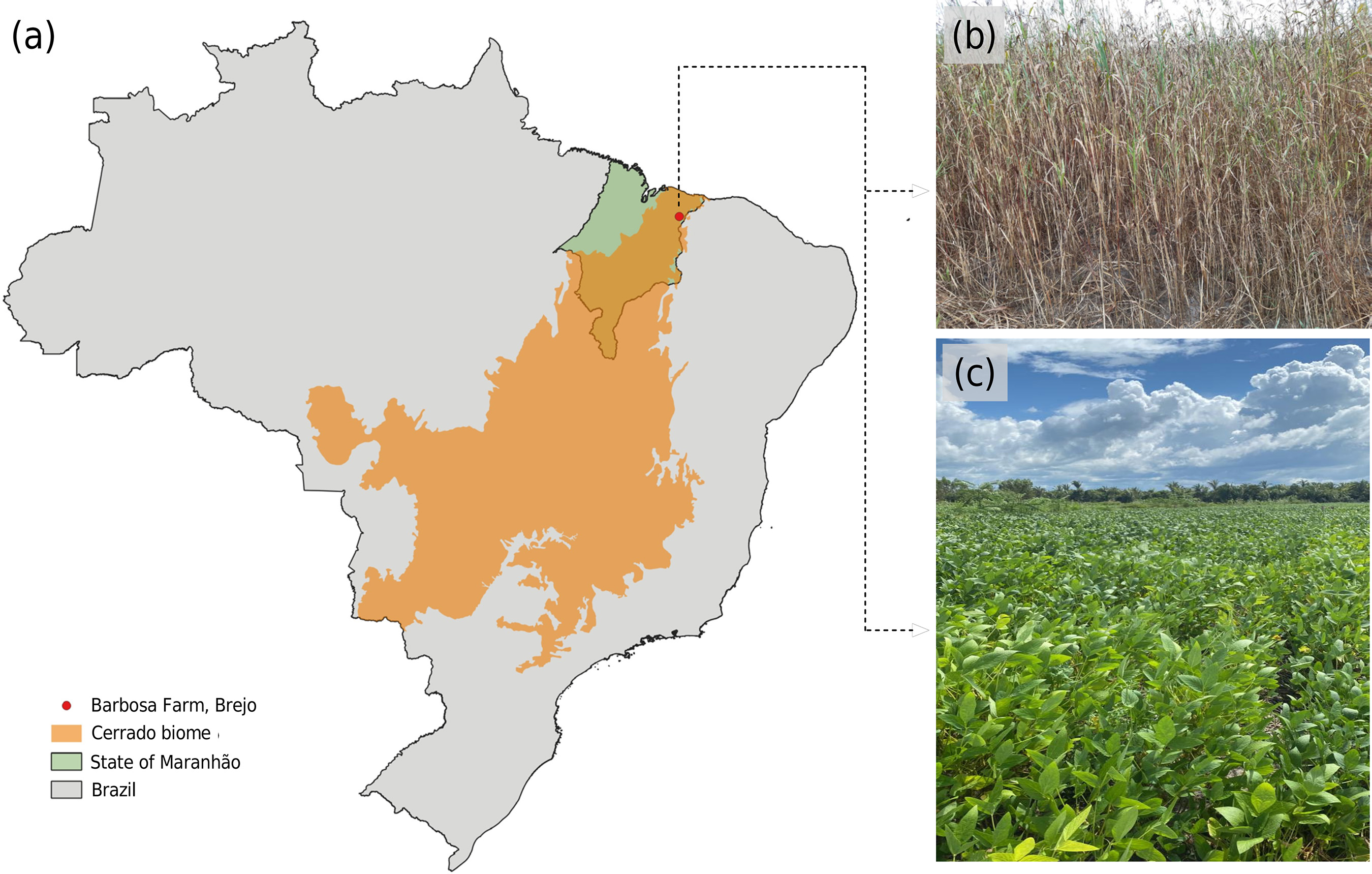
The study was conducted between 2021 and 2022 on the Barbosa Farm in the municipality/county of Brejo, in the eastern region of the state of Maranhão, Brazil (03° 42’ 44” S; 42° 55’ 44” W) (Figure 1). Soybean had been grown in the area for nine years as a monoculture.

Location of the experimental area (a); Sudan grass as a cover crop preceding soybean cultivation (b) and; soybean cultivated after Sudan grass (c) in the 2021/2022 agricultural harvest in the Barbosa Farm, Brejo.
Climate in the region is Aw type – tropical with a dry winter from July to November and a rainy summer from December to June – according to the Köppen classification system (Alvares et al., 2013). Monthly rainfall distribution and minimum and maximum temperatures during the period of conducting the study are shown in figure 2. Climate data were obtained from the TerraClimate dataset, with high spatial resolution (1/24°, ~4 km) for global earth surfaces through the Climate Engine platform (Huntington et al., 2017). Soil in the study area is classified as an Argissolo Amarelo, according to the Brazilian Soil Classification System (Santos et al., 2018), corresponding to an Ultisol in the USDA Soil Taxonomy (Soil Survey Staff, 2014). Before setting up the experiment, soil particle size and chemical analyses were performed on soil samples collected from the layer of 0.00-0.20 m (Teixeira et al., 2017) (Table 1).

Rainfall and temperature between 2021 and 2022 at Fazenda Barbosa, Brejo, Maranhão, Brazil.
Chemical and granulometric analysis of the soil before the study be set up in Brejo, Maranhão, Brazil
Experiment was conducted in a randomized block design with four blocks. To evaluate the appropriate time of terminating Sudan grass as a cover crop in the soybean off-season, it was cut at six different time periods (treatments) before soybean sowing, designated as days before sowing soybean (DBSS): 150, 120, 90, 60, 30, and 7 days, corresponding to the first, second, third, fourth, fifth, and sixth cutting times, respectively. The cutting carried out at 7 DBSS is considered late termination because it maintains the cover crop alive for the longest period, whereas the previous cuttings (30 to 150 days) are considered early terminations. Each experimental plot measured 8 × 4 m, for a total of 32 m2.
Sudan grass was sown in the soybean off-season in May 2021. Seed was broadcast, with a sowing density of 15 kg ha-1. According to the pre-established cutting times, the Sudan grass was cut mechanically using a backpack brush cutter. In August 2021, a sample of the Sudan grass plant material was collected when it reached a 90-day crop cycle (maturity stage) before the first cutting (at 150 DBSS) to determine shoot dry biomass. This characterization represents the mean of three samples collected at random in an area of 0.5 m2 for each sample. After collection, the biomass was dried in a forced-air circulation oven at 65 ± 2 °C until reaching constant weight, at approximately 72 h. After that, the biomass was ground in a Wiley-type mill and passed through a 1-mm-diameter mesh sieve. Based on shoot biomass, the following determinations were made: nutrient accumulation (Miyazawa et al., 2009), lignin content (Van Soest et al., 1991), and carbon (C) content (Tedesco et al., 1995). Dry biomass yield of the Sudan grass was 7.9 Mg ha-1. The biomass had 81.4 kg ha-1 of N, 11.9 kg ha-1 of P, 48.2 kg ha-1 of K, 11.9 kg ha-1 of Ca, 19.0 kg ha-1 of Mg, 6.1 kg ha-1 of S, 43.5 g ha-1 of Cu, 30.0 g ha-1 of Mn, 126.4 g ha-1 of Zn, 529.3 g ha-1 of Fe, 110.6 g ha-1 of B, 2,733 kg ha-1 of C, and 513 kg ha-1 of lignin. The C:N and lignin:N ratios were also calculated, exhibiting values of 34:1 and 6:1, respectively.
On January 3, 2022, after the sixth cutting of Sudan grass and before soybean sowing, 2 L ha-1 of Roundup® herbicide and 1 L ha-1 of 2,4-D Amina CCAB 806 SL® herbicide were applied. On January 8, 2022, the soybean cultivar 3190IPRO, in maturity group 9.0, was sown at a spacing of 0.5 m between rows, with a population density of 320,000 plants ha-1. At the time of sowing, the seeds were inoculated with strains of Bradyrhizobium japonicum in the plant furrow. Fertilization consisted of pre-sowing broadcast application of 100 kg ha-1 of potassium chloride (60 % K2O), 150 kg ha-1 of monoammonium phosphate (11 % N and 52 % P2O5) in the plant row, and 200 kg ha-1 of the NPK 10–00–30 formulation applied as topdressing.
Sampling and evaluation of the soil microbiological and chemical properties
In the full maturity phenological stage of soybean (R8), soil samples were collected at the 0.00-0.10 m layer. In each experimental plot, eight simple soil samples were collected from determined points in the rows and between the plant rows, and they were subsequently combined to form a composite sample. Samples were also placed in plastic bags under refrigeration (~3 °C), with openings to allow gas exchanges, and sent for microbiological analyses. Remainder of the soil sample material was air-dried, sieved (through a 2-mm-diameter mesh), and homogenized to characterize the soil chemical properties.
Total organic carbon (TOC) was determined using the modified Walkley-Black method (Teixeira et al., 2017). Microbial biomass carbon (MBC) and microbial biomass nitrogen (MBN) were estimated using the microwave irradiation-extraction method, following Ferreira et al. (1999). Basal soil respiration (BSR) was measured using the method proposed by Alef (1995), which is based on quantification of the CO2 released under 7-day soil incubation. Metabolic quotient (qCO2) (Silva et al., 2007) and the microbial quotient (qMic) (Sparling, 1992) were calculated. The qCO2 represents the ratio between BSR and MBC, while qMic corresponds to the ratio between MBC and TOC. Dehydrogenase enzyme activity (DHA) was measured using the method described by Casida et al. (1964) and Bitton and Ben (1986), which consists of spectrophotometric determination of DHA through measuring triphenyl formazan concentration. The fluorescein diacetate enzyme (FDA) hydrolysis activity was estimated using a fluorescein diacetate solution, with subsequent reading in a spectrophotometer (Schnurer and Rosswall, 1982; Chen et al., 1988).
The pH level was determined using the soil:water ratio of 1:2.5. Available K+ and P were extracted using Mehlich-1 solution, the K+ concentration was determined by atomic absorption spectroscopy, and P concentration was determined by spectrophotometry. Available Ca2+ and Mg2+ were extracted with 1 mol L-1 KCl, and both were determined using atomic absorption spectroscopy. Sulfur was determined by turbidimetry in a spectrophotometer after extraction with [Ca(H2PO4)2.H2O] in a 2 mol L-1 acetic solution. Zinc, Cu, Fe, and Mn were extracted using Mehlich-1 solution and quantified by atomic absorption spectroscopy. Boron was determined by spectrophotometry following the use of the hot water extraction method. The SB was obtained by calculating the sum of the concentrations of Ca2+, Mg2+, and K+. The CEC was calculated from the sum of the SB and H+Al. Teixeira et al. (2017) detailed procedures for chemical properties analysis.
Sampling and evaluation of the nutritional state of soybean
In the soybean full flowering phenological stage (R2), the nutritional status of the plants was evaluated by collecting twelve newly-expanded leaves with petioles, corresponding to the third trifoliate leaf from the tip of the plant, from each experimental plot (Oliveira Júnior et al., 2020). Plant tissue samples were first washed with water, then 3 % hydrochloric acid, and finally with deionized water. Samples were placed in paper bags and then in a forced-air circulation laboratory oven at 65 ± 2 °C for drying until reaching constant weight, at approximately 72 h. After drying, the material was ground in a Wiley-type mill and passed through a sieve with 1-mm-diameter mesh. Ground samples were then analyzed to determine foliar concentrations of N, P, K, Ca, Mg, S, Cu, Zn, Fe, Mn, and B, as described by Miyazawa et al. (2009).
Grain yield and protein content
In the soybean full maturity phenological stage (R8), yield was estimated by harvesting the grain from the central area of each plot (2 m2) used for data collection. Grain weight was determined and adjusted to 13 % moisture, and then used to estimate kg per hectare. A sample with 100 seeds chosen at random from each plot was used to estimate the 1000-seed weight. An aliquot of the grain was selected to quantify protein content, as described by Silva and Queiroz (2006).
Statistical analysis
Shapiro-Wilk test was performed on the data (p<0.05) to assess the normality of residuals. When the data met the criteria, analysis of variance (ANOVA) was used to determine the effect of the treatments (Sudan grass cutting times) on the response variables. When a significant effect was found by the F test (p≤0.05) for the Sudan grass cutting times, regression analysis was applied by fitting mathematical models (p≤0.05). Analyses were performed on the Infostat statistical program (Di Rienzo et al., 2020).
RESULTS
Soil microbiological and chemical properties
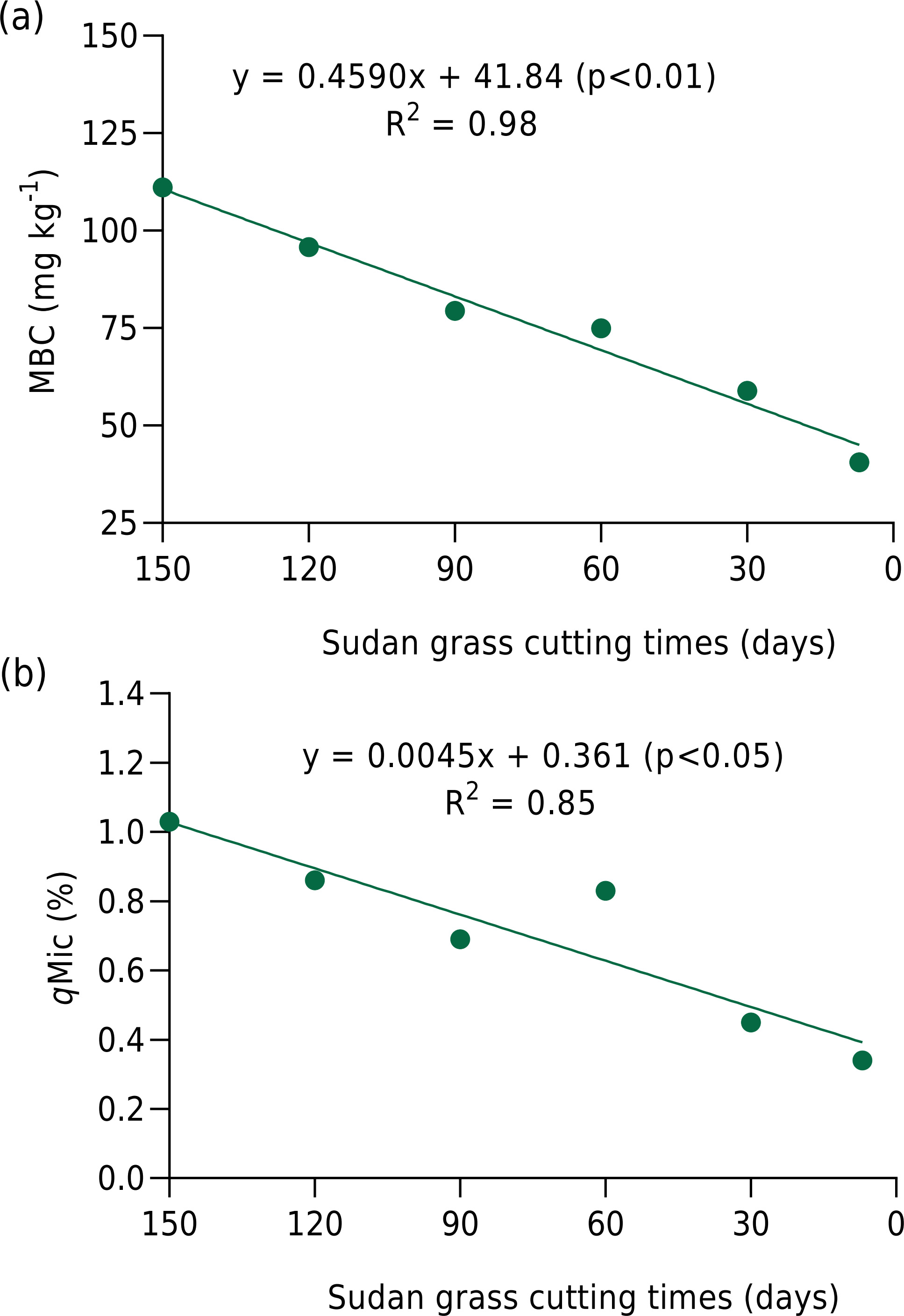
Early cutting of Sudan grass did not have a significant (p>0.05) effect on TOC and MBN concentrations, BSR, qCO2, or DHA and FDA enzyme activities (Table 2). However, early cutting of Sudan grass significantly (p<0.01) influenced MBC (Figure 3a). A linear response of MBC in the soil was observed as the time interval increased between cutting the Sudan grass and subsequent soybean sowing. Cutting the Sudan grass at 150 DBSS led to increased MBC, contributing 111 mg kg-1. Cutting Sudan grass at 7 DBSS, however, led to a 63 % decrease (41 mg kg-1) in MBC. Like MBC, qMic was also affected (p<0.01) by the Sudan grass cutting times (Figure 3b). Cutting the Sudan grass 7 days before soybean sowing resulted in a 67 % reduction in qMic. This situation changes as the time interval between Sudan grass cutting and soybean sowing increases; the qMic value in the soil corresponds to 1 % of TOC at 150 DBSS.
Soil microbiological properties in response to the effect of Sudan grass cutting times as a cover crop preceding soybean in Brejo, Maranhão, 2022

Microbial biomass carbon (a) and microbial quotient (b) in response to Sudan grass cutting times as a cover crop preceding soybean in Brejo, Maranhão, 2022.
The lack of significant effects from the treatments on the concentrations of P, K+, Ca2+, Mg2+, Cu, Fe, Mn, Zn, and B and on the values of pH, SB, and the CEC of the soil indicates that earlier cutting time of the Sudan grass does not significantly (p>0.05) alter most of the soil chemical properties during soybean growing (Table 3). The S-SO42- concentration responded significantly (p<0.01) to the grass cutting times (Figure 4). Early cutting of the Sudan grass at 150 DBSS resulted in 13 mg dm-3 of S-SO42 in the soil, but as the time interval decreased between Sudan grass cutting and soybean sowing, the S-SO42- concentration in the soil also decreased, reaching only 6 mg dm-3 when cutting occurred at 7 DBSS.
Soil chemical properties in response to the effect of cutting times on Sudan grass as a cover crop preceding soybean
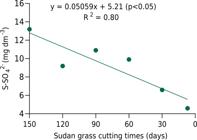
Concentration of S-SO42- of the soil in response to Sudan grass cutting times as a cover crop preceding soybean. Brejo, Maranhão, 2022.
Soybean nutritional state
Sudan grass cutting times did not significantly (p>0.05) affect the foliar concentrations of the macronutrients N, Mg, and S or of the micronutrients Fe, Mn, Zn, and B in soybean (Table 4). Foliar concentrations of P (Figure 5a), K (Figure 5b), Ca (Figure 5c), and Cu (Figure 6d) in soybean were significantly (p<0.01) affected by early cutting of the Sudan grass. Cutting the Sudan grass at 67 DBSS increased foliar K concentration at 24 g kg-1. Increasing the interval beyond 67 DBSS reduces foliar K concentration in soybean. The highest foliar P concentration of 4.11 g kg-1 occurred when the grass was cut at 98 DBSS, as the Lorentzian non-linear regression model indicates. Foliar Ca concentration in soybean exhibited a linear decline in response to cutting time. The increase in the interval between Sudan grass cutting and soybean sowing led to a 44 % decrease in foliar Ca concentration, with 2.8 g kg-1 of Ca observed at 150 DBSS. Cupper concentration, however, showed an opposite effect, with a 52 % increase in the concentration of this micronutrient in the soybean leaf from early cutting of Sudan grass at 150 DBSS.
Nutritional status of soybeans in response to the effect of Sudan grass cutting times in Brejo, Maranhão, 2022
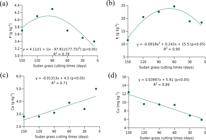
Foliar concentrations of P (a), K (b), Ca (c), and Cu (d) in soybean crops in response to Sudan grass cutting times in Brejo, Maranhão, 2022.

One-thousand seed weight (a), yield (b), and protein content (c) of soybeans in response to cutting times of Sudan grass, as a predecessor crop to soybeans. Brejo, Maranhão, 2022.
Grain yield and protein content
Cutting times of Sudan grass used as a cover crop in the soybean growing system did not significantly (p>0.05) affect 1000-seed weight (Figure 6a), yield (Figure 6b), or protein content (Figure 6c) in soybean grain.
DISCUSSION
Cover crop was sown immediately after harvest of the main crop at the end of May, which also coincided with the end of the rainy season in the region. Cumulative rainfall of 175 mm in May facilitated the initial establishment of Sudan grass. After the first month, rainfall distribution was considered irregular, with an accumulation of 165 mm up to the first cutting in August. Thus, the climate conditions between sowing the Sudan grass and the first cutting included cumulative rainfall of 340 mm, with a mean temperature of 26.8 °C. This allowed production of 7.9 Mg ha-1 of Sudan grass biomass, confirming its potential as a cover crop in soybean growing systems due to soil cover and to maintain the crop residue in a tropical region. The high biomass production during the dry season reflects the hardiness of the crop, with its tolerance to water deficit (Al-Solaimani et al., 2017; Ismail et al., 2017). Therefore, Sudan grass is an alternative for diversifying the possibilities of cover crops for the northeastern Cerrado region, which is still mainly restricted to pearl millet in soybean growing systems (Silva et al., 2022).
Earlier cutting of Sudan grass was not able to bring about higher grain yield compared with cutting carried out only seven days before soybean sowing, refuting the hypothesis of this study. Our results align with those reported by Franchini et al. (2015) and Werner et al. (2022), who observed that early desiccation of the Urochloa genus did not influence the yield, 1000-seed weight, or protein content of soybean grain. Although this was not the result expected, the absence of a negative impact on soybean production upon incorporating Sudan grass allows this living cover crop to be maintained for an extended period in the dry winter and to carry out termination only at the soybean sowing period, that is, in the summer with the onset of the rainy season.
In addition, the absence of an effect of cutting times on soybean grain yield shows that incorporation of Sudan grass as a cover crop in production systems is not a limiting factor for high soybean yields. It is noteworthy that regardless of the cutting time of Sudan grass, the mean soybean grain yield with incorporation of this grass into the system was 3,912 kg ha-1, which is higher than the mean yield for the state of Maranhão (3,331 kg ha-1) and for Brazil (3,029 kg ha-1) in the 2021/2022 crop season (Conab, 2023). These data are important, since this is the first study supported by scientific investigation that reports the effects of using Sudan grass as a cover crop in soybean growing systems.
The C:N ratio is an excellent indicator of residue quality and the mineralization rate, as residues with larger amounts of C bring about immobilization or reduced mineralization of the N (Jahanzad et al., 2016; Otte et al., 2019; Thapa et al., 2022). Late cutting of Sudan grass reduces residue quality, including the N content of the biomass (Ziki et al., 2019). Therefore, early cutting may promote N mineralization and positively affect the N release dynamics of the cover crop (Rosa et al., 2021), with a subsequent effect on foliar N concentration and protein content in soybean grain. It is likely that inoculation of soybean seeds with N2-fixing bacteria in combination with N application superseded any effects from the mineralized N from the Sudan grass residue when cutting occurred early, resulting in the absence of effects on grain protein content, as also reported by Bracey et al. (2022).
As TOC results from plant biomass, early cutting could result in lower TOC, as observed in some studies that terminated the crop in the vegetative growth stage (Ruis and Blanco-Canqui, 2017; Denton et al., 2022; Liebert et al., 2023). However, in this case, cuttings were performed when Sudan grass was in a mature stage, and consequently, there was no response in TOC concentration. Furthermore, as Sudan grass has high C:N (34:1) and lignin:N (6:1) ratios, there are signs of slow decomposition of the residues and persistence in the soil (Costa et al., 2015; Pires et al., 2022; Thapa et al., 2022). This likely explains the lack of significant changes in TOC concentrations in the soil. However, early cutting of the Sudan grass alters the concentrations of the labile carbon fraction in the soil, confirming the effectiveness of this property as an indicator of rapid soil responses to the addition of carbon from the cover crop residues (Brito et al., 2023).
However, the response was not as expected because early cutting of the Sudan grass increased MBC. Thus, although it is not possible to rule out that prolonging the cover crop may have increased the aboveground biomass (Alonso-Ayuso et al., 2014), it is possible that shorter time intervals between cutting the Sudan grass and soybean sowing prevented contact between the dead biomass and the soil for a longer time, delaying the onset of the decomposition process, due to delayed accessibility of the decomposer microorganisms to the residue (Poudel et al., 2023). Moreover, it can be inferred that delaying the termination of the Sudan grass crop, that is, keeping the crop alive for a longer time in the field before cutting, increases recalcitrance and reduces residue quality (Bloszies et al., 2022).
Therefore, it can be considered that greater recalcitrance and lower biomass quality are determining factors for the efficiency of the microbial community in using the Sudan grass biomass as a substrate. Consequently, the shorter the interval between Sudan grass cutting and soybean sowing, the lower the soil microbial community ability to convert the substrate into microbial biomass carbon, resulting in lower values of the microbial quotient (Bettio et al., 2022). Given this context, although early cutting did not increase soybean yield, shortening the Sudan grass growing season also did not negatively affect soil biological quality. Microbial biomass carbon and qMic values increased, indicating that this practice brings about a more active microbiota, leading to greater decomposition of the organic matter (Amorim et al., 2020).
Sudan grass cutting times did not affect the values of BSR and qCO2, indicating that cutting the Sudan grass at 7 DBSS or earlier did not create conditions that indicate environmental stress in the present study (Pires et al., 2022). The uniformity of nutrient supply and suitable soil moisture and temperature conditions were determining factors for soil microbiological activity (Santos et al., 2021), mitigating any potential effects of the Sudan grass cutting times on the BSR and qCO2.
Soil S-SO42- concentrations were affected by the Sudan grass cutting times, increasing along with earlier cutting times. This may be due to the ability of forage grasses to take up nutrients from subsoil layers and release them as their vegetative residues decompose (Costa et al., 2021). Thus, Sudan grass prevents leaching of the S-SO42- anion into subsoil layers, which is a common process in the sandy soils typical of the Brazilian Cerrado (Sousa et al., 2024). The increase in soil S-SO42- concentration from early cutting of Sudan grass is highly important, considering that sulfur is a limiting micronutrient in Cerrado soils, where nutrient deficiencies are common (Horowitz and Meurer, 2006). Despite their effects on the soil, the Sudan grass cutting times did not affect the S-SO4-2 concentration in soybean leaves. These findings suggest that even the lowest concentrations of this nutrient in the soil, resulting from Sudan grass cutting time nearer soybean sowing time, were not limiting for full soybean development.
Sudan grass accumulated macronutrients in the following decreasing order: N > K > Mg > Ca = P > S. The micronutrients accumulated in the Sudan grass biomass exhibited the following decreasing order: Fe > Zn > B > Cu > Mn. Biomass production and the nutrient contents help predict the release of nutrients to the following crop (Weidhuner et al., 2019). Thus, early cutting was expected to accelerate plant residue decomposition, resulting in rapid release of nutrients and their subsequent uptake by soybean plants. However, this effect was observed in a linear manner only for Cu, suggesting that cutting the Sudan grass at 7 DBSS delays the release of this micronutrient into the soil, with a consequent reduction in uptake by soybean.
As affirmed by Brito et al. (2023), higher concentrations of nutrients in soybean leaves are achieved through better synchronization between the release of nutrients from residues in decomposition and their uptake by the crop. Therefore, synchronization and P and K uptake by soybean improve when Sudan grass cutting is performed early, whereas cutting at 7 DBSS leads to higher foliar Ca concentrations. Early cutting may have reduced the uptake of certain nutrients due to their rapid release in the remaining crop residue, as observed by Dias et al. (2020) and Werner et al. (2020). That is why early termination of the cover crop does not always result in higher rates of nutrient release or improvement in the nutritional status of the main crop (Poudel et al., 2023). Reduction in the time interval between grass cutting and soybean sowing reduces soybean foliar P and K concentrations, likely because it delays decomposition and release of these nutrients from the cover crop residues. In any case, based on the results of this study, determining the optimal time for cutting the grass before soybean sowing is a strategy that can affect nutrient dynamics in the system and can affect nutrient use efficiency by aligning the period of high demand of the crop with the period of greatest release of nutrients (Silva et al., 2024).
Other studies conducted in tropical regions have shown the importance of using forage grasses in nutrient cycling and uptake by the soybean crop grown in succession (Costa et al., 2020; Santos et al., 2021; Brito et al., 2023). The present study provides new evidence that Sudan grass has advantages as a cover crop, as it can improve biological quality properties without negatively affecting soybean nutrition when the cover crop is terminated early. These findings and the hardiness of Sudan grass suggest the possibility of incorporating this species as a cover crop for use in the second crop period in soybean production systems in the Cerrado region of Maranhão. However, further studies are necessary to evaluate the long-term effects of Sudan grass on soil health, nutrient cycling, and soybean yield in other types of soil.
CONCLUSION
Sudan grass has high biomass production capacity in the dry season (off-season), and it is possible to maintain the live cover crop up to 7 days before soybean sowing without affecting grain yield in a no-tillage system under Cerrado conditions in Maranhão. However, early cutting of the crop leads to more efficient incorporation of carbon into the microbial biomass, increases in soil S-SO42- concentrations, and increases in foliar P, K, and Cu concentrations in soybean. This study confirms the Sudan grass potential as a cover crop in a soybean growing system.
ACKNOWLEDGEMENTS
The authors thank the Brazilian Agricultural Research Corporation – Embrapa (Project number 20.22.03.036.00.03.005) for financial support.
-
How to cite:
Andrade HAF, Sagrilo E, Oliveira Júnior JOL, Sousa DC, Costa PM, Silva MEC, Alcantara RMCM, Furtado MB, Souza HA. Early termination of Sudan grass (Sorghum sudanense) used as soil cover in a soybean cropping system in the Brazilian Cerrado. Rev Bras Cienc Solo. 2025;49:e0240227. https://doi.org/10.36783/18069657rbcs20240227
DATA AVAILABILITY
The data will be provided upon request.
REFERENCES
-
Abdalla M, Hastings A, Cheng K, Yue Q, Chadwick D, Espenberg M, Truu J, Rees RM, Smith P. A critical review of the impacts of cover crops on nitrogen leaching, net greenhouse gas balance and crop productivity. Glob Change Biol. 2019;25:2530-43. https://doi.org/10.1111/gcb.14644
» https://doi.org/10.1111/gcb.14644 - Alef K. Estimation of soil respiration. In: Alef K, Nannipieri P. Methods in applied soil microbiology and biochemistry. London: Academic Press; 1995. p. 464-7.
- Almeida REM, Souza HA, Evangelista BA, Uhlmann A, Ramos MR, Sagrilo E, Dias TSS, Oliveira LRSP, Costa NR. Challenges to managing soil health in the newest agricultural frontier in Brazil. In: Mendes IC, Cherubin MR, editors. Soil health series: Volume 3 Soil Health and Sustainable Agriculture in Brazil. Madison: Wiley; 2024. p. 327-74.
-
Alonso-Ayuso M, Gabriel JL, Quemada M. The kill date as a management tool for cover cropping success. PloS One. 2014;9:e109587. https://doi.org/10.1371/journal.pone.0109587
» https://doi.org/10.1371/journal.pone.0109587 -
Al‐Solaimani SG, Alghabari F, Ihsan MZ, Fahad S. Water deficit irrigation and nitrogen response of Sudan grass under arid land drip irrigation conditions. Irrig Drain. 2017;66:365-76. https://doi.org/10.1002/ird.2110
» https://doi.org/10.1002/ird.2110 -
Alvares CA, Stape JL, Sentelhas PC, Gonçalves JDM, Sparovek G. Köppen’s climate classification map for Brazil. Meteorol Z. 2013;22:711-28. https://doi.org/10.1127/0941-2948/2013/0507
» https://doi.org/10.1127/0941-2948/2013/0507 -
Amorim SP, Nascimento D, Boechat CL, Duarte LDSL, Rocha CB, Carlos FS. Grasses and legumes as cover crops affect microbial attributes in Oxisol in the Cerrado (Savannah environment) in the northeast region. Rev Caatinga. 2020;33:31-42. https://doi.org/10.1590/1983-21252020v33n104rc
» https://doi.org/10.1590/1983-21252020v33n104rc -
Aparecido LEO, Dutra AF, Lorençone PA, Alcântara Neto F, Lorençone JA, Leite MRL. Climate change in MATOPIBA region of Brazil: A study on climate extremes in agriculture. Theor Appl Climatol. 2023a;153:87-100. https://doi.org/10.1007/s00704-023-04509-x
» https://doi.org/10.1007/s00704-023-04509-x -
Aparecido LEO, Meneses KC, Lorençone PA, Lorençone JA, Moraes JRDSCD, Rolim GS. Climate classification by Thornthwaite (1948) humidity index in future scenarios for Maranhão State, Brazil. Environ Dev Sustain. 2023b;25:855-78. https://doi.org/10.1007/s10668-021-02082-9
» https://doi.org/10.1007/s10668-021-02082-9 -
Ashworth AJ, Owens PR, Allen FL. Long-term cropping systems management influences soil strength and nutrient cycling. Geoderma. 2020;361:114062. https://doi.org/10.1016/j.geoderma.2019.114062
» https://doi.org/10.1016/j.geoderma.2019.114062 -
Baptistella JLC, Andrade SAL, Favarin JL, Mazzafera P. Urochloa in tropical agroecosystems. Front Sus Food Sys. 2020;4:119. https://doi.org/10.3389/fsufs.2020.00119
» https://doi.org/10.3389/fsufs.2020.00119 -
Bender SF, Wagg C, Heijden MGVD. An underground revolution: Biodiversity and soil ecological engineering for agricultural sustainability. Trends Ecol Evol. 2016;31:440-52. https://doi.org/10.1016/j.tree.2016.02.016
» https://doi.org/10.1016/j.tree.2016.02.016 -
Bettio DP, Araujo ASF, Bonifacio A, Araujo FFD. Soil microbial biomass, organic C, and soybean physiology in integrated crop–livestock systems with different inputs. Arch Agron Soil Sci. 2022;68:971-83. https://doi.org/10.1080/03650340.2020.1864341
» https://doi.org/10.1080/03650340.2020.1864341 - Bitton G, Ben K. Biochemical tests for toxicity screening. In: Bitton G, Dutka BJ, editors. Toxicity testing using microorganisms. United States: CRC Press; 1986. p. 27-55.
-
Blanco‐Canqui H, Jasa PJ. Do grass and legume cover crops improve soil properties in the long term? Soil Sci Soc Am J. 2019;83:1181-7. https://doi.org/10.2136/sssaj2019.02.0055
» https://doi.org/10.2136/sssaj2019.02.0055 -
Bloszies SA, Reberg‐Horton SC, Heitman JL, Woodley AL, Grossman JM, Hu S. Legume cover crop type and termination method effects on labile soil carbon and nitrogen and aggregation. Agron J. 2022;114:1817-32. https://doi.org/10.1002/agj2.21022
» https://doi.org/10.1002/agj2.21022 - Bolfe ÉL, Victória DDC, Contini E, Bayma-Silva G, Spinelli-Araujo L, Gomes D. MATOPIBA em crescimento agrícola - Aspectos territoriais e socioeconômicos. Rev Pol Agric. 2016;25:38-62.
-
Bracey WM, Sykes VR, Yin X, Bates GE, Butler DM, Mcintosh DW, Willette AR. Forage yield, quality, and impact on subsequent cash crop of cover crops in an integrated forage/row crop system. Agronomy. 2022;12:1214. https://doi.org/10.3390/agronomy12051214
» https://doi.org/10.3390/agronomy12051214 -
Brito LDCR, Souza HA, Araújo Neto RB, Azevedo DMP, Sagrilo E, Vogado RF, Carvalho SP, Ferreira ACM, Cavigelli M. A. Improved soil fertility, plant nutrition and grain yield of soybean and millet following maize intercropped with forage grasses and crotalaria in the Brazilian savanna. Crop Pasture Sci. 2023;74:438-48. https://doi.org/10.1071/CP22251
» https://doi.org/10.1071/CP22251 - Casida LE, Klein DA, Santoro T. Soil dehydrogenase activity. Soil Sci. 1964;98:371-6.
- Chen W, Hoitink HAJ, Madden LV. Microbial activity and biomass in container media for predicting suppressiveness to damping-off caused by Pythium ultimum Phytopathology. 1988;78:1447-50.
-
Companhia Nacional de Abastecimento - Conab. Boletim da safra de grãos; 2024 [cited 2024 Ago 23]. Available from: https://www.conab.gov.br/info-agro/safras/graos/boletim-da-safra-de-graos
» https://www.conab.gov.br/info-agro/safras/graos/boletim-da-safra-de-graos -
Cordeiro CFS, Echer FR, Araujo FF. Cover crops impact crops yields by improving microbiological activity and fertility in sandy soil. J Soil Sci Plant Nut. 2021;21:1968-77. https://doi.org/10.1007/s42729-021-00494-0
» https://doi.org/10.1007/s42729-021-00494-0 -
Costa NR, Andreotti M, Crusciol CAC, Pariz CM, Bossolani JW, Castilhos AMD, Nascimento CAC, Lima CGR, Bonini CSB, Kuramae EE. Can palisade and Guinea grass sowing time in intercropping systems affect soybean yield and soil chemical properties? Front Sus Food Sys. 2020;4:81. https://doi.org/10.3389/fsufs.2020.00081
» https://doi.org/10.3389/fsufs.2020.00081 -
Costa NR, Andreotti M, Crusciol CAC, Pariz CM, Bossolani JW, Pascoaloto IM, Rocha CG, Bonini CSB, Castilhos AM, Calonego JC. Soybean yield and nutrition after tropical forage grasses. Nutr Cycl Agroecos. 2021;121:31-49. https://doi.org/10.1007/s10705-021-10157-2
» https://doi.org/10.1007/s10705-021-10157-2 -
Costa NR, Andreotti M, Ulian NDA, Costa BS, Pariz CM, Teixeira Filho MCM. Acúmulo de nutrientes e tempo de decomposição da palhada de espécies forrageiras em função de épocas de semeadura. Biosci J. 2015;31:818-29. https://doi.org/10.14393/BJ-v31n3a2015-22434
» https://doi.org/10.14393/BJ-v31n3a2015-22434 -
Denton S, Raper T, Stewart S, Dodds D. Cover crop termination timings and methods effect on cotton (Gossypium hirsutum L.) development and yield. Crop Forage Turfgrass Mgmt. 2023;9:e20206. https://doi.org/10.1002/cft2.20206
» https://doi.org/10.1002/cft2.20206 -
Di Rienzo JA, Casanoves MGF, Balzarini L, González M, Tablada CWR. InfoStat; 2020 [cited 2023 July 15]. Available from: https://www.infostat.com.ar/index.php?mod=page&id=46⟨=en.
» https://www.infostat.com.ar/index.php?mod=page&id=46⟨=en -
Dias MBC, Costa KAP, Severiano EC, Bilego UO, Furtini Neto AE, Almeida DP, Brand SC, Vilela L. Brachiaria and Panicum maximum in an integrated crop–livestock system and a second-crop maize system in succession with soybean. J Agr Sci. 2020;158:206-17. https://doi.org/10.1017/S0021859620000532
» https://doi.org/10.1017/S0021859620000532 -
Ferreira AS, Camargo FAO, Vidor C. Utilização de microondas na avaliação da biomassa microbiana do solo. Rev Bras Cienc Solo. 1999;23:991-6. https://doi.org/10.1590/S0100-06831999000400026
» https://doi.org/10.1590/S0100-06831999000400026 -
Franchini JC, Balbinot Junior AA, Debiasi H, Conte O. Desempenho da soja em consequência de manejo de pastagem, época de dessecação e adubação nitrogenada. Pesq Agropec Bras. 2015;50:1131-8. https://doi.org/10.1590/S0100-204X2015001200002
» https://doi.org/10.1590/S0100-204X2015001200002 -
Horowitz N, Meurer EJ. Oxidação do enxofre elementar em solos tropicais. Cienc Rural. 2006;36:822-8. https://doi.org/10.1590/S0103-84782006000300015
» https://doi.org/10.1590/S0103-84782006000300015 -
Huntington JL, Hegewisch KC, Daudert B, Morton CG, Abatzoglou JT, McEvoy DJ, Erickson T. Climate engine: Cloud computing and visualization of climate and remote sensing data for advanced natural resource monitoring and process understanding. B Am Meteorol Soc. 2017;98:2397-410. https://doi.org/10.1175/BAMS-D-15-00324.1
» https://doi.org/10.1175/BAMS-D-15-00324.1 -
Ismail SM, El‐Nakhlawy FS, Basahi JM. Sudan grass and pearl millets productivity under different irrigation methods with fully irrigation and stresses in arid regions. Grassl Sci. 2017;64:29-39. https://doi.org/10.1111/grs.12179
» https://doi.org/10.1111/grs.12179 -
Jahanzad E, Barker AV, Hashemi M, Eaton T, Sadeghpour A, Weis SA. Nitrogen release dynamics and decomposition of buried and surface cover crop residues. Agron J. 2016;108:1735-41. https://doi.org/10.2134/agronj2016.01.0001
» https://doi.org/10.2134/agronj2016.01.0001 -
Liebert J, Mirsky SB, Pelzer CJ, Ryan MR. Optimizing organic no‐till planted soybean with cover crop selection and termination timing. Agron J. 2023;115:1938-56. https://doi.org/10.1002/agj2.21390
» https://doi.org/10.1002/agj2.21390 -
Malcorra MP, Trentin G, Sperling DR, Shoffel ER, Trentin R. Desenvolvimento do capim-sudão por meio de simulação numérica para a região de Pelotas/RS. Rev Therma. 2024;23:190-204. https://doi.org/10.15536/thema.V23.2024.190-204.3463
» https://doi.org/10.15536/thema.V23.2024.190-204.3463 -
Mazzuchelli RCL, Araújo ASF, Moro E, Araújo F. Changes in soil properties and crop yield as a function of early desiccation of pastures. J Soil Sci Plant Nut. 2020;20:840-8. https://doi.org/10.1007/s42729-019-00169-x
» https://doi.org/10.1007/s42729-019-00169-x - Miyazawa M, Pavan MA, Muraoka T, Carmo CAFS. Melo WJ. Análise química de tecido vegetal. In: Silva FC, editor. Manual de análises químicas de solos, plantas e fertilizantes. 2. ed. Brasília, DF: Embrapa; 2009. p. 191-234.
- Oliveira Júnior A, Castro C, Oiveira FA, Klepker D. Fertilidade do solo e estado nutricional da soja. In: Seixas CDS, Neumaier N, Balbinot Júnior AA, Krzyzanowski FC, Leite RMVBC, editors. Tecnologias de produção de soja. Londrina: Embrapa; 2020. p. 133-84.
-
Otte B, Mirsky S, Schomberg H, Davis B, Tully K. Effect of cover crop termination timing on pools and fluxes of inorganic nitrogen in no‐till corn. Agron J. 2019;111:2832-42. https://doi.org/10.2134/agronj2018.10.0699
» https://doi.org/10.2134/agronj2018.10.0699 -
Pires GC, Denardin LGO, Silva LS, Freitas CM, Gonçalves EC, Camargo TA, Bremm C, Carvalho PCF, Souza ED. System fertilization increases soybean yield through soil quality improvements in integrated crop-livestock system in tropical soils. J Soil Sci Plant Nut. 2022;22:4487-95. https://doi.org/10.1007/s42729-022-01050-0
» https://doi.org/10.1007/s42729-022-01050-0 -
Poudel P, Parajuli B, Park D, Ye R. Cover crop residues decomposition and nutrient releases in a Sandy Ultisols of US Coastal Plain: Impacts of termination timing. Commun Soil Sci Plant. 2023;54:2394-411. https://doi.org/10.1080/00103624.2023.2223612
» https://doi.org/10.1080/00103624.2023.2223612 -
Rausch LL, Gibbs HK, Schelly I, Brandão Junior A, Morton DC, Carneiro Filho A, Strassburg B, Walker N, Noojipady P, Barreto P, Meyer D. Soy expansion in Brazil's Cerrado. Conserv Lett. 2019;12:e12671. https://doi.org/10.1111/conl.12671
» https://doi.org/10.1111/conl.12671 -
Rosa AT, Creech CF, Elmore RW, Rudnick DR, Lindquist JL, Fudolig M, Butts L, Werle R. Implications of cover crop planting and termination timing on rainfed maize production in semi-arid cropping systems. Field Crop Res. 2021;271:108251. https://doi.org/10.1016/j.fcr.2021.108251
» https://doi.org/10.1016/j.fcr.2021.108251 -
Ruis SJ, Blanco‐Canqui H, Koehler‐Cole K, Jasa PJ, Slater G, Elmore RW, Ferguson RB. Winter cover crop root biomass yield in corn and soybean systems. Agrosys Geosci Environ. 2020;3:e20101. https://doi.org/10.1002/agg2.20101
» https://doi.org/10.1002/agg2.20101 -
Ruis SJ, Blanco‐Canqui H. Cover crops could offset crop residue removal effects on soil carbon and other properties: A review. Agron J. 2017;109:1785-805. https://doi.org/10.2134/agronj2016.12.0735
» https://doi.org/10.2134/agronj2016.12.0735 - Santos HG, Jacomine PKT, Anjos LHC, Oliveira VA, Lumbreras JF, Coelho MR, Almeida JA, Araújo Filho JC, Oliveira JB, Cunha TJF. Sistema brasileiro de classificação de solos. 5. ed. rev. ampl. Brasília, DF: Embrapa; 2018.
-
Santos SFDCB, Souza HA, Araújo Neto RB, Sagrilo E, Ferreira ACM, Carvalho SP, Brito LCR, Leite LFC. Soil microbiological attributes and soybean grain yield in succession to corn intercropped with forage in the Maranhão eastern Cerrado. Int J Plant Prod. 2021;15:669-77. https://doi.org/10.1007/s42106-021-00167-z
» https://doi.org/10.1007/s42106-021-00167-z -
Schnurer J, Rosswall T. Fluorescein diacetate hydrolysis as a measure of total microbial activity in soil and litter. Appl Environ Microb. 1982;43:1256-61. https://doi.org/10.1128/aem.43.6.1256-1261.1982
» https://doi.org/10.1128/aem.43.6.1256-1261.1982 -
Silva ADN, Ribeiro Junior WQ, Ramos MLG, Lima CA, Jayme-Oliveira A, Silva AMM, Carvalho AM. Nutrient accumulation in cover crops under contrasting water regimes in the Brazilian Cerrado. Atmosphere. 2022;13:1617. https://doi.org/10.3390/atmos13101617
» https://doi.org/10.3390/atmos13101617 - Silva D, Queiroz AC. Análise de alimentos: Métodos químicos e biológicos. Viçosa, MG: UFV; 2006.
-
Silva DS, Arima EY, Reis TN, Rattis L. Temperature effect on Brazilian soybean yields, and farmers’ responses. Int J Agric Sustain. 2023;21:2173370. https://doi.org/10.1080/14735903.2023.2173370
» https://doi.org/10.1080/14735903.2023.2173370 - Silva EE, Azevedo PHS, De-Polli H. Determinação do carbono da biomassa microbiana do solo (BMS-C). Seropédica: Embrapa; 2007.
-
Silva JAG, Costa KAP, Severiano EC, Silva AG, Vilela L, Leandro WM, Muniz MP, Silva LM, Mendonça KTM, Barros VM. Efficiency of desiccation, decomposition and release of nutrients in the biomass of forage plants of the genus Brachiaria after intercropping with sorghum in integrated systems for soybean productivity. Commun Soil Sci Plant. 2024;55:1644-62. https://doi.org/10.1080/00103624.2024.2323076
» https://doi.org/10.1080/00103624.2024.2323076 - Silveira MCT, Sant’Anna DM, Montardo DP, Trentin G. Aspectos relativos à implantação e manejo de capim-sudão BRS Estribo. Begé: Embrapa; 2015.
- Soil Survey Staff. Keys to soil taxonomy. 12th ed. Washington, DC: United States Department of Agriculture, Natural Resources Conservation Service; 2014.
-
Sousa RN, Silva BA, Costa VV, Teixeira RS, Valadares SV, Silva IR, Alvarez V VH, Vergutz L. Limestone and phosphogypsum are key drivers of eucalypt production in the highly weathered soils of Brazil. Plant Soil. 2024;496:221-41. https://doi.org/10.1007/s11104-022-05801-x
» https://doi.org/10.1007/s11104-022-05801-x -
Souza VS, Santos DDC, Ferreira JG, Souza SO, Gonçalo TP, Sousa JVA, Cruvinel AG, Vilela L, Paim TP, Almeida REM, Canisares LP, Cherubin MR. Cover crop diversity for sustainable agriculture: Insights from the Cerrado biome. Soil Use Manage. 2024;40:e13014. https://doi.org/10.1111/sum.13014
» https://doi.org/10.1111/sum.13014 -
Sparling GP. Ratio of microbial biomass carbon to soil organic carbon as a sensitive indicator of changes in soil organic matter. Aust J Soil Res. 1992;30:195-207. https://doi.org/10.1071/SR9920195
» https://doi.org/10.1071/SR9920195 -
Tanaka KS, Crusciol CA, Soratto RP, Momesso L, Costa CH, Franzluebbers AJ, Oliveira Junior A, Calonego JC. Nutrients released by Urochloa cover crops prior to soybean. Nutr Cycl Agroecosys. 2019;113:267-81. https://doi.org/10.1007/s10705-019-09980-5
» https://doi.org/10.1007/s10705-019-09980-5 - Tedesco MJ, Gianello C, Bissani CA, Bohnen H, Volkweiss SJ. Análises de solo, plantas e outrosmateriais. 2. ed. Porto Alegre: Universidade Federal do Rio Grande do Sul; 1995. (Boletim técnico, 5).
- Teixeira PC, Donagemma GK, Fontana A, Teixeira WG. Manual de métodos de análise de solo. 3. ed. rev e ampl. Brasília, DF: Embrapa; 2017.
-
Thapa R, Tully KL, Reberg-Horton C, Cabrera M, Davis BW, Fleisher D, Gaskin J, Hitchcock R, Poncet A, Chomberg HH, Seehaver SA, Timlin D, Mirsky SB. Cover crop residue decomposition in no-till cropping systems: Insights from multi-state on-farm litter bag studies. Agr Ecosyst Environ. 2022;326:107823. https://doi.org/10.1016/j.agee.2021.107823
» https://doi.org/10.1016/j.agee.2021.107823 -
United States Department of Agriculture – USDA. World agricultural production; 2023 [cited 2024 Ago 10]. Available from: https://apps.fas.usda.gov/psdonline/circulars/production.pdf
» https://apps.fas.usda.gov/psdonline/circulars/production.pdf -
Van Soest PJ, Robertison JB, Lewis BA. Methods for dietary fiber, neutral detergent fiber and nonstarch polysaccharides in relation to animal nutrition. J Dairy Sci. 1991;74:3583-97. https://doi.org/10.3168/jds.S0022-0302(91)78551-2
» https://doi.org/10.3168/jds.S0022-0302(91)78551-2 -
Weidhuner A, Afshar RK, Luo Y, Battaglia M, Sadeghpour A. Particle size affects nitrogen and carbon estimate of a wheat cover crop. Agron J. 2019;111:3398-402. https://doi.org/10.2134/agronj2019.03.0164
» https://doi.org/10.2134/agronj2019.03.0164 -
Werner F, Balbinot Junior AA, Ferreira AS, Franchini JC, Debiasi H, Silva MADA. Performance of soybean crop in response to palisadegrass pasture desiccation and nitrogen fertilization under integrated crop-livestock system. Aust J Crop Sci. 2022;16:850-5. https://doi.org/10.21475/ajcs.22.16.06.p3644
» https://doi.org/10.21475/ajcs.22.16.06.p3644 -
Werner F, Ferreira AS, Balbinot Junior AA, Oliveira Junior AO, Debiasi H, Silva MAA. Nitrogen, phosphorus, and potassium released by decomposition of palisade grass to soybean in succession. Pesq Agropec Bras. 2020;55:e01853. https://doi.org/10.1590/S1678-3921.pab2020.v55.01853
» https://doi.org/10.1590/S1678-3921.pab2020.v55.01853 -
Wortman SE, Francis CA, Bernards ML, Drijber RA, Lindquist JL. Optimizing cover crop benefits with diverse mixtures and an alternative termination method. Agron J. 2012;104:1425-35. https://doi.org/10.2134/agronj2012.0185
» https://doi.org/10.2134/agronj2012.0185 -
Xie H, Huang Y, Choi Y, Shi J. Evaluating the sustainable intensification of cultivated land use based on emergy analysis. Technol Forecast Soc. 2021;165:120449. https://doi.org/10.1016/j.techfore.2020.120449
» https://doi.org/10.1016/j.techfore.2020.120449 -
Ziki SJL, Zeidan EMI, El-Banna AYA, Omar AE. Influence of cutting date and nitrogen fertilizer levels on growth, forage yield, and quality of sudan grass in a semiarid environment. Int J Agronomy. 2019;2019:6972639. https://doi.org/10.1155/2019/6972639
» https://doi.org/10.1155/2019/6972639
Edited by
-
Editor:
José Miguel Reichert https://orcid.org/0000-0001-9943-2898 and Jeferson Dieckow https://orcid.org/0000-0002-3025-4402