 Effects of 12 weeks of plyometric training on the anthropometric profile and physical fitness of young handball athletes
ABSTRACT
This study aimed to evaluate the effects of a plyometric training program (PTP) on the anthropometric profile and physical fitness of base athletes of a handball team. Nine athletes with a mean age of 15.11 ± 0.74 participated. The PTP occurred over 12 weeks, totaling 18 sessions. The intervention proved to be effective in the components of the anthropometric profile (height, wingspan, thigh, calf, and neck circumferences) and in physical fitness (throwing, horizontal jump, and 20-meter sprint tests). It is concluded that 12 weeks of a PTP efficiently improves the anthropometric profile, lower limb power, and muscular power.
Keywords:
Training; Handball; Plyometrics; Power
RESUMO
Este estudo teve como objetivo avaliar os efeitos de um programa de treinamento pliométrico (PTP) no perfil antropométrico e na aptidão física de atletas de base de uma equipe de handebol. Participaram nove atletas com média de idade de 15,11±0,74. O PTP ocorreu em 12 semanas, totalizando 18 sessões. A intervenção se mostrou eficaz nos componentes do perfil antropométrico (estatura, envergadura, circunferências de coxa, panturrilha e pescoço), e na aptidão física (testes de arremesso, salto horizontal e sprint de 20 metros). Conclui-se que 12 semanas de um PTP é eficiente para melhorar o perfil antropométrico, a potência de membros inferiores e a potência muscular.
Palavras-chave:
Treinamento; Handebol; Pliometria; Potência
RESUMEN
Este estudio tuvo como objetivo evaluar los efectos de un programa de entrenamiento pliométrico (PTP) sobre el perfil antropométrico y la aptitud física de atletas jóvenes de un equipo de balonmano. Participaron nueve atletas con una edad media de 15,11±0,74 años. El PTP se desarrolló durante 12 semanas, con un total de 18 sesiones. La intervención demostró ser efectiva en los componentes del perfil antropométrico (altura, envergadura, perímetros de muslo, pantorrilla y cuello) y en la aptitud física (pruebas de lanzamiento, salto horizontal y sprint de 20 metros). Se concluye que 12 semanas de PTP son eficientes para mejorar el perfil antropométrico, la potencia de los miembros inferiores y la potencia muscular.
Palabras clave:
Capacitación; Balonmano; Pliometría; Fuerza
INTRODUCTION
Handball is a sport that encompasses a wide range of motor skills, including jumps, sprints, and sudden changes of direction (Hermassi et al., 2018), as well as high-intensity actions followed by periods of rest or low-intensity activity (Gorostiaga et al., 2005). in addition, it has a diversity of technical and tactical actions and physical capabilities, such as strength, speed, power, agility, and motor coordination (Madruga-Parera et al., 2021).
Team sports require good explosive strength components, which are manifested in almost all movements in handball, as it involves numerous movements that require efficient recruitment of muscle fibers (Keller et al., 2020). During a game, there are sudden changes in direction and running rhythms, that is, alternating periods of effort and recovery, which characterizes the sport as intermittent (Eleno et al., 2002). According to Iacono et al. (2015) and Iacono et al. (2016), just under 500 high-intensity actions with almost 300 changes of direction occur during a match.
In this sense, for modalities that use explosive muscle contractions, it is necessary to consider the rate of force development (RFD), which is obtained through the ratio between the variation in force and the variation in time, in addition to being important for athletes who use it in a short period, culminating in important functional benefits (Aagaard, 2003; Corvino et al., 2009; Ide et al., 2014).
Considering that strength can be transformed into power through specific training, plyometric training (PT) is believed to be one of the most famous methods for this purpose (Bompa, 2004). Plyometric exercises are very suitable for improving RFD and overall performance, as they include exercises that work on strength and movement speed, reflecting the handball movements of changes of direction in feints and vertical jumps in throws (Bompa, 2004; Hermassi et al., 2010; Hermassi et al., 2014).
Additionally, untrained individuals, or those with an intermediate level of training, may present similar hypertrophic responses with PT and resistance training, at least for the muscle groups of the lower extremities, in a short intervention period of 12 weeks (Grgic et al., 2021). Furthermore, additional and significant results may be obtained more accurately in longer periods with PT and resistance training (Eihara et al., 2022).
Fernandez-Fernandez et al. (2022) argue that throwing is a fundamental handball skill developed in the early stages of training and preparation of athletes. However, Zazzali et al. (2007) warn that the overhead throwing movement alone is associated with very high levels of overload, which in most cases can cause pain and serious injuries in sports that require overhead throwing. The study by Spieszny and Zubik (2018) shows concern about this aspect, in which they report that the use of a heavy ball in such exercises only increases the tension exerted on the shoulder joint. Therefore, in their intervention program, they performed general throwing exercises with both hands, exerting less tension on the shoulder joints.
In this context, PT is well evidenced in the scientific literature as a method that improves physical fitness parameters and sports performance during stretching and shortening cycle exercises, such as jumps and sprints (Kubo et al., 2017; Kons et al., 2023). Furthermore, PT may play a crucial role in the anthropometric profile of handball athletes, a variable that is little explored in the scientific literature (Silva et al., 2016).
Although the tests used were effective for the proposed objectives, it would be relevant to include others, such as the maximum strength test for lower limbs, for a more comprehensive analysis. Participant adherence represented another challenge since the study began with almost twice as many athletes, but the weekly frequency and continuity in the program were compromised by individual issues. Although the 12-week intervention period is more extensive than other studies that use plyometric training in youth categories, an even larger period could yield more robust results, as observed in the study by Spieszny and Zubik (2018), which had an intervention lasting more than 13 weeks and reported a statistically significant improvement in the increase in Squat Jump height and the muscular power manifested during goal shooting. Thus, this study aimed to evaluate the effects of a plyometric training program on the anthropometric profile and physical fitness of athletes in the youth category of a handball team.
METHODS
This research was submitted to the Human Research Ethics Committee of IELUSC College and approved by opinion 6.569.913/2023. The athletes who voluntarily responded and signed the informed consent form, participated in the research.
Design and participants
A quantitative, quasi-experimental study was conducted. The sample for this study consisted of nine athletes from a youth handball team with a total of 20 members. To ensure representation of the different tactical roles of the team the selection included players from the main positions: two pivots, two wingers, four-point guards, and one goalkeeper. The selection of these athletes aimed to encompass the different biomechanical and physiological demands associated with each position; that is, the center player needs more speed and jumping ability compared to the defenders, allowing for a more complete analysis of the impacts of PTP. The athletes were aged 15 to 17 years, and most had never participated in PTP or strength training programs. The research was conducted at the athlete's training center so that there would be no changes to their routine.
The sample was selected in a non-probabilistic manner by convenience. The handball team was chosen by convenience, belonging to the youth category of the sport in the city of Joinville-SC, Brazil. Athletes from the youth category of the Joinville men's handball team, born between 2007 and 2009 (15 to 17 years of age) were included. Those who reported any history of knee joint injuries or musculoskeletal discomfort, as well as those who did not accept to participate in the intervention, or were not available to attend the training sessions, were not included.
Research instruments
As research evaluation instruments, anthropometric data on body mass (kg) were collected using a Caumaq scale, height (m), wingspan (cm), neck circumference (cm), arm circumference (cm), forearm circumference (cm), waist circumference (cm), abdomen circumference (cm), hip circumference (cm), thigh circumference and calf circumference (cm) using a Cescorf tape measure. Subsequently, the Body Mass Index - BMI (kg/m2), Waist-to-Height Ratio - WHtR, and Waist-to-Hip Ratio - WHR (cm/cm) were calculated.
Muscular strength was assessed by the one repetition maximum test - 1RM in the bench press exercise for upper limbs (Brown and Weir, 2001). Muscular power and physical fitness was assessed by the vertical (Matsudo, 1995) and horizontal jump tests for lower limbs and medicine ball throw (2 kg) for upper limbs (Gaya et al., 2021), aerobic capacity by the Mcardle bench (Katch and McArdle, 1996), and anaerobic capacity by the 20-meter sprint test (Gaya et al., 2021).
It is important to note that all assessments were conducted by the same researcher, ensuring intra- and inter-rater reliability. The tests were performed one week before the intervention began (PRE-TEST) and the day after the last training session (POST-TEST), in the same environment and at the same time as before the training sessions, to ensure data reliability and control for potential environmental biases.
Plyometric training intervention program
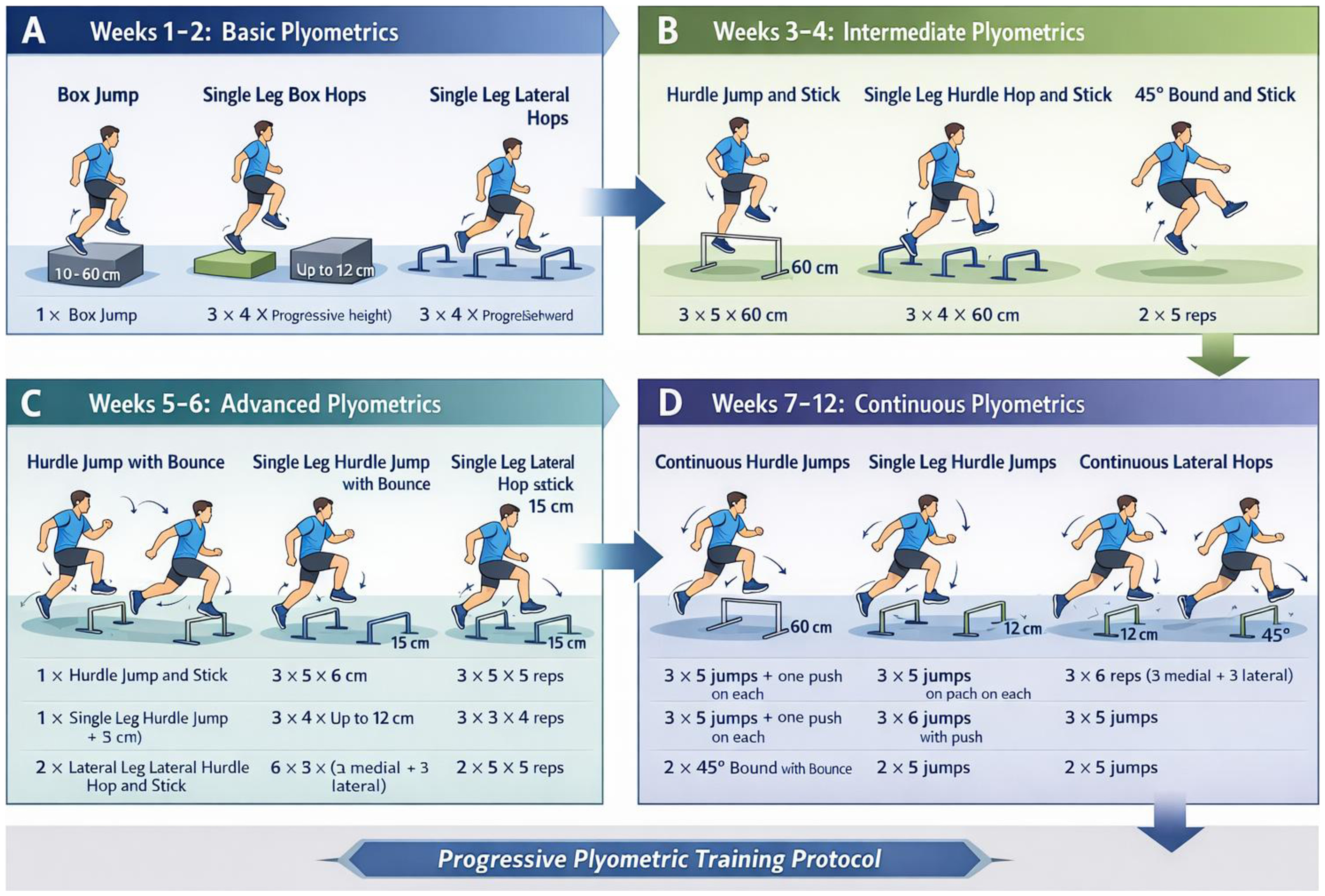
To implement the plyometric training intervention program, 12 weeks of training were applied. The sessions, exercises, sets and repetitions, as well as the obstacles used during lower limbs training were described in Table 1.
The weekly frequency was two sessions per week during the adaptive period in the first month for motor learning of sports gestures and musculoskeletal adaptations. However, subsequently, it was not possible to maintain the frequency of two sessions per week due to the team's championship calendar, given that during competitive periods, technical and tactical training are predominant. Therefore, the weekly frequency became 1 session per week starting from week 3 of training.
The intensity progression was controlled by the types of jumps. In the first two weeks of the periodization, an adaptive period was performed with gravity reduction jumps (jumps on a box). In the third week, the strategy of increasing gravity was implemented using hurdle jumps and hurdle jumps, with an additional impulse after landing, thus introducing semi-elastic exercises. From the fourth week onwards, the protocol included only elastic plyometric exercises, which aimed to reduce the time of contact with the ground with the foot and perform continuous impulses. From week 7 onwards, only exercises considered true plyometric were introduced. It is important emphasize that plyometric exercises are defined as explosive movements grounded in the stretch-shortening cycle (Boyle, 2018). The progression of the plyometric training program can be seen in Figure 1.

Data analysis
Data were expressed as mean, standard deviation, standard error of the means, and percentage. The Shapiro-Wilk test was applied to verify the normality of the data. After confirming a Gaussian distribution, the paired Student's t-test for parametric data was used to verify the benefits of plyometric training before the intervention (PRE-TEST) and after three months (POST-TEST). To verify the difference between the means the percentage of variation of delta (Δ) was calculated. The Effect Size Calculator for T-Test was used to estimate Cohen's d (https://www.socscistatistics.com/effectsize/default3.aspx) and classified, according to the new proposal by Sawilowsky (2009): a - (d=0.01 - very small); b - (d= 0.2 - small); c - (d= 0.5 - medium); d - (d= 0.8 - large); e - (d= 1.2 - very large); e - (d= 2.0 - huge). The significance level adopted was p≤0.050. Data were analyzed in the Statistical Package for the Social Sciences - SPSS, version 22 in Portuguese.
RESULTS
Nine male handball athletes from the youth category participated in this study, with a mean age of 15.11 ± 0.74, body mass of 64.20 ± 9.19, and height of 1.71 ± 0.09 at the time before the intervention (PRE-TEST). The study totaled 18 sessions, in 12 weeks of plyometric training, with adherence of 90.5%. In addition, it is possible to analyze the effects of training on anthropometric variables, with the following variables being significant: height, wingspan, thigh perimeter, calf and neck circumference (Table 2).
Table 3 shows the effects of a plyometric training program (PTP) on several physical variables frequently observed in handball matches. The results showed significant changes in some of the capacities assessed, such as throwing distance, horizontal jump, and 20-meter sprint performance, suggesting improvements in muscular power and anaerobic and aerobic capacity. The data reinforce the effectiveness of PTP in improving certain aspects of physical performance.
Effects of 12 weeks of plyometric training program on upper limb strength (Throw and bench press 1 RM), muscular power (horizontal and vertical jump), aerobic (QCBT) and anaerobic capacity (20m Sprint Test) (n=9).
Additionally, correlation analyses were performed between age and the delta variation of anthropometric variables, and the following variables showed good correlation levels (r>0.5) and statistical significance: body mass (kg); upper arm (cm); thigh (cm); calf (cm); waist circumference (cm); hip circumference (cm); body mass index (kg/m2); and waist-to-height ratio (cm/cm) (Table 4). For the correlations between age and the deltas of the physical fitness tests, only the vertical jump (cm) showed significance (Table 5). We also emphasize that the deltas of the anthropometric variables and physical tests were correlated, and no significant correlations were found.
Correlation between athletes' age and delta variation on upper limb strength, muscular power, aerobic and anaerobic capacity (n=9).
DISCUSSION
This study evaluated the effects of a 12-week plyometric training program for youth handball athletes. The data obtained revealed that PT applied to youth athletes is efficient in upgrading the following variables: horizontal jump, vertical jump, and 20-meter sprints, which are fundamental skills during a handball match. These skills are manifested several times during the play, such as throwing, feinting, and marking. The increases in these gestures ensure better mechanical efficiency and lower metabolic expenditure during the match, which can be crucial in decisive situations during the game. The results corroborate the findings of Hermassi et al. (2014), who concluded that PTP applied for 8 weeks with adolescent handball athletes induced positive effects in some explosive actions such as vertical jump height and repeated sprint ability.
The participants showed significant improvements in the analyzed tests, even with only one weekly training session for most of the analyzed period. The choice of only one session per week was made primarily due to the team's competition calendar, where most weekends and sometimes during the week the athletes were traveling, on vacation, or in technical and tactical training. Despite this, the athletes showed significant adaptations in the analyzed variables, something that was expected since Bianchi et al. (2019) concluded that both protocols with one training session per week and with two sessions are effective training modalities, inducing benefits in jump and sprint tests of elite youth soccer players.
Stretch-shortening cycle (SSC) is well accepted in the literature as a physiological mechanism that has the function of increasing force production from elastic potential energy. SSC assists in athletic gestures during the match, and training this mechanism should be part of physical preparation, especially in jumping, changing direction, and accelerating in different planes, as in the case of handball. SSC is well documented in the scientific literature as a method that improves performance during stretch-shortening cycle exercises (Kubo et al., 2017). SSC develops throughout the maturation process, therefore, young people in the early stages of the maturation process have lower cycle efficiency (Radnor et al., 2018), something that was taken into account, since the age of the sample was 15 ± 1 years. Untrained individuals, or those with an intermediate level of training, may present similar hypertrophic responses with PTP and resistance training, at least for the muscle groups of the lower extremities, in a short intervention period of 12 weeks (Grgic et al., 2021).
The athletes participating in the project showed significant changes in anthropometric measurements throughout the analyzed period. An increase in total body mass, height, and wingspan was observed, indicating physical development characteristic of the maturation period. In addition, the body circumferences, neck, arm, forearm, waist, abdomen, hip, thigh, and calf registered significant increases, suggesting positive adaptations related to the gain in muscle mass resulting from the applied protocol and the maturation process. Similar findings were observed in the study by Chelly et al. (2014), which analyzed the effects of PTP on the performance of the upper and lower limbs of adolescent handball players and found a significant increase in muscle volumes in the lower limbs.
As expected, the athletes showed significant improvements in the horizontal and vertical jump tests since the current literature has documented the positive effects of training on muscle power and performance in explosive actions. In this sense, the review study by Rocha Henrique et al. (2023) stands out, in which they sought to identify and analyze the evidence related to PT interventions in handball players. It was found that most of the investigations showed improvements in jumping capacity, running speed, change of direction, strength, and balance. Furthermore, hurdle jumps and vertical jumps are among the most used plyometric exercises in handball (Rocha Henrique et al., 2023), reinforcing the positive use of these exercises.
The use of unilateral jumps may be interesting since they will have the largest transfer to the sport, helping in game situations and directly reducing the risk of injuries since most injuries occur in situations of eccentric actions, specifically landings and decelerations. Combining high-intensity unilateral and bilateral jumps is advantageous to induce significant improvements in power performance also in the short term (8 weeks) (Markovic and Mikulic, 2010; Wang and Zhang, 2016).
Another point to highlight is the sprint performance, which recorded significant increases in the participants' anaerobic capacity. This specific skill can be decisive in a counterattack or a ball steal, in addition to its training being related to a decrease in the risk of injuries, especially in the hamstrings, which is often seen in sports such as soccer and futsal. Regarding this skill, many studies (Slimani et al., 2016; Wang and Zhang, 2016; Yanci et al., 2016) concluded the effectiveness of PTP in improving sprint performance, especially in the review study by Rocha Henrique et al. (2023), which found that 19 of the 21 studies analyzed demonstrated significant improvements in factors related to speed in handball. In addition, the change of direction obtained positive results, indicating PTP can improve this important aspect of game performance.
The athletes did not demonstrate an improvement in their performance in the 1RM bench press test. A reduction in the results obtained has been observed indicating a worsening in maximum strength in this exercise. As expected, the athletes did not show an improvement in this variable because they were not performing this exercise during the intervention period since the protocol was aimed only at lower limb power. The prioritization of the lower limbs in the PTP within handball is observed in most studies (Rocha Henrique et al., 2023). Long periods without strength training, such as going three months without performing the bench press exercise, can lead to a reduction in maximum strength performance (1RM) in this exercise. The absence of regular stimuli compromises the acquired neuromuscular adaptation, resulting in a reduction in muscle activation capacity and biomechanical efficiency (American College of Sports Medicine, 2009).
However, in the 2kg medicine ball-throwing test, participants had a significant improvement in their results, even though the protocol was not aimed at the upper limbs. This can be explained by the volume of technical and tactical training, where athletes are exposed to numerous throws per day, most of the time performed with great force and acceleration, indirectly improving the power of the participants' upper limbs. With court training and throwing practices alone, it is possible to observe an improvement in the power of handball athletes. In addition, the stimuli generated by the match itself contribute to the development of explosive and specific skills, such as jump throws (Zamberlan, 1999).
In the Mcardle bench test, increases in VO2 max were found, indicating an improvement in the athletes' aerobic capacity. Strength and power modalities, such as Olympic weightlifting, may present lower VO2 max values compared to endurance sports. Plyometric training does not promote a direct improvement in VO2 max, suggesting that the advances observed in this variable are more related to indoor training, in the same way as the improvement in upper limb power. It is possible to state that aerobic capacity in athletes of intermittent sports, such as handball, futsal, soccer, and basketball, can be improved through specific training of the sport, even without the inclusion of specific protocols aimed only at aerobic conditioning. Studies indicate that technical-tactical activities performed during regular training, such as reducedsided games, collective games, and situations with numerical variation of players, already promote significant adaptations in the aerobic system due to the high cardiovascular and metabolic demand inherent to the sport (Carminatti et al., 2017).
This study had some limitations: the final sample consisted of nine participants, which could have been great in increasing the representativeness of the results. However, several studies within the same theme (Palha et al., 2004; Carvalho et al., 2014; Alecrim et al., 2018; Alecrim et al., 2019; Alecrim et al., 2020) also presented a smaller sample, but they did not fail to report significant results and provide subsidies for future PTP interventions in handball, as in this present study.
The available resources were considered adequate and did not limit the development of the work. However, some limitations can be highlighted: lack of control over external variables, such as the limited weekly frequency and the low sample adherence, could ensure greater accuracy in the results.
CONCLUSIONS
The results demonstrate that 12 weeks of the plyometric training program is an efficient method to improve the performance of young athletes in jumping variables (horizontal and vertical) and the performance of 20-meter sprints. The results of improvement in aerobic capacity and lower limb power are more related to adaptations in training on the court.
It should be taken into account that a larger sample would increase the representativeness of the results obtained, which is the main limitation of the present study. In addition, a weekly frequency greater than one training session per week could interfere with the recorded findings. In this study, it was not possible to maintain the frequency of two weekly sessions due to the team's competition calendar.
The use of plyometric training is efficient in generating positive adaptations for muscular strength and power in young athletes. It is recommended that further research be conducted in this field, manipulating different variables such as the frequency of weekly sessions and the total volume of sets. In addition, comparative studies using PT, resistance training, and different training methods can reinforce the practical application of PT in strength and power sports.
DATA AVAILABILITY
Research data is only available upon request.
-
FUNDING
This research did not receive financial support.
REFERENCES
- Alecrim JVC, Souza MO, Bezerra RV, Pires GP. Os efeitos de treinamento pliométrico e isométrico na capacidade anaeróbia de jovens jogadoras de handebol. Fórum de Integração Ensino, Pesquisa, Extensão e Inovação Tecnológica do IFRR. 2018;5(1).
-
Alecrim JVC, Alecrim JVC No, Souza MO, Pires GP. Efeito do treinamento pliométrico e isométrico na força explosiva de atletas de handebol. Rev Cienc Act Fis UCM. 2019;20(2):1-15. https://doi.org/10.29035/rcaf.20.2.10
» https://doi.org/10.29035/rcaf.20.2.10 - Alecrim JVC, Souza MO, Pires GP, Alecrim JVC No. Efectos del entrenamiento polimétrico e isométrico en la fuerza explosiva de miembros superiores de atletas de balonmano. E-Balonmano.com Rev Cienc Deporte. 2020;16(1):49-54.
-
American College of Sports Medicine. Progression models in resistance training for healthy adults. Med Sci Sports Exerc. 2009;41(3):687-708. https://doi.org/10.1249/MSS.0b013e3181915670 PMid:19204579.
» https://doi.org/10.1249/MSS.0b013e3181915670 -
Aagaard P. Training-induced changes in neural function. Exerc Sport Sci Rev. 2003;31(2):61-7. https://doi.org/10.1097/00003677-200304000-00002 PMid:12715968.
» https://doi.org/10.1097/00003677-200304000-00002 -
Gaya AR, Gaya A, Silva P, Dias AF, Gaya ACA. Projeto Esporte Brasil: manual de medidas, testes e avaliações [Internet]. 5. ed. Porto Alegre: Universidade Federal do Rio Grande do Sul; 2021 [cited 2023 Sept 17]. Available from: https://www.ufrgs.br/proesp/
» https://www.ufrgs.br/proesp/ -
Bianchi M, Coratella G, Dello Iacono A, Beato M. Comparative effects of single vs. double weekly plyometric training sessions on jump, sprint and change of directions abilities of elite youth football players. J Sports Med Phys Fitness. 2019;59(6):910-5. https://doi.org/10.23736/S0022-4707.18.08804-7 PMid:30160086.
» https://doi.org/10.23736/S0022-4707.18.08804-7 - Bompa TO. Treinamento de potência para o esporte. São Paulo: Phorte; 2004.
- Boyle M. O novo modelo de treinamento funcional de Michael Boyle. 2. ed. Porto Alegre: Artmed; 2018.
- Brown LE, Weir JP. ASEP procedures recommendation I: accurate assessment of muscular strength and power. J Exerc Physiol. 2001;4(3):1-21.
- Carminatti LJ, Possamai CA, Del Vechio FB, da Silva BVC, de Lima JRP. Potência aeróbia em atletas de futebol e futsal. Rev Bras Ciênc Mov. 2017;25(4):5-12. http://doi.org/10.31501/rbcm.v25i4.
-
Carvalho A, Mourão P, Abade E. Effects of strength training combined with specific plyometric exercises on body composition, vertical jump height and lower limb strength development in elite male handball players: a case study. J Hum Kinet. 2014;41(1):125-32. https://doi.org/10.2478/hukin-2014-0040 PMid:25114739.
» https://doi.org/10.2478/hukin-2014-0040 -
Chelly MS, Hermassi S, Aouadi R, Shephard RJ. Effects of 8-week in-season plyometric training on upper and lower limb performance of elite adolescent handball players. J Strength Cond Res. 2014;28(5):1401-10. https://doi.org/10.1519/JSC.0000000000000279 PMid:24149768.
» https://doi.org/10.1519/JSC.0000000000000279 -
Corvino RB, Caputo F, Oliveira AC, Greco CC, Denadai BS. Taxa de desenvolvimento de força em diferentes velocidades de contrações musculares. Rev Bras Med Esporte. 2009;15(6):428-31. https://doi.org/10.1590/S1517-86922009000700005
» https://doi.org/10.1590/S1517-86922009000700005 -
Fernandez-Fernandez J, Granacher U, Martinez-Martin I, Garcia-Tormo V, Herrero-Molleda A, Barbado D, et al. Physical fitness and throwing speed in U13 versus U15 male handball players. BMC Sports Sci Med Rehabil. 2022;14(1):113. https://doi.org/10.1186/s13102-022-00507-0 PMid:35725495.
» https://doi.org/10.1186/s13102-022-00507-0 -
Eihara Y, Takao K, Sugiyama T, Maeo S, Terada M, Kanehisa H, et al. Heavy resistance training versus plyometric training for improving running economy and running time trial performance: a systematic review and meta-analysis. Sports Med Open. 2022;8(1):138. https://doi.org/10.1186/s40798-022-00511-1 PMid:36370207.
» https://doi.org/10.1186/s40798-022-00511-1 - Eleno TG, Barela JA, Kokubun E. Tipos de esforço e qualidades físicas do handebol. Rev Bras Ciênc Esporte. 2002;24(1):83-98.
-
Gorostiaga EM, Granados C, Ibañez J, Izquierdo M. Differences in physical fitness and throwing velocity among elite and amateur male handball players. Int J Sports Med. 2005;26(3):225-32. https://doi.org/10.1055/s-2004-820974 PMid:15776339.
» https://doi.org/10.1055/s-2004-820974 -
Grgic J, Schoenfeld BJ, Mikulic P. Effects of plyometric vs. resistance training on skeletal muscle hypertrophy: a review. J Sport Health Sci. 2021;10(5):530-6. https://doi.org/10.1016/j.jshs.2020.06.010 PMid:32579911.
» https://doi.org/10.1016/j.jshs.2020.06.010 -
Hermassi S, Gabbett TJ, Chelly MS, Fathloun M, Shephard RJ. Effects of a short-term in-season plyometric training program on repeated-sprint ability, leg power and jump performance of elite handball players. Int J Sports Sci Coaching. 2014;9(5):1205-16. https://doi.org/10.1260/1747-9541.9.5.1205
» https://doi.org/10.1260/1747-9541.9.5.1205 -
Hermassi S, Gabbett TJ, Chelly MS, Fathloun M, Shephard RJ. The effect of heavy- vs. moderate-load training on the development of strength, power, and throwing ball velocity in male handball players. J Strength Cond Res. 2010;24(9):2408-18. https://doi.org/10.1519/JSC.0b013e3181e58d7c PMid:20706155.
» https://doi.org/10.1519/JSC.0b013e3181e58d7c -
Hermassi S, Schwesig R, Wollny R, Fieseler G, van den Tillaar R, Fernandez-Fernandez J, et al. Shuttle versus straight repeated-sprint ability tests and their relationship to anthropometrics and explosive muscular performance in elite handball players. J Sports Med Phys Fitness. 2018;58(11):1625-34. https://doi.org/10.23736/S0022-4707.17.07551-X PMid:28639444.
» https://doi.org/10.23736/S0022-4707.17.07551-X -
Rocha Henrique J, Ramirez-Campillo R, Afonso J, Miguel Silva R, Moran J, Manuel Clemente F. Plyometric training programs in handball: a systematic scoping review. Kinesiology. 2023;55(2):298-336. https://doi.org/10.26582/k.55.2.13
» https://doi.org/10.26582/k.55.2.13 -
Iacono A, Eliakim A, Meckel Y. Improving fitness of elite handball players: small-sided games vs. high-intensity intermittent training. J Strength Cond Res. 2015;29(3):835-43. https://doi.org/10.1519/JSC.0000000000000686 PMid:25226326.
» https://doi.org/10.1519/JSC.0000000000000686 -
Iacono A, Martone D, Patti A, Palma A, Meckel Y, Padulo J. Effect of small-sided games and repeated shuffle sprint training on physical performance in elite handball players. J Strength Cond Res. 2016;30(3):830-40. https://doi.org/10.1519/JSC.0000000000001139 PMid:26907846.
» https://doi.org/10.1519/JSC.0000000000001139 - Ide BN, Lopes CR, Silva JC, Silva LF, Silva MF, Silva VR. Adaptações neurais ao treinamento de força. Rev Acta Bras Mov Hum. 2014;4(5):1-16.
- Katch F, McArdle W. Nutrição, exercício e saúde. 4. ed. Rio de Janeiro: MEDSI; 1996.
-
Keller S, Koob A, Corak D, Von Schöning V, Born DP. How to improve change-of-direction speed in junior team sport athletes—horizontal, vertical, maximal, or explosive strength training? J Strength Cond Res. 2020;34(2):473-82. https://doi.org/10.1519/JSC.0000000000002814 PMid:30199451.
» https://doi.org/10.1519/JSC.0000000000002814 -
Kons RL, Orssatto LBR, Ache-Dias J, De Pauw K, Meeusen R, Trajano GS, et al. Effects of plyometric training on physical performance: an umbrella review. Sports Med Open. 2023;9(1):4. https://doi.org/10.1186/s40798-022-00550-8 PMid:36625965.
» https://doi.org/10.1186/s40798-022-00550-8 -
Kubo K, Ishigaki T, Ikebukuro T. Effects of plyometric and isometric training on muscle and tendon stiffness in vivo. Physiol Rep. 2017;5(15):e13374. https://doi.org/10.14814/phy2.13374 PMid:28801518.
» https://doi.org/10.14814/phy2.13374 -
Madruga-Parera M, Bishop C, Beato M, Fort-Vanmeerhaeghe A, Gonzalo-Skok O, Romero-Rodríguez D. Relationship Between Interlimb Asymmetries and Speed and Change of Direction Speed in Youth Handball Players. J Strength Cond Res. 2021;35(12):3482-90. https://doi.org/10.1519/JSC.0000000000003328 PMid:31567720.
» https://doi.org/10.1519/JSC.0000000000003328 -
Markovic G, Mikulic P. Neuro-musculoskeletal and performance adaptations to lower-extremity plyometric training. Sports Med. 2010;40(10):859-95. https://doi.org/10.2165/11318370-000000000-00000 PMid:20836583.
» https://doi.org/10.2165/11318370-000000000-00000 - Matsudo VRK. Testes em Ciências do Esporte. São Caetano do Sul: CELAFISCS; 1995.
- Palha CCG, Ferrari EMS, Gomes ARS. Treinamento pliométrico para atletas de handebol portadores de instabilidade multidirecional na articulação glenoumeral. Fisioter Bras. 2004;5(6):496-9.
-
Radnor JM, Myer GD, Moore IS, Lloyd RS. The influence of growth and maturation on stretch-shortening cycle function in youth. Sports Med. 2018;48(1):57-71. https://doi.org/10.1007/s40279-017-0785-0 PMid:28900862.
» https://doi.org/10.1007/s40279-017-0785-0 -
Sawilowsky SS. New effect size rules of thumb. J Mod Appl Stat Methods. 2009;8(2):597-9. https://doi.org/10.22237/jmasm/1257035100
» https://doi.org/10.22237/jmasm/1257035100 - Silva AS, Marques RCS, Lago SA, Guedes Santos DA, Lacerda LM, Silva DC, et al. Physiological and nutritional profile of elite female beach handball players from Brazil. J Sports Med Phys Fitness. 2016;56(5):503-9. PMid:25665744.
-
Slimani M, Chamari K, Miarka B, Del Vecchio FB, Chéour F. Effects of plyometric training on physical fitness in team sport athletes: a systematic review. J Hum Kinet. 2016;53(1):231-47. https://doi.org/10.1515/hukin-2016-0026 PMid:28149427.
» https://doi.org/10.1515/hukin-2016-0026 -
Spieszny M, Zubik M. Modification of strength training programs in handball players and its influence on power during the competitive period. J Hum Kinet. 2018;63(1):149-60. https://doi.org/10.2478/hukin-2018-0015 PMid:30279950.
» https://doi.org/10.2478/hukin-2018-0015 -
Wang YC, Zhang N. Effects of plyometric training on soccer players. Exp Ther Med. 2016;12(2):550-4. https://doi.org/10.3892/etm.2016.3419 PMid:27446242.
» https://doi.org/10.3892/etm.2016.3419 -
Yanci J, Castillo D, Zubillaga A, Castagna C, Munguía-Izquierdo D. Effects of horizontal plyometric training volume on soccer players’ performance. Res Sports Med. 2016;24(4):308-19. https://doi.org/10.1080/15438627.2016.1222280 PMid:27547851.
» https://doi.org/10.1080/15438627.2016.1222280 - Zamberlan E. Desenvolvimento das habilidades técnicas no handebol escolar e de iniciação. Londrina: Treinamento Esportivo, 1999.
- Zazzali MS, Donatelli RA, Vad VB, Donatelli R. Pathophysiology of injury to the overhead-throwing athlete. In: Donatelli R, editor. Sports-specific rehabilitation. Philadelphia: Elsevier; 2007.
Edited by
-
Responsible Editors:
Executive Editor: Pedro Otavio Pimpim BezerraAssociate Editor: Fábio LanferdiniAssistant Editor: André Ivaniski MelloChief Editor: Ari Lazzarotti Filho