 Allometric analysis of the relationship between isotonic intake and mechanical power in long-distance runners
ABSTRACT
Total mechanical work (Wtot) is a predictor in long-distance running, and the intake of isotonic beverages is commonly adopted to delay fatigue and enhance performance. The aim of the present study was to investigate, using allometric scaling, the relationship between isotonic beverage intake and mechanical power during running lasting approximately 60 minutes. Seventeen runners performed three running trials using 500 mL of an isotonic drink, a placebo, or water, preceded by a treadmill running economy test. No statistically significant differences (p<0.05) were observed in Wtot among the experimental conditions, allowing the conclusion that the ingestion of 500 mL of an isotonic beverage tends not to result in changes in mechanical power and, consequently, is unlikely to improve performance in long-distance running events lasting approximately one hour.
Keywords:
Allometric scaling; Performance; Hydration
RESUMO
O trabalho mecânico total (Wtot) é um preditor em corridas de longa distância, sendo a ingestão de bebidas isotônicas adotada para retardar a fadiga e melhorar o desempenho. O objetivo do presente estudo foi investigar, alometricamente, a relação entre a ingestão isotônica e a potência mecânica em corridas de, aproximadamente, 60 minutos. Dezessete corredores realizaram três corridas fazendo uso de 500 ml de isotônico, ou placebo ou água, precedidas por um teste de economia de corrida em esteira rolante. Não foram verificaras diferenças estatisticamente significativas (p<0,05) no Wtot entre as situações experimentais permitindo concluir que a ingestão de 500 ml de isotônico tende a não resultar em alterações na potência mecânica e, provavelmente, na melhora do desempenho de corridas de longa distância, com duração de uma hora, aproximadamente.
Palavras-chave:
Escala alométrica; Rendimiento; Hidratación
RESUMEN
El trabajo mecánico total (Wtot) es un predictor en las carreras de larga distancia, y la ingesta de bebidas isotónicas se adopta comúnmente para retrasar la fatiga y mejorar el rendimiento. El objetivo del presente estudio fue investigar, mediante un escalamiento alométrico, la relación entre la ingesta de bebidas isotónicas y la potencia mecánica durante carreras de aproximadamente 60 minutos de duración. Diecisiete corredores realizaron tres pruebas de carrera consumiendo 500 mL de una bebida isotónica, un placebo o agua, precedidas por una prueba de economía de carrera en cinta rodante. No se observaron diferencias estadísticamente significativas (p<0,05) nel Wtot entre las condiciones experimentales, lo que permite concluir que la ingesta de 500 mL de una bebida isotónica tiende a no producir cambios en la potencia mecánica y, en consecuencia, mejoras nel rendimiento en pruebas de carrera de larga distancia con una duración aproximada de una hora.
Palabras clave:
Escala alométrica; Desempenho; Hidratação
INTRODUCTION
In running, total mechanical work (Wtot) is considered one of the main predictive measures of performance in long-distance events (Minetti et al., 1994; Saibene and Minetti, 2003; Keir et al., 2012; Tartaruga et al., 2013), being the sum of external (Wext) and internal (Wint) mechanical work, expressed in J.kg-1.m-1. Wext represents the work required to lift and accelerate the body’s center of mass in relation to the environment (Saibene and Minetti, 2003), while Wint is related to the work associated with changes in the internal energy of each body segment relative to the body’s center of mass (Willems et al., 1995).
Some authors (Brisswalter et al., 1996; West et al., 1997; Darveau et al., 2002) point to the need for parameters that allow performance predictor variables, such as Wtot, to be compared between individuals with different body masses. Allometric scaling is one such example. It is represented by a regression equation that indicates the behavior of a physiological variable "y" in relation to the mass variable "x" (y = axb). The coefficient "a" is characteristic of the analyzed species - such as the absolute maximal oxygen consumption (VO2max) - and the exponent "b" determines the percentage of mass associated with variable y, being called the allometric exponent. This exponential function can be transformed logarithmically into a linear function (Tartaruga et al., 2013):
In one of the first studies that used an allometric exponent to express efficiency of running, Bergh et al. (1991) found that oxygen consumption during running is better related using specific allometric exponents, for example, kg-0.75 (metabolic rate vs. body surface) and kg-0.66 (metabolic rate vs. body mass) then to kg-1. Furthermore, Tartaruga et al. (2013), examining the effect of allometric scaling on the relationship between mechanical work and long-distance running performance in recreational runners, found a significant correlation between mechanical work and performance, particularly when allometric exponents were applied (allometric scaling defined by literature (0.75) and determined mathematically (0.49), during a 6 minute submaximal running test at 3.1 m·s−1. These results indicate that mechanical work could be used as a predictor of recreational long-distance performance and an allometric model may improve this prediction. Finally, Sjodin and Svedenhag (1992) suggested that changes in running economy (RE) - the energy cost per unit of body mass to cover a given distance or at a given submaximal running velocity (Saibene and Minetti, 2003; Saunders et al., 2004) - and VO2max (ml·kg−1·min−1) in adolescent boys during growth may largely reflect an overestimation of oxygen consumption relative to body mass during running. With an increasing age and body mass during growth, both submaximal oxygen consumption (VO2submax) and VO2max will decrease differently according to the physical condition, suggesting the use of specific allometric exponents. In sports practice, studies have found the need to use different values as coefficients for determining the percentage of total body mass to be considered in the calculation of Wtot. These values are specific to different sports (e.g., cycling, karate, orienteering, running, swimming, and triathlon; Jensen et al., 2001) and also for wheelchair users (Goosey-Tolfrey et al., 2003). In this context, Saltin and Astrand (1967) state that the relationship between VO2max and body mass is used because there are many types of locomotion, each requiring a specific body mass to be moved.
Myths and misconceptions regarding human physiology and its optimization through training, nutrition, pharmacology, and performance strategies are common among both recreational and competitive athletes, and endurance running is no exception (Rapaport, 2010). Fluid intake, particularly isotonic drinks, and dietary manipulation are essential for enhancing performance, as inadequate intake of nutrients required for energy production can impair performance and induce biomechanical alterations (Lukaski, 2004; Howard et al., 2015; Scheer et al., 2018). Carbohydrate (CHO) supplementation during prolonged exercise helps maintain blood glucose levels, reduce neuromuscular fatigue, and preserve mechanical efficiency (Jeurkendrup, 2004).
Isotonic drinks are formulated with optimal concentrations of carbohydrates and electrolytes to support hydration, energy provision, and electrolyte balance, thereby delaying fatigue during prolonged exercise (Sawka et al., 2007; Kenefick, 2018; Jeurkendrup and Gleeson, 2019). This is particularly important because even moderate dehydration can impair performance, increase perceived exertion, and compromise cardiovascular efficiency (Cheuvront and Kenefick, 2014).
However, inadequate or insufficient intake of essential nutrients during exercise can impair performance. A deficiency of carbohydrates, for example, compromises the body's ability to maintain blood glucose levels and replenish glycogen stores, which is vital for sustaining prolonged and intense efforts (Thomas et al., 2016). Additionally, insufficient intake of electrolytes can result in electrolyte imbalances, which can cause muscle cramps, early fatigue, and, in extreme cases, hyponatremia (Hew-Butler et al., 2015).
Recent studies also indicate that combining isotonic drinks with dietary strategies can improve metabolic efficiency and the capacity to use fat as an energy source in endurance activities, which could reduce the impact on muscle glycogen and delay fatigue (Burke et al., 2011). Furthermore, protein supplementation during long-duration exercises has been suggested as an effective way to minimize muscle damage and promote recovery (Jäger et al., 2017). Consequently, changes in Wtot, resulting from alterations in both Wint and Wext, may occur due to adaptations in energy metabolism promoted by adequate nutrient intake during exercise.
The combined intake of CHO and electrolytes during running may significantly improve performance efficiency and preserve mechanical power throughout exercise. Carbohydrates provide a rapid and essential energy source for working muscles, helping to maintain blood glucose levels and delay the depletion of muscle glycogen, which reduces neuromuscular fatigue and preserves force‑generating capacity (Coggan and Coyle, 1991). Electrolytes, particularly sodium, potassium, and magnesium, are essential for maintaining fluid balance and muscle function, preventing dehydration, cramps, and dysfunction in the muscle contraction process (Sawka et al., 2007). The combination of these two elements not only sustains the energy required by the muscles but also ensures the mechanical efficiency of movement, maintaining running cadence and form during prolonged periods (Jeukendrup, 2017). Therefore, the simultaneous intake of CHO and electrolytes contributes to greater running economy and more consistent performance in prolonged exercise.
These findings confirm that an integrated approach to hydration and nutrition, tailored to physiological and environmental demands, is essential for optimizing performance in long-distance running. However, it is important that fluid and nutrient intake strategies be personalized, taking into account individual characteristics such as sweat rate, caloric needs, and gastrointestinal absorption capacity, to avoid adverse effects such as gastrointestinal discomfort (Jeukendrup, 2017).
Despite the numerous studies published in the literature, the relativization of Wtot by total body mass has been little investigated. There is evidence suggesting that humans do not appear to be geometrically similar, which leads different researchers to experimentally find varying allometric exponent values (Batterham and George, 1997; Vanderburgh and Dooman, 2000), encouraging continued exploration to better understand this phenomenon. Moreover, to our knowledge, no study has investigated the effect of the allometric model on the relationship between isotonic intake and mechanical work in long-distance runners. Consequently, the present study aimed to investigate, allometrically, the relationship between isotonic intake and mechanical power in long-distance running. Considering that muscular fatigue during long‑distance running leads to alterations in running technique (Borgia et al., 2022) and increases in energy cost (Fletcher and MacIntosh, 2017), and that the ingestion of carbohydrate‑ and electrolyte‑containing solutions aids in preserving fluid and energy homeostasis, it is plausible that analogous effects would be reflected in mechanical work. These effects should be demonstrable both with and without the application of a specific allometric exponent.
METHODOLOGY
Sample
The sample, recruited through voluntary participation, consisted of 17 regional recreational runners (8 men and 9 women) aged 20-40 years, with at least 2 years of experience in long-distance running (10,000 m), free from musculoskeletal disorders and not undergoing pharmacological treatment, and with an average weekly training volume of ~40-50 km. The sample size of eight participants per sex was determined based on previous studies (Williams and Cavanagh, 1987; Tartaruga et al., 2004), using the Computer Programs for Epidemiologic Analyses (PEPI), with a significance level of 0.05 and a statistical power of 90%. All participants signed an Informed Consent Form before undergoing laboratory and field assessments. This study was approved by the Research Ethics Committee involving Human Subjects (n° 1.550.669), in accordance with the Declaration of Helsinki.
Data collection procedures
All sessions were conducted with a minimum interval of 3 days and a maximum of 7 days. The subjects were instructed not to consume caffeine or any type of stimulant 3 hours before each evaluation, as well as to avoid engaging in intense physical activities during the 24 hours prior to the tests.
Sample characterization session
The first session, conducted in a physiomechanics laboratory, consisted of anthropometric assessments and the measurement of body fat percentage based on the methodology of Siri (1993). VO2max was determined according to the protocol proposed by Ebbeling et al. (1991). A FILIZOLA (São Paulo/SP, Brazil) scale-stadiometer with a resolution of 100 g and 1 mm and a capacity of 150 kg, a CALIPER (São Paulo/SP, Brazil) skinfold caliper with a resolution of 0.1 mm, and a STARRETT (Itú/SP, Brazil) measuring tape of 1 m with a resolution of 1 mm were used.
Running economy sessions
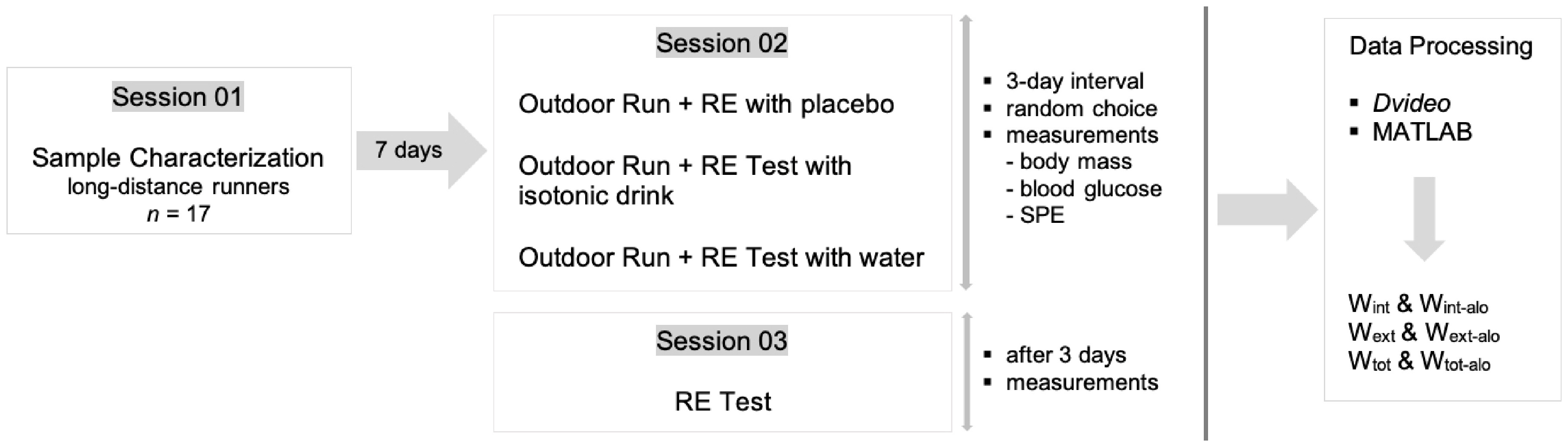
To assess the effects of beverage intake on running performance and mechanical work, participants completed three road runs over prescribed distances (11 km for men and 7.3 km for women) on a paved, flat course without vehicular traffic, conducted in the vicinity of the physiomechanics laboratory. Each run was performed under one of three hydration conditions: ingestion of an isotonic drink, a placebo, or water. Prior to each road run, participants underwent a standardized 6 minute running economy laboratory test on a MOUVEMENT treadmill (RT350, São Paulo, SP, Brazil) to evaluate baseline physiological and biomechanical responses. All testing sessions were scheduled to minimize environmental variation and ensure consistency across trials. The purpose of the test was to record the technique electronically (video) and later determine mechanical power. During each outdoor run, participants were instructed to hydrate with 500 mL of liquid, with the type of hydration randomized.
The isotonic drink used for hydration was commercially obtained, closely reflecting real‑world conditions, and provided 120 kcal, comprising 30 g of carbohydrates (including 30 g of sugars), 230 mg of sodium, 60 mg of potassium, and 210 mg of chloride. For the placebo, an artificially flavored low-sugar drink, with a taste similar to the isotonic drink, was chosen. The nutritional composition of the isotonic drinks was verified by a sports nutritionist through inspection of the beverage labels. Neither the participants nor the researchers were aware of which substances were being ingested during each outdoor run, as both hydration liquids were provided in identical plastic bottles to prevent visual identification.
The RE tests consisted of 4 constant submaximal runs (three with intake following the outdoor run, and one without intake and without an outdoor run) (Figure 1), at a 1% incline gradient and constant speed—the same average heart rate as the first outdoor run. Ten seconds of video footage in the right sagittal plane, starting at the 5th minute of running, were recorded using a CASIO EX-FH25 10.1MP High Digital camcorder (Shibuya/Tokyo, Japan) with a sampling frequency of 240 Hz. Nine anatomical reflective markers located on the 5th metatarsal, ankle, heel, knee, hip, shoulder, elbow, wrist, and head were used for subsequent kinematic analysis (Tartaruga et al., 2014).
Body mass and blood glucose were measured before each outdoor run and after each RE test, with blood glucose determined from 20 μL of capillary blood collected from the right index finger using the Accu-Chek Active Glucose Meter Kit (Roche, São Paulo, Brazil). Both variables were considered key control measures in the study. Subjective perceptions of effort (RPE) were also recorded using the Borg Rating of Perceived Exertion Scale, which ranges from 6 to 20.
Data processing
Wint, Wext, and Wtot were determined according to the methodology adopted by Tartaruga et al. (2013). The Wtot needed to sustain locomotion comprises positive Wint, which is the work done to accelerate the body segments relative to body centre of mass, and positive Wext, which is the work done to lift and accelerate the body centre of mass relative to the environment (Cavagna and Kaneko, 1977). This was computed from mechanical energies of the body segments determined from segment kinematics (Cavagna, 2010).
The determination of Wint requires computation of the instantaneous kinetic energy (KE) of each segment relative to the body centre of mass (KEr). This was performed as follows (Equation 2):
where m is the mass of the segment, vap,r and vv,r are the antero-posterior and vertical components of the linear velocities of each segment relative to body centre of mass velocities, K is segment radius of gyration, and ω is angular velocity of each segment. Instantaneous KEr of each segment within the same limb was then summed to give the kinetic energies of the upper and lower limbs, and the head-trunk. Internal work of each limb and of the head-trunk is then obtained by summing the positive increments of the KE curve of each limb and of the head-trunk segment separately over an integral number of strides. Overall Wint is then obtained as the sum of the internal work of each limb and the head-trunk segment. This computational scheme assumes energy transfers take place between segments of the same limb but not between limbs or between the trunk and limb.
The determination of Wext requires computation of the instantaneous total mechanical energy of the body centre of mass (ECM). This was performed as follows (Equation 3):
where M is total body mass, g is gravitational acceleration (9.81 m.s-2), h is height of the body centre of mass, Vap and Vv are the antero-posterior and vertical components of the linear velocities of the body centre of mass. Wext is computed by summing the positive increments in body centre of mass over the same period as for the determination of Wint. Wtot is obtained from the arithmetic sum of Wint and Wext by applying an approximation of König’s theorem of mechanics, which states that the total KE of a multilink system is made up of the KE of the segments relative to the overall centre of mass, which makes up Wint, and the KE of the overall centre of mass, which is included in Wext (Cavagna and Kaneko, 1977).
Mechanical work measures were expressed using the same units as energy cost (Cr; in J.kg-b.m-1). The conventional approach of considering only positive increments in mechanical energy (positive work) and neglecting negative work was applied. In level locomotion at a steady speed negative work is equal in magnitude but opposite in sign to positive work (and hence has no impact on comparison between groups). An inclusion of negative works would result in a network of zero which although mechanically correct is biologically meaningless and precludes determination of efficiency.
The Dvideo program (UNICAMP/São Paulo, Brazil) (Barros, 1999), version 5.0, was used for the manual and automatic digitization of kinematic records, followed by the calculation of mechanical power using a computational routine developed in MATrix LABoratory (MATLAB), version R2020b.
The allometric exponents "b" for each group (men and women) were determined from the logarithmic function Log y = Log a + b Log x, where y is VO2max (in liters per minute) and x is body mass (in kg). Consequently, the equations of the lines with their respective regression (slope) coefficients were obtained (Tartaruga et al., 2004). Based on the allometric exponents, the new mechanical power values were determined.
Sample characterization session
Statistical analysis
The Shapiro-Wilk test was applied to verify the normality of the data, and descriptive statistics were performed, including mean and standard deviations. Finally, paired Student’s t-tests and Repeated Measures Analysis of Variance (ANOVA) with Bonferroni post hoc tests were conducted, all with an alpha level of 0.05. SPSS version 15.0 was used for the analyses. The effect size was calculated using Cohen’s d, as recommended for reporting standardized mean differences in experimental studies. For interpretation, Cohen’s thresholds were applied: small (≤ 0.2), medium (≈ 0.5), and large (≥ 0.8) (Cohen, 1988).
RESULTS
Table 1 presents the sample characterization data, while the results of the pre- and post-test intergroup comparisons are shown in Tables 2 and 3.
Sample characteristics: mean and standard deviation (SD) for age, body mass, height, body fat percentage, and maximal oxygen uptake (VO2max) of 17 long-distance runners.
Mean and standard deviation (SD) of body mass and blood glucose concentrations before and after the evaluation session in 17 long-distance runners.
Mean and standard deviation (SD) of the mechanical variables measured in 17 long-distance runners.
No statistically significant intragroup differences were observed across the three evaluation sessions (isotonic, placebo, and water) in either performance (men: 0:59:58 ± 0:14:01, 1:00:45 ± 0:14:07, 1:01:06 ± 0:13:05; women: 0:53:07 ± 0:09:01, 0:56:30 ± 0:09:36, 0:55:35 ± 0:11:10) or ratings of perceived exertion (men: 15 ± 3, 15 ± 4, 16 ± 4; women: 13 ± 4, 14 ± 2, 14 ± 3). Cohen’s d analysis indicated a small-to-medium effect size (women: 0.23; men: 0.24).
The allometric exponents found were 0.27 for men and 0.54 for women. The differences in exponential values are specific to each subject group due to variations in maximal and submaximal metabolic rates between groups, as well as their sensitivity to body mass and surface area of each subject, as verified by Rubner (1883) and Kleiber (1947).
DISCUSSION
The present study aimed to investigate the allometric effect on the relationship between isotonic intake and mechanical power in long-distance running, with durations ranging from 45 minutes to 1 hour and 20 minutes. Based on the results, it was found that isotonic intake during long-distance runs, lasting between 45 and 80 minutes, does not alter mechanical work, determined allometrically, and does not improve performance.
In sports practice, studies have identified the need to adopt different allometric exponents to determine the amount of body mass to be used in the relativization of mechanical power (Tartaruga et al., 2013). These values would be specific to different sports (Jensen et al., 2001) and to special populations (Goosey-Tolfrey et al., 2003). In this context, it is stated that the relationship between body mass and mechanical power is used because there are many types of locomotion, each requiring a certain amount of body mass to be supported and moved (Saltin and Astrand, 1967). However, the most significant justifications for the application of allometric scaling can be observed in its influence on body metabolism (Darveau et al., 2002), body temperature (Gillooly et al., 2001), body fat percentage (Kusano et al., 1997), body surface area (Tartaruga et al., 2007), and heat exchange capacity with the external environment (Jensen et al., 2001) in energy metabolism. Undoubtedly, each individual exhibits a particularity in mechanical work due to physiological differences in each organism. Thus, relativizing mechanical power to total body mass may lead to errors in assessing and/or comparing physical fitness between individuals. Anthropometric characteristics, particularly body fat percentage, can influence the estimation of allometric exponents in long-distance runners, as variations in adiposity modify the scaling relationship between body size and physiological variables such as oxygen consumption and running economy, underscoring the importance of considering body composition when estimating allometric coefficients (Lee et al., 2024). In our study, the male group tended to exhibit higher body mass, stature, and VO2max than the female group, except for body fat percentage, which was significantly lower and may explain the observed differences in allometric exponents.
Despite the importance of allometric application for determining mechanical power, the present study did not find statistically significant intragroup differences in mechanical work between the experimental conditions, with and without allometric application. In fact, changes in running mechanics, which would lead to alterations in running technique, were not observed, as evidenced by the similar stride length values within groups. According to Tartaruga et al. (2014), stride length and frequency can account for approximately 50% of performance in middle- and long-distance running, highlighting the importance of running technique. In our study, the average running time of approximately 1 hour was likely insufficient to modify running technique due to fatigue, resulting in similar mechanical values across the experimental conditions.
Fatigue is a multifactorial process that reduces exercise and sports performance. It can be broadly defined as the inability to maintain the necessary force and energy or as a reduction in the capacity to generate force or energy. Although fatigue can involve many organic systems, exercise scientists often consider both central and peripheral mechanisms in the etiology of fatigue, both of which contribute to changes in movement technique and, consequently, to a reduction in skeletal muscle performance during exercise (Gandevia, 1999).
In any case, muscle glycogen availability is essential not only for high-intensity exercise but also for long-duration activities due to its capacity to rapidly provide energy and delay fatigue (Balsom et al., 1999). Studies show that carbohydrate intake in the form of isotonic drinks can improve performance by maintaining blood glucose levels and providing fast-absorbing carbohydrates during prolonged exercise (Coyle, 2004). This is particularly important during efforts lasting longer than 90 minutes, when glycogen stores begin to deplete (Burke et al., 2011).
However, in our study, despite a trend toward increased blood glucose levels with isotonic intake, this elevation was not significant compared to the intake of other fluids (placebo and water). This is consistent with the findings of Rehrer et al. (1992), who suggest that, in runs lasting between 45 and 80 minutes, water intake may be sufficient for maintaining hydration without resulting in gastrointestinal discomfort. According to Sawka et al. (2007), proper hydration is crucial for maintaining physical performance, but the intake of electrolyte- or carbohydrate-rich fluids during shorter periods may not be essential as long as the runner is adequately hydrated before exercise.
Additionally, the absence of significant differences in blood glucose levels before and after the evaluation sessions with and without isotonic intake, combined with the intermittent exercise duration (less than 2 hours), likely explains the lack of observed fatigue. Studies indicate that, for moderate-duration exercise, glycogen depletion is less critical (Stellingwerff et al., 2019), which explains the lack of significant impact on mechanical performance (Wint, Wext, and Wtot). The allometry applied in our study demonstrated that isotonic intake did not significantly influence mechanical performance, as fatigue did not manifest. This finding aligns with the literature, which suggests that water intake, along with adequate muscle glycogen reserves, may be sufficient to prevent fatigue in intermittent activities lasting less than 2 hours (Jeurkendrup, 2004).
CONCLUSION
Based on the results, the present study concludes that the intake of 500 mL of isotonic drink does not result in significant changes in mechanically determined allometric power and, consequently, does not significantly improve performance in long-distance runs lasting approximately 1 hour. This finding may be related to the fact that, in exercises lasting less than 90 minutes, muscle glycogen stores are typically sufficient to meet energy demands, making additional carbohydrate intake less crucial for maintaining performance (Burke et al., 2011).
Additionally, adequate hydration with water, without the need for additional electrolytes or carbohydrates, may be sufficient to maintain fluid balance and avoid any performance impairments, as demonstrated by other studies on moderate-duration exercise (Coyle, 2004; Rehrer et al., 1992). Thus, under moderate running conditions, water intake can be considered a viable strategy for maintaining hydration and gastrointestinal comfort without compromising performance.
DATA AVAILABILITY
The datasets generated and/or analyzed during the current study are not publicly available due to ethical and privacy restrictions but are available from the corresponding author upon reasonable request.
ACKNOWLEDGEMENTS
To the Araucária Foundation of the State of Paraná and to the Research Group in Mechanics and Energetics of Human Movement of the State University of Central-West – UNICENTRO.
-
FUNDING
Research without financial support
REFERENCES
-
Balsom PD, Gaitanos GC, Söderlund K, Ekblom B. High-intensity exercise and muscle glycogen availability in humans. Acta Physiol Scand. 1999;165(4):337-45. https://doi.org/10.1046/j.1365-201x.1999.00517.x PMid:10350228.
» https://doi.org/10.1046/j.1365-201x.1999.00517.x - Barros RML. Development and evaluation of a system for three-dimensional kinematic analysis of human movements. Rev Bras Eng Biomed. 1999;15(1-2):79-86.
-
Batterham AM, George KP. Allometric modeling does not determine a dimensionless power function ratio for maximal muscular function. J Appl Physiol. 1997;83(6):2158-66. https://doi.org/10.1152/jappl.1997.83.6.2158 PMid:9390994.
» https://doi.org/10.1152/jappl.1997.83.6.2158 -
Bergh U, Sjödin B, Forsberg A, Svedenhag J. The relationship between body mass and oxygen uptake during running in humans. Med Sci Sports Exerc. 1991;23(2):205-11. https://doi.org/10.1249/00005768-199102000-00010 PMid:2017016.
» https://doi.org/10.1249/00005768-199102000-00010 - Borgia B, Dufek JS, Silvernail JF, Radzak KN. The effect of fatigue on running mechanics in older and younger runners. Gait Posture. 2022;97:86-93. PMid:35914388.
- Brisswalter J, Legros P, Durand M. Running economy, preferred step length correlated to body dimensions in elite middle-distance runners. J Sports Med Phys Fitness. 1996;36(1):7-15. PMid:8699842.
- Burke LM, Hawley JA, Wong SHS, Jeukendrup AE. Carbohydrates for training and competition. J Sports Sci. 2011;29(1):S17-27. PMid:21660838.
-
Cavagna GA, Kaneko M. Mechanical work and efficiency in level walking and running. J Physiol. 1977;268(2):467-81. https://doi.org/10.1113/jphysiol.1977.sp011866 PMid:874922.
» https://doi.org/10.1113/jphysiol.1977.sp011866 -
Cavagna GA. Symmetry and asymmetry in bouncing gaits. Symmetry. 2010;2(3):1270-321. https://doi.org/10.3390/sym2031270
» https://doi.org/10.3390/sym2031270 -
Cheuvront SN, Kenefick RW. Dehydration: Physiology, assessment, and performance effects. Compr Physiol. 2014;4(1):257-85. https://doi.org/10.1002/j.2040-4603.2014.tb00543.x PMid:24692140.
» https://doi.org/10.1002/j.2040-4603.2014.tb00543.x - Coggan AR, Coyle EF. Carbohydrate Carbohydrate ingestion during prolonged exercise: effects on metabolism and performance. Exerc Sport Sci Rev. 1991;19:1-40.PMid:1936083
- Cohen J. Statistical power analysis for the behavioral sciences. 2nd ed. Hillsdale: Lawrence Erlbaum Associates; 1988.
-
Coyle EF. Fluid and fuel intake during exercise. J Sports Sci. 2004;22(1):39-55. https://doi.org/10.1080/0264041031000140545 PMid:14971432.
» https://doi.org/10.1080/0264041031000140545 -
Darveau CA, Suarez RK, Andrews RD, Hochachka PW. Allometric cascade as a unifying principle of body mass effects on metabolism. Nature. 2002;9;417(6885):166-70. https://doi.org/10.1038/417166a PMid:12000958.
» https://doi.org/10.1038/417166a -
Ebbeling CB, Ward A, Puleo EM, Widrick J, Rippe JM. Development of a single-stage submaximal treadmill walking test. Med Sci Sports Exerc. 1991;23(8):966-73. https://doi.org/10.1249/00005768-199108000-00014 PMid:1956273.
» https://doi.org/10.1249/00005768-199108000-00014 -
Fletcher JR, MacIntosh BR. Running economy from a muscle energetics perspective. Front Physiol. 2017;8:433. https://doi.org/10.3389/fphys.2017.00433 PMid:28690549.
» https://doi.org/10.3389/fphys.2017.00433 -
Gandevia SC. Mind, muscles and motoneurons. J Sci Med Sport. 1999;2(3):167-80. https://doi.org/10.1016/S1440-2440(99)80171-6 PMid:10668756.
» https://doi.org/10.1016/S1440-2440(99)80171-6 -
Gillooly JF, Brown JH, West GB, Savage VM, Charnov EL. Effects of size and temperature on metabolic rate. Science. 2001;293(5538):2248-51. https://doi.org/10.1126/science.1061967 PMid:11567137.
» https://doi.org/10.1126/science.1061967 -
Goosey-Tolfrey VL, Batterham AM, Tolfrey K. Scaling behavior of VO2peak in trained wheelchair athletes. Med Sci Sports Exerc. 2003;35(12):2106-11. https://doi.org/10.1249/01.MSS.0000099106.33943.8C PMid:14652509.
» https://doi.org/10.1249/01.MSS.0000099106.33943.8C -
Hew-Butler T, Rosner MH, Fowkes-Godek S, Dugas JP, Hoffman MD, Lewis DP, et al. Exercise-associated hyponatremia: updated fluid and sodium recommendations. Clin J Sport Med. 2015;25(4):303-7. https://doi.org/10.1097/JSM.0000000000000221 PMid:26102445.
» https://doi.org/10.1097/JSM.0000000000000221 -
Howard BJ, Winkler EA, Sethi P, Carson V, Ridgers ND, Salmon J, et al. Associations of low- and high-intensity light activity with cardiometabolic biomarkers. Med Sci Sports Exerc. 2015;47(10):2093-101. https://doi.org/10.1249/MSS.0000000000000631 PMid:25668400.
» https://doi.org/10.1249/MSS.0000000000000631 -
Jäger R, Kerksick CM, Campbell BI, Cribb PJ, Wells SD, Skwiat TM, et al. International Society of Sports Nutrition position stand: protein and exercise. J Int Soc Sports Nutr. 2017;14(1):20. https://doi.org/10.1186/s12970-017-0177-8 PMid:28642676.
» https://doi.org/10.1186/s12970-017-0177-8 -
Jensen K, Johansen L, Secher NH. Influence of body mass on maximal oxygen uptake: effect of sample size. Eur J Appl Physiol. 2001;84(3):201-5. https://doi.org/10.1007/s004210170005 PMid:11320636.
» https://doi.org/10.1007/s004210170005 - Jeurkendrup A. Vitamin and mineral status: effects on physical performance. Nutrition. 2004;20(7-8):669-77. PMid:15212750.
-
Jeukendrup A. Periodized nutrition for athletes. Sports Med. 2017;47(Suppl 1):51-63. https://doi.org/10.1007/s40279-017-0694-2
» https://doi.org/10.1007/s40279-017-0694-2 - Jeurkendrup A, Gleeson M. Sport nutrition: an introduction to energy production and performance. 3rd ed. Champaign: Human Kinetics; 2019.
-
Keir DA, Zory R, Boudreau-Lariviere C, Serresse O. Mechanical efficiency of treadmill running exercise: effect of anaerobic-energy contribution at various speeds. Int J Sports Physiol Perform. 2012;7(4):382-9. https://doi.org/10.1123/ijspp.7.4.382 PMid:22868489.
» https://doi.org/10.1123/ijspp.7.4.382 -
Kenefick RW. Drinking strategies: planned drinking versus drinking to thirst. Sports Med. 2018;48(1, Suppl 1):31-7. https://doi.org/10.1007/s40279-017-0844-6 PMid:29368181.
» https://doi.org/10.1007/s40279-017-0844-6 -
Kleiber M. Body size and metabolism. Physiol Rev. 1947;27(4):511-41. https://doi.org/10.1152/physrev.1947.27.4.511 PMid:20267758.
» https://doi.org/10.1152/physrev.1947.27.4.511 - Kusano MA, Vanderburgh PM, Bishop P. Impact of body size on women’s military obstacle course performance. Biomed Sci Instrum. 1997;34:357-62. PMid:9603066.
-
Lee J, Wang Z, Chen M, Liu S, Yu Q, Hu M, et al. Allometric exponents for scaling running economy in human samples: a systematic review and meta‑analysis. Heliyon. 2024;14(10):e31211. https://doi.org/10.1016/j.heliyon.2024.e31211 PMid:38818143.
» https://doi.org/10.1016/j.heliyon.2024.e31211 -
Lukaski H. Vitamin and mineral status: effects on physical performance. Nutrition. 2004;20(7-8):632-44. https://doi.org/10.1016/j.nut.2004.04.001 PMid:15212745.
» https://doi.org/10.1016/j.nut.2004.04.001 -
Minetti AE, Ardigo LP, Saibene F. Mechanical determinants of the minimum energy cost of gradient running in humans. J Exp Biol. 1994;195(1):211-25. https://doi.org/10.1242/jeb.195.1.211 PMid:7964412.
» https://doi.org/10.1242/jeb.195.1.211 -
Rapaport BI. Metabolic factors limiting performance in marathon runners. PLOS Comput Biol. 2010;6(10):e1000960. https://doi.org/10.1371/journal.pcbi.1000960 PMid:20975938.
» https://doi.org/10.1371/journal.pcbi.1000960 -
Rehrer NJ, Van Kemenade M, Meester W, Brouns F, Saris WH. Gastrointestinal complaints in relation to dietary intake in triathletes. Int J Sport Nutr. 1992;2(1):48-59. https://doi.org/10.1123/ijsn.2.1.48 PMid:1338583.
» https://doi.org/10.1123/ijsn.2.1.48 - Rubner M. Concerning the influence of body size on energy metabolism. Z Biol. 1883;19:536-62.
-
Saibene F, Minetti AE. Biomechanical e physiological aspects of legged locomotion in humans. Eur J Appl Physiol. 2003;88(4-5):297-316. https://doi.org/10.1007/s00421-002-0654-9 PMid:12527959.
» https://doi.org/10.1007/s00421-002-0654-9 -
Saltin B, Astrand PO. Maximal oxygen uptake in athletes. J Appl Physiol. 1967;23(3):353-8. https://doi.org/10.1152/jappl.1967.23.3.353 PMid:6047957.
» https://doi.org/10.1152/jappl.1967.23.3.353 -
Saunders PU, Pyne DB, Telford RD, Hawley JA. Factors affecting running economy in trained distance runners. Sports Med. 2004;34(7):465-85. https://doi.org/10.2165/00007256-200434070-00005 PMid:15233599.
» https://doi.org/10.2165/00007256-200434070-00005 -
Sawka MN, Burke LM, Eichner ER, Maughan RJ, Montain SJ, Stachenfeld NS. American College of Sports Medicine position stand: exercise and fluid replacement. Med Sci Sports Exerc. 2007;39(2):377-90. https://doi.org/10.1249/mss.0b013e31802ca597 PMid:17277604.
» https://doi.org/10.1249/mss.0b013e31802ca597 -
Scheer V, Vieluf S, Cramer L, Jakobsmeyer R, Heitkamp HC. Changes in running economy during a 65-km ultramarathon. Front Physiol. 2018;9:1809. https://doi.org/10.3389/fphys.2018.01809 PMid:30618821.
» https://doi.org/10.3389/fphys.2018.01809 - Siri WE. Body composition from fluid spaces e density: analysis of methods. 1961. Nutrition. 1993;9(5):480-91. PMid:8286893.
-
Sjodin B, Svedenhag J. Oxygen uptake during running as related to body mass in circumpubertal boys: a longitudinal study. Eur J Appl Physiol Occup Physiol. 1992;65(2):150-7. https://doi.org/10.1007/BF00705073 PMid:1396639.
» https://doi.org/10.1007/BF00705073 - Stellingwerff T, Spriet LL, Watt MJ. Depletion of muscle glycogen but not liver glycogen reduces exercise capacity in well-trained cyclists. J Appl Physiol. 2019;126(5):1211-9.
- Tartaruga LAP, Tartaruga MP, Ribeiro JL. Correlation between running economy e kinematic variables in high level runners. Braz J Biom. 2004;5:51-8.
- Tartaruga MP, Vaz FF, Coertjens M, Schmitt CD, Tiggemann CL, Kruel LFM. Comparação entre protocolos para determinação do limiar anaeróbio em canoístas de rendimento. Rev Bras Ati Fís Saúde. 2007;12:S195.
-
Tartaruga MP, Brisswalter J, Mota CB, Alberton CL, Gomeñuka NA, Peyré-Tartaruga LA. Mechanical work e long-distance performance prediction: the influence of allometric scaling. J Hum Kinet. 2013;38:73-82. https://doi.org/10.2478/hukin-2013-0047 PMid:24235986.
» https://doi.org/10.2478/hukin-2013-0047 -
Tartaruga MP, Mota CB, Peyré-Tartaruga LA, Brisswalter J. Scale model on performance prediction in recreational and elite endurance runners. Int J Sports Physiol Perform. 2014;9(4):650-5. https://doi.org/10.1123/ijspp.2013-0165 PMid:24231578.
» https://doi.org/10.1123/ijspp.2013-0165 -
Thomas DT, Erdman KA, Burke LM. Position of the Academy of Nutrition and Dietetics, Dietitians of Canada, and the American College of Sports Medicine: nutrition and athletic performance. J Acad Nutr Diet. 2016;116(3):501-28. https://doi.org/10.1016/j.jand.2015.12.006 PMid:26920240.
» https://doi.org/10.1016/j.jand.2015.12.006 -
Vanderburgh PM, Dooman C. Considering body mass differences, who are the world’s strongest women? Med Sci Sports Exerc. 2000;32(1):197-201. https://doi.org/10.1097/00005768-200001000-00029 PMid:10647549.
» https://doi.org/10.1097/00005768-200001000-00029 -
West GB, Brown JH, Enquist BJ. A general model for the origin of allometric scaling laws in biology. Science. 1997;276(5309):122-6. https://doi.org/10.1126/science.276.5309.122 PMid:9082983.
» https://doi.org/10.1126/science.276.5309.122 -
Willems PA, Cavagna GA, Heglund NC. External, internal and total work in human locomotion. J Exp Biol. 1995;198(2):379-93. https://doi.org/10.1242/jeb.198.2.379 PMid:7699313.
» https://doi.org/10.1242/jeb.198.2.379 -
Williams KR, Cavanagh PR. Relationship between distance running mechanics, running economy, e performance. J Appl Physiol. 1987;63(3):1236-45. https://doi.org/10.1152/jappl.1987.63.3.1236 PMid:3654469.
» https://doi.org/10.1152/jappl.1987.63.3.1236
Edited by
-
Responsible Editors:
Executive Editor: Pedro Otavio Pimpim BezerraAssociate Editor: Fábio LanferdiniAssistant Editor: André Ivaniski MelloChief Editor: Ari Lazzarotti Filho