 Physical activity level of Chilean preschool children during each segment of the school day: comparison by the presence of physical education class and school schedule
Abstract
Abstract This study aimed to evaluate Chilean preschoolers’ PAL during each segment and the whole school day, according to sex, presence of PE, and duration of school schedule. This is an observational, cross-sectional study including 630 preschoolers, 50% girls (5.2 years ± 0.3), who wore accelerometers during the school day. We compared days with and without PE, the time in sedentary behavior (SB), moderate-vigorous physical activity (MVPA), and PAL during each segment and whole school day, according to sex and school schedule (half or full day) as well as MVPA between more and less active children. Mann-Whitney and Wilcoxon tests for dependent samples were used. On days with no PE, 60% of the time, preschoolers engaged in SB, mainly during curricular classes (60.8% and 53.8% in half and full days, respectively), and 8% in MVPA, mainly during recess (56.9% and 49.5% during half and full days, respectively). On days with PE, boys and girls engaged in significantly higher MVPA (9.3% no PE and 13.4% with PE; girls: 7.4% no PE and 10.2% with PE). Boys spent significantly more time in MVPA than girls (9.4% boys and 7.3% girls). Active preschoolers engaged in more MVPA not only during the whole school day but also during each segment. To increase PAL in preschoolers, especially girls, at least two aspects should be considered: providing more active curricular classes and increasing activity on days without PE.
Key words:
Chile; Physical activity; Physical education; Preschool children
Resumo
Resumo Buscou-se avaliar o nível de atividade física (NAF) de pré-escolares chilenos durante cada segmento e durante todo o dia escolar, segundo sexo, presença de aulas de educação física (EF) e duração do horário escolar. Trata-se de um estudo observacional, transversal, incluindo 630 pré-escolares, 50% meninas (5,2 anos ± 0,3), que usavam acelerômetros durante o dia escolar. Comparamos, em dias com e sem EF, o tempo em comportamento sedentário (CS), atividade física moderada-vigorosa (AFMV) e NAF durante cada segmento e durante todo o dia letivo, segundo sexo e horário escolar (meio dia ou dia inteiro), conforme bem como AFMV entre crianças mais e menos ativas. Foram utilizados os testes de Mann-Whitney e Wilcoxon para amostras dependentes. Nos dias sem EF, 60% do tempo dos pré-escolares praticavam CS, principalmente durante as aulas curriculares (60,8% e 53,8% em meio período e período integral, respetivamente), e 8% em AFMV, principalmente durante o recreio (56,9% e 49,5% durante meio e integral respetivamente). Nos dias com EF, tanto meninos quanto meninas praticaram AFMV significativamente mais (meninos: 9,3% sem EF e 13,4% com EF; meninas: 7,4% sem EF e 10,2% com EF). Os meninos passaram uma proporção significativamente maior de tempo em AFMV do que as meninas (9,4% meninos e 7,3% meninas). Pré-escolares ativos praticam mais AFMV não apenas durante todo o dia escolar, mas também durante cada segmento. Para aumentar o NAF em pré-escolares, especialmente em meninas, pelo menos dois aspetos devem ser considerados, proporcionando aulas curriculares mais ativas e aumentando a atividade em dias sem EF.
Palavras-chave:
Chile; Exercício físico; Educação física e treinamento; Pré-escolar
INTRODUCTION
The World Health Organization (WHO) recommends that preschoolers from 3 to 5 years old engage in physical activity (PA) for at least 180 minutes daily, of which 60 minutes should comprise moderate to vigorous activity (MVPA). Children should not engage in sedentary behavior (SB) for more than 60 consecutive minutes1. In addition, a maximum of 60 minutes should be spent in front of a screen2-4. Complying with these recommendations is crucial in the health development of preschoolers5; performing MVPA impacts positively on the cardiovascular and bone systems, improves the lipid profile, stimulates cognitive development, and regulates body weight6,7.
The National Survey of Physical and Sports Activity in Chile8 defines active children as those who perform a minimum of 60 minutes of PA and/or sports daily, indicating that only 18.1% of children aged 5-9 years are considered active, while 45.6% are considered inactive. The daily physical activity level (PAL) for preschoolers is associated with the type of educational institution to which they attend, with kindergartens as the most important ones9.
The US Institute of Medicine recommends that preschoolers engage in at least 50% of the MVPA daily recommendation during the school day, which is 30 min of MVPA; however, evidence shows that, on average, they engage in 1.5 min/h at this intensity10, which represents only 3.3% of the school day11. Individual characteristics of kindergartens, the quality of school personnel, availability of equipment, and infrastructure explain around 50% of the variation in PA in preschoolers9. It is worth noting that compared to classroom activities, preschoolers accumulate significantly higher PA and less SB when playing outside7,9,12.
Preschool children’s information on patterns of PA during the different segments of the school day is limited since studies often focus on PAL for the whole school day, without measuring the different segments, such as curricular classes, recess, eating times, and PE13. Pate et al.14 found that PAL is greater during recess and that its duration is key in these results. Interestingly, the authors reported that during recess MVPA is greater in the first minutes, and then declines.
The Chilean State provides free kindergarten and pre-kindergarten schooling, both in nursery schools and schools15, covering 90% of the national population of children16; therefore, it is worth learning in which segments of the school day it is feasible to increase PAL.
This study aimed to evaluate PAL in Chilean preschoolers during the different segments of the school day, by sex, presence of PE, and school day schedule.
METHODS
This is an observational, cross-sectional study based on the study “Contribution of the sessions of the Active Nursery School component to the increase in PA time in 3-5 year-old preschoolers”, whose methodology was previously published17. The Active Nursery School program is state-run and targets vulnerable schools. It provides funds for physical education teachers to conduct three weekly classes of structured PE of 45-60 minutes each for at least seven months of the school year.
Participants
The sample included 630 preschool children (50% girls) aged 5.2 ± 0.3 years from 67 public schools in 28 districts of eight regions of the country (the country comprises 16 regions and 345 districts); 54.4% of preschoolers attended half-day (< 300 minutes per day) and 45.6% full-day (≥ 300 minutes daily) (Table 1).
Measurement of physical activity
Physical activity was measured using an Actigraph GT3X accelerometer (Actigraph LLC, Pensacola, Florida, USA), which was fitted on the right side of the waist of each participant on two non-consecutive days, one with and one without PE. Accelerometers were programmed to record 15-second cycles (epoch)18. The data were analyzed on the Actilife-6 software, based on the following ranges per minute: sedentary (0–204); light (205–976); moderate (977–1527); and vigorous (≥1528)19.
Segments of the school day
School days are organized in blocks of activities that are performed routinely and daily in schools, according to the following segments: curricular classes — all activities with classroom content (Spanish, art, music, mathematics, English, and others); PE — physical education classes directed by a professional of the Active Nursery School program; recess — free play time outside the classroom; free activities — those performed between classes; eating time—which may include breakfast, lunch, and snacks; and others — including initial greeting, room cleanup, trips outside the school, and personal hygiene (these activities were very heterogeneous). An observer recorded the type and duration (in minutes of each segment on days with and without PE. The segments “free activities” and “others” were not analyzed, since they were not established as curricular activities, and were not the same in all the schools.
Data analysis
Once processed on the ActiLife 6 software, the accelerometer data were validated using the numbers of steps and times recorded, excluding those with the following incongruences: less than 400 steps; less than 180 minutes recorded; and recording time greater than 510 minutes. The PAL of the more and less active preschoolers was compared, defining this variable for each sex using the minutes in MVPA during the school day without PE. An MVPA equal to or above the 50th percentile (p50) corresponded to more active children, while those below the p50 were less active.
Characteristics of the sample are described using medians and percentages. Mann-Whitney tests compared time in SB and MVPA in each of the segments of the half-day and full-day school time in a day without PE,. Wilcoxon test for dependent samples compared the proportion of time preschoolers spend in MVPA a day with and without PE by segment. Mann-Whitney tests also compared the proportion of time in MVPA during different segments of the day between boys and girls, as well as between the more and less active preschoolers in a day without PE. The analyses were performed in STATA16 based on a significance level of p<0.05.
RESULTS
Table 2 shows the mean duration and proportion of SB and MVPA in the different segments of the school day, by type of school schedule in the day without PE. Children on half-day spent an average of 237 minutes (min) in the school, compared to 399.8 min for those on a full-day schedule. Preschoolers attended classes about 50% of the school day (52.1% for half day and 48.6% for full day); half-day children spent 8.8% of their time in MVPA, compared to 8% for those with full day. Recess contributed 56.9% of the total MVPA for half-day children, significantly more than the 49.5% for full-day children. MVPA during classes and eating time was significantly greater for full-day students. The half-day preschoolers were in SB 60% of the time, while those attending full-day reached 58.7%. Classes contributed most to SB and there was a significant difference between half-day (60.8%) and full-day students (53.8%). The only significant difference found in the other segments corresponded to the proportion of SB during recess, which was greater in full-day children.
Preschooler’s total time and % of time in sedentary behavior (SB) and MVPA during the different segments of the school day, according to school schedule, in days with and without PE.
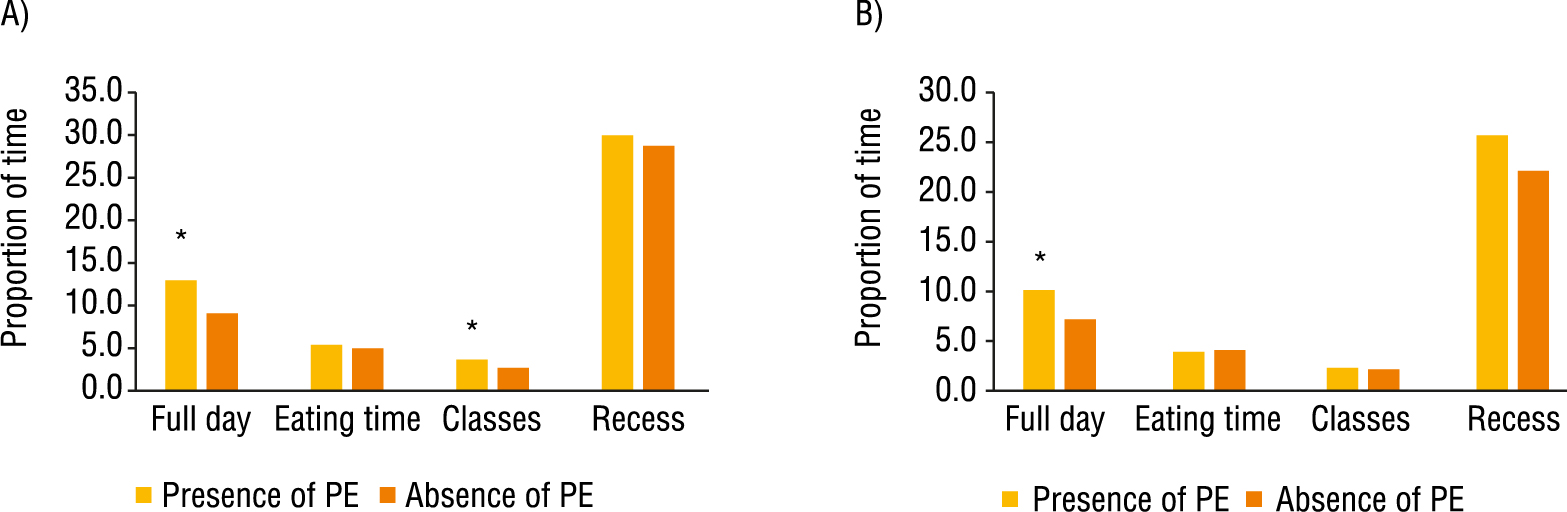
Figure 1 shows the proportion of time in MVPA by sex and segments, one day with and another without PE. Both boys and girls showed significantly higher MVPA in the day with PE (boys: 9.3% without PE; 13.4% with PE; girls: 7.4% without PE; and 10.2% with PE). Boys showed significantly greater MVPA in classes in the day with PE (3.7% vs. 3%); nevertheless, no difference was found in girls. Overall, boys spent significantly more time in MVPA than girls (9.4% vs. 7.3%) in the day without PE (Figure 2). Boys were more active during all the segments, that is, recess, classes, and eating times.
The proportion of time spent in MVPA by preschoolers during the different segments of the school day, with and without PE. Note. (A) boys / (B) girls; comparisons were made using the Wilcoxon test for dependent samples. *Indicates statistically significant differences (p < 0.05).
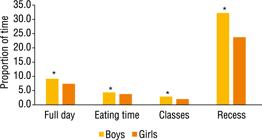
Comparison of the proportion of time in MVPA for boys and girls during the different segments of the school day without PE. Note: Comparisons were made by the Mann-Whitney test. *Indicates statistically significant differences (p < 0.05).
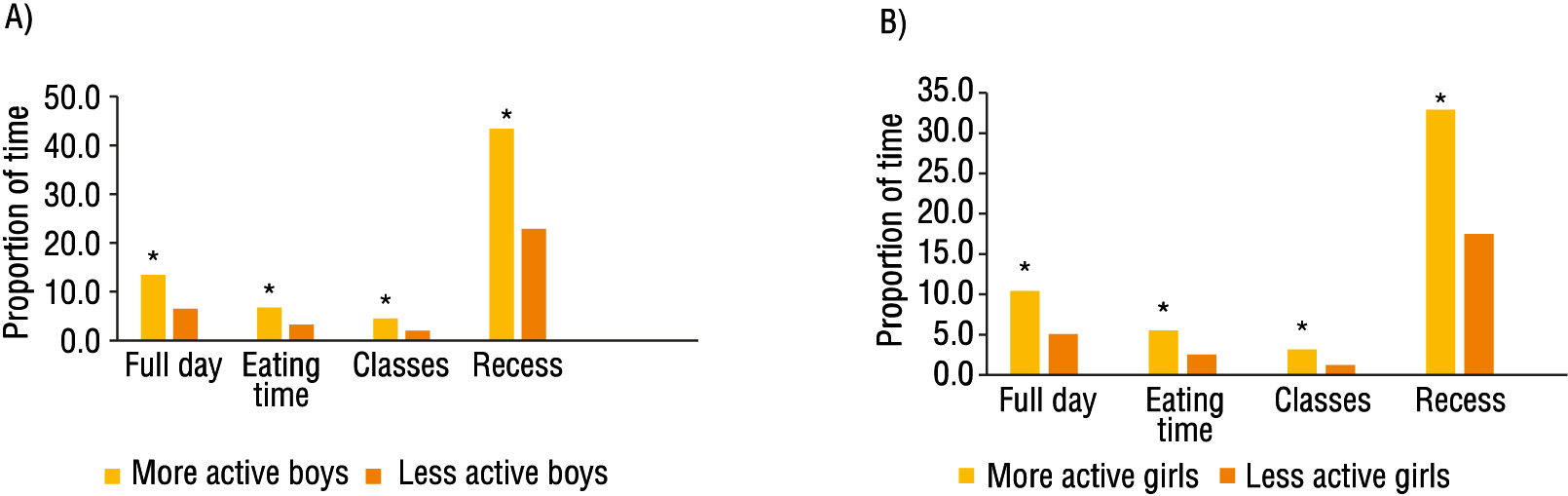
Figure 3 shows the proportion of time engaged by the children categorized as more and less active. Both more active boys and girls engaged in significantly more MVPA in each segment of the school day compared to their less active peers.

Proportion of time in MVPA during the different segments of the school day for more and less active children without PE. Note: (A) comparisons between more and less active boys; (B) comparisons between more and less active girls. Comparisons were made by the Mann-Whitney test. *Indicates statistically significant differences (p < 0.05).
DISCUSSION
This study corroborates the importance of PE as a key element for preschoolers to increase MVPA during the school day. Without PE, only 43% of girls and 63.8% of boys in full-day schedule reached the recommended amount of 30 min. of MVPA, while with PE, 69% of girls and 84% of boys engaged in at least 30 min. of MVPA. Weaver et al.20 evaluated the proportion of children who complied with the MVPA recommendations during the school day, placing accelerometers on 323 first and third-grade children. They found that 16.3% of girls and 36.5% of boys reached 30 min. of MVPA on school days without PE, while the percentages on days with PE were 36.5% and 44.1%, respectively. Although the proportions in our study were greater, preschoolers did not comply with the recommendation. To reach 60 min. of MVPA, preschoolers should perform activities outside the school, which depends on many factors, such as the availability of a safe and adequate place to play, the possibility of extra-school sports activities, etc. That is why activities carried out inside the school are so important in promoting PAL and as such, considering the quality of PE is key to reaching the recommended MVPA level21.
We found no significant difference in the percentage of time spent in SB or MVPA between half-day and full-day school schedules in contrast to the report of O’Dwyer et al.22, who found that half-day students engaged in 11.1 min more MVPA than full-day children. Preschoolers spent a greater proportion of time in SB during classes, followed by eating time. The review by Barbosa et al.11 concluded that lunchtime was one of the segments with higher SB for preschoolers and school children of 2-6 years. Chow et al.23 observed classes in four Hong Kong schools to analyze PAL and reported that preschool children were seated 76% of the time, standing 13%, and only spent 11% in MVPA. This proportion is significantly higher than the MVPA of preschoolers in our study, which was only 2% during classes. It is worth noting that Chow et al.23 used observation and not accelerometers. Given the high proportion of time in SB during classes, this segment should be considered to reduce sedentary time. One way to achieve this is by including short bouts of activity during classes24.
Recess was the activity where preschoolers spent more time in MVPA on days without PE (56.9% of the total MVPA time for half-day students and 49.5% for full-day). About half of the MVPA engaged by the preschoolers occurred during recess, reaffirming that it is a key activity in contributing to an increase in PAL during the school day25,26, contributing to achieving the recommended daily PAL27. Given this, one strategy could be to increase the time in recess; however, a 30-minute recess contributes 11 min. of MVPA, hence preschoolers would need 150 minutes of recess to reach 30 min. of MVPA. A random controlled trial found that programming several short periods of outside play could be more effective in increasing MVPA than one long period of the same total duration. In addition, it is recommended that children attending kindergarten should be allowed to spend enough time playing outdoors, thus supporting children’s development in every aspect28.
Like several studies, we also found significant differences in MVPA between boys and girls during the entire school day. Differences in PAL between boys and girls occurred in all segments of the school day. Chow et al.23 reported that girls are less active in classes, and Schneller et al.29 indicated that girls are less active during recess. Studies suggest that during recess, gender inequality is most evident; boys usually occupy the central space of the patio, relegating girls to the corners and peripheral spaces30.
Finally, the results of our study indicate that more active preschoolers spend twice as much time in MVPA as those who are less active, and these differences were significant in all segments of the school day. These results contrast with those of Howie et al.9, who studied the PAL of 230 preschoolers in the USA (mean age 4.2 years) during segments of the school day. The authors only found differences in PAL between the more and less active children during classes.
We found that preschoolers spend about 60% of the school day in SB, which approaches the results of Schlecter et al.12, who studied 73 children aged 3-6 years who attended nursery schools in the USA. The authors found the children to be inactive 69.5% of the time.
CONCLUSIONS
This study is the first to report the physical activity patterns of Chilean preschoolers during segments of the school day. Classes and recess are the main segments that facilitate higher levels of PAL. Although girls perform more MVPA on days with PE, this increase only occurred in those classes and not in other segments, while boys increased their MVPA in all segments on days with PE. Our results reinforce the current evidence that boys are more active than girls, and specifically indicate that this occurs in all segments of the school day.
-
How to cite this article
Llanos Rivera N, Kain Berkovic J, Leyton Dinamarca B, Soto-Sánchez J. Physical activity level of Chilean preschool children during each segment of the school day: comparison by the presence of physical education class and school schedule. Rev Bras Cineantropom Desempenho Hum 2025, 27:e96864. DOI: https://doi.org/10.1590/1980-0037.2025v27e96864
-
COMPLIANCE WITH ETHICAL STANDARDS
-
Funding
This study was funded by Ministry of Sports of Chile.In addition, this study corresponds to a postgraduate thesis financed by CONICYT - PFCHA / National Magister / 2019-79190090
-
Ethical approval
Ethical approval was obtained from the Ethics Committee on Research with Human Beings of the Institute of Nutrition and Technology (INTA) of the University of Chile, approval record No24, November 4, 2015. Written in accordance with the standards established by the Declaration of Helsinki.
REFERENCES
-
1 Frank ML, Flynn A, Farnell GS, Barkley JE. The differences in physical activity levels in preschool children during free play recess and structured play recess. J Exerc Sci Fit 2018;16(1):37-42. http://doi.org/10.1016/j.jesf.2018.03.001 PMid:30662491.
» http://doi.org/10.1016/j.jesf.2018.03.001 - 2 World Health Organization. Guidelines on physical activity, sedentary behaviour and sleep for children under 5 years of age. Geneva: WHO; 2019.
-
3 van Cauwenberghe E, De Craemer M, De Decker E, De Bourdeaudhuij I, Cardon G. The impact of a teacher-led structured physical activity session on preschoolers’ sedentary and physical activity levels. J Sci Med Sport 2013;16(5):422-26. http://doi.org/10.1016/j.jsams.2012.11.883 PMid:23246443.
» http://doi.org/10.1016/j.jsams.2012.11.883 - 4 World Health Organization. Global strategy on diet, physical activity and health. Geneva: WHO; 2018. Chapter 25, Physical inactivity: a global public health problem; p. 292-302.
-
5 Alhassan S, Nwaokelemeh O, Mendoza A, Shitole S, Whitt-Glover MC, Yancey AK. Design and baseline characteristics of the Short bouTs of Exercise for Preschoolers (STEP) study. BMC Public Health 2012;12(1):582. http://doi.org/10.1186/1471-2458-12-582 PMid:22853642.
» http://doi.org/10.1186/1471-2458-12-582 -
6 Tucker P, Burke SM, Gaston A, Irwin JD, Johnson AM, Timmons BW, et al. Supporting Physical Activity in the Childcare Environment (SPACE): rationale and study protocol for a cluster randomized controlled trial. BMC Public Health 2015;16(1):112. http://doi.org/10.1186/s12889-016-2775-9 PMid:26842502.
» http://doi.org/10.1186/s12889-016-2775-9 -
7 Tucker P, Vanderloo LM, Johnson AM, Burke SM, Irwin JD, Gaston A, et al. Impact of the Supporting Physical Activity in the Childcare Environment (SPACE) intervention on preschoolers’ physical activity levels and sedentary time: a single-blind cluster randomized controlled trial. Int J Behav Nutr Phys Act 2017;14(1):120. http://doi.org/10.1186/s12966-017-0579-7 PMid:28882152.
» http://doi.org/10.1186/s12966-017-0579-7 - 8 Universidad de Concepción. National survey of physical activity habits: summary of results. Concepción: Universidad de Concepción, Facultad de Ciencias Económicas; 2019.
-
9 Howie EK, Brown WH, Dowda M, McIver KL, Pate RR. Physical activity behaviours of highly active preschoolers. Pediatr Obes 2013;8(2):142-49. http://doi.org/10.1111/j.2047-6310.2012.00099.x PMid:23042629.
» http://doi.org/10.1111/j.2047-6310.2012.00099.x -
10 Weaver RG, Crimarco A, Brusseau TA, Webster CA, Burns RD, Hannon JC. Accelerometry-derived physical activity of first through third grade children during the segmented school day. J Sch Health 2016;86(10):726-33. http://doi.org/10.1111/josh.12426 PMid:27619763.
» http://doi.org/10.1111/josh.12426 -
11 Barbosa SC, Oliveira AR. Physical activity of preschool children: a review. J Physiother Phys Rehabil 2016;1(2):111. http://doi.org/10.4172/2573-0312.1000111
» http://doi.org/10.4172/2573-0312.1000111 -
12 Schlechter CR, Rosenkranz RR, Fees BS, Dzewaltowski DA. Preschool daily patterns of physical activity driven by location and social context. J Sch Health 2017;87(3):194-99. http://doi.org/10.1111/josh.12486 PMid:28147455.
» http://doi.org/10.1111/josh.12486 -
13 O’Dwyer M, Fairclough SJ, Ridgers ND, Knowles ZR, Foweather L, Stratton G. Patterns of objectively measured moderate-to-vigorous physical activity in preschool children. J Phys Act Health 2014;11(6):1233-38. http://doi.org/10.1123/jpah.2012-0163 PMid:23799283.
» http://doi.org/10.1123/jpah.2012-0163 -
14 Pate RR, Dowda M, Brown WH, Mitchell J, Addy C. Physical activity in preschool children with the transition to outdoors. J Phys Act Health 2013;10(2):170-75. http://doi.org/10.1123/jpah.10.2.170 PMid:22820709.
» http://doi.org/10.1123/jpah.10.2.170 -
15 Chile. Ministerio de Educación. Undersecretary of early childhood education [Internet]. Santiago: Ministerio de Educación; 2010 [cited 2023 Oct 18]. Available from: https://www.ayudamineduc.cl/ficha/subsecretaria-de-educacion-parvularia
» https://www.ayudamineduc.cl/ficha/subsecretaria-de-educacion-parvularia -
16 Chile. Ministerio de Educación. Education indicators in Chile 2010-2016 [Internet]. Santiago: Ministerio de Educación; 2018 [cited 2023 Oct 18]. Available from: https://bibliotecadigital.mineduc.cl/handle/20.500.12365/2405
» https://bibliotecadigital.mineduc.cl/handle/20.500.12365/2405 -
17 Kain J, Leyton B, Concha F, Close M, Soto-Sánchez J, Salazar G. Preschool children’s physical activity intensity during school time: Influence of school schedule. Prev Med Rep 2017;8:6-9. http://doi.org/10.1016/j.pmedr.2017.07.011 PMid:28831366.
» http://doi.org/10.1016/j.pmedr.2017.07.011 -
18 Migueles JH, Cadenas-Sanchez C, Ekelund U, Delisle Nyström C, Mora-Gonzalez J, Löf M, et al. Accelerometer data collection and processing criteria to assess physical activity and other outcomes: a systematic review and practical considerations. Sports Med 2017;47(9):1821-45. http://doi.org/10.1007/s40279-017-0716-0 PMid:28303543.
» http://doi.org/10.1007/s40279-017-0716-0 -
19 Butte NF, Wong WW, Lee JS, Adolph AL, Puyau MR, Zakeri IF. Prediction of energy expenditure and physical activity in preschoolers. Med Sci Sport Exerc 2014;46(6):1216-26. http://doi.org/10.1249/MSS.0000000000000209
» http://doi.org/10.1249/MSS.0000000000000209 -
20 Weaver RG, Crimarco A, Brusseau TA, Webster CA, Burns RD, Hannon JC. Accelerometry-derived physical activity of first through third grade children during the segmented school day. J Sch Health 2016;86(10):726-33. http://doi.org/10.1111/josh.12426 PMid:27619763.
» http://doi.org/10.1111/josh.12426 -
21 Meyer U, Roth R, Zahner L, Gerber M, Puder JJ, Hebestreit H, et al. Contribution of physical education to overall physical activity. Scand J Med Sci Sports 2013;23(5):600-6. http://doi.org/10.1111/j.1600-0838.2011.01425.x PMid:22151355.
» http://doi.org/10.1111/j.1600-0838.2011.01425.x -
22 O’Dwyer M, Fairclough SJ, Ridgers ND, Knowles ZR, Foweather L, Stratton G. Patterns of objectively measured moderate-to-vigorous physical activity in preschool children. J Phys Act Heal 2014;11(6):1233-38. http://doi.org/10.1123/jpah.2012-0163 PMid:23799283.
» http://doi.org/10.1123/jpah.2012-0163 -
23 Chow BC, McKenzie TL, Louie L. Physical activity and its contexts during preschool classroom sessions. Adv Phys Educ 2015;05(03):194-203. http://doi.org/10.4236/ape.2015.53024
» http://doi.org/10.4236/ape.2015.53024 -
24 Webster EK, Wadsworth DD, Robinson LE. Preschoolers’ time on-task and physical activity during a classroom activity break. Pediatr Exerc Sci 2015;27(1):160-67. http://doi.org/10.1123/pes.2014-0006 PMid:25249496.
» http://doi.org/10.1123/pes.2014-0006 -
25 Ridgers ND, Timperio A, Crawford D, Salmon J. Five-year changes in school recess and lunchtime and the contribution to children’s daily physical activity. Br J Sports Med 2012;46(10):741-46. http://doi.org/10.1136/bjsm.2011.084921 PMid:21596716.
» http://doi.org/10.1136/bjsm.2011.084921 -
26 Verbestel V, Van Cauwenberghe E, De Coen V, Maes L, De Bourdeaudhuij I, Cardon G. Within- and between-day variability of objectively measured physical activity in preschoolers. Pediatr Exerc Sci 2011;23(3):366-78. http://doi.org/10.1123/pes.23.3.366 PMid:21881157.
» http://doi.org/10.1123/pes.23.3.366 -
27 Frank ML, Flynn A, Farnell GS, Barkley JE. The differences in physical activity levels in preschool children during free play recess and structured play recess. J Exerc Sci Fit 2018;16(1):37-42. http://doi.org/10.1016/j.jesf.2018.03.001 PMid:30662491.
» http://doi.org/10.1016/j.jesf.2018.03.001 - 28 Sääkslahti A, Niemistö D. Outdoor activities and motor development in 2–7-year-old boys and girls. J Phys Educ Sport 2021;21(1):463-68.
-
29 Schneller MB, Schipperijn J, Nielsen G, Bentsen P. Children’s physical activity during a segmented school week: Results from a quasi-experimental education outside the classroom intervention. Int J Behav Nutr Phys Act. 2017;14(1):80. http://doi.org/10.1186/s12966-017-0534-7 PMid:28633656.
» http://doi.org/10.1186/s12966-017-0534-7 - 30 Saldaña D, Goula J, Cardona H, Amat C. El patio de la escuela en igualdad. Barcelona: Pollen, Equal Saree; 2017.