 Characterization of Humoral Immune Response from Commercial Poultry Flocks Vaccinated Against Avian Encephalomyelitis Virus
ABSTRACT
Despite the massive use of vaccines against Avian encephalomyelitis virus (AEV), outbreaks of the disease that may be associated with low flock immunity are still reported. This study aimed to characterize the serological immune response of birds vaccinated against AEV under field conditions. For this, a database comprising 65,535 bird serum samples collected from 2015 to 2019 and tested for antibodies against AEV, was analyzed. Samples were stratified by the following parameters: type of flock, age of birds, year of sample collection, geographic origin, layers production cycle, and were correlated with the presence or absence of antibodies anti-AEV. Broilers showed a higher percentage of samples without anti-AEV antibodies than breeders or broiler grandparents. The year and origin of the samples also showed differences in bird immunization levels, which demonstrates variation in vaccination management. Despite the influence of factors associated with vaccine failures, the intrinsic characteristics of each flock may lead to the detection of different humoral responses, which reinforces the importance of serological monitoring for AEV as a disease control strategy.
Keywords:
Antibody; broiler; immunization failure; serology
INTRODUCTION
Avian encephalomyelitis (AE) is a highly infectious disease caused by the avian encephalomyelitis virus (AEV). It affects a wide range of hosts among bird species, causing significant economic losses in the global poultry industry. Avian encephalomyelitis is caused by an RNA virus belonging to the family Picornaviridae and the genus Enterovirus (Marvil et al. 1999), which primarily affects the central nervous system of 1- to 4-week-old chicks.
Transmission of AE generally occurs horizontally and vertically, particularly via the fecal-oral route, through ingestion of contaminated food and water. Clinical signs of AEV infection include tremors, ataxia, head tilt, and paralysis with decreased egg production in laying hens. In the central nervous system, neuronal degeneration and monocyte infiltration in the meninges and perivascular spaces can be found (Almeida et al. 2020; Wang et al. 2023).
Preventing and curing AE is difficult. Like other avian virus diseases, AE has no treatment (Yu et al., 2015; Lin et al. 2018; Sarma et al. 2019). Vaccination is one of the most effective tools to prevent infection, as it can provide effective protection against the virus, and maternal antibodies can provide some protection to young chicks (Lin et al. 2018). However, vaccine responses remain suboptimal for many endemic chicken diseases due to factors that affect the variability of vaccine responses and infection outcomes, such as the geographic diversity of production farms, bird species and breeds, and production types (Pinard- van der Laan, 2002; Song et al. 2022; Lecoeur et al. 2024). The live attenuated vaccine against AEV is not sterilizing, but is effective in preventing clinical disease. Although it does not fully block infection, it reduces viral replication and clinical signs, contributing to flock-level protection and maternal antibody transfer.
Individual responses to vaccines are highly heterogeneous and the vaccine response efficacy is likely the result of complex interactions between host genetics and different immunocompetence parameters (Lecoeur et al. 2024). However, outbreaks can occur even in immunized birds (Freitas & Back, 2015; Rocha et al. 2019). Despite the heavy reliance on vaccines to immunize animals, AEV persists in the poultry industry for long periods, which increases its virulence and makes rapid detection essential to prevent and control the disease. In addition to vaccination, strict biosecurity measures play a crucial role in the control and prevention of avian encephalomyelitis, particularly by limiting the spread of the virus within and between poultry farms.
Failures in immunization using vaccines may occur. Vaccination failure occurs when the animal is unable to develop adequate immunity after immunization or susceptibility to outbreak in the field after vaccine administration (Abdullahi, et al., 2009; Sharif & Ahmad, 2018). Vaccination failure may be due to host-associated factors such as interference with antibodies of maternal origin, genetics, stress, and vaccination for immunosuppressed flocks. However, it is estimated that around 75 to 85% of vaccine failures are associated with administration errors. Technical and practical factors such as the use of inadequate dosages, inappropriate route of administration, inappropriate vaccination schedule, inadequate storage, and use of expired vaccines are responsible for vaccination failures (Sharif & Ahmad, 2018; Birhane & Fesseha, 2020; Toka & Geinoro, 2023).
Vaccine efficacy is based on the ability of the antigen to provoke a protective immune response, and the competence of the immune system to respond adequately to antigenic stimulation (Ciabattini et al., 2019). Variation in vaccination efficacy can be measured by quantifying antibodies at the peak of vaccination and their persistence after vaccination. Antibody titers provide important information to evaluate the effectiveness of vaccination in birds (Aydin, 2015; Freitas & Back, 2015). Anti-AEV antibodies are often measured by ELISA four to six weeks after vaccination (Martins & Silva, 2009), which is an important disease control strategy (Freitas & Back, 2015). In this context, this study aimed to characterize the serological immune response of birds vaccinated against AEV and identify the relationship with factors such as age and type of flock, phase of the production cycle in breeders, and location and year of sample collection.
MATERIALS AND METHODS
Database
For the study, a database provided by a company located in the state of Santa Catarina - Brazil containing information on commercial flocks of broilers (n=128), breeders (n=1212), and grandparents (n=178), totaling 65,535 serum samples, was analyzed.
Samples were stratified by: a) bird age (weeks); b) year of collection (2015 to 2019); c) type of flock (broilers, breeders, or grandparents); d) geographic origin (city A to R); and e) for breeders, an additional classification was made based on the laying hen’s production cycle: pre-laying (≥18 and <24 weeks), early laying (≥24 and <29 weeks), peak laying (≥ 29 weeks and <31 weeks), falling laying (≥31 and <60 weeks) and late laying (≥60 weeks). These factors were correlated with the presence or absence of anti-AEV antibodies.
Birds immunization
The vaccination protocol for grandparents and breeders consisted of the administration of a single dose of live attenuated virus vaccine through drinking water at the age of 8 to 12 weeks. The broilers group was not vaccinated, as they are protected with maternal antibodies resulting from the immunization of breeding flocks. The employees responsible for the bird immunization procedure received training to perform this task.
The vaccine administration procedure consisted of dissolving the stabilizer (powder) in clean, fresh, chlorine-free water. Subsequently, the stabilizer was added to the vaccine and completely homogenized. One thousand doses of vaccine were used in 40 liters of water, according to the manufacturer’s recommendation.
Antibody presence analysis
Four weeks after vaccination, blood was collected from breeders (n=15) and grandparents (n=25) from each flock to check the presence of anti-AEV antibodies in the birds. For broilers, 15 samples were collected in the first weeks of life using the same procedure. For the test, a commercial ELISA kit (Avian Encephalomyelitis Virus Antibody Test® - IDEXX Laboratories, Westbrook, ME, USA) was used, following the manufacturer’s instructions.
Each sample was classified into one of 18 serological groups, according to the titer obtained. Group zero corresponded to the lack of anti-AEV antibodies, with group numbers increasing with the increase in titers found in the sample. For example, samples with titers above 397 belonged to group 1, while samples with titers above 32000 belonged to group 18. Flocks with breeders and grandparents where a monitoring sample was classified in group zero received reinforcement, and then new serological monitoring was performed.
Statistical analysis
Statistical procedures were performed using the SAS statistical software (9.3, SAS Inst. Inc., Cary, NC). Data were subjected to chi-square analysis (PROC FREQ) to verify the relationships between seropositive (groups one to 18) or seronegative (group zero) samples with the following parameters: sample origin, type of flock, and year of collection. To identify which geographic origin, year of sample collection, type of flock, and production cycle of layers presented the highest odds ratio of birds being seronegative, logistic regression analysis (PROC LOGISTIC) and odds ratio analysis were performed.
RESULTS
Seropositivity for anti-AEV antibodies varied significantly by flock type, year, and origin (Table 1). Broiler breeders (BB) exhibited the highest seropositivity rate (74.32%), followed by broiler grandparents (BG, 16.56%) and broilers (B, 9.12%) (p<0.0001). A temporal increase in seropositivity was observed from 2015 to 2019. Origin-related differences were also significant (p<0.0001). Age analysis (Table 2) showed that antibody-positive birds were significantly older than antibody-negative birds across all flock types (p<0.01). For instance, positive broiler breeders averaged 19.90 weeks versus 18.13 weeks among the negatives.
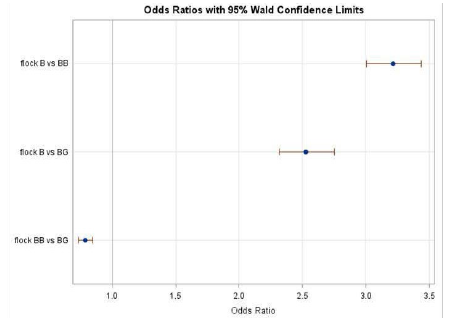
Odds ratio analysis showed that the broiler grandparents were 1.27 times more likely to have immunization failure than breeders, while the probability of detecting unprotected birds in broilers was 3.21 and 2.52 times higher than in broiler breeders and broiler grandparents, respectively (Figure 1). Comparing the AEV immune protection status with the egg production cycles of breeders, it was found that the early-laying, peak-laying, falling-laying, and late-laying, respectively, presented 1.09, 1.83, 2.08, and 1.67 more chances to have unprotected birds than pre-laying (Figure 2).
Odds ratio of vaccine protection failures according to the type of flock. B: Broilers, BB: Broiler breeders and BG: Broiler grandparents.

Odds ratio of failure of vaccinal protection according layer’s production cycle. PL: pre-laying, EL: early-laying, PK: peak-laying, FL: falling-laying and LL: late-laying.
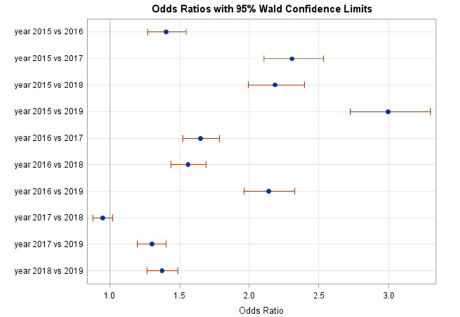
The evaluation of samples collected in different years demonstrated that the years 2015, 2016, 2017, and 2018 were more likely to present vaccine failures than in 2019 (Figure 3). The year 2015 was 2.99 times more likely to have a vaccine failure than 2019.

Odds ratio analysis was performed using data from the breeder flocks from five (I, K, M, N, and Q) out of 18 cities with the highest number of samples. The analysis showed that city K had 2.10 times more chance of having negative samples than city M, whereby cities K and M were the origins with the highest and lowest probability of finding unprotected birds, respectively (Figure 4).

Odds ratio of vaccination protection failure according to the five cities with the highest volume of samples analyzed.
DISCUSSION
The highest level of immunization against AEV was found in the broiler breeder flocks, which can be explained by the regular serological monitoring allowing for frequent detection of immunization failures and, consequently, the application of booster, contributing to the increase of flock immunity. Broiler chickens had the lowest level of immunization. In practice, birds under eight weeks of age are not vaccinated, as they may show clinical signs of the disease (Martins & Silva, 2009; Lin et al., 2018). In these birds the immunity against the virus is the result of passively transferred antibodies from breeders (innate immunity) and has a short duration post-hatching. Therefore, the results observed in broilers may be the result of a failure to transfer antibodies from the breeder to the chick, probably due to the failure of immunization of the breeders or late collection of samples (Rocha et al. 2014; Freitas & Back, 2015; Rocha et al., 2019).
Passive immunity in broilers is immediate but lasts only a short period of time - with progressive decline until the fourth week of bird life (Sharma, 1999). The estimated half-life of maternally derived anti-AEV antibodies is approximately 3 to 6 days, which results in a gradual reduction of circulating antibodies and the waning of passive protection by 3 to 4 weeks of age. The present study demonstrated that broilers with anti-AEV antibodies had a mean age of 2.32 weeks, while birds that did not show anti-AEV antibodies had a mean age of 2.69 weeks. This demonstrates that the duration of passive immunity has probably decreased. It is important to highlight that, in broiler chickens, low or absent antibody titers likely reflect the natural waning of maternally derived antibodies rather than vaccine failure. Since broilers are generally not vaccinated against AEV, their early immunity depends on passive transfer from breeders. Thus, low serological titers in broilers should be interpreted as an expected decline of maternal immunity, and not as evidence of vaccination failure. Both active and passive immunization are practices for the control of diseases in chickens. However, active immunization using live vaccines is the current industry standard (Sharma, 1999). Passive immunization is also used in certain special circumstances, such as in the case of broiler chickens that have a shorter production cycle.
In breeders, the average age of unprotected birds was 18.13 weeks. The first collection for serological tests is generally performed in the 18th week of the bird’s life, a period in which most vaccine failures are identified. The increase in immunity that occurs around the 20th week is due to vaccination boosters administered in unprotected flocks. Grandparents of broiler chickens with and without vaccine-induced protection had a mean age of 14.34 and 13.02 weeks, respectively. Serological collections from unprotected birds probably occurred before the seroconversion period, since the vaccines were administered from the 8th to the 12th week of birds’ lives.
Differences in vaccine-induced anti-AEV antibodies observed over the different years and origins may have been influenced by several factors, such as vaccine mishandling, poor vaccine storage conditions, incorrect dosage, efficacy of the vaccine used, excessive stress on birds, non-compliance with the vaccination program and/or bird nutrition, and mycotoxins (Mutinda et al., 2014; De La Torre et al., 2018; Rocha et al., 2019). The classification into 18 serological groups based on ELISA titers allowed the observation of patterns across flocks and time. However, the absence of validated clinical cutoff values for anti-AEV antibodies in the studied population limits the direct interpretation of these groups in terms of protection. Future studies should aim to establish such thresholds to enhance the diagnostic value of serological monitoring. The progressive improvement in flock immunity over the years can be explained by the measures adopted by the company to reduce vaccine failures, such as vaccinating 100% of birds, adopting booster vaccinations in cases where a single bird presents results in group zero. The constant improvement of employees and their acquired practice over time also plays an important role in immunity increase through time.
Broiler breeders showed the lowest and highest risk of vaccination failure at the periods classified as pre-laying and falling laying, respectively. Possibly immunosuppressive factors that act throughout the laying phases, such as stress, excessive heat or cold, change of diet, nutrient deficiency, infection with other viral agents and mycotoxins, contributed to the decline in vaccine protection (Rocha et al., 2014; Revilla et al., 2018). Furthermore, the adaptive immune response is compromised as animals age, as the immune system changes, making individuals more susceptible to infections, autoimmune diseases, and vaccine failures (Haberthur et al., 2010). Additionally, this study evaluated only the humoral immune response by ELISA. Cellular immunity, which also plays an essential role in protection against AEV, was not assessed. This limitation may explain cases in which birds presented low serological titers but remained protected against the disease. Moreover, no clinical data regarding the occurrence of encephalomyelitis were collected in the studied flocks. Therefore, it was not possible to directly correlate antibody titers with clinical protection, which limits the applicability of the serological findings for health management decisions. Vaccine selection and appropriate vaccination programs vary widely among commercial flocks. Factors such as flock history, endemic infectious agents, age and genetic background of the birds, health status of the parental flock, proximity to other farms, the level of biosecurity practiced, and other environmental and management influences should be considered when adopting a program vaccination (Sharma, 1999).
One limitation of this study is the lack of a control group under standardized vaccination and experimental conditions. This limits the ability to precisely evaluate factors such as vaccine quality, administration technique, and individual immune response. Future studies using controlled experimental designs would help to validate the field observations and better elucidate the causes of vaccine failure. Moreover, although statistical analyses revealed associations between variables such as age, batch type and seropositivity, the observational nature of the study does not allow for the establishment of direct causal relationships. These findings should therefore be interpreted with caution and considered as a basis for future hypothesis-driven research.
It is important to note that detailed information regarding the vaccine used, such as manufacturer, antigenic composition, and production method, could not be disclosed due to confidentiality restrictions imposed by the supplier. This limitation may hinder the reproducibility of the findings and comparison with other studies.
CONCLUSION
The study demonstrated variations in the immunization status according to the type of flock, year, origin, age, and layer’s production cycle. Although vaccination is one of the most effective ways to prevent the occurrence of diseases, many key points need to be controlled, such as vaccine quality, storage, dosage, application, and immunosuppressive factors. The intrinsic characteristics of each flock may also lead to the detection of different humoral responses. In this context, monitoring anti-AEV antibodies is crucial to detect vaccine failures and enable informed decision-making.
ACKNOWLEDGEMENTS
None.
REFERENCES
- Abdullahi US, Adamu SB, Ahmed AF. Investigation on some causes of poultry vaccination failure in Bauchi Metropolis and environs, Nigeria. Nigerian Journal of Experimental and Applied Biology 2009;14(1):47-50.
-
Almeida P, Borges P, Koerich P, et al. Circulation of immunosuppressive viruses and avian encephalomyelitis virus in backyard chicken flocks. Advances in Microbiology 2020;10 (5):203-13. https://doi.org/10.4236/aim.2020.105016
» https://doi.org/10.4236/aim.2020.105016 -
Aydin, S. A short history, principles, and types of ELISA, and our laboratory experience with peptide/protein analyses using ELISA. Peptides 2015:72:4-15. https://doi.org/10.1016/j.peptides.2015.04.012
» https://doi.org/10.1016/j.peptides.2015.04.012 -
Birhane, N, Fesseha, H. Vaccine failure in poultry production and its control methods- a review. Biomedical Journal of Scientific & Technical Research 2020;29(4):22588-96. https://doi.org/10.26717/BJSTR.2020.29.004827
» https://doi.org/10.26717/BJSTR.2020.29.004827 -
Ciabattini A, Olivieri R, Lazzeri E, et al. Role of the microbiota in the modulation of vaccine immune responses. Frontiers in Microbiology 2019;10:1305. https://doi.org/10.3389/fmicb.2019.01305
» https://doi.org/10.3389/fmicb.2019.01305 -
De La Torre D, Nuñez LF, Parra SHS, et al. Detection by Rt-pcr and molecular characterization of tremovirus a obtained from clinical cases of avian encephalomyelitis (ae) outbreaks in Brazil. Brazilian Journal of Poultry Science 2018;20(3):527-36. https://doi.org/10.1590/1806-9061-2018-0744
» https://doi.org/10.1590/1806-9061-2018-0744 -
Freitas E, Back A. New occurance of avian encephalomyelitis in broiler - Is this an Emerging Disease?. Brazilian Journal of Poultry Science 2015;17(3):399-404. https://doi.org/10.1590/1516-635x1703399-404
» https://doi.org/10.1590/1516-635x1703399-404 -
Haberthur K, Engelman F, Barron A, et al. Immune senescence in aged nonhuman primates. Experimental Gerontology 2010:45(9):655-61. https://doi.org/10.1016/j.exger.2010.06.001
» https://doi.org/10.1016/j.exger.2010.06.001 -
Lecoeur A, Blanc F, Gourichon D, et al. Host genetics drives differences in caecal microbiota composition and immune traits of laying hens raised in the same environment. Poultry Science 2024;103(5):1-19. https://doi.org/10.1016/j.psj.2024.103609
» https://doi.org/10.1016/j.psj.2024.103609 -
Lin W, Lu P, Li A, et al. Assessing the efficacy of a live vaccine against avian encephalomyelitis virus. Archives of Virology 2018;163(9):2395-404. https://doi.org/10.1007/s00705-018-3862-2
» https://doi.org/10.1007/s00705-018-3862-2 - Martins PC, Silva PL. Encefalomielite aviária. In: Berchieri A, Silva EN, Fábio JD, et al. Doença das aves. 2nd ed. Campinas: Facta; 2009. p.763-74.
-
Marvil P, Knowles NJ, Mockett APA, et al. Avian encephalomyelitis virus is a picornavirus and is most closely related to hepatitis A vírus. Journal of General Virology 1999;80(3):653-62. https://doi.org/10.1099/0022-1317-80-3-653
» https://doi.org/10.1099/0022-1317-80-3-653 -
Mutinda WU, Niaga PN, Mbuthia PG, et al. Risk factors associated with infectious bursal disease vaccination failures in broiler farms in Kenya. Tropical Animal Health and Production 2014;46:603-8. https://doi.org/10.1007/s11250-013-0533-x
» https://doi.org/10.1007/s11250-013-0533-x -
Pinard-van der Laan M-H. Immune modulation: the genetic approach. Veterinary Immunology Immunopathology 2002;87(3/4):199-205. https://doi.org/10.1016/s0165-2427(02)00075-2
» https://doi.org/10.1016/s0165-2427(02)00075-2 -
Revilla Y, Pérez-Núñez D, Richt JA. African swine fever virus biology and vaccine Approaches. Advances in Virus Research 2018:100:41-74. https://doi.org/10.1016/bs.aivir.2017.10.002
» https://doi.org/10.1016/bs.aivir.2017.10.002 - Rocha TM, Andrade MA, Santana ES, et al. Aspectos clínicos, patológicos e epidemiológicos de doenças imunossupressoras em aves. Enciclopédia Biosfera 2014;10(18):355-79.
-
Rocha PMC, Barros MEG, Rocha BP, et al. Severe outbreak of avian encephalomyelitis in laying hens in northeastern Brazil. Brazilian Journal of Poultry Science 2019;21(2):1-4. https://doi.org/10.1590/1806-9061-2018-0749
» https://doi.org/10.1590/1806-9061-2018-0749 -
Sarma G, Kersting BA, Spina G. Field safety and efficacy of a unique live virus vaccine for controlling avian encephalomyelitis and fowlpox in poultry. Veterinary World 2019;12(8):1291-8. https://doi.org/10.14202/vetworld.2019.1291-1298
» https://doi.org/10.14202/vetworld.2019.1291-1298 -
Sharma JM. Introduction to poultry vaccines and immunity. Advances of Veterinary Medicine 1999;41:481-94. https://doi.org/10.1016/s0065-3519(99)80036-6
» https://doi.org/10.1016/s0065-3519(99)80036-6 -
Sharif A, Ahmad T. Preventing vaccine failure in poultry flocks. Immunization-vaccine adjuvant delivery system and strategies. Intech Open; 2018, https://doi.org/10.5772/intechopen.79330
» https://doi.org/10.5772/intechopen.79330 -
Song B, Li P, Xu H, et al. Effects of rearing system and antibiotic treatment on immune function, gut microbiota, and metabolites of broiler chickens. Journal of Animal Science and Biotechnology 2022;13:144. https://doi.org/10.1186/s40104-022-00788-y
» https://doi.org/10.1186/s40104-022-00788-y -
Toka T, Geinoro T. Vaccine failure and its control methods in poultry production. British Journal of Poultry Sciences 2023;12(2):63-73. https://doi.org/10.5829/idosi.bjps.2023.63.73
» https://doi.org/10.5829/idosi.bjps.2023.63.73 -
Wang W, Zhang Y, Xiao S, et al. The brain-specific upregulation of CARD11 in response to avian brain-neurotropic virus infection serves as a potential biomarker. Poultry Science 2023;102(4):102539. https://doi.org/10.1016/j.psj.2023.102539
» https://doi.org/10.1016/j.psj.2023.102539 -
Yu X, Zhao J, Qin X, et al. Serological evidence of avian encephalomyelitis virus infection associated with vertical transmission in chicks. Biologicals 2015;43:512-4. https://doi.org/10.1016/j.biologicals.2015.09.003
» https://doi.org/10.1016/j.biologicals.2015.09.003
-
FUNDING
None.
-
DATA AVAILABILITY STATEMENT
You may contact the corresponding author if you would like access to the data supporting these findings.
-
DISCLAIMER/PUBLISHER’S NOTE
The published papers’ statements, opinions, and data are those of the individual author(s) and contributor(s). The editor(s) disclaim responsibility for any injury to people or property resulting from any ideas, methods, instructions, or products referred to in the content.
You may contact the corresponding author if you would like access to the data supporting these findings.