 Cinnamon Bark Polyphenol Extract on Abdominal Adipose Tissue Dynamics in Growing Broilers
ABSTRACT
This study investigates the impact of cinnamon bark polyphenols (CBP) on adipogenesis in broiler chickens across developmental stages. A total of 288 one-day-old male broilers were fed for 42 days with a basal diet or diets supplemented with 300 mg/kg (CBP300) and 600 mg/kg (CBP600) of CBP extract. CBP supplementation significantly reduced body weight gain and feed intake compared to the control group (p<0.05). This reduction indicates that CBP regulates energy metabolism, thereby enhancing metabolic efficiency and consequently preventing excessive fat accumulation. Abdominal fat proportion increased with age, and CBP notably influenced tissue weight. The addition of CBP reduced adipocyte sizes compared to the control group. Serum triglycerides decreased, whereas insulin and leptin levels rose significantly (p<0.05). Moreover, the elevated expression of PPARγ and LPL genes in adipose tissue highlights their involvement in adipogenesis and lipid metabolism regulation. This upregulation is beneficial, as it enhances lipid metabolism efficiency, contributing to the reduction in abdominal fat accumulation observed in CBP-supplemented groups. These data suggest that CBP plays a relevant role in balancing lipogenesis and lipolysis.
Keywords:
Broilers; lipid metabolism; LPL; polyphenol; PPARγ
INTRODUCTION
The broiler industry has made tremendous advancements in growth rate and feed conversion efficiency, as well as improvements in rearing conditions, allowing the time to reach the final body weight to be currently reduced to just 33 days. Unfortunately, this increase in growth rate has been associated with higher body fat accumulation, elevated mortality rates, and a higher incidence of metabolic diseases and skeletal disorders (Havenstein et al., 2003). Baeza & Le Bihan-Duval (2013) reported that the heritability estimates for breast meat yield and abdominal fat yield were 0.63 and 0.65, respectively, and the genetic correlation between breast and abdominal fat yield was -0.15, while the genetic correlation between live weight and abdominal fat yield was -0.12. Furthermore, differences in fat deposition observed both among different breeds and within strains of the same breed highlight the significant role of genetic factors in fat storage (Farran et al., 2000; Ristić, 2005; Kokoszyński & Bernacki, 2008). Initially, breeding efforts were primarily focused on achieving higher growth rates and meat yield. However, as excessive fat in carcasses became a concern, selection criteria shifted towards improving feed conversion ratios (FCR). Selection for greater body weight gain typically leads to increased carcass fat content, whereas prioritizing a lower FCR tends to reduce fat levels and increase the water content within the carcass (Tumova & Teimouri, 2010).These findings indicate that selection for breast meat yield does not substantially reduce abdominal fat yield. Such negative aspects are a significant concern for the broiler industry. As the proportion of abdominal fat to carcass weight increases, the amount of edible meat obtained per chicken decreases. Concurrently, cooking losses increase with the rise in abdominal fat. Excessive fat not only reduces carcass yield and feed efficiency but also leads to the rejection of meat by consumers (Tumova & Teimouri, 2010). Moreover, it is well-known that consumers prefer lean meat due to the known correlation between the consumption of certain fats and cardiovascular diseases. In recent years, numerous studies have focused on dietary factors affecting adipogenesis and abdominal fat accumulation in broiler chickens, with an emphasis on the fat-reducing effects of natural compounds added to feed (Mohammadpour et al., 2020; Chen et al., 2021; Mohammadpour et al., 2021).
Various feed additives, many of which are phytogenic in origin, hold promises in the poultry industry and contain medicinal plants used worldwide for the treatment of human diseases for centuries. Studies have observed that phytogenic feed additives alter abdominal fat levels in broiler chickens (Mohammadpour et al., 2020; Chen et al., 2021; Mohammadpour et al., 2021). Some active compounds in plant extracts, such as catechins, epicatechins, cinnamaldehyde, thymol, carvacrol, etc., are effective in preventing obesity, enhancing insulin sensitivity, and regulating blood glucose by influencing adipogenesis and lipogenesis. One such phytogenic additive is cinnamon bark, which contains numerous essential oils, cinnamic acid, cinnamon aldehyde, caryophyllene oxide, eugenol, L-borneol, and many other biologically active compounds. Research has shown that the polyphenolic compounds in cinnamon, along with procyanidin-bound catechins and epicatechins, as well as methylated polymers, increase triacylglycerol lipase activity (Kim & Choung, 2010). Additionally, studies have demonstrated its potential role in insulin sensitivity and blood glucose regulation, as well as its effects on total cholesterol, serum triglycerides, low-density lipoprotein cholesterol, and abdominal fat percentage (Saied et al., 2022). Qotbi (2016) investigated the effects of adding cinnamon powder at 1.5% and 3.0% levels, as well as cinnamon extract at 200 ppm and 300 ppm, to broiler chicken diets on performance. The study reported that body weights decreased in all treatment groups compared to the control, with the 1.5% cinnamon powder supplementation causing a significant reduction in body weight. Conversely, feed conversion ratio showed significant improvement in all treated groups compared to the control. In another study, Sunarno et al. (2018) reported that the inclusion of cinnamon bark powder in quail diets led to reductions in body weight and had a negative impact on growth performance. Despite the effects of cinnamon bark polyphenol extract on performance criteria in broiler chickens having been described, the molecular characterization of the mechanisms by which it influences lipid metabolism in adipose tissue remains inadequately elucidated. Additionally, unlike pigs and rodents, chickens use the liver rather than the adipose tissue as the primary site for de novo lipogenesis. Due to relative insulin resistance in insulin-dependent tissues such as skeletal muscle and adipose tissue, chickens mimic the early stages of type 2 diabetes observed in humans, exhibiting hyperglycemia (up to 200 mg/dL in fasting conditions) (Braun & Sweazea, 2008). Understanding the mechanisms of fat tissue development in chickens can benefit the poultry industry and provide insights for biomedical research.
This study examined the effects of varying doses of cinnamon bark polyphenol extract on abdominal adipose tissue development in Ross 308 broilers, focusing on fat accumulation and lipid metabolism. The aim was to assess its impact on fattening performance and the expression of key adipogenic regulators (PPARγ and LPL) across different developmental stages during a 42-day feeding period.
MATERIALS AND METHODS
Ethics Statement
All animal experiments and procedures were approved by the Local Ethics Committee for Animal Experiments of Van Yüzüncü Yıl University (Decision No: 2022/08-18, dated September 1, 2022).
Birds
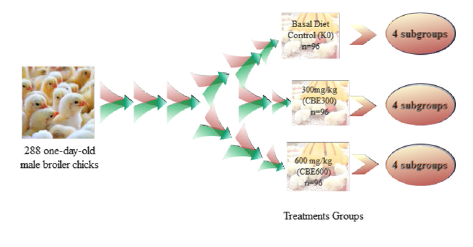
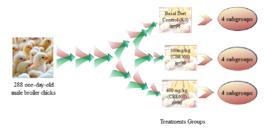
Ross 308 broiler chicks were obtained as fertilized eggs from a local hatchery and incubated using a Cimuka (Ankara, Turkey) brand incubator. For the first 17 days of incubation, the eggs were maintained at 37.7 °C with 65% relative humidity and rotated 90 degrees every 2 hours. From day 17 until hatching, the eggs were transferred to the incubation output unit, where they were incubated at 37.5 °C with 70% relative humidity, without rotation, until hatching was completed. Post-hatching, at one day of age, sex differentiation of the chicks was performed by examining the primary feathers and wing coverts, and only male chicks were used in the study. After recording initial body weights of day-old male chicks, 24 chicks were placed in 2.25 m² compartments (12 chicks/m²). They were randomly assigned to experimental units using a randomized block design, with 4 replicates per dietary group. For the treatment groups (broiler starter and finisher), CBP exract was first added to 1 kg of feed to prepare premixes. These premixes were then uniformly mixed into the respective group’s feed and prepared weekly. The control group received the basal diet, while the treatment groups were fed the basal diet supplemented with 300 mg/kg and 600 mg/kg CBP, respectively. (Figure 1).
The temperature in the experimental unit was set at 34°C in the first week, lowered to 30°C in the second, 27°C in the third, then gradually decreased to and maintained at 20°C. Semi-automatic hanging drinkers were cleaned daily to ensure the animals had constant access to clean water. Ventilation was controlled and set at a minimum rate of 0.7 m³/hour/kg live weight. The poultry house was lit 23 hours daily, with 1 hour of darkness for the first three days; then continuously for the next 39 days, including about 8 hours of natural light.
Cinnamon Bark Polyphenol Extract and Basal Diet
The cinnamon polyphenol extract (Cinnamomum cassia) used in this study was obtained by BIOMESI AR-GE through enrichment with phenolic compounds using an adsorbent column system. The total phenolic content of the obtained extract was determined using the aluminum chloride colorimetric method and was measured to be 27.08%. All chicks were fed a starter basal diet containing 21.17% crude protein and 12.75 MJ/kg metabolizable energy until day 11 of the experiment, followed by a grower basal diet containing 20.37% crude protein and 12.73 MJ/kg metabolizable energy (Aviagen, 2018). The composition and nutrient profiles of the prepared diets are presented in Tables 1 and 2. The experimental groups were established as follows: a basal diet control group, and basal diets supplemented with 300 mg/kg and 600 mg/kg cinnamon polyphenol extract.
Growth Performance
Broiler growth performance was assessed by measuring body weight, weight gain, feed intake, feed conversion ratio, and mortality. Body weights were recorded on days 7, 14, 21, 28, 35, and 42 in subgroups. Weekly feed intake was calculated by subtracting leftover feed and the feed consumed by deceased birds from the total feed offered, then averaging the result per bird.
Collection of Abdominal Adipose Tissue and Blood Samples
On the 7th, 14th, 35th, and 42nd days of the study, one chick from each replicate of each diet group was randomly selected, weighed, and subjected to decapitation. In the slaughtered animals, gizzard-associated abdominal fat was removed, weighed, and expressed as a percentage of each animal’s live weight. During slaughter, approximately 5 mL of blood samples were collected into gel tubes. Blood samples were centrifuged at 3000 g for 10 minutes at 4 °C, the serum was obtained, and then stored at −80 °C for further analysis. For adipose tissue development, 100 mg of abdominal fat samples were washed with phosphate-buffered saline and fixed in a neutral buffered formalin solution (+4 °C) at a volume of at least ten times the tissue volume (100 ml of 40% formalin, 900 ml distilled water, 4 g sodium phosphate monobasic monohydrate, and 6.5 g sodium phosphate dibasic anhydrous) for at least 12 hours. About 25mg of abdominal fat, defined as fat dissected from the abdominal cavity and around the gizzard, was sampled, placed in RNAlater buffer solution, and stored at -20 °C until further analysis. The 25 mg sample size was determined based on comprehensive preliminary optimization studies and has been consistently validated in our laboratory for RNA extraction, quantification, and subsequent gene expression analysis. To ensure sample representativeness and minimize variability, adipose tissue was consistently collected from the same anatomical site (abdominal depot). Furthermore, to enhance the reliability of our findings, the sample size was set to n = 4 per group.
Serum Biochemistry and Hormone Analyses
Otto Scientific assay kits were used to determine the serum biochemical parameters. Glucose (OTTOBC142), triglycerides (OTTOBC155), high-density lipoprotein cholesterol (OTTOBC144), low-density lipoprotein cholesterol (OTTOBC145), protein (OTTOBC154), as well as ALT (OTTOBC128) and AST (OTTOBC127) activities were analyzed using the enzymatic colorimetric method on a MINDRAY BS400 device. Serum insulin (U/L) and leptin levels (ng/L) were determined using the sandwich ELISA (Enzyme-Linked Immunosorbent Assay) method with Bird-Insulin (Avian Insulin AE64762AV) and Bird-Leptin (Avian Leptin AE64558AV) ELISA kits. The quality controls, calibrations, and experimental procedures were carried out in accordance with the supplier’s instructions.
Abdominal Adipose Tissue Histology
Adipose tissue samples were fixed in a neutral-buffered formalin solution for at least 12 hours, then sectioned into 3 mm slices and placed in tissue processing cassettes. To remove formalin residues, the cassettes were kept under running tap water for at least 6 hours. After formalin removal, the cassettes were processed in a tissue processor, undergoing dehydration with ethanol, embedding in paraffin, and block formation. Sections of 5 µm thickness were cut from the paraffin blocks using a microtome, placed on slides, and deparaffinized with xylene. Finally, the tissues were stained with hematoxylin and eosin. Three sections were obtained from each tissue sample, and three sections were mounted per slide for analysis. Images were captured using a Nikon Eclipse 80i microscope equipped with a color camera, and the data were analyzed using the ImageJ 21.0 Software. From each section, three images were acquired, and the density and area of all adipocytes within the field of view were measured at 20× magnification. The threshold method was utilized for adipocyte counting, where adipocytes were treated as binary objects with a minimum area threshold of 20 μm². For each adipocyte, the mean area and equivalent diameter were calculated. Additionally, the total adipocyte count per image and the total adipocyte area per image were recorded to provide a comprehensive analysis of adipocyte morphology and distribution (Bai et al., 2015).
Real-Time Polymerase Chain Reaction (PCR) Analysis
RNA isolation was performed in a Qiacube Lt (Qiagen) using the QIacube Qiaamp RNA Mini Kit according to the manufacturer’s instructions. The quality of isolated RNAs was tested with a nano-spectrophotometer (Nanodrop, Thermo). Reverse transcription was performed immediately following the total RNA isolation using the RT2 First strand cDNA synthesis kit (Qiagen).
In the study, a total of three genes were used, including two target genes (PPARγ and LPL) and one reference gene (β-actin). The PCR composition was set to a total volume of 20 μL, consisting of 12.5 μL SybrGreen qPCR Master Mix, 1 μL Forward and Reverse Assay Primer, and 6.5 μL H2O. Finally, 5 μL of cDNA was added. The PCR protocol was optimized with an initial incubation step at 95°C for 10 minutes, followed by annealing at 94°C for 15 seconds and 60°C for 30 seconds; this process was carried out with a total of 45 cycles (Önalan, 2019). The Ct values obtained from the real-time PCR were normalized using the b-actin reference gene. The real-time PCR data were analyzed using the ΔΔCT method. The primers and their characteristics, as determined using sequence data from the NCBI GenBank, are provided in Table 3.
Statistical Analysis
The analysis of growth performance, adipose tissue histology, serum biochemistry, hormone data, and Ct values obtained from real-time PCR analyses was performed using the SAS 9.4 software package with the Proc GLM procedure. Duncan’s multiple comparison test was used to compare the experimental groups using SAS 9.4 (2020). Values of p<0.05 were considered statistically significant, whereas p<0.01 and p<0.001 were regarded as highly significant.
RESULTS AND DISCUSSION
Daily Weight Gain, Feed Consumption and Feed Efficiency Ratio
The effect of the groups on daily weight gain during the periods of 1-21, 22-42, and 1-42 days was found to be statistically significant (p<0.0001). Daily weight gain in the CBP300 and CBP600 groups was lower than the average weight gain of the control group (p<0.05). An increase in the dose of cinnamon polyphenol extract was associated with a decrease in daily weight gain (p<0.05; Table 4). Additionally, throughout the entire trial period (1-42 days), the effects of the treatments on feed consumption and feed efficiency were found to be significant (p<0.0001).
Mortality rates throughout the entire experimental period were determined as 4.17%, 8.08%, and 10.42% in the control, CBP300, and CBP600 dietary groups, respectively. Statistical analysis indicated no significant differences (p>0.05) among the dietary treatment groups. The results should provide a concise and precise description of the experimental results, their interpretation, and the experimental conclusions that can be drawn. In our study, an examination of performance parameters revealed that the addition of Cinnamomum cassia polyphenol extract (known as Chinese cinnamon) to the diet resulted in a reduction in live weight, weight gain, and feed consumption, without causing significant adverse effects when compared to the basal diet. The effects on live weight and daily weight gain were more pronounced during the initial weeks of feeding than in the later weeks. Additionally, when considering the doses of the polyphenol extract, higher doses exhibited more pronounced effects. Qotbi (2016) investigated the effects of adding 1.5% and 3.0% cinnamon powder, and cinnamon extract at levels of 200 ppm and 300 ppm to broiler diets. The study reported a reduction in live weight across all groups compared to the control group, with a significant decrease observed specifically with the addition of 1.5% cinnamon powder. However, there was a notable improvement in feed conversion ratio across all groups compared to the control group. In another study, Sunarno et al. (2018) reported that the addition of cinnamon bark powder to quail rations resulted in a reduction in live weight and had adverse effects on growth. Al-Abdullatif et al. (2023) investigated the effects of adding cinnamon bark powder to broiler diets on growth and carcass indices. They reported that the use of the lowest dose of cinnamon bark powder (2 g/kg) improved performance parameters, while increasing the dose had a negative impact on live weight and feed consumption. Conversely, Koochaksaraie et al. (2011) found that the addition of cinnamon at levels of 0.5-2 g/kg did not affect live weight or performance. The group fed with 1.0% green tea polyphenol had a reduction in feed intake by approximately 5.1-15.9%, while feed conversion efficiency improved by 4.1-11.4% in the 5.0-1.0% green tea polyphenol feeding groups. Lopes et al. (2015) observed reductions in live weight, body mass index, and adipose tissue weight in rats given 400 mg of aqueous cinnamon extract daily, while Boque et al. (2013) reported a decrease in live weight gain in rats given cinnamon extract for 30 and 56 days.
The regulatory effects of cinnamon on feed consumption have been attributed to multiple physiological mechanisms, including the glucostatic theory, which describes the modulation of blood glucose levels influencing hypothalamic appetite centers; the thermostatic theory, which relates to cinnamon’s impact on body temperature and energy expenditure; the lipostatic theory, emphasizing the role of adipose-derived signals such as leptin in appetite regulation; and the protein intake hypothesis, which suggests that protein consumption and amino acid availability modulate feeding behavior (Koochacsaraie et al., 2011). These interconnected pathways collectively contribute to the modulation of feed intake observed with cinnamon supplementation. In our study, the cinnamon polyphenol extract contains 27.08% total phenolic compounds. Based on McKevith et al. (2003), who reported that high doses of polyphenols could act like pro-oxidants, polyphenolic compounds with hydroxyl phenol groups, such as cinnamaldehyde, may form complex compounds with proteins, carbohydrates, minerals, vitamins, and metal ions. This interaction could result in certain nutrients being absorbed in an unabsorbed form in the small intestine and reduce metabolic products, leading to lower weight gain. Furthermore, increasing evidence suggests that dietary polyphenols can be beneficial in reducing obesity by affecting various neurohormones related to the brain. In vitro and in vivo studies have highlighted the potential roles of polyphenols in modulating neurohormones that regulate nutrient intake and energy balance in obesity. Leptin, a hormone secreted by adipose tissue, controls appetite, feed and/or food intake, and energy expenditure. Friedman (2011) reported that cinnamon improves metabolism, reduces obesity, and decreases appetite by increasing leptin levels and thus curbs nutrient intake. Leptin inhibits neuropeptide Y (NPY), which stimulates proopiomelanocortin (POMC) and thus blocks appetite-stimulating and appetite-suppressing factors (Pico et al., 2022). In addition to their effects on insulin and leptin, polyphenols have also demonstrated anti-obesity effects by directly modulating neuropeptides involved in food intake; for example, anthocyanins have been reported to inhibit NPY and suppress obesity in rats fed high-energy diets (Couturier et al., 2010). Based on the explanations, as shown in Table 8, the CBP groups significantly increased serum leptin concentrations compared to the control group. Although leptin is an appetite-suppressing hormone, its effects on feed intake and body weight are believed to be determined by complex and multifactorial mechanisms. Therefore, the role of increased leptin levels in reducing feed consumption and body weight should be considered in conjunction with other hormonal and metabolic factors.
Change in Abdominal Adipose Weights and Adipocyte Cellularity
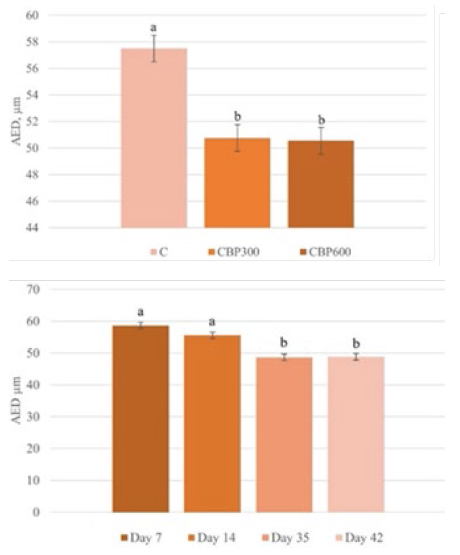
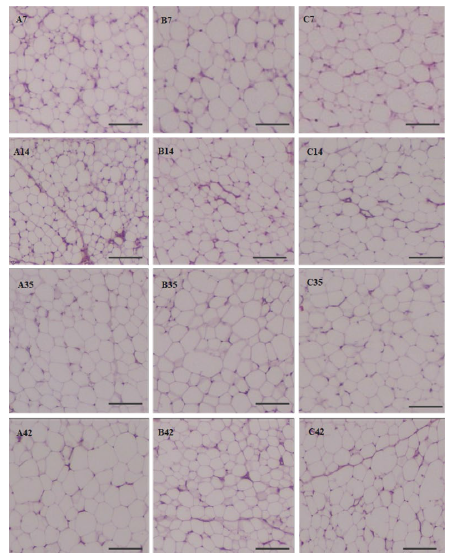
The results related to abdominal adipose tissue dynamics are presented in Table 5. The effects of treatment groups, slaughter ages, and group*age interactions on the proportional weight of abdominal adipose tissue (AAT) as a percentage of slaughter weight were found to be significant (p<0.0001). Additionally, while group, slaughter age, and group*slaughter age interactions had no significant effect on adipocyte density (AD) and adipocyte area (AA), these interactions were found to have a highly significant effect on adipocyte size (p<0.0001). In all groups except for the CBP300 treatment group, the percentage of abdominal adipose tissue as a proportion of body weight showed an increasing trend from 7 days of age to 35 days of age (Table 5). In the control group, the adipose tissue percentage was 0.29% at 7 days of age, while it was found to be 0.21% in both the CBP300 and CBP600 groups, with the differences between the groups being statistically insignificant. Adipocyte diameter was largest in the control group, while it decreased in broilers consuming the CBP diets (p<0.05). Additionally, adipocytes were larger at 7 and 14 days of age, remaining stable between these two age intervals. At 35 and 42 days of age, adipocytes were smaller and maintained their stability from 35 to 42 days (Figure 2 and 3; p<0.05).

Adipocyte size (µm) by diet groups and ages. a,b: Differences between data points with different letters within the same graph are statistically significant (p<0.05).

Histology of abdominal adipose tissue in chicks from the Control (A7-A42), CBP300 (B7-B42), and CBP600 (C7-C42) groups at 7, 14, 35, and 42 days of age (Scale bar = 100 μm).
The number and size of adipocytes increase with the accumulation of lipid droplets, leading to the expansion of adipose tissue (Sultana & Islam, 2022). In this context, considering adipocyte size, cinnamon polyphenol extract has demonstrated anti-adipogenic effects by inhibiting the differentiation of preadipocytes into adipocytes and promoting lipolysis and apoptosis in mature adipocytes, thereby preventing the expansion of adipose tissue. The increase in adipocyte number and size contributes to the cellular development and accumulation of adipose tissue (Bai et al., 2015). Age-related increases in adipocyte volume and number are positively correlated with fat accumulation and body mass. In the initial stages, the increase in fat mass is primarily due to an increase in the adipocyte population. However, later on, the accumulation of lipid droplets within fat cells becomes the predominant factor (Bai et al., 2015). The size of adipocytes depends on the amount of lipid they store, and thus plays a significant role in energy balance (Bai et al., 2015). Lan et al. (2023) examined age-related changes in the morphology of abdominal adipose tissue, reporting that adipocyte diameter and area remained stable from 7 to 21 days of age, decreased from day 21 to day 28, increased from day 28 to day 35, remained stable from day 35 to day 49, and then showed an increase again from day 49 to day 56. Islam et al. (2024), investigating the effects of different doses of clove powder and basil extract on adipocytes in various adipose tissues of broiler chickens, reported that the supplements reduced adipocyte density, with adipocyte density decreasing at day 28 compared to day 14, while adipocyte size increased at day 28. In the same study, they found that the average adipocyte size at day 14 was approximately 25 μm.
Serum Biochemical Levels
The serum lipid parameters were shown in Table 6. The effect of CBP supplementation on serum triglyceride levels was not significant, whereas age (p<0.0001) and the group*age interaction (p<0.05) were found to be significant. Serum triglyceride concentrations were highest at 7 days of age across all groups and decreased at 42 days of age (p<0.05). The effects of diet groups and the group*age interaction on serum VLDL-C and HDL-C levels were found to be insignificant, whereas only age had a significant effect. Accordingly, serum VLDL and HDL concentrations were highest at 7 days of age and decreased with advancing age (p<0.05).
Cinnamon polyphenol extract supplementation and age showed significant effects on serum glucose concentrations at p<0.0087 and p<0.0109 levels, respectively, while the group*age interaction was also significant at p<0.0446 (Table 7). In groups supplemented with 600 mg/kg CBP in the basal diet, serum glucose levels increased with advancing age. Livingston et al. (2020) reported that age significantly affects blood chemistry and hematological parameters in broiler chickens, although changes in blood glucose levels were minimal. Qotbi (2016) supplemented broiler diets with 1.5% and 3% cinnamon powder and 200 and 300 ppm cinnamon extract, finding no significant changes in blood glucose concentrations. However, cinnamon extract was reported to decrease triglyceride, cholesterol, and LDL-C levels while increasing HDL-C levels. Similarly, Akosile et al. (2023) observed that in ovo administration of cinnamon reduced blood glucose concentrations but had no effect on total protein and triglyceride levels. Mnafgui et al. (2015) demonstrated that cinnamic acid supplementation in rats decreased cholesterol and LDL-C levels while increasing HDL-C. Kim et al. (2006) reported that dietary supplementation with 200 mg/kg cinnamon powder in diabetic mice reduced blood glucose, total cholesterol, and triglyceride levels. These discrepancies are thought to arise from differences in animal species, diet types, intervention durations, and the polyphenolic content of the cinnamon preparations used.
The effects of all variables (group, age, and group*age interaction) on serum insulin and leptin concentrations were found to be statistically highly significant (Table 8; p<0.0001). The serum insulin concentrations were higher in the CBP groups compared to the control group. In the CBP groups, serum insulin levels were highest at 7 days of age, and were lower at 14 and 35 days of age (p<0.05). Serum leptin concentrations were higher in the CBP300 and CBP600 groups compared to the control group. When considering age, the CBP groups exhibited the highest serum leptin levels at 42 days of age (p<0.05). Serum leptin concentrations were higher in the treated groups compared to the control group and, considering the slaughter age, the cinnamon polyphenol extract (CBP) groups exhibited the highest levels at 42 days of age. In our study, broiler chickens fed diets supplemented with CBP (cinnamon polyphenol extract) had higher serum glucose concentrations, and serum insulin levels were also elevated. Many studies have reported that cinnamon and its extracts have the capacity to enhance insulin sensitivity and insulin secretion (Jitomir & Willoughby, 2009). The cinnamon polyphenols have restored pancreatic weight and alleviated mesenteric white fat accumulation associated with improved insulin sensitivity in rats fed a high-fat/high-fructose diet (Couturier et al., 2010). Leptin serves as a hormonal indicator of the body’s energy reserves, with its secretion being directly proportional to adipose tissue mass. As lipid storage increases in adipocytes, circulating leptin levels rise correspondingly, creating a negative feedback loop that helps maintain energy balance. Elevated leptin concentrations contribute to lipid mobilization through two primary mechanisms: firstly, leptin inhibits appetite in poultry by specifically suppressing NPY and AgRP and enhancing the expression of POMC and α-MSH (Chuang et al., 2020); and it also enhances sympathetic nervous system activity, increasing lipolysis and thermogenesis in adipose tissue.
This dual mechanism demonstrates leptin’s crucial role as a homeostatic regulator that links adiposity signals with both energy intake and expenditure pathways. The hormone’s ability to promote negative energy balance through these coordinated physiological responses makes it a key mediator in metabolic regulation. Wang et al. (2020) also reported that leptin regulates cellular triglyceride content. The same researchers studied the regulatory mechanism of quercetin on ileal lipid metabolism in broiler chickens and found that quercetin supplemented at 0.04% and 0.06% significantly increased serum leptin levels.
Changes in mRNA Expression of PPARγ and LPL in Abdominal Adipose Tissue
The mRNA expression of PPARγ and LPL in abdominal adipose tissue was significantly higher at 35 and 42 days of age compared to 7 and 14 (Table 9). In the control diet group, PPARγ mRNA expression levels remained constant as age increased (p>0.05). However, in the CBP300 group, PPARγ mRNA expression increased at all ages except for 7 and 14 days, and in the CBP600 group, except for 14 days (Figure 4). In chickens fed with polyphenol-enriched cinnamon-supplemented diets, PPARγ mRNA expression levels were found to be significantly higher compared to those fed with control diets. This finding indicates that PPARγ gene expression increases over time during the developmental period of broiler chickens and that cinnamon polyphenol extract promotes this increase at later ages. A study investigating the relationship between PPARγ gene expression and fat accumulation in chickens of different sexes, ages, and genotypes reported that PPARγ mRNA expression levels were at their lowest in 1-week-old broiler chickens but increased up to 5 weeks of age (Sato et al., 2004). The same study found a linear correlation between abdominal adipose weights and PPARγ gene expression levels in abdominal adipose tissue across all chicken sexes and genotypes. This suggests that PPARγ plays a crucial role in regulating fat accumulation in adipose tissue, specifically in adipocyte hypertrophic growth in chickens. An increase in PPARγ gene expression in adipose tissue can lead to an increase in the number of adipocytes and, consequently, the growth of adipose tissue. Additionally, PPARγ also upregulates the expression of genes that regulate lipid metabolism (Sato et al., 2004). This suggests that processes such as fatty acid storage, triglyceride synthesis, and mobilization of stored fats may be accelerated. Elevated PPARγ expression may result in increased storage of fatty acids as triglycerides and enhanced lipid accumulation in adipocytes. Saito et al. (2009) demonstrated that flavanones play a significant role in adipogenesis (fat cell differentiation) and affect this process at the gene expression level. They reported that flavanones significantly increase the expression of the PPARγ2 variant and play a promotive role in fat cell differentiation. Furthermore, PPARγ and LPL expression are closely linked with hormonal regulators such as insulin and leptin, which modulate lipid metabolism and energy homeostasis. PPARγ enhances insulin sensitivity in adipocytes, facilitating glucose uptake and lipid storage, while LPL accelerates the hydrolysis of circulating triglycerides to supply fatty acids for adipose tissue. The observed increase in serum insulin and leptin levels alongside elevated PPARγ and LPL expression suggests a coordinated hormonal and genetic regulation of adipogenesis in response to cinnamon bark polyphenol supplementation. This integrated network likely contributes to the modulation of lipid metabolism and fat deposition in broiler chickens.

Expression levels of PPARγ and LPL in abdominal adipose tissue in response to cinnamon polyphenol extract at different ages, analyzed by Real-Time PCR (C: Control (untreated-basal diet), CPE300: Basal diet + 300 mg/kg cinnamon polyphenol extract; CPE600: Basal diet + 600 mg/kg cinnamon polyphenol extract. a,b,c,d: Differences between groups indicated by different letters in the same graph are statistically significant p<0.05).
In response to cinnamon polyphenol extract in abdominal adipose tissue, LPL gene expression increased by 1.9-fold and 2.6-fold in the CBP300 and CBP600 groups, respectively (p<0.05; Table 9).LPL gene expression was also observed to increase with advancing age (p<0.05). In all diet groups, expression levels were low at 7 days of age, but overexpression was detected at 42 days of age (p<0.05). Huang et al. (2013) reported that green tea polyphenols alleviate obesity in broiler chickens by regulating the expression of genes and transcription factors related to lipid metabolism. They found that green tea polyphenols significantly increased LPL and ATGL mRNA expression in abdominal adipose tissue and notably reduced serum triglyceride concentrations. Ouyang et al. (2016) reported that the addition of alfalfa flavonoids to the diet increased LPL expression in adipose tissues and significantly elevated PPARγ expression in adipose tissue compared to the positive control group. They indicated that normal PPARγ expression in adipose tissues is critical for preventing elevated blood lipid levels in hyperlipidemia.
The observed reduction in abdominal adipose tissue associated with increased PPARγ and LPL activity can be explained through several interconnected mechanisms. LPL is an enzyme responsible for the hydrolysis of triglycerides, which leads to the release of free fatty acids. These fatty acids are then utilized as an energy source by muscle and other tissues, as demonstrated by Loongyai et al. (2018). When LPL activity increases, it accelerates the breakdown of triglycerides, promoting the utilization of fatty acids for energy production. This process directly contributes to the reduction of abdominal adipose tissue, as highlighted by Huang et al. (2013). Additionally, PPARγ plays a crucial role in optimizing glucose and lipid metabolism by regulating insulin signaling pathways. Enhanced insulin sensitivity, facilitated by PPARγ, improves the uptake and utilization of glucose by cells. This metabolic shift encourages the use of fatty acids for energy rather than storage, thereby reducing the accumulation of adipose tissue, as noted by Sato et al. (2009). Furthermore, both PPARγ and LPL contribute to the reduction of abdominal adipose tissue by regulating its remodeling and function. These molecules reduce inflammation within adipose tissue, promoting its healthy maintenance and supporting the observed decrease in abdominal fat. By enhancing triglyceride hydrolysis, LPL facilitates the mobilization of fatty acids for energy production, reducing lipid storage in abdominal adipose tissue. Simultaneously, PPARγ improves insulin sensitivity and glucose metabolism, shifting energy utilization from storage to expenditure. The anti-inflammatory effects of both PPARγ and LPL further promote healthier tissue dynamics, contributing to fat loss. In conclusion, the interplay between PPARγ and LPL activity, along with the beneficial effects of CBP extract, explains the observed reduction in abdominal adipose tissue through enhanced triglyceride hydrolysis, improved insulin sensitivity, and anti-inflammatory effects. CBP extract has been shown to amplify these mechanisms by further stimulating PPARγ and LPL activity, thereby promoting the breakdown of triglycerides and enhancing insulin sensitivity. Additionally, its potent anti-inflammatory properties contribute to the maintenance of healthy adipose tissue. These combined mechanisms underscore the critical role of PPARγ, LPL, and cinnamon polyphenol extract in regulating energy metabolism and maintaining adipose tissue homeostasis.
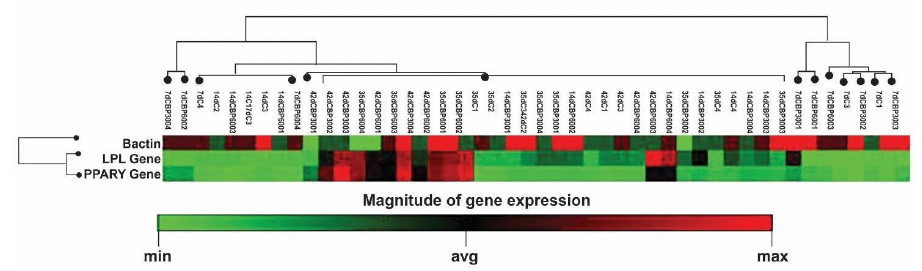
Based on the expression analyses obtained, the clustergram phylogenetic analysis at the gene level revealed that expression levels at 35 days and 42 days of age formed separate branches in the graph, while the expression analysis results at 7 days of age clustered similarly to those at 14 days of age. Additionally, it was observed that at 7 days of age, expression levels across all diet groups were the lowest, forming a distinct branch. At 42 days of age, all diet groups exhibited significantly higher expression levels. According to the color scale of the expression magnitude ratios presented in the graph, maximum values were achieved at 35 days and 42 days of age (Figure 5).

Color scale obtained based on expression magnitude ratios in different diet groups and ages.
CONCLUSION
A significant reduction in abdominal fat deposition has been observed with the supplementation of cinnamon polyphenol extract. The levels of cinnamon polyphenols used in the study were considered high in terms of live weight and breast muscle parameters. Therefore, it has been concluded that lower doses of cinnamon polyphenol supplementation in higher-energy broiler compound feeds may be more suitable, and that cinnamon polyphenols may have a protective role, particularly in mitigating the increase in pectoral muscle weight during the post-hatch growth phase. The addition of cinnamon polyphenol extract increases LPL and PPARγ gene expression in abdominal adipose tissue, decreases serum triglyceride concentrations, and raises serum leptin and insulin concentrations. These coordinated responses indicate that cinnamon polyphenol extract plays a significant role in regulating lipid metabolism in broiler chickens.
ACKNOWLEDGEMENTS
This work was supported by the Van Yuzuncu Yil University Scientific Research Projects Department (FDK-2022-10282). This research article is derived from Sezen TAYAM’s doctoral dissertation.
REFERENCES
-
Akosile OA, Olajide MS, Bukola M, et al. In ovo injection of cinnamon or clove alters the physiology and growth of broilers in a hot tropical environment. Translational Animal Science 2023;7(1):1-8. https://doi.org/10.1093/tas/txad036
» https://doi.org/10.1093/tas/txad036 - Al-Abdullatif AA, Mohammed MQ, Al-Mufarrej SI, et al. Impact of dietary supplementation with cinnamon bark powder on broiler growth and carcass indices, small intestinal measurements, physico-chemical properties of meat and economics of production. Cogent Food & Agriculture 2023;9(2):2284686.
- Aviagen WR. 308: broiler's management and nutrition specification. Scotland: Aviagen; 2018
-
Baéza E, Le Bihan-Duval E. Chicken lines divergent for low or high abdominal fat deposition: a relevant model to study the regulation of energy metabolism. Animal 2013;7(6):965-73. https://doi.org/10.1017/S1751731113000153
» https://doi.org/10.1017/S1751731113000153 -
Bai S, Wang G, Zhang W, et al. Broiler chicken adipose tissue dynamics during the first two weeks post-hatch. Comparative Biochemistry and Physiology 2015;189 (Part A):115-23. https://doi.org/10.1016/j.cbpa.2015.08.002
» https://doi.org/10.1016/j.cbpa.2015.08.002 -
Boqué N, Campió J, Iglesia R de la, et al. Screening of polyphenolic plant extracts for anti-obesity properties in wistar rats. Journal of the Science of Food and Agriculture 2013;93(5):1226-32. https://doi.org/10.1002/jsfa.5884
» https://doi.org/10.1002/jsfa.5884 -
Braun EJ, Sweazea KL. Glucose regulation in birds. Comparative Biochemistry and Physiology Part B: Biochemistry and Molecular Biology 2008;151(1):1-9. https://doi.org/10.1016/j.cbpb.2008.05.007
» https://doi.org/10.1016/j.cbpb.2008.05.007 -
Chen LW, Chuang WY, Hsieh YC et al. Effects of dietary supplementation with taiwanese tea byproducts and probiotics on growth performance, lipid metabolism, and the immune response in red feather native chickens. Animal Bioscience 2021;34(3):393-404. https://doi.org/10.5713/ajas.20.0223
» https://doi.org/10.5713/ajas.20.0223 -
Chuang WY, Hsieh YC, Chen LW, et al. Evaluation of the relationship between adipose metabolism patterns and secretion of appetite-related endocrines on chicken. Animals 2020;10(8):1282. https://doi.org/10.3390/ani10081282
» https://doi.org/10.3390/ani10081282 -
Couturier K, Batandier C, Awada M, et al. Cinnamon improves insulin sensitivity and alters the body composition in an animal model of the metabolic syndrome. Archives of Biochemistry and Biophysics 2010;501(1):158-61. https://doi.org/10.1016/j.abb.2010.05.032
» https://doi.org/10.1016/j.abb.2010.05.032 -
Friedman JM. Leptin and the regulation of body weight. The Keio Journal of Medicine 2011;60(1):1-9. https://doi.org/10.2302/kjm.60.1
» https://doi.org/10.2302/kjm.60.1 -
Havenstein GB, Ferket PR, Qureshi MA. Growth, livability and feed conversion of 1957 versus 2001 broilers when fed representative 1957 and 2001 broiler diets. Poultry Science 2003;82(10):1500-8. https://doi.org/10.1093/ps/82.10.1500
» https://doi.org/10.1093/ps/82.10.1500 -
Huang J, Zhang Y, Zhou Y, et al. Green tea polyphenols alleviate obesity in broiler chickens through the regulation of lipid-metabolism-related genes and transcription factor expression. Journal of Agricultural and Food Chemistry 2013;61(36):8565-72. https://doi.org/10.1021/jf402004x
» https://doi.org/10.1021/jf402004x -
Islam R, Sinza, SI, Sultana N. Effects of clove and tulsi supplementation on the dynamics and cellularity of adipose tissue in the visceral and subcutaneous fat depots in broiler. Journal of Advance Biotechnology and Experimental 2024;7(3):546-55. https://doi.org/10.5455/jabet.2024.d47
» https://doi.org/10.5455/jabet.2024.d47 -
Jitomir J, Willoughby DS. Cassia cinnamon for the attenuation of glucose intolerance and insulin resistance resulting from sleep loss. Journal of Medicinal Food 2009;12(3):467-72. https://doi.org/10.1089/jmf.2008.0128
» https://doi.org/10.1089/jmf.2008.0128 -
Kim SH, Choung SY. Antihyperglycemic and antihyperlipidemic action of cinnamomi cassiae (cinnamon bark) extract in c57bl/ks db/db mice. Archives of Pharmacal Research 2010;33:325-33. https://doi.org/10.1007/s12272-010-0219-0
» https://doi.org/10.1007/s12272-010-0219-0 -
Kim SH, Hyun SH, Choung SY. Anti-diabetic effect of cinnamon extract on blood glucose in db/db mice. Journal Ethnopharmacology 2006;104(1-2):119-23. https://doi.org/10.1016/j.jep.2005.08.059
» https://doi.org/10.1016/j.jep.2005.08.059 -
Koochaksaraie RR, Irani M, Gharavysi S. The effects of cinnamon powder feeding on some blood metabolites in broiler chicks. Brazilian Journal of Poultry Science 2011;13(3):197-202. https://doi.org/10.1590/S1516-635X2011000300006
» https://doi.org/10.1590/S1516-635X2011000300006 -
Lan R, Wei L, Yuftrgf H, et al. Age-related changes in hepatic lipid metabolism and abdominal adipose deposition in yellow-feathered broilers aged from 1 to 56 days. Animals 2023;13(24):3860. https://doi.org/10.3390/ani13243860
» https://doi.org/10.3390/ani13243860 -
Livingston ML, Cowieson AJ, Crespo R, et al. Effect of broiler genetics, age, and gender on performance and blood chemistry. Heliyon 2020;6(7):e04400. https://doi.org/10.1016/j.heliyon.2020.e04400
» https://doi.org/10.1016/j.heliyon.2020.e04400 - Loongyai W, Saengsawang N, Danvilai W, et al. The Expression of lipoprotein lipase gene with fat accumulations and serum biochemical levels in betong (KU Line) and broiler chickens. International Journal of Veterinary Science and Animal 2018;12(11):454-7.
-
Lopes BP, Gaique TG, Souza LL, et al. Cinnamon extract improves the body composition and attenuates lipogenic processes in the liver and adipose tissue of rats. Food & Function 2015;6(10):3257-65. https://doi.org/10.1039/c5fo00569h
» https://doi.org/10.1039/c5fo00569h -
McKevith B, Kelly C, Stanner S, et al. The food standards agency's antioxidants in food programme-a summary. Journal of Human Nutrition and Dietetics 2003;16(4):257-63. https://doi.org/10.1046/j.1365-277x.2003.00436.x
» https://doi.org/10.1046/j.1365-277x.2003.00436.x -
Mnafgui K, Derbali A, Sayadi S, et al. Anti-obesity and cardioprotective effects of cinnamic acid in high fat diet-induced obese rats. Journal of Food Science and Technology 2015;52(7):4369-77. https://doi.org/10.1007/s13197-014-1488
» https://doi.org/10.1007/s13197-014-1488 -
Mohammadpour F, Darmani-Kuhi H, Mohit A, et al. Effects of dietary fat source and green tea (Camellia sinensis) extract on genes associated with lipid metabolism and inflammatory responses in female broiler chickens. Italian Journal of Animal Science 2021;20(1):578-86. https://doi.org/10.1080/1828051X.2021.1898292
» https://doi.org/10.1080/1828051X.2021.1898292 -
Mohammadpour F, Darmani-Kuhi H, Mohit A, et al. Obesity, insulin resistance, adiponectin, and ppar-? gene expression in broiler chicks fed diets supplemented with fat and green tea (Camellia sinensis) extract. Domestic Animal Endocrinology 2020;72:106440. https://doi.org/10.1016/j.domaniend.2020.106440
» https://doi.org/10.1016/j.domaniend.2020.106440 - NRC - National Research Council. Nutrient requirements of poultry. Washington: National Academies Press; 1994.
-
Önalan S. Expression differences of stress and immunity genes in rainbow trout (Oncorhynchus mykiss, Walbaum 1792) with different bacterial fish diseases. Israel Journal of Aquaculture-Bamidgeh 2019;71:1-10. https://doi.org/10.46989/001c.20978
» https://doi.org/10.46989/001c.20978 -
Ouyang K, Xu M, Jiang Y, et al. Effects of alfalfa flavonoids on broiler performance, meat quality, and gene expression. Canadian Journal of Animal Science 2016;96(3):332-41. https://doi.org/10.1139/cjas-2015-0132
» https://doi.org/10.1139/cjas-2015-0132 -
Pico C, Palou M, Pomar CA, et al. Leptin as a key regulator of the adipose organ. Reviews in Endocrine and Metabolic Disorders 2022;23(1):13-30. https://doi.org/10.1007/s11154-021-09687-5
» https://doi.org/10.1007/s11154-021-09687-5 - Qotbi AAA. The effect of cinnamon powder and cinnamon extract on performance, blood parameters and microbial population of broiler chicks. Journal of Babylon University/Pure and Applied Sciences 2016;24(9):2654-60.
-
Saied AM, Attia AI, El-Kholy MS, et al. Effect of cinnamon oil supplementation into broiler chicken diets on growth, carcass traits, haemato-biochemical parameters, immune function, antioxidant status and caecal microbial count. Journal of Animal and Feed Sciences 2022;31(1):21-33. https://doi.org/10.22358/jafs/146921/2022
» https://doi.org/10.22358/jafs/146921/2022 -
Saito M, Okamatsu-Ogura Y, Matsushita M, et al. High incidence of metabolically active brown adipose tissue in healthy adult humans: effects of cold exposure and adiposity. Diabetes 2009;58(7):1526-31. https://doi.org/10.2337/db09-0530
» https://doi.org/10.2337/db09-0530 - SAS. SAS/STAT software: hangen and enhanced. Version 9.4. Cary; 2020.
-
Sato K, Fukao K, Seki Y, et al. Expression of the chicken peroxisome proliferator-activated receptor-? gene is influenced by aging, nutrition, and agonist administration. Poultry Science 2004: 83(8):1342-7. https://doi.org/10.1093/ps/83.8.1342
» https://doi.org/10.1093/ps/83.8.1342 -
Sultana N, Islam R. Modulation of the dynamics and cellularity of adipose tissues in different fat depots in broilers by dietary dexamethasone. Journal of Advanced Veterinary and Animal Research 2022;9(4):583-90. https://doi.org/10.5455/javar.2022.i627
» https://doi.org/10.5455/javar.2022.i627 -
Sunarno S, Djaelani MA, Rahadian R. Pegagan and cinnamon bark flours as a feed supplement for quail growth rate (Coturnix coturnix). Journal of Physics Conference Series 2018;1025:012047. https://doi.org/10.1088/1742-6596/1025/1/012047
» https://doi.org/10.1088/1742-6596/1025/1/012047 - Tumova E, Teimouri ASAB. Fat deposition in the broiler chicken: a review. Scientia Agriculturae Bohemica 2010;41(2):121-8.
-
Wang Y, Yao W, Li B, et al. Nuciferine modulates the gut microbiota and prevents obesity in high-fat diet-fed rats. Experimental & molecular medicine 2020;52(12):1959-75. https://doi.org/10.1038/s12276-020-00534-2
» https://doi.org/10.1038/s12276-020-00534-2
-
FUNDING
This work was supported by the Van Yuzuncu Yil University Scientific Research Projects Department (FDK-2022-10282).
-
DATA AVAILABILITY STATEMENT
The findings and data of this study are available from the corresponding author upon reasonable request.
-
DISCLAIMER/PUBLISHER’S NOTE
The published papers’ statements, opinions, and data are those of the individual author(s) and contributor(s). The editor(s) disclaim responsibility for any injury to people or property resulting from any ideas, methods, instructions, or products referred to in the content.
The findings and data of this study are available from the corresponding author upon reasonable request.