 Comparative Phenotypic Analysis of Multidrug Resistance and Associated Risk Factors in Avian Pathogenic and Fecal Escherichia coli from Central Algerian Poultry Systems
ABSTRACT
The emergence of antibiotic resistance in poultry farming threatens animal health, food safety, and public health. This study characterized and compared AMR profiles between avian pathogenic and fecal Escherichia coli (APEC and AFEC) and identified key risk factors associated with multidrug resistance (MDR, defined as resistance to at least three antibiotic classes). Two hundred Escherichia coli (100 APEC, 100 AFEC) were identified from 360 clinical and fecal samples collected in central Algeria, yielding prevalences of 46.5% for APEC and 68.97% for AFEC. Antibacterial susceptibility to 24 antibiotics was assessed using the disk diffusion method. Multiple correspondence analysis (MCA) was applied as an exploratory tool to uncover associations between resistance patterns and risk factors. APEC and AFEC strains demonstrated pronounced resistance to the first-line therapeutic antibiotics, notably tetracycline (84%, 91%), ampicillin (82%, 74%), amoxicillin (80%, 71%), and nalidixic acid (76%, 74%), while preserving full susceptibility to carbapenems and cefoxitin. Poultry age was the primary driver of MDR in APEC isolates, whereas MDR in AFEC was primarily linked to inadequate ventilation and suboptimal humidity levels. Fisher’s exact test indicated no significant differences in susceptibility rates between APEC and AFEC isolates (p>0.05), except for tobramycin. This first comprehensive AMR assessment in Algerian poultry emphasizes the multifactorial nature of its emergence, the imperative need for improved antimicrobial stewardship and farm management policies to safeguard animal and public health.
Keywords:
Avian fecal; Escherichia coli (AFEC); Avian Pathogenic Escherichia coli (APEC); multidrug resistance (MDR); One Health; risk factors
INTRODUCTION
Escherichia coli is the type species of the family Enterobacteriaceae. This Gram-negative bacterium is well known for its ubiquity in the environment and its prominence as a component of the normal gut flora of humans and warm-blooded animals (Diard et al., 2010; Leimbach et al., 2013). Most Escherichia coli strains persist harmlessly as commensals within the mucosal layers of the cecum and colon, where they have successfully adapted their metabolic processes to thrive in specific ecological niches (Leimbach et al., 2013).
Escherichia coli serve as reservoirs of virulence factors. While most strains belong to the normal intestinal flora and are non-pathogenic, some strains have evolved to colonize sites outside of the gut and cause extraintestinal infections. These strains fall into the extraintestinal pathogenic Escherichia coli (ExPEC) group (Dube & Mbanga, 2018). A notable subset of ExPEC is Avian pathogenic Escherichia coli (APEC), known as the leading cause of avian colibacillosis (Logue et al., 2017). This complex syndrome is characterized by a broad spectrum of clinical manifestations, including colisepticemia, coligranuloma, pleuropneumonia, salpingitis, omphalitis, pericarditis, peritonitis, airsacculitis, perihepatitis, synovitis, osteomyelitis, and yolk sac infections (Nolan et al., 2020; Redweik et al., 2020).
Avian colibacillosis causes decreased performance and high rates of morbidity, mortality, and carcass condemnation at slaughter, generating considerable economic losses that threaten the poultry industry’s sustainability and profitability both in Algeria and worldwide (Kathayat et al., 2021). These infections may also arise from opportunistic infections caused by commensal Escherichia coli strains, often precipitated by suboptimal poultry management practices (Barbosa et al., 2023). These include poor sanitation, inadequate ventilation, overcrowding, and other stressors that compromise the birds’ immune defenses (El-Sabrout et al., 2024).
Beyond their relevance to poultry health and production, APEC strains have been reported to have zoonotic potential (Sarowska et al., 2019). Additionally, they can be distinguished from commensal avian Escherichia coli strains (AFEC) by the presence of specific virulence genes located either on virulence plasmids or on the chromosome (Radwan et al., 2020; Delago et al., 2023; Nawaz et al., 2024).
To treat and control avian colibacillosis outbreaks, various antibacterial agents, including beta-lactams, aminoglycosides, fluoroquinolones, tetracyclines, trimethoprim, and sulfonamides, are extensively employed. Their widespread application exerts significant selective pressure on Escherichia coli populations, facilitating the emergence and proliferation of multidrug-resistant (MDR) phenotypes (Kim et al., 2020). This phenomenon poses a notable One Health challenge, as antibacterial resistance is not confined to poultry alone: resistant strains exhibit a remarkable capacity for zoonotic transfer via the food chain or through direct contact with infected avian hosts or their feces (Sen et al., 2022). Recent research suggests that avian Escherichia coli strains, whether pathogenic or fecal, can carry antibiotic resistance genes that may be transferred to other bacteria (Dell’Orco et al., 2019).
In numerous countries, the administration of antibiotics is not limited to therapeutic purposes. They are also employed to boost animal productivity, feed efficiency, and growth rates in food-producing animals (Rafiq et al., 2022)-as feed additives, administered at low concentrations (sub-therapeutic doses). Over-extended periods may also accelerate the emergence of antibacterial resistance (Diarra & Malouin, 2014; de Mesquita Souza Saraiva et al., 2022).
Understanding the overall diversity of avian Escherichia coli, both pathogenic and commensal, is essential for addressing the growing concern of antibacterial resistance in poultry farming. In Algeria, although several studies have explored antibiotic resistance in APEC strains, very few studies have compared the resistance profiles of AFEC and APEC strains. To date, no study has simultaneously combined a detailed phenotypic comparison of APEC and AFEC antimicrobial resistance with a formal multivariate risk factor analysis using multiple correspondence analysis (MCA) in Algerian poultry farms. This study aims to compare antibiotic resistance profiles between these two strain types and to identify key farm-level and environmental factors associated with the spread of antibiotic resistance within the Algerian poultry industry. By integrating phenotypic resistance data with MCA-based risk-factor analysis, this work provides a novel, farm-scale perspective on AMR dynamics in Algerian poultry production. It supports the development of improved antibiotic stewardship strategies.
MATERIALS AND METHODS
Research Authorization and Ethics Compliance
This study was approved by the Scientific Committee of the Faculty of Biological and Agricultural Sciences at the Mouloud Mammeri University of Tizi Ouzou, Algeria (approval number: UMMTO/2023/Ani22). All poultry sampling procedures were carried out exactly in compliance with international ethical standards for animal research.
Sampling
Three hundred and sixty samples from 108 farms were collected across the central regions of Algeria (Algiers, Bordj Bou Arreridj, Bouira, Bejaia, Tizi Ouzou, and Boumerdes) in collaboration with the Bacteriology Department of the Regional Laboratory Centre of Draa Ben Kheda between November 2023 and July 2024. Two hundred and fifteen specimens were obtained from the internal organs of chickens (liver, spleen, pericardium, lung, and ovarian tissues) that were either clinically diagnosed with or suspected of colibacillosis, and 145 samples were collected from the intestines, feces, and cloacal swabs of apparently healthy chickens. From the collected samples, only one isolate per sample and per bird was retained to ensure the independence of observations.
Microbiological Identification of Escherichia coli
Samples were enriched in brain-heart infusion broth (BHIB) (Biolab Zrt., Budapest, Hungary) and incubated overnight at 37 °C. Following enrichment, an inoculum from each sample was streaked onto Hektoen agar plates (TITAN BIOTECH LTD., Rajasthan, India) and incubated aerobically at 37 °C for 18-24 hours. Salmon-pink colonies with typical Escherichia coli morphology were subjected to Gram staining for microscopic observation. Biochemical identification was performed using the API 20E system (BioMérieux, France) according to the manufacturer’s guidelines. Escherichia coli ATCC 25922 was used as a reference strain to confirm the performance of biochemical identification and reliability. Only isolates with API 20E profiles consistent with Escherichia coli were retained, with an overall biochemical agreement above 97%.
Antimicrobial Susceptibility Patterns
Antimicrobial susceptibility testing was conducted using the Kirby-Bauer (1966) disk diffusion method on Mueller-Hinton agar plates (OXOID, UK) against a comprehensive panel of 24 antimicrobial agents (OXOID, UK). The panel included both antibiotics commonly used in poultry production and those considered critically important in human medicine, some of which are not authorized for veterinary practice but were retained for resistance surveillance and public health benchmarking. The tested drugs covered major classes, encompassing beta-lactams (amoxicillin, ampicillin, piperacillin, and amoxicillin + clavulanic acid), carbapenems (imipenem and ertapenem), and multiple generations of cephalosporins (cefazolin, cefoxitin, ceftazidime, ceftriaxone, cefotaxime, cefixime), aztreonam, aminoglycosides (kanamycin, gentamicin, tobramycin, and amikacin), quinolones (nalidixic acid, ciprofloxacin, and levofloxacin), and other clinically relevant antibiotics such as tetracycline, trimethoprim-sulfamethoxazole, chloramphenicol, and fosfomycin.
All testing procedures and results interpretation adhered to the 2023 Clinical and Laboratory Standards Institute (CLSI) guidelines, with Escherichia coli ATCC 25922 as the quality control strain.
Risk Factors Influencing Antibacterial Resistance of Avian Escherichia coli
For each sample received, an investigation form was completed to capture essential operational and environmental factors. The collected data encompassed farm characteristics, including production category, bird specifications, and facility scale, as well as carefully documented environmental parameters, such as building and soil type, farming method, feed, and water sources. The form verified the implementation of disinfection protocols and compliance with sanitary downtime, as well as humidity, temperature, and ventilation standards. This comprehensive approach fulfilled two essential purposes: assessing factors that contribute to the spread of antibiotic resistance in AFEC and APEC isolates, and examining conditions that facilitate the transmission of colibacillosis.
Statistical Analysis
A multiple correspondence analysis (MCA) was conducted separately for APEC and AFEC isolates using the CATPCA procedure (categorical principal components analysis) implemented in SPSS software version 22.0 (IBM Corp., USA). This multivariate approach was applied to identify potential risk factors associated with MDR Escherichia coli. For both datasets, the variables included resistance phenotype (susceptible or resistant), production type, age category (startup, growth, finishing, pre-laying, laying, reproduction), poultry strain (Cobb 500, Efficiency, Arbor Acres, Isa Brown, Novogen Brown, and Ross 308), flock size, housing structure and soil type, rearing system, feeding type, drinking water source, ventilation system (dynamic or static), humidity and temperature levels, implementation of disinfection and sanitary downtime, and geographic origin (region). Dimensions with eigenvalues exceeding 1 were retained according to the Kaiser criterion, and the cumulative inertia of the first two dimensions was reported on the graphical representation.
Fisher’s exact test was applied to assess whether there were statistically significant differences in antibiotic resistance rates between APEC and AFEC strains. A p-value ≤ 0.05 indicates a statistically significant difference.
RESULTS
A total of 200 strains were obtained from the 360 samples, including both APEC and AFEC isolates, with a prevalence of 46.5% and 68.97%, respectively.
Antibacterial Resistance
The antibiotic resistance results of all strains are presented in Table 1. APEC isolates exhibited high rates of resistance to tetracycline (84%), ampicillin (82%), amoxicillin (80%), and nalidixic acid (76%), followed by piperacillin (68%), ciprofloxacin (66%), levofloxacin (56%), and trimethoprim-sulfamethoxazole (54%). Intermediate resistance levels were observed for Chloramphenicol (31%), amoxicillin+clavulanic acid (29%), kanamycin (28%), and fosfomycin (12%). Low resistance rates were observed with 1st- and 3rd-generation cephalosporins and with amikacin (4%), gentamicin (7%), and tobramycin (5%). All strains were fully susceptible to cefoxitin, imipenem, and ertapenem.
The AFEC isolates showed comparable resistance patterns, although with variable percentages. These strains demonstrated high resistance rates to tetracycline (91%), ampicillin and nalidixic acid (74%), and amoxicillin (71%), followed by trimethoprim-sulfamethoxazole (65%), piperacillin (63%), and ciprofloxacin (54%). Intermediate resistance levels were observed for levofloxacin (46%), kanamycin (38%), chloramphenicol (21%), and amoxicillin/clavulanic acid (20%). Low resistance rates were recorded for gentamicin (8%), fosfomycin (7%), amikacin (6%), and cephalosporins (1st and 3rd generations) (3%). All the strains were fully susceptible to cefoxitin, imipenem, and ertapenem. In contrast to APEC, with 5% resistance, tobramycin maintained its effectiveness against AFEC.
The antibacterial susceptibility test results indicated that 78 APEC and 85 AFEC isolates were categorized as multidrug-resistant (MDR), since they exhibited resistance to at least three antimicrobial classes. Table 2 shows the distribution of MDR rates among APEC and AFEC strains by the number of antibiotic families involved.
In terms of MDR profiles, no statistically significant differences (p>0.05) between APEC and AFEC isolates were revealed by Fisher’s exact test. Similarly, no significant differences were observed in antibiotic susceptibility rates, except for tobramycin, to which all AFEC isolates were fully sensitive, yielding a statistically significant difference (p=0.030).
Comparative Analysis of Antibiotic Resistance Profiles Observed in APEC and AFEC Strains
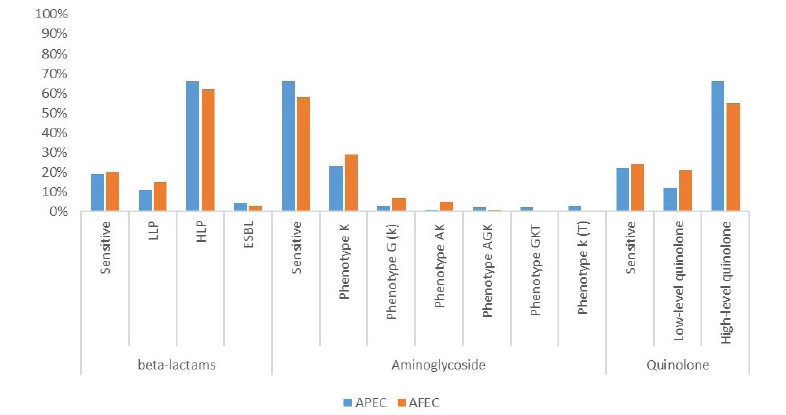
The analysis of antibiotic resistance profiles between APEC and AFEC strains is summarized in Figure 01, while the detailed distribution of various resistance phenotypes is provided in Supplementary Table S1. The data indicate specific resistance patterns against three principal classes of antibiotics: beta-lactams, aminoglycosides, and quinolones.

Comparative distribution of antibiotic resistance phenotype between APEC and AFEC strains.LLP:low-levelpenicillinase, HLP: high-level penicillinase, ESBL: extended-spectrum beta-lactamases, Phenotype K: kanamycin resistance, Phenotype G(k): gentamicin + Kanamycin resistance, Phenotype AK: amikacin resistance, Phenotype AGK: amikacin + gentamicin + kanamycin resistance, Phenotype GKT: gentamicin + kanamycin + tobramycin resistance, Phenotype k (T): kanamycin + tobramycin resistance, Low-level quinolone resistance: first-generation quinolone (nalidixic acid), High-level quinolone resistance: second- and third-generation quinolones (ciprofloxacin and levofloxacin)
Regarding beta-lactams, the study revealed a predominance of beta-lactamase profiles, with the narrow-spectrum beta-lactamase group, comprising low-level penicillinase (LLP), conferring resistance to aminopenicillins, and the high-level penicillinase (HLP) group, conferring resistance to aminopenicillins and first-generation cephalosporins. The second group covers extended-spectrum beta-lactamase (ESBL), whose resistance extends to third- and fourth-generation cephalosporins. HLP was observed in both groups of strains, with rates of 66% in APEC and 62% in AFEC. At the same time, the occurrence of ESBL was minimal, with frequencies of 4% and 3%, respectively. LLP showed an intermediate distribution of 11% in APEC and 15% in AFEC.
The aminoglycoside resistance profiles demonstrate considerable enzymatic diversity, with the phenotype K [APH(3’)-I and APH(3’)-II] representing the predominant profile. This phenotype is particularly prevalent in association with HLP and high-level quinolone resistance (17% among APEC, 10% among AFEC). The enzymatic repertoire also includes AAC(3)-I, which confers the G(K) phenotype; APH(3’)-VI, responsible for the AK phenotype, and the combination AAC(3)-I/APH(3’)-VI, generating the AGK phenotype. The comprehensive analysis of the data allowed the identification of four phenotypes unique to the APEC strains, combining various aminoglycoside-modifying enzymes and quinolone resistances: APH (3’)-I (G/T phenotype) associated with high-level (1%) or low-level (2%) quinolones, and ANT (2”) (GKT phenotype) combined with high-level (2%) quinolone resistance. Quinolone resistance levels reveal an uneven distribution, characterized by a significant predominance of high-level resistance (66% APEC versus 55% AFEC).
Correlation of Risk Factors With Antibacterial Resistance Profiles
The multivariate analysis method enabled the assessment of associations between the antibiotic resistance profiles of the isolated strains and the investigated parameters (Figure 2).

Multiple Correspondence Analysis of Risk Factors Associated with Antimicrobial Resistance in APEC and AFEC strains. (a), (c): Discrimination Measures, (b), (d): Connected trajectory of category points.
The comparative analysis of phenotypic associations between APEC and AFEC strains suggested distinct patterns of phenotypic expression in the examined avian populations. In the APEC strains, the resistance phenotype showed moderate associations with avian-specific characteristics, including age, poultry strain, and production type, the latter of which was strongly linked to the rearing method. Another moderate association was observed with the ventilation system. In contrast, the phenotype of AFEC strains was moderately associated with age and environmental conditions, particularly humidity and ventilation. For the remaining factors analyzed, associations with the phenotype were typically weak.
Multiresistant APEC strains were mainly detected among advanced stages of the breeder cycle, particularly during the pre-reproduction and reproduction phases, as well as in the startup, growth, and finishing stages in meat production. Conversely, multidrug-resistant AFEC strains were observed from the startup stage across all production systems (meat, egg, and reproduction) and persisted until the growth phase in meat production and in breeder flocks.
Sensitive pathogenic and fecal Escherichia coli strains were predominantly observed in Isa Brown laying hens raised in battery cages during the pre-laying and laying phases, as well as in Ross 308 broilers, an imported strain reared under an intensive farming system. On the other hand, MDR strains were primarily associated with meat production, especially Cobb 500 and Efficiency birds housed under intensive conditions, as well as with breeders of the Arbor Acres and Cobb 500 lines, which followed the same rearing method. Additionally, some MDR strains were identified in Novogen Brown laying hens raised in battery cages.
Sixty-four multidrug-resistant APEC and 52 multidrug-resistant AFEC strains were collected from farms, and ventilation practices were associated with the prevalence of resistant strains.
The MCA results indicated a significant association between humidity levels and the distribution of AFEC strains. On farms with moderate humidity levels, non-resistant strains were predominantly isolated. However, farms with either low (≤50%) or high (≥70%) humidity exhibited a higher prevalence of MDR AFEC strains. Moreover, certain investigated factors showed weak associations with phenotypic resistance profiles. These included building and floor type, feed type, and temperature for APEC strains, while for AFEC, only floor type showed a slight association. Disinfection protocols and sanitary downtime exhibited minimal associations in both groups.
DISCUSSION
One of the repercussions of using antibiotics in poultry farming has been a surge in antibiotic-resistant bacteria that ultimately affect humans (Xu et al., 2020). According to the WHO (2017), Escherichia coli is recognized as the primary bacterium involved in the spread of antibiotic resistance.
This research revealed a distinct distribution of avian Escherichia coli strains, both pathogenic and commensal. Compared to regional findings, Chenouf et al. (2025) recorded an overall prevalence of 85.1% of APEC strains in chickens and turkeys in north-eastern Algeria. Similarly, Aberkane et al. (2023) noted a prevalence of 78.4% among suspected carcasses in the eastern region. Conversely, Saci et al. (2024) reported a rate of barely 30% in the central province of Tizi Ouzou among diseased chickens exhibiting typical Escherichia coli lesions. Defining the differences between non-pathogenic and potentially pathogenic Escherichia coli strains in the poultry intestinal tract remains challenging, since most strains are commensals and non-infectious in the intestinal microbiome of healthy birds, which explains their higher prevalence in fecal samples (Jamali et al., 2024).
Antibiotic susceptibility testing showed high resistance rates (>50%) in APEC and AFEC isolates against tetracycline, penicillin, and aminopenicillin (AMP, AMX, PRL), trimethoprim-sulfamethoxazole, quinolones, and fluoroquinolones (NA, CIP, LEV) in APEC strains. Consistent with findings reported in Algeria (Meguenni et al., 2019; Messaili et al., 2019; Saci et al., 2024) and in other countries (Ibrahim et al., 2019; Nolan et al., 2020; Goudarztalejerdi et al., 2022).
Tetracycline exhibited the highest resistance rate among the antibiotics tested. Slightly varying results were reported in Algeria (Laarem et al., 2017; Mohamed et al., 2018; Aberkane et al., 2023). The results of this study are lower than those reported in Bangladesh, where 100% resistance was observed in layer chickens (Levy et al., 2022), and higher than those reported in Italy (43%) (Sgariglia et al., 2019). Such elevated levels likely reflect the intensive and long-standing use of tetracyclines in poultry, owing to their broad spectrum, wide safety margin, and relatively low cost compared with other antibiotics (Hofacre et al., 2013; Granados-Chinchilla & Rodríguez, 2017).
High resistance rates were observed for aminopenicillins, particularly amoxicillin and ampicillin. These results align with several reports by Messaï et al. (2015), Halfaoui et al. (2017), Messai et al. (2019) for APEC, and those obtained for AFEC in Zimbabwe by Dube & Mbanga (2018). Penicillins are among the first-line therapeutic antibiotics commonly used to treat poultry diseases (Roth et al., 2019), often administered to entire flocks, frequently without prior in vitro susceptibility testing. Such extended and occasionally indiscriminate application has probably contributed substantially to the selection and maintenance of resistant bacterial strains.
AFEC and APEC strains showed significant resistance to trimethoprim- sulfamethoxazole. Similar resistance levels were reported in commensal Escherichia coli in Qatar (Eltai et al., 2018). Higher rates were recorded in Algeria, with 73.79% in western Algeria (Benklaouz et al., 2020) and 88.89% for APEC isolates in central Algeria (Halfaoui et al., 2017). Even higher rates were observed in the studies by Laarem et al. (2017) and Ibrahim et al. (2019). These findings highlight a concerning spread of resistance to this antibiotic. SXT is widely used in avian pathology. However, one major adverse effect of using it in poultry is the potential presence of violative residues in meat and eggs. Poultry, being coprophagic, can recycle sulfonamides excreted in feces, which may result in drug residues remaining beyond the recommended withdrawal period and contribute to the observed resistance (Hofacre et al., 2013).
This study also reported high resistance to the quinolones and fluoroquinolones in both strain groups. For nalidixic acid, different resistance rates were observed in Algeria: lower by Meguenni et al. (2019) and Saci et al. (2024) for APEC strains and higher from healthy broilers by Belmahdi et al. (2016). The noted disparity may be attributed to genetic variability among bacterial strains, differences in antibiotic use practices, and region-specific environmental and sanitary conditions.
A systematic review on the occurrence of antimicrobial-resistant Escherichia coli in poultry in Bangladesh revealed alarmingly high resistance (up to 100%) to nalidixic acid, ciprofloxacin, and levofloxacin (Islam et al., 2023). APEC strains isolated from broiler chickens in Algeria showed a resistance rate of 87.5% to ciprofloxacin (Aberkane et al., 2023). In Qatar, resistance levels were even higher, with 97% in healthy chickens and 100% in sick chickens (Johar et al., 2021). Meanwhile, in Indonesia, AFEC strains exhibited a resistance rate of 55% (Putri et al., 2023).
The World Organisation for Animal Health (OIE) designated fluoroquinolones as Veterinary Critically Important Antimicrobial Agents (VCIA) (OIE, 2019). Fluoroquinolones are considered first-line therapy for infections caused by Escherichia coli. Their widespread therapeutic and prophylactic use to reduce early chick mortality and control the spread of avian diseases exerts strong selective pressure. (Perrin-Guyomard et al., 2020; Islam et al., 2023). This extensive exposure to fluoroquinolones may contribute to the higher resistance rates observed in APEC compared to AFEC strains.
The relationship between antibiotic use and resistance is complex, as resistance can persist even in the absence of antibiotic pressure due to cross-resistance and co-resistance (Pouwels et al., 2019). Cross-resistance refers to a single resistance mechanism that confers resistance to multiple antibiotics within the same class or across different classes (de Mesquita Souza Saraiva et al., 2022; Rahman et al., 2022). Co- resistance involves the simultaneous resistance to two or more classes of antibiotics within the same bacterial strain, often due to the presence of several resistance genes on the same mobile genetic elements, such as on plasmids or transposons (Bourély et al., 2019; Pouwels et al., 2019; de Mesquita Souza Saraiva et al., 2022). Co-resistance between amoxicillin and ciprofloxacin in Escherichia coli indicates that the use of one antibiotic may contribute to increased resistance to both agents simultaneously (Rahman et al., 2022).
Our findings confirm the occurrence of co-resistance between amoxicillin and ciprofloxacin. Several resistance profiles among APEC and AFEC strains exhibit simultaneous resistance to β-lactams and quinolones and fluoroquinolones, often in association with aminoglycoside resistance phenotypes. This higher prevalence in APEC compared to AFEC strains further supports the hypothesis that pathogenic strains are more frequently exposed to selective pressures, thereby facilitating the persistence and dissemination of resistance determinants.
Moderate resistance to chloramphenicol was observed. Fairly similar rates for APEC strains were observed in Algeria (39.22%) and Egypt (30%) (Halfaoui et al., 2017; Younis et al., 2017). Higher rates were recorded in eastern China (89%) and in Bangladesh (97.2%) (Xu et al., 2019; Levy et al., 2022). This resistance could be attributed to the persistence of preexisting resistance or the illegal use of this drug, which is banned in animal husbandry.
Low values were recorded. Higher resistance rates were found in Qatar: 84.4% of Escherichia coli isolates from non-healthy birds and 76.5% from healthy birds (Johar et al., 2021). Fosfomycin is approved in several countries for the treatment of urinary tract infections, but its use is restricted in poultry production (Falagas et al., 2019; Mak et al., 2022), which could explain the low percentage observed in this study. Thus, the presence of fosfomycin-resistant strains in poultry raises safety (Gazal et al., 2021).
Most cephalosporins, particularly the third-generation, are not used in the poultry industry and are primarily limited to intravenous use for the treatment of severe human infections (Johar et al., 2021). This restricted exposure may account for the low resistance rates observed in our study. Comparable findings were reported in Qatar and Iran (Eltai et al., 2018; Goudarztalejerdi et al., 2022).
Varying aminoglycoside resistance patterns were detected among APEC and AFEC isolates. Kanamycin showed moderate resistance. Gentamicin and amikacin resistance were recorded at similar rates for both types of strains; 5% resistance was observed against tobramycin for APEC, while it remained fully effective against AFEC strains. The elevated resistance to kanamycin may be a consequence of its frequent use in poultry farming. Although gentamicin is officially banned in veterinary medicine in Algeria (Meguenni et al., 2019), illicit misuse may explain the observed results. Meanwhile, amikacin and tobramycin are primarily reserved for the treatment of severe infections in human medicine (Ferreira et al., 2021).
In Algeria, Escherichia coli strains from intestinal and fecal samples exhibited a 33% resistance rate to tobramycin but were fully susceptible to gentamicin (Belmahdi et al., 2022). In contrast, poultry-derived Escherichia coli strains in China resistance to amikacin (43%) and gentamicin (26.4%) (Yassin et al., 2017). In Indonesia, AFEC isolates showed a 20% kanamycin resistance rate (Putri et al., 2023), a figure significantly lower than the 69% observed in APEC strains from Egyptian broilers (Awad et al., 2016) and the 80.19% observed in China (Xu et al., 2019).
In this study, all Escherichia coli strains were susceptible to imipenem, ertapenem, and cefoxitin, as these molecules are not used in the avian industry.
MDR appears as a veritable problem in public health. Our findings showed high MDR rates. According to Christen et al. (2021), the intestinal tract of poultry is considered an optimal environment for the selection and horizontal transmission of antibiotic resistance genes, given their high prevalence and diversity. Moreover, commensal Escherichia coli is highly diverse and may harbor diverse fitness traits, which are considered reservoirs of virulence traits (Dube & Mbanga, 2018).
The lack of statistically significant differences in MDR profiles and antibiotic susceptibility rates between APEC and AFEC isolates suggests that both are subject to comparable antibiotic selection pressures within the poultry production environment. This convergence suggests a potential role for commensal strains as latent reservoirs of resistance genes that may be mobilized and horizontally transferred to pathogenic strains.
This situation raises significant public health concerns, given the zoonotic potential of avian Escherichia coli and the possibility of transmission through the food chain. The elevated resistance rates to several antibiotics across both groups likely reflect the widespread and, in some cases, inappropriate use of these antibiotics in poultry farming. Such practices contribute to the environmental dissemination of resistant bacterial populations, underscoring the urgent need for robust antibacterial stewardship and surveillance strategies in animal agriculture.
The occurrence of colibacillosis and the spread of MDR avian strains (APEC and AFEC) are influenced by several risk factors. MCA results showed that poultry age is the principal factor associated with the phenotype of the APEC and AFEC strains. MDR pathogenic strains are mainly isolated during the advanced stages of the breeding cycle and across all phases of broiler production.
During the pre-reproductive and reproductive phases, poultry experience hormonal changes that stimulate egg laying or enhance fertility. These hormones can lead to a temporary suppression of innate immunity, making the birds more susceptible to infections (Wlaźlak et al., 2023). During these stages, antibiotics are often administered in large quantities to prevent infections. Since breeding animals have an extended lifespan, they experience prolonged exposure to antibiotics, which increases the risk of antibiotic accumulation and the selection of resistant strains.
During the first week, chicks undergo substantial changes from the hatcheries to the brooder houses, adjusting to new feeds and environmental conditions while facing disease challenges. Commercial hatcheries’ large-scale production and the transportation of chicks to brooding houses heighten their vulnerability to infections, especially APEC infections (Osman et al., 2018). As a preventive measure, antibiotics are frequently employed to mitigate the risk of opportunistic infections, including colibacillosis. This practice may exert selective pressure even on healthy birds, potentially accounting for the presence of multidrug-resistant AFEC during the starter phase across all examined production systems. AFEC colonizes chicks’ guts shortly after hatching. If parent flocks or hatchery environments harbor MDR strains, chicks acquire resistant AFEC via vertical transmission before any antibiotic exposure (Christensen et al., 2021).
Cobb 500 and Arbor Acres chickens are typically selected for rapid growth and high meat yield (Emambu et al., 2023), which can compromise immune function, making them more vulnerable to APEC infections. This predisposition to disease, combined with an accelerated growth rate and intestinal vulnerability, necessitates greater reliance on antibiotics (Snyder et al., 2022; Slegers et al., 2024). Chronic low-dose antibiotic exposure exerts persistent selective pressure while generating substantial performance gains, reportedly up to 4% improvement in feed conversion and weight gain, a fact that has historically driven widespread antibiotic use in poultry production (Hamid et al., 2019; Cowieson & Kluenter, 2019; Andrew Selaledi et al., 2020).
The use of antibiotics in egg-producing laying hens is very limited compared to other production systems, particularly during the laying phase (Moreno et al., 2019), which explains the isolation of sensitive strains from Isa Brown laying hens. Antibiotics applied to breeders can persist in eggs, particularly in the eggshells or embryonic tissues (Lima et al., 2023). These antibiotic residues are transferred to chicks during incubation, leading to early low-dose exposure, which may explain the MDR Escherichia coli strains isolated from Novogen Brown laying hens.
As the chicks grow, the levels of antibiotics in their bodies gradually decrease as they are excreted, contributing to environmental contamination, with antibiotic traces found on the walls, feeders, and drinkers. Furthermore, eggshells are commonly used as a calcium supplement chicks’ diets, so they can be considered another source of contamination (Jansen et al., 2020). This could play a role in the selection and dissemination of MDR AFEC strains in poultry production systems at an early age.
Environmental factors, such as ventilation and humidity have a significant impact on MDR phenomenon. Ventilation plays a crucial role in maintaining air quality by the elimination of odors and toxic gases, as well as expelling dust released by litter when it is too dry and promoting the proliferation of pathogenic germs.
Poultry farms with static ventilation face an insufficient air exchange leading to moisture accumulation, which creates favorable conditions for the formation of bacterial biofilms on damp surfaces (Chowdhury et al., 2023). In addition to their intrinsic high resistance to stressors, biofilms develop adaptive resistance with repeated use of disinfectants (Demkina et al., 2023). This double resistance allows biofilms to effectively protect bacteria from disinfectants and promote the horizontal transfer of resistance genes via plasmids or integrons.
The humid environment further exacerbates anaerobic fermentation of the litter, resulting in the release of ammonia (NH3) (Tan et al., 2019), a toxic gas that triggers oxidative stress in Escherichia coli. Exposure to high ammonia concentrations in poultry houses poses a serious threat to birds’ health, making them more susceptible to respiratory diseases and secondary infections, including Escherichia coli infections (Tan et al., 2019). This stress and low humidity could activate stress responses, such as the SOS response, leading to higher mutation rates and increased integration of resistance genes (Wang et al., 2022).
The onset of avian colibacillosis is influenced by several risk factors, including the type of housing, the type of soil, and the temperature within the poultry environment. Numerous studies have confirmed the role of these parameters in the development of the disease (Kathayat et al., 2021; Aberkane et al., 2023; Saci et al., 2024). However, although they are critical to the emergence of colibacillosis, their direct impact on phenotypic resistance profiles remains generally weak or indirect, which aligns with our findings. This suggests that resistance in APEC strains is more likely driven by antibiotic use than by environmental conditions. In AFEC strains, the weak correlation with soil type likely reflects indirect effects, such as variable hygiene influencing fecal-oral transmission, rather than a direct environmental pressure.
Adherence to disinfection protocols and adequate sanitary downtime reduces overall bacterial load and the presence of pathogens on surfaces, equipment, and in the air within poultry houses. This combination effectively limits cross-contamination between flocks. However, while these measures improve general hygiene, they do not directly affect the antibiotic resistance profiles of strains that persist or recolonize the environment after animals are reintroduced. Therefore, their impact on the selection or persistence of MDR strains remains limited.
CONCLUSION
The present contribution provides evidence of widespread antibiotic resistance in avian Escherichia coli populations within poultry production systems in the central region of Algeria, revealing a notable divergence between APEC and AFEC strains. The elevated prevalence of MDR strains poses a serious challenge to the Algerian poultry sector, likely driven by extensive and uncontrolled antibiotic use, particularly tetracycline, aminopenicillins, and quinolones. To our knowledge, this is the first attempt in Algeria to identify key risk factors associated with resistance development, offering valuable insights for implementing targeted interventions. The association between production stages and resistance patterns highlights how on-farm practices influence resistance dynamics throughout the poultry cycle. These findings underscore the critical need for stricter biosecurity measures and more judicious antibiotic stewardship to maintain flock health and productivity. Practically, optimizing ventilation and hygiene protocols, along with minimizing prophylactic antibiotic use during critical growth phases, could help mitigate the spread of resistant strains. Ultimately, these results support the development of integrated surveillance strategies that address both animal health and potential zoonotic risks.
ACKNOWLEDGEMENTS
Our sincere gratitude to Dr. Amellal N. from the Regional Veterinary Laboratory of Draa Ben Khedda, Tizi Ouzou (Algeria), for providing the samples and related collection data.
REFERENCES
-
Aberkane C, Messaï A, Messaï CR, et al.Antimicrobial resistance pattern of avian pathogenic Escherichia coli with detection of extended-spectrum ß-lactamase-producing isolates in broilers in east Algeria. Veterinary World 2023;16(3):449-54. https://doi.org/10.14202/vetworld.2023.449-454
» https://doi.org/10.14202/vetworld.2023.449-454 -
Andrew Selaledi L, Mohammed Hassan Z, Manyelo TG, et al. The current status of the alternative use to antibiotics in poultry production: an African perspective. Antibiotics 2020;9(9):549. https://doi.org/10.3390/antibiotics9090549
» https://doi.org/10.3390/antibiotics9090549 -
Awad A, Arafat N, Elhadidy M. Genetic elements associated with antimicrobial resistance among avian pathogenic Escherichia coli. Annals of Clinical Microbiology and Antimicrobials 2016;15(1):1-8. https://doi.org/10.1186/s12941-016-0174-9
» https://doi.org/10.1186/s12941-016-0174-9 -
Barbosa FB, Santos BQ, Rocha VGP, et al.Detection of high-risk avian pathogenic Escherichia coli (APEC) isolated from broilers in São Paulo, Brazil. Brazilian Journal of Microbiology 2023;54(3):2471-5. https://doi.org/10.1007/s42770-023-01023-0
» https://doi.org/10.1007/s42770-023-01023-0 -
Bauer AW, Kirby WM, Sherris JC, Turck M. Antibiotic susceptibility testing by a standardized single disk method. American Journal of Clinical Pathology 1966;45(4):493-6. https://doi.org/10.1093/ajcp/45.4_ts.493
» https://doi.org/10.1093/ajcp/45.4_ts.493 -
Belmahdi M, Bakour S, Al Bayssari C, et al. Molecular characterisation of extended-spectrum ß-lactamase- and plasmid AmpC-producing Escherichia coli strains isolated from broilers in Béjaïa, Algeria. Journal of Global Antimicrobial Resistance 2016;6:108-12. https://doi.org/10.1016/j.jgar.2016.04.006
» https://doi.org/10.1016/j.jgar.2016.04.006 -
Belmahdi M, Chenouf NS, Ait Belkacem A, et al. Extended spectrum ß-lactamase-producing Escherichia coli from poultry and wild birds (sparrow) in Djelfa (Algeria), with frequent detection of CTX-M-14 in sparrow. Antibiotics 2022;11(12):1814. https://doi.org/10.3390/antibiotics11121814
» https://doi.org/10.3390/antibiotics11121814 -
Benklaouz MB, Aggad H, Benameur Q. Resistance to multiple first-line antibiotics among Escherichia coli from poultry in Western Algeria. Veterinary World 2020;13(2):290-5. https://doi.org/10.14202/vetworld.2020.290-295
» https://doi.org/10.14202/vetworld.2020.290-295 -
Bourély C, Cazeau G, Jarrige N, et al.Co-resistance to amoxicillin and tetracycline as an indicator of multidrug resistance in Escherichia coli isolates from animals. Frontiers in Microbiology 2019;10:2288. https://doi.org/10.3389/fmicb.2019.02288
» https://doi.org/10.3389/fmicb.2019.02288 -
Chenouf N, Messaï CR, Carvalho I, et al. Serogrouping and Molecular Characterization of ESBL-Producing Avian Pathogenic Escherichia coli from Broilers and Turkeys with Colibacillosis in Algeria. Antibiotics 2025;14(4):345-60. https://doi.org/10.3390/antibiotics14040345
» https://doi.org/10.3390/antibiotics14040345 -
Chowdhury MAH, Ashrafudoulla M, Mevo SIU, et al.Current and future interventions for improving poultry health and poultry food safety and security: a comprehensive review. Comprehensive Reviews in Food Science and Food Safety 2023(3):1555-96. https://doi.org/10.1111/1541-4337.13121
» https://doi.org/10.1111/1541-4337.13121 -
Christensen H, Bachmeier J, Bisgaard M. New strategies to prevent and control avian pathogenic Escherichia coli (APEC). Avian Pathology 2021;50(5):370-81. https://doi.org/10.1080/03079457.2020.1845300
» https://doi.org/10.1080/03079457.2020.1845300 - Clinical and Laboratory Standards Institute. Performance standards for antimicrobial susceptibility testing, 33rd ed. Wayne: CLSI; 2023. v.43
-
Cowieson AJ, Kluenter AM. Contribution of exogenous enzymes to potentiate the removal of antibiotic growth promoters in poultry production. Animal Feed Science and Technology 2019;250:81-92. https://doi.org/10.1016/j.anifeedsci.2018.04.026
» https://doi.org/10.1016/j.anifeedsci.2018.04.026 -
Delago J, Miller EA, Flores-Figueroa C, et al. Survey of clinical and commensal Escherichia coli from commercial broilers and turkeys, with emphasis on high-risk clones using APECTyper. Poultry Science 2023;102(7):102712. https://doi.org/10.1016/j.psj.2023.102712
» https://doi.org/10.1016/j.psj.2023.102712 -
Dell'Orco F, Gusmara C, Loiacono M, et al. Evaluation of virulence factors profiles and antimicrobials resistance of Escherichia coli isolated from bulk tank milk and raw milk filters. Research in Veterinary Science 2019;123:77-83. https://doi.org/10.1016/j.rvsc.2018.12.011
» https://doi.org/10.1016/j.rvsc.2018.12.011 -
Demkina EV, Ilicheva EA, El-Registan GI, et al.New approach to improving the efficiency of disinfectants against biofilms. Coatings 2023;13(3):582. https://doi.org/10.3390/coatings13030582
» https://doi.org/10.3390/coatings13030582 -
Diard M, Garry L, Selva M, et al. Pathogenicity-associated islands in extraintestinal pathogenic Escherichia coli are fitness elements involved in intestinal colonization. Journal of Bacteriology 2010;192(19):4885-93. https://doi.org/10.1128/JB.00804-10
» https://doi.org/10.1128/JB.00804-10 -
Diarra MS, Malouin F. Antibiotics in Canadian poultry productions and anticipated alternatives. Frontiers in Microbiology 2014;5:282. https://doi.org/10.3389/fmicb.2014.00282
» https://doi.org/10.3389/fmicb.2014.00282 -
Dube N, Mbanga J. Molecular characterization and antibiotic resistance patterns of avian fecal Escherichia coli from turkeys, geese, and ducks. Veterinary World 2018;11(6):859-67. https://doi.org/10.14202/vetworld.2018.859-867
» https://doi.org/10.14202/vetworld.2018.859-867 -
El-Sabrout K, Landolfi S, Ciani F. Feed additives and enrichment materials to reduce chicken stress, maximize productivity, and improve welfare. Veterinary World 2024;17(9):2044-52. https://doi.org/10.14202/vetworld.2024.2044-2052
» https://doi.org/10.14202/vetworld.2024.2044-2052 -
Eltai NO, Abdfarag EA, Al-Romaihi H, et al. Antibiotic resistance profile of commensal Escherichia coli isolated from broiler chickens in Qatar. Journal of Food Protection 2018;81(2):302-7. https://doi.org/10.4315/0362-028X.JFP-17-191
» https://doi.org/10.4315/0362-028X.JFP-17-191 -
Emambu M, Haron A, Lokshtanov D, et al. Effects of genetic selection for fast growth on the development of wooden breast myopathy in broilers. British Poultry Science 2023;64(6):773-80. https://doi.org/10.1080/00071668.2023.2263879
» https://doi.org/10.1080/00071668.2023.2263879 -
Falagas ME, Athanasaki F, Voulgaris GL, et al. Resistance to fosfomycin: Mechanisms, frequency and clinical consequences. International Journal of Antimicrobial Agents 2019;53(1):22-8. https://doi.org/10.1016/j.ijantimicag.2018.09.013
» https://doi.org/10.1016/j.ijantimicag.2018.09.013 -
Ferreira A, Martins H, Oliveira JC, et al. PBPK modeling and simulation of antibiotics amikacin, gentamicin, tobramycin, and vancomycin used in hospital practice. Life 2021;11(11):1130. https://doi.org/10.3390/life11111130
» https://doi.org/10.3390/life11111130 -
Gazal LEDS, Medeiros LP, Dibo M, et al. Detection of ESBL/AmpC-producing and fosfomycin-resistant Escherichia coli from different sources in poultry production in Southern Brazil. Frontiers in Microbiology 2021;11:604544_54. https://doi.org/10.3389/fmicb.2020.604544
» https://doi.org/10.3389/fmicb.2020.604544 -
Goudarztalejerdi A, Mohammadzadeh A, Niazi K, et al. High prevalence of multidrug resistance and biofilm-formation ability among avian Escherichia coli isolated from broilers in Iran. Microbial Drug Resistance 2022;28(2):244-54. https://doi.org/10.1089/mdr.2021.0091
» https://doi.org/10.1089/mdr.2021.0091 -
Granados-Chinchilla F, Rodríguez C. Tetracyclines in food and feeding stuffs: From regulation to analytical methods, bacterial resistance, and environmental and health implications. Journal of Analytical Methods in Chemistry 2017(1):1315497. https://doi.org/10.1155/2017/1315497
» https://doi.org/10.1155/2017/1315497 -
Halfaoui Z, Menoueri NM, Bendali LM. Serogrouping and antibiotic resistance of Escherichia coli isolated from broiler chicken with colibacillosis in center of Algeria. Veterinary World 2017;10(7):830-5. https://doi.org/10.14202/vetworld.2017.830-835
» https://doi.org/10.14202/vetworld.2017.830-835 -
Hamid H, Zhao LH, Ma GY, et al. Evaluation of the overall impact of antibiotics growth promoters on broiler health and productivity during the medication and withdrawal period. Poultry Science 2019;98(9):3685-94. https://doi.org/10.3382/ps/pey598
» https://doi.org/10.3382/ps/pey598 -
Hofacre CL, Fricke JA, Inglis T. Antimicrobial drug use in poultry. Antimicrobial Therapy in Veterinary Medicine 2013:569-87. https://doi.org/10.1002/9781118675014.ch34
» https://doi.org/10.1002/9781118675014.ch34 -
Ibrahim RA, Cryer TL, Lafi SQ, et al. Identification of Escherichia coli from broiler chickens in Jordan, their antimicrobial resistance, gene characterization and the associated risk factors. BMC Veterinary Research 2019;15(1):1-16. https://doi.org/10.1186/s12917-019-1901-1
» https://doi.org/10.1186/s12917-019-1901-1 -
Ievy S, Hoque MN, Islam MS, et al. Genomic characteristics, virulence, and antimicrobial resistance in avian pathogenic Escherichia coli MTR_BAU02 strain isolated from layer farm in Bangladesh. Journal of Global Antimicrobial Resistance 2022;30:155-62. https://doi.org/10.1016/j.jgar.2022.06.001
» https://doi.org/10.1016/j.jgar.2022.06.001 -
Islam MS, Hossain MJ, Sobur MA, et al. A systematic review on the occurrence of antimicrobial-resistant Escherichia coli in poultry and poultry environments in Bangladesh between 2010 and 2021. BioMed Research International 2023;2023(1):2425564. https://doi.org/10.1155/2023/2425564
» https://doi.org/10.1155/2023/2425564 -
Jamali H, Akrami F, Bouakkaz S, et al. Prevalence of specific serogroups, antibiotic resistance and virulence factors of avian pathogenic Escherichia coli (APEC) isolated from clinical cases: A systematic review and meta-analysis. Microbial Pathogenesis 2024;194:106843. https://doi.org/10.1016/j.micpath.2024.106843
» https://doi.org/10.1016/j.micpath.2024.106843 -
Jansen LJ, Berentsen RJ, Arends M, et al. The vertical transmission of antibiotic residues from parent hens to broilers. Food Additives & Contaminants: Part A 2020;37(5):783-92. https://doi.org/10.1080/19440049.2020.1725147
» https://doi.org/10.1080/19440049.2020.1725147 -
Johar A, Al-Thani N, Al-Hadidi SH, et al. Antibiotic resistance and virulence gene patterns associated with avian pathogenic Escherichia coli (APEC) from broiler chickens in Qatar. Antibiotics 2021;10(5):564. https://doi.org/10.3390/antibiotics10050564
» https://doi.org/10.3390/antibiotics10050564 -
Kathayat D, Lokesh D, Ranjit S, Rajashekara G. Avian pathogenic Escherichia coli (APEC): An overview of virulence and pathogenesis factors, zoonotic potential, and control strategies. Pathogens 2021;10(4):467. https://doi.org/10.3390/pathogens10040467
» https://doi.org/10.3390/pathogens10040467 -
Kim YB, Yoon MY, Ha JS, et al. Molecular characterization of avian pathogenic Escherichia coli from broiler chickens with colibacillosis. Poultry Science 2020;99(2):1088-95. https://doi.org/10.1016/j.psj.2019.10.047
» https://doi.org/10.1016/j.psj.2019.10.047 -
Laarem M, Barguigua A, Nayme K, et al. Occurrence of plasmid-mediated quinolone resistance and virulence genes in avian Escherichia coli isolates from Algeria. Journal of Infection in Developing Countries 2017;11(2):143-51. https://doi.org/10.3855/jidc.8643
» https://doi.org/10.3855/jidc.8643 -
Leimbach A, Hacker J, Dobrindt U. Escherichia coli as an all-rounder: The thin line between commensalism and pathogenicity. Current Topics in Microbiology and Immunology 2013;358:3-32. https://doi.org/10.1007/82
» https://doi.org/10.1007/82 -
Lima É, Oliveira MB, Freitas A. Antibiotics in intensive egg production: Food safety tools to ensure regulatory compliance. Food Chemistry Advances 2023;3:100548. https://doi.org/10.1016/j.focha.2023.100548
» https://doi.org/10.1016/j.focha.2023.100548 -
Logue CM, Wannemuehler Y, Nicholson BA, et al. Comparative analysis of phylogenetic assignment of human and avian ExPEC and fecal commensal Escherichia coli using the (previous and revised) Clermont phylogenetic typing methods and its impact on avian pathogenic Escherichia coli (APEC) classification. Frontiers in Microbiology 2017;8:283. https://doi.org/10.3389/fmicb.2017.00283
» https://doi.org/10.3389/fmicb.2017.00283 -
Mak PH, Rehman MA, Kiarie EG, et al. Production systems and important antimicrobial resistant-pathogenic bacteria in poultry: a review. Journal of Animal Science and Biotechnology 2022;13(1):148-68. https://doi.org/10.1186/s40104-022-00786-0
» https://doi.org/10.1186/s40104-022-00786-0 -
Meguenni N, Chanteloup N, Tourtereau A, et al. Virulence and antibiotic resistance profile of avian Escherichia coli strains isolated from colibacillosis lesions in central of Algeria. Veterinary World 2019;12(11):1840-8. https://doi.org/10.14202/vetworld.2019.1840-1848
» https://doi.org/10.14202/vetworld.2019.1840-1848 -
Merazi Y, Hammadi K, Fedoul FF. An investigation of the practices of veterinarians and breeders in the prevalence of antibiotic resistance in poultry farms in Algeria. Nature et Technologie 2021;13(2):14-33. https://www.asjp.cerist.dz/en/Articles/47
» https://www.asjp.cerist.dz/en/Articles/47 -
Mesquita Souza Saraiva M de, Lim K, Monte DFM do, et al. Antimicrobial resistance in the globalized food chain: a One Health perspective applied to the poultry industry. Brazilian Journal of Microbiology 2022;53(1):465-86. https://doi.org/10.1007/s42770-021-00635-8
» https://doi.org/10.1007/s42770-021-00635-8 -
Messaà CR, Aà K, Khelef D, et al. Serogroups and antibiotics susceptibility pattern of avian pathogenic Escherichia coli strains responsible for colibacillosis in broiler breeding farms in the east of Algeria. African Journal of Microbiology Research 2015;9(49):2358-63. https://doi.org/10.5897/ajmr2015.7600
» https://doi.org/10.5897/ajmr2015.7600 -
Messaili C, Messai Y, Bakour R. Virulence gene profiles, antimicrobial resistance and phylogenetic groups of fecal Escherichia coli strains isolated from broiler chickens in Algeria. Veterinaria Italiana 2019;55(1):35-46. https://doi.org/10.12834/VetIt.799.3865.2
» https://doi.org/10.12834/VetIt.799.3865.2 -
Mohamed L, Ge Z, Yuehua L, et al. Virulence traits of avian pathogenic (APEC) and fecal (AFEC) E. coli isolated from broiler chickens in Algeria. Tropical Animal Health and Production 2018;50(3):547-53. https://doi.org/10.1007/s11250-017-1467-5
» https://doi.org/10.1007/s11250-017-1467-5 -
Moreno MA, García-Soto S, Hernández M, et al. Day-old chicks are a source of antimicrobial resistant bacteria for laying hen farms. Veterinary Microbiology 2019;230:221-7. https://doi.org/10.1016/j.vetmic.2019.02.007
» https://doi.org/10.1016/j.vetmic.2019.02.007 -
Nawaz S, Wang Z, Zhang Y, et al. Avian pathogenic Escherichia coli (APEC): current insights and future challenges. Poultry Science 2024;103(12):104359. https://doi.org/10.1016/j.psj.2024.104359
» https://doi.org/10.1016/j.psj.2024.104359 -
Nolan LK, Vaillancourt JP, Barbieri NL, et al. Colibacillosis. Diseases of Poultry 2020:770-830. https://doi.org/10.1002/9781119371199.ch18
» https://doi.org/10.1002/9781119371199.ch18 -
OIE - World Organization for Animal Health. OIE list of antimicrobials of veterinary importance: criteria used for categorisation. Paris; 2019. Available from: https://www.oie.int/doc/ged/D9840.PDF
» https://www.oie.int/doc/ged/D9840.PDF -
Osman KM, Kappell AD, Elhadidy M, et al. Poultry hatcheries as potential reservoirs for antimicrobial-resistant Escherichia coli: a risk to public health and food safety. Scientific Reports 2018;8(1):5859. https://doi.org/10.1038/s41598-018-23962-7
» https://doi.org/10.1038/s41598-018-23962-7 -
Perrin-Guyomard A, Jouy E, Urban D, et al. Decrease in fluoroquinolone use in French poultry and pig production and changes in resistance among E. coli and Campylobacter. Veterinary Microbiology 2020;243:108637. https://doi.org/10.1016/j.vetmic.2020.108637
» https://doi.org/10.1016/j.vetmic.2020.108637 -
Pouwels KB, Muller-Pebody B, Smieszek T, et al. Selection and co-selection of antibiotic resistances among Escherichia coli by antibiotic use in primary care: an ecological analysis. PLoS ONE 2019;14(6):1-17. https://doi.org/10.1371/journal.pone.0218134
» https://doi.org/10.1371/journal.pone.0218134 -
Putri MFR, Kendek IA, Wibisono FJ, et al. Molecular detection of iron gene on multidrug resistant avian fecal Escherichia coli isolated from broiler on traditional markets, Surabaya, Indonesia. Biodiversitas 2023;24(12):6454-60. https://doi.org/10.13057/biodiv/d241207
» https://doi.org/10.13057/biodiv/d241207 -
Radwan I, Abd El-Halim M, Abed AH. Molecular characterization of antimicrobial-resistant Escherichia coli isolated from broiler chickens. Journal of Veterinary Medical Research 2020;27(2):128-42. https://doi.org/10.21608/jvmr.2020.31870.1009
» https://doi.org/10.21608/jvmr.2020.31870.1009 -
Rafiq K, Tofazzal Hossain M, Ahmed R, et al. Role of different growth enhancers as alternative to in-feed antibiotics in poultry industry. Frontiers in Veterinary Science 2022;8:794588. https://doi.org/10.3389/fvets.2021.794588
» https://doi.org/10.3389/fvets.2021.794588 -
Rahman MRT, Fliss I, Biron E. Insights in the development and uses of alternatives to antibiotic growth promoters in poultry and swine production. Antibiotics 2022;11(6):766_78. https://doi.org/10.3390/antibiotics11060766
» https://doi.org/10.3390/antibiotics11060766 -
Redweik GA, Stromberg ZR, Van Goor A, et al. Protection against avian pathogenic Escherichia coli and Salmonella Kentucky exhibited in chickens given both probiotics and live Salmonella vaccine. Poultry Science 2020;99(2):752-62. https://doi.org/10.1016/j.psj.2019.10.038
» https://doi.org/10.1016/j.psj.2019.10.038 -
Roth N, Käsbohrer A, Mayrhofer S, et al. The application of antibiotics in broiler production and the resulting antibiotic resistance in Escherichia coli: a global overview. Poultry Science 2019;98(4):1791-804. https://doi.org/10.3382/ps/pey539
» https://doi.org/10.3382/ps/pey539 -
Saci S, Msela A, Sebbane H, et al. Epidemiological study and identification of Escherichia coli strains associated with clinical events in avian farming. RevistaCientífica de La Facultad de Veterinaria 2024;34(2):1-10. https://doi.org/10.52973/rcfcv-e34363
» https://doi.org/10.52973/rcfcv-e34363 -
Sarowska J, Futoma-Koloch B, Jama-Kmiecik A, et al. Virulence factors, prevalence and potential transmission of extraintestinal pathogenic Escherichia coli isolated from different sources: recent reports. Gut Pathogens 2019;11(1):1-16. https://doi.org/10.1186/s13099-019-0290-0
» https://doi.org/10.1186/s13099-019-0290-0 -
Sen A, Bandopadhyay S, Misri J, et al. Antimicrobial resistance in humans and livestock population in India. Indian Journal of Animal Sciences 2022;92(6):665-81. https://doi.org/10.56093/IJANS.V92I6.96034
» https://doi.org/10.56093/IJANS.V92I6.96034 -
Sgariglia E, Mandolini NA, Napoleoni M, et al. Antibiotic resistance pattern and virulence genes in avian pathogenic Escherichia coli (APEC) from different breeding systems. Veterinaria Italiana 2019;55(1):27-33. https://doi.org/10.12834/VetIt.1617.8701.1
» https://doi.org/10.12834/VetIt.1617.8701.1 -
Slegers Y, Hostens M, Matthijs MGR, et al. Broiler flocks in production systems with slower-growing breeds and reduced stocking density receive fewer antibiotic treatments and have lower mortality. Poultry Science 2024;103(11):104197. https://doi.org/10.1016/j.psj.2024.104197
» https://doi.org/10.1016/j.psj.2024.104197 -
Snyder AM, Riley SP, Robison CI, et al. Behavior and immune response of conventional and slow-growing broilers to Salmonella Typhimurium. Frontiers in Physiology 2022;13(5):890848. https://doi.org/10.3389/fphys.2022.890848
» https://doi.org/10.3389/fphys.2022.890848 -
Tan H, Li M, Jie D, et al. Effects of different litters on ammonia emissions from chicken manure. International Journal of Agricultural and Biological Engineering 2019;12(4):27-33. https://doi.org/10.25165/j.ijabe.20191204.5011
» https://doi.org/10.25165/j.ijabe.20191204.5011 -
Wang D, Ning Q, Deng Z, et al. Role of environmental stresses in elevating resistance mutations in bacteria: phenomena and mechanisms. Environmental Pollution 2022;307:119603. https://doi.org/10.1016/j.envpol.2022.119603
» https://doi.org/10.1016/j.envpol.2022.119603 -
WHO - World Health Organization. WHO publishes list of bacteria for which new antibiotics are urgently needed. Geneva; 2017. https://www.who.int/news/item/27-02-2017-who-publishes-list-of-bacteria-for-which-new-antibiotics-are-urgently-needed
» https://www.who.int/news/item/27-02-2017-who-publishes-list-of-bacteria-for-which-new-antibiotics-are-urgently-needed -
Wlazlak S, Pietrzak E, Biesek J, et al. Modulation of the immune system of chickens: a key factor in maintaining poultry production - a review. Poultry Science 2023;102(8):102785. https://doi.org/10.1016/j.psj.2023.102785
» https://doi.org/10.1016/j.psj.2023.102785 -
Xu J, Sangthong R, McNeil E, et al. Antibiotic use in chicken farms in northwestern China. Antimicrobial Resistance & Infection Control 2020;9(1):1-9. https://doi.org/10.1186/s13756-019-0672-6
» https://doi.org/10.1186/s13756-019-0672-6 -
Xu X, Sun Q, Zhao L. Virulence factors and antibiotic resistance of avian pathogenic Escherichia coli in eastern China. Journal of veterinary research 2019;63(3):317-20. https://doi.org/10.2478/jvetres-2019-0056
» https://doi.org/10.2478/jvetres-2019-0056 -
Yassin AK, Gong J, Kelly P, et al. Antimicrobial resistance in clinical Escherichia coli isolates from poultry and livestock, China. PLoS ONE 2017;12(9):e0185326. https://doi.org/10.1371/journal.pone.0185326
» https://doi.org/10.1371/journal.pone.0185326 -
Younis G, Awad A, Mohamed N. Phenotypic and genotypic characterization of antimicrobial susceptibility of avian pathogenic Escherichia coli isolated from broiler chickens. Veterinary World 2017;10(10):1167-72. https://doi.org/10.14202/vetworld.2017.1167-1172
» https://doi.org/10.14202/vetworld.2017.1167-1172
-
FUNDING
This study was supported by the PRFU project DOlNOlUN150120230006 (DGRSDT-Ministry of Higher Education and Scientific Research. Algeria).
-
DATA AVAILABILITY STATEMENT
The data that support the findings of this study are available from the corresponding author upon reasonable request.
-
DISCLAIMER/PUBLISHER’S NOTE
The published papers’ statements, opinions, and data are those of the individual author(s) and contributor(s). The editor(s) disclaim responsibility for any injury to people or property resulting from any ideas, methods, instructions, or products referred to in the content.
APPENDIX
The data that support the findings of this study are available from the corresponding author upon reasonable request.