 Machine Learning-Based Decision Trees to Predict Egg Production Performance in Laying Hens under Heat Stress Conditions
ABSTRACT
Increases in demand for egg production lead to improved egg production efficiency. Age, nutrition, and ambient temperature are among the factors influencing the performance of laying hens. Poor housing conditions can impair the well-being and performance of laying hens. This study aims to develop machine learning-based decision tree models to estimate the effects of weather variables and hen age on egg production and hen-day egg production under hot weather conditions via a data mining technique. Data from laying hens (n=48,958; 24-57 weeks old) housed in cages on a commercial farm were examined. Egg production parameters and regional weather data were analyzed. The data were processed via open-source Weka software, and the J48 classification algorithm was applied. Among the evaluated flocks, 34% presented a mortality rate within the acceptable value suggested by the genetic strain manual; and 41% of egg production was within the recommended range. We developed a decision tree model for classifying hen-day egg production with 91% accuracy, and an egg production decision tree model with 74% accuracy. Age was the most prevalent factor for both the egg production and hen-day egg production models, followed by environmental temperature and air speed. The decision tree models not only predicted egg production performance with high accuracy but also provided actionable guidelines for farm management. Specific rules identified production risks in flocks older than 36 weeks under warm and low-ventilation conditions, enabling targeted interventions such as enhanced cooling or ventilation. These insights demonstrate the tool’s applicability for optimizing on-farm decision-making and improving both productivity and animal welfare.
Keywords:
Data mining; egg production; knowledge discovery; layer performance; climate change
INTRODUCTION
In recent years, there has been a progressive increase in egg consumption and consequently in egg production, both in Brazil and worldwide (IBGE, 2020; FAO, 2023). Nevertheless, the sector still suffers from production losses, especially in Brazil’s tropical areas, since most housing facilities fail to meet good-quality environmental conditions, and thereby reduce animal well-being (Lay et al., 2011; Andrade et al., 2019).
Consumers are increasingly demanding appropriate animal welfare, a topic that has been widely studied (Pettersson et al., 2016; Campbell et al., 2017; Ricci et al., 2017). Previous studies have reported the detrimental effects of heat stress on poultry production (Lara et al., 2013; Nawab et al., 2018; Kim et al., 2020; Ghoname et al., 2022), which is an increased concern for different countries that are affected by dire climate change scenarios (Nyoni et al., 2018), as extreme heat events are projected to increase in frequency. The prevalence of extreme temperatures highlights the importance of ensuring optimal bird welfare. Heat stress poses a significant challenge in poultry production, resulting in poor performance, immunosuppression, and increased mortality, particularly in regions where high temperatures prevail (Mack et al., 2013; Riquena et al., 2019; Kim et al., 2022; Yan et al., 2022). Heat stress impairs egg production in laying hens by reducing follicle numbers and inducing apoptosis in follicular cells (Du et al., 2020; Li et al., 2020; Yan et al., 2022). This increase is particularly pronounced in naturally ventilated buildings at relatively high temperatures (Qi et al., 2023). The decrease in egg production and quality is influenced by reduced dietary calcium availability and impaired reproductive functions resulting from decreased food consumption during heat stress (Mack et al., 2013; Tesakul et al., 2025). High environmental temperatures can cause changes in the endocrine profile, which may alter the synthesis and secretion of reproductive hormones (such as estradiol and progesterone) (Elnagar et al., 2010; Du et al., 2020; Yan et al., 2022), thereby affecting egg production. However, in the case of broilers, their resistance to heat stress may gradually increase as they grow in hot conditions (Kim et al., 2024).
Climate change, accompanied by extreme weather events, increases the risk of heat stress in poultry farming and poses a threat to rural poultry production, particularly in low-income countries (Nyoni et al., 2018). Increasingly frequent heatwaves are a part of climate change and are associated with increased broiler mortality (Farag & Alagawany, 2018; Wasti et al., 2020) and decreased egg production in laying hens (Riquena et al., 2019). Although the current literature describes the adverse impact that hot weather may have on laying hens (Elnagar et al., 2010; Pereira et al., 2010; Riquena et al., 2019), we did not find existing models that estimate the effect of weather on laying performance under open-sided housing conditions.
Data mining is the process of selecting, exploring, and modeling large datasets to uncover previously unknown patterns. Decision trees utilize flowchart-like tree structures with ‘if-then’ options, allowing users to extract helpful information quickly without requiring significant computational power. This machine-learning technique has been widely applied in various fields of knowledge (Fathima & Geetha, 2014; Rajeswari & Arunesh, 2016; Valletta et al., 2017), and can also be used in poultry production (Ojo et al., 2022; Leishman et al., 2023; Subramani et al., 2025). J48 is a classification decision tree algorithm that is slightly modified from C4.5 in the Weka® processing environment (Eibe et al., 2016). The J48 algorithm can predict the importance of an attribute in a dataset given the dependent variables.
We hypothesized that machine learning models could be developed based on the production performance of the layers in open-sided housing, considering year-round weather fluctuations. The objective of the present study was to develop models to predict the effects of weather variables and age on laying hens (egg production and hen-day egg production).
MATERIALS AND METHODS
The research was carried out on a commercial laying hen farm. Hens were of the Hy-Line® W-36 genetic strain (n=48,958; 24 - 57 weeks old), and the farm was in the rural area of west-central Brazil (latitude: 12°09 10” S, longitude: 44° 59 24” W, and altitude 452 m).
Husbandry
The laying hens were housed in a naturally ventilated, open-sided poultry house measuring 4.7 m high, 10 m wide, and 30 m long, with six rows of traditional battery cages (0.05 m² of space per hen and 0.4 m high). Each cage had two nipple drinkers and 0.01 m of feeder per hen.
The roof had structural fiber-cement tiles with a projection of 1.2 m on the sides of the building. The manure belt ran behind and beneath the battery cages, and the manure was dried continuously through natural ventilation. At a given interval, ranging from daily to weekly, the manure was conveyed via the belt to one end of the house and moved to an off-farm composting facility. The eggs rolled to the front of the cage, where they were manually picked up once a day. Every week, the number of living hens, dead hens, and eggs laid was recorded as the total for the week. Eggs not suitable for commercial sale (due to cracking and spoilage) were also recorded. The mortality rate of birds per week was calculated as the percentage of dead hens in the total flock. Lighting, feeding, and other husbandry practices were based on the guidelines recommended by the breeder company (Hy-Line, 2022).
Experimental Setup
The research was conducted using a database of egg production indices, including age (in weeks), egg production (as calculated by Equation 1), and hen-day egg production (as calculated by Equation 2):
Where EP (%)= egg production, EPD=egg production in a day, and THD=total hens in a day.
Where HD (%)=hen-day egg production, TEL=total eggs laid during the period, and TNH=total hens housed at the beginning of the laying period.
The differences between on-farm recorded values and the breeder’s reference values for egg production (ΔEP) and hen-day egg production (ΔHD) were calculated using Equations 3 and 4, respectively.
Where ΔEP = difference between the on-farm registered egg production and the egg production indicated in the strain manual, EP = on-farm recorded egg production, and EPreference standard egg production breeder guidelines.
Where ΔHD = difference between the on-farm recorded hen-day egg production and the standard egg production breeder guidelines, HDrecorded on-farm = on-farm recorded hen-day egg production, and HDreference = standard hen-day egg production breeder guidelines.
Both egg production (Eq. 1) and hen-day egg production (Eq. 2) were registered on-farm by recording actual production data (EP recorded on-farm and HD recorded on-farm). They were computed according to the standard data specified in the breeder’s guidelines manual (EPreference and HDreference), which are considered the ‘reference data.’ The ΔEP (Eq. 3) and the ΔVP (Eq. 4) are negative when the recorded production on-farm is lower than specified in the breeder’s guidelines.
The observational study was conducted over ten months, from September 2023 to June 2024. The weather variables (maximum, mean, and minimum environmental temperatures, °C, and maximum, mean, and minimum air speeds, m/s) for the geographical coordinates were retrieved from the Brazilian county data INMET database (INMET, 2023), as the governmental meteorological station was located 500 m from the house. The variables ‘ΔHD’ related to hen-day egg production and ‘ΔEP’ related to egg production were discretized into three ranges of values, using the difference between the values retrieved from the breeder guidelines (Hy-Line, 2022) and those recorded at the farm. The data values used to organize the dataset are shown in Table 1, grouped by a range of production weeks. The values recorded at the farm (ΔEP and ΔHD) and those presented in Hy-Line (2022) and INMET (2023) are also presented in Table 1.
The discretized values are presented in Table 2. The threshold was established via the mean differences between the reference values and the on-farm recorded values and classified as ‘acceptable’ or ‘low.’ Values below the reference were considered ‘Low.’ Values between the reference value and zero were considered ‘acceptable’. The adopted weekly thresholds for ΔEP were related to egg production, and the range for the ΔHD was related to the hen-day egg production. The data are presented in Tables 2 and 3, respectively.
Metrics of the performance of the ‘hen-day egg production’ index (ΔHD) model by target class.
When comparing weekly values, negative values indicate that eggs could not be commercialized (due to being dirty, spoiled, cracked, or broken), and there was a mortality rate among laying hens. The reference value is the value obtained in the genetic strain manual, and the recorded values were registered on-farm. We calculated the mean values for the maximum and minimum temperatures (in degrees Celsius) and the air speed (m/s).
Data Analysis and Processing
We selected the decision tree approach, which is explicitly used in decision analysis, to help identify the strategy most likely to reach the target. This study aimed to classify the impacts of weather and hen age on commercial egg production. The decision tree algorithm was applied using 10% cross-validation samples (10-fold cross-validation) for accuracy. The initial data were randomly subdivided into ten mutually exclusive subsets of approximately equal size. Training and testing were performed ten times. For classification, accuracy is calculated as the overall number of correct classifications from the ten iterations divided by the total number of instances in the initial data.
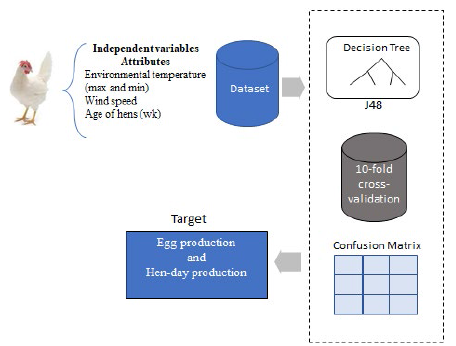
To further explore feature relevance, a derived interaction variable was computed as the product of hen age (weeks) and maximum ambient temperature (°C) and evaluated as a single predictor of feasibility classification using a decision tree model. The data were processed via Weka software with the J48 algorithm to generate the decision tree. The process for the analysis is represented in Fig. 1.

Kappa statistics (κ) were used to test interrater reliability. Rater reliability is essential because it indicates the degree to which the data collected in the study accurately represents the measured variables. κ can range from -1 to +1, where 0 represents the agreement expected from random chance, and 1 represents perfect agreement between the raters. The percentage of correctly classified samples compared with all the samples is called accuracy (Eq. 5); the rate of true positives to all positive predicted samples is called precision (Eq. (6); and the recall is the ratio of precisely predicted positive observations to all observations in the target class (Eq. 7). The confusion matrix was calculated to determine the prediction accuracy via the classification performance.
Where TP = true positives, TN = true negatives, FP = false positives, and FN = false negatives.
The F-measure output (Eq. (8)) is the harmonic mean of the precision and recall; its best value is 1 (perfect precision and recall), and the worst is 0. The F-measure is a metric that evaluates a test’s accuracy. The TP rate is defined as the rate at which the instances are correctly classified into a given class, and the FP rate is the rate at which the instances are incorrectly classified into a given class.
RESULTS
The average flock mortality was 0.5% per week. Only 34.0% of the evaluated flocks had a mortality rate within the recommendations for the genetic strain (‘Good’ index), 33.0% had an ‘acceptable’ index, and 33.0% had a ‘low’ index. To classify hen-day egg production, the model (Fig. 2) achieved a performance with 91% accuracy and a κ value of 0.84.
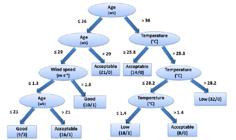
Decision tree for classifying the ‘hen-day egg production’ index of laying hens (n=48,958). The first value in the parentheses is the total number of instances for each scenario (leaf), and the second value is the number of instances incorrectly classified in that leaf.
According to the decision tree, age was the most influential factor in hen-day egg production in laying hens. The average temperature and air speed also affected the hen-day egg production index, but to a lesser degree. Among the target classes evaluated, the ‘Low’ class demonstrated higher performance, with a precision of 98%. When the model classifies the ‘hen-day egg production’ index as ‘low,’ it is correct 98% of the time. The model correctly targeted 49 (‘Low’) and missed only one, misclassifying it as ‘acceptable’ (Table 4).
Two of the eight rules generated by the algorithm (Table 5) refer to the ‘Low’ class. According to Rule 8, the hen-day egg production rate is low for birds over 36 weeks of age, particularly when the average temperature is higher than 28.2 °C. This rule classified 32 cases without error. Rule 6 states that the production index is ‘low’ for birds older than 36 weeks, with an average temperature between 25.8 and 28.2 °C and an air speed of 1.4 m/s or less. This rule shows that thermal stress can be felt even at mild ambient temperatures when ventilation is inadequate. Similarly, the hen-day egg production index decreased as the average air speed increased during hot hours (Fig. 3).
‘If-then’ rules generated by the decision tree for classifying the `hen-day egg production` index (ΔHD).

Decision tree for classifying the ‘hen-day egg production’ index of laying hens (n=48,958). The first value in the parentheses is the total number of instances for each scenario (leaf), and the second value is the number of instances incorrectly classified in that leaf.
In terms of the egg production index, 41% of the results fell within the recommended value established by the genetic strain (‘Good’ egg production index), 41% had an ‘acceptable’ index, and 18% had a ‘low’ index. The decision tree (Fig. 4) was generated to classify egg production with 74% accuracy and a κ value of 0.53.
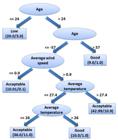
Decision tree for classifying laying hens via the egg production index. The first value in the parentheses is the total number of instances for each scenario (leaf), and the second value is the number of instances incorrectly classified in that leaf.
According to the model, laying hens aged 24 weeks or less presented a ‘low’ egg production index. At ≤24 weeks of age, hens are generally at the onset of laying, known as the pullet-to-lay transition period, during which egg production naturally begins at lower levels before reaching peak performance. Therefore, the observed lower egg production index in this age group reflects the physiological maturation process rather than impaired production (Hy-Line, 2022). For laying hens aged between 24 and 57 weeks, air speed and maximum environmental temperature were the factors that most affected egg production. Egg production was ‘good’ for hens older than 57 weeks.’ A variable that could explain the improvement in production with age is bird physiology. Another factor may be the increase in thermal resistance of the birds due to continuous exposure to heat during growth, which persists until the laying period. The layers were reared nearby and exposed to the same weather conditions. In this model, the class with the highest precision achieved 85% accuracy. Among the 25 cases that were classified as ‘Low,’ the model misclassified 8 cases (which belonged to the ‘Acceptable’ target class) (Table 6).
The model generated six rules (Table 7). Rule 4, whereby hens had the same age and were under the same air speed as in Rule 3 conditions, but with higher temperature, was rated as ‘Good’.
‘If-then’ rules generated by the decision tree for classifying the ‘hen-day egg production’ index (ΔHD).
The average air speed classification was lower for the ‘good’ egg production index and higher for the ‘acceptable’ egg production index. The ‘Low’ egg production index remained intermediate, indicating a significant difference (Fig. 5a). In contrast, the maximum and minimum temperatures varied slightly (Fig. 5b).

Variations in the air speed (a) and the maximum and minimum environmental temperatures (b) for the different egg production indices.
To evaluate the predictive relevance of the interaction between bird age and ambient temperature, a decision tree model was trained using the derived variable “Age × Temperature” as the sole predictor of feasibility classification. The model achieved an overall accuracy of 61%, with the highest predictive performance observed for the “High” feasibility class (precision = 0.89, recall = 0.80, F1-score = 0.84). The “Low” feasibility class was also moderately well predicted (precision = 0.71, recall = 0.56, F1-score = 0.63), while the “Average” class showed lower discriminability (F1-score = 0.18). These results indicate that the interaction between age and thermal environment is a meaningful indicator of production feasibility, particularly for identifying extreme performance categories. However, to improve classification robustness, especially for intermediate cases, additional variables should be incorporated into the model (Table 8).
Classification performance of a decision tree model using the interaction between hen age (weeks) and maximum ambient temperature (°C) as the sole predictor of feasibility classification.
Table 8 presents precision, recall, and F1-score for each feasibility category (High, Average, Low), along with the overall accuracy and class support (number of instances). High precision and recall for the High class indicate strong predictive capability for optimal production conditions. In contrast, moderate performance for the Low class and low discriminability for the Average class suggest that additional variables may be needed to improve classification robustness.
DISCUSSION
In poultry production research, complex datasets reveal nonlinear dependencies and sometimes unknown interactions among variables. This scenario is highly suitable for the application of knowledge discovery analysis. Previous studies have applied machine learning techniques to address analogous scenarios (Ojo et al., 2022; Solis et al., 2024; Subramani et al., 2025).
Although the J48 decision tree algorithm was selected for its interpretability, simplicity, and compatibility with farm-level decision-making, we recognize that alternative machine learning models such as Random Forest, XGBoost, Support Vector Machines (SVM), and Multilayer Perceptron (MLP) offer enhanced predictive capabilities. Future studies should incorporate these models to compare performance in terms of accuracy, generalization through cross-validation, computational efficiency, and model transparency, particularly for real-time decision-support in production environments.
Rule 8 (Table 5) indicated that if hens are older than 36 weeks and housed at an average temperature higher than 28.2 °C, then the ‘hen-day egg production’ rate is ‘low.’ The observed threshold aligns with established thermal comfort zones for layers between 21.0°C and 28.0°C (Kim et al., 2024; Tesakul et al., 2025). The ‘hen-day egg production’ index tended to decrease with increasing mean, minimum, and maximum environmental temperatures (Fig. 5). Housing conditions and flock density often affect egg production (Qi et al., 2023). However, according to Melo et al. (2016), hens subjected to very high environmental temperatures presented a decrease in feed consumption and consequent egg production compared with hens housed at thermoneutral ambient temperatures (Campbell et al., 2017; Nidamanuri et al., 2017; Farag & Alagawany, 2018). Ambient temperature variation regulates feed consumption and can negatively affect the nutrition of birds.
The observed stability or improvement in egg production at moderately elevated temperatures in certain age groups may reflect processes of thermal acclimatization. Chronic exposure to elevated but sublethal temperatures can induce physiological and endocrine adaptations that enhance thermoregulatory efficiency, alter metabolic rates, and modulate reproductive hormone synthesis (Renaudeau et al., 2012; Mack et al., 2013; Kim & Lee, 2023). For instance, adjustments in estradiol and progesterone secretion have been linked to the maintenance of reproductive function under prolonged heat stress (Yan et al., 2022). Furthermore, genetic variability in heat tolerance among poultry strains suggests that some genotypes possess inherent resilience to thermal challenges, enabling sustained productivity in warmer environments (Mack et al., 2013; Yan et al., 2022). These findings support the plausibility of an acclimatization mechanism in the present study and underscore its potential relevance for breeding programs and management strategies under climate change scenarios.
Concerning the six rules generated for the egg production index (Fig. 5) shown in Table 7, rule 4 indicated that hens of the same age under the same air speed and at a housing temperature higher than that found in rule 3 were rated as ‘Good’ egg production. This unexpected finding, whereby egg production remained stable or improved at slightly higher temperatures (Fouad et al., 2016; Nyoni et al., 2018), may reflect a degree of heat acclimatization or adaptation by the hens. Birds continuously exposed to elevated but sublethal temperatures during rearing may undergo physiological adjustments, such as improved thermoregulation, altered endocrine responses, and behavioral adaptations, which can mitigate the adverse effects of heat stress during the laying period (Renaudeau et al., 2012; Mack et al., 2013; Kim & Lee, 2023).
The analysis of the Age × Temperature interaction as a single predictor of feasibility classification revealed that this derived variable captures important biological information related to the combined effects of physiological maturity and thermal load on production performance (Renaudeau et al., 2012; Kim & Lee, 2023). The decision tree model achieved high discriminative ability for the “High” feasibility class, with precision and recall values of 0.89 and 0.80, respectively, indicating that extremely favorable conditions can be reliably identified using this interaction term alone. The “Low” feasibility class was also predicted with moderate accuracy (precision = 0.71, recall = 0.56), reflecting its association with combinations of advanced age and elevated temperatures (Mack et al., 2013; Tesakul et al., 2025). Conversely, the “Average” feasibility class exhibited low classification performance, likely due to overlapping environmental and physiological conditions with the other categories, which diminishes separability in a univariate model (Fouad et al., 2016). These findings suggest that the Age × Temperature interaction is a valuable explanatory feature, particularly for identifying extremes of performance, but its predictive utility for intermediate cases would benefit from the inclusion of additional environmental and management variables in the model (Qi et al., 2023; Kim et al., 2024).
The studied facilities lacked forced ventilation or cooling systems, and natural ventilation is often insufficient in regions with a high prevalence of hot weather, making it challenging to maintain a cool interior temperature (Campbell et al., 2017; Barrett et al., 2019). Different ventilation systems may not be sufficient to improve egg production in harsh environments with temperatures near 29.0 °C and relative humidities above 80.0% (Kim et al., 2020). In the present study, the roof was not insulated and was made of a conductive material, reflecting solar radiation only partially. Therefore, the convective heat path might have been sharply upward. However, we did not observe a difference in egg production in the upper cages. Additionally, despite potential differences in microclimate between cage tiers, no significant variation in egg production was detected among the different vertical cage levels. This outcome suggests that the natural ventilation and airflow distributions within the open-sided facility were relatively uniform across tiers during the study period.
Poultry responses vary according to the duration and intensity of thermal stress (Quinteiro-Filho et al., 2010; Fouad et al., 2016). For laying hens under hot conditions, total nutrient intake is insufficient to support the standard rate of laying (Barrett et al., 2019). Consequently, egg production decreases when hens are exposed to chronic heat stress. The laying peak decreases, and egg production decreases faster at 31.0 °C than under thermoneutral conditions (Renaudeau et al., 2012). However, in the present study, the inflection point in environmental temperature was near 27.4 °C, indicating that extreme environmental temperatures rarely reach the limit of 31.0 °C (acute heat stress) (Kim et al., 2020; Kim et al., 2024). It is essential to distinguish between the effects of chronic and acute heat stress. Chronic heat stress refers to prolonged exposure to moderately elevated temperatures over several weeks or months, resulting in cumulative physiological strain, reduced feed intake, hormonal imbalances, and a gradual decline in egg production. In contrast, acute heat stress results from sudden and short-term exposure to extremely high temperatures, often causing immediate disturbances in thermoregulation, rapid declines in productivity, and increased mortality rates (Renaudeau et al., 2012; Kim et al., 2020). The present study primarily captured chronic heat stress conditions, as the environmental temperatures seldom reached extreme levels associated with acute stress.
Beyond its predictive accuracy, the proposed decision tree approach offers clear, actionable insights for on-farm decision-making. For example, Rule 6 of the hen-day egg production model identifies a heightened risk of low production in flocks older than 36 weeks when the mean ambient temperature exceeds 25.8 °C and air speed is below 1.4 m/s. In practice, this information allows farm managers to take preventive actions, such as increasing ventilation rates, reducing stocking density, or applying targeted cooling strategies during warm periods for these specific flocks. By translating model outputs into practical management guidelines, the decision tree serves as a user-friendly tool that can be integrated into routine operations to prevent productivity losses and optimize environmental control, thereby enhancing both animal welfare and farm profitability.
The present study was limited by the use of data from a commercial farm, which did not control for environmental variables. However, it represents an actual egg production farm arrangement. New studies using a larger dataset, more flocks, and varying weather conditions should be conducted to expand the applicability of the models.
CONCLUSION
The hen-day egg production model achieved high accuracy (91%), and the egg production model performed moderately well (74%) in terms of the variables of age, average air speed, and moderate ambient temperature under tropical conditions. The flowchart-like tree structure graphs are simple to understand and may allow on-farm management strategies to improve decision-making. Two decision tree models were developed to forecast the impact on production with easy-to-record variables. The hen-day egg production and egg production indices were lower than expected, and the results were affected by the age of the hens and weather variables, including temperature and air speed.
ACKNOWLEDGEMENTS
The authors thank the Brazilian Coordination for the Promotion of Graduate Studies (CAPES) and the National Council for Scientific and Technological Development (CNPq) for the scholarships awarded to the authors.
REFERENCES
-
Barrett N, Rowland K, Schmidt C, et al. Effects of acute and chronic heat stress on the performance, egg quality, body temperature, and blood gas parameters of laying hens. Poultry Science 2019;98(12):6684-92. https://doi.org/10.3382/ps/pez541
» https://doi.org/10.3382/ps/pez541 -
Campbell DLM, Lee C, Hinch GN, et al. Egg production and quality in free-range laying hens housed at different outdoor stocking densities. Poultry Science 2017;96(9):3128-37. https://doi.org/10.3382/ps/pex107
» https://doi.org/10.3382/ps/pex107 -
Du Y, Liu L, He Y, et al. Endocrine and genetic factors affecting egg laying performance in chickens: a review. British Poultry Science 2020;61(5):538-49. https://doi.org/10.1080/00071668.2020.1758299
» https://doi.org/10.1080/00071668.2020.1758299 - Eibe F, Hall MA, Witten IH. The WEKA workbench. online appendix for data mining: practical machine learning tools and techniques. 4th ed. Massachusetts, USA: Morgan Kaufmann; 2016.
-
FAO - Food and Agriculture Organization of the United Nations. FAOSTAT. Rome: 2023 [cited 2025 Jan 10]. Available from: https://www.fao.org/faostat/en/#home
» https://www.fao.org/faostat/en/#home -
Farag M, Alagawany M. Physiological alterations of poultry to the high environmental temperature. Journal of Thermal Biology 2018;76:101-6. https://doi.org/10.1016/j.jtherbio.2018.07.012
» https://doi.org/10.1016/j.jtherbio.2018.07.012 -
Fouad AM, Chen W, Ruan D, et al. Impact of heat stress on meat, egg quality, immunity and fertility in poultry and nutritional factors that overcome these effects: A review. International Journal of Poultry Science 2016;15:81-95. https://doi.org/10.3923/ijps.2016.81.95
» https://doi.org/10.3923/ijps.2016.81.95 -
Ghoname M, Elnaggar A, Hassan S, et al. Effect of acute heat stress on production performance and egg quality in four strains of chickens. South African Journal of Animal Science 2022;52(2):168-76. https://doi.org/10.4314/sajas.v52i2.6
» https://doi.org/10.4314/sajas.v52i2.6 -
Hy-Line. Management guide Hy-Line(r) W36. 2022 [cited 2022 Dec 20]. Available from: https://www.hyline.com/filesimages/Hy-Line-Products/Hy-Line-Product-PDFs/W-80/80PLUS%20COM%20ENG.pdf
» https://www.hyline.com/filesimages/Hy-Line-Products/Hy-Line-Product-PDFs/W-80/80PLUS%20COM%20ENG.pdf -
IBGE - Instituto Brasileiro de Geografia e Estatística. Pesquisa trimestral da produção de ovos de galinha. 2020 [cited 2024 Dec 20]. Available from: https://www.ibge.gov.br/estatisticas-novoportal/economicas/agricultura-e-pecuaria/9216-pesquisa-trimestral-da-producao-de-ovos-de-galinha.html?=&t=series-historicas
» https://www.ibge.gov.br/estatisticas-novoportal/economicas/agricultura-e-pecuaria/9216-pesquisa-trimestral-da-producao-de-ovos-de-galinha.html?=&t=series-historicas -
INMET- Instituto Nacional de Meteorologia. Portal 2023 [cited 2024 Dec 21]. Available from: http://www.inmet.gov.br/portal/
» http://www.inmet.gov.br/portal -
Kim D, Lee Y, Kim S, et al. The impact of temperature and humidity on the performance and physiology of laying hens. Animals 2020;11(1):56. https://doi.org/10.3390/ani11010056
» https://doi.org/10.3390/ani11010056 -
Kim DH, Lee KW. An update on heat stress in laying hens. World's Poultry Science Journal 2023;79(4):689-712. https://doi.org/10.1080/00439339.2023.2239769
» https://doi.org/10.1080/00439339.2023.2239769 -
Kim DH, Lee YK, Lee SD, et al. Impact of relative humidity on the laying performance, egg quality, and physiological stress responses of laying hens exposed to high ambient temperature. Journal of Thermal Biology 2022;103:103167. https://doi.org/10.1016/j.jtherbio.2021.103167
» https://doi.org/10.1016/j.jtherbio.2021.103167 -
Kim HR, Ryu C, Lee SD, et al. Effects of heat stress on the laying performance, egg quality, and physiological response of laying hens. Animals (Basel) 2024;14(7):1076. https://doi.org/10.3390/ani14071076
» https://doi.org/10.3390/ani14071076 -
Lara LJ, Rostagno MH. Impact of heat stress on poultry production. Animals 2013;3(2):356-69. https://doi.org/10.3390/ani3020356
» https://doi.org/10.3390/ani3020356 -
Lay DC Jr, Fulton RM, Hester PY, et al. Hen welfare in different housing systems. Poultry Science 2011;90(1):278-94. https://doi.org/10.3382/ps.2010-00962
» https://doi.org/10.3382/ps.2010-00962 -
Leishman EM, You J, Ferreira NT, et al. When worlds collide-poultry modeling in the 'Big Data'era. Animal 2023;17(9):100874. https://doi.org/10.1016/j.animal.2023.100874
» https://doi.org/10.1016/j.animal.2023.100874 -
Li G, Liu L, Yin B, et al. Heat stress decreases egg production of laying hens by inducing apoptosis of follicular cells via activating the FasL/Fas and TNF-a systems. Poultry Science 2020;99(12):6084-93. https://doi.org/10.1016/j.psj.2020.07.024
» https://doi.org/10.1016/j.psj.2020.07.024 -
Li YR, Qi R, Li H, et al. Study on the changing patterns of production performance of laying hens and their relationships with environmental factors in a large-scale henhouse. Poultry Science 2024;103(11):104185. https://doi.org/10.1016/j.psj.2024.104185
» https://doi.org/10.1016/j.psj.2024.104185 -
Mack LA, Felver-Gant JN, Dennis RL, et al. Genetic variations alter production and behavioral responses following heat stress in 2 strains of laying hens. Poultry Science 2013;92(2):285-94. https://doi.org/10.3382/ps.2012-02589
» https://doi.org/10.3382/ps.2012-02589 -
Nawab A, Ibtisham F, Li G, et al. Heat stress in poultry production: Mitigation strategies to overcome the future challenges facing the global poultry industry. Journal of Thermal Biology 2018;78:131-9. https://doi.org/10.1016/j.jtherbio.2018.08.010
» https://doi.org/10.1016/j.jtherbio.2018.08.010 -
Nidamanuri A, Murugesan S, Mahapatra R. Effect of heat stress on physiological parameters of layers - a review. International Journal of Livestock Research 2017;7(3):1-17. https://doi.org/10.5455/IJLR.20170312042324
» https://doi.org/10.5455/IJLR.20170312042324 -
Nyoni NMB, Grab S, Archer ERM. Heat stress and chickens: climate risk effects on rural poultry farming in low-income countries. Climate and Development 2018;11(6):543-9. https://doi.org/10.1080/17565529.2018.1442792
» https://doi.org/10.1080/17565529.2018.1442792 -
Ojo RO, Ajayi AO, Owolabi HA, et al. Internet of things and machine learning techniques in poultry health and welfare management: a systematic literature review. Computers and Electronics in Agriculture 2022;200:107266. https://doi.org/10.1016/j.compag.2022.107266
» https://doi.org/10.1016/j.compag.2022.107266 -
Pettersson IC, Weeks CA, Wilson LRM, et al. Consumer perceptions of free-range laying hen welfare. British Food Journal 2016;118(8):1999-2013. https://doi.org/10.1108/BFJ-02-2016-0065
» https://doi.org/10.1108/BFJ-02-2016-0065 -
Qi F, Zhao X, Shi Z, et al. Environmental factor detection and analysis technologies in livestock and poultry houses: a review. Agriculture (Basel) 2023;13(8):1489. https://doi.org/10.3390/agriculture13081489
» https://doi.org/10.3390/agriculture13081489 -
Quinteiro-Filho WM, Ribeiro A, Ferraz-de-Paula V, et al. Heat stress impairs performance parameters, induces intestinal injury, and decreases macrophage activity in broiler chickens. Poultry Science 2010;89(9):1905-14. https://doi.org/10.3382/ps.2010-00812
» https://doi.org/10.3382/ps.2010-00812 -
Renaudeau D, Collin A, Yahav S, et al. Adaptation to hot climate and strategies to alleviate heat stress in livestock production. Animal 2012;6:707-28. https://doi.org/10.1017/S1751731111002448
» https://doi.org/10.1017/S1751731111002448 -
Riquena RS, Pereira DF, Vale MM, et al. Mortality prediction of laying hens due to heat waves. Revista de Ciência Agronômica 2019;50(1):18-26. https://doi.org/10.5935/1806-6690.20190003
» https://doi.org/10.5935/1806-6690.20190003 -
Solis IL, Oliveira-Boreli FP de, Sousa RV de, et al. Using thermal signature to evaluate heat stress levels in laying hens with a machine-learning-based classifier. Animals 2024;14(13):1996. https://doi.org/10.3390/ani14131996
» https://doi.org/10.3390/ani14131996 -
Subramani T, Jeganathan V, Kunkuma Balasubramanian S. Machine learning and deep learning techniques for poultry tasks management: a review. Multimed Tools and Applications 2025;84(2):603-45. https://doi.org/10.1007/s11042-024-18951-0
» https://doi.org/10.1007/s11042-024-18951-0 -
Tesakul S, Mitsuwan W, Morita Y, et al. Effects of heat stress on egg performance in laying hens under hot and humid conditions. Veterinary World 2025;18(4):851. https://doi.org/10.14202/vetworld.2025.851-858
» https://doi.org/10.14202/vetworld.2025.851-858 -
Valletta JJ, Torney C, Kings M, et al. Applications of machine learning in animal behaviour studies. Animal Behaviour 2017;124:203-20. https://doi.org/10.1016/j.anbehav.2016.12.005
» https://doi.org/10.1016/j.anbehav.2016.12.005 -
Wasti S, Sah N, Mishra B. Impact of heat stress on poultry health and performances, and potential mitigation strategies. Animals 2020;10(8):1266. https://doi.org/10.3390/ani10081266
» https://doi.org/10.3390/ani10081266 -
Wu X, Zheng B, Mei Z, et al. Key parameters of physiological responses to acute heat stress in two commercial layers determined by Fisher discriminant analyses. Journal of Thermal Biology 2023;117:103694. https://doi.org/10.1016/j.jtherbio.2023.103694
» https://doi.org/10.1016/j.jtherbio.2023.103694 -
Yan L, Hu M, Gu L, et al. Effect of heat stress on egg production, steroid hormone synthesis, and related gene expression in chicken preovulatory follicular granulosa cells. Animals 2022;12(11):1467. https://doi.org/10.3390/ani12111467
» https://doi.org/10.3390/ani12111467
-
REVIEW BOARD STATEMENT
All ethical principles and compliance were adhered to, following the ethical standards outlined in the 1964 Declaration of Helsinki and its subsequent amendments. This study’s ethical review and approval were waived because it was carried out on a commercial farm, and the breeder’s guide was followed.
-
FUNDING
This research received no external funding.
-
DATA AVAILABILITY STATEMENT
Data are available from the corresponding author upon reasonable request.
-
DISCLAIMER/PUBLISHER’S NOTE
The published papers’ statements, opinions, and data are those of the individual author(s) and contributor(s). The editor(s) disclaim responsibility for any injury to people or property resulting from any ideas, methods, instructions, or products referred to in the content.
Data are available from the corresponding author upon reasonable request.