Yoga and cancer-related fatigue during breast cancer treatment: protocol for a randomized clinical trial
ABSTRACT
Cancer-related fatigue is one of the symptoms that most impacts the quality of life of patients undergoing treatment for breast cancer. Yoga has been used as a non-pharmacological intervention to alleviate symptoms during breast cancer treatment. However, further studies are needed to elucidate and fill possible gaps regarding the effects of Yoga in this population. This article describes the protocol for a randomized clinical trial that aims to analyze the effects of a Yoga program, compared to a control group, on the physical and psychological outcomes of patients diagnosed with breast cancer, undergoing treatment within the Unified Health System (Sistema Único de Saúde - SUS) in the city of Pelotas, Rio Grande do Sul. Thirty women will be randomized into a Yoga or control group. Participants in the Yoga group will undergo a Yoga program associated with health education, twice a week for eight weeks, with each session lasting 60 minutes. The control group will participate only in health education meetings, once a week, also for eight weeks with sessions of 60 minutes. Assessments of cancer-related fatigue, quality of life, pain, functional capacity, and level of leisure-time physical activity will be performed before and after the intervention. Data will be analyzed using Generalized Estimating Equations and Bonferroni post-hoc tests (α = 0.05). The study protocol is registered in the Brazilian Clinical Trials Registry under number RBR- 6vk2vjr.
Keywords:
Breast neoplasm; Physical activity; Quality of life; Mindfulness.
RESUMO
A fadiga relacionada ao câncer é um dos sintomas que mais impacta a qualidade de vida de pacientes em tratamento para o câncer de mama. A prática de Yoga vem sendo utilizada como intervenção não farmacológica para atenuar os sintomas durante o tratamento para o câncer de mama. No entanto, são necessários mais estudos, a fim de elucidar e preencher possíveis lacunas acerca dos efeitos da prática de Yoga nesta população. Este artigo descreve o protocolo de um ensaio clínico randomizado que tem como objetivo analisar os efeitos de um programa de Yoga, em comparação com um grupo controle, sobre desfechos físicos e psicológicos de pacientes diagnosticadas com câncer de mama em tratamento pelo Sistema Único de Saúde (SUS) na cidade de Pelotas-Rio Grande do Sul. Trinta mulheres serão randomizadas em grupo Yoga ou controle. As participantes do grupo Yoga serão submetidas a um programa de Yoga, associado com educação em saúde, duas vezes por semana durante oito semanas, com duração de 60 minutos cada sessão. O grupo controle participará apenas de encontros de educação em saúde, uma vez por semana, também durante oito semanas e com encontros de 60 minutos. Serão realizadas avaliações da fadiga relacionada ao câncer, qualidade de vida, dor, capacidade funcional e nível de atividade física no lazer pré e pós-intervenção. Para analisar os dados será utilizado o teste Generalized Estimating Equations e post-hoc de Bonferroni (α = 0,05). O protocolo do estudo está registrado no Registro Brasileiro de Ensaios Clínicos sob o número RBR-6vk2vjr.
Palavras-chave:
Neoplasia mamária; Atividade física; Qualidade de vida; Atenção plena.
Introduction
The incidence and mortality from cancer are increasing rapidly worldwide, largely due to population aging and growth, as well as changes in the prevalence and distribution of major cancer risk factors1,2. Breast cancer is the most common cancer in women worldwide, disproportionately affecting lowand middle-income countries. Breast cancer accounts for 24.5% of all types of cancer diagnosed in women3. There may be several causes of breast cancer, which is more common in women, with men accounting for only 1% of the cases diagnosed. Age is one of the most important risk factors for the disease, since around four out of every five cases of breast cancer occur in women over 50 years of age and only 5 to 10% of all cases correspond to genetic/hereditary factors4.
Breast cancer treatment can be local (surgery and radiotherapy) or systemic (chemotherapy, hormone therapy, and biological therapy)5, and in recent years important advances have been made in both the diagnosis and in different approaches to treating breast cancer. Despite this positive advance in drug therapies for breast cancer, the quality of life of patients undergoing treatment is still negatively impacted. Women undergoing treatment for breast cancer experience emotional and psychological distress, functional impairment, pain, and fatigue6.
Among the possible effective non-pharmacological interventions to mitigate the adverse effects of cancer treatment, physical exercise stands out7. In this sense, according to Carson et al.8, Yoga, as a mind-body practice, has been shown to have a positive impact on the psychological and functional health of breast cancer patients and survivors. Similarly, Patel et al.9 evaluated the benefits perceived by patients who practiced Yoga during and/or after breast cancer treatment and showed that the majority of respondents (89.4%) reported symptomatic benefits from practicing Yoga. However, data supporting the use of yoga for symptom management after cancer diagnosis are limited and generally focus on mental health9. Furthermore, the type, intensity, and appropriate dosage for individuals in different treatment periods require further clarification10.
An important and frequent symptom in women undergoing treatment for breast cancer, which negatively impacts quality of life, is cancer-related fatigue, which is understood as a multidimensional and highly subjective experience11. Approximately 50 to 90% of cancer patients report suffering from cancer-related fatigue12. Hou et al.13 aimed, in a systematic review study with meta-analysis, to evaluate the effects of Yoga on cancer-related fatigue in patients with breast cancer. Although the authors state that Yoga can alleviate fatigue in patients with breast cancer, the studies included in the meta-analysis present distinct methodological approaches regarding the timing and frequency of the intervention and the way cancer-related fatigue is measured. Therefore, caution should be exercised when interpreting the results of the study.
Considering that cancer-related fatigue is reported as one of the most substantial problems in women undergoing treatment for breast cancer14,15, its choice as the primary outcome in the present study is justified. In this context, the main objective of the current study was to analyze the effects of a Yoga program, in comparison with a control group, on physical and psychological outcomes of patients during treatment for breast cancer in stages I-III, in order to elucidate and fill possible gaps regarding the effects of Yoga practice in this population.
Methods
Study design
The current study describes the methodological approach of a randomized clinical trial with two parallel arms. The study is being developed at the Teaching Hospital of the Federal University of Pelotas (Universidade Federal de Pelotas - UFPel) and consists of eight weeks of a Yoga program associated with health education, compared to a control group that will receive only a health education program. The study protocol is reported in accordance with the SPIRIT16 recommendations, and was approved by the Research Ethics Committee of the Higher School of Physical Education and Physiotherapy (Escola Superior de Educação Física e Fisioterapia - ESEF) of UFPel (6.185.558), and registered on the Brazilian Clinical Trials Registry platform (ReBEC: 6vk2vjr; https://ensaiosclinicos.gov.br/rg/RBR-6vk2vjr).
Eligibility criteria for participants
Participants in the current study are women from the city of Pelotas, located in the state of Rio Grande do Sul, in the southern region of Brazil, with confirmed breast cancer. To be included in the sample, participants are required to meet the following inclusion criteria: be 18 years of age or older; have been diagnosed with stage I-III breast cancer; be undergoing or have undergone chemotherapy treatment less than six months previously (can be still undergoing radiotherapy or hormonal treatment); not have active metastatic or locoregional disease; and not be engaged in regular exercise programs for more than 75 minutes per week. As exclusion criteria, women cannot have physical or mental conditions or a clinical history that prevents them from practicing physical exercise.
Recruitment
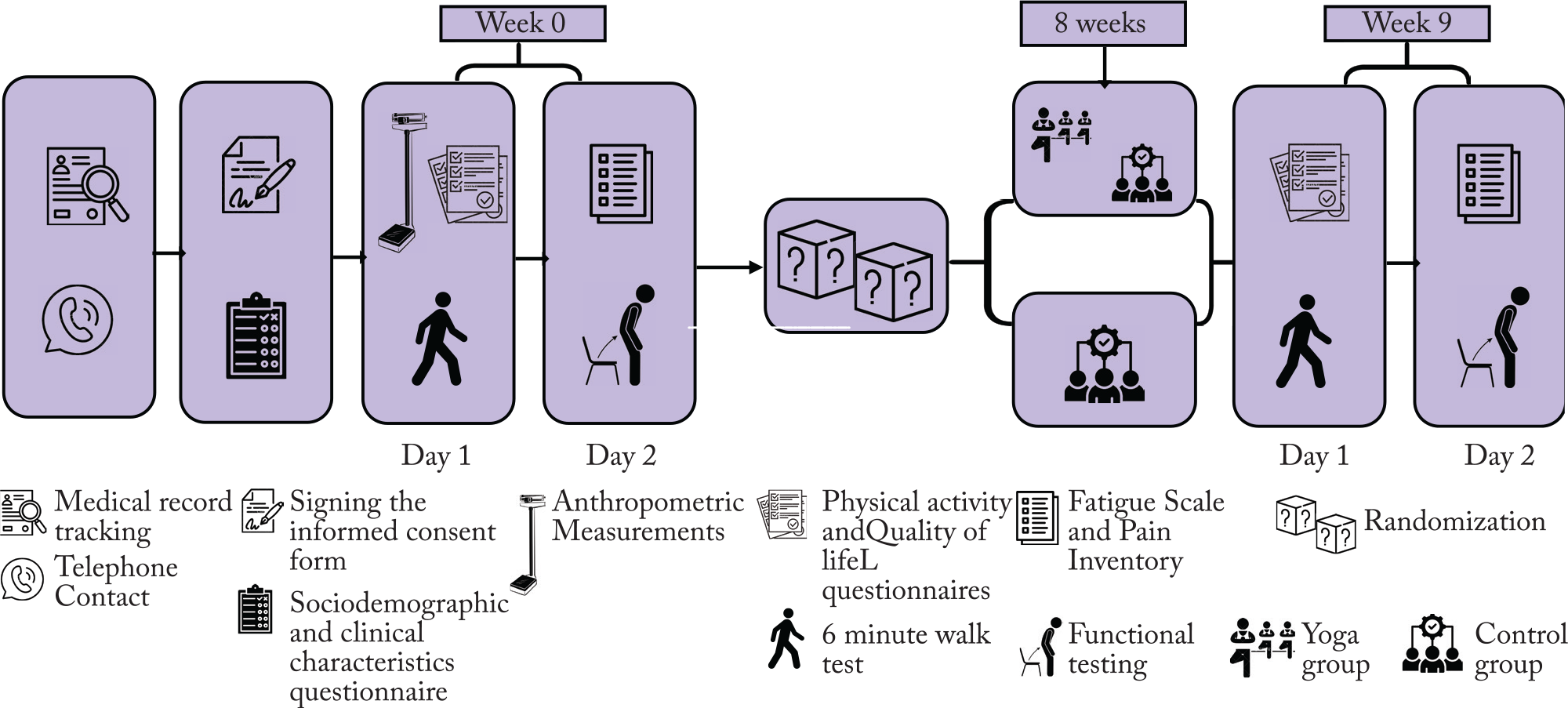
Participants are being recruited through medical record tracking and pamphlet distribution at the Oncology Department of the UFPel Teaching Hospital. The department offers oncology services in the southern region and patient attendance is fully covered by the Unified Health System (Sistema Único de Saúde - SUS). After this contact, participants who are considered eligible and agree to participate in the study are invited to participate in an interview with the researchers. During this interview, the details of the study are explained, the eligibility criteria are confirmed, and the informed consent form is signed. During this same meeting, the sociodemographic and clinical characteristics of the participants are collected.
Randomization
Randomization is performed by a researcher not involved in other research procedures and occurs in a 1:1 ratio. Blocks with even numbers of four or eight participants are generated, with the block size planned to consider the Yoga or control groups. The consultation of the allocated group for each participant is carried out on a subject-by-subject basis by the same researcher (not involved in the assessments or interventions). The allocation of participants to one of the groups is according to the order in which the pre-intervention measures are completed.
Sample size
To define the number of participants, the sample size calculation was performed using the GPower program, version 3.1, adopting a significance level of α = 0.05 and a power of 80%. The data for calculating the sample size were extracted from the results of the study of Buffart et al.17 for the primary outcome of cancer-related fatigue (Cohen’s f = 0.26), resulting in a total n of 20 participants. Considering the possibility of sample losses, 10 additional participants will be included in the study, totaling 30 participants, 15 in each group.
Intervention and control
The intervention period lasts eight weeks and participants in both groups are assessed before (week 0) and after the intervention (week 9). The tests are performed on alternate days to avoid fatigue. The assessments of each participant are performed by the same evaluator, blinded to the allocation group.
Participants in the control group attend meetings once a week, each session lasting 60 minutes. Additionally, each participant receives a self-care booklet containing information about the topics covered during the meetings. The meetings follow a standard scriptto contextualize the theme, lasting approximately 25 minutes. During the remaining time of each meeting, participants can share, if they wish, their perceptions, knowledge, and experiences related to the theme of the week. The meetings address the following topics in order: 1. Body image; 2. Arm and breast symptoms and vasomotor symptoms; 3. Cancer-related fatigue; 4. Cognitive function; 5. Depressive symptoms and anxiety; 6. Pain and peripheral neuropathy; 7. Sexuality; 8. Physical activity and eating habits.
Patients allocated to the Yoga group participate in a practical intervention with group Yoga classes for eight weeks, associated with health education. The training takes place twice a week, on non-consecutive days, lasting 60 minutes. There is an individual form for each participant to record the perceived exertion index, measured by the Borg scale (0-10)18 at the end of each session. This form is also used to record reports of pain, discomfort, well-being, motivation, and limitations to perform the activity. The planning for the eight weeks of Yoga is described in Chart 1.
After guided meditation during the yoga session, the instructor discusses a health education topic based on the same content planned for the control group according to the week of the intervention, but in a shorter format, lasting around 15 minutes in each weekly session. This group also receives a self-care booklet at the beginning of the intervention.
Criteria for discontinuing participation in the study
Participants can discontinue participation in the study by withdrawing consent, due to lack of interest or motivation. Participation may also be discontinued for safety reasons, complications of the disease, or on medical advice. In addition, serious health events during the study may lead to discontinued participation in the study.
Strategies for retention in the study
Participants allocated to the Yoga group are invited to join a WhatsApp group, where they receive material on the benefits of practicing Yoga, mantras and breathing exercises. In addition, all study participants receive private messages reminding them of the days and times of classes and questions about possible discomforts related to the study or treatment.
Outcomes
With the exception of anthropometric measurements, all outcomes are measured at baseline (week 0) and post-intervention (week 9). Assessments are performed on two days, at least 48 hours apart. The primary outcome is cancer-related fatigue, assessed using the fatigue questionnaire, the Piper Fatigue Scale19. Cancer-related fatigue was chosen as the primary outcome because it is one of the most prevalent symptoms in cancer patients12.
The secondary outcomes of the study are leisure-time physical activity level, quality of life, functional capacity, and pain. These were chosen because they are impacted by breast cancer treatment.
Other outcomes
Anthropometric measurements are used to characterize the sample. For both groups, adherence to the program is recorded as absolute and relative frequency of the number of sessions performed in the eight weeks of intervention. In addition, possible adverse events are recorded in all sessions. Adverse events are collected and classified according to severity, predictability, and potential relationship with the study procedures. These records are collected throughout the eight weeks.
Data collection
Researchers previously trained to use the data collection instruments and protocols perform the preand post-intervention assessments. The study schedule is presented in Table 1. Two days of assessments are carried out, as shown in the experimental design in Figure 1.

Primary outcome
-
Cancer-related fatigue: Perception of fatigue is assessed using the Piper Fatigue Scale questionnaire. The version translated into Portuguese is considered valid and reproducible19, and is one of the most widely used scales in cancer studies. The questionnaire consists of 22 items with a numerical scale of 0-10, with zero representing no fatigue and 10 representing severe levels of fatigue. The questionnaire contains four subscales for validation of four fatigue domains: behavioral, affective, sensory, and cognitive-emotional.
Secondary outcomes
-
Physical activity: The Godin-Shepard self-administered physical activity questionnaire is used in its validated version and translated into Brazilian Portuguese 20. Participants are asked to report the number of times per week that they practice vigorous, moderate, and light physical activities for a period of more than 15 minutes. The frequency is multiplied by a specific coefficient for each intensity, which corresponds to the metabolic equivalent of the task. Higher scores indicate a higher level of physical activity during leisure time.
-
Quality of life: Quality of life is assessed using the Functional Assessment of Cancer Therapy-Breast (FACT-B) questionnaire, specific to breast cancer and developed by Brady et al.21. The version translated into Portuguese has been validated and considered reproducible22. The participant answers 37 items related to general quality of life, the Functional Assessment of Cancer Therapy-General (FACT-G), and nine on specific problems related to breast cancer. This system presents a five-point scale; the higher the score, the higher the individual’s quality of life. The questionnaire assesses physical well-being, family well-being, emotional domain, functional domain, additional concerns - breast cancer, and additional concerns - arm.
-
Functional Capacity: To assess functional capacity we use the Senior Fitness Test23, which consists of a validated battery for older individuals, including six tests: 6-minute walk, 30-second chair stand, arm curl, chair sit-and-reach, 8-foot up-and-go, and back scratch. Before each test, the tasks are demonstrated by the evaluator and the participants performs some repetitions to familiarize themselves with the tests.
The 6-minute walk test is performed to measure aerobic fitness. The 30 m walk is performed on a flat surface marked by cones every 3 m. The participant is instructed to walk as far as possible for 6 minutes. The total distance walked (in m) is recorded.
The chair sit-to-stand test is performed to measure the endurance strength of the lower limbs. The test begins with each participant sitting on a 17-inch chair, with their back supported and their feet flat on the floor. The participant is instructed to stand up and then return to a sitting position, keeping their arms crossed, completing as many repetitions as possible in 30 seconds. The number of correct repetitions completed is recorded. The elbow flexion test is performed to measure upper limb strength. The test begins with each participant sitting in a chair, with their back supported, holding a 2 kg dumbbell in their dominant hand and their feet flat on the floor. The participant is instructed to flex the elbow, with supination of the radioulnar joint, and return to the starting position, completing as many repetitions as possible in 30 seconds. The number of correct repetitions completed is recorded. The test is repeated with the non-dominant hand.
The sit-and-reach test is performed to measure lower limb flexibility. The test begins with each participant sitting on the front edge of a chair with one knee extended, the ankle in dorsiflexion, and the heel resting on the floor (the other leg with the knee flexed and the foot supported). The participant is instructed to lean forward with one hand above the other to reach as close to (or beyond) the toes as possible. The evaluator records, with a ruler, the distance (in cm) that is missing to reach (negative score) or that goes beyond (positive score) the toes. The best result of two attempts is considered.
The behind-the-back reach test is performed to measure upper limb flexibility. The test begins with each participant standing with the preferred hand on the same shoulder and the other hand placed behind the back below the shoulder. The participant is instructed to try to touch (or overlap) the fingers of the hands behind the back. The evaluator records with a ruler the distance (in cm) that is missing to reach (negative score) or that overlaps (positive score) the middle fingers. The best result of two attempts is considered.
The stand, go and return test is performed to measure physical mobility, agility, and dynamic balance. The test begins with each participant sitting on a 43 cm chair positioned 2.44 m away from a cone. The participant is instructed to get up from the chair and walk as quickly as possible until he/she turns around the cone and returns to the sitting position. The time taken to perform the task (in s) is recorded. The best result of two attempts is considered.
-
Pain Level: Pain levels are assessed using the Brief Pain Inventory (BPI)24. This instrument consists of nine multidimensional items that assess pain intensity, pain interference in the patient’s life, pain location, and treatments for pain control and relief 25. The responses (scales from 0 to 10) should correspond to the pain felt at the time of the questionnaire and in the previous 24 hours. The scores are calculated by averaging the total number of items; the higher the score, the greater the severity of the pain.
Other outcomes
-
Anthropometric assessment: To characterize the sample, measurements of body mass, height, waist and hip circumference, waist-hip ratio26, waistheight ratio26, and body mass index are taken.
-
Adherence and adverse events: For both groups, adherence to the groups is recorded as absolute and relative frequency of the number of sessions performed in the eight weeks of intervention. In addition, possible adverse events are recorded in all sessions. Adverse events are classified according to severity (mild, moderate, or severe), predictability (expected or unexpected), and the potential relationship to study procedures (definitely related, possibly related, or not related). These outcomes are collected throughout the eight weeks.
Data management
The collected data will be double-entered into Excel spreadsheets. The identity of the participants will be preserved and identified by their identification number (ID) and their data will be stored in a database and kept strictly confidential, to which only the study coordination team will have access. A specific researcher will verify missing or inaccurate data.
Statistical analysis
To describe the sample characterization variables, the mean and standard deviation, and the absolute and relative frequencies will be used. The normality and homogeneity of the numerical sample characterization variables will be verified through the Shapiro-Wilk and Levene tests, respectively. Generalized Estimating Equations (GEE) and Bonferroni Post-hoc will be used to compare preand post-intervention moments and intervention and control groups. Statistical analyses will be performed by protocol and intention-to-treat. The statistical package SPSS 20.0 will be used
Ethics and disclosure
Amendments to the protocol: If changes to the study protocol are necessary, they will be communicated to the Human Research Ethics Committee of the ESEF of UFPel (Brazil) and the clinical trial registration protocol will also be updated.
Access to data
Databases derived from the study will be available upon request with justification by contacting the corresponding author, as will the full protocol, without violating participant confidentiality.
Additional care after completion of the study
After completing the study, participants will receive a report with their measurements and interpretations that is easy for lay people to understand, as well as general guidance on breast cancer, care during treatment, and physical activity. All participants interested in continuing to practice physical exercise will be invited to take part in the ERICA extension project carried out at ESEF/UFPel. This project offers a free supervised physical exercise program for breast cancer survivors.
Disclosure policy
The results of the study will be disseminated to as many interested parties as possible through articles in local newspapers and social media. In addition, scientific dissemination will be carried out through presentations of the results of the study at events and through scientific articles submitted to journals.
Status of the study
This manuscript is based on the research protocol approved on 12/08/2023. Patient recruitment began in December 2023 and will be completed in September 2024, and is ongoing at the time of submission of this article.
Discussion
The randomized clinical trial that this protocol article describes aims to analyze the effects of a structured and systematized Yoga program associated with health education, carried out in a hospital environment, for women undergoing treatment for breast cancer, with the aim of expanding and understanding the potential of this mind-body practice to minimize the adverse effects of the disease and its treatment. We believe in the potential of Yoga as a complementary therapy for breast cancer, as its practice results in improvementsin health outcomes, especially related to mental health, for people diagnosed with cancer17,27.
Our expectation is that a short-term Yogaprogram (i.e., 8 weeks) associated with health education will positively impact the studied outcomes, especially cancer-related fatigue, compared to the group that participates only in the health education program. This hypothesis is supported by the fact that previous studies in the literature show that Yoga significantly improves the perception of fatigue in women who have been diagnosed with breast cancer13,28,29. However, it is important to emphasize that, although it is well established that Yoga can alleviate symptoms of fatigue in breast cancer survivors, there is still a gap regarding the effects of this practice in the different phases of breast cancer treatment28. Furthermore, standardization of Yoga interventions is crucial to optimize the benefits of its practice30. By addressing these gaps, we can further increase the potential for implementing Yoga as a complementary therapy for breast cancer patients.
Given the need for new studies that contribute to elucidating and expanding knowledge of Yoga as a complementary therapy for breast cancer, we proposea standardized and systematized Yoga intervention lasting eight weeks, during which the effects of the practice on the physical and psychological outcomes of patients undergoing treatment for breast cancer will be analyzed. Our study has strengths that should be highlighted, such as the fact that it will be carried out in a hospital environment and that it presents interventions that are easy to apply, as they require few materials. However, we emphasize that the Yoga sessions need to be taught by a professional, trained in this method. Another strong point to be highlighted is the fact that our study was carried out with women during breast cancer treatment, since evidence with this type of intervention is still scarce for this phase. However, since this protocol proposes an intervention applied during treatment, adherence to the study may be a challenge and, consequently, impact the measured outcomes. Finally, we emphasize that the sample size calculation of our study was performed only for the primary outcome of cancer-related fatigue. Therefore, the analysis of secondary outcomes should be interpreted with caution and followed by an a posteriori power calculation.
-
Funding
The authors declare that this study did not receive funding. The principal investigator provided the materials used in this clinical trial. Educational support and equipment were provided by ESEF/UFPel. Alberton CL received an individual grant from National Council for Scientific and Technological Development (Conselho Nacional de Desenvolvimento Científico e Tecnológico - CNPq), protocol number 315430/2021-4.
-
Declaration regarding the use of artificial intelligence tools in the article writing process
The authors did not use artificial intelligence tools for preparation of the manuscript.
Acknowledgements
The authors would like to thank the staff of the Oncology service at the UFPel Teaching Hospital for their assistance with the procedures related to the study.
Availability of research data and other materials
Data are available upon request from the reviewers.
References
-
1 Jemal A, Bray F, Centro MM, Ferlay J, Ward E, Forman D. Global cancer statistics. CA Cancer J Clin. 2011;61(Suppl 2):69-90. doi: https://doi.org/10.3322/caac.20107
» https://doi.org/10.3322/caac.20107 -
2 Bray F, Ferlay J, Soerjomataram I, Siegel RL, Torre AL, Jemal A. Global Cancer Statistics 2018: GLOBOCAN Estimates of Incidene and Mortality Worldwide for 36 Cancers in 185 Coutries. CA Cancer J Clin. 2018;68(Suppl 6):S394-424. doi: https://doi.org/10.3322/caac.21492
» https://doi.org/10.3322/caac.21492 -
3 INCA. Estimativa 2023: I ncidência de câncer no Brasil / Instituto Nacional de Câncer: 2022. Rio de Janeiro: INCA; 2022. Disponível em: <https://www.inca.gov.br/sites/ufu.sti.inca.local/files/media/document/estimativa-2023.pdf> [2023 Abril].
» https://www.inca.gov.br/sites/ufu.sti.inca.local/files/media/document/estimativa-2023.pdf -
4 INCA. Dados e números sobre Câncer de Mama Relatório annual 2023. Instituto Nacional de Câncer: 2023. Rio de Janeiro: INCA; 2023. Disponível em: <https://www.inca.gov.br/mama> [2024 Abril].
» https://www.inca.gov.br/mama -
5 INCA. Tratamento do Câncer de Mama 2022. Disponível em: https://www.gov.br/inca/pt-br/assuntos/cancer/tratamento [2024 Abril].
» https://www.gov.br/inca/pt-br/assuntos/cancer/tratamento -
6 Paltrinieri S, Cavuto S, Contri A, Bassi MC, Bravi F, Schiavi M, et al. Needs of breast cancer survivors: a systematic review of quantitative data. Crit Rev Oncol Hematol. 2024;201:104432. doi: https://doi.org/10.1016/j.critrevonc.2024.104432
» https://doi.org/10.1016/j.critrevonc.2024.104432 -
7 Ligibel JA, Bohlke K, May AM, Clinton SK, Demark- Wahnefriend W, Gilchrist SC, et al. Exercise, Diet, and Weight Management During Cancer Treatment: Asco Guideline. J Clin Oncol. 2022;40(Suppl 22):S2491-2507. doi: https://doi.org/10.1200/JCO.22.00687
» https://doi.org/10.1200/JCO.22.00687 -
8 Carson JW, Carson KM, Olsen MK, Sanders L, Porter SL. Mindful Yoga women with metastatic breast cancer: design of a randomized controlled trial. BMC Complement Altern Med. 2017;17(Suppl 1):153. doi: https://doi.org/10.1186/s12906-017-1672-9
» https://doi.org/10.1186/s12906-017-1672-9 -
9 Patel SR, Zayas J, Medina-Inojosa JR, Loprinzi C, Cathcart- Rake EJ, Bhagra A, et al. Real-World Experiences With Yoga on Cancer-Related Symptoms in Women With Breast Cancer. Glob Adv Integr Med Health. 2021;10: 216495612098414. doi: https://doi.org/10.1177/2164956120984140
» https://doi.org/10.1177/2164956120984140 -
10 Liu Y C, Hung T T, Mudiyanselagem S P K, Wang C J e Lin M F. Beneficial Exercises for Cancer-Related Fatigue among Women with Breast Cancer: A Systematic Review and Network Meta-Analysis. Cancers (Basel). 2022;15(1):151. doi: https://doi.org/10.3390/cancers15010151
» https://doi.org/10.3390/cancers15010151 -
11 Cramp F, Byron DJ. Exercise for the management of cancer-related fatigue in adults. Cochrane DatabaseSyst Rev. 2012;11(11):CD006145. doi: https://doi.org/10.1002/14651858.CD006145.pub3
» https://doi.org/10.1002/14651858.CD006145.pub3 -
12 Campos MPO, Hassan BJ, Riechelmann R, Giglio O. Fadiga relacionada ao câncer: uma revisão. Rev Assoc Med Bras. 2011;57(Suppl 2):211-19. doi: https://doi.org/10.1590/S0104-42302011000200021
» https://doi.org/10.1590/S0104-42302011000200021 -
13 Hou L, Wang J, Mao M, Zhang Z, Liu D, Gao S, et al. Effect of yoga on cancer-related fatigue in patients with breast cancer: A systematic review and meta-analysis. Medicine (Baltimore). 2024;103(1):e36468. doi: https://doi.org/10.1097/MD.0000000000036468
» https://doi.org/10.1097/MD.0000000000036468 -
14 Baker F, Denniston M, Smith T, West MM. Adult cancer survivors: How are they faring? Cancer. 2005;104(Suppl 11):2565-76. doi: https://doi.org/10.1002/cncr.21488
» https://doi.org/10.1002/cncr.21488 -
15 Meneses-Echávez JF, González-Jiménez E, Ramírez-Vélez R. Effects of supervised exercise on cancer-related fatigue in breast cancer survivors: a systematic review and meta-analysis. BMC Cancer. 2015;15:77. doi: https://doi.org/10.1186/s12885-015-1069-4
» https://doi.org/10.1186/s12885-015-1069-4 -
16 Chan AW, Tetzlaff JM, Gøtzsche PC, Altman DG, Mann H, Berlim JA, et al. SPIRIT 2013 explanation and elaboration: guidance for protocols of clinical trials. BMJ. 2013;346:7586. doi: https://doi.org/10.1136/bmj.e7586
» https://doi.org/10.1136/bmj.e7586 -
17 Buffart LM, Uffelen JGZV, Rifagen II, Brug J, Mechelen WV, Brown WJ, et al. Physical and psychosocial benefits of Yoga in cancer patients and survivors, a systematic review and meta-analysis of randomized controlled trials. BMC Cancer. 2012;12:559. doi: https://doi.org/10.1186/1471-2407-12-559
» https://doi.org/10.1186/1471-2407-12-559 -
18 Borg G. Psichophysical scaling with applications in physical work and perception of exertion. Scand J Work Environ Health. 1990;16(Suppl 1):55-8. doi: https://doi.org/10.5271/sjweh.1815
» https://doi.org/10.5271/sjweh.1815 -
19 Mota DDCF, Pimenta CAM, Piper BF. Fatigue in Brazilian cancer patients, caregivers, and nursing students:a psychometric validation study of the Piper Fatigue Scale- Revised. Support Care Cancer. 2009;17(6):645-52. doi: https://doi.org/10.1007/s00520-008-0518-x
» https://doi.org/10.1007/s00520-008-0518-x -
20 São-joão TM, Rodrigues RCM, Gallanil MCBJ, Miura CTP, Domingues GBL, Godin G. Adaptación cultural brasileña del Godin-Shephard Leisure-Time Physical Activity Questionnaire. Rev Saúde Publ. 2013;47(3):479-87. doi: https://doi.org/10.1590/s0034-8910.2013047003947
» https://doi.org/10.1590/s0034-8910.2013047003947 -
21 Brady MJ, Cella DF, Bonomi AE,Tuisky DS, Lloyd SR, Deasy S, et al. Reability and validity of the Functional Assessment of Cancer Therapy-Breast quality-of-life instrument. J Clin Oncol. 1997;15(3):974-86. doi: https://doi.org/10.1200/JCO.1997.15.3.974
» https://doi.org/10.1200/JCO.1997.15.3.974 - 22 Michels FAS, Latorre MRDO, Maciel MS, et al. Validity and reliability of the FACT-B+4 quality of life questionnaire specific for breast cancer and comparison of IBCSG, EORTC-BR23 and FACT-B+4 questionnaires. Cad Saúde Colet. 2012;20(3):321-28.
-
23 Rikli RE, Jones CJ. Development and validation of criterionreferenced clinically relevant fitness standards for maintaining physical independence in later years. Gerontologist. 2013;53(2):255-67. doi: https://doi.org/10.1093/geront/gns071
» https://doi.org/10.1093/geront/gns071 -
24 Ferreira KA, Teixeira MJ, Mendonza T, Cleeland CS, et al. Validation of brief pain inventory to Brazilian patients with pain. Support Care Cancer. 2011; 19(4):505-11. doi: https://doi.org/10.1007/s00520-010-0844-7
» https://doi.org/10.1007/s00520-010-0844-7 - 25 Cleeland CS, Ryan KM. Pain assessment:globaluse of the brief pain inventory. Ann Acad Med Singapura. 1994;23(2):129-38.
- 26 Heyward V H. Avaliação física e prescrição de exercício técnicas avançadas. 6ª ed. Porto Alegre: Artmed, 2013.
-
27 Yi LJ, Tian X, Jin YF, Luo MJ, Jiménez-Herrera MF. Effects of yoga on health-related quality, physical health and psychological health in women with breast cancer receiving chemotherapy: a systematic review and meta-analysis. Ann Palliat Med. 2021;10(2):1961-75. doi: https://doi.org/10.21037/apm-20-1484
» https://doi.org/10.21037/apm-20-1484 -
28 Qi Y, Li H, Chan DNS, Ma X, Wong CL. Effects of yoga interventions on the fatigue-pain-sleep disturbance symptom cluster in breast cancer patients: A systematic review. Eur J Oncol Nurs. 2024;70:102594. doi: https://doi.org/10.1016/j.ejon.2024.102594
» https://doi.org/10.1016/j.ejon.2024.102594 -
29 Dong B, Xie C, Jing X, Lin L, Tian L. Yoga has a solid effect on cancer-related fatigue in patients with breast cancer: a meta-analysis. Breast Cancer Res Treat. 2019; 177(1):5-16. doi: https://doi.org/10.1007/s10549-019-05278-w
» https://doi.org/10.1007/s10549-019-05278-w -
30 Giridharan S, Kumar NV. Bibliometric Analysis of Randomized Controlled Trials onYogaInterventions for Cancer Patients: A Decade in Review. Cureus. 2024;16(4):e58993. doi: https://doi.org/10.7759/cureus.58993
» https://doi.org/10.7759/cureus.58993
-
Editor-chefe
Raphael Ritti-Dias https://orcid.org/0000-0003-2807-7109Universidade Nove de Julho, São PauloSão Paulo, Brasil.
-
Editor Associado
Eduardo Caldas Costa https://orcid.org/0000-0003-2807-7109Universidade Federal do Rio Grande do Norte, Natal, Rio Grande do Norte, Brasil.
Reviewers’ assessment
The reviews of this article were originally conducted in Portuguese. This version has been translated using ChatGPT and subsequently reviewed by the Chief Editors.Reviewer A
Did not authorize publication
- peer review recommendation: no
Reviewers’ assessment
The reviews of this article were originally conducted in Portuguese. This version has been translated using ChatGPT and subsequently reviewed by the Chief Editors.AuthorshipSCIMAGO INSTITUTIONS RANKINGSReviewer B
-
Introduction: A quick search on PubMed reveals numerous clinical trials demonstrating that yoga improves physical, clinical, and psychological outcomes for women with breast cancer at different stages and types of treatment (https://pubmed. ncbi.nlm.nih.gov/?term=yoga+and+breast+cancer filter=pubt.clinicaltrialsort=pubdate). Indeed, meta-analyses published this year show that yoga can alleviate cancer-related fatigue (see this example: https://pubmed.ncbi.nlm.nih. gov/38181269/). My primary concern is: what gap does this trial aim to address? Is it necessary to conduct such a clinical trial considering the extensive evidence already available? I suggest the authors highlight the novel aspects of this trial in the introduction, which would increase the protocol’s and study’s impact.
-
Methods: Why are health education sessions included? This could compromise the ability to determine yoga’s specific role in the assessed outcomes. Justify the use of the Piper Fatigue Scale to assess fatigue. There are many other questionnaires available; why not use additional ones in combination? What specific tests are included in the Senior Fitness Test? I suggest providing more details since this is a protocol.
-
Discussion: Again, the discussion does not clearly outline the issues the study seeks to address, nor does it emphasize which of these are novel and relevant. I suggest the authors highlight the study’s strengths, weaknesses, limitations, and potential challenges that may arise.
Recommendation
Revisions required
- peer review recommendation: revision
Reviewers’ assessment
The reviews of this article were originally conducted in Portuguese. This version has been translated using ChatGPT and subsequently reviewed by the Chief Editors.AuthorshipSCIMAGO INSTITUTIONS RANKINGSReviewer C
Format
-
Does the article comply with the manuscript preparation guidelines for submission to the Revista Brasileira de Atividade Física & Saúde?
Partially
-
Regarding formal aspects, is the manuscript well-structured, including sections such as introduction, methods, results, and discussion (conclusion included as part of the discussion)?
Yes
-
Is the title concise, sufficiently specific, and descriptive of the study (up to 100 characters)?
Yes
-
Is the language appropriate, and is the text clear, precise, and objective?
Yes
-
Was any evidence of plagiarism detected in the manuscript?
No
-
Suggestions/Comments:
No comments.
Abstract
-
Are the abstract and summary adequate (including the objective, information about the study participants, variables studied, main results, and a conclusion) and reflective of the manuscript’s content?
Yes
-
Suggestions/Comments:
-
The abstract contains all the necessary information for the reader.
Introduction
-
Is the research problem clearly defined and delimited?
Partially
-
Is the research problem adequately contextualized in relation to the available knowledge, progressing from general to specific?
Yes
-
Are the reasons justifying the study (including the authors’ assumptions about the problem) well-established?
Yes
-
Are the references used to support the presentation of the research problem current and relevant to the topic?
Yes
-
Was the objective clearly presented?
Yes
-
Suggestions/Comments:
-
Although the authors covered several aspects in the introduction, I suggest they be more concise, keeping the text straightforward and direct. For example, paragraphs 1 and 2 could be merged into one. There is a lot of information that could confuse the reader. I recommend omitting unnecessary or somewhat repetitive details.
Methods
-
Are the methodological procedures generally appropriate for the study of the research problem?
Partially
-
Are the methodological procedures detailed sufficiently?
Partially
-
Is the procedure for selecting or recruiting participants adequate and described clearly and objectively?
Yes
-
Are the data collection instruments, their psychometric properties (e.g., reliability, internal consistency, and validity), and, when relevant, the operational definitions of the variables adequately presented?
Yes
-
Is the data analysis plan adequate and described appropriately?
Yes
-
Are the inclusion and/or exclusion criteria for participants described and adequate for the study?
Partially
-
Did the authors provide clarification on the ethical procedures adopted for the research?
Yes
-
Suggestions/Comments:
-
The methods section is well described and seems appropriate to address the research question, but I would like to point out some suggestions to enhance the manuscript:
-
In the study design section, remove the sentence that mentions the outcome, as this will be addressed in detail afterward.
-
I recommend the authors use and report the SPIRIT guidelines (PMID: 23295957) to align the protocol with EQUATOR network standards.
-
In the eligibility criteria, list all criteria side by side for better organization.
-
One inclusion criterion states: “Undergoing chemotherapy, radiotherapy, or having completed chemotherapy within the last six months.” Including participants at different treatment stages may influence outcomes. Are all participants expected to have similar responsiveness? Consider reflecting on this.
-
Regarding physical activity criteria: If I understood correctly, physically active individuals can participate in the study, as participants engaging in >75 minutes per week are excluded. This criterion seems flawed. Including physically active individuals might bias the results. I suggest including only participants who have been inactive for at least six months to ensure the outcomes are genuinely intervention- driven.
-
Regarding sample size calculation: Did the authors calculate it for all the involved outcomes? Calculating only for the primary outcome may not suffice, given the multiple outcomes listed. Statistically, calculations should be performed for each outcome, with the highest value selected.
-
In the intervention and control section, clarify whether the interventions will be applied simultaneously or individually.
-
Still in the intervention and control section, it is unclear why the authors included a health education session similar to the control group. This design resembles a factorial randomized clinical trial. Consider revisiting this point.
-
Suggestion: Evaluating pain at multiple time points during follow-up may make sense, as this outcome is highly sensitive and can fluctuate easily. Measuring multiple times allows tracking potential “evolution” over the weeks. Assessing pain only at the beginning and end may miss critical dynamics and could also enable interim analyses.
-
In the analysis section, for transparency and robustness, conduct both per-protocol and intention-to-treat analyses.
Results
-
Are tables and figures appropriately used to facilitate effective communication of the study’s results?
Not applicable
-
Are the number of illustrations in the article compliant with the journal’s submission guidelines?
Not applicable
-
Does the manuscript present the number of participants at each study stage, including reasons for dropouts and refusals?
Not applicable
-
Are participant characteristics presented and sufficiently detailed?
Not applicable
-
Are the results presented adequately, highlighting key findings while avoiding unnecessary repetition?
Not applicable
-
Suggestions/Comments:
No comments.
Discussion
-
Are the main findings of the study presented?
Not applicable
-
Are the study’s limitations and strengths presented and discussed?
Not applicable
-
Are the results discussed considering the study’s limitations and the available knowledge on the subject?
Not applicable
-
Do the authors discuss the potential contributions of the study’s main findings to scientific developdevelopment, innovation, or real-world application?
Not applicable
-
Suggestions/Comments:
No comments.
Conclusion
-
Was the study’s conclusion adequately presented and coherent with its objective?
Not applicable
-
Is the study’s conclusion original?
Not applicable
-
Suggestions/Comments:
No comments.
References
-
Are the references current and sufficient?
Yes
-
Are most references from original articles?
Yes
-
Do the references comply with the journal’s guidelines (quantity and format)?
Yes
-
Are in-text citations appropriate, i.e., do they substantiate the assertions made in the text?
Yes
-
Suggestions/Comments:
No comments.
Recommendation
Revisions required
- peer review recommendation: revision