 THE INFLUENCE OF TEMPERATURE AND PRECIPITATION ON THE PRODUCTION AND REVENUE OF IN-SHELL BRAZIL NUTS IN THE SOUTHWESTERN AMAZON
ABSTRACT
The rise in temperature and changes in rainfall patterns in the Amazon may impact the phenology and survival of native species, such as the Brazil nut tree (Bertholletia excelsa, Lecythidaceae), a species of great socioeconomic importance in the state of Acre, one of Brazil's top producers of Brazil nuts. This study aimed to evaluate whether average annual temperature and precipitation influence almond production and revenue in the Brazil nut production chain in the state. Data on average temperature and precipitation (2000-2023) were obtained from the Agritempo platform, focusing on Acrean municipalities where B. excelsa occurs. Data on Brazil nut production and revenue were sourced from IBGE/SIDRA. Spearman’s correlation tests, principal component analysis (PCA), and multiple linear regression were applied to assess the impact of climatic variables on almond productivity and revenue. Statistical analyses were conducted using RStudio with specialized packages. Spearman's correlation indicated that average temperature is positively, moderately, and significantly correlated with the revenue and price of Brazil nuts in Acre. Precipitation showed a positive, moderate, and significant correlation with production and revenue. The PCA revealed that the first two components explained 80% of the data variance, highlighting the influence of climate on economic variables. The regression confirmed that precipitation significantly affects production and revenue, while temperature did not show a statistically significant effect, suggesting that other factors also influence the Brazil nut production chain.
Keywords:
Brazil nut production chain; Climate variability; Extractive economy
RESUMO
O aumento da temperatura e as mudanças nos padrões de precipitação na Amazônia podem impactar a fenologia e a sobrevivência de espécies nativas, como a castanheira (Bertholletia excelsa, Lecythidaceae), uma espécie de grande importância socioeconômica no estado do Acre, um dos maiores produtores de castanha-do-brasil no país. Este estudo teve como objetivo avaliar se a temperatura média anual e a precipitação influenciam a produção de amêndoas e a receita da cadeia produtiva da castanha no estado. Os dados de temperatura média e precipitação (2000-2023) foram obtidos da plataforma Agritempo, com foco nos municípios acreanos onde ocorre B. excelsa. Os dados de produção e receita da castanha foram obtidos por meio do IBGE/SIDRA. Foram aplicados testes de correlação de Spearman, análise de componentes principais (PCA) e regressão linear múltipla para avaliar o impacto das variáveis climáticas sobre a produtividade de amêndoas e a receita. As análises estatísticas foram realizadas no programa RStudio com pacotes especializados. A correlação de Spearman indicou que a temperatura média tem relação positiva, moderada e significativa com a receita e o preço da castanha-do-brasil no Acre. A precipitação apresentou correlação positiva, moderada e significativa com a produção e a receita. A PCA revelou que os dois primeiros componentes explicaram 80% da variância dos dados, destacando a influência do clima sobre as variáveis econômicas. A regressão confirmou que a precipitação afeta significativamente a produção e a receita, enquanto a temperatura não apresentou efeito estatisticamente significativo, sugerindo que outros fatores também influenciam a cadeia produtiva da castanha-do-brasil.
Palavras-Chave:
Cadeia produtiva da castanha-do-brasil; Variabilidade climática; Economia extrativista
1. INTRODUCTION
The Amazon rainforest harbors exceptional biodiversity and provides essential ecosystem services, including carbon sequestration and the maintenance of abiotic resource quality (Alves & Silva, 2023). However, the intensification of climate change driven by greenhouse gas emissions, combined with anthropogenic pressures such as native vegetation suppression, the expansion of intensive livestock farming, and unplanned urbanization, poses a serious threat to this ecosystem (Oliveira et al., 2021).
Projections indicate that by the end of the 21st century, global mean temperatures could increase by up to 5.7 °C (Bottino et al., 2024). In response to this scenario, the Paris Agreement, established in 2015, set international commitments to implement measures aimed at preserving natural carbon sinks-particularly tropical forests-in order to limit the increase in global temperature to a maximum of 2 °C (Oliveira et al., 2021).
In the Amazon region, empirical evidence points to rising average temperatures and a lengthening of the dry season (Espinoza et al., 2024). Concurrently, precipitation during the wet season has become more intense. The regional precipitation regime has also exhibited increasing irregularity, with rainfall concentration declining by up to 25% in the southern and southeastern Amazon Basin between 2000 and 2012 (Esquivel-Muelbert et al., 2019).
As climatic conditions become hotter and drier, a process known as “savannization” may occur in the most affected areas. In such contexts, broadleaf evergreen trees may be replaced by smaller-statured individuals and herbaceous vegetation (Bottino et al., 2024). Projections suggest that up to 37% of the region’s tree species may fail to adapt to these changes and could be lost from the ecosystem (Gomes et al., 2019).
One frequently overlooked consequence of climate change is its effect on the phenology of native species. Inouye (2022) highlights that extreme weather events can substantially disrupt flowering and fruiting patterns in trees. Nevertheless, there remains a scarcity of studies directly assessing the effects of temperature and precipitation changes on the phenology of native Amazonian species. Existing projections indicate that such changes may particularly affect non-timber forest species of socioeconomic importance. For instance, Evangelista-Vale et al. (2021) demonstrated that Bertholletia excelsa Bonpl., the Brazil nut tree, may be significantly impacted, potentially disappearing from up to nine Extractive Reserves and experiencing a reduction of up to 25% in its potential distribution area.
The Brazil nut tree is a large emergent species that can reach heights of up to 50 m, with trunk diameters exceeding 400 cm. Its woody fruits, known as “ouriços,” contain seeds of high nutritional value (Silva et al., 2020). As a climax species, its life span may range from 361 to 1,000 years (Souza et al., 2023). Brazil nut seeds are widely consumed in both national and international markets (Oliveira et al., 2020), making the species economically and socially vital to communities in the Brazilian Legal Amazon, where harvesting is predominantly extractive (Alves & Silva, 2023).
In 2023, the Brazil nut value chain generated approximately R$172.2 million in revenue. The state of Acre was the largest contributor, accounting for R$65.9 million, which represents 38.2% of the national total (IBGE, 2025a). Between 2020 and 2022, Acre recorded the second-highest cumulative Brazil nut production in the country, totaling 24,845 tons of almonds, second only to Amazonas, which produced 37,747 tons (Fórum Empresarial de Inovação e Desenvolvimento do Acre, 2023).
Given this context, it is crucial to investigate whether climate change is affecting Brazil nut production in southwestern Amazonian forests and, if so, how these effects influence the economic returns of this value chain in Acre. Accordingly, this study aimed to evaluate whether average annual temperature and precipitation influence Brazil nut almond production and the revenue generated by the Brazil nut value chain in the state of Acre, Brazil.
The following hypotheses were tested:
H1. Years with higher average temperatures result in a significant reduction in the quantity of harvested Brazil nut almonds.
H2. Annual precipitation directly and significantly affects Bertholletia excelsa almond production, with higher yields in wetter years and lower yields in drier years.
H3. Years with higher average temperatures result in increased revenue from the Bertholletia excelsa value chain.
H4. Years with higher precipitation levels result in decreased revenue in the production chain.
2. MATERIAL AND METHODS
2.1 Study area
The study was conducted in the state of Acre, located in the southwestern Brazilian Amazon. Within the state, the occurrence and exploitation of Bertholletia excelsa have been recorded in 12 municipalities-Acrelândia, Assis Brasil, Brasiléia, Bujari, Capixaba, Epitaciolândia, Plácido de Castro, Porto Acre, Rio Branco, Sena Madureira, Senador Guiomard, and Xapuri (IBGE, 2025b)-all located in the eastern portion of the state (Figure 1).

Municipalities with records of Brazil nut collection and commercialization in the state of Acre, Brazil
Figura 1
Municípios nos quais há o registro de coleta e comercialização de castanha-do-brasil no estado do Acre, Brasil
In the municipalities where Bertholletia excelsa occurs, the population totals approximately 569,000 inhabitants, representing 68.5% of the state’s population, and the combined area of these municipalities is 61,934.714 km2, corresponding to about 37.7% of the total area of Acre (IBGE, 2025c).
The local climate is classified as hot and humid equatorial, with two well-defined seasons: a rainy season and a dry season, which typically extends from mid-July to mid-September. Mean annual precipitation is high, ranging from 1,800 to 2,500 mm, and exhibits a spatial gradient, decreasing along the north-south axis and increasing along the east-west axis. Air temperatures are consistently high, with a mean annual temperature of approximately 24.5 °C and maximum values reaching up to 32 °C (Acre, 2010; Amaral et al., 2021).
The predominant vegetation in the study area comprises the following forest typologies: Open Forest with Bamboo and Open Forest with Palms; Open Forest with Palms and Open Forest with Bamboo; Open Forest with Palms, Open Forest with Bamboo, and Dense Forest; Open Forest with Palms and Dense Forest; and Open Forest with Dominant Bamboo (Acre, 2010).
Elevation in the state of Acre ranges from approximately 110 to 300 m above sea level, and soils are predominantly of sedimentary origin. The state encompasses nine geomorphological units, with a predominance of the Amazonian Plain, characterized by extensive flat lowlands with elevations ranging from 110 to 270 m along the margins of major rivers. Notable geomorphological features also include the Rio Branco, Iaco-Acre, and Endimari-Abunã depressions (Acre, 2010).
2.2 Collection of climate variables
Data on average air temperature and annual precipitation were obtained from the Agritempo platform, an Agrometeorological Monitoring System that provides meteorologicalandagrometeorological information for Brazilian municipalities and states. The platform is operated by the Brazilian Agricultural Research Corporation (Embrapa Digital Agriculture) in partnership with the Center for Meteorological and Climatic Research Applied to Agriculture (CEPAGRI) at the State University of Campinas (UNICAMP) (Agritempo, 2025).
For this study, the period from 2000 to 2023 was considered. Based on the data retrieved from the Agritempo platform, a database was compiled containing mean annual air temperature (°C) and total annual precipitation (mm) for each municipality in which the occurrence and harvesting of Bertholletia excelsa almonds have been recorded. For each municipality, data from a single meteorological station were used (Table 1).
Meteorological stations used for data collection in the present study
Tabela 1
Estações meteorológicas utilizadas para a coleta de dados no presente estudo
The meteorological stations used in this study were originally established to support the Tropical Rainfall Measuring Mission (TRMM), a joint initiative between the National Aeronautics and Space Administration (NASA) and the Japan Aerospace Exploration Agency (JAXA), which operated from 1997 to 2015. Following the conclusion of the mission, these meteorological stations remained in operation.
The primary objective of the TRMM mission was to monitor and quantify precipitation in tropical regions through the use of satellite-borne remote sensors, providing estimates with high spatial and temporal resolution. Data generated by the TRMM mission have been widely applied in environmental, hydrological, and agroforestry studies, particularly in regions with limited ground-based meteorological station coverage, such as the area examined in the present study (GPM, 2025).
2.3 Productivity and revenue information of the Brazil nut production chain
Data on production volumes (tons) and revenue (BRL) for the Bertholletia excelsa value chain were obtained from the System of Vegetal Extraction and Silviculture Production (PEVS), managed by the Brazilian Institute of Geography and Statistics (IBGE) and accessed through the SIDRA platform (IBGE, 2025c). This system provides annual statistical information on the quantity and monetary value of the main products derived from the exploitation of native forest resources, including Brazil nuts.
For this study, data on the quantity of in-shell Brazil nuts harvested in municipalities of the state of Acre, as well as the revenue generated from their commercialization, were analyzed for the period from 2000 to 2023. Based on these data, a database was compiled containing municipality-level information. The average price of in-shell Brazil nuts was calculated using the following equation:
Where:
AP = Average price of in-shell Brazil nuts in the i-th year, in R$.t⁻1 (reais per ton);
R = Revenue from in-shell Brazil nuts in the i-th year, in R$ (reais);
P = Quantity of in-shell Brazil nuts in the i-th year, in t (tons).
2.4 Statistical analysis
To evaluate whether annual temperature and precipitation significantly influence production and revenue within the Brazil nut value chain, a Spearman rank correlation analysis was first performed. The following variable pairs were analyzed: mean temperature × production; mean temperature
× revenue; mean temperature × price; precipitation × production; precipitation × revenue; and precipitation × price (Campelo et al., 2021; Sarma & Devi, 2025). The statistical significance of each correlation was assessed, and the results were summarized in a Spearman correlation matrix.
Subsequently, a Principal Component Analysis (PCA) was conducted to estimate the proportion of variance explained by each principal component. In addition, Pearson correlation analyses were applied to examine the associations between the principal components and the following variables: mean temperature, precipitation, production, revenue, and price. This approach enabled the identification of correlations between components and the selected variables, as well as the direction (positive or negative) and magnitude of these relationships (Hongyu et al., 2016).
Finally, to determine whether climatic variables significantly affect the productive and economic dimensions of the Brazil nut value chain in Acre, a multiple linear regression model was fitted, following an adaptation of the methodology proposed by Sarma & Devi (2025). In this model, the independent variables were annual mean temperature (°C) and total annual precipitation (mm), while the dependent variables were analyzed separately and consisted of productivity (kg) and annual revenue (BRL) from Brazil nut commercialization. Model assumptions, including residual normality and the absence of multicollinearity among predictors, were evaluated using diagnostic plots and the Variance Inflation Factor (VIF). This modeling framework enabled formal testing of the statistical significance of climatic effects on production and revenue, thereby supporting inferences regarding the sensitivity of the Brazil nut value chain to interannual climatic variability.
The multiple linear regression model used was as follows:
Where:
Variable = Production (in tons) or revenue (in BRL);
Temperature = Mean annual temperature (°C);
Precipitation = Annual total precipitation (mm).
Model performance was evaluated using the adjusted coefficient of determination (R2adj), which represents the proportion of the total variance explained by the regression model while accounting for the number of predictors. This metric ranges from 0 to 1 (or 0% to 100%), with values closer to 1 indicating better model performance (Duarte et al., 2024).
All statistical analyses were performed in the RStudio environment (version 4.4.3). Data preprocessing and manipulation were conducted using the dplyr package. Spearman correlation matrices were visualized with the ggcorrplot package. Principal Component Analysis (PCA) was carried out using the FactoMineR package, with additional graphical outputs generated using the factoextra package. Multiple linear regression models were fitted using the base R function lm(), and model diagnostics-including assessment of multicollinearity via the Variance Inflation Factor (VIF)-were supported by the car package.
3. RESULTS
Between 2000 and 2023, the cumulative production of in-shell Brazil nuts in the state of Acre totaled 230,692 tons, with a mean annual production of 9,612.1 tons (CV = 30.8%). Over the same period, cumulative revenue from the commercialization of this product reached approximately BRL 543.5 million, corresponding to a mean annual revenue of BRL 22.6 million (CV = 79.6%) (Figure 2).

Production (in t) and revenue (in $) of Brazil nut in shell in the state of Acre, Brazil, between 2000 and 2023
Figura 2
Produção (em t) e receita (em $) da castanha-do-brasil com casca no estado do Acre, Brasil, entre os anos de 2000 e 2023
Between 2000 and 2015, the volume of in-shell Brazil nuts harvested in the state of Acre increased by 70.1%, followed by a pronounced decline of 65.9% between 2015 and 2017. In contrast, revenue from the commercialization of in-shell Brazil nuts exhibited a substantial increase over the study period, rising by approximately 2,099.9%, from BRL 3.14 million in 2000 to BRL 65.96 million in 2023.
According to Bayma et al. (2014), Acre has been one of the leading Brazil nut-producing states in Brazil since the 1990s. In 2023, it also ranked as the federal unit with the highest revenue from in-shell Brazil nut commercialization, accounting for BRL 65.9 million, or 38.2% of total national revenue (IBGE, 2025a).
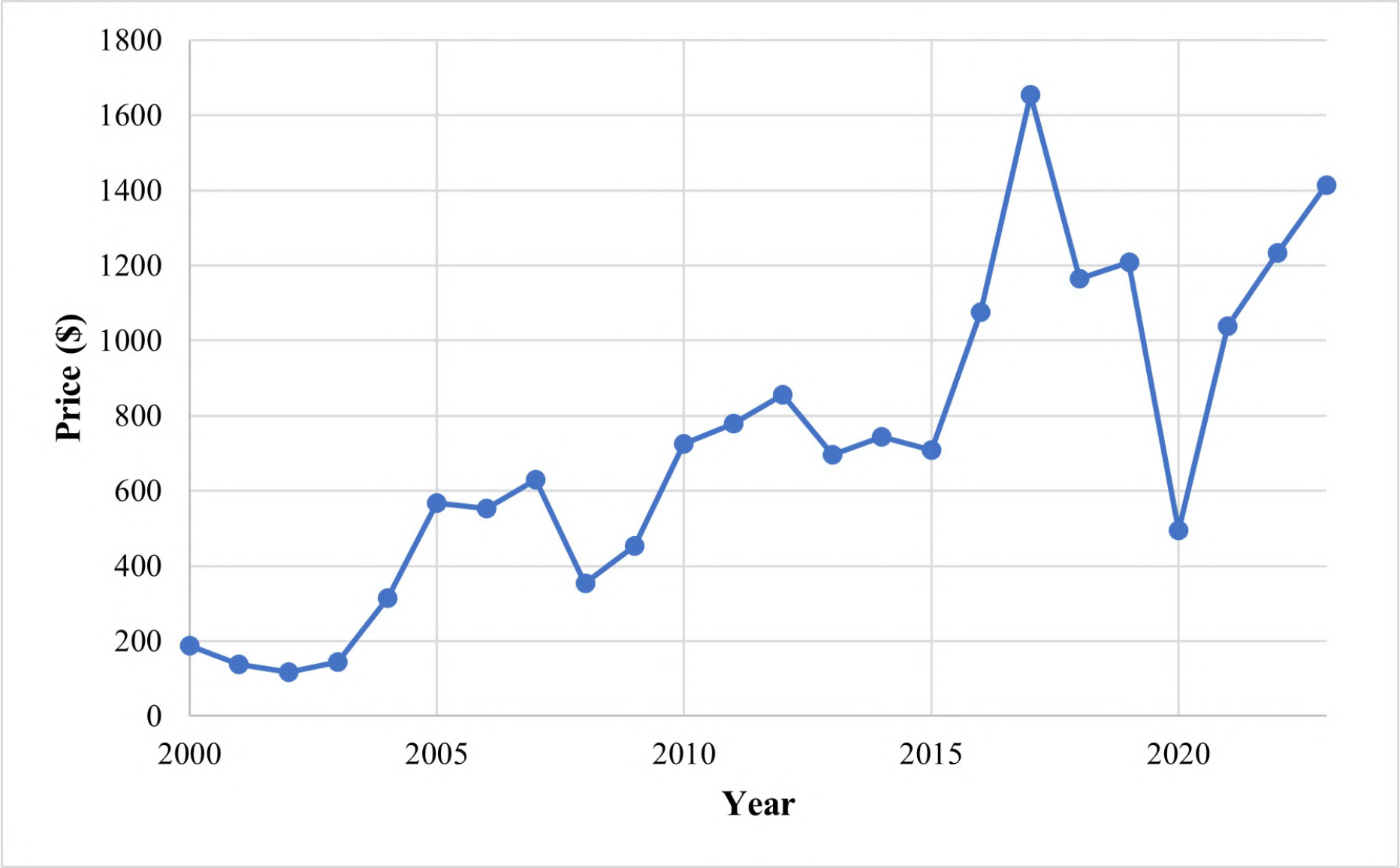
Over the analyzed period, the price per ton of in-shell Brazil nuts increased by 1,761% (Figure 3), rising from BRL 368.28 in 2000 to BRL 6,850.23 in 2023, with a mean annual price of BRL 2,436.30 per ton (CV = 85.8%). These price dynamics may be driven by multiple factors, including climate variability and fluctuations in supply and demand (Queiroz et al., 2022), as well as growing consumer demand for products associated with sustainability and environmental responsibility (Raasch et al., 2021).
Price ($) of Brazil nut in shell in the state of Acre, Brazil, between 2000 and 2023
Figura 3
Preço ($) da castanha-do-brasil com casca no estado do Acre, Brasil, entre os anos de 2000 e2023
Regarding the climatic conditions in the municipalities where Brazil nut harvesting occurs in the state of Acre, mean air temperature increased by 2.7 °C (9.2%) between 2000 and 2023 (CV = 2.1%), rising from 24.8 °C in 2000 to 27.1 °C in 2023. Over this period, the highest mean temperatures were recorded in 2010 and 2023, when average values exceeded 27 °C (Figure 4).

Average temperature recorded in the Brazil nut production areas in the eastern region of the state of Acre, Brazil, between 2000 and 2023
Figura 4
Temperatura média registrada nas áreas de produção de castanha-do-brasil na região leste do estado do Acre, Brasil, entre os anos de 2000 e 2023
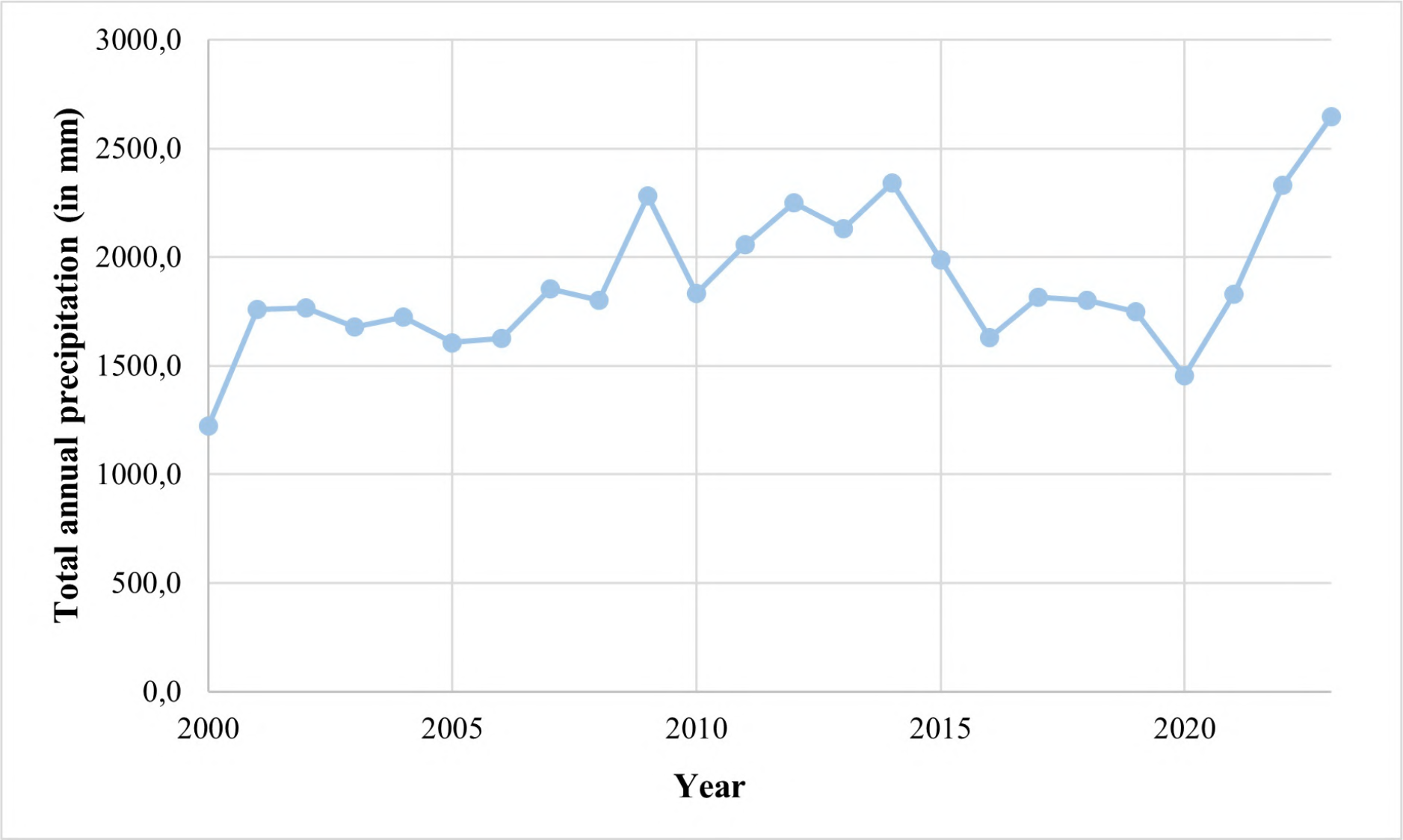
Mean annual precipitation in the study area increased by 116.6% over the study period, rising from 1,221.5 mm in 2000 to 2,646.3 mm in 2023. The mean annual precipitation for the entire period was 1,881.6 mm (CV = 17.0%) (Figure 5).

Annual precipitation recorded in the Brazil nut production areas in the eastern region of the state of Acre, Brazil, between 2000 and 2023
Figura 5
Precipitação anual registrada nas áreas de produção de castanha-do-brasil na região leste do estado do Acre, Brasil, entre os anos de 2000 e 2023
Spearman correlation analysis revealed that mean air temperature was positively and moderately correlated with both revenue (r = 0.47; p = 0.021) and the price of Brazil nuts (r = 0.47; p = 0.021) in the state of Acre. Precipitation also exhibited positive and moderate correlations, being significantly associated with production (r = 0.55; p = 0.005) and revenue (r = 0.45; p = 0.024) (Figure 6; Table 2).

Spearman correlation between climatic variables and the production, revenue, and price of Brazil nuts in the study area in the state of Acre, Brazil
Figura 6
Correlação de Spearman entre as variáveis climáticas e a produção, receita e preço da castanha-do-brasil na área de estudo no estado do Acre, Brasil
Spearman’s correlation coefficient assesses the strength and direction of a monotonic relationship between two variables measured at least on an ordinal scale, based on the ranked order of observations. This method is suitable for both linear and non-linear associations (Lira, 2004). According to Dancey & Reidy (2017), the interpretation of Spearman’s correlation depends on the nature of the data; however, the authors propose that coefficients between 0.10 and 0.30 indicate weak correlations, values between 0.40 and 0.60 indicate moderate correlations, and values between 0.70 and 0.90 indicate strong correlations.
Principal Component Analysis (PCA) applied to the variables temperature, precipitation, Brazil nut production, revenue, and price indicated that the first two principal components (PC1 and PC2) jointly explain approximately 80% of the total variance, with 53.79% attributed to PC1 and 26.19% to PC2 (Table 3). This result suggests that most of the variability among the analyzed observations is captured by these two components, enabling a more concise and effective visualization of the relationships among variables. The remaining components (PC3, PC4, and PC5) account for a relatively small proportion of the total variance and contribute little to the overall interpretation of the observed patterns.
Values of factor loadings obtained in the PCA between climatic and economic variables of the Brazil nut production and marketing chain in the state of Acre, Brazil
Tabela 3
Valores das cargas fatoriais obtidas na PCA entre variáveis climáticas e econômicas da cadeia de produção e comercialização da castanha-do-brasil no estado do Acre, Brasil
Each principal component represents a linear combination of the variables mean temperature, precipitation, production, revenue, and Brazil nut price, with the associated loadings indicating the relative contribution of each variable to the component. The first principal component (PC1) exhibits positive loadings for temperature, precipitation, revenue, and price (Table 4), suggesting that climatic variability is positively associated with these economic variables.
Contribution of variables in the principal components of the principal component analysis evaluating the impact of temperature and precipitation on the production, revenue, and price of brazil nuts in Acre, Brazil
Tabela 4
Contribuição das Variáveis nos Componentes Principais da Análise de Componentes Principais Avaliando o Impacto da Temperatura e Precipitação na Produção, Receita e Preço da castanha-do-brasil no Acre, Brasil
The second principal component (PC2) is characterized by a strong negative loading for production (-0.75), moderate positive loadings for price (0.49) and revenue (0.24), and an intermediate negative loading for precipitation (-0.34). This pattern indicates that periods of lower production tend to be associated with higher prices, potentially reflecting a market scarcity effect. The negative loading for precipitation further suggests that reduced rainfall may be linked to declines in Brazil nut production.
By integrating Spearman’s correlation analysis with the principal components derived from the PCA, the interactions between climatic and economic variables were further elucidated. The first principal component (PC1) exhibited positive and relatively strong correlations with most variables, particularly revenue (0.91) and price (0.86), as well as mean temperature (0.67) and precipitation (0.68) (Table 5). These associations indicate that climatic conditions are closely linked to the economic performance of the Brazil nut production chain, suggesting that years characterized by more favorable climatic conditions tend to yield higher economic returns.
Spearman Correlation between Climatic and Economic Variables and Principal Components of the PCA Analysis of Brazil Nut Production in Acre, Brazil
Tabela 5
Correlação de Spearman entre Variáveis Climáticas e Econômicas e Componentes Principais da Análise PCA da Produção de Castanha-do-brasil no Acre, Brasil
The second principal component (PC2) showed a very strong negative correlation with production (-0.80) and a moderate negative correlation with precipitation (-0.45) (Table 5), while maintaining positive correlations with revenue and price. This pattern suggests that periods of reduced production are often associated with higher prices and revenues, likely reflecting supply constraints that increase market value. Overall, these results highlight an inverse relationship between production volume and economic value within the Brazil nut value chain.
The regression model fitted for the production variable indicates that precipitation exerts a positive and statistically significant effect on Brazil nut production (p = 0.04), whereas mean temperature does not show a significant influence (p = 0.97). According to the model estimates, each 1 mm increase in annual precipitation is associated with an expected increase of 4.35 tons in in-shell Brazil nut production.
Despite this relationship, the model explains only 21.7% of the total variance in production, and the overall model significance is marginal (p = 0.07). These results suggest that, in addition to temperature and precipitation, other environmental, biological, or socioeconomic factors likely play an important role in shaping Brazil nut production (Table 6).
Estimates of the Linear Regression Model for Brazil Nut Production as a Function of Average Temperature and Precipitation in Acre, Brazil
Tabela 6
Estimativas do Modelo de Regressão Linear para a Produção de Castanha-do-brasil em Função da Temperatura Média e Precipitação no Acre, Brasil
The regression model fitted to explain revenue from Brazil nuts indicates that precipitation has a positive and statistically significant effect (p = 0.04), suggesting that increased rainfall is associated with higher revenue. In contrast, mean temperature does not exert a significant influence on revenue (p = 0.28). According to the model estimates, each 1 mm increase in precipitation is associated with an expected increase of R$ 24,889.00 in revenue from in-shell Brazil nuts.
The model explains approximately 34.3% of the total variance in revenue, and the F-statistic indicates that the model is statistically significant overall (p = 0.01), confirming that at least one of the explanatory variables contributes meaningfully to explaining variation in Brazil nut revenue (Table 7).
Estimates of the linear regression model for Brazil nut revenue as a function of average temperature and precipitation in Acre, Brazil
Tabela 7
Estimativas do modelo de regressão linear para a receita de castanha-do-brasil em função da temperatura média e precipitação no Acre, Brasil
4. DISCUSSION
In the present study, it was not possible to confirm a statistically significant influence of temperature on the production of in-shell Brazil nuts in the state of Acre. This finding contrasts with the results reported by Pastana et al. (2021), who evaluated fruit production of Bertholletia excelsa in the state of Amapá under climatic fluctuations associated with the El Niño phenomenon and identified a significant negative correlation between fruit production and monthly maximum temperature.
Anjos et al. (2024) employed species distribution models to project changes in the potential distribution of Brazil nut trees through 2100 under scenarios of increasing mean temperature. Their results indicate that, across all projected scenarios-including the most optimistic one, with temperature increases below 1.5 °C by 2100-the species is expected to experience a reduction exceeding 50% in its suitable distribution area as a consequence of climate change. The authors further suggest that rising temperatures may render higher-altitude areas climatically suitable for B. excelsa establishment; however, the species may face substantial constraints in reaching these areas due to losses in landscape connectivity.
In this study, the highest mean annual temperature recorded was 27.1 °C, observed in 2010 and 2023. According to Costa et al. (2022), B. excelsa typically occurs in environments where temperatures range from 24.3 to 27.2 °C, indicating that the observed temperatures fall within the species’ known thermal tolerance. Nonetheless, elevated temperatures may impair the photosynthetic efficiency of forest species, leading to ecophysiological constraints (Anjos et al., 2024). Moreover, increasing temperatures, particularly when combined with deforestation, may compromise the occurrence and activity of pollinators and seed dispersers essential for B. excelsa reproduction (Sales et al., 2020).
Regarding the positive and significant correlation between temperature and both revenue and price of Brazil nuts, Pastana et al. (2021) reported similar patterns, suggesting that warmer years may be associated with reduced fruit production, which in turn decreases market supply and drives price increases. The authors highlight 2017 as an illustrative case, when a sharp decline in Brazil nut production across the Amazon resulted in an increase of approximately R$ 70 per can (11 kg) relative to 2016.
The positive and statistically significant correlations observed between precipitation and both production and revenue are consistent with previous studies. Ivanov et al., (2018) reported higher Brazil nut seed production in years with increased precipitation during September in Roraima, northern Amazonia. Similarly, Kainer et al., (2007), analyzing B. excelsa populations in the Chico Mendes Extractive Reserve, Acre, found that years with reduced precipitation negatively affected burr production.
Ivanov et al., (2018) argue that fluctuations in precipitation during the flowering period of Brazil nut trees can influence floral bud initiation and pollinator activity, potentially reducing fruit set. Anjos et al. (2024) further report that B. excelsa occurs predominantly in regions with annual precipitation ranging from 1,445 to 3,399 mm.
Understanding how climatic variables such as temperature and precipitation influence Brazil nut production, revenue, and price requires consideration of the fact that interannual variability in nut production directly affects market supply, pricing dynamics, and the economic viability of this product (Pastana et al., 2021). In warmer years, reduced fruit production leads to supply constraints, which tend to increase prices and, consequently, revenue. Based on basic supply-demand relationships, it was initially expected that years with higher precipitation-associated with increased fruit production-would result in lower prices and reduced revenue. However, the present results indicate the opposite pattern.
Further studies are therefore needed to elucidate the moderate yet significant positive correlations observed between precipitation and both revenue and price of Brazil nuts. One possible explanation is that the Brazil nut market exhibits relative short-term price inelasticity (Nogueira & Santana, 2018). Additionally, higher precipitation may enhance nut quality, thereby facilitating commercialization and sustaining higher prices despite increased supply.
It is important to emphasize that B. excelsa exhibits substantial phenotypic plasticity, enabling physiological adjustments that support high survival and growth rates across diverse environmental conditions (Costa et al., 2022). Nevertheless, the findings of this study, together with evidence from the literature, suggest that extreme or persistent climatic changes may pose significant risks to the long-term persistence of the species.
Given the substantial social and economic importance of Brazil nut harvesting for traditional Amazonian communities, reductions in fruit production may directly threaten household income and livelihoods. Pastana et al. (2021) reported that in 2017, within the Cajari Extractive Reserve (Amapá, Brazil), the sharp decline in B. excelsa fruit production and the associated price increase led to reports of invasions and theft of nuts, driven by the unusually high market values reached during that period.
5. CONCLUSION
Temperature did not exert a statistically significant influence on in-shell Brazil nut production in the state of Acre. Nevertheless, this variable showed a direct and significant correlation with both the revenue and price of in-shell Brazil nuts. Precipitation, in contrast, exhibited a direct and positive influence on production and revenue, indicating its central role in shaping the productivity and economic performance of the Brazil nut supply chain in Acre.
Although the hypothesis that temperature significantly affects in-shell Brazil nut production in the study area was not supported, it remains essential to investigate potential indirect effects, particularly those mediated through impacts on pollinators and seed dispersers, which are critical to the reproductive success of the species.
It is important to emphasize that Bertholletia excelsa holds substantial socioeconomic relevance, serving as a primary source of income for many traditional Amazonian communities. Accordingly, further research is required to better understand how this species and its associated production systems may respond to ongoing and future climatic changes.
DATA AVAILABILITY
The entire dataset supporting the findings of this study has been published within the article.
6. REFERENCES
-
Agritempo. (2025). Estado do Acre https://www.agritempo.gov.br/br/estado/AC/estatistica/
» https://www.agritempo.gov.br/br/estado/AC/estatistica/ -
Alves, T. C. V., & Silva, K. E. (2023). Valoração do trabalho agroextrativista de produtos da sociobiodiversidade na Amazônia: atividade de coleta da castanha-da-amazônia na reserva extrativista Chico Mendes, Acre, Brasil. Acta Scientiarum. Human and Social Sciences, 45(1), e69247. https://doi.org/10.4025/actascihumansoc.v45i1.69247
» https://doi.org/10.4025/actascihumansoc.v45i1.69247 - Amaral, E. F., Martorano, L. G., & Bardales, N. G. (2021). Clima do Acre e cultivo da seringueira. In E. F. do Amaral & R. C. Gonçalves (Eds.), Zoneamento pedoclimático para seringueira no estado do Acre (pp. 105-132). Embrapa Acre.
-
Anjos, L. J. S., Gonçalves, G. S. R., Dutra, V. A. B., Rosa, A. G., Santos, L. B., Barros, M. N. R., Souza, E. V., & Toledo, P. M. (2024). Brazil nut journey under future climate change in Amazon. PLoS ONE, 19(11), e0312308. https://doi.org/10.1371/journal.pone.0312308
» https://doi.org/10.1371/journal.pone.0312308 - Bayma, M. M. A., Malavazi, F. W., Sá, C. P., Fonseca, F. L., Andrade, E. P., & Wadt, L. H. O. (2014). Aspectos da cadeia produtiva da castanha-da-amazônia no estado do Acre, Brasil. Boletim do Museu Paraense Emílio Goeldi - Ciências Naturais, 9(2), 417-426
-
Bottino, M. J., Nobre, P., Giarolla, E., Silva Junior, M. B., Capistrano, V. B., Malagutti, M., Tamaoki, J. N., Oliveira, B. F. A., & Nobre, C. A. (2024). Amazon savannization and climate change are projected to increase dry season length and temperature extremes over Brazil. Scientific Reports, 14, 5131. https://doi.org/10.1038/s41598-024-55176-5
» https://doi.org/10.1038/s41598-024-55176-5 -
Campelo, M. F., Lameira, O. A., Moreira, R. K. V. P. P., & Ramires, A. C. S. (2021). Reproductive phenology of Carapichea ipecauanha (Brot.) L. Andersson and its correlation with average air temperature and rainfall. Research, Society and Development, 10(5), e7610514625. http://dx.doi.org/10.33448/rsd-v10i5.14625
» http://dx.doi.org/10.33448/rsd-v10i5.14625 -
Costa, K. C. P., Gonçalves, J. F. C., Gonçalves, A. L., Nina Junior, A. R., Jaquetti, R. K., Souza, V. F., Carvalho, J. C., Fernandes, A. V., Rodrigues, J. K., Nascimento, G. O., Wadt, L. H. O., Kainer, K. A., Lima, R. M. B., Schimpl, F. C., Souza, J. P., Oliveira, S. S., Miléo, H. T. S., Souza, D. P., Silva, A. C. L. … Rodrigues, M. O. (2022). Advances in Brazil nut tree ecophysiology: Linking abiotic factors to tree growth and fruit production. Current Forestry Reports, 8, 90-110. https://doi.org/10.1007/s40725-022-00158-x
» https://doi.org/10.1007/s40725-022-00158-x - Dancey, C., & Reidy, J. (2017). Statistics without maths for psychology (7th ed.). Pearson
-
Duarte, A. N. F., Amaro, M. A., Ortega, G. P., Cunha, T. A., Carvalho, C. A., Lima, Q. S., Ribeiro, Í. F. N., & Brito, L. R. (2024). Uso de equações alométricas para estimar o volume e altura de árvores em área de manejo florestal na Amazônia Ocidental. Caderno Pedagógico, 21(13), 01-22. https://doi.org/10.54033/cadpedv21n13-208
» https://doi.org/10.54033/cadpedv21n13-208 -
Esquivel-Muelbert, A., Baker, T. R., Dexter, K. G., Lewis, S. L., Brienen, R. J. W., Feldpausch, T. R., Lloyd, J., Monteagudo-Mendoza, A., Arroyo, L., Álvarez-Dávila, E., Higuchi, N., Marimon, B. S., Marimon-Junior, B. H., Silveira, M., Vilanova, E., Gloor, E., Malhi, Y.; Chave, J., Barlow, J., ..., Phillips, O. L. (2019). Compositional response of Amazon forests to climate change. Global Change Biology, 25(1), 39-56. https://doi.org/10.1111/gcb.14413
» https://doi.org/10.1111/gcb.14413 -
Espinoza, J. C., Jimenez, J. C., Marengo, J. A., Schongart, J., Ronchail, J., Lavado-Casimiro, W., & Ribeiro, J. V. M. (2024). The new record of drought and warmth in the Amazon in 2023 related to regional and global climatic features. Scientific Reports, 14, 8107. https://doi.org/10.1038/s41598-024-58782-5
» https://doi.org/10.1038/s41598-024-58782-5 -
Evangelista-Vale, J. C., Weihs, M., José-Silva, L., Arruda, R., Sander, N. L., Gomides, S. C., Machado, T. M., Pires-Oliveira, J. C., Barros-Rosa, L., Castuera-Oliveira, L., Matias, R. A. M., Martins-Oliveira, A. T., São Bernardo, C. S., Silva-Pereira, I., Carnicer, C., Carpanedo, R. S., & Eisenlohr, P. V. (2021). Climate change may affect the future of extractivism in the Brazilian Amazon. Biological Conservation, 257, 109093. https://doi.org/10.1016/j.biocon.2021.109093
» https://doi.org/10.1016/j.biocon.2021.109093 - Fórum Empresarial de Inovação e Desenvolvimento do Acre. (2023). Boletim de conjuntura econômica: Produção extrativa de castanha-da-amazônia (5ª ed.).
-
Gomes, V. H. F., Vieira, I. C. G., Salomão, R. P., & Ter Steege, H. (2019). Amazonian tree species threatened by deforestation and climate change. Nature Climate Change, 9, 547-553. https://doi.org/10.1038/s41558-019-0500-2
» https://doi.org/10.1038/s41558-019-0500-2 -
GPM - Global Precipitation Measurement. (2025). Tropical Rainfall Measuring Mission (TRMM). https://gpm.nasa.gov/missions/trmm
» https://gpm.nasa.gov/missions/trmm - Governo do Estado do Acre. (2010). Zoneamento Ecológico-Econômico do Estado do Acre, Fase II (Escala 1:250.000): Documento Síntese. SEMA
-
Hongyu, K., Sandanielo, V. L. M., & Oliveira Júnior, G. J. (2016). Análise de Componentes Principais: resumo teórico, aplicação e interpretação. Engineering and Science, 5(1), 83-90. https://doi.org/10.18607/ES201653398
» https://doi.org/10.18607/ES201653398 -
Instituto Brasileiro de Geografia e Estatística (IBGE). (2025a). Produção de Castanha-do-Pará.https://www.ibge.gov.br/explica/producao-agropecuaria/castanha-do-para/br
» https://www.ibge.gov.br/explica/producao-agropecuaria/castanha-do-para/br -
Instituto Brasileiro de Geografia e Estatística (IBGE). (2025b). Produção da Extração Vegetal e da Silvicultura.https://sidra.ibge.gov.br/pesquisa/pevs/quadros/brasil/2023
» https://sidra.ibge.gov.br/pesquisa/pevs/quadros/brasil/2023 -
Instituto Brasileiro de Geografia e Estatística (IBGE). (2025c). Cidades e estados do Brasil.https://cidades.ibge.gov.br/
» https://cidades.ibge.gov.br/ -
Inouye, D. W. (2022). Climate change and phenology. WIREs Climate Change, 13(3), e764. https://doi.org/10.1002/wcc.764
» https://doi.org/10.1002/wcc.764 -
Ivanov, G. B., Fleig, F. D., & Tonini, H. (2018). Fatores edafoclimáticos relacionados à produção de sementes em castanhais nativos de Roraima. Pesquisa Florestal Brasileira, 38, e201701553, 1-6. https://doi.org/10.4336/2018.pfb.38e201701553
» https://doi.org/10.4336/2018.pfb.38e201701553 -
Kainer, K. A., Wadt, L. H. O., & Staudhammer, C. L. (2007). Explaining variation in Brazil nut fruit production. Forest Ecology and Management, 250, 244-255. https://doi.org/10.1016/j.foreco.2007.05.024
» https://doi.org/10.1016/j.foreco.2007.05.024 - Lira, S. A. (2004). Análise de correlação: Abordagem teórica e de construção dos coeficientes com aplicações (Dissertação de mestrado, Universidade Federal do Paraná).
-
Nogueira, A. K. M., & Santana, A. C. (2018). Influência das chuvas na oferta de castanha-do-brasil e o impacto no benefício socioeconômico e ambiental, no Oeste do estado do Pará. Desenvolvimento e Meio Ambiental, 45, 215-230. https://doi.org/10.5380/dma.v45i0.50562
» https://doi.org/10.5380/dma.v45i0.50562 -
Oliveira, B. F. A., Bottino, M. J., Nobre, P., & Nobre, C. A. (2021). Deforestation and climate change are projected to increase heat stress risk in the Brazilian Amazon. Communications Earth & Environment, 2, 207. https://doi.org/10.1038/s43247-021-00275-8
» https://doi.org/10.1038/s43247-021-00275-8 -
Oliveira, G. S., Silva, M. T. S., Dreyer, T. C., Freire, G. M., Orso, G. A., & Heimann, J. P. (2020). Exportações brasileiras de castanha-do-pará (Bertholletia excelsa H.B.K), sob a ótica de concentração de mercado. BIOFIX Scientific Journal, 5(1), 7-12. https://dx.doi.org/10.5380/biofix.v5i1.66895
» https://dx.doi.org/10.5380/biofix.v5i1.66895 -
Pastana, D. N. B., Modena, É. S., Wadt, L. H. O., Neves, E. S., Martorano, L. G., Lira-Guedes, A. C., Souza, R. L. F., Costa, F. F., Batista, A. P. B., & Guedes, M. C. (2021). Strong El Niño reduces fruit production of Brazil-nut trees in the eastern Amazon. Acta Amazonica, 51(3), 270-279. http://dx.doi.org/10.1590/1809-4392202003702
» http://dx.doi.org/10.1590/1809-4392202003702 -
Queiroz, J. F., Homma, A. K. O., Filgueiras, G. C., Menezes, A. J. E. A., Reymão, A. E. N., & Santos, M. A. S. (2022). Produção e mercado dos produtos florestais não-madeireiros: o caso da castanha-do-pará (Bertholletia excelsa H.B.K.). Research, Society and Development, 11(13), e189111335284. https://doi.org/10.33448/rsd-v11i13.35284
» https://doi.org/10.33448/rsd-v11i13.35284 - Raasch, M., Sousa Júnior, J. H., & Rocha, R. A. (2021). Consciência ambiental de consumidores e sua disposição a pagar. REUNA, 26(2), 46-68.
-
Sales, L. P., Rodrigues, L., & Masiero, R. (2020). Climate change drives spatial mismatch and threatens the biotic interactions of the Brazil nut. Global Ecology and Biogeography, 30, 117-127. https://doi.org/10.1111/geb.13200
» https://doi.org/10.1111/geb.13200 -
Sarma, P., & Devi, A. (2025). Tree phenology of tropical semi‑evergreen forest and its correlation with climatic variables in the Eastern Himalayan region of India. Plant Ecology, 226, 409-426. https://doi.org/10.1007/s11258-025-01503-3
» https://doi.org/10.1007/s11258-025-01503-3 -
Silva, B. I. A., Salomão, R. P., Santana, A. C., Sousa, V. G., & Hage, A. L. F. (2020). Predação de mudas de castanheira (Bertholletia excelsa Bonpl.) em áreas sob restauração florestal na Amazônia. Brazilian Journal of Development, 6(4), 20667-20689, https://doi.org/10.34117/bjdv6n4-298
» https://doi.org/10.34117/bjdv6n4-298 -
Souza, J. H. G., Borella, D. R., Silva, K. N. C., & Silva, A. C. (2023). Bertholletia excelsa seeds in the Cerrado-Amazon transition region: morphometry, colorimetry, viability and germination. Nativa, 11(2), 166-177. https://doi.org/10.31413/nat.v11i2.15580
» https://doi.org/10.31413/nat.v11i2.15580
Edited by
-
Editors:
Angeline Martini and Emanoele Lima Abreu.