 GRAFTING AS A STRATEGY FOR THE RESCUE OF NATIVE BRAZILIAN TREE SPECIES: ANALYSIS OF GROWTH AND ANATOMY
ABSTRACT
Environmental degradation caused by human activities, such as dam failures, leads to habitat fragmentation, river contamination, and biodiversity loss. To mitigate these impacts, conservation strategies have been developed to preserve the genetic diversity of forest species. One promising approach is grafting, which allows the rescue and propagation of vulnerable trees. This study aimed to evaluate the efficiency of cleft grafting in rescuing individuals of Garcinia gardneriana (Planch. & Triana) Zappi, Calophyllum brasiliense Cambess., and Handroanthus albus (Cham.) Mattos in the Brumadinho region. Branch segments were collected from mature trees and grafted onto seedlings of the same species or genus. Over a 90-day period, graft survival and growth were monitored at 15-day intervals. In addition, anatomical analyses were conducted to evaluate the graft union between the scion and rootstock. The results showed that C. brasiliense exhibited the highest survival rate (70%), with significant shoot growth in both length and diameter. H. albus showed steady and uniform growth, with a survival rate of 60%. In contrast, G. gardneriana presented the lowest survival rate (40%) and slower growth, probably due to anatomical incompatibility. Microscopic analysis revealed differences in tissue development and a pronounced accumulation of phenolic compounds in the graft union region of G. gardneriana, which may have hindered vascular reconnection and negatively affected graft establishment. These results highlight the importance of anatomical compatibility for grafting success and seedling development. Furthermore, they demonstrate that cleft grafting is a promising technique for the genetic conservation and ecological restoration of native tree species in impacted areas
Keywords:
Genetic conservation; Ecological restoration; Vegetative rescue
RESUMO
A degradação ambiental causada por atividades humanas, como o rompimento de barragens, leva à fragmentação de habitats, contaminação de rios e perda de biodiversidade. Para mitigar esses impactos, estratégias de conservação têm sido desenvolvidas com o objetivo de preservar a diversidade genética das espécies florestais. Uma abordagem promissora é a enxertia, que permite o resgate e a propagação de árvores vulneráveis. Este estudo teve como objetivo avaliar a eficiência da enxertia de fenda no resgate de indivíduos de Garcinia gardneriana (Planch. & Triana) Zappi, Calophyllum brasiliense Cambess. e Handroanthus albus (Cham.) Mattos na região de Brumadinho. Segmentos de ramos foram coletados de árvores adultas e enxertados em mudas da mesma espécie ou gênero. Durante 90 dias, a sobrevivência e o crescimento dos enxertos foram monitorados a cada 15 dias. Além disso, foram realizadas análises anatômicas para avaliar a união entre enxerto e porta-enxerto. Os resultados mostraram que C. brasiliense apresentou a maior taxa de sobrevivência (70%), com crescimento significativo dos brotos em comprimento e diâmetro. H. albus apresentou crescimento constante e uniforme, com taxa de sobrevivência de 60%. Em contraste, G. gardneriana teve a menor taxa de sobrevivência (40%) e crescimento mais lento, provavelmente devido à incompatibilidade anatômica. A análise microscópica revelou diferenças no desenvolvimento dos tecidos e um acúmulo expressivo de compostos fenólicos na região de união em G. gardneriana, o que, possivelmente, dificultou a reconexão vascular e afetou negativamente o estabelecimento da enxertia. Esses resultados evidenciam a importância da compatibilidade anatômica para o sucesso da enxertia e o desenvolvimento das mudas. Além disso, demonstram que a enxertia de fenda constitui uma técnica promissora para a conservação genética e a restauração ecológica de espécies arbóreas nativas em áreas impactadas.
Palavras-Chave:
Genetic conservation; Ecological restoration; Vegetative rescue
1. INTRODUCTION
The degradation of ecosystems caused by human activities has driven scientific efforts to develop strategies for conserving the genetic diversity of forest species. The genetic component is fundamental to the success and long-term sustainability of degraded land restoration programs, as it enhances species' resilience to environmental stressors (Kampa et al., 2020).
Genetic variability plays a crucial role by providing a "pool" of adaptive traits that enable certain individuals within a species to survive under adverse environmental conditions, thereby preventing population and/or species extinction (Shimizu et al., 2007; Teixeira & Huber, 2021). However, habitat destruction, population decline, and forest fragmentation can lead to inbreeding, reducing genetic variability and increasing extinction risks (Mendes et al., 2021). In Brazil, these challenges are further intensified by large-scale environmental disturbances, particularly those associated with mining activities, which can cause sudden and severe losses of native vegetation and local genetic resources (Mallett et al., 2021).
One of the most severe environmental disasters in recent history was the 2019 collapse of a tailings dam owned by Vale S.A. in Brumadinho, Minas Gerais (Duarte et al., 2020). This event caused extensive habitat destruction, including the loss of 133.27 hectares of native Atlantic Forest and 70.65 hectares of Permanent Preservation Areas (PPAs) (APPs), legally protected riparian zones in Brazil (Thompson et al., 2019). The destruction of these ecosystems not only compromised their structure but also threatened the survival of plant species adapted to local conditions. Given this scenario, strategies for rescuing and conserving genetic material have become essential to mitigate these losses and ensure the survival of these species in ecological restoration programs.
Vegetative rescue strategies are important for the conservation of genetic resources, particularly in scenarios of rapid habitat loss and population decline. Among the available approaches, grafting stands out as an effective technique for preserving selected genotypes and enabling the propagation of plants at risk of mortality (Mendes et al., 2021).
This practice involves the union of a branch segment (graft) with a compatible rootstock, ensuring the maintenance of the genetic characteristics of the parent plant (Mendes et al., 2020). The formation of a functional union between the scion and the rootstock depends directly on the anatomical compatibility between the tissues involved. After grafting, adhesion initially occurs between the cut surfaces, followed by the formation of wound-healing tissue (callus) at the interface between the two parts. Subsequently, cells from this callus may differentiate into meristematic tissues that reestablish the continuity of the vascular cambium, allowing the formation of new xylem and phloem elements that physiologically connect the scion to the rootstock. Thus, structural similarity between the tissues and proper alignment of the cambial regions are determining factors for grafting success, whereas marked anatomical differences may hinder vascular reconnection and lead to graft union failure (Pina et al., 2012; Rasool et al., 2020; Feng et al., 2024).
In post-disaster scenarios, such as Brumadinho, grafting serves as a critical tool for the vegetative propagation of endangered individuals, preventing the irreversible loss of genotypes adapted to local conditions. By rescuing plants that might otherwise be lost due to environmental impacts, grafting ensures their survival and reproduction. Consequently, it plays a crucial role in maintaining genetic variability within affected populations and contributes significantly to the conservation and restoration of degraded ecosystems.
Beyond genetic conservation, grafting can accelerate the production of seeds and seedlings for ecosystem restoration. This is particularly valuable for threatened or ecologically significant species, such as Garcinia gardneriana (Planch. & Triana) Zappi, Calophyllum brasiliense Cambess. and Handroanthus albus (Cham.) Mattos, which play important roles in forest regeneration dynamics and in supporting fauna through the provision of floral and fruit resources. In this context, grafting contributes to the survival of remaining populations and supports the reconstruction of degraded ecosystems (Liu et al., 2023).
Thus, the application of grafting in environmental recovery efforts not only helps preserve genetic diversity but also strengthens ecological restoration initiatives, enhancing the resilience of impacted areas and promoting the long-term sustainability of ecosystems (Nevill et al., 2016).
The success of grafting is directly dependent on the anatomical compatibility between the graft and the rootstock (Xiong et al., 2021). One notable advantage of this technique is that when using graft material from a reproductive-phase plant, the resulting seedlings can flower and bear fruit in a shorter time frame. This occurs because the grafted propagule already possesses reproductive competence, allowing for earlier flower and fruit production compared to plants propagated through seeds (Mendes et al., 2020).
Within this context, this study aimed to evaluate the efficiency of grafting in three different native species affected by the Brumadinho dam collapse, based on the hypothesis that the anatomy and histochemical composition of the graft and rootstock influence the success of the technique.
2. MATERIAL AND METHODS
2.1 Selection of parent trees
Plant material was collected in Brumadinho, Minas Gerais, Brazil (20° 08' 34" S, 44° 12' W, 881 m altitude). The species were selected for rescue based on their ecological importance for environmental restoration in the region, their role as a food source for local fauna, and their relevance in maintaining native ecosystems.
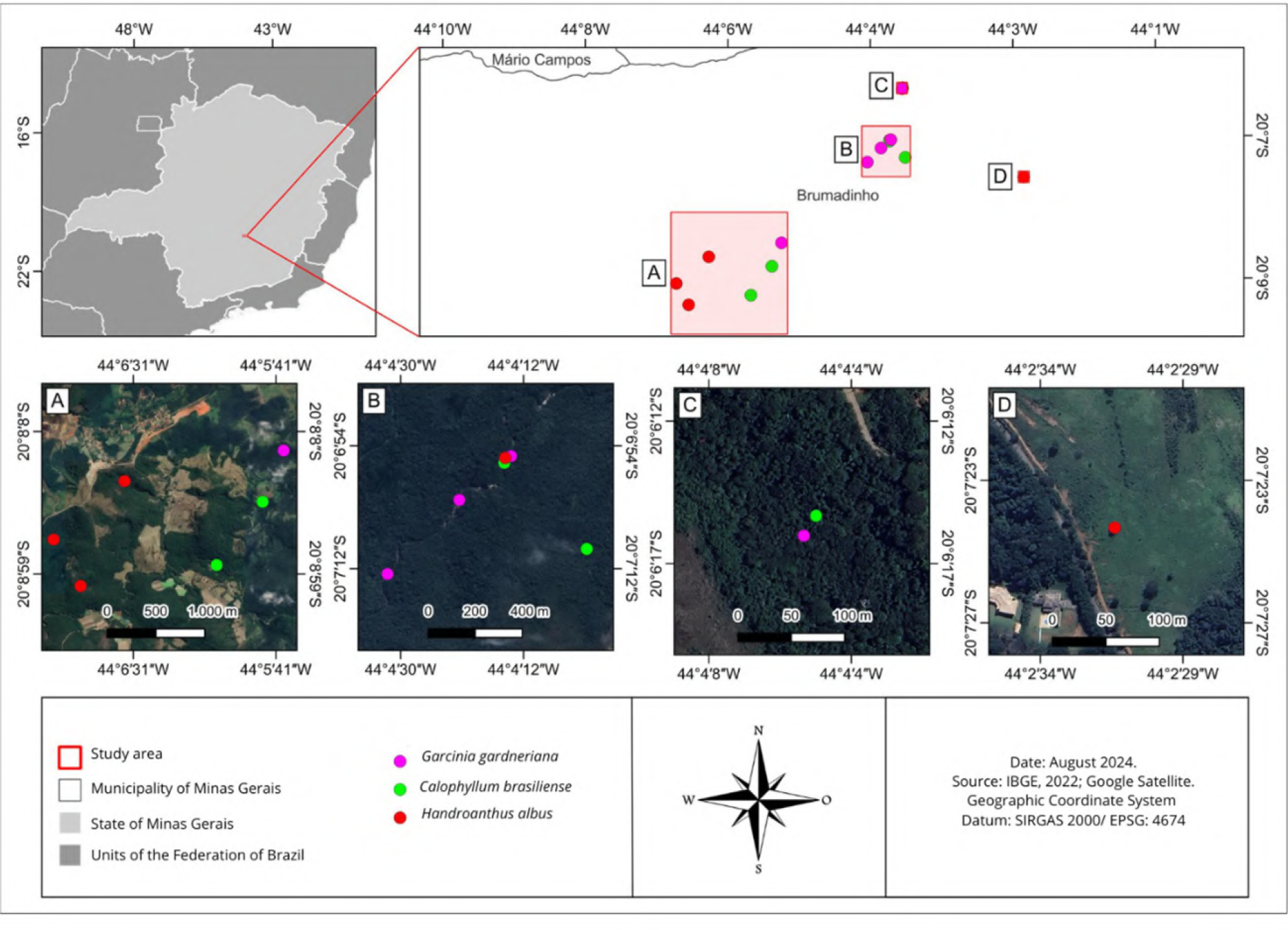
Prior to collection, parent trees were marked by selecting five mature individuals of each species in good phytosanitary condition, ensuring a minimum distance of 500 m between individuals, as illustrated in
Figure 1. Branch segments measuring 15 to 20 cm in length and 8 mm in diameter were collected from the upper third of the trees. To maintain viability during transport, the segments were immediately moistened with water, wrapped in paper towels and aluminum foil, and stored in insulated containers with ice.

Map of the study area with the geographic coordinates of the mother trees of Garcinia gardneriana (pink dots), Calophyllum brasiliense (green dots), and Handroanthus albus (red dots) in the Brumadinho region, Minas Gerais, Brazil. The main image shows the geographic boundaries of the study area, with subareas A, B, C, and D highlighted in the satellite images. The quadrants display species distribution
Figura 1
Mapa da área de estudo com as coordenadas geográficas das árvores-matrizes de Garcinia gardneriana (pontos rosas), Calophyllum brasiliense (pontos verdes) e Handroanthus albus (pontos vermelhos) na região de Brumadinho, Minas Gerais, Brasil. A imagem principal mostra os limites geográficos da área de estudo, com as subáreas A, B, C e D destacadas nas imagens de satélite. Os quadrantes apresentam a distribuição das espécies
2.2 Cleft grafting
The experiment was conducted in the indoor orchard at the research nursery of the Department of Forestry Engineering (DEF) at the Federal University of Viçosa (20° 45’ S, 42° 15’ W, 650 m altitude), Viçosa, Minas Gerais, Brazil. The structure is enclosed and covered with plastic film, and the environmental conditions inside followed the natural variation of the local climate. It was used mainly to reduce the incidence of pests and diseases and to limit excessive exposure to external factors such as wind and radiation. Cleft grafting procedures were carried out during the summer months (January and February).
Rootstock seedlings were obtained from commercial nurseries in the region. These seedlings were produced from seeds collected from mother trees located in forest fragments in the municipality of Dona Euzébia, Minas Gerais, Brazil. The seedlings were grown in 2.78 L plastic bags containing subsoil substrate fertilized with cattle manure and NPK (6-30-6). The age of the rootstocks was variable, as seedlings were selected based on stem diameter in order to match the diameter of the collected scions.
Branch segments were grafted using the cleft grafting method. For G. gardneriana and C. brasiliense, rootstocks consisted of seedlings of the same species. In contrast, for H. albus, seedlings of Handroanthus heptaphyllus were used as rootstocks. The cleft grafting process followed these steps: (1) cutting the rootstock at a height of 20 cm above the root collar; (2) making a vertical slit in the rootstock; (3) shaping the base of the scion into a wedge; (4) inserting and securing the scion to the rootstock using Parafilm; and (5) applying a sealing layer of thread-seal tape at the graft union.
2.3 Growth analysis
Graft survival and growth were evaluated at 15-day intervals over a period of 90 days for C. brasiliense and H. albus, and 100 days for G. gardneriana. The evaluated variables included graft survival, shoot length, and the diameter of the scion, rootstock, and newly formed shoots. Graft survival was determined by visual assessment, considering the presence of living shoots and the absence of tissue necrosis at the graft union. Shoot length was measured using a ruler, and stem diameters (scion, rootstock, and shoots) were measured with a digital caliper.
2.4 Anatomical analysis
To examine the anatomical characteristics of the grafted material, three samples per treatment were analyzed, corresponding to the three studied species. In each sample, anatomical evaluations were performed on three distinct regions of the grafted plant: the rootstock, the graft union (connection zone), and the scion. Samples were collected at 90 days after grafting. The graft union was sampled from its central portion, approximately 20 cm above the soil surface. Additional samples of the scion and rootstock were collected at 3 cm above and 3 cm below the graft union, respectively. The material was fixed in FAA50 (formaldehyde, glacial acetic acid, 50% ethanol; 1:1:18, v/v) for 48 h and subsequently stored in 70% ethanol (Johansen, 1940).
Next, plant material was embedded in methacrylate resin (Historesin-Leica), following the manufacturer’s instructions. Sections were obtained transversely using a rotary microtome with automatic advance (model RM2155, Leica Microsystems Inc., Deerfield, USA) at a thickness of 5 µm. Sections were then stained with toluidine blue at pH 6.5 (O’Brien et al., 1964). Structural analysis images were captured using a light microscope (model AX-70 TRF, Olympus Optical, Tokyo, Japan) equipped with a digital camera (model Zeiss AxioCam HRc, Göttingen, Germany) and connected to a computer running Axion Vision image capture software. For the analysis of nonstructural phenolic compounds, a 10% aqueous ferric chloride solution was used.
2.5 Statistical analyses
The experiment was conducted in a completely randomized design (CRD), with six replicates, each consisting of ten plants. Descriptive statistical analyses were used to characterize graft growth and survival, including measures of central tendency (mean) and dispersion (standard error). Growth and survival data were analyzed using SigmaPlot software (Systat Software Inc., 2021).
To analyze the growth dynamics of each species, three-parameter Gompertz functions were fitted to the shoot length and shoot diameter data (Grange & Andrews, 1994). The time required to reach 50% of the final shoot size was estimated by calculating half of the maximum observed value and determining the corresponding time through graphical interpolation from the growth curves.
3. RESULTS
3.1 Graft survival and growth
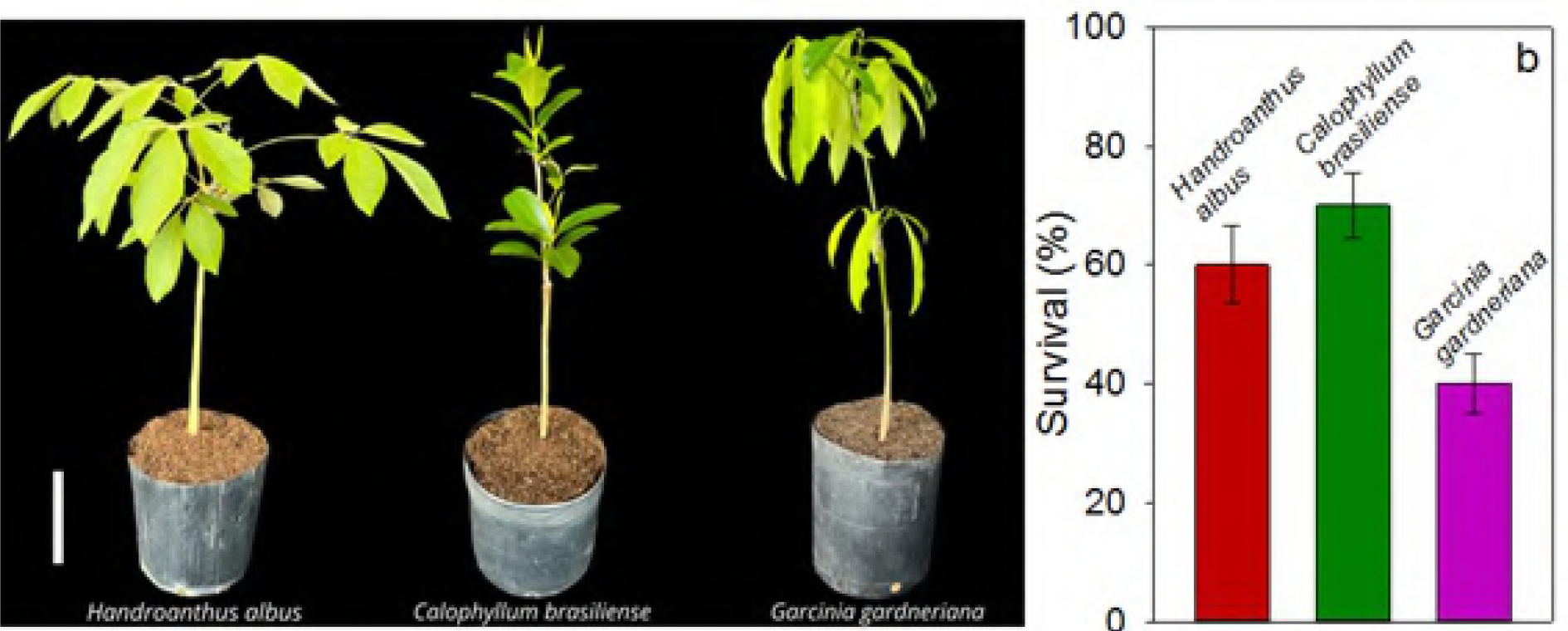
All three species responded positively to the cleft grafting technique employed (Figure 2a). At 90 days after cleft grafting (DAG), the grafted plants exhibited proper development, with the graft union fully healed and the aerial parts showing no signs of chlorosis or abnormal shoot growth (Figure 2a). However, survival rates varied among species. During this period, C. brasiliense showed the highest survival rate (70 ± 5.4%), followed by H. albus (60 ± 6.5%) and G. gardneriana (40 ± 5%).
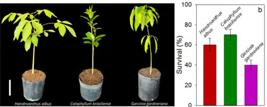
Grafted plants at 90 days after grafting (DAG) (a). Graft survival at 90 DAG (b). Scale bar = 30 cm. Values represent the mean ± standard error of 6 replicates
Figura 2
Plantas enxertadas aos 90 dias após a enxertia (DAG) (a). Sobrevivência dos enxertos aos 90 DAG (b). Barra de escala = 30 cm. Os valores representam a média ± erro padrão de 6 repetições
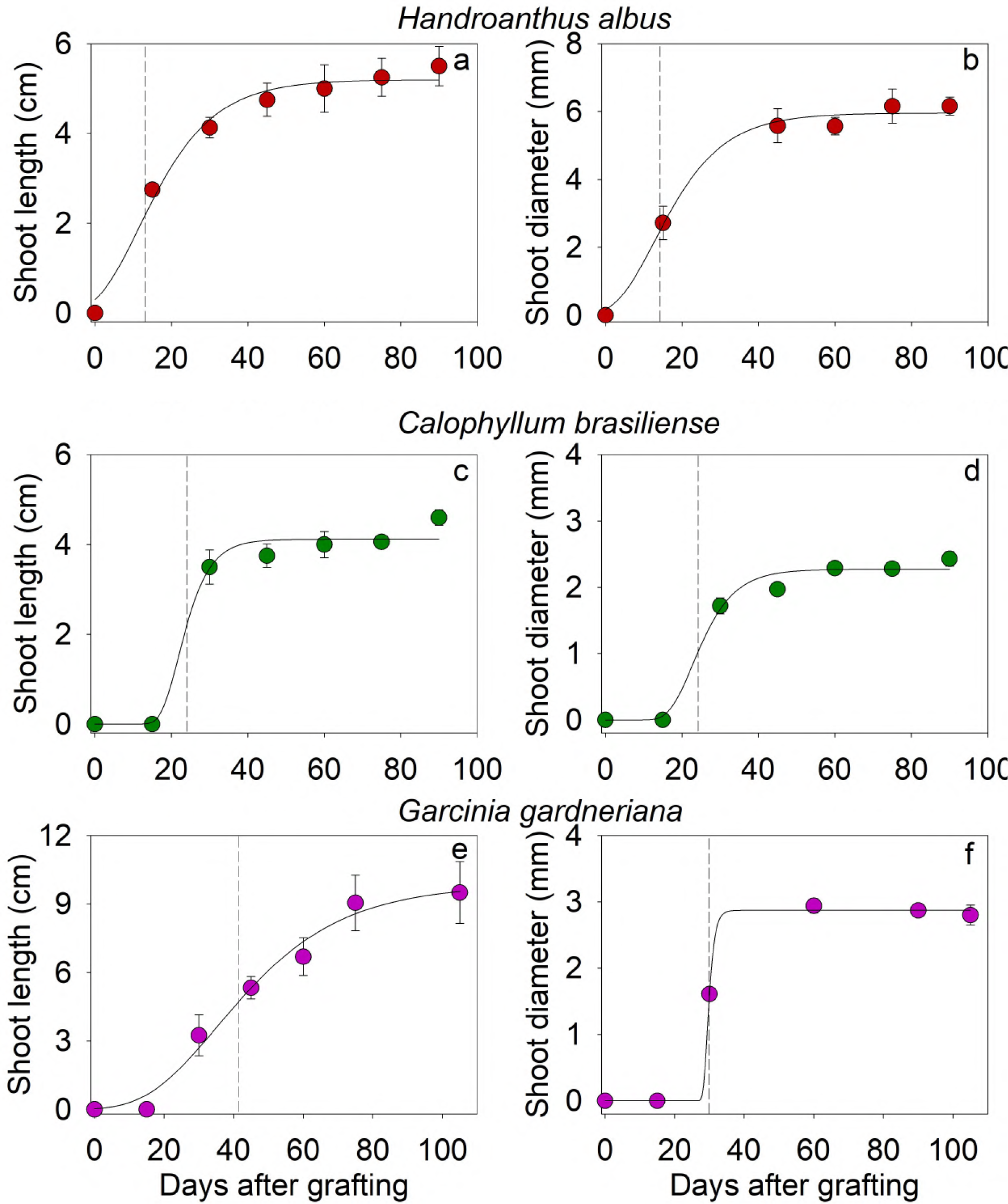
Distinct shoot growth patterns were recorded among the species, in terms of both length and diameter. H. albus exhibited a significant increase in both parameters at 15 DAG, reaching 2.75 cm in shoot length and 2.72 mm in shoot diameter (Figures 3a, b). Between 20 and 60 DAG, growth remained steady, followed by stabilization after 60 DAG, reaching 5.25 cm in length and 6.16 mm in diameter. The time required to reach 50% of the final shoot size was 13 DAG for length (2.25 cm) and 17 DAG for diameter (3.08 mm).
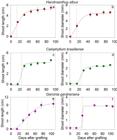
Growth of grafted plants. a, c, e: Shoot length. b, d, f: Shoot diameter. Dashed line indicates the number of days required to reach 50% of final size. Values represent the mean ± standard error of 6 replicates
Figura 3
Crescimento das plantas enxertadas. a, c, e: comprimento dos brotos. b, d, f: diâmetro dos brotos. A linha tracejada indica o número de dias necessários para atingir 50% do tamanho final. Os valores representam a média ± erro padrão de 6 repetições
In C. brasiliense, no shoot emergence was detected until 20 DAG (Figures 3c, d). From that point onward, shoot growth progressed rapidly, reaching 3.5 cm in length and 1.74 mm in diameter by 30 DAG. At 90 DAG, shoots measured 4.6 cm in length and 2.3 mm in diameter (Figures 3c, d). The time required to reach 50% of the final shoot size was approximately 24.5 days.
G. gardneriana exhibited a slower shoot growth pattern compared to the other species. From 20 to 75 DAG, shoot length increased continuously and linearly, reaching 9 cm (Figure 3e). Shoot diameter began to increase rapidly at 30 DAG, reaching 1.74 mm (Figure 3f). Growth stabilized around 60 DAG and was maintained at approximately 2.94 mm in diameter. G. gardneriana reached 50% of its final shoot length by 41 DAG (4.75 cm), and required 20 days to reach a diameter of 1.47 mm.
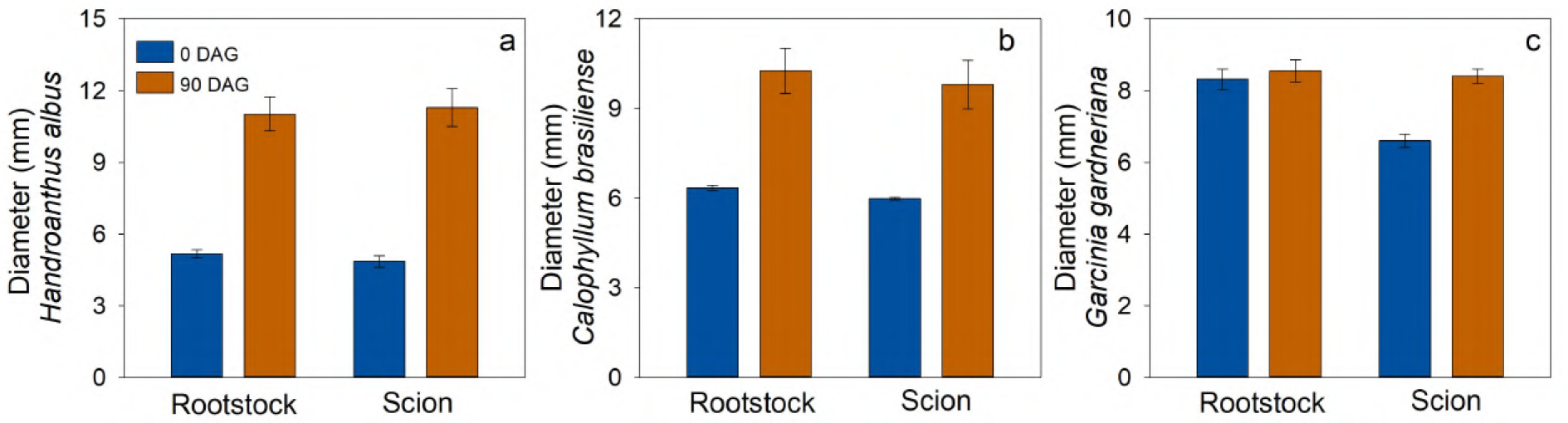
Regarding the diameter of the graft components, in H. albus, the rootstock had an average diameter of approximately 5.3 mm at 0 DAG, increasing to 11 mm at 90 DAG, while the scion diameter increased from 5.0 mm to 11.2 mm over the same period (Figure 4a). In C. brasiliense, the rootstock had an average diameter of 6.5 mm at the time of cleft grafting and 10.5 mm at 90 DAG, while the scion increased from 5.5 mm to 9.3 mm (Figure 4b). In G. gardneriana, the rootstock measured 8.2 mm at 0 DAG and 8.4 mm at 90 DAG, while the scion increased from 6.3 mm to 8.1 mm during the same period (Figure 4c).
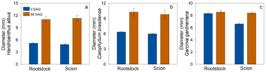
Initial (0 DAG) and final (90 DAG) diameter of rootstocks and scions. a Handroanthus albus. b Calophyllum brasiliense. c Garcinia gardneriana. DAG: Days after grafting. Values represent the mean ± standard error of 6 replicates
Figura 4
Diâmetro inicial (0 DAG) e final (90 DAG) dos porta-enxertos e enxertos. a: Handroanthus albus. b: Calophyllum brasiliense. c: Garcinia gardneriana. DAG: Dias após a enxertia. Os valores representam a média ± erro padrão de 6 repetições
3.2 Stem anatomy of grafted plants
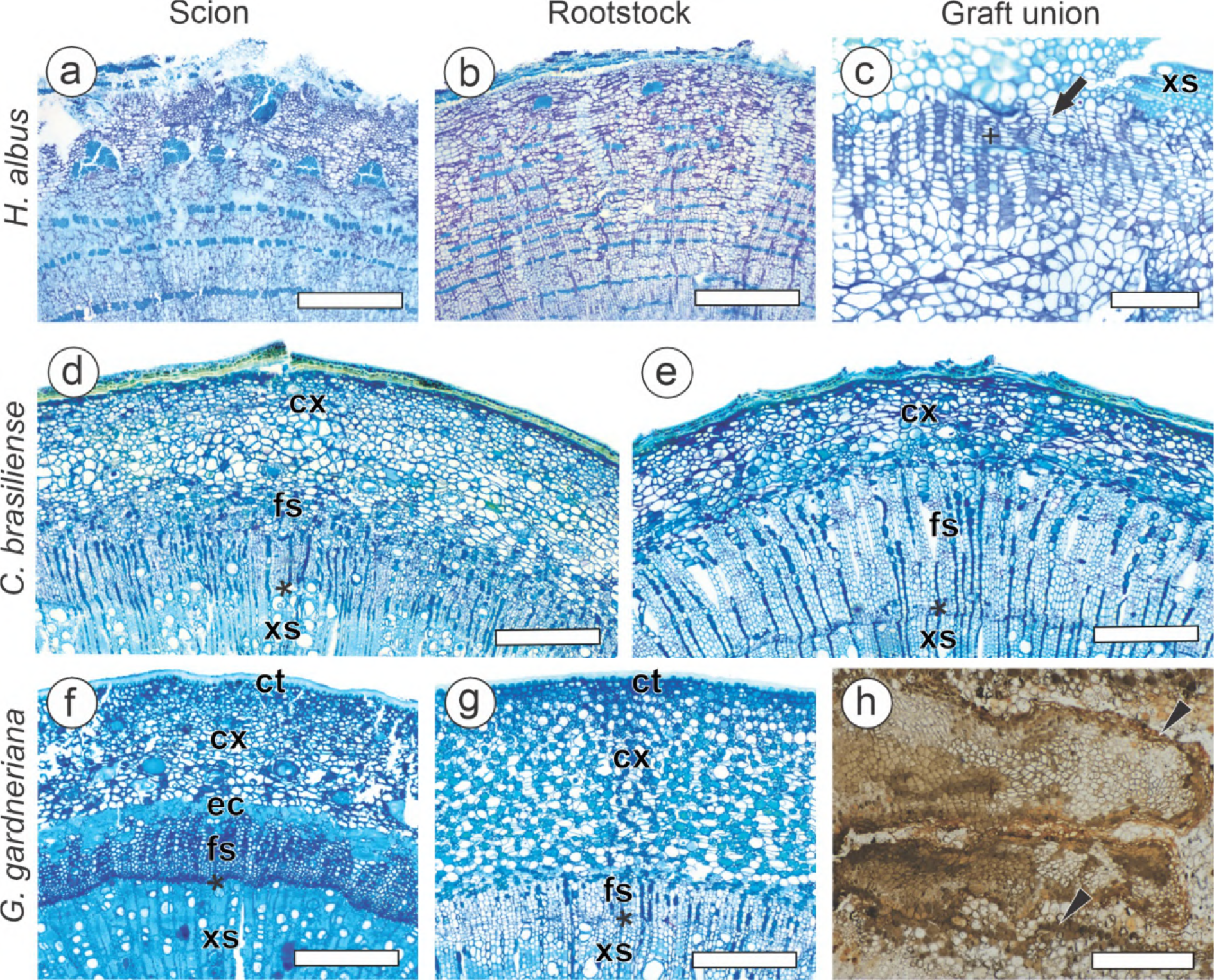
Structural anatomical analysis of the stem in H. albus indicated that both the scion and rootstock exhibited well-developed secondary xylem and phloem, indicating that the two components of the grafted plant were at similar developmental stages (Figures 5a, b).

Transverse stem anatomy of grafted seedlings stained with toluidine blue (a-g) or ferric chloride (f). a, d, f Transverse sections of the scions. b, e, g Transverse sections of the rootstocks. c, h Graft union. Arrow indicates xylem vessel formed at the union. Plus sign (+) indicates small, undifferentiated cells. Asterisk (*) indicates vascular cambium. Arrowheads indicate phenolic compound accumulation. Scale bars: a, b, d, e, f, g = 400 µm; c, h = 200 µm. cx, cortex; ct, cuticle; ec, sclerenchyma; fs, secondary phloem; xs, secondary xylem
Figura 5
Anatomia transversal do caule de mudas enxertadas coradas com azul de toluidina (a-g) ou cloreto férrico (f). a, d, f: Secções transversais dos enxertos. b, e, g: Secções transversais dos portaenxertos. c, h: União do enxerto. A seta indica vaso do xilema formado na união. O sinal de adição (+) indica células pequenas e indiferenciadas. O asterisco (*) indica o câmbio vascular. As pontas de seta indicam acúmulo de compostos fenólicos. Barras de escala: a, b, d, e, f, g = 400 µm; c, h = 200 µm. cx: córtex; ct: cutícula; ec: esclerênquima; fs: floema secundário; xs: xilema secundário
In the graft union region, a large number of small, undifferentiated cells were identified between the scion and rootstock tissues, regardless of the tissue type-such as xylem tissue adjoining the pith parenchyma (Figure 5c). Additionally, xylem formation was observed in some of these undifferentiated regions, indicating the onset of vascular connection between the scion and rootstock.
In C. brasiliense, greater anatomical similarity was verified between the scion and rootstock, including the presence of secondary xylem and phloem, a wellorganized vascular cambium, and a similarly structured cortex-suggesting that both parts were at comparable developmental stages, thereby facilitating graft union (Figures 5d and e). Furthermore, periderm formation was recorded in both scion and rootstock, along with the presence of secretory structures in the cortex.
In G. gardneriana, slow graft development and low survival rates were recorded. Anatomical analysis demonstrated a developmental mismatch between the scion and rootstock at the time of cleft grafting. The scion was characterized by a more advanced stage, showing well-developed secondary xylem and phloem, a thick layer of sclerenchyma, a more robust cuticle, and the presence of secretory structures (Figure 5f). In contrast, the rootstock presented an earlier developmental stage, characterized by less developed xylem and phloem and early formation of sclerenchyma (Figure 5g). Histochemical testing indicated weak staining for phenolic compounds in the scion, while the union region exhibited disorganized cell proliferation and significant accumulation of phenolic compounds along the tissue margins (Figure 5h).
4. DISCUSSION
4.1 Cleft grafting as a tool for genetic rescue and ecological restoration
Cleft grafting is an ancient technique widely used in agriculture in a wide range of species for the conservation of superior genotypes, early production, and increased resistance to soil-borne pests (Nie & Wen., 2023). However, the application of cleft grafting in native forest species of Brazil remains limited, particularly for purposes of genetic conservation. The often reduced success rate in tropical forest species, compared to agricultural crops, may be associated with factors such as higher anatomical heterogeneity, greater physiological complexity, longer juvenile periods, and limited domestication history of forest species, which contrast with the longterm selection and standardization characteristic of agricultural systems (Loupit et al., 2023).
Here, we demonstrate that cleft grafting is a viable method for rescuing genotypes of species of interest for ecological restoration, even though one of the studied species, G. gardneriana, exhibited a survival rate below 50%. In such cases, the primary goal is the preservation of collected genetic material. As an additional advantage for forest restoration and the recovery of degraded areas, cleft grafting enables the production of seedlings that can be planted in the field already at the reproductive stage (Mendes et al., 2021; Simões et al., 2021). Once established, these grafted seedlings may enhance biotic interactions by attracting pollinators and seed dispersers, which can contribute to increasing genetic variability in restored areas. From a practical perspective, this approach may reduce the time required for ecosystem functional recovery, representing a favorable cost-benefit strategy in large-scale restoration programs, particularly in miningimpacted landscapes where rapid vegetation establishment is critical.
4.2 Determinants of graft success: environmental factors and anatomical compatibility
Our results also highlight variations in survival rates, graft growth, and anatomical features, underscoring the complexity of the factors influencing cleft grafting success. Ensuring graft compatibility depends on effective vascular connection between the graft components and prolonged survival that allows the plant to maintain physiological function (Rasool et al., 2020). Additional external factors, such as environmental conditions during graft establishment, physiological age of the rootstocks, seasonal timing of scion collection, and microclimatic variability, may further influence graft performance (Franzon et al., 2008; Nanda & Melnyk, 2018).
The species analyzed in this study exhibited variation in graft survival rates, likely due to anatomical differences between scion and rootstock (Babar et al., 2023; Xiong et al., 2021). A series of anatomical interactions determines the success of graft union. The first critical stage is the adhesion between the two parts, followed by the formation of callus tissue at the graft interface-a healing tissue that forms in response to the injury (Babar et al., 2023; Thomas et al., 2024). Subsequently, callus cells differentiate into cambial cells, leading to the formation of a continuous vascular tissue that connects the scion to the rootstock. This connection is essential, as the vascular cambium-a meristematic tissue responsible for secondary growth-must align for the union to be functional. Once the cambial connection is established, xylem and phloem differentiate, enabling the transport of water and nutrients between graft components, thereby supporting plant development (Pina et al., 2012). Anatomical compatibility between cleft grafting partners is therefore a key factor for a successful union (Feng et al., 2024).
According to previous studies, graft incompatibility can be categorized into distinct types. Translocated incompatibility manifests through visual symptoms such as leaf chlorosis and premature defoliation, while localized incompatibility is characterized by anatomical irregularities at the graft union, including abnormalities in vascular tissue continuity and the formation of a disorganized callus (Reig et al., 2018; Errea et al., 2001).
4.3 Incompatibility and wound responses: the role of anatomy and phenolic compounds in graft failure
The low survival rate and slow development observed in G. gardneriana suggest that anatomical incompatibility may have been a key factor limiting its cleft grafting success (Thomas et al., 2024). Anatomical analysis revealed a marked developmental mismatch, with the scion exhibiting more advanced secondary xylem and phloem development compared to the less differentiated vascular tissues in the rootstock, potentially hindering the formation of a functional vascular cambium. Such mismatches are more frequently reported in tropical forest species, where ontogenetic gradients and asynchronous growth patterns between graft components may be pronounced (Mendes et al., 2020; Mendes et al., 2021)
Graft compatibility, influenced by cellular recognition processes (Feng et al., 2024), is critical to avoid the formation of abnormal structures at the graft interface, thereby ensuring uniform and healthy plant growth (Xiong et al., 2021).
Histological analysis also revealed stronger ferric chloride staining in G. gardneriana, indicating a higher accumulation of phenolic compounds at the graft union interface. Phenolic compounds play a protective role in plants and are involved in wound responses, with known antioxidant and antifungal properties (Babar et al., 2023; Hu et al., 2022). The quantity and nature of phenolic compounds are considered important indicators of graft compatibility, with less compatible combinations tending to exhibit higher concentrations of these compounds (Feng et al., 2024; Hu et al., 2022).
As a consequence of the accumulation of phenolic compounds, cleft grafting success can be negatively affected. This is because the presence of such compounds may suppress callus responsiveness to growthpromoting signals, hindering cellular differentiation and, subsequently, the establishment of functional water and nutrient transport between scion and rootstock (Liu et al., 2023; Thippan et al., 2024).
In G. gardneriana, non-structural phenolic compounds were not detected within the scion itself; however, their pronounced accumulation at the graft union suggests a localized tissue response to wounding and stress. This may have interfered with vascular reconnection, contributing to the low graft survival rate observed for this species (40%) compared to the others analyzed (Babar et al., 2023).
4.4 Species synthesis and recommendations for large-scale application
In H. albus, a survival rate of 60% was recorded, along with a shorter period (approximately 15 days) required to reach 50% of final shoot growth, compared to C. brasiliense and G. gardneriana. Anatomical observations support these results, as both graft components showed similar structural features and developmental stages. This suggests that anatomical compatibility- particularly when there is close developmental alignment between the scion and rootstock-is a key factor in cleft grafting success (Opoku et al., 2019).
Seedlings of H. albus were grafted onto H. heptaphyllus rootstocks due to the unavailability of conspecific seedlings. Despite this, the outcome was satisfactory, likely due to the anatomical similarity shared by congeneric species. Cleft grafting within the Handroanthus genus appears promising, as also demonstrated by Simões et al. (2021), who reported a graft success rate of 86.6% using H. heptaphyllus as the rootstock. Additionally, H. albus presented a larger seedling diameter-an anatomical trait that, according to Gomes et al. (2010), may favor callus formation.
C. brasiliense showed the highest survival rate (70%) and reached 50% of its final shoot size in approximately 25 days. These results suggest that, beyond anatomical compatibility, the cleft grafting technique employed may have facilitated rapid healing, growth, and survival (Opoku et al., 2019). As also observed in H. albus, anatomical analyses of C. brasiliense revealed strong similarity between scion and rootstock, contributing to its superior performance in terms of graft union success and subsequent growth.
From an applied perspective, these findings indicate that cleft grafting can be scaled up as a complementary strategy in ecological restoration programs, particularly in mining areas, where rapid seedling establishment, genetic rescue of remnant individuals, and cost-efficient propagation are essential. However, this technique should be viewed as complementary to other genetic conservation strategies, such as germplasm banks, seed-based restoration, and clonal propagation via cuttings or micropropagation, rather than as a substitute.
5. CONCLUSION
Cleft grafting is a viable tool for the genetic rescue of native tree species. The appropriate selection of rootstocks and propagules, combined with anatomical compatibility, significantly increases propagation success rates. Growth and anatomical analyses of the grafted plants highlight the critical role of anatomical compatibility between scion and rootstock for successful cleft grafting.
The hypothesis of this study was accepted, as the results demonstrated that the anatomical characteristics and histochemical composition of the graft and rootstock influenced grafting success among the studied species.
The results obtained are relevant for all three studied species, particularly C. brasiliense and H. albus, which showed higher cleft grafting efficiency. Although G. gardneriana exhibited survival rates below 50% after 90 days, cleft grafting remains a feasible strategy for preserving the species’ genetic material, representing a promising approach for genetic conservation and ecological restoration in mining-impacted areas.
Overall, these findings provide baseline evidence supporting the application of grafting techniques in tropical forest species, a field that remains underexplored within conservation biology. Future studies should evaluate long-term field performance and physiological responses of grafted individuals to confirm their effectiveness and scalability in large-scale restoration programs.
6. ACKNOWLEDGEMENTS
The authors would like to thank the Federal University of Viçosa (UFV), the Sociedade de Investigações Florestais (SIF), and Vale S.A. for their institutional, technical, and financial support in the development of this study.
DATA AVAILABILITY
The entire dataset supporting the findings of this study has been published within the article.
7. REFERENCES
-
Babar, M., Afzal, N., Siddiqui, K., Azhar, A., & Galani, S. (2023). Exploring graft incompatibility markers: Intraspecific and interspecific grafts of tomato (Solanum lycopersicum L.). Scientia Horticulturae, 310, 111762. https://doi.org/10.1016/j.scienta.2023.111762
» https://doi.org/10.1016/j.scienta.2023.111762 -
Duarte, S. F., Gomes, L. N. L., Oliveira, S. C., & Soares, A. L. C. (2020). Impacto do rompimento da barragem de rejeitos de minério de ferro da mina do Feijão, em Brumadinho, quanto ao uso e à cobertura do solo e à qualidade das águas superficiais do rio Paraopeba. Revista da Universidade Federal de Minas Gerais, 27, 356-381. https://doi.org/10.35699/2316-770X.2020.20557
» https://doi.org/10.35699/2316-770X.2020.20557 -
Errea, P., Garay, L., & Marín, J. A. (2001). Early detection of graft incompatibility in apricot (Prunus armeniaca) using in vitro techniques. Physiologia Plantarum, 112, 135-141. https://doi.org/10.1034/j.13993054.2001.1120118.x
» https://doi.org/10.1034/j.13993054.2001.1120118.x -
Feng, M., Augstein, F., Kareem, A., & Melnyk, C. W. (2024). Plant grafting: Molecular mechanisms and applications. Molecular Plant, 17, 75-91. https://doi.org/10.1016/j.molp.2023.12.006
» https://doi.org/10.1016/j.molp.2023.12.006 -
Franzon, R. C., Gonçalves, R. S., Antunes, L. E. C., Raseira, M. C. B., & Trevisan, R. (2008). Surinam cherry propagation through grafting. Revista Brasileira de Fruticultura, 30(2), 488-491. https://doi.org/10.1590/S010029452008000200038
» https://doi.org/10.1590/S010029452008000200038 -
Gomes, W. A., Mendonça, R. M. N., Souza, E. P., Estrela, M. A., Melo, V. S., Silva, S. de M., & Souza, A. P. (2010). Garfagem e diâmetro de porta-enxerto na obtenção de mudas de umbuzeiro do acesso laranja. Revista Brasileira de Fruticultura, 32, 952-959. https://doi.org/10.1590/S0100-29452010000300041
» https://doi.org/10.1590/S0100-29452010000300041 -
Grange, R. I., & Andrews, J. (1994). Expansion rate of young tomato fruit growing on plants at positive water potential. Plant, Cell & Environment, 17, 181-187. https://doi.org/10.1111/j.13653040.1994.tb00281.x
» https://doi.org/10.1111/j.13653040.1994.tb00281.x -
Hu, W., Sarengaowa, Guan, Y., & Feng, K. (2022). Biosynthesis of phenolic compounds and antioxidant activity in freshcut fruits and vegetables. Frontiers in Microbiology, 13, 906069. https://doi.org/10.3389/fmicb.2022.906069
» https://doi.org/10.3389/fmicb.2022.906069 - Johansen, D. A. (1940). Plant microtechnique McGraw-Hill.
- Kampa, M. B., Homczinski, I., Roque, R. H., Figueiredo Filho, A., Peres, F. S. B., & Tambarussi, E. V. (2020). Variabilidade genética em progênies de Campomanesia xanthocarpa Mart. ex O. Berg em viveiro. Scientia Forestalis, 48, e2935.
-
Liu, J., Magige, EA, Peng-Zhen, V., Wambulwa, MC., Luo, YH., Qi, HL., GAO, LM., & Milne, RI. (2023). Genetic imprints of grafting in wild iron walnut (Juglans sigillata): Implications for germplasm conservation and utilization. BMC Plant Biology, 23, 423. https://doi.org/10.1186/s12870-023-04428-z
» https://doi.org/10.1186/s12870-023-04428-z -
Loupit, G., Brocard, L., Ollat, N., & Cookson, S. J. (2023). Grafting in plants: Recent discoveries and new applications. Journal of Experimental Botany, 74(8), 2433-2447. https://doi.org/10.1093/jxb/erad061
» https://doi.org/10.1093/jxb/erad061 -
Mallett, A., França, E. L. B., Alves, I., & Mills, L. (2021). Environmental impacts of mining in Brazil and the environmental licensing process: Changes needed for changing times? The Extractive Industries and Society, 8(3), 100952. https://doi.org/10.1016/j.exis.2021.100952
» https://doi.org/10.1016/j.exis.2021.100952 -
Mendes, G. G. C., Santos, G. A., Xavier, A., Martins, S. V., Souza, G. A., Martins, T. G. V., & Reis Neto, R. F. (2021). Grafting efficiency in Brazilian native tree species. Scientia Forestalis, 49, e3687. https://doi.org/10.18671/scifor.v49n132.04
» https://doi.org/10.18671/scifor.v49n132.04 - Mendes, G. G. C., Santos, G., Resende, M. D., Martins, S. V., Souza, G. A., Nunes, A., & Martins, T. (2020). Flowering acceleration in native Brazilian tree species for genetic conservation and breeding. Annals of Forest Research, 63, 1751.
-
Nanda, AK., & Melnyk, C. W. (2018). The role of plant hormones during grafting. Journal of Plant Research, 131(1), 49-58. https://doi.org/10.1007/s10265-017-0994-5
» https://doi.org/10.1007/s10265-017-0994-5 -
Nevill, P. G., Tomlinson, S., Elliott, C. P., Espeland, E. K., Dixon, K. W., & Merritt, D. J. (2016). Seed production areas for the global restoration challenge. Ecology and Evolution, 6, 7490-7497. https://doi.org/10.1002/ece3.2455
» https://doi.org/10.1002/ece3.2455 -
Nie, W., & Wen, D. (2023). Study on the applications and regulatory mechanisms of grafting in vegetables. Plants, 12(15), 2822. https://doi.org/10.3390/plants12152822
» https://doi.org/10.3390/plants12152822 -
O’Brien, T. P., Feder, N., & McCully, M. E. (1964). Polychromatic staining of plant cell walls by toluidine blue O. Protoplasma, 59, 368-373. https://doi.org/10.1007/BF01248568
» https://doi.org/10.1007/BF01248568 -
Opoku, E. M., Opuni-Frimpong, E., & Dompreh, D. (2019). Developing sustainable regeneration techniques for four African mahogany species: grafting methods for success and growth. New Forests, 50, 539-554. https://doi.org/10.1007/s11056-018-9677-x
» https://doi.org/10.1007/s11056-018-9677-x -
Pina, A., Errea, P., & Martens, H. J. (2012). Graft union formation and cell-to-cell communication via plasmodesmata in compatible and incompatible stem unions of Prunus spp. Scientia Horticulturae, 143, 144-150. https://doi.org/10.1016/j.scienta.2012.06.017
» https://doi.org/10.1016/j.scienta.2012.06.017 -
Rasool, A., Mansoor, S., Bhat, K. M., Hassan, G. I., Baba, T. R., Alyemeni, M. N., Alsahli, A. A., El-Serehy, H. A., Paray, B. A., & Ahmad, P. (2020). Mechanisms underlying graft union formation and rootstock-scion interaction in horticultural plants. Frontiers in Plant Science, 11, 590847. https://doi.org/10.3389/fpls.2020.590847
» https://doi.org/10.3389/fpls.2020.590847 -
Reig, G., Guerriero, R., & GarcésClaver, A. (2018). Anatomical graft compatibility study between apricot cultivars and different plum-based rootstocks. Scientia Horticulturae, 237, 67-73. https://doi.org/10.1016/j.scienta.2018.03.035
» https://doi.org/10.1016/j.scienta.2018.03.035 - Systat Software Inc. (2021). SigmaPlot, version 15.1. Systat Software Inc., San Jose, California, USA.
- Shimizu, J. Y. (2007). Estratégia complementar para conservação de espécies florestais nativas: Resgate e conservação de ecótipos ameaçados. Pesquisa Florestal Brasileira, 54, 7-35.
-
Simões, I. M., Lopes, J. C., Schmildt, E. R., Ferreira, A., Baptista, J. O., Araujo, C. P. de, Rosa, T. L. M., Amaral, G. C., & Alexandre, R. S. (2021). Grafting between species of the genus Handroanthus for the production of multi-colored flower canopies. Scientia Forestalis, 49, e3701. https://doi.org/10.18671/scifor.v49n132.07
» https://doi.org/10.18671/scifor.v49n132.07 -
Teixeira, C., & Huber, C. D. (2021). The inflated significance of neutral genetic diversity in conservation genetics. Proceedings of the National Academy of Sciences of the United States of America, 118, e2015096118. https://doi.org/10.1073/pnas.2015096118
» https://doi.org/10.1073/pnas.2015096118 -
Thippan, S., Bunya-Atichart, K., Isarangkool, S., & Lerslerwong, L. (2024). Histological and biochemical aspects as potential markers for evaluation graft compatibility in durian at the early nursery stage. Scientia Horticulturae, 337, 13490. https://doi.org/10.1016/j.scienta.2023.13490
» https://doi.org/10.1016/j.scienta.2023.13490 -
Thomas HR, Gevorgyan A, Hermanson A, Yanders S, Erndwein L, Norman-Ariztía M, Sparks EE, Frank MH (2024) Graft incompatibility between pepper and tomato can be attributed to genetic incompatibility between diverged immune systems. Hortic Res 11:uhae255. https://doi.org/10.1093/hr/uhae255
» https://doi.org/10.1093/hr/uhae255 -
Thompson, F., de Oliveira, B. C., Cordeiro, M. C., Masi, B. P., Rangel, T. P., Paz, P., Freitas, T., Lopes, G., Silva, B. S., Cabral, A. S., Soares, M., Lacerda, D., Vergilio, C. S., Lopes-Ferreira, M., Lima, C., Thompson, C., & de Rezende, C. E. (2019). Severe impacts of the Brumadinho dam failure (Minas Gerais, Brazil) on the water quality of the Paraopeba River. Science of the Total Environment, 135914. https://doi.org/10.1016/j.scitotenv.2019.135914
» https://doi.org/10.1016/j.scitotenv.2019.135914 -
Xiong, M., Liu, C., Guo, L., Wang, J., Wu, X., Li, L., Bie, Z., & Huang, Y. (2021). Compatibility evaluation and anatomical observation of melon grafted onto eight Cucurbitaceae species. Frontiers in Plant Science, 12, 762889. https://doi.org/10.3389/fpls.2021.762889
» https://doi.org/10.3389/fpls.2021.762889
Edited by
-
Editors:
Sílvio Nolasco de Oliveira Neto and Rodolfo Soares de Almeida.