 AEROPONICS IN THE CHARACTERIZATION OF THE ROOT SYSTEM OF EUCALYPTUS
ABSTRACT
Understanding the root system of plants is essential for improving productivity and resilience, particularly under water-deficit conditions. Despite its recognized importance, root system characterization in eucalyptus has been limited. This study presents a fast and accurate method for evaluating root biomass in eucalyptus seedlings and cuttings using an aeroponic system. Custom-built aeroponic boxes equipped with external drip irrigation and internal fogger systems were developed to accommodate 90-day-old seedlings/cuttings. Initially, the optimal number of replications for aeroponic experiments was determined using 12 vegetatively propagated Eucalyptus spp. clones. This optimization enhanced experimental precision and reproducibility. Subsequently, root system of 23 clonal genotypes and seedlings from seven Eucalyptus spp. species were characterized. After 50 days in the aeroponic system, the following root parameters were evaluated: dry weight, length, and number of roots. Among these, dry root biomass showed the greatest variation among clones, making it a key trait for genotype differentiation. For seed-derived seedlings, root length, as a non-destructive characteristic, makes it possible to select and maintain the superior genotypes in the Breeding Program. This study demonstrates that early root phenotyping using aeroponics is a valuable approach for identifying productive and drought-tolerant eucalyptus clones and species, contributing to more efficient and resilient forestry practices.
Keywords:
Plant breeding; Drought tolerance; Water relations
RESUMO
Compreender o sistema radicular das plantas é essencial para melhorar a produtividade e a resiliência, particularmente em condições de déficit hídrico. Apesar de sua reconhecida importância, a caracterização do sistema radicular em eucalipto tem sido limitada. Este estudo apresenta um método rápido e preciso para avaliar a biomassa radicular em mudas de eucalipto utilizando um sistema aeropônico. Caixas aeropônicas personalizadas, equipadas com irrigação por gotejamento externo e nebulização interna, foram desenvolvidas para acomodar mudas com 90 dias de idade. Inicialmente, o número ideal de repetições para experimentos aeropônicos foi determinado utilizando 12 clones de eucalipto propagados vegetativamente. Essa otimização aumentou a precisão e a reprodutibilidade experimentais. Posteriormente, os sistemas radiculares de 23 genótipos clonais e progênies de sete espécies de eucalipto foram caracterizados. Após 50 dias no sistema aeropônico, os seguintes parâmetros radiculares foram avaliados: massa seca, comprimento e número de raízes. Dentre estes, a biomassa seca radicular apresentou a maior variação entre os clones, tornando-se uma característica-chave para a diferenciação genotípica. Para mudas derivadas de sementes, o comprimento da raiz, por ser uma característica não destrutiva, possibilita a seleção e a manutenção de genótipos superiores no Programa de Melhoramento. Este estudo demonstra que a fenotipagem precoce da raiz por aeroponia é uma abordagem valiosa para a identificação de clones e espécies de eucalipto produtivos e tolerantes à seca, contribuindo para práticas florestais mais eficientes e resilientes.
Palavras-Chave:
Melhoramento de plantas; Tolerância à seca; Relações hídricas
1. INTRODUCTION
Eucalyptus spp. is one of the most economically important forest crops worldwide. Due to its rapid growth, high wood yield, easy propagation, and broad genetic variability, eucalypts plantations expanding rapidly and are now cultivated in up to 95 countries, as an excellent source of wood, bioenergy, and cellulose (Zhang & Wang, 2021; Chambi-Legoas et al., 2022). One of the major challenges to maintaining eucalyptus productivity in the coming decades is climate change, which has altered temperature and precipitation patterns (Brunner et al., 2015). Among the negative impacts, the combination of rising temperatures and reduced rainfall can lead to water deficit-induced decline and even plantation mortality (Allen et al., 2010).
Plant responses to drought-induced decline are complex, involving both adaptive changes and deleterious effects, with no universal mechanism of drought tolerance. Plants employ various adaptive strategies to cope with water scarcity, such as reducing water potential and undergoing physiological, anatomical, and morphological modifications (Matos et al., 2014; Gonçalves et al., 2017; Pita-Barbosa et al., 2023). A commonly observed response in drought-tolerant plants is increased carbon allocation to the roots, resulting in a higher root-to-shoot ratio, which is typically associated with more efficient root development and water uptake (Costa & Silva et al., 2004; Valdés et al., 2013; Maseda & Fernández, 2016). However, despite the critical role of root systems, especially in long-cycle species such as trees, in drought tolerance (Brunner & Godbold, 2007; Silva et al., 2004), most existing research has focused on above-ground plant structures (McDowell et al., 2008; Hamanishi & Campbell, 2011; Ryan, 2011; Noleto-Dias et al., 2023).
Improved access to information on root development could be a key factor in enhancing our understanding of drought tolerance in eucalyptus and significantly contribute to the selection of more resilient genetic materials (Zinta et al., 2022). However, under field conditions, unlike the unobstructed assessment of above-ground structures, evaluating the root system in traditional cultivation systems presents numerous challenges that hinder accurate characterization. This is primarily because the root system penetrates deeply into the soil, making it less accessible for quantification and analysis. Meanwhile, methods used to characterize root systems in potted plants under controlled conditions are often labor-intensive and imprecise, frequently resulting in the destruction of fine secondary roots responsible for water absorption.
To overcome the inherent challenges of root system phenotyping in eucalyptus, this study proposes the use of an aeroponic system for early-stage root characterization, enabling non-destructive and easily accessible monitoring of root development. Unlike hydroponics, which involves partial or complete immersion of roots in a nutrient solution, aeroponics irrigates plant roots with aerosolized droplets (Lakhiar et al., 2018; Eldridge et al., 2020). Experiments using clones and progenies from different Eucalyptus species were conducted to evaluate the effectiveness of the aeroponic system in root characterization and to highlight its advantages over traditional invasive or destructive assessment methods.
2. MATERIAL AND METHODS
2.1 Aeroponic System Platform
The root phenotyping system in aeroponics was constructed in the form of boxes using isothermal panels made of expanded polystyrene sheets, manufactured with pre-painted steel sheets featuring an epoxy primer finish. Each panel had a thickness of 50 mm, and the boxes measured 1.15 m (L) × 1.72 m (H) × 1.15 m (W) (Figure 1a). Each box was designed to accommodate 45 Eucalyptus seedlings or cuttings, with equidistant holes (35 mm in diameter) in the lid to hold 90-day-old seedlings - cuttings grown in tubes. To ensure water availability for the plants, wetting was carried out in two ways:

Aeroponics system used in the characterization of eucalyptus seedling roots. (A) Aeroponic boxes with eucalyptus seedlings in a greenhouse; (B) detail of the drip system in each seedling; (C) detail of the microspray system using Fogger nozzles at the bottom of the box; (D) beginning of root development; (E) root development at 30 days; and (F) final root development at 50 days
Figura 1
Sistema de aeroponia utilizado na caracterização das raízes de mudas de eucalipto. (A) Caixas de aeroponia com mudas de eucalipto em casa de vegetação; (B) detalhe do sistema de gotejamento em cada muda; (C) detalhe do sistema de microaspersão utilizando bicos Fogger no fundo da caixa; (D) início do desenvolvimento radicular; (E) desenvolvimento radicular aos 30 dias; e (F) desenvolvimento radicular final aos 50 dias
Micro-dripping directly onto each seedling - cutting (60 seconds every 60 minutes) (Figure 1b).
Fogger-type misters, with 19 units installed inside each box (10 seconds every 60 minutes) (Figure 1c), generating mist to keep the roots consistently moist.
During the root biomass evaluation period, only water was used, no nutrient solution was applied. The aeroponic boxes were placed in a greenhouse to protect them from rainfall and major climatic fluctuations.
2.2 Optimum plot number of replications
To determine the different sample sizes of repetitions, for evaluating the optimal number of plots in aeroponic system experiments, an experiment was conducted in a greenhouse, with temperatures ranging from 20 to 32°C and relative air humidity between 90% and 70%. Twelve clones of Eucalyptus spp. (Table 1) were evaluated under two seedling management prior to the experiment installation.
Eucalyptus clones used to determine the ideal number of plot replications and to characterize root biomass in the aeroponic system
Tabela 1
Clones de Eucalyptus utilizados para determinação do número ideal de replicações de parcela e para caracterização da biomassa radicular no sistema aeropônico
In the first treatment (control), cuttings aged 90–120 days were not standardized in terms of leaf number or other above-ground traits. These cuttings were propagated via the traditional mini-cutting method in tubes. In the second treatment, cuttings were standardized to three pairs of leaves, with excess leaves pruned.
Twenty cuttings (plots) of each genotype were randomly distributed across aeroponic boxes for each treatment. The experiment followed a factorial design: 12 genotypes × 2 treatments, with 20 replications per combination. Thirty days after installation, root length (cm) and dry root biomass (g) were measured.
To estimate the effect of the minimum number of replications on genetic parameter estimates, different numbers of replications were sampled. The number of replications ranged from 2 to 19 using 1000 resamplings without replacement. In each simulation, estimates of the overall mean of the clones, the residual coefficient of variation (CVe), and the accuracy in clone selection (AS) (Resende & Duarte, 2007) were obtained following estimator:
Subsequently, for each estimate, the standard deviation considering the 1,000 resamplings was obtained, and the definition of the ideal number of replications was determined by calculating a 90% reduction in the standard deviation of the AS estimate.
2.3 Seedling from clonal cuttings
The root systems of 23 Eucalyptus spp. clones from the Suzano’s Breeding Program were characterized using the aeroponic system (Table 1). The experiment was conducted in a greenhouse under the same temperature and humidity conditions as previously described. Ten cuttings from each genotype were randomly arranged in aeroponic boxes, following a completely randomized design.
Cuttings were propagated via mini-cutting in tubes and transferred to the aeroponic system at 90 days of age. Prior to transfer, cuttings were standardized to three pairs of leaves, with excess foliage pruned. To support the cuttings in the aeroponic boxes, the plastic tubes were cut 5 cm from the top, leaving the roots exposed to the misting system.
2.4 Seed-Derived Seedlings
In addition to clonal materials, the root systems of seed-derived seedlings from seven eucalyptus species from the Suzano’s Breeding Program were characterized aeroponically. The species included: Eucalyptus camaldulensis Dehnh, Eucalyptus pellita F. Muell, Eucalytpus grandis W. Hill, Eucalyptus saligna Smith, Eucalyptus robusta Smith, Eucalyptus tereticornis Smith, and Eucalyptus resinifera Smith.
Fifteen seedlings per species, aged 90 days post-germination, were randomly arranged in aeroponic boxes using a completely randomized design. Seeds were sown in tubes with substrate, and only one seedling per tube was maintained. The greenhouse conditions and standardization procedures were identical to those used for clonal seedlings.
2.5 Evaluation and analyses
Seedlings remained in the aeroponic boxes for 50 days (Figures 1d and 1e), allowing some genotypes to develop roots that reached the bottom of the box (Figure 1f). After this period, the following variables were assessed:
-
Root length (cm)
-
Number of primary roots
-
Dry root biomass (g)
To determine dry weight, seedlings were cut at the collar, and both above-ground and root portions were placed in paper bags. Samples were dried in an oven at 60°C for 48 hours, after which their weight was recorded. Data analysis was performed using R® software version 4.3.1 (R Core Team, 2022). Clone grouping was conducted using the Scott-Knott test at a significance level of ≥ 0.05.
3. RESULTS
3.1 Optimum plot number of replications
Analysis of replication numbers revealed that increasing the number of repetitions significantly reduced the standard deviation of the estimated parameters. This reduction in variance minimized the sampling effect typically observed with smaller replication sizes (Figure 2). Seedling standardization had a modest positive impact on root development, with average increases of 10% in dry biomass and 5.6% in root length. This improvement also enhanced the reliability of parameter estimates for both variables. Additionally, it led to a reduction in the experimental coefficient of variation, thereby increasing selection accuracy, particularly evident in experiments with fewer replications (Figures 2 and 3).

Accuracy estimates obtained from the average of 1000 resamplings for twelve clones in Eucalyptus spp. assay, considering the root dry weight (g) and root length (cm) for mean (A), coefficient of error (B) and accuracy of selection (C)
Figura 2
Estimativas de acurácia obtidas a partir da média de 1000 reamostragens para doze clones de Eucalyptus spp., considerando o peso seco (g) e o comprimento das raízes (cm) para média (A), coeficiente de erro (B) e acurácia de seleção (C)

Relation between the number of replications and the standard deviation for the accuracy of selection estimates obtained from the average of 1000 simulations for root dry weight (g) and root length (cm). Dashed lines indicate values of reduction of 90% of the deviation for the accuracy of selection estimates
Figura 3
Relação entre o número de réplicas e o desvio padrão para a precisão das estimativas de seleção obtidas a partir da média de 1000 simulações para peso seco (g) e comprimento (cm) das raízes. As linhas tracejadas indicam valores de redução de 90% do desvio para a precisão das estimativas de seleção
Dry root biomass emerged as the most reliable trait for selective accuracy, with simulations showing values above 0.75 starting from eight replications. This was accompanied by a substantial reduction in the standard deviation of accuracy estimates, exceeding 90%. Similar trends were observed for root length, with optimal accuracy achieved at ten replications. These results highlight the effectiveness of using 10 clonal replicates for phenotypic screening of root performance.
3.2 Clone screening
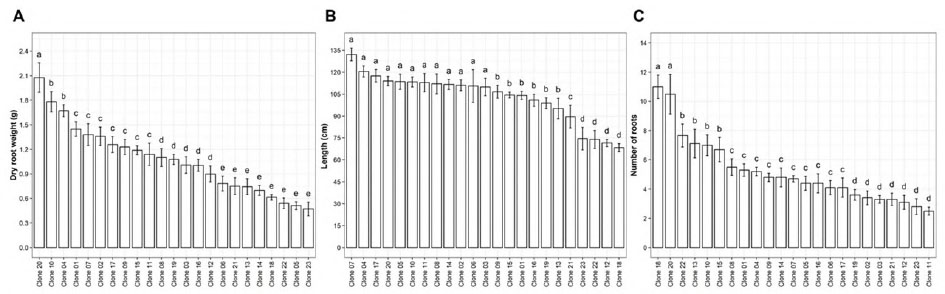
Data dispersion and distribution (Figures 4 and 5) revealed significant differences among the evaluated genotypes for all root traits. For dry root biomass, the clones were grouped into five distinct categories. Clones 20, 10, and 04 stood out with the highest biomass, while clones 23, 05, 22, 18, 14, and 13 showed the lowest values (Figure 4a).
Clustering of clones using the Scott-Knott test (α = 5%) according to the variables: A) root dry weight (g), B) root length (cm) and C) number of roots
Figura 4
Agrupamento de clones usando o teste de Scott-Knott (α = 5%) de acordo com as variáveis: A) peso seco da raiz (g), B) comprimento da raiz (cm) e C) número de raízes

Root characterization of different Eucalyptus spp. clones using the aeroponic system. Boxplots display data through their upper and lower quartiles. The boxes show the interquartile range, and the inner line represents the median for the variables: A) dry weight (g), B) length (cm), and C) number of roots
Figura 5
Caracterização radicular de diferentes clones de Eucalyptus spp. utilizando o sistema aeropônico. Boxplots exibem dados por meio de seus quartis superior e inferior. As caixas mostram o intervalo interquartil, e a linha interna representa a mediana para as variáveis: A) peso seco (g), B) comprimento (cm) e C) número de raízes
Regarding root length, four groupings were formed, although differences among them were not statistically significant.
Twelve clones demonstrated superior performance in this trait (Figure 4b). For the number of primary roots, three distinct groupings were identified (Figure 4c). Interestingly, clones 13, 22, and 18, previously ranked low in biomass and length, showed better performance in root number.
Among the three evaluated traits, dry root biomass, root length, and number of roots, dry biomass exhibited the least data dispersion across clones, indicating greater consistency in this trait (Figure 5).
3.3 Seed-derived seedlings screening
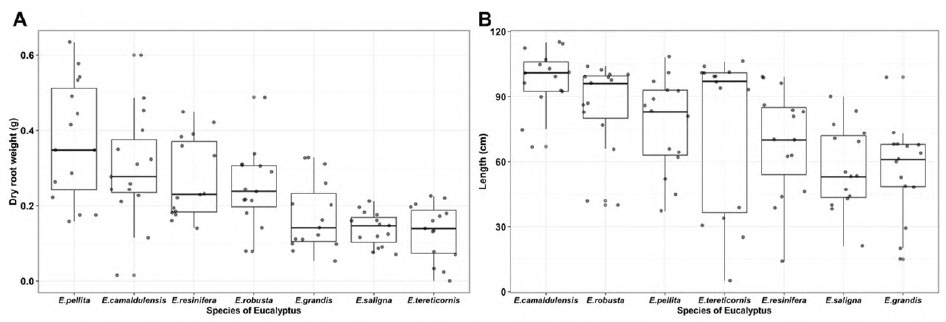
Evaluations of seed-derived seedlings revealed significant intra- and interspecific variation across the seven Eucalyptus species. Species with the highest number of individuals exhibiting greater root biomass were E. pellita, E. camaldulensis, and E. resinifera (Figure 6a). For root length, the standout species were E. camaldulensis, E. tereticornis, and E. robusta (Figure 6b). No significant differences were observed among species for the number of roots, as all exhibited a dominant taproot structure.

Characterization of dry weight (A) and root length (B) in seven Eucalyptus spp. species using the aeroponic system. Boxplots display data through their upper and lower quartiles. The boxes represent the interquartile range, and the inner line shows the median for the variables: dry weight (g) and length (cm). Each point represents a measurement from an individual originating from seed for each species
Figura 6
Caracterização do peso seco (A) e comprimento da raiz (B) em sete espécies de Eucalyptus spp. usando o sistema aeropônico. Os boxplots exibem os dados por meio de seus quartis superior e inferior. Os boxes representam o intervalo interquartil, e a linha interna mostra a mediana para as variáveis: peso seco (g) e comprimento (cm). Cada ponto representa uma medida de um indivíduo seminal para cada espécie
4. DISCUSSION
The selection of water deficit–tolerant plants traditionally require field trials in drought-prone areas. However, field evaluations are time-consuming, are affected by fluctuating and often unpredictable weather conditions. In the context of climate change, the development of efficient and rapid screening methods for assessing water deficit tolerance under controlled conditions becomes essential. This study demonstrates that aeroponics offers a practical and effective approach for monitoring and measuring early root development in Eucalyptus seedlings. Aeroponics has long been utilized in root physiology research (Barak et al., 1996), particularly for its ability to maintain steady-state control of nutrients, gas exchange, and root temperature (Aidoo et al., 2017; Zobel et al., 1976), as well as for assessing plant water relations and nitrate uptake under saline stress (Tafesse et al., 2021). The findings of this study demonstrate that aeroponics can also serve as a valuable tool for identifying genotypes with greater root biomass, which may be indicative of enhanced drought tolerance.
The heterogeneity of the morphological and physiological within and among conditions of seedlings is a common problem in experiments with seedlings of tree species (Ekamawanti et al., 2021, Moreira et al., 2023). This heterogeneity directly influences the number of experimental plots used (Steel et al., 1997, Martin et al., 2005). To date, no studies have addressed the optimal number of replications in aeroponic experiments. This research fills that gap by demonstrating that optimizing replication improves experimental accuracy and reproducibility in root system evaluations.
In the screening of the 23 clones, four (S16, S14, S05, and S06) have a recent history of sensitivity to water deficit (unpublished data, Forest Management, Suzano S.A.), with mortality rates ranging from 30% to 75%, depending on the severity of the deficit. In the present assay, these clones exhibited reduced root dry biomass compared to the other genotypes, corroborating their field performance and highlighting the potential of aeroponic systems for identifying genotypes tolerant to water deficit. However, a validation experiment using the same genetic materials under field conditions with water deficit is essential to better identify the variable most correlated with this characteristic. Among the traits analyzed, root dry biomass showed the lowest coefficient of variation, suggesting it is a more reliable parameter for discriminating genetic materials, particularly those propagated vegetatively. A deeper understanding of the contribution of each trait to drought resilience is also crucial for the accurate classification and selection of tolerant genotypes.
In the screening of seedlings derived from seeds, E. pellita and E. camaldulensis showed the highest number of individuals with greater root biomass in aeroponics. Both are recognized for their productivity in water-deficit environments. E. pellita is highly adaptable to diverse conditions (Clarke et al., 2009; Hutapea et al., 2023), and hybrid clones involving E. pellita have demonstrated strong performance under drought in the Brazilian Midwest (Santos et al., 2021). E. camaldulensis, on the other hand, employs physiological mechanisms to restrict water loss and access deep soil moisture (Lemcoff et al., 2002), with its rapid and deep root system growth as confirmed in this study.
E. tereticornis also exhibited high intraspecific variation in root length, which is an important characteristic for obtaining water. E. tereticornis naturally occurs in transitional climates between semi-arid and humid zones (BSh and Cfa), and is classified as having intermediate drought tolerance (Bourne et al., 2015). The high intraspecific variation in root length observed in E. tereticornis seedlings is particularly valuable for breeding programs, as root length can be assessed in aeroponia non-destructively, allowing for the selection and retention of superior genotypes.
Conversely, E. grandis and E. saligna exhibited the lowest average root biomass and length. These species are known to cope with drought through alternative strategies, such as efficient stomatal regulation and increased hydraulic conductivity following drought events (Pita et al., 2005; Sperry, 2000; Gauthey et al., 2022; Chambi-Legoas et al., 2022). The limited investment in root systems observed in this trial supports the hypothesis that these species rely more on above-ground mechanisms to withstand water deficit.
Aeroponics proved to be a practical and efficient tool for early-stage screening of genotypes with potential resilience to water deficit, particularly through the evaluation of dry root biomass. Aeroponics offers several advantages for root system characterization, including the absence of mechanical resistance to root growth (Peterson & Krueger, 1988), the ability to conduct both destructive and non-destructive measurements (Aidoo et al., 2017), and direct observation of roots without loss of fine structures. Their main limitation is sensitivity: the lack of substrate protecting the root zone makes plants vulnerable to total collapse within a relatively short period due to power outages or irrigation equipment failures (Savvas & Gruda, 2018; Tafesse et al., 2021).
Beyond early selection of genotypes with enhanced root allocation, aeroponics enables comparative root system analysis across Eucalyptus species considered drought-tolerant. These insights help clarify whether determined species or clone primarily relies on robust root architecture or efficient above-ground physiology to cope with water deficit (White et al., 2000; Pita-Barbosa et al., 2023). Understanding these strategies is critical for combining complementary traits to develop more resilient genetic materials in the face of climate change.
5. CONCLUSION
The innovative aeroponics technique for eucalypts used in this study allows non-invasive observation and detailed measurement of root system adaptations in clones and Eucalyptus spp. species within a controlled environment, providing valuable insights into their phenotypic plasticity and root system adaptability. This tool can contribute to an integrated approach in analyzing eucalypts clone responses to water deficit, encompassing both aboveground and root systems.
6. ACKNOWLEDGEMENTS
The authors would like to thank Suzano S.A. for financial support and the Field Resource Coordination (CRC) team of the Maranhão Forestry Unit for their support in the experiment. We thank José Luiz Stape for his insightful contributions and discussions, which were instrumental in the development of the aeroponics concept for studying eucalyptus roots under controlled conditions.
DATA AVAILABILITY
The entire dataset supporting the findings of this study has been published within the article.
7. REFERENCES
-
Aidoo, M. K., Sherman, T., Lazarovitch, N., Fait, A., & Rachmilevitch, S. (2017). A bell pepper cultivar tolerant to chilling enhanced nitrogen allocation and stress related metabolite accumulation in the roots in response to low root zone temperature. Physiologia Plantarum, 161: 196–210. https://doi.org/10.1111/ppl.12584
» https://doi.org/10.1111/ppl.12584 - Allen, C. D., Macalady, A. K., Chenchouni, H., Bachelet, D., McDowell, N., Vennetier, M., Kitzberger, T., Rigling, A., Breshears, D. D., Hogg, E. H. T., Gonzalez, P., Fensham, R., Zhang, Z., Castro, J., Demidova, N., Lim, J. H., Allard, G., Running, S. W., Semerci, A., & Cobb, N. (2010). A global overview of drought and heat-induced tree mortality reveals emerging climate change risks for forests. Forest ecology and management, 259(4), 660-684.
-
Barak, P., Smith, J. D., Kruger, A. R., & Pete, L. A. (1996). Measurement of short-term nutrient uptake rates in cranberry by aeroponics. Plant, Cell and Environment, 19: 237–242. https://doi.org/10.1111/j.1365-3040.1996.tb00246.x
» https://doi.org/10.1111/j.1365-3040.1996.tb00246.x -
Brunner, I., & Godbold, D. L. (2007). Tree roots in a changing world. Journal of forest research, 12(2): 78-82. https://doi:10.1007/s10310-006-0261-4
» https://doi:10.1007/s10310-006-0261-4 -
Brunner, I., Herzog, C., Dawes, M. A., Arend, M., & Sperisen, C. (2015). How tree roots respond to drought. Frontiers in Plant Science, 6: 547. https://doi.org/10.3389/fpls.2015.00547
» https://doi.org/10.3389/fpls.2015.00547 -
Bourne, A. E., Haigh, A. M., & Ellsworth, D. S. (2015). Stomatal sensitivity to vapour pressure deficit relates to climate of origin in Eucalyptus species. Tree Physiology, 35(3): 266–278. https://doi.org/10.1093/treephys/tpv014
» https://doi.org/10.1093/treephys/tpv014 -
Chambi-Legoas, R., Tomazello-Filho, M., Guedes, F. T. P., & Chaix, G. (2022). High growth recovery ability of Eucalyptus grandis trees following a 3-year period of 80% throughfall reduction. Forest Ecology and Management, 503: 119766. https://doi.org/10.1016/j.foreco.2021.119766
» https://doi.org/10.1016/j.foreco.2021.119766 - Clarke, B., McLeod, I., & Vercoe, T. (2009). Trees for farm forestry: 22 promising species RIRDC.
-
Costa e Silva, F., Shvaleva, A., Maroco, J. P., Almeida, M. H., Chaves, M. M., & Pereira, J. S. (2004). Responses to water stress in two Eucalyptus globulus clones differing in drought tolerance. Tree Physiology, 24: 1165–1172. https://doi.org/10.1093/treephys/24.10.1165
» https://doi.org/10.1093/treephys/24.10.1165 -
Eldridge, B. M., Manzoni, L. R., Graham, C. A., Rodgers, B., Farmer, J. R., & Dodd, A. N. (2020). Getting to the roots of aeroponic indoor farming. New Phytologist, 228(4): 1183-1192. https://doi.org/10.1111/nph.16780
» https://doi.org/10.1111/nph.16780 - Ekamawanti, H. A., Simanjuntak, L., & Muin, A. (2021). Assessment of the physical quality of Eucalyptus pellita seedlings from shoot cutting by age level. Journal Sylva Lestari, 9(2): 280-290.
-
Gauthey, A., Peters, J. M., López, R., CariTns-Murphy, M. R., Rodriguez-Dominguez, C. M., Tissue, D. T., Medlyn, B. E., Brodribb, T. J., & Choat, B. (2022). Mechanisms of xylem hydraulic recovery after drought in Eucalyptus saligna Plant, Cell & Environment, 45(4): 1216-1228. https://doi.org/10.1111/pce.14265
» https://doi.org/10.1111/pce.14265 -
Gonçalves, J. L. M., Alvares, C. A., Rocha, J. H. T., Brandani, C. B., & Hakamada, R. (2017). Eucalypt plantation management in regions with water stress. Southern Forests: a Journal of Forest Science, 79: 169–183. https://doi.org/10.2989/20702620.2016.1255415
» https://doi.org/10.2989/20702620.2016.1255415 -
Hamanishi, E. T., & Campbell, M. M. (2011). Genome-wide responses to drought in forest trees. Forestry, 84(3): 273-283. https://doi.org/10.1093/forestry/cpr012
» https://doi.org/10.1093/forestry/cpr012 -
Hutapea, F. J., Weston, C. J., Mendham, D., & Volkova, L. (2023). Sustainable management of Eucalyptus pellita plantations: A review. Forest Ecology and Management, 537, 120941. https://doi.org/10.1016/j.foreco.2023.120941
» https://doi.org/10.1016/j.foreco.2023.120941 -
Lakhiar, I. A., Gao, J., Syed, T. N., Chandio, F. A., & Buttar, N. A. (2018). Modern plant cultivation technologies in agriculture under controlled environment: A review on aeroponics. Journal of Plant Interactions, 13(1): 338-352. https://doi.org/10.1080/17429145.2018.1472308
» https://doi.org/10.1080/17429145.2018.1472308 -
Lemcoff, J. H., Guarnaschelli, A. B., Garau, A. M., & Prystupa, P. (2002). Elastic and osmotic adjustments in rooted cuttings of several clones of Eucalyptus camaldulensis Dehnh. from southeastern Australia after a drought. Flora-Morphology, Distribution, Functional Ecology of Plants, 197(2): 134-142. https://doi.org/10.1078/0367-2530-00023
» https://doi.org/10.1078/0367-2530-00023 - Matos, F. S., Junior, H. D. T., Rosa, V. R., Santos, P. G. F., Borges, L. F. O., Ribeiro, R. P., & Cruvinel, C. K. L. (2014). Estratégia morfofisiológica de tolerância ao déficit hídrico de mudas de pinhão manso. Magistra, 26(1): 19-27.
-
Martin, T. N., Dutra, L. M. C., Jauer, A., Storck, L., Zabot, L., Uhry, D., Santi, A. L., Stefanelo, C., & Lucca Filho, O. A. (2005). Tamanho ótimo de parcela e número de repetições em soja (Glycine max (L.) Merril). Ciência Rural, 35: 271-276. https://doi.org/10.1590/S0103-84782005000200004
» https://doi.org/10.1590/S0103-84782005000200004 -
Moreira, G. G., Hakamada, R., Silva, R. M. L. D., Lemos, C. C. Z. D., Florentino, A. L., & Gonçalves, J. L. D. M. (2023). Seedling morphological characteristics on survival, uniformity, and growth during a full short rotation in Eucalyptus grandis x E. urophylla plantation. Forests, 14(9): 1756. https://doi.org/10.3390/f14091756
» https://doi.org/10.3390/f14091756 -
McDowell, N., Pockman, W. T., Allen, C. D., Breshears, D. D., Cobb, N., Kolb, T., Plaut, J., Sperry, J., West, A., Williams, D. G., & Yepez, E. A. (2008). Mechanisms of plant survival and mortality during drought: why do some plants survive while others succumb to drought? New phytologist, 178(4): 719-739. https://doi.org/10.1111/j.1469-8137.2008.02436.x
» https://doi.org/10.1111/j.1469-8137.2008.02436.x -
Maseda, P. H., & Fernández, R. J. (2016). Growth potential limits drought morphological plasticity in seedlings from six Eucalyptus provenances. Tree Physiology, 36: 243–251. https://doi.org/10.1093/treephys/tpv137
» https://doi.org/10.1093/treephys/tpv137 -
Noleto-Dias, C., Picoli, E. A. D. T., Porzel, A., Wessjohann, L. A., Tavares, J. F., & Farag, M. A. (2023). Metabolomics characterizes early metabolic changes and markers of tolerant Eucalyptus ssp. clones against drought stress. Phytochemistry, 212: 113715. https://doi.org/10.1016/j.phytochem.2023.113715
» https://doi.org/10.1016/j.phytochem.2023.113715 - Peterson, L. A., & Krueger, A. R. (1988). An intermittent aeroponics system. Crop Science, 28: 712–713.
-
Pita, P., Canas, I., Soria, F., Ruiz, F., & Toval, G. (2005). Use of physiological traits in tree breeding for improved yield in drought-prone environments. The case of Eucalyptus globulus Forest Systems, 14, 383. https://doi.org/10.5424/srf/2005143-00931
» https://doi.org/10.5424/srf/2005143-00931 -
Pita-Barbosa, A., Oliveira, L. A., Barros, N. F. de, Hodecker, B. E. R., Oliveira, F. S., Araújo, W. L., & Martins, S. C. (2023). Developing a roadmap to define a potential ideotype for drought tolerance in Eucalyptus Forest Science, 69(1): 101-114. https://doi.org/10.1093/forsci/fxac044
» https://doi.org/10.1093/forsci/fxac044 - R Core Team. (2022). R: A language and environment for statistical computing. R Foundation for Statistical Computing, Vienna, Austria.
- Resende, M. D. V., & Duarte, J. B. (2007). Precisão e controle de qualidade em experimentos de avaliação de cultivares. Pesquisa Agropecuária Tropical, 182-194.
- Ryan, M. G. (2011). Tree responses to drought. Tree Physiology, 31(3): 237-239.
-
Santos, D. R. S., Santos, R. F., Anciotti, J. L. R., Silva-Neto, C. D. M. E., Silva, A. S., Novaes, E., Sette-Júnior, C. R., Tomazello-Filho, M, & Chagas, M. P. (2021). Growth differential related to wood structure and function of Eucalyptus spp. clones adapted to seasonal drought stress. Forest Systems, 30(3), e014-e014. https://doi.org/10.5424/fs/2021303-17908
» https://doi.org/10.5424/fs/2021303-17908 -
Savvas, D., & Gruda, N. (2018). Application of soilless culture technologies in the modern greenhouse industry—A review. European Journal of Horticultural Science, 83(5): 280-293. https://doi.org/10.17660/eJHS.2018/83.5.2
» https://doi.org/10.17660/eJHS.2018/83.5.2 -
Silva, F. C. E., Shvaleva, A., Maroco, J. P., Almeida, M. H., Chaves, M. M., & Pereira, J. S. (2004). Responses to water stress in two Eucalyptus globulus clones differing in drought tolerance. Tree Physiology, 24(10): 1165-1172. https://doi.org/10.1093/treephys/24.10.1165
» https://doi.org/10.1093/treephys/24.10.1165 -
Sperry, J. S. (2000). Hydraulic constraints on plant gas exchange. Agricultural and Forest Meteorology, 104, 13–23. https://doi.org/10.1016/S0168-1923(00)00144-1
» https://doi.org/10.1016/S0168-1923(00)00144-1 - Steel, R. G. D., & Torrie, J. H. (1997). Principles and procedures of statistics 3.ed. New York: McGraw Hill, 666p.
-
Tafesse, E. G., Aidoo, M. K., Lazarovitch, N., & Rachmilevitch, S. (2021). Aeroponic systems: A unique tool for estimating plant water relations and NO3 uptake in response to salinity stress. Plant Direct, 5(4): e00312. https://doi.org/10.1002/pld3.312
» https://doi.org/10.1002/pld3.312 -
Valdés, A. E., Irar, S., Majada, J. P., Rodríguez, A., Fernández, B., & Pagès, M. (2013). Drought tolerance acquisition in Eucalyptus globulus (Labill.): A research on plant morphology, physiology and proteomics. Journal of Proteomics, 79: 263–276. https://doi.org/10.1016/j.jprot.2012.12.019
» https://doi.org/10.1016/j.jprot.2012.12.019 - White, D. A., Turner, N. C., & Galbraith, J. H. (2000). Leaf water relations and stomatal behavior of four allopatric Eucalyptus species planted in Mediterranean southwestern Australia. Tree Physiology, 20: 1157-1165.
-
Zhang, Y., & Wang, X. (2021). Geographical spatial distribution and productivity dynamic change of eucalyptus plantations in China. Scientific Reports, 11(1): 19764. https://doi.org/10.1038/s41598-021-97089-7
» https://doi.org/10.1038/s41598-021-97089-7 -
Zinta, R., Tiwari, J. K., Buckseth, T., Thakur, K., Goutam, U., Kumar, D., & Kumar, M. (2022). Root system architecture for abiotic stress tolerance in potato: Lessons from plants. Frontiers in Plant Science, 13: 926214. https://doi.org/10.3389/fpls.2022.926214
» https://doi.org/10.3389/fpls.2022.926214 -
Zobel, R. W., Del Tredici, P. & Torrey, J. G. (1976). Methods for growing plants aeroponically. Plant Physiology, 57: 344–346. https://doi.org/10.2135/cropsci1988.0011183X002800040033x
» https://doi.org/10.2135/cropsci1988.0011183X002800040033x
Edited by
-
Editors:
Sílvio Nolasco de Oliveira Neto and Rodolfo Soares de Almeida.