 RAPD ANALYSIS OF GENETIC DIVERSITY IN Thuja koraiensis Nakai POPULATION
ABSTRACT
Thuja koraiensis Nakai belongs to the Cupressaceae family, which is an evergreen tree species celebrated for its durable wood. The branches, leaves, and seeds of the plant can be utilized as medicinal components, exhibiting properties such as hemostasis and cough relief. The volatile oil extracted from its branches and leaves functions as a spice with notable bacteriostatic effects. It is a rare and endangered protected species with ornamental, medicinal and aromatic characteristics. However, increasing attention to these resources has led to illegal logging and deforestation of wild T. koraiensis populations, resulting in a sharp decline in both the area and number of these populations, pushing the species to the brink of extinction. Urgent conservation efforts are imperative to protect this valuable species. To reveal the genetic diversity and genetic relationship of T. koraiensis Nakai, it is necessary to provide the basis for exploring the molecular mechanism and conservation of this endangered species. The study utilized Random Amplified Polymorphic DNA (RAPD) markers to analyze genetic diversity and genetic distance of T. koraiensis. The analyses were conducted at 8 distribution sites in Jilin Province, China. A total of 331 loci including 230 polymorphic loci, were amplified by 21 RAPD primers, and the percentage of polymorphic loci (PPL) was 69.49%. The average Nei’s genetic diversity index (H) was 0.1138, and the average Shannon Diversity Information index (I) was 0.1687. The genetic diversity of T. koraiensis is relatively low. The coefficient of genetic differentiation (Gst) among populations was 0.5418, indicating that the majority of genetic variation is partitioned among populations. The gene flow (Nm) between the populations was 0.4228. There was less gene exchange between groups, and the genetic diversity of the species was at a low level. The genetic distance among the 8 populations of T. koraiensis ranged from 0.1126 to 0.2734. Through cluster analysis based on these genetic distances, the 8 populations were classified into two distinct groups. The results showed that there were few polymorphic loci and a low genetic diversity in the population. Genetic diversity among populations was higher than within populations. Genetic differentiation mainly existed among populations, and gene flow was small. This might be an important reason for the endangered status of T. koraiensis.
Keywords:
Critically endangered plant; Genetic mechanism; Molecular marker
RESUMO
Thuja koraiensis Nakai pertence à família Cupressaceae, que é uma espécie de árvore perene celebrada por sua madeira durável. Os galhos, folhas e sementes da planta podem ser utilizados como componentes medicinais, exibindo propriedades como hemostasia e alívio da tosse. O óleo volátil extraído de seus galhos e folhas funciona como uma especiaria com efeitos bacteriostáticos notáveis. É uma espécie protegida rara e ameaçada de extinção com características ornamentais, medicinais e aromáticas. No entanto, a crescente atenção a esses recursos levou à extração ilegal de madeira e ao desmatamento de populações selvagens de T. koraiensis, resultando em um declínio acentuado na área e no número dessas populações, levando a espécie à beira da extinção. Esforços urgentes de conservação são imperativos para proteger esta valiosa espécie. Este estudo revela a diversidade e as relações genéticas de T. koraiensis, fornecendo uma base sólida para explorar o mecanismo molecular e estratégias de conservação para essa espécie ameaçada de extinção. Utilizando marcadores DNA polimórfico amplificado aleatório (RAPD), foram analisados a diversidade e a distância genética de T. koraiensis em oito locais de distribuição na província de Jilin , China. Um total de 331 loci, incluindo 230 loci polimórficos, foram amplificados por 21 primers RAPD, resultando numa porcentagem de loci polimórfios (PPL) de 69,49%. O índice médio de diversidade genética de Nei (H) foi de 0,1138 e o índice médio de Informação de Diversidade de Shannon (I) foi de 0,1687. T. koraiensis apresentou baixa diversidade genética geral. O coeficiente de diferenciação genética (Gst) entre as populações foi de 0,5418, indicando que uma proporção significativa da variação genética está distribuída entre as populações. O fluxo gênico (Nm) entre as populações foi estimado em 0,4228. Houve menor troca gênica entre os grupos e a diversidade genética das espécies foi baixa. A distância genética entre as oito populações variou de 0,1126 a 0,2734. As oito populações foram estratificadas em dois grupos distintos por meio de uma análise de agrupamento baseada nas distâncias genéticas. Os resultados revelaram um número limitado de locos polimórficos e uma diversidade genética relativamente baixa dentro das populações de T. koraiensis. A diversidade genética entre as populações foi significativamente maior do que a observada internamente. A diferenciação genética é predominantemente interpopulacional, com evidências de fluxo gênico restrito. Esta pode ser uma razão importante para o status de ameaça de extinção de T. koraiensis.
Palavras-Chave:
Espécie criticamente ameaçada; Mecanismo genético; Marcador molecular
1. INTRODUCTION
Thuja koraiensis Nakai, belonging to the family Cupressaceae and genus Thuja L., is an small evergreen tree (Zheng, 1983). It is classified as a second-class nationally protected plant in China (National forestry and grassland administration, 2021), listed as critically endangered by the IUCN Red List, and is protected due to its extremely small population size (Institute of Botany, Chinese Academy of Sciences, 2025). It is among the valuable tree species found in the mountainous regions of eastern Jilin Province. China's distribution is primarily concentrated in Jilin Province (Lan et al., 2021), where it grows on slopes, valleys, and ridges at altitudes ranging from 600 to 2,000 meters (Yin et al., 2016). T. koraiensis is also distributed in North Korea, South Korea, and other regions (Jilin Institute of Traditional Chinese Medicine, 1982).
T. koraiensis exhibits a graceful form and remains verdant throughout the year; its wood is robust and long-lasting; its branches, leaves, and seeds possess medicinal properties, including hemostatic, blood-cooling, antitussive, and expectorant effects, demonstrating significant therapeutic benefits for various ailments. Volatile oils extracted from its branches and leaves (Qi et al., 1995), serve as high-quality spices (Wang J. et al., 2022), and these oils exhibit notable antibacterial activity (Fu et al., 2021). It is evident that T. koraiensis is a precious and endangered species with ornamental, medicinal, and aromatic properties. However, the natural distribution of T. koraiensis is exceedingly limited, with a sparse population. In recent years, human activities, plant competition, climate warming, and habitat fragmentation have led to a sharp decline in both the range and abundance of wild T. koraiensis populations, placing them at risk of extinction. Consequently, research into the genetic diversity and genetic relationships of T. koraiensis populations is being conducted to inform conservation efforts.
Currently, research on T. koraiensis primarily centers on its biological traits (Du et al., 2019), population and community dynamics (Jin et al., 2019), photosynthetic physiology and ecology (Yuan et al., 2022), breeding techniques (Wang et al., 2021; Yuan et al., 2019), essential oil extraction and composition (Fu et al., 2021), and genetic studies (John et al., 1990; Lu et al., 2018). Among them, Yang et al. (2009) utilized ISSR markers to investigate the genetic variation among four populations of T. koraiensis in South Korea, while Lu et al. (2018) employed SSR markers to examine the genetic variation within three populations of T. koraiensis in Jilin Province. These studies provided an initial understanding of the genetic variation in T. koraiensis. However, the detection of polymorphic sites varies with different molecular marker techniques, each of which has its own limitations.
Random amplified polymorphic DNA (RAPD) molecular marker technology is grounded in PCR methodology. It employs random short nucleotide sequences as primers to amplify target genomic DNA. The genetic variations among samples are revealed through the diversity of the amplified DNA fragments (John et al., 1990; John & Michael, 1990).
The advantage of RAPD molecular marker technology lies in its ability to use primers without the need for designing them based on specific sequences (Abuhena et al., 2024). RAPD markers are based on the amplification of DNA fragments using random primers. These amplified fragments typically represent random genomic regions, enabling the detection of a broader range of genomic areas. However, since these fragments do not correspond to genes with specific functions, they cannot provide information regarding gene linkages. In contrast, SSR and ISSR markers focus primarily on specific repetitive sequence regions within the genome, which are commonly used for studying plant genetic diversity. RAPD markers may identify certain genetic variation regions that are overlooked in SSR and ISSR marker analyses, thereby offering more comprehensive insights into the genetic diversity of T. koraiensis. From a research perspective, this approach supplements and validates the genetic information of T. koraiensis.
Currently, RAPD has been successfully utilized in studies of genetic diversity in various plant species (Liu et al., 2023; Liu, Li & Zhang, 2024; Wang Y. et al., 2022). Genetic diversity refers to the measurement of genetic variation among plant populations or individuals at the molecular level. In endangered plant species, genetic diversity is typically low. This reduction in genetic diversity can diminish the population's adaptability to environmental changes, potentially leading to extinction. T. koraiensis is a typical wild plant species with an extremely small population, primarily distributed in Jilin Province. However, to date, no comprehensive research has been conducted on the genetic diversity of T. koraiensis across its entire distribution range in Jilin Province. Moreover, the genetic diversity of T. koraiensis studied by RAPD molecular marker technique has not been reported.
In this study, T. koraiensis populations from eight distribution sites in Jilin Province were selected as research subjects, and their molecular traits were analyzed using RAPD molecular marker technology. The primary objective of this study is to elucidate the genetic diversity and relationships within and among T. koraiensis populations, thereby providing a foundation to investigate the causes of its endangered status and to formulate effective conservation strategies.
2. MATERIAL AND METHODS
The soil types in the distribution area of T. koraiensis are predominantly mountainous dark brown soils. The forest types in this region are primarily composed of dark coniferous forests and mixed coniferous and broad-leaved forests.
In August 2019, T. koraiensis were collected from eight distribution sites in Jilin Province, China (Figure 1). According to the population distribution of T. koraiensis, leafy twigs were systematically collected every 5 meters as samples. A total of 120 samples were obtained and dried with silica gel for subsequent RAPD analysis. Because T. koraiensis has an extremely small population size, the number of samples collected from some populations was inevitably limited, and the challenging environmental conditions further restricted sampling consistency. Specifically, 20 samples were collected from each of JA, WT, LJ, GS, and DY, while 8, 7, and 5 samples were collected from BS, CS, and CN, respectively (Table 1).
Basic information of 8 populations of T. koraiensis
Tabela 1
Informações básicas de 8 populações de T. koraiensis
2.1 DNA extraction of T. koraiensis
The plant genomic DNA extraction kit provided by Beijing Zhuangmeng Biological Company was used to extract DNA from the leafy twigs of T. koraiensis collected from eight distribution sites. The absorbance of the extracted DNA at OD280 nm and OD260 nm was measured using a using an ultraviolet spectrophotometer, followed by quality verification trough electrophoresis.
2.3 Primer screening
According to the published literature, a total of 76 RAPD primers from Cupressaceae and Pinaceae plants, which are closely related to the Korean population of T. koraiensis, were selected and synthesized by the designated company (Beijing Thermo Fisher Scientific Co., Ltd.). Ten samples of T. koraiensis were randomly collected from eight sites in Jilin Province and used as templates for PCR amplification with all primers. The primers with the best performance in PCR amplification, those that produced bands with clear, distinct patterns and high discriminatory power, were selected to amplify the DNA of the 120 collected samples.

8 population distribution sites of Thuja koraiensis Nakai
Figura 1
8 locais de distribuição populacional de Thuja koraiensis Nakai
2.3 Amplified by PCR
DNA samples from each collection site were used as templates for PCR amplification with the selected primers. RAPD reaction system (20 μL) consisted of 1.0 μL of each primer (positive and negative), 10 μL of 2× Utaq PCR Mix (with dye); 1.5 μL DNA template and 7.5 μL deionized water.
The optimized PCR amplification reaction procedure was as follows: pre-denaturation at 94 °C for 3 minutes; denaturation at 94 °C for 20 seconds; annealing at 38 °C for 1 minute; extension at 72 °C for 2 minutes; 40 cycles. The amplified products were visualized and photographed in a 1.5% agarose gel (containing ExRed nucleic acid electrophoresis dye) using a gel imaging system.
2.4 Data processing and analysis
The agarose gel electrophoresis patterns were analyzed to identify DNA bands within the 100-5000bp range. Bands with distinct, high-resolution patterns were used to construct a binary (0/1) matrix for diversity analysis. Thereby, the presence of bands was scored as “1”, and absence as “0”. The PopGen 32 software was utilized to compute various genetic diversity indices, including Nei's gene diversity index (H), the Shannon Diversity Information Index (I), the effective number of alleles (Ne), the total genetic diversity for the species (Ht), the gene diversity within populations (Hs), the coefficient of genetic differentiation (Gst), and the gene flow (Nm). The genetic distances among populations were calculated, and the UPGMA clustering was performed using RAPD data to estimate the genetic diversity of T. koraiensis.
3. RESULTS
3.1 Screening of RAPD primers and polymorphism analysis
From 76 RAPD primers screened, 21 primers (Table 2) were identified that could amplify stable bands across eight populations. A total of 331 loci were detected, and 230 were polymorphic. Among them, the number of loci obtained was up to 18, specifically S46, S66, and S91, with the number of polymorphic loci being 13, 12, and 11, respectively. A total of at least 14 loci were identified, specifically S11, S24, S101, and OPD07, with the number of polymorphic loci being 11, 9, 12, and 9, respectively. The results showed that primers S46, S66 and S91 provided the most genetic diversity information for T. koraiensis population.
Primers sequences and resulting amplification patterns
Tabela 2
Sequências de primers e padrões de amplificação resultantes
3.2 Analysis of genetic diversity in the T. koraiensis population
The results of the genetic diversity analysis for 8 populations of T. koraiensis are presented in Table 3. The results indicated that the percentage of polymorphic loci (PPL) in the LJ population was the highest at 46.53%, whereas the CN population had the lowest at 7.55%. The average PPL for the T. koraiensis populations was 31.19%. The Nei's genetic diversity index (H) was also highest in the LJ population at 0.1773, and lowest in the CN population at 0.0323, with an overall average of 0.1138. Similarly, the Shannon information index (I) was highest in the LJ population at 0.2614, and lowest in the CN population at 0.0462, averaging 0.1687. The total genetic diversity of T. koraiensis populations was 0.2482, with an in-tra-population genetic diversity of 0.1137 and an inter-population genetic diversity of 0.1345. It is evident that the genetic diversity among T. koraiensis populations is marginally higher than that within populations.
Genetic diversity parameters in T. koraiensis populations
Tabela 3
Parâmetros de diversidade genética em populações de T. koraiensis
3.3 Genetic differentiation of T. koraiensis population
The Gst among populations was 0.5418, indicating that 54.18% of the genetic variation is attributed to differences among populations, while 45.82% of the genetic variation is found within populations. It is evident that the genetic differentiation among T. koraiensis populations is marginally higher than the genetic differentiation within populations. The genetic data for T. koraiensis populations are presented in Table 4, with the gene flow between populations being 0.4228.
Genetic diversity of T. koraiensis Populations
Tabela 4
Diversidade genética de populações de T. koraiensis
3.4 Genetic distance among various populations of T. koraiensis
As illustrated in Table 5, the genetic distance (GD) among the 8 populations of T. koraiensis varied from 0.1126 to 0.2734, with a mean of 0.1895. The genetic similarity (GS) ranged from 0.7608 to 0.8935, averaging 0.8286. The genetic distance between the southern of Changsongling (CN) population in the south and the Ji'an (JA) population was 0.2734, while the genetic distance between the Shisidaogou Cliff (DY) and Linjiang (LJ) populations was 0.1126.
Genetic information of T. koraiensis populations
Tabela 5
Informações genéticas de populações de T. koraiensis
3.5 Cluster analysis among various populations of T. koraiensis
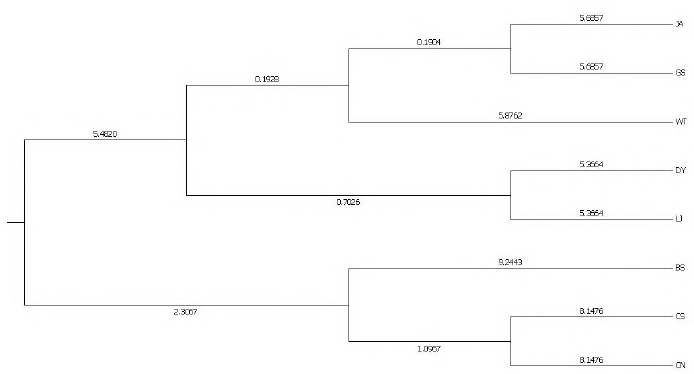
The clustering results (Figure 1) demonstrated that the populations from Wangtian Scenic Area (WT), Ji'an (JA), Shisidaogou Ancient Tree (GS), Shisidaogou Cliff (DY), and Linjiang (LJ) formed a single cluster. Additionally, the populations from Mt. Baishan (BS), Changsongling (CS), and the southern part of Changsongling (CN) also formed a distinct cluster. It demonstrates that the population genetic background of T. koraiensis, when clustered into one class, is highly similar, indicating a close genetic relationship.
Genetic distance and genetic identity of 8 populations
Tabela 6
Distância genética e identidade genética de 8 populações

UPGMA cluster map of T. koraiensis populations based on RAPD molecular marker
Figura 2
Mapa de agrupamento UPGMA de populações de T. koraiensis com base no marcador molecular RAPDs
4. DISCUSSION
Thuja koraiensis Nakai is classified as a national second-class protected plant in China and is categorized as critically endangered (CR) by the International Union for Conservation of Nature (IUCN, 2011). This species qualifies as a protected species due to its extremely small population size. In general, the genetic diversity of endangered plants is low (Frankham et al., 2002). The decrease of genetic diversity can diminish a population's adaptability to environmental changes, potentially leading to its extinction. Therefore, the study of genetic diversity is of great significance to the survival of plants.
Molecular marker technology serves as a prevalent method for investigating plant genetic diversity. The abundance of polymorphic loci stands as a critical indicator in assessing species genetic diversity. A higher number of polymorphic loci correlates with greater genetic diversity within populations (Xu et al., 2014). In this study, the percentage of polymorphic loci (PPL) ranged from 7.55% to 46.53%, with an average of 31.19%. The genetic diversity of the T. sutchuenensis population was investigated using RAPD molecular markers. The results indicated that the PPL values were 72.09% (Zhang et al., 2007) and 77.27% (Liu & Xiao, 2008). The number of polymorphic loci in T. koraiensis was lower than that in T. sutchuenensis, and the genetic diversity within T. koraiensis populations was also less than that within T. sutchuenensis populations. This finding is consistent with the endangered status of both T. koraiensis and T. sutchuenensis. Generally, the more endangered a plant species is, the lower its genetic diversity tends to be (Frankham et al., 2002).
The Nei's genetic diversity index and Shannon's information index were 0.3015 and 0.4360 for T. sutchuenensis, respectively. In comparison, the Nei's genetic diversity index and Shannon's information index for T. koraiensis were 0.1138 and 0.1687, respectively, which were significantly lower than those observed in T. sutchuenensis. (Liu & Xiao, 2008; Zhang et al., 2007). The Shannon index is generally understood such that the closer the value is to 0, the lower the diversity (Gois et al., 2014). This further indicates that the genetic diversity of T. koraiensis is relatively low.
The low genetic diversity of T. koraiensis is attributed to the combined effects of multiple factors, including environmental influences, intrinsic characteristics of the species, and human activities. T. koraiensis is predominantly found in the Changbai Mountain region of Jilin Province, with a restricted distribution range, small population sizes, and extremely limited gene flow between populations. The breeding method for T. koraiensis lacks diversity, being characterized by a low seed yield and poor seed quality. It primarily relies on root tiller reproduction, which indicates a limited capacity for population renewal. Moreover, older T. koraiensis trees often exhibit hollow and decayed trunks, contributing to a decline in population numbers. In recent years, the popularity of handicrafts such as "T. koraiensis bracelets" and root carvings has surged, leading to severe issues of illegal excavation, indiscriminate logging, and excessive cutting. Overexploitation has further intensified the endangered status of T. koraiensis.
In this study, the total genetic diversity of the population (Ht) was 0.2482, with the genetic diversity within the population (Hs) being 0.1137 and the genetic diversity between populations (Dst) being 0.1345. Notably, the genetic diversity between populations was marginally higher than that within populations. The Coefficient of genetic differentiation (Gst) of T. koraiensis populations was 0.5418, indicating that 54.18% of the genetic variation occurred among populations, while 45.82% of the variation was observed within populations. Sabina vulgaris populations were investigated using the RAPD molecular markers. The results indicated that the genetic variation among populations of Sabina vulgaris was significantly higher than that within populations, a finding that aligns with the conclusions drawn for T. koraiensis. The genetic variation in S. vulgaris was observed within populations (Gst was 0.1872) (Hong et al., 2006). The genetic variation of T. koraiensis mainly exists among populations, which may be caused by geographical isolation. The low vitality and limited propagation ability of T. koraiensis seeds restrict inter-population connectivity.
Gene flow can diminish genetic differentiation between populations while enhancing the genetic diversity within populations. By estimating the Nm value, it is possible to infer historical gene exchange patterns among populations. The gene flow between T. koraiensis populations was 0.4228 (< 1.0), suggesting a low level of gene flow and limited genetic exchange between populations. This may be due to habitat fragmentation, the limited regeneration capacity of populations and a certain degree of geographical isolation between different populations, resulting in a lack of effective gene flow between populations, thereby increasing genetic differentiation and contributing to the endangered status of T. koraiensis. The results of T. koraiensis population Nm not only provide an important basis for understanding the evolutionary history of the population, but also provide scientific guidance for future conservation strategies.
The genetic distance (GD) among 8 populations of T. koraiensis ranged from 0.1126 to 0.2734, with an average of 0.1895. Based on the cluster analysis of genetic distance, the genetic background of T. koraiensis populations is highly similar, indicating a close genetic relationship. However, the T. koraiensis population does not exhibit complete clustering based on geographical distance. The populations of Wangtiane Scenic Reserve (WT), fourteen ditch ancient tree side (GS), and Shisidaogou Cliff (DY), which are geographically close to each other, were clustered into one group. However, these populations were not clustered with those of Changsongling (CS) and the southern of Changsongling (CN), despite their close geographical proximity. Despite the relatively short geographical distance, long-term geographical isolation has led to limited gene flow between populations, resulting in genetic divergence among different groups.
We used RAPD molecular markers to study the genetic diversity of 8 wild populations of T. koraiensis in Jilin Province. This not only expanded the sampling range of T. koraiensis populations but also supplemented the existing research on the genetic diversity of T. koraiensis. However, since RAPD is a dominant marker, it can only detect whether a certain allele exists at a gene locus but cannot distinguish between heterozygotes and homozygotes. This makes it impossible to accurately estimate the heterozygosity of the gene loci when analyzing genetic diversity, thereby affecting the analysis of the genetic structure of the population. If different molecular markers, such as co-dominant SSR molecular markers, are utilized, the genetic diversity of T. koraiensis can be supplemented, thereby improving the accuracy of genetic diversity estimation.
5. CONCLUSION
The number of polymorphic loci in the T. koraiensis population in Jilin Province is lower compared to other populations of the same genus, indicating a reduced level of genetic diversity within the population.
The genetic diversity among populations of T. koraiensis was greater than that within populations, with significant genetic differentiation between populations and limited gene flow.
Based on genetic distance, the 8 populations were categorized into two groups.
The habitats of the existing T. koraiensis populations are predominantly isolated fragments, with only a few well-preserved populations remaining. Human disturbance and habitat de-struction are accelerating the degradation of these populations. A nature reserve focused on protecting the T. koraiensis population should be established. Additionally, public awareness should be enhanced, and regulations should be enacted to effectively curb human-induced destructive activities.
6. ACKNOWLEDGEMENTS
We sincerely appreciate the financial support provided by Research on Key Technologies for the Ex Situ Conservation of Endamgered Species Thujia koraiensis Nakai (20240303096NC).
DATA AVAILABILITY
The entire dataset supporting the findings of this study has been published within the article.
7. REFERENCES
-
Abuhena, M., Al-Rashid, J., & Kalam, A. A. (2024). Analysis of genetic variability among regional mango varieties grown in Rajshahi district using RAPD markers. Ecological Genetics and Genomics, 32 https://doi.org/10.1016/j.egg.2024.100258
» https://doi.org/10.1016/j.egg.2024.100258 - Du, F. G., Yuan, J. Q., Gao, C., Zhou, B., Li, M. J., Sun, H., Yu, Z. L., & Liu, Z. J. (2019). Characteristics of Cones and Seeds of Endangered Species Thuja koraiensis Nakai. Journal of Beihua University (Natural Science), 20(5), 600-604
-
Fu, C., Lan, X. H., Li, L. M., Yuan, J. Q., Li, C. H., & Du, F. G. (2021). Optimum extraction technology and antibacterial activity of essential oil from the branches and leaves of Thuja koraiensis Journal of Beijing Forestry University, 43(6), 141-151. https://doi.org/10.12171/j.1000−1522.20210076
» https://doi.org/10.12171/j.1000−1522.20210076 - Frankham, R., Ballou, J., Briscoe, D. (2002). Introduction to conservation genetics Cambridge: Cambridge University Press
-
Gois, I. B., Ferreira, R. A., Silva-Mann, R., Pantaleão, S. M., Gois, C. B., & Oliveira, R. S. C. (2014). Variabilidade genética em populações naturais de Ziziphus joazeiro Mart., por meio de marcadores moleculares RAPD. Rev. Árvore, 38(4), 621-630. https://doi.org/10.1590/S0100-67622014000400005
» https://doi.org/10.1590/S0100-67622014000400005 - Hong, Y., Wang, l., H., & Liang, X., R. (2006). Analysis on the genetic diversity of Sabina Vulgaris at different habitats and the influence of the environmental factors. Journal of Arid Land Resources and Environment, 20(3), 184-187
-
IUCN (International Union for Conservation of Nature) (2011). The IUCN red list of threatened species[EB/OL].[2024-10-19]. https://www.iucnredlist.org
» https://www.iucnredlist.org -
Institute of Botany, Chinese Academy of Sciences (2025). Thuja koraiensis http://www.iplant.cn/rep/prot/Thuja%20koraiensis
» http://www.iplant.cn/rep/prot/Thuja%20koraiensis - Jin, H., Zhao, Y., Liu, L. j., Jia, X., Dai, Y. H., Qin, L. W., Wang, C., & Yin, H. (2019). Quantitative characteristics and population dynamics of the endangered plant Thuja koraiensis in Changbai Mountain. China. Chinese Journal of Applied Ecology, 30(5), 1563-1570
- Jilin Institute of Traditional Chinese Medicine (1982). Plant medicine records of Changbai mountain Changchun: Ji lin People's Publishing House
- John, G. K. W., Anne, R. K., Kenneth, J. L., Rafalski, J. A., & V.Tingey, S. (1990). DNA polymorphisms amplified by arbitrary primers are useful as genetic markers. Nucleic Acids Res, 18(22), 6531-6535
- John, W., & Michael, M. (1990). Fingerprinting genomes using PCR with arbitrary primers. Nucleic Acids Res, 18(24), 7213-7218
- Lan, X., Fu, C., Li, L., Yuan, M., Tan, T., Wang, M., Wang, Y., & Du, F. (2021). Prediction of potential suitable distributiona reas in China for Thuja koraiensis Nakai based on MaxEnt model. Journal of Beihua University (Natural Science), 22(3), 292-298
-
Liu, B., N., Li, L., M., & Chen, F., X. (2023). Genetic diversity analysis of ornamental spring dendrobium based on RAPD molecular markers. Southeast Horticulture, 11(4), 257-264. https://doi.org/ 10.20023/j.cnki.2095-5774.2023.04.004
» https://doi.org/ 10.20023/j.cnki.2095-5774.2023.04.004 -
Liu, C., J., Li, C., Y., & Zhang, J. (2024). RAPD Analysis of genetic diversity of hemerocallis fulva germplasm resources in southern Qinling mountain. Molecular Plant Breeding, 22(10), 3264-3273. https://doi.org/10.13271/j.mpb.022.003264
» https://doi.org/10.13271/j.mpb.022.003264 - Liu, J., & Xiao, W. (2008). RAPD analysis of the genetic diversity of a critically endangered Plant, Thuja sutchuenensis (Cupressaceae). Acta Agriculturae Universitatis Jiang xiensis, 30(1), 668-672
-
Lu, H., Cui, Y., Li, X., Chen, W., Zhang, Z., Pang, X., & Li, Y. (2018). Genetic evaluation of natural populations of the endangered conifer Thuja koraiensis using microsatellite markers by restriction-associated DNA sequencing. Genes, 9(4), 218. https://doi.org/10.3390/genes9040218
» https://doi.org/10.3390/genes9040218 -
National Forestry and Grassland Administration (2021). List of National Key Protected Wild Plants. National Forestry and Grassland Administration web. https://www.forestry.gov.cn/c/www/gkzfwj/272693.jhtml
» https://www.forestry.gov.cn/c/www/gkzfwj/272693.jhtml - Qi,J.,Z., Sun, G.,R., Yang, W.,S., Sun, R., C., & Xue, F. (1995). Analysis on the chemical constituents of essential oil from branches and leaves of Thuja koraiensis Nakai. Journal of Plant Resorces and Eninromment, 4(5), 61-62
- Wang, G., Yang, K., Wu, M., Wang, Y., Xia, F., Yu, J., Guan, N., Zhao, D., & Zhu, W. (2021). Rooting and anatomical character in adventitious root of Thuja koraiensis Nakai. Journal of Beihua University (Natural Science), 22(5), 576-580
-
Wang, J. L., Lv, W., W., Wang, R., J., Mao, D., R., Wang, H., & Du, F., G. (2022). Function and application of essential oil of Thuja koraiensis Journal of Temperate Forestry Research https://kns.cnki.net/kcms/detail/23.1603.S.20221013.1335.002.html
» https://kns.cnki.net/kcms/detail/23.1603.S.20221013.1335.002.html - Wang, Y., H.,Wei, Q., Y.,Xue, T., Y., He, S., X.,Chen, W., D.,Dong, Y., H., & Zeng, C., L. (2022). Genetic diversity analysis of Artemisia selengensis germplasm resources based on RAPD molecular markers. Journal of Hunan Ecological Science, 9(4), 29-36
- Xu, B., Zhu, B., Zhang, F., Pan, W., Wang, Y.(2014). Genetic diversity analysis on Rhodoleia championii Wild Populations. Bulletin of Botanical research, 34(4): 479-484
- Yang, B. H., Song, J.H., Lee, J.J., Hur, S.D., & Hong, Y. P. (2009). Genetic variation and structure of the relict populations of Korean Arborvitae (Thuja koraiensis Nakai) in South Korea, Employing ISSR marker. Journal of Korean Forestry Society, 98(1), 1-7
- Yin, H., Jin, H., Zhao, Y., Qin, L., Dai, Y., Liu, L., & Zhao, W. (2016). Present situation and conservation strategy of rare and endangered species Thuja koraiensis in Changbai mountain. Jouranl of Beihua University(Natural Science), 17(1), 40-42
- Yuan, J., Yu, Z., Gao, C., Li, C., Zhou, B., Wang, M., Li, M., Sun, H., Zhou, M., & Du, F. (2019). Preliminary study on the morphology quality and germination characteristics of Thuja koraiensis seed. Journal of Jilin Forestry Science and Technology, 48(4)
- Yuan, J., Yu, Z., Lan, X., Li, C., Tian, N., & Du, F. (2022). Effects of shading treatments on photosynthetic characteristics of endangeredplant Thuja koraiensis Journal of Nanjing Forestry University (Natural Sciences Fdition), 46(5), 58-66
- Zhang, R., B., Dou, Q., L., He, P., & Deng, H., P. (2007). Analysis of genetic diversity in Thuja sutchuenensis populations as revealed by morphological and molecular data. Guihaia, 27(5), 687-691
- Zheng, W. (1983). Chinese tree records Beijing: China Forestry Publishing House
Edited by
-
Editors:
Sílvio Nolasco de Oliveira Neto and Rodolfo Soares de Almeida.