 BRAZIL-NUT SHELL BIOCHAR OPTIMIZES NURSERY MEDIA AND PLANTING-STOCK QUALITY IN Euterpe precatoria UNDER CONTRASTING FERTILIZATION REGIMES
ABSTRACT
Biochar offers a practical circular-economy strategy to improve nursery substrates and nutrient use efficiency, but optimal rates and their interaction with fertilization remain species-specific. This study evaluated the effects of six proportions of Brazil-nut shell biochar (0, 10, 20, 30, 40, and 50% v/v) and two fertilization regimes on substrate physicochemical properties and the nursery performance of Euterpe precatoria. The experiment was conducted in a randomized complete block design in a 6 × 2 factorial arrangement, with three replicates and eight plants per plot. Seedling height, stem diameter, leaf number, biomass partitioning, SPAD chlorophyll index, and Dickson Quality Index (DQI) were analyzed by two-way ANOVA, polynomial regression, and multivariate factor analysis. The biochar × fertilization interaction was significant for shoot dry mass, root dry mass, total dry mass, SPAD index, and DQI, but not for height, stem diameter, or leaf number. Conventional NPK plus micronutrients generally outperformed controlled-release fertilizer. Intermediate biochar proportions (20-30% v/v) provided the best overall nursery performance, particularly under conventional NPK fertilization. Under this regime, the highest seedling quality was achieved at intermediate biochar proportions, with DQI reaching 3.45 at approximately 20% biochar and SPAD values approaching 49 at approximately 28%. These results indicate that incorporating 20-30% (v/v) Brazil-nut shell biochar into a commercial substrate, combined with conventional NPK fertilization, is an effective strategy for producing vigorous Euterpe precatoria seedlings while valorizing abundant Amazonian agro-industrial residues.
Keywords:
Amazonian agro-industrial residues; Plant nutrition; Seedling production
RESUMO
O biochar representa uma estratégia prática de economia circular para melhorar substratos de viveiro e a eficiência de uso de nutrientes, mas as proporções ideais e sua interação com a adubação permanecem dependentes da espécie. Este estudo avaliou os efeitos de seis proporções de biochar de casca de castanha-do-brasil (0, 10, 20, 30, 40 e 50% v/v) e de dois regimes de adubação sobre as propriedades físico-químicas do substrato e o desempenho em viveiro de Euterpe precatoria. O experimento foi conduzido em delineamento de blocos ao acaso, em arranjo fatorial 6 × 2, com três repetições e oito plantas por parcela. Altura da muda, diâmetro do colo, número de folhas, partição de biomassa, índice SPAD de clorofila e Índice de Qualidade de Dickson (IQD) foram analisados por ANOVA bifatorial, regressão polinomial e análise fatorial multivariada. A interação biochar × adubação foi significativa para massa seca da parte aérea, massa seca da raiz, massa seca total, índice SPAD e IQD, mas não para altura, diâmetro do colo ou número de folhas. A adubação convencional com NPK mais micronutrientes apresentou, em geral, melhor desempenho que o fertilizante de liberação controlada. As proporções intermediárias de biochar (20-30% v/v) proporcionaram o melhor desempenho geral em viveiro, especialmente sob adubação convencional. Nesse regime, a maior qualidade de muda foi obtida com proporções intermediárias de biochar, com IQD de 3,45 em aproximadamente 20% de biochar e valores de SPAD próximos de 49 em aproximadamente 28%. Esses resultados indicam que a incorporação de 20-30% (v/v) de biochar de casca de castanha-do-brasil em substrato comercial, combinada com adubação convencional com NPK, constitui uma estratégia eficiente para a produção de mudas vigorosas de Euterpe precatoria, além de valorizar resíduos agroindustriais abundantes na Amazônia.
Palavras-Chave:
Nutrição de plantas; Resíduos agroindustriais amazônicos; Produção de mudas
1. INTRODUCTION
The açaí palm Euterpe precatoria Mart. is a single-stem species native to wet tropical America and widely distributed in the Brazilian Amazon region, where it occurs in diverse habitats ranging from upland forests to seasonally flooded areas in the states of Acre, Amazonas, Rondônia, and Pará (Henderson, 1995). This species underpins critical regional value chains for fruit production and co-products, and escalating nutritional awareness combined with growing domestic and international market demand has created unprecedented opportunities for planned cultivation systems (Silveira et al., 2023; Teixeira et al., 2025). In Acre, however, production still relies predominantly on extractivism and the transition toward productive orchards is only beginning to expand (IBGE, 2025), making the development of technically sound nursery protocols an urgent priority for securing sustainable supply chains (Martinot et al., 2017).
The success of productive and sustainable E. precatoria orchards depends fundamentally on high-quality planting stock with optimal architecture and nutritional status for field transplanting. Seedling performance is intrinsically linked to growing media that provide appropriate physical properties - porosity, water retention, and bulk density - and adequate chemical characteristics, including pH, cation exchange capacity (CEC), electrical conductivity (EC), and nutrient availability, combined with fertilization regimes precisely synchronized to nursery demand patterns (Jorge et al., 2020; Ferreira et al., 2023). Previous studies with this species have demonstrated that both controlled-release fertilizers and conventional mineral nutrient management can markedly affect seedling growth and quality, reinforcing the importance of defining nutritional strategies tailored to E. precatoria (Almeida et al., 2018; Jorge et al., 2020; Ferreira et al., 2023). However, commercial substrates are increasingly costly and exhibit substantial quality variability, while locally abundant agro-industrial residues remain largely underutilized despite their potential for sustainable media formulation.
Within this context, biochar has attracted growing interest as a substrate component for container nurseries because of its potential to simultaneously modify physical and chemical properties of growing media. Converting agricultural residues into biochar can address substrate limitations and waste management challenges at once - increasing pH and CEC, improving water retention and aeration, reducing bulk density, and contributing stable organic carbon to the growing medium (Kaudal et al., 2016; Huang & Gu, 2019; Natalli et al., 2024). These physicochemical improvements can enhance nutrient availability and use efficiency, translating into improved early seedling performance. However, biochar effects are not universally positive: broad reviews of its use in container substrates consistently indicate that performance is highly context-dependent, that optimal incorporation rates vary with plant species and substrate composition, and that high proportions may impair rather than improve growing conditions (Kaudal et al., 2016; Huang & Gu, 2019; Natalli et al., 2024). This variability makes speciesand system-specific evaluation essential before practical recommendations can be proposed.
For Amazonian nurseries, the use of regionally abundant agro-industrial residues as biochar feedstocks is particularly attractive from both agronomic and environmental perspectives, since feedstock composition and pyrolysis conditions strongly determine the properties of the resulting material. Brazil-nut shells are generated in large quantities across the region and represent a locally available lignocellulosic co-product with potential for value-added incorporation into substrate formulations. Emerging regional studies have reported consistent increases in substrate pH and CEC alongside improved seedling performance when Amazonian biomass-derived biochars are used, while also contributing to residue valorization and more circular production systems (Dias Júnior et al., 2022; Mendonça et al., 2024; Natalli et al., 2024). Endocarpand shell-derived biochars are particularly noteworthy in this context, as their typically higher ash content and alkalinity make them effective for correcting the acidity that commonly limits growing conditions in the region (Liu et al., 2023). Despite this growing body of evidence, no clear recommendation exists for the use of Brazil-nut shell biochar in nursery substrates for E. precatoria, particularly regarding which incorporation proportions can improve seedling quality without impairing the physicochemical balance of the growing medium.
A further unresolved question is whether the effect of biochar on seedling performance is modulated by the fertilization regime adopted in the nursery. Excessive biochar concentrations may elevate EC to detrimental levels and reduce nitrogen availability through immobilization, whereas intermediate application rates typically optimize the balance between improved porosity, water supply, and ionic provision - particularly when combined with readily available nutrient sources (Huang & Gu, 2019; Natalli et al., 2024). Biochar may therefore improve the substrate environment at moderate proportions but become less effective or even detrimental at higher rates, and this dose-response relationship likely depends on the nature and timing of nutrient supply. For E. precatoria, the combined effects of Brazil-nut shell biochar dose and contrasting fertilization strategies on substrate physicochemical properties and seedling performance remain poorly understood, limiting the development of evidence-based recommendations for Amazonian nursery systems. Therefore, the objective of this study was to evaluate how six proportions of Brazil-nut shell biochar combined with two contrasting fertilization regimes affect substrate physicochemical properties and the nursery performance of Euterpe precatoria seedlings.
2. MATERIAL AND METHODS
2.1 Experimental site and cultivation conditions
The experiment was conducted in the nursery of Embrapa Acre’s Experimental Field, Rio Branco, Acre, Brazil (10°01′30″ S, 67°42′18″ W; 160 m a.s.l.), from August 2022 to August 2023. The regional climate is tropical monsoon (Am, Köppen climate classification). During the experimental period, mean maximum, mean, and mean minimum air temperatures were 30.9 °C, 26.0 °C, and 20.0 °C, respectively; mean relative humidity was 83%, and cumulative precipitation was approximately 2,359 mm (INMET, 2024). Seedlings were maintained under 70% shade cloth throughout the nursery cycle and irrigated twice daily with Agrojet orange spinner micro-sprinklers (1.0-mm emitter), with a nominal discharge of 37 L h⁻1 at 20 mca. Weed control was performed manually. Anthracnose caused by Colletotrichum gloeosporioides was managed with fortnightly applications alternating pyraclostrobin + epoxiconazole and trifloxystrobin + tebuconazole (2.5 mL L⁻1), following Nogueira et al. (2017).
2.2 Feedstock and biochar production
Brazil-nut shells (Bertholletia excelsa Bonpl.) were obtained from local agro-industries in Rio Branco, Acre, Brazil, through the municipal solid-waste treatment unit (UTRE), and sun-dried for 3 days before pyrolysis. Biochar was produced in an artisanal pyrolysis kiln based on traditional local farmer models, located in Colônia Baixa Verde, Plácido de Castro, Acre, Brazil. The kiln was 1.63 m high, had a circumference of 4.70 m, 12 vents arranged in three layers, and a 1.00 × 0.70 m front door. Brazil-nut shells were pyrolyzed separately at approximately 250-350 °C for about 96 h. Temperature was monitored with a 0-500 °C thermometer attached to the kiln. After pyrolysis, the vents were progressively sealed with moistened clay as smoke emission ceased, the kiln received two external clay coatings, and the material was allowed to cool for 72 h before opening. The resulting Brazil-nut biochar (BNB) was then removed, stored in 50-kg fiber bags, ground, and used to prepare the experimental substrate mixtures. The pyrolysis process yielded 23.300 kg of biochar from 35.050 kg of sun-dried shells, corresponding to a gravimetric yield of 66.48%.
2.3 Physicochemical characterization of mixtures
The physicochemical characterization was performed for mixtures prepared by blending Maxfertil®, an organic commercial substrate formulated with composted pine bark, vermiculite, and carbonized rice husks, with increasing proportions of Brazil-nut biochar (BNB). The evaluated properties included pH; macronutrient concentrations (N, P, K, Ca, Mg, and S); micronutrient concentrations (Fe, B, Cu, Mn, and Zn); carbon-to-nitrogen ratio (C:N); electrical conductivity (EC); moisture content (MC); ash; organic matter (OM); organic carbon (OC); dry bulk density (DBD); wet bulk density (WBD); water-holding capacity at 10 cm tension (WHC₁₀); and cation exchange capacity (CEC). The substrate mixtures were sampled for physicochemical characterization before the addition of either fertilization regime; therefore, the values reported in Table 1 represent the baseline properties of the Maxfertil® × BNB mixtures prior to conventional NPK plus micronutrients or controlled-release fertilizer application. The 100% BNB treatment was included only for physicochemical characterization; all experimental treatments consisted of Maxfertil® × BNB mixtures.
Physicochemical attributes of commercial substrate (Maxfertil®) × Brazil-nut shell biochar mixtures at different proportions (v/v)
Tabela 1
Atributos físico-químicos de substrato comercial (Maxfertil®) × misturas de biocarvão de casca de castanha-do-brasil em diferentes proporções (v/v)
2.4 Experimental design and treatments
The experiment was arranged in a randomized complete block design (RCBD) in a 6 × 2 factorial scheme, with three replicates. The first factor consisted of six proportions of Brazil-nut biochar in mixture with Maxfertil® (0, 10, 20, 30, 40, and 50% v/v), and the second factor consisted of two fertilization regimes: conventional NPK plus micronutrients and controlled-release fertilizer (CRF). Each experimental plot comprised eight seedlings, totaling 12 treatments × 3 replicates × 8 plants = 288 seedlings. Plot means were used as the experimental unit for statistical analyses. The RCBD was adopted to reduce the effect of possible spatial heterogeneity within the nursery environment.
2.5 Seedling production
Mature Euterpe precatoria seeds were collected in a protected area at Embrapa Acre. Seeds were sown in a rectangular sand-filled seedbed measuring 2.0 m × 1.0 m and raised 40 cm above ground level. Emergence occurred 30 days after sowing, after which uniform seedlings at the “match-stick” stage, approximately 4 cm in height, were selected and transplanted into 800-mL tubes containing the respective Maxfertil® × BNB mixtures assigned to each treatment.
2.6 Nutritional management
Two fertilization conditions were established. In the controlled-release fertilizer (CRF) treatment, the substrate was previously enriched with 8 kg m⁻3 of Basacote® Plus 12M NPK 15-08-12, a rate selected based on previous results for Euterpe precatoria seedlings under high shade conditions (Almeida et al., 2018). In the conventional fertilization treatment, nutrients were supplied as NPK plus micronutrients every 15 days over a 12-month period, totaling 21 applications. The application rate was approximately 0.30 g per tube per application, corresponding to approximately 6.4 g per tube over the entire cycle. This value was calculated from the tube volume (800 cm3) and the reference rate of 8 kg m⁻3 of substrate, according to the equation (800 cm3 × 8 kg m⁻3) / 1000 = 6.4 g per tube.
Conventional fertilization began when the first leaf was fully expanded. The conventional nutrient blend consisted of urea (45% N), single superphosphate (18% P₂O₅), triple superphosphate (46% P₂O₅), potassium chloride (60% K₂O), magnesium sulfate (K₂O 1%; S 11.80%; Mg 9%; S-SO₄ 11.80%), and FTE BR-12 (S 3.9%; B 1.8%; Cu 0.85%; Mn 2%). This blend was formulated to match the nutrient composition of Basacote® Plus 12M NPK 15-08-12 (N 15%; P 8%; K 12%; S 5%; Mg 1.2%; B 0.02%; Cu 0.05%; Fe 0.4%; Mn 0.06%; Mo 0.015%), used in the CRF treatment. The rates applied for each fertilizer source are presented in Table 2.
Mass proportions of the conventional fertilizer mixture (kg per 100 kg of mixture) formulated to match Basacote® Plus 12M NPK 15-08-12
Tabela 2
Proporções em massa da mistura do fertilizante convencional (kg por 100 kg de mistura) formulada para corresponder ao Basacote® Plus 12M NPK 15-08-12
2.7 Measured variables
At 12 months after transplanting, all seedlings in each experimental plot were evaluated for: plant height (H, cm), measured from the collar to the emergence point of the youngest fully expanded leaf; stem diameter (SD, mm), measured 1.0 cm above the substrate using a digital caliper; and number of leaves (NL), counting physiologically active, fully expanded leaves. All seedlings were then harvested and separated into shoots and roots, placed in kraft paper bags, oven-dried at 55 °C until constant weight, and weighed to obtain shoot dry mass (SDM), root dry mass (RDM), and total dry mass (TDM) (g). The Dickson Quality Index (DQI) was computed following Dickson et al. (1960) (Equation 1):
The SPAD index (relative chlorophyll content) was measured between 08:00 and 11:00 using a SPAD-502 portable chlorophyll meter (Konica Minolta, Tokyo, Japan) on the youngest fully expanded, healthy leaf, in four plants per plot. Measurements were standardized within the morning period to reduce possible time-of-day effects on SPAD readings (Padilla et al., 2019).
2.8 Statistical analyses
Data were checked for normality and homoscedasticity using the Shapiro-Wilk and Bartlett tests, respectively. When assumptions were met, data were subjected to ANOVA, and, for significant F-tests (α = 0.05), regression models were fitted. To complement these analyses and capture joint patterns between growth and substrate attributes, we performed factor analysis extracted by principal components (FA-PC) (Auerswald & Moshagen, 2019; Jolliffe & Cadima, 2016) in RStudio (RStudio Team, 2023), using the packages tidyverse, psych, GPArotation, pheatmap, and ggrepel. The matrix comprised the 12 treatments (six biochar concentrations × two fertilization regimes [NPK+ and CRF]) and the variables NL, H, SD, SPAD, SDM, RDM, TDM, pH, N, P, K, C:N, moisture, OM, OC, ash, WHC₁₀, CEC, EC, WBD, and DBD. All numeric variables were standardized (z-scores), and extraction was based on the correlation matrix. The number of factors followed the Kaiser criterion (λ > 1), ensuring at least two axes for interpretation.
Factor loadings were rotated using varimax (orthogonal) to maximize interpretability without altering total variance. Communalities (Equation 2) and uniqueness (Equation 3) were computed to assess the variance proportion explained per variable.
Factor scores for treatments were obtained by the regression method, applying the same rotation. For visualization, (i) a heat map of rotated loadings and (ii) an F1 × F2 biplot were built. Associations were interpreted as strong when |loading| ≥ 0.50 and moderate for 0.30 ≤ |loading| < 0.50.
3. RESULTS
Two-way ANOVA revealed that biochar proportion and fertilization regime significantly affected (p < 0.05) seedling performance, but the pattern differed among variables (Table 3). Among the evaluated variables, a significant biochar × fertilization interaction was detected for shoot dry mass (SDM), root dry mass (RDM), total dry mass (TDM), Dickson Quality Index (DQI), and SPAD index. Height (H) and stem diameter (SD) were significantly affected by both biochar proportion and fertilization regime but showed no significant interaction.
Summary of two-way ANOVA for growth and quality variables of Euterpe precatoria seedlings grown in Maxfertil® × Brazil-nut shell biochar mixtures under two fertilization regimes
Tabela 3
Resumo da ANOVA para variáveis de crescimento e qualidade de mudas de Euterpe precatoria cultivadas em misturas de biochar da casca de castanha-do-Brasil × Maxfertil® sob dois regimes de fertilização
Seedling height showed a quadratic response to biochar proportion, reaching an estimated maximum of 29.84 cm at 23.04% biochar (Figure 1A). Across the biochar gradient, seedlings fertilized with conventional NPK plus micronutrients were taller than those receiving controlled-release fertilizer (Figure 1B; see also Figure 2A-B).

Height (H) of Euterpe precatoria seedlings 12 months after transplanting as a function of (A) Brazil-nut shell biochar concentration in the substrate and (B) fertilization regime (NPK + micronutrients vs. controlled-release fertilizer, CRF). Among fertilization regimes, means followed by the same letter do not differ from each other by the F test (p > 0.05). ** significant at 1%
Figura 1
Altura (H) de mudas de Euterpe precatoria aos 12 meses após a repicagem em função de (A) concentrações de biocarvão da casca da castanha-do-brasil no substrato e (B) regimes de adubação (NPK + micronutrientes vs. fertilizante de liberação controlada, CRF). Entre os regimes de fertilização, médias seguidas pela mesma letra não diferem entre si pelo teste F (p > 0,05). ** significativo a 1%

Twelve-month-old Euterpe precatoria seedlings grown under contrasting fertilization regimes with graded biochar: (A) NPK + micronutrients and (B) controlled-release fertilizer
Figura 2
Mudas de Euterpe precatoria aos 12 meses de idade cultivadas sob regimes de fertilização contrastantes com biochar graduado: (A) NPK + micronutrientes e (B) fertilizante de liberação controlada
Stem diameter also followed a quadratic response to biochar proportion, with an estimated maximum of 14.31 mm at 17.64% biochar (Figure 3A). In addition, conventional NPK fertilization resulted in greater stem diameter than controlled-release fertilizer, with mean values of 15.08 and 11.45 mm, respectively (Figure 3B).

Stem diameter (SD) of Euterpe precatoria seedlings 12 months after transplanting as a function of (A) biochar concentration and (B) fertilization regime (NPK + micronutrients vs. CRF). Among fertilization regimes, means followed by the same letter do not differ from each other by the F test (p > 0.05). ** significant at 1%
Figura 3
Diâmetro do colo (SD) de mudas de Euterpe precatoria aos 12 meses após a repicagem em função de (A) concentrações de biocarvão da casca da castanha-do-brasil no substrato e (B) regimes de adubação (NPK + micronutrientes vs. CRF). Entre os regimes de fertilização, médias seguidas pela mesma letra não diferem entre si pelo teste F (p > 0,05). ** significativo a 1%
Biomass responses depended on the interaction between biochar proportion and fertilization regime (Table 3). Under conventional NPK fertilization, SDM, RDM, and TDM showed quadratic responses, with maximum estimated values at intermediate biochar proportions. The estimated optima were 22.26% biochar for SDM, 21.48% for RDM, and 22.07% for TDM, corresponding to 19.74, 5.35, and 25.09 g, respectively (Figure 4A-C). In contrast, under controlled-release fertilizer, the three biomass components declined linearly with increasing biochar proportion over the evaluated range. Thus, the positive effect of intermediate Brazil-nut shell biochar proportions on biomass accumulation was evident only when associated with readily available nutrient supply.

Shoot (SDM, A), root (RDM, B), and total (TDM, C) dry mass of Euterpe precatoria seedlings 12 months after transplanting as a function of biochar concentration under (NPK + micronutrients) and (CRF) fertilization. Within each biochar proportion, means followed by the same letter do not differ from each other by the F test (p > 0.05). ** significant at 1%
Figura 4
Massas secas da parte aérea (SDM, A), da raiz (RDM, B) e total (TDM, C) de mudas de Euterpe precatoria aos 12 meses após a repicagem em função da concentração de biochar sob adubação com NPK + micronutrientes e CRF. Em cada proporção de biochar, médias seguidas da mesma letra não diferem entre si pelo teste F (p > 0,05). ** significativo a 1%
The SPAD index was significantly influenced by the interaction between factors as well. Both fertilization regimes showed quadratic responses, but values were consistently higher under conventional NPK fertilization. The estimated SPAD maximum under NPK occurred at 28.14% biochar, reaching 48.83, whereas under controlled-release fertilizer the estimated maximum occurred at 27.94% biochar, with a much lower value of 17.96 (Figure 5A). The Dickson Quality Index also showed a significant biochar × fertilization interaction (Table 3). Under conventional NPK fertilization, DQI followed a quadratic model, with an estimated maximum of 3.45 at 20.11% biochar. Under controlled-release fertilizer, however, DQI decreased linearly as biochar proportion increased (Figure 5B).

SPAD index (A) and Dickson Quality Index (DQI) (B) of Euterpe precatoria seedlings 12 months after transplanting as a function of biochar concentration under NPK + micronutrients and CRF. Within each biochar proportion, means followed by the same letter do not differ from each other by the F test (p > 0.05). ** significant at 1%
Figura 5
Índice SPAD (A) e Índice de Qualidade de Dickson (IQD) (B) de mudas de Euterpe precatoria aos 12 meses após a repicagem em função de concentrações de biochar sob NPK + micronutrientes e CRF. Em cada proporção de biochar, médias seguidas da mesma letra não diferem entre si pelo teste F (p > 0,05). ** significativo a 1%
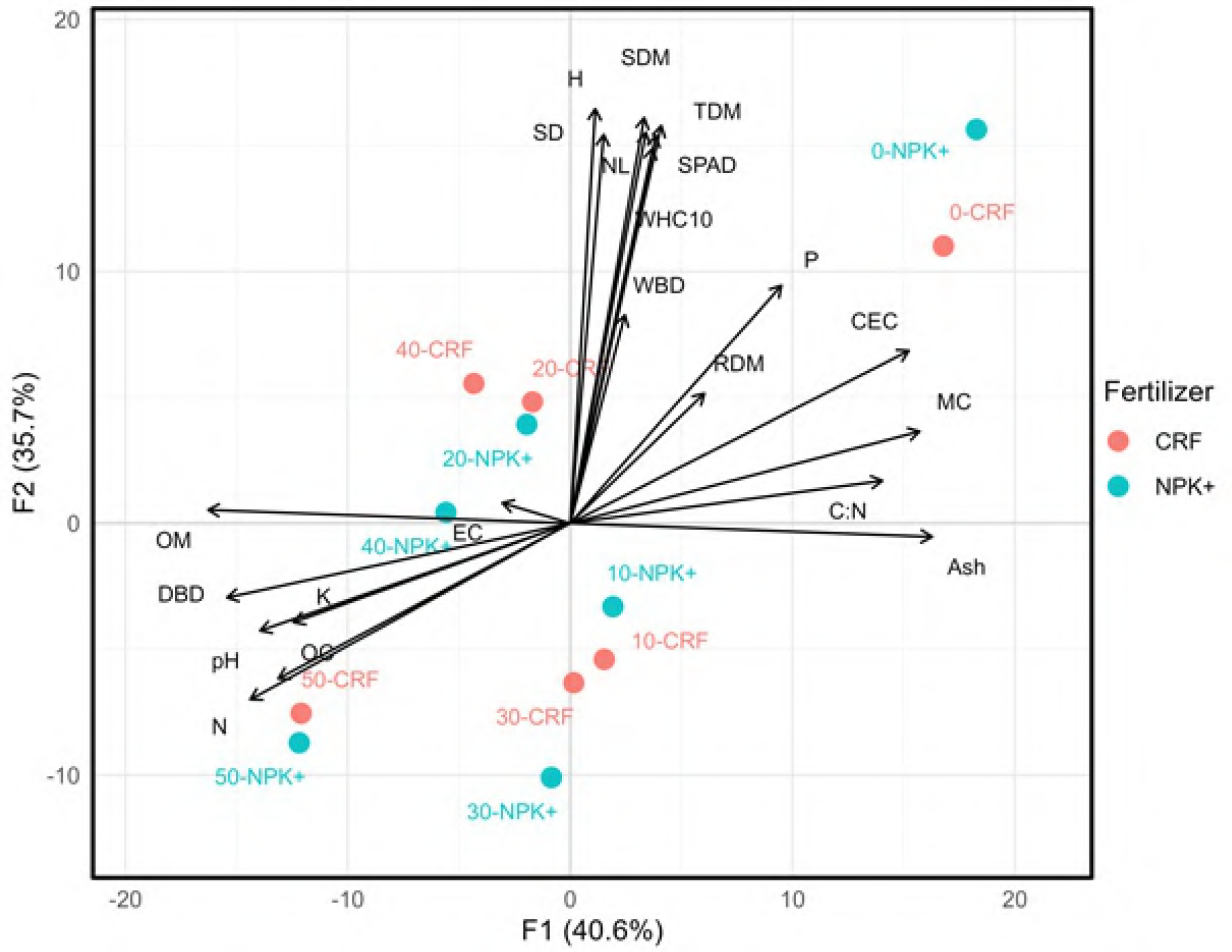
Factor analysis extracted through principal components retained three rotated factors, which together explained approximately 91% of the total variance (Figure 6). Factor 2 represented a vegetative-hydric vigor axis, with strong positive loadings for H, SD, NL, SDM, TDM, SPAD, and WHC₁₀, indicating that these traits varied in a coordinated manner across treatments. Factor 1 described a structural-stoichiometric substrate gradient, with positive loadings for MC, CEC, Ash, and C:N, as well as a moderate positive loading for P, and negative loadings for DBD, pH, N, K, OM, and OC. Factor 3 represented a conductive-ionic axis, characterized by positive loadings for EC, WBD, and K, and a negative loading for RDM. Together, these results indicate that the treatments varied simultaneously in terms of seedling vigor, substrate physical condition, and chemical composition, rather than along a single response dimension.

Heat map of varimax-rotated factor loadings from FA-PC on the correlation matrix. Rows represent variables (biometric and substrate attributes), and columns represent Factor 1, Factor 2, and Factor 3. Interpretation: strong association when |loading| ≥ 0.50 and moderate association when 0.30 ≤ |loading| < 0.50
Figura 6
Mapa de calor das cargas fatoriais rotacionadas por varimax obtidas por AF-CP na matriz de correlação. As linhas representam as variáveis (atributos biométricos e do substrato), e as colunas representam o Fator 1, o Fator 2 e o Fator 3. Interpretação: associação forte quando |carga fatorial| ≥ 0,50 e moderada quando 0,30 ≤ |carga fatorial| < 0,50
In the F1 × F2 ordination space, treatment scores were relatively dispersed, with no clear clustering by fertilization regime (Figure 7). Nevertheless, the distribution of scores suggested that some of the best-performing treatments, including intermediate biochar proportions under NPK+ fertilization, tended to occupy regions associated with higher F2 values, where growth and quality traits showed their strongest positive associations. In contrast, treatments positioned toward the opposite side of the ordination were less associated with these vigor-related variables. Thus, the ordination reinforces the general response pattern detected in the univariate analyses, while indicating that treatment differences were expressed mainly as gradients rather than as sharply separated groups.

FA-PC biplot (F1 × F2) of Euterpe precatoria treatments. Points represent treatment centroids, colored by fertilization regime (NPK+ = conventional NPK plus micronutrients; CRF = controlled-release fertilizer). Axes show rotated factors (F1, F2) with their explained variance (%). Variable acronyms: H, height; SD, stem diameter; NL, number of leaves; SDM, shoot dry mass; RDM, root dry mass; TDM, total dry mass; SPAD, chlorophyll index; WHC₁₀, water-holding capacity at 10 cm tension; WBD, wet bulk density; DBD, dry bulk density; MC, moisture content; OM, organic matter; OC, organic carbon; C:N, carbon-to-nitrogen ratio; CEC, cation exchange capacity; EC, electrical conductivity; Ash, ash content; N, nitrogen; P, phosphorus; K, potassium
Figura 7
Biplot da AF-CP (F1 × F2) dos tratamentos de Euterpe precatoria. Os pontos representam os centróides dos tratamentos, coloridos por regime de fertilização (NPK+ = NPK convencional mais micronutrientes; CRF = fertilizante de liberação controlada). Os eixos mostram os fatores rotacionados (F1, F2) com sua variância explicada (%). Siglas das variáveis: H, altura; SD, diâmetro do colo; NL, número de folhas; SDM, massa seca da parte aérea; RDM, massa seca da raiz; TDM, massa seca total; SPAD, índice de clorofila; WHC₁₀, capacidade de retenção de água a 10 cm de tensão; WBD, densidade aparente úmida; DBD, densidade aparente seca; MC, teor de umidade; OM, matéria orgânica; OC, carbono orgânico; C:N, relação carbono:nitrogênio; CEC, capacidade de troca catiônica; EC, condutividade elétrica; Ash, teor de cinzas; N, nitrogênio; P, fósforo; K, potássio
4. DISCUSSION
The response of Euterpe precatoria seedlings to Brazil-nut shell biochar was strongly conditioned by the fertilization regime, indicating that biochar functioned as a substrate-conditioning component whose effect depended on concurrent nutrient supply rather than acting as a self-sufficient amendment. This pattern is consistent with the container-substrate literature, in which biochar performance is typically doseand context-dependent, with intermediate application rates often providing the most favorable balance between physical conditioning and plant growth (Huang & Gu, 2019; Kaudal et al., 2016; Natalli et al., 2024). The present results extend this principle to an Amazonian palm species under nursery conditions, showing that the beneficial effects of biochar emerged only when substrate improvement was accompanied by adequate and temporally consistent nutrient availability.
A meaningful comparison can be drawn with Araújo et al. (2020), who evaluated agro-industrial residue-based substrates for E. precatoria seedlings using Brazil-nut shell material naturally decomposed for two years. In that study, decomposed residue-particularly combined with acerola pit at a 1:1 (v/v) ratio-promoted high seedling growth and quality. In the present study, the same residue source was subjected to pyrolysis prior to incorporation, fundamentally altering its stability, alkalinity derived from mineral ash, and structural properties. While both approaches demonstrate the agronomic potential of Brazil-nut residues for nursery production, naturally decomposed material and biochar likely improve seedling performance through distinct physicochemical mechanisms and should not be treated as equivalent or interchangeable. This distinction is important because the decomposed residue acts mainly as an organic substrate component, whereas the biochar acts more strongly as a structural and chemical conditioner of the commercial substrate matrix.
Among the physicochemical attributes measured, pH adjustment emerged as the most consistent benefit of biochar incorporation. For container substrates, pH is one of the primary determinants of nutrient availability, and a range of approximately 5.4-6.5 is generally considered favorable for many nursery crops because it supports a more balanced supply of macroand micronutrients (Schafer & Lerner, 2022; Carapezza et al., 2025). The intermediate biochar mixtures shifted the substrate from a more acidic condition toward this agronomically favorable range, whereas at the highest proportions, progressive alkalinization likely moved the system away from the initial physicochemical balance of the substrate matrix. This helps explain why the intermediate rates were more favorable than the extremes even though the response was not accompanied by generalized improvement in all substrate variables.
The physical response of the mixtures also helps explain why the highest biochar rates were not the most beneficial. Water-holding capacity remained high across all treatments, indicating that the mixtures preserved an important hydric function for seedling establishment. Dry bulk density (DBD), however, increased with increasing biochar proportion. This pattern is not unusual given that biochar effects on substrate density depend on feedstock characteristics and on the physical properties of the base material (Huang & Gu, 2019; Natalli et al., 2024). More broadly, the literature shows that biochar can improve water retention and plant-available water while its effect on density and pore organization depends strongly on the structure of the receiving medium (Carvalho et al., 2020; Razzaghi et al., 2020). Zanutel et al. (2023) further emphasized that physical responses to biochar are often mediated more by changes in medium structure than by the internal porosity of the biochar particles themselves. In this context, the rise in DBD at higher rates in the present study suggests that structural reorganization of the substrate mixture may have reduced the physical advantage of the system, even though WHC remained high. Considered alongside the concurrent decline in cation exchange capacity (CEC), this pattern indicates that intermediate treatments achieved a more favorable compromise among structural support, gas exchange, water retention, and nutrient buffering than the mixtures with the highest biochar proportions.
CEC followed the opposite pattern of what is frequently expected for some biochars. Instead of increasing, it declined relative to the commercial substrate alone. This indicates that the benefit of Brazil-nut shell biochar in this system was not linked to greater exchange capacity, but to the maintenance of still substantial CEC values under conditions of improved pH and high water retention. In practical terms, this means that the positive response under intermediate biochar incorporation was associated with a better overall physicochemical balance rather than with a generalized enhancement of all chemical attributes. This point is especially relevant because it underscores the material-specific nature of Brazil-nut shell biochar behavior in this system and shows that expectations derived from the broader soil-biochar literature cannot be transferred directly to nursery substrates.
Electrical conductivity (EC) also requires contextual interpretation. As one of the main indicators of soluble salt concentration, EC reflects the intensity of the nutritional and osmotic environment surrounding the root system and is among the most diagnostically important chemical attributes of plant substrates (Schafer & Lerner, 2022). In the previous study of Araújo et al. (2020), better E. precatoria seedling performance was associated with substrates whose EC values remained in a very low to low range. In the present study, EC increased moderately with biochar incorporation but remained within a range more consistent with low to moderate salinity than with severe salt stress. Thus, the inferior performance at the highest biochar rates should be attributed to a less favorable integration of density, exchange capacity, and nutrient dynamics rather than to excessive EC alone. In other words, EC formed part of the response pattern, but it does not appear to have acted as the single dominant limiting factor.
The nutrient profile of the mixtures reinforces this integrative interpretation. Potassium increased with biochar proportion, consistent with the ash-rich nature of many biochars and with the documented capacity of biochar to supply exchangeable K depending on feedstock and pyrolysis conditions (Huang & Gu, 2019). Phosphorus, in contrast, was highest in the unamended commercial substrate and declined with biochar addition. This contrasting pattern indicates that the favorable seedling response at intermediate biochar rates was not driven by a generalized increase in substrate fertility, but by the way moderate biochar incorporation reorganized the substrate environment while nutrient supply was sustained by the fertilization regime. This agrees with Lima et al. (2016), who showed that biochar responses in seedling production are strongly modulated by nutrient management and cannot be interpreted independently of N and P dynamics. Similarly, recent reviews emphasize that biochar performance depends on interactions among substrate properties and crop management rather than on isolated nutrient gains (Natalli et al., 2024).
The superiority of conventional NPK plus micronutrients (NPK+) over controlled-release fertilizer (CRF) suggests that temporal synchrony between nutrient availability and seedling demand was a decisive factor. Under warm and humid nursery conditions, nutrient release from polymer-coated fertilizers may accelerate or become misaligned with plant demand, whereas split applications of soluble fertilizers maintain a more consistent supply throughout the production cycle (Lawrencia et al., 2021; Govil et al., 2024). Biochar improved the substrate environment for seedling growth only when nutrient availability was sufficiently regular, explaining why the same biochar gradient produced more favorable responses under NPK+ than under CRF and reinforcing fertilization regime as the primary moderating factor in the system. This also helps explain why the best-performing treatments combined an improved substrate condition with an immediately available nutrient source, rather than relying on gradual nutrient release alone.
From the standpoint of seedling quality, intermediate biochar proportions under conventional fertilization favored the formation of more robust and morphologically balanced planting stock. This interpretation is supported by the combined behavior of stem diameter (SD), biomass partitioning, SPAD, and the Dickson
Quality Index (DQI). DQI is particularly informative because it integrates biomass accumulation with allometric balance (Eloy et al., 2013), while SD remains one of the most reliable indicators of nursery stock structural robustness and field transplant potential (Silva et al., 2020). The relevance of the present results lies not merely in producing larger seedlings, but in improving the overall structural and physiological quality of the planting stock. The treatments associated with superior performance were also those with the highest SPAD values, suggesting that the substrate conditions created by moderate biochar incorporation translated into a genuine physiological advantage only when nutrient availability remained adequate throughout the nursery cycle (Fernandes et al., 2021; Vidigal et al., 2021). This interpretation is consistent with applied studies showing that biochar can improve seedling development when its effects on the substrate environment are matched by adequate nutritional support (Santos et al., 2022; Kafle et al., 2024).
The multivariate analysis adds an important interpretive layer because growth, biomass accumulation, chlorophyll status, and physicochemical properties formed an interrelated response system that univariate analysis alone could not fully capture. FA-PC reduced dimensionality while preserving the dominant covariation structure among traits, allowing the dataset to be interpreted as coordinated response gradients rather than as disconnected outcomes (Jolliffe & Cadima, 2016). Three biologically meaningful factors were retained: F2, the most directly associated with nursery performance, integrated plant height, SD, leaf number, shoot and total dry mass, SPAD, and water-holding capacity into a common vegetative-hydric vigor axis; F1 summarized a structural-stoichiometric substrate gradient; and F3 represented a conductive-ionic component associated primarily with EC, wet bulk density, and inverse variation in root dry mass. Together, these factors showed that treatment differences were expressed as coordinated gradients of vigor and substrate organization (Auerswald & Moshagen, 2019), providing a coherent structural explanation for the nonlinear and fertilization-dependent response to biochar.
The main strength of the multivariate analysis was therefore not to force discrete treatment groups, but to justify biologically why the experiment had to be interpreted as a coordinated system of correlated responses.
From an applied perspective, Brazil-nut shell biochar represents a promising regional input for Amazonian nurseries because it allows the valorization of an abundant agro-industrial co-product while partially substituting commercial substrate components. This point becomes stronger when viewed in the broader regional context. Sato et al. (2020) highlighted biochar as a sustainable alternative for açaí waste disposal in Amazonia, while Mendonça et al. (2024) showed that Amazonian biomass-derived biochar can improve seedling performance in another crop system. Recent work on soilless media also supports the idea that biochar-containing blends can partially replace conventional components when rates are carefully adjusted (Kafle et al., 2024). Practical recommendations should therefore target intermediate biochar proportions-those that improve substrate pH and water retention without intensifying the less favorable increases in bulk density and reductions in CEC observed at higher rates.
Some limitations merit acknowledgment. The biochar was produced in an artisanal kiln under approximate temperature control, which may introduce batch-to-batch variability. A more complete characterization of the pure biochar, including elemental composition, surface area, and porosity, would strengthen mechanistic interpretation in future research (Huang & Gu, 2019). In addition, because the present study focused on nursery performance, whether the observed gains in seedling quality translate into improved establishment after transplanting remains to be tested in the field.
Taken together, the evidence indicates that Brazil-nut shell biochar can be an effective amendment for Euterpe precatoria nursery production when incorporated at intermediate proportions in combination with conventional NPK plus micronutrients. Under these conditions, seedling performance appears to result from a favorable convergence among partial pH correction,adequatewaterretention, acceptable EC, temporally synchronized nutrient supply, and an integrated gradient of vigor expressed across multiple correlated traits. This provides a technically robust basis for practical recommendation in Amazonian nursery systems.
5. CONCLUSION
Brazil-nut shell biochar is a promising amendment for nursery media for Euterpe precatoria, but its effect depends on the incorporation rate and the fertilization regime. Under the conditions of this study, intermediate proportions of biochar (20-30% v/v) combined with conventional NPK plus micronutrients provided the best overall seedling performance, supporting the production of vigorous and balanced planting stock. For Amazonian nurseries, this combination represents the most suitable recommendation among the treatments tested, while also contributing to the valorization of regional agro-industrial residues.
6. ACKNOWLEDGEMENTS
We thank the Brazilian Agricultural Research Corporation (Embrapa Acre) for financial support, provision of plant material, access to the experimental area and research infrastructure, and logistical assistance during field activities, through the project 20.22.03.015.00.00 - Technologies for the rational cultivation of single-stem açaí (Euterpe precatoria) in the Western Amazon - Phase II, coordinated by Dr. Aureny Maria Pereira Lunz. The first author also acknowledges support from the Coordenação de Aperfeiçoamento de Pessoal de Nível Superior - Brasil (CAPES; Finance Code 001) through a doctoral scholarship.
DATA AVAILABILITY
The data that support the findings of this study are available from the corresponding author upon reasonable request.
7. REFERENCES
-
Almeida, U. O. de, Andrade Neto, R. C. de, Lunz, A. M. P., Nogueira, S. R., Costa, D. A. da, & Araújo, J. M. de. (2018). Environment and slow-release fertilizer in the production of Euterpe precatoria seedlings. Pesquisa Agropecuária Tropical, 48(4), 382-389. https://doi.org/10.1590/1983-40632018v4853294
» https://doi.org/10.1590/1983-40632018v4853294 -
Araújo, C. S. de, Lunz, A. M. P., Santos, V. B. dos, Andrade Neto, R. C. de, Nogueira, S. R., & Santos, R. S. dos. (2020). Use of agro-industry residues as substrate for the production of Euterpe precatoria seedlings. Pesquisa Agropecuária Tropical, 50, e58709. https://doi.org/10.1590/1983-40632020v5058709
» https://doi.org/10.1590/1983-40632020v5058709 -
Auerswald, M., & Moshagen, M. (2019). How to determine the number of factors to retain in exploratory factor analysis: A comparison of extraction methods under realistic conditions. Psychological Methods, 24(4), 468-491. https://doi.org/10.1037/met0000200
» https://doi.org/10.1037/met0000200 -
Carapezza, G., Wilson, S. B., Knox, G. W., Freyre, R. H., Wright, A. L., Scoggins, H. L., Adams, C., & Deng, Z. (2025). Effects of container substrate composition on the growth and performance of Garberia heterophylla (W. Bartram) Merr. & F. Harper: A native xeric species. Horticulturae, 11(8), 982. https://doi.org/10.3390/horticulturae11080982
» https://doi.org/10.3390/horticulturae11080982 -
Carvalho, M. L., Moraes, M. T. de, Cerri, C. E. P., & Cherubin, M. R. (2020). Biochar amendment enhances water retention in a tropical sandy soil. Agriculture, 10(3), 62. https://doi.org/10.3390/agriculture10030062
» https://doi.org/10.3390/agriculture10030062 -
Dias Júnior, L., Castro, W. C. de, Bonatto, E. C. S., & Falcão, N. P. S. (2022). Caracterização de biocarvões produzidos com resíduos de açaí e castanha-do-brasil. Brazilian Journal of Development, 8(4), 27429-29442. https://doi.org/10.34117/bjdv8n4-308
» https://doi.org/10.34117/bjdv8n4-308 -
Dickson, A., Leaf, A. L., & Hosner, J. F. (1960). Quality appraisal of white spruce and white pine seedling stock in nurseries. The Forestry Chronicle, 36, 10-13. https://doi.org/10.5558/tfc36010-1
» https://doi.org/10.5558/tfc36010-1 -
Eloy, E., Caron, B. O., Schmidt, D., Behling, A., Schwers, L., & Elli, E. F. (2013). Avaliação da qualidade de mudas de Eucalyptus grandis: Parâmetros morfológicos. Floresta, 43(3), 373-384. https://doi.org/10.5380/rf.v43i3.26809
» https://doi.org/10.5380/rf.v43i3.26809 -
Fernandes, F. M., Soratto, R. P., Fernandes, A. M., & Souza, E. F. C. (2021). Chlorophyll meter-based leaf nitrogen status to manage nitrogen in tropical potato production. Agronomy Journal, 113(2), 1733-1746. https://doi.org/10.1002/agj2.20589
» https://doi.org/10.1002/agj2.20589 -
Ferreira, M. A. A., Vieira, C. R., & Araújo, M. M. V. (2023). Doses de adubo nitrogenado nas características morfofisiológicas de mudas de mogno brasileiro. Ensaios e Ciência: Ciências Biológicas, Agrárias e da Saúde, 27(1), 79-86. https://doi.org/10.17921/1415-6938.2023v27n1p79-86
» https://doi.org/10.17921/1415-6938.2023v27n1p79-86 -
Govil, S., Nguyen, V. D. L., Escribà-Gelonch, M., & Hessel, V. (2024). Controlled-release fertiliser: Recent developments and perspectives. Industrial Crops and Products, 219, 119160. https://doi.org/10.1016/j.indcrop.2024.119160
» https://doi.org/10.1016/j.indcrop.2024.119160 -
Henderson, A. (1995). The palms of the Amazon Oxford University Press. https://academic.oup.com/book/53096/chapter/421990783
» https://academic.oup.com/book/53096/chapter/421990783 -
Huang, L., & Gu, M. (2019). Effects of biochar on container substrate properties and growth of plants: Review. Horticulturae, 5(1), 14. https://doi.org/10.3390/horticulturae5010014
» https://doi.org/10.3390/horticulturae5010014 -
IBGE - Instituto Brasileiro de Geografia e Estatística. (2025). Produção da extração vegetal e da silvicultura (PEVS). https://www.ibge.gov.br/estatisticas/economicas/agricultura-e-pecuaria/9105-producao-da-extracao-vegetal-e-da-silvicultura.html
» https://www.ibge.gov.br/estatisticas/economicas/agricultura-e-pecuaria/9105-producao-da-extracao-vegetal-e-da-silvicultura.html -
INMET - Instituto Nacional de Meteorologia. (2024). Estações meteorológicas para o estado do Acre https://portal.inmet.gov.br/boletinsagro
» https://portal.inmet.gov.br/boletinsagro -
Jolliffe, I. T., & Cadima, J. (2016). Principal component analysis: A review and recent developments. Philosophical Transactions of the Royal Society A: Mathematical, Physical and Engineering Sciences, 374(2065), 20150202. https://doi.org/10.1098/rsta.2015.0202
» https://doi.org/10.1098/rsta.2015.0202 -
Jorge, M. H. A., Melo, R. A. C., Resende, F. V., Costa, E., Silva, J., & Guedes, I. M. R. (2020). Substratos utilizados na produção de mudas de hortaliças (Documentos, 180). Embrapa Hortaliças. https://www.infoteca.cnptia.embrapa.br/infoteca/bitstream/doc/1125796/1/DOC-180-18-set-2020.pdf
» https://www.infoteca.cnptia.embrapa.br/infoteca/bitstream/doc/1125796/1/DOC-180-18-set-2020.pdf -
Kafle, A., Singh, S., Singh, M., Venkataramani, S., Saini, R., & Deb, S. (2024). Effect of biochar-compost amendment on soilless media properties and cucumber seedling establishment. Technology in Horticulture, 4(1), e001. https://doi.org/10.48130/tihort-0023-0029
» https://doi.org/10.48130/tihort-0023-0029 -
Kaudal, B. B., Chen, D., Madhavan, D. B., Downie, A., & Weatherley, A. (2016). An examination of physical and chemical properties of urban biochar for use as growing media substrate. Biomass and Bioenergy, 84, 49-58. https://doi.org/10.1016/j.biombioe.2015.11.012
» https://doi.org/10.1016/j.biombioe.2015.11.012 -
Lawrencia, D., Wong, S. K., Low, D. Y. S., Goh, B. H., Goh, J. K., Ruktanonchai, U. R., et al. (2021). Controlled release fertilizers: A review on coating materials and mechanism of release. Plants, 10(2), 238. https://doi.org/10.3390/plants10020238
» https://doi.org/10.3390/plants10020238 -
Lima, S. L., Marimon Júnior, B. H., Santos, K. S. M., Reis, S. M., Petter, F. A., Vilar, C. C., & Marimon, B. S. (2016). Biochar no manejo de nitrogênio e fósforo para a produção de mudas de angico. Pesquisa Agropecuária Brasileira, 51(2), 120-131.https://doi.org/10.1590/S1678-3921.pab2016.v51.21810
» https://doi.org/10.1590/S1678-3921.pab2016.v51.21810 -
Liu, Y., Jia, L., Li, S., Lu, H., Zhou, J., Feng, L., et al. (2023). Comparative analysis of biochars from pecan feedstocks and pyrolysis temperatures. Industrial Crops and Products, 197, 116638. https://doi.org/10.1016/j.indcrop.2023.116638
» https://doi.org/10.1016/j.indcrop.2023.116638 -
Martinot, J. F., Pereira, H. D. S., & Silva, S. C. P. D. (2017). Coletar ou cultivar: As escolhas dos produtores de açaí da mata do Amazonas. Revista de Economia e Sociologia Rural, 55(4), 751-766. https://doi.org/10.1590/1234-56781806-94790550408
» https://doi.org/10.1590/1234-56781806-94790550408 -
Mendonça, M. de S., Melo, W. J. de, Melo, G. M. P. de, Bertipaglia, L. M. A., Araújo, A. S. F. de, Reis, I. M. S., Rocha, S. M. B., Nogueira, T. A. R., Abreu Júnior, C. H., & Jani, A. D. (2024). Açai seed biochar improves soil quality and black pepper seedling development in the Amazon region. Journal of Environmental Management, 367, 121752. https://doi.org/10.1016/j.jenvman.2024.121752
» https://doi.org/10.1016/j.jenvman.2024.121752 -
Natalli, L. H., Hillig, E., Lombardi, K. C., Godinho, M., & Nuñez, R. P. (2024). Use of biochar as a component of substrates in horticulture and forestry: A review. Revista Brasileira de Ciência do Solo, 48, e0240027. https://doi.org/10.36783/18069657rbcs20240027
» https://doi.org/10.36783/18069657rbcs20240027 -
Nogueira, S. R., Silva, I. M. da, Macedo, P. E. F. de, Lunz, A. M. P., & Andrade Neto, R. C. de. (2017). Controle de antracnose em açaí-solteiro (Euterpe precatoria) no Acre (Comunicado Técnico, 197). Embrapa Acre.https://www.infoteca.cnptia.embrapa.br/infoteca/bitstream/doc/1084263/1/26437.pdf
» https://www.infoteca.cnptia.embrapa.br/infoteca/bitstream/doc/1084263/1/26437.pdf -
Padilla, F. M., de Souza, R., Peña-Fleitas, M. T., Grasso, R., Gallardo, M., & Thompson, R. B. (2019). Influence of time of day on measurement with chlorophyll meters and canopy reflectance sensors of different crop N status. Precision Agriculture, 20(6), 1087-1106. https://doi.org/10.1007/s11119-019-09641-1
» https://doi.org/10.1007/s11119-019-09641-1 -
Razzaghi, F., Obour, P. B., & Arthur, E. (2020). Does biochar improve soil water retention? A systematic review and meta-analysis. Geoderma, 361, 114055. https://doi.org/10.1016/j.geoderma.2019.114055
» https://doi.org/10.1016/j.geoderma.2019.114055 -
RStudio Team. (2023). RStudio: Integrated Development Environment for R [Software]. Posit Software, PBC. https://www.rstudio.com/
» https://www.rstudio.com/ -
Santos, F. P. dos, Lima, S. F., Silva, A. A. P. da, Contardi, L. M., & Vendruscolo, E. P. (2022). Biochar and biostimulant in forming Schinus terebinthifolius seedlings. Revista Brasileira de Engenharia Agrícola e Ambiental, 26(7), 520-526. https://doi.org/10.1590/1807-1929/agriambi.v26n7p520-526
» https://doi.org/10.1590/1807-1929/agriambi.v26n7p520-526 -
Sato, M. K., Lima, H. V. de, Costa, A. N., Rodrigues, S., Mooney, S. J., Clarke, M., Pedroso, A. J. S., & Maia, C. M. B. F. (2020). Biochar as a sustainable alternative to açaí waste disposal in Amazon, Brazil. Process Safety and Environmental Protection, 139, 36-46. https://doi.org/10.1016/j.psep.2020.04.001
» https://doi.org/10.1016/j.psep.2020.04.001 -
Schafer, G., & Lerner, B. L. (2022). Physical and chemical characteristics and analysis of plant substrate. Ornamental Horticulture, 28(2), 181-192. https://doi.org/10.1590/2447-536x.v28i2.2496
» https://doi.org/10.1590/2447-536x.v28i2.2496 -
Silva, J. J. da, Santos, A. R. dos, Sousa, G. S. de, Anjos, G. L. dos, & Ferreira, P. M. (2020). Ambientes de luz e substratos orgânicos na produção e diagnose nutricional de Salvia officinalis L. Brazilian Journal of Development, 6(3), 15447-15465. https://doi.org/10.34117/bjdv6n3-426
» https://doi.org/10.34117/bjdv6n3-426 -
Silveira, J. T. da, Rosa, A. P. C. da, Morais, M. G. de, Victoria, F. N., & Costa, J. A. V. (2023). An integrative review of açaí (Euterpe oleracea and Euterpe precatoria): Traditional uses, phytochemical composition, market trends, and emerging applications. Food Research International, 173, 113304. https://doi.org/10.1016/j.foodres.2023.113304
» https://doi.org/10.1016/j.foodres.2023.113304 -
Teixeira, B., Teixeira, G., Darnet, E., Schaller, H., Rogez, H., & Darnet, S. (2025). A review of the genus Euterpe: Botanical and genetic aspects of açaí, the purple gold of the Amazon. Botanical Journal of the Linnean Society, 208(1), 1-13. https://doi.org/10.1093/botlinnean/boae060
» https://doi.org/10.1093/botlinnean/boae060 -
Vidigal, S. M., Puiatti, M., Lopes, I. P. C., & Sediyama, M. A. N. (2021). Nitrogen content, SPAD index and production of single head broccoli. Horticultura Brasileira, 39(1), 52-57. https://doi.org/10.1590/S0102-0536-20210108
» https://doi.org/10.1590/S0102-0536-20210108 -
Zanutel, M., Garré, S., Sanglier, P., & Bielders, C. (2023). Biochar modifies soil physical properties mostly through changes in soil structure rather than through its internal porosity. Vadose Zone Journal, 23(1), e20301. https://doi.org/10.1002/vzj2.20301
» https://doi.org/10.1002/vzj2.20301
Edited by
-
Editors:
Sílvio Nolasco de Oliveira Neto and Rodolfo Soares de Almeida.