 POTENTIAL APPLICATION OF Luffa cylindrica FIBERS IN GYPSUM-BASED COMPOSITES
ABSTRACT
Social evolution has intensified the search for materials in the construction industry, a situation that exacerbates waste production and high consumption of energy and nonrenewable inputs. Given this scenario, it is essential to seek sustainable alternatives through the use of materials that can minimize waste production and environmental impacts. Luffa cylindrica, also known as vegetable loofah, can be incorporated into gypsum composites (widely used in construction) to produce sustainable, strong, lightweight, and environmentally friendly materials, with a positive impact on construction, the environment, and the economy. This study aims to verify the potential of Luffa cylindrica fibers as reinforcement in gypsum- based composites, evaluating their interaction with gypsum matrices through physical and mechanical analysis. Five formulations were produced with different fiber contents (0, 2.5, 5.0, 7.5, and 10.0%). The results demonstrated that the inclusion of vegetable sponge fibers did not significantly affect bulk density or short-term water absorption, likely due to the high lignin content. There was no change in the thermal resistance of the composites across treatments. These preliminary findings indicate that gypsum composites reinforced with up to 10% Luffa cylindrica fibers maintain stable physical and thermal properties, meeting the minimum flexural strength requirements established by EN 13279-1 (2008). Therefore, the proposed material proves to be a valid and effective sustainable alternative for civil construction applications, without compromising the performance of conventional gypsum.
Keywords:
Natural fibers; Sustainable materials; Vegetable sponge
RESUMO
A evolução social tem intensificado a busca por materiais na construção civil, condição que agrava a produção de resíduos e consumo elevado de energia e insumos não renováveis. Diante desse cenário, torna-se essencial buscar alternativas sustentáveis, por meio do uso de materiais que possam minimizar a produção de resíduos e impactos ambientais. A Luffa cylindrica também conhecida como bucha vegetal, pode ser inserida em compósitos de gesso (largamente empregado na construção civil), com o objetivo de produzir materiais de caráter sustentável, resistente, leve e ecologicamente correto, com impacto positivo na construção civil, meio ambiente e economia. Este estudo tem por objetivo verificar o potencial das fibras de Luffa cylindrica como reforço em compósitos à base de gesso, avaliando sua interação com matrizes de gesso por meio de análises físicas e mecânicas. Cinco formulações foram produzidas com diferentes teores de fibras (0, 2,5, 5,0, 7,5 e 10,0%). Os resultados demonstraram que a inclusão de fibras de esponja vegetal não afetou significativamente a densidade aparente ou a absorção de água a curto prazo, provavelmente devido ao alto teor de lignina. Não houve alteração na resistência térmica dos compósitos nos tratamentos. Essas descobertas preliminares indicam que os compósitos de gesso reforçados com até 10% de fibras de Luffa cylindrica mantêm propriedades físicas e térmicas estáveis, atendendo aos requisitos mínimos de resistência à flexão previstos pela norma EN 13279-1 (2008). Portanto, o material proposto mostra-se válido e eficaz como alternativa sustentável para aplicações na construção civil, sem comprometer o desempenho do gesso convencional.
Palavras-Chave:
Fibras naturais; Materiais sustentáveis; Esponja vegetal
1. INTRODUCTION
Gypsum-based composites have historically been used as decorative materials and remain widely applied in construction due to their low cost, energy efficiency, good workability, and fire resistance (Xie et al., 2016). With the continuous growth and innovation in the construction industry, gypsum has been employed in diverse applications such as mortars, masonry blocks, porous bricks, sandwich panels, and fiber-reinforced panels (Henrik, 2017; Gencel et al., 2016).
Despite its advantages, gypsum exhibits some inherent limitations, including brittleness, low mechanical strength, poor water resistance, and inadequate thermal and acoustic insulation, which restrict its broader application (Arikan & Sobolev, 2002; Deng & Furuno, 2001). These limitations have been increasingly addressed through the incorporation of reinforcing fibers (Xue et al., 2019; Rovero et al., 2020). Fiber- reinforced gypsum composites exhibit enhanced mechanical, thermal, and acoustic performance compared to their unreinforced counterparts (Kim et al., 2019; Sair et al., 2019; Du et al., 2020).
In addition to improving these properties, fibers also contribute to increased energy dissipation, stiffness, ductility, and impact resistance (Bijen & Van der Plas, 1992). Numerous studies have explored the incorporation of both synthetic and natural fibers, including glass fibers (Martias et al., 2014), textile and polyamide fibers, polypropylene fibers (Gencel et al., 2014; Medina & Barbero-Barrera, 2017), and microfibers derived from shredded tires (Parres et al., 2009). Recent investigations involving plant-based fibers have demonstrated the viability of pea pod fibers (Azzouzi et al., 2020), sugarcane bagasse fibers (Hernández-Olivares et al., 2020), and sisal fibers (Miraoui et al., 2022) in gypsum composites.
Belonging to the Cucurbitaceae family, Luffa cylindrica (L.) M. Roem, commonly known as sponge gourd or vegetable sponge, is characterized by its unique three-dimensional fibrous structure, high toughness, and mechanical strength (Jino et al., 2017). This species has garnered attention as a sustainable and biodegradable alternative to synthetic reinforcements (Demir et al., 2006), and has been studied for diverse composite applications (Anastopoulos & Pashalidis, 2020; Kalusuraman et al., 2019; Dhanola et al., 2018).
However, to date, no studies have specifically evaluated the use of Luffa cylindrica fibers as reinforcement in gypsum matrices. Therefore, this research aimed to investigate the interaction between Luffa cylindrica fibers and gypsum through physical and mechanical characterization of composites incorporating varying fiber contents (0, 2.5, 5.0, 7.5, and 10.0%).
2. MATERIAL AND METHODS
2.1 Materials acquisition
The Luffa cylindrica fibers (vegetable sponge) used in this research were collected in a location whose name was preserved to ensure confidentiality and compliance with the ethical criteria of the study. The plaster used in the production of the test specimens was obtained from a local supplier in the same city and complied with the European Standard EN 14496 of the European Committee for Standardization (CEN).
2.2 Residue preparation
The collected vegetable sponges were processed using a high-speed hammer mill. The resulting material was sieved, and the fraction retained between 40 and 60 mesh was selected for use in the composites.
2.3. Chemical characterization of Luffa cylindrica
The Luffa cylindrica particles were chemically characterized in their natural form. The total extractives content was determined following the Brazilian Regulatory Standard - NBR 14853 standard (Brazilian Association of Technical Standards - ABNT, 2010a), while acid-insoluble lignin content was analyzed according to NBR 7989 (ABNT, 2010b). Ash content was evaluated using NBR 13999 (ABNT, 2017). The holocellulose content was estimated by subtracting the sum of extractives, lignin, and ash from 100% (Equation 1):
2.4 Composite production
The composite formulations used in this study are presented in Table 1.
Percentage composition of plaster and bushing in the composition of composites
Tabela 1
Composição percentual de gesso e bucha na composição dos compósitos
For each formulation, five specimens were molded in 40 x 40 x 160 mm dimensions, following EN 13279-2 (CEN, 2014). After 24 hours, the specimens were demolded and stored in a well-ventilated environment protected from direct environmental exposure. Mechanical and physical testing was carried out after a curing period of seven days.
2.5 Composite characterization
The influence of Luffa cylindrica on the composites was assessed through a series of tests summarized in Table 2.
To complement the analysis, microstructural evaluation of the fractured surfaces was performed using scanning electron microscopy (SEM, Zeiss EVO 40) and optical microscopy (Motic BA210E, Xiamen, China), coupled with a Moticam X3 camera.
2.6 Statistical analysis
A completely randomized design was employed to evaluate the five treatments. Statistical analyses were conducted using Scott-Knott, regression, and Tukey’s test at a 95% confidence level.
3. RESULTS
3.1 Characterization of the fibers
The average values of the extractive, lignin, ash and holocellulose contents of Luffa cylindrica fibers are shown in Table 3.
3.2 Apparent density of the composites
Chemical characterization of Luffa cylindrica and basic density
Tabela 3
Caracterização química de Luffa cylindrica e densidade basica
The results of the apparent density analysis for the gypsum composites reinforced with different fiber contents of Luffa cylindrica are shown in Figure 1. The density values remained consistent across all treatments, with minimal variation. Statistical analysis revealed no significant differences among the five formulations.

Apparent density of gypsum composites reinforced with Luffa cylindrica fibers. *Means followed by the same letter do not differ significantly at the 5% level (Tukey test)
Figura 1
Densidade aparente de compósitos de gesso reforçados com fibras de Luffa cylindrica. *Médias seguidas pela mesma letra não diferem significativamente no nível de 5% (teste de Tukey)
3.3 Water absorption of the composites
Regarding water absorption (Figure 2), the results indicated that the variation in fiber content did not demonstrate differences between the treatments evaluated.

Water absorption after 2 hours for gypsum composites reinforced with Luffa cylindrica fibers. *Means followed by the same letter do not differ significantly at the 5% level (Tukey test)
Figura 2
Absorção de água após 2 horas para compósitos de gesso reforçados com fibras de Luffa cylindrica. *Médias seguidas pela mesma letra não diferem significativamente ao nível de 5% (teste de Tukey)
3.4 Mechanical characterization of the composites
The figures 3A and 3B represent the values of the modulus of elasticity (MOE) and modulus of rupture (MOR) of the gypsum composites reinforced with Luffa cylindrica fibers.

(A) Modulus of Elasticity (MOE); (B) Modulus of Rupture (MOR) of the composites. ^Regression analysis applied; values fitted with a quadratic model
Figura 3
(A) Módulo de Elasticidade (MOE); (B) Módulo de Ruptura (MOR) dos compósitos. *Análise de regressão aplicada; valores ajustados com um modelo quadràtico
3.5 Thermal conductivity of the composites
As illustrated in figure 4, the thermal conductivity values of the composites remained consistent across all treatments, with no statistically significant differences observed.

Thermal conductivity of gypsum composites reinforced with Luffa cylindrica fibers. *Means followed by the same letter do not differ significantly at the 5% level (Tukey test)
Figura 4
Condutividade térmica de compósitos de gesso reforçados com fibras de Luffa cylindrica. *Médias seguidas pela mesma letra não diferem significativamente no nível de 5% (teste de Tukey)
3.6 Microstructural analysis of the composites
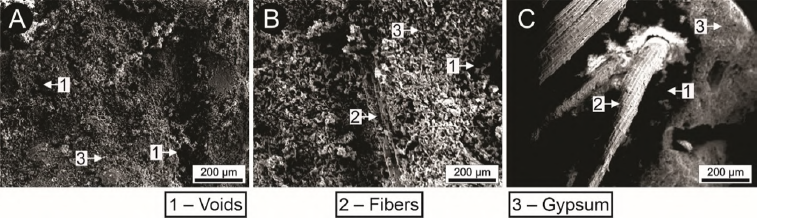
The fractured surfaces of the plaster composites with Luffa cylindrica fibers, analyzed by scanning electron microscopy (SEM) and optical microscopy, are represented in Figures 5 and 6.

SEM images of fractured regions in composites containing (A) 0%, (B) 2.5%, and (C) 10% Luffa cylindrica fibers
Figura 5
Imagens SEM de regiões fraturadas em compósitos contendo (A) 0%, (B) 2,5% e (C) 10% de fibras de Luffa cylindrica
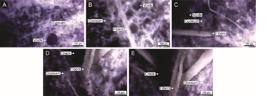
Optical microscopy images of gypsum composites containing (A) 0%, (B) 2.5%, (C) 5%, (D) 7.5%, and (E) 10% Luffa cylindrica fibers
Figura 6
Imagens de microscopía óptica de compósitos de gesso contendo (A) 0%, (B) 2,5%, (C) 5%, (D) 7,5% e (E) 10% de fibras de Luffa cylindrica
4. DISCUSSION
It can be observed that the extractive content obtained was higher than that reported in the literature (Table 3). Koruk & Genc (2019) reported extractives content of 3.2% for Luffa sp., while Koc et al. (2015) found similar values. A lower extractives content is advantageous, as excessive amounts of non-polar compounds and mineral content may inhibit reactive chemical sites, ultimately impairing the mechanical performance of composites (Mesquita Junior et al., 2018).
The lignin content identified in the present study (39.84%) was higher than that reported in previous works. Alhijazi et al. (2020), Koruk & Genc (2019), and Chen et al. (2018) reported lignin contents of 11.7%, 10-23%, and 20.5%, respectively. Ash content in this study also exceeded that found by Koruk & Genc (2019), who reported only 0.4%. The holocellulose content measured here (43.56%) is lower than the values reported by Paula et al. (2011) for other biomass residues, which ranged from 63.17% to 66.23%.
Such compositional variations among studies are expected and can be attributed to intrinsic species variability, environmental conditions, soil composition, plant age, and geographic origin (Akinyemi & Dai, 2021).
The basic density of Luffa cylindrica was measured at 0.11 g/cm3, notably lower than that of many commonly used natural fibers. For instance, coconut fibers range around 1.25 g/cm3, cotton fibers between 1.5-1.6 g/cm3, sisal fibers from 1.26 to 1.45 g/cm3, and hemp fibers at approximately 1.48 g/cm3 (Koruk & Genc, 2019). Nonetheless, Akinyemi & Dai (2022) reported higher values for Luffa, ranging from 0.719 to 0.721 g/cm3, underscoring the variability related to cultivation and processing methods.
Regarding apparent density (Figure 1), it is observed that density values remained consistent in all treatments, with minimal variation. Statistical analysis revealed no significant differences between the five formulations. Comparable findings have been reported in studies using other agricultural residues in gypsum composites. For instance, Miranda et al. (2023) evaluated the addition of bean husk residues at various concentrations and observed no statistically significant differences in apparent density, with values ranging from 1.40 to 1.52 g/cm3. The highest densities were observed in the control treatment without fiber addition.
The results are generally attributed to the reduction in porosity caused by fiber incorporation, which leads to a denser matrix. Similarly, Romero-Gomez et al. (2022) reported that incorporating cellulose acetate fiber residues into gypsum composites did not significantly affect apparent density, which aligns with the observations from this study.
Varying fiber content did not result in statistically significant differences in water absorption between treatments (Figure 2). This behavior can be associated with the relatively high lignin content of the Luffa cylindrica fibers (39.84%), as indicated in Table 3. Lignin contributes hydrophobic properties to the material, which can reduce water uptake. Contrary to these results, Veloso et al. (2021) observed a decrease in water absorption with increasing amounts of lignocellulosic residues. These differences can be attributed to variations in fiber composition and interaction with the matrix.
Oliveira et al. (2020), when incorporating eucalyptus wood fibers into gypsum matrices, reported an increase in water absorption ranging from 19.48% to 26.14%. These differences highlight the influence of fiber type and composition on the moisture behavior of composites. In general, water absorption in gypsum-based materials is governed by a range of factors, including matrix porosity, fiber characteristics, and composite formulation.
Overall, gypsum composites exhibit moderate water absorption compared to other porous construction materials such as concrete (Plazonic et al., 2016), and the incorporation of Luffa cylindrica fibers did not significantly alter this property.
A quadratic regression indicates a decrease in MOE, with the minimum value (66.11 MPa) observed at approximately 5.07% fiber contente (Figure 3A). A similar trend was reported by Miranda et al. (2023), who observed a reduction of 142 MPa in the MOE when incorporating 5.84% of bean residue into gypsum matrices. This reduction is likely associated with weak interfacial bonding between the ceramic matrix and lignocellulosic fibers, which limits stress transfer efficiency.
For flexural strength (MOR), a quadratic decreasing trend was also observed, with the lowest value (1.02 MPa) at approximately 7.52% fiber addition (Figure 3B). This behavior can be attributed to the chemical composition of the Luffa cylindrica fibers— specifically the presence of lignin and extractives—which may impair fiber-matrix adhesion, as previously discussed (Veloso et al., 2021).
Vilela et al. (2020) also reported reduced MOR values when multilayer packaging residues were incorporated into gypsum, with strength decreasing from 5.12 MPa to 1.42 MPa. According to the authors, this reduction results from the low stiffness of the reinforcing material, which contributes to post-crack deformation, high energy absorption, and dynamic load resistance. Despite the observed decrease in mechanical performance, all formulations met the minimum flexural strength requirement of 1.0 MPa as established by the EN 13279-1 (2008) standard.
Regarding the results obtained for thermal conductivity (Figure 4), it is noted that the incorporation of up to 10% Luffa cylindrica fibers does not compromise the thermal insulation capacity of the gypsum matrix. Although no statistical differences were found, the data indicate a slight trend toward increased thermal resistance with higher fiber content.
To verify this behavior, further studies are recommended using higher percentages of Luffa cylindrica, which may accentuate the insulating effect due to the natural porosity and low thermal conductivity of lignocellulosic materials.
The thermal resistance values obtained in this study were higher than those reported by Veloso et al. (2021), who incorporated cocoa agro-industrial residues into gypsum. According to Pinto (2018), materials with lower thermal conductivity exhibit higher thermal resistance, a desirable property for insulating applications in the construction sector.
SEM analysis of the fractured areas revealed similar patterns across treatments, particularly regarding the interface between the fiber and the matrix (Figure 5). All formulations exhibited regions of poor adhesion, suggesting limited interfacial bonding between the gypsum and the Luffa cylindrica fibers. This inadequate adhesion may explain the reductions observed in mechanical performance.
Optical microscopy confirmed the presence of fiber interaction zones in treatments B through E, which were not observed in the control sample (A) (Figure 6). Additionally, the presence of void channels and regions of plastic deformation in samples B and C was evident. These microstructural features directly influence the mechanical behavior of natural composites (Paula et al., 2011).
Similar findings were reported by Ramesh et al. (2021), who observed voids and adhesion failures in polymer composites reinforced with Calotropis gigantea fibers, which were attributed to impurities and poor compatibility at the fiber-matrix interface.
5. CONCLUSION
This study presented the physical, mechanical, and thermal characterization of gypsum composites reinforced with Luffa cylindrica fibers. Apparent density remained stable across all treatments, and no statistically significant differences were observed in water absorption after 2 hours, likely due to the high lignin content (39.84%) of the fibers, which imparts hydrophobic behavior.
Mechanical tests showed a decrease in both the modulus of elasticity and flexural strength with increasing fiber content, attributed to limited interfacial bonding between the gypsum matrix and the lignocellulosic fibers. Nevertheless, all treatments met the minimum flexural strength requirement established by EN 13279-1 (2o08). The lowest flexural strength (MOR) value obtained was 1.02 MPa, which is approximately 2% higher than the minimum value required by the standard (1.0 MPa), confirming the structural validity of the proposed material.
Thermal conductivity results revealed consistent behavior among the treatments, indicating that the incorporation of up to 10% Luffa cylindrica fibers does not adversely affect thermal resistance. Microstructural analyses confirmed the presence of poor fiber-matrix adhesion and voids, which help explain the mechanical performance observed.
Overall, the incorporation of Luffa cylindrica fibers in gypsum matrices proves to be a valid and sustainable alternative for developing lightweight and insulating materials in the construction sector. Further investigations are encouraged to explore higher fiber contents and additional treatments that may enhance fiber-matrix interaction and improve the overall performance of these bio-based composites.
DATA AVAILABILITY
The entire dataset supporting the findings of this study has been published within the article.
6. REFERENCES
-
Akinyemi, B. A. & Dai, C. (2021). Luffa cylindrica fibre as a natural reinforcement for cement composites: A review. Journal of Sustainable Cement-Based Materials, 11(5), 297-307. https://doi.org/10.1080/21650373.2021.1952658
» https://doi.org/10.1080/21650373.2021.1952658 -
Alhijazi, M., Safaei, B., Zeeshan, Q., Asmael, M., Eyvazian, A. & Qin, Z. (2020). Recent developments in Luffa natural fibre composites. Sustainability, 12(18), 7683. https://doi.org/10.3390/su12187683
» https://doi.org/10.3390/su12187683 -
Anastopoulos, J. & Pashalidis, J. (2020). Environmental applications of Luffa cylindrica-based adsorbents. Journal of Molecular Liquids, 309, 114127. https://doi.org/10.1016/j.molliq.2020.114127
» https://doi.org/10.1016/j.molliq.2020.114127 - Arikan, M. & Sobolev, K. (2002). The optimization of a gypsum-based composite material. Cement and Concrete Research, 32(11), 1725-1728.
-
Azzouzi, D., Rabahi, W. & Seddiri, F. (2020). Hemis, M. Experimental study of the fibres content effect on the heat insulation capacity of new vegetable composite plaster- pea pod fibres. Sustainable Materials and Technologies, 23, e00144. https://doi.org/10.1016/j.susmat.2019.e00144
» https://doi.org/10.1016/j.susmat.2019.e00144 -
Bijen, J. & van der plas, C. (1992). Polymer-modified glass fibre reinforced gypsum. Materials and Structures, 25, 107114. https://doi.org/10.1007/BF02472464
» https://doi.org/10.1007/BF02472464 - Brazilian Association of Technical Standards (ABNT). (2010a). NBR 14853:2010 - Wood - Determination of soluble matter in ethanol-toluene, in dichloromethane and in acetone. ABNT.">https://doi.org/10.1007/BF02472464 Brazilian Association of Technical Standards (ABNT). (2010a). NBR 14853:2010 - Wood - Determination of soluble matter in ethanol-toluene, in dichloromethane and in acetone. ABNT.
- Brazilian Association of Technical Standards (ABNT). (2010b). NBR 7989:2010 - Pulp and wood - Determination of acid- insoluble lignin. ABNT.
- Brazilian Association of Technical Standards - ABNT. (2017). NBR 13999: Paper, cardboard, cellulose pulp and wood - Determination of residue (ash) after incineration at 525 °C. Rio de Janeiro: ABNT
-
Chen, Q., Zhang, Q., Qi, C., Fourier, A. & Xiao, C. (2018). Recycling phosphogypsum and construction demolition waste for cemented paste backfill and its environmental impact. Journal of Cleaner Production, 186, 418-429. https://doi.org/10.1016/j.jclepro.2018.03.131
» https://doi.org/10.1016/j.jclepro.2018.03.131 -
Demir, H., Atikler, U., Balkose, D. & Tihminlioglu, F. (2006). The effect of fiber surface treatments on the tensile and water sorption properties of polypropylene-luffa fiber composites. Composites Part A: Applied Science and Manufacturing, 37, 447-456. https://doi.org/10.1016/j.compositesa.2005.05.036
» https://doi.org/10.1016/j.compositesa.2005.05.036 - Deng, Y H. & Furuno, T. (2001). Study on gypsum-bonded particleboard reinforced with polypropylene fibers. Journal of the Japan Wood Research Society, 47, 445-450.
- Dhanola, A., Bisht, A. S., Kumar, A. & Kumar, A. (2018). Influence of natural fillers on physico-mechanical properties of Luffa cylindrica/polyester composites. Materials Today: Proceedings, 5(9), 17021-17029
-
Du, Z., She, W., Zuo, W., Hong, J., Zhang, Y & Miao, C. (2020). Foamed gypsum composite with heat-resistant admixture under high temperature: mechanical, thermal and deformation performances. Cement and Concrete Composites, 108, 103549. https://doi.org/10.1016/j.cemconcomp.2020.103549
» https://doi.org/10.1016/j.cemconcomp.2020.103549 - European Committee for Standardization - CEN. (2014). EN 132792: Gypsum binders and gypsum plasters - Part 2: Test methods: CEN.
-
Gencel, O., Diaz, J. J. C., Sutcu, M., Koksal, F., Rabanal, F. P. A. & Martinez- Barrera, G. (2016). A novel lightweight gypsum composite with diatomite and polypropylene fibers. Construction and Building Materials, 113, 732-740. https://doi.org/:10.1016/j.conbuildmat.2016.03.125
» https://doi.org/:10.1016/j.conbuildmat.2016.03.125 -
Gencel, O., Diaz, J. J., Sutcu, M., Koksal, F., Rabanal, F. P. A. & Martinez- Barrera, G. (2014). Properties of gypsum composites containing vermiculite and polypropylene fibers: Numerical and experimental results. Energy and Buildings, 70, 135-144. https://doi.org/10.1016/j.enbuild.2013.11.047
» https://doi.org/10.1016/j.enbuild.2013.11.047 - Henrik, L. N. (2017). Now: 100% wallboard recycling with gypsum recycling international. Global Gypsum Magazine, 98, 122-129.
-
Hernandez-Olivares, F., Alvarado, R. E. M., Valdivieso, X. E. B. & Suarez, A. Z. (2020). Short sugarcane bagasse fibers cementitious composites for building construction. Construction and Building Materials, 247, 118451. https://doi.org/10.1016/j. conbuildmat.2020.118451
» https://doi.org/10.1016/j. conbuildmat.2020.118451 -
Jino, R., Rajagopal, P., Ashok, G., Llango, T. & Chakravarthy, K. (2017) Enhancement of mechanical properties of Luffa fiber/epoxy composite using B4C. Journal of Advanced Microscopy Research, 12, 89-91. https://doi.org/10.1166/jamr.2017.1324
» https://doi.org/10.1166/jamr.2017.1324 -
Kalusuraman, G., Irulappasamy, S., Aslan, M., Anandkumar, S. & Satyanarayana, K. G. (2019). Evaluation of surface pretreatments on the surface characteristics modifications in sponge gourd (Luffa cylindrica) fibers. Materials Research Express, 6(9). https://doi.org/10.1088/2053- 1591/ab3252
» https://doi.org/10.1088/2053- 1591/ab3252 - Kim, D., Lee, S., Kim, G. (2019). Mechanical and thermal performance of glass fiber-reinforced gypsum. Construction and Building Materials, 230, 117063.
- Koc, K.N., Stodola, J.L., Burgers, P.M., Galletto, R.. (2015). Regulation of yeast DNA polymerase 5-mediated strand displacement synthesis by 5'-flaps. Nucleic Acids Res 43(8):4179-90.
-
Koruk, H. & Genc, G. (2019). Acoustic and mechanical properties of Luffa fibre- reinforced biocomposites. In: Jawaid, M., Thariq, M., Saba, N. (Ed.), Composites Science and Engineering. (pp.325-341). Woodhead Publishing. https://doi.org/10.1016/B978-0-08-102292-4.00017-5
» https://doi.org/10.1016/B978-0-08-102292-4.00017-5 -
Martias, C., Jolif, Y & Favotto, C. (2014). Effects of the addition of glass fibers, mica and vermiculite on the mechanical properties of a gypsum-based composite at room temperature and during a fire test. Composites Part B: Engineering, 62, 37-53. https://doi.org/10.1016/j.compositesb.2014.02.01
» https://doi.org/10.1016/j.compositesb.2014.02.01 -
Medina, N. F. & Barbero-Barrera, M. M. (2017). Mechanical and physical enhancement of gypsum composites through a synergic work of polypropylene fiber and recycled isostatic graphite filler. Construction and Building Materials, 131, 165-177. https://doi.org/10.1016/j.conbuildmat.2016.11.073
» https://doi.org/10.1016/j.conbuildmat.2016.11.073 -
Mesquita Junior, L., Faria, D. L., Guimarães Junior, J. B., Eugênio, T. M. C., Ferreira, S. R. & Rabelo, G. F. (2018). Compósitos à base de cimento e gesso reforçados com partículas de madeira de Eucalyptus grandis. Revista Ciência da Madeira, 9(3), 191-198. https://doi.org/10.12953/2177-6830/rcm.v9n3p191-198x
» https://doi.org/10.12953/2177-6830/rcm.v9n3p191-198x -
Miranda, E. H. N., Gomes, D. A. C., Resende, G. M. C. S. R., Guimarães, T. C., Mendes, L. M. & Guimarães Júnior, J. B. (2023). Evaluation of the influence of the addition of bean residue in gypsum matrices. Clean Technologies and Environmental Policy, 25, 93-103. https://doi.org/10.1007/s10098-022-023 89-9
» https://doi.org/10.1007/s10098-022-023 89-9 -
Miraoui, I., Jaballi, S. & Rabeh, S. (2022). Analysis of long unidirectional sisal fibers reinforced plaster: An experimental investigation. Materials Today: Proceedings, 52(1), 152-157. https://doi.org/10.1016/j.matpr.2021.11.401
» https://doi.org/10.1016/j.matpr.2021.11.401 -
Oliveira, A. S., Villela, L. S., Veloso, M. C. R., Silva, D. W., Mendes, L. & Guimarães Júnior, J. B. (2020). Composites with gypsum matrix reinforced with eucalyptus wood fibers. Scientia Forestalis, 48(127), e3260. https://doi.org/10.18671/scifor.v48n127.23
» https://doi.org/10.18671/scifor.v48n127.23 -
Parres, F., Crespo-Amorós, J.E. Nadal- Gisbert, A. (2009). Mechanical properties analysis of plaster reinforced with fiber and microfiber obtained from shredded tires, Construction and Building Materials, 23(10), 3182-3188. https://doi.org/10.1016/j.conbuildmat.2009.06.040.
» https://doi.org/10.1016/j.conbuildmat.2009.06.040. -
Paula, L. E. R., Trugilho, P. F., Napoli, A. & Bianchi, M. L. (2011). Characterization of residues from plant biomass for use in energy generation. Cerne, 17, 237-246. https://doi.org/10.1590/S0104- 77602011000200012
» https://doi.org/10.1590/S0104- 77602011000200012 - Pinto, J. M. (2018). Thermal properties of building materials and energy efficiency. Journal of Sustainable Construction Materials, 12(3), 45-53.
- Plazonic, I., Barbaric-Mikocevic, Z., Antonovic, A. (2016). Chemical composition of straw as an alternative material to wood raw material in fbre isolation. Drv Industrija 67,119-125
-
Ramesh R, Dautel M, Lee Y, Kim Y, Storey K, Gottfried S, Goss Kinzy T, Huh WK, Sattlegger E. (2021). Asp56 in actin is critical for the full activity of the amino acid starvation-responsive kinase Gcn2. FEBS Lett 595(14): 1886-1901. https://doi.org/10.1002/1873-3468.14137
» https://doi.org/10.1002/1873-3468.14137 -
Romero-Gomez, M. I., Silva, R. V., Costa Pereira, M. F. & I. Flores-Colen. (2022). Thermal and mechanical performance of gypsum composites with waste cellulose acetate fibres. Construction and Building Materials, 356, 129308. https://doi.org/10.1016/j. conbuildmat.2022.129308
» https://doi.org/10.1016/j. conbuildmat.2022.129308 -
Rovero, L., Galassi, S. & Misseri, G. (2020). Experimental and analytical investigation of bond behavior in glass fiber- reinforced composites based on gypsum and cement matrices. Composites Part B: Engineering, 194, 108051. https://doi.org/10.1016/j.compositesb.2020.108051
» https://doi.org/10.1016/j.compositesb.2020.108051 -
Sair, S., Mandili, B., Taqi, M. & El Bouari, A. (2019). Development of a new eco-friendly composite material based on gypsum reinforced with a mixture of cork fibre and cardboard waste. Composites Communications, 16, 20-24. https://doi.org/10.1016/j.coco.2019.08.010
» https://doi.org/10.1016/j.coco.2019.08.010 -
Veloso, M. C. R., Villela, L. S., Mesquita Junior, L., Valle, M. L. A., Mendes, L. M. & Guimarães Júnior, J. B. (2021). Produção e caracterização de compósitos à base de gesso reforçado com partículas de resíduo da agroindústria do cacau. Revista Matéria, 26(1). https://doi.org/10.1590/S1517-707620210001.1245
» https://doi.org/10.1590/S1517-707620210001.1245 -
Villela, L. S., Castro, E. D., Mesquita Junior, L., Veloso, M. C. R. A., Mendes, R. F., Mendes, L. M. & Guimarães Júnior, J. B. (2020). Desempenho físico-mecânico de compósitos à base de gesso reforçados com embalagens multicamadas trituradas. Revista Matéria, 25(3). https://doi.org/10.1590/S1517-707620200003.1105
» https://doi.org/10.1590/S1517-707620200003.1105 -
Xie, S., Zhijang, J., Yang, Y, Hou, G. & Wang, J. (2016). Electromagnetic wave absorption enhancement of carbon black/gypsum-based composites filled with expanded perlite. Composites Part B: Engineering, 106, 10-19. https://doi.org/10.1016/j.compositesb.2016.09.014
» https://doi.org/10.1016/j.compositesb.2016.09.014 -
Xue, G., Yilmaz, E., Chen, W. & Cao, S. (2019). Mechanical, flexural and microstructural properties of cement-tailings matrix composites: effects of fiber type and dosage. Composites Part B: Engineering, 172, 131-142. https://doi.org/10.1016/j.compositesb.2019.05.039
» https://doi.org/10.1016/j.compositesb.2019.05.039
Edited by
-
Editors:
Iara Fontes Demuner and João Gilberto Meza Ucella Filho.