 How are refugees affected by Brazilian responses to COVID-19?
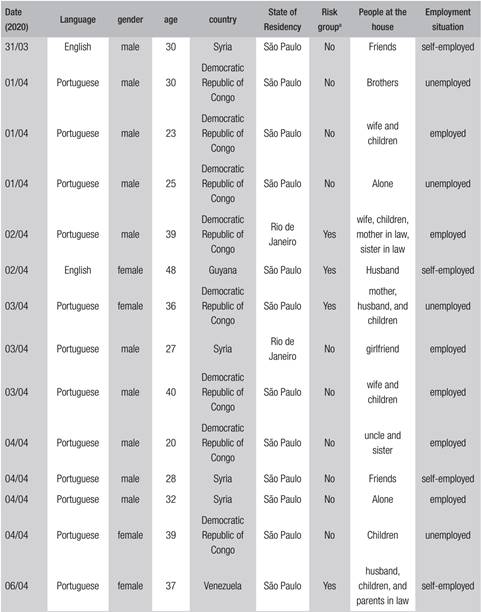
Refugees are forcibly displaced people who fled their home countries due to persecutions because of their religion, nationality, political opinion, race, or being part of a particular social group. Brazilian Law 9474/1997 recognizes people who are fleeing a situation of severe and generalized violation of human rights as refugees. According to Brazilian law and Constitution, refugees have the same rights as Brazilians. However, my research with 29 refugees living in the states of São Paulo and Rio de Janeiro shows that refugees are disproportionately affected by the Brazilian responses to the COVID-19 pandemic. This article discusses how refugees in Brazil are affected by federal responses to the pandemic. I conducted 29 semi-structured phenomenological interviews with refugees between March 27, 2020, and April 06, 2020. These interviews were analyzed considering responses adopted by the Brazilian government (at the federal level) to respond to COVID-19. I conclude that refugees are affected by the closure of the borders and their rights to documentation, healthcare, and social assistance (the emergency benefit) are violated.
Keywords:
COVID-19; refugees; Brazil; public policies
 Thumbnail
 Thumbnail
 a Risk group means if the refugee has a person in his house who is part of a group facing more risk to COVID-19 (e.g., older people, people with chronic diseases like health problems and diabetes). b this refugee was employed when I interviewed him. He lost his job ten days after that due to his company’s needs to cut costs following the closure of non-essential commerce. Source: Elaborated by the authors.