 Diversity management and performance: The mediating role of satisfaction and commitment at work
Abstract
Purpose: This article analyzed the relationship between diversity mana-gement and individual performance, examining the mediating role of satisfaction and commitment in this relationship.
Originality/value: Diversity management has received attention from academia and organizations, given the need to promote equal opportunities for groups considered minorities in society. Therefore, it is important to understand the impacts that diversity management practices bring to organizations and individuals. There are few studies that address the impacts of diversity management on performance and even fewer studies that evaluate the mediating role of commitment and satisfaction in this relationship.
Design/methodology/approach: A quantitative method was used, structural equation modeling, to test the hypotheses proposed in the study, with data collected through a questionnaire, applied to Brazilian workers, between the months of May and December 2022, obtaining a non-proba-bilistic sample of 563 respondents.
Findings: The results showed that diversity management practices positively influence satisfaction and commitment, in addition to having a positive effect on individual performance when mediated by commitment. This means that commitment acts as a mediator between diversity management and performance, indicating that increasing diversity practices leads to increased commitment, which, in turn, raises workers’ performance. These are important results both for organizations and for defending affirmative policies towards increasing diversity in organi-zations.
Keywords:
diversity management; performance; commitment; satisfaction; mediation
Resumo
Objetivo: Este artigo analisou a relação entre gestão da diversidade e desempenho individual, examinando o papel mediador da satisfação e do comprometimento nessa relação. Originalidade/valor: A gestão da diversidade tem merecido atenção da acade-mia e das organizações, dada a necessidade de promoção da igualdade de oportunidades para os grupos considerados minorias na sociedade. Assim, é relevante entender os impactos que as práticas de gestão da diversidade trazem para as organizações e os indivíduos. Existem poucos estudos que abordam os impactos da gestão da diversidade no desempenho e ainda menos trabalhos que avaliam o papel mediador do comprometimento e da satisfação nessa relação. Design/metodologia/abordagem: Foi utilizado método quantitativo com uso da modelagem de equações estruturais, para testar as hipóteses propostas no estudo, sendo os dados coletados por meio de questionário, aplicados a trabalhadores brasileiros, durante os meses de maio a dezembro de 2022, obtendo-se uma amostra não probabilística com 563 respondentes.
Resultados: Os resultados mostraram que práticas de gestão da diversidade influenciam positivamente a satisfação e o comprometimento, além de afetar positivamente o desempenho individual quando mediadas pelo comprometimento. Isso significa que o comprometimento atua como mediador entre a gestão da diversidade e o desempenho, indicando que aumentar práticas de diversidade leva ao aumento do comprometimento, que, por sua vez, eleva o desempenho dos trabalhadores. São resultados importantes tanto para as organizações quanto para a defesa das políticas afirmativas em direção ao aumento da diversidade nas organizações.
Palavras-chave:
gestão da diversidade; desempenho; comprometimento; satisfação; mediação
INTRODUCTION
Diversity management comprises a set of organizational policies and practices for increasing the number of people from the various groups in society that have been excluded from the job market (Fleury, 2000; Dennissen et al., 2018). It has become relevant in recent years, especially since the 2000s, for several reasons (Roberson, 2019; Yadav & Lenka, 2020; Fraga et al., 2022). One of them is the fact that diversity management is positively related to several dimensions of organizations, such as creativity and competitiveness (Nóbrega et al., 2014), organizational culture, organizational trust (Migueles et al., 2021), talent attraction, and, especially, performance (Triguero-Sánchez et al., 2018).
A second reason is that the practice of diversity management is aligned with the United Nations’ (UN) 2030 agenda (Nações Unidas Brasil, 2015), which established 17 sustainable development goals (SDG) for promoting social and economic equality, as well as environmental preservation. Among the 17 actions defined by the UN, at least seven address the issue of diversity, like SDG 5 (gender equality) and SDG 10 (reducing inequality). In turn, the World Economic Forum has also addressed the issue of diversity and inclusion through the Lighthouse programme, which “is an annual effort from WEF to bring to light, emphasize, and scale impactful initiatives for diversity, equity, and inclusion (DEI)” (Madner et al., 2023).
Another relevant motivation is that Brazil shows significant inequality in the labor market (Instituto Brasileiro de Geografia e Estatística [IBGE], 2022). Considering the scenario for the year 2022, unemployment for white men was significantly lower than for non-whites or women. In addition, management positions in Brazilian companies are held mostly by white men, although the country has a larger population of women and black and brown people, showing how difficult it is for these groups to get a job in the labor market, in the first place, and then climb to the highest positions in companies, thus limiting their economic and social rise and the inequality between groups.
On the other hand, although governments have created laws and public policies to minimize the problem of outcast groups in the job market, these are insufficient to actually implement diversity in organizations (Rohden, 2023); therefore, convincing managers that diversity is a powerful performance facilitator is particularly relevant in Brazil, where companies still do not appreciate or understand its real value (Tomaz, 2022). It is in this context that this study seeks to contribute to analyzing the effects of diversity management practices on organizational performance, using job satisfaction and commitment as mediating variables of this relationship (Moon & Christensen, 2020; Li et al., 2021). Few articles address the influence of diversity management practices on organizational performance, and even fewer use satisfaction and commitment as mediators of this relationship (Yadav & Lenka, 2020; Triguero-Sánchez et al., 2018).
The relationship between diversity management practices, satisfaction and commitment, and performance is based on the idea that individuals who belong to society’s minority groups and already work in the organization, when noticing that it values hiring and inserting other individuals from these groups, tend to develop a more positive relationship with the organization and see it as a partner, leading to feelings of belonging and gratitude, which increases their satisfaction, commitment, and performance (Migueles et al., 2021; Ju & Li, 2019; Li et al., 2021; Brimhall, 2019).
Therefore, this study investigates the relationship between diversity management practices and organizational performance, with satisfaction and commitment as mediating variables. This study is timely for many reasons. According to Yadav and Lenka (2020), and Triguero-Sánchez et al. (2018), there are few studies that address this set of dimensions simultaneously: diversity management, performance, and employee satisfaction and commitment.
In Brazil, studies on diversity management have not approached these dimensions yet, dealing with the effects of gender diversity on boards of directors and on company performance (Nisiyama & Nakamura, 2018; Costa et al., 2019; Garcia-Blandon et al., 2022); and some examine the effect of diversity on organizational performance (Trigueiro-Sáches et al., 2018). However, we did not find any articles that tackle the dimensions we address here. For Roberson (2019) and Yadav and Lenka (2020), there is a lack of studies on diversity in developed countries, and even more in developing ones, like Brazil. Hence, this paper intends to fill this gap, in addition to helping strengthen the speech towards diversity in organizations, as described by the UN’s SDG and the World Economic Forum.
To achieve this goal, this study is structured as follows: after this introduction, we present a theoretical discussion on the main concepts: diversity management, job satisfaction, and commitment. Next, we address the methodological procedures, followed by results and discussion. At the end, we present the final remarks.
THEORETICAL BACKGROUND AND HYPOTHESES DEVELOPMENT
Diversity management
Diversity management covers the group of practices and policies for hiring and promoting people who belong to historically marginalized groups (Fraga et al., 2022). For Dennissen et al. (2018, p. 2), diversity management is the “set of specific programs, policies, and practices that organizations have developed and implemented to effectively manage a diverse workforce and foster organizational equity”. Besides the idea associated with diversity management, according to which companies would be responsible for implementing or strengthening affirmative actions, with or without government’s involvement (Cox & Blake, 1991; Fleury, 2000), the definitions and arguments for implementing diversity management carry at their core the relation with improving individual and organizational performance. A group made up of diverse people - reflected in the plurality of knowledge, skills, cultures, and identities - would increase the capacity for creativity and innovation (Yadav & Lenka, 2020).
Diversity management seeks to manage working relationships, employment practices, and the internal configuration of teams, attracting and retaining professionals from minority groups (Fleury, 2000). For Van Knippenberg and Schippers (2007), diversity management must go beyond measures of representation and inclusion, adding training practices and inclusive leadership, developing intercultural competencies, and creating an organizational climate that values differences and fosters collaboration and mutual respect. Diversity management practices involve leaders’ commitment to having people from all groups that make up society in the company’s workforce, as well as the existence of policies and programs that stimulate diversity at the workplace, such as the recruitment of minorities and building awareness toward employee diversity (Choi & Rainey, 2010).
It involves the adoption of administrative measures that use personal or group attributes as resources for improving organizational performance (Dauth et al., 2023). Therefore, managing workforce diversity can bring benefits to employees’ performance, including increased satisfaction and commitment, besides encouraging innovation and creativity (Moon & Christensen, 2020).
Previous studies suggest a positive and significant relationship between diversity management practices and performance in organizations. This is because these practices allow for the inclusion of people with different skills, knowledge, and competencies (Triguero-Sánchez et al., 2018). Diversity management also fosters creativity, innovation, and problem-solving abilities (Cox & Blake, 1991). In addition, according to Migueles et al. (2021), these practices also give rise to employees’ sense of justice and trust toward the organization, leading them to make more efforts on its behalf, which increases performance (Li et al., 2021; Choi & Rainey, 2010). Therefore, we proposed the following hypothesis:
-
H1: There is a positive relationship between managing diversity in the work team and individual performance at work.
Satisfaction at work and diversity management
Job satisfaction can be described as a multifaceted structure that involves cognitive, affective, and behavioral aspects of the worker regarding several elements of the job, both intrinsic and extrinsic (Locke, 1976; Misener et al., 1996). For Spector (1985, p. 695), it is the “representation of a grouping of evaluation feelings about the work; a variable of attitude that reflects how a person feels about work, in general and in its various aspects”. For Karaferis et al. (2022), it is the positive emotional state that results from work evalua-tion or professional experience.
Regarding the factors present in the organizational environment, Tamayo (2001), Warr (2007) and Misener et al. (1996) describe that job satisfaction is affected by remuneration, career, relationship with colleagues and supe-riors, organizational climate, job content, hierarchical position, the indi-vidual’s perception of justice in the organization, and the quality of working factors such as autonomy and support (Karaferis et al., 2022; Düzgün & Çelik, 2023; Moro et al., 2021). In turn, previous studies have analyzed the effects of satisfaction at the workplace, considering that it can affect many dimensions of the organization positively since happy individuals tend to be more productive (Silveira, 2019; Karaferis et al., 2022; Hellín Gil et al., 2022; Ohene Afriyie et al., 2024). However, there are different results of the impact of satisfaction on organizational performance (Bakotić, 2016; Karaferis et al., 2022).
Managing workforce diversity can play an important role in promoting job satisfaction (Migueles et al., 2021; Ju & Li, 2019; Li et al., 2021). With diversity management practices, it is possible that individuals notice that the organization seeks to correct social inequalities inside and outside it, favoring the perception of justice and belonging (Tamayo, 2001; Warr, 2007; Misener et al., 1996), which leads to increased satisfaction. For Tajfel and Turner (1986), social identification with the work group can influence job satisfaction positively.
In turn, previous studies have sought to identify the mediating role of satisfaction in the relationship between budget participation and organizational performance (Zonatto et al., 2020), between people management practices and organizational performance (Ohene Afriyie et al., 2024), and between emotional intelligence, transformational leadership, and performance (Alwali & Alwali, 2022). As shown before, there is a relationship between diversity management practices, satisfaction, and performance (Migueles et al., 2021; Ju & Li, 2019; Li et al., 2021), as well as between job satisfaction and performance at work (Dudasova et al., 2023; Silveira, 2019; Karaferis et al., 2022; Hellín Gil et al., 2022). Therefore, satisfaction is expected to act as a mediating variable in the relationship between diversity management and performance, which led to the following hypotheses:
-
H2a: There is a positive relationship between diversity management and job satisfaction.
-
H2b: There is a positive relationship between job satisfaction and individual performance.
-
H2c: Job satisfaction mediates the relationship between diversity mana-gement and individual performance.
Commitment and diversity management
Commitment at work refers to individuals’ links with the organization that lead them to wish to remain there (Meyer & Allen, 1991; Meyer et al., 2013). Hence, individuals with high levels of commitment accept the organi-zation’s goals, beliefs, and values, want to make efforts on its behalf and wish to stay there with dedication and involvement (Mowday et al., 1979; Meyer & Allen, 1991; Klein et al., 2014). According to Becker (1960), commitment leads workers to a consistent engagement with the organization.
Organizational commitment has been studied from three foundations, according to Meyer and Allen (1991): affective, normative, and instrumental. However, it is on the basis of affective commitment that it is possible to identify closer relationships with diversity management since it involves feelings of belonging to the organization. The affective base emphasizes the individual’s attitude towards the institution, resulting from a positive relationship, and an individual willingness activated by their interaction with it and colleagues (Meyer et al., 2013; Rodrigues et al., 2022).
Previous studies identified the relationship between commitment and various dimensions of organizations, especially work performance (Teo et al., 2020; Donkor et al., 2021; Mowday et al., 1979; Yousef, 2000). These relationships are based on the understanding that committed individuals are more willing to dedicate greater efforts to organizations (Porter et al., 1974; Yadav & Lenka, 2020; Costa et al., 2019; Migueles et al., 2021), leading them to reach higher levels of performance (Ashikali & Groeneveld, 2015).
Other studies sought to understand the effects of diversity management on levels of commitment, such as Gilbert et al. (1999), which analyzed the effects of top management practices, and Celik et al. (2011), which exami-ned the effects of diversity training programs. For Ashikali and Groeneveld (2015), this relationship takes place because diversity management refers to actions for attracting, selecting, retaining, and promoting workers from different social groups, especially from society and organizations’ minorities. Therefore, members of minority groups from a company feel appreciated and confident, with a sense of justice and belonging, and are willing to increase their commitment to it (Brimhall, 2019; Li et al., 2021).
On the other hand, some studies have sought to assess the mediating role of organizational commitment between relationships with other variables. Donkor et al. (2021) concluded that commitment mediates the relationship between transformational and laissez-faire leadership styles and workers’ performance, while Yousef (2000) found that commitment acts as a mediator in the relationship between leadership behaviors, performance, and job satisfaction. Hence, considering the existence of a relationship between diversity management and commitment, and between the latter and job performance, an indirect effect could be expected from the relationship between diversity management and performance, mediated by job commitment. Therefore, we proposed the following research hypotheses:
-
H3a: Workforce diversity management is positively related to organizational commitment.
-
H3b: Commitment is positively related to individual performance.
-
H3c: Commitment mediates the relationship between diversity management and job performance.
METHODOLOGICAL PROCEDURES
This was a quantitative survey with a non-probabilistic sample, a technique widely used in research when it is not feasible or practical to select a random sample from the population. In this method, the elements of the population do not have an equal chance of being chosen for the sample, which can cause some bias to the results. However, even with its limitations, non-probability sampling is still valuable in many contexts (Hair et al., 2014). For the analysis, we used the Structural Equation Modeling (SEM) method. We collected data between May and December 2022, through a questionnaire sent online using email and social networks, to people working in any type of organization, through the snowball technique, in which one individual passes on the questionnaire to others.
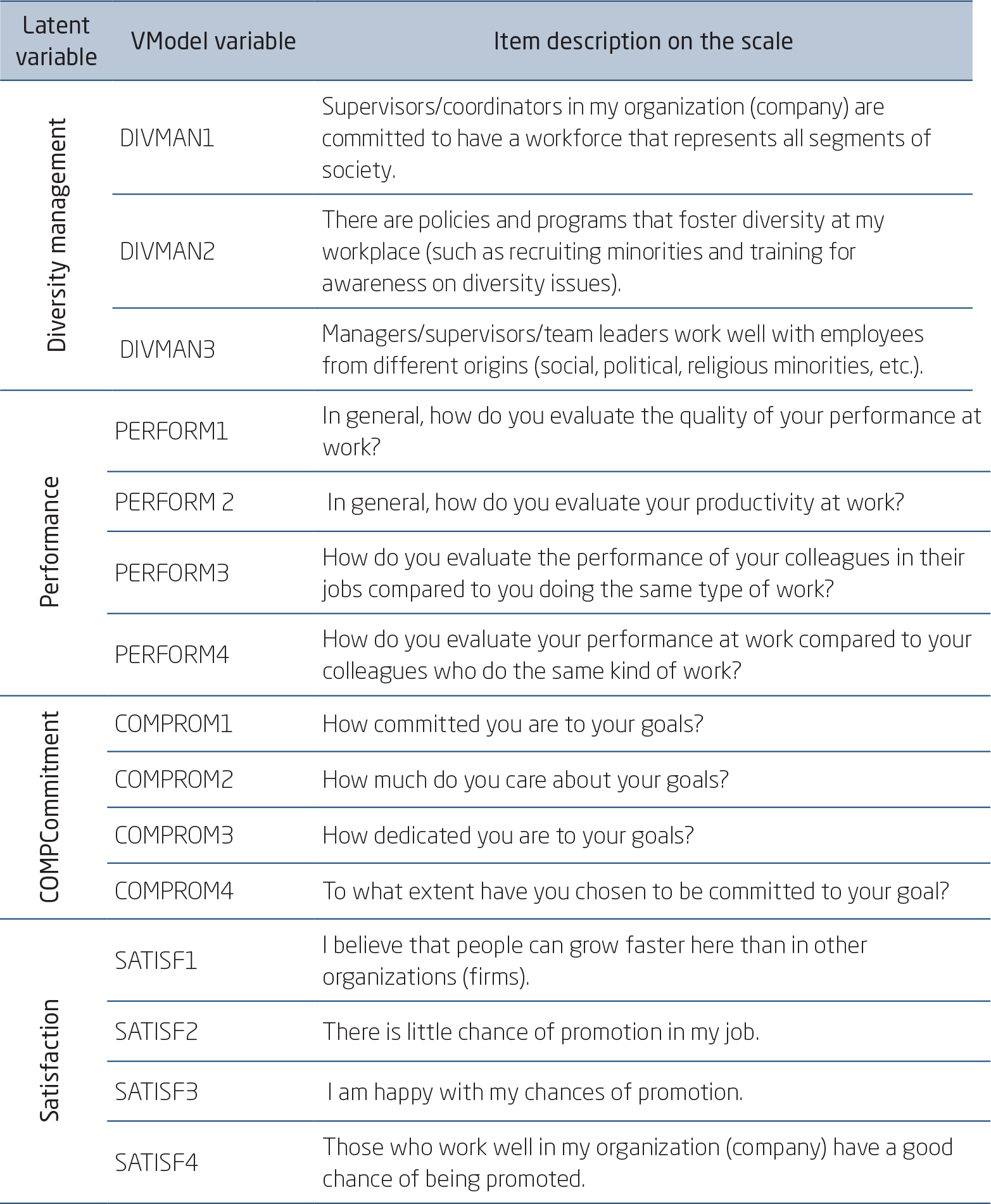
The questionnaire was made available on the Google Forms platform, where participants could answer it directly. The questionnaire was divided into two parts. The first collected demographic data from the participants, and the second presented statements associated with each of the constructs: diversity management (DIVMAN), commitment (COMPROM), satisfaction (SATISF), and individual performance (PERFORM), with a five-point Likert-type scale for the answers, ranging from 1, “totally disagree” to 5, “totally agree”. Diversity management was assessed by using a three-item scale based on the papers by Choi and Rainey (2010) and Li et al. (2021). The commitment scale contained four items and was based on Klein et al. (2014). We measured employee performance by Yousef’s scale (2000), and satisfaction was measured according to the scale used by Silva et al. (2018). The scales’ items are described in Figure 1.

The hypotheses proposed in the previous section were tested through SEM, as shown in Figure 2. First, we carried out a confirmatory factor analysis (CFA) of the variables. The main indices used to evaluate the model resulting from factor analysis were the χ2 statistics, which has lower values for the best fits, in addition to the degrees of freedom (g.l), in which χ2/g.l. ratio should preferably be < 5. Comparative fit index (CFI) and transport layer interface (TLI) values should be higher than 0.9, and root mean square error of approximation (RMSEA) and standardized root mean square residual (SRMR) error indices should be lower than 0.08 (Hair et al., 2014).

After CFA, the hypotheses were tested according to the model described in Figure 2, by SEM, using the R software, with the lavaan package, version 0.6-9. SEM is a family of statistical models that investigates the relationships between several variables, enabling us to estimate the relationships between the constructs simultaneously (Hair et al., 2014). We used the estimation method diagonally weighted least squares (DWLS). Similarly to factor analysis, model adjustment indices are expected to have the same values described for factor analysis.
Participants
The sample consisted of 563 respondents from Brazilian organizations. Most participants were female (55.24%) and self-declared as white (34.28%) or brown (42.98%); 34.64% have a specialization degree and 25.93% have a higher education degree, with 43.34% having worked at the company for up to five years. Married people account for 50.27%, and 55.60% do not hold leadership or management positions. Also, 39.61% work for companies with more than 1,000 employees, and 88.81% of the participants are heterosexual. The full characterization of the participants is shown in Table 1.
RESULTS PRESENTATION AND DISCUSSION
The first stage of analysis was CFA, and a path diagram was drawn up (Figure 3), in which we can see the interactions between the latent and observed variables in the proposed model.

The model fit indices were satisfactory: χ2 = 150.129, degrees of freedom (d.f) = 84, with ratio χ2/d.f. = 1.787 (preferably < 5), with the best models < 3; CFI = 0.990; TLI = 0.987; RMSEA = 0.037, and SRMR = 0.051. However, reliability tests showed an average variance extracted (AVE) of 0.46 for the individual performance construct, which is below the recommended. Therefore, we excluded item 3 from this construct. Item 2 on job satisfaction was inverted because the meaning of the statement was primarily “negative”: “There is little chance of promotion in my job”, which is why it appears in Table 2 as SATISF2I.
After these procedures, the fit indices of the new model became: χ2 = 49.097, d.f = 71, with ratio χ2/d.f. = 0.691; CFI = 1.000; TLI = 1.005; RMSEA= 0.000; and SRMR = 0.032, which are considered very good. The reliability tests are described in Table 2. Cronbach’s alpha and composite validity must be higher than 0.70. The AVE should be greater than 0.50, which confirms convergent validity. Discriminant validity was confirmed through the square root of AVE, which should be greater than the coefficients of the corresponding correlations (Hair et al., 2014).
After checking CFA, we carried out SEM. The model’s fit indices were χ2 = 72.984, d.f = 72; ratio χ2/d.f. = 0.97 (preferably < 5), with the best models < 3; CFI = 1.000; TLI = 1.000; RMSEA = 0.005 and SRMR = 0.039. The results indicate good quality of the proposed model. The results of the SEM analysis are shown in Table 3, with the estimates of the regression parameters between the variables.
Table 4 shows the coefficients, p values, and the significance of the proposed hypotheses tests.
The results for H2a confirmed the positive relationship between diversity management in the workforce and job satisfaction, which is in line with previous studies (Park & Liang, 2020; Lee & Kim, 2020; Migueles et al., 2021; Ju & Li, 2019; Li et al., 2021). Diversity management practices include people from various social backgrounds, especially from minority groups from society, allowing individuals to identify themselves with their groups within the organi-zation (Tajfel & Turner, 1986; Fraga et al., 2022; Dennissen et al., 2018).
Hence, workers can associate these practices with an attitude more focused on correcting social inequalities, which leads to a perception of valuing these groups and a feeling of justice and belonging (Tamayo, 2001; Warr, 2007; Misener et al., 1996; Brimhall, 2019; Li et al., 2021; Cambré et al., 2012). Since satisfaction involves affective and emotional aspects (Spector, 1985; Locke, 1976; Brief & Weiss, 2002; Karaferis et al., 2022), this perspective of valuing these groups can make individuals develop a positive and pleasant perception towards the company and work (Hellín Gil et al., 2022), with increasing satisfaction (Migueles et al., 2021; Ju & Li, 2019; Li et al., 2021).
H2b, which suggests a positive relationship between job satis-faction and individual performance, was rejected. This result strengthens previous discussions about the real effects of satisfaction on productivity, with part of the studies linking satisfaction and improved productivity, such as those by Fogaça and Coelho (2015) and Bakotić (2016), which found a posi-tive relationship between satisfaction and performance, while other studies found no association or a negative one between these constructs, as satisfaction does not always lead to attitudes or behaviors that favor a better performance (Ajzen & Klobas, 2013). In this study, in addition to a non-significant relationship between satisfaction and performance, the sign of the coef-ficient is negative (-0.061), which raises more questions about the real relationship between satisfaction and performance at work.
The results of H3a confirm the significant relationship between diversity management and commitment. These results prove previous studies that highlight the importance of diversity management for promoting employee commitment (Ashikali & Groeneveld, 2015; Brimhall, 2019; Jyoti et al., 2021).
Our findings advance the discussion on diversity management towards a broader understanding of how organizations can promote diversity mana-gement practices and, thereby, improve their workers’ level of commitment. This occurs because diversity practices show a company’s concern about attracting and retaining workers from groups with less prestige in society (Fraga et al., 2022; Dennissen et al., 2018), and this can awaken workers’ feelings of belonging and justice towards the firm (Migueles et al., 2021).
This can affect an individual’s commitment, since it relates to their attitude towards the organization as a result of how the firm and colleagues treat them, as observed by Ashikali and Groeneveld (2015). The authors understand that, especially in the affective dimension of commitment, there is an association with diversity management practices, as it involves feelings of belonging towards the organization.
H3b was confirmed, indicating that higher levels of commitment lead to increased individual performance at work. These results are in line with previous studies that suggest that workers’ commitment fosters their individual performance (Yadav & Lenka, 2020; Costa et al., 2019; Migueles et al., 2021). As commitment indicates a person’s willingness to remain in the organization and work harder for it (Porter et al., 1974; Mowday et al., 1979; Meyer & Allen, 1991; Klein et al., 2014), it is possible that the individuals surveyed in this study also show a positive association between commitment and performance, as highlighted by Teo et al. (2020) and Donkor et al. (2021).
Mediation analysis
Table 5 presents the results of the analysis of the mediating effect of satisfaction and commitment on the relationship between diversity management and performance.
Regarding satisfaction, the results did not confirm H2c, which proposed that job satisfaction mediates the relationship between diversity management and individual performance. This result agrees with Van Knippenberg et al. (2004), who suggest that other organizational elements, such as motivation, leadership, and perception of organizational justice, can affect the relationship between diversity management practices, satisfaction, and performance. This result, however, differs from those by Zonatto et al. (2020), Ohene Afriyie et al. (2024), Alwali and Alwali (2022), and Silveira (2019), in which satisfaction played a mediating role between some organizational dimensions and organizational performance.
Regarding H3c, which proposed that commitment mediates the relationship between diversity management and individual performance, the results in Table 5 confirm it. This finding reinforces the importance of the mediating variables suggested by Van Knippenberg et al. (2004) and adds to the results of previous studies that highlight the mediating role of commitment in relation to other variables (Donkor et al., 2021; Yousef, 2000). However, there are almost no studies that analyze commitment as a mediating variable in the relationship between diversity management and performance (Roberson, 2019; Yadav & Lenka, 2020; Nishii et al., 2018; Li et al., 2021). Hence, we offer this contribution
Our findings are based on the understanding that diversity management has a positive effect on commitment (Triguero-Sánchez et al., 2018; Ibidunni et al., 2018; Choi & Rainey, 2010), and this, in turn, has a positive effect on individuals’ performance (Porter et al., 1974; Mowday et al., 1979; Meyer & Allen, 1991; Klein et al., 2014). The conclusions reveal that diversity mana-gement practices influence performance, directly or indirectly, through incentives for commitment (Morrow, 2011).
Finally, analyzing the result of H1 (Table 5), we could conclude that diversity management is not related to performance, contradicting the initial argument that diversity management practices contribute to increasing employee performance (Fleury, 2000; Costa et al., 2019; Li et al., 2021; Choi & Rainey, 2010). However, this conclusion would not be entirely correct, because, in the mediation process, the analysis is done jointly, seeking to understand how the explanatory variable behaves in relation to the explained variable, in the presence of the mediating variable. If, in its presence, the relationship between the explanatory variable and the explained variable is significant, then, there is partial mediation (Hair et al., 2014). On the other hand, if, in its presence, the relationship between the explanatory variable and the explained variable is not significant, there is total mediation, which is a very significant result and happened in this study.
The results showed a p value of 0.176 (not significant) for the relationship between diversity management and individual performance, suggesting that the relationship occurs only through commitment, configuring a total mediation process. This reinforces that the effects of commitment are relevant in diversity management practices. While these practices affect the level of commitment, they increase performance (Mowday et al., 1979; Meyer & Allen, 1991; Klein et al., 2014). Overall, the effect of diversity mana-gement on performance is positive and significant, with a total effect of 0.478, which is a relevant finding, as it strengthens understanding of the importance of diversity in organizations.
Given that result, it is important to consider the contribution of this study to the broader debate on the relevance of diversity practice in organizations. It reinforces the importance of the efforts made by governments and international organizations, such as the UN, by introducing SDG in the 2030 agenda, and the World Economic Forum, through the Lighthouse programme. It is important that governments act to reduce social inequalities by fighting discrimination in the job market. In Brazil, we highlight the implementation of quotas in public tenders and the search for equal pay for men and women in the job market, established by Law 14.611, of July 3, 2023. Despite this government effort, Rohden (2023, p. 4) mentions that laws and decrees are insufficient to really implement diversity in organizations, and it is necessary to convince managers that diversity is a “powerful performance facilitator, particularly in Brazil, where companies still do not appreciate or understand the real value of diversity”. This study contributes in this regard, by highlighting the positive impacts of diversity management practices on individual satisfaction, commitment, and performance.
In turn, SDG 5 (gender equality) is aligned with Law 14.611, for implementing gender equality policies, promoting women in leadership positions, and ensuring equal remuneration for similar work (Fraga et al., 2022). SDG 10 (reducing inequality) highlights: “By 2030, empowering and promoting social, economic, and political inclusion of everyone, irrespective of age, gender, disability, race, ethnicity, origin, religion, economic status, or other […]” (Nações Unidas Brasil, 2015). Through diversity management practices, it is possible to expand hiring to other groups that have been historically marginalized in the job market. On the one hand, the company contribu-tes to reducing inequalities, and at the same time, it benefits from these practices because they have a positive effect on performance (Rohden, 2023; Tomaz, 2022).
In turn, the World Economic Forum’s Lighthouse programme was designed to identify and disseminate DEI initiatives at any company in the world, with the goal of providing leaders with ideas and tools to focus on DEI efforts and contribute to a faster and stronger impact. This study seeks to support these efforts by describing the benefits of diversity management.
FINAL REMARKS
This study investigated the relationship between diversity management and performance, with satisfaction and commitment as mediating variables, by using SEM on a sample of workers of Brazilian organizations.
The results confirmed the relevance of diversity management in fostering employee satisfaction and commitment. Above all, we highlight the role of commitment as a mediating variable in the relationship between diversity management and individual performance. On the other hand, satisfaction was not significant, either for performance or as a mediating variable in that relationship, but remains a valuable result itself, since diversity management practices affect workers’ satisfaction, and they should not be implemented only for pursuing companies’ financial results, but, above all, as social responsibility practices, as a way of expanding government efforts on affirmative policies for minority groups in society.
This paper is a contribution to other studies on diversity management in the Brazilian context, where there are still organizations with biased practices that neglect individuals from society’s minority groups. By presenting the effects of diversity on satisfaction, commitment, and the mediating effect of commitment, we show, theoretically and practically, the benefits that organizations can achieve by adopting diversity management practices. Hence, we show that it is possible to go beyond the speech on diversity since our data reveal that diversity management is also important for organizations, as it is for people.
For organizations and managers, the study suggests that, in addition to social responsibility, managers can increase the performance of their employees by adopting diversity management practices, which affect their level of commitment, leading to higher levels of performance. Similarly, these practices can help increase employee satisfaction.
Despite these contributions, the sample was relatively small, considering the Brazilian labor market, besides the fact that it was mostly formed by heterosexual individuals, which can skew the answers. Another important limitation is the absence of questions that consider the perceptions of both people with disabilities (PWD) and those without disabilities. Future studies could try to gather a more diverse sample to test the relationships found in our study and, also, the effects of control variables on the relationship between diversity and performance and other variables.
-
RAM does not have permission from the authors or evaluators to publish this article’s review.
-
RAM does not have information about open data regarding this manuscript.
REFERENCES
-
Ajzen, I., & Klobas, J. (2013). Fertility intentions: An approach based on the theory of planned behavior. Demographic Research, 29, 203-232. https://doi.org/10.4054/DemRes.2013.29.8
» https://doi.org/10.4054/DemRes.2013.29.8 -
Alwali, J., & Alwali, W. (2022). The relationship between emotional intelligence, transformational leadership, and performance: A test of the mediating role of job satisfaction. Leadership & Organization Development Journal, 43(6), 928-952. https://doi.org/10.1108/LODJ-10-2021-0486
» https://doi.org/10.1108/LODJ-10-2021-0486 -
Ashikali, T., & Groeneveld, S. (2015). Diversity management in public organizations and its effect on employees’ affective commitment: The role of transformational leadership and the inclusiveness of the organizational culture. Review of Public Personnel Administration, 35(2), 146-168. https://doi.org/10.1177/0734371X13511088
» https://doi.org/10.1177/0734371X13511088 -
Bakotić, D. (2016). Relationship between job satisfaction and organizational performance. Economic Research-Ekonomska Istraživanja, 29(1), 118-130. https://doi.org/10.1080/1331677X.2016.1163946
» https://doi.org/10.1080/1331677X.2016.1163946 -
Becker, H. S. (1960). Notes on the concept of commitment. The American Journal of Sociology, 66(1), 32-40. https://doi.org/10.1086/222820
» https://doi.org/10.1086/222820 -
Brief, A. P., & Weiss, H. M. (2002). Organizational behavior: Affect in the workplace. Annual Review of Psychology, 53(1), 279-307. https://doi.org/10.1146/annurev.psych.53.100901.135156
» https://doi.org/10.1146/annurev.psych.53.100901.135156 -
Brimhall, K. C. (2019). Inclusion and commitment as key pathways between leadership and nonprofit performance. Nonprofit Management and Leadership, 30(1), 31-49. https://doi.org/10.1002/nml.21368
» https://doi.org/10.1002/nml.21368 -
Cambré, B., Kippers, E., Van Veldhoven, M., & De Witte, H. (2012). Jobs and organisations: Explaining group level differences in job satisfaction in the banking sector. Personnel Review, 41(2), 200-215. https://doi.org/10.1108/00483481211200076
» https://doi.org/10.1108/00483481211200076 - Celik, S., Ashikali, T., & Groeneveld, S. (2011). The binding effect of diversity management on employees in the Dutch public sector: The role of transformational leadership. Journal for HRM, 14(4), 32-53.
-
Choi, S., & Rainey, H. G. (2010). Managing diversity in US federal agencies: Effects of diversity and diversity management on employee perceptions of organizational performance. Public Administration Review, 70(1), 109-121. https://doi.org/10.1111/j.1540-6210.2009.02115.x
» https://doi.org/10.1111/j.1540-6210.2009.02115.x -
Costa, L., Sampaio, J. O., & Flores, E. S. (2019). Diversidade de gênero nos conselhos administrativos e sua relação com desempenho e risco financeiro nas empresas familiares. Revista de Administração Contemporânea, 23(6), 721-738. https://doi.org/10.1590/1982-7849rac2019180327
» https://doi.org/10.1590/1982-7849rac2019180327 -
Cox, T. H., & Blake, S. (1991). Managing cultural diversity: Implications for competitiveness organizational. Academy of Management Perspectives, 5(3), 45-56. https://doi.org/10.5465/ame.1991.4274465
» https://doi.org/10.5465/ame.1991.4274465 -
Dauth, T., Schmid, S., Baldermann, S., & Orban, F. (2023). Attracting talent through diversity at the top: The impact of TMT diversity and firms’ efforts to promote diversity on employer attractiveness. European Management Journal, 41(1), 9-20. https://doi.org/10.1016/j.emj.2021.10.007
» https://doi.org/10.1016/j.emj.2021.10.007 -
Dennissen, M., Benschop, Y., & van den Brink, M. (2018). Rethinking diversity management: An intersectional analysis of diversity networks. Orga-nization Studies, 41(2), 219-240. https://doi.org/10.1177/0170840618800103
» https://doi.org/10.1177/0170840618800103 -
Donkor, F., Dongmei, Z., & Sekyere, I. (2021). The mediating effects of organi-zational commitment on leadership styles and employee performance in SOEs in Ghana: A structural equation modeling analysis. Sage Open, 11(2), 1-12. https://doi.org/10.1177/21582440211008894
» https://doi.org/10.1177/21582440211008894 -
Dudasova, L., Vaculik, M., Prochazka, J., Svitavska, P., & Patton, G. (2023). Causality of the satisfaction-performance relationship: A task experiment. Europe’s Journal of Psychology, 19(1), 48-66. https://doi.org/10.5964/ejop.4075
» https://doi.org/10.5964/ejop.4075 -
Düzgün, M., & Çelik, M. (2023). Antecedents of job satisfaction: A moderated mediation model. Current Psychology, 42, 20075-20090. https://doi.org/10.1007/s12144-023-04898-2
» https://doi.org/10.1007/s12144-023-04898-2 -
Fleury, M. T. L. (2000). Gerenciando a diversidade cultural: Experiências de empresas brasileiras. Revista de Administração de Empresas, 40(3), 18-25. https://doi.org/10.1590/S0034-75902000000300003
» https://doi.org/10.1590/S0034-75902000000300003 -
Fogaça, N., & Coelho, F. A., Jr. (2015). A hipótese “trabalhador feliz, produtivo”: O que pensam os servidores públicos federais. Cadernos EBAPE.BR, 13(4), 759-775. https://doi.org/10.1590/1679-395126953
» https://doi.org/10.1590/1679-395126953 - Fraga, A. M., Colomby, R. K., Gemelli, C. E., & Prestes, V. A. (2022). As diversidades da diversidade: Revisão sistemática da produção científica bra-sileira sobre diversidade na administração (2001-2019). Cadernos EBAPE.BR, 20(1), 1-19.
-
Garcia-Blandon, J., Maria, A. B. J., & Diego, R. (2024). Female directors and the firm’s cost of debt: Evidence from a quasi-natural experiment. European Management Journal, 42(2), 224-232. https://doi.org/10.1016/j.emj.2022.11.007
» https://doi.org/10.1016/j.emj.2022.11.007 -
Gilbert, J., Stead, B. A., & Ivancevich, J. (1999). Diversity management: A new organizational paradigm. Journal of Business Ethics, 21, 61-76. https://doi.org/10.1023/A:1005907602028
» https://doi.org/10.1023/A:1005907602028 - Hair, J. F., Jr., Black, W. C., Babin, B. J., & Anderson, R. E. (2014). Multivariate data analysis (7th ed.). Pearson.
-
Hellín Gil, M. F., Ruiz Hernández, J. A., Ibáñez-López, F. J., Seva Llor, A. M., Roldán Valcárcel, M. D., Mikla, M., & López Montesinos, M. J. (2022). Relationship between job satisfaction and workload of nurses in adult inpatient units. International Journal of Environmental Research and Public Health, 19(18), 11701. https://doi.org/10.3390/ijerph191811701
» https://doi.org/10.3390/ijerph191811701 -
Ibidunni, A. S., Falola, H. O., Ibidunni, O. M., Salau, O. P., Olokundun, M. A., Borishade, T., Amaihian, A. B., & Peter, F. (2018). Workforce diversity among public healthcare workers in Nigeria: Implications on job satisfaction and organisational commitment. Data in Brief, 18, 1047-1053. https://doi.org/10.1016/j.dib.2018.03.127
» https://doi.org/10.1016/j.dib.2018.03.127 -
Instituto Brasileiro de Geografia e Estatística (IBGE). (2022). PNAD contínua: Desemprego tem queda em 22 estados no 2º trimestre de 2022 https://agenciadenoticias.ibge.gov.br/agencia-noticias/2012-agencia-de-noticias/noticias/34643-desemprego-tem-queda-em-22-estados-no-2-trimestre-de-2022
» https://agenciadenoticias.ibge.gov.br/agencia-noticias/2012-agencia-de-noticias/noticias/34643-desemprego-tem-queda-em-22-estados-no-2-trimestre-de-2022 -
Jyoti, J., Sharma, P., Kour, S., & Kour, H. (2021). The role of job involvement and career commitment between person-job fit and organizational commitment: a study of higher education sector. International Journal of Educational Management. 35(1), 109-130. doi: 10.1108/IJEM-06-2019-0205
» https://doi.org/10.1108/IJEM-06-2019-0205 -
Ju, B., & Li, J. (2019). Exploring the impact of training, job tenure, and education-job and skills-job matches on employee turnover intention. European Journal of Training and Development, 43(3/4), 214-231. https://doi.org/10.1108/EJTD-05-2018-0045
» https://doi.org/10.1108/EJTD-05-2018-0045 -
Karaferis, D., Aletras, V., & Niakas, D. (2022). Determining dimensions of job satisfaction in healthcare using factor analysis. BMC Psychology, 10, 240. https://doi.org/10.1186/s40359-022-00941-2
» https://doi.org/10.1186/s40359-022-00941-2 -
Klein, H. J., Cooper, J. T., Molloy, J. C., & Swanson, J. A. (2014). The assessment of commitment: Advantages of a unidimensional, target-free approach. Journal of Applied Psychology, 99(2), 222-238. https://doi.org/10.1037/a0034751
» https://doi.org/10.1037/a0034751 -
Lee, H. W., & Kim, E. (2020). Workforce diversity and firm performance: Relational coordination as a mediator and structural empowerment and multisource feedback as moderators. Human Resource Management, 59(1), 5-23. https://doi.org/10.1002/hrm.21970
» https://doi.org/10.1002/hrm.21970 -
Li, Z., Oljaca, M., Firdousi, S. F., & Akram, U. (2021). Managing diversity in the Chinese organizational context: The impact of workforce diversity management on employee job performance. Frontiers in Psychology, 12, 733429. https://doi.org/10.3389/fpsyg.2021.733429
» https://doi.org/10.3389/fpsyg.2021.733429 - Locke, E. A. (1976). The nature and causes of job satisfaction. In M. D. Dunnette (Ed.), Handbook of industrial and organizational psychology (pp. 1297-1349). Rand McNally.
- Madner, S., Peres-Chano, F. A., & Pipic, E. (2023). Accelerating diversity, equity, and inclusion outcomes with business leadership World Economic Forum. DEI in 2023: 8 impactful diversity initiatives to inspire.
-
Meyer, J. P., & Allen, N. J. (1991). A three-component conceptualization of organizational commitment. Human Resource Management Review, 1(1), 61-89. https://doi.org/10.1016/1053-4822(91)90011-Z
» https://doi.org/10.1016/1053-4822(91)90011-Z -
Meyer, J. P., Stanley, L. J., & Vandenberg, R. J. (2013). A person-centered approach to the study of commitment. Human Resource Management Review, 23(2), 190-202. https://doi.org/10.1016/j.hrmr.2012.07.007
» https://doi.org/10.1016/j.hrmr.2012.07.007 -
Migueles, C. P., Zanini, M. T. F., Carvalho, J., & Filardi, F. (2021). The impact of generation diversity on trust within companies. Cadernos EBAPE.BR, 19(4), 932-945. https://doi.org/10.1590/1679-395120200218
» https://doi.org/10.1590/1679-395120200218 -
Misener, T. R., Haddock, K. S., Gleaton, J. U., & Ajamieh, A. R. A. (1996). Toward an international measure of job satisfaction. Nursing Research, 45(2), 87-91. https://doi.org/10.1097/00006199-199603000-00006
» https://doi.org/10.1097/00006199-199603000-00006 -
Moon, K. K., & Christensen, R. K. (2020). Realizing the performance benefits of workforce diversity in the US federal government: The moderating role of diversity climate. Public Personnel Management, 49(1), 141-165. https://doi.org/10.1177/0091026019848458
» https://doi.org/10.1177/0091026019848458 -
Moro, S., Ramos, R. F., & Rita, P. (2021). What drives job satisfaction in IT companies? International Journal of Productivity and Performance Management, 70(2), 391-407. https://doi.org/10.1108/IJPPM-03-2019-0124
» https://doi.org/10.1108/IJPPM-03-2019-0124 -
Morrow, P. (2011). Managing organizational commitment: Insights from longitudinal research. Journal of Vocational Behavior, 79(1), 18-35. https://doi.org/10.1016/j.jvb.2010.12.008
» https://doi.org/10.1016/j.jvb.2010.12.008 -
Mowday, R. T., Steers, R. M., & Porter, L. W. (1979). The measurement of organizational commitment. Journal of Vocational Behavior, 14(2), 224-247. https://doi.org/10.1016/0001-8791(79)90072-1
» https://doi.org/10.1016/0001-8791(79)90072-1 -
Nações Unidas Brasil. (2015, September 15). Agenda 2030 para o desenvolvimento sustentável https://brasil.un.org/pt-br/91863-agenda-2030-para-o-desenvolvimento-sustent%C3%A1vel
» https://brasil.un.org/pt-br/91863-agenda-2030-para-o-desenvolvimento-sustent%C3%A1vel - Nishii, L. H., Khattab, J., Shemla, M., & Paluch, R. M. (2018). A multi-level process model for understanding diversity practice effectiveness. Academy of Management Annals, 12(1), 37-82.
-
Nisiyama, E. K., & Nakamura, W. T. (2018). Diversidade do conselho de administração e a estrutura de capital. Revista de Administração de Empresas, 58(6), 551-563. https://doi.org/10.1590/S0034-759020180604
» https://doi.org/10.1590/S0034-759020180604 -
Nóbrega, B. A., Santos, J. N., & Jesus, G. A. (2014). Um estudo da relação entre diversidade, criatividade e competitividade em organizações brasileiras. Revista de Ciências da Administração, 16(39), 194-209. https://doi.org/10.5007/2175-8077.2014v16n39p194
» https://doi.org/10.5007/2175-8077.2014v16n39p194 -
Ohene Afriyie, E., Jin, Y., Yakubu, M., & Awudu, I. (2024). Role of job satisfaction in microfinance institutions’ performance: Considering performance appraisal, training and development. International Journal of Productivity and Performance Management, 73(6), 1749-1771. https://doi.org/10.1108/IJPPM-08-2022-0384
» https://doi.org/10.1108/IJPPM-08-2022-0384 -
Park, S., & Liang, J. (2020). Merit, diversity, and performance: Does diversity management moderate the effect of merit principles on governmental performance? Public Personnel Management, 49(1), 83-110. https://doi.org/10.1177/0091026019848459
» https://doi.org/10.1177/0091026019848459 -
Porter, L. W., Steers, R. M., Mowday, R. T., & Boulian, P. V. (1974). Organizational commitment, job satisfaction, and turnover among psychiatric technicians. Journal of Applied Psychology, 59(5), 603-609. https://doi.org/10.1037/h0037335
» https://doi.org/10.1037/h0037335 -
Roberson, Q. M. (2019). Diversity in the workplace: A review, synthesis, and future research agenda. Annual Review of Organizational Psychology and Organizational Behavior, 6, 69-88. https://doi.org/10.1146/annurev-orgpsych-012218-015243
» https://doi.org/10.1146/annurev-orgpsych-012218-015243 -
Rodrigues, A. C. A., Bastos, A. V. B., Moscon, D. C. B., & Queiroz, G. C. (2022). Commitment or entrenchment? Convergent and discriminant vali-dation of affective and continuance dimensions of the three-component model. Revista de Gestão, 29(1), 17-38. https://doi.org/10.1108/REGE-10-2020-0090
» https://doi.org/10.1108/REGE-10-2020-0090 -
Rohden, L. (2023). Inclusion and diversity in companies: Premises to maximize quality of life and profitability. Brazilian Administration Review, 20(2), e230058. https://doi.org/10.1590/1807-7692bar2023230058
» https://doi.org/10.1590/1807-7692bar2023230058 -
Silva, L. P., Castro, M. A. R., Santos, M. G. D., & Lima, P. J., Neto (2018). Comprometimento no trabalho e sua relação com a cultura organizacional mediada pela satisfação. Revista Brasileira de Gestão de Negócios, 20(3), 401-420. https://doi.org/10.7819/rbgn.v20i3.3947
» https://doi.org/10.7819/rbgn.v20i3.3947 -
Silveira, A. M. (2019). O funcionário sempre tem razão: Satisfação dos empregados e desempenho no Brasil. Revista de Administração Contemporânea, 23(6), 739-764. https://doi.org/10.1590/1982-7849rac2019190224
» https://doi.org/10.1590/1982-7849rac2019190224 -
Spector, P. E. (1985). Measurement of human service staff satisfaction: Development of the job satisfaction survey. American Journal of Community Psychology, 13(6), 693-713. https://doi.org/10.1007/BF00929796
» https://doi.org/10.1007/BF00929796 - Tajfel, H., & Turner, J. C. (1986). The social identity theory of intergroup behavior. In S. Worchel & W. G. Austin (Eds.), Psychology of intergroup relations (pp. 7-24). Nelson-Hall.
-
Tamayo, A. (2001). Prioridades axiológicas, atividade física e estresse ocupacional. Revista de Administração Contemporânea, 5(3), 127-147. https://doi.org/10.1590/S1415-65552001000300007
» https://doi.org/10.1590/S1415-65552001000300007 -
Teo, S. T., Bentley, T., & Nguyen, D. (2020). Psychosocial work environment, work engagement, and employee commitment: A moderated, mediation model. International Journal of Hospitality Management, 88, 102415. https://doi.org/10.1016/j.ijhm.2019.102415
» https://doi.org/10.1016/j.ijhm.2019.102415 -
Tomaz, S. (2022, June 28) Por que diversidade e inclusão são uma boa para os negócios Exame. https://exame.com/bussola/por-que-diversidade-e-inclusaoe-uma-boa-para-os-negocios/
» https://exame.com/bussola/por-que-diversidade-e-inclusaoe-uma-boa-para-os-negocios/ -
Triguero-Sánchez, R., Peña-Vinces, J., & Guillen, J. (2018). Como melhorar o desempenho da empresa por meio da diversidade de colaboradores e da cultura organizacional. Revista Brasileira de Gestão de Negócios, 20(3), 378-400. https://doi.org/10.7819/rbgn.v20i3.3303
» https://doi.org/10.7819/rbgn.v20i3.3303 -
Van Knippenberg, D., De Dreu, C. K., & Homan, A. C. (2004). Work group diversity and group performance: An integrative model and research agenda. Journal of Applied Psychology, 89(6), 1008-1022. https://doi.org/10.1037/0021-9010.89.6.1008
» https://doi.org/10.1037/0021-9010.89.6.1008 - Warr, P. (2007). Work, happiness, and unhappiness Lawrence Erlbaum.
-
Yadav, S., & Lenka, U. (2020). Diversity management: A systematic review. Equality, Diversity and Inclusion, 39(8), 901-929. https://doi.org/10.1108/EDI-07-2019-0197
» https://doi.org/10.1108/EDI-07-2019-0197 -
Yousef, D. A. (2000). Organizational commitment: A mediator of the relationships of leadership behavior with job satisfaction and performance in a non-western country. Journal of Managerial Psychology, 15(1), 6-24. https://doi.org/10.1108/02683940010305270
» https://doi.org/10.1108/02683940010305270 -
Zonatto, V. C., Nascimento, J. C., Lunardi, M. A., & Degenhart, L. (2020). Effects of budgetary participation on managerial attitudes, satisfaction, and managerial performance. Revista de Administração Contemporânea, 24(6), 532-549. https://doi.org/10.1590/1982-7849rac2020200047
» https://doi.org/10.1590/1982-7849rac2020200047
Edited by
-
EDITORIAL PRODUCTION
Publishing coordinationAndreia Cominetti
-
Editorial intern
Bruna Silva de Angelis
-
Language editor
Paula Di Sessa Vavlis
-
Layout designer
Emap
-
Graphic designer
Emap
-
EDITORIAL BOARDEditor-in-chiefAlmir Martins Vieira
-
Associated editorAlmir Martins Vieira
-
Technical supportGabriel Henrique Carille
RAM does not have information about open data regarding this manuscript.