 Organizational citizenship behavior for the environment: An analysis in universities
Abstract
Objective: To understand the influence of organizational commitment on the relationship between personal norms and employees’ organizational citizenship behavior for the environment, from the perspective of Norm Activation Theory.
Originality/value: The relationship between organizational commitment and pro-environmental organizational behavior (OCBE) still requires further analytical depth, since the existing literature does not present a consensus regarding the degree or form of influence of this construct on such behaviors. At the same time, it is observed that Norm Activation Theory (NAT), despite being widely used in research on sustainable practices, has been little explored specifically in the context of OCBEs.
Design/methodology/approach: Scales measuring personal norms, organizational commitment, and OCBE were administered to employees (faculty and administrative staff) from three Brazilian universities, resulting in a sample of 318 respondents. The Structural Equation Modeling (SEM) method was used to analyse the data.
Results: The data showed that organizational commitment did not mediate the relationship between personal norms and OCBE. However, the relationship between personal norms and OCBE was confirmed, suggesting that, regardless of context, individual values and beliefs are important predictors of environmental engagement, and that intervention strategies based on employees’ organizational commitment may not be effective for this type of behavior.
Contribution/implication: Although the hypothesis predicting an association between organizational commitment and organizational citizenship behavior toward the environment (OCBE) was not corroborated by the results, the research presents relevant contributions in both the theoretical and practical fields about the constructs investigated. Among these findings, the confirmation of a positive relationship between personal norms and OCBE stands out.
Keywords:
sustainable behavior; organizational commitment; antecedents; norm activation theory; organizational sustainability
Resumo
Objetivo: O objetivo deste estudo é compreender a influência do compromisso organizacional na relação entre normas pessoais e comportamento cidadão organizacional dos funcionários em relação ao meio ambiente, a partir da perspectiva da Teoria da Ativação de Normas.
Originalidade/valor: A relação entre o compromisso organizacional e o comportamento organizacional pró-ambiental (OCBE) ainda requer uma análise mais aprofundada, uma vez que a literatura existente não apresenta consenso quanto ao grau e à forma de influência desse constructo sobre tais comportamentos. Ao mesmo tempo, observa-se que a Teoria da Ativação de Normas (NAT), apesar de ser amplamente utilizada em pesquisas voltadas à compreensão de práticas sustentáveis, ainda tem sido pouco explorada especificamente no contexto dos OCBE.
Design/metodologia/abordagem: Escalas que medem normas pessoais, compromisso organizacional e OCBE foram aplicadas a funcionários (docentes e administrativos) de três universidades brasileiras, resultando em uma amostra de 318 respondentes. O método de Modelagem de Equações Estruturais (SEM) foi utilizado para a análise dos dados.
Resultados: Os resultados mostram que o compromisso organizacional não medeia a relação entre as normas pessoais e o OCBE. No entanto, a relação entre normas pessoais e OCBE foi confirmada, sugerindo que, independentemente do contexto, os valores e crenças individuais são importantes preditores do envolvimento ambiental e que estratégias de intervenção baseadas no compromisso organizacional dos funcionários podem não ser eficazes para esse tipo de comportamento.
Contribuição/implicações: Embora a hipótese de associação entre o compromisso organizacional e o comportamento de cidadania organizacional em relação ao ambiente (OCBE) não tenha sido corroborada pelos resultados, a investigação apresenta contribuições relevantes tanto no campo teórico quanto no prático, no que diz respeito aos construtos investigados. Entre estas conclusões, destaca-se a confirmação de uma relação positiva entre as normas pessoais e o OCBE.
Palavras-chave:
comportamento sustentável; compromisso organizacional; antecedentes; teoria da ativação de normas; sustentabilidade organizacional
INTRODUCTION
The pursuit of mechanisms and strategies to advance a more sustainable world remains an ongoing and complex challenge (Hedlund-de Witt et al., 2014; Lozano et al., 2025). Within this broader debate, pro-environmental behavior has been examined across multiple domains, including recycling (Wang et al., 2016; Miliute-Plepiene et al., 2016), organic product consumption (Faletar et al., 2021), and energy conservation (Sweeney et al., 2013; Mizobuchi & Takeuchi, 2013). Collectively, these studies reinforce the notion that human conduct, at both individual and collective levels, is closely intertwined with environmental impacts (Melo & Tortato, 2025).
Organizations occupy a particularly prominent position in this context, not only because of their role in shaping infrastructure and fostering innovation (Kai et al., 2017), but also because of the scale of their environmental footprints. Although numerous organizational initiatives are aimed at sustainability, the literature consistently emphasizes that their effectiveness largely depends on the extent to which employees are engaged, with workforce mobilization often identified as a decisive factor for success (Melo & Tortato, 2025).
In workplace settings, pro-environmental actions have been conceptualized as organizational citizenship behavior for the environment (OCBE), defined as “discretionary acts by employees within the organization, unrewarded or required, that are directed toward environmental improvement” (Daily et al., 2009, p. 252). Recent research has sought to explain these behaviors by examining psychosocial and organizational antecedents separately (Yuriev et al., 2020; Ametorwo et al., 2025; Khan et al., 2025). Such analyses provide a foundation for designing targeted interventions that focus specifically on the factors shaping individuals’ intentions to adopt sustainability-oriented behaviors.
Despite these contributions, several limitations in the OCBE literature remain. First, many studies rely on a relatively narrow set of theoretical frameworks, with social exchange theory (Raineri & Paillé, 2016) and the theory of planned behavior (Yuriev et al., 2020) being especially prominent. By contrast, norm activation theory (NAT)-although widely applied to sustainability-related behaviors-has been less frequently used to investigate pro-environmental actions in organizational contexts (Melo & Tortato, 2025).
Second, the specific role of personal norms in shaping workplace pro-environmental behavior has not been extensively explored. In this study, personal norms are understood as internalized moral standards, consistent with Schwartz’s formulation of Norm Activation Theory (1977).
Third, employee involvement and performance in relation to broader organizational goals have often been analyzed through the lens of organizational commitment (Raziq et al., 2025; Bodhi et al., 2024; Cady, 2018; Jin et al., 2018; Mowday et al., 1979; Meyer et al., 2002). These investigations are crucial for clarifying why individuals choose to commit to an organization and to its objectives. However, the connection between organizational commitment and OCBE remains insufficiently understood, as empirical findings do not converge on a clear pattern regarding its influence (Paillé et al., 2013; Temminck et al., 2015; Lamm et al., 2013).
Additionally, a substantial proportion of OCBE research has been conducted in the United States, Canada, and the United Kingdom (Yuriev et al., 2018; Jankelová et al., 2024), which may constrain the understanding of how cultural particularities shape such behaviors. Investigations conducted in countries with distinct cultural profiles have the potential to yield new insights into pro-environmental engagement at work.
Considering these gaps, the present study aims to examine the role of organizational commitment in the relationship between personal norms and OCBE among university employees in Brazil, thereby extending the discussion on how individual and organizational factors jointly contribute to environmental engagement in higher education settings.
THEORETICAL FRAMEWORK
Antecedents of sustainable behavior
The adoption of practices aimed at safeguarding natural resources and cultural heritage entails substantial challenges. Such behaviors frequently involve some form of personal cost or sacrifice, even when these costs are not strictly financial. Given this complexity, various academic fields have sought to clarify the drivers and barriers to sustainable action, with psychology and economics standing out as particularly influential.
From a psychological perspective, attention is directed toward internal determinants of human behavior, including values, beliefs, and individual dispositions. These factors are viewed as central antecedents of actions oriented toward environmental protection and collective good (Unsworth & McNeill, 2017).
Within this body of work, Norm Activation Theory (NAT) emerges as a prominent framework for explaining environmental behavior. This approach focuses on why individuals engage in altruistic conduct, that is, behaviors oriented toward collective welfare. In this view, personal norms-conceived as internalized values and beliefs-assume a key role in directing prosocial and, by extension, pro-environmental behaviors (Kim & Kim, 2018; Abdoulaye et al., 2024). De Groot and Steg (2009, p. 426) argue that environmental behavior can be regarded as a specific form of prosocial behavior, since it involves benefiting others even when the actor obtains no direct personal gain. Numerous studies have relied on NAT to examine sustainability-related intentions and practices (Faletar et al., 2021; Abdoulaye et al., 2024; He & Sui, 2024).
According to Schwartz (1977), one of the principal developers of NAT, the emergence of sustainable behavior depends on the activation of personal norms. Consequently, the decision to act sustainably does not necessarily stem from purely rational cost-benefit calculations but may instead be grounded in moral motivations. Two conditions are critical for the activation of personal norms: awareness of the consequences of one’s actions and the perception of personal responsibility for those consequences.
Recent empirical evidence indicates that sustainability-related choices are shaped not only by anticipated benefits or perceived social pressure, but also by moral evaluations anchored in pre-existing values. For instance, Abdoulaye et al. (2024) examined tourists’ decisions regarding environmentally responsible transport options. Building on this line of inquiry, subsequent research has applied NAT to a range of environmental behaviors (Chen & Wang, 2022; Chen et al., 2025; Andreica Mihuţ et al., 2025).
Despite its widespread adoption, much of the NAT-based literature still concentrates on environmental behavior in domestic settings. This emphasis underscores the need to extend the application of NAT to other social contexts, including organizational environments. Although psychological determinants accompany individuals across different life domains, organizational settings present specific characteristics that may shape the adoption of sustainable practices. In such contexts, additional variables can influence environmental engagement, among which organizational commitment has been identified as a relevant driver of participation in institutionally promoted initiatives (Ostertag, 2023).
Organizational commitment is a central construct in research concerned with the attainment of organizational objectives and is frequently treated as an important antecedent of organizational effectiveness. Prior studies suggest that insufficient commitment can hinder or even prevent the achievement of desired outcomes (Yoo, 2024). Its inclusion in OCBE research is partly due to the previously established association between organizational commitment and Organizational Citizenship Behavior (OCB) (Raziq et al., 2025; Bishop et al., 2000).
The link between organizational commitment-often conceptualized through the three-dimensional model proposed by Allen and Meyer (1990)-and OCB has continued to attract scholarly attention, particularly regarding its predictive role for OCB. Thakur et al. (2025), for example, examined this relationship among professionals in emerging economies. OCB, originally introduced in the early 1980s (Bateman & Organ, 1983; Haldorai, 2025), refers to voluntary and altruistic employee behaviors that go beyond formal role requirements.
However, as research on OCB has evolved. Its seven dimensions-helping behavior, sportsmanship, organizational loyalty, organizational obedience or conscientiousness, individual initiative, civic virtue, and self-development-have been more clearly delineated (Costa & Andrade, 2015; Hesse & Mikkelson, 2024). It has become apparent that environmental considerations have remained largely absent from these discussions for a considerable time. Addressing this omission, Daily et al. (2009) introduced the notion of Organizational Citizenship Behavior for the Environment (OCBE). Since then, the potential influence of organizational commitment on employees’ discretionary environmental behaviors has been examined in a growing number of studies and remains a salient topic in contemporary literature (Melo & Tortato, 2025).
Given that OCB and OCBE are conceptually distinct yet closely related, it is reasonable to expect a relationship between organizational commitment and OCBE.
Sustainable behavior and organizational commitment
Sustainable behavior in organizations and organizational commitment
The involvement of individuals within organizational settings has long been a central topic in literature, particularly in studies that address processes of organizational change. In this context, organizational commitment has consistently been identified as a key factor in fostering employee involvement. John P. Meyer and Natalie J. Allen (1997) define organizational commitment as a psychological state that characterizes the individual’s relationship with the organization and reduces the likelihood of turnover intentions.
According to these authors, organizational commitment is a multidimensional construct composed of three components: affective, continuance, and normative commitment. Affective commitment reflects an emotional attachment to, identification with, and involvement in the organization, echoing the attitudinal perspective proposed by Richard T. Mowday, Richard M. Steers, and Lyman W. Porter (1979), in which employees remain because they identify with organizational values. Continuance commitment aligns with the behavioral view advanced by Howard S. Becker (1960), whereby staying in the organization is primarily associated with the perceived costs of leaving. Normative commitment, in turn, is rooted in a sense of moral obligation toward the organization, frequently linked to perceived reciprocity regarding benefits received. This three-component model has been widely employed in research on organizational commitment.
Despite its widespread adoption, the tripartite structure of commitment is not universally accepted. Some scholars, such as Mowday, Steers, and Porter (1979), focus exclusively on affective commitment, arguing that continuance commitment does not constitute an organizational bond in a strict sense and that normative commitment substantially overlaps with the affective dimension. This line of reasoning forms an alternative influential strand within the field.
In contrast, proponents of the three-component framework contend that organizational commitment should be examined in an integrated manner. Meyer and Allen (1997) argue that studies that isolate a single dimension may encounter analytical limitations, since different forms of commitment are often interrelated and may display empirical overlap.
More recently, organizational commitment has increasingly been incorporated into research on sustainability within organizations. This is largely because the shift toward sustainable practices typically demands both cultural and structural transformations, which require heightened employee involvement. In this regard, authors such as Charbel José Chiappetta Jabbour (2018) and Christoph Ostertag (2023) emphasize that the capacity to manage organizational change is a critical prerequisite for implementing sustainability.
Among the early works connecting these themes, the study by Daily et al. (2009) is particularly noteworthy. The authors identified several antecedents of employees’ pro-environmental organizational behavior (OCBE), including individual environmental concern, organizational commitment, perceived leadership support for environmental practices, and the perceived social evaluation of the organization’s environmental performance. Part of the literature further suggests a positive association between OCBE and affective commitment, especially in studies grounded in the approach proposed by Lyman W. Porter and co-authors (1974), which emphasizes the emotional bond between employees and the organization.
The examination of organizational commitment as a mediating variable in relationships that influence OCBE is relatively recent, particularly when individual characteristics are considered as antecedents of environmental behavior. For instance, Lamm et al. (2013) investigated organizational commitment as a mediator in the relationship between perceived organizational support and OCBE. Earlier, Daily et al. (2009) proposed that organizational commitment could mediate the relationship between perceived organizational support and employees’ environmental behavior. However, empirical evidence at the time was still limited to fully substantiate this proposition (Melo & Tortato, 2025).
Subsequent empirical studies on the relationship between organizational commitment and OCBE have yielded mixed results. Paillé & Boiral (2013) found support for a positive relationship between the constructs, whereas Paillé et al. (2013) did not confirm the hypothesis of a positive correlation. It is important to note that even in Paillé and Boiral’s (2013) study, which supported the relationship, organizational commitment was conceptualized exclusively in terms of affective commitment, that is, employees’ emotional attachment to the organization.
Temminck et al. (2015), for example, confirmed a positive association between affective commitment-treated as a single dimension of organizational commitment-and OCBE. Mi et al. (2021) argue that in organizations with a supportive climate for green initiatives, employees tend to perceive their work as more meaningful, thereby enhancing intrinsic motivation and fostering engagement in sustainability-oriented behaviors. From this standpoint, organizational commitment is seen as an important attribute; however, these authors restrict their analysis to commitment in relation to ecological initiatives rather than the full three-dimensional construct. Following a similar logic, Bodhi et al. (2024) reported positive and significant effects of organizational commitment on psychological well-being, social well-being, work-related social media use, and employee green behavior. In their study, organizational commitment is operationalized using the multidimensional framework proposed by Meyer and Allen (1993) of affective, continuance, and normative commitment.
Temminck et al. (2015) also hypothesized that affective commitment would mediate the relationship between environmental concern and OCBE; however, this mediating effect was not empirically supported. Even so, their findings contributed to advancing the idea that a personal variable could serve as an antecedent to OCBE and that organizational commitment might function as a mediator. It is plausible that by reconsidering the personal antecedent-employing theoretical perspectives more closely aligned with OCBE-the mediating relationship could be confirmed.
In this vein, it is proposed that personal norms (i.e., individual beliefs and values) constitute a more appropriate antecedent variable, given their frequent use in studies on environmental engagement grounded in Norm Activation Theory. Accordingly, the relationship between personal norms (independent variable) and OCBE (dependent variable) is conceived as being mediated by organizational commitment, which transmits the effect of the independent variable to the dependent variable (Marôco, 2014).
However, there is a recurring understanding in the literature that considering only one dimension of commitment can lead to inaccurate interpretations (Allen & Meyer, 1990). Despite this, studies investigating the relationship between organizational commitment and OCBE (Chart 1) do not appear to fully account for this methodological issue.
Formulation of hypotheses
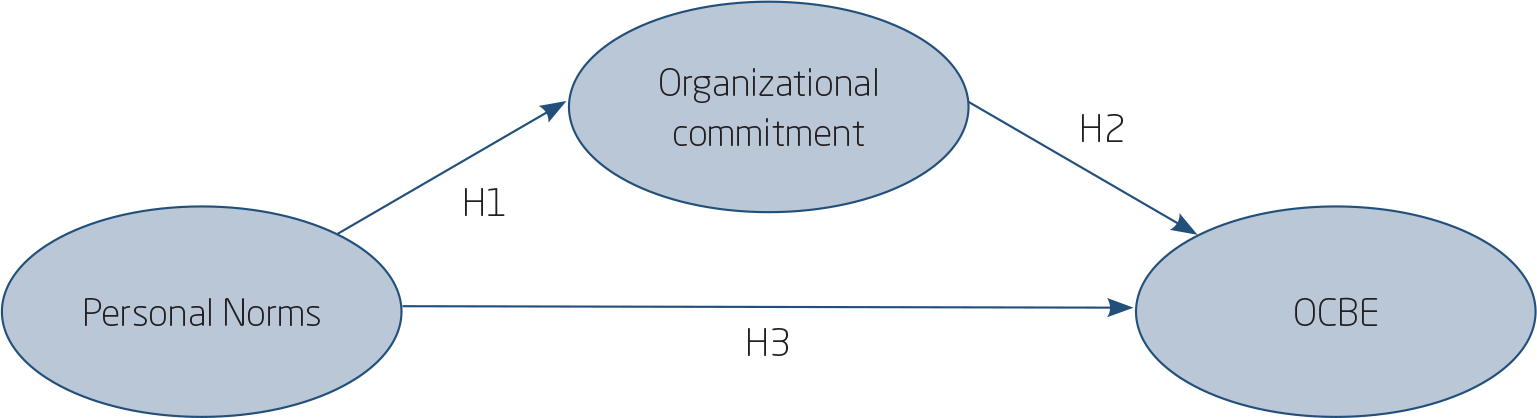
In line with the purpose of this study-to examine the role of organizational commitment in the relationship between personal norms and the organizational behavior of Brazilian university employees-and drawing on the literature reviewed, the following hypotheses are proposed.
-
1. As argued by Allen and Meyer (1990), organizational commitment is primarily shaped by three groups of antecedents: individual characteristics, workplace experiences, and socialization processes within the organization (Ostertag, 2023; Abdoulaye et al 2024). These factors are frequently linked in the literature to individuals’ value systems, beliefs, and personal norms (Wiener, 1982). Based on this perspective, we propose that:
-
• H1: Personal norms are positively correlated with organizational commitment.
-
2. A substantial body of research reports positive associations between organizational commitment and organizational citizenship behavior (OCB) (Bishop et al., 2000; Haldorai et al., 2025; Hesse & Mikkelson, 2024). In a similar vein, studies on pro-environmental organizational behavior (OCBE) have identified links between employees’ organizational commitment and their voluntary engagement in environmental practices at work (Paillé et al., 2013; Temminck et al., 2015). Despite some conflicting findings, the environmental management literature generally relates higher levels of organizational commitment to the success of internal sustainability initiatives (Zutshi & Sohal, 2003; Ametorwo et al., 2025; Khan et al., 2025). In practical terms, employees who strongly identify with their organizations may be more inclined to adopt voluntary behaviors that contribute to environmental preservation in their daily activities. Accordingly, we formulate the following hypothesis:
-
• H2: Organizational commitment is positively correlated with OCBE.
-
3. According to Schwartz (1977), personal norms are key predictors of altruistic behaviors and, consequently, of prosocial actions (Lauper et al., 2016; Wittenberg et al., 2018; Mi et al., 2021; Abdoulaye et al., 2024). Since OCBEs are voluntary behaviors in the workplace that are not directly driven by personal gains, they may be viewed as specific manifestations of prosocial behavior. From the perspective of Norm Activation Theory (NAT), we therefore propose that:
-
• H3: Personal norms are positively correlated with OCBE.
To support the interpretation of these propositions, the three hypotheses are visually summarized in Figure 1.
METHODOLOGY
Context and participants
This study was conducted within higher education institutions for two main reasons. First, universities have increasingly engaged in initiatives related to environmental sustainability. Second, they are expected to play a central role in preparing individuals to address emerging societal challenges, among which sustainability is particularly prominent (Lozano et al., 2025). In this setting, the everyday conduct of academic and administrative staff is of particular importance, as their practices can shape students’ learning experiences and are often perceived as part of the educational process itself (Yuriev & Sierra-Barón, 2020; Melo et al., 2020). Consequently, the pro-environmental behaviors of these professionals constitute a relevant subject for empirical investigation.
The sample comprised faculty members and technical-administrative staff from three Brazilian higher education institutions: the Federal University of Maranhão, with approximately 3,700 employees; the Univel University Center, with around 335 employees; and the Federal University of Viçosa, with roughly 2,925 employees. The inclusion of the Federal University of Viçosa was partly justified by its participation in the GreenMetric international ranking, created in 2010 by Indonesian universities to assess and compare sustainability practices in higher education worldwide. The other institutions were selected for reasons of convenience, taking into account their distinct institutional profiles (Melo & Tortato, 2025).
Data were collected using a questionnaire distributed to participants via their institutional e-mail addresses, ensuring anonymity and confidentiality of responses. At the end of the data collection process, 318 valid questionnaires were obtained. Given that the instrument comprised 37 items, this number of respondents is considered adequate, in light of Hair et al. (2005), who recommend a ratio of five to 10 participants per item.
The survey was administered online via a form created in Qualtrics. The access link was sent to employees’ institutional e-mails between October and November 2019.
Measurements
Personal norms were measured using the scale developed by Dalvi-Esfahani et al. (2017), originally adapted from the instrument proposed by Steg et al. (2005). Organizational commitment was assessed with the scale created by Meyer et al. (1993). Employees’ pro-environmental organizational behaviors (OCBE) were measured using the instrument validated by Boiral and Paillé (2012), which is widely recognized in the literature and was adopted in this study. Table 1 presents all items included in the questionnaire, along with their respective factor loadings for each construct.
Considering that the scales were originally developed in international contexts, and to minimize ambiguity in how items would be interpreted, all questions were translated into Portuguese by a professional linguist, in line with the recommendations of Sireci et al. (2006). It was essential to ensure that, after translation, the instruments preserved the same measurement properties as the original versions. In this regard, back-translation was employed as an additional quality-control step to verify whether the Portuguese version accurately reproduced the content of each item in the source instrument (Sireci et al., 2006).
The back-translation procedure involved translating all items across both language directions (English-Portuguese and Portuguese-English). For this purpose, four professional translators, all university professors based in Brazil, were engaged, with two translators participating in each back-translation cycle.
Prior to the final administration of the survey, a pre-test was conducted with eight employees from the participating universities to assess item clarity and estimate the time required to complete the questionnaire. Following Gudmundsson’s (2009) recommendations, this step was conducted in two phases: first, through in-person meetings and subsequently, in an online format.
To mitigate potential common method bias, the order of questionnaire items was randomized for respondents (Podsakoff et al., 2003). Responses were recorded on an eleven-point scale ranging from zero to ten, where a value of zero indicated complete disagreement with the statement and a value of ten indicated complete agreement.
Data analysis
To assess the reliability and quality of the collected data, a confirmatory factor analysis (CFA) was initially conducted using SPSS (version 21). Once the adequacy of the measurement model had been established, the study’s hypotheses were tested using structural equation modeling (SEM). The choice of SEM is justified by the complexity of the relationships under investigation, as it enables the simultaneous examination of multiple dependency relationships among variables (Hair et al., 2005). All SEM procedures were performed with AMOS Graphics, which was used to enhance the precision of the statistical estimates.
FINDINGS
In total, 318 questionnaires were collected, and the sample’s statistical characteristics are presented in Table 2.
Although the primary purpose of Exploratory Factor Analysis (EFA) is to reduce and summarize data (Hair et al., 2005), in this study, the scales employed had already been validated in previous research, and their dimensional structures were well established, which would, in principle, obviate the need for an exploratory stage. Nonetheless, as Mingoti (2005) points out, even when the main objective is to perform a Confirmatory Factor Analysis (CFA), it is advisable to conduct an EFA to verify whether the theoretically defined factors are consistent with the empirical structure observed in the sample.
All Kaiser-Meyer-Olkin (KMO) values obtained were above the minimum acceptable threshold, using the principal components method. Regarding explained variance, however, two scales presented values below the commonly recommended benchmark of 60%. The Personal Norms scale accounted for 43.511% of the total variance, whereas the Normative Commitment scale explained 47.316%. Considering communality values-whose reference cutoff is 0.40-it was observed that items PN1, PN3, PN4, PN6, and PN8 from the Personal Norms scale, as well as item CN1 from the Normative Commitment scale, fell below this threshold (Hair et al., 2005), which is consistent with the lower levels of explained variance reported for these scales.
Subsequent analyses, including reliability assessment via Cronbach’s alpha (minimum acceptable value of 0.70), indicated the need to exclude additional items before proceeding to CFA. In this stage, the same items that had exhibited low communality in earlier steps-PN1, PN3, PN4, PN6, PN8, and CN1-were removed from the model. Once it was confirmed that their exclusion improved overall model fit, the decision was made to drop these items definitively.
With respect to the identified psychometric and methodological limitations, it is important to note that both the Personal Norms and Normative Commitment scales showed total explained variance below 60%. These constructs are strongly shaped by contextual, cultural, and individual factors, which can reduce the homogeneity of respondents’ perceptions captured by the instruments. This characteristic helps to explain the communality values below 0.40 for items PN1, PN3, PN4, PN6, and PN8 (Personal Norms), as well as for item CN1 (Normative Commitment) (Hair et al., 2005). Items that tap into moral judgments or normative obligations do not always display strong inter-item correlations, which may account for the lower communalities found in this study (Melo & Tortato, 2025).
Despite these limitations, the decision was made to retain the overall model and the two scales in the analysis for three main reasons. First, both instruments are grounded in robust theoretical frameworks and are widely recognized in the literature, having been extensively used to explain prosocial and organizational behaviors. Second, although the variance explained falls short of ideal thresholds, the values remain acceptable for exploratory work and for studies in the social sciences, where psychological and normative constructs seldom attain very high levels of explained variance. Third, removing these scales would compromise the model’s theoretical coherence, given that Personal Norms and Normative Commitment are central to understanding the behaviors under investigation. Their exclusion could therefore weaken the study’s explanatory power and reduce its analytical depth (Hair et al., 2017).
In this sense, the choice to maintain the model represents a compromise between statistical rigor and theoretical consistency, acknowledging empirical constraints while preserving the research’s explanatory and interpretative potential. Additionally, removing a limited number of items improved the final model fit.
Following these steps, the model’s quality with the remaining indicators was re-evaluated. As shown in Table 3, all but one item presented factor loadings above 0.60, a value considered satisfactory (Malhotra, 2001). Given the conceptual relevance of item PN7 to the Personal Norms construct and its loading of 0.598-very close to the recommended minimum-the item was retained. The other psychometric indicators, namely average variance extracted and composite reliability, were also within acceptable ranges for the model tested. In line with Malhotra (2001) and Hair et al. (2005), the average variance extracted is considered adequate when it exceeds 50%, and composite reliability is expected to exceed 0.70.
The values obtained in the confirmatory factor analysis, after establishing the parameters among the sampling errors, are presented in Table 4.
After validating the measurement model, the three structural hypotheses were tested (Table 6). The p-values obtained for H1 and H2 were 0.114 and 0.087, respectively, both above the 0.05 significance threshold. In addition, the corresponding standardized coefficients (β) for H1 and H2 were -0.131 and -0.994, indicating effects in the opposite direction to those theoretically expected. By contrast, hypothesis H3 presented a p-value of 0.000 and a β coefficient of 0.878.
These results indicate that only the relationship between Personal Norms and OCBE was statistically significant. In light of the β estimate for H3, the proposed positive influence of the Personal Norms construct on Organizational Citizenship Behavior for the Environment is supported. Conversely, the hypothesized effects of Personal Norms on Organizational Commitment, as well as of Organizational Commitment on OCBE, were not confirmed, given their non-significant p-values and the direction and magnitude of the estimated coefficients.
As shown in Table 5, hypotheses H1, H2, and H3 returned p-values of 0.114, 0.087, and 0.000, respectively. The p-values associated with H1 and H2 are above the conventional 0.05 threshold (5% significance level), and their standardized coefficients (β) were -0.131 and -0.994, indicating effects in the opposite direction of those theoretically expected. In contrast, hypothesis H3 exhibited a p-value of 0.000-evidence of statistical significance-and a β coefficient of 0.878.
These findings indicate that only the relationship between Personal Norms and OCBE was statistically significant. In view of the β coefficient estimated for H3, the hypothesis positing an influence of Personal Norms on Organizational Citizenship Behavior for the Environment (OCBE) is supported. By contrast, the hypotheses concerning the influence of Personal Norms on Organizational Commitment and the influence of Organizational Commitment on OCBE were not confirmed, given their nonsignificant p-values and the estimated coefficients falling below the acceptable criteria.
DISCUSSION
Some authors have proposed that organizational commitment may act as a predictor of sustainable practices at work and, consequently, of OCBE (Lamm et al., 2013; Temminck et al., 2015; Ostertag, 2023). However, in this study, the hypothesis that organizational commitment mediates the relationship between personal norms and OCBE was not supported. The confirmation of H3, together with the results for H1 and H2, has important theoretical and practical implications.
Theoretical implications
The outcome of hypothesis 3 reinforces Ciocirlan’s (2017) notion of the “green employee”, according to which individuals can engage in OCBE predominantly based on their intrinsic personal norms. In line with this view, the results suggest that employees’ pro-environmental discretionary behaviors may be driven primarily by their own values and beliefs, regardless of the strength of their bond with the organization. Yuriev et al. (2020) had already highlighted the limited explanatory power of organizational variables for certain types of OCBE, which in turn invites reflection on the very definition of the construct. Ostertag (2023, p. 15) also reported no significant correlation between affective commitment and pro-environmental norms (r = 0.08; p > 0.05) but argued that a pro-environmental work climate can foster a sense of moral obligation to act sustainably at work. This obligation, according to the author, is reinforced by employees’ emotional attachment to the organization rather than to the natural environment, suggesting that there remains a meaningful-albeit more nuanced-connection between organizational commitment and OCBE.
With respect to hypothesis 1 (H1: personal norms are positively correlated with organizational commitment), its rejection suggests that internalized beliefs and moral standards alone may not function as direct antecedents of organizational commitment. Allen and Meyer (1990) emphasize the roles of personal characteristics, work experiences, and organizational socialization processes as key predictors of commitment. It is therefore plausible that personal norms, by themselves, are insufficient to shape organizational commitment, whereas social norms (Kim & Kim, 2018)-anchored in expectations and sanctions within the organizational context-may be more directly related to commitment. The findings point to a closer alignment between personal norms and altruistic behavior in general (Schwartz, 1977), rather than behaviors explicitly oriented toward organizational objectives. This interpretation supports the view that personal norms and organizational commitment are grounded in different behavioral domains (Ostertag, 2023).
From this standpoint, the idea that personal norms and organizational commitment operate in distinct spheres also helps explain the non-confirmation of hypothesis 2 (H2), which posits that organizational commitment is positively related to OCBE. The OCBE construct is rooted in notions of discretion and altruism, is not directly tied to formal organizational goals, and is not regulated by formal reward or punishment systems. It is therefore reasonable to assume that OCBE may be more closely connected to individual moral motivations than to the types of bonds captured by organizational commitment measures.
Although some studies have found positive associations between organizational commitment and OCBE (Paillé & Boiral, 2013; Temminck et al., 2015), these investigations typically focus on the affective component of commitment, following Porter et al. (1974). From the standpoint of the present study, attempts to clarify the relationship between organizational commitment and OCBE should adopt the more comprehensive framework proposed by Meyer and Allen (1984; 1997), which encompasses affective, continuance, and normative dimensions. Furthermore, the conflicting empirical evidence regarding the link between commitment and OCBE may also reflect differences in organizational contexts. In this research, data were collected exclusively in universities, a specific type of organization whose characteristics may shape both commitment and pro-environmental discretionary behavior in particular ways (Melo & Tortato, 2025).
Practical implications
These findings reshape how organizations might design incentives to foster OCBE. If organizational variables are not the primary drivers of such behaviors, capacity-building efforts should prioritize reinforcing employees’ beliefs, values, and socialization processes that increase their willingness to act on sustainability issues, so that these dimensions become personally internalized. It is also plausible that organizational factors exert greater influence on behaviors directly linked to formal job responsibilities. In contrast, OCBE, by definition, involves discretionary, informal actions that are not typically tied to formal reward or sanction systems (Yuriev, 2020).
Even so, Ostertag (2023) argues that cultivating a pro-environmental work climate and strengthening employees’ affective attachment to the organization can help trigger sustainable behaviors, even if organizational variables alone do not fully account for OCBEs. Throughout this study, the importance of such behaviors for advancing organizational sustainability has been emphasized. Ultimately, organizational sustainability is realized through individual sustainable actions, and formal mechanisms often struggle to elicit such discretionary conduct due to the inherent challenges of operationalizing sustainability within organizations (Ostertag, 2023; Melo & Tortato, 2025).
CONCLUSIONS
Using Norm Activation Theory, this study set out to examine and clarify the relationships among organizational citizenship behavior for the environment (OCBE), organizational commitment, and personal norms. By incorporating alternative perspectives and theoretical foundations-such as analyzing organizational commitment from Allen and Meyer’s (1990) three-component framework and applying Norm Activation Theory, which is frequently used in pro-environmental behavior research but rarely in OCBE studies-it sought to extend existing work in the field. Although the hypothesized relationship between organizational commitment and OCBE was not supported, confirming a positive association between personal norms and OCBE makes both theoretical and practical contributions to the constructs analyzed.
One limitation identified during the research concerns the psychometric performance of the Personal Norms scale and the normative commitment dimension of the Organizational Commitment scale, both of which presented average variance extracted values below the commonly accepted minimum of 50%. Another constraint lies in the exclusive use of self-report measures, an issue that was partially addressed by following methodological recommendations from the literature, but which nonetheless suggests that richer results might be obtained when multiple data sources or methods are combined.
With respect to future research, it is worth noting that, as highlighted by Yuriev et al. (2018), most studies examining voluntary behaviors related to employees’ sustainability performance have been conducted in three countries: The USA, Canada, and the UK, with little inclusion of employees from South America, Australia, or Africa. This study, therefore, contributes by analyzing such behaviors using data from a country that had not previously been considered. A natural next step would be to carry out research in other national contexts-particularly in South America-to explore how cultural differences may influence these behaviors.
Future investigations are also encouraged to apply Norm Activation Theory alongside complementary frameworks, such as the Theory of Planned Behavior. In doing so, it is important to design data collection strategies aligned with the adopted theoretical models and to follow the associated validation procedures rigorously. Moreover, additional variables-such as self-identity, past behavior, and habit-may help explain further variance in outcomes, given that routines and prior experiences often shape individuals’ willingness to change their behavior at work (Schwanen et al., 2012; Ostertag, 2023; Bodhi et al., 2024). Other promising avenues include qualitative approaches (Mussi et al., 2018) and the incorporation of perspectives from institutional theory (Veiga et al., 2014).
Open Data:
the contents underlying the research text are contained in the manuscript
-
RAM does not have permission from the authors or evaluators to publish this article’s review.
-
RAM does not have information about open data regarding this manuscript.
REFERENCES
-
Abdoulaye, D. A., Yin, P., & Shiqian, B. (2024). Influencing the mechanism of tourists’ choice of green transportation modes: A case study of Beijing, China. Sustainability, 16(6), 2350. https://doi.org/10.3390/su16062350
» https://doi.org/10.3390/su16062350 -
Allen, N. J., & Meyer, J. P. (1990). The measurement and antecedents of affective, continuance, and normative commitment to the organization. Journal of Occupational Psychology, 63(1), 1-18. https://doi.org/10.1111/j.2044-8325.1990.tb00506.x
» https://doi.org/10.1111/j.2044-8325.1990.tb00506.x -
Ametorwo, A. M., Kyei-Frimpong, M., & Suleman, A. R. (2025). How climate for green initiatives drives eco-innovative and citizenship behaviours: The role of green engagement and green values. Journal of Hospitality and Tourism Insights, 8(11), 240-258. https://doi.org/10.1108/JHTI-02-2025-0303
» https://doi.org/10.1108/JHTI-02-2025-0303 -
Andreica Mihuţ, I. S., Sterie, L. G., & Mican, D. (2025). The green dilemma: what drives consumers to green purchase intention in an emerging EU economy? Journal of Applied Economics, 28(1), 2536323-253. https://doi.org/10.1080/15140326.2025.2536323
» https://doi.org/10.1080/15140326.2025.2536323 -
Bateman, T. S., & Organ, D. W. (1983). Job satisfaction and the good soldier: The relationship between affect and employee “citizenship”. Academy of Management Journal, 26(4), 587-595. https://doi.org/10.2307/255908
» https://doi.org/10.2307/255908 -
Becker, H. S. (1960). Notes on the concept of commitment. American Journal of Sociology, 66(1), 32-40. https://www.jstor.org/stable/2773219
» https://www.jstor.org/stable/2773219 -
Bishop, J. W., Scott, K. D., & Burroughs, S. M. (2000). Support, commitment, and employee outcomes in a team environment. Journal of Management, 26(6), 1113-1132. https://doi.org/10.1177/014920630002600603
» https://doi.org/10.1177/014920630002600603 -
Bodhi, R., Chaturvedi, S., & Purohit, S. (2024). The influence of organizational commitment on employee green behavior: Mediating role of work-related social media use. International Journal of Manpower, 46(4), 605-631. https://doi.org/10.1108/IJM-10-2023-0624
» https://doi.org/10.1108/IJM-10-2023-0624 -
Boiral, O., & Paillé, P. (2012). Organizational citizenship behavior for the environment: Measurement and validation. Journal of Business Ethics, 109(4), 431-445. https://doi.org/10.1007/s10551-011-1138-9
» https://doi.org/10.1007/s10551-011-1138-9 -
Cady, S. H., Brodke, M., Kim, J. H., & Shoup, Z. D. (2018). Volunteer motivation: A field study examining why some do more, while others do less. Journal of Community Psychology, 46(3), 281-292. https://doi.org/10.1002/jcop.21939
» https://doi.org/10.1002/jcop.21939 - Chen, Q., Zhang, Q., Huang, R., & Zhang, J. (2025). Slow food, fast intentions? Linking values with sustainable food choices. Food Quality and Preference, 105779.
-
Chen, T., & Wang, H. (2022). Consumers’ purchase intention of wild freshwater fish in China from the perspective of ecological protection. British Food Journal, 124(10), 3308-3322. https://doi.org/10.1108/BFJ-05-2021-0596
» https://doi.org/10.1108/BFJ-05-2021-0596 - Ciocirlan, C. E. (2017). Environmental workplace behaviors: Definition matters. Organization & Environment, 30(1), 51-70.
-
Costa, V. F., & Andrade, T. D. (2015). Comportamento de cidadania organizacional: Caracterização da produção científica internacional no período de 2002 a 2012. Revista de Administração Mackenzie, 16(2), 45-71. https://doi.org/10.1590/1678-69712015/administracao.v16n2p45-71
» https://doi.org/10.1590/1678-69712015/administracao.v16n2p45-71 -
Daily, B. F., Bishop, J. W., & Govindarajulu, N. (2009). A conceptual model for organizational citizenship behavior directed toward the environment. Business & Society, 48(2), 243-256. https://doi.org/10.1177/0007650308315439
» https://doi.org/10.1177/0007650308315439 -
Dalvi-Esfahani, M., Ramayah, T., & Rahman, A. A. (2017). Moderating role of personal values on managers’ intention to adopt Green IS. Industrial Management & Data Systems, 117(3), 582-604. https://doi.org/10.1108/IMDS-02-2016-0049
» https://doi.org/10.1108/IMDS-02-2016-0049 -
De Groot, J. I., & Steg, L. (2009). Mean or green: which values can promote stable pro-environmental behavior? Conservation Letters, 2(2), 61-66. https://doi.org/10.1111%2Fj.1755-263X.2009.00048.x
» https://doi.org/10.1111%2Fj.1755-263X.2009.00048.x -
Faletar, I., Kovačić, D., & Cerjak, M. (2021). Purchase of organic vegetables as a form of pro-environmental behavior: Application of Norm Activation Theory. Journal of Central European Agriculture, 22(1), 211-225. https://doi.org/10.5513/JCEA01/22.1.3026
» https://doi.org/10.5513/JCEA01/22.1.3026 -
Gudmundsson, E. (2009). Guidelines for translating and adapting psychological instruments. Nordic Psychology, 61(2), 29-45. https://doi.org/10.1027/1901-2276.61.2.29
» https://doi.org/10.1027/1901-2276.61.2.29 - Hair, J. F., Anderson, R. E., Tatham, R. B., & Black, R. (2005). Análise multivariada de dados [Multivariate data analysis]. Bookman.
- Hair, J. F., Hult, G. T. M., Ringle, C. M., & Sarstedt, M. (2017). A primer on partial least squares structural equation modeling (PLS-SEM) Sage.
-
Haldorai, K., Kim, W. G., Mussina, K., & Li, J. J. (2025). Walking the tightrope: The dark side of going above and beyond the call of duty. International Journal of Hospitality Management, 128, 104174. https://doi.org/10.1016/j.ijhm.2025.104174
» https://doi.org/10.1016/j.ijhm.2025.104174 -
He, J., & Sui, D. (2024). Investigating college students’ green food consumption intentions in China: Integrating the Theory of Planned Behavior and Norm Activation Theory. Frontiers in Sustainable Food Systems, 8, 1404465. https://doi.org/10.3389/fsufs.2024.1404465
» https://doi.org/10.3389/fsufs.2024.1404465 -
Hedlund-de Witt, A., De Boer, J., & Boersema, J. J. (2014). Exploring inner and outer worlds: A quantitative study of worldviews, environmental attitudes, and sustainable lifestyles. Journal of Environmental Psychology, 37, 40-54. https://doi.org/10.1016/j.jenvp.2013.11.005
» https://doi.org/10.1016/j.jenvp.2013.11.005 -
Hesse, C., & Mikkelson, A. C. (2024). Organizational communication patterns as predictors of organizational citizenship behaviors: the mediating role of citizenship motives. International Journal of Business Communication https://doi.org/10.1177/23294884241248133
» https://doi.org/10.1177/23294884241248133 -
Jabbour, C. J. C., & Renwick, D. W. S. (2018). The soft side of environmentally-sustainable organizations. RAUSP Management Journal, 53, 622-627. https://doi.org/10.1108/RAUSP-07-2018-0044
» https://doi.org/10.1108/RAUSP-07-2018-0044 -
Jankelová, N., Némethová, I., Dabić, M., & Kallmuenzer, A. (2024). Enhancing organizational citizenship behavior towards the environment. Review of Managerial Science, 19, 899-930. https://doi.org/10.1007/s11846-024-00781-x
» https://doi.org/10.1007/s11846-024-00781-x -
Jin, X., Sun, I. Y., Jiang, S., Wang, Y., & Wen, S. (2018). The relationships between job and organizational characteristics and role and job stress among Chinese community correctional workers. International Journal of Law, Crime and Justice, 52, 36-46. https://doi.org/10.1016/j.ijlcj.2017.09.002
» https://doi.org/10.1016/j.ijlcj.2017.09.002 -
Kai, D. A., Jesus, É. T. D., Pereira, E. A. R., Lima, E. P. D., & Tortato, U. (2017). Influence of organisational characteristics in sustainability corporate strategy. International Journal of Agile Systems and Management, 10(3-4), 231-249. https://doi.org/10.1504/IJASM.2017.088548
» https://doi.org/10.1504/IJASM.2017.088548 -
Khan, M., Dedahanov, A. T., Khadir, Y., Alidjonovich, R. D., Turobjonovna, K. M., Yuldashev, O. T., & Odilovich, I. J. (2025). Investigating the impact of Organizational Citizenship Behavior on supply chain performance and corporate sustainability: An empirical study. Cogent Business & Management, 12(1), 2460621. https://doi.org/10.1080/23311975.2025.2460621
» https://doi.org/10.1080/23311975.2025.2460621 -
Kim, W. H., & Kim, K. S. (2018). Pro-environmental intentions among food festival attendees: An application of the value-belief-norm model. Sustainability, 10(11), 3894. https://doi.org/10.3390/su10113894
» https://doi.org/10.3390/su10113894 -
Lamm, E., Tosti-Kharas, J., & Williams, E. G. (2013). Read this article, but don’t print it: Organizational citizenship behavior toward the environment. Group & Organization Management, 38(2), 163-197. https://doi.org/10.1177/1059601112475210
» https://doi.org/10.1177/1059601112475210 -
Lauper, E., Moser, S., Fischer, M., Matthies, E. (2016). Explaining car drivers’ intention to prevent road-traffic noise: An application of the Norm Activation Model. Environment and Behavior, 48(6), 826-853. https://psycnet.apa.org/doi/10.1177/0013916515570476
» https://psycnet.apa.org/doi/10.1177/0013916515570476 -
Lozano, R., Barreiro-Gen, M., Ortiz-Martínez, G., Mendoza, A., Segalàs, J., Caeiro, S., Simão, J., Favi, C. Gładysz, B., Alló, M., Gago-Cortés, C., Tortato, U., Mónus, F., Pietikäinen, J., Södervik, I., Ratvio, R., Bostanci, S., Tóth, M. D., Benayas, J., Munguía, M. T. J., Cervantes, D. X. F., Díaz, R. A. L., Corona, N. R., Desha, C., Hales, R., Boddy, J., Djekic, I., Caldera, S., Sáenz, O., Azizi, L., & Sassen, R. (2025). Students’ perspectives on sustainability competences and pedagogical approaches: Groupings and interrelations results from 17 international case studies. Sustainable Development, 33(3), 4689-4701. https://doi.org/10.1002/sd.3368
» https://doi.org/10.1002/sd.3368 - Malhotra, N. K. (2001). Pesquisa de Marketing: Uma orientação aplicada Bookman Editora.
-
Marôco, J. (2014). Análise de equações estruturais: Fundamentos teóricos, software & aplicações Report Number. Springer Nature. https://doi.org/10.1007/978-3-030-30306-8_14
» https://doi.org/10.1007/978-3-030-30306-8_14 - Melo, A. A., Tortato, U., & Mussi, F. B. (2020). Sustainable behavior and its antecedents: A systematic literature review. In Universities and Sustainable Communities: Meeting the Goals of the Agenda 2030 (pp. 247-257). Springer International Publishing.
-
Melo, A. Alvares, Tortato, Ubiratã. (2025). Organizational citizenship behavior for the environment and its relationship with organizational commitment and personal norms: A study carried out with university. In Leal Filho, W., Salgueirinho Osório de Andrade Guerra, J. B., Sima, M., Salvia, A. L., Frankenberger, F., Dibbern, T. (Orgs.), World Sustainability Series (1st ed., pp. 431-448). Springer Nature. https://doi.org/10.1007/978-3-031-96251-6_26
» https://doi.org/10.1007/978-3-031-96251-6_26 -
Meyer, J. P., Stanley, D. J., Herscovitch, L., & Topolnytsky, L. (2002). Affective, continuance, and normative commitment to the organization: A meta-analysis of antecedents, correlates, and consequences. Journal of Vocational Behavior, 61(1), 20-52. https://doi.org/10.1006/jvbe.2001.1842
» https://doi.org/10.1006/jvbe.2001.1842 -
Meyer, J. P., & Allen, N. J. (1984). Testing the “side-bet theory” of organizational commitment: Some methodological considerations. Journal of Applied Psychology, 69(3), 372-378. https://psycnet.apa.org/doi/10.1037/0021-9010.69.3.372
» https://psycnet.apa.org/doi/10.1037/0021-9010.69.3.372 - Meyer, J. P., & Allen, N. J. (1997). Commitment in the workplace: Theory, research, and application Sage.
-
Meyer, J. P., Allen, N. J., & Smith, C. A. (1993). Commitment to organizations and occupations: Extension and test of a three-component conceptualization. Journal of Applied Psychology, 78(4), 538-551. https://psycnet.apa.org/doi/10.1037/0021-9010.78.4.538
» https://psycnet.apa.org/doi/10.1037/0021-9010.78.4.538 -
Mi, L., Sun, Y., Gan, X., Yang, Y., Jia, T., Wang, B., & Xu, T. (2021). Predicting environmental citizenship behavior in the workplace: A new perspective of environmental affective event. Sustainable Production and Consumption, 27, 2037-2046. https://doi.org/10.1016/j.spc.2021.05.006
» https://doi.org/10.1016/j.spc.2021.05.006 -
Miliute-Plepiene, J., Hage, O., Plepys, A., Reipas, A. (2016). What motivates households recycling behavior in recycling schemes of different maturity? Lessons from Lithuania and Sweden. Resources, Conservation and Recycling, 113, 40-52. https://doi.org/10.1016/j.resconrec.2016.05.008
» https://doi.org/10.1016/j.resconrec.2016.05.008 - Mingoti, S. A. (2005). Análise de dados através de métodos de estatística multivariada: Uma abordagem aplicada [Data analysis using multivariate statistical methods: an applied approach]. Editora UFMG.
-
Mizobuchi, K., Takeuchi, K. (2013). The influences of financial and nonfinancial factors on energy-saving behavior: A field experiment in Japan. Energy Policy, 63, 775-787. https://doi.org/10.1016/j.enpol.2013.08.064
» https://doi.org/10.1016/j.enpol.2013.08.064 -
Mowday, R. T., Steers, R. M., & Porter, L. W. (1979). The measurement of organizational commitment. Journal of Vocational Behavior, 14(2), 224-247. https://doi.org/10.1016/0001-8791(79)90072-1
» https://doi.org/10.1016/0001-8791(79)90072-1 - Mussi, F. B., Melo, A. A., & Tortato, U. (2018). Contributions for the use of qualitative indicators: An analysis of Itaipu Power Plant’s Sustainability Program. Environment, Development and Sustainability, 20(1), 109-128.
-
Ostertag, F. (2023). Integrating OCBE literature and norm activation theory: A moderated mediation on proenvironmental behavior of employees. Sustainability, 15(9), 7605. https://doi.org/10.3390/su15097605
» https://doi.org/10.3390/su15097605 -
Paillé, P., & Boiral, O. (2013). Pro-environmental behavior at work: Construct validity and determinants. Journal of Environmental Psychology, 36, 118-128. https://psycnet.apa.org/doi/10.1016/j.jenvp.2013.07.014
» https://psycnet.apa.org/doi/10.1016/j.jenvp.2013.07.014 -
Paillé, P., Boiral, O., & Chen, Y. (2013). Linking environmental management practices and organizational citizenship behavior for the environment: A social exchange perspective. The International Journal of Human Resource Management, 24(18), 3552-3575. https://doi.org/10.1080/09585192.2013.777934
» https://doi.org/10.1080/09585192.2013.777934 -
Podsakoff, P. M., MacKenzie, S. B., Lee, J. Y., & Podsakoff, N. P. (2003). Common method biases in behavioral research: A critical review of the literature and recommended remedies. Journal of Applied Psychology, 88(5), 879-903. https://doi.org/10.1037/0021-9010.88.5.879
» https://doi.org/10.1037/0021-9010.88.5.879 -
Porter, L. W., Steers, R. M., Mowday, R. T., & Boulian, P. V. (1974). Organizational commitment, job satisfaction, and turnover among psychiatric technicians. Journal of Applied Psychology, 59(5), 603-609. https://doi.org/10.1037/h0037335
» https://doi.org/10.1037/h0037335 -
Raineri, N., & Paillé, P. (2016). Linking corporate policy and supervisory support with environmental citizenship behaviors: The role of employee environmental beliefs and commitment. Journal of Business Ethics, 137, 129-148. https://doi.org/10.1007/s10551-015-2548-x
» https://doi.org/10.1007/s10551-015-2548-x -
Raziq, M. M., Wazir, R., Memon, M. A., Rice, J. L., & Moazzam, M. (2025). Empowering leadership, employee organizational commitment and organizational citizenship behavior: the roles of leader authenticity and trust. International Journal of Productivity and Performance Management, 74(1), 81-106. https://doi.org/10.1108/IJPPM-09-2023-0489
» https://doi.org/10.1108/IJPPM-09-2023-0489 -
Schwanen, T., Banister, D., & Anable, J. (2012). Rethinking habits and their role in behavior change: The case of low-carbon mobility. Journal of Transport Geography, 24, 522-532. https://doi.org/10.1016/j.jtrangeo.2012.06.003
» https://doi.org/10.1016/j.jtrangeo.2012.06.003 -
Schwartz, S. H. (1977). Normative influences on altruism. Advances in Experimental Social Psychology, 10(1), 221-279. https://doi.org/10.1016/S0065-2601(08)60358-5
» https://doi.org/10.1016/S0065-2601(08)60358-5 -
Sireci, S. G., Yang, Y., Harter, J., & Ehrlich, E. J. (2006). Evaluating guidelines for test adaptations: A methodological analysis of translation quality. Journal of Cross-Cultural Psychology, 37(5), 557-567. https://doi.org/10.1177/0022022106290478
» https://doi.org/10.1177/0022022106290478 -
Steg, L., Dreijerink, L., & Abrahamse, W. (2005). Factors influencing the acceptability of energy policies: A test of VBN theory. Journal of Environmental Psychology, 25(4), 415-425. https://doi.org/10.1016/j.jenvp.2005.08.003
» https://doi.org/10.1016/j.jenvp.2005.08.003 -
Sweeney, J. C., Kresling, J., Webb, D., Soutar, G. N., Mazzarol, T. (2013). Energy saving behaviors: Development of a practice-based model. Energy Policy, 61, 371-381. https:/doi.org/10.1016/j.enpol.2013.06.121
» https:/doi.org/10.1016/j.enpol.2013.06.121 -
Temminck, E., Mearns, K., & Fruhen, L. (2015). Motivating employees towards sustainable behavior. Business Strategy and the Environment, 24(6), 402-412. https://doi.org/10.1002/bse.1827
» https://doi.org/10.1002/bse.1827 -
Thakur, A., Ghuman, K., Bedi, M., & Magliocca, P. (2025). Impact of affective, normative and continuance commitment on organizational citizenship behavior in emerging economies. Review of International Business and Strategy, 36(1), 76-96. https://doi.org/10.1108/RIBS-08-2024-0100
» https://doi.org/10.1108/RIBS-08-2024-0100 -
Unsworth, K. L., & McNeill, I. M. (2017). Increasing pro-environmental behaviors by increasing self-concordance: Testing an intervention. Journal of Applied Psychology, 102(1), 88-103. https://psycnet.apa.org/doi/10.1037/apl0000155
» https://psycnet.apa.org/doi/10.1037/apl0000155 - Veiga, C. R. P., Veiga, C. P., Catapan, A., Tortato, U., Silva, W. V., & Leinig, A. K. G. (2014). Institutional theory and resource dependency in the alteration of distribution channels. Int. Bus. Manage, 8, 240-250.
- Wang, Z., Guo, D., Wang, X. (2016). Determinants of residents’ e-waste recycling behavior intentions: Evidence from China. Journal of Cleaner Production, 137(20), 850-860.
-
Wiener, Y. (1982). Commitment in organizations: A normative view. Academy of Management Review, 7(3), 418-428. https://doi.org/10.2307/257334
» https://doi.org/10.2307/257334 -
Wittenberg, I., Blöbaum, A., Matthies, E. (2018). Environmental motivations for energy use in PV households: Proposal of a modified norm activation model for the specific context of PV households. Journal of Environmental Psychology, 55, 110-120. https://doi.org/10.1016/j.jenvp.2018.01.002
» https://doi.org/10.1016/j.jenvp.2018.01.002 -
Yoo, D. Y. (2024). Eco-leadership in action: Integrating green HRM and the new ecological paradigm to foster organizational commitment and environmental citizenship in the hospitality industry. Sustainability, 16(20), 9044. https://doi.org/10.3390/su16209044
» https://doi.org/10.3390/su16209044 -
Yuriev, A., Boiral, O., Francoeur, V., & Paillé, P. (2018). Overcoming the barriers to pro-environmental behaviors in the workplace: A systematic review. Journal of Cleaner Production, 182(1), 379-394. https://doi.org/10.1016/j.jclepro.2018.02.041
» https://doi.org/10.1016/j.jclepro.2018.02.041 -
Yuriev, A., Boiral, O., & Guillaumie, L. (2020). Evaluating determinants of employees’ pro-environmental behavioral intentions. International Journal of Manpower, 41(7), 1005-1019. https://doi.org/10.1108/IJM-08-2019-0387
» https://doi.org/10.1108/IJM-08-2019-0387 -
Yuriev, A., & Sierra-Barón, W. (2020). Exploring sustainability cross-culturally: Employees’ beliefs on green behaviors. Sustainable Development, 28(5), 1199-1207. https://doi.org/10.1002/sd.2069
» https://doi.org/10.1002/sd.2069 -
Zutshi, A., & Sohal, A. S. (2003). Stakeholder involvement in the EMS adoption process. Business Process Management Journal, 9(2), 133-148. https://doi.org/10.1108/14637150310468362
» https://doi.org/10.1108/14637150310468362
Edited by
-
EDITORIAL BOARD
Editor-in-chiefAlmir Martins VieiraAssociated editorVera CançadoTechnical supportVitória Batista Santos Silva
-
EDITORIAL PRODUCTION
Publishing coordinationAndreia Ferreira CominettiEditorial InternSofia LelisLanguage editorBardo EditorialLayout designerLibroGraphic designerLibro