 Mitigating emissions from mining, agriculture, and livestock farming: A sustainability assessment in a developing country
Abstract
Purpose: To evaluate and classify the environmental and operational efficiency of Brazilian states, identifying best practices in sustainable development regarding the environmental impact of mining, agriculture, and livestock farming.
Originality/value: This study’s relevance and originality revolve around analyzing real and updated data from 23 Brazilian states plus the Fede-ral District, considering two national databases to assess sustainability performance. We also included relevant variables in our empirical model in terms of sustainability and economic impact.
Design/methodology/approach: Data envelopment analysis (DEA) methodology was employed to analyze secondary data from 2018 to 2022 originating from satellite images of the Brazilian Annual Land Use and Cover Mapping Project (MapBiomas) and the Greenhouse Gas Emissions and Removals Estimation System (Sistema de Estimativa de Emissões e Remoções de Gases de Efeito Estufa [SEEG]). Each Brazilian state was considered a decision-making unit (DMU). We take as input variables the land use in mining, agriculture, and livestock sectors, while data on carbon dioxide (CO2) and methane (CH4) emissions were considered outputs.
Results: The resulting ranking highlights the most efficient states in integrating economic activities with environmental sustainability. Amapá, Distrito Federal, and Rio Grande do Norte presented consistent efficiency, while Mato Grosso and Goiás emerged as the less efficient states in the Brazilian scenario, highlighting livestock farming as one of the main contributors to CH4 emissions. Contribution/implication: Our empirical findings can help policymakers and urban planners by supporting data-driven decision-making and investment strategies aimed at fostering sustainable, intelligent, and resilient cities and regions, especially in emerging economies.
Keywords:
environmental efficiency; sustainable urban governance; natural resource optimization; data envelopment analysis; Brazil
Resumo
Objetivo: Avaliar e classificar a eficiência ambiental e operacional dos estados brasileiros, identificando as melhores práticas em desenvol-vimento sustentável quanto ao impacto ambiental da mineração, da agricultura e da pecuária.
Originalidade/valor: A relevância e a originalidade deste estudo giram em torno da análise de dados reais e atualizados de 23 estados brasileiros e o Distrito Federal, considerando duas bases de dados nacionais para avaliar desempenhos em sustentabilidade. Adicionalmente, foram incluí-das variáveis relevantes no modelo empírico em termos de sustentabilidade e de impacto econômico.
Design/metodologia/abordagem: A análise envoltória de dados (AED) foi empregada para analisar dados secundários, de 2018 a 2022, originários de imagens de satélite do Projeto de Mapeamento Anual de Uso e Cobertura do Solo Brasileiro (MapBiomas, 2024) e do Sistema de Estimativa de Emissões e Remoções de Gases de Efeito Estufa (SEEG). Cada estado brasileiro foi considerado uma unidade de tomada de decisão (UTD). Como variável de entrada, foi considerado o uso da terra nos setores de mineração, agricultura e pecuária, enquanto dados sobre emissões de dióxido de carbono (CO2) e metano (CH4) foram considerados como saídas.
Resultados: O ranqueamento destacou os estados mais eficientes na integração de atividades econômicas com sustentabilidade ambiental. Amapá, Distrito Federal e Rio Grande do Norte apresentaram eficiência consistente, enquanto Mato Grosso e Goiás emergiram como os estados menos eficientes, destacando a pecuária como um dos principais contribuintes para as emissões de CH4.
Contribuição/implicação: As descobertas empíricas podem ajudar formuladores de políticas e gestores, apoiando a tomada de decisões e a criação de estratégias de investimento baseadas em dados que visem a promover cidades e regiões sustentáveis, inteligentes e resilientes, especialmente em economias emergentes.
Palavras-chave:
eficiência ambiental; governança urbana sustentável; otimização de recursos naturais; análise envoltória de dados; Brasil
INTRODUCTION
Over the years, the exploitation of natural resources and global economic production have led to social and environmental imbalances and issues, causing a worrying gap between business and society (Hellvig & Nobre, 2024). As Brazil consolidates its position as one of the world’s largest agricultural producers, the discussion on environmental efficiency and its sustainability-related impacts is becoming increasingly important. The country’s vast geographic diversity, made up of states and cities with distinct socioeconomic and environmental realities, presents both challenges and opportunities for industrial activities such as mining, agriculture, and livestock farming. These sectors are essential for economic development, but if not managed responsibly, they can generate significant environmental damage (Silva et al., 2024; Food and Agriculture Organization of the United Nations [FAO], 2022).
Historically, agriculture in Brazil has been one of the main drivers of environmental issues, such as deforestation, biodiversity loss, increased greenhouse gas emissions, and soil degradation (Alves et al., 2018; Carvalho et al., 2024; El Bilali, 2019b). From the perspective of mining, Brazil holds a prestigious position in the global production of mineral-based raw resources (Alves et al., 2021). This scenario highlights the urgent need for effective monitoring and adoption of sustainable practices to preserve natural resources (Zalles et al., 2019). The consequences of these activities are diverse and range from the loss of biodiversity to the increase in emissions of polluting gases, caused mainly by the burning of vegetation, productive activities, and the intensive use of natural resources, driving climate change, especially global warming (Amui et al., 2017; Dagar et al., 2021).
In such a backdrop, studies echoing sustainability transitions in mining and agribusiness sectors have gained attention from scholars worldwide (Alves et al., 2021; Angotii et al., 2024; Ranängen & Lindman, 2017; Souza-Filho et al., 2020; Virgone et al., 2018), pointing out difficult challenges in achieving sustainability principles in these sectors. Especially in developing countries, despite the discussion on the fact that sustainability remains scarce (Alves et al., 2018; El Bilali, 2019a; Vermunt et al., 2020), the lack of well-developed environmental regulations makes sustainable development difficult to achieve (Alves et al., 2019; Carlucci et al., 2025). Additionally, the absence of effective public policies can result in severe damage to natural resources, putting at risk both the continuity of economic activities and the balance of biodiversity and well-being of populations (Alves & Vicentin, 2024; Rockström et al., 2024).
Data envelopment analysis (DEA) methodology, using Banker, Charnes, and Cooper (BCC) (Banker et al., 1984) models (BCC-DEA) is an effective tool for assessing complex scenarios. It enables the simultaneous evaluation of multiple inputs and outputs, making it especially well-suited for analyzing the relationship between economic activities and their environmental impacts across various scales. This model provides a detailed analysis of efficiency, taking into account several variables involved in an economic and environmental context (Karki et al., 2024; Lombardi et al., 2019).
In such a scenario, this study aims to evaluate and classify the environmental and operational efficiency of Brazilian states, identifying best practices in sustainable development regarding the environmental impact of mining, agriculture, and livestock farming. The analysis employs the BCC-DEA model, considering land use for mining, agriculture, and livestock as input variables, and carbon dioxide (CO2) and methane (CH4) emissions as undesirable outputs. The study uses updated data from 2018 to 2022, obtained from MapBiomas (land-use data) and Greenhouse Gas Emissions and Removals Estimation System (Sistema de Estimativa de Emissões e Remoções de Gases de Efeito Estufa [SEEG]) (greenhouse gas emissions), allowing for a temporal assessment of efficiency trends over this period.
LITERATURE REVIEW
Sustainability transitions in mining, agriculture, and livestock farming
Sustainability transitions are a special topic in sustainability scholarship given the urgent need for sustainable systems aiming at meeting the needs of the current generation without compromising the meeting of needs of future generations (El Bilali, 2019a; Kamel & El Bilali, 2022). Especially since the establishment of the 17 sustainable development goals (SDGs) proposed by the United Nations (UN) in 2015, attention regarding more responsible ways of production and consumption has emerged (Angotii et al., 2024), with a special emphasis on mining, agriculture, and livestock production.
Numerous manufactured consumer goods and services rely on minerals as their primary source of raw materials (Alves et al., 2018). However, the social and ecological impacts caused by mining have put the sector at the center of the need for awareness (Nico et al., 2024), although mining has been responsible for economic prosperity and societal advancements in some regions (Alves et al., 2021; Virgone et al., 2018). In Brazil, mining is focused on the extraction of gold (Au), iron (Fe), copper (Cu), and niobium (Nb) (Alves et al., 2016). Still, in the Brazilian case, the mining sector has contributed to economic growth by generating jobs, supporting local communities in remote areas, and increasing municipal revenues through royalties (Alves et al., 2018).
However, mining industries present substantial impacts on the natural environment, geography, culture, and human and non-human health, such as contamination of soil, air, and water; risks to farmers; possible violations; and issues related to safety and human rights, among others (Alves et al., 2021; Angotii et al., 2024; Ranängen & Lindman, 2017). Also, artisanal mining (garimpo, in Brazilian Portuguese) is a widespread activity in Brazil that causes significant environmental and social harm (Nico et al., 2024). In such a scenario, sustainability has become central to the mining industry, fostering the mobilization of physical, technological, financial, and societal resources to advance towards the SDGs (Nico et al., 2024; Souza-Filho et al., 2020).
In the literature, numerous strategies have been proposed to help mining businesses achieve sustainability. Following Alves et al. (2019), mining firms typically pursue sustainability in two ways: i) by taking environmental principles into consideration or ii) by generating societal benefits beyond extraction areas, either through compensation or reinvestment to offset the impacts caused by resource depletion. Another alternative emerges from cooperatives. Cooperatives emerged in the 19th century as a response to labor exploitation and, in the mining sector, represent a path towards the SDGs by promoting social participation, equitable revenue distribution, and poverty reduction through support for small-scale producers (Alves et al., 2019; Nico et al., 2024).
Similarly to mining, the agricultural and livestock sectors face a dilemma. On the one side, farming activities feed over 8 billion people worldwide; on the other side, these activities are a relevant threat to global sustainabili-ty (Melchior & Newig, 2021). According to the literature, especially after World War II, the implementation of chemically intensive and advanced agricultural technology has had profound negative effects on rural areas (Kamel & El Bilali, 2022). Due to pollution from excessive use of inputs such as fertilizers and pesticides, as well as the conversion and fragmentation of natural habitat brought on by agricultural growth, farming production systems have a significant detrimental impact on biodiversity (Vermunt et al., 2020).
In this scenario, the SDGs indeed anchor food security and resilient agricultural systems as a path toward a sustainable future (Melchior & Newig, 2021; Shah et al., 2021). Nonetheless, transitions to sustainable agro-food systems data emerge from the 1960s onwards, including in Latin America (Vankeerberghen & Stassart, 2016). Despite the diversity of pathways leading towards transition to sustainable agriculture and food systems, agroecology is considered one of the most prominent and promising alternatives (El Bilali, 2019a). It regenerates agroecosystems and advocates for sustainable use of natural resources, although being focused on rights-based strategies, fair resource distribution, and food sovereignty (Melchior & Newig, 2021). In regard to livestock, the adoption of technologies focused on animal welfare for sustainable and high-quality products has provided space for organic beef cattle production systems (Casagranda et al., 2023). In Brazil, with the use of technologies such as sensors, cameras, and monitoring systems, precision livestock farming makes it possible to better regulate environmental factors and animal health, enhancing animal welfare and increasing productivity (Moreira et al., 2024).
Sustainability and efficiency analysis
Sustainability transitions increasingly demand frameworks capable of evaluating how economic growth aligns with environmental preservation. DEA has been widely applied to assess how different decision-making units (DMUs), such as regions, industries, and urban systems, balance economic activities with sustainability goals. Originally developed by Charnes et al. (1978) and later extended by Banker et al. (1984) to account for variable returns to scale (VRS), DEA provides a comparative assessment of DMUs based on their ability to optimize inputs - such as land use and energy consumption - while minimizing undesired outputs - such as CO2 emissions and pollution.
In the context of sustainable governance and smart cities, DEA has become a key tool for identifying best practices and guiding policy decisions (Zhou et al., 2008; Zhou & Xu, 2018). For instance, Kutty et al. (2022) applied the DEA model to evaluate the long-term sustainability of 35 leading European smart cities between 2015 and 2020, considering key dimensions, such as energy efficiency, governance, economic dynamism, and climate resilience. Similarly, Sun and Loh (2019) assessed the ecological efficiency of 30 Chinese provinces from 1998 to 2015, providing insights into regional disparities in sustainability governance.
The pursuit of environmental efficiency in resource-intensive sectors is essential for sustainable governance. The Organisation for Economic Co-operation and Development (OECD, 2021) defines ecological efficiency as maximizing value while minimizing environmental impacts. Similarly, the World Business Council for Sustainable Development (WBCSD, 1999) emphasizes the need to balance economic growth and sustainability, while Oggioni et al. (2011) highlight the role of energy conservation and pollution reduction in optimizing production processes.
Sectors such as mining and agriculture significantly contribute to CH4 and CO2 emissions and environmental degradation (Pradhan et al., 2024; Xu et al., 2024). In agriculture, rice cultivation and livestock production are the primary sources of CH4 emissions, with economic activity driving their increase in recent years (Xu et al., 2024). In transportation, Pradhan et al. (2024) show that while infrastructure and institutional quality stimulate growth, increased CO2 emissions offset these gains, highlighting the urgency of decarbonization strategies. Given the environmental impact of CH4, DEA models have been used to evaluate the efficiency of agricultural systems in managing greenhouse gas emissions, emphasizing the need for improved resource allocation to enhance sustainability (Lu et al., 2022).
In farming systems, challenges are further compounded by the global need to balance food security and environmental preservation, as the world population is expected to grow by 2 billion until 2050 (Calicioglu et al., 2019; FAO, 2020). Meeting this demand may require an additional 100 million hectares of farmland, potentially driving deforestation, biodiversity loss, and soil degradation (FAO, 2017). Moreover, agriculture already accounts for 69% of freshwater consumption and 30% of greenhouse gas emissions, exacerbating its environmental footprint (Fassio & Tecco, 2019; Porkka et al., 2016).
Similarly, the mining sector faces challenges related to land degradation, resource depletion, and CO2 emissions. Recent studies have applied DEA models to assess the environmental efficiency of mining and agriculture, particularly regarding burned forest areas and degraded land (Li et al., 2019; Wang et al., 2023; Zhou et al., 2019). Advances in DEA methodology, including Charnes, Cooper, and Rhodes (CCR) and BCC models, have strengthened its capacity to assess resource optimization under different scales (An et al., 2022; Dagar et al., 2021; Fulginiti & Perrin, 1997; Guo et al., 2022; Kalirajan et al., 1996; Mirmozaffari et al., 2021; Wood, 2021).
Brazil, as a leading global producer of agricultural and mineral commodities, presents a relevant context for efficiency analysis. The country is the fourth-largest grain producer and the second-largest beef exporter (19% of the global market) (Empresa Brasileira de Pesquisa Agropecuária [Embrapa], 2023). In the mineral sector, the country ranks among the top global producers, with iron ore, gold, copper, and aluminum leading exports worth over US$ 1 billion (Cardoso, 2021). This economic profile highlights the need to examine how the country balances growth and environmental sustainability (Arias et al., 2017).
Given this context, governance frameworks, public policies, and economic incentives at the state level are key drivers of both development and sustainability outcomes. Brazil’s governance structure is organized into fede-ral, state, and municipal levels, comprising 26 states and one Federal District, grouped into five geographic regions: North, Northeast, Midwest, Southeast, and South (Instituto Brasileiro de Geografia e Estatística [IBGE], 2025).
Thus, DEA provides not only a measure of resource efficiency but also insights into how governance and institutional frameworks shape sustainability outcomes, as explored in the next section.
Public governance and environmental policy related to sustainability
Sustainability transitions and efficiency outcomes are influenced not only by technological and operational strategies but also by public governance mechanisms and environmental policies that shape the institutional landscape where economic activities occur (D’Amato et al., 2017; Hirlekar et al., 2025; Meadowcroft, 2009). The governance of sustainability involves a complex set of public policies, regulations, and institutional frameworks that guide how territories and industries manage the trade-offs between economic growth and environmental protection. Key policy instruments, such as environmental licensing, land-use regulation, fiscal incentives, and enforcement of environmental standards, play a decisive role in shaping production patterns in sectors such as mining, agriculture, and livestock (Bergougui & Satrovic, 2025; Howlett, 2019; Zhang & Zhang, 2024).
In Brazil, this is particularly relevant as states hold autonomy to implement complementary policies for environmental management, sustainable land use, and the adoption of cleaner technologies, directly influencing production efficiency and sustainability outcomes (IBGE, 2018; Ministério do Meio Ambiente e Mudança do Clima [MMA], 2025). Additionally, sustainability-oriented governance relies on mechanisms as environmental taxes, payment for ecosystem services (PES), subsidies for sustainable practices, and incentives for low-carbon technologies, which are essential to drive structural changes in resource-intensive sectors (OECD, 2021). The public administration further emphasizes that sustainability transitions depend on multi-level governance, requiring strong coordination between federal, state, and municipal governments, as well as public-private collaboration (Howlett & Ramesh, 2014; Jordan & Lenschow, 2010). Therefore, evaluating the efficiency of Brazilian states through DEA not only reflects productive performance but also captures how governance quality, regulatory frameworks, and public policies contribute to advancing sustainable development (Barbosa et al., 2021; Carlucci et al., 2025).
Therefore, DEA serves not only to assess resource allocation and productivity but also to provide insights into how public governance and policy instruments shape sustainable development outcomes. Despite its widespread use in other contexts, there is still a gap in applying DEA to evaluate how Brazilian states balance economic productivity in agriculture and mining and environmental sustainability. This study addresses this gap by providing a comparative efficiency analysis that highlights regional disparities and potential policy improvements to enhance sustainable resource management.
METHODOLOGY
This study conducts descriptive and mixed-method research by applying mathematical techniques to analyze secondary data. Operations research (OR) employs quantitative methods from mathematics, computing, probability, and statistics to support decision-making. One of its key techniques, linear programming (LP), models systems using equations and an objective function that together form a decision model aimed at identifying the optimal solution based on a defined criterion within a set of alternatives (Saquetto & Araujo, 2019; Cava et al., 2016).
DEA, a mathematical technique based on LP, is widely used to measure the relative efficiency of DMUs in multidimensional contexts. As mentioned in the literature review section, DEA is relevant for organizational management and public policy, especially sustainable development (Kutty et al., 2022; Lombardi et al., 2019; Lu et al., 2022; Zhou et al., 2019). Thus, in this study, we analyzed the efficiency in mining and agriculture of 23 Brazilian states plus the Federal District as DMUs. We excluded Acre, Alagoas, and Espírito Santo due to missing data, which could compromise the reliability of the analysis. A complete dataset is essential to ensure the robustness of DEA results, as missing values can distort efficiency estimates and hinder meaningful comparisons.
Complementarily, we conducted a temporal analysis covering data from 2018 to 2022. This temporal perspective is crucial for assessing performance trends over time, allowing us to identify potential improvements or deteriorations in efficiency. By examining multiple years, we can better understand how resource utilization and sustainability efforts evolve, providing insights into the effectiveness of policies and external factors influencing the sectors under study.
Within the DEA, inputs represent resources employed by the DMUs, while outputs denote outcomes or results generated from these activities. The input and output data of this study were obtained from MapBiomas (2024) and SEEG (2024). The inputs considered here are i) mining area (hectares): this variable represents regions allocated to mineral extraction, encompassing open-pit mines, underground exploration sites, and their associated environmental impacts; and ii) agricultural and livestock areas (hectares): these areas correspond to land used for agriculture and livestock farming, often linked to deforestation and land-use changes.
For the outputs, we consider two indicators: CO2e (t) GWP-AR5: tons of carbon dioxide equivalent (tCO2e), calculated based on the global warming potential (GWP) outlined in the 5th Assessment Report (AR5) of the Intergovernmental Panel on Climate Change (IPCC); and CH4 (t): tons of CH4.
The selected resource variables reflect regional productive structures and are directly linked to economic activities. They indicate both resource use intensity and factors driving greenhouse gas emissions (CO2 and CH4 as undesirable outputs). Since regions with stronger mining and agribusiness activities tend to show higher emissions, efficiency assessments must consider these economic characteristics to avoid biased interpretations. This contextualization is key to ensuring that policy implications align with each region’s specific socioeconomic realities.
A detailed descriptive analysis of the input and output data was conducted to enhance the understanding of the collected data. A description of the dataset is available in the GitHub repository.
CO2 and methane emissions are commonly treated as undesirable outputs by Dyson et al. (2001) in analytical models. In DEA, an inefficient DMU can become efficient if there is a reduction in resource (input) usage or an increase in production (output). Our approach aims to ensure that the directive for an inefficient DMU must be to reduce CO2 and methane emissions (output orientation). To implement this strategy, we preprocess the results before applying the DEA models, taking CO2 and methane emissions into account and using the subtraction protocol proposed by Dyson et al. (2001) to handle undesirable outputs.
The CCR model (Charnes et al., 1978) is the model that gave rise to studies involving DEA. This model works with constant returns to scale, in which input variation results in a proportional output variation. However, we identify outliers by analyzing the dispersion of inputs and outputs (Figu-re 1). This analysis indicates that the units operate under different conditions. In this situation, the BCC-DEA model (Banker et al., 1984) is the initial option to consider VRS.

The BCC model allows units to operate at different levels of efficiency, considering that not all are at the same scale of operation. This model helps to reduce the impact of units that are too large or too small in relation to others. In addition, the BCC model separates pure technical efficiency from scale efficiency, helping to identify whether a unit is inefficient due to internal problems (poor resource management) or because it is not operating at the ideal scale.
Mathematically, the BCC model (output orientation) seeks to minimize the weighted sum of inputs while ensuring that the weighted sum of outputs equals one, subject to efficiency constraints across all DMUs. The BCC model extends the original CCR model by introducing an additional variable v*, which accounts for scale efficiency. Here, v* denotes a free variable that allows for variable returns to scale, distinguishing the BCC model from the CCR model.
The parameters used in the model are:
r: number of inputs;
s: number of outputs;
n: total number of DMUs;
xik: the i-th input of the k-th DMU;
yjk: the j-th output of the k-th DMU;
xio: the i-th input of the DMU under evaluation; and
yjo: the j-th output of the DMU under evaluation.
The objective function minimizes the weighted sum of inputs plus the free variable v*, as shown in Equation (1). The constraint Equation (2) normalizes the output weights to ensure that the weighted sum of outputs equals one. The constraint Equation (3) is the linearization of , which ensures that the efficiency score of each DMU does not exceed one, incorporating the additional variable v*, differentiating BCC from CCR models. Finally, non-negativity constraints are imposed on the input and output weights, while v* remains unrestricted .
This equation allows for the identification of pure technical efficiency, which is independent of scale efficiency, making the BCC model particularly useful when DMUs operate under different production scales.
The BCC model was implemented in the Python programming language, importing the OR-tools package. The LP problem solver chosen was the Google Linear Optimization Package (GLOP).
RESULTS
The DEA results applied to evaluate the efficiency of individual Brazilian states in balancing agricultural and mining productivity and environmental sustainability are associated with qualitative analysis. The BCC model, which assumes VRS, was used due to its ability to deal with the complexity and heterogeneity of federative units, which often operate under variable conditions and different environmental and economic influences.
The BCC output-oriented model obtained three federative states as efficient DMUs: Amapá, Distrito Federal, and Rio Grande do Norte, except in 2022, when Amapá also presented itself as inefficient.
Figure 2 shows the behavior of inefficient states from 2018 to 2022. Greater variations in efficiency were observed in the states of Mato Grosso do Sul and Rio Grande do Sul. Little variation is observed over the years, which is why the analyses that follow focus on 2022.

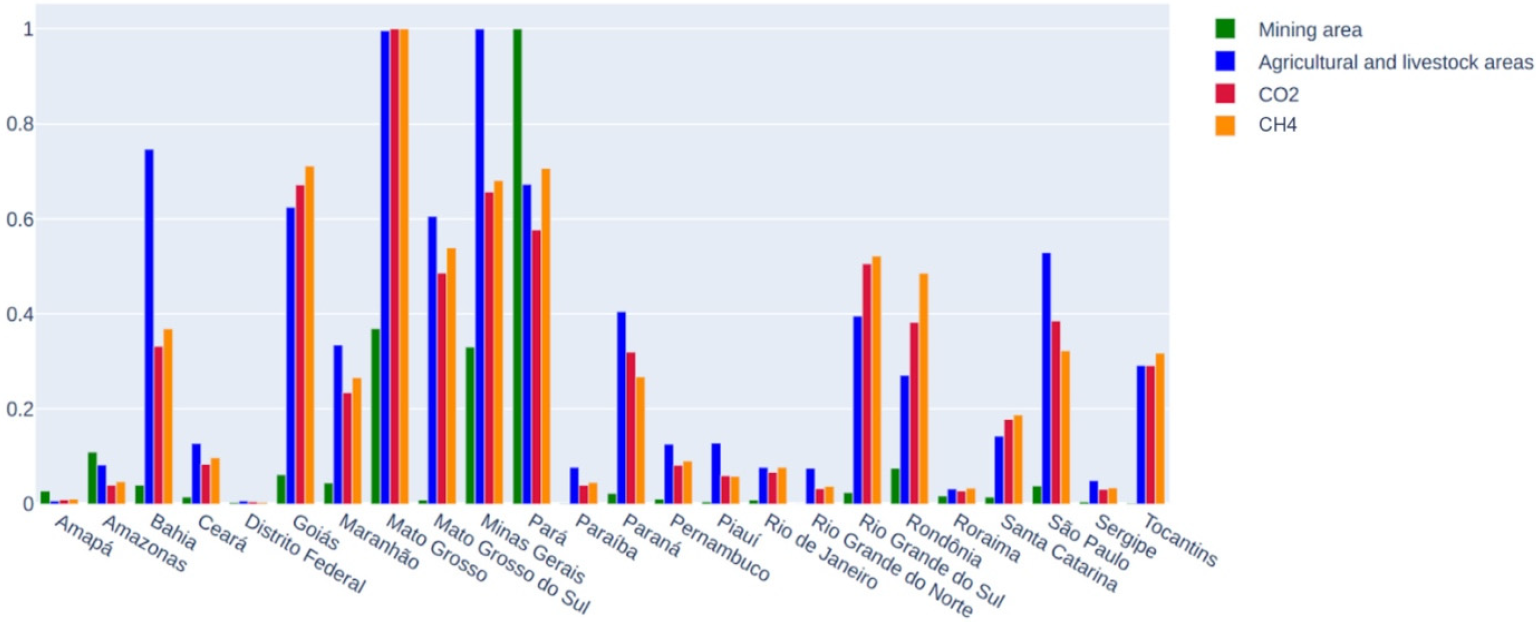
Table 1 presents the efficiency (in %) of the inefficient states using data from 2022. We can associate these results with the multidimensional context of inputs and outputs (Figure 3). Regarding the agriculture and livestock areas resource, the states that stood out were, in decreasing order, Minas Gerais, Mato Grosso, Bahia, Pará, and Goiás. Regarding the mining area resource, in decreasing order, we had Pará, Mato Grosso, Minas Gerais, Amazonas, and Rondônia. From the perspective of outputs, the states in the worst situation for CO2 emissions were, in descending order, Mato Grosso, Goiás, Minas Gerais, Pará, and Rio Grande do Sul. For CH4 emissions, the states that appear in descending order are Mato Grosso, Goiás, Pará, Minas Gerais, and Mato Grosso do Sul. The exploratory analysis of inputs and outputs corroborates the quantitative results obtained by the BCC model (Table 1). The least efficient states had the worst results in CO2 and CH4 emissions, probably associated with the exploitation of agriculture, livestock, and mining, since they also stood out as the largest exploiters of these activities.

A key sign of environmental inefficiency identified in the analysis involves regions with high greenhouse gas emissions despite not having economies heavily reliant on agriculture or mining. These areas show significant environmental impacts without a proportional productive basis, suggesting poor environmental practices or other emission sources beyond the activities analyzed. This scenario highlights the need for targeted public policies focused on emission mitigation, improved land management, control of diffuse pollution, and the adoption of clean technologies.
For instance, based on Table 1 and Figure 3, the combined BCC-DEA results and exploratory data analysis reveal that Rondônia, Goiás, and Rio Grande do Sul had disproportionately high CO2 and CH4 emissions relative to their productive scale, indicating management inefficiencies. In contrast, Minas Gerais, Mato Grosso do Sul, and Pará, despite economic dependence on agriculture or mining, showed relatively lower emissions for their activi-ty level, suggesting better resource and impact management.
From the analysis of the dual variables associated with the model restriction, it is possible to obtain targets for reducing outputs. The values of the reduction rates are sensitive to the parameter used in the subtraction protocol to treat the undesired outputs - a very large value from which the isotonic factor is subtracted (Dyson et al., 2001). However, the sorting of the states according to the reduction rates obtained is the same, regardless of the value of the parameter. Table 2 presents the order of priority for establishing policies to reduce CO2 and CH4 gases.
DISCUSSION AND CONTRIBUTIONS
This study aimed to evaluate and classify the environmental and operational efficiency of Brazilian states, identifying best practices in sustainable development regarding the environmental impact of mining, agriculture, and livestock farming.
By combining the BCC-DEA results with an exploratory data analysis, it is observed that Amapá, the Federal District, and Rio Grande do Norte consistently achieved high efficiency, showing relatively low greenhouse gas emissions for their level of economic activity. Amapá’s economy is less reliant on agriculture, and its extensive Amazon Rainforest coverage limits defore-station and livestock expansion. The Federal District employs controlled, technology-driven farming practices, resulting in efficient land use and a smaller carbon footprint. Meanwhile, Rio Grande do Norte’s semi-arid climate naturally curtails intensive agriculture, leading to lower CH4 emissions. As noted by Vermunt et al. (2020), these examples illustrate how geographic and climatic conditions directly influence production systems and their environmental impacts.
Conversely, the analysis reveals that Rondônia, Goiás, and Rio Grande do Sul were classified as inefficient, showing disproportionately high CO2 and CH4 emissions relative to the scale of their productive activities. This suggests weaknesses in the management of both natural resources (inputs) and environmental impacts (outputs), potentially related to diffuse emission sources or inadequate environmental practices not fully explained by agricultural or mining activity alone.
From another perspective, regions with economies strongly dependent on agricultural and mining activities, such as those represented by Mato Grosso and Goiás, exhibit higher levels of CO2 and CH4 emissions. Mining, while historically a driver of economic prosperity, continues to raise significant social and environmental concerns globally. Although some initiatives aim to mitigate the negative impacts of resource exploitation, Fonseca et al. (2013) indicate that monitoring progress toward sustainability remains insufficient, which aligns with our findings. Therefore, key agricultural and mining hubs, including Sorriso, Campo Novo do Parecis, and Sapezal in Mato Grosso, as well as Rio Verde, Jataí, and Cristalina in Goiás, should adopt and strengthen sustainable practices within their production systems.
A different pattern is observed in Minas Gerais, Mato Grosso do Sul, and Pará, where, despite being classified as inefficient, emissions were proportionally lower relative to the scale of their landand resource-intensive activities, suggesting a comparatively more efficient management of resources and environmental impacts within their economic constraints.
For the less efficient states, such as Mato Grosso and Goiás, as well as their cities, public policies focused on reducing emissions are essential. Livestock farming, particularly, is one of the main contributors to CH4 emissions, which reinforces the need for public policies that promote the transition to more sustainable practices (Casagranda et al., 2023). In the agricultural sector, it is essential to adopt agroecological practices, such as low-carbon farming, more efficient use of fertilizers, and efficient irrigation systems. In addition, policies to encourage low-impact agriculture and sustainable soil management are essential to reduce the intensity of greenhouse gas emissions (Shah et al., 2021).
Mining in states such as Pará and Minas Gerais, as well as their cities, also requires a more sustainable approach. Implementing clean extraction technologies, increasing protected areas, and regulating mining activities are necessary measures to minimize environmental impacts (Alves et al., 2021). Creating conservation units and strengthening sustainable use zones can help protect ecosystems and reduce emissions associated with mining. Furthermore, incentivizing the formation of cooperatives can be an alternative to supporting social participation, equitable revenue distribution for miners, and poverty alleviation (Nico et al., 2024). Attention is needed for garimpeiros, whose growing numbers in Northern Brazil threaten both the environment and their own health.
These findings reinforce that environmental efficiency is intrinsically linked to regional economic structures. Regions with higher dependence on extractive or land-based sectors face greater challenges in decoupling economic growth from emissions, whereas territories with more diversified or less resource-intensive economies tend to show better efficiency scores. Therefore, policy recommendations must consider these structural characteristics to avoid misinterpretations that could unfairly penalize certain regions.
In short, a coordinated effort is needed to reduce CO2 and CH4 emissions, combining effective public policies, adoption of sustainable technologies, and stricter control over livestock, mining, and agriculture. Additionally, promoting environmental education and raising awareness among local producers about the importance of sustainable practices are also essential. Financial and tax incentives can be a powerful tool to support the transition to a low-carbon economy, with subsidies for cleaner agricultural practices and agricultural credits directed towards the implementation of green technologies.
By evaluating and classifying the environmental and operational efficiency of Brazilian states regarding the production of three types of commodities, this study also offers theoretical and methodological implications. Theoretically, it advances the understanding of best practices in sustainable development, considering the environmental impacts of land-based economic activities over time, complemented by exploratory data analysis. Metho-dologically, it offers a robust framework that supports policymakers and stakeholders in strategic decision-making. The identification of regions with higher efficiency enables the prioritization of investments and targeted development policies that balance economic growth and environmental preservation. This contribution is further enhanced by integrating advanced analytical tools, such as the BCC-DEA combined with exploratory data analy-sis, demonstrating the applicability of these methods to complex contexts with interconnected economic and environmental challenges.
Finally, this study is aligned with specific SDGs by approaching and advocating for sustainable food systems and mining exploitation: SDG 2 (zero hunger); SDG 6 (clean water and sanitation); SDG 12 (responsible consumption and production); SDG 14 (life below water); and SDG 15 (life on land).
CONCLUSION
This study used the BCC model of DEA to assess the eco-efficiency of Brazilian states, considering inputs related to agro-industrial and mining activities and outputs related to environmental impacts. Drawing on seconda-ry data from 23 Brazilian states plus the Federal District, the resulting ranking highlighted the most efficient and inefficient states in integrating economic activities with environmental sustainability.
Results clearly highlighted that territories with lower dependence on landand resource-intensive activities tend to achieve higher environmental efficiency, with relatively lower greenhouse gas emissions. In contrast, contexts where economic structures are strongly tied to sectors such as livestock and mining show greater environmental pressure relative to land use, which negatively affects efficiency. These findings call attention to the importance of designing territorially adapted policies that align sustaina-bility strategies with the economic characteristics and production dynamics of each region.
Our study has limitations that future research can address. First, the absence of complete data from states such as Acre, Alagoas, and Espírito Santo limited a full national assessment, highlighting the need for better data collection in these territories. Second, the analysis was conducted at the state level, preventing city-level insights. Similarly, we focused our analysis on the BCC model. For future research, it would be interesting to explore the application of different DEA methods and incorporate city-level data, allowing for more detailed comparisons and offering a more accurate view of the dynamics of sustainable efficiency in the states and their main cities.
-
RAM does not have permission from the authors or evaluators to publish this article’s review.
-
RAM does not have information about open data regarding this manuscript.
-
1
Acknowledgment: This work has been supported by the São Paulo Research Foundation (FAPESP) under the grants #2024/22932-7, #2020/09838-0 (BIOS - Brazilian Institute of Data Science), and #2024/03045-0.
REFERENCES
-
Alves, P. N., Junior, & Vicentin, D. C. (2024). Efficiency analysis of Brazilian regions for the sustainable expansion of food production based on satellite data: A data envelopment analysis approach. In S. Boubaker, T. Ngo (Eds.), Handbook on data envelopment analysis in business, finance, and sustainability (pp. 511-530). World Scientific Publishing. https://doi.org/10.1142/9781800615786_0017
» https://doi.org/10.1142/9781800615786_0017 - Alves, W., Ferreira, P., & Araújo, M. (2016). Sustainability in small-medium-artisanal mining enterprises in Brazil [Conference paper]. 3rd International Conference on Project Evaluation (ICOPEV), Universidade do Minho, Braga, Portugal.
-
Alves, W., Ferreira, P., & Araújo, M. (2018). Sustainability awareness in Brazilian mining corporations: The case of Paraíba state. Environment, Development and Sustainability, 20(S1), 41-63. https://doi.org/10.1007/s10668-018-0171-6
» https://doi.org/10.1007/s10668-018-0171-6 -
Alves, W., Ferreira, P., & Araújo, M. (2019). Mining co-operatives: A model to establish a network for sustainability. Journal of Co-operative Organization and Management, 7(1), 51-63. https://doi.org/10.1016/j.jcom.2019.03.004
» https://doi.org/10.1016/j.jcom.2019.03.004 -
Alves, W., Ferreira, P., & Araújo, M. (2021). Challenges and pathways for Brazilian mining sustainability. Resources Policy, 74, 101648. https://doi.org/10.1016/j.resourpol.2020.101648
» https://doi.org/10.1016/j.resourpol.2020.101648 -
Amui, L. B. L., Jabbour, C. J. C., de Sousa Jabbour, A. B. L., & Kannan, D. (2017). Sustainability as a dynamic organizational capability: A systematic review and a future agenda toward a sustainable transition. Journal of Cleaner Production, 142, 308-322. https://doi.org/10.1016/j.jclepro.2016.07.103
» https://doi.org/10.1016/j.jclepro.2016.07.103 -
An, Q., Zhang, R., & Shen, Y. (2022). Performance measurement of decision making units through interval efficiency with slacks-based measure: An application to tourist hotels in Taipei. Journal of Intelligent & Fuzzy Systems, 42(3), 1925-1936. https://doi.org/10.3233/JIFS-211292
» https://doi.org/10.3233/JIFS-211292 -
Angotii, M., Ferreira, A. C. de S., Eugénio, T., Branco, M., & Queiroz, J. M. (2024). A sustainability assessment modeling-based external account of the impacts of mining activities in Brazil. Sustainability Accounting, Management and Policy Journal, 15(6), 1286-1309. https://doi.org/10.1108/SAMPJ-05-2023-0297
» https://doi.org/10.1108/SAMPJ-05-2023-0297 -
Arias, D., Vieira, P. A., Contini, E., Noronha Farinelli, B. C., & Morris, M. (2017). Agriculture productivity growth in Brazil: Recent trends and future prospects World Bank Group. https://documents1.worldbank.org/curated/en/268351520343354377/pdf/123948-WP-6-3-2018-8-39-22-AriasetalAgriculturalgrowthinBrazil.pdf
» https://documents1.worldbank.org/curated/en/268351520343354377/pdf/123948-WP-6-3-2018-8-39-22-AriasetalAgriculturalgrowthinBrazil.pdf -
Banker, R. D., Charnes, A., & Cooper, W. W. (1984). Some models for estimating technical and scale inefficiencies in data envelopment analysis. Management Science, 30(9), 1078-1092. http://www.jstor.org/stable/2631725
» http://www.jstor.org/stable/2631725 -
Barbosa, L. G., Alves, M. A. S., & Grelle, C. E. V. (2021). Actions against sustainability: Dismantling of the environmental policies in Brazil. Land Use Policy, 104, 105384. https://doi.org/10.1016/j.landusepol.2021.105384
» https://doi.org/10.1016/j.landusepol.2021.105384 -
Bergougui, B., & Satrovic, E. (2025). Towards eco-efficiency of OECD countries: How does environmental governance restrain the destructive ecological effect of the excess use of natural resources? Ecological Informatics, 87, 103093. https://doi.org/10.1016/j.ecoinf.2025.103093
» https://doi.org/10.1016/j.ecoinf.2025.103093 -
Calicioglu, O., Flammini, A., Bracco, S., Bellù, L., & Sims, R. (2019). The future challenges of food and agriculture: An integrated analysis of trends and solutions. Sustainability, 11(1), 222. https://doi.org/10.3390/su11010222
» https://doi.org/10.3390/su11010222 -
Cardoso, D. M. (2021). Evolução recente do market share das exportações minerais brasileiras. Radar: Tecnologia, Produção e Comércio Exterior, 65, 23-27. https://doi.org/10.38116/radar65art4
» https://doi.org/10.38116/radar65art4 -
Carlucci, F. V., Salgado, A. P., Junior, Rebehy, P. C. P. W., Lemos, S. V., Novi, J. C., & Saddow, S. E. (2025). Techno-economic and agricultural best practices for increasing the efficiency of bioenergy companies: Mixed method for the optimization of land use in Brazil and Australia. Business Strategy and the Environment, 34(2), 1708-1734. https://doi.org/10.1002/bse.4063
» https://doi.org/10.1002/bse.4063 -
Carvalho, W. D., Lourenço, E. C., Luz, J. L., Xavier, B. S., Yantén, A. V., & Costa, L. M. (2024). Giving wings to sustainability: Brazil needs to consider bats as suppressors of agricultural pests and tropical disease vectors. Sustainability, 16(14), 5858. https://doi.org/10.3390/su16145858
» https://doi.org/10.3390/su16145858 -
Casagranda, Y. G., Wis´niewska-Paluszak, J., Paluszak, G., Mores, G. de V., Moro, L. D., Malafaia, G. C., Azevedo, D. B. de, & Zhang, D. (2023). Emergent research themes on sustainability in the beef cattle industry in Brazil: An integrative literature review. Sustainability, 15(5), 4670. https://doi.org/10.3390/su15054670
» https://doi.org/10.3390/su15054670 -
Cava, P. B., Salgado, A. P., Junior, & Branco, A. M. de F. (2016). Evaluation of bank efficiency in Brazil: A DEA approach. Revista de Administração Mackenzie, 17(4), 62-84. https://doi.org/10.1590/1678-69712016/administracao.v17n4p61-83
» https://doi.org/10.1590/1678-69712016/administracao.v17n4p61-83 -
Charnes, A., Cooper, W. W., & Rhodes, E. (1978). Measuring the efficiency of decision making units. European Journal of Operational Research, 2(6), 429-444. https://doi.org/10.1016/0377-2217(78)90138-8
» https://doi.org/10.1016/0377-2217(78)90138-8 -
Dagar, V., Khan, M. K., Alvarado, R., Usman, M., Zakari, A., Rehman, A., Murshed, M., & Tillaguango, B. (2021). Variations in technical efficiency of farmers with distinct land size across agro-climatic zones: Evidence from India. Journal of Cleaner Production, 315, 128109. https://doi.org/10.1016/j.jclepro.2021.128109
» https://doi.org/10.1016/j.jclepro.2021.128109 -
D’Amato, D., Droste, N., Allen, B., Kettunen, M., Lähtinen, K., Korhonen, J., Leskinen, P., Matthies, B. D., & Toppinen, A. (2017). Green, circular, bio economy: A comparative analysis of sustainability avenues. Journal of Cleaner Production, 168, 716-734. https://doi.org/10.1016/j.jclepro.2017.09.053
» https://doi.org/10.1016/j.jclepro.2017.09.053 -
Dyson, R. G., Allen, R., Camanho, A. S., Podinovski, V. V., Sarrico, C. S., & Shale, E. A. (2001). Pitfalls and protocols in DEA. European Journal of Opera-tional Research, 132(2), 245-259. https://doi.org/10.1016/S0377-2217(00)00149-1
» https://doi.org/10.1016/S0377-2217(00)00149-1 -
El Bilali, H. (2019a). Innovation-sustainability nexus in agriculture transition: Case of agroecology. Open Agriculture, 4(1), 1-16. https://doi.org/10.1515/opag-2019-0001
» https://doi.org/10.1515/opag-2019-0001 -
El Bilali, H. (2019b). Research on agro-food sustainability transitions: Where are food security and nutrition? Food Security, 11(3), 559-577. https://doi.org/10.1007/s12571-019-00922-1
» https://doi.org/10.1007/s12571-019-00922-1 -
Empresa Brasileira de Pesquisa Agropecuária (Embrapa). (2023). Brasil é o quarto maior produtor de grãos e o maior exportador de carne bovina do mundo, diz estudo https://www.embrapa.br/busca-de-noticias/-/noticia/62619259/brasil-e-o-quarto-maior-produtor-de-graos-e-o-maior-exportador-de-carne-bovina-do-mundo-diz-estudo
» https://www.embrapa.br/busca-de-noticias/-/noticia/62619259/brasil-e-o-quarto-maior-produtor-de-graos-e-o-maior-exportador-de-carne-bovina-do-mundo-diz-estudo -
Fassio, F., & Tecco, N. (2019). Circular economy for food: A systemic interpretation of 40 case histories in the food system in their relationships with SDGs. Systems, 7(3), 43. https://doi.org/10.3390/systems7030043
» https://doi.org/10.3390/systems7030043 -
Fonseca, A., Fitzpatrick, P., & McAllister, M. L. (2013). Government and voluntary policymaking for sustainability in mining towns: A longitudinal analysis of Itabira, Brazil. Natural Resources Forum, 37(4), 211-220. https://doi.org/10.1111/1477-8947.12024
» https://doi.org/10.1111/1477-8947.12024 -
Food and Agriculture Organization of the United Nations (FAO). (2017). The future of food and agriculture: Trends and challenges https://openknowledge.fao.org/server/api/core/bitstreams/2e90c833-8e84-46f2-a675-ea2d7afa4e24/content
» https://openknowledge.fao.org/server/api/core/bitstreams/2e90c833-8e84-46f2-a675-ea2d7afa4e24/content -
Food and Agriculture Organization of the United Nations (FAO). (2020). The state of food security and nutrition in the world: Transforming food systems for affordable healthy diets https://openknowledge.fao.org/server/api/core/bitstreams/9a0fca06-5c5b-4bd5-89eb-5dbec0f27274/content
» https://openknowledge.fao.org/server/api/core/bitstreams/9a0fca06-5c5b-4bd5-89eb-5dbec0f27274/content -
Food and Agriculture Organization of the United Nations (FAO). (2022). FAO strategy on climate change 2022-2031 https://openknowledge.fao.org/server/api/core/bitstreams/f6270800-eec7-498f-9887-6d937c4f575a/content
» https://openknowledge.fao.org/server/api/core/bitstreams/f6270800-eec7-498f-9887-6d937c4f575a/content -
Fulginiti, L. E., & Perrin, R. K. (1997). LDC agriculture: Nonparametric Malmquist productivity indexes. Journal of Development Economics, 53(2), 373-390. https://doi.org/10.1016/S0304-3878(97)00022-9
» https://doi.org/10.1016/S0304-3878(97)00022-9 -
Guo, H., Xia, Y., Jin, J., & Pan, C. (2022). The impact of climate change on the efficiency of agricultural production in the world’s main agricultural regions. Environmental Impact Assessment Review, 97, 106891. https://doi.org/10.1016/j.eiar.2022.106891
» https://doi.org/10.1016/j.eiar.2022.106891 -
Hellvig, J., & Nobre, F. S. M. (2024). Organizing capabilities and per-formance in the scope of business sustainability. Revista de Administração Mackenzie, 25(3), 1-28. https://doi.org/10.1590/1678-6971/eramc240126
» https://doi.org/10.1590/1678-6971/eramc240126 -
Hirlekar, O., Kolte, A., & Vasa, L. (2025). Transition in the mining industry with green energy: Economic dynamics in mining demand. Resources Policy, 100, 105409. https://doi.org/10.1016/j.resourpol.2024.105409
» https://doi.org/10.1016/j.resourpol.2024.105409 -
Howlett, M. (2019). Designing public policies Routledge. https://doi.org/10.4324/9781315232003
» https://doi.org/10.4324/9781315232003 -
Howlett, M., & Ramesh, M. (2014). The two orders of governance failure: Design mismatches and policy capacity issues in modern governance. Policy and Society, 33(4), 317-327. https://doi.org/10.1016/j.polsoc.2014.10.002
» https://doi.org/10.1016/j.polsoc.2014.10.002 -
Instituto Brasileiro de Geografia e Estatística (IBGE). (2018). Divisão regional do Brasil em regiões geográficas imediatas e regiões geográficas intermediárias IBGE. https://biblioteca.ibge.gov.br/index.php/biblioteca-catalogo?view=detalhes&id=2100600
» https://biblioteca.ibge.gov.br/index.php/biblioteca-catalogo?view=detalhes&id=2100600 -
Instituto Brasileiro de Geografia e Estatística (IBGE). (2025). Mapas políticos do Brasil https://www.ibge.gov.br/en/geosciences/maps/brazil-reference-maps/18972-political-maps.html
» https://www.ibge.gov.br/en/geosciences/maps/brazil-reference-maps/18972-political-maps.html -
Jordan, A., & Lenschow, A. (2010). Environmental policy integration: a state of the art review. Environmental Policy and Governance, 20(3), 147-158. https://doi.org/10.1002/eet.539
» https://doi.org/10.1002/eet.539 - Kalirajan, K. P., Obwona, M. B., & Zhao, S. (1996). A decomposition of total factor productivity growth: The case of Chinese agricultural growth before and after reforms. Agricultural and Applied Economics Association, 78(2), 331-338.
-
Kamel, I. M., & El Bilali, H. (2022). Sustainability transition to organic agriculture through the lens of the multi-level perspective: Case of Egypt. Organic Agriculture, 12(2), 191-212. https://doi.org/10.1007/s13165-022-00391-5
» https://doi.org/10.1007/s13165-022-00391-5 -
Karki, U., Seth, H., & Bhatia, V. (2024). Demystifying the efficiency in mana-ging the working capital through the lens of sustainability. Managerial Finance, 51(6), 942-963. https://doi.org/10.1108/MF-04-2024-0328
» https://doi.org/10.1108/MF-04-2024-0328 -
Kutty, A. A., Kucukvar, M., Abdella, G. M., Bulak, M. E., & Onat, N. C. (2022). Sustainability performance of European smart cities: A novel DEA approach with double frontiers. Sustainable Cities and Society, 81, 103777. https://doi.org/10.1016/j.scs.2022.103777
» https://doi.org/10.1016/j.scs.2022.103777 -
Li, Y., Chiu, Y., & Lin, T.-Y. (2019). Coal production efficiency and land destruction in China’s coal mining industry. Resources Policy, 63, 101449. https://doi.org/10.1016/j.resourpol.2019.101449
» https://doi.org/10.1016/j.resourpol.2019.101449 -
Lombardi, G. V., Stefani, G., Paci, A., Becagli, C., Miliacca, M., Gastaldi, M., Giannetti, B. F., & Almeida, C. M. V. B. (2019). The sustainability of the Italian water sector: An empirical analysis by DEA. Journal of Cleaner Production, 227, 1035-1043. https://doi.org/10.1016/j.jclepro.2019.04.283
» https://doi.org/10.1016/j.jclepro.2019.04.283 -
Lu, L.-C., Chiu, S.-Y., Chiu, Y., & Chang, T.-H. (2022). Sustainability efficiency of climate change and global disasters based on greenhouse gas emissions from the parallel production sectors - A modified dynamic parallel three-stage network DEA model. Journal of Environmental Management, 317, 115401. https://doi.org/10.1016/j.jenvman.2022.115401
» https://doi.org/10.1016/j.jenvman.2022.115401 -
MapBiomas. (2024). Brazilian annual land use and land cover mapping project: Cobertura e transições bioma-estados https://brasil.mapbiomas.org/estatisticas/
» https://brasil.mapbiomas.org/estatisticas/ -
Meadowcroft, J. (2009). What about the politics? Sustainable development, transition management, and long term energy transitions. Policy Sciences, 42, 323-340. https://doi.org/10.1007/s11077-009-9097-z
» https://doi.org/10.1007/s11077-009-9097-z -
Melchior, I. C., & Newig, J. (2021). Governing transitions towards sustainable agriculture: Taking stock of an emerging field of research. Sustainability, 13(2), 528. https://doi.org/10.3390/su13020528
» https://doi.org/10.3390/su13020528 -
Ministério do Meio Ambiente e Mudança do Clima (MMA). (2025). Gover-nança no MMA https://www.gov.br/mma/pt-br/acesso-a-informacao/acoes-e-programas/governanca
» https://www.gov.br/mma/pt-br/acesso-a-informacao/acoes-e-programas/governanca -
Mirmozaffari, M., Shadkam, E., Khalili, S. M., Kabirifar, K., Yazdani, R., & Asgari Gashteroodkhani, T. (2021). A novel artificial intelligent approach: Comparison of machine learning tools and algorithms based on optimization DEA Malmquist productivity index for eco-efficiency evaluation. International Journal of Energy Sector Management, 15(3), 523-550. https://doi.org/10.1108/IJESM-02-2020-0003
» https://doi.org/10.1108/IJESM-02-2020-0003 -
Moreira, M. da R., Trabachini, A., Amorim, M. do N., Harada, É. dos S., Silva, M. A. da, & Silva-Miranda, K. O. da. (2024). The perception of Brazilian livestock regarding the use of precision livestock farming for animal welfare. Agriculture, 14(8), 1315. https://doi.org/10.3390/agriculture14081315
» https://doi.org/10.3390/agriculture14081315 -
Nico, O. M. S., Henrique Xavier Araujo, C., Goldemberg, D., & de Tomi, G. (2024). A responsible mining approach to the economic modeling of small-scale gold mining. World Development Perspectives, 33, 100561. https://doi.org/10.1016/j.wdp.2023.100561
» https://doi.org/10.1016/j.wdp.2023.100561 -
Oggioni, G., Riccardi, R., & Toninelli, R. (2011). Eco-efficiency of the world cement industry: A data envelopment analysis. Energy Policy, 39(5), 2842-2854. https://doi.org/10.1016/j.enpol.2011.02.057
» https://doi.org/10.1016/j.enpol.2011.02.057 -
Organisation for Economic Co-operation and Development (OECD). (2021). Evaluating Brazil’s progress in implementing Environmental Performance Review recommendations and promoting its alignment with OECD core acquis on the environment https://one.oecd.org/document/ENV/EPOC/WPEP(2021)6/FINAL/en/pdf
» https://one.oecd.org/document/ENV/EPOC/WPEP(2021)6/FINAL/en/pdf -
Porkka, M., Gerten, D., Schaphoff, S., Siebert, S., & Kummu, M. (2016). Causes and trends of water scarcity in food production. Environmental Research Letters, 11(1), 015001. https://doi.org/10.1088/1748-9326/11/1/015001
» https://doi.org/10.1088/1748-9326/11/1/015001 -
Pradhan, R. P., Nair, M. S., Hall, J. H., & Bennett, S. E. (2024). Planetary health issues in the developing world: Dynamics between transportation systems, sustainable economic development, and CO2 emissions. Journal of Cleaner Production, 449, 140842. https://doi.org/10.1016/j.jclepro.2024.140842
» https://doi.org/10.1016/j.jclepro.2024.140842 -
Ranängen, H., & Lindman, Å. (2017). A path towards sustainability for the Nordic mining industry. Journal of Cleaner Production, 151, 43-52. https://doi.org/10.1016/j.jclepro.2017.03.047
» https://doi.org/10.1016/j.jclepro.2017.03.047 -
Rockström, J., Donges, J. F., Fetzer, I., Martin, M. A., Wang-Erlandsson, L., & Richardson, K. (2024). Planetary boundaries guide humanity’s future on Earth. Nature Reviews Earth & Environment, 5(11), 773-788. https://doi.org/10.1038/s43017-024-00597-z
» https://doi.org/10.1038/s43017-024-00597-z -
Saquetto, T. C., & Araujo, C. A. S. (2019). Efficiency evaluation of private hospitals in Brazil: A two-stage analysis. Revista de Administração Mackenzie, 20(5), 1-32. https://doi.org/10.1590/1678-6971/eramr190183
» https://doi.org/10.1590/1678-6971/eramr190183 -
Shah, S. M., Liu, G., Yang, Q., Casazza, M., Agostinho, F., & Giannetti, B. F. (2021). Sustainability assessment of agriculture production systems in Pakistan: A provincial-scale energy-based evaluation. Ecological Modelling, 455, 109654. https://doi.org/10.1016/j.ecolmodel.2021.109654
» https://doi.org/10.1016/j.ecolmodel.2021.109654 -
Silva, M. G. da, Soares, L. R., Marques, G. R., & da Costa, T. P. (2024). Integration between olive cultivation and sheep farming in Brazil: Carbon footprint mitigation potential. Journal of Cleaner Production, 450, 141776. https://doi.org/10.1016/j.jclepro.2024.141776
» https://doi.org/10.1016/j.jclepro.2024.141776 -
Souza-Filho, P. W. M., Cavalcante, R. B. L., Nascimento, W. R., Nunes, S., Gastauer, M., Santos, D. C., Silva, R. O., Sahoo, P. K., Salomão, G., Silva, M. S., Ramos, S. J., Caldeira, C. F., Dall’Agnol, R., & Siqueira, J. O. (2020). The sustainability index of the physical mining environment in protected areas, Eastern Amazon. Environmental and Sustainability Indicators, 8, 100074. https://doi.org/10.1016/j.indic.2020.100074
» https://doi.org/10.1016/j.indic.2020.100074 -
Sun, X., & Loh, L. (2019). Sustainability governance in China: An analysis of regional ecological efficiency. Sustainability, 11(7), 1958. https://doi.org/10.3390/su11071958
» https://doi.org/10.3390/su11071958 -
System for Estimating Greenhouse Gas Emissions and Removals (SEEG). (2024). Greenhouse gas emission and removal estimating system https://seeg.eco.br/
» https://seeg.eco.br/ -
Vankeerberghen, A., & Stassart, P. M. (2016). The transition to conservation agriculture: An insularization process towards sustainability. International Journal of Agricultural Sustainability, 14(4), 392-407. https://doi.org/10.1080/14735903.2016.1141561
» https://doi.org/10.1080/14735903.2016.1141561 -
Vermunt, D. A., Negro, S. O., Van Laerhoven, F. S. J., Verweij, P. A., & Hekkert, M. P. (2020). Sustainability transitions in the agri-food sector: How ecology affects transition dynamics. Environmental Innovation and Societal Transitions, 36, 236-249. https://doi.org/10.1016/j.eist.2020.06.003
» https://doi.org/10.1016/j.eist.2020.06.003 -
Virgone, K. M., Ramirez-Andreotta, M., Mainhagu, J., & Brusseau, M. L. (2018). Effective integrated frameworks for assessing mining sustaina-bility. Environmental Geochemistry and Health, 40(6), 2635-2655. https://doi.org/10.1007/s10653-018-0128-6
» https://doi.org/10.1007/s10653-018-0128-6 -
Wang, S., Guo, J., Yu, Y., Shi, P., & Zhang, H. (2023). Quality evaluation of land reclamation in mining area based on remote sensing. International Journal of Coal Science & Technology, 10, 43. https://doi.org/10.1007/s40789-023-00601-9
» https://doi.org/10.1007/s40789-023-00601-9 -
Wood, D. A. (2021). Prediction and data mining of burned areas of forest fires: Optimized data matching and mining algorithm provides valuable insight. Artificial Intelligence in Agriculture, 5, 24-42. https://doi.org/10.1016/j.aiia.2021.01.004
» https://doi.org/10.1016/j.aiia.2021.01.004 -
World Business Council for Sustainable Development (WBCSD). (1999). Eco-efficiency https://docs.wbcsd.org/2006/08/EfficiencyLearningModule.pdf
» https://docs.wbcsd.org/2006/08/EfficiencyLearningModule.pdf -
Xu, Z., Zheng, Y., & Wu, Y. (2024). Paving the way for sustainable agriculture: An analysis of evolution and driving forces of methane emissions reduction in China. Resources, Conservation and Recycling, 202, 107392. https://doi.org/10.1016/j.resconrec.2023.107392
» https://doi.org/10.1016/j.resconrec.2023.107392 -
Zalles, V., Hansen, M. C., Potapov, P. V., Stehman, S. V., Tyukavina, A., Pickens, A., Song, X.-P., Adusei, B., Okpa, C., Aguilar, R., John, N., & Chavez, S. (2019). Near doubling of Brazil’s intensive row crop area since 2000. Proceedings of the National Academy of Sciences, 116(2), 428-435. https://doi.org/10.1073/pnas.1810301115
» https://doi.org/10.1073/pnas.1810301115 -
Zhang, Y., & Zhang, J. (2024). Environmental governance and regional green development: Evidence from China. Journal of Cleaner Production, 447, 141643. https://doi.org/10.1016/j.jclepro.2024.141643
» https://doi.org/10.1016/j.jclepro.2024.141643 -
Zhou, P., Ang, B. W., & Poh, K. L. (2008). A survey of data envelopment analysis in energy and environmental studies. European Journal of Operational Research, 189(1), 1-18. https://doi.org/10.1016/j.ejor.2007.04.042
» https://doi.org/10.1016/j.ejor.2007.04.042 -
Zhou, X., & Xu, Z. (2018). An integrated sustainable supplier selection approach based on hybrid information aggregation. Sustainability, 10(7), 2543. https://doi.org/10.3390/su10072543
» https://doi.org/10.3390/su10072543 -
Zhou, Y., Liu, W., Lv, X., Chen, X., & Shen, M. (2019). Investigating interior driving factors and cross-industrial linkages of carbon emission efficiency in China’s construction industry: Based on super-SBM DEA and GVAR model. Journal of Cleaner Production, 241, 118322. https://doi.org/10.1016/j.jclepro.2019.118322
» https://doi.org/10.1016/j.jclepro.2019.118322
Edited by
-
EDITORIAL PRODUCTIONPublishing coordinationAndreia CominettiEditorial internBruna Silva de AngelisLanguage editorPaula Di Sessa VavlisLayout designerEmapGraphic designerEmapEDITORIAL BOARDEditor-in-chiefAlmir Martins VieiraAssociated editorGustavo Hermínio Salati Marcondes de MoraesTechnical supportGabriel Henrique Carille
RAM does not have information about open data regarding this manuscript.