
 Operational capability as a mediator on the relationship between supply chain integration and operational performance
ABSTRACT
Purpose: This article examines the role of operational capabilities as a mediator factor in the relationship between supply chain integration and operational performance.
Originality/value: This is one of the first empirical studies to explore the relationship between elements of supply chain management—including strategy, structure, and operational capabilities—and performance. We imply that the strategy–structure supply chain management capabilities and performance (SS-M-CP) paradigm adopted was useful to understand the cumulative role of operational capabilities as well as supply chain management as an administrative department with authority to integrate organizational strategies and structures to influence the operational capabilities and leverage operational performance.
Design/methodology/approach: Structural equation modeling was used to survey 138 strategic and operational supply chain managers of Brazilian and foreign companies headquartered in Brazil and associated with the capital goods industry. The hypotheses were validated, and the results showed the integration of organizational strategies and structures in supply chain management and a partial mediating factor of operational capabilities in the relationship between supply chain management and operational performance.
Findings: The study validates the instrument that forms the strategies, structures, operational capabilities, and supply chain management for decision-making practices and analyses of potential mismatches in its implementation. The article contributes to the legacy of supply chain management research by providing theoretical understanding and empirical support for the SS-M-CP paradigm, which, when aligned, can improve and gain a competitive advantage.
KEYWORDS:
organizational strategy; organizational structure; supply chain management; operational capabilities; operational performance
RESUMO
Objetivo: Este artigo examina o papel das capabilidades operacionais como fator mediador na relação entre a integração da cadeia de suprimentos e o desempenho operacional.
Originalidade/valor: Este é um dos primeiros estudos empíricos a explorar a relação entre elementos da gestão da cadeia de suprimentos – incluindo estratégia, estrutura, bem como capabilidades operacionais – e desempenho. Por meio deste estudo, fica implícito que o paradigma estratégia-estrutura-gestão da cadeia de suprimentos-capabilidades e desempenho operacional (EE-G-CD) adotado foi útil para compreender o papel cumulativo das capabilidades operacionais, bem como da gestão da cadeia de suprimentos como um departamento administrativo com autoridade para integrar estratégias e estruturas organizacionais, para influenciar as capabilidades operacionais e alavancar o desempenho operacional.
Design/metodologia/abordagem: A modelagem de equações estruturais foi utilizada para tratar uma amostra com 138 gestores estratégicos e operacionais da cadeia de suprimentos de empresas brasileiras e estrangeiras sediadas no Brasil e associadas à indústria de bens de capital. As hipóteses foram validadas e mostraram a integração das estratégias e estruturas organizacionais na gestão da cadeia de suprimentos, e as capabilidades operacionais como um fator mediador parcial na relação entre a gestão da cadeia de suprimentos e o desempenho operacional.
Resultados: O estudo valida o instrumento que compõe as estratégias, estruturas, capabilidades operacionais e gestão da cadeia de suprimentos para práticas de tomada de decisão e análises de potenciais incompatibilidades na sua implementação. O artigo contribui para o legado da pesquisa em gestão da cadeia de suprimentos ao fornecer compreensão teórica e suporte empírico para o paradigma EE-G-CD, que, quando alinhado, pode melhorar processos produtivos e obter vantagem competitiva.
PALAVRAS-CHAVE:
estratégia organizacional; estrutura organizacional; gestão da cadeia de suprimentos; capabilidades operacionais; desempenho operacional
INTRODUCTION
The fractioning of industrial production into dispersed global value chains facilitated by digital technology has enabled organizations to develop operational capabilities (OCPs) for increasingly better activities than those of their competitors (Porter & Heppelmann, 2015). Competitive advantage only survives over time if manufacturing-based strategies are dynamic or change with time, as a company can easily replicate a piece of operating equipment and competitors’ policies over a short time (Teece et al., 1997).
According to Roberts (2004), a company achieves sustainable business performance by establishing and maintaining a balance among three elements: company strategy, organizational structure, and an uncertain and turbulent environment due to globalization and market interconnection (Nakano, 2015). However, the relationship among these three elements has been conceptualized in different ways.
In an environment of large American corporations in the first half of the twentieth century, Chandler (1962) pointed out that structure must theoretically and prescriptively follow strategy. However, Hall and Saias (1980) found that the relationship can be made either from structure following strategy or the reverse.
In this context, Patel et al. (2013) and Hsiao and Wu (2020) argued about the need for strategic guidance in supply chain management (SCM) to meet an operational performance (OPF), while Mu et al. (2017) mentioned that adopting a strategic orientation alone is not enough; it is also necessary to know and understand the OCPs, and the market contingencies to obtain OPF (Yu et al., 2018). Nakano (2015) observed that few studies in the field of SCM have examined the relationship between supply chain administrative elements, including strategies, structures, and processes. Studies on SCM integration, or SCM orientation (Patel et al., 2013), having as antecedents the organizational strategy and structure and the mediating factor of OCPs on the relationship between SCM integration and OPF, are still rare.
In this regard, Teece (2019) indicated that to build a robust OCP, organizational management must position itself for excellence, using an internal team to face challenges since internal learning processes are complex to accelerate; internal staff must have the responsibility, and success must be measured objectively concerning the planned goals.
With few studies based on the protagonism of OCPs in gaining a competitive advantage in the Brazilian capital goods industry, this study investigates the following question: Do OCPs play a mediating role in the relationship between SCM integration and OPF? The objective was to examine the mediating factor of OCPs on the relationship between SCM integration (strategy and organizational structure) and OPF, in order to contribute: a) to a better understanding SCM integration, involving strategy, structure, OCP and OPF, for which research is still rare; and b) to identify underlying managerial mechanisms and establish robust connections between the phenomena studied as cumulative capabilities and alternatives to manage the complexity of the integrated SCM.
The study is structured as follows: after an introduction, the theoretical framework and hypothesis are described; the methodological procedures are then detailed, followed by data analysis and empirical results; finally, discussion, implications, conclusions, and suggestions for further studies are described.
THEORETICAL FRAMEWORK, CONCEPTUAL DEVELOPMENT, AND HYPOTHESES
The research problem was tested in manufacturing plants where competitors cannot easily replicate OCP in an environment driven by global hypercompetition. In this context, OCP is critical because innovations and discoveries alter constantly; thus, companies must continually change their strategies.
Thus, the domain of SCM was contingency theory; OCP (an extension of dynamic capability) was the resource-based view, and OPF was the theory of industrial industrial-organizationalorganizational. The study’s basic premise was that OCP mediates the relationship between SCM integration and OPF. Figure 1 displays the conceptual model and hypothesis.
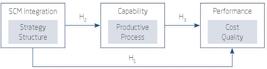
Theoretical framework
SCM integration is rooted in the paradigm of collaborative advantage (Dyer & Singh, 1998) rather than competitive advantage (Porter, 1985). In this context, the structure and strategy supply chain is integrated (or aligned) with OCP to drive strategic positioning and improve operational efficiency (Barney, 1991). In the literature, SCM integration is represented by multiple perspectives, of which this study examined three: contingency theory, resource-based view, and industrial organization theory.
Contingency theory
Contingency theory states that no single organizational structure is highly effective for all organizations. The optimization of the structure varies according to the contingency factors (Donaldson, 2001; Flynn et al., 2010a), in which the SCM integration must be guided by the path where the results are better (Flynn et al., 2010a).
SCM integration emerges as an organizational arrangement capable of dealing with different contingency factors, such as the strategies and organizational structures of the companies that make up the supply chain and the environmental uncertainties, particularly technological and demand concerns (Dyer et al., 2014). Additionally, based on the relational view (Dyer & Singh, 1998), that is, the collaboration between supply chain partners, companies can develop as if they were part of a single company (Lambert & Christopher, 2000) and create value through the advantage of collaboration.
Resource-based view
The resource-based view sees the potential for profit determined by resources that are rare, exclusive, valuable, and costly to imitate (Barney, 1991), held internally by the company and not by positions in external industries. This resource-based reasoning was extended by Teece et al. (1997) for dynamic capabilities, according to which, in a competitive environment, what matters is not only the resources but the ability to improve and develop them, making the resources dynamic continuously. Dynamic capabilities emerge gradually over time. Unlike resources, they represent a distinctive and superior way of allocating, coordinating, and deploying resources. Operational capabilities are empirically validated through their application to problems faced by a firm (Flynn et al., 2010b).
Industrial organization theory
The industrial organization theory, based on the structure-conduct-performance (SCP) paradigm (Porter, 1980) on how companies are structured, developed empirical models to lead the industry to above-average performances, on which the managers define their behavior (or conduct). The sense of causality is not always unidirectional. Performance can often lead to changes in conduct, and conduct can lead to changes in market structure.
With regard to the integration of SCM in manufacturing companies, Porter (1980) provides an in-depth analysis of the structure of the industry. Research still in development has shown that there is heterogeneity in the performance of firms within a single branch, although it has been found that a company’s unique attributes are more important for its performance than the branch in which it operates (Rumelt, 1991).
Conceptual framework and hypothesis development
SCM integration and OPF
SCM is defined by the Council of Supply Chain Management Professionals as follows:
Supply chain management encompasses the planning and managing of all activities involved in sourcing and procurement, conversion, and all logistics management activities. It also includes coordination and collaboration with channel partners, suppliers, intermediaries, third-party service providers, and customers. Supply chain management integrates supply and demand management within and across companies (CSCMP, 2021).
This is an extensive definition and entails several cuts or subdefinitions. Although there are gaps in a convergent definition of SCM, Ramana et al. (2016) unanimously argued that the objective of SCM is to add value, improve operational efficiency, and maximize profit.
Empirical SCM studies have mainly used observed variables related to resource sharing, joint planning, integrated activities, goal congruence, decision synchronization, incentive alignment, collaborative communication, and joint knowledge creation (Cao & Zhang, 2011; Nakano & Akikawa, 2014).
For Patel et al. (2013), SCM should be guided by the logic of a competitive environment according to two distinct and interdependent dimensions. Thus, it is oriented by strategy and structure. Roberts (2004) observed that this task is not easy, as a strategy can be changed relatively quickly. However, contingency factors lead organizational structures to continually adapt and adjust their strategy (Chandler, 1962; Lawrence & Lorsch, 1967).
In this regard, SCM integration with organizational strategies and structures is like a higher-order co-aligning construct that consists of detecting, harnessing, and transforming resources and, in turn, requires several skills for the coordinated implementation of supply, manufacturing, and distribution among people from different cultures (Vanpoucke et al., 2014). It involves exchanging information for the joint benefit of buyers and suppliers. The process also requires SCM departments characterized by a high degree of formalization, with staff trained in OCP to support logistical and sales services (Nakano, 2015). Many researchers have empirically examined the positive and direct relationship between SCM integration in OPF (Flynn et al., 2010a), SCM collaboration in OPF (Cao & Zhang, 2011), and SCM strategy in OPF (Swink et al., 2007).
However, the conceptual model seen in Figure 1 suggests the absence of a significant coefficient, with the proposition that OCP fully mediates the relationship between SCM integration and OPF. In this regard, Fisher (1997) argued that there are adversarial relationships between partners in the supply chain, as well as dysfunctional practices in the industry, such as dependence on price promotions, which result in the bullwhip effect due to a lack of synchronization between supply chain members (Lee, 2002).
Mediation tests (Baron & Kenny, 1986) specify the existence of a significant intervening mechanism (OCP) between the antecedent variable (SCM integration) and the consequent variable (OPF). The mediation analysis is also aligned with hypotheses H2 (SCM integration → OCP) and H3 (OCP → OPF), developed in the following items.
Thus, the following hypothesis was formulated:
-
H1: SCM positively relates to OPF, and OCP mediates the relationship.
SCM integration and OCP
The resource-based view (RBV) is defined as tangible and intangible assets (related to issues of value, rarity, imitability, and organization) that a company controls and can be used to create and implement strategies (Wernerfelt, 1984). It was consolidated by Rumelt (1991), who showed that industry factors explained 9%–16% of variations in profit as opposed to 44%–46% for specific factors of company or business units. Rumelt (1991) concluded that industry resources do not matter much, and this was extended by Teece et al. (1997) to dynamic capabilities. Teece et al. (1997) defined dynamic capabilities as a complex set of skills and accumulated knowledge that lead companies to coordinate activities and use their productive assets. What matters is the resources given and the ability to continually improve and evolve them, thus making the resources dynamic.
The problem with these definitions is that they are tautological; for example, for RBV: “if a resource is valuable and rare then it can generate competitive advantage” (Priem & Butler, 2001), or for dynamic capabilities, “if the firm has a dynamic capability, it must perform well, and if the firm is performing well, it should have a dynamic capability” (Cepeda & Vera, 2007). Contrary to the principle of falsifiability by Popper (1977), tautology shows that it is not possible to consider these as theories, given the impossibility of refuting them. However, many researchers believe that tautology does not compromise the contribution of these theories to the sector studied. Barney et al. (2011) and Teece (2019) recommend investigating them to fill gaps that theory may allow for studies.
Capabilities reflect different strategies and result from adaptation, reconfiguration, and use of resources, as well as managerial competencies and functional competencies to face the challenges of the external environment (Gligor & Holcomb, 2014). For instance, research on dynamic capabilities from a supply chain perspective comprises supply chain alignment, responsiveness, and information exchange processes (Ju et al., 2016; Oh et al., 2019).
Other studies (Ju et al., 2016; Teece, 2007; Yu et al., 2018) argue that dynamic capabilities are high-order capabilities that can be disaggregated into different ones, as seen in Yu et al. (2018).
Rooted in the definition of dynamic capabilities, there seems to be a broad consensus that OCP refers to leveraging a company from its manufacturing function to support organizational success (Tan et al., 2007). Nevertheless, there are differences in how OCP is defined, and it is sometimes used synonymously with competitive priority or the “sand cone” model (Ferdows & DeMeyer, 1990).
Therefore, in this study, operational capabilities were considered in a production process context (quality and operations) as a proxy for operational dynamic capabilities (Flynn et al., 2010b) and provide unity, integration, and direction to resources and operational practices (Cepeda & Vera, 2007).
Thus, the following hypothesis was formulated:
-
H2: SCM integration is directly and positively related to OCP.
OCP and OPF
The impact of OCP on OPF is central, but it is a controversial issue among academics (Vanpoucke et al., 2014). A classic example is cited by Deming (1990), in which two conflicting and OPF opposing dimensions, quality and cost, simultaneously occur to create a competitive advantage. As seen in the literature, OPF originates from SCM integration but may also be indirectly derived from OCP. Bourne et al. (2018) argued that while OPF measurement theory and practices have evolved over the years, several scholars, such as Swink et al. (2007), have questioned whether the OPF measurement paradigm rooted in the control systems literature is suitable for demanding environments and uncertain technologies.
Patel et al. (2013) defined OPF as the firm’s ability to effectively manage its key internal process function. Return on assets, inventory turnover and order fill capacity are manifestations of OPF. In this regard, OPF required by stipulated goals reflects an organization’s technological efficiency, which is effective, for example, due to its ability to reduce losses, greater agility in production, superior product quality, and the process itself. In a supply chain, teamwork skills allow companies to more effectively integrate and link operations (Soosay et al., 2008) since SCM influences OPF improvement by eliminating wastes and efficiently using supplier capabilities – both internal and external – of technology and coordination of the supply chain (Paulraj & Chen, 2007). Thus, companies composing the supply chain must collaborate and share information and knowledge, leading to a better OPF as a whole rather than acting without collaboration (Soosay et al., 2008). Such an OPF can be measured by inventory costs, productivity, and transportation costs, among other factors (Bourne et al., 2018).
Strategic alignment of innovation processes and close coordination between supply chain partners are essential to connect OCP (Wook, 2006). Fuchs et al. (2018) reinforced the argument that OCP significantly influences OPF. Therefore, OPF is related to OCP in reducing production cycle times, higher productivity, and logistic and operating costs, which are fundamental goals for SCM integration (Ou et al., 2010).
Thus, the following hypothesis was formulated:
-
H3: OCP is directly and positively related to OPF.
METHODS
Type of research, questionnaire, sample, and type of informant
Descriptive quantitative research was previously carried out as an exploratory study to understand SCM integration with organizational strategies and structures, OCP, and OPF and thus define the research problem with greater precision, as Malhotra (2019) recommended. Personal interviews selected by convenience sampling (Malhotra, 2019) were conducted with ten managers of Brazilian companies of capital goods, using as a collection instrument a script of flexible and unstructured questions related to the theoretical framework. These, in the end, resulted in the preliminary construction of a questionnaire for the descriptive research.
This preliminary data collection instrument consisted of five blocks. The first and second blocks referred to data from respondents and companies. Block three referred to measures for strategy and organizational structure constructs, with four indicators each. Blocks four and five comprised the measures of OCP and OPF constructs, with four indicators each. Both OCP and OPF measures were modeled as first-order reflexive latent constructs.
SCM was modeled as an exogenous and reflexive second-order factor, while organizational strategy and structure were considered endogenous and reflexive first-order factors. Thus, the second-order factor was considered the “cause” of the first-order factor. Despite having several observable measures for the first-order factor, the second-order factor was completely latent, unobservable, and unmeasurable. In other words, SCM as a second-order factor is just a function of relationships with first-order factors (Hair et al., 2014).
A Likert-type scale with five points (1 = totally disagree and 5 = totally agree) was used to measure the constructs. Moreover, a pretest of the questionnaire with nine managers related to SCM was carried out to verify the understanding of the measurements and format of the collection instrument.
Then, the minimum sample size was estimated by the application G*Power3.1.9.4, indicating a total sample size of 68. However, Ringle et al. (2014) suggested double or triple this value for a consistent model.
Supply chain-related managers were selected by convenience sampling (Malhotra, 2019), such as purchasing, warehousing, transport, sales, and production managers, as well as those linked to business units of the same company, providing more than one questionnaire per company.
Data was collected by email, and responses were given through an attached questionnaire or a link to the Google Docs form. In October 2015, approximately 1,200 questionnaires were sent to a population of 5,000 companies linked to the Brazilian Association of Machinery and Equipment. Follow-up was by email, and phone call with the companies’ managers, and 138 questionnaires were returned from October 2015 to January 2016, corresponding to 11.5% of the total sent, which is within the limit recommended by the G*Power3. 1.9.4 application (Ringle et al., 2014).
Data processing and method limitation
Descriptive statistics were used for an initial examination to identify atypical observations or extreme responses that could result in bias in the multivariate analysis (Hair et al., 2014). Then, the measures and scales of the measurement model constructs were validated. We evaluated the one-dimensionality of the constructs using Cronbach’s alpha coefficient and composite reliability (CR) for more reliable measures so that the individual indicators are all consistent. The minimum acceptable value for both measures is 0.7 (Hair et al., 2014).
The content was validated by an exploratory study with ten interviewees and in nine pretests of the questionnaires with managers to evaluate how well the domain content of a construct is captured by its indicators (Hair et al., 2014).
Convergent validity was evaluated by factor loadings and average variance extracted (AVE), which had acceptable minimum values of 0.7 and 0.5, respectively.
For discriminant validity, the criterion suggested by Fornell and Larcker (1981) was used, in which the square root of the AVE of each construct must be greater than the correlations of each construct.
After being incorporated into the measurement model, control variables were subjected to statistical tests to verify the statistical significance of the constructs’ relationships. The partial least squares-path modeling (PLS-PM) technique was used to estimate the structural model with robust applicability in a sample without asymmetric distributions.
We continued to assess the quality of data adjustments using the following structural equation modeling procedures: a) Pearson’s coefficient of determination (R2), for which Cohen (1977) considered a value of 0.26 for R2 as a high-effect quality for the area of human and social behavioral sciences; b) indicator of relevance or predictive validity (Q2), also called the Stone-Geisser indicator, whose acceptance criterion must have values above zero for each construct; and c) the effect size indicator (f2) or Cohen’s (1977) indicator in which the usefulness of each construct for the model adjustment is evaluated. The values 0.02, 0.15, and 0.35 at f2 are considered small, medium, and large, respectively (Hair et al., 2014).
To evaluate OCP mediating factor on the SCM and OPF relationship, the approach proposed by Hair et al. (2014) was used, given by variance accounted for (VAF), which can be calculated by , wherein β12, β23 and β13 are the captured structural coefficients of the relationship between the constructs [SCM → OPC], [OPC → OPF] and [SCM → OPF], respectively. A VAF value > 80% means total mediation, VAF < 20% means no mediation, and 20% ≤ VAF ≤ 80% means that mediation is partial.
In a study with self-administered questionnaires, the data may present a common method bias, which causes an inflated effect on the relationship between variables. Harman’s single-factor test (Podsakoff et al., 2003) was used to assess the bias, which assumes that a large amount of variance comprehended by a single factor may indicate potential standard method bias. For this test, a value below 50% of total variance is expected to demonstrate the absence of sampling bias. Finally, the results generated and extracted from the reports can be used to analyze direct, indirect, and total effects on constructs before OPF.
Control variables
The SCM integration directly related to OPF is a complex and multifaceted issue (Cao & Zhang, 2011). It is dependent on competitive market dynamics and contingency factors. Nine control variables related to respondent and company profiles were selected to investigate whether contingency factors could capture the different conditions of a competitive environment and influence the responsiveness of SCM and OCP-related constructs. They comprise current function, field and main area of expertise, education, higher education course, time in the function, time in the company, size (number of employees), annual revenue (R$ million annuals), and time of the relationship with the leading suppliers (years). Table 1 shows the descritive statistics for these contingency factors or control variables.
Method limitation
Based on a review of the empirical literature, there are three limitations to the method used in this study. First, the problem of common method bias permeates different points of view regarding its practical relevance (Chin et al., 2013). This study used Harman’s single-factor test (Podsakoff et al., 2003), one of the oldest and most used in international studies (Guide & Ketokivi, 2015). Although there are several approaches to evaluate or eliminate common method bias, such as the measured latent marker variable (MLMV) (Chin et al., 2013), Harman’s single factor test (Podsakoff et al., 2003) or the full collinearity test (Kock, 2015), there is no consensus on which is the best to assess or eliminate common method bias. In this sense, standard method bias is a methodological subject that arouses interest and reveals gaps left to explore and establish a reliable and robust method.
Second, choosing a nonprobabilistic sampling by convenience was considered the most appropriate for the period of execution of this research, as well as the project budget and operationality. Although the collection instrument was sent to the corporate email addresses of respondents, it was not necessarily completed in the workplace. This is due to the heterogeneity of companies with different technological bases and organizational structures, with many being small family-run companies (BNDES, 2015; Souza et al., 2018). Accordingly, the instrument may have undergone some bias in the responses, resulting from interruptions or diverting attention to matters unrelated to the study’s object.
Third, the study focused on OCPs as a measuring factor of the relationship between SCM integration and OPF; in the current study, we measured the OCPs as a proxy for the production process. The RBV suggests that each firm has distinctive recourses and capabilities (Day, 1990; Song et al., 2007). Research by Rumelt (1991) has shown that companies in the same branch or strategic group where the company operates generally have more heterogeneity in performance. This difficulty also occurs with OCPs, especially when investigating the cumulative capabilities (Vilkas et al., 2020).
In view of these limitations, this study aimed to stimulate the investigative mindset of researchers to seek a consistent and robust solution. However, the comparison of these results with other surveys should be done sparingly.
Data analysis and empirical results
The sample represented by the 138 respondents was initially subjected to descriptive statistics to synthesize, organize, and describe data related to overt measures, thus providing a global view of the characteristics of the collected measures.
Profile of participants (respondents and companies)
Table 1 summarizes the profile of participants (respondents and companies).
According to Table 1, the sample: a) concerning the respondents, most of them held decision-making positions related to supply chain management, with higher education in engineering, and their length of stay in the company and the position was predominantly more than five years; b) regarding the companies, size and revenue varied and their relationship time with their suppliers was predominantly over five years, the branches of activities of Brazilian capital goods companies comprised metal, machinery and equipment, electric motors, pulp and paper, and chemical industries.
Additionally, the profile of companies surveyed in terms of revenue and number of employees reflected Brazil’s capital goods industry’s distribution. Over 60% (in annual revenue) encompassed small and medium-sized companies. Official data show that 80% of Brazilian capital goods companies are small and medium-sized (BNDES, 2015).
After being exposed, the sample was considered representative to examine the influence of OCPs on capital goods companies.
Validation of construct measures and scales
The factor analysis technique was used to validate data measures and scales. After several rounds and interactions, an underlying structure with 16 measures was obtained and distributed in four constructs, strategy, structure, OCP, and OPF, with factor loadings above the cutoff value of 0.700. Table 2 displays the factor loading and other indicators, such as AVE, CR, and Cronbach’s alpha, used to assess the measurement model.
Thus, Cronbach’s alpha and CR index were above 0.700, denoting that single-construct indicators had acceptable adjustments to the single-factor model (one-dimensional) and that latent construct indicators were consistent in their measurements, indicating the reliability of the construct (Hair et al., 2014). Still, as can be seen in Table 2, all factor loads were greater than 0.700, and the AVE was above 0.500, revealing convergent validity. An assessment of discriminant validity according to the criteria of Fornell and Larcker (1981) revealed that the square root value of the AVE for each construct (written diagonally in italics) was greater than the values of the correlation coefficients (in row and column), as can be seen in Table 3, denoting discriminant validity.
The descriptive examination in Table 3 shows that the mean varied from a minimum of 4.00 to a maximum of 4.50 on a scale of 1 to 5 points, with a standard deviation of a minimum of 0.55 and a maximum of 0.75. These values greater than 3 with low dispersion and tending towards the concordant side of the scale showed a slight trend of SCM integration with the strategy and organizational structure and with OCP, and, in turn, favoring OPF. The structural correlations between first-order variables showed an average correlation between a minimum value of 0.376 and a maximum value of 0.696, indicative of convergent validity.
Figure 2 shows a direct correlation model on first-order latent variables.

The direct correlation shown in Figure 2, given by the paths: Strategy → Structure (β = 0.699, p < 0.000), Structure → OCP (β = 0.535, p < 0.000), and OCP → OPF (β = 0.408, p < 0.000), present a Strategic-Structure–Capability–Performance (SSCP) paradigm. This paradigm is similar to Chandler’s (1962) strategy, which defines the behavior of the structure. To put it another way, the structure follows the strategy.
Evaluation of the measurement of second-order latent variables
Strategy and structure constructs were used to model SCM as a second-order latent variable in the SmartPLS 3.0 application. Thus, the first-order manifest variables of strategy and organizational structure were repeated in the SCM constructed as a second-order factor (Wetzels et al., 2009). When adopting this approach, the AVE and composite reliability had to be calculated manually, as they are biased (Hair et al., 2014), based on structural correlations of latent first-order variables. First-order data related to the latent strategy and organizational structure variables were extracted from Table 2, and the average variance extracted and composite reliability was obtained. Thus, it is also observed that there is convergent and discriminant validity and reliability at this (second-order) level, as can be seen in Table 4.
Table 4 highlights that values on the matrix diagonal are above those outside (correlation). Therefore, there is discriminant validity between constructs.
Mediating variable analysis and control variable insertion
To examine the mediating factor of OCP on the relationship between SCM integration, OPF, and control variable insertion (time in the function), two conceptual models were built, called “without OCP mediation” and “with OCP mediation,” both composed of time in the function. Table 5 shows the results.
Hypothesis, structural coefficients, control variable (time in function), and adjustment indexes
Table 5 highlights that none of the scenarios had multicollinearity problems, as variance inflation factor (VIF) values were below 5 to ensure that collinearity is not a model problem (Hair et al., 2014).
The two scenarios built in Figure 3 serve to visualize the structural model better.
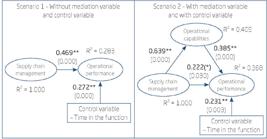
Scenarios for estimating OCP models as a mediator of the relationship between SCM and OPF and under the influence of the control variable “time in the function”
Between scenarios 1 and 2, control variable insertion, [SCM → OPF] reduced from (β1 = 0.469, p < 0.000) to (β2 = 0.222, p < 0.030), and standard error reduced from 0.121 to 0.102, which is equivalent to 15.78%. Method underestimation (−0.247) was small, and unbiased scenario 2 resulted in an explained variance for SCM of 17.58% [0.222 × 0.792]. The value 0.792 corresponds to the structural coefficient correlation (Table 4).
Post hoc analysis
After estimating the structural equation modeling and evaluating the general fit of the model, to derive additional insights, we conducted a post hoc analysis to verify the influence of the control variable (time in the function), which is constituted in three groups with ordinal categorical measures (Table 1), on operational performance (OPF). For this purpose, the non-parametric Kruskal-Wallis test was used. The result reveals that the three groups of professionals with different times in the function influence operational performance differently [χ = 6.568; p < 0.037], showing that type-I error levels are not guaranteed. The mean rank values for Group 1 (up to 2 years), Group 2 (between 2 and 5 years), and Group 3 (over 5 years) were 47.27, 64.63 and 74.24, respectively, with groups [1–2] and [2–3] retaining the null hypothesis, and groups [1–3] rejecting it. The division of time in the function into two groups, of which Group 3 is the one that most influences OPF, reinforces the Strategy–Structure–SCM–Capability–Performance (SS-M-CP) paradigm. This model highlights the importance of administration, accentuated by the presence of more experienced managers (time in the function), in adding value to the company’s investments, whether by OCP or commercial or service operations, which have as their primary focus in both cases, keeping the company operating in the market.
Model adjustment, method bias, hypothesis testing, and mediator factor evaluation
Scenario 2 (unbiased) was considered the most adequate measurement model, and we continued to test SCM integration and the OCP mediating factor on the relationship between SCM and OPF.
Before testing the hypothesis, sampled data adjustments to the measurement model proposed by the SmartPLS3.0 application, enabled in the path-weighting scheme and bootstrapping option, were analyzed to generate the t-statistic with 138 cases and 5,000 repetitions. The quality adjustment indices and Pearson’s coefficient of determination (R2) were above 0.26, denoting an adjustment of a significant effect. Predictive validity (Q2) presented values above zero for strategy, structure, SCM, OCP, and OPF, equal to 0.541, 0.492, 0.383, 0.211, and 0.184, respectively, denoting that the model had accuracy and predictive abilities. As for the effect size (f2), the values for strategy, structure, SCM, OCP, and OPF were equal to 0.406, 0.341, 0.383, 0.307, and 0.314, respectively, denoting that the constructs were important (i.e., they had a great effect for the general adjustment of the measurement model).
Regarding the data collected from Brazilian capital goods companies, the questionnaires were sent in October 2015, with no event that could alter the companies’ working. Therefore, the assessment of potential response bias was not conducted.
Moreover, common method bias was tested using Harman’s single-factor test (Podsakoff et al., 2003). The factorial solution, a rotation factor analysis, revealed that a single factor represents 40.14% of the total variance, below the threshold value of 50%. This result suggests that common method bias was not a problem in this study.
Regarding the hypothesis, SCM was strongly and directly related to OPF, i.e., hypothesis H1 (β1→3 = 0.222, p < 0.030, standard error = 0.102), which impacted OPF and the intermediate OCP construct, hypothesis H2 (β1→2 = 0.639, p < 0.000, standard error = 0.086). The intermediate OCP construct was significantly related to OPF, hypothesis H3 (β2→3 = 0.385, p < 0.000, standard error = 0.106), which impacted OPF.
Concerning OCP mediation, in Scenario 2, the paths between SCM and OPC (β1→2 = 0.639, p < 0.000) and between OCP and OPF (β2→3 = 0.385, p < 0.000) were significant. However, the path between SCM and OPF (β1→3 = 0.222, p < 0.030) was also significant. Thus, these results suggest OCP as a mediator factor (Baron & Kenny, 1986) in the relationship between SCM and OPF at a 5% significance level (p < 0.05).
To evaluate the OCP mediating factor, whether total or partial, a variance test (variance accounted for – VAF) was applied, with its values extracted from the paths between SCM and OCP, between OCP and OPF and between SCM and OPF, given by (β1→2 = 0.639, p < 0.000), (β2→3 = 0.385, p < 0.000), and (β1→3 = 0.222, p < 0.030). Then, VAF was obtained as follows: VAF = [0.639 × 0.385 / (0.639 × 0.385 + 0.222)] = 0.53, evidencing partial mediation.
The partial mediation of OCP can be justified by the fact that companies in the capital goods sector:
-
They are no longer exclusively manufacturers and have become commercial representatives of foreign companies, machinery, and equipment, reducing their dependence on OCP required for manufacturing. This is because the competitiveness of national companies strongly depends on their network of specialized suppliers and their specific skills in project and product engineering, marketing, technical support, and after-sales procedures (Souza et al., 2018);
-
present a direct correlation model (Figure 2) that results in the SSCP paradigm, but from the SCM perspective, there is a reallocation of results derived from OCP to activities of other types, such as commercial or services activities, and
-
other justifications, based on the dynamic capabilities theory that, according to Teece (2019), allow a deeper understanding of sustainable competitiveness at the company level in line with the supply chain and functioning of the economic system.
Evaluation of effects (direct, indirect, and total) of constructs on OPF
Figure 3 displays the evaluation of direct, indirect, and total effects, referring to Scenario 2, through a measurement model. It shows that SCM had a direct impact in OPF of 0.222 (p < 0.030) and an indirect effect, through OCP of 0.246 (0.639 * 0.385 = 0.246; p < 0.01). The effect of the control variable (time in the function) on OPF was 0.231 (p < 0.01). Thus, the total effect was 0.468 (0.222 + 0.639 * 0.385 + 0.231 = 0.699; p < 0.05). OCP mediation proportion in OPF variance, explained directly and indirectly by SCM, was 35.2% ([0.639 * 0.385] / [(0.639 * 0.385) + (0.222 + 0.231)] = 0.352). This explanation proportion is low due to the participation of the contingent factor (control variable) in the employees’ experience, the second factor that positively influences OPF.
Although no formal hypotheses were declared, important results were also observed in Table 3 for the variables strategy and structure, which were interdependent (β = 0.696, p < 0.01) and different from each other (discriminant validity for strategy and structures were 0.805 and 0.777, respectively), corroborating the arguments of Patel et al. (2013) for SCM guidance. Equally important, Table 3 also shows other significant positive relationships found between strategy and OCP (β = 0.538, p < 0.01), strategy and OPF (β = 0.376, p < 0.01), structure and OCP (β = 0.645, p < 0.01) and structure and OPF (β = 0.467, p < 0.01). These findings suggest that SCM integration and OCP can produce “synergistic” interactions capable of amplifying their effects on variables of the analyzed model.
Control variables
As can be seen in Table 3, of the nine verified factors, two showed correlations: the first was the current function and organizational strategy (p = 0.228; p-value < 0.01), not visible in Figure 3 because initially it was modeled with a first-order variable, and later was integrated into the integration of the SCM as a second-order variable; and the second was time in the function and operational performance (p = 0.249; p-value < 0.01), visible in Figure 3 because it was modeled as a first-order variable. These results show possible positive relationships of explanations between the current function (managers) that may interfere with the organizational strategy and time in the function (tenure), which can contribute to OPF. The other control variables were not significant.
DISCUSSION
Table 6 shows a summary of the survey results.
As can be seen from Table 6, the results launch the following discussions. First, the OCP partially and positively mediated the relationship between SCM integration and OPF. The result seems to evidence the fragility of industrial plants, and the main point is to elevate OCP to a secondary level. The sensible action would be to have total mediation. Total mediation would reveal the strength of operational capabilities in using productive resources, as Yu et al. (2018) and Tan et al. (2007) argued. However, considering the capital goods sector, which has heavy structures (machinery and equipment) and long-term strategies and is inserted in an environment of uncertainty (demand and technology), it seems to be favorable (partially) to the arguments of Roberts (2004) and Chandler (1962) and, that by the contingency theory with which the integration of the SCM must be aligned to achieve the best performance (Flynn et al., 2010a).
Second, the support for H1 confirmed the findings of Patel et al. (2013) that a supply chain must be guided by strategy and structure and that only structure is related to operational performance. Furthermore, structure mediates the relationship between strategy and operational performance.
Third, the support for H2 and H3 suggests that both are correlated, with SCM integration being positively correlated with OCP (Gligor & Holcomb, 2014; Teece et al., 1997) and OCP being positively correlated with OPF (Fuchs et al., 2018; Swink et al., 2007). Still, these results are consistent with those of Flynn et al. (2010a), who found that a contingency and configuration approach indicated that SCM integration was related to both operational and business performance, being stronger in the OCP indirect path [SCM → OCP → OPF] than in the direct path [SCM → OPF].
Fourth, in terms of the control variables:
-
In the current function, we verify the strength of the relationship between managers and shareholders, a typical case treated in agency theory, which is favorable to the arguments of Jensen and Meckling (1976). Also, according to Hirsch et al. (1990), agency theory focuses on the investor (shareholder), which seems consistent with the positive correlation between managers and strategy. They seem to act as visible hands (Chandler, 1977). On the one hand, they solve conflicts between customers in an environment of new ideas, free from conventional thinking. Conversely, they complement shareholder income by capturing value from the resale of products purchased abroad, corroborating the above result.
-
Regarding the role, we could highlight the importance of experienced administrators as facilitators of OPF increase. In the same way, observed in the correlation between current function and organizational strategy, the visible hands (Chandler, 1977) seem to be again in action. In terms of manufacturing managers, Joshi et al. (2003) report that the tenure of an employee is related to their knowledge of the organization, and this knowledge is eventually associated with performance. In addition, it could be used as a proxy for cumulative capabilities. Still, due to uncertainties (of demand and technology), tenure diversity, from time to function, tends to mitigate losses of operational capabilities (Tanikawa & Jung, 2016).
THEORETICAL AND PRACTICAL IMPLICATIONS
In the literature, there are several studies on the mediation or moderation relationships between OCP and SCM and the respective impacts on OPF (Cepeda & Vera, 2007; Hong & Hwang, 2011; Wu et al., 2010); however, none of them reports on the role of SCM principles in decision making. On the contrary, dealing with SCM is a contestable and imperfect practice. In a supply chain context, the search for integration generally encompasses operational goals to be met simultaneously, such as agility, inventory reduction, quality, delivery flexibility, and volume. Meeting these goals is complex and sometimes antagonistic, and Fisher (1997) argues that the root cause of supply chain problems is a mismatch between product type and supply chain type. He suggested two types of supply chains: a) for functional products, which include the basics that people buy in a wide variety of retail stores; and b) for innovative products, which usually have a life cycle of a few months and for which imitators quickly erode competitive advantage. Other approaches have been developed along with those of Patel et al. (2013); they are based on the strategy-structure-performance paradigm and argue that the supply chain guided by strategy and structure positively affects different dimensions of OPF. Moreover, it is supposed that the structure-driven supply chain plays a mediating role in the relationship between the strategy-driven supply chain and OPF.
This study found an SS-M-CP paradigm that fits into the responsive supply chain through strategies that aim to be responsive and flexible to customers’ dynamic and diverse needs (Lee, 2002). However, political turmoil leads to uncertainty and investments in strategic formulations to develop managerial skills and competencies. This leads to structures oriented toward productive processes based on technologies [S] with SCM [M] imbued with authority for the alignment between demand and supply. These have a fundamental role in adding value through OCPs [C] and, thus, guarantee OPF [P] and competitive advantages and, consequently, the profitability of shareholders.
Management practices
The study showed that, as a higher-order tool used to plan, organize, direct, control, and evaluate, SCM directly impacts OPF and indirectly through OCP, which allows an understanding of the importance of integrating strategies and organizational structure with production processes. Skinner (1974) argued that a production process is much more efficient when focused on a relatively limited set of competing priorities. This means, for example, that a company should not dominate all aspects of a manufacturing system (cost, quality, flexibility, new product launches, reliability, short lead times, and low investments). However, given the innovations in manufacturing technology, there is an evolution in factories’ competitive priorities toward doing everything very well. Therefore, companies are currently better structured to deal with these apparent contradictions. In general, it can be said that if a company does not have the technology to master several goals, a narrower focus would be the logical choice. Another way would be to recognize the practical reality that not all companies are in industry segments that require them to use all their OCP ranges to be competitive.
However, in this study, in addition to obtaining OPF by OCPs, there was also a direct impact of SCM due to “the visible hand of managers” (Chandler, 1977), who leveraged organizational strategies and structures for gains beyond the shop floor, such as acting in machinery and equipment dealerships. Thus, despite the argument of Porter (1985) that a company can obtain competitive advantages through cost leadership, differentiation, and market focus or niche and that these paths are exclusive, Hunger and Wheelen (2000) showed that, as manufacturing and OCP technologies advance, both cost and differentiation strategies can work together and obtain a double advantage, as in the case of Toyota, through its Just in Time (JIT ), and lean model manufacturing (lean production). Undoubtedly, in this case, an effective SCM is fundamental as a functional department integrated into the production system, sharing not only standardized information but also non-standard or occasional information, internally and with suppliers and customers, to obtain the complete coordination of manufacturing and supply processes. This coordination extends beyond the manager’s company, as requirements start with investors who permeate the entire supply chain and extend to end consumers.
CONCLUSIONS AND SUGGESTIONS FOR FURTHER STUDIES
Therefore, given the results obtained and theoretical and practical implications, the importance of SCM as an integrating element of organizational strategies and structures, some conclusions can be drawn. On the one hand, they are aligned with OCPs that impact OPF. On the other hand, they benefit from the advantages offered by the resale of products purchased abroad in the domestic market to meet OPF goals and serve stakeholders. It is unthinkable that a company that manufactures capital goods dedicates part of its assets to the resale of products; however, it has become a global phenomenon. In a process of deindustrialization, manufacturers have stopped manufacturing nationally and have started to import and resell products in the domestic market, for example in Asia, so as not to close down their commercial activities (OESP, 2010). In any case, the supply chain is still challenged to integrate productive and logistical processes of participating companies to facilitate global efficiency.
The study contributed from the theoretical perspective of dynamic capability (Teece et al., 1997), in which the hypothesis of an OCP mediating factor on the relationship between SCM and OPF was established. OCP is considered an essential dimension of the dynamic capability of companies operating in competitive markets. Highlighting OCP as a mediating construct helps to understand its cumulative role in competence (skills) to make critical resources dynamic and sustain a competitive advantage. Likewise, SCM can be considered an administrative department with the authority to integrate organizational strategies and structures and leverage OPF through non-manufacturing activities. While SCM integration is unquestionable, there are not enough studies that include strategy, organizational structures, and OCP to understand its impact on OPF.
From a practical point of view, the study provided valuable information for administrators to better understand the importance of OCP for achieving OPF in dynamic environments.
The SS-M-CP paradigm (strategy–structure–SCM–capability–performance), empirically evidenced by the study, allowed us to understand the complexity of SCM integration due to different contingencies, both at a supply chain-aligned company level and an economic system level.
In this regard, our results provided, on the one hand, economic substance to understand the “visible hand” concept by Chandler (1977), in which the company has full control of the entire process from raw material to final product. On the other hand, they helped to highlight flaws in the “invisible hand” concept of Smith (2013), where the market is not able to regulate product prices automatically, which is associated with incomplete markets (i.e., unwillingness to take risks). Accordingly, it has led to an understanding of how companies operate, not as the simple incorporation of a set of measures related to capital, labor, and technology, but as complex organizations that thrive and shrink based, to some extent, on the “visible hands” of the activity of management (Teece, 2019).
Although this study contributes significantly to the literature on SCM and has important implications for administration theory and practice, there are some opportunities for further research.
First, important findings, such as considering SCM as a second-order variable to integrate organizational strategies and structures and aligning it with OCP, delimited to capital goods companies, are insufficient to generalize our results to other economic segments. Thus, the research must be expanded to other productive branches. Second, the finding of an SS-M-CP paradigm that approximates a supply chain with responsive characteristics seems to be evidenced by two paths of market response strategy: a) customizable for individual products (practiced by in-house manufacturing); and b) responsive to innovative products (largely practiced by retailers). Third, carry out more in-depth research to consolidate or refute the SS-M-CP paradigm in the SCM area to better understand the complex supply chain phenomena, especially in a deindustrialization environment where industrial plants have also acted as resellers of foreign products, in addition to manufacturing products, thus serving their customers and providing income to their shareholders.
-
This paper may be copied, distributed, displayed, transmitted or adapted for any purpose, even commercially, if provided, in a clear and explicit way, the name of the journal, the edition, the year and the pages on which the paper was originally published, but not suggesting that RAM endorses paper reuse. This licensing term should be made explicit in cases of reuse or distribution to third parties.
-
RAM does not have information about open data regarding this manuscript.
-
RAM does not have authorization from the authors or evaluators to publish this article’s review.
ACKNOWLEDGMENTS
This research was supported by the National Council for Scientific and Technological Development (CNPq), Mackenzie Research Fund (MackPesquisa), and Coordination for Improvement of Higher Education Personnel (CAPES).
REFERENCES
- Barney, J. B. (1991). Firm resources and sustained competitive advantage. Journal of Management, 17, 99–120.
- Barney, J. B., Ketchen, D. J., & Wright, M. (2011). The future of resource-based theory: Revitalization or decline? Journal of Management, 37(5), 1299–1315.
- Baron, R. M., & Kenny, D. A. (1986). The moderator-mediator variable distinction in social psychological. Journal of Personality and Social Psychology, 51(6), 1173–1182.
-
BNDES. (2015). Investments prospects 2015–2018 and sectorial scenery. https://web.bndes.gov.br/bib/jspui/bitstream/1408/2842/7/Investments prospects 2015-2018andsectorialscenary_update_BD.pdf
» https://web.bndes.gov.br/bib/jspui/bitstream/1408/2842/7/Investments prospects 2015-2018andsectorialscenary_update_BD.pdf -
Bourne, M., Franco-Santos, M., Micheli, P., & Pavlov, A. (2018). Performance measurement and management: A system of systems perspective. International Journal of Production Research, 56(8), 2788–2799. https://doi.org/10.1080/00207543.2017.1404159
» https://doi.org/10.1080/00207543.2017.1404159 -
Cao, M., & Zhang, Q. (2011). Supply chain collaboration: Impact on collaborative advantage and firm performance. Journal of Operations Management, 29(3), 163–180. https://doi.org/10.1016/j.jom.2010.12.008
» https://doi.org/10.1016/j.jom.2010.12.008 - Cepeda, G., & Vera, D. (2007). Dynamic capabilities and operational capabilities: A knowledge management perspective. Journal of Business Research, 60(5), 426–437.
- Chandler, A. (1962). Strategy and structure. MIT Press.
- Chandler, A. (1977). The visible hand: The managerial revolution in American business. Harvard University Press.
- Chin, W. W., Thatcher, J. B., Wright, R. T., & Steel, D. (2013). Controlling for common method variance in PLS analysis: The measured latent marker variable approach. In H. Abdi, & W. W. Chin et al. (Eds.) New perspectives in partial leat squares and related methods. (pp. 231-239). Springer.
- Cohen, J. (1977). Statistical power analysis for the behavioral sciences. Academic Press.
-
CSCMP. (2021). Supply chain management definitions and glossary. https://cscmp.org/supply-chain-management-definitions
» https://cscmp.org/supply-chain-management-definitions - Day, G. S. (1990). Market-driven strategy: Processes for creating value. Free Press.
- Deming, W. E. (1990). Qualidade: A revolução da administração. (p. 368). Editora Marques Saraiva.
- Donaldson, L. (2001). The contingency theory of organisation. Sage Publications.
- Dyer, J., Furr, N., & Lefrandt, C. (2014). The industries plagued by the most uncertainty. Harvard Business Review.
- Dyer, J. H., & Singh, H. (1998). The relational view: Cooperative strategy and sources of interorganizational competitive advantage. Academy Management Review. 23(4), 660–679.
- Ferdows, K., & DeMeyer, A. (1990). Lasting improvements in manufacturing performance: In search of a new theory. Journal of Operations Management, 9(2), 168–184.
- Fisher, M. L. (1997). What is the right supply chain for your product? Harvard Business Review, 75(2), 105–116.
- Flynn, B. B., Huo, B., & Zhao, X. (2010a). The impact of supply chain integration on performance: A contingency and configuration approach. Journal of Operations Management, 28, 58–71.
- Flynn, B. B., Wu, S. J., & Melnyk, S. (2010b). Operational capabilities: Hidden in plain view. Business Horizons, 53, 247–256.
- Fornell, C., & Larcker, D. (1981). Evaluating structural equation models with unobservable variables and measurement error. Journal of Marketing Research, 18(1), 39–50.
- Fuchs, C., Bek, D., Lienland, B., & Kellner, F. (2018). The role of IT in automotive supplier supply chains. Journal of Enterprise Information Management, 31(1), 64–88.
-
Gligor, D. M., & Holcomb, M. C. (2014). Understanding the role of logistics capabilities in achieving supply chain agility: A systematic literature review. Supply Chain Management, 17(4), 438–453. https://doi.org/10.1108/13598541211246594
» https://doi.org/10.1108/13598541211246594 -
Guide, D., & Ketokivi, M. (2015). Notes from the editors: Redefining some methodological criteria for the journal. Journal of Operations Management, 37, v–viii. https://doi.org/10.1016/S0272-6963(15)00056-X
» https://doi.org/10.1016/S0272-6963(15)00056-X - Hair, J. F., Hult, G. T., & Ringle, C. M. (2014). A primer on partial least squares structural equation modeling (PLS-SEM). Sage Publications.
- Hall, D. J., & Saias, M. A. (1980). Strategy follows structure! Strategic Management Journal, 1 , 149, 163.
- Hirsch, IP M., Friedman, R., & Koza, M. IP (1990). Collaboration or paradigm shift? Caveat emptor and the risk of romance with economic models for strategy and policy research. Organization Science, 1 , 87–98.
- Hong, P., & Hwang, W. (2011). Operational capabilities and performance toward global supply chain: An overview of Korean manufacturing and service firms. Int. J. Logistics Systems and Management, 8(2), 183–197.
-
Hsiao, Y-C., & Wu, M-H. (2020). How organizational structure and strategic alignment influence new product success. Management Decision, 58(1), 182–200. https://doi.org/10.1108/MD-06-2017-0628
» https://doi.org/10.1108/MD-06-2017-0628 - Hunger, J. D., & Wheelen, T. L. (2000). Essentials of strategic management. Prentice-Hall.
- Jensen, M. C., & Meckling, W. H. (1976). Theory of firm: Managerial behavior, agency costs and ownership structure. Journal of Financial Economics, 3, 305–360.
- Joshi, M. P., Kathuria, R., & Porth, S. J. (2003). Alignment of strategic priorities and performance: An integration of operations and strategic management perspectives. Journal of Operations Management, 21, 353–369.
-
Ju, K.-J., Park, B., & Kim, T. (2016). Causal relationship between supply chain dynamic capabilities, technological innovation, and operational performance. Management and Production Engineering Review, 7(4), 6–15. http://doi.org/10.1515/mper-2016-0031
» https://doi.org/10.1515/mper-2016-0031 - Kock, N. (2015). Common method bias in PLS-SEM: A full collinearity assessment approach. International Journal of e-Collaboration, 11(4), 1–10.
- Lambert, D. M., & Christopher, M. G. (2000). From the editors. International Journal of Logistics Management, 11(2), pii–ii.
- Lawrence, IP R., & Lorsch, J. W. (1967). Organization and environment. Harvard University Press.
- Lee, H. L. (2002). Aligning supply chain strategies with product uncertainties. California Management Review, 44(3), 105–119.
- Malhotra, N. (2019). Pesquisa de marketing: Uma orientação aplicada (7th ed., p. 800). Bookman.
- Mu, J., Thomas, E., Peng, G., & Di-Benedetto, A. (2017). Strategic orientation and new product development performance: The role of networking capability and networking ability. Industrial Marketing Management, 64, 187–201.
- Nakano, M. (2015). Exploratory analysis on the relationship between strategy and structure/processes in supply chains: Using the strategy-structure-processes-performance paradigm. The International Journal of Logistics Management, 26(2), 381–400.
- Nakano, M., & Akikawa, T. (2014). Literature review of empirical studies on SCM using the SSPP paradigm. International Journal of Production Economics, 153, 35–45.
-
OESP O Estado de São Paulo. (2010). Setor de máquinas e equipamentos perde espaço no mercado mundial. https://ruralcentro.com.br/noticias/setor-de-maquinas-e-equipamentos-perde-espaco-no-mercado-mundial-19479
» https://ruralcentro.com.br/noticias/setor-de-maquinas-e-equipamentos-perde-espaco-no-mercado-mundial-19479 -
Oh, S., Ryu, Y. U., & Yang, H. (2019). Interaction effects between supply chain capabilities and information technology on firm performance. Information Technology and Management, 20, 91–106. https://doi.org/10.1007/s10799-018-0294-3
» https://doi.org/10.1007/s10799-018-0294-3 -
Ou, C. S., Liu, F. C., Hung, Y. C., & Yen, D. C. (2010). A structural model of supply chain management on firm performance. International Journal of Operations & Production Management, 30(5), 526–545. https://doi.org/10.1108/01443571011039614
» https://doi.org/10.1108/01443571011039614 - Patel, P. C., Azadegan, A., & Ellram, L. M. (2013). The effects of strategic and structural supply chain orientation on operational and customer-focused performance. Decision Sciences, 44(4), 713–753.
-
Paulraj, A., & Chen, I. J. (2007). Strategic buyer/supplier relationships, information technology and external logistics integration. The Journal of Supply Chain Management, 43(2), 2–14. https://doi.org/10.1111/j.1745-493X.2007.00027.x
» https://doi.org/10.1111/j.1745-493X.2007.00027.x - Podsakoff, P. M., Mackenzie, S. B., Lee, J-Y., & Podsakoff, N. P. (2003). Common method biases in behavioral research: A critical review of the literature and recommended remedies. Journal of Applied Psychology, 88(5), 879–903.
- Popper, K. R. (1977). A lógica da pesquisa social. Cultrix.
- Porter, M. E. (1980). Competitive strategy. Free Press.
- Porter, M. E. (1985). Vantagem competitiva, criando e sustentando um desempenho superior. Campus.
- Porter, M. E., & Heppelmann, J. E. (2015). How smart, connected products are transforming companies. Harvard Business Review, 1–19.
- Priem, R. L., & Butler, J. E. (2001). Tautology in the resource-based view and the implications of externally determined resource value: Further comments. Academy of Management Review, 26(1), 57–66.
-
Ramana, D. V., Rao, K. N., & Kumar, J. S. (2016). A critical review on supply chain strategies and their performance. International Journal of Engineering Science and Computing, 6(5), 4525–4545. https://doi.org/4010/2016.1132
» https://doi.org/4010/2016.1132 - Ringle, C. M., Silva, D., & Bido, D. S. (2014). Structural equation modeling with the smart PLS. BJM - Brazilian Journal of Marketing, 13(2), 56–73.
- Roberts, J. (2004). The modern firm. (p. 334). Oxford University Press.
- Rumelt, R. (1991). How much does industry matter? Strategic Management Journal, 12(3), 167–185.
- Skinner, W. (1974). The focused factory. Harvard Business Review, 113–121.
- Smith, A. (2013). The invisible hand (1st ed., p. 128). Penguin.
- Song, M., Benedetto, A. D., & Nason, R. W. (2007). Capabilities and financial performance: The moderating effect of strategic type. Journal of the Academy of Marketing Science, 35(1), 18–34.
- Soosay, C. A., Hyland, P. W., & Ferrer, M. (2008). Supply chain collaboration: Capabilities for continuous innovation. Supply Chain Management, 13(2), 160–169.
-
Souza, L. D. W., Araújo, B. P., & Daudt, G. M. (2018). Sector overview 2015-2018: Brazilian capital goods. https://web.bndes.gov.br/bib/jspui/handle/1408/14157
» https://web.bndes.gov.br/bib/jspui/handle/1408/14157 - Swink, M., Narasimhan, R., & Wang, C. (2007). Managing beyond the factory walls: Effects of four types of strategic integration on manufacturing plant performance. Journal of Operations Management, 25, 148–164.
- Tan, K. C., Kannan, V. R., & Narasimhan, R. (2007). The impact of operations capability on the firm performance. International Journal of Production Research, 45(21), 5135–5156.
- Tanikawa, T., & Jung, Y. (2016). Top management team (TMT) tenure diversity and firm performance. Examining the moderating effect of TMT average age. International Journal of Organizational Analysis, 24(3), 454–470.
- Teece, D. J. (2007). Explicating dynamic capabilities: The nature and micro-foundations of (sustainable) enterprise performance. Strategic Management Journal, 28, 1319–1350.
- Teece, D. J. (2019). A capability theory of the firm: An economics and (strategic) management perspective. New Zealand Economic Papers, 53(1), 1–43.
- Teece, D. J., Pisano, G., & Shuen, A. (1997). Dynamic capabilities and strategic management. Strategic Management Journal, 18(7), 509–533.
- Vanpoucke, E., Vereecke, A., & Wetzels, M. (2014). Developing supplier integration capabilities for sustainable competitive advantage: A dynamic capabilities approach. Journal of Operations Management, 32, 446–461.
- Vilkas, M., Duobiene, J., & Rauleckas, R. (2020). International Journal of Industrial Engineering and Management, 11(4), 275–287.
-
Wernerfelt, B. (1984). A resource-based view of the firm. Strategic Management Journal, 5(2), 171–180. https://doi.org/10.1002/smj.4250050207
» https://doi.org/10.1002/smj.4250050207 - Wetzels, M., Odekerken-Schroder, G., & Oppen, C. V. (2009). Using PLS path modeling for assessing hierarchical construct models: Guidelines and empirical illustration. MIS Quarterly, 33(1), 177–195.
-
Wook, K. S. (2006). The effect of supply chain integration on the alignment between corporate competitive capability and supply chain operational capability. International Journal of Operations & Production Management, 26(10), 1084–1107. https://doi.org/10.1108/ 01443570610691085
» https://doi.org/10.1108/ 01443570610691085 -
Wu, S. J., Melnyk, S. A., & Flynn, B. B. (2010). Operational capabilities: The secret ingredient. Decision Sciences, 41(4), 721–754. https://doi.org/10.1111/j.1540-5915.2010.00294.x
» https://doi.org/10.1111/j.1540-5915.2010.00294.x - Yu, W., Ramanathan, R., Wang, X., & Yang, J. (2018). Operations capability, productivity and business performance: The moderating effect of environmental dynamism. Industrial Management & Data Systems, 118(1), 126–143.


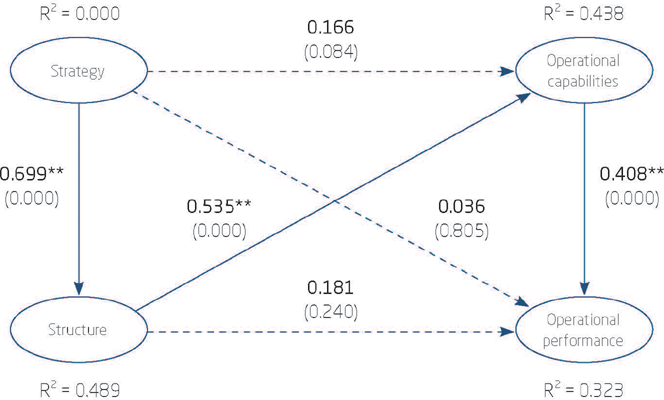 Note: p-values for each standardized parameter are shown in parentheses.
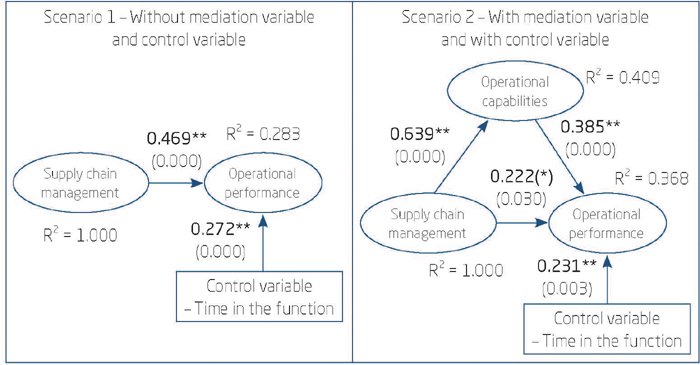 Notes: Paths in bold highlight significant connections at p < 0.05.(*) t-values significant at p < 0.05 and (**) t-values significant at p < 0.01; (p-values in parentheses from the Smart PLS 3.0 report).