 DYNAMICS OF ENTREPRENEURIAL ECOSYSTEMS IN BRAZIL AND THE NETHERLANDS: THE ROLE OF UNIVERSITIES TO FOSTER ECOSYSTEMS AND KNOWLEDGE-INTENSIVE ENTREPRENEURIAL FIRMS IN THE GLOBAL SOUTH
ABSTRACT
The literature on innovation policies for knowledge-intensive entrepreneurship presents results achieved at the macroeconomic level, discussing results based on indicators to evaluate the effectiveness and efficiency of these policies. There is still a need for research in this area at the micro and meso levels, analyzing and discussing these innovation policies in knowledge-intensive entrepreneurial (KIE) companies and entrepreneurial ecosystems. This study investigated the disparities between regional innovation and entrepreneurship policies in a developing country and a developed country, examining the support offered for entrepreneurial ecosystems and KIE firms. Interviews were carried out with researchers, policymakers, and entrepreneurs in the state of Ceará, Brazil, and in the region of Twente, in the Netherlands. In the Brazilian state, the policy aimed to build an entrepreneurial ecosystem with low maturity, connecting academia, government, and companies. In Twente, universities boosted innovation, attracting companies to technology parks and promoting knowledge flows through projects and businesses. The study offers insights on how universities in the Global South can contribute to develop entrepreneurial ecosystems, contributing to the UN Sustainable Development Goals 8 - Decent work and economic growth and 9 - Industry, innovation, and infrastructure.
Keywords:
knowledge-intensive entrepreneurship; innovation policy; entrepreneurship policy; dynamic capabilities; entrepreneurship ecosystem.
RESUMO
A literatura sobre políticas de inovação para o empreendedorismo intensivo em conhecimento apresenta resultados alcançados em nível macroeconômico, discutindo resultados com base em indicadores para avaliar a eficácia e eficiência dessas políticas. Ainda há necessidade de pesquisas que visem estudar essa área nos níveis micro e meso, analisando e discutindo essas políticas de inovação no empreendedorismo intensivo em conhecimento (EIC) empreendimentos intensivos em conhecimento (EIC) e no ecossistema empreendedor. Este estudo investigou as disparidades entre as políticas regionais de inovação e empreendedorismo num país em desenvolvimento e num país desenvolvido, examinando o apoio ao ecossistema empreendedor e ao EIC. Foram realizadas entrevistas com pesquisadores, formuladores de políticas e empresários no estado do Ceará, no Brasil, e na região de Twente, nos Países Baixos. No caso brasileiro, a política teve como objetivo construir um ecossistema empreendedor com baixa maturidade, conectando academia, governo e empresas. Em Twente, as universidades impulsionaram a inovação atraindo empresas para parques tecnológicos e promovendo fluxos de conhecimento via projetos e negócios. O estudo oferece insights sobre como as universidades do Sul Global podem contribuir para o desenvolvimento dos ecossistemas de empreendedorismo, contribuindo com os Objetivos de Desenvolvimento Sustentável (ODS) das Nações unidas, em particular o ODS 8 - Trabalho decente e crescimento econômico, e o ODS 9 - Indústria, inovação e infraestrutura.
Palavras-chave:
empreendedorismo intensivo em conhecimento; política de inovação; política de empreendedorismo; capacidades dinâmicas; ecossistema empreendedor.
RESUMEN
La literatura sobre políticas de innovación para empresas intensivas en conocimiento (EIC) presenta los resultados alcanzados a nivel macroeconómico y discute dichos resultados basándose en indicadores para evaluar la efectividad y eficiencia de estas políticas. Aún existe una necesidad de investigaciones dirigidas a estudiar esta área a nivel micro y meso, que analicen y discutan estas políticas de innovación en las EIC y en el ecosistema emprendedor. Este estudio investigó las disparidades entre las políticas regionales de innovación y emprendimiento en un país en desarrollo y un país desarrollado, examinando el apoyo al ecosistema emprendedor y a las EIC. Se realizaron entrevistas con investigadores, responsables de políticas y empresarios. En Ceará, Brasil, la política apuntó a construir un ecosistema emprendedor de baja madurez, conectando academia, gobierno y empresas. En Twente, Países Bajos, las universidades impulsaron la innovación, atrayendo empresas a parques tecnológicos y promoviendo flujos de conocimiento a través de proyectos y negocios. Este artículo ofrece insights sobre cómo las universidades del sur global pueden contribuir al desarrollo de los ecosistemas de emprendimiento contribuyendo así a los Objetivos de Desarrollo Sostenible (ODS) 8 y 9 (Trabajo decente y crecimiento económico, e Industria, innovación e infraestructura).
Palabras clave
empresas intensivas en conocimiento; política de innovación; política de emprendimiento; capacidades dinámicas; ecosistema de emprendimiento..
INTRODUCTION
Knowledge-intensive entrepreneurship has been a widely studied field of research, exploring the factors promoting this approach (Caloghirou & Llerena, 2015; Groen, 2005). These studies address both its development at the regional level, investigating inter-institutional dynamics, and at the firm level, seeking to understand internal factors that characterize knowledge-intensive entrepreneurial (KIE) firms. Another aspect of research in this field is the public policies to promote KIE firms, investigating government mechanisms that encourage and promote the creation and development of these firms (Acs et al., 2014; Fischer et al., 2018).
A vast literature on knowledge-intensive entrepreneurship explores mechanisms that promote and encourage entrepreneurship, technology, and innovation (Audretsch, 2014; Caloghirou & Llerena, 2015; Stam, 2015; Walsh, 2019). Entrepreneurship policies usually focus on i) supporting the development of new businesses through tax incentives or loans; ii) mentoring the development of new businesses, through monitoring programs for the development and scaling of the business; iii) investing in institutions that are conducive to the development of innovative entrepreneurship, such as universities and science and technology institutions. Regarding policies for developing new businesses and entrepreneurs, there are different strategies to foster KIE Firms. Literature on dynamic capabilities helps to understand the promotion and development of these companies in the context of entrepreneurship policies.
Dynamic capabilities are the firm’s internal capabilities. They seek to understand how firms develop their competitive advantages (Groen, 2005; Teece et al., 1997). In this regard, various entrepreneurship policies are implemented to enhance the dynamic capabilities of KIE firms and foster an entrepreneurial ecosystem. Universities typically play an important role in the planning and implementation of entrepreneurship policies by promoting KIE firms and entrepreneurial ecosystems (Siegel & Wright, 2015; Uyarra, 2010).
Research on the implementation of entrepreneurship policies comparing regions and countries has recently gained prominence (Subrahmanya, 2017). Although there are studies that compare entrepreneurial ecosystems in different regions, there are still few studies that compare entrepreneurship policies and entrepreneurial ecosystems in developed and developing countries. Usually, these studies focus on innovation policy and measure economic variables at the macro-level (Kantis et al., 2021; Russo & Pavone, 2021).
More studies are necessary on the impacts of these policies at the meso and micro-level, in terms of capabilities, practices, and routines of companies engaged in programs designed to develop entrepreneurial ecosystems. In addition, further research is needed on strategies to foster these ecosystems. Within this research gap, this study seeks to understand the differences and similarities of ecosystems and entrepreneurship policies between a developed and a developing region, guided by the following research question: What is the role of universities in entrepreneurship policies that foster knowledge-intensive entrepreneurial firms?
The regions chosen were the state of Ceará, in Brazil, and Twente, in the Netherlands. The choice was strategic for several reasons. Firstly, Ceará is a rising state in Brazil, with a diversified economy and a growing innovation ecosystem, making it an interesting case study for understanding technological development in emerging regions. On the other hand, Twente is internationally recognized as a leading region in innovation, with a strong investment in research and development, and a solid infrastructure for high-tech companies. By comparing data from these regions, it is possible to analyze the challenges faced by developing economies and the best practices adopted by developed regions, providing valuable insights for advancing innovation in both contexts.
The findings can foster the discussion on how universities in the Global South can inspire from other experiences in the Global North to foster the development of regional entrepreneurial ecosystems. This contributes to the UN Sustainable Development Goals (SDGs) 8 and 9 by revealing measures that organizations in the Global South may adopt to advance entrepreneurship, innovation, and regional economic development.
LITERATURE REVIEW
Maturity levels of entrepreneurial ecosystems and the influence of public policy
Many studies on entrepreneurship and innovation have addressed the issue of entrepreneurial ecosystems, emphasizing the importance of regional development in boosting entrepreneurship. The ongoing debate on knowledge-intensive entrepreneurship also touches this aspect, at the same time as it seeks to increase understanding of how regions and countries can foster this approach. Such discussions focus on creating technology-based businesses capable of significantly enhancing the economy and regional development (Fischer et al., 2018; Harrison & Leitch, 2010; Virolainen et al., 2024).
The literature has explored how strengthening connections and relationships among actors within an ecosystem can contribute to forming an entrepreneurial ecosystem. These studies have fueled debates on how entrepreneurs and institutions interact to create innovative businesses with high economic potential and regional impact (Guerrero & Lira, 2023; Qian, 2018; Spigel & Harrison, 2018; Stam, 2015). In addition to academic discussions, public policies aimed at fostering these ecosystems have been prominent, especially in Europe and the U.S., with examples of policies focused on their creation and development (Brown & Mason, 2017; Ferguson & Fernández, 2015; Spigel, 2022).
The formulation and implementation of entrepreneurship po’licies must consider the socio-economic and cultural contexts, assessing the maturity of entrepreneurial activities and the generation of knowledge-intensive entrepreneurial firms (Guerrero & Lira, 2023). In this sense, Wurth et al. (2022) observe that path-dependence applies to entrepreneurial ecosystems, emphasizing the importance of regional characteristics as the foundation for entrepreneurship policy.
Despite the extensive research on entrepreneurial ecosystems and knowledge-intensive entrepreneurship, studies focusing on regions at early stages of ecosystem development or on policies promoting KIE businesses are limited. It is worth reflecting on how to classify the maturity of entrepreneurial ecosystems in a developing country like Brazil, considering that studies such as Brown and Mason (2017) have explored developed countries - Portugal and Finland -, and classified them as “embryonic ecosystems.” Therefore, more efforts are needed to understand regions that are just beginning to implement their entrepreneurship policies, observing how they can benefit from the lessons learned in countries that have undergone this experience.
The role of universities in fostering dynamic capabilities within entrepreneurial ecosystems
Many studies highlight universities and their science and technology parks as key drivers of innovation and entrepreneurship (Harrison & Leitch, 2010). Universities are seen as critical institutions in fostering entrepreneurial ecosystems that encourage innovation and technological development (Guerrero & Urbano, 2012; Rasmussen & Wright, 2015). Beyond traditional R&D partnerships with companies to generate patents and transfer technology, universities are now directly involved in creating companies through academic spin-offs, startups, and technology-based firms (Díaz-González & Dentchev, 2022; Harrison & Leitch, 2010; Rasmussen & Wright, 2015).
Research, knowledge creation, and their application to generate economic value, along with entrepreneurial education (Arranz et al., 2017), make universities one of the most important institutions for entrepreneurial ecosystems and the creation of KIE firms. In the academic environment, the stimulation of new ideas, research, technology development, and problem-solving drives entrepreneurship.
Universities are fundamentally important for innovation and entrepreneurial ecosystems, and for creating and developing KIE firms (Leydesdorff & Etzkowitz, 1995; Ranga & Etzkowitz, 2015; Etzkowitz & Leydesdorff, 2000; Zmiyak et al., 2019). They are the central institutions responsible for providing human capital and new knowledge to society. The skilled human resources, well-versed in the latest advancements in their fields, are typically the ones who start new KIE firms or contribute to their growth (Audretsch, 2014; Bonaccorsi et al., 2014; Brown, 2016; Pinto et al., 2015). Furthermore, the partnership between universities and KIE firms is crucial for fostering interaction with industry, as KIE firms serve as intermediaries of knowledge in the relationship between industry and university (Pinto et al., 2015).
Universities also play a significant role in operationalizing dynamic capabilities within the context of public policies for entrepreneurship. Their importance lies in their ability to act as centers of knowledge and innovation, providing essential resources for these dynamic capabilities (Protogerou & Caloghirou, 2015). Higher education institutions are key sources of technical, scientific, and technological knowledge, offering advanced research, specialized laboratories, and academic expertise.
Universities are crucial in fostering dynamic capabilities within firms by facilitating knowledge transfer, developing human capital, and nurturing innovation networks. Through collaboration with businesses, universities help build firms’ adaptive and absorptive capacities, enabling them to effectively respond to changes in the market and technological landscapes. For example, research by Siegel and Wright (2015) shows how university-business collaborations enhance firms’ innovative performance by integrating scientific knowledge into business practices.
Analytical framework
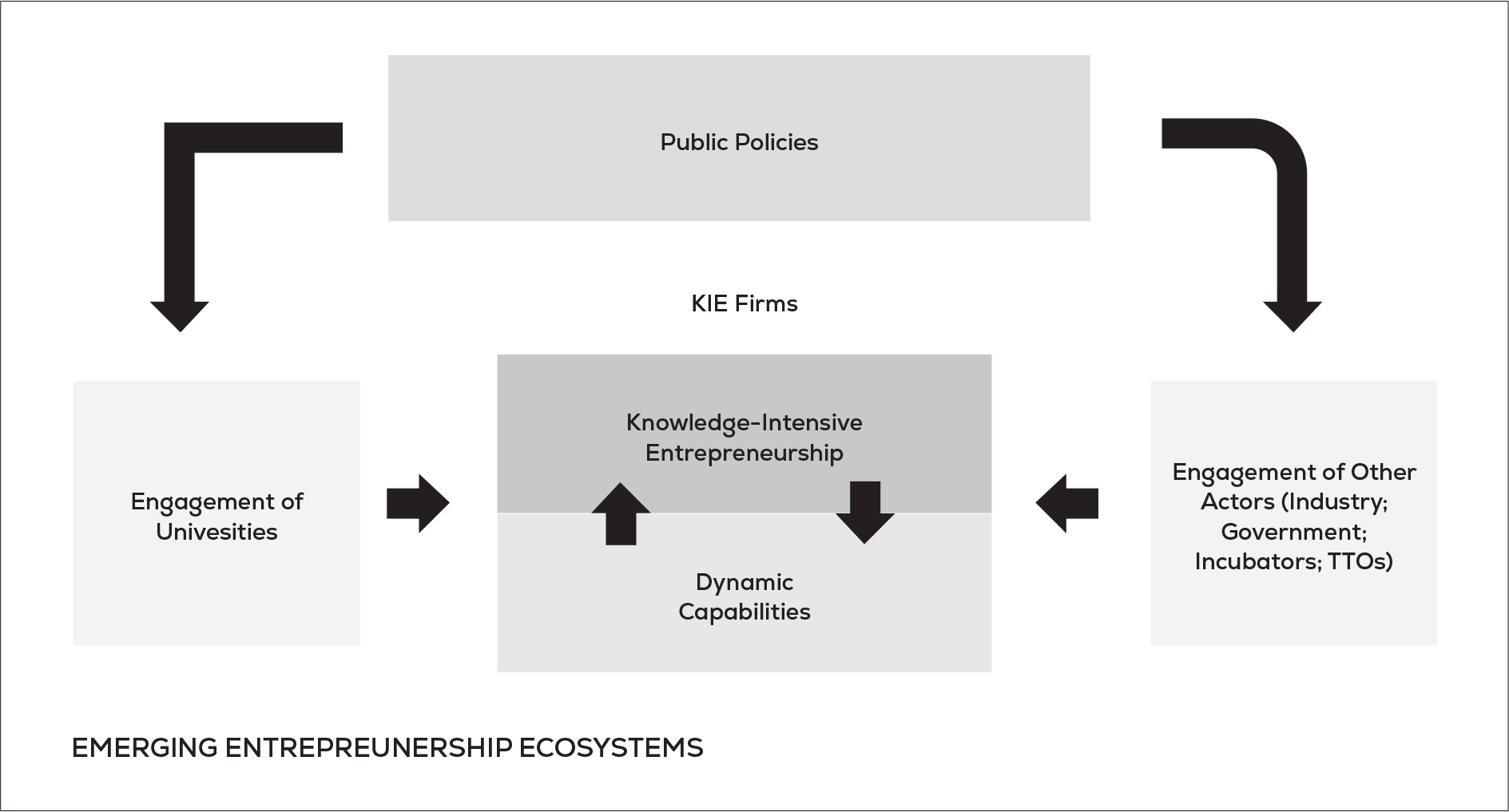
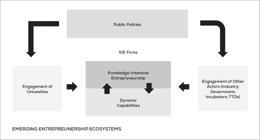
The analytical framework proposed in this research focuses on public policy relations in emerging entrepreneurial ecosystems (Figure 1). The promotion of KIE firms occurs through the participation and engagement of universities, industries, and other important institutions such as incubators, technology transfer offices (TTOs), and government departments.
Studying KIE firms is crucial considering their innovation-driven growth, particularly within entrepreneurial ecosystems. KIE firms rely on advanced knowledge and human capital to create innovative solutions (Malerba & McKelvey, 2020). Understanding these firms offers valuable insights into how innovation systems function in various contexts, especially when comparing developed and developing countries.
Dynamic capabilities, a concept introduced by Teece et al. (1997), explain how firms adapt, innovate, and maintain competitiveness by developing and reconfiguring internal and external resources. This framework is especially relevant for KIE firms, which must navigate rapidly evolving technological and market environments. By exploring dynamic capabilities, the study can reveal how firms in different regions innovate under diverse institutional support and constraints, focusing on universities’ role in fostering dynamic capabilities.
Innovative policies represent the formal mechanisms through which governments support technological development and entrepreneurial activity. Policies promoting R&D, knowledge transfer, and entrepreneurial networks are crucial in shaping the success of KIE firms and the broader entrepreneurial ecosystem (Lundvall, 2007). Comparing innovation policies between developed and developing countries can highlight disparities in support for KIE firms and reveal gaps that hinder entrepreneurial growth in less-developed contexts.
By integrating literature on KIE firms, dynamic capabilities, and innovation policies, this study aims to provide a comprehensive understanding of how regional policies influence entrepreneurial ecosystems and the development of KIE firms, focusing on universities’ role in fostering both. These insights can guide policymakers in adopting best practices to encourage innovation-driven entrepreneurship across diverse economic contexts.
RESEARCH DESIGN
Research setting: A comparison between entrepreneurship policies from Ceará/Brazil and Twente/Netherlands
The study was conducted in the state of Ceará within the framework of the Economic Clusters of Innovation Program (ECIP), a regional innovation policy aimed at reinforcing economic and social development. The program seeks to enhance regional competitiveness, foster a new economy based on innovation-driven business ventures, promote better income distribution, and attract and retain talent by offering quality opportunities. It encourages entrepreneurs with innovative ideas to address key competitiveness challenges within Ceará’s existing economic clusters.
The program promotes the development of technological solutions and the creation of projects by KIE companies, contributing to the advancement of specific sectors. It was selected for this study due to its network approach and focus on fostering entrepreneurial innovation through the implementation of entrepreneurial ecosystems to boost each cluster/region. A total of 52 interviews were conducted with entrepreneurs, KIE company managers, researchers, and policymakers.
In the Twente region, the research was not focused on a specific public policy but rather on various actors within an innovative and entrepreneurial ecosystem. A total of 15 interviews were conducted with policymakers involved in formulating and implementing public policies to foster innovation and entrepreneurship, early-stage entrepreneurs, university members engaged in planning and implementing innovation and entrepreneurship policies at the region’s main universities, and students who participated in programs promoting innovation and entrepreneurship.
Methodological approach
For this research, primary and secondary data were collected through semi-structured, in-depth online interviews and documentary analysis. Table 1 presents the interview script. Data collection occurred between January and March 2022. The interviews, which the average time was 40 minutes, were recorded with the participants’ consent and transcribed.
The research strategy employed was a multiple case study (Yin, 2002), which allows us to compare two distinct regions and examine their institutions, such as universities, companies, and governments (public policies). Following Eisenhardt’s (2021) guidelines for selecting cases for comparison, two regions with different development characteristics were chosen, allowing for a comparison that could highlight similarities and differences for theory building (Eisenhardt, 2021). The findings from these similarities and differences can potentially advance the theory on the role of universities in entrepreneurship policies.
Yin’s (2002) recommendation was adopted, analyzing complementary data in addition to the interviews: i) documents and supplementary files related to the policies and universities; ii) public policy management reports, which included data on the program’s execution stages, goals achieved, results obtained, and perceived benefits; iii) additional information from the interviewees after the interviews, aimed at validating the analyses. The data from interviews and documents were analyzed through data triangulation (Alves et al., 2019). Table 2 presents the background of the actors interviewed for the study.
Data from the program’s documents, participants’ perceptions, and final reports were also incorporated into the research. In addition to data triangulation, thematic content analysis techniques were employed, based on pre-determined and emerging categories of interpretation and narrative analysis. Thematic content analysis involves identifying the core meanings within a communication, where the presence or frequency of these meanings contributes to achieving the analytical objective.
The analytical categories were organized and divided into subcategories, as presented in the analytical framework. Data analysis involved cross-referencing information collected from documents and observations recorded from program participants during the interviews, providing detailed insights into the initiatives and activities of the ECIP. Codifications were carried out based on emerging concepts from the field, aligned with existing literature, following the methodological approach of Gioia et al. (2013).
Based on the analysis and following Gioia et al.’s (2013) methodology, the first-order categories were identified: i) strategies and implementation of innovation/entrepreneurship policies, which captures interviewees’ perspectives on this matter; ii) dynamics of entrepreneurial ecosystems, which reveals perceptions of the actors and dynamics involved in developing entrepreneurial ecosystems, as well as their relationship with policies and universities; and, finally, iii) the role of the universities, which compiles information on these institutions as orchestrators of the ecosystem, executors of the policy, and promoters of KIE firms. These first-order categories were further detailed into subcategories, which together structure the results section below.
In addition to the interviews and documentary analysis, direct observation and engagement with entrepreneurs, policymakers, and researchers in the Netherlands provided insights into the local entrepreneurial ecosystem. The dataset obtained from the two regions allowed for a comparison of their innovative and entrepreneurial ecosystems, as well as the roles of the institutions involved.
RESULTS
The content analysis involved the development of codes in first and second order (Strauss, 2003) to establish connections between the interviewees’ speech and the literature. Microsoft Excel was used to classify the quotes according to themes and AI tools such as ChatGPT was employed in data triangulation to synthesize analyses, compile information, and compare interviewees’ statements.
Strategies and implementation innovation/entrepreneurship policies
The structuring of the innovation/entrepreneurial ecosystem as an objective of the policy and the interactions within the triple helix
The entrepreneurship policies were primarily formulated to establish the foundations for a sustainable entrepreneurial ecosystem (Audretsch & Link, 2012; Autio & Rannikko, 2016). The intention was to facilitate connections and collaborative networks among institutions that can leverage the development of innovative initiatives and actions.
The first initiatives aimed at fostering entrepreneurship and innovation in the Twente region focused on establishing relationships between companies to connect and share knowledge and resources, leveraging their innovation potential. The policies implemented in the Twente region in the early 2000s sought to create innovation hubs, attracting companies to areas near the region’s main university, facilitating the exchange of knowledge and access to qualified human capital.
In the state of Ceará, the regional policy of the Economic Clusters of Innovation Program was aimed not only at promoting the creation and maturation of knowledge-intensive entrepreneurial (KIE) firms, but also at the maturation of an innovative and entrepreneurial ecosystem. The interviewees’ speeches revealed the program’s important role in maturing the ecosystem by promoting collaboration between the industry and the university, connecting entrepreneurs and researchers.
One of the main characteristics of both policies analyzed, in Brazil and the Netherlands, is the objective of establishing the university as one of the main institutions to host and lead programs to foster innovation, aligning with findings from previous studies (Borwn, 2016; Pinto et al., 2015). Programs that foster entrepreneurship in students, presenting undergraduate students with opportunities in this field, are used to foster knowledge-intensive entrepreneurship, allowing students to apply the knowledge acquired at the university to generate new businesses.
Training and retaining talent as a guideline for innovation policy and regional development
One of the main concerns of the innovation and entrepreneurship policies studied was the promotion of regional development by fostering innovation and entrepreneurship and mitigating the risk of talent evasion. Talent retention is crucial in regional development policies, since innovation requires qualified human resources (Câmara et al., 2022).
The interviews with policymakers in the Twente region showed that talent retention is a strategic objective in their innovation policies. The importance of talent retention was also observed from the fact that a manager of one of the KIE firms in the region designed a solution in this sense, starting a business that connects undergraduate-level students, who are in the early stages of their careers, with companies that need professionals with this profile.
In Ceará, ECIP aimed to direct talents from universities, specialist researchers, and students with an entrepreneurial profile, to address the industry’s bottlenecks, to further specialize these professionals, and generate business from the exchange of knowledge. Although retaining human capital is one of ECIP’s goals, its strategies were mainly focused on promoting the creation of new companies. Subsequently, the entrepreneurs and employees participating in these companies continue working in the region.
The risks associated with this strategy are the fact that it is essentially tied to the belief that the program’s companies will thrive and that the involved employees will remain working in them. It would be important for the program to establish other strategies to promote employability and retention of human capital. Among these strategies would be the establishment of policies to promote hiring for participating industries, such as access to university talents and ease of recruitment, through hiring policies involving scholarships in R&D projects, for instance. The research findings corroborate other results in the literature, highlighting the relevance of universities as providers of human capital for KIE firms (Audretsch, 2014; Bonaccorsi et al., 2014; Brown, 2016).
Dynamics of the entrepreneurial ecosystem
Importance of connection and collaboration between KIE firms and industry
Collaboration between industry and KIE firms was one of the main objectives of the public policies studied in the regions of both countries. The ECIP had as its premise the mapping of technological bottlenecks in Ceará’s industry, separated by economic sectors in the region. Based on this mapping, challenges were launched so that potential entrepreneurs and early-stage KIE firms could participate.
These policies work in various ways, such as fostering institutions that support the creation and development of KIE firms, offering mentoring, and promoting government policies that encourage R&D collaboration between universities and industry. Events like the UT Challenge also stimulate startup creation. KIE firms focus on building connections with established suppliers and partners and hiring skilled human resources for their projects. For instance, having access to talent like developers is crucial for executing innovative projects and new businesses. Thus, innovation policies aim to create an environment that bridges the triple helix players, bringing universities, researchers, and market professionals together to foster business growth and innovation.
The policy implemented in Ceará faces challenges in terms of triple helix interaction and implementation, difficulties that have been highlighted in previous literature (Carayannis et al., 2022; Leydesdorff & Etzkowitz, 1995). The policy aimed to promote the creation of KIE firms and foster interaction between these startups and the industry. However, a key issue observed was the low engagement from the industry in collaborating with these companies to develop new technologies.
The role of the government and public policy in strengthening the ecosystem
In the innovation policies studied, the government plays a critical role not only in financing but also in implementing and operationalizing the policy (Audretsch & Link, 2012; Patanakul & Pinto, 2014). The government collaborates with other institutions, with universities being key partners in implementing innovation and entrepreneurship policies. In the case of the ECIP in Ceará, the policy aimed to foster the state’s entrepreneurship ecosystem by promoting cooperation within the triple helix framework. The program sought to enhance interaction among KIE firms, industries, and university researchers (represented by the Regional Researcher). Interviewees highlighted that a key aspect of the program was encouraging cultural change within institutions, fostering greater collaboration among the triple helix actors.
This is one of the limitations of the ECIP, as it aims to foster the entrepreneurial ecosystem in its early stages of development by promoting collaboration among actors, resulting in cultural and institutional practice changes. This type of policy works on fostering collaboration among actors during the execution of the policy. However, the difficulty of this type of policy lies in the continuity and sustainability in the long term.
Public policies that follow the implementation of an innovation policy should focus on continuing to support industries and KIE firms through mentorship and financing. However, it is important to emphasize that the willingness of these actors to collaborate and take joint actions is essential for the development of the ecosystem. This positions institutions as key players in ecosystem development, with public policies serving to foster and promote this development.
In the case of the Twente region, the federal government worked with the allocation of resources according to established criteria and based on the region’s performance. The government at the regional level also financed innovation projects, but mainly acted in support of the operationalization of policies. The regional government is also more concerned with the development of the entrepreneurial ecosystem, which is a recommendation pointed out in the literature (Brown & Mason, 2017; Cantner et al., 2021).
Role of the universities
The universities as the main actors within the entrepreneurial ecosystem
Universities can be considered the main institutions fostering entrepreneurship and innovation in the policies studied. They work as a way for the government to operationalize policies, forming an emerging ecosystem from the academic environment. It is an environment counting on researchers with expertise in different economic sectors, students who have the interest and potential to become entrepreneurs, as well as qualified labor to work on projects or become employees of KIE firms.
The university thus becomes a major connection hub, to implement government policies, to attract the interest of the private sector for the development of R&D projects and to foster the creation of new KIE firms, in addition to offering qualified human capital, allowing knowledge spillovers to the different spheres of society and the market. The findings corroborate previous studies of Qian (2018) and Cantner et al. (2021), which highlight the importance of universities in knowledge spillovers to foster entrepreneurial ecosystems in early stages of development.
Many universities in Ceará actively participated in the ECIP, through the presence of regional researchers in the program. Most of the participants (entrepreneurs, potential entrepreneurs, and managers of KIE firms) come from these universities, which demonstrates the importance of the universities’ technological capacity and human capital for the economy of Ceará. The regional researcher was included in each of the clusters proposed by the program, aiming to support KIE firms in the development of their technological solutions and responsible for connecting these early-stage KIE firms with industry managers.
In Twente, the institution that fosters entrepreneurship and innovation, called Novel-T, is located at the main university of the region, the University of Twente. The institution is funded and maintained by the local government in partnership with the University of Twente and the Saxion University. The university promotes several actions to foster knowledge-intensive entrepreneurship, such as entrepreneurship competitions, technological development competitions, and creates connection hubs with companies and students working in technical sectors (such as robotics, biotechnology, and environmental protection).
The role of the university in developing network capability in KIE firms
Network capability was an element that stood out in the interviews. The innovation policies investigated focused on connecting different actors in the entrepreneurial ecosystem, both in Brazil and in the Netherlands. Network capability was noticed at the ecosystem level (Roundy & Fayard, 2019), when connecting different actors, such as entrepreneurs, researchers, policymakers, and university students, and at the firm level, as the KIE firms benefit from new contacts and mentorships (Protogerou & Caloghirou, 2015).
In ECIP, regional researchers were responsible for guiding a group of KIE firms in specific areas of expertise. Besides providing technical guidance to the companies and teams participating in the program, these actors had the role of establishing connections with specialized professionals in the field and industry managers. However, the teams did not have as much access to connections and interactions with the regional researchers’ home universities because of the centralization of the communication in the researcher.
In the Twente region, universities acted institutionally, being responsible for leading projects and formalizing partnerships to promote knowledge-intensive entrepreneurship. As mentioned before, the two main universities in the region fund an institution called Novel-T, which coordinates entrepreneurship and innovation actions, such as business incubation, event promotion, offering coworking spaces, and connections for fledgling startups. Novel-T is an important hub connecting companies, universities, research centers, and entrepreneurs. The events and programs promoted by the institution are aimed at developing students and potential entrepreneurs in business management and the creation of new ventures.
The role of the university in developing absorptive capability in KIE firms
Universities play a pivotal role in developing absorptive capabilities in KIE firms by serving as hubs for knowledge creation, dissemination, and collaboration. Through research partnerships, knowledge transfer programs, and incubators, universities provide KIE firms with access to cutting-edge scientific knowledge and technological expertise (Perkmann et al., 2013). For instance, collaboration with university researchers helps KIE firms enhance their ability to recognize and integrate new knowledge, thereby strengthening their absorptive capacity. Additionally, universities contribute to the development of human capital by equipping graduates with advanced analytical skills and problem-solving abilities that are critical for knowledge assimilation in these firms (Siegel & Wright, 2015). By facilitating innovation networks and promoting an entrepreneurial mindset, universities help KIE firms stay agile and competitive in knowledge-intensive industries.
In the ECIP policy, regional researchers were important in promoting learning for the participating KIE firms and entrepreneurs and provided technical guidance to the participating teams, with the main objective of transforming the team’s technical knowledge (potential absorptive capacity) into a technological product/service (realized absorptive capacity). In the Twente region, however, this role of fostering and promoting learning for KIE Firms was primarily centralized in Novel-T. Besides promoting learning in management and business areas, the institution also facilitated connections with specialized professionals and provided technical training in varied fields.
Table of comparison
The policies studied were aimed at different profiles of entrepreneurs and KIE firms: i) the potential entrepreneur, who is looking to start a new business and is usually in the ideation and proof-of-concept phase of the product; ii) the entrepreneur in the initial stage of development, who already has a minimum viable product, and who is looking to mature the product and start the first sales; iii) the KIE firm in early stages, which already has a business model and a validated product, and which is seeking to consolidate its presence in the market and have sustainable revenue; iv) the KIE firm that is seeking to leverage its business potential, improving productivity and generating competitive advantages, in addition to expanding its operations in the market.
Table 3 presents a comparison matrix between the findings of the Twente region and the state of Ceará, related to the application of their innovation and entrepreneurship policies in their region. These findings can help to clarify the main differences between the two ecosystems and the innovative policies adopted.
Contributions to the literature and practice on the role of universities in developing regions
The analysis of the differences (Table 3) found between the two regions can be observed in a more systematic way in Figures 2a and 2b. In the Twente region (located in a developed country), public policy is filtered and implemented by the orchestrated action between the ecosystem actors and mainly by the coordinated and collaborative actions involving universities and entrepreneurs, making the policy more customized and capable of affecting the ecosystem more effectively, creating dynamic capabilities for KIE firms and making these ecosystems capable of evolving more, and faster (Acs et al., 2014; Autio et al., 2014).
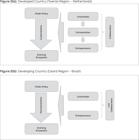
Difference between Developed and Developing Countries Regarding the Performance of Public Policies on Entrepreneurial Ecosystems
In the context of a developing country, the policy in the Brazilian state of Ceará shows advances along its trajectory. However, there is still a lack of greater coordination between the actors and collaboration, resulting in more homogeneous policies that fail to address the different actors’ specific needs (Fischer et al., 2018; Stam, 2015). The findings of this research reinforce the importance of adapting the policy to the local reality, considering the specificities of the regions and, mainly, of the actors that comprise it (Audretsch & Link, 2012).
This study contributes to the discussion of entrepreneurial universities and their role in entrepreneurial ecosystems (Abreu & Grinevich, 2024; Compagnucci & Spigarelli, 2020; Lahikainen et al., 2019). It was possible to observe the similarities and differences in the implementation of entrepreneurship and innovation policies in the two regions with different levels of development, demonstrating that the experience in a developed economy has a greater density of connections between the institutions that are part of the ecosystem (Spigel & Harrison, 2018). The results contribute to the literature by presenting an analytical framework and empirical evidence on the role of universities in leading initiatives in the entrepreneurial ecosystem, and how this leadership can foster the dynamic capabilities for KIE firms linked to the university (Bonaccorsi et al., 2014; Perkmann et al., 2013). The mechanisms of collaboration of universities in developed countries, such as the university acting as a business attractor and fostering entrepreneurial initiatives, demonstrate the relevance of mechanisms of technology transfer and entrepreneurial programs in universities (Audretsch, 2014; Etzkowitz & Leydesdorff, 2000). Some regions of developing countries still lack actions to put universities in leadership positions and enable them to operate as orchestrators in entrepreneurial ecosystems (Cantner et al., 2021; Fischer et al., 2018).
This study also contributes to the literature by addressing gaps in innovation policies for knowledge-intensive entrepreneurship at the micro and meso levels, particularly in developing and developed countries. While existing research focuses on macroeconomic indicators, this study examines how regional policies impact entrepreneurial ecosystems and KIE firms. By comparing Ceará, Brazil, and Twente, Netherlands, it was possible to highlight different ecosystem maturities and universities’ roles in driving innovation. Virolainen et al. (2024) note universities’ crucial role in regional innovation ecosystems, while Ferguson and Fernández (2015) stress their importance in terms of offering science parks and leading entrepreneurial initiatives. Zmiyak et al. (2019) emphasize the university’s leading role as supporters of KIE firms. This research builds on these frameworks to explore how universities collaborate with government and industry to influence regional innovation and the development of knowledge-intensive entrepreneurship.
Contributions to the societal challenges and the role of universities in the Global South
By examining the role of universities in regional innovation policies, this study expands the discussion on their influence within entrepreneurial ecosystems. In line with Guerrero and Urbano (2012), the findings highlight universities as key enablers of entrepreneurial capabilities, though their impact varies based on institutional and regional dynamics. Additionally, Díaz-González and Dentchev (2022) emphasize that while universities provide essential resources for entrepreneurs, structural barriers can hinder effective collaboration, a challenge also observed in this study.
Building on Guerrero and Lira (2023), the research reinforces the importance of university engagement in sustainability-oriented innovation policies, particularly in developing economies where their role can be pivotal in fostering economic and social transformation. In this sense, the findings provide guidance on how universities in the Global South can act to foster entrepreneurial ecosystems in their regions, when comparing the actions executed in a region of a developed country with the actions of a developing region.
Finally, the findings of this research reinforce the role of universities in coordinating, fostering, and orchestrating the actions of entrepreneurial ecosystems and public policies, even influencing the trajectory of companies’ dynamic capabilities (Teece et al., 1997; Walsh, 2019). In the case of a developing region, such as the Brazilian state of Ceará, universities have directed efforts to lead and generate engagement in entrepreneurial programs, but there is still a long way for the universities to reach a high level of orchestration and leadership in the regional entrepreneurial ecosystems (Pinto et al., 2015; Qian, 2018).
The framework and discussions presented reinforce how public policies can count on universities to generate dynamic capabilities for KIE companies, in partnership with other actors in the ecosystem, such as industries, TTOS, and incubators (Caloghirou & Llerena, 2015; Uyarra, 2010).
CONCLUSIONS
This study sought to understand how regional innovation and entrepreneurship policies of a developing country differ from those of a developed country in fostering the development of the entrepreneurial ecosystem and the development of knowledge-intensive entrepreneurship. The comparison between entrepreneurial ecosystems and public policies in these regions allowed us to analyze the opportunities for improvement and the lessons learned that the two regions can share.
Despite the differences in geographical size and the maturity levels of their respective entrepreneurial ecosystems, the comparison between the two regions is valid for enabling learning and examining the strategies followed for the development of knowledge-intensive entrepreneurship. The Twente region can be classified, following Cantner et al.’s (2021) scale, as “phase II: The growth of an entrepreneurial ecosystem,” as it presents evidence of support levels and mentoring according to the profile of KIE firms, some of which are examples of high scalability potential, such as the company Booking.com. The state of Ceará, in turn, is still in the phase of growth and consolidation of its ecosystem. Following Cantner et al.’s (2021) scale, the region falls between “phase I: The birth of an entrepreneurial ecosystem” and phase II, with high investment in creating new companies, fostering an entrepreneurial culture, and implementing policies to make the ecosystem more specialized.
The results provide insights into the discussion on entrepreneurship and innovation policies, and on the role of universities in implementing these policies. The study also presents how universities can play a relevant role in the development of KIE companies, fostering dynamic capabilities in these firms, by presenting connective platforms (such as innovation environments, incubators, and innovation programs) with investors, entrepreneurs, and customers, as well as strengthening their networking capability and absorptive capacities. In addition to contributing to the literature, these findings are also relevant for the formulation of public policies and for university administrators and researchers working with knowledge-intensive entrepreneurship.
Thus, the results of this article provide valuable contributions for policymakers in the Global South who are responsible for formulating policies that aim to position universities as orchestrators of regional entrepreneurial ecosystems. The contributions are directly related to UN SDGs 8 and 9, by linking the role of universities in the Global South in fostering entrepreneurship and regional economic development.
The research has limitations, such as comparing regions of different geographical sizes, which influences the development of entrepreneurship and innovation policies and the behavior of entrepreneurial ecosystems. Also, the study did not focus on a specific policy in the Twente region, which required establishing the research locus for ecosystem analysis. The analyses of public policy strategies were conducted in a generic manner, without focusing on a specific public policy. Finally, the qualitative study also has limitations as it does not allow generalizations and applications to all contexts, despite presenting useful insights.
Future research should compare similar policies between developed and developing countries, refining the insights obtained in this study. Although it is quite challenging to make this comparison during policy implementation, as in the cases examined here, conducting comparisons through ex-post analyses is still possible.
-
Evaluated through a double-anonymized peer review.
-
The Peer Review Report is available at this link
ACKNOWLEDGEMENTS
The researchers would like to recognize the support from SECITECE (Secretaria de Ciência, Tecnologia e Educação Superior), SDE (Secretaria do Desenvolvimento Econômico), FUNCAP (Fundação Cearense de Apoio ao Desenvolvimento Científico e Tecnológico), Programa Cientista Chefe, and the Economic Clusters Innovation Program.
REFERENCES
-
Abreu, M., & Grinevich, V. (2024). The entrepreneurial university: Strategies, processes, and competing goals. The Journal of Technology Transfer, 49(6), 1991-2034. https://doi.org/10.1007/s10961-024-10085-7
» https://doi.org/10.1007/s10961-024-10085-7 -
Acs, Z. J., Autio, E., & Szerb, L. (2014). National systems of entrepreneurship: Measurement issues and policy implications. Research Policy, 43(3), 476-494. https://doi.org/10.1016/j.respol.2013.08.016
» https://doi.org/10.1016/j.respol.2013.08.016 -
Alves, A. C., Fischer, B., Vonortas, N. S., & Queiroz, S. R. R. D. (2019). Configurations of knowledge-intensive entrepreneurial ecosystems. RAE-Revista de Administração de Empresas, 59(4), 242-257. https://doi.org/10.1590/S0034-759020190403
» https://doi.org/10.1590/S0034-759020190403 -
Arranz, N., Ubierna, F., Arroyabe, M. F., Perez, C., & Fdez. de Arroyabe, J. C. (2017). The effect of curricular and extracurricular activities on university students’ entrepreneurial intention and competences. Studies in Higher Education, 42(11), 1979-2008. https://doi.org/10.1080/03075079.2015.1130030
» https://doi.org/10.1080/03075079.2015.1130030 -
Audretsch, D. B. (2014). From the entrepreneurial university to the university for the entrepreneurial society. The Journal of Technology Transfer, 39, 313-321. https://doi.org/10.1007/s10961-012-9288-1
» https://doi.org/10.1007/s10961-012-9288-1 -
Audretsch, D. B., & Link, A. N. (2012). Entrepreneurship and innovation: Public policy frameworks. The Journal of Technology Transfer, 37, 1-17. https://doi.org/10.1007/s10961-011-9240-9
» https://doi.org/10.1007/s10961-011-9240-9 -
Autio, E., Kenney, M., Mustar, P., Siegel, D., & Wright, M. (2014). Entrepreneurial innovation: The importance of context. Research Policy, 43(7), 1097-1108. https://doi.org/10.1016/j.respol.2014.01.015
» https://doi.org/10.1016/j.respol.2014.01.015 -
Autio, E., & Rannikko, H. (2016). Retaining winners: Can policy boost high-growth entrepreneurship? Research Policy, 45(1), 42-55. https://doi.org/10.1016/j.respol.2015.06.002
» https://doi.org/10.1016/j.respol.2015.06.002 -
Bonaccorsi, A., Colombo, M. G., Guerini, M., & Rossi-Lamastra, C. (2014). The impact of local and external university knowledge on the creation of knowledge-intensive firms: Evidence from the Italian case. Small Business Economics, 43, 261-287. https://doi.org/10.1007/s11187-013-9536-2
» https://doi.org/10.1007/s11187-013-9536-2 -
Brown, R. (2016). Mission impossible? Entrepreneurial universities and peripheral regional innovation systems. Industry and Innovation, 23(2), 189-205. https://doi.org/10.1080/13662716.2016.1145575
» https://doi.org/10.1080/13662716.2016.1145575 -
Brown, R., & Mason, C. (2017). Looking inside the spiky bits: A critical review and conceptualisation of entrepreneurial ecosystems. Small Business Economics, 49, 11-30. https://link.springer.com/article/10.1007/s11187-017-9865-7
» https://link.springer.com/article/10.1007/s11187-017-9865-7 - Caloghirou, Y., & Llerena, P. (2015). Public policy for knowledge intensive entrepreneurship: Implications from the perspective of innovation systems. In Dynamics of knowledge intensive entrepreneurship (pp. 451-463). Routledge.
-
Câmara, S. F., Buarque, B., Pinto, G. P., Ribeiro, T. V., & Soares, J. B. (2022). Innovation policy and public funding to stimulate innovation in knowledge intensive companies: The influence of human and social capital. Journal of Science and Technology Policy Management. 15(2), 418-442. https://doi.org/10.1108/JSTPM-09-2021-0135
» https://doi.org/10.1108/JSTPM-09-2021-0135 -
Cantner, U., Cunningham, J. A., Lehmann, E. E., & Menter, M. (2021). Entrepreneurial ecosystems: A dynamic lifecycle model. Small Business Economics, 57, 407-423. https://doi.org/10.1007/s11187-020-00316-0
» https://doi.org/10.1007/s11187-020-00316-0 -
Carayannis, E. G., Campbell, D. F., & Grigoroudis, E. (2022). Helix trilogy: The triple, quadruple, and quintuple innovation helices from a theory, policy, and practice set of perspectives. Journal of the Knowledge Economy, 13(3), 2272-2301. https://doi.org/10.1007/s13132-021-00813-x
» https://doi.org/10.1007/s13132-021-00813-x -
Compagnucci, L., & Spigarelli, F. (2020). The Third Mission of the university: A systematic literature review on potentials and constraints. Technological Forecasting and Social Change, 161, 120284. https://doi.org/10.1016/j.techfore.2020.120284
» https://doi.org/10.1016/j.techfore.2020.120284 -
Diaz-Gonzalez, A., & Dentchev, N. A. (2022). A resource-based view on the role of universities in supportive ecosystems for social entrepreneurs. Business and Society Review, 127(3), 537-590. https://doi.org/10.1111/basr.12281
» https://doi.org/10.1111/basr.12281 -
Eisenhardt, K. M. (2021). What is the Eisenhardt Method, really? Strategic Organization, 19(1), 147-160. https://doi.org/10.1177/1476127020982866
» https://doi.org/10.1177/1476127020982866 -
Etzkowitz, H., & Leydesdorff, L. (2000). The dynamics of innovation: From National Systems and “Mode 2” to a Triple Helix of university-industry-government relations. Research Policy, 29(2), 109-123. https://doi.org/10.1016/S0048-7333(99)00055-4
» https://doi.org/10.1016/S0048-7333(99)00055-4 -
Ferguson, D. L., & Fernández, R. E. (2015). The role of the university in the innovation ecosystem, and implications for science cities and science parks: A human resource development approach. World Technopolis Review, 4(3), 132-143. https://doi.org/10.7165/wtr2015.4.3.132
» https://doi.org/10.7165/wtr2015.4.3.132 -
Fischer, B. B., Queiroz, S., & Vonortas, N. S. (2018). On the location of knowledge-intensive entrepreneurship in developing countries: Lessons from São Paulo, Brazil. Entrepreneurship & Regional Development, 30(5/6), 612-638. https://doi.org/10.1080/08985626.2018.1438523
» https://doi.org/10.1080/08985626.2018.1438523 -
Gioia, D. A., Corley, K. G., & Hamilton, A. L. (2013). Seeking qualitative rigor in inductive research: Notes on the Gioia methodology. Organizational Research Methods, 16(1), 15-31. https://doi.org/10.1177/1094428112452151
» https://doi.org/10.1177/1094428112452151 -
Groen, A. J. (2005). Knowledge intensive entrepreneurship in networks: Towards a multi-level/multi dimensional approach. Journal of Enterprising Culture, 13(1), 69-88. https://doi.org/10.1142/S0218495805000069
» https://doi.org/10.1142/S0218495805000069 -
Guerrero, M., & Lira, M. (2023). Entrepreneurial university ecosystem’s engagement with SDGs: Looking into a Latin-American University. Community Development, 54(3), 337-352. https://doi.org/10.1080/15575330.2022.2163411
» https://doi.org/10.1080/15575330.2022.2163411 -
Guerrero, M., & Urbano, D. (2012). The development of an entrepreneurial university. The Journal of Technology Transfer, 37(1), 43-74. https://doi.org/10.1007/s10961-010-9171-x
» https://doi.org/10.1007/s10961-010-9171-x -
Harrison, R. T., & Leitch, C. (2010). Voodoo institution or entrepreneurial university? Spin-off companies, the entrepreneurial system and regional development in the UK. Regional Studies, 44(9), 1241-1262. https://doi.org/10.1080/00343400903167912
» https://doi.org/10.1080/00343400903167912 -
Kantis, H., Federico, J., & Girandola, M. S. (2021). Tensions and challenges evaluating the impact of entrepreneurship policies. Tec Empresarial, 15(1), 36-55. http://dx.doi.org/10.18845/te.v15i1.5392
» http://dx.doi.org/10.18845/te.v15i1.5392 -
Lahikainen, K., Kolhinen, J., Ruskovaara, E., & Pihkala, T. (2019). Challenges to the development of an entrepreneurial university ecosystem: The case of a Finnish university campus. Industry and Higher Education, 33(2), 96-107. https://doi.org/10.1177/0950422218815806
» https://doi.org/10.1177/0950422218815806 -
Leydesdorff, L., & Etzkowitz, H. (1995). The triple helix---university-industry-government relations: A laboratory for knowledge based economic development. Easst Review, 14(1), 14-19. https://ssrn.com/abstract=2480085
» https://ssrn.com/abstract=2480085 -
Lundvall, B. Å. (2007). National innovation system: Analytical concept and development tool. Industry and Innovation, 14(1), 95-119. https://doi.org/10.1080/13662710601130863
» https://doi.org/10.1080/13662710601130863 -
Malerba, F., & McKelvey, M. (2020). Knowledge-intensive innovative entrepreneurship integrating Schumpeter, evolutionary economics, and innovation systems. Small Business Economics, 54(2), 503-522. https://doi.org/10.1007/s11187-018-0060-2
» https://doi.org/10.1007/s11187-018-0060-2 -
Patanakul, P., & Pinto, J. K. (2014). Examining the roles of government policy on innovation. The Journal of High Technology Management Research, 25(2), 97-107. https://doi.org/10.1016/j.hitech.2014.07.003
» https://doi.org/10.1016/j.hitech.2014.07.003 -
Perkmann, M., Tartari, V., McKelvey, M., Autio, E., Broström, A., D’Este, P., Fini, R., Geuna, A., Grimaldi, R., Hughes, A., Krabel, S., Kitson, M., Llerena, P., Lissoni, F., Salter, A., & Sobrero, M. (2013). Academic engagement and commercialisation: A review of the literature on university-industry relations. Research Policy, 42(2), 423-442. https://doi.org/10.1016/j.respol.2012.09.007
» https://doi.org/10.1016/j.respol.2012.09.007 -
Pinto, H., Fernandez-Esquinas, M., & Uyarra, E. (2015). Universities and knowledge-intensive business services (KIBS) as sources of knowledge for innovative firms in peripheral regions. Regional Studies, 49(11), 1873-1891. https://doi.org/10.1080/00343404.2013.857396
» https://doi.org/10.1080/00343404.2013.857396 - Protogerou, A., & Caloghirou, Y. (2015). Dynamic capabilities in young knowledge-intensive firms: An empirical approach. In Dynamics of knowledge intensive entrepreneurship (pp. 239-264). Routledge.
-
Qian, H. (2018). Knowledge-based regional economic development: A synthetic review of knowledge spillovers, entrepreneurship, and entrepreneurial ecosystems. Economic Development Quarterly, 32(2), 163-176. https://doi.org/10.1177/0891242418760981
» https://doi.org/10.1177/0891242418760981 - Ranga, M., & Etzkowitz, H. (2015). Triple Helix systems: an analytical framework for innovation policy and practice in the Knowledge Society. Entrepreneurship and knowledge exchange, 107-148.
-
Rasmussen, E., & Wright, M. (2015). How can universities facilitate academic spin-offs? An entrepreneurial competency perspective. The Journal of Technology Transfer, 40, 782-799. https://doi.org/10.1007/s10961-014-9386-3
» https://doi.org/10.1007/s10961-014-9386-3 -
Roundy, P. T., & Fayard, D. (2019). Dynamic capabilities and entrepreneurial ecosystems: The micro-foundations of regional entrepreneurship. The Journal of Entrepreneurship, 28(1), 94-120. https://doi.org/10.1177/0971355718810296
» https://doi.org/10.1177/0971355718810296 -
Russo, M., & Pavone, P. (2021). Evidence-based portfolios of innovation policy mixes: A cross-country analysis. Technological Forecasting and Social Change, 168, 120708. https://doi.org/10.1016/j.techfore.2021.120708
» https://doi.org/10.1016/j.techfore.2021.120708 -
Siegel, D. S., & Wright, M. (2015). Academic entrepreneurship: time for a rethink? British Journal of Management, 26(4), 582-595. https://doi.org/10.1111/1467-8551.12116
» https://doi.org/10.1111/1467-8551.12116 -
Spigel, B. (2022). Examining the cohesiveness and nestedness entrepreneurial ecosystems: Evidence from British FinTechs. Small Business Economics, 59, 1381-1399. https://doi.org/10.1007/s11187-021-00589-z
» https://doi.org/10.1007/s11187-021-00589-z -
Spigel, B., & Harrison, R. (2018). Toward a process theory of entrepreneurial ecosystems. Strategic Entrepreneurship Journal, 12(1), 151-168. https://doi.org/10.1002/sej.1268
» https://doi.org/10.1002/sej.1268 -
Stam, E. (2015). Entrepreneurial ecosystems and regional policy: A sympathetic critique. European Planning Studies, 23(9), 1759-1769. https://doi.org/10.1080/09654313.2015.1061484
» https://doi.org/10.1080/09654313.2015.1061484 - Strauss, A. L. (2003). Qualitative analysis for social scientists (14th ed.). Cambridge University Press.
- Subrahmanya, M. B. (2017). Comparing the entrepreneurial ecosystems for technology startups in Bangalore and Hyderabad, India. Technology Innovation Management Review, 7(7).
- Teece, D. J. (2018). Business models and dynamic capabilities. Long Range Planning, 51(1), 40-49.
-
Teece, D. J., Pisano, G., & Shuen, A. (1997). Dynamic capabilities and strategic management. Strategic Management Journal, 18(7), 509-533. https://doi.org/10.1002/(SICI)1097-0266(199708)18:7%3C509::AID-SMJ882%3E3.0.CO;2-Z
» https://doi.org/10.1002/(SICI)1097-0266(199708)18:7%3C509::AID-SMJ882%3E3.0.CO;2-Z -
Uyarra, E. (2010). Conceptualizing the regional roles of universities, implications and contradictions. European Planning Studies, 18(8), 1227-1246. https://doi.org/10.1080/09654311003791275
» https://doi.org/10.1080/09654311003791275 -
Virolainen, M. H., Heikkinen, H. L., & Laitinen-Väänänen, S. (2024). The evolving role of Finnish universities of applied sciences in the regional innovation ecosystem. Journal of Vocational Education & Training, 1-21. https://doi.org/10.1080/13636820.2024.2443905
» https://doi.org/10.1080/13636820.2024.2443905 -
Walsh, K. (2019). Regional capability emergence in an entrepreneurial ecosystem. Journal of Entrepreneurship and Public Policy, 8(3), 359-383. https://doi.org/10.1108/JEPP-04-2019-0030
» https://doi.org/10.1108/JEPP-04-2019-0030 -
Wurth, B., Stam, E., & Spigel, B. (2022). Toward an entrepreneurial ecosystem research program. Entrepreneurship Theory and Practice, 46(3), 729-778. https://doi.org/10.1177/1042258721998948
» https://doi.org/10.1177/1042258721998948 - Yin, R. K. (2002). Case study research: Design and methods SAGE Publications.
-
Zahra, S. A., & George, G. (2002). Absorptive capacity: A review, reconceptualization, and extension. Academy of Management Review, 27(2), 185-203. https://doi.org/10.5465/amr.2002.6587995
» https://doi.org/10.5465/amr.2002.6587995 - Zmiyak, S. S., Ugnich, E. A., & Taranov, P. M. (2019). Development of a regional innovation ecosystem: The role of a pillar university. In Growth poles of the global economy: Emergence, changes and future perspectives (pp. 567-576). Springer International Publishing.
Edited by
-
Guest Editors:
Charles Kirschbaum, Daniel Paulino Teixeira Lopes, Gregory Pogue, Kadígia Faccin e Ricardo Reolon