 Losing control: the effect of food literacy, emotion regulation and perceived self-control on impulsive food purchases
Abstract
Purpose This study aims to examine the influence of food literacy and emotion regulation on impulsive food purchasing, considering the mediating role of perceived self-control. It addresses a gap in the literature by focusing on internal, developable consumer skills rather than external stimuli or stable personality traits.
Design/methodology/approach A quantitative research design was used with survey data from 211 Brazilian participants. Data were collected through an online questionnaire with validated and culturally adapted scales. The proposed model was tested by covariance-based structural equation modeling.
Findings The results indicate that both food literacy and emotion regulation positively influence perceived self-control. However, only emotion regulation has a significant negative effect on impulsive food purchases. These findings suggest that emotion regulation plays a more critical role than cognitive knowledge in impulsive consumption contexts.
Research limitations/implications The use of a non-probabilistic convenience sample and self-reported data limits the generalizability of the findings. Future research should explore additional mediators and moderators, test experimental interventions and further investigate the distinction between impulsive and opportunistic purchasing behaviors.
Practical implications Enhancing consumers’ emotion regulation skills can help mitigate impulsive purchasing, particularly through simple planning tools and emotion-focused strategies.
Social implications The findings suggest pathways to improve dietary behavior and consumer well-being.
Originality/value The study highlights the role of developable skills and identifies emotion regulation as a key predictor of reduced impulsivity. It also advances understanding of the limits of perceived self-control in explaining unplanned consumer behavior.
Impulse buying; Impulsive food purchase; Perceived self-control; Food literacy; Emotion regulation
Perdendo o controle: O efeito do letramento alimentar, da regulação das emoções e do autocontrole percebido na compra impulsiva de alimento
Objetivo Este estudo examina a influência da alfabetização alimentar e da regulação emocional na compra impulsiva de alimentos, considerando o papel mediador do autocontrole percebido. Ele aborda uma lacuna na literatura ao focar em habilidades internas e desenvolvíveis do consumidor, em vez de estímulos externos ou traços de personalidade estáveis.
Metodologia/abordagem Foi empregado um delineamento de pesquisa quantitativa utilizando dados de questionário de 211 participantes brasileiros. Os dados foram coletados por meio de uma survey online com escalas validadas e adaptadas culturalmente. O modelo proposto foi testado por meio de modelagem de equações estruturais baseada em covariância (CB-SEM).
Resultados Os resultados indicam que tanto a alfabetização alimentar quanto a regulação emocional influenciam positivamente o autocontrole percebido. No entanto, apenas a regulação emocional tem um efeito negativo significativo sobre as compras impulsivas de alimentos. Esses achados sugerem que a regulação emocional desempenha um papel mais crítico do que o conhecimento cognitivo em contextos de consumo impulsivo.
Limitações/implicações da pesquisa O uso de uma amostra de conveniência não probabilística e de dados autorrelatados limita a generalização dos resultados. Pesquisas futuras devem explorar mediadores e moderadores adicionais, testar intervenções experimentais e investigar mais a fundo a distinção entre comportamentos de compra impulsivos e oportunistas.
Implicações práticas Aprimorar as habilidades de regulação emocional dos consumidores pode ajudar a mitigar compras impulsivas, principalmente por meio de ferramentas de planejamento simples e estratégias focadas nas emoções.
Implicações sociais Os resultados sugerem caminhos para melhorar o comportamento alimentar e o bem-estar do consumidor.
Originalidade/valor O estudo destaca o papel das habilidades desenvolvíveis e identifica a regulação emocional como um importante preditor da redução da impulsividade. Também contribui para a compreensão sobre os limites do autocontrole percebido na explicação do comportamento não planejado do consumidor.
compra impulsiva; compra impulsiva de alimentos; autocontrole percebido; letramento alimentar; regulação das emoções
Introduction
Impulse buying – the spontaneous, unplanned and immediate purchase of products – arises from emotional attraction and the promise of instant gratification (Rook and Fisher, 1995), often linked to hedonic product attributes (Iyer et al., 2020; Liu et al., 2022). Highly impulsive consumers are especially susceptible to the availability of such products and to rewarding retail environments (Badgaiyan and Verma, 2014; Barros et al., 2024; Nigam et al., 2022). In food contexts, it has been associated with negative emotions and low self-esteem (Verplanken et al., 2005), frequently serving as a coping mechanism to escape these states (Barros et al., 2024; Silvera et al., 2008), thereby undermining well-being (Zeng and Sansaloni, 2025). Self-control varies across individuals, and behavioral intentions (e.g. healthy eating) can be compromised by situational factors or personal limitations (Atakan and Bagozzi, 2024). Perceived behavioral control – the perceived ease or difficulty of performing a behavior, shaped by past experiences and anticipated obstacles or resources (Ajzen, 2002) – is central to psychological well-being (Bertrams, 2020), yet often fails to translate into action (Baumeister et al., 1994). This gap is particularly salient in food contexts: although perceived control supports healthy eating (Parkinson et al., 2017), impulsive food choices tend to occur automatically, driven primarily by emotion (Barros et al., 2024; Pivarunas and Conner, 2015; Verplanken et al., 2005).
Recent research has sought to identify strategies consumers can use to inhibit impulsive behavior (Sivakumaran et al., 2025). However, studies have predominantly focused on external situational factors or stable personality traits, rather than on more malleable personal skills (Ding et al., 2023). For instance, marketing triggers, such as conditional retail promotions (Nigam et al., 2022) and time pressure (Steenburg and Naderi, 2020), have been shown to increase impulsive purchases. Likewise, personality traits, such as high neuroticism and extraversion and low conscientiousness, have been linked to impulsive behavior (Badgaiyan and Verma, 2014; Fenton‐O’Creevy and Furnham, 2020). While relevant, these traits and factors are hard to modify, making them less practical for interventions aimed at preventing loss of control. Thus, there is a gap in identifying skills and competencies that can be developed and trained to strengthen consumer self-control (Ding et al., 2023; Sivakumaran et al., 2025).
Knowledge is a skill with the potential to reduce impulsive purchases. For example, financial management skills have been shown to decrease both impulse buying and credit card misuse (Ngo et al., 2025), and media literacy can strengthen resistance to online persuasion and lower the tendency to engage in impulsive purchases (Nyrhinen et al., 2024). In the food context, food literacy – encompassing the ability to plan, manage, select, prepare and consume food (Vidgen and Gallegos, 2014) – can enhance dietary self-control and reduce impulsivity. For instance, Rhea et al. (2020) found that food literacy was positively associated with self-control and negatively associated with impulsivity. Similarly, Giacomini et al. (2024) observed that health literacy reduced impulsive purchases in food delivery apps. Although promising, food literacy remains an emerging construct in consumer behavior literature (McManus and Pendergast, 2025).
Regarding emotional resources, marketing research has mostly examined the effects of specific emotions or personality traits on impulse buying (Islam et al., 2021; Silvera et al., 2008; Wang et al., 2022), often overlooking the broader construct of emotion regulation (Lee et al., 2020) or focusing solely on post-consumption emotional responses (Cachón-Rodríguez et al., 2024; Li et al., 2024). Emotion regulation strategies are adaptive skills that can be strengthened and have contributed to mitigating emotional eating (Zhao et al., 2021). For example, emotion regulation ability has been identified as a competency capable of curbing food-related impulses (Barros et al., 2024; Pivarunas and Conner, 2015). Moreover, interventions targeting emotion regulation, such as cognitive reappraisal – a strategy involving the reinterpretation of a stimulus to alter its emotional impact (Gross, 1998) – can reduce the desire to consume high-calorie foods (Mamede et al., 2024; Weinbach et al., 2022).
Addressing these gaps, this study examines the influence of food literacy and emotion regulation on impulsive food buying, considering the mediating role of perceived self-control. By focusing on skills and competencies that can be developed, this research contributes to the understanding of how consumers may better manage impulsive food purchases.
Theoretical framework
Impulsive food purchases
The impulse purchase phenomenon was initially defined as episodes in which “a consumer experiences a sudden, often powerful and persistent need to buy something immediately” (Rook, 1987, p. 191). Subsequently, other authors extended the definition, describing impulsive purchase as a spontaneous buying event with consumers experiencing a strong temptation for an object of desire and having little behavioral constraint to resist that temptation (Roberts and Manolis, 2012; Rook and Fisher, 1995; Rook and Gardner, 1993). As for the determinants, impulsive purchasing can be determined by three groups of antecedents: psychological traits (such as the search for sensations, the tendency to buy impulsively, for example); motivations (utilitarian or hedonic, for example); and consumer resources (such as skills or contextual constraints, for example); with self-control and mood states being the aspects that mediate the relationship (Iyer et al., 2020).
The food purchase environment and the not-always-healthy relationship of individuals with food constitute facilitating elements for impulsive food purchases. For example, it is known that highly tasty foods are powerful baits for impulsive purchases (Pivarunas and Conner, 2015), especially when these hedonic products are presented in tempting conditions of immediate self-fulfillment for the consumer (Badgaiyan and Verma, 2014; Barros et al., 2024; Nigam et al., 2022). Individuals are constantly battling to balance pleasure and the pursuit of self-control. However, food is often a resource to regulate negative emotions (Barros et al., 2024; Tice et al., 2001; Verplanken et al., 2005). In addition to hedonic and emotional aspects, impulsive food purchasing also reflects the cognitive aspect related to the lack of planning in food decisions, resulting from consumers’ habits and lifestyles (Verplanken and Herabadi, 2001; Verplanken et al., 2005). On the other hand, self-control and food literacy seem to be important resources to reduce impulsivity (Giacomini et al., 2024; Poelman et al., 2018).
The next sections discuss perceived behavioral self-control as a mediating mechanism for impulsive purchases and food literacy and emotion regulation as cognitive and affective determinants intrinsic to consumers.
Perceived self-control
Self-control, or the regulation of the self by the self, involves individuals using strategies to restrain their desires, conform to rules and alter their ways of thinking, feeling or acting (Muraven and Baumeister, 2000). An individual’s self-control scheme for maintaining a desired behavior follows an experience of subjective vitality (Bertrams, 2020). Individuals assess the effort required for behavioral self-control and the extent to which their vitality is threatened; to avoid depletion of their energy, they may fail in their self-control attempts (Bertrams, 2020; Tice et al., 2001). Unlike previous research that analyzed the general trait of self-control (Roberts and Manolis, 2012; Wang et al., 2022) or the pursuit of a sense of control (Li et al., 2024; Park et al., 2022), this study focuses on perceived self-control, in which individuals formulate an expectation of effort or difficulty in adopting a behavior in the face of a future opportunity (Atakan and Bagozzi, 2024).
The marketing literature presents several models of perceived self-control for predicting both consumer behavioral intentions and actual behaviors. The Theory of Planned Behavior (TPB) is the most widely used and posits that individuals’ behavioral intentions and performance depend, among other factors, on their assessment of their own control over executing the behavior (Ajzen, 2002). Thus, perceived behavioral control serves as a proxy for actual control, as it reflects realistic constraints that may exist in performing the behavior (Fishbein and Ajzen, 2011). While TPB incorporates antecedents, such as attitudes and subjective norms, toward a desired behavior, these factors directly influence only the intention to engage in the behavior (Ajzen, 2002; Fishbein and Ajzen, 2011). In contrast, impulse buying models focus not on intention but on actual behavior and individuals’ self-control (Ding et al., 2023; Iyer et al., 2020; Sivakumaran et al., 2025; Wang et al., 2022).
Although originally designed to predict intentional behaviors, perceived behavioral control reflects a broader sense of self-regulatory capacity that can also operate in unplanned responses. Its utility has been extended beyond its original scope, maintaining the logic that “greater perceived control → greater ability to influence the course of action,” including the prevention of undesired actions (Armitage and Conner, 2001). For instance, perceived self-control has been found to predict avoidance of high-calorie snacks (Churchill et al., 2008), reduce impulsive credit card use (Ngo et al., 2025) and decrease retail impulsivity in affectively attached contexts (Ramadan et al., 2021). Conversely, Zhou et al. (2025) found that perceived self-control significantly predicted fruit and vegetable consumption but not sugary drink consumption. Honkanen et al. (2012) examined reported self-control as a moderator and concluded that individuals with low self-control exhibited more impulsive eating tendencies.
Therefore, although the evidence is not conclusive, based on the premise that perceived self-control strengthens the reflective system and impulse suppression (Ajzen, 2002; Armitage and Conner, 2001; Fishbein and Ajzen, 2011), we hypothesize as follows:
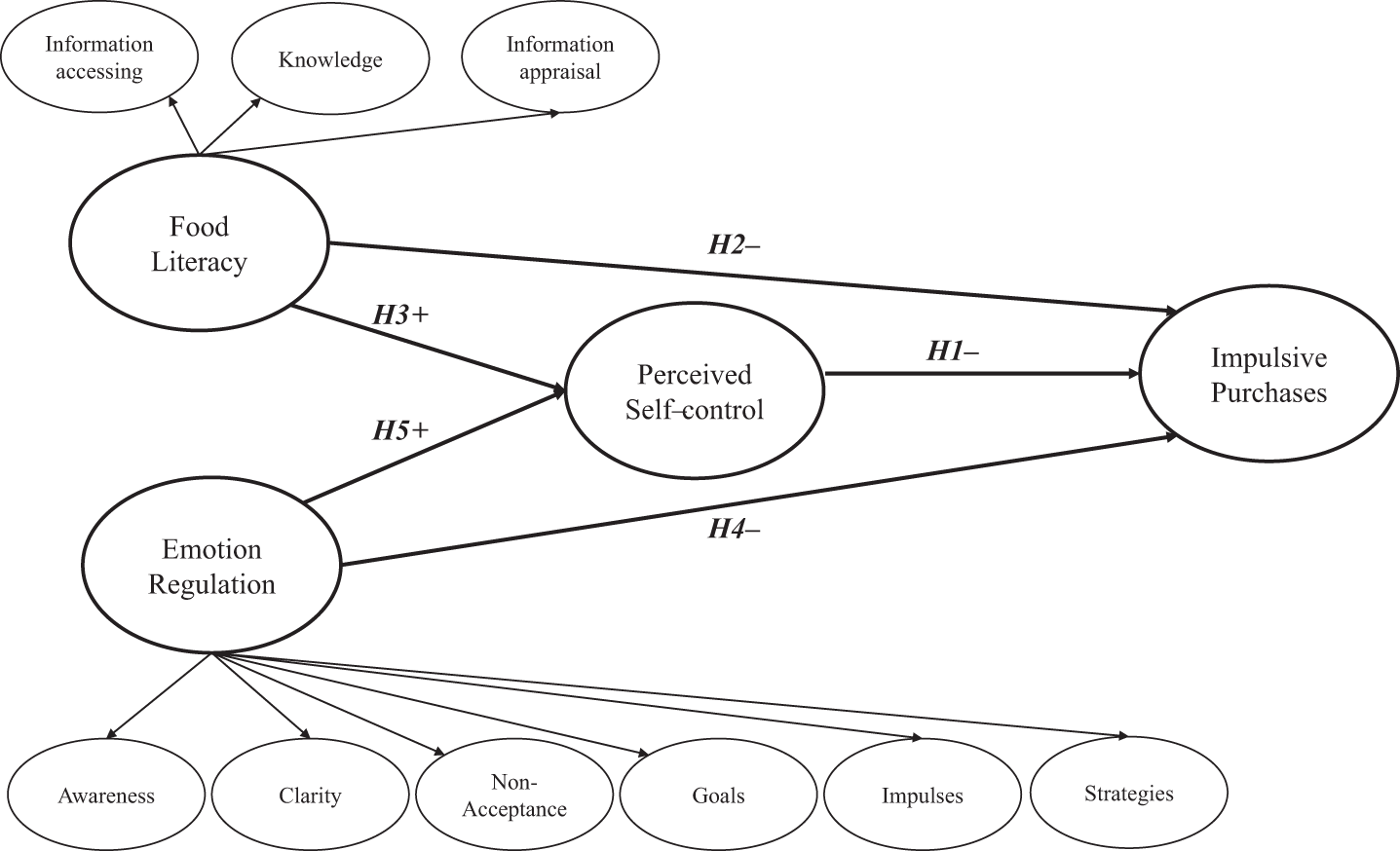
H1.The greater the perceived self-control, the less likely impulsive purchases will be.
Food literacy
Food literacy initially emerged from a broader concept of health literacy, which focused on knowledge related to the nutritional quality of food (Poelman et al., 2018). Although there is no single concept, a widely accepted definition for food literacy is that the construct describes a set of interrelated knowledge, skills and behaviors that are indispensable for planning, managing, selecting, preparing and consuming foods that meet food intake needs (Krause et al., 2018; Vidgen and Gallegos, 2014). More recently, this construct has been better explained through three dimensions: information accessing, referring to the ability to seek, understand and select information on food and nutrition; knowledge, associated with awareness of national and international guidelines on nutrition and health; and information appraisal, which emphasizes the challenge of assessing the reliability and potential influence of food on health across various contexts (Zwierczyk et al., 2022). In the scope of consumer research, food literacy has been defined as the ability of consumers to use their knowledge about food to make conscious and critical decisions and adopt informed behaviors (McManus and Pendergast, 2025).
Although food literacy is an emerging construct in marketing, its theoretical foundation – encompassing the ability to plan, manage and evaluate information and long-term impacts related to eating – aligns with empirical factors known to reduce impulsive purchasing. For instance, intentional planning (Upadhye et al., 2021), the ability to assess point-of-sale stimuli (Massara et al., 2014), need for cognition (Lins et al., 2015) and awareness of adverse consequences (Mau et al., 2019) have been found to inhibit impulsive buying. Moreover, while this relationship has not been tested specifically under impulsive consumption conditions, food literacy has been associated with healthier eating habits (Krause et al., 2018; Poelman et al., 2018), greater attention to nutritional content (Trieste et al., 2021) and reduced purchasing via apps (Giacomini et al., 2024).
Therefore, given its potential to drive behavioral change, the following hypothesis is proposed:
H2.The higher the individuals’ level of food literacy, the lower their impulsive purchasing will be.
Food literacy can also influence perceived self-control. One of the key determinants of self-control success or failure is monitoring, which refers to the ability to maintain interest and control over a relevant behavior (Baumeister, 2002). Additionally, within the scope of TPB, individuals’ beliefs about the skills required to perform a given behavior shape their sense of perceived behavioral control (Fishbein and Ajzen, 2011). Previous marketing research has demonstrated that both awareness, a measure of interest in behavior (Paul et al., 2016) and knowledge (Wang and Wang, 2016) significantly influenced perceived self-control. Since food literacy is related not only to knowledge but also to the relevance of nutrition for the consumer (McManus and Pendergast, 2025) and given that food literacy has been positively correlated with self-control in dietary contexts (Poelman et al., 2018; Rhea et al., 2020), we propose the following hypothesis:
H3.The higher the individuals’ level of food literacy, the higher their perceived self-control.
Emotion regulation
Emotion regulation comprises the processes by which individuals influence the emotions they have, when they have them and how they experience and express these emotions (Gross, 2014). Emotion regulation modulates emotions by increasing, decreasing, or maintaining them through both conscious and unconscious strategies (Gross, 2001). It operates in phases either before or after the production of emotions, dividing into antecedent-focused strategies – occurring before emotional responses are activated – and response-focused strategies – after emotion activation (Gross, 1998). This process is multifaceted and can be described by six factors: emotional awareness; emotional clarity; acceptance of emotions; the ability to control impulsive behaviors; act in accordance with desired goals; and the ability to use emotion regulation appropriately by using strategies aligned with one’s goals (Gratz and Roemer, 2004). Therefore, like literacy (a cognitive resource), emotion regulation is also a capacity (Atakan and Bagozzi, 2024) or a resource individuals use (Iyer et al., 2020) to manage marketing stimuli.
As explained by Iyer et al. (2020), both positive emotions, such as pleasure associated with consumption, and negative emotions, such as sadness, can influence impulse purchases. However, negative emotions have been considered major triggers of this deleterious behavior. For example, impulsive purchasing is reported in several studies as a form of personal compassion in negative emotional circumstances (Badgaiyan and Verma, 2014; Silvera et al., 2008; Verplanken et al., 2005; Vohs and Faber, 2007). In relation to eating behavior, the literature suggests that individuals with difficulties managing emotions may be more likely to eat in response to emotional cues, as eating may be their only approach to effectively regulating their emotions (Pidgeon et al., 2013; Tice and Bratslavsky, 2000). It is sought, especially in the consumption of highly palatable foods, to reduce cortisol levels, the result of which is a decrease in perceived stress (Konttinen et al., 2010; Pivarunas and Conner, 2015). Therefore, we have the following hypothesis:
H4.The more emotionally regulated individuals are, the less likely their impulsive purchasing will be.
The ability to regulate emotions also contributes to an individual’s perception of their own behavioral self-control. The appraisal model associated with emotions involves anticipating the relevance and valence (positive or negative) of situations, the likelihood of their occurrence and outcomes, the sense of agency (responsibility) and the individual’s coping possibilities (MacInnis and Patrick, 2006). For instance, Bagozzi et al. (1998) found that anticipating positive emotions (including pride, joy and satisfaction) and negative emotions (including guilt, shame and sadness) was associated with both the success and failure of dietary self-control.
Antecedent-focused emotion regulation strategies – those enacted before emotional responses occur (Gross, 1998) – anticipate or modify the way events are appraised, as in the case of cognitive reappraisal (Gross, 2001). Cognitive reappraisal involves altering the meaning of a stimulus to change its emotional impact (Mamede et al., 2024). For example, engaging in a diet can be reframed as an opportunity rather than a sacrifice. Antecedent-focused emotion regulation strategies are associated with greater cognitive flexibility, planning and control over behavioral responses (Gross and John, 2003) – aspects that directly align with the concept of perceived behavioral control, defined as one’s belief in their ability to carry out actions and overcome barriers (Ajzen, 2002).
While marketing studies have largely emphasized the emotional response aspect of emotion regulation (Cachón-Rodríguez et al., 2024; Li et al., 2024), research in psychology (Dijkstra and Homan, 2016; Zhao et al., 2021) and nutrition (Mamede et al., 2024; Weinbach et al., 2022) has found a positive impact of antecedent-focused strategies, such as appraisal and cognitive reappraisal, on perceived control. Therefore, we posit that:
H5.The greater an individual’s emotion regulation, the higher their perceived behavioral control.
Figure 1 presents the conceptual model developed with the proposed hypotheses. The emotion regulation construct, as it reflects its six dimensions, is inserted in the model as a second-order latent variable.
Method
Sampling and data collection
Following Kyriazos’ (2018) recommendation, we determined the sample size a priori based on statistical power (≥200). We aimed to detect medium-sized effects using the estimated measurement model parameters (unobserved variables = 37; latent variables = 10; α ≤ 0.05; and 1 – β ≥ 0.8). A sample of 211 participants was obtained, deemed adequate for the sensitivity of fit indices (Hair et al., 2019; Kyriazos, 2018).
The sample was obtained through convenience sampling based on the researchers’ accessibility. Although this method limits statistical generalization, it remains one of the most widely used sampling techniques in the field of Management (Porter et al., 2019). The sample consisted of Brazilian individuals aged 18 or older, as the cultural adaptation of the scales was developed for this population. Data were collected via an online questionnaire hosted on Google Forms. Participants accessed the survey through an invitation containing a link, shared on the researchers’ social media accounts and in online forums, such as student communities on Facebook.
To ensure the ethical aspect, participants were initially asked to agree to an Informed Consent Form (in Portuguese TCLE), which explained the research interests, the condition of voluntary participation and the possibility of abandoning the questionnaire at any time. Questionnaires that were incomplete or participants who did not agree to the TCLE were excluded.
Instruments
The study was conducted by four constructs measurement scales – impulse purchases, perceived self-control, food literacy and emotion regulation – and the control variables. Two researchers fluent in English translated and culturally adapted the items from the original perceived self-control (Parkinson et al., 2017) and food literacy (Krause et al., 2018) scales. The instrument’s final wording was validated through a pretest with 10 subjects from the target population who analyzed the clarity and pertinence of the items.
Perceived behavioral control was measured using two adapted scales. From Parkinson et al. (2017), the items “Whether I eat healthily or not over the next 12 weeks depends entirely on me” and “If I wanted to, it would be easy to eat healthily over the next 12 weeks to achieve/maintain my weight goal” were selected and adapted. In addition, two items based on Francis et al. (2004) were included: “If I wanted to, I could develop a healthy diet for the next 12 weeks” and “If I considered it necessary, I could eat healthily for the next 12 weeks.” Responses were recorded on a five-point scale ranging from 1 (strongly disagree) to 5 (strongly agree).
Food literacy was measured using the Short Food Literacy Questionnaire (SFLQ) developed by Krause et al. (2018), translated and culturally adapted. The scale uses four or five-point anchors, ranging from “very poor” to “very good,” “strongly disagree” to “strongly agree,” “very difficult” to “very easy,” or “never” to “always.” In the adaptation, references to the “Swiss Food Pyramid” were replaced with the “Brazilian Dietary Guidelines,” and items mentioning “official Swiss recommendations” were adapted to “WHO recommendations.”
Emotion regulation was assessed using the Difficulties in Emotion Regulation Scale (DERS) by Gratz and Roemer (2004), in its short form validated for Portugal (DERS-SF) by Moreira et al. (2020), with minor wording adjustments for the Brazilian context. The DERS-SF measures the degree of difficulty in emotion regulation; therefore, scores were reversed to capture higher levels of regulation. Responses were recorded on a five-point scale ranging from 1 (almost never) to 5 (almost always).
The gender, age, body mass index (BMI), income, hunger state and consumption habit variables were collected as control variables because they have been listed as influential in the impulse purchase literature (Iyer et al., 2020; Pivarunas and Conner, 2015).
Data analysis procedures
Initially, an exploratory analysis of missing data and outliers was performed. No missing data were identified, and regarding outliers, no extreme standardized values were found (less than 3 or greater than 3). The next step in the analysis involved checking the reliability and validity of the scales used. Cronbach’s alpha (α) and Composite Reliability (CR) were analyzed for the measure reliability, average variance extracted (AVE) for the convergent validity of the constructs, and Fornell and Larcker’s (1981) criterion for discriminant validity. Finally, the proposed conceptual model was analyzed using the covariance-based structural equation modeling (SEM-CB) technique, with estimation by the maximum likelihood method (Hair et al., 2019). All analyses were supported by SPSS and AMOS software.
Results
Participants
Most participants were female (65.4%), single (60.9%), with an average age of 29.87 years (standard deviation = 11.40), average income of BRL 4,935.68 (standard deviation = 6,635.42) and, with regard to education, the sample comprised, in decreasing order, higher education (44.5%), post-graduate (31.3%) and high school (22.7%). The participants’ weight and height were also collected to calculate the BMI, which had a mean of 25.19 (standard deviation = 5.74).
Scale validation
Initially, to address potential common method bias (CMB) from self-reported questionnaires, we adopted procedural and statistical remedies recommended by Podsakoff et al. (2003). Anonymity was ensured, respondents were informed there were no right or wrong answers and honesty was encouraged. Harman’s single-factor test indicated that a single factor accounted for 23.99% of the variance, below the 50% threshold. A common latent factor (CLF) analysis showed negligible changes in standardized loadings (<0.09), suggesting CMB was not a concern.
The factorial loadings and their significance were examined to assess the suitability of the adapted scales. Based on the initial measurement model, a refinement process was conducted, excluding items with low factor loadings or cross-loadings. Three items (FL2, FL6 and RE1) were removed for these reasons. Subsequently, the reliability and validity of the constructs were evaluated. Internal consistency, assessed through Cronbach’s alpha and composite reliability, met the recommended threshold of 0.70 for all constructs (Hair et al., 2019), except for Information Accessing. However, given its small number of items, a value above 0.60 was deemed acceptable (Hair et al., 2019). Convergent validity was examined using the AVE. Although awareness, clarity and information accessing showed AVE values below the 0.50 benchmark, these dimensions were retained as they form part of a second-order latent construct. Table 1 presents the reliability and validity metrics, along with the mean and standard deviation for each construct.
Average, standard deviation, reliability and average variance extracted from the constructs
The constructs’ discriminant validity was evaluated by the Fornell and Larcker (1981) criterion, for which the square root of the AVE of each construct must be superior to the correlations with the other constructs in the measurement model. The strategies dimension of the emotion regulation construct showed strong correlations with three other dimensions of emotion regulation, higher than its AVE. Previous studies have noted instability in the strategies dimension, with its exclusion (Moreira et al., 2020) or combination with goals and impulses (Sicorello et al., 2025) yielding good model fit. The exploratory factor analysis showed that the “strategies” items loaded poorly (≤0.364) on all other dimensions. In line with Moreira et al. (2020) and supported by discriminant validity, we excluded this dimension. The other constructs, as shown in Table 2, are in accordance with Fornell and Larcker’s (1981) criteria, revealing the suitability of these constructs for use in the structural model.
Structural model
From the constructs validated in the measurement model, the structural model was evaluated to verify the proposed hypotheses. As shown in Table 3, the adjusted model of this study demonstrated adequate fit indices, according to the criteria indicated in the literature (Hair et al., 2019). Although the SRMR turned out to be above the commonly indicated cut-off point, the RMSEA and its confidence interval can be considered reliable compared to the SRMR, given the sample size (n = 211) and maximum likelihood estimation (Shi et al., 2020). In relation to the initial model (without exclusion of variables), the adjusted model presented superior fit indices (such as < SRMR and > CFI and > TLI).
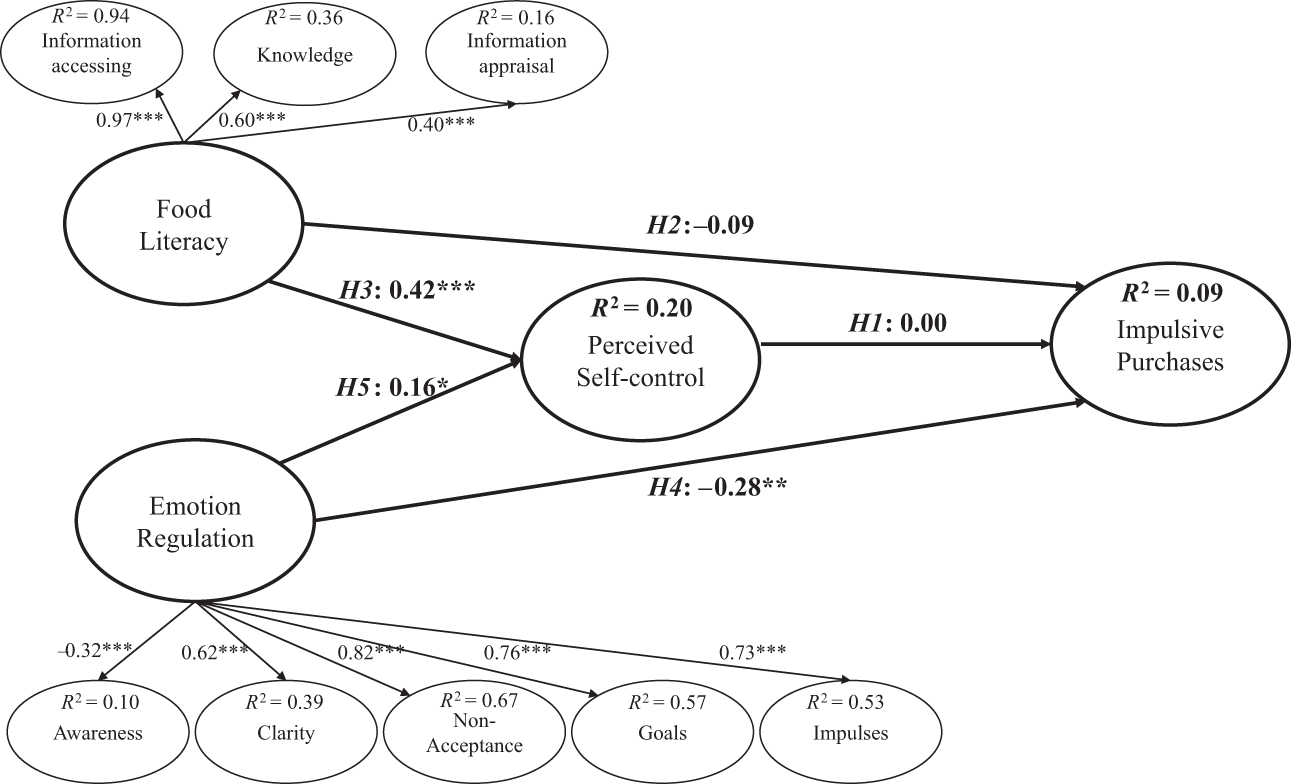
The conceptual model hypotheses were verified from the structural model estimates. As shown in Table 4, H3 and H4 were supported, considering the significance (p < 0.05) and the sign of the relationships. Therefore, individuals’ food literacy positively explains the behavioral self-control perception, and emotion regulation ability is negatively related to impulsive purchases, which suggests that the more individuals are able to manage their emotions, the less impulsive they are. H5, which relates emotion regulation to perceived self-control, was also supported, although marginally significant (p = 0.06). The relationships of the perceived self-control (H1) and food literacy (H2) constructs with impulsive purchase were not significant in this study. As a robustness check, we tested an alternative model (see Table 3) excluding H5. This resulted in poorer fit indices (χ2/df, CFI and SRMR) without affecting the significance of the remaining regressions. Thus, the alternative model still supports H1, H2, H3 and H4.
The conceptual model shown in Figure 2 illustrates the latent variables, the structural paths that formed the hypotheses and the coefficient of determination (R2) of the dependent variables. According to criteria in the literature (Serdar et al., 2021), the antecedents of the constructs perceived self-control and impulsive purchases had low explanatory power (0.04 ≤ R2 < 0.25). As for the emotion regulation factors, awareness had a low effect (R2 ≥ 0.04); clarity, goals, difficulty controlling impulses had a medium effect (R2 > 0.25); and non-acceptance had a high effect (R2 > 0.64).

As indicated in the impulsive purchase literature, some personal variables have an impact on this outcome. The following control variables were inserted in the model, but without significant interference on impulse purchase: age (standardized in z-score), gender, marital status (whether single or not), BMI (standardized in z-score), hunger status and habit of buying French fries.
Discussion
This article aimed to analyze the influence of food literacy and emotion regulation on impulsive food purchasing behavior and the mediating role of perceived self-control in these relationships. The results revealed that although food literacy and emotion regulation contribute to perceived self-control, it is not possible to infer that food literacy and perceived self-control have an inhibitory effect on impulse purchases. Emotion regulation, on the other hand, seems to negatively impact impulsivity in food purchases.
Food literacy, as expected, was a significant and positive predictor of perceived self-control, but, contrary to what was hypothesized, it did not affect impulsive food purchasing. As described in the literature, individuals can strengthen their perception of control over a behavior (Fishbein and Ajzen, 2011), including eating behavior (Poelman et al., 2018; Rhea et al., 2020). Therefore, the more skillful they are in this, the more confident they become about their self-control condition. Conversely, food literacy may have a limited impact on food choices made in impulsive contexts. While theoretically associated with less impulsive decision-making (Lins et al., 2015; Mau et al., 2019; Upadhye et al., 2021), its analytical and reflective scope (Giacomini et al., 2024; Trieste et al., 2021) may be more relevant to opportunistic rather than impulsive purchases. As clarified by Massara et al. (2014), both are forms of unplanned buying. However, they differ fundamentally: impulsive purchases are spontaneous and driven by affective responses, whereas opportunistic purchases are deliberate, rational decisions prompted by exposure to specific stimuli.
Emotion regulation, as predicted, was associated positively with perceived self-control and negatively with impulsive purchases. Emotional management competence can function as a predictor of individuals’ perceived behavioral self-control because, as explained by Bertrams (2020), it is related to individuals’ emotional well-being and perception of vitality, which inhibits the sense of effort inherent to impulse control. Likewise, emotion regulation can decrease impulsive eating behavior, as individuals’ psychological traits, especially emotional ones, are determinants with an intensity that has strong predictive power for impulsivity (Badgaiyan and Verma, 2014; Iyer et al., 2020; Silvera et al., 2008).
Although food literacy and emotion regulation have been shown to enhance individuals’ perceived self-control, this perceived behavioral control does not appear to influence the reduction of impulsive purchases. Indeed, prior literature is inconclusive. While perceived self-control has been found to inhibit impulsive outcomes (Churchill et al., 2008; Ngo et al., 2025; Ramadan et al., 2021), it has also failed to predict unhealthy food choices (Zhou et al., 2025). This may be because, even when consumers intend to and believe they can control a behavior, they may rationalize an impulsive purchase (Sivakumaran et al., 2025). Even “super-controlled” consumers may choose to override their control mechanisms to enjoy the hedonic rewards or the economic benefits of a good deal (Ayadi et al., 2013; Massara et al., 2014). For instance, Honkanen et al. (2012) found that unhealthy food consumption can occur either reflectively or impulsively, and that perceived self-control may amplify the effect of attitudes on unhealthy behavior as a way of rationalizing the decision.
Conclusion
The findings of this study indicate that although both food literacy and emotion regulation enhance individuals’ perceived self-control, only emotion regulation directly reduces impulsive food purchasing behavior. The ambiguous role of perceived self-control reveals the complexity of impulsive buying, where consumers often act based on emotional triggers yet subsequently rationalize their decisions to preserve a sense of control. While food literacy increases confidence in behavioral regulation, it does not necessarily curb impulsive consumption, suggesting that its effects are more relevant in deliberate, reflective decision-making rather than in affect-driven contexts. In contrast, individuals with stronger emotion regulation skills experience less effort in exercising self-control and are better equipped to manage the emotional factors that shape food-related decisions in impulsive situations.
Theoretical and practical implications
Overall, this research contributes to the literature on impulsive purchasing by focusing on antecedents related to internal, potentially developable aspects of consumers (Ding et al., 2023; Sivakumaran et al., 2025). The lack of association between food literacy and impulsive purchasing found in this study highlights the inefficiency of this skill in inhibiting food-related impulsivity, which may shed light on a discrepancy between food literacy and other types of literacy. Regarding emotional resources, our findings advance marketing research by incorporating emotion regulation – a broader yet underexamined construct – as an important antecedent of impulsive purchases. Finally, this study also adds to the TPB literature, particularly to the discussion on the ability of perceived behavioral control to predict unplanned behaviors.
The practical implications of this study center on enhancing consumer capabilities to reduce impulsive purchasing. Therefore, policymakers and marketing professionals can draw on our findings to prevent or mitigate the adverse effects of impulsive buying. Based on Sivakumaran et al. (2025), we suggest two main groups of strategies: those aimed at consumers and those aimed at policymakers. For consumers with lower emotion regulation capacity, the most effective approach is to anticipate consequences. Such strategies have been shown to reduce cravings for highly palatable foods (Mamede et al., 2024; Weinbach et al., 2022). Policymakers should develop strategies characterized by low functional complexity and high adherence. For example, creating shopping lists helps consumers adhere to their plans and avoid impulsive decisions triggered by emotional states. Upadhye et al. (2021) recommend that policymakers develop an application to encourage shoppers to make lists and plan their purchases.
In terms of social implications, this research may be valuable for professionals concerned with food well-being, particularly in equipping consumers to make more deliberate food-related decisions (Zeng and Sansaloni, 2025). In this regard, the findings of this study can inform practices aligned with the Sustainable Development Goals (SDGs), specifically those related to reducing waste and promoting sustainable consumption (SDG 12), improving nutrition (SDG 2) and fostering healthy, well-being-oriented diets (SDG 3).
Limitations and suggestions for future research
This study has three noteworthy limitations. First, the sample was not heterogeneous, as most participants were young women with higher education. Moreover, recruitment relied on convenience sampling, rendering the sample non-representative of the population; thus, the model’s generalizability is limited. Second, the exclusion of the strategy dimension represents a limitation of this study. Nevertheless, recent research has reported instability in validating this dimension. For instance, Sicorello et al. (2025) found that the strategy dimension could be merged with goals and impulses, forming a broader dimension referred to as modulation. Therefore, although strategy items were excluded from this study, the validity of the emotion regulation construct remains supported by the other dimensions. Third, causal inferences concerning the hypothesized associations should be drawn with caution, given the observational and cross-sectional design of the study.
Based on our findings and limitations, we propose at least four directions for future research. First, subsequent studies should examine the impact of the variables investigated here on unplanned purchases more broadly, distinguishing between impulsive and opportunistic purchase contexts. Second, these studies may consider different product categories to assess whether the antecedents’ effects vary by product type. For example, Sivakumaran et al. (2025) highlight differences between products classified as vice and virtue. Third, researchers could further explore the mechanisms underlying emotion regulation. For instance, Beikverdi et al. (2024) suggest that post-purchase emotions may trigger responses such as rationalization and positive reinterpretation of impulsive purchases, which emotion regulation should attenuate. Fourth, in light of the limitations, future studies should aim to strengthen causal evidence regarding the antecedent–consequent relationships identified here by employing randomized controlled experimental designs.
Data availability
The entire dataset supporting the findings of this study is available upon request from the corresponding author.
References
-
Ajzen, I. (2002), “Perceived behavioral control, self-efficacy, locus of control, and the theory of planned behavior 1”, Journal of Applied Social Psychology, Vol. 32 No. 4, pp. 665-683, doi: 10.1111/j.1559-1816.2002.tb00236.x.
» https://doi.org/10.1111/j.1559-1816.2002.tb00236.x -
Armitage, C.J. and Conner, M. (2001), “Efficacy of the theory of planned behaviour: a meta‐analytic review”, British Journal of Social Psychology, Vol. 40 No. 4, pp. 471-499, doi: 10.1348/014466601164939.
» https://doi.org/10.1348/014466601164939 -
Atakan, S.S. and Bagozzi, R.P. (2024), “Reconceptualizing the desire‐intention relationship in the model of goal directed behavior”, Psychology and Marketing, Vol. 41 No. 12, pp. 3106-3123, doi: 10.1002/mar.22107.
» https://doi.org/10.1002/mar.22107 -
Ayadi, N., Giraud, M. and Gonzalez, C. (2013), “An investigation of consumers’ self-control mechanisms when confronted with repeated purchase temptations: evidence from online private sales”, Journal of Retailing and Consumer Services, Vol. 20 No. 3, pp. 272-281, doi: 10.1016/j.jretconser.2013.01.010.
» https://doi.org/10.1016/j.jretconser.2013.01.010 -
Badgaiyan, A.J. and Verma, A. (2014), “Intrinsic factors affecting impulsive buying behaviour: evidence from India”, Journal of Retailing and Consumer Services, Vol. 21 No. 4, pp. 537-549, doi: 10.1016/j.jretconser.2014.04.003.
» https://doi.org/10.1016/j.jretconser.2014.04.003 -
Bagozzi, R.P., Baumgartner, H. and Pieters, R. (1998), “Goal-directed emotions”, Cognition and Emotion, Vol. 12 No. 1, pp. 1-26, doi: 10.1080/026999398379754.
» https://doi.org/10.1080/026999398379754 -
Barros, J. E. D M., Pereira, R. D C. D F. and Borba, M. D C. (2024), “Falling into temptation: the role of emotional regulation in the relationship between anxiety, impulsive traits, food motivation and impulsivity in food purchasing”, Interações: Sociedade e as Novas Modernidades, Vol. 47 No. 47, pp. 256-280, doi: 10.31211/interacoes.n47.2024.a9.
» https://doi.org/10.31211/interacoes.n47.2024.a9 -
Baumeister, R.F. (2002), “Yielding to temptation: self‐control failure, impulsive purchasing, and consumer behavior”, Journal of Consumer Research, Vol. 28 No. 4, pp. 670-676, doi: 10.1086/338209.
» https://doi.org/10.1086/338209 - Baumeister, R.F., Heatherton, T.F. and Tice, D.M. (1994), Losing Control: How and Why People Fail at Self-Regulation, Academic Press, Inc, San Diego, CA, USA.
-
Beikverdi, L., Sipilä, J. and Tarkiainen, A. (2024), “Post‐purchase effects of impulse buying: a review and research agenda”, Journal of Consumer Behaviour, Vol. 23 No. 3, pp. 1512-1527, doi: 10.1002/cb.2287.
» https://doi.org/10.1002/cb.2287 -
Bertrams, A. (2020), “A schema-activation approach to failure and success in self-control”, Frontiers in Psychology, Vol. 11, p. 2256, doi: 10.3389/fpsyg.2020.02256.
» https://doi.org/10.3389/fpsyg.2020.02256 -
Cachón-Rodríguez, G., Blanco-González, A., Prado-Román, C. and Fernández-Portillo, A. (2024), “How compulsive and impulsive buying affect consumer emotional regulation: is anxiety a differential element?”, European Journal of Management and Business Economics, Vol. 34 No. 3, pp. 340-358, doi: 10.1108/EJMBE-06-2023-0172.
» https://doi.org/10.1108/EJMBE-06-2023-0172 -
Churchill, S., Jessop, D. and Sparks, P. (2008), “Impulsive and/or planned behaviour: can impulsivity contribute to the predictive utility of the theory of planned behaviour?”, British Journal of Social Psychology, Vol. 47 No. 4, pp. 631-646, doi: 10.1348/014466608X284434.
» https://doi.org/10.1348/014466608X284434 -
Dijkstra, M.T.M. and Homan, A.C. (2016), “Engaging in rather than disengaging from stress: effective coping and perceived control”, Frontiers in Psychology, Vol. 7, p. 1415, doi: 10.3389/fpsyg.2016.01415.
» https://doi.org/10.3389/fpsyg.2016.01415 -
Ding, Z., Tu, M. and Guo, Z. (2023), “Exploring the inhibitory effect of maximising mindset on impulse buying”, Journal of Consumer Behaviour, Vol. 22 No. 3, pp. 676-687, doi: 10.1002/cb.2153.
» https://doi.org/10.1002/cb.2153 -
Fenton‐O’Creevy, M. and Furnham, A. (2020), “Money attitudes, personality and chronic impulse buying”, Applied Psychology, Vol. 69 No. 4, pp. 1557-1572, doi: 10.1111/apps.12215.
» https://doi.org/10.1111/apps.12215 - Fishbein, M., and Ajzen, I. (2011), Predicting and Changing Behavior, Psychology Press.
-
Fornell, C. and Larcker, D.F. (1981), “Evaluating structural equation models with unobservable variables and measurement error”, Journal of Marketing Research, Vol. 18 No. 1, p. 39, doi: 10.2307/3151312.
» https://doi.org/10.2307/3151312 - Francis, J., Eccles, M.P., Johnston, M., Walker, A.E., Grimshaw, J.M., Foy, R., Kaner, E.F.S., Smith, L. and Bonetti, D. (2004), Constructing Questionnaires Based on the Theory of Planned Behaviour: A Manual for Health Services Researchers, Centre for Health Services Research.
-
Giacomini, G., Scacchi, A., Ragusa, P., Prinzivalli, A., Elhadidy, H.S.M.A. and Gianino, M.M. (2024), “Which variables and determinants influence online food delivery consumption among workers and students? Results from the DELIvery Choice In OUr Society (DELICIOUS) cross-sectional study”, Frontiers in Public Health, Vol. 11, p. 1326628, doi: 10.3389/fpubh.2023.1326628.
» https://doi.org/10.3389/fpubh.2023.1326628 -
Gratz, K.L. and Roemer, L. (2004), “Multidimensional assessment of emotion regulation and dysregulation: development, factor structure, and initial validation of the difficulties in emotion regulation scale”, Journal of Psychopathology and Behavioral Assessment, Vol. 26 No. 1, pp. 41-54, doi: 10.1023/B:JOBA.0000007455.08539.94.
» https://doi.org/10.1023/B:JOBA.0000007455.08539.94 -
Gross, J.J. (1998), “Antecedent- and response-focused emotion regulation: divergent consequences for experience, expression, and physiology”, Journal of Personality and Social Psychology, Vol. 74 No. 1, pp. 224-237, doi: 10.1037/0022-3514.74.1.224.
» https://doi.org/10.1037/0022-3514.74.1.224 -
Gross, J.J. (2001), “Emotion regulation in adulthood: timing is everything”, Current Directions in Psychological Science, Vol. 10 No. 6, pp. 214-219, doi: 10.1111/1467-8721.00152.
» https://doi.org/10.1111/1467-8721.00152 - Gross, J.J. (2014), “Emotion regulation: conceptual foundations”, in Gross, J. J. (Ed.), Handbook of Emotion Regulation, The Guilford Press, pp. 3-24.
-
Gross, J.J. and John, O.P. (2003), “Individual differences in two emotion regulation processes: implications for affect, relationships, and well-being”, Journal of Personality and Social Psychology, Vol. 85 No. 2, pp. 348-362, doi: 10.1037/0022-3514.85.2.348.
» https://doi.org/10.1037/0022-3514.85.2.348 - Hair, J.F., Black, W.C., Babin, B.J., and Anderson, R.E. (2019), Multivariate Data Analysis, (8th ed.), Cengage.
-
Honkanen, P., Olsen, S.O., Verplanken, B. and Tuu, H.H. (2012), “Reflective and impulsive influences on unhealthy snacking: the moderating effects of food related self-control”, Appetite, Vol. 58 No. 2, pp. 616-622, doi: 10.1016/j.appet.2011.11.019.
» https://doi.org/10.1016/j.appet.2011.11.019 -
Islam, T., Pitafi, A.H., Arya, V., Wang, Y., Akhtar, N., Mubarik, S. and Xiaobei, L. (2021), “Panic buying in the COVID-19 pandemic: a multi-country examination”, Journal of Retailing and Consumer Services, Vol. 59, p. 102357, doi: 10.1016/j.jretconser.2020.102357.
» https://doi.org/10.1016/j.jretconser.2020.102357 -
Iyer, G.R., Blut, M., Xiao, S.H. and Grewal, D. (2020), “Impulse buying: a meta-analytic review”, Journal of the Academy of Marketing Science, Vol. 48 No. 3, pp. 384-404, doi: 10.1007/s11747-019-00670-w.
» https://doi.org/10.1007/s11747-019-00670-w -
Konttinen, H., Männistö, S., Sarlio-Lähteenkorva, S., Silventoinen, K. and Haukkala, A. (2010), “Emotional eating, depressive symptoms and self-reported food consumption. A population-based study”, Appetite, Vol. 54 No. 3, pp. 473-479, doi: 10.1016/j.appet.2010.01.014.
» https://doi.org/10.1016/j.appet.2010.01.014 -
Krause, C.G., Beer-Borst, S., Sommerhalder, K., Hayoz, S. and Abel, T. (2018), “A short food literacy questionnaire (SFLQ) for adults: findings from a Swiss validation study”, Appetite, Vol. 120, pp. 275-280, doi: 10.1016/j.appet.2017.08.039.
» https://doi.org/10.1016/j.appet.2017.08.039 -
Kyriazos, T.A. (2018), “Applied psychometrics: sample size and sample power considerations in factor analysis (EFA, CFA) and SEM in general”, Psychology, Vol. 9 No. 8, pp. 2207-2230, doi: 10.4236/psych.2018.98126.
» https://doi.org/10.4236/psych.2018.98126 -
Lee, S.-Y., Sweeney, J.C. and Soutar, G.N. (2020), “Emotion regulation in service encounters: are customer displays real?”, Journal of Service Theory and Practice, Vol. 30 No. 2, pp. 171-194, doi: 10.1108/JSTP-12-2018-0285.
» https://doi.org/10.1108/JSTP-12-2018-0285 -
Li, T., Cai, L., Liu, Y., Yuen, K.F. and Wang, X. (2024), “From a functional service to an emotional ‘saviour’: a structural analysis of logistics values for in-home consumers”, Journal of Retailing and Consumer Services, Vol. 78, p. 103696, doi: 10.1016/j.jretconser.2023.103696.
» https://doi.org/10.1016/j.jretconser.2023.103696 -
Lins, S., Dóka, Á., Bottequin, E., Odabašić, A., Pavlović, S., Merchán, A., Golasa, A. and Hylander, F. (2015), “The effects of having, feeling, and thinking on impulse buying in European adolescents”, Journal of International Consumer Marketing, Vol. 27 No. 5, pp. 414-428, doi: 10.1080/08961530.2015.1027028.
» https://doi.org/10.1080/08961530.2015.1027028 -
Liu, X.S., Shi, Y., Xue, N.I. and Shen, H. (2022), “The impact of time pressure on impulsive buying: the moderating role of consumption type”, Tourism Management, Vol. 91, p. 104505, doi: 10.1016/j.tourman.2022.104505.
» https://doi.org/10.1016/j.tourman.2022.104505 -
McManus, S. and Pendergast, D. (2025), “Exploring the intersection of food literacy and consumer research: a review, conceptualisation, and agenda for sustainability-focused research”, Food Quality and Preference, Vol. 126, p. 105429, doi: 10.1016/j.foodqual.2025.105429.
» https://doi.org/10.1016/j.foodqual.2025.105429 -
MacInnis, D.J. and Patrick, V.M. (2006), “Spotlight on affect: affect and affective forecasting in impulse control”, Journal of Consumer Psychology, Vol. 16 No. 3, pp. 224-231, doi: 10.1207/s15327663jcp1603_4.
» https://doi.org/10.1207/s15327663jcp1603_4 -
Mamede, A., Boffo, M., Noordzij, G., Denktaş, S. and Wieser, M.J. (2024), “The effect of cognitive reappraisal on food craving and consumption: does working memory capacity influence reappraisal ability? An event-related potential study”, Appetite, Vol. 193, p. 107112, doi: 10.1016/j.appet.2023.107112.
» https://doi.org/10.1016/j.appet.2023.107112 -
Massara, F., Melara, R.D. and Liu, S.S. (2014), “Impulse versus opportunistic purchasing during a grocery shopping experience”, Marketing Letters, Vol. 25 No. 4, pp. 361-372, doi: 10.1007/s11002-013-9255-0.
» https://doi.org/10.1007/s11002-013-9255-0 -
Mau, G., Schramm-Klein, H., Schuhen, M. and Steinmann, S. (2019), “What helps children resist distracting marketing stimuli? Implementation intentions and restrictions alter food choice”, Appetite, Vol. 140, pp. 159-168, doi: 10.1016/j.appet.2019.05.016.
» https://doi.org/10.1016/j.appet.2019.05.016 -
Moreira, H., Gouveia, M.J. and Canavarro, M.C. (2020), “A bifactor analysis of the difficulties in emotion regulation Scale – Short form (DERS-SF) in a sample of adolescents and adults”, Current Psychology, Vol. 41 No. 2, pp. 757-782, doi: 10.1007/s12144-019-00602-5.
» https://doi.org/10.1007/s12144-019-00602-5 -
Muraven, M. and Baumeister, R.F. (2000), “Self-regulation and depletion of limited resources: does self-control resemble a muscle?”, Psychological Bulletin, Vol. 126 No. 2, pp. 247-259, doi: 10.1037/0033-2909.126.2.247.
» https://doi.org/10.1037/0033-2909.126.2.247 - Ngo, Q.V., Dang, C.N., Le, A.P., Nguyen, H.T.K. and Nhu, Y.T.H. (2025), “Factors affecting credit card usage behavior among Hanoi students: the mediating role of impulsive buying behavior”, In Proceedings of the 5th International Conference on Research in Management and Technovation
-
Nigam, A., Dewani, P., Behl, A. and Pereira, V. (2022), “Consumer’s response to conditional promotions in retailing: an empirical inquiry”, Journal of Business Research, Vol. 144, pp. 751-763, doi: 10.1016/j.jbusres.2022.02.051.
» https://doi.org/10.1016/j.jbusres.2022.02.051 -
Nyrhinen, J., Sirola, A., Koskelainen, T., Munnukka, J. and Wilska, T.-A. (2024), “Online antecedents for young consumers’ impulse buying behavior”, Computers in Human Behavior, Vol. 153, p. 108129, doi: 10.1016/j.chb.2023.108129.
» https://doi.org/10.1016/j.chb.2023.108129 -
Park, I., Lee, J., Lee, D., Lee, C. and Chung, W.Y. (2022), “Changes in consumption patterns during the COVID-19 pandemic: analyzing the revenge spending motivations of different emotional groups”, Journal of Retailing and Consumer Services, Vol. 65, p. 102874, doi: 10.1016/j.jretconser.2021.102874.
» https://doi.org/10.1016/j.jretconser.2021.102874 -
Parkinson, J., David, P. and Rundle-Thiele, S. (2017), “Self-efficacy or perceived behavioural control: which influences consumers’ physical activity and healthful eating behaviour maintenance?”, Journal of Consumer Behaviour, Vol. 16 No. 5, pp. 413-423, doi: 10.1002/cb.1641.
» https://doi.org/10.1002/cb.1641 -
Paul, J., Modi, A. and Patel, J. (2016), “Predicting green product consumption using theory of planned behavior and reasoned action”, Journal of Retailing and Consumer Services, Vol. 29, pp. 123-134, doi: 10.1016/j.jretconser.2015.11.006.
» https://doi.org/10.1016/j.jretconser.2015.11.006 -
Pidgeon, A., Lacota, K. and Champion, J. (2013), “The moderating effects of mindfulness on psychological distress and emotional eating behaviour”, Australian Psychologist, Vol. 48 No. 4, pp. 262-269, doi: 10.1111/j.1742-9544.2012.00091.x.
» https://doi.org/10.1111/j.1742-9544.2012.00091.x -
Pivarunas, B. and Conner, B.T. (2015), “Impulsivity and emotion dysregulation as predictors of food addiction”, Eating Behaviors, Vol. 19, pp. 9-14, doi: 10.1016/j.eatbeh.2015.06.007.
» https://doi.org/10.1016/j.eatbeh.2015.06.007 -
Podsakoff, P.M., MacKenzie, S.B., Lee, J.-Y. and Podsakoff, N.P. (2003), “Common method biases in behavioral research: a critical review of the literature and recommended remedies”, Journal of Applied Psychology, Vol. 88 No. 5, pp. 879-903, doi: 10.1037/0021-9010.88.5.879.
» https://doi.org/10.1037/0021-9010.88.5.879 -
Poelman, M.P., Dijkstra, S.C., Sponselee, H., Kamphuis, C.B.M., Battjes-Fries, M.C.E., Gillebaart, M. and Seidell, J.C. (2018), “Towards the measurement of food literacy with respect to healthy eating: the development and validation of the self perceived food literacy scale among an adult sample in The Netherlands”, International Journal of Behavioral Nutrition and Physical Activity, Vol. 15 No. 1, p. 54, doi: 10.1186/s12966-018-0687-z.
» https://doi.org/10.1186/s12966-018-0687-z -
Porter, C.O.L.H., Outlaw, R., Gale, J.P. and Cho, T.S. (2019), “The use of online panel data in management research: a review and recommendations”, Journal of Management, Vol. 45 No. 1, pp. 319-344, doi: 10.1177/0149206318811569.
» https://doi.org/10.1177/0149206318811569 -
Ramadan, Z., Farah, M.F. and Saada, R.B. (2021), “Fooled in the relationship: how amazon prime members’ sense of self‐control counter‐intuitively reinforces impulsive buying behavior”, Journal of Consumer Behaviour, Vol. 20 No. 6, pp. 1497-1507, doi: 10.1002/cb.1960.
» https://doi.org/10.1002/cb.1960 -
Rhea, K.C., Cater, M.W., McCarter, K. and Tuuri, G. (2020), “Psychometric analyses of the eating and food literacy behaviors questionnaire with university students”, Journal of Nutrition Education and Behavior, Vol. 52 No. 11, pp. 1008-1017, doi: 10.1016/j.jneb.2020.05.002.
» https://doi.org/10.1016/j.jneb.2020.05.002 -
Roberts, J.A. and Manolis, C. (2012), “Cooking up a recipe for self-control: the three ingredients of self-control and its impact on impulse buying”, Journal of Marketing Theory and Practice, Vol. 20 No. 2, pp. 173-188, doi: 10.2753/MTP1069-6679200204.
» https://doi.org/10.2753/MTP1069-6679200204 -
Rook, D.W. (1987), “The buying impulse”, Journal of Consumer Research, Vol. 14 No. 2, p. 189, doi: 10.1086/209105.
» https://doi.org/10.1086/209105 -
Rook, D.W. and Fisher, R.J. (1995), “Normative influences on impulsive buying behavior”, Journal of Consumer Research, Vol. 22 No. 3, p. 305, doi: 10.1086/209452.
» https://doi.org/10.1086/209452 - Rook, D.W., and Gardner, M.P. (1993), “In the mood: impulsive buyings’ antecedents”, in Arnold-Costa, J. and Belk, R. W. (Eds), Research in Consumer Behavior, JAI Pres, pp. 1-28.
-
Serdar, C.C., Cihan, M., Yücel, D. and Serdar, M.A. (2021), “Sample size, power and effect size revisited: simplified and practical approaches in pre-clinical, clinical and laboratory studies”, Biochemia Medica, Vol. 31 No. 1, pp. 27-53, doi: 10.11613/BM.2021.010502.
» https://doi.org/10.11613/BM.2021.010502 -
Shi, D., Maydeu-Olivares, A. and Rosseel, Y. (2020), “Assessing fit in ordinal factor analysis models: SRMR vs. RMSEA”, Structural Equation Modeling: A Multidisciplinary Journal, Vol. 27 No. 1, pp. 1-15, doi: 10.1080/10705511.2019.1611434.
» https://doi.org/10.1080/10705511.2019.1611434 -
Sicorello, M., Elsaesser, M. and Kolar, D.R. (2025), “Translation, validation and extended factor models of the German state difficulties in emotion regulation scale (S-DERS)”, Borderline Personality Disorder and Emotion Dysregulation, Vol. 12 No. 1, p. 25, doi: 10.1186/s40479-025-00299-y.
» https://doi.org/10.1186/s40479-025-00299-y -
Silvera, D.H., Lavack, A.M. and Kropp, F. (2008), “Impulse buying: the role of affect, social influence, and subjective wellbeing”, Journal of Consumer Marketing, Vol. 25 No. 1, pp. 23-33, doi: 10.1108/07363760810845381.
» https://doi.org/10.1108/07363760810845381 -
Sivakumaran, B., Deshpande, B., Pradhan, D. and Lyngdoh, T. (2025), “Reducing impulse buying: a review and research agenda”, Journal of Consumer Marketing, Vol. 42 No. 6, pp. 838-860, doi: 10.1108/JCM-03-2024-6721.
» https://doi.org/10.1108/JCM-03-2024-6721 -
Steenburg, E.V. and Naderi, I. (2020), “Unplanned purchase decision making under simultaneous financial and time pressure”, Journal of Marketing Theory and Practice, Vol. 28 No. 1, pp. 98-116, doi: 10.1080/10696679.2019.1684206.
» https://doi.org/10.1080/10696679.2019.1684206 -
Tice, D.M. and Bratslavsky, E. (2000), “Giving in to feel good: the place of emotion regulation in the context of general self-control”, Psychological Inquiry, Vol. 11 No. 3, pp. 149-159, doi: 10.1207/S15327965PLI1103_03.
» https://doi.org/10.1207/S15327965PLI1103_03 -
Tice, D.M., Bratslavsky, E. and Baumeister, R.F. (2001), “Emotional distress regulation takes precedence over impulse control: if you feel bad, do it!”, Journal of Personality and Social Psychology, Vol. 80 No. 1, pp. 53-67, doi: 10.1037/0022-3514.80.1.53.
» https://doi.org/10.1037/0022-3514.80.1.53 -
Trieste, L., Bazzani, A., Amato, A., Faraguna, U. and Turchetti, G. (2021), “Food literacy and food choice: a survey-based psychometric profiling of consumer behaviour”, British Food Journal, Vol. 123 No. 13, pp. 124-141, doi: 10.1108/BFJ-09-2020-0845.
» https://doi.org/10.1108/BFJ-09-2020-0845 -
Upadhye, B., Sivakumaran, B., Pradhan, D. and Lyngdoh, T. (2021), “Can planning prompt be a boon for impulsive customers? Moderating roles of product category and decisional procrastination”, Psychology and Marketing, Vol. 38 No. 8, pp. 1197-1219, doi: 10.1002/mar.21490.
» https://doi.org/10.1002/mar.21490 -
Verplanken, B. and Herabadi, A. (2001), “Individual differences in impulse buying tendency: feeling and no thinking”, European Journal of Personality, Vol. 15 No. 1_suppl, pp. S71-S83, doi: 10.1002/per.423.
» https://doi.org/10.1002/per.423 -
Verplanken, B., Herabadi, A.G., Perry, J.A. and Silvera, D.H. (2005), “Consumer style and health: the role of impulsive buying in unhealthy eating”, Psychology and Health, Vol. 20 No. 4, pp. 429-441, doi: 10.1080/08870440412331337084.
» https://doi.org/10.1080/08870440412331337084 -
Vidgen, H.A. and Gallegos, D. (2014), “Defining food literacy and its components”, Appetite, Vol. 76, pp. 50-59, doi: 10.1016/j.appet.2014.01.010.
» https://doi.org/10.1016/j.appet.2014.01.010 -
Vohs, K.D. and Faber, R.J. (2007), “Spent resources: self‐regulatory resource availability affects impulse buying”, Journal of Consumer Research, Vol. 33 No. 4, pp. 537-547, doi: 10.1086/510228.
» https://doi.org/10.1086/510228 -
Wang, Y., Pan, J., Xu, Y., Luo, J. and Wu, Y. (2022), “The determinants of impulsive buying behavior in electronic commerce”, Sustainability, Vol. 14 No. 12, p. 7500, doi: 10.3390/su14127500.
» https://doi.org/10.3390/su14127500 -
Wang, Y.-F. and Wang, C.-J. (2016), “Do psychological factors affect green food and beverage behaviour? An application of the theory of planned behaviour”, British Food Journal, Vol. 118 No. 9, pp. 2171-2199, doi: 10.1108/BFJ-12-2015-0469.
» https://doi.org/10.1108/BFJ-12-2015-0469 -
Weinbach, N., Barzilay, G. and Cohen, N. (2022), “Cognitive reappraisal reduces the influence of threat on food craving”, Affective Science, Vol. 3 No. 4, pp. 818-826, doi: 10.1007/s42761-022-00141-6.
» https://doi.org/10.1007/s42761-022-00141-6 -
Zeng, T. and Sansaloni, E.X.M. (2025), “Food well-being: a review of its conceptualization and measurement”, British Food Journal, Vol. 127 No. 3, pp. 857-877, doi: 10.1108/BFJ-04-2024-0380.
» https://doi.org/10.1108/BFJ-04-2024-0380 -
Zhao, T., Fu, Z., Lian, X., Ye, L. and Huang, W. (2021), “Exploring emotion regulation and perceived control as antecedents of anxiety and its consequences during covid-19 full remote learning”, Frontiers in Psychology, Vol. 12, p. 675910, doi: 10.3389/fpsyg.2021.675910.
» https://doi.org/10.3389/fpsyg.2021.675910 -
Zhou, Y., Nie, X., Lin, Y., Pan, S., Cao, R. and Zhang, Y. (2025), “Enhancing the theory of planned behavior with social reactive constructs in explaining adolescents’ dietary behaviors”, Appetite, Vol. 214, p. 108170, doi: 10.1016/j.appet.2025.108170.
» https://doi.org/10.1016/j.appet.2025.108170 -
Zwierczyk, U., Kobryn, M. and Duplaga, M. (2022), “Validation of the short food literacy questionnaire in the representative sample of polish internet users”, International Journal of Environmental Research and Public Health, Vol. 19 No. 15, p. 9710, doi: 10.3390/ijerph19159710.
» https://doi.org/10.3390/ijerph19159710
Data availability
The entire dataset supporting the findings of this study is available upon request from the corresponding author .
*
José Eduardo de Melo Barros can be contacted at: E-mail: Jeduardobarros@hotmail.comASSOCIATE EDITOR: