 PEOPLE MANAGEMENT IN CONTENT PRODUCTION: DIGITAL INFLUENCERS IN THE NETWORKS OF CAPITAL
ABSTRACT
Digital influencers, content creators, and YouTubers are just a few of the terms used to describe the work of content producers in contemporary media. Using a Marxist theoretical framework and critical studies in people management, this article aims to examine the people management processes operationalized to oversee the work of content producers, who subordinated to the process of capital valorization, emerge as one form of the proletariat in the 21st century. The analysis includes documentaries on influencers, documents from major platform companies, reports, news articles, and scientific literature on the topic. The key findings illustrate how recruitment and selection processes, compensation, and performance management are employed by these platforms.
Keywords:
content producers; digital influencers; people management; digital platforms; algorithmic management
RESUMO
Influenciadores digitais, criadores de conteúdo, YouTubers são apenas algumas das tantas denominações utilizadas para designar o trabalho dos produtores de conteúdo na mídia recente. Partindo de um aporte teórico marxista e dos estudos críticos em gestão de pessoas, o presente artigo tem como objetivo realizar uma apreensão dos processos de gestão de pessoas que são operacionalizados para gerir o trabalho dos produtores de conteúdo, os quais, subordinados ao processo de valorização do capital, emergem como uma das formas de ser proletariado no século XXI. A análise abrangeu documentários sobre influenciadores, documentos das principais empresas-plataformas, relatórios, reportagens e a bibliografia científica sobre o tema. Os principais resultados demonstram como funcionam os processos de recrutamento e seleção, gestão da remuneração e do desempenho utilizados por essas plataformas.
Palavras-chave:
produtores de conteúdo; influenciadores digitais; gestão de pessoas; plataformas digitais; gestão algorítmica
RESUMEN
Influencers digitales, creadores de contenido, youtubers son solo algunos de los muchos nombres utilizados para designar el trabajo de los productores de contenido en los medios recientes. A partir de un aporte teórico marxista y de estudios críticos en gestión de personas, este artículo tiene como objetivo aprehender los procesos de gestión de personas que se operacionalizan para gestionar el trabajo de los productores de contenido, los cuales, subordinados al proceso de valorización del capital, emergen como una de las formas de ser proletariado en el siglo XXI. El análisis abarcó documentales sobre influencers, documentos de las principales empresas de plataforma, informes, reportajes y bibliografía científica sobre el tema. Los principales resultados demuestran cómo funcionan los procesos de reclutamiento y selección, y de gestión de remuneración y desempeño utilizados por estas plataformas.
Palabras clave:
productores de contenidos; influencers digitales; gestión de personas; plataformas digitales; gestión algorítmica
INTRODUCTION
Digital platforms are tools that facilitate a range of activities, such as communication, sharing, shopping, and consuming various types of content. Social media platforms, in particular, have become key instruments for long-distance communication, product promotion, and the shaping of political opinions (Appel et al., 2020; Zimmermann et al., 2022).
On average, Brazilians spend 10.19 hours per day on the internet across various devices, with approximately 35% (3.6 hours) of that time spent on social media. It is estimated that around 27.6% of internet users aged between 16 and 64 discover new brands, products, and services through ads on these platforms, and that $150 billion was spent globally on social media advertising in 2021 (Kemp, 2022).
This technological infrastructure not only enables online interactions but also drives the production of both objective and subjective ways of living in society. This is because interactions are encouraged, discouraged, and/or filtered based on different interests and strategies. We observe, then, that what is commonly referred to as social media are not merely democratic communication vehicles. They are platform-companies (Ferraz et al., 2021) that incorporate, transmit, and commercialize spaces, data, and personal information (Sasikumar & Sersia, 2021), and constitute sociodigital media (SDM) (Silva, 2023).
Thus, SDMs encompass a specific set of platforms, such as Facebook, TikTok, YouTube, and Instagram. These are private virtual spaces intended for human interaction, managed by platform-companies that create mechanisms to control the mass content production process, collect data, and sell advertising space, combining commodified and non-commodified social practices. The reciprocity between these practices is the element that helps us understand how the interactive-communicative dimension integrates with the sale of advertising space through the work of content producers, who both attract and retain users on these platforms (Silva, 2023).
In a broad sense, a “content producer” can be anyone who creates books, music, videos, poetry, photos, etc.; however, at the current stage of capitalist development, it is not enough to simply produce content; that content must also be capable of mobilizing an audience connected to SDMs so that the interaction on these media becomes a driving force for future commercial consumption. On the one hand, users of SDMs are, broadly speaking, also content producers (in the form of comments, photos, videos, etc.), as demonstrated by the phenomenon of prosumption (Ferraz et al., 2021); on the other hand, not all users derive income from this interaction. In this way, the capitalist development of productive forces has given rise to a more restricted form of content production carried out by content production workers (CPWs).
According to Souza-Leão et al. (2022), many of these workers are considered micro-celebrities, standing out as agents capable of influencing consumer decisions. As such, some of these workers are commonly referred to as digital influencers (Karhawi, 2017). However, unlike major industry entrepreneurs who are also influencers, such as Felipe Neto or Virgínia Fonseca, content production workers, whether directly or indirectly, labor on behalf of the companies that own the SDMs, with their work primarily instrumentalized for the placement of ads tied to the consumption of videos, images, texts, and a variety of other content.
Thus, the work of these professionals has attracted increasing attention from marketing and social communication scholars, highlighting, for example, the key characteristics of influencers and the most effective ways to promote a brand through their involvement (Barbosa et al., 2022; Souza-Leão et al., 2022; Wielki, 2020). In contrast, reports (Fontes, 2022; McNeal, 2022; Parkin, 2018) have also emerged about the physical and mental exhaustion of these workers, caused by long hours, intense pressure, lack of clear rules, low wages, and other factors that position SDMs at the heart of the debate on the exploitation and precarization of CPWs (Karhawi & Prazeres, 2022; Matos, 2020).
In this context, while most studies aim to produce knowledge on how to increase business sales performance through the work of content producers, few efforts have been made to develop a theory that encompasses the practices in managing these workers (Matos, 2020)and how they are engineered for the private appropriation of value. Thus, to date, the focus appears to be more on better exploiting this labor force than on understanding the links that reveal the processes and consequences of this exploitation. In this regard, the goal of this article is to provide an understanding of the people management processes that are operationalized to manage the work of content producers, who subordinated to the process of capital valorization, emerge as one of the forms of the proletariat in the 21st century.
This work makes relevant and novel contributions to the field of people management in Brazil, which is predominantly focused on the management practices of direct and formal employees in large organizations. By critically understanding how people management is systematized to control and direct the work of content producers, we contribute scientifically to the theoretical production that dissects the new management models situated in the so-called platform economy (Montalban et al., 2019) and politically by revealing a scenario of labor precarization that causes significant harm to workers and is an integral part of the current capitalist reproduction.
In addition to this introduction, the article is divided into five other sections: first, we provide the reader with an overview of critical studies in management, particularly within the field of people management; next, we offer a theoretical framework that places the proletariat within the context of digital platforms; then, we discuss the research methodology; the fourth section presents the research findings, followed by the final considerations.
CRITICAL STUDIES IN PEOPLE MANAGEMENT
As Cunha (2018) presents, management theorists have significant difficulty in pinpointing the specific difference between this field and other social practices, such as politics and war. While many terms adopted by contemporary administrative thought originate from military practices, such as strategy, target, and domain, and while it is undeniable that politics and war are inseparable from the management of material and human resources, “only the way in which people organize themselves to materially produce and reproduce provides the traits that allow for identifying the specificity of administration in relation to other social practices” (Cunha, 2018, p. 16).
Following the author’s argument and historically situating Management, we see that its “genesis arises from the progressive conditions of the technical division of labor and, later, with the impact of forces from the social division of labor on the unity between preparation and execution, carrying the basic traits of both simple labor and combined labor” (Cunha, 2018, p. 29). Thus, the function of direction, which encompasses the practices involved in managing the work of others, that is, how humans manage the labor of other humans, has been - and continues to be - inherently intertwined with the constitution of societies in social classes.
As an autonomous field of knowledge, management, since the seminal studies of Taylor (1999) and Fayol (1989) in the early 20th century, has tended to erase the historical origins that formed the division between those who plan and those who execute the work, presenting the forms of work organization under capital as abstract entities that align the interests of workers and owners (to whom the profits from labor exploitation are directed). In this realm, if the capital-labor contradiction manifests in conflicts in and of labor relations, it is due to a failure in management, which did not implement the most appropriate practices to encourage workers to internalize the interests of capitalists.
Throughout the historical development of the field of management studies, the functionalist epistemological current, based on positivism, became (and remains) hegemonic (Cabral, 2004), as it meets the capitalist need for knowledge production aimed at optimizing production processes and profitability while promoting the erasure of historical conflicts that also shaped the establishment of command structures in business societies. Thus, when social conflicts bring their reflections into productive organizations, people management policies and practices become essential to control these conflicts, with the aim of guiding workers toward behaviors more suited to the effective performance of their tasks.
As highlighted by Ferraz and Ferraz (2018), the different schools within the hegemonic management field constitute part of a single movement of instrumentalizing science for capitalist accumulation, a material necessity for the expansion of this system. Analyzing the content taught in subjects like human resource management, Ferraz (2017) emphasizes that one of the main obstacles to the formation of class consciousness among workers is “the disruption of the partial awareness we have of the reality of existing social relations. A task hindered by the production of knowledge that, when used ideologically, shapes workers’ class consciousness as a consciousness for capital” (p. 66).
Critical studies in the field of people management aim, in this context, to deconstruct the elements of heteromanagement by revealing how people management practices work to intensify worker productivity and produce subjectivities that conform to the status quo. In this study, we, therefore, adopt a critical stance (Faria, 2015) and a Marxist philosophical framework to understand reality, which requires overcoming naive conceptions that view CPWs and other workers linked to digital platforms as mere communicative transmitters, detached from the logic of alienated and exploited labor, as discussed in the following section.
PROLETARIAT SUBORDINATED TO DIGITAL PLATFORMS
In Marx (2013), the concept of proletariat refers to the condition of wage workers who, stripped of the means of production, are compelled to sell their labor power to a capitalist in order to secure their survival. The execution of this sale does not rely on the existence of legal contracts, nor does it require that it be made to a single capitalist. What defines the transformation of labor power into a commodity, both historically and in everyday life, is the fact that our physical and psychological energies are consumed in labor processes that create and realize value in exchange for another commodity, typically money.
In contemporary capitalist societies, there is still a portion of the working class that is not directly salaried by the owners of the means of production. This is the case, for example, with many electricians, plumbers, and domestic workers who, as self-employed workers, sell the useful effect of their labor directly to the consumer without the mediation of a capitalist. However, with the rise of digital platforms, even these workers have been proletarianized, as platform-companies, leading the phenomenon of the Uberization of labor, subsume this labor force into capital accumulation (Franco et al., 2023).
According to Dijck et al. (2018), digital platforms are structured as programmable architectures that organize user interactions. They argue that five major corporations (Alphabet-Google, Facebook, Apple, Amazon, and Microsoft) control the global informational ecosystem, which has become the global epicenter of interconnected networks. Following the authors’ argument, the infrastructure of physical technologies, such as railways and the internet itself, has historically been built through a combination of public and private investments. In the contemporary digital landscape, although governments and non-profit organizations may operate their own platforms, it is increasingly difficult to do so independently. Platforms not integrated into the dominant ecosystem cannot benefit from advantages such as global connectivity and network effects.
This broad reach has enabled a large portion of social interactions, such as conversations, news circulation, shopping, and job hiring, to occur frequently through digital platforms. The expansion of these intermediary platforms in socioeconomic interactions is linked both to the ability of certain capitals to objectively appropriate social wealth through their technological efficiency - enabling access to data, people, companies, and the rapid distribution of products - and to their capacity to subjectively transform social needs, which come to be met only by these specific platforms.
In recent literature, research on labor mediated by platform-companies, especially that of drivers, urban delivery workers, and domestic workers, has advanced significantly in an effort to demonstrate the management practices aimed at controlling and intensifying the exploitation of the proletariat performing services linked to apps, as seen in the studies by Franco and Ferraz (2019), Abílio et al. (2021), and Souza (2020). On the other hand, few studies have focused on managing content producers’ labor, as noted in the bibliometric study by Vila-López et al. (2023) on digital influencers. Therefore, our research explores the people management practices applied to this group of workers.
RESEARCH METHODOLOGY
This research is guided by the onto-epistemological conception of historical materialism (Marx, 2022). It is worth emphasizing that “Primacy is thus given to the real, and it is in the object↔subject dialectic that the concrete real, through successive mediations, reconciles itself with itself in the form of the thought real” (Faria, 2015, p. 21).
In our approach to the research object, in this case, the work of content producers and the people management processes that are operationalized to manage them, we drew upon various sources, such as documentaries, reports, terms of use from SDMs, news articles, influencer videos, and scientific investigations by other researchers. These sources are listed in Table 1:
The sources were analyzed independently, and the data derived from this analysis were cross-referenced to capture the internal logic of each management technique and their interrelation, ensuring that the abstractions made were reasonable. According to Chasin (2009), a reasonable abstraction preserves the complexity of the real, avoiding oversimplification into superficial or monocausal explanations. It results from a thorough investigation into the profiles of particularity and singularization in their dialectical relationship with the whole. The abstraction must maintain a strong connection to the concrete - that is, to reality as it manifests in practice - while uncovering the internal dynamics of that reality.
Throughout the analytical process, Marx’s (2013) analysis of labor exploitation within capitalist social relations proved indispensable, with these relations now reshaped by advances in information and communication technologies. In the case of SDMs, their development and growth are closely tied to the mass production and consumption of digital content. It is within this context that understanding how the work of content producers is managed becomes essential, as we explore below.
PRESENTATION OF RESULTS
In the effort to transpose aspects of concrete reality into the conceptualized, the investigation of both theoretical and empirical materials enabled us to understand the people management practices related to the work of content producers through the following analytical categories relevant to this labor context: recruitment and selection; compensation management; and performance management.
Managing CPWs in SDMs does not use traditional recruitment tools (such as posting a vacancy and receiving resumes), selection methods (applying tests, group dynamics, and interviews), compensation (fixed salary and benefits), or performance evaluation; this is because people management techniques focus on concrete labor, which transforms according to the technological base and legal regulations that shape it. Therefore, we are no longer referring to what defines the essence of a class, the working class, but rather to the ways and means-here: management techniques-through which capital dominates and subjugates the bought labor forces, who will resurrect dead labor (machinery, raw materials) for production and/or the realization of value.
Preliminarily, it is important to outline the personified forms of capital that materialize the relations of control over CPWs’ labor force (Figure 1)..
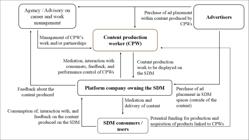
We recognize that not all content producers are linked to marketing agencies or consultancies, and many have not yet been able to secure partnerships for brand promotion within their content. However, this does not alter the structure of this labor market. Additionally, the possibility of creating specific products (such as subscriptions for access to exclusive content, branded makeup linked to CPWs, etc.) or raising crowdfunding from consumers exists only for a small portion of content producers (Squid, 2023). In this regard, the purpose of the figure above was to inform the reader about the different agents shaping the content production labor market and who are directly or indirectly involved in exploiting content production labor.
It is also worth noting that we draw from the literature on people management the categories that most emerged from our understanding of the phenomenon at hand. In this context, it would be possible to engage in a meaningful debate on the main characteristics of the “position” of the content producer or to delve into extensive discussions on the training and development strategies employed by these platforms. However, we chose to concentrate our expositional efforts on the most decisive practices of the subject, rather than exploring increasingly specific singularities, which, while allowing for the creation of a collection of such singularities, would contribute little to understanding the internal logic underlying the control of human resources through people management techniques.
Recruitment and Selection
We start with the existence of a labor market for content producers, meaning we abstract the process of the original formation of this market while emphasizing that it is a product of capitalist technological development - a product that, in the form of SDMs, becomes massified as a locus of social interaction frequented by the working class. It is no coincidence to find accounts of how the profession transformed their lives among the stories of early influencers, fueling the myth that all you need is a cellphone and personal qualities to become a celebrity. This scenario does not reflect the reality of an already established and consolidated labor market, as shown by research conducted by the agencies YouPix and Squid (2020), which, by surveying 2,800 CPWs from various categories and regions of Brazil, found that the majority (68.5%) of respondents do not consider this work their primary income source. In short, capital recruits CPWs from within the working class itself.
In general, CPWs begin their work autonomously and later seek out or are sought by advertising companies or career management and consultancy agencies (Bilton, 2021). The connection to these economic agents happens only after the CPW has managed to build a significant audience capable of mobilizing consumers on SDMs through views, likes, and comments. According to Postigo (2016), in the case of YouTube, the number of subscribers is the basic “currency” of this system, and acquiring and retaining them translates into revenue for YouTube. During this study, if a content producer did not have at least one thousand subscribers, the platform would not hire them, meaning their videos would not be “monetized.”
Thus, to be selected as a CPW by the capitalist agents who remunerate work (agencies, companies that promote products, and the SDMs themselves), it is necessary to have the labor qualities demonstrated by the number of followers/subscribers, which becomes an entry barrier into this market. However, this does not lead to decreased content production, as SDMs encompass both commodified and non-commodified practices (which interchange with each other). Since content production is a sine qua non for the existence of these platforms, also serving as a space for many professionals to showcase their work outside the media, SDMs attract paid and unpaid producers, and both are key players in their capital accumulation strategies.
Therefore, the more content producers SDMs are able to entice, the larger the recruitment pool they can manage, allowing them to use their selection and compensation strategies to their advantage. Thus, the human capacity to produce digital content in order to purchase it as a commodity-”labor power”-requires the worker to make prior investments and build a certain audience (Postigo, 2016). This is also why some content producers with previous involvement in the cultural industry were already famous and capitalized on this public recognition, transitioning to or combining their prior occupation with content production work (Wielki, 2020).
In the concrete reality of CPWs, what does it mean to have many or few followers? The content producer invests a significant amount of time trying to establish and expand their connection with a specific audience while attempting to decipher the ranking algorithm. Valderrama and Velasco (2018) conducted in-depth interviews with Chilean YouTubers and concluded that to achieve significant subscriber numbers, the most recognized YouTubers put in hard work-some took seven years to reach high visibility. In this context, while striving to build their follower base, the content producer provides a free product under the terms of use of SDMs.
In the private space of virtual interactions, the terms of use transform into a work contract with no recognition of labor rights. For example, the YouTube terms of use (2022) state that: i) the user who uploads content to the platform is legally responsible for what is posted; ii) the rights to the content are granted to the platform, which can then monetize the posted content-this includes running ads and charging fees for access. The platform specifies that the CPW will not receive the full amount earned from commercializing the content it produces. Moreover, as we will see later, what initially seems to be the granting of a product for exploitation by a capitalist becomes the very exploitation of the CPW’s labor power.
The formation of a CPW army takes place through non-commodified social interaction practices, which allow for both training these potential workers and building a follower base, enabling a selection process in line with the needs of value accumulation. The increasing competition among content producers drives the professionalization of the role, encouraging the qualification of this labor force while simultaneously lowering its cost as supply increases. It is at this point that work and career management agents/consultancies come into play. Being a CPW is no longer, as often imagined, a natural result of social interaction on SDMs, but the realization of a set of guidelines imposed by such agents who shape and trade labor in this market.
As Marx (2013) teaches us, in the movement of value, it is necessary for the capitalist agent to advance capital, which, when applied to constant capital (means of production) and variable capital (labor power), allows the production process to occur and the sale of commodities to realize the value. CPW management agencies and the SDMs themselves, such as YouTube, already select influencers with pre-established followings in their recruitment and selection process. This means that the content producer has already contributed to reducing the amount of capital to be advanced by the private capitalist in the communications industry. Reducing this amount is crucial for the survival of the value accumulation process, given the essence of this industry, which is to channel the surplus value produced in the production sphere (Marx, 2014).
Compensation Management
In Marx (2013), we learn that the wage expresses the price of labor power. Through it, the capitalist acquires the right to consume this commodity. However, what is expressed in the wage is not the amount the worker produces while working, but rather the value of their labor power, which is determined by the value of the commodities necessary for (re)producing the worker’s capacity to labor.
The analysis of the collected materials showed that CPWs’ wages appear in two main forms: the universal form of money and the specific forms of goods and/or services. In one scene from the documentary Fake Famous, the simple increase in the number of followers of participant Dominique was accompanied by her receiving products and services in exchange for promotion (Bilton, 2021). Although not a general equivalent, barter has become a form of compensation that has gained popularity among CPWs. Moreover, in most of these cases, there is no formal employment relationship established (Squid, 2023).
It is worth noting that wages spent on unproductive workers are also a cost to capital (Marx, 2014). Thus, when the wage takes the form of goods to be displayed in the content produced by the CPW, a salary strategy is put into effect, aimed at reducing costs for the commercialization of goods and the realization of the value embedded in them.
Regarding payments made directly by the platforms, there are a number of prerequisites that the content producer must meet to receive this compensation. For example, the YouTube “Terms of Service” (2022) state that, for salary payment (commonly known as video monetization) to occur, the CPW must have more than 4,000 valid public watch hours in the last 12 months, and the channel must have no fewer than 1,000 subscribers. Before 2018, the minimum was 100 subscribers.
The metrics, guidelines, and requirements emphasize that it is not enough to simply upload videos, which, if monetized, would signify their purchase by the platform companies. The key metric is the consumption of advertisements, which require the posting of videos to be displayed. Some producers will be compensated by the SDMs, while others will not-and advertisements will be shown in the content (before, during, or after) regardless of this. In short, what matters least is “the video,” but its ability to keep consumers’ eyes and ears focused on the screen.
Once all the criteria for being selected as labor force, i.e., receiving compensation, have been met, there is no fixed portion, as there generally is for formal workers in retail. In the case of YouTube, the wage for CPWs is determined by the advertiser’s pay for every thousand impressions (views) of ads, expressed by the CPM metric (cost per thousand impressions). This metric and other secondary revenue sources for the platform (YouTube Premium, YouTube Music, etc.) form the basis for calculating RPM (revenue per thousand views), the index that appears to the worker as their productivity to be compensated.
In practice, RPM is not a metric that guarantees a monetary value to be received, since the CPW has no control over the price of the ads shown on their channels/videos. RPM merely sets a parameter that determines whether there will be compensation or not. The salary is paid monthly if the producer reaches 100 dollars in local currency; otherwise, it accumulates, with the calculation based on the actual consumption of ads (YouTube, 2022).
It is estimated that, of the financial amounts received by platform companies from the display of ads, 45% are appropriated by them (Raulino, 2018). This is the profit gained from exploiting CPWs, who contribute to the business with their follower base and part of the means of labor. The maintenance of these levels tends to be ensured by the constant changes in the numerous labor productivity metrics.
In this scenario, CPWs can hardly sustain themselves solely with the amount paid by the SDM. Correa (2018) interviewed YouTubers from the Rio Grande do Sul region and found that these workers’ main source of income came from product promotion contracts, meaning the salary received directly from the platform (Google Ads) had to be supplemented.
Finally, there are cases where content producers are employed by the agencies managing their careers. In this case, these agencies negotiate all their partnerships, and from the amount paid by the promoting companies to the agency, the salary once again takes the form of a percentage to be passed on to the content producer.
Our study emphasized the most common ways these workers earn income. However, there are other possibilities, such as receiving funds directly from the audience (crowdfunding) and selling merchandise tied to their “personal brand.” In most cases, only content producers with high visibility can capitalize on these opportunities and achieve significant financial returns, which by no means alters the logic of the labor market in this sector or the concrete reality of these workers.
Performance Management
Marx (2013) demonstrates that when labor is subsumed by capital, it implies that the production activity is carried out in a manner subordinated to the needs of the production and reproduction of value. Capital is a social relation of exploitation between owners of the means of production and sellers of labor power, and within this relation occurs the process of creation and realization of surplus value in its various metamorphoses, in which the substance of value (and surplus value) is labor. In line with the imperative of continuously seeking to increase the surplus value appropriated, people management techniques, through worker-managers’ involvement, exercise control over the labor force employed in the production process, prescribing the manner and intensity of that labor. As explained below, despite the apparent autonomy of content producers, their work is controlled and managed by the platform company that dominates the SDM through agents who reinforce control and productivity mechanisms.
To illustrate our arguments, we will use the YouTube video platform as an example. Since its acquisition by Google in 2006, numerous changes have been implemented to commercialize the content circulating in these private spaces, thus reinforcing its commercial nature. According to the platform company, these changes aimed to: i) make the platform more “user-friendly” for advertisers, ii) professionalize the content and improve the quality of uploaded videos; and iii) reduce copyright and intellectual property violations (Lobato, 2016).
To achieve its commercial objectives, Google’s strategy operated on several fronts; one of them involved enabling other companies to assist in managing the labor force working on SDMs. It was within this context that agents and multi-channel networks (MCNs) began to operate actively. These companies may own several channels, giving them exclusive rights to the content, which facilitates the process of managing producers and the teams responsible for monetization strategies. According to Raulino (2018), the fee charged by MCNs ranges from 20% to 50% of the channel’s advertising revenue.
Lobato (2016) highlights that the strong involvement of MCNs along with SDMs directly results in the production of certain types of content to the detriment of others, causing videos on beauty, cooking, gaming, and fashion to gain more visibility-not because they are demanded by the average user, but because they are clearly linked to the marketing strategies of specific sectors. Therefore, this scenario reveals that the growing presence of intermediary companies is not necessarily a direct response to a demand from consumers and CPWs but also a result of the commercial strategies of platforms that have sought to turn all the content circulating in this virtual space into something profitable for capitalist agents.
In addition to the strong involvement of these companies, other important tools for monitoring, controlling, and intensifying the work of content producers are adopted. The first of these is the constant quantification and (de)qualification of the results of these professionals’ work, with tools like Google Analytics and Meta Business Suite, along with metrics that measure the content’s reach.
YouTube generates “YouTube Analytics” for each channel, a report with a range of metrics for CPWs and MCNs, quantifying the performance of the content producer with the justification of improving the quality of what they produce. These metrics are mainly aimed at controlling the produced content and the labor force, serving as benchmarks for distributing the surplus value generated in other sectors of the economy among the CPW army. These CPWs were recruited from the vast sea of content created by many other CPWs who do not have a follower base in the form of a salary.
Another important tool for monitoring, controlling, and intensifying the work of these professionals is algorithmic management, whose programming is designed to rank, select, promote, and delete content. The documentary Quem quer ser um influenciador? (Who Wants to Be an Influencer?) depicts how this control manifests. One of the workers considers changing her hair color but fears the consequences, unsure how the numbers will react to it (Schmidt, 2021), saying that the algorithm favors bright, shiny colors, just like her pink hair. In this “war for audience,” the amount of content posted, the time of posting, and the video duration become variables to measure which strategy brings the most visibility on the platform.
There is a series of recent publications, both national and international, on algorithmic control in the organization of work via digital platforms. The systematic review and bibliometric analysis conducted by Silva and Saltorato (2024) showed that “precarity” and “resistance” are two of the four themes that dominate the investigative efforts in the articles analyzed. In the case of CPWs, the ranking algorithm is an important tool for performance control and management, as the rules formulated by companies and implemented by the algorithms determine which content will be promoted and which will be forgotten; ultimately, this content display determines which content will be compensated and which will be disregarded.
While user interaction with this content is important, ultimately, it is the interests of these organizations that guide the constant updates to the content ranking algorithm (Souza, 2018). Therefore, the success of a content producer lies not in the quality of the content itself but in their ability to ensure that this content is distributed by the platform.
These configurations, which are simplistically referred to as “algorithms,” are technologies that intensify labor and dictate the pace of delivering results (the content). In this regard, Karhawi and Prazeres (2022) highlight that “influencers internalize norms of subordination, a form of self-management. [...] The flesh-and-blood boss disappears, only to be replaced by a machinic boss with whom decisions on the pace of work are not negotiated” (Karhawi & Prazeres, 2022, p. 807).
In the active management of SDMs (in this case, YouTube) over the labor force of content producers, practices for increasing productivity are established through “rewards,” which range from plaques sent to the producer to various training sessions, vouchers for purchasing electronic devices, audiovisual equipment, among others. There are no mentions of cash prizes. The rewards are limited to work tools that will improve the produced content and, as such, are aligned with the interests of the platform company itself.
Thus, it is impossible to analyze the management techniques in isolation. While outside the virtual environment, the connection between them becomes more visible to workers, such as in companies that adopt profit-sharing schemes (PSS), where there is a clear connection between salary and performance evaluation, in the real exploitation of CPWs in the virtual world, performance evaluation not only conditions salary but also recruitment and selection.
FINAL CONSIDERATIONS
In light of the above, we conclude that the people management mechanisms used to oversee the work of content producers are, in essence, no different from the guidelines found in the hegemonic science of human resource management. While the interactive possibilities introduced by SDMs are an important feature for understanding the transformations in the world of work under contemporary capitalism, a closer look at labor management reveals that the fast-paced movement of these platforms’ mechanisms has not altered the classical meaning of capitalist production: to intensify exploitation.
Considering that the appearance of new technologies does not make their logic of accumulation evident, the analysis conducted here aimed to demonstrate how CPWs characterize the working class of the 21st century. Computerized management techniques-or algorithmic management, as they are more commonly known-are merely a distinct way of controlling labor to expand the commodification of social interaction relations, subordinating these activities to capital. Thus, this study adds to other critical studies in people management that expose, among other contradictory aspects of capitalism, the connection between the condition of CPWs and the material necessity of SDMs to supply content for their endless feeds and timelines, to continually entertain a multitude of users, and to encourage them to spend a large portion of their time in these spaces, since all these factors are crucial for these platforms to become destinations for other private capital.
The analysis of the recruitment and selection processes, compensation management, and performance evaluation used by SDMs revealed an intensified correspondence between these techniques, with performance evaluation being the predominant factor. In a single move, it determines the recruitment and selection of workers from the pool of individuals who aspire to become content producers (expanding the reserve army available to capital), reducing production costs for large capital by requiring CPWs to have both the working tools and a following; and it intensifies wage flexibility both in quantitative terms (monetary values) and qualitative terms (money or other specific commodities). The direct result of this process is the devaluation of this labor force.
As we have shown, various management technologies act as levers in the exploitation process mediated and driven by SDMs. These platforms use these technologies as tools to control the performance and compensation of content producers, putting into practice on a global scale what was already in traditional human resource manuals.
-
The Peer Review Report is available at this link https://zenodo.org/records/15014709
-
Reviewers: The first reviewer did not authorize disclosure of their identity. The second reviewer did not authorize disclosure of their identity. The third reviewer did not authorize disclosure of their identity and peer review report.
-
Evaluated through a double-anonymized peer review.
References
-
Abílio, L. C., Amorim, H., & Grohmann, R. (2021). Uberização e plataformização do trabalho no Brasil: Conceitos, processos e formas. Sociologias, 23(57), 26-56. https://doi.org/10.1590/15174522-116484
» https://doi.org/10.1590/15174522-116484 -
Appel, G., Grewal, L., Hadi, R., & Stephen, A. T. (2020). The future of social media in marketing. Journal of the Academy of Marketing Science, 48(1), 79-95. https://doi.org/10.1007/s11747-019-00695-1
» https://doi.org/10.1007/s11747-019-00695-1 -
Barbosa, M. D. O., Ferreira, F. L., & Christino, J. M. M. (2022, maio-agosto). Influenciadores digitais e branding: Uma revisão bibliométrica e sistemática do campo no período de 1945-2019. Revista Alcance, 29(2), 208-240.https://doi.org/10.14210/alcance.v29n2(Mai/Ago).p208-240
» https://doi.org/10.14210/alcance.v29n2(Mai/Ago).p208-240 -
Bilton, N. (Diretor). (2021). Fake famous: Uma experiência surreal nas redes [Documentário; On-line]. HBO Max. https://bit.ly/3usRKNZ
» https://bit.ly/3usRKNZ -
Cabral, A. (2004). A sociologia funcionalista nos estudos organizacionais: Foco em Durkheim. Cadernos EBAPE.BR, 2(2), 1-15.https://doi.org/10.1590/S1679-39512004000200002
» https://doi.org/10.1590/S1679-39512004000200002 - Chasin, J. (2009). Marx: Estatuto ontológico e resolução metodológica. Boitempo.
-
Correa, J. de C. (2018). Da diversão à profissão: Decisão de carreira entre youtubers (Trabalho de conclusão de curso, Universidade Federal do Rio Grande do Sul).https://lume.ufrgs.br/bitstream/handle/10183/194995/001094159.pdf?sequence=1&isAllowed=y
» https://lume.ufrgs.br/bitstream/handle/10183/194995/001094159.pdf?sequence=1&isAllowed=y - Cunha, E. P. (2018). Ontogênese da função direção. In D. L. Ferraz & E. P. Cunha, Crítica Marxista da administração (pp. 15-62). Rizoma Editorial.
- Dijck, J. Van, Poell, T., & Wall, M. (2018). The platform society: Public values in a connective world Oxford Press.
-
Faria, J. H. D. (2015). Epistemologia crítica do concreto e momentos da pesquisa: Uma proposição para os estudos organizacionais. RAM - Revista de Administração Mackenzie, 16(5), 15-40.https://doi.org/10.1590/1678-69712015/administracao.v16n5p15-40
» https://doi.org/10.1590/1678-69712015/administracao.v16n5p15-40 - Fayol, H. (1989). Administração geral e industrial. Atlas.
- Ferraz, D. L. da S., & Ferraz, J. D. M. (2018). Crítica marxista da administração. In E. P. Cunha & D. Ferraz (Orgs.), O materialismo histórico e dialético: Porque ser contra-hegemônico (pode) não é ser contra o capital. p. 91 Rizoma Editorial.
-
Ferraz, D. L. da S. (2017). Administração de recursos humanos como conhecimento que constitui uma consciência de classe para o capital. Revista Brasileira de Administração Política, 9(2). p. 65 https://periodicos.ufba.br/index.php/rebap/article/view/24550
» https://periodicos.ufba.br/index.php/rebap/article/view/24550 -
Ferraz, D. L. da S., Franco, D. S., & Maciel, J. A. (2021). Desvelando o prosumption: O produtor-consumidor, as plataformas digitais e o movimento do capital. REAd - Revista Eletrônica de Administração (Porto Alegre), 27(2), 519-546. https://doi.org/10.1590/1413-2311.323.106450
» https://doi.org/10.1590/1413-2311.323.106450 -
Fontes, I. (2022, agosto 15). Como lógica de assinaturas de OnlyFans e Twitch está cansando influencers. Terra. https://www.terra.com.br/byte/como-logica-de-assinaturas-de-onlyfans-e-twitch-esta-cansando-influencers,1eeb1f634a99e0de7bb6456a63d923f5tzoajssf.html
» https://www.terra.com.br/byte/como-logica-de-assinaturas-de-onlyfans-e-twitch-esta-cansando-influencers,1eeb1f634a99e0de7bb6456a63d923f5tzoajssf.html -
Franco, D. S., & Ferraz, D. L. D. S. (2019). Uberização do trabalho e acumulação capitalista. Cadernos EBAPE.BR, 17, 844-856.https://doi.org/10.1590/1679-395176936
» https://doi.org/10.1590/1679-395176936 -
Franco, D. S., Ferraz, D. L. D. S., & Ferraz, J. D. M. (2023). Economia política da uberização: A exploração dos trabalhadores conforme as três formas de intermediação do trabalho nas empresas-plataforma. Organizações & Sociedade, 30(105), 360-387.https://doi.org/10.1590/1984-92302023v30n0012pt
» https://doi.org/10.1590/1984-92302023v30n0012pt -
Karhawi, I. (2017). Influenciadores digitais: Conceitos e práticas em discussão. Revista Communicare, 17(Edição especial de 70 anos da Faculdade Casper Líbero), 46-61.https://static.casperlibero.edu.br/uploads/sites/5/2020/12/comunicare17-especial.pdf
» https://static.casperlibero.edu.br/uploads/sites/5/2020/12/comunicare17-especial.pdf -
Karhawi, I., & Prazeres, M. (2022). Exaustão algorítmica: Influenciadores digitais, trabalho de plataforma e saúde mental. Revista Eletrônica de Comunicação, Informação & Inovação em Saúde, 16(4), 800-819.https://doi.org/10.29397/reciis.v16i4.3378
» https://doi.org/10.29397/reciis.v16i4.3378 -
Kemp, S. (2022). Digital 2022: Brazil Kepios, Hootsuite, We are Social. https://datareportal.com/reports/digital-2022-brazil
» https://datareportal.com/reports/digital-2022-brazil -
Lobato, R. (2016). The cultural logic of digital intermediaries: YouTube multichannel networks. Convergence: The International Journal of Research into New Media Technologies, 22(4), 348-360. https://doi.org/10.1177/1354856516641628
» https://doi.org/10.1177/1354856516641628 - Marx, K. (2013). O capital: Crítica da economia política (Livro I: O processo de produção do capital). Boitempo Editorial.
- Marx, K. (2014). O capital: Crítica da economia política (Livro II: O processo de circulação do capital) Boitempo.
- Marx, K. (2022). Contribuição à critica da economia política. Expressão Popular.
-
Matos, L. S. (2020). “O Youtube não liga pra gente”: Agenciamentos sociotécnicos na percepção de criadores de conteúdo brasileiros para o Youtube (Tese, Universidade Federal do Rio Grande do Sul).https://lume.ufrgs.br/bitstream/handle/10183/212469/001116571.pdf?sequence=1&isAllowed=y
» https://lume.ufrgs.br/bitstream/handle/10183/212469/001116571.pdf?sequence=1&isAllowed=y -
McNeal, S. (2022). As YouTube’s biggest creators burn out, the platform is facing an identity crisis https://www.buzzfeednews.com/article/stephaniemcneal/youtube-mcbrooms-quitting-david-dobrik
» https://www.buzzfeednews.com/article/stephaniemcneal/youtube-mcbrooms-quitting-david-dobrik -
Montalban, M., Frigant, V., & Jullien, B. (2019). Platform economy as a new form of capitalism: A Régulationist research programme. Cambridge Journal of Economics, 43(4), 805-824. https://doi.org/10.1093/cje/bez017
» https://doi.org/10.1093/cje/bez017 -
Parkin, S. (2018, setembro 8). As estrelas do YouTube caminhando para o esgotamento: ’O trabalho mais divertido que se possa imaginar tornou-se profundamente sombrio. The Guardian.https://www.theguardian.com/technology/2018/sep/08/youtube-stars-burnout-fun-bleak-stressed
» https://www.theguardian.com/technology/2018/sep/08/youtube-stars-burnout-fun-bleak-stressed -
Postigo, H. (2016). The socio-technical architecture of digital labor: Converting play into YouTube money. New Media & Society, 18(2), 332-349. https://doi.org/10.1177/1461444814541527
» https://doi.org/10.1177/1461444814541527 - Raulino, G. D. B. (2018). Do lúdico ao lucro: O trabalho da audiência do Facebook e do Youtube na acamulação de capital. Universidade Federal do Rio de Janeiro.
-
Sasikumar, S. K., & Sersia, K. (2021). Digital platform economy: Overview, emerging trends and policy perspectives. Productivity, 61(3), 336-347.https://doi.org/10.32381/PROD.2020.61.03.8
» https://doi.org/10.32381/PROD.2020.61.03.8 -
Schmidt, A. (Diretor). (2021). Quem consegue ser um influenciador? [Documentário; On-line]. FX/Hulu.https://bit.ly/3Rccgw2
» https://bit.ly/3Rccgw2 -
Silva, C. R. C. (2023). O chão de fábrica das redes sociodigitais: O trabalho dos produtores de conteúdo na dinâmica do capitalismo contemporâneo. Universidade Federal de Minas Gerais.http://hdl.handle.net/1843/62827
» http://hdl.handle.net/1843/62827 -
Silva, F. M. E., & Saltorato, P. (2024). O controle algorítmico na organização do trabalho via plataformas digitais: Uma revisão sistemática da literatura. Revista de Administração, Sociedade e Inovação, 10(1), 36-58. https://doi.org/10.20401/rasi.10.1.791
» https://doi.org/10.20401/rasi.10.1.791 -
Souza, C. F. (2018). A transparência do buscador Google como direito dos consumidores na tutela do meio ambiente digital (Tese, Pontifícia Universidade Católica de São Paulo).https://tede2.pucsp.br/handle/handle/21078
» https://tede2.pucsp.br/handle/handle/21078 - Souza, M. D. de. (2020). “Ser trabalhadora produtiva é antes um azar”: A expansão da exploração capitalista sobre o trabalho reprodutivo. Centro de Pós-Graduação e Pesquisas em Administração, Universidade Federal de Minas Gerais.
-
Souza-Leão, A. L. M. D., Moura, B. M., & Nunes, W. K. D. S. (2022). All in one: Digital influencers as market agents of popular culture. Review of Business Management, 24(2), 247-274. https://doi.org/10.7819/rbgn.v24i2.4167
» https://doi.org/10.7819/rbgn.v24i2.4167 -
Squid. (2023). Censo de criadores de conteúdo do Brasil. Squid Digital Media Channel Ltda. https://squidit.com.br/conteudo/censo-dos-criadores-de-conteudo-do-brasil-2023/
» https://squidit.com.br/conteudo/censo-dos-criadores-de-conteudo-do-brasil-2023/ - Taylor, F. W. (1999). Princípios da administração científica (8a ed.). Atlas.
-
Valderrama, M., & Velasco, P. (2018). ¿Programando la creación? Una exploración al campo socio-técnico de YouTube en Chile. Cuadernos.info, 42, 39-53. https://doi.org/10.7764/cdi.42.1370
» https://doi.org/10.7764/cdi.42.1370 -
Vila-López, N., Kuster-Boluda, I., Mora-Pérez, E., & Pascual-Riquelme, I. (2023). A bibliometric analysis of virtual influencers in the Web of Science. Journal of Marketing Analytics, 13, 145-161. https://doi.org/10.1057/s41270-023-00262-2
» https://doi.org/10.1057/s41270-023-00262-2 -
Wielki, J. (2020). Analysis of the role of digital influencers and their impact on the functioning of the contemporary on-line promotional system and its sustainable development. Sustainability, 12(17), 7138.https://doi.org/10.3390/su12177138
» https://doi.org/10.3390/su12177138 -
YouPix, & Squid. (2020). Machismo, sexismo & equidade no marketing de influência.https://medium.youpix.com.br/pesquisa-machismo-sexismo-equidade-no-marketing-de-influ%C3%AAncia-8bc21ecfe323
» https://medium.youpix.com.br/pesquisa-machismo-sexismo-equidade-no-marketing-de-influ%C3%AAncia-8bc21ecfe323 -
YouTube. (2022). Termos de serviço. https://www.youtube.com/t/terms
» https://www.youtube.com/t/terms -
Zimmermann, D., Noll, C., Gräßer, L., Hugger, K.-U., Braun, L. M., Nowak, T., & Kaspar, K. (2022). Influencers on YouTube: A quantitative study on young people’s use and perception of videos about political and societal topics. Current Psychology, 41(10), 6808-6824.https://doi.org/10.1007/s12144-020-01164-7
» https://doi.org/10.1007/s12144-020-01164-7
Edited by
-
Ad hoc Associate Editor:
Jair Santos