 SME PERFORMANCE AND JOB CREATION IN SUB-SAHARAN AFRICA: THE ROLE OF DIGITAL INNOVATION
ABSTRACT
This study investigates the relationship between Digital innovation, SME performance, and Job creation in Sub-Saharan Africa (SSA). It examined how SME performance mediates the relationship between digital innovation and job creation. Using data obtained from 655 SMEs in SSA, we discovered that digital innovation has the potential to help SMEs create jobs and enhance performance. Our analysis confirmed the mediating role of SME performance in the relationship between digital innovation and job creation; we found that digital innovation is significantly associated with improved performance, enhancing their capacity for job creation. This study contributes to the literature by presenting empirical evidence on the role of digital innovation in job creation and SME performance and the mediating role of SME performance in the relationship between digital innovation and job creation.
Keyword:
job creation; digital innovation; technology; SMEs; Sub-Sahara Africa.
RESUMO
O presente estudo investiga a relação entre a inovação digital, o desempenho das pequenas e médias empresas (PMEs) e a criação de emprego na África Subsaariana (SSA). Examina também a forma como o desempenho das PMEs medeia a relação entre a inovação digital e a criação de emprego. Utilizando dados obtidos de 655 PMEs na SSA, descobrimos que a inovação digital tem potencial para ajudar as PMEs a criar empregos e melhorar o seu desempenho. Nossa análise confirmou o papel mediador do desempenho das PMEs na relação entre a inovação digital e a criação de emprego; constatamos que a inovação digital está significativamente associada à melhoria do desempenho das PMEs, o que, por sua vez, aumenta a sua capacidade de criação de emprego. Este estudo contribui para a literatura ao apresentar evidências empíricas sobre o papel da inovação digital na criação de emprego e no desempenho das PMEs e o papel mediador do desempenho das PMEs na relação entre a inovação digital e a criação de emprego.
Palavra-chave:
criação de emprego; inovação digital; tecnologia; PME; África Subsaariana.
RESUMEN
El presente estudio investiga la relación entre la innovación digital, el desempeño de las pymes y la creación de empleo en África subsahariana (ASS). También examina cómo el desempeño de las pymes media la relación entre la innovación digital y la creación de empleo. Utilizando datos obtenidos de 655 pymes en ASS, descubrimos que la innovación digital tiene el potencial de ayudar a las pymes a crear empleos y mejorar su desempeño. Nuestro análisis confirmó el papel mediador del desempeño de las pymes en la relación entre innovación digital y creación de empleo. Descubrimos que la innovación digital está significativamente asociada con un mejor desempeño de las pymes, lo que a su vez mejora su capacidad de creación de empleo. Este estudio contribuye a la literatura al presentar evidencia empírica sobre el papel de la innovación digital en la creación de empleo y el desempeño de las pymes y el papel mediador del desempeño de las pymes en la relación entre la innovación digital y la creación de empleo.
Palabras clave:
creación de empleo; innovación digital; tecnología; pymes; África subsahariana.
INTRODUCTION
Technology has become a driving force for economic development. It has become a valuable tool for SMEs to enhance business operations, increasing their chances of contributing to economic development, especially by providing value for money through offering solutions to social problems (Santos et al., 2023). It can be argued that digital innovation, as a component of technology, is a key driver of economic transformation, enabling businesses to enhance operational efficiency, explore untapped markets, and create new employment opportunities.
The implementation of digital innovation can lead to disruptive changes in certain areas while gradually complementing existing activities in others. Moreover, digital innovation stimulates the development of new services, innovations, and business prospects, which are crucial for economic growth (Cirali et al., 2021). In Sub-Saharan Africa (SSA), digital innovation is particularly significant due to the region’s infrastructural challenges, including limited access to technology and underdeveloped markets, which impede economic progress (Bakibinga-Gaswaga et al., 2020; Myovella et al., 2021; Solomon & Klyton, 2020). Integrating digital technologies across different sectors is vital for SSA countries as they strive to bridge economic disparities and foster sustainable development. Numerous studies have demonstrated that digital innovation has the potential to create new opportunities, bolster economic resilience, and contribute to the fulfillment of the United Nations’ Sustainable Development Goals, especially in regions facing substantial socio-economic hurdles (Clark et al., 2022; Dzator et al., 2023; Hui, 2014). Therefore, understanding the impact of digital innovation on economic activities in SSA is essential for formulating strategies that promote inclusive growth within the region.
Small and Medium Enterprises (SMEs) are central to the economies of Sub-Saharan Africa (SSA), significantly contributing to job creation, fostering innovation, and promoting economic diversification (Abdul-Azeez et al., 2024; Abisuga-Oyekunle et al., 2020; Achieng & Malatji, 2022). However, these SMEs often encounter substantial obstacles that hinder their growth and competitiveness. These challenges include limited access to financial resources, inadequate infrastructure, and a lack of advanced technology (Abisuga-Oyekunle et al., 2020; Endris & Kassegn, 2022). Digital innovation offers a promising avenue to overcome these barriers by enhancing operational efficiency, expanding market reach, and improving competitiveness (Abdul-Azeez et al., 2024). Consequently, adopting digital technologies can play a crucial role in driving economic growth and employment generation in SSA,. Thus, it is imperative to explore how these innovations can be effectively used to stimulate broader economic development.
The relationship between digital innovation and job creation is a critical area of study, particularly in Sub-Saharan Africa (SSA), where unemployment remains a significant challenge. Digital innovation has the potential to create new jobs by enabling SMEs to operate more efficiently and expand their businesses, thereby fostering improved performance (Abisuga-Oyekunle et al., 2020; Surya et al., 2021). As digital technologies become more widespread, they generate demand for new skills and create opportunities for employment in emerging industries (Gadi, 2022), which is essential for addressing high unemployment rates in SSA. The findings from this study support the notion that higher levels of digital innovation are positively associated with job creation among SMEs in SSA, highlighting the importance of fostering digital adoption to combat unemployment and stimulate economic development in the region via SMEs’ performance (Nguimkeu & Okou, 2021; Okpe, 2022).
Studies have shown that technology has the potential to create job opportunities (Balsmeier & Woerter, 2019; Chege & Wang, 2020), while others have provided empirical evidence on how ICT enhances SME performance (Etim et al., 2023; Tarutė & Gatautis, 2014). With these studies, we noticed a significant gap that this study sets to fill. We discovered that these studies focused primarily on ICT, which entails the use of technology infrastructure, which is different from digital innovation. We argue that digital innovation involves the use of emerging technologies (Artificial Intelligence, Machine Learning, Internet of Things, Data Analysis, Big Data, etc.) to develop new products, business models, and processes. Secondly, to the best of our knowledge, no study has examined the relationship between digital innovation, job creation, and SME performance in a single model. Our study addresses this gap by investigating the relationship between digital innovation, job creation, and SME performance and further tests the mediating role of SME performance in the relationship between digital innovation and SME performance, which is also missing from the literature to the best of our knowledge.
The study contributes to the innovation literature in three key ways. Firstly, it presents empirical evidence highlighting digital innovation’s role in enhancing SME performance and fostering job creation in SSA. Secondly, the study establishes that digital innovation is critical for improving the operational efficiency and market competitiveness of SMEs, which in turn facilitates job creation and drives economic development. Lastly, the study underscores the mediating role of SME performance in the relationship between digital innovation and job creation, providing a deeper understanding of how digital technologies can be harnessed to combat unemployment and promote sustainable economic growth in SSA. These findings have significant implications for policymakers and business leaders in the region, suggesting that strategies promoting the diffusion of digital innovation among SMEs could serve as a crucial solution in alleviating poverty and fostering economic resilience.
The subsequent sections of this paper are organized in the following manner. The next section presents an extensive literature review closely associated with our paper. Section 3 establishes the empirical model and details the empirical strategies and data employed. Section 4 examines the empirical findings, and lastly, the concluding section delivers final remarks.
LITERATURE REVIEW
Digital innovation
Digital innovation can be seen as the application of technology to solve problems (Achmad, 2023). The emergence of technology heralded digital innovation, leading to the creation of new products, services, and processes, which, in turn, improve business operations. With digital innovation, values are created (Wang et al., 2023) that benefit society by solving social problems (Kitsios & Kamariotou, 2022). Digital innovation boosts productivity and growth (Babilla, 2023), offers sustainability for businesses (Bähr & Fliaster, 2023), and helps create various opportunities (Volberda et al., 2021). Felicetti et al. (2023) opined that it can be tailored by any organization to solve problems and create a competitive advantage. Generally, digital innovation provides numerous opportunities to businesses, especially SMEs, as they can leverage common and low-cost technology (Leliveld & Knorringa, 2018) to enhance their business operations, create value, foster growth, and drive performance, leading to organizational success (Rubio-Andrés et al., 2022), and contributing to economic development (Ibidunni et al., 2021).
For Zhang et al. (2023) and Lei (2023), digital innovation helps job creation, which is crucial to economic growth. Although digital innovation can lead to job destruction as technology replaces human capital, in the long run, it compensates by creating new opportunities and bringing about new fields and jobs (Asravor & Sackey, 2023). It can be argued that digital innovation is a pillar upon which job creation and high business performance rest. Jobs created through digital innovation aid in economic recovery, enhance sustainability (Khaleel et al., 2023), and contribute to achieving the United Nations’ 17 Sustainable Development Goals for 2030. Therefore, it is important to investigate how digital innovation can help enhance economic growth in SSA by creating more jobs for citizens and improving SMEs’ performance.
Theory: Diffusion of innovation theory
In alignment with the literature on innovation and technology, the theoretical foundation of this study is premised on a theory propounded in 1962 by Rogers, popularly known as the Diffusion of Innovation Theory (DOI). Rogers (1962) attempted to explain how innovation and technology spread within a particular system or region. Akumbom et al. (2023) opined that this framework can be used to direct innovation based on individual and regional needs. They further stated that innovation reaches saturation when the majority of individuals embrace it. Technology must be embraced first before it can benefit society, as Criollo-C et al. (2021) posited that technology or digital innovation must be accepted by a particular group of people before they can derive the associated benefits. In a study by Blut and Wang (2020), it was established that digital innovation is accepted primarily based on the perceived benefits it offers.
When comparing developed countries with developing countries, which most countries in the SSA fall under, developed countries embraced technology and benefited from it. Molla and Licker (2005) confirmed that innovation diffusion is higher in developed nations than in developing nations. Kouladoum (2023) affirmed that most countries in the Sub-Sahara Africa region are characterized by low technology. Collier and Venables (2012) believe that digital innovation will favor African nations as it does in other developed nations if there is an increase in the level of technology diffusion. It can be argued that the level of digital innovation diffusion in any nation will dictate the level of development (Blut & Wang, 2020; Collier & Venables, 2012).
Rogers (1962) established five different categories of innovation adopters, namely: innovators, early adopters, early majority, late majority, and laggards. He defined innovators as risk-takers who are willing to innovate. In the context of this study, they are countries that are willing to develop new technologies. Early adopters know they need to embrace emerging technologies. They are a set of people that first adopt technology before the majority of people or nations try such technology. It can be argued that technology diffusion is usually high among innovators and early adopters (Molla & Licker, 2005). Rogers (1962) further described the early majority as individuals or nations who need to see evidence that technology works before adopting it, while the late majority are those who are skeptical about digital innovation. Rogers (1962) emphasized that the laggards are individuals and nations who are conservative and tradition-minded and are not willing to adopt innovation. African countries can be categorized as laggards (Yonazi et al., 2012), implying that the rate of innovation diffusion is low in Africa. In contrast, the diffusion of innovation in developed countries can be likened to the speed of light (Gewehr et al., 2019).
Digital innovation and job creation
Digital innovation (DI) could be seen as a source of job creation (JC) especially digital skills, which empower individuals with skills needed to work in the technological age. When there is a high level of digital innovation diffusion, new jobs are created due to new industries (Tian, 2024). As technology adoption increases, pressure is placed on the country to prepare individuals with the technical know-how to handle such technologies (Rafiana, 2024). This suggests that when there is an increase in technological diffusion, there is a need to seek experts in that field. This, in turn, leads to the creation of new jobs and industries.
Also, a high level of technology diffusion among SMEs enhances business operations and empowers businesses to support the government in fighting against poverty via job creation, empowerment, increase in per capita income, and market expansion (Abisuga et al., 2019). Based on innovation diffusion theory, more jobs will be created in environments where innovation diffusion is high. This is supported by Araki et al. (2024) that diffusion is crucial for creating job opportunities. Sharma and Khanna (2024) established that rapid job creation will surface when innovation is well spread in a territory. With all these studies, the exact channel in which digital innovation impacts job creation remains unclear, especially in SSA. Our focus is to explain how digital innovation diffusion helps to create more jobs in SSA using SMEs as a channel.
Based on the relative advantage dimension of innovation diffusion theory, Molla and Licker (2005) discovered that technology adopters have higher revenue and market visibility than non-adopters. We believe that the adoption of digital innovation in SME operations leads to an increase in profitability, effectiveness, and efficiency, allowing SME expansion and thereby leading to job creation.
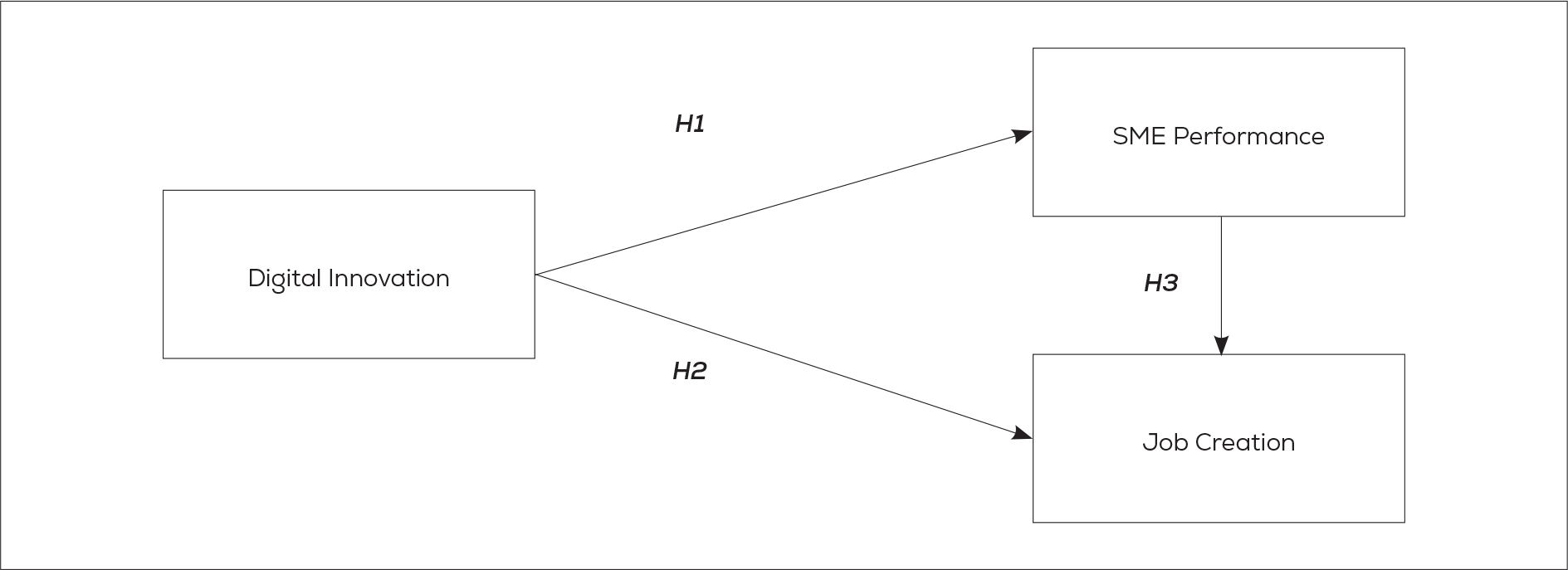
Therefore, our first hypothesis states:
-
H1: Digital Innovation relates positively to Job Creation.
Digital innovation and SME performance
According to Shahadat et al. (2023), evenly diffused digital innovation (DI) enhances SME performance (SP). For Abisuga-Oyekunle et al. (2019), SMEs can only help alleviate poverty, when they have a competitive advantage in the market (Zide & Jokonya, 2022), which will help them to contribute to economic growth, especially in SSA. Xie and Redding (2018) believe that no business can contribute to economic growth that will lead to poverty eradication without having a proper environment that will enable a high level of digital innovation diffusion and adoption, but countries in the SSA region are characterized by low digital innovation diffusion (Akinlo, 2023).
Looking at developed nations, for instance, countries like the United States and Japan benefit greatly from digital innovation due to a high level of technology diffusion (Xia, 2023). China is another example (Li & Yang, 2023). It is evident that developed nations have strategies for digital innovation and economic growth; even developing nations with the right strategy can experience economic growth. Ebong and Babu (2020) established that digital innovation drives economic growth via SMEs, enhancing SME performance and sustainability (Puriwat & Tripopsakul, 2021). Despite the potential of digital innovation for economic growth and SME performance, countries in SSA have yet to take full advantage of digital innovation, especially to enhance SME performance.
Studies affirmed the power of technology diffusion to herald economic growth (Cohen, 2010; Cordes & Marinova, 2023; Dedrick et al., 2003; Pohjola, 2001). Therefore, countries in the SSA region should focus on digital innovation to improve SMEs’ performance. We contend that there is considerable evidence to show that SMEs in developed countries are taking advantage of digital innovation to improve performance when it is compatible with SME operations. Alimi and Adediran (2020) asserted that improved SME performance is one of the advantages digital innovations offer countries in SSA. We believe that observing how SMEs in advanced countries adopt digital innovation can influence SMEs in SSA to replicate these practices, particularly when these innovations are compatible with the local context and existing business practices.
The aim is to understand how digital innovation can enhance SMEs’ performance in SSA, which will, in turn, enhance job creation in the region. Based on innovation diffusion theory, we argue that as the level of digital innovation increases among SMEs in SSA, the extent to which they benefit from the advantages of digital innovation to improve their performance also increases, leading to enhanced job creation in the region. The dimension of compatibility suggests that the more aligned digital innovations are with the existing values, needs, and capabilities of SMEs in SSA, the more likely they are to be effectively adopted and leveraged for improved performance.
Therefore, our second hypothesis is:
-
H2: Digital innovation relates positively to SMEs’ Performance.
Relationship between digital innovation, SME performance, and job creation
Ibidunni et al. (2021) established that SMEs contribute significantly to the economic development of any nation, with their activities supporting economic growth, job creation, and other economic activities. SMEs can improve the economy when their performance improves, which can be facilitated by an increase in operational capacity, requiring the creation of new jobs (Endris & Kassegn, 2022). According to Shahadat et al. (2023), digital innovation can help improve SME performance, leading to enhanced operational capacity and, consequently, job creation. These arguments must be validated with a scientific approach, which is currently lacking in the body of knowledge, especially in SSA. We argue that a high level of digital innovation among SMEs in SSA will enhance their performance, thereby creating room for job creation. Therefore, our third hypothesis is:
-
H3: Digital Innovation relates to Job Creation when mediated by SME performance.
METHODOLOGY
This study adopts a survey research design, selecting five different countries in the Sub-Saharan Africa region, namely Nigeria, Ghana, Benin Republic, Togo, and Niger Republic, to examine how digital innovation can be used as a tool to alleviate poverty in SSA. Our motivation for selecting these countries is based on their contribution to economic development, particularly through the use of technology. According to Statista (2024), Nigeria ranked highest in the number of internet users in Africa as of January 2024, while Ghana ranked sixth. Benin Republic, Togo, and Niger Republic are characterized by high rates of internet penetration (Statista, 2024).
Participants in this study are business owners willing to acquire more knowledge on digital adoption for business operations. We focused on business owners who attended a month-long virtual training on digital skill acquisition and adoption, comprising citizens of Nigeria, Ghana, Benin Republic, Togo, and Niger Republic. The research intention was discussed with the training organizers, and participants were informed about the study’s objectives, with assurances of privacy and confidentiality. A structured questionnaire using a five-point Likert scale was designed and made accessible online. An introductory message accompanying the questionnaire link explained the survey’s purpose and requested participants’ consent. After seven weeks, responses were retrieved for further analysis. Out of the 689 individuals invited to participate, 12 voluntarily declined. The remaining 677 responses were exported to Microsoft Excel 2019 for data treatment and coding, with 22 deemed incomplete or unsuitable. Therefore, the final sample consisted of 655 respondents.
The data analysis and hypotheses testing were conducted using the SEMinR package in R programming to model the study via Structural Equation Modelling (SEM). This approach was guided by the opinion of Loehlin and Beaujean (2016), who stated that a minimum of 100 respondents is required for SEM. The study sampled 655 respondents, which meets the criterion set by Loehlin and Beaujean (2016).
Variables
Digital Innovation was used as the independent variable for the study, measuring the extent to which SMEs adopt digital innovation. Questions used to measure digital innovation were adopted and adapted from past studies (Kim et al., 2016; Yu et al., 2014). Job creation was used as a dependent variable to determine whether digital innovation among SMEs in SSA can lead to job creation. Questions on job creation were adopted and adapted from Ademilua et al. (2022). Additionally, SME Performance was used both as a dependent and mediating variable, with questions on SME Performance derived and adapted from Bontis et al. (2000). All questions under these constructs were edited to fit the research context to achieve the study’s objectives.
ANALYSIS
Demographic analysis
Table 1 shows the demographic characteristics of respondents, which reveals that 59.85% of the respondents were male, while the remaining 40.15% were female. In terms of respondents’ age, more than half of the respondents, representing 74.5%, were between the ages 28 and 37, giving a rich sample of young and active people aware of emerging technologies, 19.08% of the respondents were between 18 and 27, 5.65% between 38 and 47 while the remaining respondents representing 0.77% were above 48 years old. Respondents’ educational level shows that the majority of the respondents, representing 90.23%, had a BSc/HND degree, i.e., these individuals were well educated. Of the respondents, 9.47% earned a second degree, either an MSc or MBA, while the remaining 0.30% had a doctorate degree. This implies that the study focused on educated people, who should be aware and can relate well with emerging technologies. Of the respondents, 74.49% were single, while 23.51% were married. Countries spread of respondents show that 28.24% of the respondents were from Nigeria, 21.53% from Ghana, 14.96% from Togo, and the remaining 18.7% and 17.1% were from Benin and Niger Republic, respectively. Almost a fair representation of the countries sampled in the region.
Measurement models
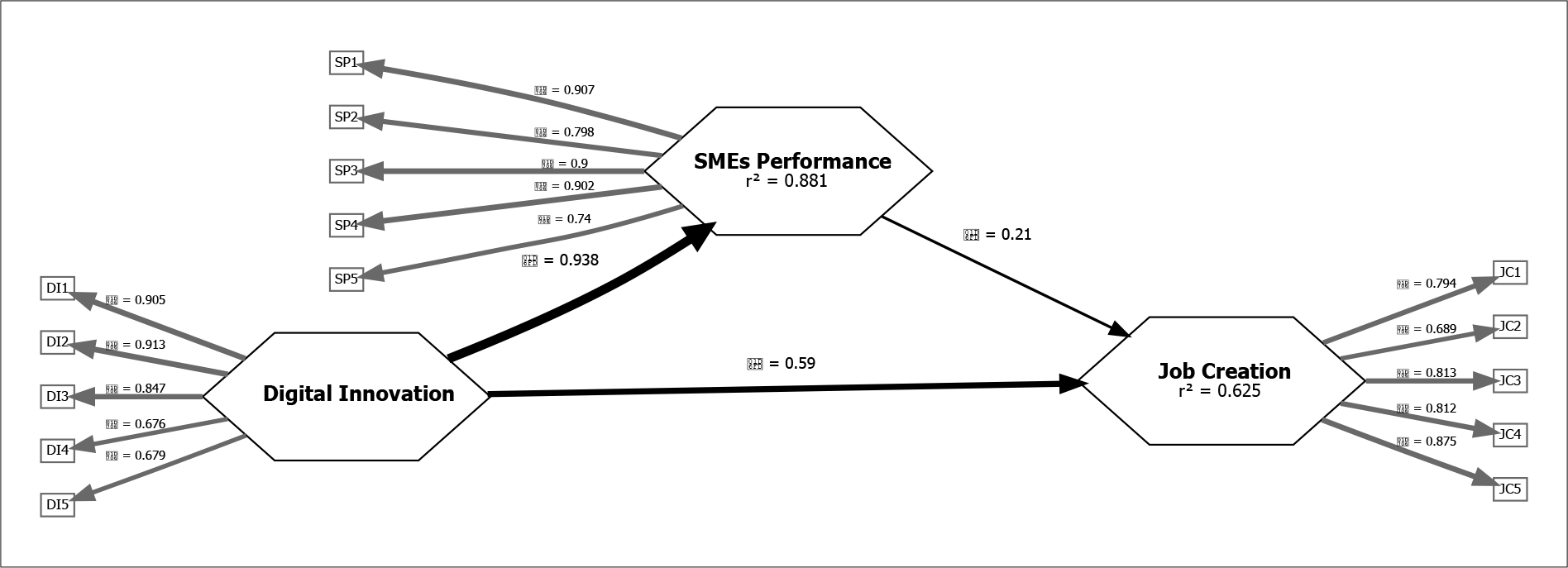
The measurement model is essential before conducting Structural Equation Modelling (SEM), as it helps relate the measurement model to latent variables, ensuring the quality of constructs in this study. The reliability and validity of the constructs were tested using Cronbach’s Alpha for each construct, as presented in Table 2. Digital Innovation, the independent variable, shows a Cronbach’s alpha value of 0.765. Job Creation and SME Performance, which are dimensions of Poverty Alleviation, have Cronbach’s Alpha values of 0.857 and 0.905, respectively. In addition to Cronbach’s Alpha, Table 2 also presents the composite reliability value, denoted by rhoC. Digital Innovation, Job Creation, and SME Performance show composite reliability values of 0.898, 0.898, and 0.929, respectively. Both Cronbach’s Alpha and composite reliability exceed the 0.70 thresholds recommended by Hair et al. (2010). Additionally, the factor loading for each item is greater than 0.7, which is the recommended threshold by Hair et al. (2016), except for two items under Digital Innovation and one item under Job Creation, which are very close to 0.7. Based on this, we are confident that the reliability of the measurement model is confirmed, and we established that the model is consistent with the study’s intention.
The discriminant validity of the model was tested using the Fornell-Larcker (FL) criterion. To ascertain the discriminant validity of the model, the results of the Fornell-Larcker Criterion (square root of AVE), Heterotrait-Monotrait Ratio (HTMT), and Cross Loading are presented in Tables 3 and 4. Table 3 shows that the Fornell-Larcker Criterion (diagonal and bold) value for each construct (Digital Innovation = 0.711, Job Creation = 0.799, and SME Performance = 0.852) is greater than the correlations between the other constructs in the model. This aligns with the recommendation of Fornell and Larcker (1981) that the FL criterion value should be greater than other correlations in the model. Above the Fornell-Larcker Criterion are the HTMT values, which are lower than 0.85, as recommended by Henseler et al. (2015), indicating that the constructs are distinct if the HTMT values are less than 0.85. Table 4 presents the cross-loading between items and different constructs in the model, showing that items perform better under their parent construct than under other constructs. Based on the results of the Fornell-Larcker Criterion, HTMT, and Cross Loading, the discriminant validity of the model is established.
Table 5 presents the covariance matrix, which was used to analyze the relationships between digital innovation, job creation, and SME performance constructs. All the items within each construct show positive covariance, indicating a positive relationship between the items under each construct. Additionally, there is a positive covariance between the items of one construct and the items of other constructs in the model, providing preliminary evidence of an association between digital innovation, job creation, and SME performance.
Structural model analysis
After ensuring validity and reliability of constructs, we assessed the structural model to test the hypotheses that were raised in this study. Table 5 shows the result of the analysis.
The result shows R2 value of 0.625 (62.5%) and 0.881 (88.1%) for job creation and SME performance, respectively; Briones et al. (2018) established that R2 can be used to determine the strength of the model to be able to predict while Falk and Miller (1992) suggested that R2 must be greater than 0.1 for predictive capacity to be established. R2 for the two dependent variables in this study are over 0.1; therefore, the model has a capacity to predict.
The first hypothesis is supported since the analysis shows that digital innovation positively relates to job creation, and the relationship is significant (β = 0.59; T-Stat = 7.268; P = 0.000). The second hypothesis is also supported since the analysis shows a positive and significant relationship between digital innovation and SME performance (β = 0.938; T-Stat = 249.551; P = 0.000).
To explore the mediating role of SME performance on the relationship between digital innovation and job creation, mediation analysis was performed. The result of the analysis in Table 5 established the mediating role of SME performance on the relationship between digital innovation and job creation (β = 0.197; T-Stat = 2.443; P = 0.009), this result established that the mediating role of SME performance is statistically significant.
Robustness check
The results of the analysis show that digital innovation is positively related to job creation and SME performance. Additionally, SME performance plays a mediating role in the relationship between digital innovation and job creation. The data used in the study were collected from five different countries in Sub-Saharan Africa (SSA), namely Nigeria, Ghana, Niger Republic, Benin Republic, and Togo. Responses from Nigeria and Ghana accounted for 326 out of the 655 total responses, constituting 49.77% of the study population. It is possible that responses from these two countries influenced the results obtained in the analysis. To ensure that our results are not biased by these responses, we performed a supplementary analysis to check the robustness of the findings. This involved excluding responses from Nigeria and Ghana and reanalyzing the data using only the 329 responses from Niger Republic, Benin Republic, and Togo.
The results of the supplementary analysis revealed no bias in the original findings. We discovered that digital innovation is positively associated with job creation and SME performance in Niger Republic, Benin Republic, and Togo. The results also show that SME performance has the capacity to mediate the relationship between digital innovation and job creation in these three countries selected for the supplementary analysis.
DISCUSSION
The study explored the effect of digital innovation on job creation and SME performance in Sub-Saharan African countries: Nigeria, Ghana, Niger Republic, Benin Republic, and Togo. The purpose was to understand how emerging technologies can assist these countries in combating unemployment and contribute to sustainable development in this region.
Our finding regarding the first hypothesis supports the theoretical notion provided by previous studies that established a relationship between technologies and job creation (Balsmeier & Woerter, 2019). Our study discovered a significant and positive relationship between digital innovation and job creation, especially among SMEs in SSA, which is plagued by unemployment. This result aligns with Brynjolfsson and McAfee (2011), who argued that technologies create opportunities for more jobs. Theoretically, the result implies that the higher the level of digital innovation diffusion, the higher the level of job creation. This finding also contributes to the literature by demonstrating that digital innovation is a valuable tool for SMEs in SSA to create more jobs, a perspective that was previously missing in the literature.
The result of the second hypothesis emphasizes that there is a positive relationship between digital innovation and SME performance. SMEs can perform better with digital innovation and make significant contributions to economic development, as suggested by Ibidunni et al. (2021). Our result aligns with Quinton et al. (2018), who found that digital innovations improve SME performance. Based on innovation diffusion theory, we discovered that when there is a high level of digital innovation diffusion compatible with SME operations in SSA, there is a corresponding high level of SME performance. This result supports previous studies on digital innovation and performance, and it makes a significant contribution to the body of knowledge by demonstrating that SME performance in SSA can be improved through digital innovation. This finding fills a gap in the literature regarding the mechanisms through which digital innovation can be used to enhance performance.
The relationship between digital innovation and SME performance impacts job creation. Thus, the third hypothesis highlights the mediating role played by SME performance in the relationship between digital innovation and job creation. In essence, digital innovation enhances SME performance, enabling them to create more jobs. Our results support the third hypothesis, showing that as digital innovation diffuses more widely among SMEs in SSA, SME performance increases, thereby leading to job creation.
Theoretical implication
The study highlighted the capacity of digital innovation on job creation and SME performance, especially in the Sub-Sahara Africa region. The results corroborate previous studies and explain the implication of diffusion of innovation theory on how digital innovation can contribute to economic growth via job creation and SME performance. This study contributes to the literature by exploring channels in which digital innovation can be used to fight unemployment in SSA; the study explored how SMEs can serve as a channel in which digital innovation can be used to enhance economic growth in SSA, which has not been previously studied. The study also contributes to the body of knowledge by exploring the mediating role of SME performance on the relationship between digital innovation and job creation, which helps to enhance economic growth in SSA; it explains how increased digital innovation among SMEs in SSA can lead to increase in SME performance thereby leading to job creation.
Managerial implication
The study clearly demonstrates that digital innovation contributes to job creation and enhances SME performance. With this, SMEs can contribute to economic growth, as noted by Ibidunni et al. (2021), by leveraging digital innovation to create more jobs and improve their performance. This enables SMEs to provide solutions for economic growth in SSA, as job creation has been identified as a pathway to economic growth (Abisuga-Oyekunle et al., 2020). To drive economic growth, it is essential to improve SME performance, and digital innovation serves as a key factor in achieving this, leading to job creation that improves livelihoods and fosters economic development. Therefore, digital innovation can be a valuable tool for SMEs to support governments in promoting economic growth in SSA. SMEs can assist in enhancing economic growth by improving their performance, which in turn leads to job creation. This implies that SMEs must be prepared to adopt digital innovation in their operations and be willing to invest in emerging technologies.
Policy implications
Policymakers should create a suitable environment that will enable the adoption of digital innovation in their country, which will help them create jobs and enhance SME performance. Countries, especially those in the Sub Sahara Africa region, should develop policies to enhance the diffusion of digital innovation and economic growth. Training on digital innovation can be done to empower graduates, unemployed, and underemployed youth to empower them to create jobs. Such training should be done to empower small business owners and equip them for improved performance and job creation. Also, policymakers should ensure that there is an enabling environment for researchers to support the development of emerging technologies that could help SME operations.
CONCLUSION, LIMITATION, AND FURTHER STUDIES
This study focuses on digital innovation and economic growth in SSA using SMEs as the channel through which digital innovation can be used to create jobs and improve SME performance. Based on the findings, we conclude that digital innovation is an essential tool to enhance economic growth in SSA via job creation and improvement in SME performance. Also, it shows that digital innovation is suitable for improving SME performance, enabling them to contribute to economic development. The study further concludes that digital innovation can improve SME performance, leading to job creation. This study has improved our understanding of how digital innovation can be used to create jobs, especially in SSA, which is plagued by unemployment. We conclude that there is a direct relationship between digital innovation, job creation, and SME performance. As digital innovation diffusion increases, job creation and SME performance increase.. However, the study was limited to five countries in SSA. We recommend that comparative studies be carried out to see how SMEs in developed and developing countries are using digital innovation to contribute to sustainable economic growth.
ACKNOWLEDGMENTS
We extend our heartfelt appreciation to the esteemed reviewers whose valuable insights helped to improve the quality of this work, as well as to the guest editors-Ayodotun Stephen Ibidunni, Ebes Esho, Ogechi Adeola, and Alexandre de Almeida Faria. Their thoughtful guidance and dedication throughout this process have been instrumental. Their expertise and constructive feedback have been invaluable in refining our manuscript, and we are truly honored to benefit from their knowledge and scholarly experience.
-
Evaluated through a double-anonymized peer review.
-
The Peer Review Report is available at this link.
REFERENCES
-
Abdul-Azeez, O., Ihechere, A. O., & Idemudia, C. (2024). SMEs as catalysts for economic development: Navigating challenges and seizing opportunities in emerging markets. GSC Advanced Research and Reviews, 19(3), 325-335.https://doi.org/10.30574/gscarr.2024.19.3.0230
» https://doi.org/10.30574/gscarr.2024.19.3.0230 -
Abisuga-Oyekunle, O. A., Patra, S. K., & Muchie, M. (2019). SMEs in sustainable development: Their role in poverty reduction and employment generation in sub-Saharan Africa. African Journal of Science, Technology, Innovation and Development, 12(4), 405 - 419. https://doi.org/10.1080/20421338.2019.1656428
» https://doi.org/10.1080/20421338.2019.1656428 -
Achieng, M. S., & Malatji, M. (2022). Digital transformation of small and medium enterprises in sub-Saharan Africa: A scoping review. Journal for Transdisciplinary Research in Southern Africa, 18(1), 1-13. http://dx.doi.org/10.4102/td.v18i1.1257
» http://dx.doi.org/10.4102/td.v18i1.1257 -
Achmad, W. (2023). MSMEs empowerment through digital innovation: The key to success of e-commerce in Indonesia. Daengku: Journal of Humanities and Social Sciences Innovation, 3(3), 469-475. https://doi.org/10.35877/454RI.daengku1742
» https://doi.org/10.35877/454RI.daengku1742 -
Ademilua, V. A., Lasisi, T. T., Ogunmokun, O. A., & Ikhide, J. E. (2022). Accounting for the effects of entrepreneurial orientation on SMEs’ job creation capabilities: A social capital and self-determination perspective. Journal of Public Affairs, 22(2), e2413. https://doi.org/10.1002/pa.2413
» https://doi.org/10.1002/pa.2413 -
Akinlo, T. (2023). Information technology and insurance development in Sub-Saharan Africa. Information Development, 39(1), 169-183. https://doi.org/10.1177/02666669211028960
» https://doi.org/10.1177/02666669211028960 -
Akumbom, P., Egwu, M. J. B., & Shillie, P. N. (2023). Agricultural technology adoption, productivity, and poverty reduction in Cameroon: A mediating analysis. Journal of Enterprise and Development (JED), 5(2), 188-201. https://doi.org/10.20414/jed.v5i2.6839
» https://doi.org/10.20414/jed.v5i2.6839 -
Alimi A. S., & Adediran, I. A. (2020). ICT diffusion and the finance - Growth nexus : A panel analysis on ECOWAS countries. Future Business Journal, 6(16), 1-10. https://doi.org/10.1186/s43093-020-00024-x
» https://doi.org/10.1186/s43093-020-00024-x -
Araki, M. E., Bennett, D. L., & Wagner, G. A. (2024). Regional innovation networks and high-growth entrepreneurship. Research Policy, 53(1), 104900. https://doi.org/10.1016/j.respol.2023.104900
» https://doi.org/10.1016/j.respol.2023.104900 -
Asravor, R. K., & Sackey, F. G. (2023). Impact of technology on macro-level employment and the workforce: What are the implications for job creation and job destruction in Ghana? Social Indicators Research, 168(1), 207-225. https://doi.org/10.1007/s11205-023-03109-6
» https://doi.org/10.1007/s11205-023-03109-6 -
Babilla, T. U. K. (2023). Digital innovation and financial access for small and medium-sized enterprises in a currency union. Economic Modelling, 120(106182), 1-26 https://doi.org/10.1016/j.econmod.2022.106182
» https://doi.org/10.1016/j.econmod.2022.106182 -
Bähr, K., & Fliaster, A. (2023). The twofold transition: Framing digital innovations and incumbents’ value propositions for sustainability. Business Strategy and the Environment, 32, 920-935. https://doi.org/10.1002/bse.3082
» https://doi.org/10.1002/bse.3082 -
Bakibinga-Gaswaga, E., Bakibinga, S., Bakibinga, D. B. M., & Bakibinga, P. (2020). Digital technologies in the COVID-19 responses in sub-Saharan Africa: Policies, problems and promises. The Pan African Medical Journal, 35(Suppl 2),1 -3. https://doi.org/10.11604%2Fpamj.supp.2020.35.2.23456
» https://doi.org/10.11604%2Fpamj.supp.2020.35.2.23456 -
Balsmeier, B., & Woerter, M. (2019). Is this time different? How digitalization influences job creation and destruction. Research Policy, 48(8), 103765. https://doi.org/10.1016/j.respol.2019.03.010
» https://doi.org/10.1016/j.respol.2019.03.010 -
Blut, M., & Wang, C. (2020). Technology readiness: A meta-analysis of conceptualizations of the construct and its impact on technology usage. Journal of the Academy of Marketing Science, 48, 649-669. https://doi.org/10.1007/s11747-019-00680-8
» https://doi.org/10.1007/s11747-019-00680-8 - Bontis, N., Keow, W. C. C., & Richardson, S. (2000). Intellectual capital and business performance in Malaysian industries. Journal of intellectual capital, 1(1), 85-100.
- Brynjolfsson, E., & McAfee, A. (2011). Race against the machine: How the digital revolution is accelerating innovation, driving productivity, and irreversibly transforming employment and the economy. Digital Frontier Press
-
Chege, S. M., & Wang, D. (2020). Information technology innovation and its impact on job creation by SMEs in developing countries: An analysis of the literature review. Technology Analysis & Strategic Management, 32(3), 256-271. https://doi.org/10.1080/09537325.2019.1651263
» https://doi.org/10.1080/09537325.2019.1651263 -
Ciarli, T., Kenney, M., Massini, S., & Piscitello, L. (2021). Digital technologies, innovation, and skills: Emerging trajectories and challenges. Research Policy, 50(7), 104289. https://doi.org/10.1016/j.respol.2021.104289
» https://doi.org/10.1016/j.respol.2021.104289 -
Clark, S., MacLachlan, M., Marshall, K., Morahan, N., Carroll, C., Hand, K., Boyle, N. & O’Sullivan, K. (2022). Including digital connection in the United Nations sustainable development goals: A systems thinking approach for achieving the SDGs. Sustainability, 14(3), 1883. https://doi.org/10.3390/su14031883
» https://doi.org/10.3390/su14031883 -
Cohen, W. M. (2010). Fifty years of empirical studies of innovative activity and performance. Handbook of the Economics of Innovation, 1, 129-213. https://doi.org/10.1016/S0169-7218(10)01004-X
» https://doi.org/10.1016/S0169-7218(10)01004-X -
Collier, P., & Venables, A. J. (2012). Greening Africa? Technologies, endowments and the latecomer effect. Energy Economics, 34, S75-S84. https://doi.org/10.1016/j.eneco.2012.08.035
» https://doi.org/10.1016/j.eneco.2012.08.035 -
Cordes, D. L., & Marinova, D. (2023). Systematic literature review of the role of e-commerce in providing pathways to sustainability for poverty alleviation in Sub-Saharan Africa. Discover Sustainability, 4(1), 7. https://doi.org/10.1007/s43621-022-00109-3
» https://doi.org/10.1007/s43621-022-00109-3 -
Criollo-C, S., Guerrero-Arias, A., Jaramillo-Alcázar, Á., & Luján-Mora, S. (2021). Mobile learning technologies for education: Benefits and pending issues. Applied Sciences, 11(9), 4111. https://doi.org/10.3390/app11094111
» https://doi.org/10.3390/app11094111 -
Dedrick, J., Gurbaxani, V., & Kraemer, K. L. (2003). Information technology and economic performance: A critical review of the empirical evidence. ACM Computing Surveys (CSUR), 35(1), 1-28. https://doi.org/10.1145/641865.641866
» https://doi.org/10.1145/641865.641866 -
Dzator, J., Acheampong, A. O., Appiah-Otoo, I., & Dzator, M. (2023). Leveraging digital technology for development: Does ICT contribute to poverty reduction?. Telecommunications Policy, 47(4), 102524. https://doi.org/10.1016/j.telpol.2023.102524
» https://doi.org/10.1016/j.telpol.2023.102524 -
Ebong, J., & Babu, G. (2021). Financial inclusion through digital financial services (DFS): A study in Uganda. Journal of Risk and Financial Management, 14(9), 393. https://doi.org/10.3390/jrfm14090393
» https://doi.org/10.3390/jrfm14090393 -
Endris, E., & Kassegn, A. (2022). The role of micro, small and medium enterprises (MSMEs) to the sustainable development of sub-Saharan Africa and its challenges: A systematic review of evidence from Ethiopia. Journal of Innovation and Entrepreneurship, 11(1), 20. https://doi.org/10.1186/s13731-022-00221-8
» https://doi.org/10.1186/s13731-022-00221-8 -
Etim, G. S., James, E. E., Ekong, J. E., & Jemil, D. O. (2023). Information and communication technologies (ICT) and performance of micro, small and medium enterprises (MSMEs) in Nigeria. African Journal of Economics and Sustainable Development, 6(3), 89-112. https://doi.org/10.52589/AJESD-WYE3IERI
» https://doi.org/10.52589/AJESD-WYE3IERI - Falk, R. F. & Miller, N. B. (1992). A primer for soft modeling. Ohio University of AkronPress
- Fornell, C., & Larcker, D. F. (1981). Evaluating structural equation models with unobservable variables and measurement error. Journal of marketing research, 18(1), 39-50.
-
Felicetti, A. M., Corvello, V., & Ammirato, S. (2023). Digital innovation in entrepreneurial firms: A systematic literature review. Review of Management Science, 18, 315-362 https://doi.org/10.1007/s11846-023-00638-9
» https://doi.org/10.1007/s11846-023-00638-9 -
Gadi, N. H. (2022). Increasing women’s employment opportunities in digitalizing Saudi Arabia’s economy. Open Journal of Business and Management, 10(5), 2869-2902. https://doi.org/10.4236/ojbm.2022.105142
» https://doi.org/10.4236/ojbm.2022.105142 -
Gewehr, A. C., Ruffoni, J., & Carvalho, A. M. (2019). Technological diffusion dynamics in developed and developing economies: An analysis for the information and communication technologies (ICT). Estudios Económicos, 36(73), 71-107. https://doi.org/10.52292/j.estudecon.2019.1368
» https://doi.org/10.52292/j.estudecon.2019.1368 - Hair, J. F., Black, W. C., Babin, B. J., & Anderson, R. E. (2010) Multivariate data analysis (7th ed.). Pearson.
-
Hair, J. F., Sarstedt, M., Matthews, L. M., & Ringle, C. M. (2016). Identifying and treating unobserved heterogeneity with FIMIX-PLS: Part I-method. European Business Review, 28(1), 63-76. https://doi.org/10.1108/EBR-09-2015-0094
» https://doi.org/10.1108/EBR-09-2015-0094 -
Hui, G. (2014). How the internet of things changes business models. Harvard Business Review, 92(7/8), 1-5. https://hbr.org/2014/07/how-the-internet-of-things-changes-business-models
» https://hbr.org/2014/07/how-the-internet-of-things-changes-business-models -
Ibidunni, A. S., Ogundana, O. M., and Okonkwo, A. (2021). Entrepreneurial competencies and the performance of informal SMEs: The contingent role of business environment. Journal of African Business, 22(4), 468 - 490. https://doi.org/10.1080/15228916.2021.1874784
» https://doi.org/10.1080/15228916.2021.1874784 -
Khaleel, M., Yusupov, Z., Ahmed, A. A., Alsharif, A., Alarga, A., & Imbayah, I. (2023). The effect of digital technologies on energy efficiency policy. International Journal of Electrical Engineering and Sustainability (IJEES), 1(1), 1-8. https://ijees.org/index.php/ijees/article/view/5
» https://ijees.org/index.php/ijees/article/view/5 -
Kim, W. G., Li, J. J., & Brymer, R. A. (2016). The impact of social media reviews on restaurant performance: The moderating role of excellence certificate. International Journal of Hospitality Management, 55, 41-51. https://doi.org/10.1016/j.ijhm.2016.03.001
» https://doi.org/10.1016/j.ijhm.2016.03.001 -
Kitsios, F., & Kamariotou, M. (2022). Digital innovation and entrepreneurship transformation through open data hackathons: Design strategies for successful start-up settings, International Journal of Information Management, 69(102472). https://doi.org/10.1016/j.ijinfomgt.2022.102472
» https://doi.org/10.1016/j.ijinfomgt.2022.102472 -
Kouladoum, J. C. (2023). Digital infrastructural development and inclusive growth in Sub-Saharan Africa. Journal of Social and Economic Development, 25, 403-427. https://doi.org/10.1007/s40847-023-00240-5
» https://doi.org/10.1007/s40847-023-00240-5 -
Lei, Z. (2023). Examining the relationship between entrepreneurship education and job creation in China’s post-pandemic economy. Journal of Digitainability, Realism and Mastery (DREAM), 2(5), 45-52. https://doi.org/10.56982/dream.v2i05.119
» https://doi.org/10.56982/dream.v2i05.119 -
Leliveld, A., & Knorringa, P. (2018). Frugal innovation and development research. The European Journal of Development Research, 30, 1-16. https://doi.org/10.1057/s41287-017-0121-4
» https://doi.org/10.1057/s41287-017-0121-4 -
Li, H., & Yang, S. (2023). The road to common prosperity: Can the digital countryside construction increase household income? Sustainability, 15(5), 4020, 1 - 19. http://dx.doi.org/10.3390/su15054020
» http://dx.doi.org/10.3390/su15054020 - Loehlin, J. C., & Beaujean, A. A. (2016). Latent variable models: An introduction to factor, path, and structural equation analysis Taylor and Francis.
-
Molla, A., & Licker, P. S. (2005). eCommerce adoption in developing countries: A model and instrument. Information and Management, 42(6), 877-899. https://doi.org/10.1016/j.im.2004.09.002
» https://doi.org/10.1016/j.im.2004.09.002 -
Myovella, G., Karacuka, M., & Haucap, J. (2021). Determinants of digitalization and digital divide in Sub-Saharan African economies: A spatial Durbin analysis. Telecommunications Policy, 45(10), 102224. https://doi.org/10.1016/j.telpol.2021.102224
» https://doi.org/10.1016/j.telpol.2021.102224 -
Nguimkeu, P., & Okou, C. (2021). Leveraging digital technologies to boost productivity in the informal sector in Sub-Saharan Africa. Review of Policy Research, 38(6), 707-731. https://doi.org/10.1111/ropr.12441
» https://doi.org/10.1111/ropr.12441 - Okpe, S. O. (2022). Challenges impoverished people in Sub-Saharan Africa experience in the adoption of technology (Doctoral dissertation, Colorado Technical University).
- Pohjola, M. (2001). Information technology, productivity, and economic growth: International evidence and implications for economic development Oxford University Press.
-
Puriwat, W., & Tripopsakul, S. (2021). Explaining an adoption and continuance intention to use contactless payment technologies: During the COVID-19 pandemic. Emerging Science Journal, 5(1), 85-95. http://dx.doi.org/10.28991/esj-2021-01260
» http://dx.doi.org/10.28991/esj-2021-01260 - Statista. (2024). Number of internet users in Africa as of January 2024, by country.
- Statista (2024). Internet penetration in Africa January 2024, by country.
-
Quinton, S., Canhoto, A., Molinillo, S., Pera, R., & Budhathoki, T. (2018). Conceptualising a digital orientation: Antecedents of supporting SME performance in the digital economy. Journal of Strategic Marketing, 26(5), 427-439. https://doi.org/10.1080/0965254X.2016.1258004
» https://doi.org/10.1080/0965254X.2016.1258004 -
Rafiana, N. N. (2024). Technopreneurship strategy to grow entrepreneurship career options for students in higher education. ADI Journal on Recent Innovation, 5(2), 110-126. https://doi.org/10.34306/ajri.v5i2.995
» https://doi.org/10.34306/ajri.v5i2.995 - Rogers, E. M. (1962). Diffusion of innovations Free Press.
-
Rubio-Andrés, M., Ramos-González, M. del M., & Sastre-Castillo, M. Á. (2022). Driving innovation management to create shared value and sustainable growth. Review of Managerial Science, 16(7), 2181-2211. https://doi.org/10.1007/s11846-022-00520-0
» https://doi.org/10.1007/s11846-022-00520-0 -
Santos, A. M., Barbero, J., Salotti, S., & Conte, A. (2023). Job creation and destruction in the digital age: Assessing heterogeneous effects across European Union countries. Economic Modelling, 126, 106405. https://doi.org/10.1016/j.econmod.2023.106405
» https://doi.org/10.1016/j.econmod.2023.106405 -
Shahadat, M. M. H., Nekmahmud, M., Ebrahimi, P., & Fekete-Farkas, M. (2023). Digital technology adoption in SMEs: What technological, environmental and organizational factors influence in emerging countries? Global Business Review, 0(0). https://doi.org/10.1177/09721509221137199
» https://doi.org/10.1177/09721509221137199 -
Sharma, C., & Khanna, R. (2024). Do trade and technology foster employment growth? Evidence from Indian industries. Managerial and Decision Economics, 45(2), 989-1005. https://doi.org/10.1002/mde.4048
» https://doi.org/10.1002/mde.4048 -
Solomon, E. M., & Klyton, A. van. (2020). The impact of digital technology usage on economic growth in Africa. Utilities Policy, 67, 101104. https://doi.org/10.1016/j.jup.2020.101104
» https://doi.org/10.1016/j.jup.2020.101104 -
Surya, B., Menne, F., Sabhan, H., Suriani, S., Abubakar, H., & Idris, M. (2021). Economic growth, increasing productivity of SMEs, and open innovation. Journal of Open Innovation: Technology, Market, and Complexity, 7(1), 20. https://doi.org/10.3390/joitmc7010020
» https://doi.org/10.3390/joitmc7010020 -
Tarutė, A., & Gatautis, R. (2014). ICT impact on SMEs performance. Procedia-social and behavioral Sciences, 110, 1218-1225. https://doi.org/10.1016/j.sbspro.2013.12.968
» https://doi.org/10.1016/j.sbspro.2013.12.968 -
Tian, J. (2024). Does technological innovation have an impact on employment in the hospitality industry? International Journal of Contemporary Hospitality Management, 36(4), 1025-1043. https://doi.org/10.1108/IJCHM-03-2022-0370
» https://doi.org/10.1108/IJCHM-03-2022-0370 -
Volberda, H. W., Khanagha, S., Baden-Fuller, C., Mihalache, O. R., & Birkinshaw, J. (2021). Strategizing in a digital world: Overcoming cognitive barriers, reconfiguring routines and introducing new organizational forms. Long Range Planning, 54(5), 102110. https://doi.org/10.1016/j.lrp.2021.102110
» https://doi.org/10.1016/j.lrp.2021.102110 -
Wang, X., Li, Y., Tian, l., & Hou, Y. (2023). Government digital initiatives and firm digital innovation: Evidence from China. Technovation, 119, 102545,1-15. https://doi.org/10.1016/j.technovation.2022.102545
» https://doi.org/10.1016/j.technovation.2022.102545 -
Xia, J. (2023). Research on the Influence of digital technology on the development of common prosperity. Academic Journal of Business and Management, 5(13), 63-76. https://doi.org/10.25236/AJBM.2023.051310
» https://doi.org/10.25236/AJBM.2023.051310 -
Xie, E., & Redding, K. S. (2018). State-owned enterprises in the contemporary global business scenario: Introduction. International Journal of Public Sector Management, 31(2), 98-112. https://doi.org/10.1108/IJPSM-01-2018-0015
» https://doi.org/10.1108/IJPSM-01-2018-0015 - Yonazi, E., Kelly, T., Halewood, N., & Blackman, C. (2012). The transformational use of information and communication technologies in Africa. World Bank.
-
Yu, W., Ramanathan, R., & Nath, P. (2014). The impacts of marketing and operations capabilities on financial performance in the UK retail sector: A resource-based perspective. Industrial Marketing Management, 43(1), 25-31. https://doi.org/10.1016/j.indmarman.2013.07.014
» https://doi.org/10.1016/j.indmarman.2013.07.014 -
Zhang, Z., Jin, J., Li, S., & Zhang, Y. (2023). Digital transformation of incumbent firms from the perspective of portfolios of innovation. Technology in Society, 72, 102149, 1-14. https://doi.org/10.1016/j.techsoc.2022.102149
» https://doi.org/10.1016/j.techsoc.2022.102149 -
Zide, O., & Jokonya, O. (2022). Factors affecting the adoption of data management as a service (DMaaS) in small and medium enterprises (SMEs). Procedia Computer Science, 196, 340-347. https://doi.org/10.1016/j.procs.2021.12.022
» https://doi.org/10.1016/j.procs.2021.12.022
Edited by
-
Guest editors:
Ayodotun Stephen Ibidunni, Ebes Esho, Ogechi Adeola e Alexandre de Almeida Faria