
 The Role of Social Capital and Digital Literacy on Entrepreneurial Performance
ABSTRACT
Objective: this study examines how social capital and digital literacy influence entrepreneurial performance directly and indirectly toward entrepreneurial orientation among small and medium enterprises (SMEs).
Theoretical approach: this study is grounded in the Resource-Based View (RBV) and Social Capital Theory, extended by the dynamic capabilities perspective, to explain how social capital and digital literacy influence entrepreneurial orientation and, ultimately, the performance of SMEs.
Method: data were collected through online and offline surveys, and a total of SME owners participated in this study. Structural equation modeling (SEM) was used to validate the research hypotheses.
Results: social capital and digital literacy have a positive effect on SMEs’ owners’ entrepreneurial orientation. Furthermore, entrepreneurial orientation partially mediates the relationship between predictor variables (e.g., social capital and digital literacy) and outcome variables (e.g., entrepreneurial performance).
Conclusions: the role of social capital, in terms of internal and external relationships, social networks, and values and beliefs, can improve the business performance of SMEs. In addition, the role of digital literacy in understanding information technology, communication, digital content creation, and social media use greatly influences SMEs’ performance.
Keywords:
social capital; digital literacy; entrepreneurship orientation; SME performance
RESUMO
Objetivo: este estudo investiga como o capital social e a alfabetização digital influenciam o desempenho empreendedor, de forma direta e indireta, por meio da orientação empreendedora em pequenas e médias empresas (PMEs).
Marco teórico: este estudo está fundamentado na Visão Baseada em Recursos (RBV) e na Teoria do Capital Social, estendidas pela perspectiva das capacidades dinâmicas, para explicar como o capital social e a alfabetização digital influenciam a orientação empreendedora e, consequentemente, o desempenho das PMEs.
Método: os dados foram coletados por meio de pesquisas online e presenciais, com a participação de proprietários de PMEs. Utilizou-se a modelagem de equações estruturais (MEE) para validar as hipóteses da pesquisa.
Resultados: o capital social e a alfabetização digital exercem efeito positivo sobre a orientação empreendedora dos proprietários de PMEs. Além disso, a orientação empreendedora faz uma mediação parcial da relação entre as variáveis preditoras (capital social e alfabetização digital) e as variáveis de resultado (desempenho empreendedor).
Conclusões: o capital social, entendido em termos de relacionamentos internos e externos, redes sociais, valores e crenças, pode aprimorar o desempenho empresarial das PMEs. Da mesma forma, a alfabetização digital, relacionada à compreensão das tecnologias de informação e comunicação, à criação de conteúdo digital e ao uso de mídias sociais, exerce influência significativa sobre o desempenho dessas empresas.
Palavras-chave:
capital social; alfabetização digital; orientação empreendedora; desempenho de PMEs
INTRODUCTION
Small and medium enterprises (SMEs) play a crucial role in economic growth worldwide, yet they face persistent challenges that hinder their development (Gherghina et al., 2020; Khan, 2022). Globally, SMEs struggle with limited access to financing, technological adoption, market competition, and regulatory barriers (Abu et al., 2025). Hence, some SMEs lack the financial resources to invest in expansion, innovation, or digital transformation, making it difficult for them to compete with larger firms (Faiz et al., 2024). Additionally, digitalization remains a significant challenge, particularly in developing economies where infrastructure, internet access, and digital literacy are inadequate. Moreover, SMEs often face bureaucratic hurdles, high taxation, and complex regulations, making it difficult to scale operations or enter international markets (Surya et al., 2021). Some SMEs, especially in rural areas, have low digital literacy, limiting their ability to leverage e-commerce and digital financial services (Gherghina et al., 2020). Although the Indonesian government has introduced policies such as financial inclusion programs and digitalization incentives, significant gaps remain in infrastructure, education, and policy execution, hindering SME growth and sustainability. The contribution of SMEs to the Indonesian economy includes their ability to absorb 97% of the total workforce and account for up to 60.4% of total investment (Ramlawati et al., 2023). Although the role of SMEs is recognized, their current development still faces many shortcomings, such as limited access to technology, inadequate capital, insufficient human resources, and a lack of SMEs and business understanding (Lantara et al., 2022).
Several recent studies highlight the importance of social capital theory as a value in improving business performance through the formation of social networks (Hamid et al., 2024; Junaidi et al., 2023; Nguyen et al., 2020). A key aspect of social capital is the value it provides to network members, enabling them to leverage competitiveness to create an advantage over competitors (Junaidi et al., 2020). The correlation between social capital and digital literacy among SMEs is a mutually reinforcing relationship that significantly impacts business success, innovation, and resilience (Raharjo et al., 2024). SMEs with strong social capital are more likely to access knowledge-sharing platforms, mentorship programs, and peer networks that facilitate digital skill development through active participation in industry associations, business forums, and online communities (Ozanne et al., 2022; Wahyono & Hutahayan, 2021). Hence, SMEs gain exposure to emerging digital trends and best practices, ultimately improving their ability to adopt and utilize digital technologies. Furthermore, trust and collaboration within a strong social network encourage SMEs to embrace digital literacy solutions.
Digital literacy strengthens social capital by enabling SMEs to engage effectively in digital business ecosystems, expanding their network reach beyond local connections to global opportunities (Abu et al., 2025; Begum et al., 2023). SMEs proficient in digital tools can leverage social media, professional networking sites, and e-commerce platforms to build and maintain business relationships, market their products, and access resources such as funding and training (Salah & Ayyash, 2024; Zhou et al., 2023). This can strengthen SMEs’ reputation and credibility and attract valuable partnerships. However, SMEs in some developing countries with low social capital often struggle to enhance digital literacy due to a lack of access to information and financial resources (Faiz et al., 2024; Khan, 2022). This proves that low digital literacy may hinder the ability to maintain social capital in an increasingly competitive business environment, making it difficult to connect, collaborate, and compete effectively. SMEs with robust social capital are more likely to adopt and integrate digital technologies to access information, trust in digital innovations, and seize collaborative opportunities. Digital literacy, when combined with strong social capital, leads to improved innovation, market competitiveness, and business resilience, particularly in times of crisis or rapid technological change, helping achieve sustainable growth, competitive advantage, and long-term success in an increasingly digital economy (Junaidi, 2024; Ramlawati et al., 2023). This relationship indicates that social capital not only provides direct resources but also fosters an entrepreneurial mindset, essential for long-term success.
Digital literacy plays a vital role in improving SMEs’ performance, especially within Indonesia’s rapidly growing digital economy. Integrating digital literacy into SMEs’ operations facilitates better communication and information exchange, transforming business models and operational strategies (Ritala et al., 2021; Yani et al., 2020). This transformation is essential for SMEs to remain competitive in an increasingly digital market. Research shows that digital literacy encompasses a variety of skills, including searching for information, communicating digitally, creating digital content, and strategically utilizing digital devices (Asdar et al., 2024; Muliadi et al., 2024). These skills enable businesses to harness technology for effective management and marketing strategies. A study conducted by Surya et al. (2021) found that digital literacy initiatives significantly contribute to the growth of local SMEs by enhancing operational capabilities and expanding market reach. However, some findings highlight varying results or gaps. Tasavori et al. (2018) indicate that social capital does not always positively contribute to economic performance, including in the SME context. Furthermore, Surya et al. (2021) and Ramlawati et al. (2023) emphasize the importance of digital literacy but show that it does not significantly influence SMEs. These findings suggest that digital literacy does not always directly enhance business performance.
Prior studies on the correlation between social capital and digital literacy have some weaknesses. First, some studies focus on large companies rather than SMEs. Second, the existing research tends to be context-specific, examining certain industries without considering broader economic, cultural, and technological differences that affect both social capital and digital literacy. Third, few comprehensive frameworks explain how these two factors influence each other dynamically over time. Lastly, some studies fail to address external factors such as government policies, financial constraints, and digital infrastructure, which play a crucial role in shaping both social capital and digital literacy among SMEs.
This research offers a novel contribution by developing an integrative theoretical model on social capital theory, digital literacy, and entrepreneurial orientation in SMEs’ performance. This study provides a deeper perspective on the dynamics affecting SMEs’ performance in the digital era, emphasizing the critical role of entrepreneurial orientation in maximizing the impact of social capital and digital literacy on business success.
LITERATURE REVIEW
The RBV theory
The resource-based view (RBV) theory is a business development strategy model that emphasizes that a company can achieve competitive advantage and sustainable performance if it has valuable resources. In the context of SMEs, the RBV theory can be interpreted as an effort to build a sustainable competitive advantage through the use of heterogeneous resources. In the context of small and medium enterprises (SMEs), the resource-based view (RBV) theory provides a relevant framework for analyzing how SMEs can build a sustainable competitive advantage through unique and heterogeneous resource management. RBV emphasizes that competitive advantage can be achieved through valuable, scarce, difficult-to-replicate, and irreplaceable resources (Barney et al., 2001; Nakabuye et al., 2023). For SMEs, these resources can include innovation, managerial skills, and a solid social network, all of which contribute to improving the company’s performance and competitiveness.
One of the key elements in the implementation of RBV in SMEs is the use of ‘entrepreneurial orientation’, which can strengthen performance. Previous research has stated that entrepreneurial orientation can serve as a strategic resource that supports organizational innovation, which requires certain structures and behaviors to be transformed into real innovation performance. SMEs will be more responsive to market dynamics and able to improve their performance by developing and managing these resources optimally. In this context, the success of SMEs is not only determined by internal resources but also by the ability to collaborate with external parties to take advantage of available resources (Nakabuye et al., 2023). Therefore, the development of diverse resource management capacities is essential to achieving a sustainable competitive advantage. On the other hand, the importance of effective human resource management (HRM) practices in the context of RBV should not be overlooked. Research reveals that a high-performance work system can help SMEs build superior human resource capabilities, which ultimately increases competitiveness and innovation capabilities (Zhou et al., 2023). The integration of HRM strategy with organizational goals is an important key in creating a sustainable competitive advantage for SMEs (Gerhart & Feng, 2021).
Social capital
Social capital is a social dimension of the sustainable development paradigm that tries to integrate three dimensions, namely social, economic, and environmental (Junaidi et al., 2023). Social capital is all the resources of a company that are collected through a network of relationships with other companies (Hamid et al., 2024). Furthermore, social capital is the relationship or interaction of an individual with the structure of his or her social environment and the ability of an individual to regulate the scarce resources he or she has based on their membership in a wider network or social structure. Social capital, in terms of economics, is very important because society consists of various individuals, organizations, or groups that are interconnected (Junaidi et al., 2023). Social capital is an actual and potential resource that is available through a network of relationships owned by individuals or units (Junaidi et al., 2020; Schlepphorst et al., 2020; Yani et al., 2020).
Digital literacy
Digital literacy is a crucial skill required to critically navigate and evaluate information in an increasingly digital world (Pangrazio et al., 2020). In the context of small and medium enterprises (SMEs), digital literacy is particularly important for managers, as it enhances their ability to use digital tools, software, and technologies to improve business efficiency and decision-making (Zahoor et al., 2023). These skills broadly include the ability to identify, access, and integrate new knowledge, allowing managers to stay competitive in dynamic market environments (Cetindamar et al., 2021). Digital literacy encompasses a combination of skills, knowledge, and awareness that enable managers to effectively perform their tasks using digital technologies and data-driven insights (Adomako et al., 2021; Scuotto et al., 2021). Managers who are confident in their digital literacy skills are often better equipped to embrace digital transformation, adopt new technologies, and optimize business operations (Neumeyer et al., 2021). This confidence leads to a greater willingness to engage with complex digital tools, improving productivity, fostering innovation, and strengthening competitiveness. In an era where businesses increasingly rely on artificial intelligence, automation, and digital platforms, enhancing digital literacy among managers is vital for ensuring SME resilience and sustainable growth in the digital economy.
Entrepreneurial orientation
Entrepreneurial orientation is a creative and innovative ability used as a foundation, approach, and resource to identify opportunities for success. Junaidi et al. (2023) revealed that entrepreneurial orientation is a beneficial strategy for SME actors to compete in the business world, characterized by an innovative, proactive, and risk-taking attitude. Entrepreneurial orientation is one of the critical factors that can increase SMEs’ productivity (Al-Hakimi & Borade, 2020). A strong entrepreneurial orientation, coupled with determination, courage to take risks, and innovation in managing a business, is further enhanced by these factors (Junaidi, 2024; Ritala et al., 2021). Implementing a business with a strong entrepreneurial orientation focuses on achieving superior performance by building strategies that create business value that cannot be imitated by competitors. The indicators of entrepreneurial orientation, based on the research of Nguyen et al. (2020)and Basco et al. (2020), comprise three dimensions: innovation, proactivity, and risk-taking.
SMEs performance
Small and medium enterprises (SMEs) in Indonesia are businesses operated by individuals or entities that are not branches of small, medium, or large businesses (Kilay et al., 2022). Based on the Law no. 20 (2008), the criteria for SMEs in Indonesia are as follows: micro businesses are those with a maximum asset value of IDR 50 million and a turnover of IDR 300 million; small businesses are those with assets ranging from IDR 50-500 million and a turnover of IDR 300 million to IDR 2.5 billion; medium businesses are those with assets between IDR 500 million and IDR 10 billion and a turnover ranging from IDR 2.5-50 billion. SMEs’ performance refers to a company’s ability to achieve predetermined targets (Ramlawati et al., 2023). Furthermore, Kotane and Kuzmina-Merlino (2017) revealed that SMEs’ performance refers to the results of a company’s business activities. Performance measurement systems are critical in the decision-making process for improving business performance (Petkoska et al., 2019). Business performance can be assessed based on a company’s effectiveness in terms of cost, time, quality, and quantity (Wahyono & Hutahayan, 2021). Hamid et al. (2024) found that SMEs contribute significantly to economic growth and poverty reduction.
DEVELOPMENT OF HYPOTHESES AND CONCEPTUAL FRAMEWORK
Social capital and digital literacy on SMEs performance
Social capital is a critical asset for SME actors to improve the performance of SMEs. Good relationships built on togetherness, mutual trust, and mutual understanding between SME owners and stakeholders can serve as social capital for SME actors. Social capital is divided into two categories: external social capital and internal social capital. Akintimehin et al. (2019) revealed that both internal and external social capital have a significant influence on a company’s performance. This finding is supported by the research of Gelderman et al. (2016) and Junaidi (2024), which identified three dimensions of social capital - cognitive, relational, and structural - that are positively related to SMEs’ performance.
Digital literacy can be used to measure the performance of SMEs in utilizing information technology (Junaidi et al., 2023). Surya et al. (2021) and Ollerenshaw et al. (2021) highlight the need for a digital development strategy for SMEs, which includes the provision of information and technology infrastructure, production processes, and market expansion in the short, medium, and long term. This strategy ensures that SME actors remain competitive in enhancing their business performance. Marketing digitalization requires SME owners to be digitally literate (Yanto et al., 2022). Indicators for measuring digital literacy, according to Iordache et al. (2017) and Zahoor et al. (2023), include five components: information and data literacy, communication and collaboration, digital content creation, security, and problem-solving.
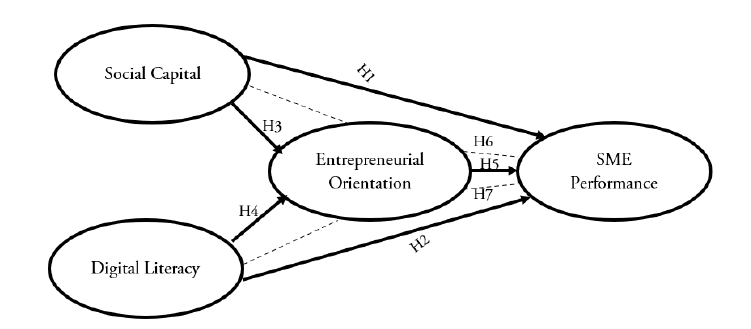
H1: Social capital has a significant impact on SMEs’ performance.
H2: Digital literacy has a significant impact on SMEs’ performance.
Social capital and digital literacy on entrepreneurial orientation
Social capital, defined as a network of relationships between individuals, plays an important role in fostering entrepreneurial orientation by increasing access to resources, information, and support systems. Research shows that social capital positively influences individual entrepreneurial orientation attributes such as innovation, proactivity, and risk-taking, especially in developing countries where these attributes are important for navigating complex market environments (Nguyen et al., 2020). In addition, social capital can reduce barriers to entrepreneurship by facilitating connections that lead to collaborative opportunities and shared knowledge (Gandhiadi & Kencana, 2019).
Digital literacy is increasingly recognized as an important component of entrepreneurial success in the modern economy. The integration of digital education platforms has been shown to improve entrepreneurial competence and intention among students, showing that exposure to digital tools and technologies can have a significant impact on entrepreneurial orientation (Begum et al., 2023; Monllor & Soto-Simeone, 2020). For example, research has shown that incorporating digital fabrication technology into the educational curriculum not only improves students’ technical skills but also increases entrepreneurial self-efficacy, thereby fostering a stronger entrepreneurial mindset (Monllor & Soto-Simeone, 2020). Additionally, the ability to navigate the digital environment is essential for entrepreneurs who want to take advantage of online networks and resources, which are essential for innovation and competitive advantage.
H3: Social capital has a significant impact on entrepreneurial orientation.
H4: Digital literacy has a significant impact on entrepreneurial orientation.
Entrepreneurial orientation as a mediating variable between social capital and digital literacy on SMEs performance
Entrepreneurial orientation directly influences performance outcomes, with social bonds and digital competencies acting as critical moderators in this relationship (Mulda, 2020). This shows that entrepreneurs who effectively utilize social networks and their digital skills are more likely to achieve superior performance in their ventures, highlighting the need for targeted interventions that enhance these abilities in entrepreneurship education programs (Lai et al., 2015).
H5: Entrepreneurial orientation has a significant influence on SMEs performance.
H6: Entrepreneurial orientation mediates the relationship between social capital and SMEs performance.
H7: Entrepreneurial orientation mediates the relationship between digital literacy and SMEs performance.
Conceptual framework
Based on the explanation of hypothesis development, the conceptual framework can be presented in Figure 1.
METHODOLOGY
This study explores the role of social capital and digital literacy in the performance of SMEs in South Sulawesi, with the addition of entrepreneurial orientation as an intervening variable. Social capital, which includes networks, trust, and shared norms, plays a crucial role in facilitating business growth by enhancing collaboration and access to resources. Meanwhile, digital literacy enables SMEs to leverage technology to improve efficiency, marketing, and competitiveness. The population of this study includes all SMEs in South Sulawesi, a region known for its rapidly expanding small and medium enterprises sector, as the largest region outside of Java Island in Indonesia. The province’s strategic location and government support have contributed to the significant growth of SMEs across various industries, including agriculture, fisheries, textiles, and handicrafts. Despite this progress, many SMEs in South Sulawesi face challenges related to limited digital adoption and varying levels of entrepreneurial orientation, which may impact their overall performance.
This study aims to provide valuable insights into how these factors influence SME success, ultimately contributing to policy recommendations and strategies for sustainable business growth in the region. Given that the total sample in this study is unknown and the total number of respondents is difficult to identify, this study uses non-probability sampling to collect data. Latan et al. (2020) recommended the use of non-probability sampling when the number of respondents is large and cannot be counted. Respondents were identified using snowball sampling, starting by identifying several SMEs actors through personal and professional social media networks. A total of 423 respondents were obtained, and they agreed to take part in filling out the questionnaire. Of the total questionnaires returned and received, there were 409, but nine questionnaires were not included because they were incomplete; the number of questionnaires processed was 400. The minimum sample size for structural equation modelling (SEM) is 100 samples (Hair & Alamer, 2022) with an error rate of 5%. Therefore, since the study had 400 respondents, it met the minimum sample requirement (Guenther et al., 2023).
This study applied a pre-test and a pilot test before the questionnaire was employed to collect the data. Two experts from the accounting and business disciplines were engaged to validate it. They were asked whether the questionnaire was easy to read and understand and whether it was demanding or confusing. Once the feedback was obtained, minor revisions were made for improvement. The items used to measure each construct are presented in the Appendix. A seven-point Likert scale anchored between one (strongly disagree) and seven (strongly agree) was used for all scale items. The study adopts the measurement items of previous empirical research. The use of existing measurement items is generally considered to be better practice than developing new ones, given the complexity of scaling up adoption from the research. Basco et al. (2020), Cetindamar et al. (2021), and Nguyen et al. (2020) provided as many as 20 measurement items related to the performance structure of SMEs, social capital, digital literacy, and entrepreneurial orientation, which were assessed on a Likert scale ranging from one (strongly disagree) to five (strongly agree). Hypothesis testing was carried out using structural equation modelling (SEM) with partial least squares (PLS-SEM) software.
RESULTS AND DISCUSSION
Respondent characteristics
The respondents in this study are SMEs entrepreneurs in South Sulawesi. The reason for choosing South Sulawesi is that it is one of the largest provinces located in the eastern part of Indonesia. The number of respondents was 400 SMEs owners who were sent questionnaires using Google Forms. The research was conducted from June to August 2024. The identity of the respondents is depicted according to Table 1. In the table, it can be seen that the number of male respondents is 246 and female respondents 154. In terms of business type, 267 respondents (61.5%) were culinary entrepreneurs. Regarding education level, the majority were undergraduates, with 339 entrepreneurs (84.8%).
Correlation results
This study conducted a correlation analysis as part of the structural equation modelling (SEM). The correlation analysis provides a foundational view of the strength and direction of the relationships between constructs, offering preliminary insights before hypothesis testing. This section presents the correlation coefficients among the variables, which are crucial in identifying the patterns of association and assessing the validity of the proposed conceptual framework. These insights lay the groundwork for interpreting the direct and mediating effects explored in the hypothesis testing section.
Measurement result
The outer loading value of each variable indicator determines the findings of the study, utilizing the PLS application to test the measurement model/outer model. If the outer loading value is more than 0.07, the determination criteria are considered to be valid. According to the research findings, the outer loading value for all indicators of the SC, DL, EO, and PF variables was greater than 0.7 (see Table 2). In addition, the model is stated to be reliable if the Cronbach’s alpha value is greater than 0.6 and the composite reliability (CR) is greater than 0.7. According to the study’s findings, the CR values for each construct were SC = 0.952, DL = 0.908, EO = 0.960, and PF = 0.914 (greater than 0), indicating that reliability was achieved (see Table 2). Furthermore, the convergent validity indication is met when the resultant average variance extracted (AVE) value is greater than 0.50. The study found that the AVE values for each variable were SC = 0.688, DL = 0.664, EO = 0.888, and PF = 0.781, implying that convergent validity was achieved (see Table 2). In addition to convergent validity, the research findings examined discriminant validity using the square root of the AVE for the Fornell-Larcker criterion. According to Table 3, the square root of the AVE for each variable is greater than its correlation with other variables, indicating that discriminant validity is achieved.
Structural result
Direct and indirect results
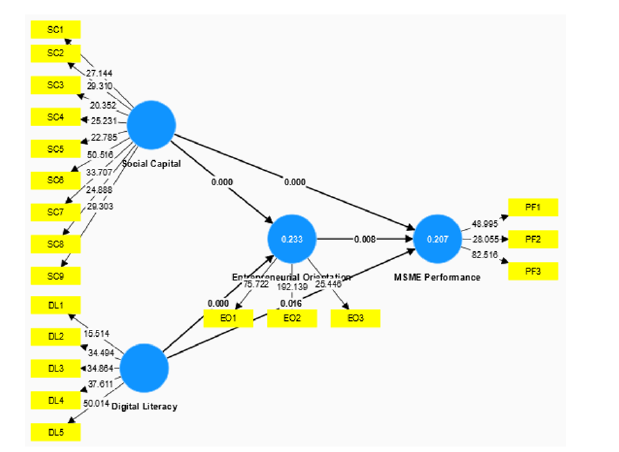
The results of hypothesis testing confirm all proposed relationships as statistically significant at a rate of 5%. These findings reveal that social capital (β = 0.254, p < 0.001) and digital literacy (β = 0.185, p = 0.016) are directly related to improving SME performance; hence, H1 and H2 are accepted. In addition to positively influencing entrepreneurial orientation (β = 0.220, p < 0.000), H3 is accepted, which indicates that strong social networks and shared norms improve entrepreneurial behavior. Digital literacy showed a stronger impact on entrepreneurial orientation (β = 0.355, p < 0.000); H4 was accepted, highlighting its important role in driving innovation, proactivity, and risk-taking among SMEs. Entrepreneurial orientation contributes significantly to performance outcomes (β = 0.147, p = 0.008); H5 is accepted, which validates its role as a key driver of business success. Furthermore, entrepreneurial orientation mediated the influence of social capital (β = 0.032, p = 0.034) and digital literacy (β = 0.052, p = 0.029) on the performance of SMEs; H6 and H7 were accepted, showing that these resources provide a stronger influence when channeled through entrepreneurial skills. These results strengthen the conceptual framework and underscore the strategic importance of fostering social and digital competencies to improve entrepreneurial outcomes and business performance.
Table 4 and Picture 2 show hypothesis testing with the SEM application. Each variable’s value indicates a good correlation. For each variable correlation, the t-value spans from 2.123 to 6.338 (>1.96). The p-value indicates the level of significance between variables, with a p-value of 0.05 indicating that the correlation between variables is significant, showing that all seven hypotheses proposed in the study have a positive and significant influence.

DISCUSSION
Social capital has a positive effect on the performance of SMEs. This is in line with research (Junaidi et al., 2020), which explains that social capital emphasizes the importance of social networks, trust-based personal relationships, and cooperation in improving SME performance. In addition, this research is also in line with Akintimehin et al. (2019), Ozanne et al. (2022), and Xie et al. (2021), who describe social capital as the main resource that SMEs can mobilize to utilize existing resources in internal and external relationships to achieve business success. In line with the theory of social capital developed by Pratono (2018), social capital is aimed at understanding social bonds, social interactions, and social beliefs. SME entrepreneurs who have a strong social network, values, and confidence will then experience a good performance increase.
The role of entrepreneurial orientation acts as a mediator of social capital in improving the performance of SMEs in South Sulawesi. These results are in line with the findings of a study (Nguyen et al., 2020) showing that social capital, which is a link - namely, external networks and social interactions - improves the quality of SME entrepreneurs in running their businesses proactively, as well as generating innovative ideas in developing businesses and taking risks to improve existing ones.
The results of the study show that digital literacy has a positive effect on the performance of SMEs in South Sulawesi. This illustrates that the influence of digital literacy is very important in improving the performance of SMEs. This is in line with research (Hamid et al., 2022), which found that digital literacy affects the performance of SMEs. An understanding of information technology, communication, digital content creation, and the effective use of social media can improve the performance of SMEs. However, Ceci et al. (2020) revealed that the role of social capital in influencing SMEs’ innovation still needs to be confirmed. This proves that entrepreneurial orientation plays a critical role in enhancing SME performance by fostering innovation, risk-taking, and proactiveness - all of which are essential for business growth and competitiveness toward encouraging innovation, which allows businesses to develop new products, improve processes, and adopt digital technologies for competitive advantage. SMEs with a strong entrepreneurial orientation are more likely to experiment with new ideas, embrace technological advancements, and differentiate themselves from competitors.
The role of entrepreneurial orientation in mediating digital literacy in improving the performance of SMEs in South Sulawesi has a positive and significant effect on the performance of SMEs through entrepreneurial orientation. This is in accordance with the findings of a study (Lantara et al., 2022), which examined the influence of digital literacy and entrepreneurial orientation on SME business performance. Good use of technology will directly improve the performance of SMEs, and with a proactive orientation, innovation in digital technology will make it easier for SME entrepreneurs to achieve healthy business performance and be able to compete. In addition, entrepreneurial orientation facilitates the mitigation of risks associated with digital adoption by promoting a mindset that views challenges as opportunities rather than obstacles. SMEs with high entrepreneurial orientation are more risk-tolerant and tend to invest in technology, digital marketing, and e-commerce platforms. This proactive approach helps them adapt to market changes and leverage digital literacy for improved operational efficiency.
THEORETICAL IMPLICATIONS
This study makes significant theoretical contributions by deepening the understanding of the interplay between social capital, digital literacy, and entrepreneurial orientation in influencing SME performance. While prior research has extensively examined the independent effects of social capital and digital literacy on business success, few studies have explored their interactive and mediating mechanisms in the context of SMEs, particularly in developing regions. This study extends the resource-based view (RBV) and social capital theory with regard to applying entrepreneurial orientation as a bridge between social capital and SME performance. This insight challenges traditional assumptions that strong social networks alone are sufficient for fostering entrepreneurial orientation and suggests that digital competencies play a crucial role in ensuring that the benefits of social capital translate into innovative and proactive business strategies. In addition, this study advances the dynamic capabilities perspective by illustrating how digital literacy enhances an SME’s ability to sense, seize, and transform market opportunities, thereby strengthening SME performance. These insights have significant implications for policymakers, educators, and business development organizations seeking to design more effective SME support programs.
PRACTICAL IMPLICATIONS
The practical and managerial implications of this study include various strategic steps to improve the performance of SMEs. First, the development of social capital improvement programs can be pursued by forming communities or business forums to strengthen internal and external relations between business actors. In addition, digital literacy training needs to be facilitated by local governments or related institutions to help SME actors understand and utilize information technology. This training can include social media management, digital content creation, and the use of e-commerce tools to increase business competitiveness. Facilitating engagement among SMEs that are less integrated with digital tools requires targeted strategies to enhance their social capital, digital literacy, and entrepreneurial orientation. One key approach is capacity-building programs, including digital training workshops, mentorship initiatives, and business incubators tailored to rural and underserved SMEs. This approach may help SME businesses overcome technological barriers and increase competitiveness.
Entrepreneurial orientation must also be enhanced through training and mentoring designed to develop innovation skills, risk-taking, and a proactive attitude in capturing business opportunities. Governments, educational institutions, and business organizations need to collaborate to provide platforms for sharing information and resources for SMEs so that there is a transfer of knowledge and skills improvement. In addition, a pivotal strategy involves leveraging local networks and cooperatives to build social capital. Most SMEs operate in close-knit communities where trust and relationships are essential for business survival. Governments also need to strengthen public-private partnerships to help bridge the resource gap by providing access to affordable technology, internet infrastructure, and financial assistance. Furthermore, SMEs can be encouraged to integrate digital technology into their operational processes, such as using business management software, digital payments, and data-driven marketing, to improve the efficiency and effectiveness of business operations.
Government policy support is also very necessary, especially policies that provide incentives for digital training, innovation funds, and strengthening technology infrastructure in the regions. This policy must also support the formation of business communities and network facilitation between business actors. Finally, financial literacy needs to be improved as part of a strategy to help SMEs better manage business finances, including the ability to manage cash flow, debt, and investments. Furthermore, offering a low-cost digital tool tailored for traditional sectors, such as agriculture, handicrafts, and small-scale manufacturing, can encourage digital adoption and help SMEs in these sectors integrate into the digital economy. Ultimately, a combination of education, infrastructure support, and collaborative networks can empower underserved SMEs to embrace digital transformation and entrepreneurial growth.
CONCLUSION
The research seeks to investigate the linkages between social capital, digital literacy, entrepreneurial orientation, and SME performance. The findings show that SME performance can be explained through social capital and digital literacy, as well as the role of entrepreneurial orientation as a moderating factor. The role of social capital - in terms of internal and external relationships, social networks, and values and beliefs - can improve the performance of SMEs. In addition, the role of digital literacy - in understanding information technology, communications, the creation of digital content, and the use of social media - is highly influential in improving SME performance. This research has limitations in terms of population because it focuses only on South Sulawesi. Apart from that, researchers who want to build upon this study can add other variables, such as financial literacy, when analyzing SME performance.
The limitations of this study include several aspects that need to be considered for further research development. First, this study is limited to the SME population in South Sulawesi, so the findings may not be fully generalizable to other regions with different social, cultural, or economic characteristics. These geographical limitations affect the variation of the data obtained and the applicability of the findings to a broader context. Second, this study does not include other variables that may also affect SME performance, such as financial literacy, technological innovation, or the influence of government policies. The addition of these variables in further research can provide a more comprehensive understanding of the factors that influence SME performance.
Third, this study uses the snowball sampling method, which has potential biases and restricts the generalizability of the findings. This method may lead to the overrepresentation of certain groups while excluding others, thereby reducing the study’s representativeness. Future studies need to consider employing random sampling or stratified sampling for better representation. Fourth, this study focuses mainly on analyzing the relationship between variables without delving into qualitative aspects, such as the internal dynamics of SME actors or obstacles faced in implementing digital literacy and entrepreneurial orientation. A qualitative approach can complement this study to provide deeper insights. Future research should expand the geographical scope, add relevant variables, and adopt a mixed-method approach to produce richer and more applicable findings.
REFERENCES
-
Abu, N., Silva, F. P., & Vieira, P. R. (2025). Government support for SMEs in the Fintech Era: Enhancing access to finance, survival, and performance. Digital Business, 5(1), 100099. https://doi.org/10.1016/j.digbus.2024.100099
» https://doi.org/10.1016/j.digbus.2024.100099 -
Adomako, S., Amankwah-Amoah, J., Tarba, S. Y., & Khan, Z. (2021). Perceived corruption, business process digitization, and SME’ degree of internationalization in sub-Saharan Africa. Journal of Business Research, 123, 196-207. https://doi.org/10.1016/j.jbusres.2020.09.065
» https://doi.org/10.1016/j.jbusres.2020.09.065 -
Akintimehin, O. O., Eniola, A. A., Alabi, O. J., Eluyela, D. F., Okere, W., & Ozordi, E. (2019). Social capital and its effect on business performance in the Nigeria informal sector. Heliyon, 5(7). https://doi.org/10.1016/j.heliyon.2019.e02024
» https://doi.org/10.1016/j.heliyon.2019.e02024 -
Al-Hakimi, M. A., & Borade, D. B. (2020). The impact of entrepreneurial orientation on the supply chain resilience. Cogent Business and Management, 7(1). https://doi.org/10.1080/23311975.2020.1847990
» https://doi.org/10.1080/23311975.2020.1847990 -
Asdar, A. S., Hasbiah, S., & Ar, M. (2024). Do self-efficacy, financial literacy, and digital literacy among students contribute to entrepreneurial behavior through entrepreneurship education? Pinisi Journal of Entrepreneurship Review, 2(1). https://journal.unm.ac.id/index.php/PEREV/index
» https://journal.unm.ac.id/index.php/PEREV/index -
Barney, J., Wright, M., & Ketchen, D. J. (2001). The resource-based view of the firm: Ten years after 1991. Journal of Management, 27(6), 625-641. https://doi.org/10.1177/014920630102700601
» https://doi.org/10.1177/014920630102700601 -
Basco, R., Hernández-Perlines, F., & Rodríguez-García, M. (2020). The effect of entrepreneurial orientation on firm performance: A multigroup analysis comparing China, Mexico, and Spain. Journal of Business Research, 113, 409-421. https://doi.org/10.1016/j.jbusres.2019.09.020
» https://doi.org/10.1016/j.jbusres.2019.09.020 -
Begum, M., Ilyas Mehmood, Dr. M., & Maryam. (2023). Digital Education Platforms as Catalysts for Entrepreneurial Ventures. Journal of Policy Research, 9(4), 190-197. https://doi.org/10.61506/02.00141
» https://doi.org/10.61506/02.00141 -
Ceci, F., Masciarelli, F., & Poledrini, S. (2020). How social capital affects innovation in a cultural network: Exploring the role of bonding and bridging social capital. European Journal of Innovation Management, 23(5), 895-918. https://doi.org/10.1108/EJIM-06-2018-0114
» https://doi.org/10.1108/EJIM-06-2018-0114 -
Cetindamar, D., Abedin, B., & Shirahada, K. (2021). The role of employees in digital transformation: A preliminary study on how employees’ digital literacy impacts use of digital technologies. IEEE Transactions on Engineering Management, 71, 7837-7848. https://doi.org/10.1109/TEM.2021.3087724
» https://doi.org/10.1109/TEM.2021.3087724 -
Faiz, F., Le, V., & Masli, E. K. (2024). Determinants of digital technology adoption in innovative SMEs. Journal of Innovation & Knowledge, 9(4), 100610. https://doi.org/10.1016/j.jik.2024.100610
» https://doi.org/10.1016/j.jik.2024.100610 -
Gandhiadi, G. K., & Kencana, E. N. (2019). Identification of internal factor affecting tourism business performance in Jembrana regency of Bali. Jurnal Matematika, 9(1), 50. https://doi.org/10.24843/jmat.2019.v09.i01.p110
» https://doi.org/10.24843/jmat.2019.v09.i01.p110 -
Gelderman, C. J., Semeijn, J., & Mertschuweit, P. P. (2016). The impact of social capital and technological uncertainty on strategic performance: The supplier perspective. Journal of Purchasing and Supply Management, 22(3), 225-234. https://doi.org/10.1016/j.pursup.2016.05.004
» https://doi.org/10.1016/j.pursup.2016.05.004 -
Gerhart, B., & Feng, J. (2021). The resource-based view of the firm, human resources, and human capital: Progress and prospects. Journal of Management, 47(7), 1796-1819. https://doi.org/10.1177/0149206320978799
» https://doi.org/10.1177/0149206320978799 -
Gherghina, Ș. C., Botezatu, M. A., Hosszu, A., & Simionescu, L. N. (2020). Small and Medium-Sized Enterprises (SMEs): The engine of economic growth through investments and innovation. Sustainability, 12(1), 347. https://doi.org/10.3390/su12010347
» https://doi.org/10.3390/su12010347 -
Guenther, P., Guenther, M., Ringle, C. M., Zaefarian, G., & Cartwright, S. (2023). Improving PLS-SEM use for business marketing research. Industrial Marketing Management, 111, 127-142. https://doi.org/10.1016/J.INDMARMAN.2023.03.010
» https://doi.org/10.1016/J.INDMARMAN.2023.03.010 -
Hair, J., & Alamer, A. (2022). Partial Least Squares Structural Equation Modeling (PLS-SEM) in second language and education research: Guidelines using an applied example. Research Methods in Applied Linguistics, 1(3), 100027. https://doi.org/10.1016/J.RMAL.2022.100027
» https://doi.org/10.1016/J.RMAL.2022.100027 -
Hamid, R. S., Abror, A., Anwar, S. M., & Hartati, A. (2022). The role of social media in the political involvement of millennials. Spanish Journal of Marketing - ESIC, 26(1), 61-79. https://doi.org/10.1108/SJME-08-2021-0151
» https://doi.org/10.1108/SJME-08-2021-0151 -
Hamid, R. S., Ukkas, I., Goso, G., Abror, A., Anwar, S.M., & Munir, A.R. (2024). The role of social media in building trust, self-perceived creativity and satisfaction for millennial entrepreneurs. Journal of Small Business and Enterprise Development, 31(2), 377-394. https://doi.org/10.1108/JSBED-11-2022-0482
» https://doi.org/10.1108/JSBED-11-2022-0482 -
Iordache, C., Mariën, I., & Baelden, D. (2017). Developing digital skills and competences: A quick-scan analysis of 13 digital literacy models. Italian Journal of Sociology of Education, 9(1), 6-30. https://doi.org/10.14658/pupj-ijse-2017-1-2
» https://doi.org/10.14658/pupj-ijse-2017-1-2 - Junaidi, J., Chih, W.H., & Ortiz, J. (2020). Antecedents of information seeking and sharing on social networking sites: An empirical study of Facebook users. International Journal of Communication, 14, 5705-5728.
-
Junaidi, J., Anwar, S. M., & Sahrir, S. (2023). The role of religion and social capital on entrepreneurship self-efficacy and motivation among students in Indonesia. Cogent Business & Management, 10(3). https://doi.org/10.1080/23311975.2023.2265091
» https://doi.org/10.1080/23311975.2023.2265091 -
Junaidi, J. (2024). The role of ethical leadership to employees work engagement: a social learning theory perspective. International Journal of Social Economics, 51(7), 884-898. https://doi.org/10.1108/IJSE-03-2023-0218
» https://doi.org/10.1108/IJSE-03-2023-0218 -
Khan, M. A. (2022). Barriers constraining the growth of and potential solutions for emerging entrepreneurial SMEs. Asia Pacific Journal of Innovation and Entrepreneurship, 16(1), 38-50. https://doi.org/10.1108/APJIE-01-2022-0002
» https://doi.org/10.1108/APJIE-01-2022-0002 -
Kilay, A. L., Simamora, B. H., & Putra, D. P. (2022). The influence of e-payment and e-commerce services on supply chain performance: Implications of open innovation and solutions for the digitalization of Micro, Small, and Medium Enterprises (SME) in Indonesia. Journal of Open Innovation: Technology, Market, and Complexity, 8(3). https://doi.org/10.3390/joitmc8030119
» https://doi.org/10.3390/joitmc8030119 -
Kotane, I., & Kuzmina-Merlino, I. (2017). Analysis of small and medium sized enterprises’ business performance evaluation practice at transportation and storage services sector in Latvia. Procedia Engineering, 178, 182-191. https://doi.org/10.1016/j.proeng.2017.01.093
» https://doi.org/10.1016/j.proeng.2017.01.093 -
Lai, C., lv, W., & Jiang, Y. (2015). Entrepreneurial Knowledge and the Influence of Entrepreneurship Education on Students’ Entrepreneurial Abilities. Open Journal of Social Sciences, 3(07), 1-6. https://doi.org/10.4236/jss.2015.37001
» https://doi.org/10.4236/jss.2015.37001 -
Lantara, D., Junaidi, J., Rauf, N., Pawennari, A., & Achmad, R. N. (2022). Indonesian Islamic banks: A review of the financial state before and after the COVID-19 pandemic. Banks and Bank Systems, 17(4), 12- 24. https://doi.org/10.21511/bbs.17(4).2022.02
» https://doi.org/10.21511/bbs.17(4).2022.02 -
Latan, H., Jabbour, C. J. C., Jabbour, A. B. L. S., Fiorini, P. C., & Foropon, C. (2020). Innovative efforts of ISO 9001-certified manufacturing firms: Evidence of links between determinants of innovation, continuous innovation and firm performance. International Journal of Production Economics, 223, 107526. https://doi.org/10.1016/j.ijpe.2019.107526
» https://doi.org/10.1016/j.ijpe.2019.107526 -
Law of the Republic of Indonesia no. 20 of 2008. (2008). Micro, small, and medium enterprises by the blessings of almighty God the President of The Republic of Indonesia. https://faolex.fao.org/docs/pdf/ins211799.pdf
» https://faolex.fao.org/docs/pdf/ins211799.pdf -
Monllor, J., & Soto-Simeone, A. (2020). The impact that exposure to digital fabrication technology has on student entrepreneurial intentions. International Journal of Entrepreneurial Behaviour and Research, 26(7), 1505-1523. https://doi.org/10.1108/IJEBR-04-2019-0201
» https://doi.org/10.1108/IJEBR-04-2019-0201 -
Mulda, R. (2020). Government regulations, interpreneurial orientation and stakeholder network capability in achieving organizational performance. Journal La Bisecoman, 1(4), 1-8. https://doi.org/10.37899/journallabisecoman.v1i4.217
» https://doi.org/10.37899/journallabisecoman.v1i4.217 -
Muliadi, M., Muhammadiah, M., Amin, K. F., Kaharuddin, K., Junaidi, J., Pratiwi, B. I., & Fitriani, F. (2024). The information sharing among students on social media: the role of social capital and trust. VINE Journal of Information and Knowledge Management Systems, 54(4), 823-840. https://doi.org/10.1108/VJIKMS-12-2021-0285
» https://doi.org/10.1108/VJIKMS-12-2021-0285 -
Nakabuye, Z., Mayanja, J., Bimbona, S., & Wassermann, M. (2023). Technology orientation and export performance: The moderating role of supply chain agility. Modern Supply Chain Research and Applications, 5(4), 230-264. https://doi.org/10.1108/mscra-01-2023-0006
» https://doi.org/10.1108/mscra-01-2023-0006 -
Neumeyer, X., Santos, S. C., & Morris, M. H. (2021). Overcoming barriers to technology adoption when fostering entrepreneurship among the poor: The role of technology and digital literacy. IEEE Transactions on Engineering Management, 68(6), 1605-1618. https://doi.org/10.1109/TEM.2020.2989740
» https://doi.org/10.1109/TEM.2020.2989740 -
Nguyen, L. T., An, J., Ngo, L. V., & Hau, L. N. (2020). Transforming social capital into performance via entrepreneurial orientation. Australasian Marketing Journal, 28(4), 209-217. https://doi.org/10.1016/j.ausmj.2020.03.001
» https://doi.org/10.1016/j.ausmj.2020.03.001 -
Ollerenshaw, A., Corbett, J., & Thompson, H. (2021). Increasing the digital literacy skills of regional SME through high-speed broadband access. Small Enterprise Research, 28(2), 115-133. https://doi.org/10.1080/13215906.2021.1919913
» https://doi.org/10.1080/13215906.2021.1919913 -
Ozanne, L. K., Chowdhury, M., Prayag, G., & Mollenkopf, D. A. (2022). SME navigating COVID-19: The influence of social capital and dynamic capabilities on organizational resilience. Industrial Marketing Management, 104, 116-135. https://doi.org/10.1016/j.indmarman.2022.04.009
» https://doi.org/10.1016/j.indmarman.2022.04.009 -
Pangrazio, L., Godhe, A. L., & Ledesma, A. G. L. (2020). What is digital literacy? A comparative review of publications across three language contexts. E-Learning and Digital Media, 17(6), 442-459. https://doi.org/10.1177/2042753020946291
» https://doi.org/10.1177/2042753020946291 -
Petkoska, M. M., Odzaklieska, D., & Lazaroski, S. (2019, May 17). Designing an Integrated Framework for Measuring Organizational Performance in the Companies of the Food Industry in the Republic of North Macedonia. https://doi.org/10.46541/978-86-7233-380-0_52
» https://doi.org/10.46541/978-86-7233-380-0_52 -
Pratono, A. H. (2018). From social network to firm performance: The mediating effect of trust, selling capability and pricing capability. Management Research Review, 41(6), 680-700. https://doi.org/10.1108/MRR-03-2017-0080
» https://doi.org/10.1108/MRR-03-2017-0080 -
Raharjo, K., Afrianty, T. W., & Prakasa, Y. (2024). Digital literacy and business transformation: social-cognitive learning perspectives in small business enterprises. Cogent Business & Management, 11(1). https://doi.org/10.1080/23311975.2024.2376282
» https://doi.org/10.1080/23311975.2024.2376282 -
Ramlawati, R., Serang, S., Arminas, A., Junaidi, J., & Wicaksono, R. (2023). The role of ethical leadership on employee comitment to the organization: The mediating role of job satisfaction and job engagement. Organizational Psychology, 13(1), 73-91. https://doi.org/10.17323/2312-5942-2023-13-1-73-91
» https://doi.org/10.17323/2312-5942-2023-13-1-73-91 -
Ritala, P., Baiyere, A., Hughes, M., & Kraus, S. (2021). Digital strategy implementation: The role of individual entrepreneurial orientation and relational capital. Technological Forecasting and Social Change, 171, 120961. https://doi.org/10.1016/j.techfore.2021.120961
» https://doi.org/10.1016/j.techfore.2021.120961 -
Salah, O. S., & Ayyash, M. M. (2024). E-commerce adoption by SMEs and its effect on marketing performance: An extended of TOE framework with ai integration, innovation culture, and customer tech-savviness. Journal of Open Innovation: Technology, Market, and Complexity, 10(1), 100183. https://doi.org/10.1016/j.joitmc.2023.100183
» https://doi.org/10.1016/j.joitmc.2023.100183 -
Schlepphorst, S., Koetter, E. C., Werner, A., Soost, C., & Moog, P. (2020). International assignments of employees and entrepreneurial intentions: the mediating role of human capital, social capital and career prospects. International Journal of Entrepreneurial Behaviour and Research, 26(6), 1259-1279. https://doi.org/10.1108/IJEBR-11-2019-0637
» https://doi.org/10.1108/IJEBR-11-2019-0637 -
Scuotto, V., Nicotra, M., Del Giudice, M., Krueger, N., & Gregori, G. L. (2021). A microfoundational perspective on SME’ growth in the digital transformation era. Journal of Business Research, 129, 382-392. https://doi.org/10.1016/j.jbusres.2021.01.045
» https://doi.org/10.1016/j.jbusres.2021.01.045 -
Surya, B., Menne, F., Sabhan, H., Suriani, S., Abubakar, H., & Idris, M. (2021). Economic Growth, Increasing Productivity of SMEs, and Open Innovation. Journal of Open Innovation: Technology, Market, and Complexity, 7(1), 20. https://doi.org/10.3390/joitmc7010020
» https://doi.org/10.3390/joitmc7010020 -
Tasavori, M., Zaefarian, R., & Eng, T. Y. (2018). Internal social capital and international firm performance in emerging market family firms: The mediating role of participative governance. International Small Business Journal: Researching Entrepreneurship, 36(8), 887-910. https://doi.org/10.1177/0266242618773145
» https://doi.org/10.1177/0266242618773145 -
Wahyono, & Hutahayan, B. (2021). The relationships between market orientation, learning orientation, financial literacy, on the knowledge competence, innovation, and performance of small and medium textile industries in Java and Bali. Asia Pacific Management Review, 26(1), 39-46. https://doi.org/10.1016/j.apmrv.2020.07.001
» https://doi.org/10.1016/j.apmrv.2020.07.001 -
Xie, G. H., Wang, L. P., & Lee, B. F. (2021). Understanding the impact of social capital on entrepreneurship performance: The moderation effects of opportunity recognition and operational competency. Frontiers in Psychology, 12. https://doi.org/10.3389/fpsyg.2021.687205
» https://doi.org/10.3389/fpsyg.2021.687205 -
Yani, A., Eliyana, A., Sudiarditha, I. K. R., & Buchdadi, A. D. (2020). The impact of social capital, entrepreneurial competence on business performance: An empirical study of SMEs. Systematic Reviews in Pharmacy, 11(9), 779-797. https://dx.doi.org/10.31838/srp.2020.9.110
» https://dx.doi.org/10.31838/srp.2020.9.110 -
Yanto, H., Kiswanto, Baroroh, N., Hajawiyah, A., & Rahim, N. M. (2022). The roles of entrepreneurial skills, financial literacy, and digital literacy in maintaining SME during the Covid-19 pandemic. Asian Economic and Financial Review, 12(7), 504-517. https://doi.org/10.55493/5002.v12i7.4535
» https://doi.org/10.55493/5002.v12i7.4535 -
Zahoor, N., Zopiatis, A., Adomako, S., & Lamprinakos, G. (2023). The micro-foundations of digitally transforming SME: How digital literacy and technology interact with managerial attributes. Journal of Business Research, 159. https://doi.org/10.1016/j.jbusres.2023.113755
» https://doi.org/10.1016/j.jbusres.2023.113755 -
Zhou, Q., Edafioghor, T. E., Wu, C. H., & Doherty, B. (2023). Building organisational resilience capability in small and medium-sized enterprises: The role of high-performance work systems. Human Resource Management Journal, 33(4), 806-827. https://doi.org/10.1111/1748-8583.12479
» https://doi.org/10.1111/1748-8583.12479
-
Funding
The authors thank to the Ministry of Education, Culture, Research, and Technology through the Directorate of Research, Technology, and Community Service (DRTPM) for the financial support through postgraduate research grants. They would also like to thank the University of Muhammadiyah Palopo and all parties who have helped this research process. Hopefully the results of this research will be useful for the development of science and society.
-
Peer Review Method
This content was evaluated using the double-blind peer review process. The disclosure of the reviewers’ information on the first page, as well as the Peer Review Report, is made only after concluding the evaluation process, and with the voluntary consent of the respective reviewers and authors.
-
Plagiarism Check
RAC maintains the practice of submitting all documents approved for publication to the plagiarism check, using specific tools, e.g.: iThenticate.
-
Data Availability
The authors claim that all data used in the research have been made publicly available, and can be accessed via the Harvard Dataverse platform:Indrawan; Salju, Salju; khaddapi, muammar, 2025, "Replication Data for: The Role of Social Capital and Digital Literacy on Entrepreneurial Performance published by RAC-Revista de Administração Contemporânea", Harvard Dataverse, V1. https://doi.org/10.7910/DVN/SLQSEXRAC encourages data sharing but, in compliance with ethical principles, it does not demand the disclosure of any means of identifying research subjects, preserving the privacy of research subjects. The practice of open data is to enable the reproducibility of results, and to ensure the unrestricted transparency of the results of the published research, without requiring the identity of research subjects.
-
Cite as:
Indrawan, I., Salju S., & Khaddapi M. (2025). The role of social capital and digital literacy on entrepreneurial performance. Revista de Administração Contemporânea, 29(5), e240374. https://doi.org/10.1590/1982-7849rac2025240374.en
-
JEL Code:
M13, L26, O33
-
Peer Review Report:
The disclosure of the Peer Review Report was not authorized by its reviewers.

Edited by
-
Editor-in-Chief:
Paula Chimenti (Universidade Federal do Rio de Janeiro, COPPEAD, Brazil) https://orcid.org/0000-0002-6492-4072
-
Ah doc Associate Editor:
Gustavo H. Salati M. de Moraes (Universidade de Campinas, Brazil) https://orcid.org/0000-0001-5238-0314
The authors claim that all data used in the research have been made publicly available, and can be accessed via the Harvard Dataverse platform:
Indrawan; Salju, Salju; khaddapi, muammar, 2025, "Replication Data for: The Role of Social Capital and Digital Literacy on Entrepreneurial Performance published by RAC-Revista de Administração Contemporânea", Harvard Dataverse, V1. https://doi.org/10.7910/DVN/SLQSEX
RAC encourages data sharing but, in compliance with ethical principles, it does not demand the disclosure of any means of identifying research subjects, preserving the privacy of research subjects. The practice of open data is to enable the reproducibility of results, and to ensure the unrestricted transparency of the results of the published research, without requiring the identity of research subjects.

 Source: Elaborated by the authors.
 Source: Developed by the authors.